

Sample Category Title
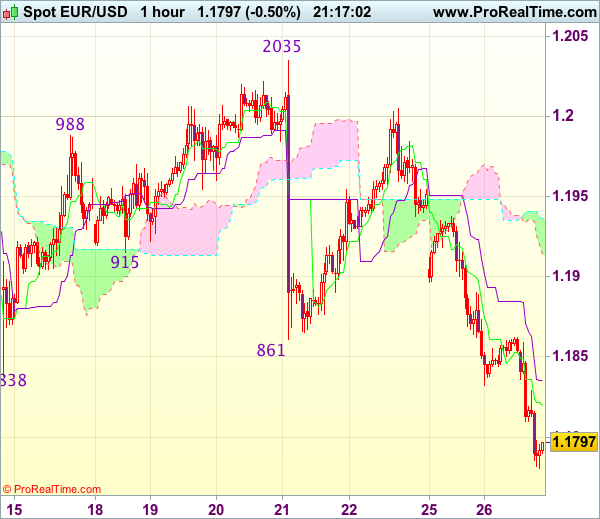
Trade Idea Update: EUR/USD – Sell at 1.1850
EUR/USD - 1.1793
New strategy :
Sell at 1.1850, Target: 1.1750, Stop: 1.1885
Position : -
Target : -
Stop : -
The single currency has dropped again after yesterday’s anticipated decline, adding credence to our bearish view that another leg of corrective decline from 1.2093 top is underway and mild downside bias remains for further weakness towards previous support at 1.1740, however, near term oversold condition should prevent sharp fall below 1.1720-25 and reckon 1.1700 would hold from here, bring rebound later.
In view of this, would not chase this fall here and would be prudent to sell euro on recovery as 1.1850 should limit upside. Above previous support at 1.1861 would defer and risk a stronger rebound to 1.1880-85 but price should falter well below yesterday’s high at 1.1937.
USD/JPY Mid-Day Outlook
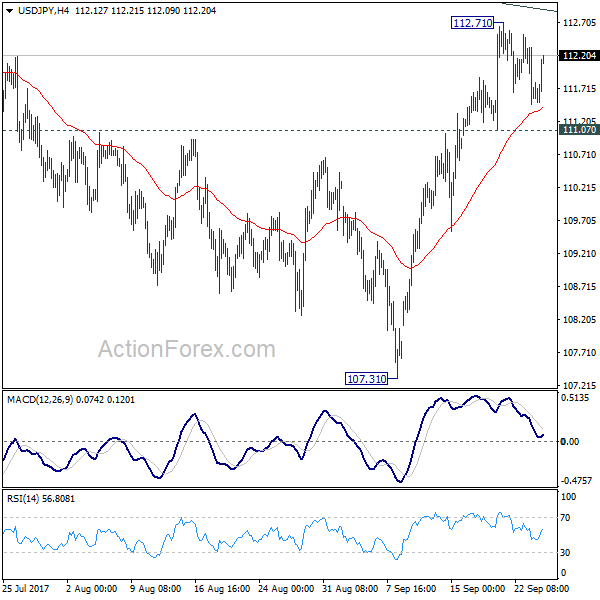
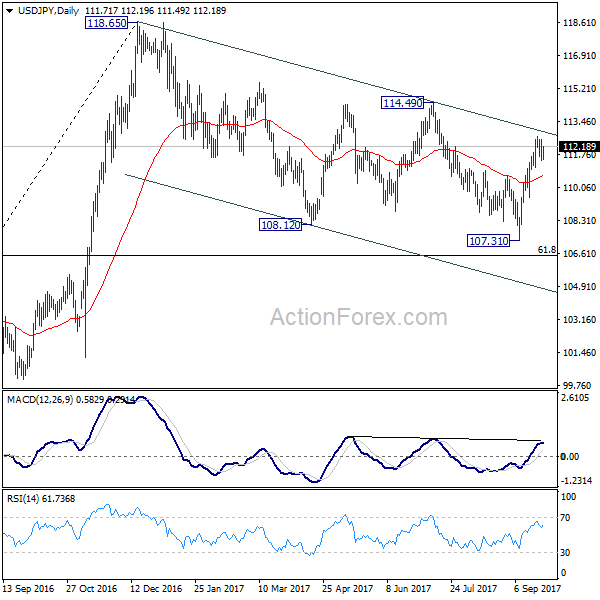
Daily Pivots: (S1) 111.27; (P) 111.90; (R1) 112.33; More...
Intraday bias in USD/JPY remains neutral for the moment. Further rise is in favor with 111.07 support intact. Sustained break of medium term channel resistance (now at 112.90) will argue that whole correction from 118.65 has completed. In that case, further rise should be seen to 114.49 resistance for confirmation. However, break of 111.07 minor support will raise the risk of rejection from channel resistance and turn bias back to the downside for 55 day EMA (now at 110.64) and below.
In the bigger picture, rise from 98.97 (2016 low) is seen as the second leg of the corrective pattern from 125.85 (2015 high). It's unclear whether this this second leg has completed at 118.65 or not. But medium term outlook will be mildly bearish as long as 114.49 resistance holds. And, there is prospect of breaking 98.97 ahead. Meanwhile, break of 114.49 will bring retest of 125.85 high. But even in that case, we don't expect a break there on first attempt.
USD/CHF Mid-Day Outlook
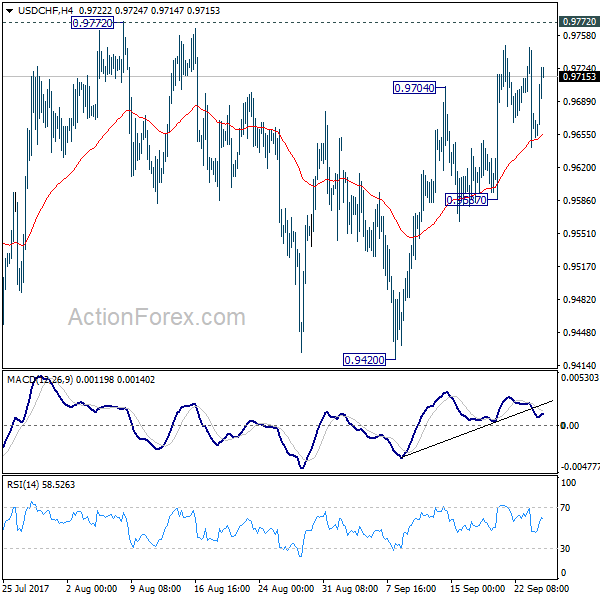
Daily Pivots: (S1) 0.9622; (P) 0.9683; (R1) 0.9725; More....
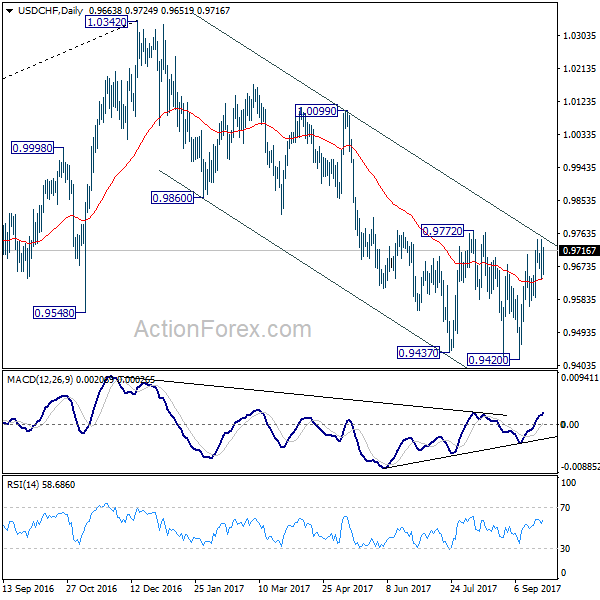
Intraday bias in USD/CHF remains neutral for the moment. On the upside decisive break of 0.9772 resistance will suggest that whole down trend form 1.0342 has completed. In that case, near term outlook will be turned bullish for 0.9860/1.0099 resistance zone. Nonetheless, with 0.9772 resistance intact, outlook remains bearish. Below 0.9587 minor support will turn bias back to the downside for retesting 0.9420 low.
In the bigger picture, current development suggests that 0.9443 key support (2016 low) could be taken out firmly as down trend form 1.0342 extends. There are various interpretation of the price actions. But in any case, medium term outlook will stay bearish as long as 0.9772 resistance holds. Current down trend could extend to 38.2% retracement of 0.7065 (2011 low) to 1.0342 (2016 high) at 0.9090. However, break of 0.9772 will indicate that USD/CHF has successfully defended 0.9443 again and turn outlook bullish for 1.0099 resistance.
Trade Idea Update: USD/JPY – Buy at 111.70
USD/JPY - 112.19
New strategy :
Buy at 111.80, Target: 112.80, Stop: 111.45
Position : -
Target : -
Stop : -
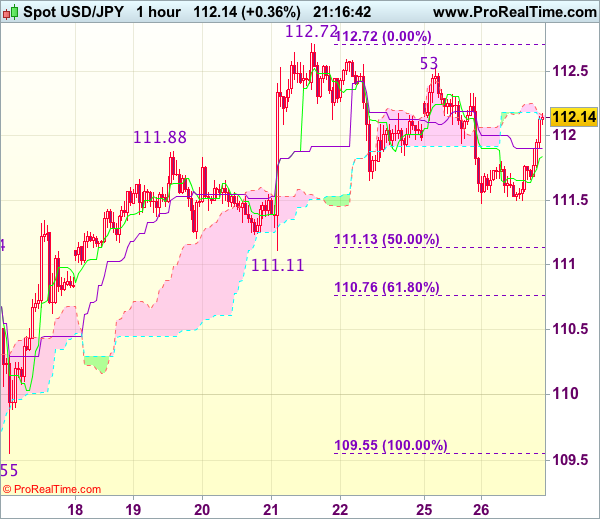
As the greenback found renewed buying interest at 111.47 and has staged a rebound, suggesting the pullback from 112.72 has possibly ended there and consolidation with upside bias is seen for gain to 112.53 resistance but break there is needed to confirm recent upmove has resumed and bring retest of 112.72, then towards 113.00 but reckon upside would be limited to 113.25-30 (1.236 times projection of 107.32-111.04 measuring from 109.55) and price should falter below previous chart resistance at 113.58.
In view of this, we are looking to reinstate long on pullback as 111.75-80 should limit downside and bring another rise. Below said support at 111.47 would abort and signal top has been formed at 112.27 last week, bring retracement of recent rise to 111.11-13 (previous support and 50% Fibonacci retracement of 109.55-112.72) but price should stay well above 110.75-80 (61.8% Fibonacci retracement).
GBP/USD Mid-Day Outlook
Daily Pivots: (S1) 1.3410; (P) 1.3490; (R1) 1.3549; More....
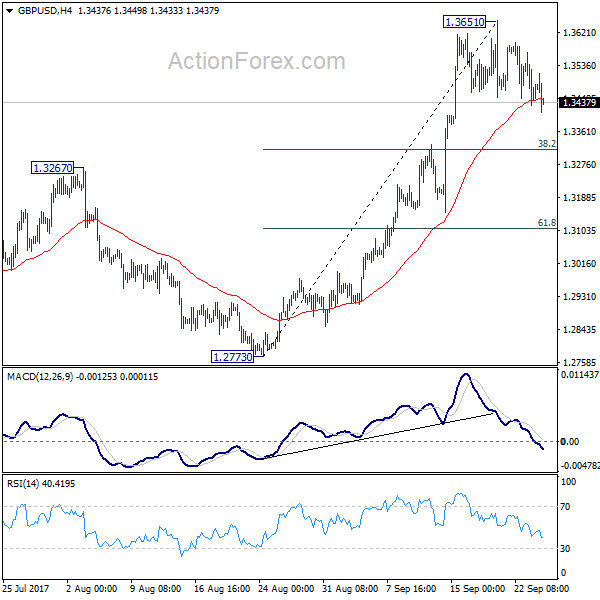
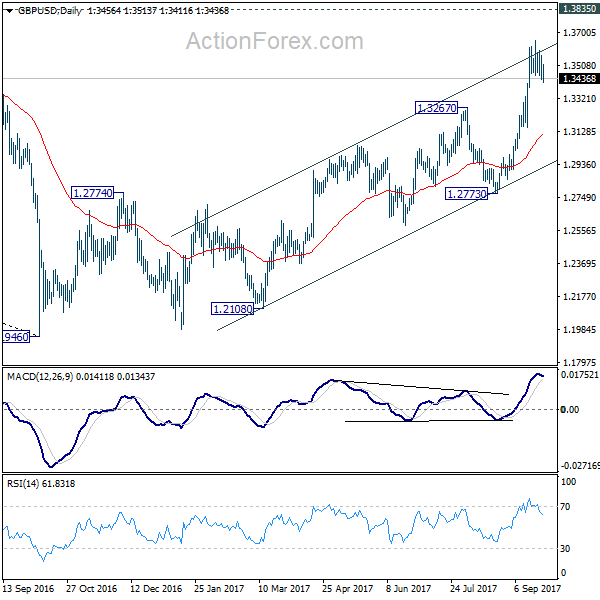
GBP/USD is staying in consolidation from 1.3651 and intraday bias remains neutral. In case of deeper fall, downside should be contained by 38.2% retracement of 1.2773 to 1.3651 at 1.3316 and bring rise resumption. Above 1.3651 will turn bias back to the upside for 1.3835 support turned resistance next. Break there will target 55 month EMA (now at 1.4405).
In the bigger picture, current development argues that the long term trend in GBP/USD has reversed. That is, a key bottom was formed back in 1.1946 on bullish convergence condition in monthly MACD. Current rise from 1.1946 will target 38.2% retracement of 2.1161 (2007 high) to 1.1946 (2016 low) at 1.5466 next. In any case, medium term outlook will now stay bullish as long as 1.2773 support holds.
EUR/USD Mid-Day Outlook
Daily Pivots: (S1) 1.1808; (P) 1.1872 (R1) 1.1913; More...
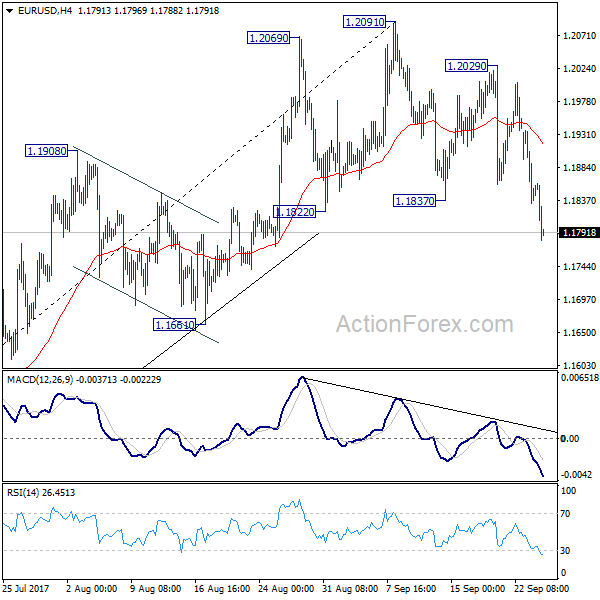
Intraday bias in EUR/USD remains on the downside for 1.1661 support. Fall from 1.2091 is corrective whole rise from 1.0569. Break of 1.1661 will target 38.2% retracement of 1.0569 to 1.2091 at 1.1510, where we're expecting support to bring rebound. On the upside, break of 1.2029 resistance is needed to confirm completion of the pull back. Otherwise, deeper fall will remain in favor as the correction develops.
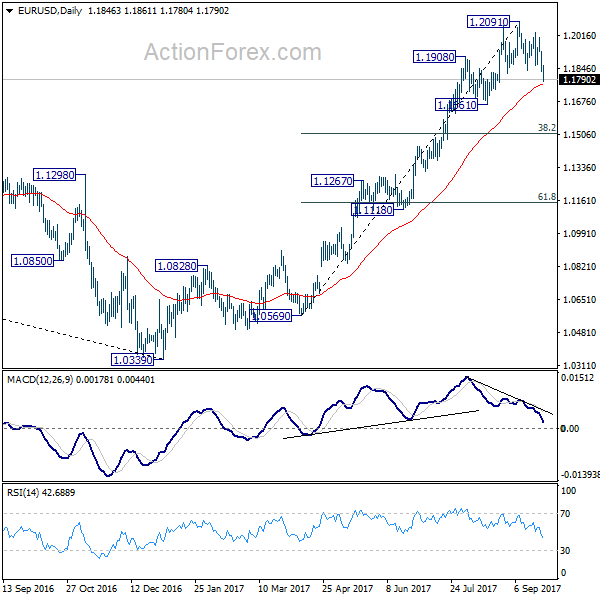
In the bigger picture, rise from medium term bottom at 1.0339 is still in progress for 38.2% retracement of 1.6039 (2008 high) to 1.0339 (2017 low) at 1.2516. However, it should be noted that there is no confirmation of trend reversal yet. That is, such rebound from 1.0399 could be a correction. And the long term fall from 1.6039 (2008 high) could resume. Hence, we'd be cautious on strong resistance from 1.2516 to limit upside. But after all, break of 1.1661 is needed to indicate medium term topping. Otherwise, outlook will remain bullish in case of pull back.
Dollar Strengthens as Markets Eye Yellen Today, Tax Plan Tomorrow
Dollar trades broadly higher today as markets are awaiting Fed Chair Janet Yellen's speech on inflation, uncertainty and monetary policy at the National Association for Business and Economics in Cleveland. Yellen is likely to maintain the tone that Fed is on course for gradual stimulus removal. Her comments regarding slowdown in inflation will also be closely watched. With the job market maintaining solid growth momentum, inflation is the main obstacle to another hike by Fed this year. Comments from other Fed officials are mixed so far. For example, New York Fed President Dudley just reiterated his expectation for inflation to climb back to 2% target after "idiosyncractic" factors fade. But Chicago Fed President Charles Evans is a little bit concerned that the slowdown in inflation is structural.
The anticipation of the details of US President Donald Trump's tax plan is also giving the greenback a lift. Republicans are set to unveil the plan tomorrow. It's reported that Trump told dinner guests on Monday that House will approve the tax bill in October, followed by the Senate by year end. But that's is an extremely aggressive scheduled considering that no details are being released yet. And comparing to the last time a tax overhaul was done back in 1986, it took roughly 10 months for the bill to move from introduction to then President Ronald Reagan's desk.
Meanwhile, market concerns over tensions between US and North Korea have eased mildly. There have been busy verbal exchanges between Trump, North Korea leader Kim Jong-Un and his Foreign Minister Ri Yong Ho. After Trump tweeted in his private account that the latter two "won't be around much longer", Ri criticized that was a declaration of war. And North Korea claimed every right on counter measures including shooting down US bombers "even when they are not inside the airspace border of our country". The White house's official message was that "we've not declared war on North Korea. And frankly, the suggestion of that is absurd."
Released from US, S&P Case-Shiller 20 cities house price rose 5.8% yoy in July, meeting expectations.
Euro selloff accelerates, pointing lower
On the other hand Euro's selloff started to accelerate today after EUR/GBP breaks 0.8773 support. EUR/USD's break of 1.1822 support argues that it's now in a medium term correction. Deeper fall could be seen through 1.1661 support in near term. Based on the hesitation in the decline, results of Germany election shouldn't be a direct reason for the selloff. Instead, markets are looking through the temporary uncertainty over Chancellor's difficulty in forming a coalition. The main problem is that a so called Jamaica coalition of CDU, pro-business FDP and Greens is intrinsically unstable. That raises some worries over the predictability of Germany's economic policies. And as the main driver of Eurozone economy, the whole bloc will also be affected. In addition, with the presence of right wing Afd in the parliament, it would be tougher for Merkel to work with French President Emmanuel Macron on deeper integration of EU.
Released from Eurozone, German import price index rose 0.0% mom in August.
BoJ July minutes optimistic on inflation trend
Minutes of BoJ July meeting showed that policy makers generally agreed to stick with current policy framework. Meanwhile, the minutes noted that "most members shared the view that, although the recent developments in CPI had been relatively weak, the year-on-year rate of change was likely to continue on an uptrend and increase toward 2 percent, mainly on the back of the improvement in the output gap and the rise in medium- to long-term inflation expectations."
Also from Japan, corporate service price index rose 0.8% yoy in August.
New Zealand business confidence tumbled
New Zealand NBNZ business confidence sank to 0 in September, down sharply from 18.3. That's the third straight month of decline and the lowest reading since September 2015. Nonetheless, ANZ chief economist Cameron Bagrie noted today that news economic drivers are emerging and growth would remain "respectable". The drivers are appearing in form of "higher commodity prices, rising household incomes and expansionary fiscal policy". Nonetheless, Bagrie also pointed out, after the election over the weekend, "policy uncertainty will rise over the coming months as political horse trading takes place" and that can be "unsettling".
Also from New Zealand, trade deficit came in much higher than expected at NZD -1235m in August.
EUR/USD Mid-Day Outlook
Daily Pivots: (S1) 1.1808; (P) 1.1872 (R1) 1.1913; More...
Intraday bias in EUR/USD remains on the downside for 1.1661 support. Fall from 1.2091 is corrective whole rise from 1.0569. Break of 1.1661 will target 38.2% retracement of 1.0569 to 1.2091 at 1.1510, where we're expecting support to bring rebound. On the upside, break of 1.2029 resistance is needed to confirm completion of the pull back. Otherwise, deeper fall will remain in favor as the correction develops.
In the bigger picture, rise from medium term bottom at 1.0339 is still in progress for 38.2% retracement of 1.6039 (2008 high) to 1.0339 (2017 low) at 1.2516. However, it should be noted that there is no confirmation of trend reversal yet. That is, such rebound from 1.0399 could be a correction. And the long term fall from 1.6039 (2008 high) could resume. Hence, we'd be cautious on strong resistance from 1.2516 to limit upside. But after all, break of 1.1661 is needed to indicate medium term topping. Otherwise, outlook will remain bullish in case of pull back.
Economic Indicators Update
| GMT | Ccy | Events | Actual | Forecast | Previous | Revised |
|---|---|---|---|---|---|---|
| 21:45 | NZD | Trade Balance (NZD) Aug | -1235M | -825M | 85M | 98M |
| 23:50 | JPY | BOJ Minutes July 19-20 Meeting | ||||
| 23:50 | JPY | Corporate Service Price Y/Y Aug | 0.80% | 0.70% | 0.60% | |
| 00:00 | NZD | NBNZ Business Confidence Sep | 0 | 18.3 | ||
| 06:00 | EUR | German Import Price Index M/M Aug | 0.00% | 0.10% | -0.40% | |
| 13:00 | USD | S&P/Case-Shiller Composite-20 Y/Y Jul | 5.80% | 5.80% | 5.70% | 5.60% |
| 14:00 | USD | New Home Sales Aug | 591K | 571K | ||
| 14:00 | USD | Consumer Confidence Sep | 120 | 122.9 |
EURUSD Moves Below 1.1800
EURUSD selling has accelerated during the European trading session, with pair moving below the 1.1800 level, hitting 1.1785, as the U.S dollar index pushes higher, adding further pressure on the single currency.
The next risk event for the EURUSD will be later today, where Federal Reserve Chair Janet Yellen delivers a key-note speech at the 59th Annual Meeting, of the National Association for Business Economics.
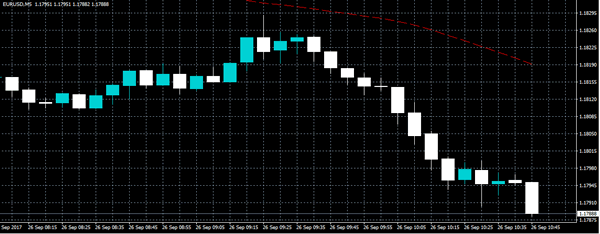
From a technical perspective, the U.S dollar index is now testing a key metric of overall currency strength, its 200-month moving average. Any break-out above the 92.83 level on the U.S dollar index should accelerate U.S dollar buying.
Key technical support below 1.1800 on the euro is found at 1.1773, 1.1740 and the pairs key 200-week moving average, at 1.1716.
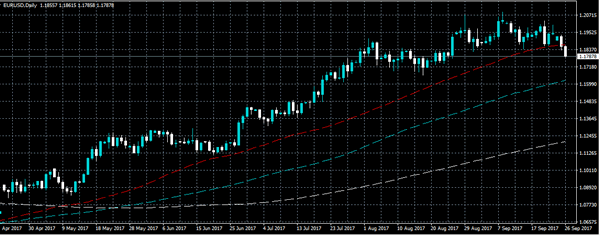
To the upside, key intraday resistance is found at 1.1815 and the recent swing high at 1.1829.
Above the former swing-high, price may further test the 1.1838 and 1.1861 levels.
GBPUSD Breaks Lower
After a period of consolidation, the British pound has finally moved lower against the U.S dollar, with GBPUSD pair breaking below key channel-support, with price moving to a seven-day low, hitting 1.3418.
In early Tuesday trading, the GBPUSD pair managed a timid rally towards 1.3515, before sellers moved in to push prices sharply lower.
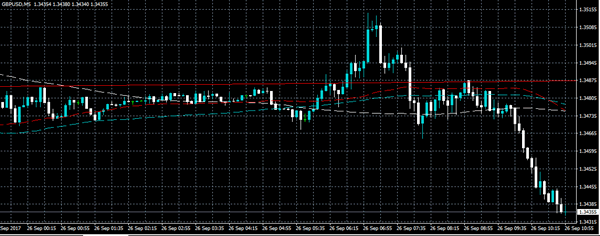
Sterling is now approaching strong support from the 50 percent Fibonacci retracement of the September 14th BOE price-low, to the 2017 price high, located at 1.3405.
Going forward, the British pound may trade in lock-step with euro, as both come under intense pressure from intraday U.S index strength.
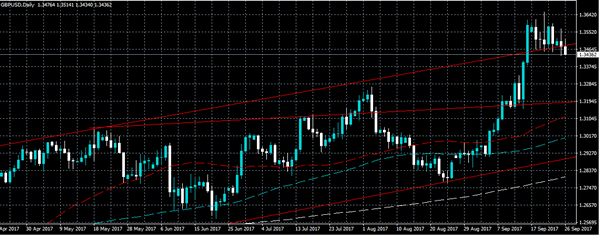
To the upside, key intraday technical resistance is now found at 1.3445, 1.3368 and the uptrend channel-top at 1.3389.
Key intraday technical GBPUSD support is located at 1.3405, 1.3380,1.3363 and 1.3320.
DAX Steady as Draghi Says Stimulus to Continue
The DAX index has posted small gains in the Tuesday session. Currently, the DAX is trading at 12,617.00, up 0.13% on the day. On the release front, Angela Merkel won the German election and will serve a fourth term as president. On the release front, German Ifo Business Climate slowed to 115.2, short of the estimate of 116.0 points. Later in the day, ECB President Mario Draghi testifies before the European Parliament Economic and Monetary Affairs Committee. On Tuesday, Germany releases Import Prices.
ECB President Mario Draghi testified on Monday before the European Parliament Economic and Monetary Affairs Committee. Draghi was careful not to make any headlines, as he said that the ECB would remain "patient and persistent". Draghi acknowledged that there was uncertainty regarding the inflation outlook, adding that recent volatility in the exchange rate would require monitoring. Draghi remains committed to the ECB's loose monetary policy, saying that "ample" accommodation is still needed in order to raise inflation levels. Some policymakers have come out in favor of tightening monetary policy, with the eurozone economy continuing to grow and unemployment falling. However, inflation remains well below the ECB target of just below 2 percent. Draghi told lawmakers that he is confident that the inflation target will be met, but that would require avoiding any hasty changes to current monetary policy.
Angela Merkel may have won a remarkable fourth term as German President, but her victory appears to be somewhat hollow. Merkel's CDU won 33 percent of the vote and will be the largest party in parliament, but Merkel will now have to barter with other parties in order to form a coalition government. The center-left SFD, which won 20 percent of the vote, announced that it will not join the CDU, so Merkel will have to negotiate with smaller parties. The far-right AFD ran on a far-right, anti-immigrant platform, and the party's surge in support has sent shock waves in Germany and across Europe. The AFD can be ruled out as a coalition partner, which leaves the Greens and the pro-business FDP party as the most likely configuration. However, the FDP has insisted on the powerful finance portfolio and will likely try to reduce German transfer payments to the European Union. As well, the FDP has little interest in closer European integration, a cherished goal for Merkel. During the election campaign, Christian Lindner, the leader of the FDP, called for Greece to return to the drachma, underscoring the party's opposition to Germany continuing to prop up weaker members of the eurozone.
The markets are digesting the results of the German election, and although Angela Merkel won a fourth term, the post-election picture is complicated. Merkel's CDU party has little to celebrate, dropping from 41% of the vote in the last election to just 33% on Sunday. The result has tarnished the image of Europe's most powerful politician and the de facto leader of the European Union. Merkel's most likely coalition partners, the Greens and the FDP, will be looking to extract major concessions as the price for joining a coalition as junior partners. For the time being, Europe's iron woman will need to focus her energies on forming a workable coalition and will have to put other issues on the back burner, at a time when the European Union is locked in difficult negotiations with Britain over the terms of its departure from the EU.