Sample Category Title
US Data Fails To Impress
On Friday, the US Commerce Department released Retail Sales showing a drop of 0.2% in August, the biggest decline in 6 months. The markets had expected a decline resulting from both Hurricanes Harvey and Irma. The Commerce Department commented that it could not isolate the impact of Hurricane Harvey on retail sales, it did receive indications from companies that the hurricane had “both positive and negative effects on their sales data, while others indicated they were not impacted at all.” Whilst Harvey may have had an impact on August data, June and July data were revised lower suggesting US consumer spending has slowed down.
The Federal Reserve released Industrial Production for August on Friday showing a decline of 0.9% – the biggest decline since May 2009. The Fed is attributing as much as 0.75% to Harvey, as Gulf coast oil and natural gas production was stopped. The markets are expecting that September's Industrial Production will also be negatively impacted due to Irma.
The tension resulting from North Koreas continued missile testing, and Pyongyang's defiance in the face of international condemnation, is causing concern in the markets. North Korea's official state news agency, KCNA, has added to concerns by calling for a break up in the UN Security Council which they see as a “tool of evil”. In further rhetoric, KCNA has threatened to “sink” Japan and reduce the USA to “ashes and darkness”. US Secretary of State Tillerson recently stated that the U.S. “seeks a peaceful resolution but is prepared to use military force if diplomatic efforts fail to end the nuclear standoff with North Korea”. This, as President Trump is scheduled to make his first address before the United Nations on Tuesday. The markets expect more rhetoric from the US and North Korea.
The Federal Reserve meets Tuesday and Wednesday to discuss monetary policy where many believe they will announce the start of the reduction in the Central Banks massive balance sheet. Later in the week, the Bank of Japan will meet to discuss Japanese monetary policy with many expecting no change in their stance. This week marks the final week before the German General Election on September 24th and the New Zealand General Election on September 23rd. Today is a Public Holiday in Japan.
EURUSD has gained 0.24% overnight to currently trade around 1.1945.
USDJPY has moved higher from Friday's close to currently trade around 111.35.
GBPUSD remains strong, reaching levels not seen since 3 June of last year. Currently, GBPUSD is trading around 1.3595.
Gold gave back recent gains, as risk-on sentiment has improved. Currently, Gold is trading around $1,316.
WTI has been buoyed by higher demand, resulting in a 5% gain last week. Currently, WTI is trading around $50.50.
Major economic data releases for today:
At 10:00 BST, Eurostat will release Eurozone Consumer Price Index & Core (MoM & YoY) for August. Core CPI is forecast to come in at 1.2%, a slight decline from the previous release of 1.3%. YoY CPI is expected to remain at 1.5%. Eurozone inflation appears to be restrained, but any major change from the forecasts will see EUR volatility in the markets.
Sterling Extends Gains On BoE Rate-Hike Talk
The British pound continued to rally on Friday, following some relatively hawkish comments from BoE MPC member Gertjan Vlieghe. Among other optimistic remarks, the policymaker said that the appropriate time for a rate hike might be as early as in the coming months, something that pushed the implied probability for a hike by December to 78%. Today, we will hear from BoE Governor Mark Carney, who will speak at the IMF. Should he reaffirm that a hike in the coming months is likely, sterling could gain further. Given the heightened speculation for a hike, we maintain the view that the short-term outlook of GBP remains positive.
Looking further ahead, the key risk to the continuation of the GBP rally are politics, we think. The latest focus on monetary policy developments seems to have shifted market attention away from the continued delays and the lack of progress in the Brexit negotiations. In addition, the upcoming Conservative Party conference (1st October) presents further political uncertainty, as any rebellious attempt to replace PM May could put a lid on further sterling gains.
EUR/GBP continued to tumble on Friday on the hawkish remarks by BoE's Vlieghe, falling below the support (now turned into resistance) barrier of 0.8830 (R1). However, the slide was stopped by the crossroads of the 0.8780 (S1) support and the longer-term upside support line taken from the lows of November 2015. The price structure on the 4-hour chart continues to suggest a short-term downtrend, but given our proximity to the aforementioned crossroads, we prefer to take the sidelines for now. A clear break below that support zone is needed before we get confident on more bearish extensions. The catalyst for such a break may be more hawkish comments by BoE Governor Mark Carney today. If this is the case, we expect a dip below 0.8780 (S1) to initially aim for our next support of 0.8715 (S2). On the other hand, if the Governor appears less hawkish than expected, the pair could rebound from the longer-term upside support line.
Yen continues to retreat amid early election reports
The yen retreated further on Friday, alongside other safe havens like gold, despite the North Korean missile launch that occurred a few hours earlier. Meanwhile, major global equity markets such as the S&P 500 closed the day at new record highs. In our view, this suggests that as long as the situation does not escalate into military conflict, market participants may continue to place less and less emphasis on North Korean developments.
Turning to Japan, reports over the weekend suggest that PM Abe is considering to hold a snap election as early as next month, in order to exploit the disarray in the main opposition party and gain a bigger majority for his own party. If early elections are confirmed in the next days, the increased domestic political uncertainty could be another factor weighing on the yen, besides the latest risk-on environment.
USD/JPY traded north on Friday and during the Asian morning Monday, the pair opened with a positive gap above the key resistance (now turned into support) of 111.00 (S1). That barrier acted as the upper bound of the sideways range that had been containing the price action since the 28th of July. As such, its break may have turned the short-term picture to positive, in our view. We now expect the bulls to remain in the driver's seat and perhaps drive the battle higher for a test near the 111.70 (R1) line, marked by the peak of the 27th of July.
Today's highlights:
Besides Carney's speech, we only have Eurozone's final CPIs for August. Nevertheless, the bloc's final inflation data are usually not market movers.
As for the rest of the week:
On Tuesday, the only noteworthy data set we get is Germany's ZEW survey for September. On Wednesday, the main event will be the FOMC gathering. This is one of the 'bigger' meetings, meaning that besides the rate decision we also get fresh economic forecasts for the US economy, an updated 'dot plot', as well as a press conference by Chair Yellen. Then on Thursday, focus will turn to the BoJ and Norges Bank policy meetings. Finally on Friday, Eurozone's manufacturing and services PMIs for September are out, as well as Canada's CPI data for August.
EUR/GBP
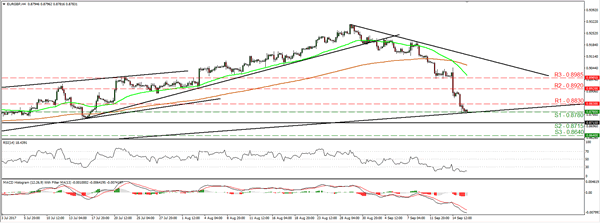
Support: 0.8780 (S1), 0.8715 (S2), 0.8640 (S3)
Resistance: 0.8830 (R1), 0.8920 (R2), 0.8985 (R3)
USD/JPY
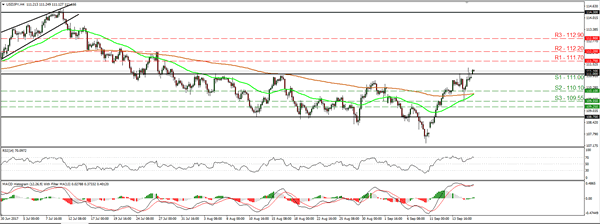
Support: 111.00 (S1), 110.10 (S2), 109.55 (S3)
Resistance: 111.70 (R1), 112.20 (R2), 112.90 (R3)
EUR/USD Elliott Wave Analysis
EUR/USD – 1.2020
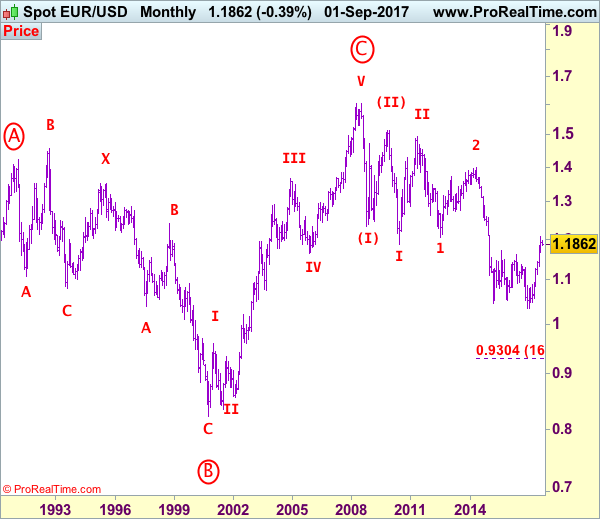
EUR/USD: Wave (c) of 2 ended at 1.3993 and wave 3 of III has commenced for weakness to 1.0411 (1.236 of wave 1), then 1.0000.
Although the single currency resumed recent rise and rose to a marginal high of 1.2093, lack of follow through buying on break of previous resistance at 1.2070 and the subsequent retreat suggest consolidation below said resistance would be seen and another test of 1.1838 support cannot be ruled out, however, a daily close below there is needed to signal a temporary top has possibly been formed, bring retracement of recent rise to 1.1770-75, then 1.1700 but previous support at 1.1662 (previous 4th of a lesser degree) should hold from here, bring rebound later.
Our preferred count on the daily chart remains that a wave (II) from 1.2329 ended at 1.5145 with A-leg ended at 1.4720, followed by wave B at 1.2457, the wave C from there was also a 3 legged move and is labeled as (a): 1.3739, (b): 1.2885, the wave iii of the 5-waver (c) from 1.2885 has ended at 1.4339 and wave iv is a triangle ended at 1.3878 and wave v formed a top at 1.5145. The decline from there is a 5-waver (C) with minor wave (i) of I of (C) ended at 1.4218 with wave (ii) ended at 1.4580, wave (iii) ended at 1.3267 and wave (iv) ended at 1.3692 and wave (v) ended at 1.1876, this is also the low of wave I of (C) and wave II ended at 1.4940, hence wave III is now in progress with a diagonal wave 1 ended at 1.2042, the breach of previous support at 1.1876 (wave I trough) adds credence to our view that the wave 2 has ended at 1.3993, wave 3 has commenced for further weakness to 1.0411, then towards 1.0000.
On the upside, expect recovery to be limited to 1.2000 and reckon 1.2040-50 should hold, bring another retreat later. Only break of said resistance at 1.2093 would signal recent upmove from 1.0340 low is still in progress and may extend headway to 1.2150-55 (61.8% projection of 1.1119-1.1910 measuring from 1.1662), however, loss of upward momentum should prevent sharp move beyond 1.2200-10 and price should falter below 1.2255-60, risk from there remains for a much-needed correction to take place later this month.
Recommendation: Stand aside for this week.
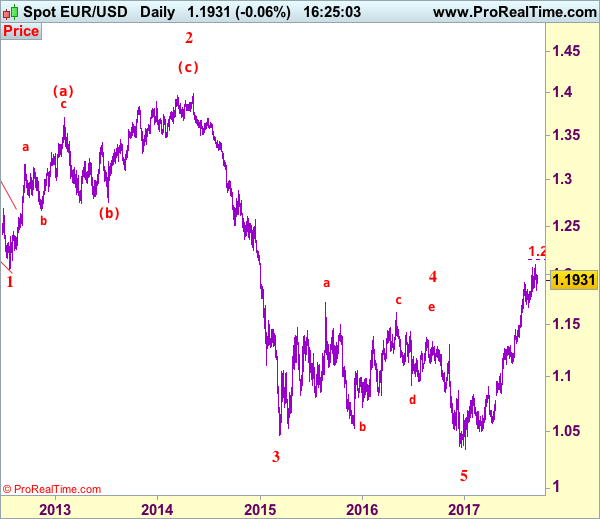
Euro's long-term uptrend started from 0.8228 (26 Oct 2000) with an impulsive structure. The rise from 0.8228 to 0.9593 (5 Jan 2001) is labeled as wave I, the retreat to 0.8352 (6 Jul 2001) is wave II and the rally to 1.3670 (31 Dec 2004) is wave III. Wave IV from there ended at 1.1640 (15 Nov 2005), the subsequent upmove to 1.6040 (July 15, 2008) is treated as wave V, the major selloff from the record high of 1.6040 to 1.2329 (October 27, 2008) signals a reversal has taken place with (I) leg ended at 1.2329 and once (II) ended at 1.5145, wave (III) itself is an extended move with I: 1.1876 and complex wave II ended at 1.4902, wave III has commenced with wave 1 and 2 ended at 1.2042 and 1.3993 respectively, wave 3 of III is now unfolding for weakness towards parity.
USD/JPY Elliott Wave Analysis
USD/JPY - 111.35
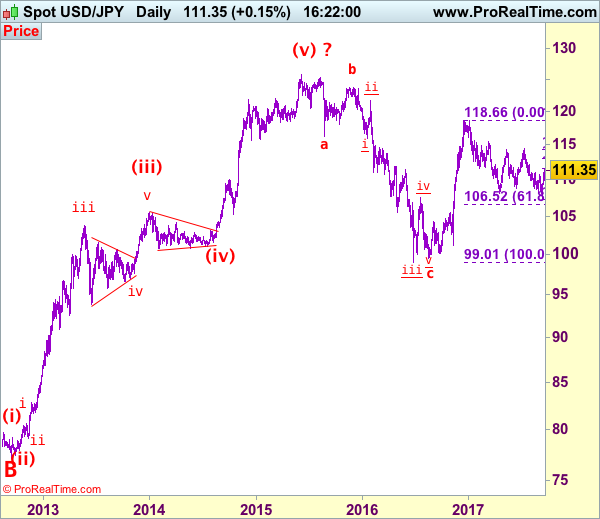
USD/JPY – Wave V of larger degree circle V has possibly ended at 75.31 and major correction has commenced and already met indicated target at 125.00.
As the greenback has staged a strong rebound after finding good support at 107.32 earlier this month, suggesting low has indeed been formed there and consolidation with upside bias is seen for at least a retracement of recent entire fall from 118.66, hence further gain to 111.65 (38.2% Fibonacci retracement of 118.66-107.32), then 112.20-25 would be seen, however, near term overbought condition should limit upside to 112.95-00 (50% Fibonacci retracement) and price should fatter well below resistance at 114.50, bring retreat later.
Our preferred count is that, triangle wave IV (with circle) ended at 101.45 and the circle wave V brought dollar down to the record low of 75.31 in 2011 and the subsequent rebound signal major correction has commenced with A leg ended at 84.19, followed by wave B at 77.14 and impulsive wave C is now unfolding (indicated upside target at 125.00 had been met) for gain towards 127.00 level. In the event dollar drops below support at 99.01, this would confirm medium term decline from 125.86 top (2015 high) has resumed for subsequent weakness to 98.00 and possibly 97.00.
Under this count, this wave C is unfolding as impulsive waves with (1) (2), 1 2 ended at 80.67, 79.07, 82.84 and 81.69 respectively, hence the extended wave 3 has ended at 103.74 and wave 4 correction of recent upmove should bring weakness to 92.57, then towards 90.88 but psychological support at 90.00 should limit downside and bring another rally later in wave 5, indicated target at 125.00 had been met and gain to 127.00 cannot be ruled out but reckon price would falter below 130.00.
On the downside, whilst pullback to 110.90.00 and possibly 110.50-60 cannot be ruled out, reckon downside would be limited to 110.00 and bring another rise later. Below strong support at 109.55 would abort and suggest the rebound from 107.32 has ended instead, risk weakness to 109.00 and possibly 108.50-60 but price should stay well above said support at 107.32 and bring another rebound later.
Recommendation: Buy at 110.00 for 112.00 with stop below 109.00.
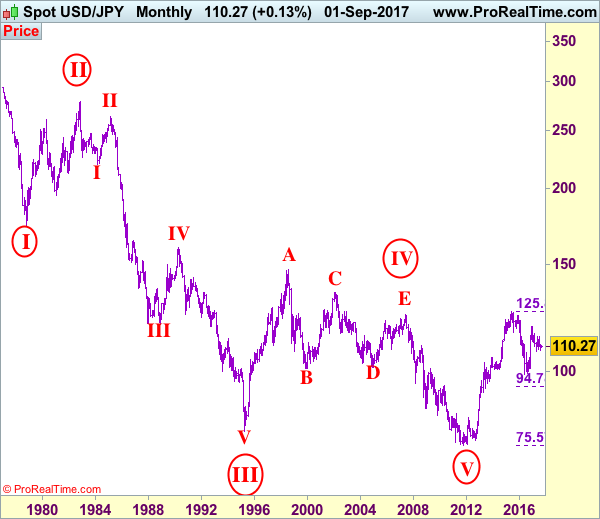
On the monthly chart, we have changed our preferred count that an impulsive wave is unfolding with major wave III with circle ended at 79.75, then followed by wave IV with circle and is labeled as a triangle with A: 147.64 (11 August, 1998), B: 101.25, C: 135.20, D: 101.67 and E leg ended at 124.14 to end the wave IV with circle. Hence, wave V with circle commenced from there and hit a record low of 75.31, however, the subsequent strong rebound signals this circle wave V has possibly ended there, hence gain to (indicated upside target at 122.00 and 125.00 had been met), the retreat from 125.86 suggests wave A of major correction has ended there and wave B correction back to 99.00, then 95.00 would be seen, however, reckon downside would be limited to 90.00, bring another rebound in wave C next year.
Currencies: Dollar Mixed Ahead Of FOMC. Sterling Gets Additional Support From BoE
Sunrise Market Commentary
- Rates: Dovish positions scaled back; neutral ahead of Fed?
Core bond markets lost ground last week despite mixed to weaker US eco data, scaling back too dovish bets against monetary policy normalisation. With markets now positioned more neutral, we expect sideways trading given the empty eco calendar and the approaching Fed meeting. Portuguese bonds can outperform after regaining “investment grade” from S&P. - Currencies: Dollar mixed ahead of FOMC. Sterling gets additional support from BoE
USD/JPY remains well bid as sentiment on risk improves further and as the yen suffers from higher core yields. However, poor US data prevented further USD gains against the euro. The dollar will probably trade in wait-and-see modus ahead of Wednesday's FOMC decision. Sterling rebounds further as the BoE made a hawkish U-turn.
The Sunrise Headlines
- US equities ended Friday's trading with minor gains, but worth mentioning the S&P closed above 2500 threshold. Overnight, Asian equities started the week on a strong footing with overnight gains around 0.5% to 1% on hopes the US seeks a peaceful resolution in the N-Korean issue.
- The cost of new housing in China rose at the slowest pace on more than a year in August as price growth in top-tier cities experiencing a marked deceleration
- S&P upgraded the Portuguese rating to investment grade (BBB-) stable outlook due to progress in reducing its deficit. Since 2012 the country had a junk S&P rating. The upgrade might raise investors' appetite for Portuguese bonds.
- Moody's raised Ireland's rating with one notch to A2, positive outlook, due to stronger than expected growth and progress regarding its public finances.
- Japanese PM Abe appears to be considering calling a snap election when parliament resumes later this month, according to reports. The media leaks might be a trial balloon to gauge the public mood.
- The world's central banks can't sit back and ignore the growth in cryptocurrencies as it could pose a financial system risk, according to the BIS.
- Today's calendar is super light with only the final September EMU inflation and the US homebuilders'
Currencies: Dollar Mixed Ahead Of FOMC. Sterling Gets Additional Support From BoE
USD trading mixed going into FOMC decision
The dollar showed a mixed picture on Friday. Core yields kept an upward bias even as US data (retail sales and production) disappointed. The euro outperformed and EUR/USD rebounded into the high 1.19 area. At the same time, USD/JPY and EUR/JPY were in good shape. This was mainly yen weakness as the Japanese currency suffered from higher US/EMU yields. Sentiment on risk also improved throughout the session as the impact from the North Korean missile test ebbed further. EUR/USD finished the session at 1.1945. USD/JPY end the session at 110.83.
Overnight, Asian equities show gains between 0.5% and 1.0%, supported by record closing levels on WS on Friday. Chinese house price increases slowed further in August, reducing the need for additional measures to cool house prices. This adds to the Chinese risk-on sentiment. Japanese markets are closed, but sources suggest that Japanese PM Abe may call snap elections as soon as next month. The yen holds near recent lows and USD/JPY trades in the 111.15 area. The dollar is slightly better bid against the euro. EUR/USD trades in the 1.1940 area.
Today the eco calendar only contains the EMU (final) August inflation and the US September NAHB housing index. The former is expected to confirm the preliminary outcome. The latter is expected marginally lower (67) from August (68), but still close to the cycle high. No sustained market reaction is expected. BoE Carney speaks at the IMF. Markets will look for more warnings about a rate hike. Further out this week, the main event is the FOMC meeting on Wednesday. The FOMC will likely announce the start of a gradual balance sheet tapering (Q4) and keep the FF rate unchanged. Most attention will go to the rate projections (dots). Will the median projection still point to another rate hike in 2017 (December)? What about the long run FF rate projection (currently 3% but likely revised lower)? North Korea (and the US handling of the conflict) and the debate on US tax reduction remain a wildcard for (USD) trading
Last week, the dollar cautious rebound on a more positive risk sentiment was not convincing, as softer than expected US data created a mixed dollar context. Despite disappointing US data, core yields extended their rise at the end of last week, suggesting that markets don't expect an overly soft FOMC. This might prevent further USD losses going into the FOMC policy meeting. We start the week with a neutral bias on the dollar. EUR/USD hovers in the middle of a sideways consolidation pattern between 1.1823 and 1.2070. It was disappointing for EUR/USD bears that last week's correction didn't reach this range bottom. More confirmation is still needed that the recent bottoming out process in US yields and in the dollar might be the start of more sustained USD gains (against the euro). The day-to-day momentum in USD/JPY is a more constructive. The pair tries to sustain above the 110.67/95 previous support. Yen weakness prevails, but we are still not convinced that current cautious break above 111 will be the start of a protracted uptrend.
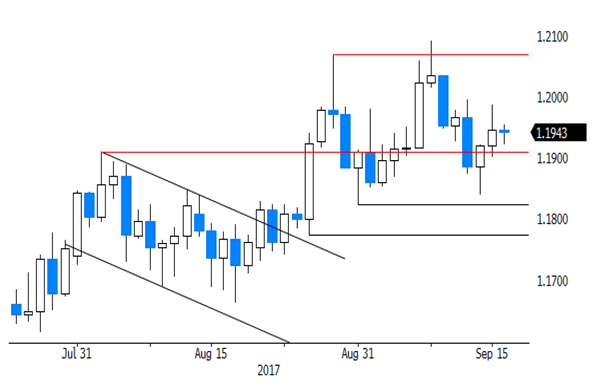
EUR/USD consolidation off recent top, but no test of first significant support level yet.
EUR/GBP
BoE gives GBP rebound more fuel
On Thursday, sterling jumped sharply higher as the BoE minutes revealed that a majority of MPC members expected a gradual withdrawal of monetary stimulus over the coming months. On Friday, BoE's Vlieghe, a notorious dove, supported the call for a rate hike. This hawkish turn of a BoE dove triggered further GBP gains. EUR/GBP dropped temporary below 0.88 and closed the session at 0.8789 (from 0.8896). Cable (currently 1.3575) jumped temporary north of 1.36, but eased late in the session on the dollar rebound. BGP/USD finished at 1.3594.
Overnight, Rightmove UK House prices declined 1.2% M/M to rise only 1.1% Y/Y (from 3.1% in August). Prices in London are coming under further pressure. For now, the report has no noticeable impact on sterling trading. BoE's Carney speaks at an IMF meeting in Washington. Markets will be keen to see whether he joins the hawkish chorus of BOE speakers of late. After last week's jump of sterling, a lot of good news should be discounted. Even so, we don't row against the sterling positive tide yet. The EUR/GBP correction might still go a bit further.
From a technical point of view, EUR/GBP cleared 0.8854/80 resistance (top end June), opening the way for a protracted August rebound. The move was the result of euro strength. Simultaneously, UK price data were soft enough to keep the BoE side-lined at the August meeting. Recent price data amended this story and the ST-trend reversal of sterling was reinforced by recent BoE comments. Medium term, we maintain a EUR/GBP buy-on-dips approach as we expect the mix of relative euro strength and sterling softness to persist. However, the prospect of withdrawal of BOE stimulus probably put a solid floor for sterling ST term. We let the current correction do its job, before selling sterling versus the euro. EUR/GBP is nearing next support at 0.8743 and 0.8652
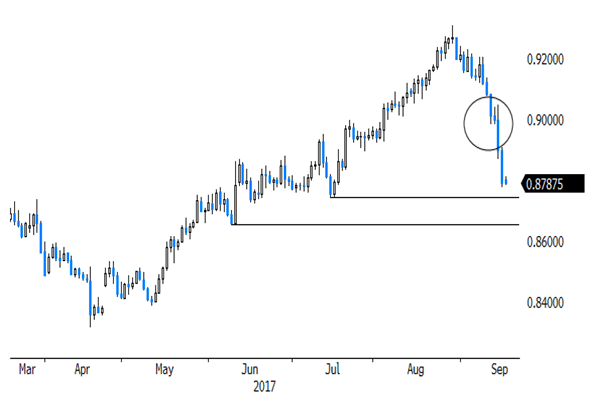
EUR/GBP: BoE rate hike signal accelerates GBP-rebound
Trade Idea: GBP/USD – Buy at 1.3450
GBP/USD – 1.3558
Original strategy :
Buy at 1.3490, Target:1.3690, Stop: 1.3430
Position: -
Target: -
Stop: -
New strategy :
Buy at 1.3450, Target:1.3650, Stop: 1.3390
Position: -
Target: -
Stop:-
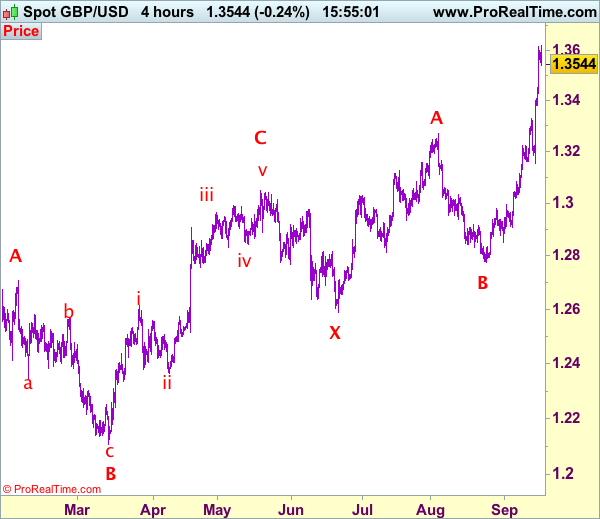
Although cable rise briefly to 1.3619 earlier today, lack of follow through buying on break of Friday’s high at 1.3617 and current retreat suggest consolidation below said resistance would take place and pullback to 1.3500-10 cannot be ruled out, however, reckon downside would be limited to 1.3440-50 and bring another rise later, above said resistance at 1.3619 would extend recent upmove to 1.3650-60, then towards 1.3700. We have re-labeled our preferred count (pls see the attached chart) that the wave IV is unfolding as a complex double three (ABC-X-ABC) correction with 2nd wave B ended at 1.2774, hence 2nd wave C is unfolding and may extend further gain to 1.3650, then 1.3700, however, near term overbought condition should limit upside to 1.3770-75 and reckon 1.3800-10 would hold from here, bring retreat later.
In view of this, would not chase this rise here and would be prudent to buy sterling on subsequent pullback as 1.3440-50 should limit downside. Below 1.3425-30 would defer and suggest a temporary top is possibly formed, risk correction to 1.3385-90 but previous resistance at 1.3329 should remain intact, bring another upmove later.
Our preferred count on the daily chart is that cable's rebound from 1.3500 (wave (A) trough) is unfolding as a wave (B) with A ended at 1.7043, followed by triangle wave B and wave C as well as wave (B) has ended at 1.7192, the subsequent selloff is the larger degree wave (C) which is still unfolding with minor wave (III) of larger degree wave 3 ended at 1.1986, hence wave (IV) correction is in progress which could either be a triangle wave (IV) of a complex formation but upside should be limited to 1.3500 and price should falter well below 1.4000, bring another decline in wave (V) of 3 for weakness to 1.1500, then 1.1200.
Trade Idea: GBP/JPY – Buy at 149.50
GBP/JPY - 150.95
Original strategy:
Buy at 149.95, Target: 151.95, Stop: 149.35
Position: -
Target: -
Stop: -
New strategy :
Buy at 149.50, Target: 151.50, Stop: 148.90
Position: -
Target: -
Stop:-
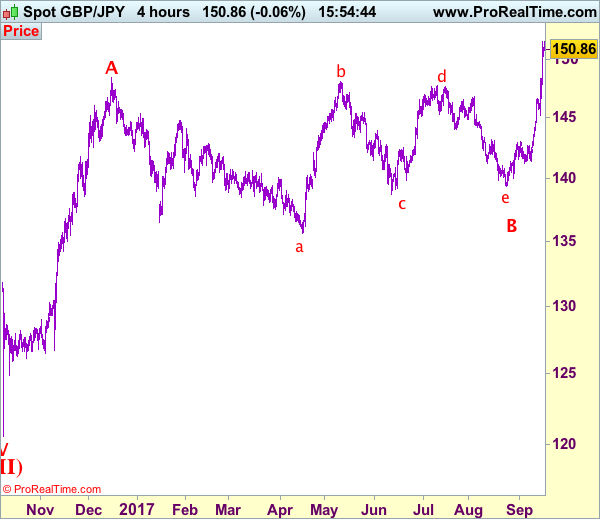
As sterling has retreated after faltering below last week’s high at 151.55, suggesting further consolidation below this level would be seen and pullback to 150.00-10 cannot be ruled out, however, reckon downside would be limited to 149.40-50 and bring another rise later, above said resistance at 151.55 would extend recent upmove to 152.00, then 153.00, however, near term overbought condition should limit upside to 154.00-10 and price should falter below 155.00. Our latest preferred count is that triangle wave B correction ended at 139.35 (the final e leg of triangle), hence wave C has commenced and may extend further gain to 153.00 and later 154.00.
In view of this, we are still looking to buy sterling on pullback as 149.50 should limit downside. Below 149.00 would risk correction to 148.50 but still reckon downside would be limited to previous resistance at 148.35 and 147.75-80 should hold, bring another upmove later.
Our preferred count is that larger degree wave V with circle is unfolding from 251.12 with wave (I) 219.34, (II): 241.38 and wave (III) is subdivided into 1: 192.60, 2: 215.89 (23 Jul 2008) and wave 3 ended at 118.87 earlier in 2009. The correction from there to 162.60 is wave 4 which itself is a double three and is labeled as first a-b-c ended at 151.53, followed by wave x at 139.03, 2nd a ended at 162.60, 2nd b at 146.75 and 2nd c leg of wave 4 ended at 163.00. Therefore, the decline from 163.00 to 116.85 is now treated as wave 5 which also marked the end of larger degree wave (III), hence wave (IV) major correction has commenced for retracement of the wave (III) from 241.38 and upside target at 183.95-00 (50% Fibonacci retracement of the wave (II) from 241.38) had been met, a drop below 160.00 would suggest wave (IV) has ended at 195.85, bring decline in wave (V) for initial weakness to 130 (already met) and 120.
Brent Oil Loses Momentum
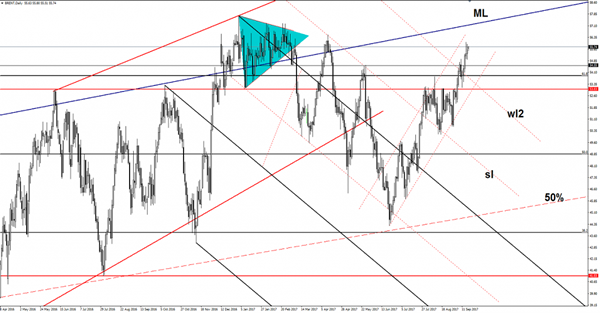
Brent Oil moves higher within the ascending channel and should hit new highs in the upcoming period. Technically is showing some exhaustion signs, but nothing significant. The Friday's failure to reach the 56.06 previous high has signaled that a minor drop could come. Price could decrease a little to retest the downside line of the minor ascending channel before will jump towards the $57.00 per barrel.
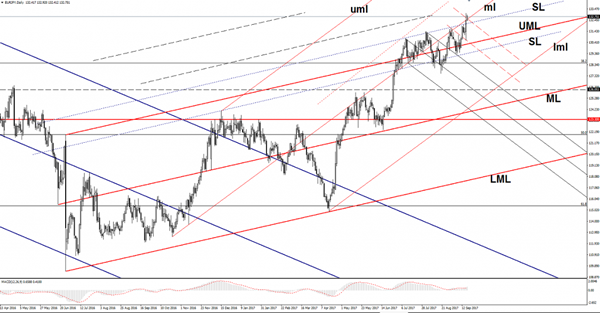
EUR/JPY Breakout In Play
EUR/JPY is trying to breakout from the confluence area formed at the intersection between the median line (ml) with the second warning line (descending dotted line) of the minor descending pitchfork.
A valid breakout through the mentioned confluence area will accelerate the upside movement. Price has finally escaped from the minor ascending channel between the sliding lines (SL), signaling a further increase.
USD/JPY Bulls In Control
The USD/JPY has opened with a gap up signaling that the bulls are in full control. Price is approaching a major dynamic resistance, but a breakout is favored as the Yen is demolished by the Nikkei's bullish movement.
The Japanese currency drops versus all its rivals on the short term, this could continue as the JP225 continues the upside movement. The Nikkei is pressuring a major horizontal resistance, a valid breakout above the 20058 static resistance will confirm a further increase and a Yen's further depreciation.
Only another false breakout above the 20058 horizontal resistance will signal another leg lower and a Yen's dominance. The Japanese banks are closed in observance of Respect-for-the-Aged Day.
The pair is driven by the technical factors, remains to see what will happen after the United States data will be released, but I don't think that will have any significant impact.
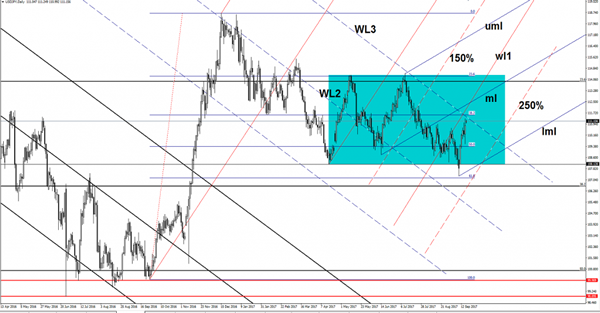
The USD/JPY is trading in the green and is almost to hit the third warning line (WL3) of the descending pitchfork. Personally, I believe that if will touch it will break it because, a valid breakout will signal a further increase in the upcoming period.
Continues to move in range on the short term, so we'll have a clear direction once will breakout from this range.
I've drawn a minor ascending pitchfork hoping that I'll catch another leg higher, the rate could be attracted by the median line (ml) of this pitchfork. Temporary resistance could be found at the 38.2% retracement level as well.
A failure to reach the median line (ml) will signal a minor drop towards the lower median line (lml).