

Sample Category Title
USD/JPY Mid-Day Outlook
Daily Pivots: (S1) 109.79; (P) 110.56; (R1) 111.59; More...
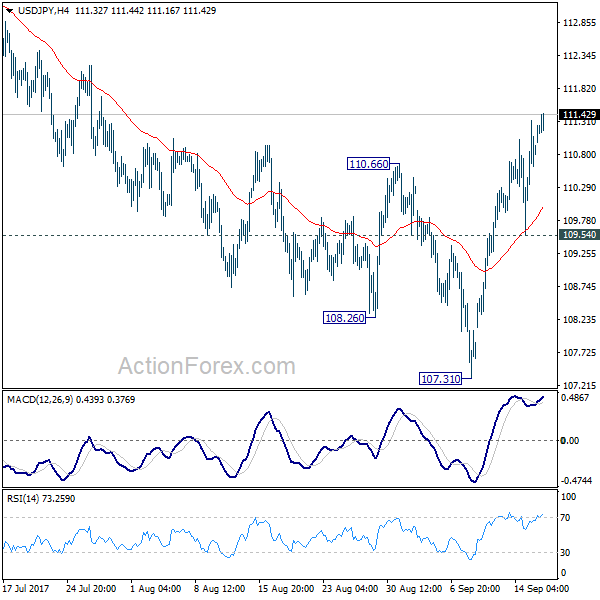
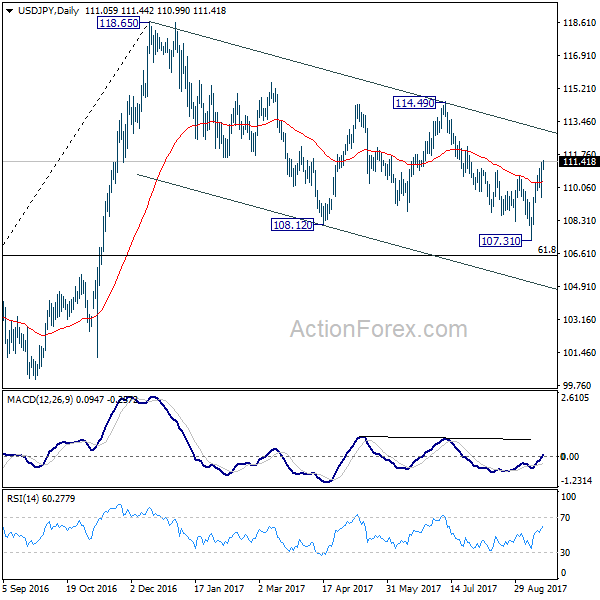
USD/JPY's rebound from 107.31 continues today and reaches 111.44 so far. Intraday bias remains on the upside for medium term channel resistance (now at 112.91). Sustained break there will argue that whole correction from 118.65 has completed too. In that case, further rise should be seen to 114.49 resistance for confirmation. On the downside, break of 109.54 support is needed to indicate completion of the rebound. Otherwise, outlook will stay cautiously bullish in case of retreat.
In the bigger picture, rise from 98.97 (2016 low) is seen as the second leg of the corrective pattern from 125.85 (2015 high). It's unclear whether this this second leg has completed at 118.65 or not. But medium term outlook will be mildly bearish as long as 114.49 resistance holds. And, there is prospect of breaking 98.97 ahead. Meanwhile, break of 114.49 will bring retest of 125.85 high. But even in that case, we don't expect a break there on first attempt.
Yen Lower on Risk Appetite in Quiet Markets, Sterling Pares Gains
Yen trades generally lower today in otherwise quiet markets. Euro is trading firmer while Sterling is paring some of last week's sharp gains. Global markets are generally in risk seeking mode. The MSCI Asia Pacific ex Japan index surged to decade high earlier today. European indices follow with some gains, including FTSE. US futures also suggest that stocks are going to extend the record run. If other markets, gold continues with it's pull back from recent high at 1362.4 and hits as low as 1314.5 so far. It's possibly heading back to 1300 handle, which is close to 55 day EMA at 1293.4. WTI crude oil weakens mildly as it struggles to find sustainable buying to stay firm above 50 handle.
The economic calendar is rather light today. Canada international securities transactions rose CAD 23.95b in July. Eurozone CPI was finalized at 1.5% yoy in August, core CPI at 1.2% yoy. UK Rightmove house price dropped -1.2% mom in September. There are a lot of high profile events ahead in the week. BoE Governor Market Carney will speak at IMF in Washing today. RBA will release meeting minutes tomorrow. US President Trump will also address the United Nations. Fed is expected to announce the plan to unwind the balance sheet on Wednesday. UK Prime Minister Theresa will deliver a Brexit speech in Italy on Friday. And there will be general elections in New Zealand and Germany in the coming weekend.
ECB Hansson advocates broader recalibration of monetary policy
ECB Governing Council member Ardo Hansson urged not to have "inordinate focus on the asset purchase program". Instead, he advocates a "somewhat broader recalibration" of monetary policy. He noted that the central has "a range of instruments already under implementation" And, ECB could "in addition bring to the table for consideration". He pointed out that "various refinancing operations and the details of forward guidance could be more precise about interest rates". Hansson also played down the concern over Euro's strength. He noted that the exchange rate is "well within the historical range". Also, the euro area has a "current accounts surplus of some volume".
Sterling awaits BoE Carney speech
Sterling pares back some gains today as markets await BoE Governor Mark Carney's speech at IMF in Washington. Traders are rather convinced that a November hike is on the table because a known dove Gertjan Vlieghe turned his stance last Friday and said a rate hike is "approaching". The echoed the surprised BoE minutes that showed most members believe there will be a hike in coming months. Markets will look into Carney's speech today to further verify such expectations. Nonetheless, it should already be priced in well after the strong surge in Sterling last week. Therefore, any Carney triggered gains could be temporary. The Pound may turn into consolidation to digest recent gains, before getting fresh inspirations from incoming data.
Japan PM Abe will decide on parliament dissolution after September 22
In Japan, it's report over the weekend that Prime Minister Shinzo Abe will dissolve the Lower House on September 28 and call for a snap election on October. Abe responded to the rumor at Haneda airport as he was departing for United Nations Meetings in New York. Abe said that he'll "refrain from answering each and every question about a dissolution of parliament". And he will "decide when I return to Japan" on September 22. It's believed that Abe wants to ride on recent resurgence in his approval rating, for handling of the North Korea tensions. In additional, politic analysts noted that the main opposition Democratic Party is in terrible shape, leaving practically no opposition to Abe.
RBA minutes watched in upcoming Asian session
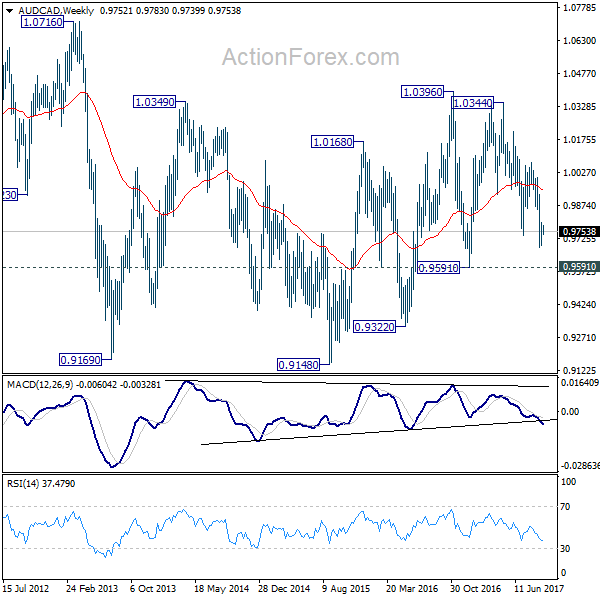
RBA minutes will be a focus in the coming Asian session. The central bank left benchmark interest rate unchanged at 1.50% on September 4 and left the markets with a relatively neutral statement. The minutes would probably just reflect that neutral stance. Nonetheless, attention will still be on any change in tone regarding monetary policies that agrees with the market expectation of a hike as next step in 2018. AUD/CAD has been softer since BoC surprised the markets by two rate hikes this year. Deeper fall is expected in the cross to 09591 key support level in short to medium term. The bearish outlook will remain until RBA becomes more explicitly in its tightening bias.
USD/JPY Mid-Day Outlook
Daily Pivots: (S1) 109.79; (P) 110.56; (R1) 111.59; More...
USD/JPY's rebound from 107.31 continues today and reaches 111.44 so far. Intraday bias remains on the upside for medium term channel resistance (now at 112.91). Sustained break there will argue that whole correction from 118.65 has completed too. In that case, further rise should be seen to 114.49 resistance for confirmation. On the downside, break of 109.54 support is needed to indicate completion of the rebound. Otherwise, outlook will stay cautiously bullish in case of retreat.
In the bigger picture, rise from 98.97 (2016 low) is seen as the second leg of the corrective pattern from 125.85 (2015 high). It's unclear whether this this second leg has completed at 118.65 or not. But medium term outlook will be mildly bearish as long as 114.49 resistance holds. And, there is prospect of breaking 98.97 ahead. Meanwhile, break of 114.49 will bring retest of 125.85 high. But even in that case, we don't expect a break there on first attempt.
Economic Indicators Update
| GMT | Ccy | Events | Actual | Forecast | Previous | Revised |
|---|---|---|---|---|---|---|
| 23:01 | GBP | Rightmove House Prices M/M Sep | -1.20% | -0.90% | ||
| 09:00 | EUR | Eurozone CPI M/M Aug | 0.30% | 0.30% | -0.50% | |
| 09:00 | EUR | Eurozone CPI Y/Y Aug F | 1.50% | 1.50% | 1.30% | |
| 09:00 | EUR | Eurozone CPI - Core Y/Y Aug F | 1.20% | 1.20% | 1.20% | |
| 12:30 | CAD | International Securities Transactions (CAD) Jul | 23.95B | 4.46B | -0.92B | |
| 14:00 | USD | NAHB Housing Market Index Sep | 67 | 68 | ||
| 20:00 | USD | Net Long-term TIC Flows Jul | 42.3B | 34.4B |
DAX Starts Week With Gains as Eurozone CPI Improves
The DAX index has posted slight gains in the Monday session. Currently, the DAX is trading at 12,552.00, up 0.30% on the day. On the release front, Eurozone Final CPI improved to 1.5%, matching the forecast. On Tuesday, Germany releases ZEW Economic Sentiment, which is expected to improve to 12.3 points.
With less than a week to go before the German federal election, Angela Merkel is widely expected to win her fourth term as prime minister. Merkel's CDU conservative party has a 14 percent lead over the center-left SPD, its current coalition partner. Another option for Merkel is the FDP, but the latter has insisted on receiving the finance ministry, and has also taken a hard line on immigration which Merkel may not be comfortable with. Germany's position in Europe will be even more dominant when Britain leaves the European Union, which may some members of the club uneasy.
French President Emmanuel Macron, a staunch supporter of a unified Europe, is hoping to continue working with Merkel and reform the eurozone. Macron's proposal includes a eurozone finance minister who would be in charge of a eurozone budget. Macron's call for greater cooperation is linked to Britain's exit from the EU, which could lead to divisions among the remaining 27 members in the bloc. However, the French ambitious plan will need Germany's support before it can become a reality. Will Germany embrace the idea? Angela Merkel has indicated that she is open to the idea, but Jean-Claude Juckner, head of the European Commission, came out against the plan last week. Juckner said he favored a finance minister for the EU but was against a separate eurozone budget and finance minister. Even if the plan is not adopted, we can expect a Macron-Merkel alliance to take steps which will strengthen Franco-German ties and further unify the eurozone.
Before & After the Hurricanes
Hurricanes will get the bulk of the blame but the latest data showed growth was slowing before Harvey and Irma. A big week ahead: Trump's UN speech on Tuesday; Fed decision & Yellen presser on Wednesday; PM Theresa May's EU speech on Friday and German Elections on Sunday. A new Premium note has been added to further our existing index trade.
A cascade of growth downgrades followed US retail sales and industrial production numbers on Friday. Retail sales fell 0.2% compared to +0.1% expected in August. The control group, which excludes autos, gas and building supplies was down 0.2% compared to +0.2% expected. In addition, July sales were revised lower.
It wasn't just consumers with bad news. August industrial production fell 0.9% compared to +0.1% expected in the worst monthly decline in five years. The Fed said Harvey reduced output by 0.75 pp so it's not as bad as it looks, but it's undoubtedly a poor reading. How poor? The NY Fed and Atlanta Fed GDP trackers were both lowered by 0.8 pp for Q3 while Q4 estimates were trimmed as well.
The market took the weak data in stride in a sign that it views Harvey as the culprit. That may be a hint on how buoyant the dollar will be in the week ahead as the market prepares for details of Trump's tax plan at the end of the month.
What was unambiguous was pound strength as cable finished the week just under 1.36. The OIS market is pricing in a 65% chance of a BOE hike on Nov 2 and 73% before year-end. What makes that probability even higher is that Carney's credibility can't afford another misstep.
CFTC Commitments of Traders
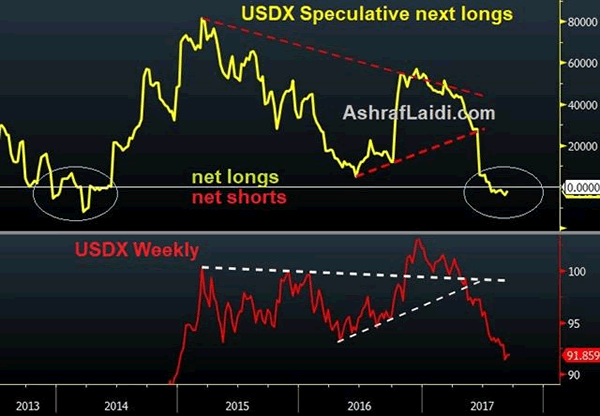
Speculative net futures trader positions as of the close on Tuesday. Net short denoted by - long by +.
- EUR +86K vs +96K prior
- GBP -46K vs -54K prior
- JPY -57K vs -74K prior
- CHF -2K vs -2K prior
- CAD +50K vs +54K prior
- AUD +60K vs +65K prior
- NZD +12K vs +15K prior
Those sterling shorts are suddenly rather vulnerable and no doubt many covered since the Bank of England decision. Watch out for Carney's speech today at 11 am EST (4 pm London). Euro shorts were pared after last week hitting the most-extreme since May 2011.
Market Update – Asian Session: Quiet Start To Week
Notes/Observations
ECB sees inflation rate below 1% in early 2018 citing a statistical quirk
Overnight
Asia:
Japan PM Abe: To decide on dissolving Diet and election after current US visit (**Note: Earlier reports circulated that PM Abe was considering snap election as soon as Oct)
UN Sec Council statement (from Friday) condemned 'highly provocative' North Korean missile launch
US Ambassador to UN Haley: UN Security Council may run out of options with regard to North Korea. Iran, Syria and North Korea will be major focus at UN Gen Assembly next week
US Sec of State Tillerson: increasingly aggressive North Korean threatens the region and endangers the world
North Korea said to be aiming to establish "military equilibrium" with US; "will make the US rulers dare not talk about military option"
Europe:
ECB's Praet (Belgium): Reiterates Council view that euro zone still needs substantial stimulus to get back to the near 2% inflation target; will also respond if inflation were to get too high
ECB reportedly estimates 2018 QE reinvestment average at €15B/month (**Reminder: current QE program of €60B/month in bond purchases is expected to be wound down during 2018)
Bank for International Settlements (BIS) Quarterly Review: Strong outlook with low inflation spurs risk-taking
Forza Italia party chief Berlusconi (former PM) lays policy priorities in marking a formal return to Italy's political stage
Foreign Sec Johnson laid out his vision for Brexit; believes it can still deliver £350M a week extra for the NHS (**Note: Various cabinet colleagues accuse Johnson of "backseat driving" on Brexit)
UK Interior Sec Rudd: Johnson was not starting a leadership bid by setting out his plans for Brexit in a newspaper article, adding that his intervention was "absolutely fine"
Sovereign rating actions from Friday:
S&P raised Portugal sovereign rating to investment grade, raises one notch to BBB- from BB+; outlook Stable
Moody's raised Ireland's sovereign rating to A2 from A3; outlook revised to Stable from Positive
S&P affirmed Cyprus sovereign rating at BB+; outlook revised to Positive from Stable
S&P affirmed Russia sovereign rating at BB+; outlook Positive
S&P affirmed Austria and Finland sovereign ratings at AA+; outlook Stable
Economic data
(AT) Austria Aug CPI M/M: -0.1% v -0.3% prior; Y/Y: 2.1% v 2.0% prior
(CZ) Czech Aug PPI Industrial M/M: 0.2% v 0.1%e; Y/Y: 1.4% v 1.3%e
(HK) Hong Kong Aug Unemployment Rate: 3.1% v 3.1%e
(EU) Euro Zone Aug CPI M/M: 0.3% v 0.3%e; Y/Y (final reading): 1.5% v 1.5%e; CPI Core (final reading) Y/Y: 1.2% v 1.2%e
Fixed Income Issuance:
(NO) Norway sold total NOK6.0B vs. NOK6.0B indicated in 12-month Bills; Avg Yield 0.39% v 0.41% prior; Bid-to-cover x v 2.42x prior
SPEAKERS/FIXED INCOME/FX/COMMODITIES/ERRATUM
Equities
Indices [Stoxx600 +0.5% at 382.5, FTSE +0.3% at 7235, DAX +0.6% at 12591, CAC-40 +0.4% at 5235, IBEX-35 +0.7% at 10391, FTSE MIB +0.7% at 22381, SMI +0.4% at 9061, S&P 500 Futures +0.2%]
Market Focal Points/Key Themes: European Indices start the week of on the front foot continuing the momentum from the end of last week, with the dollar reach an 8 week high against the yen ahead of the FOMC rate decision mid week. On the corporate front Fingerprint cards continue to fall after guiding Q3 Rev short of expectations, whilst Ryanair trades lower after cancelling over 150 flights after 'Messing up' Pilot holidays. Elsewhere Petra Diamonds trade sharply lower after prelim results, whilst in the healthcare space Thrombogenics trade higher after regaining rights to JETREA.
Equities
Consumer discretionary [(Ryanair [RYA.UK] -3.4% (Flight cancellations)]
Materials: [Petra diamonds [PDL.UK] -8.6% (Prelim FY17 results)]
Financials: [Esure [ESUR.UK] +6.8% (Controlling shareholder mulling sale), Hiscox [HSX.UK] -2% (Hurricane Harvey claims estimates)]
Technology: [Fingerprint Cards -22% (FINGB.SE] -21% (Q3 guidance)]
Telecom: [Nokia [NOKIA.FI] +1.2% (Received decision in patent license arbitration with LG Elec)]
Healthcare: [Thrombogenics [THR.BE] +17.5% (Regains global rights to JETREA (ocriplasmin))]
Energy: [Seabird Exploration [SBX.NO] -59% (Private placement)]
Speakers
ECB noted that base effect seen affecting inflation in coming quarters. Combined impact of base effects from the energy and unprocessed food HICP components will lower headline inflation in the first quarter of 2018, but raise it in the following quarter. September staff projections foresaw a V-shaped path for headline inflation
ECB's Hansson (Estonia): ECB steps could involve new refinancing operations, reworked guidance and more details on reinvestments
France Budget Min Darmanin: 2017 GDP growth seen at 1.7% vs. 1.5% official govt target
Spain Fin Min de Guindos: No market impact from any instability resulting in Catalonia region. Companies were leaving Catalonia due to high taxes. Unemployment is falling faster than govt projections as domestic economy was growing over 3%
Italy Fin Min Podoan: Domestic banks efficiency has improved due to govt measures; NPLs were falling at a faster rate. Pubic backstop and deposit insurance is needed for EU banking union
Greece PM Tsipras: Optimistic to see above target primary surplus in 2017. Country needed to complete 3rd bailout review asap despite technical and political difficulties. Aiming to complete prior actions by November
China PBOC Adviser Sheng Songcheng: Now is not the time to change the CNY currency (Yuan) regime
China PBoC said to be working on draft proposal for foreign access to financial sector
China FX Regulator SAFE reiterated view that CNY currency (Yuan) exchange rate was stable even with recent FX appreciation
Currencies
USD/JPY was at a 2-month high with the pair above 111.30 ahead of the NY Morning. Dealers were eyeing the upcoming FOMC policy meeting mid-week meeting for clues on whether interest rates could rise again by year-end
EUR/USD was little changed at 1.1940 area with dealers seeing little impetus for movement before Wednesday's Fed policy meeting
Yields on 10-year Portuguese government bonds drop faster than their euro zone counterparts early Monday after the sovereign's upgrade to BBB-, an investment-grade rating, by S&P after the close Friday
Fixed Income
Bund futures trade little changed at 161.37 as investors await a number of speeches by European and U.K. central bankers this week, as well as the US Federal Reserve's meeting. Continued downside targets 161.03 while upside resistance stands initially at 162.07, followed by 163.27.
Gilt futures trade at 125.42 up 12 ticks with little in the way of UK economic data, Gilts will take their lead from the performance of core European government bonds.. Continued downside eyeing 124.91. Upside targets 127.90 then 128.24.
Monday's liquidity report showed Friday's excess liquidity fell to €1.7655T from €1.7660T and use of the marginal lending facility fell to €109M from €115M.
Corporate issuance saw $42.8B last week via 66 tranches, bringing YTD issuance to above $1.03T. For the week ahead analysts forecast around $25B to come to market. In Euro denominated issuance ~€35B came to market via 39 issuers and 49 tranches
Looking Ahead
(UR) Ukraine Q2 Final GDP Q/Q: 0.6%e v 0.6%prelim; Y/Y: 2.4%e v 2.4%
05:30 (BE) Belgium Debt Agency (BDA) to sell €3.5B in 2024, 2027 and 2034 OLO Bonds
05:30 (NL) Netherlands Debt Agency (DSTA) to sell €2.0-4.0B in 3-Month and 6-month Bills
06:00 (PT) Portugal Aug PPI M/M: No est v -0.3% prior; Y/Y: No est v 2.2% prior
06:45 (US) Daily Libor Fixing - 07:00 (IN) India announces details of upcoming bond sale (held on Fridays)
07:00 (BR) Brazil Sept IGP-M Inflation (2nd Preview): 0.4%e v 0.3% prior
07:25 (BR) Brazil Central Bank Weekly Economists Survey
08:00 (PL) Poland Aug Employment M/M: 0.1%e v 0.3% prior; Y/Y: 4.6%e v 4.5% prior
08:00 (PL) Poland Aug Average Gross Wages M/M: -1.1%e v -0.1% prior; Y/Y: 5.7%e v 4.9% prior
08:00 (ES) Spain Debt Agency (Tesoro) announces size of upcoming actions in week
08:05 (UK) Baltic Dry Bulk Index
08:30 (CA) Canada July Int'l Securities Transactions (CAD): No est v -0.9B prior
08:30 (CH) Swiss Government question time in Parliament
09:00 (FR) France Debt Agency (AFT) to sell combined €4.0-5.2B in 3-month, 6-month and 12-month Bills
09:30 (EU) ECB announces Covered-Bond Purchases - 09:35 (EU) ECB calls for bids in 7-Day Main Refinancing Tender
09:50 (UK) BOE to buy £1.125B in in APF Gilt purchase operation (3-7 years)
10:00 (US) Sept NAHB Housing Market Index: 67e v 68 prior
10:30 (DE) ECB's Lautenschlaeger (Germany) in Basel
11:00 (UK) BOE Gov Carney at IMF in Washington DC
11:00 (CO) Colombia July Trade Balance: -$0.6Be v -$0.1B prior
11:30 (US) Treasury to sell 3-month and 6-month bills
14:15 (DE) SPD's Schulz takes questions at Televised Town-Hall Event in Luebeck
14:15 (CA) Bank of Canada (BOC) Dep Gov Lane
16:00 (US) July Total Net TIC flows: No est v $7.7B prior; Net Long-Term Tic Flows: No est v $34.4B prior
16:00 (US) Weekly Crop Progress Report
Dollar To Remain Contained Ahead Of Fed Decision
September 18: Five things the markets are talking about
This is a busy week both on the central bank and parliamentary election front.
Among the G7, the Bank of Japan (Thursday) and the Fed (Wednesday) hold policy meetings this week, as to does Norway’s Norges Bank (Thursday).
The BoJ is expected to leave its policy unchanged and probably will not reveal when it will unwind stimulus, but could signal determination to keep the yield curve under control.
However, for the Fed, expectations are uncertain. Recent hurricane activity is expected to cloud the outlook for the Fed – intensifying the problem is the delay in the collection and publication of official data. Expectations are for revisions going forward. Interest rates are expected to remain on hold, while the market assigns a +50% probability of a December rate increase. Many anticipate the FOMC to begin reducing the Fed’s balance sheet.
In the U.K, Brexit strategy is in focus as PM May prepares to outline her revised approach this Friday, while in Germany, the final days of the federal parliamentary campaign will play out before next Sunday’s vote (Sept. 24). Down-under, New Zealand goes to the polls this Saturday (Sept. 23).
1. Stocks given the green light
The bullish sentiment that stoked more records stateside on Friday has carried through into the new week, with both European and Asian rallying across the board.
In Japan capital markets were shut for respect-for-the-aged day.
In Hong Kong, equities jumped to the highest a 27-month overnight, as regional bourses hit decade highs, while stronger-than-expected Chinese loan data aided sentiment. The Hang Seng index rose +1.3%, while the China Enterprises Index gained +1.2%.
Down-under, and Australia’s S&P 200 was up +0.5% at the close, while in S. Korea, the Kospi index climbed +1.4%.
In China, equities were boosted by stronger domestic data that added to views that economic growth is holding up and by the loosening of margin requirements on stock index futures trading. The blue-chip CSI300 index rose +0.3%, while the Shanghai Composite Index also added +0.3%.
In Europe, regional bourses all start the week on the front foot, continuing Friday’s momentum as the U.S dollar reaches a two-month high outright against the yen (¥111.40).
U.S stocks are set to open in the black (+0.2%).
Indices: Stoxx600 +0.5% at 382.5, FTSE +0.3% at 7235, DAX +0.6% at 12591, CAC-40 +0.4% at 5235, IBEX-35 +0.7% at 10391, FTSE MIB +0.7% at 22381, SMI +0.4% at 9061, S&P 500 Futures +0.2%
2. Oil bid on rising refinery demand, falling rig count, and gold lower
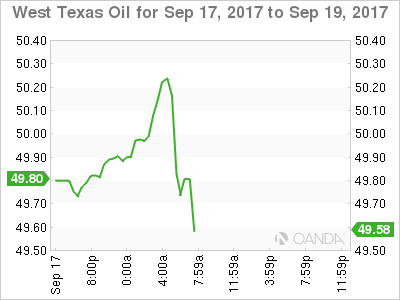
Ahead of the U.S open, crude oil prices remain better bid, trading atop of multi-month highs as the number of U.S rigs drilling for new production fell and refineries continued to restart after getting knocked out by Hurricane Harvey.
Brent crude futures are at +$55.91 a barrel, up +29c, straddling their five-month high print touched last Thursday, while U.S West Texas Intermediate (WTI) crude is trading up +41c, or +0.8%, at +$50.30, near their three-month high print also reached last Thursday.
Note: Oil refineries across the Gulf of Mexico and the Caribbean are also restarting after being shut due to hurricanes Harvey and Irma.
Also supporting crude prices is the number of rigs drilling for oil in the U.S fell sharply last week. Friday’s Baker Hughes report revealed that U.S energy firms cut seven oilrigs in the week to Sept. 15, bringing the total to 749, the fewest since June.
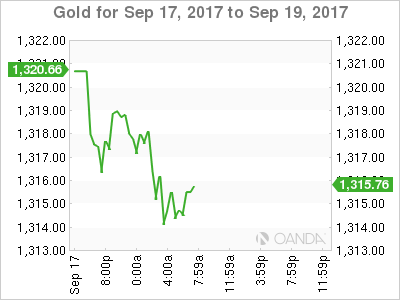
In the Euro session, gold has slipped to its lowest level in a fortnight as the dollar and stocks rally, while prospects of U.S monetary policy tightening ahead of a Fed meeting is also weighing on the metal. The ‘yellow’ metal is down -0.3% at +$1,315.36 an ounce.
3. Sovereign yields rise
This week, the main event will be the Federal Open Market Committee (FOMC) meeting, starting tomorrow and concluding with Wednesday’s press conference (02:30 pm EDT).
U.S policy makers are expected to take another step towards policy “normalisation,” but will it be this week? It’s not a slam-dunk, as persistently subdued global inflation, despite a pick-up in growth, remains somewhat of an impediment to tightening monetary policy. As such, the market is not wholly convinced that the Fed will move on rates again this year, with a December change put at less than a +50% probability.
The yield on 10-year Treasuries has backed up +1 bps to +2.21%, the highest yield in almost four-weeks. In Germany, the 10-year Bund yield has gained less than +1 bps to +0.44%, the highest in more than a month, while Britain’s 10-year Gilt yield has climbed less than +1 bps to +1.31% – the highest print in more than 10-weeks.
4. Dollar to remain contained ahead of Fed decision
Last week’s positive U.S inflation surprise was not sufficient to convince the market of a noteworthy continuation of the Fed rate hike cycle. Investor focus now shifts to the Fed directly.
The U.S dollar is unlikely to move much before Wednesday’s Fed announcement as is usual in the run-up to these meetings. With rates expected to remain on hold should not mean much for the dollar unless there is a ‘hawkish’ signal from this week’s Fed meet.
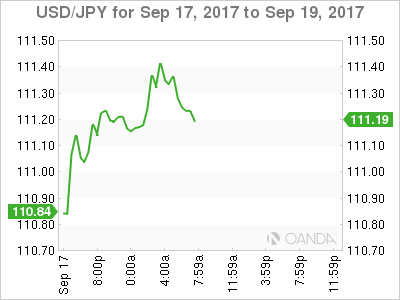
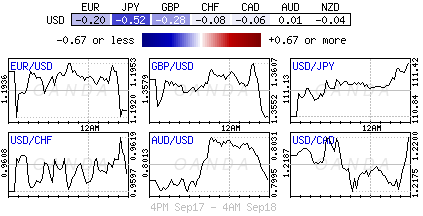
Ahead of the open, the dollar is a tad firmer across the board. EUR/USD at €1.1931 is down -0.16%, USD/JPY is up +0.5% at ¥111.40, while GBP/USD down 0.3% at £1.3554.
Note: Sterling is down after rallying on Thursday and Friday as caution sets in before a speech by BoE Governor Mark Carney at 10:00 am EDT.
Note: JPY outright is trading atop of its two-month lows as investors are shaking off risk fears of political threats, but also because there is a public holiday in Japan, which means less liquidity in the market.
5. Euro annual inflation up to +1.5%
Data this morning from Eurostat showed that Euro area (monetary union of 19 members) annual inflation was +1.5% in August 2017, up from +1.3% in July 2017. In August 2016 the rate was +0.2%.
European Union (28 member states) annual inflation was +1.7% in August 2017, up from +1.5% in July. A year earlier the rate was +0.3%.
Note: ECB President Draghi indicated earlier this month that the bank would outline plans next month to scale down its +€2.3T bond-buying program (QE).
Euro Continues To Drift As Eurozone CPI Matches Forecast
The euro ended the week quietly, and the lack of activity continues in the Monday session. Currently, the pair is trading at 1.1941, up 0.27% on the day. On the release front, Eurozone Final CPI improved to 1.5%, matching the forecast. There are no major US events on the schedule. On Tuesday, Germany releases ZEW Economic Sentiment and the US publishes Building Permits and Housing Starts.
Eurozone economic conditions have been solid in 2017, but inflation levels have been stubbornly low. This has complicated the ECB’s plans to reduce its quantitative easing scheme (QE), although ECB President Mario Draghi has said that the ECB will announce its plans to reduce QE at the October policy meeting. QE is scheduled to end in December, and policymakers will have to balance opposing interests as to what happens next. Germany, with its robust economy, would like to remove stimulus entirely, while less affluent eurozone members want to retain an accommodative monetary policy. We’re likely to see some compromise, in which stimulus is extended into 2018, but will be tapered from its current level of EUR 60 billion/month.
Germany head for the polls on September 24, and Angela Merkel is widely expected to win her fourth term as prime minister. French President Emmanuel Macron, a staunch supporter of a unified Europe, is hoping to work with Merkel and reform the eurozone. Macron’s proposal includes a eurozone finance minister who would be in charge of a eurozone budget. Macron’s call for greater cooperation is linked to Britain’s exit from the EU, which could lead to divisions among the remaining 27 members in the bloc. However, the French ambitious plan will need Germany’s support before it can become a reality. Will Germany embrace the idea? Angela Merkel’s has indicated that she is open to the idea, but Jean-Claude Juckner, head of the European Commission, came out against the plan last week. Juckner said he favored a finance minister for the EU but was against a separate eurozone budget and finance minister. Even if the plan is not adopted, we can expect a Macron-Merkel alliance to take steps which will strengthen Franco-German ties and further unify the eurozone.
Forex Technical Analysis: EUR/USD, USD/JPY, GBP/USD
EUR/USD
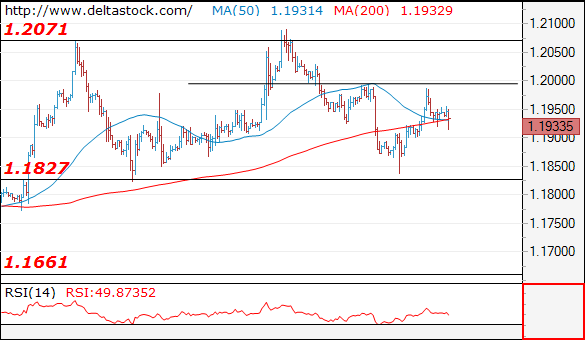
Current level - 1.1933
The recent rise has been capped at 1.2000 interim resistance, but the pullback is corrective in nature, so my intraday outlook is positive, for a spike towards 1.2070 area. Crucial on the downside is 1.1830 and only a break through that area will challenge 1.1660 and 1.1480.
| Resistance | Support | ||
| intraday | intraweek | intraday | intraweek |
| 1.2000 | 1.2160 | 1.1900 | 1.1830 |
| 1.2070 | 1.2500 | 1.1830 | 1.1660 |
USD/JPY
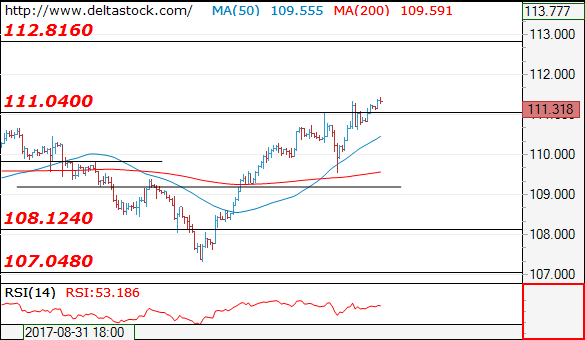
Current level - 111.31
The uptrend has been renewed, heading towards 112.80 hurdle. Initial support lies at 110.50.
| Resistance | Support | ||
| intraday | intraweek | intraday | intraweek |
| 111.00 | 111.00 | 110.30 | 108.12 |
| 112.80 | 112.80 | 109.20 | 107.30 |
GBP/USD
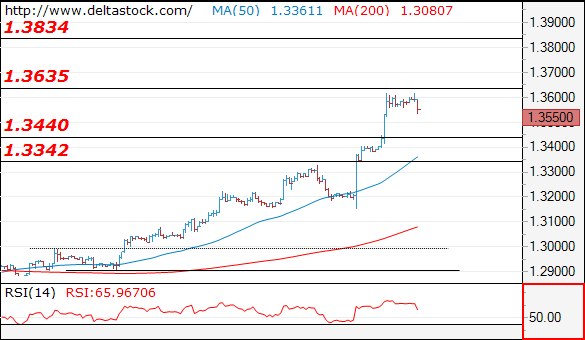
Current level - 1.3550
The acceleration of the uptrend led to test of 1.3635 resistance area and current pullback should be considered corrective, preceding another leg towards 1.3830 area. Key support is projected at 1.3440.
| Resistance | Support | ||
| intraday | intraweek | intraday | intraweek |
| 1.3635 | 1.3635 | 1.3530 | 1.3340 |
| 1.3830 | 1.3830 | 1.3440 | 1.3150 |
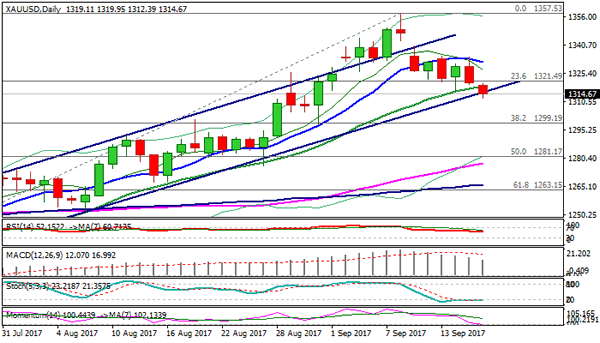
Technical Outlook: SPOT GOLD – Bears May Extend To Fibo 38.2% Support At $1300
Spot Gold remains in red at the beginning of the week with extended weakness probing below strong supports at $1317 (bull-channel support line / Fibo 38.2% of $1251/$1357 upleg.
Fresh bears hit session low at $1312 (daily Kijun-sen) which may act as temporary footstep for near-term consolidation, signaled by oversold slow stochastic on daily chart.
Upside attempts are expected to be limited (broken 20SMA at $1319 to ideally cap) before bears resume.
Close below bull-channel support line will initial bearish signal, while close below daily Kijun-sen is needed to confirm bearish continuation, which could extend to $1300 (Fibo 38.2% of $1204/$1357 ascend).
Alternative scenario requires firm break above last week's tops at $1334, reinforced by south-turning daily Tenkan-sen, to turn near-term bias higher.
Res: 1319, 1327, 1331, 1340
Sup: 1312, 1304, 1300, 1292
FOMC To Focus On Data | Three Reasons For Sterling Strength | ECB Ready
Rift in hard and soft economy data
Sterling Bullish Due to Three Main Reasons
ECB Ready
Rift in hard and soft economy data
- Retail sales below forecast and downward revision
- Industrial production underwhelming
- Empire state and Michigan guiding you towards a ditch
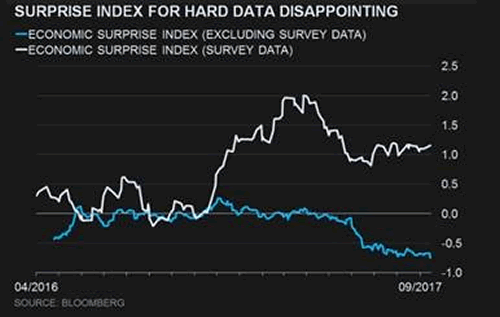
The rift continues between the soft data and hard data over in the US. Last week, we have seen more evidence of this in the economic numbers and it is about time for the Fed to start paying attention to this. They are going to embark on the process of unwinding their balance sheet and at the same time continue their glide path to normalise the interest rate.
The hard economic numbers have been coming in underwhelming since April. Last week's industrial and retail sales number reminded the markets of the same message. If you look at the Empire State Manufacturing and the university of Michigan Consumer Sentiment numbers, it tells you that the soft data is navigating investors towards a ditch. What is important to keep in mind is that your hard data is something which is the engine that drives the economic growth.
Fed's Plan For Four More Interest Rate Hikes To Face Serious Headwinds
- The economic growth is going to remain sluggish
- Catastrophes caused from the hurricanes are becoming prominent in the economic data; the US factory output declined in August due to the curtailing of the refinery operations and chemical production
- The US consumer sentiment dipped as investors have shown their anxieties growing due to the hurricane
- The Atlanta Fed's GDPNow index has reduced its economic growth target for the third quarter from 2.29% to s.s25%
- The New York Fed's GDP forecast has taken the same route, and he expect the GDP to grow at 1.34% a much lower number from the previous reading of 0.3%
Sterling Bullish Due to Three Main Reasons
- The BoE may increase interest rate; the dovish voters are turning hawkish- November meeting could be a live meeting
- The Dollar weakness is a factor
- The Sterling weakness improved trade balance and has hence an effect on the economy
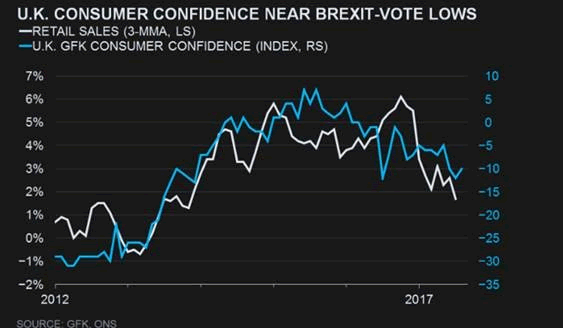
The critical aspect due to which we do not support the strength in the sterling is that the Brexit negotiations are heavily ignored. We have literally no progress and the negotiations process is chocking itself.
The weakness in the consumer spending is largely being ignored. The wage growth is abate and rising inflation is making consumers to tighten their belt even further which is a recipe for a disaster.
ECB Ready
The ECB is expected to make an announcement this week about reinvesting an average of 15 billion euros a month from maturing debt holdings. This would have a twofold impact; firstly, it would soften the blow on the Eurozone's economic growth when the ECB will start its monetary policy tapering process. And finally, it would send a clear signal for the euro traders that the tapering process is going to become reality now and that could see more upward movement for the euro-dollar pair.