

Sample Category Title
XAUUSD Analysis: Breaks Long-Term Channel Up
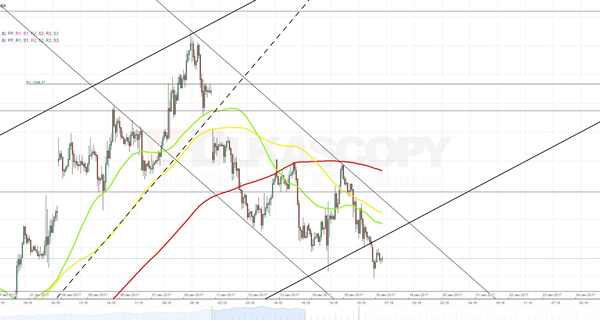
Even though information released about the US Core Retail Sales appeared to be worse than analysts expected, the pair did not manage to stay in a long termascending channel. It seems that the breakout was triggered by a combined pressure from the 55- and 100-hour SMAs.
Today the pair is likely to continue to move to the bottom, trying to reach the updated weekly S1 at 1,310.77. A recovery of the yellow metal is not expected to follow, as the northern side is reliably secured not only by the above 55- and 100- hour SMAs, but also by the updated weekly PP at 1,325.63 as well as the upper boundary of a new junior channel down.
EUR/USD: US Retail Sales
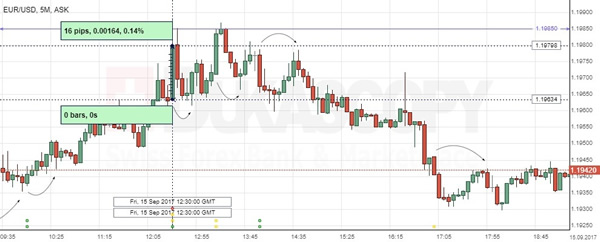
The EUR/USD revealed temporary appreciation amid weaker-thanexpected reports on retail sales in the US. The European single currency added against the Greenback 0.14% or 16 base points to enter the 1.1980 area, but continued a side move at a slightly weaker level.
The Commerce Department reported that the US retail sales dropped unexpectedly 0.2% over the month of August, missing expectations for a 0.3% increase. The negative changes were mainly due to depressed purchases of motor vehicles likely after Hurricane Harvey, which could cause a further moderation in consumer spending in the Q3. However, a rise in purchases at restaurants and furniture outlets suggested the demand is set to be supported by a healthy labour market.
EUR/GBP: EU Trade Balance
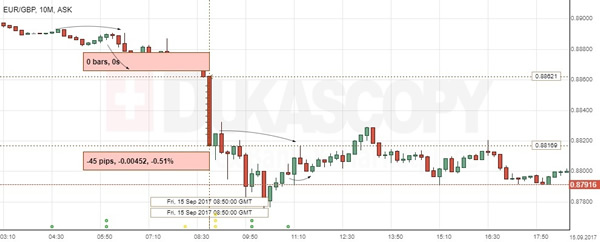
The Sterling strengthened significantly against the Euro, continuing to benefit from strong inflation data and a more hawkish stance of the Bank of England. The EUR/GBP exchange rate fell 0.51% or 45 base points ahead of the report showing diminished EU trade balance. Data managed to keep the pair consolidating below the 0.8820 level.
According to the Eurostat, the European Union's trade balance release for July marked that the surplus decreased more than expected to €18.6B from €22.3B registered previously, supporting the bearish sentiment in the pair. However, while businesses put off investments and the UK households kept suffering from a real income squeeze amid Brexit fears, the EUR/GBP is set to be seen at 0.90 by the end of 2017.
Euro Opens The Week Neutral
The EURUSD pair is tentatively trading above its calculated weekly pivot point, located at 1.1938. Traders should watch this level closely for further confirmation of the euros intraday directional bias.
Key intraday resistance above the 1.1938 level is located at 1.1957 and 1.1979. Above 1.1979, the euro may further test towards 1.1999 and 1.2030.
The EURUSD pair has opened the week with a neutral trading bias, with the pair holding above the 1.1900 handle, but seemingly unable to move price-action back above the key 1.1979 level.
This week the euro faces a number of key risk events, firstly, we have the U.S Federal Reserve interest rate decision and monetary policy statement mid-week, and then we see the results of the German Federal over the coming weekend.
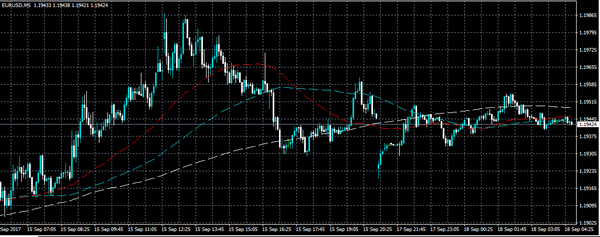
The EURUSD pair is tentatively trading above its calculated weekly pivot point, located at 1.1938. Traders should watch this level closely for further confirmation of the euros intraday directional bias.
Key intraday resistance above the 1.1938 level is located at 1.1957 and 1.1979. Above 1.1979, the euro may further test towards 1.1999 and 1.2030.
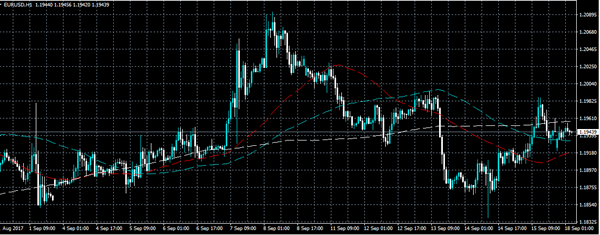
Key intraday support below the 1.1938 level is found at found at the 50-hour moving average at 1.1917 and the former swing price low, at 1.1907.
Below 1.1900, traders should look to the 1.1889 level for further support, and the key 50-period moving average on the monthly time-frame, at 1.1871.
Pound Risks Price Correction
The British pound risks a possible price correction against the U.S dollar, with BOE Governor speaking today and bearish MACD divergence forming on the price charts over the lower- time frames.
Sterling remains at elevated trading levels as the new trading week gets underway, with the pair trading just below the key 1.3600 handle. On Friday the pair topped at the 1.3616 level, with price-action managing only a minor correction lower, to 1.3554.
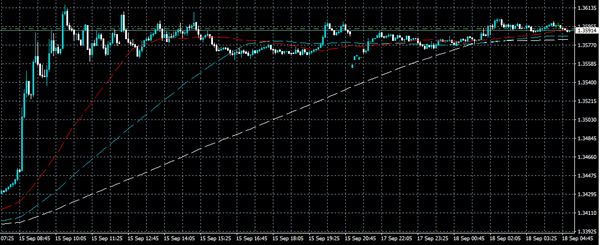
The GBPUSD pair remains strongly bullish on all time-frames, however technical indicators warn of a possible retracement towards the 1.3400 handle.
Intraday sellers may need further confirmation that an interim price-high has been reached, before the correction gathers momentum.
Key upside resistance areas for the GBPUSD pair remain 1.3610, 1.3630 and 1.3654.
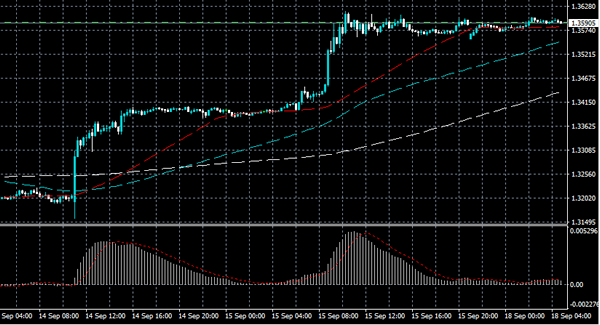
Key downside GBPUSD technical support is located at 1.3580 and 1.3554.
Further intraday support is found at the pairs daily pivot point, at 1.3533, and the psychological 1.3500 level.
Data-Packed Week Begins With Eurozone CPI On Monday
Investors are bracing for a highly active week in the financial markets, with a deluge of economic data and a pair of monetary policy statements scheduled to make headlines. The Monday session features a lighter schedule, but one that could still impact the currency markets ahead of more compelling releases later in the week.
Action begins at 08:00 GMT when the Italian government reports on the July trade balance. The headline numbers include global trade flows as well as EU-specific balances.
One hour later, the European Commission’s statistical agency will release the final August consumer price index (CPI). Annual inflation is forecast to come in at 1.5%. So-called core inflation, which strips away volatile food and energy products, is expected to reach 1.2% year-over-year.
The German Buba Monthly Report is tentatively scheduled for Monday, although no timeframe has been provided. The monthly release contains relevant articles, speeches and analyses of current economic conditions from the perspective of the Deutsche Bundesbank.
Shifting gears to North America, the Canadian government will report on foreign portfolio investment at 12:30 GMT. Ninety minutes later, the US National Association of Home Builders (NAHB) will unveil its September Housing Market Index. The NAHB indicator provides an important snapshot of the housing market from the perspective of national homebuilders.
After a solid start to the week, the US dollar index (DXY) declined sharply on Thursday and Friday. The DXY basket held steady during Asian trade, and was last seen hovering at 91.89.
In commodities, gold and silver prices drifted slightly lower following last week’s broad downward correction.
EUR/USD
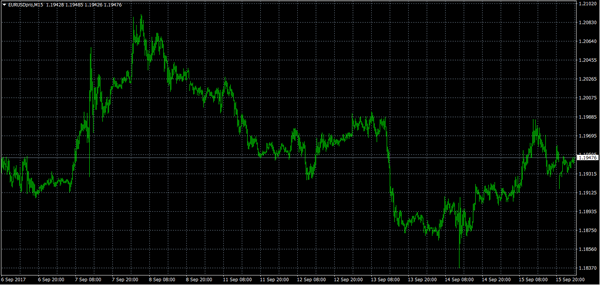
The euro regained its footing on Friday to settle at 1.1950 US. The EUR/USD exchange rate had suffered a sharp retreat earlier in the week back below 1.1900. The pair was last seen trading at 1.1949. The euro’s outlook remains favourable, as the combination of strong economic data and a dovish dollar continues to drive the common currency higher. The Federal Reserve policy decision on Wednesday could have a major impact on dollar pairs, including the euro.
USD/CAD
The USD/CAD kept a steady hand last week, as the pair hovered between 1.2100 and 1.2200. The pair was last seen trading at the upper end of that range, or roughly 20 pips below 1.2200. Immediate support is located in the mid-1.2100s and a loss of this region could spark a bigger pullback toward the 1.2075 level. On the upside, resistance has formed in the 1.2230 area.

GOLD
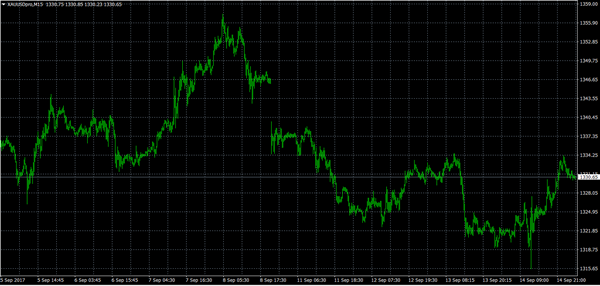
After a strong start to the month, gold prices have been in a downward consolidation for the past week. The loss in momentum was accompanied by the return of risk sentiment, as investors shrugged off the latest provocation from North Korea. Prices are hanging around $1,320.00. The US dollar is likely to provide fresh trading catalysts over the next five days.
Can Euro Resume Uptrend Above 1.2000 Vs US Dollar?
Key Highlights
- The Euro corrected lower from the 1.2092 swing high against the US Dollar, and traded below 1.1900.
- There was a break below a crucial bullish trend line with support near 1.1900 on the 4-hours chart of EUR/USD.
- China's house price index in August 2017 increased 8.3%, compared with the last +9.7%.
- China's new loans in August 2017 were 1,090.0B, compared with the forecast of 900.0B.
EURUSD Technical Analysis
The Euro struggled to move past 1.2100 recently against the US Dollar and started a correction. The EUR/USD pair corrected to 1.1840 and currently attempting to move back above 1.2000.
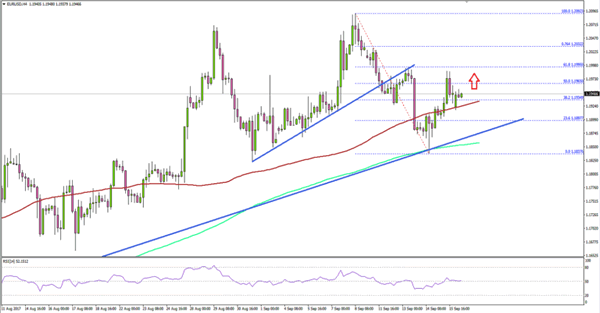
During the downside move from 1.2092, the pair broke a couple of important supports levels. The 1.2000 support, the 100 hourly simple moving average (H4) and 1.1900 were breached. There was also a break below a crucial bullish trend line with support near 1.1900 on the 4-hours chart.
The pair traded as low as 1.1837 where the 200 SMA (H4) and another bullish trend line prevented declines. The pair recovered well and currently trading above 1.1880 and the 100 SMA (H4).
A proper close above the 50% Fib retracement level of the last decline from the 1.2092 high to 1.1837 low is needed for a push above 1.2000 in the near term. On the downside, the 100 SMA (H4), the trend line support at 1.1900 and the 200 SMA (H4) are important hurdles for sellers.
China's House Price Index and New Loans
Today in China, there were a few low-risk economic releases like the house price index and new loans lined up for August 2017. The house price index released by the National Bureau of Statistics was forecasted to increase 9% in August 2017.
However, the result was less than the forecast as the HPI increased 8.3%. On the other hand, the new loans figure released by People's Bank of China was forecasted to post 900.0B. The actual was better, as the new loans were 1,090.0B, compared with the forecast of 900.0B and more than the last 825.5B.
The M2 Money Supply increased 8.9% in August 2017, compared with the same month a year ago. It was less than the last +9.2% and below the forecast of +9.1%.
Overall, the results were mixed and did not impact the market sentiment for EUR/USD above 1.1900. If the pair continues to hold the 1.1900 support and the 200 SMA (H4), it might continue to move higher.
EURUSD Turns Neutral To Bullish After Rally Stalls Near 1.21
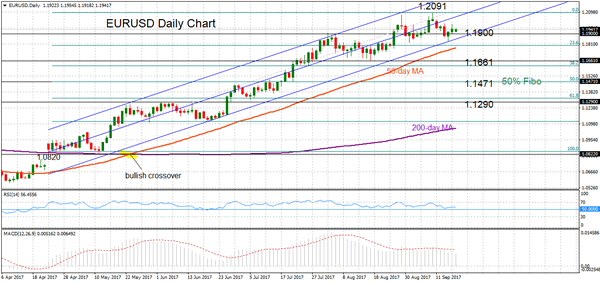
EURUSD remains in a neutral bias after pausing the uptrend from 1.0820 in April. The pair has been trading sideways in the past 3 weeks within a range of 1.1822 to 1.2091. The medium-term technical picture is still bullish and prices continue to rise within the ascending channel but the near-term outlook has shifted to a consolidation phase.
After the market reached its highest level in over 2 years on September 8 at 1.2091, EURUSD retreated to the 1.1900 area. This is now a key support level. Downside risk has diminished as RSI has stopped falling and is now flat while it remains in bullish territory above 50. MACD is horizontal and is well above the zero line which also indicates the absence of downside momentum.
Should prices fall below 1.1900 and extend lower from the range low of 1.1822, the focus will clearly turn to the downside with support at 1.1661 coming into view. A deeper fall would target a previous resistance-turned-support zone at 1.1471. Falling below this level would see the market retrace more than 50% of the 1.0820 – 1.2091 uptrend and likely move lower to 1.1290 and then 1.1100 before reversing the whole uptrend.
There is little immediate risk of a downturn for now but EURUSD needs a strong bounce from current levels to clear the 1.2091 peak in order to see a resumption of the uptrend that started in April.
EURUSD maintains a technically bullish tone for the medium-term and trend indicators are bullish. The 50-day and 200-day moving averages are positively aligned and are sloping upwards. The short-term bias is neutral as momentum signals are turning flat and suggest the market is entering a consolidation phase.
Gold Has Turned Increasingly Bearish After Retreating From 1-Year Highs
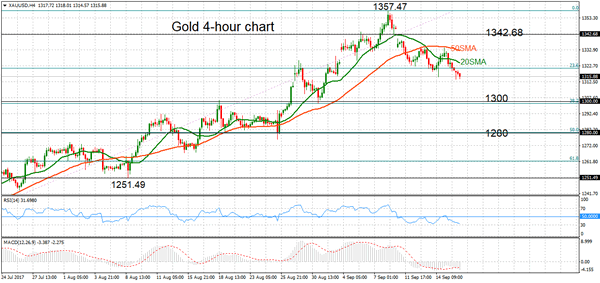
Gold has turned increasingly bearish in the short term after the 50-period moving average fell below the 20-period MA last week. Momentum oscillators on the 4-hour chart are giving bearish signals.
After rallying to a more than a 1-year high of 1357.47 on September 8, the rally lost steam as the market became overextended. This was indicated by RSI rising above 70 into overbought territory. Gold prices failed to sustain gains at these levels and consequently fell below an important support level at 1342.68 and the market has been carving out lower highs and lower lows since the 1357.47 peak.
Momentum oscillators are now bearish, with RSI below 50 and MACD below zero, thereby increasing the risk to the downside. The focus has shifted to the key 1300 level which is expected to provide support. From here, prices could target the 1280 level which is the 50% Fibonacci retracement level of the uptrend from 1204.79 to 1357.47 (July 10-September 8). A move lower would increase the bearish view and result in a reversal of the July to September uptrend.
Not much damage has been done to the medium-term bullish market structure but gold prices are expected to stay under pressure in the near-term unless they can reclaim and stay above the 1335 area. Such a move would increase the odds for a re-test of the 1357.47 peak and bring a resumption of the uptrend. For now, the near-term bearish bias is expected to remain.
Safe-Havens Pull Back As US Seeks Peace With N.Korea, Dollar Steady Ahead Of FOMC
On Monday, safe-haven currencies were trading lower as UN leaders were preparing to kick off a meeting on Tuesday to discuss possible solutions on North Korea's nuclear programs, with the US seeking a peaceful resolution. The dollar was hovering sideways ahead of the FOMC meeting.
With the economic calendar lacking significant releases during the Asian session, the dollar index was mainly flat at 91.88 as investors were waiting for the two-day FOMC meeting ending on Wednesday. Although investors anticipate Fed policymakers to keep rates unchanged, they will be focused to hear whether the Fed will start shrinking its $4.4 trillion balance sheet.
Attention will be also paid to Trump's speech at the UN General Assembly on Tuesday, where leaders from all over the world will gather to discuss options on how to discourage North Korea's threatening nuclear programs. The US Secretary of State, Rex Tillerson, said that the US seeks for a peaceful resolution but if efforts fail to deter North Korea's nuclear actions, then the country will use its military options.
The safe-haven currencies moved lower on the above news, with dollar/swissie climbing by 0.20% to 0.9611, while dollar/yen peaked at an eight-week high of 111.39 after the Japanese Prime Minister, Shinzo Abe, called for a snap election probably in the next two months.
According to government sources, Abe is considering calling elections in mid-October or after Trump's visit in November to take advantage of his party's leading position against the opposition party. Recent ratings showed that the ruling party attracted 50% of voters polled following Abe's response on North Korea's missile tests as well as conflicts observed within the opposition party.
Besides that, market watchers will keep a close eye on the BOJ policy meeting on Thursday, where expectations are for the central bank to maintain its ultra-easy monetary policy.
The pound slipped to $1.3570 after it touched a one-year high of $1.3615 on Friday. This arose after the BOE Monetary Policy Committee (MPC) member, Gertjan Vlieghe, clarified that the central bank should raise rates “as early as in the coming months”.
Euro/dollar changed hands at 1.1937 ahead of the Eurozone's final inflation readings for August later today.
The aussie and the kiwi gained against the greenback as investors were looking for riskier assets. The aussie jumped by 0.16% to $0.8015, while the kiwi was up by 0.21% at $0.7300, hitting a one-month high of $0.7342 earlier in the session.
Regarding commodities, oil prices were in an uptrend during the Asian trading, with WTI crude rising by 0.52% to $50.15 per barrel and Brent being 0.13% higher at $55.69. This came after the OPEC report signalled increasing demand in 2018 and the number of US drilling rigs for new production reported last week fell.
Gold was weaker by 0.30% at $1,315.90 per ounce amid lower risk-off sentiment.