

Sample Category Title
Gold Yawns as Preliminary GDP Revised Upwards
Gold is showing little movement in the Wednesday session. In North American trade, spot gold is trading at $1309.06, down 0.03% on the day. In economic news, Preliminary GDP posted a strong gain of 3.0%, beating the estimate of 2.7%. There was more positive news from the employment front, as ADP Nonfarm Payrolls jumped to 237 thousand, crushing the forecast of 185 thousand. On Thursday, the US releases unemployment claims.
US numbers looked sharp on Wednesday. Preliminary GDP (second estimate) for the second quarter was revised to 3.0%, a marked improvement from the first estimate of 2.6%. Consumer confidence and spending remain strong and helped contribute to the strong GDP report, as the economy posted its strongest gain since the first quarter of 2015. However, solid consumer spending has failed to boost inflation, which continues to hover at low levels. The lack of inflation could hamper the Federal Reserve's plans to raise interest rates, with the likelihood of a rate hike in December standing at just 35%. On the employment front, ADP Nonfarm Payrolls jumped to 237 thousand, marking a 3-month high. The official Nonfarm Payrolls report will be released on Friday, and if this indicator also beats the forecast, it would be a strong signal that the economic momentum has continued into the third quarter.
Gold is considered a safe-haven asset, and renewed tensions in the Korean peninsula earlier this week propelled the metal above the symbolic $1300 level. On Tuesday, North Korea fired a missile over Japanese territory, drawing sharp condemnations from Japan and the US, with President Trump declaring that "all options remain on the table". However, tensions have since eased somewhat, restoring risk appetite and sending gold prices lower. Still, if North Korea decides to fire another missile towards Japan or the US military base on Guam, it is likely that gold prices will move higher.
Pound Shows Little Change as US GDP Jumps
The British pound continues to have an uneventful week. In Wednesday's North American session, the pair is trading at 1.2914, down 0.04% on the day. On the release front, British Net Lending to Individuals slowed to GBP 4.8 billion, missing the estimate of GBP 5.3 billion. This marked a 3-month low. In the US, Preliminary GDP impressed with a sharp gain of 3.0%, beating the estimate of 2.7%. There was more positive news from the employment front, as ADP Nonfarm Payrolls jumped to 237 thousand, crushing the forecast of 185 thousand. Later in the day, Japan releases Preliminary Industrial Production, with the markets braced for a decline of 0.4%. On Thursday, there are a host of key events in the US, led by unemployment claims.
The US economy scored well on its GDP report card on Wednesday. Preliminary GDP (second estimate) for the second quarter was revised to 3.0%, a marked improvement from the first estimate of 2.6%. Consumer confidence and spending remain strong and helped contribute to the strong GDP report, as the economy posted its strongest gain since the first quarter of 2015. However, solid consumer spending has failed to boost inflation, which continues to hover at low levels. The lack of inflation could hamper the Federal Reserve's plans to raise interest rates, with the likelihood of a rate hike in December standing at just 35%. On the employment front, ADP Nonfarm Payrolls jumped to 237 thousand, marking a 3-month high. The official Nonfarm Payrolls report will be released on Friday, and if this indicator also beats the forecast, it would be a strong signal that the economic momentum has continued into the third quarter.
Have the Brexit negotiations hit a brick wall? Talks have resumed in Brussels, as the two sides are meeting for a third round of talks this week. There are large gaps between the sides, and even the range of topics to be discussed at the onset is in dispute. Britain wants to discuss a future trading relationship with the EU at the same time that points in contention are dealt with, but the Europeans insist on solving the contentious issues first, such as the size of Britain's bill and the jurisdiction of the European High Court on European citizens living in the UK. With plenty of distrust between the sides, the negotiations could grind to a halt if both sides don't show greater flexibility.
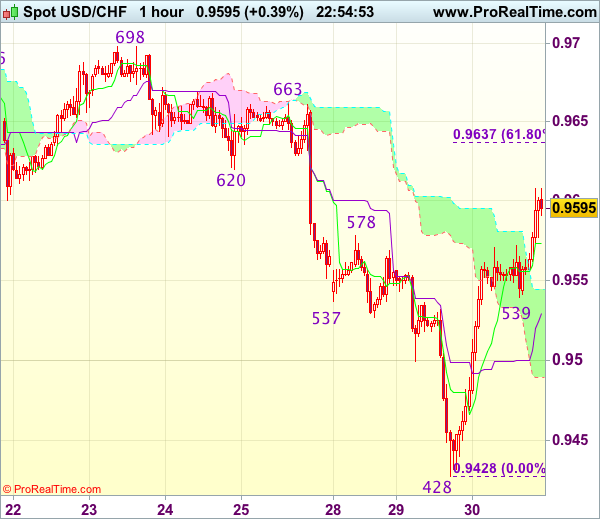
Trade Idea Wrap-up: USD/CHF – Buy at 0.9540
USD/CHF - 0.9596
Most recent candlesticks pattern : N/A
Trend : Down
Tenkan-Sen level : 0.9574
Kijun-Sen level : 0.9534
Ichimoku cloud top : 0.9545
Ichimoku cloud bottom : 0.9489
Original strategy :
Buy at 0.9540, Target: 0.9640, Stop: 0.9505
Position : -
Target : -
Stop : -
New strategy :
Buy at 0.9540, Target: 0.9640, Stop: 0.9505
Position : -
Target : -
Stop : -
As the greenback found good support at 0.9428 and has staged a strong rebound, suggesting recent decline has formed a temporary low there and consolidation with upside bias is seen for gain to previous support at 0.9620 then 0.9637-40 (61.8% Fibonacci retracement of 0.9766-0.9428), however, near term overbought condition should prevent sharp move beyond resistance at 0.9663 and price should falter below 0.9698-99 resistance, bring retreat later.
In view of this, we are looking to buy dollar on pullback as 0.9539 support should limit downside and bring another rebound later. Below 0.9500-10 would defer and suggest first leg of rise from 0.9428 has ended, risk weakness to 0.9470 but price should stay well above said support at 0.9428, bring another rebound.
Dollar Extends Rebound on US Data; Euro Runs Out of Steam
Risk sentiment improved notably on Wednesday as geopolitical risks ebbed, helping the US dollar extend its gains into the European session. The euro was the worst performing major currency as the three-day sharp rally ran out of steam. The commodity-driven Canadian, Australian and New Zealand dollars also came under pressure against the resurgent dollar but the pound was a surprise outperformer.
The euro was unable to hold on to the $1.20 handle after rising above the level yesterday for the first time since January 2015. Stronger-than-expected Eurozone business survey data was unable to lift the euro, which stood 0.4% lower at $1.1923 in late session. It was down a similar amount against the pound at 0.9227, but was flat versus the yen at 131.41.
The European Commission's economic sentiment index beat expectations of 111.3 to rise to 111.9 in August (the highest since 2007) from 111.3 in July. The business climate index also came in above forecasts, rising to 1.09 from the prior 1.04.
The pound benefited from the weakness in euro/pound with cable holding above 1.29 for most of the day. Sterling was up the most against the Canadian and New Zealand dollars, as well as the yen. There was little reaction to Bank of England data showing UK consumer lending expanded at the slowest rate in a year in July, adding to concerns of weakening consumer spending. The pound was last trading flat on the day at $1.2919.
The greenback's overnight rebound gathered momentum at the start of US trading today on the back of upbeat US data. The ADP employment report, seen as a good indication for the official nonfarm payrolls report due on Friday, showed a surprise jump in private-sector jobs of 237k in August. This was the biggest increase in five months and was well above forecasts of 183k and higher than July's upwardly revised 201k.
Further boosting the dollar was the second estimate of GDP growth for the second quarter. Annualized growth in the three months to June was revised up from 2.6% to 3.0%, beating forecasts of 2.7%. US consumer spending rose more strongly than initially estimated but there was no revision to the core PCE price index, which was left unchanged at 0.9% in the second quarter.
The dollar hit a two-week high of 110.43 yen immediately after the data, while the dollar index rose to 92.87, which was a three-day high. A tweet by US President Trump created a brief panic that drove the dollar down to just above the 110 level, before recovering to around 110.20 yen. Trump tweeted "talking is not the answer". However, it was unclear if the President was talking about military action as some reports suggested he may have been referring to US efforts to impose an oil embargo on North Korea.
The Australian dollar could not keep its Asian session gains as the greenback's rebound pushed the aussie lower to $0.7911. The New Zealand dollar fell even more steeply to trade around $0.7210, following another exchange rate warning by RBNZ Governor Graeme Wheeler earlier in the day.
Gold prices were steadier today after coming off 9½-month highs on Tuesday. The precious metal was marginally higher on the day at $1309.50.
Oil prices fell on Wednesday despite another drop in crude stocks in the latest weekly inventory numbers from the US Energy Information Administration. US oil stocks fell by a bigger-than-expected 5.39 million barrels last week versus forecasts of a drawdown of 1.91 million. Gasoline stocks rose unexpectedly but the trend will likely reverse next week for both crude and gasoline stocks as the impact of Tropical Storm Harvey starts to affect inventory levels.
WTI crude was down 1.3% at $45.84 a barrel, while Brent crude declined by 1.4% to $51.29.
The inventory data weighed on the Canadian dollar which fell 0.7% against its US counterpart. A smaller-than-forecast current account deficit for Canada in the second quarter provided little support. Dollar/loonie recovered sharply from yesterday's 4-week lows to reclaim the 1.26 level in late European trading today.
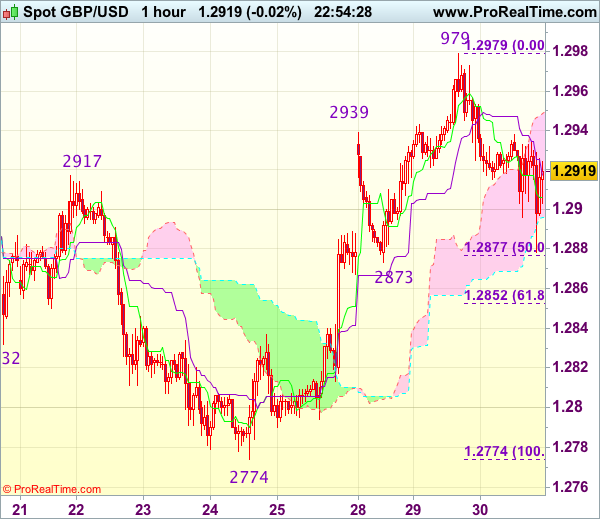
Trade Idea Wrap-up: GBP/USD – Buy at 1.2855
GBP/USD - 1.2917
Most recent candlesticks pattern : N/A
Trend : Near term up
Tenkan-Sen level : 1.2906
Kijun-Sen level : 1.2916
Ichimoku cloud top : 1.2950
Ichimoku cloud bottom : 1.2896
Original strategy :
Buy at 1.2875, Target: 1.2975, Stop: 1.2840
Position : -
Target : -
Stop : -
New strategy :
Buy at 1.2855, Target: 1.2955, Stop: 1.2820
Position : -
Target : -
Stop : -
Cable’s retreat after rising to 1.2979 yesterday suggests a temporary top has been formed there and consolidation with initial downside bias is seen for correction to 1.2873 support, however, renewed buying interest should emerge around 1.2852-55 (61.8% Fibonacci retracement of 1.2774-1.2979) and bring rebound later, above 1.2955-60 would signal the retreat from 1.2979 has ended, bring retest of this level, break there would extend recent rise from 1.2774 (last week’s low) to 1.3000, then towards previous resistance at 1.3032 which is likely to hold from here.
In view of this, we are looking to buy sterling on further pullback as 1.2852-55 should limit downside. Below previous resistance at 1.2837 would defer and signal first leg of upmove from 1.2774 has ended, risk weakness to support at 1.2813 but price should stay well above support at 1.2774, bring another rebound later.
Greenback Restores Previously Lost Positions
Today's trading session was full of important events. First up, the head of the Reserve Bank of New Zealand, Governor Wheeler, stated that the weakening of the New Zealand dollar is needed to balance economic growth in the country. This statement together with the US dollar strengthening has led to a confident price decline of the NZD/USD. International rating agency, Moody's, released positive news for China's GDP growth forecast with an increase to 6.8% from the previously forecasted 6.6%. As a key trading partner for New Zealand, the good news out of China was still unable to change price dynamics for the kiwi dollar.
Moody's also improved the forecast on economic expansion in the Eurozone for 2017 and 2018 to 2.1% and 1.9% respectively. Despite this fact, the EUR/USD was under pressure from the strong GDP report out of the US, according to which the American economy increased by 3.0% in the second quarter - 0.3% better than the expected figure. Traders are still waiting for the labor market report in the US, which will be released on Friday. Additional pressure on the pair's quotes may come from profit taking after a prolonged rally and short position accumulation by the bears on the background of fears that the euro is overbought at the moment.
The USD/CAD is growing on the background of strong macro data from the US and increased demand for the USD. The current account balance deficit in Canada has grown to 16.3 billion in the second quarter against 12.9 billion in the previous period and that, together with the fall of oil quotes, is negative for the Canadian dollar.
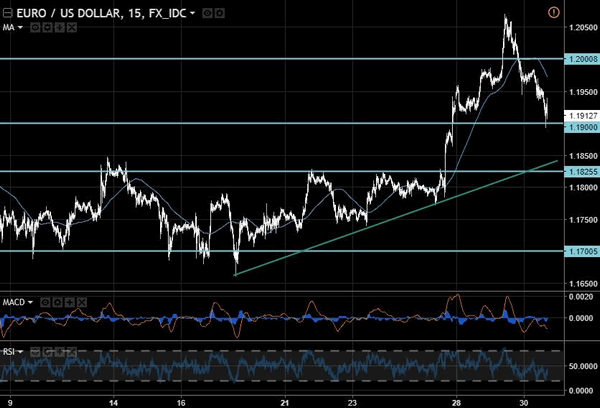
EUR/USD
On the EUR/USD price chart we saw the formation of the "head and shoulders" figure that is considered to be a reversal pattern. As a result, quotes tested the support at 1.1900 and its breaking may become the trigger for continued declines to 1.1825 and 1.1700. The upward correction is limited by the local resistance at 1.1950 and its overcoming may lead to further growth up to 1.2000 and 1.2060.
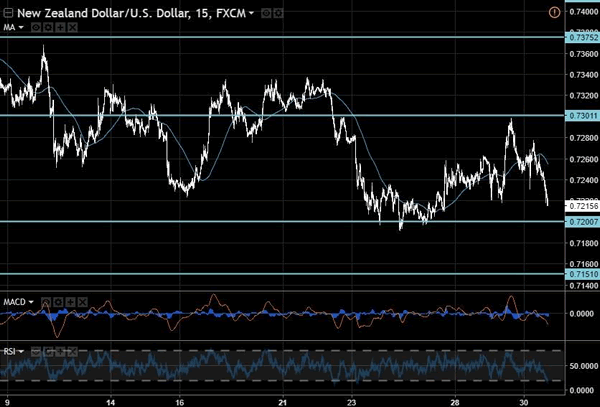
NZD/USD
The NZD/USD fell sharply today and the closet objective within the current impulse is located at 0.7200. Fixing below this line may become the signal to accumulate short positions with the fall potential to 0.7150, 0.7050 and 0.7000. The RSI on the 15-minute chart is in the oversold zone which points to a potential upward correction soon. In this case the price may return to the 0.7260-0.7300 range.
USD/CAD
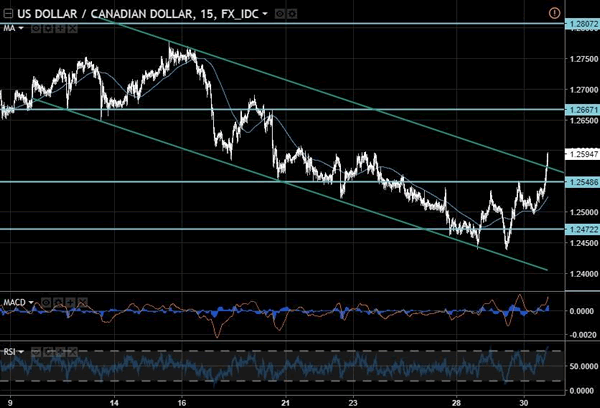
The USD/CAD price has broken through the local high at 1.2550 and the upper limit of the descending channel. This fact may become a trigger for the trend change to positive with immediate goals at 1.2665 and 1.2800. After the sharp increase, we do not exclude a price correction with the first objective at 1.2550.
Trade Idea Wrap-up: EUR/USD – Stand aside
EUR/USD - 1.1906
Most recent candlesticks pattern : N/A
Trend : Up
Tenkan-Sen level : 1.1932
Kijun-Sen level : 1.1966
Ichimoku cloud top : 1.2008
Ichimoku cloud bottom : 1.1928
New strategy :
Stand aside
Position : -
Target : -
Stop : -
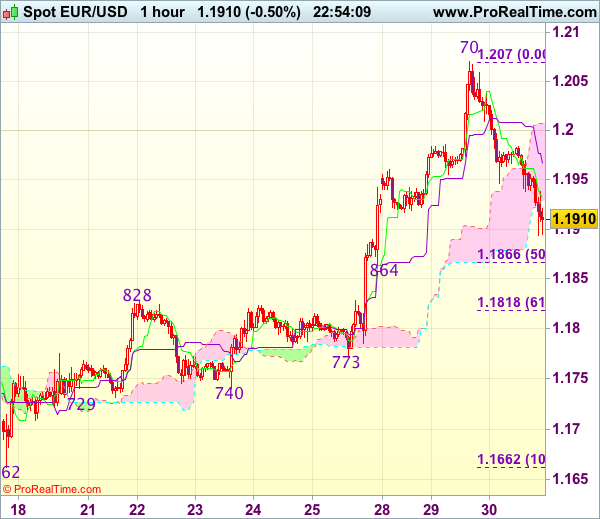
The single currency slipped again after yesterday’s sharp retreat from 1.2070, dampening our bullishness and suggesting top has been formed there, hence downside risk remains for retracement of the rise from 1.1662 and weakness to 1.1890-95 cannot be ruled out, however, reckon downside would be limited to 1.1864-66 (previous support and 50% Fibonacci retracement of 1.1662-1.2070) and price should stay above previous resistance at 1.1828, bring rebound later.
On the upside, whilst recovery to 1.1955-60 cannot be ruled out, reckon 1.1980-85 would limit upside and 1.2005-10 should hold, bring retreat later. Above 1.2035-40 would suggest the retreat from 1.2070 has ended, bring another rise towards this level but break there is needed to signal upmove has resumed for headway to 1.2100.
EURUSD Cracked Pivotal Supports at 1.1910 Zone
The Euro cracked pivotal supports at 1.1910 zone on fresh bearish acceleration after upbeat US ADP private sector jobs data (237K in Aug vs 183K forecast) inflated the dollar. The single currency came under increased pressure, generating stronger signals for completion of reversal pattern, forming on daily chart. Close below 1.1900 is needed for confirmation and signal of deeper correction. Rising daily Tenkan-sen (1.1889) is under pressure, with break lower to open pivots at 1.1841 (daily Tenkan-sen) and 1.1818 (Fibo 61.8% of 1.1662/1.2070 upleg).
Res: 1.1984; 1.2000; 1.2070; 1.2101
Sup: 1.1889; 1.1866; 1.1841; 1.1818
Trade Idea Wrap-up: USD/JPY – Buy at 109.55
USD/JPY - 110.16
Most recent candlesticks pattern : N/A
Trend : Near term up
Tenkan-Sen level : 110.13
Kijun-Sen level : 109.55
Ichimoku cloud top : 109.06
Ichimoku cloud bottom : 108.73
Original strategy :
Buy at 109.55, Target: 110.55, Stop: 109.20
Position : -
Target : -
Stop : -
New strategy :
Buy at 109.55, Target: 110.55, Stop: 109.20
Position : -
Target : -
Stop : -
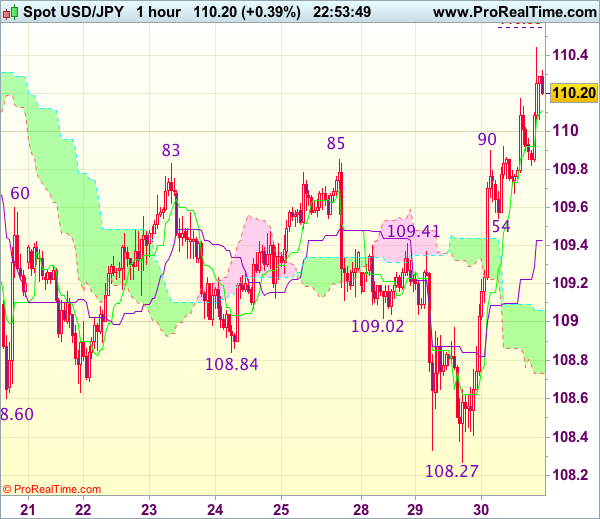
As the greenback has staged a strong rise after holding above previous chart support at 108.13, suggesting the decline from 114.50 has ended at 108.27 yesterday and mild upside bias is seen for this move to bring retracement of recent decline, hence bullishness remains for further gain to 110.55 (61.8% projection of 108.27-109.90 measuring from 109.54), however, reckon 110.75-80 would limit upside and price should falter below resistance at 110.95, bring retreat later.
In view of this, would not chase this rise here and we are looking to buy dollar on pullback as support at 109.54 should limit downside and bring another upmove. Below said support (this would also penetrate the Kijun-Sen now at 109.55) would defer and suggest an intra-day top is formed instead, bring weakness to 109.05-10 first.
USD/JPY – Dollar Gains as US GDP Sparkles
USD/JPY has posted gains in the Wednesday session. In North American trade, the pair is trading at 110.22, up 0.45% on the day. On the release front, Japanese Retail Sales jumped 1.9%, easily beating the forecast of 1.0%. In the US, Preliminary GDP impressed with a sharp gain of 3.0%, beating the estimate of 2.7%. There was more positive news from the employment front, as ADP Nonfarm Payrolls jumped to 237 thousand, crushing the forecast of 185 thousand. Later in the day, Japan releases Preliminary Industrial Production, with the markets braced for a decline of 0.4%. On Thursday, there are a host of key events in the US, led by unemployment claims.
The US economy continues to perform well, and this was underscored on Wednesday, as Preliminary GDP (second estimate) for the second quarter was revised to 3.0%. This figure was a marked improvement from the first estimate of 2.6%. Consumer confidence and spending remain strong and helped contribute to second quarter growth, which posted its strongest gain since the first quarter of 2015. However, solid consumer spending has failed to boost inflation, which continues to hover at low levels. The lack of inflation could hamper the Federal Reserve's plans to raise interest rates, with the likelihood of a rate hike in December standing at just 35%. On the employment front, ADP Nonfarm Payrolls jumped to 237 thousand, marking a 3-month high. The official Nonfarm Payrolls report will be released on Friday, and if this indicator also beats the forecast, it would be a strong signal that the economic momentum has continued into the third quarter.
The Japanese yen is considered a safe-haven asset, with the currency often showing volatility following geopolitical tensions. This has been the case this week, as the yen initially posted gains after North Korea fired a missile over Japanese territory on Tuesday, drawing sharp condemnations from Japan and the US. The easing of tensions since the missile launch has enabled the US dollar to recover and push above the symbolic 110 level. Still, if North Korea decides to fire another missile towards Japan, it's a safe bet that the yen will gain ground.
Like other Western economies, Japan remains gripped with low inflation. This has resulted in the Bank of Japan keeping in place its ultra-accommodative monetary policy. Unlike the US and Europe, however, the BoJ has given no indications of tightening policy anytime soon, insisting that that inflation must first rise closer to its target of 2%. The economy is headed in right direction, as GDP has expanded for six consecutive quarters. In the second quarter, GDP impressed with a gain of 1.0%, well above the forecast of 0.6%. Still, with inflation nowhere near the BoJ's target, the bank's radical stimulus program is likely to remain in place for the foreseeable future.