

Sample Category Title
GBP/JPY Daily Outlook
Daily Pivots: (S1) 141.49; (P) 141.78; (R1) 142.31; More
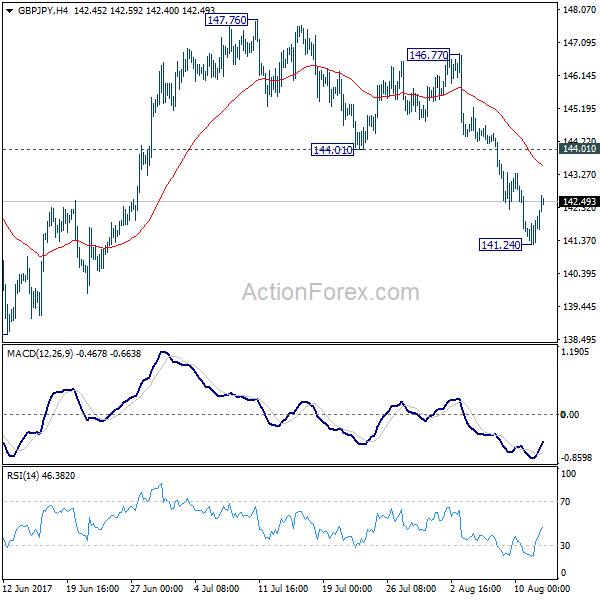
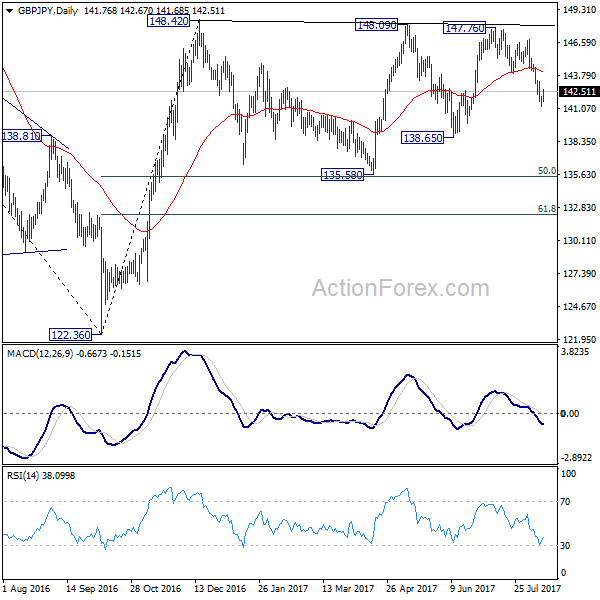
Intraday bias in GBP/JPY remains neutral for consolidation above 141.24 temporary low. Near term outlook stays bearish as long as 144.01 support turned resistance holds. Below 141.24 will extend the fall from 147.76 to 138.65 support and below. As GBP/JPY is seen as staying in consolidation pattern from 148.42, we'd expect strong support from 135.58 to contain downside. On the upside, break of 144.01 will indicate completion of the decline from 147.76 and turn bias back to the upside.
In the bigger picture, the sideway pattern from 148.42 is extending with another leg. But we'd expect strong support from 135.58 and 50% retracement of 122.36 to 148.42 at 135.39 to contain downside. Medium term rise from 122.36 is still expected to resume later. And break of 38.2% retracement of 196.85 to 122.36 at 150.43 will carry long term bullish implications. However, firm break of 135.58/39 will dampen the bullish view and turn focus back to 122.36 low.
EUR/JPY Daily Outlook
Daily Pivots: (S1) 128.33; (P) 128.74; (R1) 129.44; More...
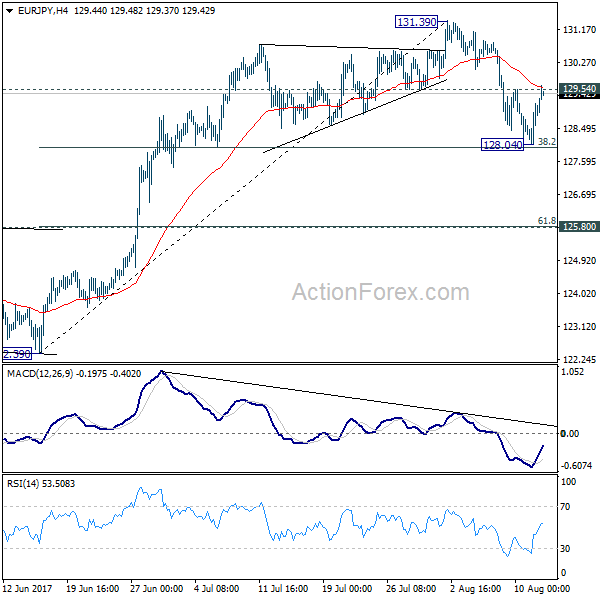
EUR/JPY's recovery from 128.04 extends higher today. Breach of 129.54 minor resistance argues that pull back from 131.39 has completed at 128.04, supported by 38.2% retracement of 122.39 to 131.39 at 127.95 as expected. Intraday bias is turned back to the upside for retesting 131.39. But break there is needed to confirm up trend resumption. Otherwise, we'd likely see more consolidation first. On the downside, sustained break of 127.95, however, will bring deeper decline to 125.80 cluster support (61.8% retracement at 125.82) before completing the correction.
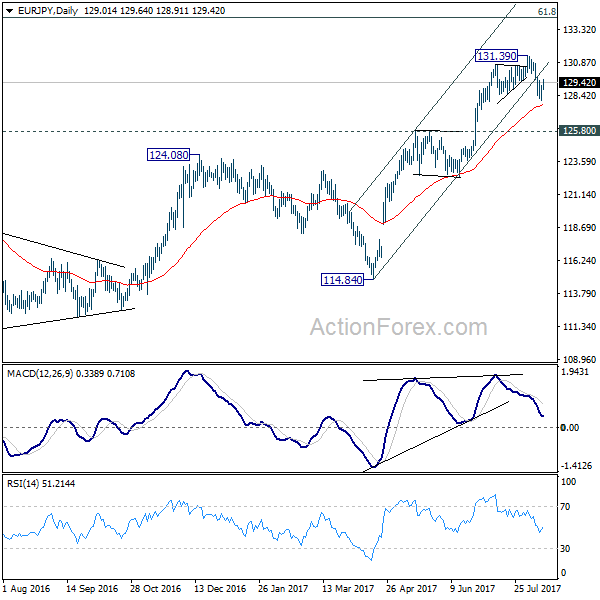
In the bigger picture, the down trend from 149.76 (2014 high) is completed at 109.03 (2016 low). Current rally from 109.03 should be at the same degree as the fall from 149.76 to 109.03. Further rise is expected to 61.8% retracement of 149.76 to 109.03 at 134.20. Sustained break there will pave the way to key long term resistance zone at 141.04/149.76. Medium term outlook will remain bullish as long as 124.08 resistance turned support holds.
Dollar Recovers With No Escalation in US-North Korea Tensions, Japan GDP Grew Strongly in Q2
Dollar recovers broadly today as the markets are calmed down from the concerns over US-North Korea tensions. Meanwhile, Yen and Swiss Franc also soften mildly as a result. There was no further drastic development regarding the tension during the weekend. Chinese President Xi Jinping had a telephone call with US President Donald Trump on Saturday and urged a peaceful resolution to the issue, and all sides to avoid words or actions that escalate the tensions. Focus will temporary turn back to minutes of Fed, RBA and ECB, as well as a large number of global economic data. But markets will also keep one eye on the US-North Korea development.
Japan GDP grew fastest in more than two years
Japan GDP grew 1.0% qoq in Q2, much higher than expectation of 0.6% qoq, more than triple of Q1's 0.3% qoq. On annualized balance, GDP grew 4% in the period, much higher than Q1's 1.5% annualized. The quarterly rate was the fastest pace in more than two years. That's also the sixth straight quarter of expansion as recovery gathered steam. Strong domestic demand, which grew 1.3% qoq, is seen as an encouraging sign of the recovery while private consumption also grew 0.9%. That's more than enough to offset the -0.5% qoq fall in exports of goods and services. GDP deflator dropped less than expected by -0.4% yoy.
China data showed deeper slowdown
China retails sales grew 10.4% yoy in July, down from 11% a month ago. The market had anticipated a milder moderation to 10.8%. Industrial production expanded 6.4% yoy in July, decelerating from 7.6% in the prior month. The slowdown is much sharper than consensus. Urban fixed asset investment expanded 8.3% in the first 7 months of the year, slowing from 8.6% in the first half of the year. The market had anticipated a steady growth of 8.6%. The slowdown in economic activities in China has been widely expected as the government pledged to deleverage in at attempted to defend and prevent systematic risks. However the dataflow in July suggests that the slowdown came in deeper than expected.
Hammond and Fox published joint Brexit article
In UK, Chancellor of Exchequer Philip Hammond and International Trade Secretary Liam Fox released a joint article on Brexit over the weekend. They reiterated that UK will definitely leave EU in March 2019. And, they emphasized any trade deal will not be the "back door" to stay in EU. But they emphasized that a "time-limited" transition period would "further our national interest and give business greater certainty". One of the key takeaways from the article is that Hammond and Fox appeared to be trying to settle their differences regarding Brexit. And that raised the prospect of a more united cabinet on the issue.
New Zealand retail sales jumped on sporting events
New Zealand retail sales rose strongly by 2.0% qoq versus expectation of 0.7% qoq. Core retail sales rose 2.1% qoq, above expectation of 0.7% qoq. Sporting events were the main drivers in the strong growth. More than 28000 people attended the World Masters Game back in April. And there were 23000 visitors from UK and Ireland for the Lions rugby series in June. But these event driven figures won't alter RBNZ's neutral stance.
Fed, RBA and ECB minutes to highlight a busy week
For the rest of today, Eurozone industrial production is the only feature in the calendar. Three central banks will release meeting minutes this week including Fed, RBA and ECB. Fed is generally expected to start unwinding the balance sheet in September. But the focus is on Fed official's mind regarding a December rate hike. On the other hand, markets would like to get more confirmation on whether ECB would announce a tapering plan in September or October meeting.
In addition to that UK will release a string of key data including CPI, employment a retail sales. Sterling has been under pressure against Euro after last month's CPI disappointment. Further downside supply in UK inflation data will drag the Pound lower. From Eurozone, GDP will be the main focus for confirming underlying strength in the recovery. From US a large batch of data will be released with main focus on retail sales. Other data to watch include Australia employment and Canada CPI.
Here are some highlights for the week ahead:
- Tuesday: RBA minutes; German GDP; Swiss PPI; UK CPI and PPI; US retail sales, Empire state manufacturing, import prices, business inventories, NAHB housing market index
- Wednesday: Australia wage price index; Eurozone GDP, Italy GDP; UK employment; US housing starts and building permits; FOMC minutes
- Thursday: New Zealand PPI; Australia employment; Japan trade balance; UK retail sales; Eurozone trade balance, CPI final, ECB meeting accounts; US jobless claims, Philly Fed survey, industrial production, leading indicators.
- Friday: German PPI, Eurozone current account; Canada CPI; US U of Michigan sentiment
EUR/JPY Daily Outlook
Daily Pivots: (S1) 128.33; (P) 128.74; (R1) 129.44; More...
EUR/JPY's recovery from 128.04 extends higher today. Breach of 129.54 minor resistance argues that pull back from 131.39 has completed at 128.04, supported by 38.2% retracement of 122.39 to 131.39 at 127.95 as expected. Intraday bias is turned back to the upside for retesting 131.39. But break there is needed to confirm up trend resumption. Otherwise, we'd likely see more consolidation first. On the downside, sustained break of 127.95, however, will bring deeper decline to 125.80 cluster support (61.8% retracement at 125.82) before completing the correction.
In the bigger picture, the down trend from 149.76 (2014 high) is completed at 109.03 (2016 low). Current rally from 109.03 should be at the same degree as the fall from 149.76 to 109.03. Further rise is expected to 61.8% retracement of 149.76 to 109.03 at 134.20. Sustained break there will pave the way to key long term resistance zone at 141.04/149.76. Medium term outlook will remain bullish as long as 124.08 resistance turned support holds.
Economic Indicators Update
| GMT | Ccy | Events | Actual | Forecast | Previous | Revised |
|---|---|---|---|---|---|---|
| 22:45 | NZD | Retail Sales Q/Q Q2 | 2.00% | 0.70% | 1.50% | 1.60% |
| 22:45 | NZD | Core Retail Sales Q/Q Q2 | 2.10% | 0.70% | 1.20% | 1.50% |
| 23:50 | JPY | GDP Q/Q Q2 P | 1.00% | 0.60% | 0.30% | |
| 23:50 | JPY | GDP Deflator Y/Y Q2 P | -0.40% | -0.50% | -0.80% | |
| 2:00 | CNY | Retail Sales Y/Y Jul | 10.40% | 10.80% | 11.00% | |
| 2:00 | CNY | Fixed Assets Ex Rural YTD Y/Y Jul | 8.30% | 8.60% | 8.60% | |
| 2:00 | CNY | Industrial Production Y/Y Jul | 6.40% | 7.10% | 7.60% | |
| 9:00 | EUR | Eurozone Industrial Production M/M Jun | -0.50% | 1.30% |
Market Morning Briefing: The Dollar Remains Weak Overall Against The Majors
STOCKS
Equities remain on the defensive overall.
Although the Dow (21858, +0.07%) was quiet on Friday after the fall from 22000 over the course of the week, it can test trend-Support near 21700 this week.
The Nikkei (19546, -0.84%) has opened sharply gap-down today, possibly making up for the Japanese holiday last Friday. This opens up chances of further dip to 19400, putting the uptrend since 15000 (June-2016) in danger.
Support at 3200 is holding so far on the Shanghai (3221, +0.4%), but a dip to deeper/ stronger Support 3100 is possible if the Support at 3200 breaks.
The underperformance in the Nifty (9710.80, - 1.1%) could give way to more pronounced bearishness 9500 or even lower.
COMMODITIES
Overall crude prices have some possibility of falling in the coming sessions while Silver could have some more room on the upside. Gold looks bearish.
Gold (1287.59) has come off slightly from levels near 1292 seen last week. Immediate resistance is visible near 1296 which if holds could push off the price towards 1267 in the coming sessions. A break above 1296-1300, if seen could open up chances of testing 1315-1320 on the upside. We will have to remain cautious just now. In case the Dollar Index (93.07) falls towards 92, Gold could strengthen some more in the near term.
Silver (17.09) could test resistance near 17.50 in the coming sessions before coming off towards 16.50-16.00 levels. A break above 17.50 could turn bullish for Silver.
Brent (51.97) is also trading below important resistance near 55 and while that holds, could come off towards 50-48 levels in the near to medium term. Also note an interim support near 51 which if holds, could possibly keep Brent prices stable within 55-51 zone for some sessions. While 51 holds, we may assign less preference to 50-48 levels just now.
WTI (48.75) could test 46.95 before again rising back towards 51-53 levels. Near term looks bearish.
Copper (2.9115) could be headed towards 3.00 in the medium term while above 2.80. Near term looks bullish.
FOREX
The Dollar remains weak overall against the Majors and relatively stronger against the Rupee.
Friday saw fresh strength in the Euro (1.1828) which has risen from a low of 1.1748. Good Support is available at 1.1720-00 now, reducing our concern about the risk of a fall to 1.1650-00.
Surprisingly, there hasn't been much follow-through sales below 109.00 in Dollar-Yen (109.40). Still, the trend remains overall bearish with intra-day/ intra-week Resistance at 109.70-90. At the same time, near-term Support has been established at 108.68. So, a sideways whipsaw movement is a possibility to be considered.
Consequetly, the Euro-Yen (129.36) still manages to trade above 128, a crucial Support on the Weekly Candles. If there is a strong bounce above 130 from here, it might rekindle the "Risk-ON" trade, which had come into doubt last week.
Decent Support is seen at 1.29 for the Pound (1.3016) on the 3-day Candles and dips thereto might get bought for a bounce towards 1.32.
The Aussie (0.7905) has bounced well enough from the Support at 0.7835 mentioned on Friday. As such, it might gather strength to rise further towards 0.80.
Dollar-Rupee saw a high near 64.2650 on Friday before closing a little lower at 64.13/14. The picture is unclear now and people might not take positions given the market is closed tomorrow for Independence Day and on Thursday for Navroz.
INTEREST RATES
The US yields seem to be rising just now but looks bearish for the longer term. the 10Yr (2.19%) could test 2.1% while the 5YR (1.74%) and the 30Yr (2.80%) could test 1.70% and 2.78% respectively before bouncing back in the next few sessions.
The US-Japan 10Yr (2.13%) broke below immediate support near 2.15% and could head towards 2.08% from where a slight bounce is possible. In case it breaks below 2.08%, it could turn bearish for the spread as well as Dollar Yen and Nikkei for the medium term.
The German-US 10Yr (-1.81%) is almost stable while the German-US 2Yr (-2.02%) is slowly inching upwards and could move up in the near future. This could support the Euro strength in the next few sessions.
A Weekend Risk Reprieve, But No Rest For The Wicked
A weekend risk reprieve; but no rest for the wicked
Fears of escalating military tension between North Korea and the US continues to be the market focus but headlines out Charlottesville over the weekend dominated the wires and while not immediately trade impacting it could present further headwinds for the Republican Party which continues to struggle in the court of public appeal.
On the North Korean front, the market's response continues to be a rather low key. With no escalation of rhetoric over the weekend, we should expect the moderate risk reduction from last week to abate reflecting that geopolitical brouhaha can hush as quickly as it started given the overwhelming belief that the risk of a military face off is highly unlikely. However, this is not to say we should expect a risk revival as the Geo jitters could set in again as we head into the joint annual military exercises between South Korea and the US scheduled to start on August 21
As for global macro risk, Friday's US CPI unsurprisingly came in on the tepid side, sitting at 1.7 % YoY shifting the December rate hike probability lower, and disappointing the dollar bulls.
The lack of regional geopolitical escalation over the weekend and the tepid US CPI print should play out well for most Asian currencies. And given the dovish Fed narrative, the local basket remains constructive over the medium term, but short term wobbles related to global equity markets will continue to be a concern over the near future. But with the North Korea panic seemingly pausing and with the “ lower for longer” Fed, we could see some tactical buying and pockets of interest across the region despite the omnipresent headline risk
There is a vast hodge-podge of tier one macro economic data out this week that could distract from the North Korea narrative, but keep in mind the next two weeks are known to be the markets favourite holiday weeks, so liquidity will continue to be a concern ahead September.
Euro
The US CPI miss has the EURUSD trading above the key 1.1800 watermark in early APAC as price action remains relatively stable.The disappointing US inflation report has weighed on dollar sentiment as dealers have slightly lowered their expectations of a December US rate hike
Japanese Yen
With a pause in the North Korea inspired risk reduction, it allows some breathing room for USDJPY to move higher, but Friday's disappointing US CPI and the never-ending cycle of political backfires in Washington, it should keep any top side run in check
Australian Dollar
RBA Governor Lowe's comments that the Central Bank was “Prepared to intervene in AUD in extreme situations” should keep the Australian Dollar top side momentum in check.And while there's a domestic case for a move lower, the topsy turvy US political landscape keeps the US dollar risk very exposed and owning US dollar still a very unappealing trade.
EURUSD – Sets Up To Resume Upside Pressure
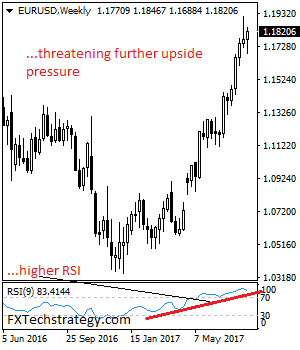
EURUSD - The pair continues to retain its upside pressure as more strength is envisaged in the new week. Resistance comes in at 1.1850 level with a cut through here opening the door for more upside towards the 1.1900 level. Further up, resistance lies at the 1.1950 level where a break will expose the 1.2000 level. Its weekly RSI is bullish and pointing higher suggesting further strength. Conversely, support lies at the 1.1750 level where a violation will aim at the 1.1700 level. A break of here will aim at the 1.1650 level. All in all, EURUSD faces further upside pressure.
GOLD – Strengthens Further Higher On Bull Pressure
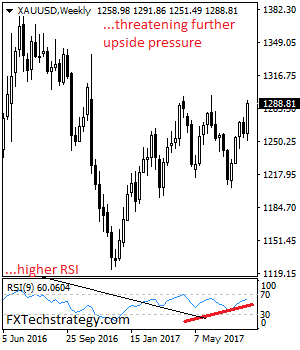
GOLD - With the commodity continuing to hold on to its upside pressure as it close higher the past week. On the downside, support comes in at the 1,280.00 level where a break will turn attention to the 1,270.00 level. Further down, a cut through here will open the door for a move lower towards the 1,260.00 level. Below here if seen could trigger further downside pressure targeting the 1,250.00 level. Conversely, resistance resides at the 1,300.00 level where a break will aim at the 1,310.00 level. A turn above there will expose the 1,320.00 level. Further out, resistance stands at the 1,330.00 level. All in all, GOLD looks to recover further.
Identifying Correlations
Unless you intend on trading one market at a time, it is vital to understand how different instruments markets interact with one another. A correlation, in simple terms, describes how much (or how little) two markets move together over a period of time.
The key thing to remember is that financial markets DO NOT trade in isolation. Currency pairs, for example, deal with TWO economies. You can easily see this by overlaying and comparing different pairs or by simply reading a currency correlation table.
In this article, we'll attempt to cover not only how currency pairs typically interrelate, but also look at what affect commodities, bonds and equities have on the currency markets. With this being a somewhat extensive subject we'll do our best to keep it as concise as possible!
These correlations, however, are not fool proof and do from time-to-time deviate. However, they can help a trader immensely if he/she knows how to correctly use them.
Some correlated currency pairs to keep an eye on
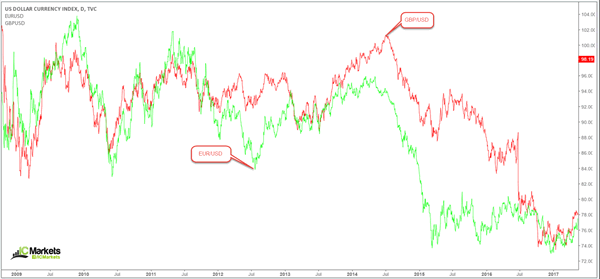
The EUR/USD and GBP/USD usually track each other over 80% of the time. This means that when the EUR/USD puts in a high, you'll typically see a similar scenario over on the GBP/USD.
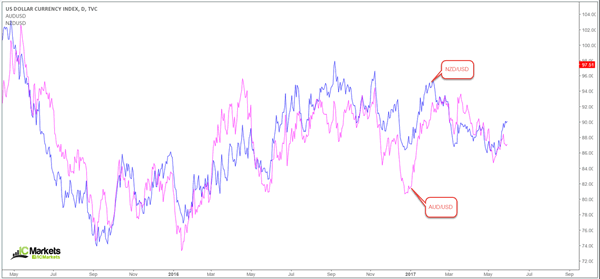
The AUD/USD and NZD/USD are two other markets with a similar relationship as above. Notice that these two instruments almost mirror each other exactly. In fact, these markets move in tandem over 70% of the time!
Over the long haul we can expect the above markets to mirror each other's movements, but there will be times when the correlation deviates and this is usually due to political or economic reasons. Why these correlations exist is largely due to the currency pairs having the quote currency priced in US dollars. For example, imagine that the dollar sold off across the board, this would likely send the EUR, GBP, AUD, and NZD higher. Of course, some markets are more hot-blooded than others, so do not expect each unit to have the same range!
A few inversely correlated currency pairs to pay attention to
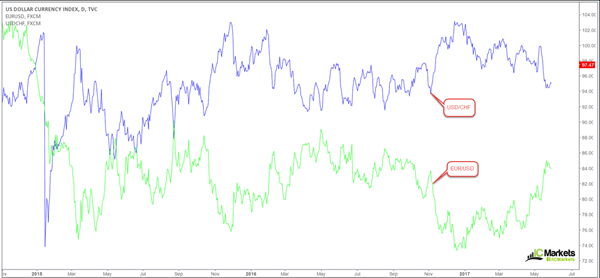
First up is a well-known inverse correlation: the EUR/USD and the USD/CHF. These two pairs tend to trade contrary to one another nearly 90% of the time!
You can see that both pairs have the US dollar in common, one as a quote currency and the other as a base currency. The US dollar is an extremely powerful currency. It is in fact the world's reserve currency. Therefore, when the dollar is bid, this will typically send the USD/CHF higher and the EUR/USD lower. In addition to this, bear in mind that the GBP/USD pair also has a strong inverse correlation to the USD/CHF.
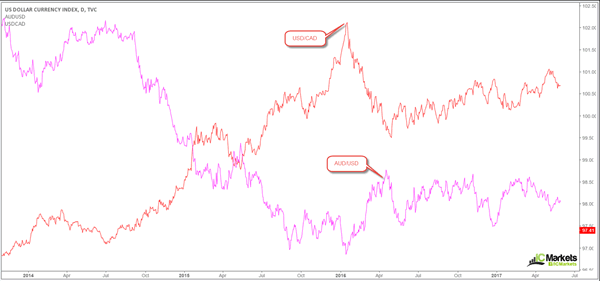
Two other pairs that we also keep a close eye on is the AUD/USD and the USD/CAD. Both pairs generally move opposite to one another around 80% of the time. Both the Aussie and Canadian dollar are considered commodity currencies (we'll touch on this soon), with a specific relationship to gold and oil. Similarly, like the EUR/USD and the USD/CHF, both pairs have the US dollar in common, again one as a quote currency and the other a base currency.
Intermarket correlations
With a brief understanding of how some currency pairs correlate, it would be unwise not to include additional intermarket correlations between the forex market and other financial markets… Grasping an understanding of how stocks, bonds and commodities affect the currency market is, in our humble view, a technical edge by and of itself.
Gold
Let's begin by looking at everyone's favourite yellow metal: gold. Bullion is considered a good hedge against inflation, and is also believed to be a safe-haven asset.
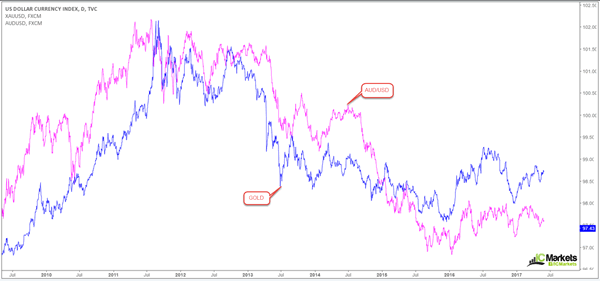
The relationship between gold and the AUD/USD pair is a positive one. Behind China, Australia is the second biggest gold-producing country in the world. So, when the price of gold rallies, the Aussie dollar tends to follow. Therefore, try and avoid buying both the Aussie and gold simultaneously, as you'll be potentially doubling up on risk.
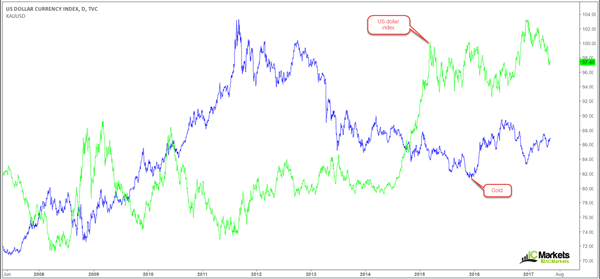
Gold also has an interesting relationship with the US dollar. When the dollar rises in value, it is usually expected to see the price of gold deteriorate. This inverse relationship remains because a falling dollar increases the value of other currencies, and thus increases the demand for gold. When the dollar starts to lose value, investors tend to look for alternative investments, with gold being one of those alternatives. During times of economic unrest, investors also tend to dump the dollar in favour of gold. Unlike other assets, gold maintains its intrinsic value.
Also of interest is the USD/JPY pair and gold. These two instruments continue to trade inversely. This extremely strong correlation shows that gold is, in fact, viewed as a safe-haven asset. So, we can say that gold behaves similarly to the Japanese yen, which is also considered to be a safe-haven currency.
Oil
Before we have a look at oil's effect on currencies, there's an important link between oil and gold that needs addressing, and that is inflation. As the price of crude rises, inflation also rises. Gold, as we briefly mentioned above, is known to be a good hedge against inflation. Therefore, the value of gold increases when inflation is rising. Over 60% of the time, gold and oil are said to have a positive relationship.
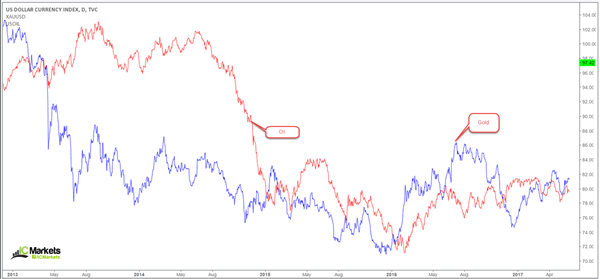
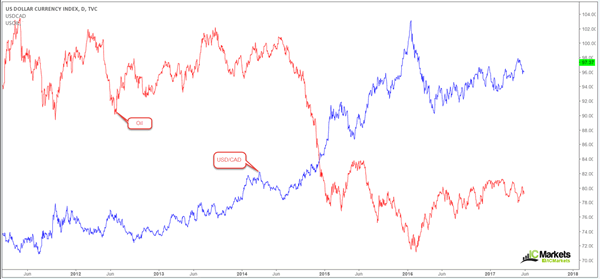
The price of oil also affects the USD/CAD pair. Canada is one of the top oil producers in the world, exporting over 3 million barrels of oil per day to the US. Due to this large volume, the Canadian dollar is in demand. Therefore, if the demand for oil rises, manufactures need more oil which generally leads to a depreciation in the USD/CAD.
US dollar index
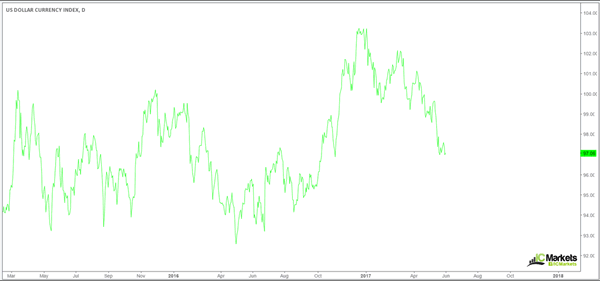
We use this index all of the time as it is beneficial in determining dollar strength. The US dollar index provides investors with a general indication of the value of the US dollar. It does this by averaging the exchange rates between the dollar and six other major currencies (EUR, GBP, JPY, CAD, CHF and SEK). As can be seen from the chart below, the dollar has been struggling since the index topped at highs of 103.0ish. So, with this, we should be seeing a rally in pairs like the EUR/USD, GBP/USD, AUD/USD etc.
Global stock indexes
It might surprise newbie forex traders that there is a relationship present between the global stock markets and currencies. It is certainly something traders/investors should be cognizant of.
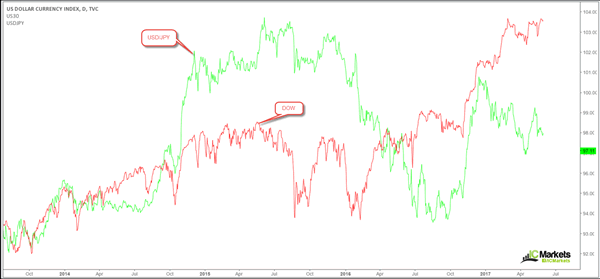
The USD/JPY and the Dow Jones Index generally track each other's movements. Why? Well, from our perspective, it boils down to investor risk appetite. When traders/investors are feeling optimistic about the global economy (the US in particular), they tend to bid both the dollar and stocks. Conversely, when global risks emerge, market participants typically sell equities and the dollar and buy safe-haven assets like gold and the Japanese yen. As you can see, the correlation is not perfect, but it does tend to track each other close to 70% of the time.
Bonds
For the purpose of this article, we'll be talking about the ten-year treasury note. Basically, this instrument is a debt obligation issued by the US government that matures in ten years. It is, in effect, an 'IOU'. So, what does this unit have to do with the currency market?
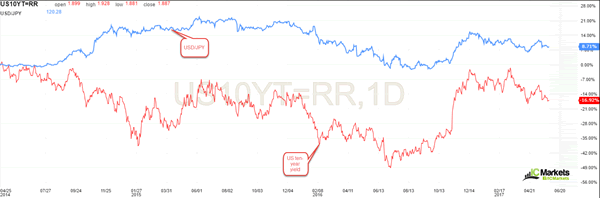
Falling treasury yields tend to be dollar negative, while rising treasury yields typically support the dollar. Bond yield refers to the rate of return, or interest, paid to the bondholder while the bond price is the amount of money the bondholder pays for the bond. Also, do remember that bond prices and bond yields are inversely correlated. Furthermore, government bond yields act as an indicator of the overall direction of the country's interest rates and expectations.
Therefore, when the ten-year yield is on the rise, we can expect the USD/JPY pair to generally follow suit.
How can I use these correlations?
Utilising correlation techniques can help you stay out of positions that could cancel each other out.
For example, let's look at the EUR/USD and the USD/CHF pairs. As we already know, these markets usually trade inverse to one another. So, placing a buy on the EUR/USD and a short on the USD/CHF simultaneously is not a wise move! By the same token, taking a long trade on the EUR/USD and a long on the GBP/USD would, given the close correlation between the two pairs, be similar to doubling your risk!
Having used correlations for years, we like to keep it simple by solely using price action: supply/demand and support/resistance.
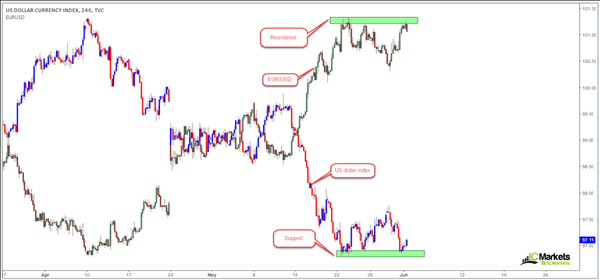
On The chart below, we've plotted the EUR/USD and US dollar index together. Notice how the EUR is currently chiselling in an area of resistance, while the US dollar index is busy forming a support area. What's also notable is the US dollar is showing signs of strength at the moment (look at the current candle), which could imply the EUR/USD will likely see further downside over the next few hours.
Here's another interesting example. Say that you wanted to short this H4 bearish selling wick at the underside of the broken trendline on the Aussie H4 chart, which by the way is a beautiful setup. From here, one could check out what the USD/CAD is up to on the H4 chart.
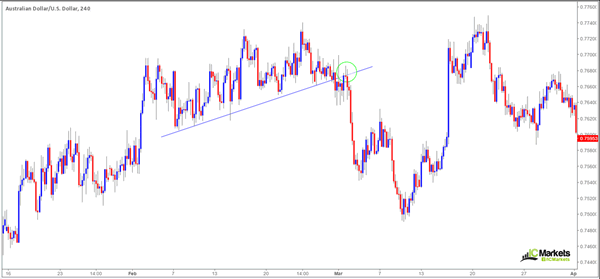
And here's what we would find: price had actually closed above a H4 trendline resistance a few hours PRIOR to the Aussie striking the underside of the trendline resistance! The only grumble we would have had here though was the Quasimodo resistance level that was sighted just above!
Nevertheless, the USD/CAD had given us an early signal (a correlation confirmation if you will) that Aussie bears may look to strengthen. This – coupled with the Aussie H4 bearish selling wick at the underside of a trendline resistance was, in our humble view, worth the risk.

In closing…
Books have been written on the subject of correlations, so we've not even really began to scratch the surface here. As such, we most certainly encourage you to research the world of correlations!
Concentrate on Trades by Overcoming Forex Trading Jitters
At times, the excitement during executions can bring about many emotions. One of these is the feeling of nervousness. Whether new or highly skilled, there will always be moments when traders experience forex trading jitters. In an active and volatile forex market, it is normal to feel anxious about trading activities like entering and closing a trade or planning out the best strategy. Because of this, it is important to properly manage nervous energy to channel more productivity when trading. With enough planning and practice, learn how to easily overcome forex trading jitters for optimal forex trading.
Top benefits of relaxed forex trading
Feeling apprehensive towards a trade can cripple decision making and focus. To keep up with the market, traders need to be able to control emotions like forex trading jitters. Eventually, overcoming nerves can also improve mental health as well as boost trading results. For optimal performance and quality trades, learn the top benefits of relaxed forex trading:
- Promotes a more engaging trading session
- Encourages consistency in strategy and decision making
- Develops a highly focused trading mindset
- Gives extra energy to get into the details of the trade
- Creates a positive and proactive way of thinking
- Diminishes stress and lessens the possibility of energy drain
- Allows consistent execution of calculated plans and strategies
Have a focused and relaxed mindset by managing forex trading jitters.
What you can do to overcome forex trading jitters
Going through forex trading jitters is a common feeling for any forex trader. The most important thing to remember is that nerves should not distract you during vital trading activities. In the long run, this will lead to optimized emotional management and enhancement of overall forex trading performance.
If your trading jitters negatively affect attitude and mindset towards trading, it is time to apply ways to overcome these nerves. To be able to avoid disruptive habits caused by nervousness, be sure to learn the best techniques to properly manage your forex trading jitters:
Trust in your calculated strategy
In order to overcome forex trading jitters, traders need to trust the strategy that they have created. Oftentimes, it is easy to get nervous and question the way trades are executed. Because of this, you will need to efficiently plan and execute a reliable strategy that will lead to desirable trades. Once you gain confidence your strategy, you can easily rely on your system whenever any nerves kick in.
To achieve successful trades, traders must be confident in their strategy. You must also view your trading journey with a proactive and positive mindset. With positivity and an efficient trading plan, you can conquer nerves while improving overall performance. To be able to trust in yourself and your strategy, learn the secrets to achieving a positive mindset.
Refine your strategy with a demo account
Before acquiring a reliable trading strategy, forex traders need to refine the process through trial and error. By starting with a demo account, traders can practice and master skills without risking any real capital. Every execution in a demo account allows you to practice your strategy and also apply forex education. It gives you an idea of market movement and the importance of staying focused during trades. To be able to navigate and understand the forex market, be sure to gain confidence and optimize your system with the help of a demo account.
Practice disciplined decision making
For consistently profitable trades, disciplined decision making is a great skill to use when avoid forex trading jitters. Whether during executions or chart analysis, forex traders need to make calculated decisions on a constant basis. It provides structure and confidence in every trading activity. Disciplined decision making also encourages better planning that ultimately lessens the possibility of trading nerves.
For long term success, make use of disciplined decision making to avoid forex trading jitters. According to Top Ways to Boost Decision Making Skills, here are a few ways to boost excellent decision making for focused trading:
- Simplify processes and mindset through goals or priorities
- Take advantage of available quality forex trading education
- Set a standard system of approach when important decisions need to be made
- Make use of tools to stay updated with forex trade news and activity
Learn to embrace and manage the pressure
In a changeable market, forex trading jitters will always be a part of the journey. Whether for large or small trades, traders will always feel a sense of pressure during executions. To become a successful, you will need to learn how to manage and embrace forex trading jitters. By doing this, you can overcome any anxiety and use nerves to your advantage. Take note of these reminders to help embrace your nerves:
- When feeling nervous, it means you are careful about your trades. Take this as a positive and manage from there.
- Forex trading jitters can minimize impulsive decision making. This will allow you to have a moment to be able to think about your next steps.
- To fully embrace your nerves, be comfortable in its nature when forex trading. You can use this to improve and optimize the scenarios when you feel anxious This will refine your trading character and boost performance.
Emotionally Detach from trades
To gain optimal clarity and focus, master the best ways to emotionally detach from any type of trade. - Ways to Emotionally Detach from a Trade
Forex traders often feel anxiety because of past trades. To avoid disruptive forex trading jitters in the future, it is important to emotionally detach from past trades. Being able to learn from each trade makes way for a relaxed mindset especially during stressful trading scenarios. Forex trading jitters caused by previous attachments can increase the chances of emotional trading. With time and practice, emotional detachment can help traders better overcome forex trading jitters and optimize mental health.
Be mindful of chronic anxiety
To properly manage and prevent forex trading jitters, traders must learn the nature of chronic anxiety. According to Anxiety BC, chronic anxiety describes those with excessive or uncontrollable worry towards daily activities. In reality, everybody experiences nervousness from time to time. When these nerves become uncontrollable, this may lead to chronic anxiety. The best way to beat the possibility of chronic anxiety is by constant exposure and proactive learning.
Forex trading jitters should have a positive effect on both mindset and performance. Through a helpful forex trading journal, traders can input and review past trades to manage forex trading jitters. This will enable you to view your trades constructively and actively avoid the chances of chronic anxiety.
Avoid chronic anxiety to achieve consistently desirable trades and optimal performance.
Take advantage of your strengths
Nerves come from self-doubt or uncertainty of the future. To overcome feeling nervous, be sure to stay positive and be self-assured in your personal strengths. For new traders, forex education is a great time to learn new skills and to get exposed to the latest trading tools or techniques. When there is a sense of anxiety in a demo or live account, one of the best ways to overcome forex trading jitters is to make use of your personal strengths. This will greatly boost your performance without letting your nerves take over. Here are top 3 methods to recognize and take advantage of your strengths:
- Take note of all your innate skill and recent achievements. Build on these to optimize or enhance overall skills.
- If you cannot trust your own judgement, trust your calculated strategy and lessons from previous trades.
- Always pair your inner strengths with commitment and passion. By doing this, you are not only overcoming forex trading jitters but also finding more opportunities in the market.
Create a personal development plan
Creating a personal development plan is the enhancement of skills geared towards a goal. Whether for work or for personal goals, is a great method to reinforce all efforts for a target achievement.
Applying a personal development plan in forex trading provides more structure when optimizing and reaching goals. This includes improving way of thinking or optimizing skills that are affected by forex trading jitters. Through a personal development plan, forex traders can also increase self-awareness. It can identify which areas need more work and which skills require more practice. This way of viewing forex trade encourages traders to train towards target goals. By mastering overall skill and performance, traders can effectively gain confidence in the strategy they have developed while reducing nerves along the way.
Remain confident and focused when trading
In an exciting and fast paced market, it is inevitable to get nervous at times. The most important thing to remember is to never let these nerves control your decision making or affect mental well being. In order to control any anxiety, traders need to learn how to overcome forex trading jitters. If traders do not take action, these jitters may lead to loss of confidence in systems and impulsive decision making. Because of this, it is vital to manage nerves to get a clear and controlled trading mindset. To successfully manage any nerves, you must practice the best techniques according to your strategy and what works for you. Eventually, you can properly overcome forex trading jitters while improving performance.
To encourage discipline and focus, master the ways to control forex trading jitters.
How Long Will it Take Before I Can Expect Consistency?
We understand that this is a perfectly natural question, especially for newer traders. Unfortunately, it is difficult to answer. To a degree, we believe it depends on the person who is doing the asking. With that in mind, let's have a look at some of the key points relating to this subject…
Time
Learning to trade the markets requires a substantial time investment. Do not underestimate this.
One trader may have three hours each day that they're able to devote to the charts, while another may only have an hour. The more time you invest, the quicker you're likely to see results. However, it does not always work out this way. Having a mentor with a proven track record will highly likely help speed up this process.
Using your time effectively is also key. Spending thirty minutes reading about some trader whine and bitch about how trading is not possible is NOT effective time management. Focus on learning methods that have stood the test of time. Of course, this will take some research, but it's time very well spent if you ask us.
Having the right mindset
Having the right mindset for trading takes time to develop. Trading is an incredibly solitary venture, and without the correct psychology you'll find trading terribly frustrating and will likely fail to ever make consistent profits.
Before you invest time in this venture, it's wise to consider whether trading is a good fit, as this business really is unlike any other. Mull over the following questions and try to give yourself honest answers:
- When every bone in your body is telling you not to be, can you demonstrate patience?
- Are you usually a disciplined person? There's constant temptation in the market. So, having the discipline to stick to a trading plan is paramount.
- Can you handle losing money? This may seem a stupid question since let's be honest there are few individuals on the planet who enjoy losing money. Nonetheless, when operating in the markets, losses are a part of the business. Expecting each and every trade to be a winner is NOT something you can do. Well, you can, but it will likely end with you going insane and throwing your monitor out of the window. This is where thinking in probabilities helps a lot!
So much to consider
Everyone is unique and learns at different rates. With this, we believe it is almost impossible to definitively answer how long it'll take for any one person to reach consistency. Anyone who is telling you otherwise is either trying to lure you into buying something, or, quite frankly, doesn't know what they're talking about.
Therefore, the best answer to this question, in our opinion, is quite simply: 'it depends'. 'Depends on what?' We hear you asking. Well, many things… For example, some people are just better wired to deal with the stresses of trading. Being a naturally patient and disciplined individual is going to benefit you in your trading journey. Someone who rushes into things and lacks discipline may find trading a challenging endeavour. That doesn't mean that those who struggle will not become consistently profitable traders, it just means that it might take a little more time.
In closing…
Let's keep in mind that trading, at least in our opinion, has no destination. There is no finish line here! It is actually a continual learning process.
With that in mind, especially in the earlier stages of one's journey, focusing more on the PROCESS of trading, rather than the result is advisable. If the process is correct, the results will undoubtedly follow.
Learning to trade the markets is an incredibly difficult feat to accomplish. Friends of ours who have traded the market for many years reported that, on average, it took them over 7 years to reach a level they were satisfied with. Of course, this doesn't mean that it will take you that long!