

Sample Category Title
EURCHF Corrects Lower But Oversold; Bias Turns Bearish
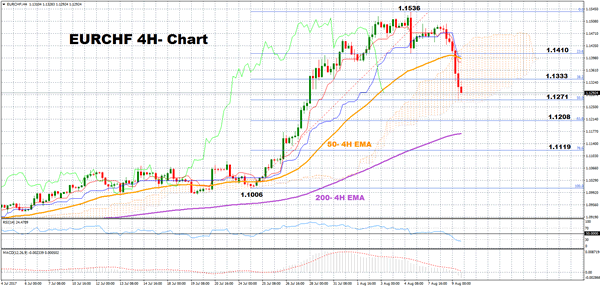
EURCHF is currently building a downtrend after a strong rally between July 25 and August 4, which drove the pair to a 2 ½ - year high of 1.1536. Since then, the pair has corrected lower despite making an effort to gain ground on August 4-8. The bias has turned bearish but a trend reversal is likely to emerge.
The short-term bias according to the technical indicators is bearish with a potential shift to the upside. The MACD has entered a negative territory below its signal line, while the RSI is currently located in oversold area, hinting that a trend reversal might occur. Additional evidence comes from the pair crossing below the 50-4-hour exponential moving average (EMA) and the Kijun-sen trending above the Tenkan-sen since August 8.
Should the pair head up, an immediate resistance could be provided by the 38.2% Fibonacci level of 1.1333 of the upleg from 1.1006 to 1.1536 (July 25- August 4). From here any further increases would meet the 23.6% Fibonacci of 1.1410, while steeper upside movements would target the 2 ½ -year top of 1.1536.
Alternatively, if the price moves down, support is likely to be found first at the 50% Fibonacci mark of 1.1271 which was also an intraday low. Next, the 61.8% Fibonacci of 1.1208 could stand a second barrier to downside movements, whereas if support at this level fails to hold, the price would likely meet the 78.6% Fibonacci of 1.1119.
USD/CHF Registered An Unbelievable Drop
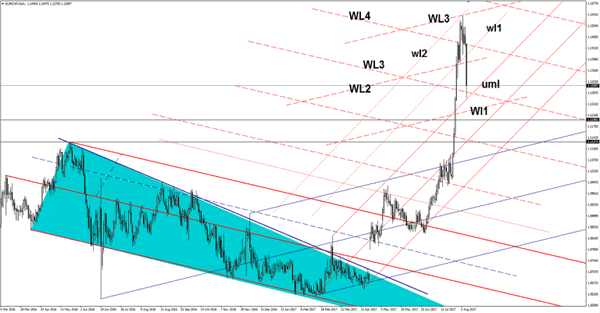
Price plunged after the failure to reach the confluence area formed between the second warning line (wl2) of the minor ascending pitchfork with the third warning line (WL3) of the major ascending pitchfork. Was almost to reach the upper median line (uml) today, could still reach the confluence between the upper median line (uml) with the WL3, where he may find support again.
USD/JPY Breakdown Favored
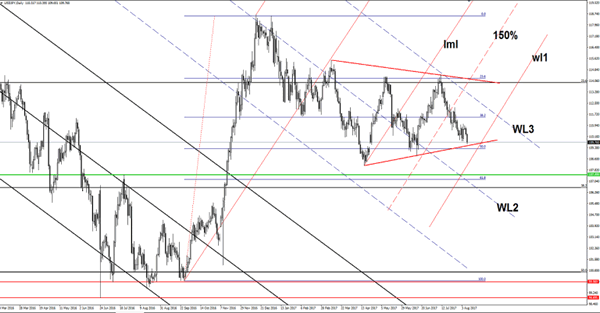
USD/JPY continues to move within a symmetrical triangle, but a breakdown is favored as the Nikkei stock index plunged aggressively today. JP225 reached the 19700 major static support and looks too heavy to be stopped, a valid breakdown below this level will signal that the Yen will dominate the currency market in the upcoming weeks.
Price approaches the downside line of the symmetrical triangle and the 50% retracement level, a breakdown will send the rate much below the first warning line (wl1).
USD/CAD Break Or Bounce?
The price registered little gains today as the USDX failed to resume the minor rebound. USD/CAD needs a bullish spark to be able to climb towards new highs. Technically the rate was somehow expected to increase further in the upcoming days, but the USDX has found temporary resistance right below the 93.81 static support, failing to reach the 94.00 psychological level.
USDX is still trapped below a strong dynamic resistance, will take out this obstacle only if the United States data will impress today.
The fundamental events will bring life on the USD/CAD later, the Canadian Building Permits could drop by 1.8% in June versus an 8.9% growth in May, while the Housing Starts are expected to decrease from 213K to 204K.
The US Prelim Nonfarm Productivity and the Prelim Unit Labor Costs could increase by 0.7%, respectively by 1.1% level. The Final Wholesale Inventories will be released as well and are expected to increase by 0.6%.
The US Crude Oil Inventories will be published and could help the Loonie if will drop much more than expected.
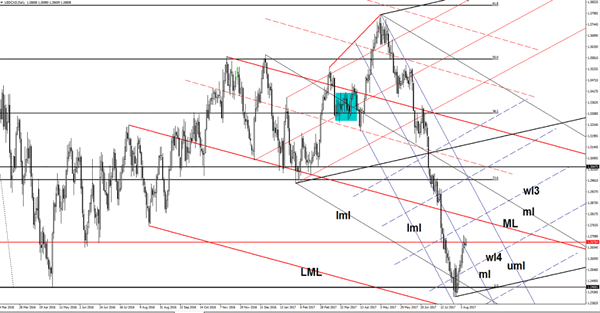
It is pressuring the 1.2678 static resistance and only a valid breakout will confirm a further increase on the short term. Was somehow expected to resume the bullish movement after the breakout above the median line (ml) of the minor descending pitchfork, has retested this level and now could climb higher. I want to remind you that a disappointment coming from the US will send the rate towards the near term support from the fourth warning line (wl4).
You should know that the next major upside target will be at the median line (ML) of the major descending pitchfork, we have some important confluence area that could attract the rate higher. The minor rebound was natural after the failure to reach the lower median line (lml) and the LML.
Optimism that the Rand Could Strengthen Quickly Fades
Any optimism that the South African Rand (ZAR) would continue its attempt to strengthen against the USD, appears to have gone out the window - following the news that Jacob Zuma survived another no-confidence vote. The Rand was previously showing signs of strengthening on indications that President Zuma would be ousted, but the ZAR quickly lost all gains following the news that he had survived a 'no confidence' vote for the 8th time.
With traders showing signs of positioning themselves beforehand for a potential Zuma loss, the decision to keep him in power, has increased the risk of eliminating Rand buyers from the market. At the time of writing, USDZAR has advanced 1.6% since Monday, with the Rand declining against all G-10 currencies, including an overwhelming majority of additional currencies across the global markets.
Following the news that Parliament has once again voted to offer President Zuma a lifeline, the risks on the Rand are pointing towards further downward pressure. This is due to the likelihood that ongoing political risk will continue to dominate the South African headlines. Political turmoil has plagued the nation since the surprise removal of the respected Finance Minister, Pravin Gordhan, back in March. When one combines ongoing political risk, a technical recession and emerging concerns over potential political interference in the hallowed ground of monetary policy, it creates a picture that sellers will remain in control of the South African Rand.
Gold and Yen gain on Trump warning
Both Gold and the Japanese Yen have shown signs of safe-haven buying from investors, following the overnight warning from US President Trump to North Korea. Donald Trump has been quoted throughout the global media as warning the North Korean regime, that any threat to the United States would be met with "fire and fury". The South Korean Won has also declined by over 0.8% - on the signs of another escalation of political tensions between North Korea and the United States.
The reaction to Trump's overnight comments, clearly shows that all it takes is one "off the cuff" remark to wake markets up, even during the summer season of light market volatility.
Time to buy the Chinese Yuan?
This one has slipped under the radar somewhat, with most of the spotlight today being focused on the escalating tensions between President Trump and North Korea. The Yuan has continued to advance, after reaching a 10-month high against the Dollar on Tuesday.
It's been clear in recent weeks, that the People's Bank of China (PBoC) is protecting the currency from further downside. However, even with China's fundamentals improving, the Yuan has only advanced approximately 3% against the Dollar this year, whereas some major currencies like the Euro and Australian Dollar, have moved around 10%.
I think the momentum of the Yuan is sending a clear signal that the currency will strengthen further over the coming months, and there is room for the Yuan to advance another 2-3% before the end of 2017.
Limited reaction to OPEC meeting
The lack of reaction to the OPEC meeting in Abu Dhabi, is thought to be linked to the fact that the meetings' focus was to discuss compliance, rather than deeper production cuts - a message that investors want to hear before they reload purchasing positions in Oil. If the theme of the OPEC meeting in the United Arab Emirates (UAE) had been geared towards measures to reduce continued oversupply in the market, rather than compliance, investors would have watched the meeting in Abu Dhabi more closely.
The theme of "compliance" is likely to be used to show that the cartel are united in their efforts to stabilize the oil market, in terms of the current production cuts that are taking place. I expect to hear more messages from OPEC in this vein in the coming weeks.
Franc Jumps as North Korea Heats Up
US Q2 productivity rose 0.9% from 0.1%, beating expectations of a 0.7% rise, while unit laour costs slowed to 0.6% from 5.4%. Yesterday, a secondary jobs indicator gave the US dollar a second wind to build on gains from Friday's non-farm payrolls report. The Swiss franc is the highest perfomer of the day, followed closely by the yen, while metals are on top of all instruments, led by silver. A new USD trade has been posted to Premium members.
It's not often that the JOLTS report is a major market mover but the perfect storm of a quiet market and net US dollar shorts in a crowded position led to a sizeable move. The report showed a record 6163K job openings in June compared to 5700K expected. At first, the market had its usual 10-pip reaction to the report but momentum quickly began to build as cable fell below 1.3000 and the euro slipped below 1.18. The lows were 1.2950 and 1.1714, respectively.
In order to truly kick higher, the US dollar needs an uptick in inflation or hard growth data but the latest jobs data underscored that it may only be a matter of time.
It also appears to be only a matter of time until North Korea builds a nuclear weapon capable of hitting the United States. The timeline moved up after a US intelligence report cited by the Washington Post said they may have already miniaturized a warhead. That set off some risk aversion that was compounded by Trump saying that if North Korea escalated the threat, the US would release fire and fury. The President has previously said the US would never allow Kim Jong-Un to possess a weapon capable of hitting the US but it may be too late. With the recent sanctions, there is a risk that this story escalates quickly.
Later on this evening is RBNZ decision, widely expected to hold rates unchanged, but will the usual jawboning serve to keep the kiwi under pressure.
EURUSD Bearish, Extends Its Corrective Weakness
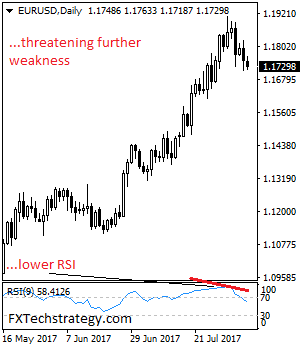
EURUSD: The pair continues to hold on to its downside pressure closing lower on Tuesday and set to extend further decline. Resistance comes in at 1.1800 level with a cut through here opening the door for more upside towards the 1.1850 level. Further up, resistance lies at the 1.1900 level where a break will expose the 1.1950 level. Conversely, support lies at the 1.1700 level where a violation will aim at the 1.1650 level. A break of here will aim at the 1.1600 level. Its daily RSI is bearish and pointing lower suggesting more weakness. All in all, EURUSD faces further corrective downside pressure.
Canadian Dollar Shrugs Off Strong Canadian Housing Data
The Canadian dollar continues to have an uneventful week. In the North American session, USD/CAD is trading at the 1.27 line, up 0.17% on the day. On the release front, the focus is on Canadian housing numbers. Housing Starts jumped to 222 thousand, well above the estimate of 204 thousand. This marked a 4-month high. Building Permits surprised with a 2.5% gain, crushing the estimate of -1.8%. In the US, Preliminary Nonfarm Productivity came in at 0.9% and Preliminary Unit Labor Costs gained 0.6%, as both indicators missed expectations.
The war of words between North Korea and the US has escalated, and the rising political tensions have sent global stock markets lower. Pyongyang has reacted furiously to new sanctions imposed by Washington, and has threatened to attack Guam, which is a major US military base. President Donald Trump is taking a tough line on North Korea, and has promised that any aggression from North Korea will be met with "fire and fury." With Trump and North Korean President Kim Jong-un on a possible collision course, risk appetite has decreased, as nervous investors have snapped up gold, a traditional safe-haven asset. If the crisis worsens, minor currencies like the Canadian dollar could lose ground.
In contrast to the uncertainty over the Fed's monetary plans, the Bank of Canada is leaning towards further tightening, possibly before the end of 2017. The bank raised interest rates in July and the odds of a rate increase in October are at 78 percent. In May, annualized GDP was up 4.6%, and the labor market continues to produce jobs. The increase in oil prices has revived the economy has also pushed the Canadian dollar higher. Like its southern neighbor, inflation remains subdued, despite a stronger economy and improving labor market. The lack of inflation could cause the Federal Reserve to abandon plans for another rate hike this year, and this could also lead to the BoC deciding to delay a rate hike until inflation moves higher.
Will the US dollar pull out of its slump? Paralysis in Washington is weighing on the greenback, as Donald Trump's antics and inability to pass healthcare legislation has increased political risk in the US. As well, the Federal Reserve's monetary policy remains unclear. Earlier this year the Federal Reserve strongly hinted that it planned to raise rates three times in 2017, but has only pressed the rate trigger twice. In June, Fed Chair Janet Yellen shrugged off low inflation, saying that it was due to "transient" factors, leaving the impression that the Fed still planned one final hike. However, inflation has not improved and the Fed has changed its tune. Last week, St. Louis Federal Reserve President James Bullard said he opposed further Fed hikes, warning that another hike would actually delay inflation from hitting the Fed's target of 2%. The markets have become more skeptical about a rate hike in December, as the odds have fallen to 34%, compared to 43% a week ago.
USD/CHF Mid-Day Outlook
Daily Pivots: (S1) 0.9708; (P) 0.9741; (R1) 0.9772; More...
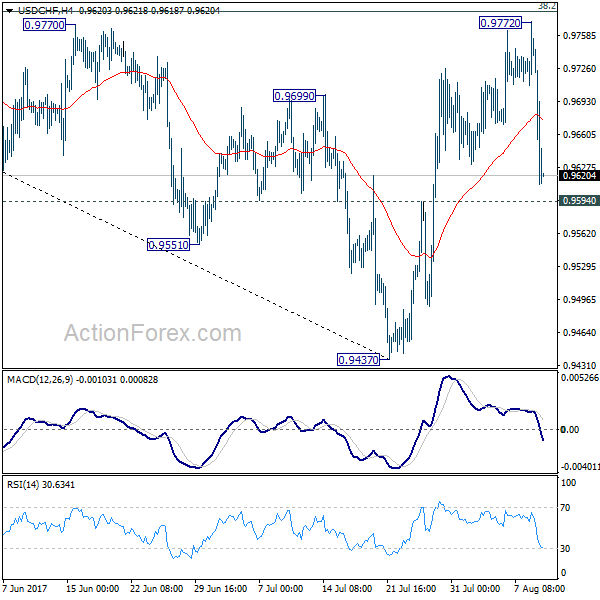
USD/CHF dropped to as low as 0.9611 so far. It's staying above 0.9594 support and intraday bias remains neutral first. But outlook is turned a bit mixed as the pair is bounded inside medium term falling channel. The pair was also limited below 38.2% retracement of 1.0342 to 0.9437 at 0.9783. Firm break of 0.9594 will dampen our bullish view and turn bias back to the downside for 0.9437. This could also extend the fall through 1.0342 through 0.9437/43 key support level. On the upside, above 0.9772 will revive the bullish case and turn bias back to the upside.
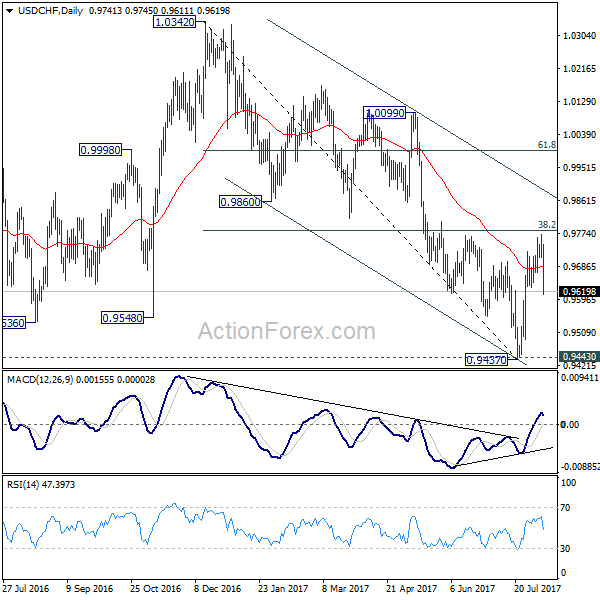
In the bigger picture, current development argues that USD/CHF has successfully defended 0.9443 key support level. And long term range trading in 0.9443/1.0342 is extending with another rise. At this point, there is no sign of an up trend yet. Hence, while further rise is expected in USD/CHF, we'll start to be cautious on loss of momentum above 61.8% retracement of 1.0342 to 0.9437 at 0.9996.
Swiss Franc Overtaking Yen as the Strongest as European Stocks Fall on Risk Aversion
Yen and Swiss Franc remain the strongest major currencies today with US-North Korean tensions as the main theme of the markets. Japan Nikkei suffered steep selloff today by losing -1.29% to close at 19738.71. Major European indices follow with FTSE down -0.8%, DAX down -1.5% and CAC down -1.8% at the time of writing. Among the currencies, risk sensitive Aussie and Canadian Dollar are hardest hit, followed by Sterling and Euro. Risk aversion pushes gold to as high as 1282.4 so far today as recent rebound resumes. WTI continues to tread water between 48.5 and 49.0.
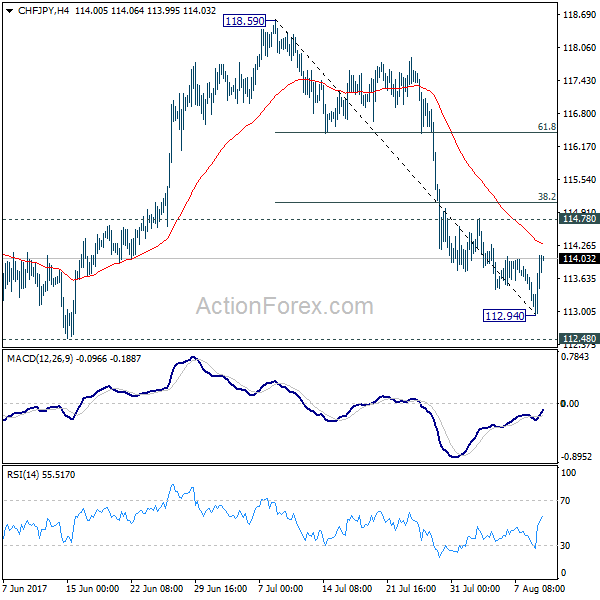
Weakness in European equities is giving the Franc an extra push as CHF/JPY is staging a rebound after hitting 112.94, a recent low, earlier today. CHF/JPY is now back pressing 114 handle. It's now likely that a short term bottom is formed at 112.94, ahead of 112.48 key support, on bullish convergence condition in 4 hour MACD. CHF/JPY should be heading back to 114.789 resistance and possibly further to 38.2% retracement of 118.59 to 112.94 at 115.09 and above.
US Tillerson: Trump just used language that Kim can understand?
This episode of US-North Korea started on reports that North Korea is ready to give US a ""severe lesson" as it's examining plans to strike US territory Guam. US President warned that North Korea "best not make any more threats to the United States". And, Trump said that "they will be met with fire, fury and, frankly, power the likes of which this world has never seen before.
US Secretary of State Rex Tillerson tried to talk down the tension and said that there is no "imminent threat" from North Korea and "Americans should sleep well at night". Also he noted that "nothing that I have seen and nothing that I know of would indicate that the situation has dramatically changed in the last 24 hours." He said that Trump's "met with fire and fury like the world has never seen" was for "sending a strong message to North Korea in language that Kim Jong Un can understand". And Tillerson said that because "he doesn't seem to understand diplomatic language". From the context, Tillerson should be talking about Kim as illiterate on so called diplomatic language.
China growth to ease in 2H
China's trade and inflation data surprised to the downside in July, likely drive by the government's targeted tightening monetary policy. GDP growth is expected to slow in second half of the year. Yet, given the strong readings in the first half, with the economy expanding 6.9% in both the first and second quarters, GDP growth should be able to meet government's target of "around 6.5%". We believe the government would continue its tightening monetary policy in order to prevent and resolve systematic risks, and to curb excessive strength in property prices. Meanwhile, as ultra accommodative monetary policies across major central banks are coming to an end, with the Fed and BOC raising interest rates, while ECB will begin discussing reduction of asset purchases, it would be detrimental to the renminbi if the central bank pledges to maintain monetary easing. This would exacerbate capital outflow from China. More in China Watch – July Trade And CPI Disappoint, Growth To Ease In 2H As Government Tightens.
Also released earlier today, Japan M2 rose 4.0% yoy in July. Machine tool orders rose 26.3% yoy in July. Australia Westpac consumer confidence dropped -1.2% in August, home loans rose 0.5% in June.
RBA Kent: Aussie strength due to unwinding of Trump trade
RBA Assistant Governor Christopher Kent said that recent appreciation in the Australian exchange is mainly due to unwinding of so-called "Trump Trade". He noted that investors have initially anticipated US President Donald Trump's fiscal stimulus, which could be inflationary. That pushed Dollar and US yields higher after last year's election. But "gradually that's just been unwinding". Also, he noted that there's been a bit weaker inflation in the US. Together "that's a large part of the Australian dollar appreciation story of late."
Regarding the shrinking yield gap between US and Australia, Ken noted that "one might imagine that if the rest of the world is experiencing increasingly better conditions, better inflation, that underpins a pickup in yields, then that yield differential will come back and our estimates suggest that will potentially have some impact on the Australian dollar."
RBNZ to stand pat
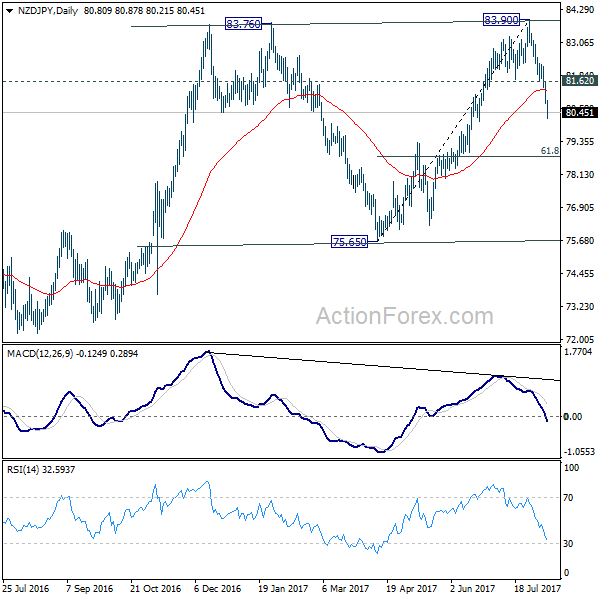
RBNZ rate decision will be a major focus in the upcoming Asian session. The central bank is widely expected to keep the OCR unchanged at record low of 1.75%. New Zealand Dollar has been soft this month as markets are cautious that RBNZ governor Graeme Wheeler might turn a bit dovish in his statement. NZD/JPY accelerates lower today as also pressured by risk aversion. Follow up on our analysis earlier in the week, 55 day EMA is firmly taken out. The development confirmed that whole rise from 75.65 has completed at 83.90, after failing to sustain above 83.76 resistance. Deeper fall should now be seen back to 61.8% retracement of 75.65 to 83.90 at 78.80 and below before getting support for rebound. In any case, near term outlook will stay bearish as long as 81.62 resistance holds.
USD/CHF Mid-Day Outlook
Daily Pivots: (S1) 0.9708; (P) 0.9741; (R1) 0.9772; More...
USD/CHF dropped to as low as 0.9611 so far. It's staying above 0.9594 support and intraday bias remains neutral first. But outlook is turned a bit mixed as the pair is bounded inside medium term falling channel. The pair was also limited below 38.2% retracement of 1.0342 to 0.9437 at 0.9783. Firm break of 0.9594 will dampen our bullish view and turn bias back to the downside for 0.9437. This could also extend the fall through 1.0342 through 0.9437/43 key support level. On the upside, above 0.9772 will revive the bullish case and turn bias back to the upside.
In the bigger picture, current development argues that USD/CHF has successfully defended 0.9443 key support level. And long term range trading in 0.9443/1.0342 is extending with another rise. At this point, there is no sign of an up trend yet. Hence, while further rise is expected in USD/CHF, we'll start to be cautious on loss of momentum above 61.8% retracement of 1.0342 to 0.9437 at 0.9996.
Economic Indicators Update
| GMT | Ccy | Events | Actual | Forecast | Previous | Revised |
|---|---|---|---|---|---|---|
| 23:50 | JPY | Japan Money Stock M2+CD Y/Y Jul | 4.00% | 3.90% | 3.90% | |
| 00:30 | AUD | Westpac Consumer Confidence Aug | -1.20% | 0.40% | ||
| 01:30 | CNY | CPI Y/Y Jul | 1.40% | 1.50% | 1.50% | |
| 01:30 | CNY | PPI Y/Y Jul | 5.50% | 5.60% | 5.50% | |
| 01:30 | AUD | Home Loans Jun | 0.50% | 1.50% | 1.00% | 1.10% |
| 06:00 | JPY | Machine Tool Orders Y/Y Jul P | 26.30% | 31.10% | ||
| 12:30 | CAD | Building Permits M/M Jun | 2.50% | -1.90% | 8.90% | |
| 12:30 | USD | Non-Farm Productivity Q2 P | 0.90% | 0.80% | 0.00% | |
| 12:30 | USD | Unit Labor Costs Q2 P | 0.60% | 1.10% | 2.20% | |
| 14:00 | USD | Wholesale Inventories Jun F | 0.60% | 0.60% | ||
| 14:30 | USD | Crude Oil Inventories | -1.5M | |||
| 21:00 | NZD | RBNZ Rate Decision | 1.75% | 1.75% |