Sample Category Title
EUR/USD Mid-Day Outlook
Daily Pivots: (S1) 1.0667; (P) 1.0738; (R1) 1.0788; More...
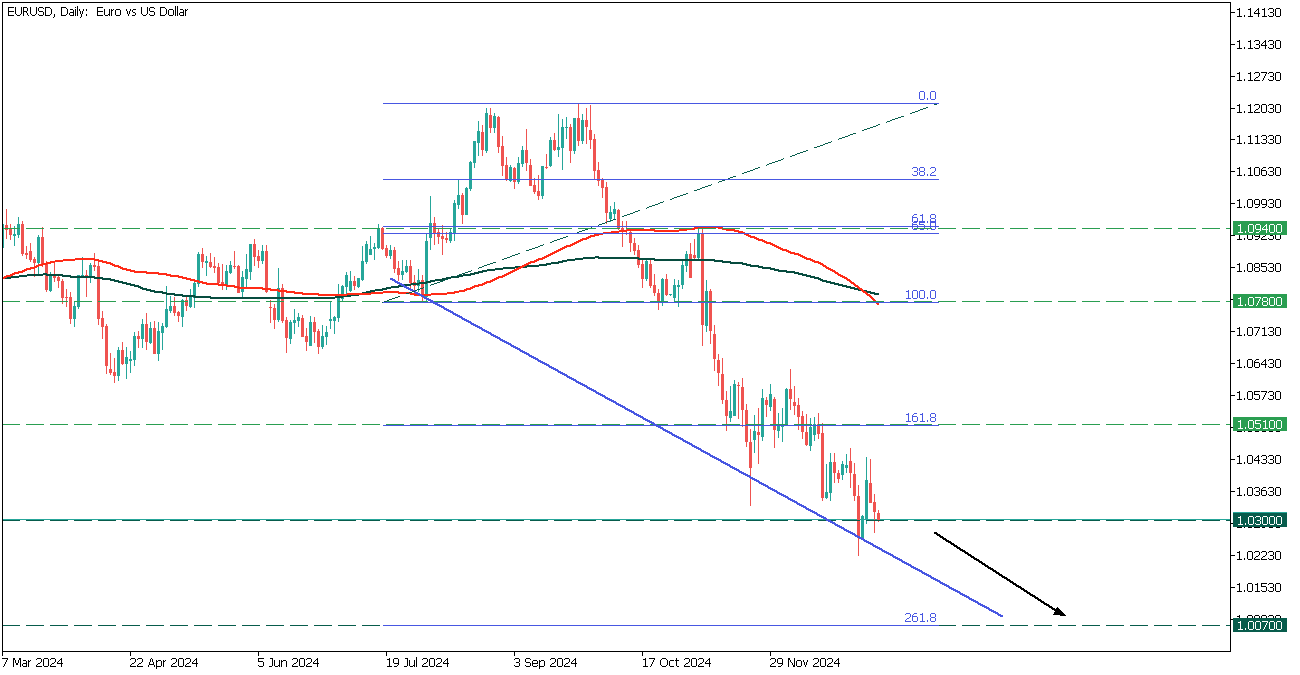
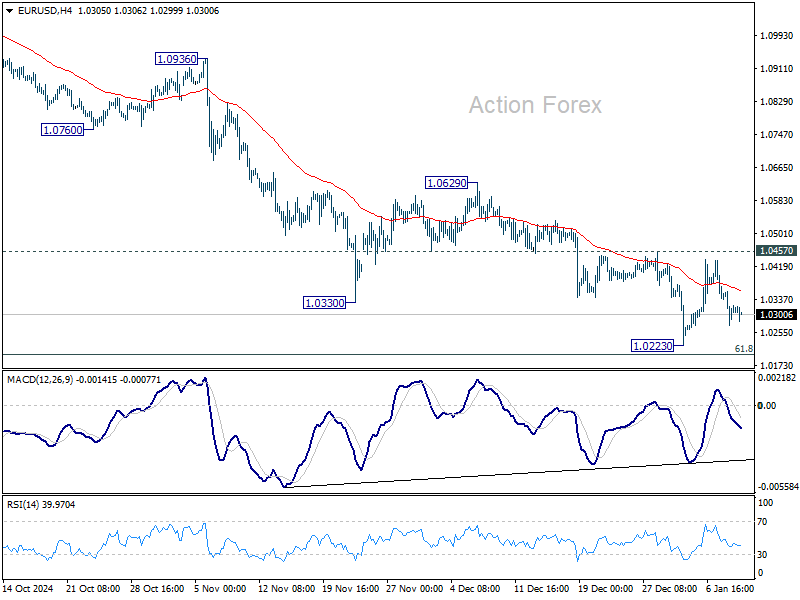
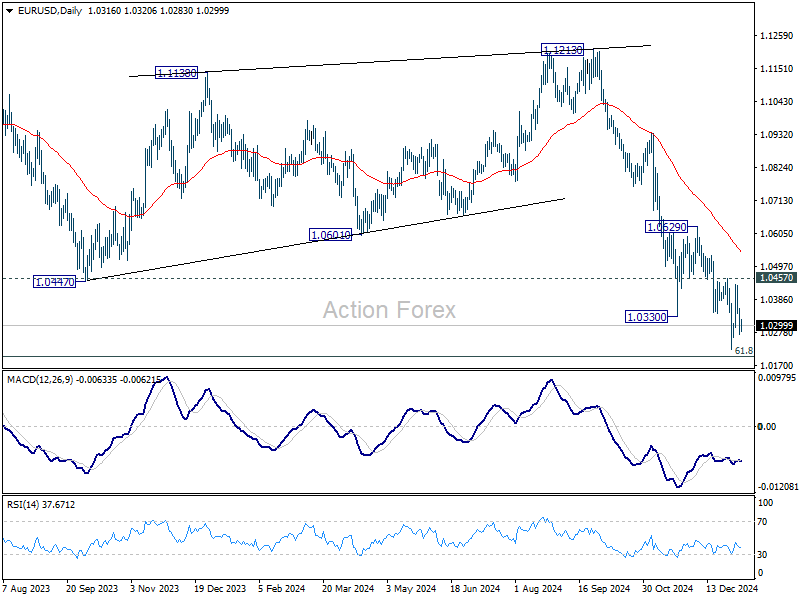
EUR/USD's decline resumed by breaking through 1.0681 temporary low and intraday bias is back on the downside. Sustained trading below 61.8% projection of 1.1213 to 1.0760 from 1.0936 at 1.0656 will extend the fall from 1.1213 to 100% projection at 1.0483. On the upside, above 1.0727 minor resistance will turn intraday bias neutral first. But outlook will stay bearish as long as 1.0936 resistance holds.
In the bigger picture, price actions from 1.1274 (2023 high) are seen as a consolidation pattern to up trend from 0.9534 (2022 low), with fall from 1.1213 as the third leg. Downside should be contained by 50% retracement of 0.9534 (2022 low) to 1.1274 at 1.0404, to bring up trend resumption at a later stage.
Renewed US Tariff Concerns and German Instability Hammer Euro
Euro is facing immense selling pressure today as US session commences, driven by both external trade concerns and internal political challenges in Germany. The market is wary of escalation in trade tensions with the US following Donald Trump’s election victory, with reports suggesting that Robert Lighthizer—a trade hawk known for his aggressive stance—could make a return as the US Trade Representative. Such a move signals a push for increased tariffs, raising fears of a "second round" of the trade war, which could place substantial pressure on Europe’s already sluggish economy.
Compounding these external risks, Germany is facing its own internal political crisis. Chancellor Olaf Scholz has indicated willingness to move up national elections after the collapse of his ruling coalition last week. This came following his dismissal of former Finance Minister Christian Lindner, triggering turmoil within the government. The prospect of a snap election adds a layer of uncertainty for Euro, as markets turn anxious about Germany’s future fiscal direction, given its role as the economic engine of the Eurozone.
Despite the Euro's struggles, Yen remains the weakest currency today. Prime Minister Shigeru Ishiba managed to retain his position in a parliamentary vote but received only 221 votes, well below the required majority in the 465-seat legislature. Ishiba’s position is now precarious, heading a minority government that faces escalating trade threats from the US, along with heightened geopolitical challenges involving China and North Korea. This political instability could hinder BoJ’s ability to execute its planned policy tightening as the central bank deals with heightened uncertainty both at home and abroad.
Meanwhile, Dollar is so far the day’s strongest performer, though it remains below last week's peak against all major currencies except the Euro and Swiss Franc, indicating restrained momentum. Australian and New Zealand Dollars follow the greenback as next strongest. British Pound and Canadian Dollar sit in the middle of the pack.
Technically, EUR/GBP's down trend also picks up momentum today. Further fall should be seen to 61.8% projection of 0.8624 to 0.8294 from 0.8446 at 0.8242 and possibly below. The question remains on whether 0.8201 key support (2023 low) is strong enough to contain downside.
In Europe, at the time of writing, FTSE is up 0.68%. DAX Is up 1.45%. CAC is up 1.31%. UK 10-year yield is up 0.033 at 4.478. Germany 10-year yield is down -0.007 at 2.364. Earlier in Asia, Nikkei rose 0.08%. Hong Kong HSI fell -1.45%. China Shanghai SSE rose 0.51%. Singapore Strait Times rose 0.41%. Japan 10-year JGB yield fell -0.0045 to 1.001.
SNB's Martin: Swiss Franc appreciation expected due to inflation differentials
SNB Vice President Antoine Martin conveyed a cautious stance on future monetary policy in an interview with Le Temps.
While SNB indicated at its September meeting the readiness to cut interest rates further, Martin stressed that "it's not useful for central banks to lock themselves into forward-looking communications."
He highlighted that "between now and the next decision, there may be changes in conditions that render current communications invalid," This approach means SNB has made "absolutely no commitment" to a specific policy path.
Addressing the performance of Swiss Franc, Martin noted that its development this year has been "neither particularly surprising nor exceptionally problematic."
He explained that due to the inflation differential between Switzerland and other countries, SNB expects Swiss Franc to "appreciate structurally over time in nominal terms."
However, he pointed out that "in real terms, excluding the inflation effect, the appreciation has been limited."
BoJ affirms core stance: Rate hikes to proceed gradually if economic outlook holds
BoJ's Summary of Opinions from its October 30-31 reiterated its "basic thinking" that it will adjust the degree of monetary accommodation if the outlook for economic activity and prices unfolds as expected. Emphasizing the importance of "communicating effectively" this core message, BoJ aims to manage market expectations carefully.
One member indicated that if economic conditions progress as anticipated, BoJ could "raise the policy interest rate gradually," reaching 1.0% in the second half of fiscal 2025 at the earliest.
Conversely, another member expressed caution, noting the difficulty in confidently conveying a medium-term policy rate path due to "high uncertainties" surrounding the neutral interest rate and the transmission mechanism of monetary policy.
RBNZ 1-yr inflation expectation down, 2-yr's up
RBNZ's latest Survey reveals that expectations for one-year-ahead annual inflation dropped significantly by -35 basis points from 2.40% to 2.05%, extending a steady downward trend in inflation expectations since Q2 2023. On the other hand, two-year inflation expectations inched up to from 2.03% 2.12% .
For wage inflation, one-year-ahead expectations decreased modestly by -7 basis points to 2.81%, while two-year projections rose from 2.86% to 3.16%.
Growth expectations improved. The mean one-year-ahead GDP growth expectation jumped by 61 basis points to 1.60%, with a smaller increase of 7 basis points for two-year growth expectations to 2.17%.
On the interest rate front, the survey points to further monetary easing ahead. OCR is expected to be 4.20% by the end of Q4 2024, with a sharper decline to 3.33% anticipated by Q3 2025. OCR is currently at 4.75% following a recent 50bps cut in October.
EUR/USD Mid-Day Outlook
Daily Pivots: (S1) 1.0667; (P) 1.0738; (R1) 1.0788; More...
EUR/USD's decline resumed by breaking through 1.0681 temporary low and intraday bias is back on the downside. Sustained trading below 61.8% projection of 1.1213 to 1.0760 from 1.0936 at 1.0656 will extend the fall from 1.1213 to 100% projection at 1.0483. On the upside, above 1.0727 minor resistance will turn intraday bias neutral first. But outlook will stay bearish as long as 1.0936 resistance holds.
In the bigger picture, price actions from 1.1274 (2023 high) are seen as a consolidation pattern to up trend from 0.9534 (2022 low), with fall from 1.1213 as the third leg. Downside should be contained by 50% retracement of 0.9534 (2022 low) to 1.1274 at 1.0404, to bring up trend resumption at a later stage.
New Zealand Dollar Shrugs as Inflation Expectations Remains Near 2%
The New Zealand dollar is showing limited movement on Monday. In the European session, NZD/USD is trading at 0.5967, up 0.07% on the day. The New Zealand dollar was trounced on Friday, falling 1%.
New Zealand inflation expectations inch up to 2.1%
New Zealand inflation expectations inched higher to 2.1% in the fourth quarter, up from 2.0% in Q3. Expectations for one-year ahead annual inflation declined to 2.05% from 2.40%. The Reserve Bank of New Zealand keeps a careful eye on inflation expectations are they can translate into real inflation. Inflation has been on a downtrend and fell to 2.2% in the third quarter, the first time in over three years that inflation is back in the target band of 1% to 3%.
The RBNZ has been aggressive in its easing cycle in response to falling inflation. The central bank slashed the cash rate by 50 basis points to 4.75% last week and is expected to reduce rates by another 50 bp at the final meeting of the year on Nov. 27. The RBNZ is likely to continue trimming rates in 2025, with the pace and size of rate cuts largely dependent on inflation, employment and GDP.
China’s CPI ticks lower
China’s consumer prices rose 0.3% y/y in October, below the 0.4% gain in September and the lowest since June. This missed the market estimate of 0.4%. The monthly reading pointed to deflation, coming in at -0.3%, compared to 0% in September and lower than the -0.1% market estimate. China’s central bank announced in September aggressive stimulus to boost the sluggish economy and encourage more consumption, but the measures will take time to filter through the economy.
NZD/USD Technical
- NZD/USD has pushed above resistance at 0.5987 and is testing resistance at 0.6002
- There is support at 0.5957 and 0.5942
XAU/USD Outlook: Gold Holds in Red as Markets Await Fresh Signals from US Inflation Data
Gold remains at the back foot and stays in red for the second day on firmer dollar and also pressured by eased US political uncertainty, which recently fueled safe haven demand, along with geopolitics and expectations for stronger Fed rate cuts.
New circumstances after Trump’s victory point to measures which will boost economic growth and subsequently fuel inflation that requires revision of Fed’s current stance on monetary policy.
The latest remarks from Fed Chair Powell suggest that the US central bank will be likely less aggressive in rate cuts and that policy easing cycle would likely end earlier than initially planned, which may further dent metal’s safe haven appeal.
Pivotal supports at $2646/43 (Fibo 76.4% of $2602/$2790 / Nov 7 higher low) came under pressure, with break here to further weaken near-term structure and risk test of key supports at $2616/02 (top of thick rising daily Ichimoku cloud / Oct 10 trough), violation of which to generate reversal signal and open way for deeper correction.
Such scenario won’t be a surprise as gold was in steep uptrend and without significant correction for one year, however fundamentals, currently metal’s key driver, are expected to define fresh direction.
Technical studies weakened on daily chart as negative momentum continues to strengthen, MA’s (10/20/30-d) turned to bearish configuration and south-heading RSI points to more space for downside extension.
Adding to negative signals was last week’s bearish close with the biggest weekly loss since mid-May.
Markets focus on release of US October inflation data and speeches from several Fed officials (due later this week) which would provide fresh details on direction and the pace of changes in the US monetary policy in the near future.
Res: 2686; 2700; 2749; 2758.
Sup: 2643; 2600; 2560; 2471.
USD/JPY Outlook: Bulls Regain Control After Correction
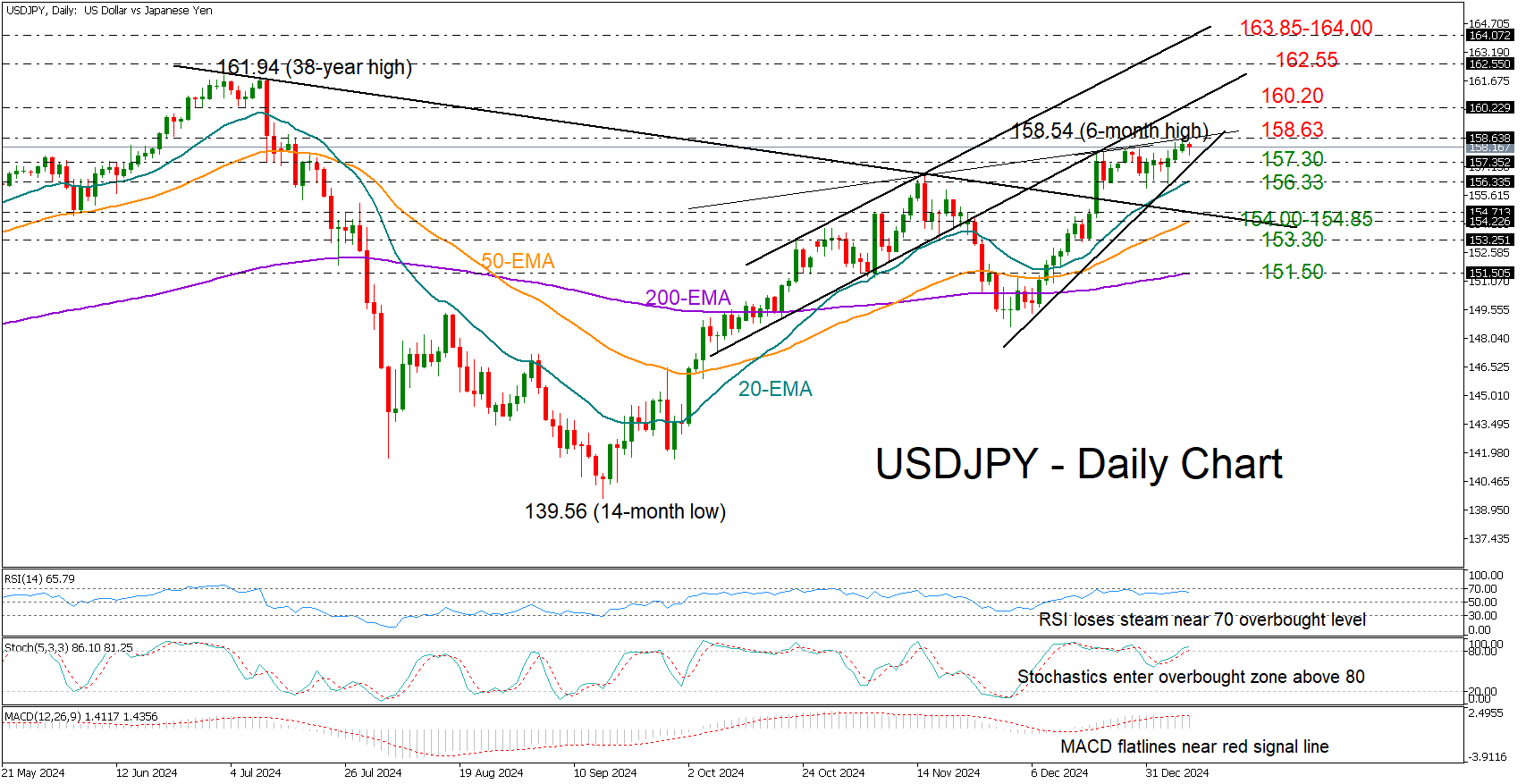
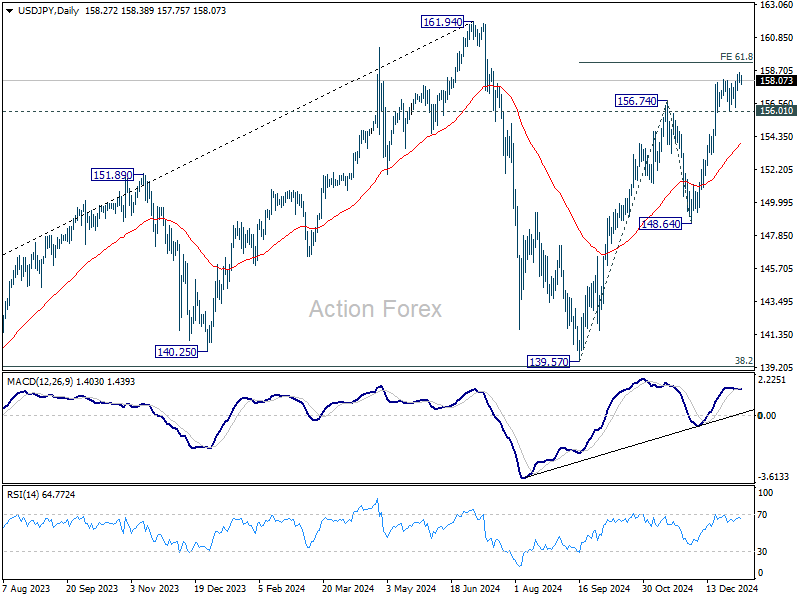
USDJPY regained traction and bounced from 152.14 (low of two-day pullback from new multi-week tops), offsetting negative signal from bull-trap on weekly chart (failure to register weekly close above 153.40 (Fibo 61.8% of 161.95/139.57).
Fresh strength signals that the dollar is likely to continue benefiting from renewed Fed hawkishness on expectations that Trump’s administration will follow campaign’s promises and focus on boosting economic growth.
Technical studies on daily chart show strong positive momentum, with the latest formation of 20/200DMA golden cross, adding support.
We look for initial bullish signal on close above 153.40 Fibo level but lift and close above 154.70 double top (Nov 6/7 highs) to confirm signal and open way for acceleration towards next target at 156.67 (Fibo 76.4%).
Caution on potential repeated rejection a 154.70 pivot which would keep the price in extended consolidation, with bullish bias above correction low (152.14).
Stronger bearish signal to be expected on firm break of 151.70/30 zone (200DMA / recent range floor).
Res: 153.88; 154.70; 155.22; 156.67.
Sup: 153.40; 153.00; 152.14; 151.69.
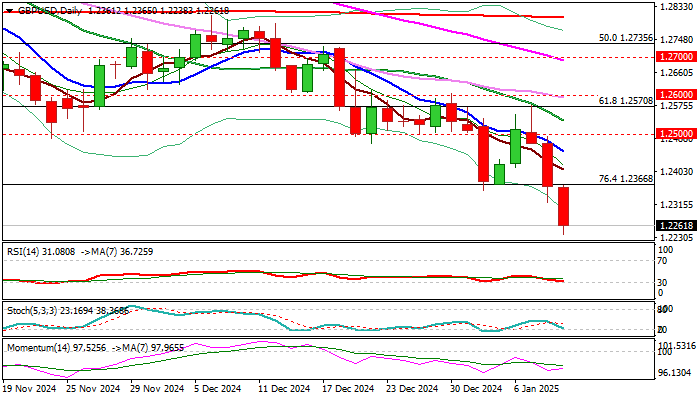
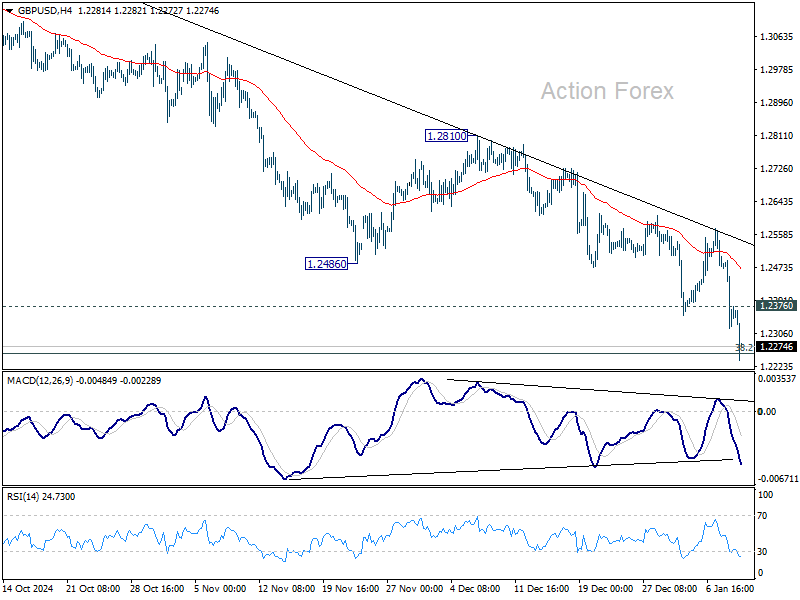
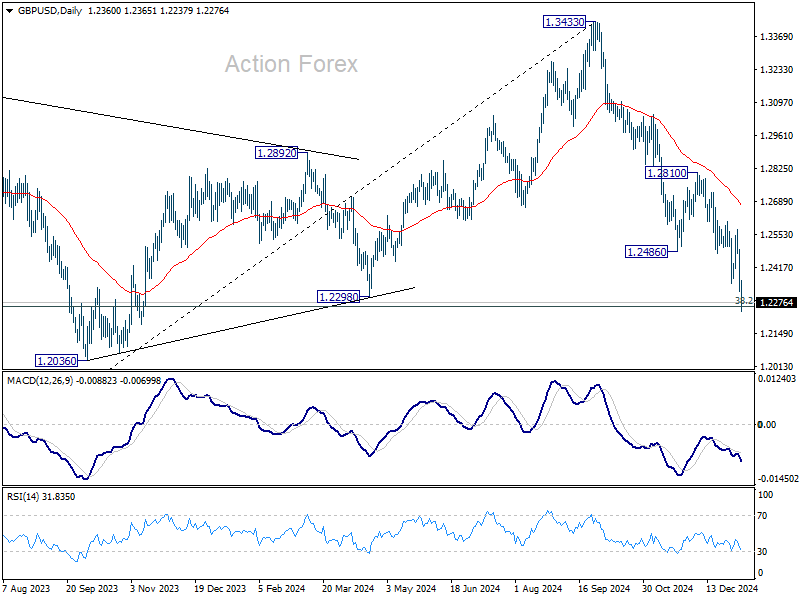
GBP/USD Chart Analysis: Bears Apply Pressure to Key Support
According to ICE data, the U.S. Dollar Index futures have reached highs last seen in early July 2024. The dollar’s strength is attributed, in part, to anticipated economic stimulus measures outlined by the newly elected President Donald Trump during his campaign.
This has put pressure on other currencies paired with the dollar. Currently, the British pound is trading near 1.28400, close to a three-month low.
Today’s technical analysis of the 4-hour GBP/USD chart reveals:
→ long-term price fluctuations have shaped an upward channel since May;
→ the pair is near a key support level at the lower boundary of this channel;
→ a downtrend channel (in red) has formed since early October, highlighting recent bearish control; → the ATR indicator is at an annual high, indicating heightened volatility.
Key economic events are on the horizon:
→ UK labour market data on Tuesday at 10:00 (GMT+3),
→ U.S. CPI figures on Wednesday at 16:30 (GMT+3),
→ speeches by the Fed and Bank of England heads on Thursday.
With these events approaching, traders may anticipate continued wide fluctuations around the lower boundary of the upward channel.
Trade over 50 forex markets 24 hours a day with FXOpen. Take advantage of low commissions, deep liquidity, and spreads from 0.0 pips. Open your FXOpen account now or learn more about trading forex with FXOpen.
This article represents the opinion of the Companies operating under the FXOpen brand only. It is not to be construed as an offer, solicitation, or recommendation with respect to products and services provided by the Companies operating under the FXOpen brand, nor is it to be considered financial advice.
Altcoins Acceleration Amid Bitcoin’s New Heights
Market Picture
The crypto market capitalisation has reached $2.75 trillion, approaching the peak of $2.77 trillion reached in March this year. The next target for the crypto bulls looks to be the historical highs at $2.86 trillion and possibly even the next round level of $3.0 trillion.
Bitcoin has broken the upper boundary of the ascending channel, accelerating the renewal of historical highs. A key technical target and next milestone now appears to be the $100-110K area, as the five-month drift down from $73K to $50K looks like a correction of the bullish momentum from September 2023 to March 2024. The breakout to new highs confirmed the extension of the bullish momentum, making the 161.8% level the next target. Next, the $100-110K area should be ready for a major shakeout as many will be looking to take profits after impressive gains and on reaching key round levels.
Bitcoin is attracting attention with its all-time highs and weight in the crypto market. However, altcoins such as Dogecoin and Cardano, although far from their highs, more than doubled in value in the 5 days following Trump’s victory before correcting late on Sunday. Although both coins look overbought on daily timeframes, they are being driven by FOMO and short squeeze, which promises more chaotic moves in the coming days. Perhaps now is the time to pick up altcoins, which have so far shown growth rates averaging between Bitcoin and Dogecoin.
News Background
From a fundamental perspective, Bitcoin shows no signs of overheating. Galaxy Digital notes the lack of a spike in funding costs for perpetual contracts and a moderate increase in open interest (OI) for cryptocurrencies in general.
According to Fundstrat co-founder Tom Lee, Bitcoin prices will rise to “six figures” before the end of the year. He believes the likely reason for the interest in BTC is its potential as a reserve asset. Trump has previously promised to create a national Bitcoin reserve.
Technical analyst Peter Brandt commented on the optimal time to buy Bitcoin. According to him, the asset will rise another 73-100% and form a cycle top in August or September 2025.
The US SEC has postponed a decision on the NYSE’s proposal to list options-based spot Ethereum ETFs. The NYSE requested this from the SEC on August 7th.
Tether’s investment arm has funded a $45 million USDT crude oil deal that is “the first of its kind” and provides new lending opportunities in various areas, the company said.
The Ethereum Foundation (EF) reported $970 million in cash reserves, which includes liquid and vesting allocations. In 2022-2023, startups in the Ethereum ecosystem received $497 million in funding, according to the EF report.
EURUSD Creates Negative Gap Near 1.0700
- EURUSD remains under selling pressure
- Next pause at 1.0665-1.0685
- Stochastics and MACD confirm bearish structure
EURUSD recently took a considerable dive, falling beneath the 1.0700 round number and developing below the long-term ascending trend line. The pair began the day with a negative gap, with the technical oscillator suggesting further declines. The stochastic is moving toward the oversold region, while the MACD is extending its bearish momentum beneath its trigger and zero lines.
If the market retreats further, it could test the restrictive supportive region of 1.0665-1.0685 before resting near the 1.0600 handle, creating a lower low.
On the flip side, a successful attempt above the ascending trend line could find significant obstacles at the 20- and 200-day simple moving averages (SMAs) at 1.0815 and 1.0870, respectively. Further up, the peak at 1.0935 could potentially halt the upward trend.
Overall, EURUSD has been shifting from a broader bullish outlook to a bearish one, particularly after the drop below the uptrend line.
Gold Price Takes Hit While WTI Crude Oil Eyes Upsides
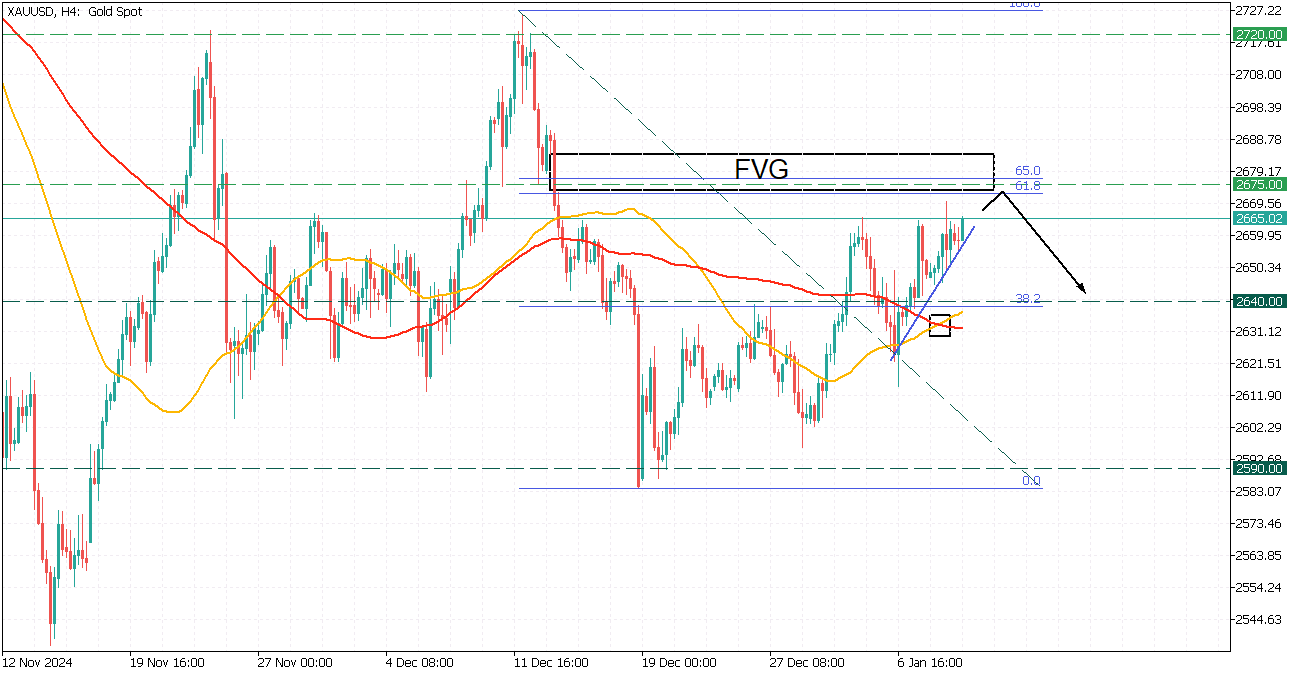
Gold price is declining below the $2,700 support zone. Crude oil price is rising and it could climb further higher toward the $75.00 resistance.
Important Takeaways for Gold and WTI Crude Oil Prices Analysis Today
- Gold price failed to clear the $2,800 resistance and corrected lower against the US Dollar.
- There is a key bearish trend line forming with resistance at $2,725 on the hourly chart of gold at FXOpen.
- WTI Crude oil prices are moving higher above the $70.00 resistance zone.
- There is a key bullish trend line forming with support near $70.90 on the hourly chart of XTI/USD at FXOpen.
Gold Price Technical Analysis
On the hourly chart of Gold at FXOpen, the price was able to climb above the $2,750 resistance. The price even broke the $2,765 level before the bears appeared.
The price traded toward $2,785 before there was a fresh decline. There was a move below the $2,760 pivot zone. The price settled below the 50-hour simple moving average and RSI dipped below 30. Finally, it tested the $2,645 zone.
The price is now consolidating losses near the $2,660 level. Immediate resistance on the upside is near the $2,668 level or the 23.6% Fib retracement level of the downward move from the $2,749 swing high to the $2,643 low.
The next major resistance is near the 50-hour simple moving average and the 61.8% Fib retracement level of the downward move from the $2,749 swing high to the $2,643 low at $2,708.
There is also a key bearish trend line forming with resistance at $2,725. An upside break above the $2,725 resistance could send Gold price toward $2,760. Any more gains may perhaps set the pace for an increase toward the $2,780 level.
If there is no recovery wave, the price could continue to move down. Initial support on the downside is near the $2,645 level. The first major support is $2,635. If there is a downside break below the $2,635 support, the price might decline further. In the stated case, the price might drop toward the $2,620 support.
WTI Crude Oil Price Technical Analysis
On the hourly chart of WTI Crude Oil at FXOpen, the price started a decent increase against the US Dollar. The price gained bullish momentum after it broke the $69.40 resistance.
There was a sustained upward move above the $70.00 and $70.90 levels. The bulls pushed the price above the 50-hour simple moving average and the RSI climbed toward 70. A high was formed near $72.31 before there was a downside correction.
The price declined below the 23.6% Fib retracement level of the upward move from the $69.43 swing low to the $72.31 high. However, the bulls are active above the 50-hour simple moving average.
There is also a key bullish trend line forming with support near $70.90. Immediate resistance is near the $72.30 level. If the price climbs further higher, it could face resistance near $73.50. The next major resistance is near the $74.20 level. Any more gains might send the price toward the $75.00 level.
Conversely, the price might correct gains and retest the 50-hour simple moving average or the 50% Fib retracement level of the upward move from the $69.43 swing low to the $72.31 high at $70.90.
The next major support on the WTI crude oil chart is near $70.10. If there is a downside break, the price might decline toward $68.75. Any more losses may perhaps open the doors for a move toward the $66.85 support zone.
Start trading commodity CFDs with tight spreads. Open your trading account now or learn more about trading commodity CFDs with FXOpen.
This article represents the opinion of the Companies operating under the FXOpen brand only. It is not to be construed as an offer, solicitation, or recommendation with respect to products and services provided by the Companies operating under the FXOpen brand, nor is it to be considered financial advice.
Divergence
Last week ended on a very positive note for the US equity markets. All major indices rallied, the S&P500 notched its best week in more than a year and toped the 6000 level for the first time in history. The Dow Jones traded past the 44’000 level for the first time as well, while Nasdaq 100 closed above 21’100, and small caps approached at ATH, despite some investors pessimism that the Trump-fuelled US yields could backfire on small caps as they have smaller margin to shoulder higher-than-otherwise borrowing costs. And indeed, the Minneapolis Federal Reserve (Fed) President Neel Kashkari said that the bank could lower the rates less than previously anticipated, but he rather pointed at the strength of the US economy rather than Trump policies. He said that it’s too early to determine the impact of what’s to come in terms of Trump policies. If the new President favours tax cuts over tariffs, the US equities could continue to surf on a wave of optimism, while focusing on tariffs before tax cuts would brush off a part of the present optimism.
For now, optimism prevails. During the weekend, the Trump optimism continued to show in Bitcoin prices. The price of a coin spiked past the $81’000 level, and the next natural target on the grill is the $100’000 psychological level.
That’s the American leg of the story: the picture remains bullish for the US equities. Elsewhere, worries mount: FTSE 100 and the European Stoxx 600 index both closed last week below the 200-DMA on worries about a heated international trade environment and the Chinese leg of the story is much less dreamy, too. China announced that it will deploy 10 trillion yuan to refinance local government debt, as expected by investors. Alas, the announcement failed to revive optimism as many were hoping to see bigger measures deployed in response to Trump presidency – who is now expected to increase tariffs on Chinese goods to 60%. As such, the big banks are back to cutting their growth forecasts for China. Standard Chartered and Macquarie expect the increased US tariffs to shave 2 percentage points off annual growth. While UBS trimmed its growth forecast from 4.5% to 4%.
The data released during the weekend wasn’t encouraging, either. Consumer inflation in China came in line with expectations, but deflation in producer prices unexpectedly accelerated last month to -2.9% on a yearly basis, and came as a mixed signal on the impact of the stimulus measures on the Chinese economy. As such, the CSI 300 bounced lower on Friday and erased a part of last week’s gains that were built on optimism that the Chinese stimulus measures would – this time – please.
And crude oil is under a renewed pressure since Friday, on China’s failure to wet investors’ appetite with fiscal stimulus measures. The barrel of US crude is back testing the $70pb support to the downside, having erased past week gains that were supported by geopolitical worries and hints that OPEC would delay the end of its production restrictions by at least a month. Iron ore is also under pressure, the spot price slipped below the 100-DMA and the latter weighs on the Aussie.
Elsewhere, in the FX, the US dollar index remains bid on rising uncertainties regarding the Fed’s easing path. For now, the markets still expect the Fed to deliver another 25bp cut before the year ends, but that probability fell from above 70% to below 65%. The data – especially the inflation data – will gain importance moving forward as Trump policies – the tax cuts and tariffs – are inflationary and will certainly limit the Fed’s capacity to ease wholeheartedly. This week, investors will focus on the next US CPI update, due Wednesday. The headline inflation is seen steady at 2.4% and core inflation unchanged at 3.3%. Higher-than-expected figures could further awaken the Fed hawks and support the dollar bulls against major peers.
Speaking of major peers, the EURUSD is testing the 1.07 support to the downside. The Trump’s tariff threat on European imports has become one of the major drivers here as well, combined with the troubled French finances and the chatter of early election in Germany. A further retreat is on the cards, unless we see a surprise easing in US inflation. Across the Channel, Cable consolidates below the 1.30 level. The Bank of England’s (BoE) less dovish stance after the UK budget is countered by a broad-based dollar strength, yet sentiment in EURGBP reflects well the divergence between more dovish ECB expectations and less dovish BoE expectations. And the latter points at a possible and a sustainable advance in EURGBP to 0.80/0.82 area.