

Sample Category Title
European Open Briefing: Asian Stock Markets Rose Overnight
Global Markets:
- Asian equity markets: Nikkei up 0.75 %, Shanghai Composite rose 0.10 %, Hang Seng rallied 0.85 %, ASX 200 gained 0.60 %
- Commodities: Gold at $1210 (+0.10 %), Silver at $15.50 (+0.30 %), WTI Oil at $44.60 (0.80 %), Brent Oil at $47.10 (+0.90 %)
- Rates: US 10 year yield at 2.39, UK 10 year yield at 1.31, German 10 year yield at 0.57
News & Data:
- China CPI (Y/Y) Jun: 1.50% (Est 1.60%, Prev 1.50%)
- China PPI (Y/Y) Jun: 5.50% (Est 5.50%, Prev 5.50%)
- Japan Machine Orders (M/M) May: -3.60% (Est 1.70%, Prev -3.10%)
- Japan Machine Orders (Y/Y) May: 0.60% (Est 7.60%, Prev 2.70%)
- PBoC Fixes USDCNY Reference Rate At 6.7964 (Prev 6.7914)
- BoJ Gov Kuroda: Will Maintain QQE With Yield Curve Control For As Long As Needed To Achieve 2% Inflation In Stable Manner
- BoJ Gov Kuroda: Japan's Economy Expected To Continue Expanding Moderately
CFTC Positioning Data:
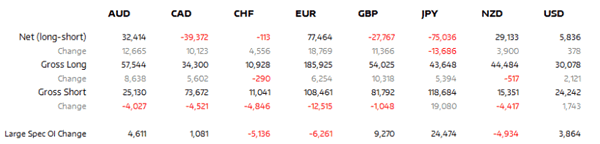
- EUR long 77K vs 59K long last week. Longs increased by 18K
- GBP short 28K vs 39K short last week. Shorts trimmed by 11K.
- JPY short 75K vs 61K short last week. Shorts increased by 14K
- CHF short 0K vs 5K short last week. Shorts trimmed by 5K
- CAD short 39K vs 49K short. Shorts trimmed by 10K.
- AUD long 32k vs long 20k last week. Longs increased by 12K.
- NZD long 29K vs 25K long last week. Longs increased by 4K
Markets Update:
Asian stock markets rose overnight, as risk appetite increased. In FX, the US Dollar failed to sustain the momentum from Friday and fell against most major currencies except the Japanese Yen.
USD/JPY looks quite bullish. It is back above 114 and a test of 115.50 resistance seems likely. The reason why the Yen has been underperforming is that the BoJ is maintaining its loose monetary policy while many other central banks are signaling changes. Therefore, JPY weakness is likely to persist.
The Euro managed to get back above 1.14 in Asia. Demand remains strong for the currency. Should it break above 1.1450, there is little resistance until 1.16.
The Canadian Dollar rallied on Friday after better than expected employment data. The market is speculating that the Bank of Canada might hike interest rates this week. This week should decide the near-term direction for USDCAD. A rate hike and hawkish BoC could send the currency pair towards 1.26, while a disappointment would trigger a short squeeze and pave the way for a 1.32 retest.
Upcoming Events:
- 07:00 BST – German Trade Balance
- 09:30 BST – Euro Zone Sentix Investor Confidence
The Week Ahead
- Tuesday: US JOLTs Job Openings
- Wednesday: UK employment data, Bank of Canada rate decision, Fed Chair Yellen testifies
- Thursday: US PPI
- Friday: US CPI & Retail Sales
USDJPY To Remain Buoyant In The Week Ahead
Key Points:
- USDJPY continues to trend towards near term resistance.
- Japanese economic data continues to worsen.
- Watch for an upside break above resistance in the coming week
The USDJPY was strongly bullish through most of last week as the pair reacted to the strong US ISM Manufacturing PMI and Non-Farm Payroll figures. Subsequently, there was a relatively strong sentiment swing towards the greenback which saw the pair close the week sharply higher at 113.89. However, it remains to be seen if the pair can retain its bullish predilection in the week ahead. So let’s take a look at which events could shape its near term trend
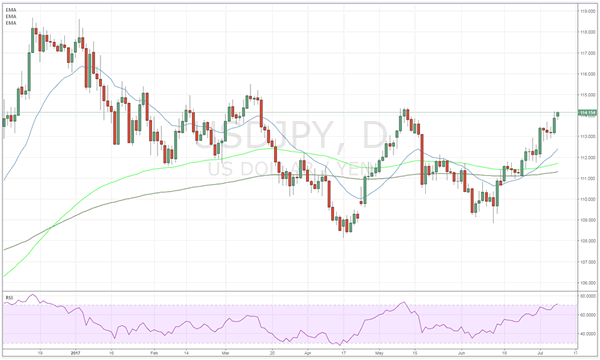
The USDJPY continued to triumph over the past week as the pair was buoyed by some encouraging U.S. economic results. In particular, the U.S. ISM Manufacturing PMI figures surprised the market, coming in well above forecasts at 57.8, which saw the pair catch a long and steady bid. Additionally, the exceedingly strong Non-Farm Payroll figures also played a role in seeing the pair gain some traction with the benchmark posting a solid 222k gain. Subsequently, the sentiment swing towards the greenback was relatively strong and this saw the pair closing the week out around the 113.89 mark. In fact, the strong U.S. results meant that evidence of a gain in Japanese wage inflation was largely ignored by the broader market.
The coming week is likely to largely focus upon the Japanese Tertiary Industry Activity Index and the U.S PPI results. However, the forecast for the former isn’t positive with most economists predicting that the Tertiary Industry Activity is likely to fall sharply to -0.6% m/m. In contrast, the PPI, and to a lesser extent the Core CPI, figures are expected to post robust returns which support the narrative of a U.S. recovery. Subsequently, it’s difficult to see much in the way of bullish fundamental drivers for the JPY in the week ahead.
From a technical perspective, the bullish trajectory is likely to continue in the week ahead with price action making an almost linear drive towards the 114.35 high. In addition, price action currently retains its position above support at 112.88 and there appears to be no sign of topping yet. However, the RSI Oscillator has just ticked into oversold and will now a period of reprieve at some stage. Subsequently, our bias is bullish with the caveat to watch for a potential short period of consolidation. Support is currently in place for the pair at 112.88, 111.80, and 110.50. Resistance exists on the upside at 114.36, 114.94, and 115.49.
Ultimately, the pair is likely to continue its ascent of the recent high in the coming week especially given the depth of despair that appears to be the trend for the Japanese economic data. Subsequently, keep a close watch for a breakout above near term resistance around 114.40 as this is likely to signal the start of an additional bullish leg.
Will The Kiwi Dollar Remain Afloat This Week?
Key Points:
- Despite a rough week, the NZD may not be moving into a downtrend just yet.
- Fears over falling dairy prices may be somewhat overblown.
- The technical bias suggests that support should remain intact.
The Kiwi Dollar declined rather sharply as last week opened and then remained rather depressed in the following sessions. As a result, questions over what is next for the pair are now circling as some fear that the NZD could be moving into a medium to long-term downtrend. However, if we take a closer look at what was fundamentally behind last week's tumble and also the broader technical bias, the bulls may have some reason to remain optimistic.
The Kiwi Dollar was slammed straight out of the gate last week, coming under heavy selling pressure as the Greenback roared higher. Of course, most of the blame for this move can be laid at the feet of the ISM Manufacturing PMI which saw an uptick from its prior print of 54.9 to 57.8. However, the rest of the week's performance largely reflected deeper concerns over the pair's recent rally given that we saw yet another slip in the GDT Price Index, this time, of around -0.4%. This broader pessimism prevented the NZD from making much use of the sudden shift in sentiment away from the USD on Thursday following a dismal ADP NFP result of 158K (185k exp).
One thing worth pointing out here is the fact that this general pessimism may be somewhat of an overreaction. Whilst it is true we have now has two consecutive (albeit slight) contractions in the GDT Index, it pays to remember that dairy prices are still at the highest that they have been in over two years. As a result, fears that falling dairy prices are going to be sending the NZD into retreat in the medium-term are a little overblown and may subside moving forward. What's more a quick look at the technical bias reveals that the pair may have more support than it at first appears
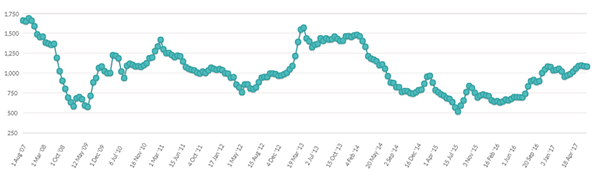
Specifically, although the Kiwi Dollar is fairly neutral technically, it at least looks as though support could limit any further losses. This is primarily due to the presence of the old declining trendline which is now likely to be a source of support for the pair. This support could prevent the NZD from sinking too much lower and thereby avoid an inversion of the Parabolic SAR to bearish. Additionally, the EMA bias remains highly bullish and we have trended out of overbought territory which leaves the upside open to exploitation should impending economic news proves to be supportive.
Overall, even if the NZDUSD isn't looking particularly bullish this week, at least its support seems to be relatively intact. Additionally, as the initial shock factor of the GDT data wears off, the Kiwi Dollar should regain its footing and remain buoyant – even if it doesn't stage a recovery just yet.
GOLD – Bearish, Remains Weak And Vulnerable
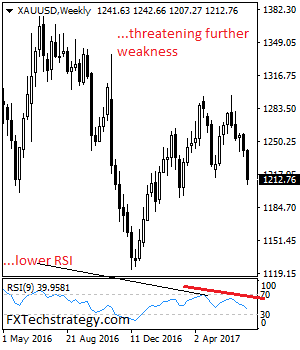
GOLD - The commodity looks to weaken further in the new week. On the downside, support comes in at the 1,200.00 level where a break will turn attention to the 1,190.00 level. Further down, a cut through here will open the door for a move lower towards the 1,180.00 level. Below here if seen could trigger further downside pressure targeting the 1,170.00 level. Conversely, resistance resides at the 1,220.00 level where a break will aim at the 1,230.00 level. A turn above there will expose the 1,240.00 level. Further out, resistance stands at the 1,250.00 level. All in all, GOLD looks to weaken further.
Back to the Futures: 10th July 2017
A snapshot view of speculative positioning on FX futures from the weekly COTS report and analysis of related markets.
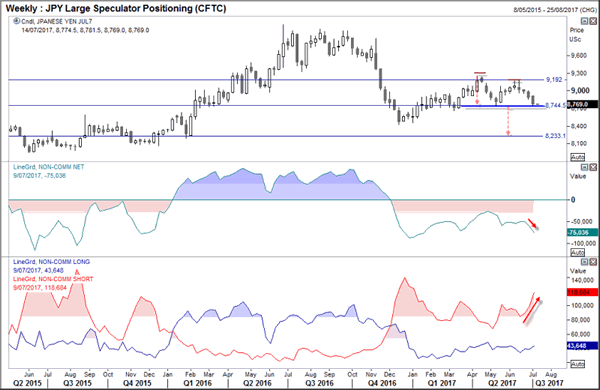
- JPY gross shorts at their highest levels since January
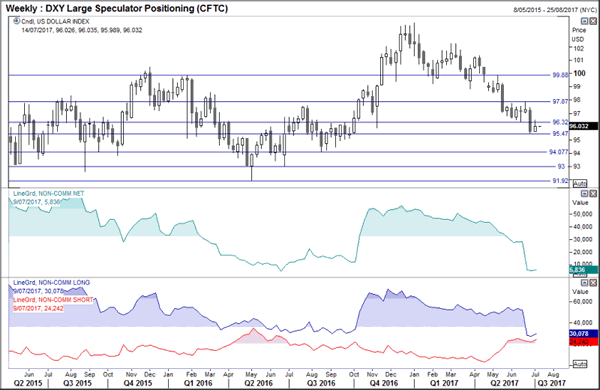
- Only minor adjustments on US Dollar Index positioning, which keeps net positioning marginally long by 5.3k contracts.
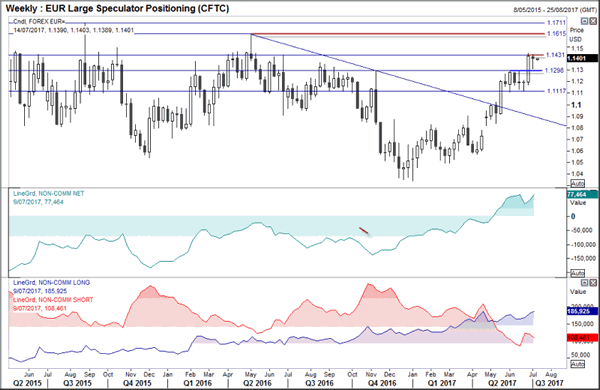
- EUR very close to breaking to its most net long status since 2011
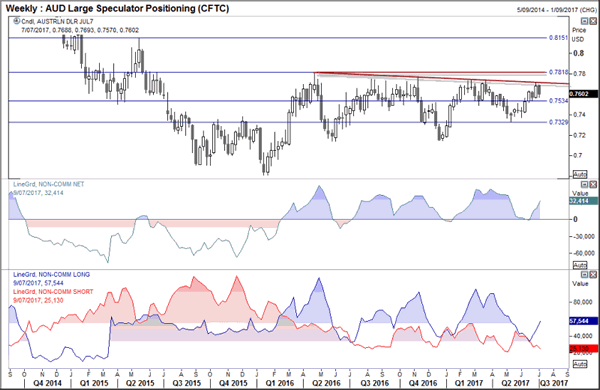
- AUD gross longs increased by 8.7k contracts to bring the net long positing to its highest level in 8-weeks.
- JPY sort interest surges and appears read to confirma double top pattern
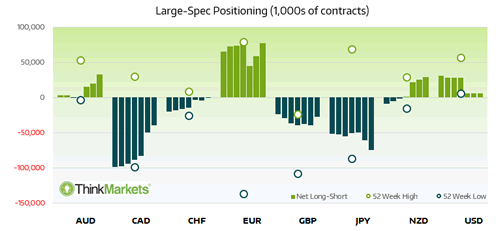
DXY: Positioning on DXY was mostly unchanged, which keeps the index only marginally net long by 5.8k contracts. That said, we also note a slight up-tick for both longs and short, although not by enough to be confident of a bullish or bearish move room here. Technically DXY remains on the ropes and last week's bullish inside week provides little confidence of a base. 96.32 remains an important resistant level as it will likely tempt bears to fade into a rally whilst beneath it. And whilst we remain below the 97.87 swing high then trend remains technically bearish. A break below 95 assumes a run down to 94.08 and could help AUD run for the 2016 high.
EUR: Bulls are on the cusp of being the most net-long since 2011. The trend of gross longs continues to point higher and bearish interest is starting to curl lower. This divergent pattern among bulls and bears with the bullish price action is the ideal scenario for a healthy, bullish trend. Last week provided a bearish inside week and hammer to warn of potential weakness on the near-term, yet as long as we remain above 113 then a move higher is still the preferred bias. We could be at 116 within a couple of weeks at this rate, and a break lower on DXY will only make this happen sooner. If we are to break beneath 113 then 112 and 1.118 become the next levels of support yet this outcome appears quite unlikely for now.
JPY: JPY futures are on the cusp of confirming a double top pattern which, if successful, assumes an initial target at 8.233. We have been awaiting this turn of events on JPY for the most part of this year and price action and behaviour of bulls and bears are now making this outcome materialise. The surge in bearish interest is a promising sign that USDJPY will move beyond the 114.38 target we called in mid June.
AUD: The neckline projected from the 2016 high will remain an important level of resistance, although a break above it is likely to see resistance then be found at 0.78 and the 2016 high of 0.7818. It will require a break above here to truly confirm a bullish resumption and 80c will then be within site. The move higher for gross longs is promising, as it was the ingredient missing from a sustainable bullish run. Up until this point we argued the move higher on AUD was fuelled mainly by a weaker Greenback. However, that AUD then declined following the report of last Tuesday also undermines this a little. The week provided a bearish inside candle below resistance to warn of near-term weakness and a break beneath its low assumes a return to 0.75. If S data picks up this week, it may provide short covering on the US Dollar and add further pressure onto AUD.
Market Morning Briefing: The Currency Markets Are Preparing For The Shift
STOCKS
Dow (21320.04, -0.74%) broke below 21400, indicating that the downward correction might not be over yet. Note that 21500 is a crucial long term resistance which could bring in sharp rejection towards 21200 or maybe even lower. Medium term looks bearish.
Dax (12381.25, -0.58%) has been trading exactly between 12500 and 12300 levels and as mentioned yesterday, while 12500 holds we could see some more downside in the near term possibly extending towards 12200 levels. Near term looks sideways to bearish.
Shanghai (3196.23, -0.50%) is in an uptrend and could see eventual rise towards 3220-3240 with some interim dips. We could see a bounce from 3190 back to higher levels next week.
Nikkei (19965.78, -0.14%) came down to test 19856 contrary to our expectation of a rise. There could be some chances of testing 19750 on the downside in the near term but overall medium term looks potentially bullish.
Nifty (9674.55, +0.38%) made an intra-day high of 9700 yesterday, testing our initial target. 9700 is an important level just now and if it breaks, we could see a sharp 100points rally towards 9800 soon. Else there could be some scope of consolidation within 9600-9700 region.
COMMODITIES
In the smaller time frame, Gold (1219) is oversold and needs a pause before attempting sub 1190 levels. It is hovering around 1120 levels which is a near term area of support and a pause in the range of 12320-1245 can provide the necessary bearish momentum.
Silver (15.74) is trading below its support of 15.80. The scrip is oversold too thus weekend profit taking could pull the price towards 16.20 levels. Markets are now awaiting U.S. non-farm payrolls for June, due on today at 6:00 pm IST, for more insight into Fed policy and the future path of U.S Dollar.
No directional movement had been seen in Copper (2.66) also as it is trading within the range of 2.66-2.78.If 2.66 holds then we might see 2.82 within few days of time otherwise it might come back towards 2.55 levels. We will remain bullish on copper while it is trading above 2.55 levels.
A shortage in U.S crude inventory by more than 6 million barrels could not generate enough buying momentum to keep the prices of Brent (47.46) and WTI (44.92) above their respective resistances. Prices had fallen as OPEC June exports were up 450k bpd from May, and up 1.9 million barrel a day from a year ago due to the supply from Libya and Nigeria, which are not bound by the OPEC/NOPEC production cut agreements. If the key resistances of 48 (Brent) 46.50 (WTI) will hold for the week then gradual selling for the target of 44.70 and 42 can ’t be ruled as seller will take every bounce as a further opportunity for selling.
FOREX
The currency markets are preparing for the shift to a more hawkish stance of the central banks from the decade long accommodative stance, pushing the yields higher everywhere and strengthening majors against Dollar. US NFP data tonight remains the main focus now.
It was stated repeatedly earlier in the week that most of the majors have been in a normal correction and further break of major supports are required before the downtrend can be confirmed. The correction of Euro (1.1415) has probably ended as it bounced back near to the year high of 1.1445 and Dollar Index (95.92) slipped below 96.00. If the US NFP data comes weak tonight, Dollar may test the major support of 95.50-40 while Euro may rise further to the long term resistance area near 1.15-1.16.
Dollar Yen (113.69) is rallying towards our targets of 114.30-115.00 as expected with the immediate support coming higher at 113.00-112.75.
Pound (1.2970) responded well to the requirement of an immediate rally but still requires a break above the major resistance area of 1.3030-50 to negate downside risks and confirm further rise towards 1.3200.
Aussie (0.7585) remains weak despite the global Dollar weakness and may test the lower support levels of 0.7530-15.
Dollar Rupee (64.78) closed flat despite the activity in the global forex and may end the week in the range of 64.60-90 without much movement.
INTEREST RATES
The US yields have risen sharply, the 30YR (2.92%) breaking above the immediate resistance. The 5YR (1.94%) and the 10Yr (2.37%) are also trading higher and looks bullish for the next few sessions.
The US 10-5Yr differential (0.43%) has risen sharply and could test resistance near 0.4375% in the next few sessions from where a rejection towards 0.4125% is possible.
The German-US 10Yr (-1.81%) has risen above important resistance and while that holds, the yield spread could move up in the near term. In that case, it could be an indication of further strength in Euro.
The US-Japan 10Yr (2.28%) has been rising sharply in the last few sessions and while it continues to rise, we may see a weaker Yen going forward. The yield spread could rise towards 2.33% in the coming sessions.
The German-Japan 10Yr yield spread (0.47%) has broken a long 1-year sideways channel and moved up sharply. The spread could move up further in the near term and take up EUR/JPY to much higher levels in the near term. A rise in EUR/JPY (129.84) towards 132 and higher is possible soon.
EURUSD – Continues To Retain Its Medium Term Uptrend
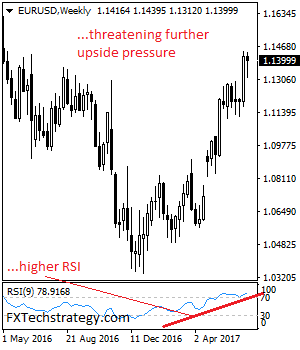
EURUSD - The pair continues to hold on to its upside pressure leaving risk higher in the new week. Resistance comes in at 1.1450 level with a cut through here opening the door for more upside towards the 1.1500 level. Further up, resistance lies at the 1.1550 level where a break will expose the 1.1600 level. Its daily RSI is bullish and pointing higher suggesting further upside pressure. Conversely, support lies at the 1.1350 level where a violation will aim at the 1.1300 level. A break of here will aim at the 1.1250 level. Its weekly RSI is bullish and pointing higher supporting this view. All in all, EURUSD faces further upside pressure.
The G19 + USA Non-Event
The G19 + USA non-event
Weekend G20 headlines had no impact on Foreign Exchange markets this morning as the overall language reads very familiar. The great divide between G-19 and the USA remains climate control and trade with President trump winning minor concessions on steel concerns.The US has argued unfair steel dumping practices are hurting US jobs. But with the market opening at or near Friday’s closing prices, G20 is being viewed as a non-event by market participants.
Currency movements are remarkably placid in early trade as dealers continue to digest Friday’s Non-Farm Payroll data. While there was an uptick in USD volatility after a weaker than expected Average Hourly wages, with many focusing on wage numbers, the overall report was not particularly USD negative with stronger jobs, positive revisions and a higher participation rate. Hence the sudden USD sell off was followed by the rapid knee-jerk higher.While the wages component does little to increase the September rate hike probability, the positive growth narrative does extend the length of the rate hike cycle.
The weaker wage growth buys the Fed more time to wait for inflation signals to pick up before increasing rates which supports the current market view of balance sheet announcement in September followed by a rate hike in December. With no change in the sentiment, the dollar is trading neutral in early Asia and equities remain bubbly. Ultimately the Goldilocks NFP is a win-win for the US dollar and global equities; the headline keeps US rate hike expectations on track while the lower inflation print suggests a slower pace of normalisation.
Given the growing decouple between wages and the employment data I suspect the markets will begin to view the CPI more impactful on Fed policy rather than the job prints as we move through the second half of 2017. So look for this weeks USD CPI print to be heavily scrutinised by traders
Canadian Dollar
The Loonie was the market showstopper as Friday Canadian payrolls data came in above market expectation.The Canadian Dollar has quickly cleared the last impediment to an all but guaranteed rate hike this week. Well, as guaranteed as one can be in the Forex Markets. But the potent combination of data and Governor Poloz’ interview just before the blackout week, has traders all aboard this rate hike bus.
Japanese Yen
With the market banking on end to Central Banks perpetual money printing machines.As markets yield to this adversity, a surprising pivot by BoJ has policy divergence between the US and Japan is back to the fore The BoJ caught trader leaning the wrong way last week after conduction aggressive bond buying operations. It’s hard not to remain constructive on the USDJPY given the divergence narrative, and we could see the USDJPY push higher early this week.
Euro
It’s a quiet week on the EU data from, but the move to the move to normalisation is more than just a Fed story. The EURO will continue to move in sympathy with the selloff in EUR fixed income.And given we’re in the early stages of this EU bond move, the market is positioning long Euro. Last week’s ECB minutes were very bearish for bonds, even after the Draghi hawkish tilt the week prior. The key within the ECB minutes was the bank’s discussion around removing the pledge to increase bond purchases. It’s now a case of when and not if.
Australian Dollar
While the RBA is likely a long way from walking the path of interest rate normalisation, the Aussie should catch a ride on the broader US dollar weakness, so dip demand remains. But the US interest rate trajectory continues to be the primary driver, and with the Feds likely in no rush to raise rates given the tepid inflation outlook, this should feed well into global risk sentiment wich could filter into the Aussie dollar near term. But the ultimate risk for the Australian currency remains the US yield curve
EUR/USD Reaches Daily Channel Resistance
We've been following this EUR/USD intraday breakout and retest after the market supposedly misjudged ECB President Draghi's speech in relation to winding back the bank's stimulus package.
If you take a look at this current EUR/USD hourly chart, you can see that the market in fact didn't actually care what he said, and that headline drop was in fact just a nice pullback into previous resistance turned support and an opportunity to get long.
EUR/USD Hourly:
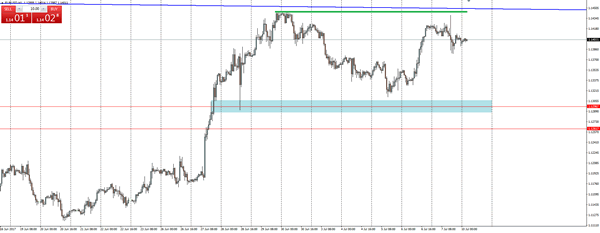
Next stop for price on it's bullish run now brings us back up to the higher time frame and channel resistance.
EUR/USD Daily:
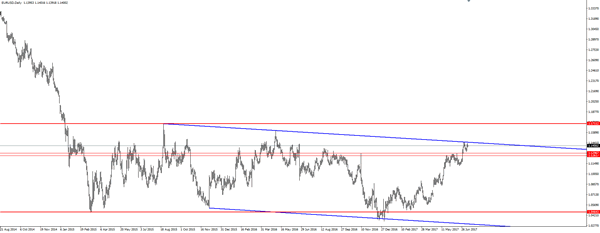
If you're already long off that previous hourly resistance turned support level, then you're sitting pretty right now and can afford to hold for a higher time frame break out.
On the other hand, if you're not already long then that intraday double top at higher time frame channel resistance must certainly be getting you interested in a possible short position?
14 – Developing Good Trading Habits
Most expert traders credit their success to good trading habits, which can be developed over time through a solid daily routine. Once these habits are ingrained in your processes, discipline and proper decision-making can become second nature.
As mentioned, habits take quite some time to develop. For instance, becoming a morning person doesn't happen in an instant as you have to get used to waking up earlier on a regular basis before you get the habit of starting your day earlier. Athletes or performers go through a set of drills regularly before developing muscle memory and strength to do better in their endeavor.
As with trading, you need to be able to repeat certain routines day in and day out in order to turn those into habits. For some, this involves starting the trading day by reading up on economic updates and market events before looking at price action. From there, trading setups can be identified using technical indicators before higher-probability trades are taken. After that, trade review and journaling must be conducted before ending the trading day.
Of course these routines can vary from trader to trader, as some might place more emphasis on technical price patterns and be less inclined to analyze fundamentals. On the flip side, some traders might be more focused on economic reports and schedule their trading routine around news releases.
What's important is that you are able to set your regular trading routine based on your strategy and trading preferences. In figuring out which methods work best for you, one can be able to fine-tune the trading approach and develop the necessary trading habits.
Another crucial part of coming up with your own trading routine is developing the habit of reviewing your performance for the day. This should include logging in your progress, profits or losses, and market thoughts in your trade journal so you can have something to review and work on later on. Apart from that, being able to sum up how your trading day went can enable you to gauge whether you are on track to meeting your trading goals or not.
Remember that having losing trades doesn't necessarily equate to a bad trading day, as you can still be able to draw helpful lessons from these losses. In addition, having large wins doesn't mean that you no longer need to review your performance, as you should be able to build from what you did right and turn these decisions into habits as time goes by.
While some might find a trading routine too tedious to repeat every single day, remind yourself that you can reap longer-term benefits in being able to develop the proper habits throughout the course of your trading career.