

Sample Category Title
01 – Types of Charts
One of the most basic foundations of technical analysis is watching price charts. There are three popular types of charts used by forex traders and these are line charts, bar or open-high-low-close charts, and candlestick charts.
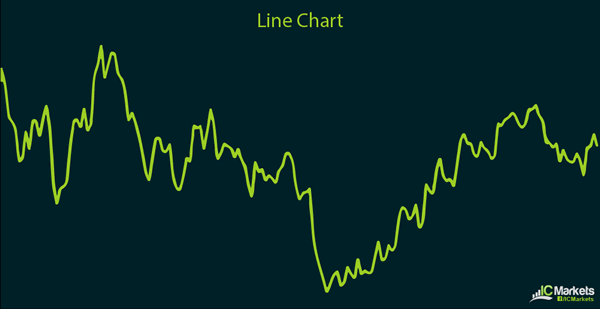
The line chart is the simplest among the three, with a price line connecting one closing price to the next. This allows the trader to gauge the general direction of price action, whether the exchange rate is trending higher or lower.
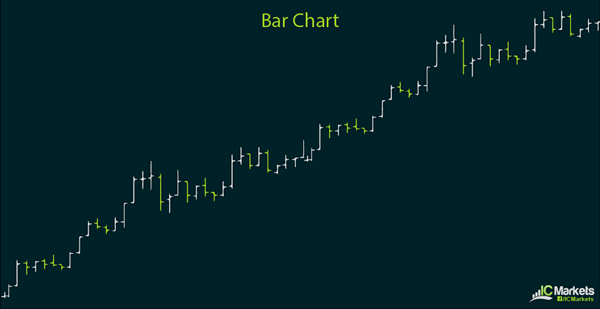
The bar chart, which is also called the OHLC (open, high, low, close) chart, is a little more complex. Each bar notates the open, high, low, and close of the price depending on the time frame used.
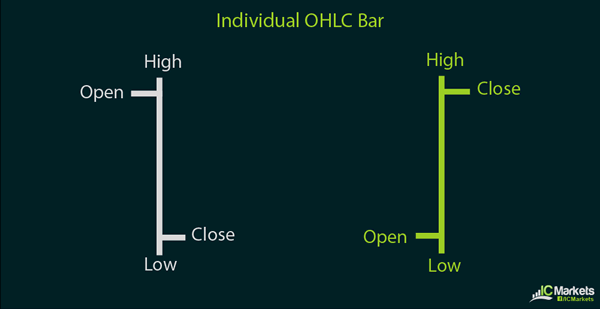
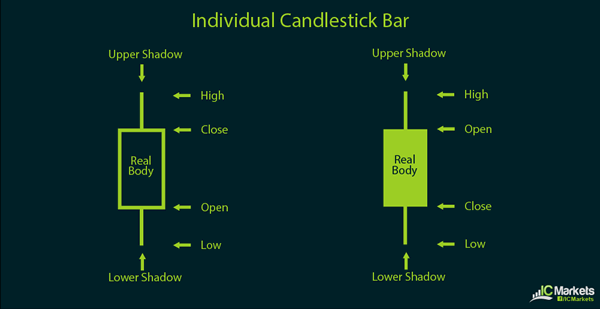
Zooming in to each bar, the horizontal line to the left marks the open price for the period while the horizontal line to the right marks the closing price. The highest point of each bar stands for the high for the period while the lowest point is for the low.
Lastly, the Candlestick chart is the most commonly used by forex traders. Similar to the OHLC chart, candlesticks also indicate the open, high, low, and close of price action during the period.
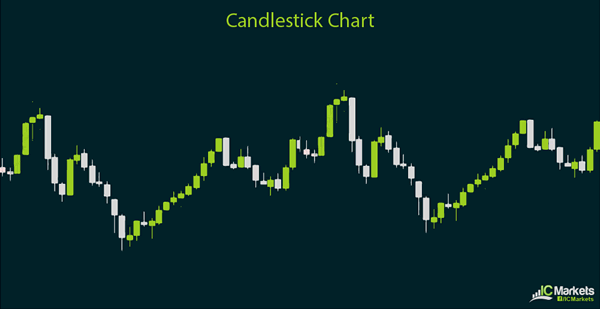
What sets candlestick charts apart is that the bars have a colored body, which makes it easier to visualize whether price went up or down during the period. When price closed higher than its open price for the period, the candlestick is colored white or green. When price closed lower than its open price for the period, the candlestick is colored black or red. This way, forex traders can get a clearer idea of whether buying or selling pressure is building up.
In addition to providing a quick snapshot of bullish or bearish momentum, Japanese candlesticks also have formations that act as reversal or continuation signals. These formations can come in individual candlestick patterns or in groups of two or three. Candlestick patterns, which are also a major component of modern technical analysis, are covered in the next section.
00 – A Beginner’s Guide to Technical Analysis
Technical analysis refers to the study of past price action as a guide in forecasting future price movements. This involves looking at candlestick formations, chart patterns, and indicators.
The Dow Theory, which is based on the collective writings of Charles Dow, is used as the framework for modern technical analysis. Other techniques, such as those introduced by Ralph Nelson Elliott and William Delbert Gann, also comprise the commonly-used techniques in technical analysis of financial markets.
The underlying concept behind these ideas is that all market information is reflected in the asset price and that history tends to repeat itself. In other words, forex market factors such as economic data and risk sentiment are already incorporated in the exchange rate and that historical price patterns have a high probability of occurring again and again.
07 – A Brief History of Forex
What follows is a brief rundown of some of the major historical developments that have led to the Forex market you are now preparing yourself to trade on.
Bretton Woods 1944. USD Becomes the World's Reserve Currency.
In July 1944, with the Second World War still raging in Europe and South East Asia, 730 representatives from the 44 Allied nations convened at the Mount Washington Hotel in Bretton, New Hampshire, USA, for the United Nations Monetary and Financial Conference. Bretton Woods was an attempt to reach a consensus on how to govern the international economy in the aftermath of the war, as well as to address the isolationist policies of economic discrimination and trade warfare, which many believed had contributed to both World Wars, as well as to the Great Depression. As such, eradicating what had come to be known as "beggar thy neighbour policies" (policies that alleviate a country's economic woes at the expense of other countries), and encouraging a freer flow of trade between nations, became a focal point for the conference. Essential to the agreement was an international system of payments to facilitate trade with safeguards in place to prevent large fluctuations in currency value or competitive devaluations. For all these reasons Bretton Woods was a major milestone in the development of the foreign exchange market, and indeed the global financial system we have today.
It was the first time a comprehensive monetary system had been negotiated between nation states, and even though most of the key points of the Bretton Woods system have since been abandoned, its legacy lives on in the institutions it gave rise to. The agreement that was reached at Bretton Woods on the 22nd of July 1944 led to the creation of the International Monetary Fund (IMF), the International Bank for Reconstruction and Development (now part of the World Bank) and the General Agreement on Tariffs and Trade (GATT).
Key to the Bretton Woods agreement was a system of fixed exchange rates between countries whose currency values were all pegged to the U.S dollar, and the US dollar's convertibility to gold at a fixed rate of $35 dollars per ounce. This effectively made the US dollar the world's reserve currency as it took on the role that gold had formerly played under the gold standard. In addition to becoming the world's currency, it's interchangeability with gold made it the currency with the highest purchasing power. Also, the way other currencies were pegged to it, each with its own fixed rate, meant that the majority of international transactions were denominated in US dollars. Taking into account that in the wake of WWII the European powers most affected by the conflict were also heavily in debt to the United States, the geopolitical and economic climate was absolutely ideal for the rise of the United States as the world's superpower. While Britain had been the dominant economic force in the 19th and early 20th century, with the sterling taking pride of place as the world's reserve currency during this period, the second half of the twentieth century would see dominance passing to the United States.
Post Bretton Woods. The Rise of Free Market Capitalism.
Bretton Woods would last until 1971, at which point it was superseded by the short-lived Smithsonian agreement brokered by US President Richard Nixon. However, the golden age of Bretton Woods only really lasted until 1968, up until this time there was a steady improvement in global production and trade, and from 1959 onwards all currencies that were part of the agreement enjoyed full convertibility. But it was the dollar's relationship to gold that would prove to be the real problem that would eventually unhinge the system, this and the fact that the United States was running a large balance of payments deficit to help fund European recovery and keep the financial system liquid. Economists foresaw this eventuality more than a decade in advance, and indeed the problem of keeping gold at $35 per ounce was a real issue as far back as the late 1950's.
The main problem with Bretton Woods was perhaps best stated in 1960 by Robert Triffin, an economist who wrote of what would later come to be known as Triffin's Dilemma. Simply put, Triffin's Dilemma stated that the US deficit was vital to economic growth and to the liquidity of the financial system, but that eventually the very deficit that was aiding Europe's post-war recovery was bound to undermine confidence in the US dollar as the World's reserve currency, and could eventually lead to widespread financial instability.
The US dollar was the only currency that enjoyed gold convertibility, and at the end of the Second World War the US held around 65% of the world's gold reserves. However, inflation had led to it not being economically viable to produce much more gold, and as more and more US dollars flooded into the global financial system, and US gold reserves hardly budged, dollar confidence started to wane as it became apparent that the US would be unable to meet its commitments should dollar holders desire to enforce dollar convertibility. Also, the fact that there was a free market on which gold was traded (separate from the transactions conducted by central banks under Bretton Woods rates), led to a situation where it was cheaper to buy gold at the Bretton Woods rate and then sell it on to the open market.
By 1971 the US only held enough gold to cover 22% of foreign US dollar reserves and was running a $56 billion reserve deficit. Add to this the country's growing public debt which was being used to fund the Great Society initiatives introduced by President Lyndon B. Johnson, as well as the on-going Vietnam War, and it became clear that the Bretton Woods system had become untenable. In November of 1967 the U.K devalued the sterling from $2.80 to $2.40. In November of 1968 an exchange crisis led to the close of the French, German and British markets. In August of 1968 the French franc was devalued from 0.18 grams of gold per franc to 0.16 grams. In October of the same year the German Deutsche mark was revalued from $0.25 to $0.273. Finally in May of 1971 the Deutsche mark and the Dutch guilder were floated. On August 15th 1971, US President Richard Nixon withdrew US dollar gold convertibility as well as imposing a 10% import duty and temporarily locking down wages and prices. This came to be known as the Nixon Shock and caused all major economic powers except France to float their currencies and begin intervening by buying up dollars.
In December of 1971 the Smithsonian Agreement was signed by the G-10 countries. It was an attempt to keep the Bretton Woods system alive by adjusting its fixed rates to more accurately reflect the market pressures of the early 1970s. The dollar was re-pegged to gold at the new price of $38 per ounce and was allowed to fluctuate within a range of 2.25%, rather than the 1% range permitted by Bretton Woods, with other nations agreeing to readjust their fixed rates to the newly devalued dollar accordingly. The biggest difference the Smithsonian Agreement had to Bretton Woods was that the US dollar was no-longer to be convertible to gold. While the Smithsonian agreement adjusted the relationships between the world's currencies, it did not address the fundamental imbalances that had led to the dollar's devaluation in the first place. The US continued to run a huge deficit, as well as increasing its money supply at an inflationary rate, this led to other central banks being forced to intervene in order to keep their own currencies from appreciating, pegged as they were to the dollar at a fixed rate. By 1972 the sterling was finally allowed to float against the dollar. A rise in the value of gold led to the dollar having to be revalued again in February of 1972 at $42.22 per ounce (causing all major currencies to also revalue against the dollar). By March of the same year, after huge interventions by European central banks costing around $3.5 billion, the fixed rate system collapsed entirely and the value of the US dollar was henceforth to be determined by free market economics.
OPEC and the Oil Crisis of '73.
Up until now we have overlooked a significant player in our story. If gold features heavily in the history of Forex, then oil, as vital to the wheels of industry as it is precious, certainly deserves a section of its own. To say that free market capitalism as we now know it would not have been possible were it not for oil is not to overstate the case. Gold may have enjoyed a period where it was the backbone of the international monetary system, but the growth of our global economy was literally and figuratively driven by oil.
America's late entry into the Second World War, its financial standing thereafter, and its status as reserve currency with the signing of Bretton Woods, are often cited as contributing factors for its rise to superpower status. But the United States didn't just emerge from WWII relatively unscathed, with much of Europe indebted to it, and its currency central to the global monetary system; the rise of the United States also coincided with the discovery of its own oil reserves, which quickly replaced coal as the country's primary source of energy. Just as the 19th century belonged to the British Empire; an empire, it should be noted, powered by coal. The 20th century would belong to the United States, and would be the century of oil.
As a backdrop to the events that we have already looked at, it's important to keep in mind that the post WWII years saw an ever-increasing demand for oil. Between the end of the Second World War and the demise of the Smithsonian Agreement the global consumption of oil tripled, and the demand for it increased more than fivefold. After WWII oil was rapidly replacing coal; it was abundant, cheap, easier to transport than coal, and also conferred a competitive advantage in terms of productivity to countries that opted to make the switch. Millions upon millions of barrels flowed out of the Middle East and Venezuela, fuelling post war reconstruction, economic recovery and global growth.
Oil's widespread uptake also had the effect of gradually shifting the balance of power, making many countries increasingly reliant on a constant affordable supply from oil-producing nations. The first time the members of the Organisation of Arab Petroleum Exporting Countries (OPEC) attempted to employ what came to be known as the "oil weapon" was early in June of 1967, a day after the start of the Six Day War. In response to an Israeli incursion into Egyptian, Jordanian and Syrian territories OPEC members issued an oil embargo against all countries deemed to be in support of Israel and within days the Arab oil supply had been reduced by around 60%. The situation threatened to worsen when civil war broke out in Nigeria the following month, removing a further 500,000 barrels of crude oil from the global supply chain each day. This first oil embargo would be short-lived and largely unsuccessful due to the existence of relatively healthy reserves, as well as the re-routing of supplies to areas most affected by the embargo. However, OPEC's second attempt at throwing its weight around would have a much more destabilising effect.
Between 1967 and 1973 the global economy's reliance on cheap oil had reduced surplus capacity to dangerously low levels. In 1970, there were around 3 million barrels of surplus capacity per day (excluding the U.S), by 1973 this had shrank to 500,000 barrels per day. So when OPEC wielded the "oil weapon" for the second time on October 17th 1973, the stakes would be significantly higher than they were in 1967.
A number of convergent factors contributed to the oil crisis of '73. Tense negotiations between OPEC and Western oil companies regarding pricing and production had been on-going for some time. Also, when in 1971 President Richard Nixon put an end to the Bretton Woods system by withdrawing the US dollar's convertibility to gold, the inevitable US dollar devaluation which ensued affected oil-producing countries because oil was (and still is) priced in US dollars. Add to this the fact that US oil production peaked at around 10 million barrels per day in 1970 (declining steadily thereafter), and that by 1973 the US was actually importing 6 million barrels per day, making it extremely vulnerable to disruptions in supply, and you have the ideal conditions for a perfect storm.
On the 6th of October 1973, during the Jewish holy day of Yom Kippur, Egypt and Syria invaded Israeli territories that had been seized by Israel during the Six Day War six years earlier. On October 17th, in response to US support of Israel during the conflict, OPEC raised the price of oil by 70%, as well as imposing an embargo against the United States and any other countries that had supported Israel during the conflict. The war would be over by the end of October, but OPEC refused to change its course. In November of the same year OPEC cut oil production by 25%, and threatened a further 5% cut. In December the price of oil was again doubled. By January, when Israel agreed to pull its troops back to the east side of the Suez Canal, the price of oil was four times higher than it had been before the crisis began.
The attitude of the oil-producers during this period can be summed up by a memorable quote from the Shah of Iran that was publicised by the New York Times in December of 1973:
"Of course [the price of oil] is going to rise… Certainly!... You [the West] increased the price of wheat you sell us by 300%, and the same for sugar and cement… You buy our crude oil and sell it back to us, refined as petrochemicals, at a hundred times the price you've paid to us… It's only fair that, from now on, you should pay more for oil. Let's say ten times more."
Iran had not participated in the embargo, continuing to ship oil to the West throughout the conflict, but it was clear that the age of cheap oil was over and everybody knew it.
The oil crisis changed the geopolitical landscape and the global economy in a number of key ways. The inflated prices at which OPEC nations were selling their oil after the embargo caused economic growth to slow in the West while also causing inflation, a situation that came to be known as "stagflation". Also, the quadrupling of the price of oil immediately led to a huge flow of capital from the West to the oil-exporting nations of the Middle-East, a great deal of which was spent on weapons and technology, further exacerbating tensions in the region and leading to an increased American military presence. The price of oil, as well as its consistent supply, began to figure heavily in the agendas of industrialised nations, such was the shock caused by the embargo. It may seem like the most obvious of dots to connect from our perspective, but even though there were glaring signs leading up to the crisis, oil price and supply was never the topic of concern before 1973 that it is today. Nowadays the balance of supply and demand is so delicate that it's important for you as a Forex trader to understand how currencies are correlated with oil prices (more on this later), as well as to keep abreast of any global events that could impact its supply. Finally, the oil crisis of 1973 also made energy conservation, a term largely absent from people's vocabularies at the time, a priority which has only grown more urgent as we move closer and closer to depleting our planet's fossil fuel reserves.
Cooperative Central Bank Intervention. The Plaza Accord of 1985.
You may have observed an interesting dynamic at work in the brief history of forex we have outlined so far; a certain pull and push between the need for overt regulation and control, versus a laissez-faire approach in which a free market is allowed to regulate itself. If you have identified this theme you are right to do so, the two opposing drives are always present, with proponents of the former most vocal in the wake of an economic crisis, and advocates for the latter seeming to have free rein when all is well in the global economy. The fears that led to Bretton Woods in the first place, and to Nixon wanting to keep exchange rates fixed in the Smithsonian Agreement, were precisely that if left to regulate itself competing devaluations between rival currencies and other antagonistic trade practices would lead to global instability. Conversely, the short-comings of both Bretton Woods and the Smithsonian Agreement were made glaringly obvious by a market unwilling, or unable, to be locked down to the very same fixed relationships that were imposed in order to regulate it. And again, the period between the free-floating of the world's major currencies and the Plaza Accord would give lie to the myth that simple supply and demand dynamics are all that are required to regulate an efficient market.
We have already looked at the first major crisis to affect the global economy after the abandonment of Bretton Woods in 1971. The fourfold increase in the price of oil after the crisis of 1973 resulted in increased import expenditures for industrialised nations, upsetting their balance of payments. Recall that oil is priced in dollars, so the recycling of US dollars held by OPEC nations (petrodollar recycling) inevitably led to a h2 US dollar even though the United States continued to run a substantial trade deficit.
In the late 1970's the US dollar would fall in value as this growing deficit eroded investor confidence. This would be exacerbated by the Iranian revolution and the second oil shock of 1979, when OPEC again hiked the price of oil. However, by the early 1980s a hawkish stance from Federal Reserve chairman Paul Volcker, combined with renewed interest in the dollar as a safe haven currency after the outbreak of the Iran-Iraq war, helped dollar strength to return. 1980 would also be a watershed moment for oil as increased output from the USSR, Venezuela, Mexico, Nigeria, as well as the entry of Alaskan and North Sea oil, precipitated the start of a 20-year decline in oil prices, and a loosening of OPEC's grip.
Volcker's mandate to halt stagflation by raising US interest rates was successful, although an undesired consequence of his policies was that the dollar became overvalued. This resulted in US exports being expensive and uncompetitive (especially American cars), while imports became cheap, which put further pressure on US trade balance. Between 1980 and 1985 the US dollar appreciated by around 50% against the yen, the Deutsche mark, the sterling and the French franc.
The Plaza Accord, so called because it was signed at the Plaza hotel in New York, was an attempt to bring the economies of the United States, Japan, West Germany, the United Kingdom and France back into sync by devaluing the US dollar. When the agreement was made the US current account deficit had reached around 3.5% of the nation's GDP while its economy was growing by around 3%. Europe on the other hand had a large trade surplus and was experiencing negative growth of around -0.7%. In order to redress the balance, the G-5 agreed to a mixture of tax and public spending cuts, private sector expansion and the opening up of markets.
Over the next couple of years the US dollar would depreciate by 50% against the rest of the G-5 nations. By 1987 the Japanese yen had gone from 242 per dollar to 150 per dollar. The US trade deficit with Europe had also been successfully reduced, though not with Japan.
The US dollar would continue to drop beyond the agreed targets, prompting the then G-6 to negotiate the Louvre Accord, which was an effort to halt the US dollar's decline. This would prove to be a much trickier proposition than the devaluation of the Plaza accord. This is due to the dollar having already been in the midst of a downtrend at the time when the Plaza Accord was signed. On the other hand the Louvre Accord would attempt to reverse an already well-established trend and do so through a sustained coordination of the economic policies of the 6 largest economies in the world. By 1988 the dollar was worth 121 yen and 1.57 Deutsche marks. A drastic increase in US interest rates was the only thing that would halt the downturn and strengthen the dollar.
The Plaza Accord was an important historical milestone in the development of the foreign exchange market. It was the first time that nations had agreed to actively intervene in a coordinated way so as to affect currency values, it was an example of how central bank interventions could be orchestrated across national borders in the interests of the global economy. It was also a moment in history when the broadest consequences of globalisation were there for all to see, and markets were shown to require an occasional guiding hand in order to be able to run smoothly and efficiently.
The Latin American Debt Crisis
In the 1980s much of Latin America was affected by a severe debt crisis which blighted the lives and stifled the opportunities of countless citizens, it would come to be known as La DécadaPerdida, or the lost decade.
So far we have been sketching an outline of the global economy, tracking the way it has developed from the "beggar thy neighbour" policies leading up to the Great Depression, to today's global reality where a single surprise can have knock-on effects that are felt around the planet. We have seen how a valuable commodity in the hands of a few can be wieldedlike a weapon over the rest of the world, we've looked at the pull and push dynamic between regulation and free markets, and have observed how central banks can coordinate between themselves in order to affect exchange rates. One of the things you will observeas you immerse yourselves in the markets is that both leaving them to their own devices and attempting to control them inevitably lead to undesired outcomes.
One of the consequences of the oil crisis of the 1970s came about as a result of petrodollar recycling. The fact that oil is priced in US dollars led to OPEC nations accumulating a great deal of wealthwhen the price of oil was drastically increased. OPEC'spetrodollarsinevitably found their way back into the banking system, partly due to many OPEC nations opting not to reinvest this capital into their own domestic infrastructures. The massive influx ofpetrodollar deposits significantly increased the lending capacity of the banks, and with the demand for loans among industrialised nations having fallen during the recession, a large amount of this money was loaned out to rapidly industrialising Latin American countries.
Latin America had been experiencing something of a boom in manufacturing from the 1930's onwards. Its newly industrialised economies had been focused on breaking their dependence on imported consumer goods from the developed world by buildingdomestic industries to feed this demand. This process of import substitution industrialisation (ISI) had brought rapid growth to countries such as Mexico, Brazil and Argentina, but was nearing a ceiling in terms of possiblefuture growth without renewed investment inthe manufacture of heavier consumer goods such as cars.
During the oil crisis of 1973 soaring oil prices and a reduction in global production led to South American oil producers picking up the slack left by OPEC nations and exporting a great deal of oil to the United States.This situation was doomed to be short-lived though, and as the inflated prices settled after the crisis and production was ramped up again in the Middle East, economies such as Mexico's became economically unstable. Other South American net importers of oil suffered from increasing fuel bills during the crisis and higher debt repayments after the crisis as their western creditors raised interest rates.
The choice to carry on pursuing import substitution industrialisation rather than transitioning to export driven economies, was perhaps partially decided by the global economic climate of the time. The severe recession which had hit developed countries in the wake of the oil-shock meant that demand for imports had fallen drastically, as had the demand forraw materials, which also hurt South America's export market.
With interest rates rising in the west, especially in the United States where hawkish policies had been introduced by Fed chairman Paul Volker to ease stagflation (most of the commercial banks that had lent money to South America were US and Japanese), the cost of servicing theseloans increased drastically. Rising interest rates had also helped restore confidence in the US dollar, which put pressure on Latin American exchange rates, further increasing both the value of their debts and the cost of their repayments. From 1975 to 1983 Latin America's debt had gone from $75 billion to $315 billion, the latter figure being around 50% of the region's GDP. The annual cost of servicing those loans had also risen from $12 billion in 1975 to $66 billion in 1982.
In August of 1982 it was announced by Mexico's Minister of finance, Jesus Silva-Herzog, that the country would not be able to continue servicing its existing loans. The loan market imploded overnight. Commercial banks stopped lending to the region and as most of the existing loans were short term in nature, the fact that banks were refusing to refinance them led to billions of dollars of debt being due all at once.
The resulting crisis would be the worst in the region'shistory. Unemployment shot up, incomes and spending power plummeted, growth ground to a halt and poverty increased as social programs were abandoned in favour of debt repayments. Between 1982 and 1985 Latin American economies contracted by around 9 percent. In order to refinance the existing loans countries were required to accept much stricter conditions as well as allowing the International Monetary Fund (IMF) to step in and introduce austerity measures and country-wide reforms, the most notable of which were the abandonment of import substitution industrialisation in favour of free market capitalism and the privatisation of industry.
The Asian Financial Crisis of 1997
The Asian financial crisis occurred in 1997-98 and revealed just how interconnected the global currency markets are. One of our on-going themes in this brief history of forex has been how central banks and governments have sought to intervene in the markets; the Asian crisis revealed once and for all how powerless these institutions can be when attempting to act against overwhelming market forces and unsustainable fundamentals.
Leading up to the crisis the economies of Southeast Asia had been particularly attractive for investors owing to their impressive growth rates. The four Asian Tigers (Hong Kong, Singapore, South Korea and Taiwan) had rapidly developed into formidable global economies specialising in finance and manufacturing, followed closely by what came to be known as the Tiger Cub economies of Malaysia, Indonesia, Thailand and Philippines. These economies in particular had been rapidly expanding and were attracting a great deal of speculative investment due to the high interest rates they maintained. Thailand was an economic miracle in its own right, experiencing growth of just below 10% per year for more than a decade preceding the crisis. It would also eventually prove to be the weak link that set the crash in motion.
The precise causes of the crisis are, of course, numerous and still provoke debate; however a combination of hot money fuelling unsustainable asset bubbles, poor lending practices leading to non-performing loans, ballooning current account deficits, the devaluation of the yen and renminbi, and the U.S recovering from recession are all cited as contributing factors.
A massive influx of foreign investment had led to there being a great deal of capital available for development loans, many of which ended up in the hands of individuals with nepotistic ties to government and banking officials, rather than those most eligible and best able to pay them back. Thailand, South Korea and Indonesia were running pretty hefty current account deficits, Thailand's in particular represented around 8% of the country's GDP and stood at just under $15 billion before the crash. In the wake of the Plaza Accord the devaluation of the yen and renminbi and the subsequent strengthening of the U.S dollar made Asian exports far less competitive. This further exacerbated current account deficits in the region. Factor in the Federal Reserve's interest rate hikes which led to capital flight back into the US economy, and you have a convergence of circumstances that led to a massive loss of confidence resulting in the speculative attacks of May 14 and 15 1997, which caused the eventual devaluation of the Thai baht.
A lack of foreign exchange reserves rendered the Thai government incapable of supporting the baht in the face of these attacks, the currency was eventually allowed to float on July 2, 1997, and swiftly lost more than half of its value while the Thai stock market dropped by 75%.
Within several months of the Thai crash the Indonesian rupiah and stock market reached record lows, causing the country's GDP to contract by around 13.5% that year.
The South Korean won also lost more than half of its value against the dollar, the country's credit rating was downgraded twice and its motor industry was kept alive by a series of mergers and acquisitions.
These three economies were the worst affected by the crisis, and were the beneficiaries of a $40 billion International Monetary Fund (IMF) initiative to restore economic balance to the region. However the knock-on effects of the crisis were far-reaching and led to a general economic slowdown that was felt across the globe. Investors had become increasingly risk averse when it came to developing markets. The ensuing economic slowdown also caused the price of oil to drop and was a contributing factor in the Russian financial crisis of 1998.
In the decade following the Asian crisis many countries in the region took steps to be much less reliant on hot money as an economic stimulant. They also started to run current account surpluses and built up their foreign exchange reserves so as to be able to support their respective currencies in the event of future speculative attacks. As a direct result of these measures Asia was far better able to weather the global financial crisis of 2008. The table below reveals the extent of China's growing foreign exchange reserves from 2004 up until the present day.
China FX Reserves as % World Total
| 2014-06-27 | 33.087 |
| 2013-12-31 | 31.739 |
| 2012-12-31 | 30.284 |
| 2011-12-30 | 31.315 |
| 2010-12-31 | 29.338 |
| 2009-12-31 | 29.806 |
| 2008-12-31 | 28.142 |
| 2007-12-31 | 23.507 |
| 2006-12-29 | 20.535 |
| 2005-12-30 | 19.005 |
| 2004-12-31 | 14.603 |
06 – Market Participants
The Forex Food-chain
Just as it can be easy to miss the deeper market trends when monitoring currency pairs at shorter time frames, it can also be easy to lose sight of the wider forex-trading ecosystem when you're overly concerned with the minor price fluctuations of your open positions.
The forex market is a world unto itself, with all manner of players, from individual traders like you, all the way up to the interbank network and central banks. As an individual retail trader you are the smallest fish, you have the ability to buy and sell the same currency pairs as other participants, but you are have to go through a longer transaction chain than others in order to get hold of liquidity, as such you don't receive the same prices as participants further up the hierarchy. You are also unable to affect the market with your trades because you are far too small to make any waves. Your role is to react to what is going on in the wider market and to position yourself accordingly. While this may seem like a disadvantage; it also comes with its advantages as we will see further on. Learning about all the entities that are large enough to move the waters, as well as knowing how and why they do, will be important to you as a trader. Understanding the wider structure of the market allows you to make educated choices and reduce the degree of randomness in your trading.
Governments /Central Banks.
Central banks such as The Bank of England, The Federal Reserve and the European Central Bank are responsible for managing money supply and interest rates, as well as supervising their respective commercial banking systems. They are the blue whales of the forex-market. As part of their remit to manage growth and currency stability, central banks exert a tremendous influence on the forex market.
As part of their open market operations (OMOs) central banks control the money supply and stabilise interest rates through repurchase agreements (repos) with commercial banks (primary dealers). Repurchase agreements effectively work to increase the money supply in an economy when central banks lend money out (by purchasing treasury bills from the banking sector), or in the case of reverse repos to take money out of circulation when borrowing money (by selling treasury bills to the banking sector).
When spending outpaces production (more demand than supply) prices rise, this is called inflation. When faced with inflation central banks also have the power to directly raise interest rates, this increases the price of credit, making the servicing of existing loans more costly and the prospect of borrowing less attractive.
When production outpaces spending (more supply than demand) prices fall, this is called deflation. When faced with deflation central banks can lower interest rates, reducing the price of credit, which makes it cheaper to service existing loans and more attractive to borrow money.
What we have come to understand as a free market actually refers to a very delicately managed ecosystem, which is kept in balance through periodic intervention by central banks. There are several reasons central banks are located at the top of the Forex food chain. They are the only entities in the financial system with the ability to bring money in and out of existence, they set interest rates, influence the market's expectations and normally hold very large currency reserves (the most popular by far being the US dollar and the euro). The influence that central banks can exert on the FX market when adjusting their own currency reserves can be substantial owing to the sheer volumes they are able to generate.
Institutional dealers
Comprised of banks and large financial institutions, institutional dealers provide liquidity to the FX market. Dealers trade with each other on the interbank market, an electronic communication network backed by lines of credit between participating institutions. Broadly speaking the interbank market is a network of institutional FX dealers that trade currencies between themselves in order to keep the banking system liquid. According to data compiled in 2013 by the Bank of International Settlements, the interbank network accounts for around 40% of the forex market's $5.3 trillion daily turnover.
Banks and large financial institutions trade with each other in order to ensure that they are liquid enough to satisfy the needs of their customers. Their customers range from other smaller banks without the credit relationships necessary to participate on the network, companies who require foreign exchange as part of their import and export cycle, forex brokers who act as intermediaries between the big banks and retail traders, and retail clients requiring access to cash and credit services. These institutions are able to borrow directly from central banks at wholesale prices, allowing them to access liquidity at better prices than all other market participants further down the chain. Their profits stem from the premiums they charge for the liquidity they provide to smaller institutions, companies, brokers and retail clients.
Primary dealers set the exchange rates on the currency pairs you trade. Forex being an entirely decentralised market there is no one price for any one currency pair, rather each institution will quote slightly differing prices depending on its own supply and demand dynamics. When we quote prices to our clients we aggregate the best bid and ask prices from our liquidity providers and execute your orders at the volume-weighted average price after charging either a commission (cTrader) or applying a small mark-up to the spread (MT4).
As part of their monetary policies, central banks set the rate at which commercial banks may borrow money (via repo we mentioned earlier) from the central bank. This lending rate will then dictate the rate at which banks lend between themselves. Owing to different supply and demand conditions the actual rate at which these transactions take place is constantly changing. These rates are known as libor rates. Libor rates are quoted from 1 week to 1 year. The longer the term, the less they are determined by the central bank rate. If I am a bank and want to lend you money for six months, the rate I charge is dependent on what I expect my funding costs to be over the coming 6 months. If I expect the central bank will lower its lending rate to me, then I will set the rate lower.
Multinational Companies
Twice removed from central bank liquidity we find the companies that also require access to the foreign exchange market. Businesses are among the largest clients of institutional dealers. This is because foreign exchange is essential to international commerce. Any international transaction involving selling products and services to clients or purchasing them from suppliers requires the buying and selling of foreign currencies. Globalisation has led to foreign exchange transactions being an indispensable part of the business cycle.
For example: An American consumer electronics giant orders components from Japan for its new line of products. It will have to settle the bill six months from the order date in Japanese yen. The company will have to purchase a large amount of yen with US dollars in order to do so. This can have a noticeable effect on the USD/JPY exchange rate when the transaction takes place. However the forex market being what it is, by the time the payment is due JPY may have risen against USD making the order more costly for the American company, thus throwing out its profit margin. The company may choose to exchange dollars for yen in advance in order to be certain of how much the transaction will cost, however this being a large order, it is unlikely that the company has sufficient cash reserves to purchase the required yen outright on the spot market and hold on to them until payment is due.
In order to hedge against the risk of an unfavourable exchange rate at a later date the firm may decide to enter into a forward or future contract with a willing party. This is done in order to hedge against market volatility and to guarantee that six months down the line the company will be able to purchase the required JPY to meet its obligations at the current price.
Another reason forex is so important to multinationals is that when conducting business in foreign markets they regularly have to repatriate funds. Depending on the size of the company this may be require extremely large foreign exchange transactions, which even when divided into separate orders will move the respective prices of the underlying currencies.
Traders
Traders are perhaps the most diverse group of market participants. Their influence depends on the capital they have at their disposal and how high up the hierarchy their liquidity is sourced from, meaning they can be located almost anywhere on the forex food chain. One thing, however, does unite all traders; the forex market is not something they use as a tool to help them conduct their everyday business, for them the FX market is their business. Traders are not interested in using the forex market to hedge against the risk of future purchases, or even to actually take possession of the currencies they trade. Traders are only concerned with profiting from price fluctuations, and what better market for them to trade on than the largest and most liquid in the world?
Hedge funds are one of the most impactful groups of currency speculators and can easily influence currency values due to the sheer size of the trades they regularly place. They are also among the most knowledgeable and experienced market participants. Hedge funds invest on behalf of individuals, pension funds, companies and even governments. They employ a number of different techniques including discretionary trading, algorithmic trading, a combination of both and fully automated high frequency trading. They also have very deep pockets and the power to make huge waves.
It may come as a surprise, then, that one of the most famous currency speculations of all time was made by an individual trader. In 1992 George Soros, an investor now known as "the man who broke the bank of England" used $1 billion (the entire value of his fund) with 1:10 leverage to short the pound sterling against the deutsche mark to the tune of $10 billion. The logic behind the trade being that sterling was overvalued due to the Bank of England refusing to devalue its currency after joining the Exchange Rate Mechanism (ERM) in 1990. Within 24 hours the sterling had dropped by around 5,000 pips. Soros liquidated his position a month later profiting from the now more valuable deutsche mark and walked away with $2 billion. Of course you as an individual retail trader are a far cry from the George Soroses of this world. Even at maximum leverage your positions are bound to be worth but a fraction of the trades that wealthy investors like Soros are able to command.
If you are dealing with a market maker then your buy orders are offset by the identical sell orders of other clients. By matching orders in this way brokers can keep them on their own order books and remain risk neutral. However, in practice a market maker's books rarely ever match up this neatly, making it necessary for them to hedge risk by taking their own counter-positions on the "real" market. This is where the conflict arises, by trading against you when your orders can't be reconciled with other orders on the book, your profit becomes your broker's loss and your loss becomes their profit.
Brokers like FxPro, who do not act as market makers and do not take on proprietary risk; forward client orders directly through to the dealing desks of the institutional dealers they source their liquidity from. When dealing with true brokers like us you receive the best respective bid and ask prices from a number of institutional liquidity providers and your orders are executed at the volume-weighted average price.
In the following section we will look a little closer at the retail forex market and at some of the advantages of being a small fish in a huge ocean.
05 – The Sun Never Sets on Forex Traders
Monday Morning
A typical week in the currency markets kicks off on Monday morning in Wellington, New Zealand. This is the first financial centre in the world to see the dawn of a new trading day. When Wellington opens for business it is very early Monday morning in Asia, while still being Sunday evening in Europe, and Sunday afternoon in North America. The exact opening times of each market will vary depending on whether your country observes daylight savings or not. Wellington is where the currency markets resume trading after the North American close on Friday evening. Unlike other markets they will remain open for business all the way through to 5 p.m. Eastern time on the following Friday.
Open your trading platform; choose a currency pair and using either a bar or candlestick chart try to find the most recent Monday opening with a distinct break in price action. If you have trouble finding one try viewing the data at a shorter duration. In many cases you will see a gap in the chart between where the market closed on Friday evening in New York and where it opened in Wellington on Monday morning. You will be able to find a particularly pronounced break on all USD pairs between the 13th and 15th of September 2013. Over this weekend Larry Summers withdrew from running as the next chairman of the Federal Reserve. This news caused the dollar to trade much lower when the markets re-opened on Monday.
The Wellington opening is important because it is the first point in the week where the market has an opportunity to digest the events that took place over the weekend. As a result, it's not uncommon to see a gap up or down between the close of the North American session on Friday evening and the New Zealand opening on Monday morning. This is something to keep in mind when you are holding positions over the weekend. Even though trading ceases on Friday currency traders don't take days off, so always stay abreast of the news that may affect the currencies you are trading because you could be in for a shock come Monday morning.
Three Trading Sessions
Forex trading is divided into three main sessions that overlap throughout the day as different markets open and close. These sessions are the Asian/Tokyo session, the European/London session, and finally the North American/New York session. Even though Tokyo, London and New York are the big three financial players, there are many other countries contributing, both in terms of liquidity and also by extending opening hours beyond those of the cities which have become synonymous with each session. For instance, as already mentioned New-Zealand is open hours before Tokyo gears up for trading, but the Asian session also includes other important global players such as Australia, Singapore and China.
Asia
During the Asian session important economic data from the region is released, so traders are watching closely for developments that will have knock-on effects on the European and North American regions throughout the rest of the trading day. As the third most traded currency in the world the yen is by far the biggest player during the Asian session. According to the preliminary findings of the BIS Triennial Central Bank Survey, the yen accounted for around 23% of daily turnover in April of 2013. During this session you can expect a great deal of activity on USD/JPY, EUR/JPY and AUD/JPY.
Europe
At the end of the Asian trading day European markets start coming online. The European session is important to traders because it coincides with the close of the Asian trading day and the first half of the North American trading day. Positioned as it is between these two other major financial centres, and with the euro being the second most traded currency globally (33.4% of daily turnover by the last BIS count), the European session benefits from being in the very thick of it as far as trading activity is concerned. Liquidity and market activity are at their highest during the European session and even though London is the biggest player here, other large European financial centres, such as Germany and France, are also very important and begin trading in advance of London's opening. Economic data from the Eurozone, as well as from the United Kingdom and Switzerland cause the biggest movements in price action to come from EUR/USD, GBP/USD and USD/CHF, as well from the EUR/GBP and EUR/CHF cross pairs.
North America
The North American session coincides with afternoon in the European session. The fact that the markets using the first and second most traded currencies are live at the same time (USD was on one side of 87% of all trades in April of 2013) and that most key economic indicators from the United States are released in the morning, causes this period to be by far the most active in terms of trade volumes and price movements. At midday the European markets start winding down; this can result in some final flurries of activity which have been known cause surprises. In the afternoon trading activity can be a little subdued as the American continent finds itself trading on its own, however volatility can be generated by several economic indicators that are routinely released in the afternoon as well as public addresses by FOMC members. Obviously New York is the main player here but activity from the Canadian and South American market shouldn't be overlooked. In fact the Mexican Peso was one of 2013's big surprises in the triennial BIS survey. It saw a large increase in market share compared to the other emerging market currencies to become one of the top ten most actively traded currencies, with a global market share of 2.5%.
Trading wraps up at 5 p.m. Eastern time in New York and the markets will remain dormant until Wellington re-opens for business bright and early on Monday morning.
04 – The Art of the Chart
Learning how to use price charts is an indispensable part of Forex trading. There are a few wizened old Forex masters out there who claim not to use charts at all when taking positions, their trading activities are so deeply entrenched in the fundamental trends that charting plays little or no role for them. However, for most Forex traders the use of charts is essential, so it's of the utmost importance that you get to grips with how they work and how to use them early on.
Price charts are graphs that track the changing values of assets in real time. You will ordinarily find a list of the available assets on the left, and a chart of the one you are currently viewing centre screen. FxPro offers trading facilities on two main platforms; MT4 and cTrader. Both have very similar charting functions and indeed most platforms will offer you the same set of basic options. Charting is an huge subject in its own right, but for now you will be introduced to a few basic concepts that will give you an understanding of why charts are important and how they work. We will delve into the subject in more detail when we look at technical analysis later on in the course.
Chart Durations
When monitoring an asset's price you can specify the duration at which changes in price are being registered on the chart. These durations can be anywhere between a single minute all the way up to a month. So if, for instance, you are charting at the monthly duration, every change in the chart will represent a month's worth of data. This will naturally obscure all of the price moves which occur within the month. Similarly, charting at the hourly duration won't provide you with any of the changes in price that take place at any period of time shorter than one hour. This is why the shape of the chart changes so radically at different time frames; you are effectively viewing the same data at different resolutions. Regardless of the time frame you select, all of the trading data is being recorded down to the minute, so you can go back at any point and see exactly what took place at the shorter durations.
Open your trading platform and chart a currency pair at the monthly duration. Change this to weekly, then daily, and gradually move all the way down to the 1 minute duration. Notice how much the shape changes? This is what happens when you narrow in to reveal more and more information about what is happening at the shorter time frames.
The time frame you choose will be largely dependent on your trading style. If you are opening and closing multiple positions within a single day then obviously a daily chart will not provide you with sufficient data to make educated choices. Similarly if you are taking long term positions which you intend hold for weeks, charting at the one minute time frame won't provide you with any useful information regarding the deeper trends that are at work. Picking a suitable time frame, and indeed learning to switch between them to gain a wider, or more localised perspective, will become more important as you begin to develop your own trading system.
Chart Types
There are three main chart types that you can choose between when monitoring the price action of an asset. These are: line charts, bar charts and candlestick charts. Generally there are up to four key pieces of information provided by a price chart.
- The opening price of the asset.
- The closing price of the asset.
- The highest price registered in each period.
- The lowest price registered in each period.
Let's discuss and compare the information that the three chart types listed above are able to provide at a glance.
Line charts: Line charts use a simple line to represent the upward and downward movement of an asset's price. Line charts are the simplest of the three to understand, but are only equipped to provide you with an asset's closing price. Their jagged lines are created by plotting a single point at the closing price of each period, and then drawing a line between it and the next period's closing price. You will see the end of this line waver as the price changes, only to be plotted as a fixed point when the period has closed. When this happens the line is extended from the last fixed point and will begin to fluctuate until the next close.
Bar charts: The bar charts used on most charting platforms are also known as Western line charts or OLHC charts (short for Open, Low, High, Close). These charts are basically a Western re-working of the Japanese candlestick charts, which we will look at next. Just like candlestick charts they provide you with all four pieces of data listed above. Bar charts are composed of a vertical line and two smaller horizontal lines, one connecting to the vertical line from the left and one from the right side. Each vertical line provides you with the price range the asset moved through in the period of time you are charting at. The bottom of the line represents the lowest point that the price fell to, and the top of the line represents the highest point the price reached. Also, the horizontal line on the left informs you of the asset's opening price for that period and the horizontal line on the right informs you of the asset's closing price for the period.
Candlestick charts: Candlestick charts originated in 17th century Japan where they were employed by traders to track changing rice prices. Candlestick charts are the most popular chart type among traders for the simple reason that they are very information dense, efficiently providing you with a great deal of information in a very intuitive and eye-catching way. Each candlestick represents a unit of time at the period being charted. They are composed of a main part, called the 'real body', as well as upper and lower 'shadows', also known as 'wicks'. Each candlestick represents the price action that took place within one unit of time frame you are charting at. So at the minute duration each candlestick represents a minute of trading activity, at the monthly duration each candlestick represents a month of trading activity, and so on. Unlike the other chart types we have looked at candlesticks are coloured differently depending on whether they represent a rising or a falling price. If the opening price is higher than the closing price then the body of the candlestick is filled in, in this way traders can easily discern trends as they emerge. The shadows, or wicks, are lines that extend upwards and downwards from the top and bottom of the real body, these represent the highest and lowest prices that were reached within the given time frame.
03 – Forex Basics
Easy to grasp, difficult to master.
Forex and FX are interchangeable abbreviations for Foreign Exchange, which is a term used to refer to the global currency markets. As complex as these markets are, currencies are probably the easiest of all the asset classes for beginners to get to grips with. Even people who have never traded before will have a basic understanding of what currency trading involves. After all, everyone is familiar with using their national currency, and many have had the experience of converting this currency into another one of a different value when travelling. This, in a nutshell, is what currency trading is all about. Currencies differ in value and these differences are constantly changing; buying an undervalued currency as it begins to rise yields profits, selling an over-valued currency as it begins to fall also yields profits. Conversely, selling in the former example and buying in the latter will cause you to incur losses. Simple enough, right? Yes, but learning to discern the influences that cause these fluctuations, and being able to act upon them in a timely and consistently profitable way, that's the real challenge of trading Forex.
Exchange rates explained
Exchange rates are the relative values between currencies that belong to different countries or economic regions. When you are presented with an exchange rate, say for EUR/USD, you are being quoted the value of one currency in relation to the other (in this case the euro against the US dollar). This is why you see two currencies in an exchange rate quote but only one figure; the value of one is determined by how much of it you can buy with the other. It makes no sense to think in terms of absolute values when it comes to currencies as their values are interdependent. This is one of the main differences between trading Forex and trading equities or commodities.
The first currency in every pair is called the base currency, this is the one that you are being given the value of. It is also the one on which you are performing the action of either buying or selling when trading Forex. The second currency in the pair is the quote or counter currency, the figure quoted in an exchange rate is denominated in this currency. Essentially when you see an exchange rate you are being informed what the base currency is worth in terms of the quote currency. So when looking at an exchange rate for EUR/USD you are being quoted what the euro is worth in US dollars, or more accurately how many US dollars are required to purchase 1 euro.
So a EUR/USD exchange rate of 1.33 means that 1 euro is worth 1 dollar and 33 cents, or that $1.33 is required to purchase 1 euro. Currencies are always quoted in this way, were it not for this convention 1 euro would just be worth 1 euro, and that would tell us nothing about anything.
When EUR/USD rises, this means that the euro is growing higher and/or the dollar is getting weaker. As a Forex trader you can position yourself in different ways, taking advantage of any eventuality. You can buy, or go long on EUR/USD when you think the euro is likely to rise, or when the US dollar is likely to fall. You can also sell, or short EUR/USD when you foresee that the euro is due to drop in value, or when you think the US dollar is about to rise.
A closer look at currency pairs
All currencies are given a three letter abbreviation known as that currency's ISO code, in most cases the first two letters refer to the country, and the third letter refers to the name of the currency in question.
The most commonly traded currencies are known as the majors. These are: The US dollar (USD), the euro (EUR), the Japanese yen (JPY), the Great British pound (GBP), the Swiss franc (CHF), the Canadian dollar (CAD), the Australian dollar (AUD) and the New Zealand dollar (NZD).
The major pairs all involve USD being paired with each of the other major currencies listed above.
| Major Currency Pairs |
|---|
| EUR/USD (Euro-zone/ United States) |
| USD/JPY (United States/ Japan) |
| GBP/USD (United Kingdom/ United States) |
| USD/CHF (United States/ Switzerland) |
| USD/CAD (United States/ Canada) |
| AUD/USD (Australia/ United States) |
| NZD/USD: (New Zealand/ United States) |
Pairs that do not feature the US dollar as either base or quote are known as the cross pairs, or crosses. The main crosses consist of any of the major currencies listed above (except, of course, USD) crossed with each other (the most common cross pairs are those which feature the euro, pound sterling, or yen).
One thing to keep in mind is that the euro is always the base currency in any pair. It's easy enough to reverse an exchange rate though, if you need to. So, for instance, if you want to find out the value of USD/EUR (how many euros it takes to purchase one US dollar) all you have to do is divide 1 by the EUR/USD exchange rate (1/1.33 = 0.75). In this example one US dollar can be purchased with 75 euro cents.
In addition to the majors and the crosses there are also the exotic pairs. Exotics consist of a major crossed with a lesser traded currency such as one belonging to an emerging market. Exotic pairs are less liquid and can cost more to trade due to them having wider spreads.
Buying and selling
Most beginners will quickly gain an understanding of how exchange rates work, but then they log into their broker's trading platform for the first time and are greeted by two prices, as well as the option to buy or sell, and their heads start to spin. It may be a little confusing at first but it's really not as complicated as it seems.
In Forex trading you have the option to buy or sell the base currency in the pair. How exactly do you sell something that you don't actually own in the first place? Well you borrow it from your broker. So if you want to sell, or short, 1 lot (or 100,000) of EUR/USD, then you essentially have to borrow it from your broker before being able to sell it (it's not quite a loan but we'll look at this 'borrowing' in further detail when we focus on how CFDs work). Doing this means that you are expecting EUR/USD to drop in value so that you can then buy it back cheaper at a later time, returning those 100,000 units to your broker, and keeping the profit you made for yourself.
As confusing as this may initially sound, don't be daunted by the option to sell and the two different prices you are quoted. All currency trades involve both buying and selling; closing a position you have opened requires you to perform the exact opposite action you took when you opened the trade. So if you clicked 'Buy' and bought 1 lot of a currency, then later you when click 'Close Order' you are effectively selling back those 100,000 euros you bought at the new price, keeping the profit or taking the hit depending on what the pair is valued at when you sell. Naturally, it follows that closing a short position, as we saw in the example of selling EUR/USD above, involves buying back the same amount of the currency that you initially sold to open the position. When this balance is restored and you no-longer have any open positions you are said to be square, or flat. If you went long, then squaring-up requires you to sell the same amount of the currency you initially bought. If you shorted, then squaring-up involves you buying back the same amount of the currency you initially sold.
Also keep in mind that since every currency you buy is a pair of currencies, every position you take involves buying one and selling the other. This is not something you have to think about when you decide to click Buy or Sell, but to go long on a pair involves simultaneously buying the base and selling quote, conversely shorting involves selling the base and buying the quote (more on this later in the course).
Bid and Ask
The two different prices that you see quoted on your trading platform for each currency pair are the respective Bid and Ask (or Sell and Buy) prices available for that pair, the difference between these two prices is known as the spread. The Bid is the price on the left, this is the price at which you can sell a given currency pair and is the lower of the two prices listed. The Ask is the price on the right, it's the price at which you can buy a given currency pair and is the higher of the two prices listed.
Essentially the Bid price tells you the most that buyers are prepared to pay for a currency, and the Ask price tells you the least that sellers are prepared to accept to sell a currency. All currency transactions involve a Bid/Ask spread. FxPro receives Bid and Ask quotes from our own liquidity providers, and by making different banks compete for your trades we select the most competitive Bid and Ask prices available to us and forward them to you. We make our commissions either by slightly marking up the spread if you trade on our MT4 platform, or by charging a set commission for opening and closing positions if you trade on our cTrader platform. A transparent broker's revenue should only come from these sources.
Pips and Ticks
When viewing currency prices on your trading platform you'll notice that they are displayed to more decimal places than you may be used to. Most of us are accustomed to calculating our country's currency to two decimal places. This is because as mediums of everyday exchange most currencies have 100 fractional units. There are one hundred pennies to the pound, one hundred cents to the dollar etc.
On the Forex markets changing currency values are calculated by smaller increments. A pip is the name of the smallest increment that currency values can fluctuate by. For most currencies the pip is the fourth decimal place, in the case of the Japanese yen it is the second decimal place. FxPro calculates currencies to five decimal places on most pairs and to three decimal places on the Japanese yen. The ability to price pairs to an extra tenth of a pip allows us to more accurately reflect market conditions, which means that you get a narrower spread than when prices are just rounded up or down to four (or indeed two) decimal places. There is no convention for the naming of this fifth decimal place, some call it a fractional pip, some refer to it as pip decimal precision, and others have affectionately called it a pipette.
Pips should not be confused with ticks. While a pip is the smallest increment by which a currency can change in value, a tick is the increment by which it actually does change in value. So say a currency pair's value changes 3 times between 13:01 and 13:02, these fluctuations can be as small as a single pip but they can also be larger. It could, for instance, jump 3 pips in value from 1.33912 to 1.33942, then drop by a single pip to 1.33932, and then jump by another four pips to 1.33972. The actual moves it makes, irrespective of the number of pips that each move is worth, are called ticks.
Even though ticks are what you will observe as you monitor a live chart of a currency, pips are what will make the difference to your trading account balance. This is why it is so important that you understand them. Pips are important for a couple of reasons. Broker spreads are quoted in pips, so a 1.2 pip spread means that there is a difference of 1.2 pips between the Bid and Ask prices on a given currency pair. Also, as a trader, your profits and losses are governed by how many pips the pair you have invested in rises or falls before you Buy or Sell. Once you have opened a position each pip up or down will be worth a certain amount of money to you, depending, of course, on the volume of your position and how much leverage you are using.
Successful currency trading can be boiled down to a very simple formula. Make pips; keep pips; repeat. As you will find out when you begin practicing with your demo account this formula is much easier expressed than it is realised.
Volume, leverage and margin
Trade volumes, leverage and margin are also common points of confusion for many beginners. Let's begin with volume.
Volume: refers to the actual size of a trade and is ordinarily calculated in lots. In Forex a lot represents 100,000 units of a currency, in other words one lot of EUR/USD is a position worth 100,000 euros. Over the past few years mini and micro lots have also been made available to traders; a mini-lot is worth 10,000 units and a micro-lot is worth 1000 units of the currency being bought or sold.
Depending on the platform you are using this can be represented differently. On the MT4 platform your trade execution window has a section labelled 'Volume', from here you can select the size of the position you are to open. 1.0 is one lot, 0.1 is a one mini-lot and 0.01 is one micro-lot. So, for example, a trade volume of 0.4 on EUR/USD is a position worth 40,000, euros. On the cTrader platform volumes are labelled in a more familiar way, with options to enter trades anywhere from 10k (thousand) to 100m (million) being available as long as you have adequate margin in your account.
Let's move on to leverage.
Leverage: enables you to command positions that exceed the value of your initial investment. Any time you borrow money or use a financial instrument such as a CFD to make an investment that exceeds the value of your capital, you are using leverage. In trading leverage is expressed as a ratio. FxPro offers its clients leverage from 1:1 (no leverage) to 500:1 (500 times the amount invested). So, say you want to buy 100,000 euros (1 lot) and have your account leveraged 100:1, then you will only need to have 1000 euros (or the equivalent depending on the currency your account is denominated in) as margin to guarantee the position.
Now on to margin.
Margin: can be thought of as a deposit that is required when using leverage. Each time you open a leveraged position a certain amount of your account balance is secured as margin. The exact amount is dependent on the size of the position and the leverage which is being used. Margin is there to guarantee the position you have opened in case it goes against you. Just as each pip up or down in an open trade will be reflected in your account balance, it can also eat into your margin should it turn against you.
Your free margin is the amount you have in your trading account which is not currently being used to guarantee any positions; this amount can be used to guarantee the opening of further trades.
Your equity is your trading account balance plus or minus the profits or losses from any open positions you have.
Your margin level is calculated as a percentage and is the ratio of your equity to used margin. When this figure drops to 100% it means that all of your trading account balance is being employed as margin and no further positions may be opened. Keeping your margin level as high above 100% as possible is important, especially for traders who invest on longer time frames. A high margin level allows you to stay in a trade for longer should it move in the opposite direction, so if you are convinced of the underlying trend you can wait for it to re-establish itself without risking a margin call. If you are confident in the position you have taken and regard the market's move against it as temporary, you can afford to ride it out and wait for the trend you have invested in to reassert itself.
As mentioned earlier, the reasons that Forex trading used to be much less accessible to individual investors are related to volumes and leverage. Before mini- and micro-lots the minimum trade volume was 1 lot, factor in that leverage also used to be very limited, and it becomes apparent that opening the smallest possible Forex position only a decade ago required a substantial amount of capital. This is not the case today. Today an educated trader with a solid grasp of risk management can trade on the world's currency markets, and be successful, with a relatively small initial investment.
02 – Why Trade Forex?
High liquidity and price stability
Forex is hands down the largest market in the world. The preliminary report from the Bank of International Settlements (BIS) for April of 2013 has foreign exchange turnover at a record-breaking 5.4 trillion US dollars per day. This figure dwarfs the daily turnover of all the world's equity markets combined.
What this means for you as a prospective trader is that Forex most markets are highly liquid; currencies can easily be bought and sold in large quantities without prices being substantially affected. This in-turn means increased price stability. Also, the fact that currencies are traded in pairs, their value being determined by one currency's value in relation to another's, means that the value of currency pairs tend to stay within a certain established trading range most of the time. This is unlike stock markets which have been known to be vulnerable to all-out crashes in certain conditions.
24/5 trading
Unlike stocks, bonds and options, Forex markets are open around the clock between Monday and Friday. Each trading day is actually comprised of three trading days rolled into one because the Asian, European, and American markets overlap as they open and close throughout the day. As a result you do not have to wait for markets to open, they are always open, leaving you free to trade whenever you like.
Profit in both upward and downward trending markets.
Forex traders buy, or go long, when they expect a currency pair to rise in value, and sell, or go short, when they expect a currency pair to drop in value. However, since currencies are always quoted in pairs, every position you take involves being long on one currency and short on the other. So when buying EUR/USD, for example, you are long on the first currency in the pair and short on the second. This means that as a Forex trader you are easily able to position yourself in a way that allows you to profit, regardless of the state of the underlying market. This is not the case for all investment vehicles. Stocks are a perfect case in point because even though the facility does exist for investors to short stocks, shorting a stock is more complicated, involves taking on more risk, and in some cases additional fees, than when buying or going long.
Low entry and transaction costs
The sheer number of market participants and stiff competition between brokers has led to low entry and transaction costs compared to other financial instruments. This is a relatively recent phenomenon; traditionally Forex markets were only open to institutional investors and very wealthy individuals. This was because the minimum lot sizes and margin requirements from the banks were high. As the retail sector has grown, brokers who aggregate the positions of smaller investors and forward them to the markets have come onto the scene. Lot sizes and margin requirements have shrunk so much over the past decade or so that you can now open a Forex account and start trading with as little as $500 US dollars*. Also, with more and more retail brokers competing for your trades, spreads have narrowed and commissions have dropped drastically over the past few years. This has led to online Forex being one of the most cost-effective trading vehicles available to retail traders.
*recommended minimum amount for MT4 with FxPro
High leverage
Leverage is, of course, a double-edged sword, and we will get into this in further detail later on in the course. Nevertheless the current state of play reflects what traders have been demanding of their brokers, and one of these demands has been for ever-increasing leverage ratios. Compared to other instruments where leverage is limited, Forex boasts the highest leverage in retail trading. It is now commonplace for traders with modest trading account balances to leverage their capital up to 500:1 and command far larger positions than they ever would have been able to in the past. Also, it should be noted that interest is not charged on leverage in Forex. This is because, in essence, you are not buying or selling, but rather agreeing to do so at a future date. This means that in Forex leverage is not borrowed capital as it is in stock trading, which does involve paying interest on the capital used to leverage your positions (more on this later).
Negative balance protection
One of the criticisms levelled at Forex brokers, is that by offering highly leveraged trading accounts they expose their clients to the risk of losing more than they invested in the first place. This is not so. While using leverage carries with it the risk of exacerbating losses in the same way as it provides the potential of amplifying returns, it is now standard practice for all reputable brokers to offer their clients negative balance protection. What this means is your trading account will never fall below zero. You will receive margin calls if your margin level drops below a certain percentage of your equity, depending on the platform you are trading on. Should it continue to drop your broker will begin automatically closing any open positions you have so as to protect you from incurring losses beyond the capital you have in your account.
No suspensions or de-listings
Unlike stocks the foreign exchange markets are live 24/5, irrespective of the underlying market conditions. This means that no-matter what is happening you as a trader can take the appropriate position and potentially profit. Stock trading can be suspended during times of high market volatility in order to curb dramatic changes in price, only to reopen with a gap between closing and opening prices. Also if a company fails to meet an exchange's regulations and financial criteria it can be delisted entirely from the exchange it is traded on, which can be catastrophic for an investor holding shares in it. In contrast the foreign exchange markets suffer from no such issues; currencies are always available for trading, 24 hours a day, 5 days a week.
Instant execution
The online Forex industry has had to be very technically resourceful in order to address the fact that Forex is an entirely decentralised market, meaning that trades are not made over an exchange. The way traders, brokers and the interbank network are dispersed across the globe has required the development of advanced trading platforms that can provide traders with up to the second price quotes in a constantly changing environment, and to facilitate transactions between parties that can be separated by entire continents. These technological advances have led to Forex traders enjoying better trade execution speeds than almost any other form of online trading. The trading process is as easy as you entering a trade and FxPro's liquidity providers filling the order, no-matter where you are in the world.
Forex as an asset class
Historically currencies were not regarded as an asset class, but rather as a medium of exchange facilitating the trade of other assets. Now with a daily turnover of $5.4 trillion, of which Spot transactions account for more than $2 trillion, it's fair to say that a great deal of Forex's daily turnover is speculative in nature, meaning that today an increasing percentage of traders and investors treat foreign exchange as an asset class in its own right.
Increasingly level playing field
This applies to all trading instruments, but especially to online Forex. The same technologies that have made online Forex trading possible have also made information freely available. Nowadays resources that were once only available to large financial institutions are open to everyone. In addition to this, the speed at which information travels across the globe has meant that a trader monitoring their open positions from home can react just as swiftly as a professional trading from the very thick of it in London, New York, or Tokyo. Knowledge is indeed power, and today's information technology provides it in abundance. Especially considering how incredibly complex the Forex markets are, and the myriad of influences which they are subject to, both macro and micro-economic, online traders are now better positioned than they have ever been in the past to take advantage of information and use it to manage their capital intelligently.
01 – Welcome
Welcome to FxPro Trading Academy. If you're reading this you have decided to join one of the world's fastest growing online communities. Since the Internet revolution made it possible to trade currencies online a little over a decade ago, more and more people have turned to Forex, either as a way to supplement their existing incomes, or as a way to completely escape the workaday world and earn money on their own terms. Most seasoned Forex traders will tell you that those who end up profiting, in the long run, are in the minority. But despite this the number of people turning to online Forex continues to grow. Trading Forex is indeed risky, and we're not here to obscure these risks, or to give you a false sense of your own abilities. We're in the business of helping to create educated traders; this is what FxPro Trading Academy is all about.
One thing that not many people in the industry discuss very often is that the churn rate in online Forex is incredibly high. One of the more sobering statistics is that most beginners tend to wipe out their trading account balances within their first few months of trading. Brokers draw novices in, convince them that currency trading is as simple as applying a few technical indicators or clicking 'Buy' when an economic report comes in better than expected, then they watch them lose it all, safe in the knowledge that more beginners are flocking to their websites all the time. Our business model is different. We want our traders to have long and profitable trading careers. And while we may not be able to guarantee your success, we do our best to ensure that you go in with your eyes open and take your best self to the markets every time you trade.
A few things about this course.
FxPro Trading Academy has been designed to prepare a complete beginner for the challenges of trading on the world's currency markets. By the end of this course you should know how Forex works, where you stand in the currency trading food chain, and what steps you can take to increase your edge. Don't feel that you have to go through the material linearly. If there is a specific subject that intrigues you please feel free to tackle it first, and then move on to other sections depending on the questions that arise as you move through the material.
Many people pick things up quicker when they direct their own learning, and our Trading Academy has been created to allow for this. If you are new to Forex it's advisable that you eventually cover all of the material, but the order in which you choose to do so is entirely up to you. If you have some knowledge of trading there are sections that you will no-doubt want to skip, feel free to pick and choose what's useful to you. If you fancy yourself as some kind of Forex-trading mastermind then you're in the wrong place, surely.
Recent developments in neuroscience are starting to throw older, more established methods of learning into question. What is being demonstrated over and over again is that experiencing the difference between what you have attempted to do and the actual result, then correcting your behaviour accordingly and trying again, is a much more efficient way to acquire new skills than plain old textbook learning or attending lectures. The most important part of this trading academy, by far, will be the demo account that you will use to practice trading with as you progress through the material. We regard it as essential to your growth as a trader; this is why FxPro offers unlimited demo accounts for both of its main platforms. Should you lose the demo balance you started with you can always re-deposit more funds from FxPro Direct entirely free of charge. An unlimited demo account wasn't always as easy to come by in online Forex, so take advantage of it. The more practice you put in on your demo account, the more proficient you will be when you finally start trading with your own money. Make sure you sign up for one before proceeding any further.
Register for a demo account here
Finally, we recommend that you take advantage of the trader's glossary and FAQ sections of our help centre. As you work through the trading academy you will come across unknown words and concepts. Rather than stopping to explain a new term each and every time it arises, we have decided to gradually immerse you in this language until you become proficient in it yourself. Hovering your cursor over certain words will bring up further information from our trader's glossary. Beyond this we encourage you to be active while working through the trading academy, the help centre should be regarded as supplementary to this course so make sure you refer to it often.
Right, let's get started!
11 – How to Use Autochartist Metatrader Plugin
Technical analysis, while proven to be one of the most reliable ways to make informed trading decisions, can be time consuming and often requires multiple indicators and other tools. In order to simplify chart analysis and ensure a higher percentage of profitable trades among our clients, OctaFX has partnered with Autochartist, one of the leading providers of chart pattern recognition tools.
The Autochartist Metatrader plugin delivers real-time trading opportunities straight to your terminal. See chart patterns and trends in just one click. You'll also receive daily Market Reports on each session direct to your inbox.
Get the Autochartist Metatrader plugin
- Your total combined accounts balance must be 500 USD or more.
- Download the plugin.
- Drag and drop the plugin Expert Advisor onto one of your charts.
How do I open a trade with the Autochartist plugin?
The Expert Advisor plugin does not open any trades, it only shows the patterns identified by Autochartist.
1. Find the currency or the opportunity that you're interested in. You can do this in a number of ways.
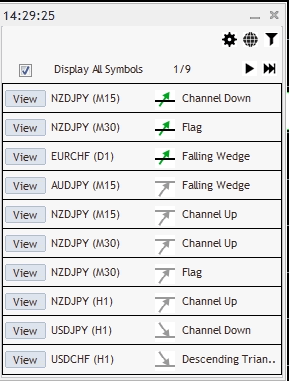
Click the left and right arrow buttons to browse all opportunities present in the market at that moment.
If you're interested in particular timeframe or pattern types, use the Filters option to filter market activity.
Here's a short explanation of each filter:
- Completed chart pattern - the pattern has been identified and the price has reached the target level
- Emerging chart pattern - the pattern has been identified but the price has not reached the target level yet
- Completed Fibonacci Pattern - patterns that form when the price graph moves up and down in a particular price ratios
- Emerging Fibonacci Pattern - if the price reaches and turns around at the price level of the pink dot, the pattern would be complete and the expected levels of support or resistance would apply
- Key levels: Breakouts - trading opportunities where the price has broken through the support level
- Key levels: Approaches - trading opportunities where the price has broken through the resistance level
Uncheck 'Display all symbols' to only see the patterns identified on the instrument you've opened the chart for.
Click 'View' to see each opportunity identified on the chart. Get more details using the 'Pattern details' window.
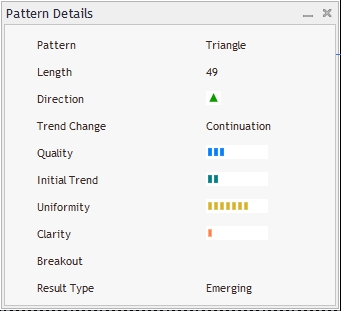
2. Use the predictions to help you decide which direction to trade in. The general rule of thumb is to go long (open a buy order) when the price is expected go up and to go short when the price is expected to go down.
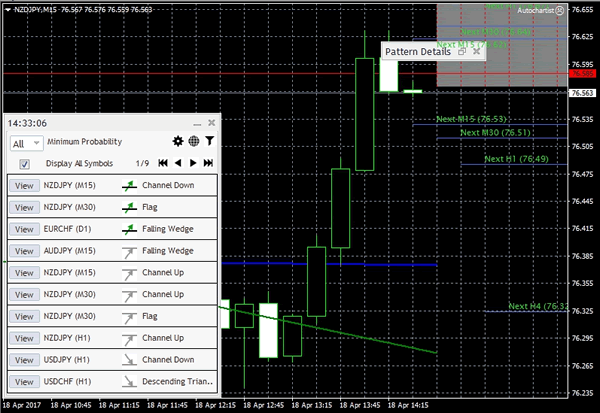
CHFJPY is expected to appreciate based on triangle pattern.
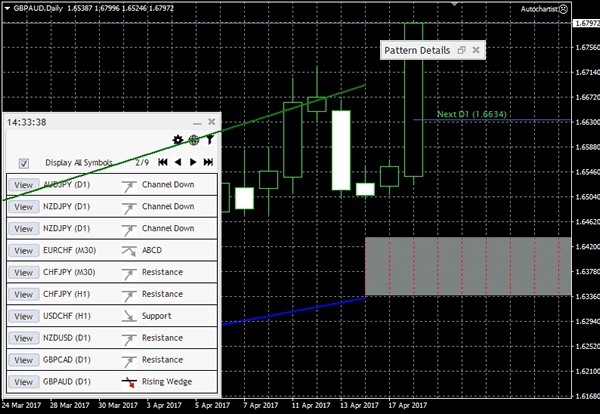
EURCAD is expected to depreciate based on triangle pattern.
3. Press F9 to open a new order window or click 'New Order'.
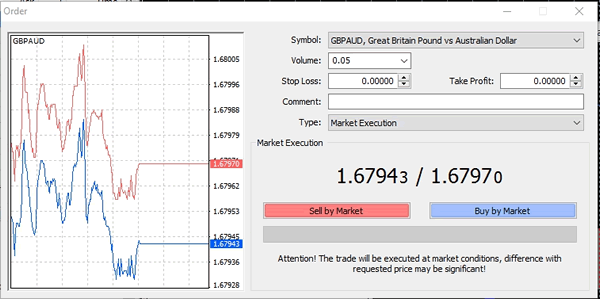
4. Make sure the instrument selected is the one you want to trade, and specify the volume of your position in lots. Volume depends on the size of your fund, your leverage and which risk to reward ratio you are aiming for.
5. Click Buy or Sell depending on the price direction.
6. Setting a stop loss and take profit based on volatility levels is recommended, however this step is optional.
Click 'View' in the Autochartist plugin to open the pattern you're going to trade. Enable 'Shift end of the chart from right border' at the toolbar.

'Volatility levels' are displayed on the right hand side of the chart. This is an approximation of how much the price is expected to fluctuate.
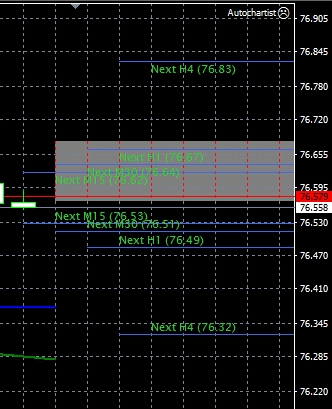
If you're going long (opening a buy order), you should set your Stop Loss at the price which is below the order open price and Take Profit at the price which is above the open price. For a short (sell) position, set the stop loss at a higher price and take profit at a lower one.
When choosing SL and TP levels, give special consideration to the minimum stop level, which you can check by right clicking the instrument in 'Market Watch' and selecting 'Specification'. It is recommended from a risk management perspective to keep a risk:reward ratio of at least 1:2.
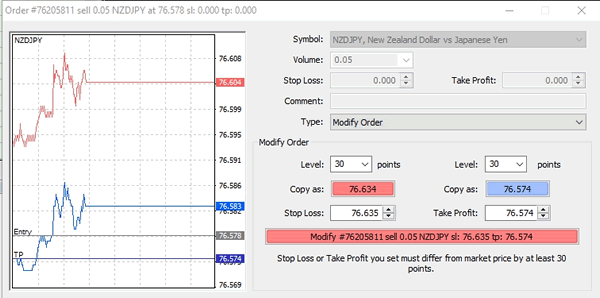
Having identified the appropriate levels, find your position in the 'Trade' tab. Right click and select 'Modify or delete order'.
Set Stop Loss and Take Profit and click 'Modify' to save your changes.
The Autochartist plugin provides a unique insight into the market situation and saves you a significant amount of time. If you'd like to know more about Autochartist, get in touch with our Customer Support team.