

Sample Category Title
Currencies: Dollar Still Awaiting A Trigger For A Directional Move
Sunrise Market Commentary
- Rates: Slow start ahead of key events, but Italian underperformance?
We start the week with a neutral bias as markets will focus on Yellen's speech (tomorrow) and German/US inflation readings (both on Friday). Italian BTP's could underperform following the Italian state's rescue of 2 regional lenders and as the center-right's gains in municipal elections could further tangle up the political landscape. - Currencies: Dollar still awaiting a trigger for a directional move
Last week, there was no clear guide for USD trading, leaving EUIR/USD and USD/JPY in tight ranges. This process might still continue at the start of this week. US data surprise or clear CB guidance is probably needed to unlocked this stalemate. Sterling feels conflicting influences from lingering political uncertainty, but hawkish BoE talk.
The Sunrise Headlines
- US stock markets ended flat (Dow Jones) to 0.5% higher (Nasdaq) in the final session of an uneventful week. Overnight, Asian stock markets record similar gains with China outperforming (up to +1%).
- Italian authorities said they were prepared to spend as much as €17B as part of the shutdown of two regional banks, in a deal that will transfer the lenders' best assets to Intesa for a nominal sum.
- Italy's centre-right opposition was poised for an emphatic victory in municipal races around the country, bolstering its hopes of a political resurgence and dealing a blow to Matteo Renzi's ruling centre-left Democratic party
- Fitch affirmed Belgium's AA- rating (stable outlook) saying that the high debt ratio balances against the substantial net creditor position, strong governance indicators, high income per capita and macroeconomic stability.
- The Bank for International Settlements warned in its annual report that rising protectionist sentiment and a retreat from global cooperation on economic matters would threaten the world economy.
- US President Trump made calls to fellow Republicans in the US Senate to mobilize support for their party's healthcare overhaul while acknowledging the legislation is on a "very, very narrow path" to passage.
- Today's eco calendar contains the German Ifo-indicator and US durable goods orders. The US Treasury holds a $26B 2-yr Note auction
Currencies: Dollar Still Awaiting A Trigger For A Directional Move
Dollar still waiting for a directional trigger
Dollar cross rates didn't show much spirit on Friday. USD/JPY kept a tight range near 111.30. EUR/USD moved slightly higher, from around 1.1150 to 1.1180. The short term (2y) interest rate differential between US/German narrowed from 200 bps on Monday to 196 bps on Friday. Reuters sources indicated that scarcity of German government bonds is a key ECB consideration for deciding on extending QE. It limits the possibility of a major extension. The rumours maybe underpinned the single currency, but it is a long shot.
This morning, Asian equities trade with moderate gains, as the Tech rally continues. A gradual rebound of the oil price is also slightly supportive. However, the direct impact of equities on USD trading is again small. USD/JPY opened soft, but reversed the initial dip and trades again in the 111.30 area. EUR/USD is trading little changed in the 1.1190 area.
Eco calendar heats up, Fed speakers take the stage
The June German IFO business sentiment is expected little changed. The weakening of the services PMI suggests some downside risks, even if the composition of both measures of sentiment is different. The US durable orders are expected to have dropped by 0.6% in May, following a drop in April. It follows strong readings in February/March. The more important orders excluding transportations are expected to have rebounded 0.4% M/M. The ECB holds its forum in Sintra on investment and growth. The subject contains lots of interesting items that touch monetary policy, but policy itself is not the subject. We expect few comments with direct on impact markets, but one never knows with such conference.
In a day-to day perspective, the data (Ifo and US durables) at the margin might be USD supportive, but it is highly unlikely that they will change the broader picture. Late in the session, the headlines from the ECB forum will filter trough. If there would be suggestions on policy normalisation on a more global scale, it could be slightly more supportive for the euro and the yen rather than for the dollar. However, all these considerations are highly hypothetical. So, we start the week with a neutral bias for EUR/USD trading. The positive risk sentiment might protect the downside of USD/JPY, but it didn't cause any meaningful gains of late.
Technical picture: USD still confined to tight ranges
Early May, EUR/USD failed to break below the 1.0821/1.0778 support (gap). Poor US data and US political upheaval propelled EUR/USD north of the 1.1023 range top. The pair tested the 1.1300 area going into the FOMC decision, but the test was rejected. The Trump top/correction top at 1.1300/1.1366 proved to be a solid resistance. USD sentiment will have to become really negative to clear this hurdle. EUR/USD 1.1110 is a first minor support. A return below 1.1023 would indicate that the upside momentum has eased.
The USD/JPY rally ran into resistance in early May. A mini sell-off mid-May made the short-term picture negative, driving the pair further down in the 108.13/114.37 range. The post-Fed USD rebound pushed the pair beyond a first minor resistance at 110.81. A break beyond the 112.13 correction top would improve the ST-picture. The day-to-day sentiment improved slightly of late, but we remain cautious to forecast a U-turn.
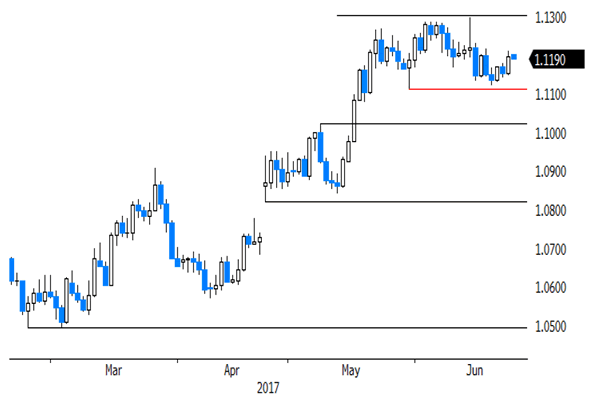
EUR/USD: test off 1.1300/66 resistance rejected, but correction remains modest. First support at 1.1110 holds
EUR/GBP
Sterling balanced by BoE speak and political uncertainty
On Friday, sterling initially profited from the hawkish farewell speech of resigning BoE Forbes. The recent sequence of events (BoE meeting – Carney comments – Haldane speech) triggered a significant rethinking in rate hike expectations. The probability of a 25 bps hike by the BoE this year rose from 6.5% on June 14 to 50% Friday. However, sterling gains remained modest as official Brexit-talks started on a bad note. EU Tusk said that PM May's opening offer on EU nationals living in the UK is below expectations. Sterling's fortunes changed throughout the day with EUR/GBP reversing the earlier decline to close the session in again in the 0.88 area.
Today, the eco calendar only contains the BBA loans for home purchases. The focus for sterling trading will be on Brexit negotiations and on PM May trying to find support for her minority government. The results of the exchange of views on the rights of EU citizens in the UK didn't go really smooth. On the other hand, the debate within the BoE might give sterling some downside protection, especially when UK eco data remain relatively strong. So, for now we expect EUR/GBP to hold its sideways consolidation pattern in the 0.88 area.
From a technical point of view, EUR/GBP extensively tested the 0.8854 area (2017 top), but a real break didn't occur. BoE comments caused some volatility recently. In the end, the 0.8854/66 resistance remains within reach. A break would open the way to the 0.90 area. A return below the 0.8655 correction low would indicate easing pressure on sterling. Such a break lower will be difficult. A EUR/GBP buy-on-dips approach remains favoured
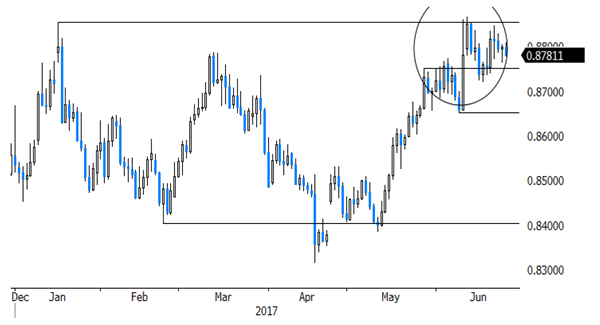
EUR/GBP: sterling rebounds temporary on BoE comments, but the 0.8854/66 resistance stays within reach.
Trade Idea : EUR/USD – Stand aside
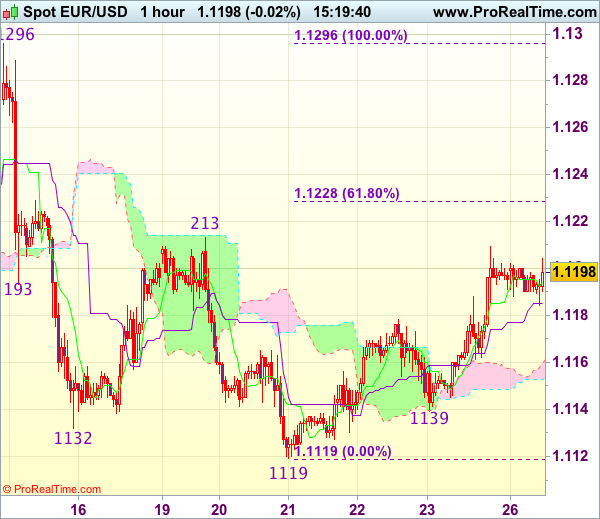
EUR/USD - 1.1203
Most recent candlesticks pattern : N/A
Trend : Near term down
Tenkan-Sen level : 1.1195
Kijun-Sen level : 1.1185
Ichimoku cloud top : 1.1159
Ichimoku cloud bottom : 1.1153
New strategy :
Stand aside
Position : -
Target : -
Stop : -
The single currency has maintained a firm undertone after last week’s rebound from 1.1119, suggesting near term upside risk remains for this rebound to extend gain to 1.1213 resistance, then towards 1.1228-30 ((61.8% Fibonacci retracement of 1.1296-1.1119), however, reckon upside would e limited to 1.1260-70 and price should falter well below resistance at 1.1296, bring retreat later.
In view of this, would not chase this rise here and would be prudent to stand aside for now. Below the Kijun-Sen (now art 1.1185) would bring weakness towards 1.1139 support but break there is needed to revive bearishness and signal top is formed, bring retest of 1.1119.
Trade Idea : USD/JPY – Buy at 110.65
USD/JPY - 111.48
Most recent candlesticks pattern : N/A
Trend : Near term up
Tenkan-Sen level : 111.36
Kijun-Sen level : 111.32
Ichimoku cloud top : 111.35
Ichimoku cloud bottom : 111.26
Original strategy :
Buy at 110.65, Target: 111.65, Stop: 110.30
Position : -
Target : -
Stop : -
New strategy :
Buy at 110.65, Target: 111.65, Stop: 110.30
Position : -
Target : -
Stop : -
Although the greenback has rebounded after finding support at 110.95 last week and gain towards resistance at 111.79 (last week’s high) cannot be ruled out, break there is needed to signal recent upmove has resumed and extend headway to 111.90-95 (50% projection of 108.82-111.42-110.65), however, upside should be limited to resistance at 112.13 and 112.25 (61.8% Fibonacci retracement of 114.37-108.82 and 61.8% projection) should hold. If said resistance at 111.79 continues to hold, then further consolidation would take place and another retreat to 110.95 cannot be ruled out, however, previous support at 110.65 would limit downside and bring another rise later.
In view of this, would not chase this rise here and we are looking to buy dollar on pullback as 110.65 support should limit downside. Below 110.30-35 (50% Fibonacci retracement of 108.82-111.79 and previous resistance turned support) would abort and signal a temporary top has been formed instead, risk weakness towards 109.95-00 (61.8% Fibonacci retracement).

Will The Range Bound Trading Continue In The Week Ahead?
Last week the financial markets experienced very low volatility in equities, fixed income, and currency exchanges. The S&P 500 moved withina 23 points trading range. Similarly, the U.S. 10-year Treasury bonds were stuck in a six basis points trading range, and FX markets were incredibly boring for many traders.
Although oil fell into a bear market, equities were slightly impacted. This is probably due to the lower weightage the energy sector represents now compared to 2014. However, if the slump in oil resumes, I think it will threaten other sectors, particularly the financials, as lower oil prices mean lower inflationary pressures and lower interest rates across developed economies, which will eventually lead to compressed profit margins for banks.
The Fed policymakers had been broadly hawkish last week, and most of them anticipate another rate hike in 2017 (most likely in December). However, fixed income markets are saying it's over for this year as they don’t see inflationary pressures coming anytime soon. It’s still too far from December, but oil prices will play a significant role on how interest rates go from here.
With valuations still high and the timetable for President Donald Trump’s fiscal policies being unpredictable, only robust earnings can support stocks. According to FactSet, the estimated earnings growth for S&P 500 is 6.6%, down from 8.7% forecast in March. Given the negative surprises in recent U.S. economic data, we might also see estimates dragged lower. Thus, bulls and bears will be cautious at this stage leading to the continuation of sideway movements in major U.S. indices.
In currency markets, the Cable will be under the spotlight. Queen Elizabeth gave approximately a one-week deadline for the vote in the House of Commons. Prime Minister Theresa May needs to strike a deal with the Democratic Unionist Party to prevent her government from falling apart. I believe there’s a high chance that she will get a deal, but if she failed to do so, GBPUSD would likely experience another fall towards 1.25, however, if she were to besuccessful, l expect to see a further recovery towards 1.29. There’s very little on U.K.’s data front, so politics will be the primary driver of the Pound.
Another interesting currency to trade is the Loonie. Despite falling oil prices, the Canadian dollar was the top performing currency past week on prospects of higher interest rates. Monetary policymakers shifted their tone to prepare markets for a rate hike. Inflation rate doesn’t support their argument as it declined to 1.3%, but with other economic data remaining robust, they will keep sending hawkish signals. Governor Poloz, will be joined by ECB’s Mario Draghi, BOJ’s Haruhiko Kuroda, and BoE’s Mark Carney on a panel discussion on Wednesday, which will likely shed some light on central bankers’ thoughts.
Brent Oil Has Climbed Slightly Higher
Market movers today
Today is a very quiet one in terms of data releases.
In the US, we are set to receive core capex goods orders for May. The new orders component has levelled off recently, in line with the general cooling of the manufacturing sector. We estimate a slight increase of 0.2% m/m in goods orders in May.
In the euro area, the German ifo expectation is due for release today. The ifo expectation increased from 105.2 in April to 106.5 in May, which is its highest level since February 2014. We expect this figure to decline to 106.1 in June, as the German ZEW and Sent ix have both declined in June, and the weakening business cycle indicators in the US and China could still weigh on the German business expectation.
Selected market news
On Friday in the euro area, PMI figures were due out . The euro area manufacturing PMI continued higher in June to 57.3 from 57.0 in May despite the weakness seen in the US and China. In our view, weaker global growth will continue to weigh on the euro area and we look for weaker headline manufacturing PMI in coming months. The service PMI came out weak at 54.7 in June from 56.3 in May, which is the lowest level since January 2017. The lower service PMI figure could reflect slower real wage growth, which has followed as inflation has picked up without nominal wage growth following suit . Looking ahead, we continue to expect this to be a headwind for consumers.
On Friday, we also got US PMI manufacturing and services for June. Manufacturing PMI fell unexpectedly to 52.1 in June (market consensus and our expectation was for a slight increase to 53) from 52.7 in May. Service PMI also came out lower than expected at 53 in June (consensus was at 53.5) from 53.6 in May.
It has been a calm session in global financial markets this morning. Asian stock markets have mainly been moving sideways, though slightly in the green and in fixed income markets, changes in the US 10-year government benchmark bond yield have been subdued since Friday. Brent oil has climbed slightly higher to around USD46/bbl at the time of writing.
What’s Next For The AUD?
Key Points:
- After a volatile week, the AUD's future is in question.
- Lack of much Australian news leaves the pair exposed to US risk events.
- Technical bias is somewhat mixed.
The AUDUSD had a rough week last week which brings into question whether or not the pair's recent rally can extend any further. Indeed, there are some early signs that the Aussie Dollar could be making a beeline for the 0.75 handle which may have the bears excited. As a result, it might be worth taking a closer look at what happened last week and what we can expect moving ahead.
The Aussie Dollar was under pressure from the get go last week, declining all the way to the 0.7539 level before things finally turned around. This bearish momentum stemmed from a number of robust US data releases that largely eclipsed the 2.2% uptick in the Aussie HPI figure and a flat MI Leading Index posting. In particular, the US Existing Home Sales result of 5.62M worked against the pair and sparked the biggest single day rout for the AUD this month. However, on Friday, the Aussie Dollar did bounce back somewhat as the US PMI data proved disappointing – subsequently causing the pair to close the week out only moderately lower at the 0.7567 handle.
As for what lies ahead, it is another quiet week on the Australian news front which will mean the US data is driving prices once gain. Of the figures due out, the GDP and Jobless Claims are likely to be the key results to watch for but some comments from Yellen could also be worth looking at as well. Most Fed members have remained rather hawkish in the wake of the recent hike which suggests that the top dog is likely to take a similar tone. If this is indeed the case, it could see selling pressure build from as early as Tuesday and this might see the AUD have yet another disappointing week.
On the technical front, the Aussie Dollar is actually relatively neutral and could go either way this week. On the one hand, the Parabolic SAR and the EMA bias are bullish – signalling that the bears may not be in complete control just yet. However, on the other hand, the pair is about to run into some fairly stiff resistance around the 0.7580 handle which may prove rather difficult for the bulls to break through in the absence of a fundamental upset. What's more, both RSI and stochastics are neutral which gives the AUD a significant degree of freedom moving forward but also indicates that it may begin to range. Importantly, resistance is present at the 0.7580, 0.7636, and 0.7679 levels whilst support will be seen at 0.7532, 0.7486, and 0.7435.
Ultimately, we can expect a fairly flat week for the AUD and the pair is likely to remain within the 0.7580 – 0.7532 range. Nevertheless, keep an eye on those fundamentals as they could disrupt the sideways movement if they come in significantly above or below expectations.
Euro Dollar Likely To Remain Flat In The Week Ahead
Key Points:
- Price action takes a largely sideways direction.
- U.S. GDP results loom and could fundamentally impact the pair.
- Watch for a break out from the consolidation pattern in the coming week.
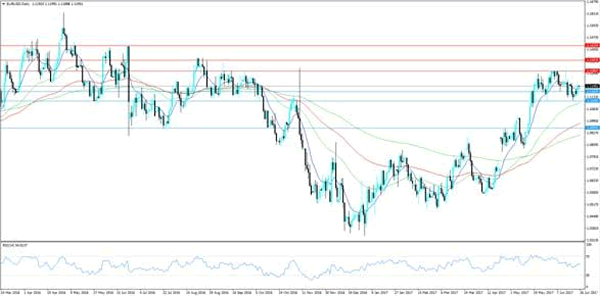
The Euro remained relatively flat over the course of the week retaining its position within the consolidative structure to close around the 1.1191 mark. There was little on the fundamental front to change the volatility outlook but a slight sentiment swing against the greenback was evident with most of the U.S. economic data proving fractionally disappointing. Therefore, it remains to be seen if the Euro will continue to trend within the current consolidation pattern but let’s review last week’s major points with the intent of highlighting some looming risks.
The Euro entered the week with plenty of speculation that we might see an end to the low volatility period that has plagued the pair of late. However, that wasn’t to be and the pair continued to trend within the consolidative structure in a largely sideways pattern. Subsequently, the pair closed the week out largely where it started at 1.1191. However, we did see some signs of bullishness late in the week when the U.S. Manufacturing and Services PMI figures were released and showed declines to 52.1, and 53.0, respectively. This sent the Euro rising by around 40 pips but it soon ran out of lift and the move abated.
Looking ahead, the coming week has plenty of fundamental events looming that could cause volatility to return to the pair. In particular, the U.S. GDP figures are likely to be closely watched by the market given that there is some concern as to the current negative trend within the domestic economy. Subsequently, this result will need to be relatively robust to support the Fed’s current narrative around rate hikes. In addition, ECB Chair Mario Draghi is due to speak in the middle of the week and is likely to provide some illuminating comments on the current state of the Eurozone. This will be particularly interesting given that the central bank just cut the inflationary outlook for the coming few years. Ultimately, either of these statements might be enough to cause some volatility, and a breakout, for the Euro Dollar so monitor them carefully.
From a technical perspective, the Euro Dollar has stayed in consolidation below 1.1295 which suggests that our bias of neutral from last week remains in play. In addition, support at 1.1109 remains intact which suggests that a reversal is not yet on the cards. Ultimately, the pair will need to break out of the current structure, and develop a strong trend, before a directional bias can be highlighted. Support is currently in place for the pair at 1.1163, 1.1109, and 1.0954. Resistance exists on the upside at 1.1281, 1.1343, and 1.1425.
Ultimately, the Euro is likely to take a largely sideways direction in the week ahead until price action breaks out of the current consolidation phase. However, keep a close watch on the U.S. GDP figures as a strong result could see the 1.1109 support coming into focus.
Aussie Dollar Trading On A Stronger Footing This Morning
AussFor the 24 hours to 23:00 GMT, the AUD rose 0.29% against the USD and closed at 0.7570 on Friday.
LME Copper prices rose 0.7% or $38.0/MT to $5774.0/MT. Aluminium prices declined 0.2% or $4.0/MT to $1868.0/MT.
In the Asian session, at GMT0300, the pair is trading at 0.7581, with the AUD trading 0.15% higher against the USD from Friday’s close.
The pair is expected to find support at 0.7556, and a fall through could take it to the next support level of 0.7532. The pair is expected to find its first resistance at 0.7594, and a rise through could take it to the next resistance level of 0.7608.
With no economic releases in Australia today, trading trend in the Aussie Dollar is expected to be determined by global macroeconomic factors.
The currency pair is trading above its 20 Hr and 50 Hr moving averages.e Dollar trading on a stronger footing this morning

Euro-Zone’s Manufacturing Sector Activity Accelerated In June, While Services Sector Growth Cooled In The Same Month
For the 24 hours to 23:00 GMT, the EUR rose 0.34% against the USD and closed at 1.1196 on Friday, after the Euro-zone's flash Markit manufacturing PMI unexpectedly rose to a level of 57.3 in June, expanding at its fastest pace in more than six years, thus suggesting that robust manufacturing sector will help drive growth in the region's economy. Market participants had expected the PMI to drop to a level of 56.8, following a level of 57.0 in the previous month. On the other hand, the region's preliminary Markit services PMI dropped more-than-expected to a five-month low level of 54.7 in June, after registering a reading of 56.3 in the previous month, while investors had envisaged it to ease to a level of 56.1.
Separately, activity in Germany's manufacturing sector eased less-than-expected to a level of 59.3 in June, compared to market expectations of a fall to a level of 59.0. In the previous month, the PMI had recorded a level of 59.5. Further, the nation's services sector expanded at its weakest pace in 5 months in June, after the PMI surprisingly eased to a level of 53.7, defying market consensus for the PMI to remain steady at a level of 55.4 registered in the prior month.
The greenback ended lower against its major peers on Friday, after weaker-than-expected US manufacturing and services sector data pointed to a slowdown in the world's largest economy.
Data showed that the US preliminary Markit manufacturing PMI unexpectedly eased to a level of 52.1 in June, hitting its lowest level in nine months and confounding market consensus for an advance to a level of 53.0. In the previous month, the PMI had recorded a reading of 52.7. Moreover, the nation's services sector growth eased to a 3-month low level of 53.0 in June, higher than market expectations of a drop to a level of 53.5. In the preceding month, the PMI had recorded a reading of 53.6. On the contrary, the nation's new home sales rebounded less-than-anticipated by 2.9% on a monthly basis in May, compared to a revised fall of 7.9% in the preceding month.
Meanwhile, St. Louis Federal Reserve (Fed) President, James Bullard, stated that the Fed should wait on further rate hikes until inflation was moving towards the central bank's target.
In the Asian session, at GMT0300, the pair is trading at 1.1194, with the EUR trading slightly lower against the USD from Friday's close.
The pair is expected to find support at 1.1163, and a fall through could take it to the next support level of 1.1132. The pair is expected to find its first resistance at 1.1217, and a rise through could take it to the next resistance level of 1.1240.
Going ahead, investors will keep a close watch on Germany's Ifo expectations and business climate indices, both for June, slated to release in a few hours. Moreover, the US flash durable goods orders for May, due to release later in the day, will be on investors' radar.
The currency pair is showing convergence with its 20 Hr moving average and trading above its 50 Hr moving average

Pound Trading Higher, Ahead Of UK’s BBA Mortgage Applications Data
For the 24 hours to 23:00 GMT, the GBP rose 0.23% against the USD and closed at 1.2727 on Friday, after the British Prime Minister, Theresa May, offered European Union (EU) citizens the right to stay in the UK in exchange for Britons to stay in the EU, thus raising the likelihood for a softer Brexit.
In the Asian session, at GMT0300, the pair is trading at 1.2751, with the GBP trading 0.19% higher against the USD from Friday's close.
The pair is expected to find support at 1.2710, and a fall through could take it to the next support level of 1.2670. The pair is expected to find its first resistance at 1.2773, and a rise through could take it to the next resistance level of 1.2796.
Going ahead, traders would look forward to Britain's BBA mortgage applications data for May, slated to release in a few hours.
The currency pair is trading above its 20 Hr and 50 Hr moving averages.
