

Sample Category Title
Divisions in Fed and BoE Boards Might Signal Changes in Monetary Policy Stances ahead
There wasn't a unified theme in the forex markets last week. Movements in the major currencies were driven by different factors. But a trend to note is that markets attentions were generally back to central banks, from politics. The divisions in Fed and BoE boards were very apparent and showed that the overall policy stances of both central banks could be shifting. Euro was mixed as it's awaiting economic data to push ECB officials to recede from being too dovish. Meanwhile, Canadian Dollar failed to extend the BoC inspired rally as rate hike bets cooled after tame inflation readings. The extended rout in oil price also added some weight to the Loonie and Aussie. New Zealand Dollar, on the other hand, ended as the second strongest one, next to Swiss Franc, on a mild RBNZ hawkish turn.
Fed officials views on inflation and rate path diverge
In US, markets were getting increasing doubtful on whether Fed will hike interest rate again in September. And the voices of doves were getting louder after three months of weak inflation reading. St. Louis Fed President James Bullard said on Friday "recent inflation data have surprised to the downside and call into question the idea that US inflation is reliably returning toward target." And his view is that inflation is not going to increase substantially "based on current estimates of the relationship between unemployment and inflation." He urged Fed to "wait and see how the economy develops before making any further adjustments to the policy rate."
Chicago Fed President Charles Evans said earlier in the week that the current environment of low inflation "supports very gradual rate hikes and slow preset reductions in our balance sheet". And, "it remains to be seen whether there will be two rate hikes this year, or three, or four or exactly when we start paring back reinvestments of maturing assets." He added that "I don't see why we would not be served to allow more time to wait." Evans also urged Fed to "assure the public that we recognize the new low-inflation environment and that we are not overly conservative central bankers who see our inflation target as a ceiling."
On the other hand, there are Fed officials who aren't concerned with the inflation undershoot. Cleveland Fed President Loretta Mester said that "inflation is on this gradual upwards path that we've been projecting for a while." And she added that "we got a couple of weak reports but fundamentally it doesn't look like demand is falling out." She sees the current "gradual reduction of accommodation" makes senses to her.
New York Fed President William Dudley didn't sound much concerned with low inflation neither. Instead, he noted that the US is "pretty close to full employment. And if labor market continues to tighten further "wages will gradually pick up". And with that "inflation will gradually get back to 2%". Regarding the economy, Dudley also expressed that he is "confident" that the expansion has "quite a long way to go".
30 year yield tumbled
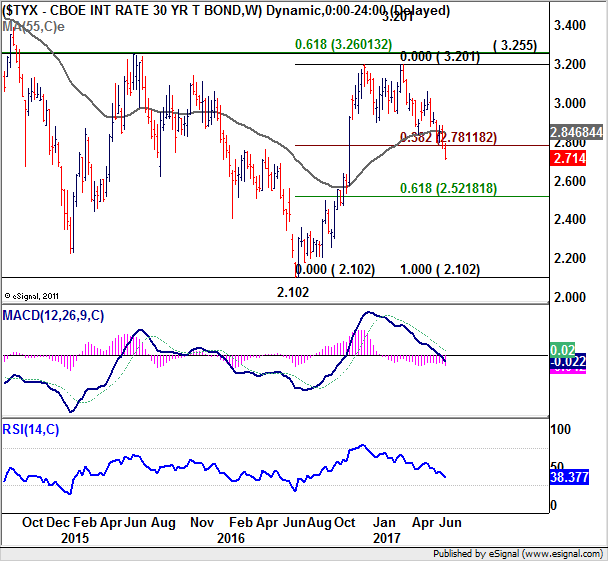
Overall, the growing voice of doves is limiting Dollar's strength for rebound. 10 year yield was held in range below key near term resistance at 2.229 and maintained bearish outlook. Additional pressure was seen in 30 yield yield as oil rout continued. TYX dropped sharply to close at 2.714 last week and took out 2.781 fibonacci support firmly. 55 week EMA was also decisively taken out. The development argues that rebound from 2.102 low has completed at 3.201 after failing to push through 3.255 cluster resistance, 61.8% retracement of 3.976 to 2.102 at 3.260. There is prospect of further fall to 61.8% retracement of 2.102 to 3.201 at 2.521 and below.
Dollar index staying bearish
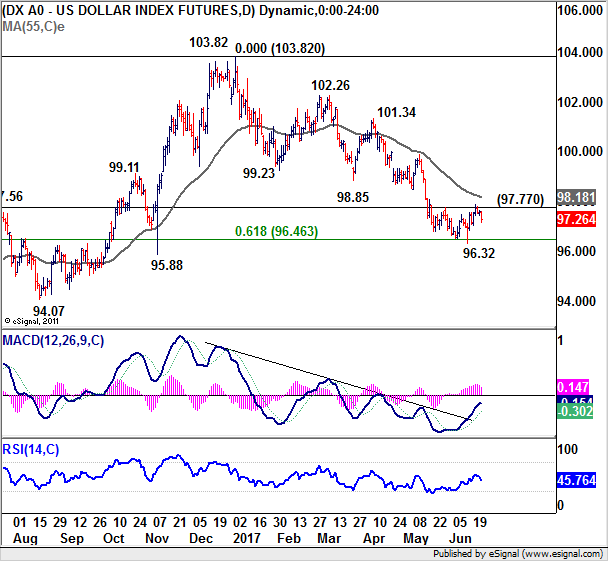
Dollar index recovered last week and breached 97.77 near term resistance but failed to stay above there. While a short term bottom is in place at 96.32, there is no confirmation of trend reversal yet. The index is held well below 98.85 support turned resistance and 55 day EMA at 98.18. Some more consolidations could be seen but at this point, a downside breakout remains in favor. Sustained break of 61.8% retracement of 91.91 to 103.82 at 96.46 will push DXY further lower to key cluster level at 91.91, 38.2% retracement of 72.69 (2011 low) to 103.82 (2016 high) at 91.93), before getting enough support for sustainable rebound.
Divisions also seen in BoE MPC
Similar division is seen in BoE. On the one hand, BoE Governor Mark Carney said in his Mansion House speech that "now is not yet the time to begin that adjustment" of monetary policies. He added that "different members of the MPC will understandably have different views about the outlook and therefore on the potential timing of any Bank Rate increase. But all expect that any changes would be limited in scope and gradual in pace." For him, he would like to see "the extent to which weaker consumption growth is offset by other components of demand, whether wages begin to firm, and more generally, how the economy reacts to the prospect of tighter financial conditions and the reality of Brexit negotiations."
On the other hand, BoE chief economist Andy Haldane said that partial removal of monetary stimulus would be "prudent relatively soon". And he noted that "risks associated with tightening too early, on the one hand, and too late, on the other, has swung materially towards the latter in the past six to nine months." He pointed out that "the risks of tightening too early have shrunk as growth and, to lesser extent, inflation have shown greater resilience than expected. And if policy tightened too late, this could result in a much steeper path of rate rises later on." Haldane's comments was taken seriously by the markets as firstly, he's the chief economist. Secondly, he's perceived by many as the most dovish MPC member. Thirdly, while Kristin Forbes will be released by Silvana Tenreyro, there are potentially still three MPC member, including Haldane, Ian McCafferty and Michael Saunders, that could vote for rate hike ahead.
But overall, the Pound ended the week broadly lower except versus Aussie and Loonie. It's still weighed by political uncertainties in UK as well as all the unknowns regarding Brexit. To recap, UK and EU representatives met in Brussels last week for the first formal Brexit negotiation. Agreement was made that talks until October should focus on the three issues of financial settlement, citizens rights and Northern Ireland. Further talks will be held in the weeks of July 17, August 28, September 18 and October 9. UK's Brexit Minister David Davis said he was "encouraged" by the first talks that "laid solid foundations for future discussions and an ambitious but achievable timetable". On the other hand, EU's chief negotiation Michel Barnier said that little was achieved other than setting a timetable and a structure for negotiations.
FTSE steady but stays vulnerable for reversal
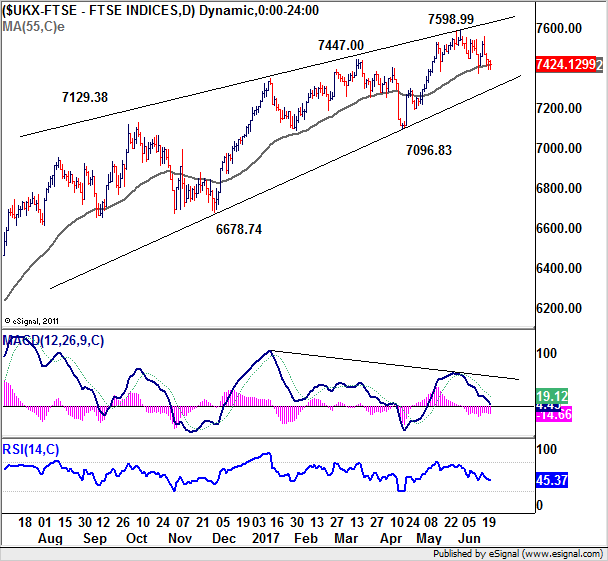
FTSE 100 ended the week mildly lower and continued to test 55 day EMA. Our view on FTSE's outlook remains unchanged. Upside momentum has been diminishing clearly with bearish divergence condition in daily MACD and the terminal triangle like structure. The index is starting to be vulnerable for a trend reversal and sustained break of 55 day EMA would now put 7096.83 key support level in focus. And we'd like to point out again that the impact of Pound depreciation on corporate earnings have been fading. And the correlation of Sterling and FTSE could be turning positive. Thus, the next selloff in FTSE might be accompanied by similar selloff in the Pound. We'll keep an eye on such development.
Loonie weighed down by oil rout
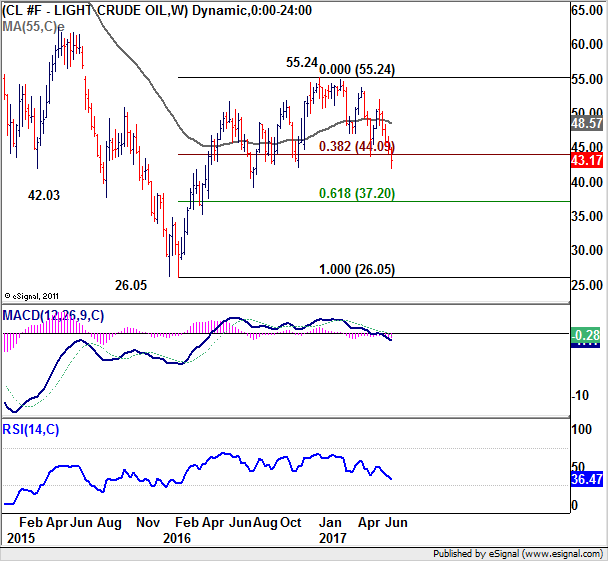
Elsewhere, Canadian Dollar struggled to find the needed fuel for extending it's BoC inspired rally. The Loonie was boosted earlier this month by the hawkish turn of BoC Governor Stephen Poloz. There was a chance to extend recent rise after last week's strong retail sales report. But tamer than expected May inflation reading quickly knocked down the rally attempt. On the background, extended sell off in oil price was also weighing down the Canadian Dollar. WTI crude oil's dive through 38.2% retracement of 26.05 to 55.24 at 44.09 is opening up the case for deeper fall through 40 handle to 61.8% retracement at 37.20. USD/CAD could extend the near term consolidation from 1.3164 if weakness in oil price persists.
Aussie turning weak quietly
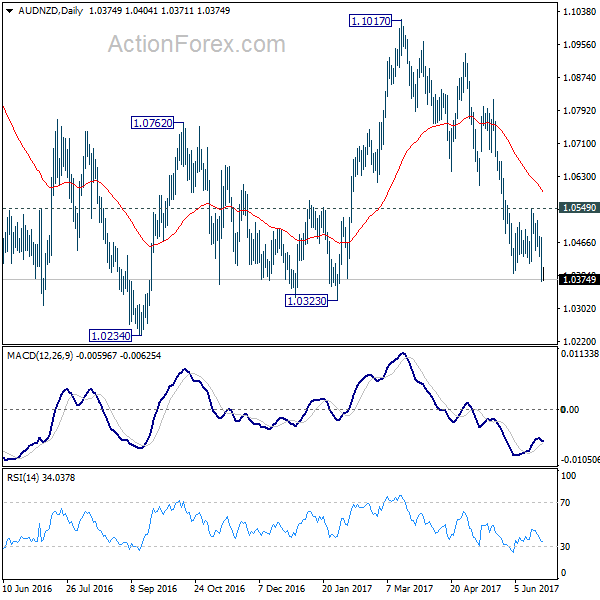
Aussie also turned a bit weaker last week without any apparent reason. Selloff in AUD/NZD after RBNZ could be a factor dragging Aussie down. Weakness in iron ore price and softening Chinese demand is seen as another factor. But the overall outlook of Aussie in the currency markets is a bit mixed. On the one hand, AUD/NZD's near term down trend has just resumed and is on course for 1.0323 support first and then 1.0234. EUR/AUD is also trying to draw support from 1.4614 fibonacci level and 55 day EMA to rebound. On the other hand, AUD/USD is held above 0.7523 support so far and maintains near term bullishness. Development in Aussie ahead is worth a watch.
Trading strategy: Hold USD/CAD short, EUR/GBP Long, Eye on Aussie
Regarding trading strategy, we're holding on to USD/CAD short (sold at 1.3510, stop at 1.3400). There is no clear sign of reversal yet. Price actions from 1.3164 low are corrective and suggests further fall ahead. Hence, we'll just hold on to the position unchanged. We're still expecting medium term decline through 1.2460 low. But for near term, it's getting more likely that there would be support above 1.2968 (61.8% retracement of 1.2460 to 1.3793 at 1.2969). Hence, we'll look to take profit on next decline and sell again later. Stay tuned.
Also, we're holding on to EUR/GBP long (bought at 0.8740, stop at 0.8640). Consolidative price actions from 0.8865 is affirming out bullish view for extension of rise from 0.8312. We'll stay long in the cross and expect further rally to retest 0.9304 high. And, we'll look at the momentum of the next rise to determine the chance of a break of 0.9304 in medium term.
Meanwhile, we'll start to look at Aussie short opportunities but keep our hands off first.
GBP/USD Weekly Outlook
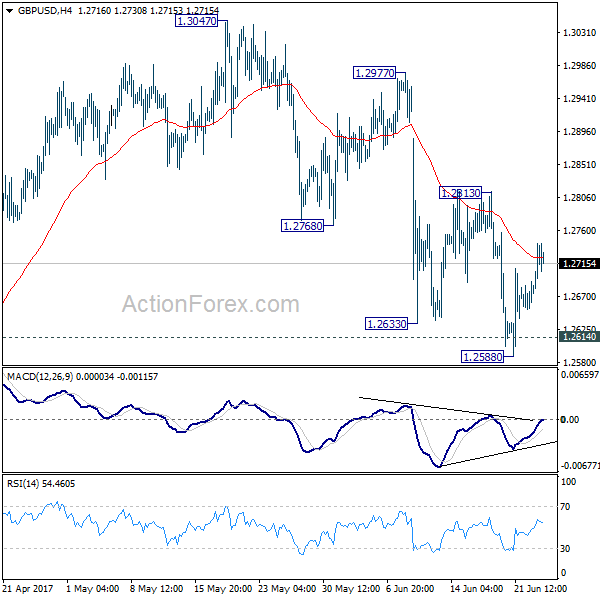
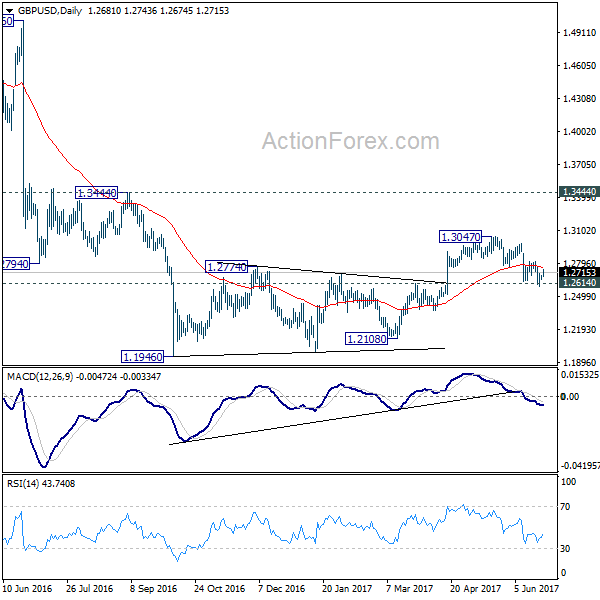
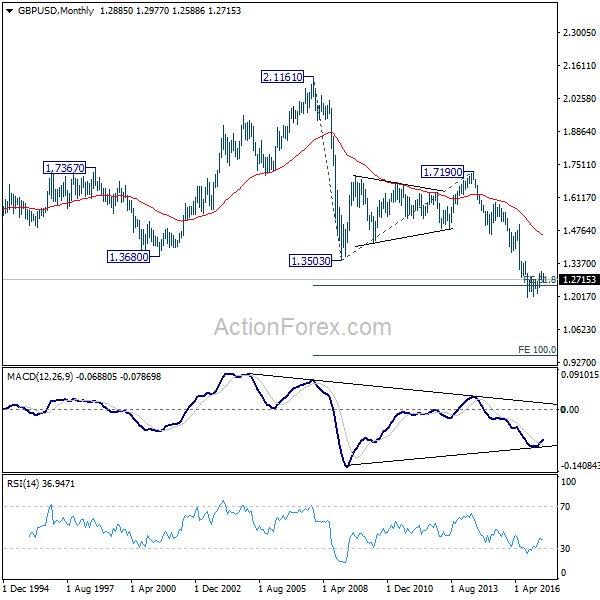
GBP/USD dropped to 1.2588 last week and breached 1.2614 key support level but recovered. Upside of rebound was limited below 1.2813 resistance and outlook is unchanged. Initial bias remains neutral this week first. At this point, we still favor the case that consolidation pattern from 1.1946 has completed at 1.3047 already. Sustained break of 1.2614 should confirm our bearish view and target a test on 1.1946 low next. However, break of 1.2813 resistance will dampen our view and turn bias back to the upside for 1.3047 and above.
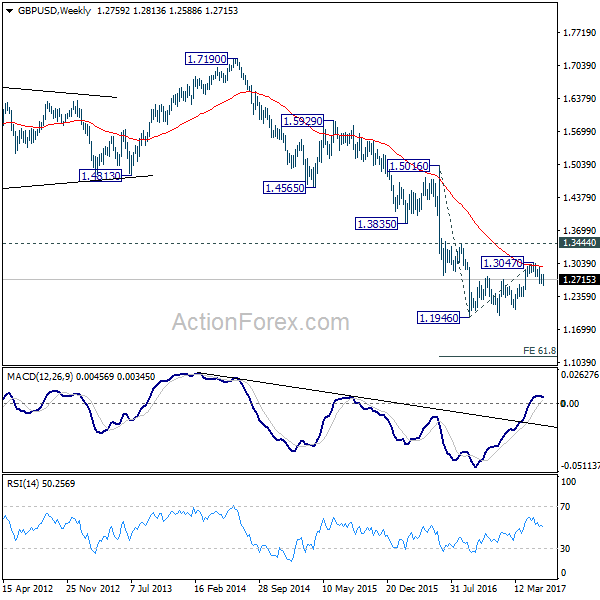
In the bigger picture, fall from 1.7190 is seen as part of the down trend from 2.1161. Price actions from 1.1946 medium term low are seen as a consolidation pattern, which could have completed at 1.3047 after hitting 55 week EMA. Break of 1.1946 low will target 61.8% projection of 1.5016 to 1.1946 from 1.3047 at 1.1150 next. In case the consolidation from 1.1946 extends, outlook will stay remain bearish as long as 1.3444 resistance holds.
In the longer term picture, no change in the view that down trend from 2.1161 is still in progress. On resumption, such decline would extend deeper to 100% projection of 2.1161 to 1.3503 from 1.7190 at 0.9532.
Summary 6/26 – 6/30
Monday, Jun 26, 2017
[php_everywhere] [/php_everywhere]
Tuesday, Jun 27, 2017
[php_everywhere] [/php_everywhere]
Wednesday, Jun 28, 2017
[php_everywhere] [/php_everywhere]
Thursday, Jun 29, 2017
[php_everywhere] [/php_everywhere]
Friday, Jun 30, 2017
[php_everywhere] [/php_everywhere].
Weekly Economic and Financial Commentary
U.S. Review
Buckle Up for the Oil Price Roller Coaster Ride
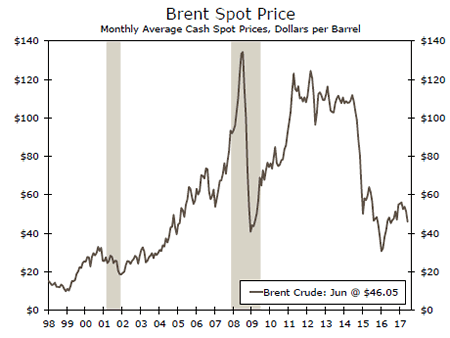
- Brent crude oil, the international benchmark, and West Texas Intermediate (WTI) fell below $45 per barrel during the week amid renewed angst about persistent oversupply. Since the beginning of the year, prices are down more than 20 percent. If sustained, the drop in oil prices presents downside risks to our business fixed investment forecast in the coming quarters.
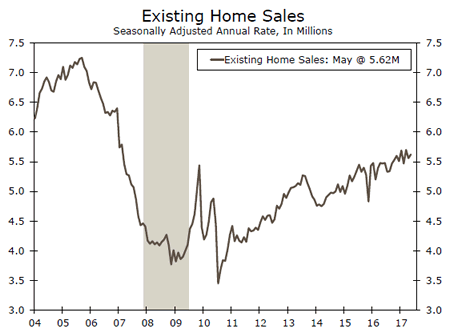
- Following the sluggish reading in housing starts and permits, existing home sales rebounded in May, with median home prices edging higher relative to a year earlier.
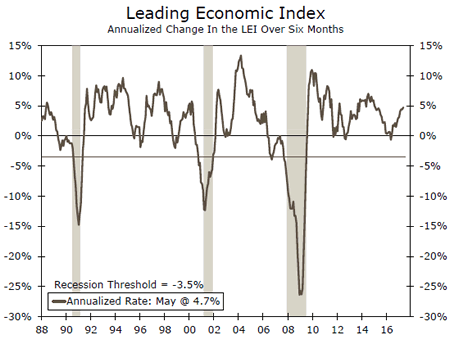
- The Leading Economic Index climbed higher in May suggesting continued gains in U.S. economic activity.
What Is Feeding the Bear?
During the week, oil prices declined sharply to a 10-month low, falling below $45 per barrel. Since the beginning of the year, prices for Brent and WTI oil prices have fallen more than 20 percent as concerns resurface about rising production, especially in countries that are exempt from the original and extended agreement between OPEC nations and other oilproducing countries to curb output. Much of the angst is focused on U.S. oil production, but growing output in Nigeria and Libya are also fueling uneasiness.
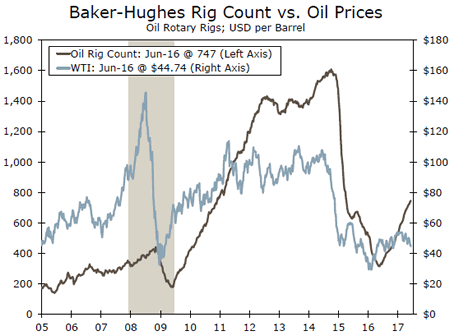
Whether the drop in oil prices would have a net positive effect on the U.S. economy is an open question. Indeed, the drop in oil prices in 2015 and 2016 was largely evidenced in the energyrelated components of structure investment, namely mining exploration, shafts and wells, and lower net exports which over time offset increases in consumer spending. Regarding the labor market, the energy sector is capital intensive, which suggests any additional downside risks in energy exploration could have only a modest impact on job growth. We continue to keep an eye on the weekly U.S. rig count which could provide an early warning for business fixed investment. Indeed, the rig count has risen over the past year, reaching its highest level in over two years in May.
Also fueling angst is the housing market, especially as singlefamily and multifamily starts and permits fell in May despite the still-elevated level of builder sentiment. Relieving some of the worries, existing home sales came in stronger than expected in May, rising 1.1 percent to a 5.62 million-unit pace. Existing home sales are used to calculate broker commissions in the residential investment component of real GDP growth.
We also learned that median home resale prices continued to increase in May, with single-family climbing 6.0 percent relative to a year earlier. That said, the housing market still faces wellknown challenges, namely tight inventories, an insufficient number of finished lots and shortage of available construction workers. Mortgage purchase applications fell for the second straight week in the week ending June 16; the drops follow a huge 10 percent spike a week earlier, however.
We maintain our forecast for sales activity and starts, especially as the pace of owner-occupied household growth accelerates relative to rentals. Multifamily construction is moderating following a multiyear run-up. Single-family construction continues to gain traction and builders have an eye on the firsttime buyer market. Moreover, there is a larger shift to more affordable housing toward the suburbs and markets where home prices are less expensive. We expect new home sales to rise in the low double-digits in 2017 and existing home sales should rise moderately and contribute to real GDP growth this year.
Also released this week was the Leading Economic Index (LEI), which is a forward-looking indicator for the U.S. economy. LEI rose in May, registering its ninth straight monthly gain. Eight of ten components added to the top line figure, with the interest rate spread making the largest contribution.
U.S. Outlook
Durable Goods • Monday
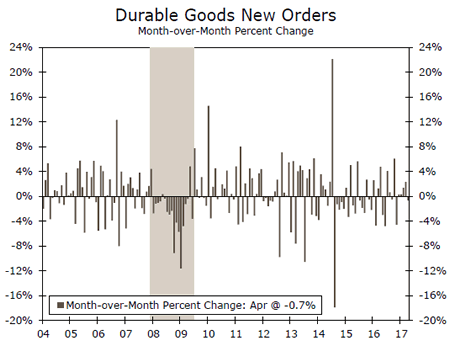
April marked the end of a four-month run up of durable goods orders, slipping 0.8 percent, though March's gain was revised up to 2.3 percent on the month. Consensus had estimated a larger drop as payback for the recent hot streak, which did not materialize in the April report. The subsequent rise in shipments, which would logically follow a period of strong orders, also did not materialize. Shipments declined 0.3 percent in April, even after stripping out volatile transportation and defense goods. Non-defense capital goods shipments, ex-air, or core goods, the gauge that closely tracks business fixed investment in GDP, was down 0.1 percent.
Orders of core goods have been flat for the past two months, which casts doubt on a significant boost to GDP growth from the sector in the next few months. Our call for a gradual firming remains in place, even though the hard data have yet to signal a major pickup for the factory sector is imminent.
Previous: -0.8% Wells Fargo: -1.0% Consensus: -1.0% (Month-over-Month)
Consumer Confidence • Tuesday
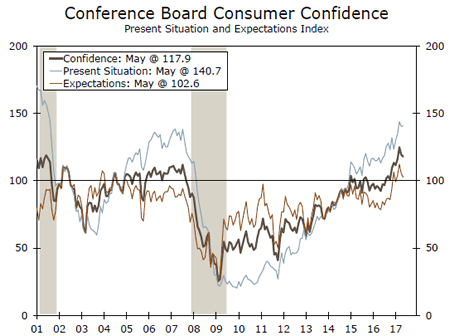
The Conference Board's index of consumer confidence continued to decline from the cycle-high of 124.9 in March, falling from 119.4 in April to 117.9 in May. The overall index rose 17.9 points since the U.S. election, but the driving factors have shifted in recent months. The surge from October to December was largely the product of a jump in the expectations index, while the rise from January to its March peak was pushed by consumers' growing confidence in their present situation. Confidence peaked for both the present situation and expectations indices in March, at 143.9 and 112.3, respectively. Much of the give back since then has been in consumer expectations, which now stands about 10 points lower. The present situation measure fell slightly in April but inched higher in May to end at 140.7. The strong job market and improving economic fundamentals should continue to support this measure, while fiscal policy uncertainty may continue to dampen expectations.
Previous: 117.9 Wells Fargo: 117.0 Consensus: 115.4
Personal Spending • Friday
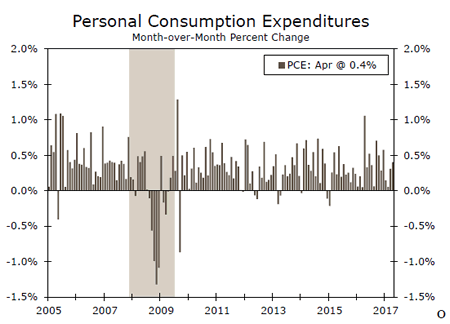
Personal spending started the second quarter off with solid momentum, rising 0.4 percent in April after a revised gain of 0.3 percent in March. Adjusted for inflation, consumer spending rose at an annual rate of 2.8 percent over the past three months, supporting our call for the consumer spending component of GDP to rise 2.9 percent in Q2 after a soft Q1 print. Personal income also rose 0.4 percent in April, though inflation trimmed growth to just 0.2 percent. That was still an improvement from the first two months of the year when inflation-adjusted income declined.
The PCE deflator, the Fed's preferred gauge of inflation, rose 0.2 percent in April after declining in March, which helped support the Fed's case for a rate hike last week. Still, other readings of inflation in May have disappointed, with declines in both the CPI and import prices. We will watch next week's print for the PCE deflator closely.
Previous: 0.4% Wells Fargo: 0.1% Consensus: 0.1% (Month-over-Month)
Global Review
Global Economy: Stable as It Goes
- The next best thing to a strong improvement in economic activity is sustainable, but relatively weak economic growth. This is what seems to be happening across the global economy. Our expectation is for global growth to improve a bit this year but remain slightly below the historical average.
- This week we saw Taiwan's exports orders post a notable 9.1 percent increase compared to a consensus forecast of a 7.5 percent improvement, year over year. We have also seen an improvement in export and import growth in the Chinese economy, which tends to indicate that China is doing its part in generating stronger economic activity across the globe.
Global Economy: Stable as It Goes
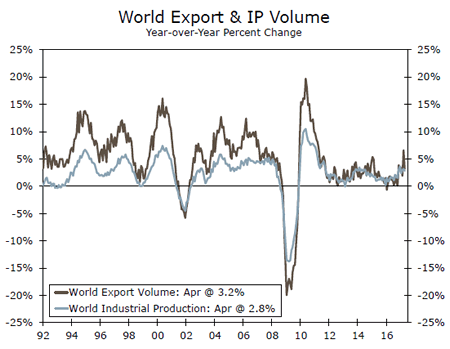
The next best thing to a strong improvement in economic activity is sustainable, but relatively weak, economic growth and this is what seems to be happening across the global economy. Our expectation is for global economic growth to improve a bit this year but remain slightly below its historical average (see graph on first page). Signs that economic growth continues to proceed along these lines have included improvements in industrial production as well as exports (top graph). To this end, this week we saw Taiwan's exports orders rise by a notable 9.1 percent compared to a consensus forecast of a 7.5 percent improvement, year over year. We have also seen an improvement in export and import growth in the Chinese economy, which tends to indicate that China is doing its part in generating stronger economic activity across the globe. Although we are far from the days in which the Chinese economy was calling the economic shots and driving global demand, a better than expected increase in economic activity by the Chinese economy is a welcome sign for the rest of the world. This is especially true for those economies that are very open, i.e., economies that are large exporters, as in the case of the Taiwanese economy.
Argentina's Economic Recovery Strengthened in Q1.
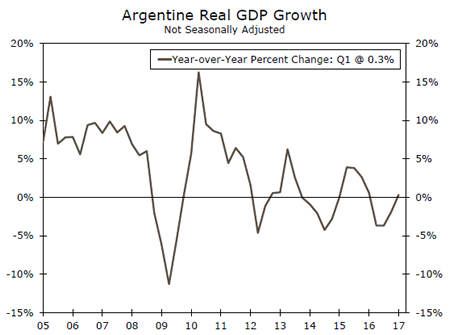
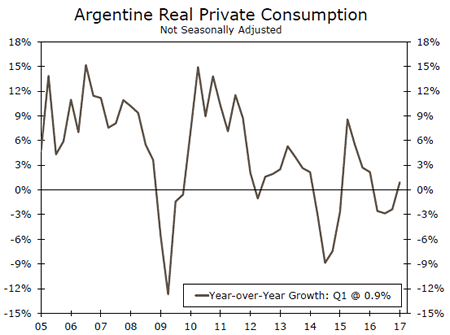
The Argentine economy grew 1.1 percent in the first quarter of the year, quarter on quarter, marking the third consecutive quarterover- quarter improvement in economic activity. The quarter showed an important improvement from domestic demand, especially personal consumption expenditures (PCE) and gross fixed capital formation. PCE grew 0.9 percent on a year-over-year basis, the first year-over-year increase since the first quarter of 2016. Meanwhile, gross fixed capital formation improved 3.0 percent during the first quarter of the year, the first yearover- year increase since the last quarter of 2015. Both measures show that the economy is on the mend and that the effects of the severe adjustment implemented by the Macri administration are finally abating.
The question for the Macri administration as the mid-term elections approach is: will this recovery in economic activity be enough to keep his political alliance in place? As we have been saying for several quarters, the Macri administration needs the economy to surge this year in order for the governing coalition to be able to keep the reform process in place. The recent return of ex-President Cristina Fernández de Kirchner to the political fray will probably add some risks to the political environment. However, the Macri administration is likely betting that Mrs. Kirchner's irruption into the political scenery will help him and his coalition by dividing the Peronist party instead of unifying it behind the ex-President, as other individuals within the party position themselves to try to contest her leadership. It is too early to tell whether this new leadership will be successful in unseating her. For now, President Macri is counting on an improving economy to do the trick. This is a very risky strategy for Mr. Macri but perhaps it is the only one that he has at his disposal as the country prepares for the next political fray.
Global Outlook
Japan CPI • Friday
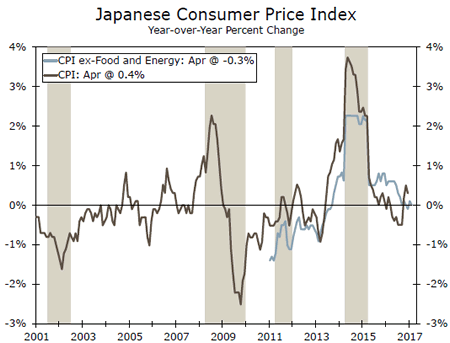
The Bank of Japan (BoJ) is somewhat unique among world central banks as it has clung to a policy of unabashed policy easing, even as other major foreign central banks have begun to at least talk about eventual policy normalization.
It is easy to understand why policymakers in Tokyo are reticent on the matter of normalization, considering the fact that CPI inflation remains well below its 2.0 percent target.
Given the dovish bias at the BoJ, our currency strategists expect modest near-term weakness for the yen. Talk of an eventual exit policy could be yen supportive. Until that time, a widening U.S.- Japan interest rate spread should weigh on the yen. The eventual pass-through effect of that yen-weakness could be helpful to the BoJ in achieving its target. The May CPI number for Japan prints on Friday of next week.
Previous: 0.4% Wells Fargo: 0.6% Consensus: 0.5% (Year-over-Year)
China PMI • Friday
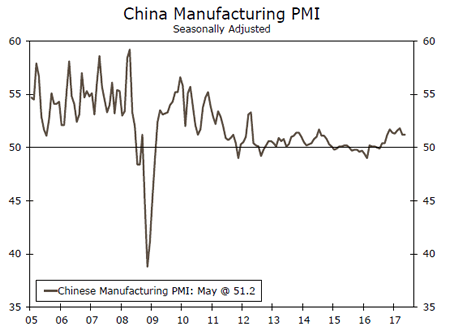
The great moderation in Chinese economic growth has stabilized recently; in fact, first quarter GDP came in a shade above consensus expectations.
The somewhat faster pace of growth was partly attributable to a pick-up in secondary sector activities like mining, manufacturing and construction.
The end of next week will bring a June number for the Chinese manufacturing PMI—a key barometer of manufacturing activity that mostly reflects the state-owned enterprises in China. The less widely followed non-manufacturing index also prints on Friday. Early in the following week the Caixin PMI will offer an update on factory activity in the Chinese private sector.
Previous: 51.2 Consensus: 51.1
Eurozone CPI • Friday
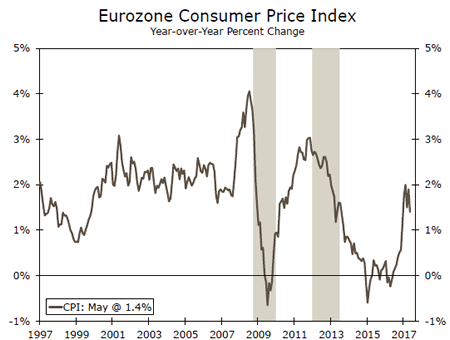
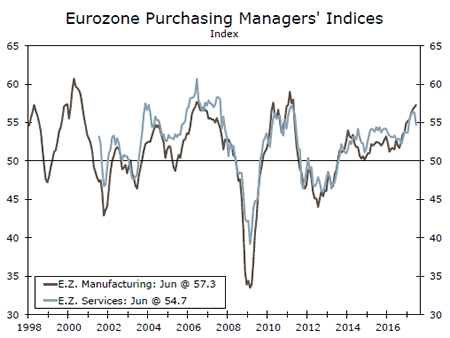
The Eurozone economy continues to expand and there are few signs of it losing momentum in the near term. In fact, just this morning the manufacturing PMI for the Eurozone came in at 57.3—the fastest pace of expansion in six years.
Despite indication of firming in the economic outlook, the European Central Bank (ECB) offered only modest changes to its policy guidance in June. The reason for that may have to do with a puzzling situation that is not unique to Europe: despite a firming economy and expansionary monetary policy, sustained inflation at or above 2.0 percent has been a fleeting objective.
On Friday of next week, bourses in Europe will be watching the wire for the release of June CPI data to gauge how well the ECB is doing in terms of achieving its inflation target.
Previous: 1.4% Consensus: 1.3% (Year-over-Year)
Point of View
Interest Rate Watch
Tension in the Tumult
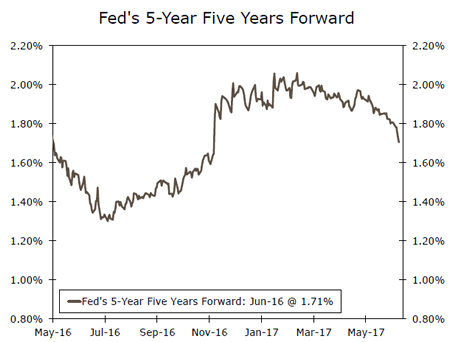
Within the ongoing tumult of financial market surprises, the rising tension between market expectations of policy actions and the stated intensions of the FOMC creates the potential for a sharp shift in asset prices.
In recent months, the pattern of the 5Y/5 year forward inflation expectations (top graph) has indicated that market expectations have declined and these expectations have moved in the opposite direction from FOMC expectations that inflation will approach 2 percent ahead.
As for measured inflation, the data have indicated a slower pace of inflation. The overall CPI has moderated over recent months and it is not just wireless communications. Used car prices are down significantly while core goods in the CPI have declined 0.8 percent year-over-year. Core goods prices have experienced deflation for the past three years—not a transitory phenomenon.
Policy Persistence?
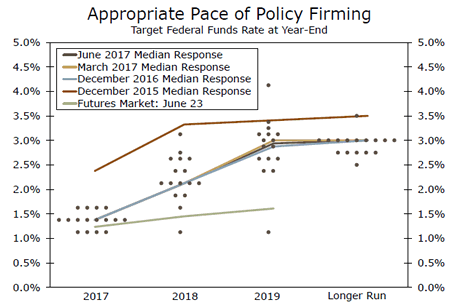
When viewed through the dot-plot lens, the FOMC is committed to continue on a path of raising the funds rate based upon their model of how inflation works. Yet markets have certainly not priced in the same view of inflation (middle graph). This price discrepancy will be resolved and we expect the market is underpricing the FOMC's commitment to raise the funds rate a few more times in the year ahead.
Implications for Treasuries
Given the assumption that the FOMC will follow its intentions with action, the Fed will raise the funds rate once more this year, begin its balance sheet reduction program in Q4 and signal its intention to raise rates a few more times in 2018.
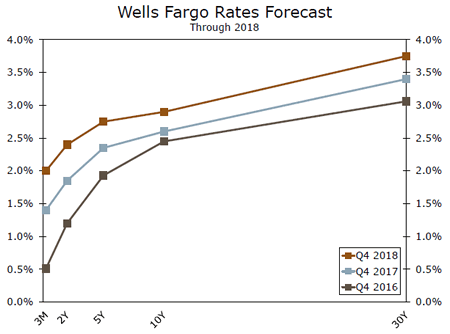
Therefore, our expectation is that both the two and ten year benchmark Treasury rates will move up as the second half of 2017 unfolds. We have the two-year and 10-year benchmark at 1.85 percent and at 2.6 percent in Q4 (bottom graph). Higher rates are also consistent with our expectations for a stronger dollar by Q4. Yet we expect the PCE deflator to remain unchanged—a signal that real rates will rise.
Credit Market Insights
Loan Growth, Delinquencies Down
The FDIC Quarterly Banking Profile report showed generally healthy net income growth and modestly improving loan quality for the banking industry during the first quarter.
The noncurrent loan rate declined to 1.3 percent, marking a new cycle-low. All loan types saw a decline in delinquencies except for credit cards, which after bottoming out in mid-2015 have crept modestly higher in the past couple years.
Noncurrent loan rates for commercial and industrial (C&I) loans, which more than doubled after peaking in mid-2016 amid the slump in energy prices and the manufacturing sector, declined for the third consecutive quarter. The improvement has generally come in less energy-centric districts, such as the San Francisco and Chicago regions. The Dallas region, which includes Texas and Oklahoma, has seen little improvement in C&I delinquencies over the past few quarters.
Loan growth continued to slow in Q1, decelerating to 4 percent year-over-year. The slowdown has been broad based, with lending growth slowing the most in the C&I space. Higher rates following the election may have dampened borrowing demand. Tighter lending standards in some sectors, such as commercial real estate, could also be playing a role. Even with the slowdown, however, loan growth is still a bit faster than nominal GDP growth, which was up 3.4 percent year-ago in Q1.
Topic of the Week
PMIs Support Case for Eurozone Expansion
Data released this morning provided further confirmation that the expansion in the Eurozone is becoming increasingly self-sustaining. The manufacturing PMI in the euro area rose to 57.3 in June, its highest reading in six years. The comparable index for the services sector edged down a bit in June, but it remains at an elevated level. The manufacturing PMI in Germany softened modestly in June, but stands at 59.3—the second highest reading since the series began. Likewise, the manufacturing PMI in France climbed to 55.0 in June, eclipsing the consensus expectation which called for 54.0. Furthermore, the manufacturing confidence index for Italy, slated to be released next week, is expected to remain at an elevated level.
The strength in European PMIs is consistent with the pickup in global export activity, which was up 3.2 percent in April, on a year-over-year basis. Likewise, global industrial production continues to gain momentum, rising 2.8 percent in April. Continued firming in global growth should support European exports, manufacturing activity and overall growth.
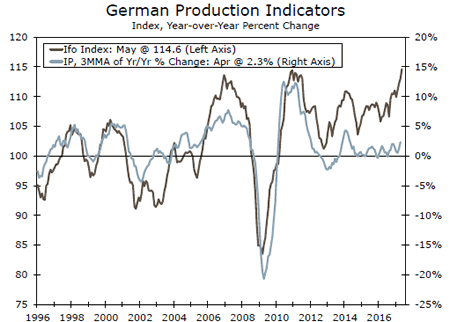
Sentiment indicators in the Eurozone are also at elevated levels. In Germany, the single largest economy in the euro area, the current situation index climbed to 88.0 from 83.9, its highest reading in six years. Likewise, the Ifo index of German business sentiment rose in May to its highest level since German reunification occurred in 1991. However, some of the hard data coming out of Germany is not as robust as one might expect. Industrial production was up only 1.1 percent on a year-ago basis in the first quarter. The manufacturing PMI figures point to some acceleration in production going forward.
The expansion in the Eurozone is becoming increasingly self-sustaining. Accordingly, we look for real GDP in the Eurozone to accelerate modestly in coming quarters and expand 1.8 percent and 2.0 percent in 2017 and 2018, respectively.
The Weekly Bottom Line
HIGHLIGHTS OF THE WEEK
United States
- Equity markets started off the week on a positive note. But the advance proved transitory as oil prices slid into bear territory, sending energy stocks and the main indices lower.
- With little in the way of economic data, Fed speeches took center stage. While echoing support for last week's decision, some Fed speakers appeared to take on a more dovish tone, with Harker and Evans putting an emphasis on waiting for further proof to hike again.
- The only significant economic data releases this week pertained to housing activity. Existing home sales surprised on the upside. Meanwhile,sales in the smaller and more volatile new home market, also rebounded in May.
Canada
- For those trying to time the next Bank of Canada rate, this week's economic data brought mixed signals with inflation easing for a fifth straight month and momentum retail spending holding strong into the second quarter of the year.
- While soft inflation is likely to keep the Bank of Canada on hold through July, the pick-up in economic momentum offers good grounds for an October rate hike. Inflation is a lagging indicator, and May's reading likely reflects soft economic conditions from late 2015 to early 2016. But inflation may be nearing a trough, as slack is being eaten up at a quickened pace.
UNITED STATES - FED SPEECHES TAKE CENTER STAGE
Markets started off the week on a positive note. Tech stocks bounced back on Monday as industry leaders met with President Trump at the first gathering of the American Technology Council. Meanwhile, financials were buoyed by comments from FOMC voting member Dudley that didn't seem too concerned with the slowdown in inflation. Sentiment was also supported by Macron's majority-win of the French parliamentary elections.
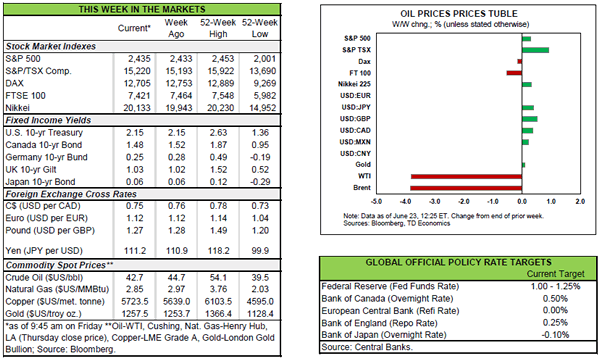
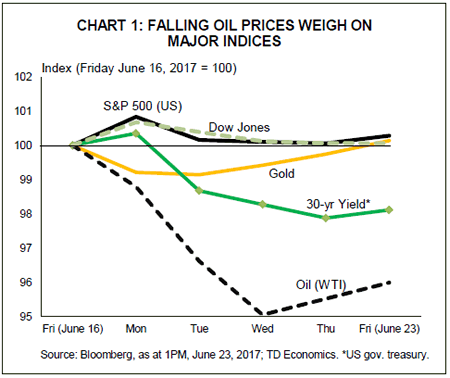
Unfortunately, the advance proved transitory. Oil prices slid into bear territory on account of rising production among the U.S., Libya and Nigeria and doubts as to whether recent OPEC cuts would be sufficient to manage the supply glut. This sent energy stocks and the main indices lower and enabled a move toward safe heaven assets (Chart 1).
With little in the way of economic data, Fed speeches took center stage. Given that last week's decision to hike was not unanimous and the fact that inflation has drifted lower, FOMC members appeared to be on the defensive. Vice-Chair Fischer pointed to "high and rising" home prices as one of the hazards of keeping rates low for long. While echoing support for last week's decision, other Fed speakers appeared to take on a more dovish tone, with Harker and Evans putting an emphasis on waiting for further proof to hike again. Bullard (non-voter) suggested that the expectation for rates rise to 3% over the next two and a half years is "unnecessarily aggressive."
Still, the Fed is sticking to its guns in expecting another rate hike by the end of this year, betting that the factors weighing on price growth will prove temporary and that a tight labor market will pull up wages and buoy inflation.
They may also get some help from a lower U.S. dollar, which is well off its peak level set earlier this year and is on track to end lower again the week. A lower dollar should help put upward pressure on goods prices, which have been consistently negative over the past year.
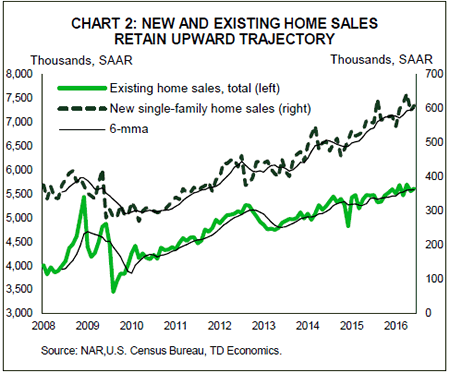
The only significant economic data releases this week pertained to housing activity. Existing home sales rose 1.1% m/m, surprising on the upside. Tight inventory levels and rising prices have weighed on momentum recently. But, declining mortgage rates contributed to the positive print and should provide further support in June, with the volume of mortgage applications on an upswing during the month. Sales in the smaller and more volatile new home market, also rebounded in May, with both series retaining an upward trajectory (Chart 2).
Rising interest rates, combined with robust price growth on the bigger resale segment are expected weigh on affordability. Still, households are likely to withstand the incremental increases in borrowing costs thanks to a solid labor market that is poised to deliver continued job and income gains. An improvement in the homeownership rate is also expected to provide a gentle tailwind as outlined in our recent report, with resales expected to advance by 3.4% this year and 2.6% in 2018 to nearly 5.8 million by the end of the forecast horizon. Price growth should remain strong this year, holding near 6%. But a rebound in for-sale inventory, which is expected to be more of a factor next year, will help keep price growth in check at around 4% in 2018.
CANADA - MIXED SIGNALS
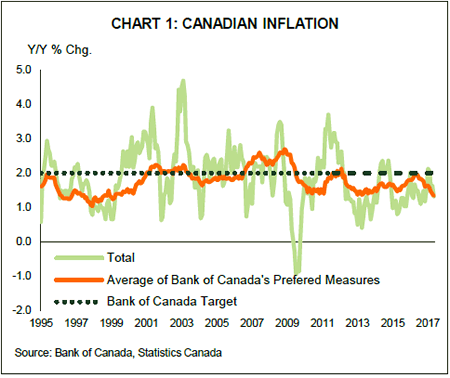
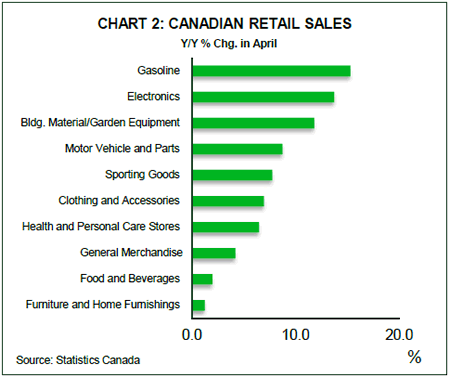
Those trying to time the next Bank of Canada move received mixed signals this week. Retail sales in April started the second quarter off on a strong note, suggesting the continuation of strong economic momentum. But, then Friday's weaker-than-anticipated consumer price report showed that inflation continued to decelerate into May. Most of the Bank of Canada's preferred measures of inflation eased for a fifth straight month, and are well below the Bank's 2% target. While the soft inflation report helped curb enthusiasm over the possibility of a July rate hike, there are still grounds to believe the Bank of Canada will begin raising interest rates in October.
The weakness in inflation was fairly broad based and it was difficult to find signs of any significant price pressures in this morning's report.The biggest decline was in clothing and footwear prices, which fell 1.5% year-overyear in May. This was followed by a 0.1% y/y contraction in food prices. Price growth for household operation and furnishings slowed to just 0.3% y/y in May, after averaging between 1.5% and 2% earlier this year. Transportation price growth also decelerated to just 2.2% y/y from 4.2% in the prior month as gasoline price growth slowed to 6.8% from 15.9% in April.
While the downward trend in inflation was broad, it likely reflects the lagged effect of past soft economic conditions from four to six quarters ago. Given the strength in economic growth over the past several quarters we are likely nearing a trough. Economic growth picked up considerable over the second half of 2016 and early 2017. Real GDP growth averaged 3.5% annualized between the third quarter of 2016 and the first quarter of 2017, up from an average sub- 1% in early 2016. Based on the Bank of Canada's measures of the output gap, the amount of economic slack peaked in the second quarter of 2016 (four quarters ago), and has been eaten up fairly quickly since.
Looking forward, a healthy pace of consumer spending is likely to continue to underpin robust economic momentum. While housing related items were at the top of household shopping lists, consumers have been spending on just about everything at a healthy rate - a trend that will likely continue through most of 2017. Households are still carrying a lot of debt, but the low interest rate environment has kept the carrying costs of that debt low, giving them some financial wiggle room to continue to support retail spending. Meanwhile, the strength in housing activity through the last quarter of 2016 and into early 2017 is likely to continue to boost spending on house-related items as those buyers renovate and furnish their homes. The slowdown in housing activity currently underway will likely not feed into a slower pace of retail spending until the end of this year and early next year.
Overall, the low inflation backdrop is likely to keep the Bank of Canada on hold through July's rate announcement, but given that monetary policy acts with a long and variable lead, improving economic conditions are likely to give the central Bank motivation to start gradually raising rates in October of this year.
Week Ahead Fed Rhetoric Fails to Boost Dollar
Improving European manufacturing balanced euro against dollar
The dollar is mixed against major pairs after a week where Fed speakers offered a mixed narrative. The majority of policy makers agree that the massive balance sheet accumulated during the quantitative easing program from the US central bank should start shrinking sooner rather than later. The point of debate remains the number of rate hikes in the horizon, with St. Louis Fed President James Bullard calling it "unnecessarily aggressive" and the CME FedWatch tool showing a 50 percent probability of a hike in December.
Flash manufacturing purchasing manager surveys boosted the euro on Friday with improvements in France, Germany and Europe overall. The German Ifo business survey released on Monday, June 26 at 4:00 am EDT could be inline with the perception of European recovery even as inflation struggles to gain momentum. The European Central Bank (ECB) forum will also kick off on Monday with plenty of speaking opportunities for President Mario Draghi. The European calendar will close with inflation data on Thursday and Friday expected with little improvement as the market ponders what the next move will be for the ECB before the end of the year which could include a rate hike, the start of QE tapering or both at the same time.
The US calendar will feature events like the release of core durable goods orders on Monday, June 26 at 8:30 am EDT. The Conference Board's Consumer Confidence index on Tuesday, June 27 at 10:00 am EDT which is expected to have declined slightly from last month and the Final Q1 GDP release on Thursday, June 29 at 8:30 am EDT confirming the slowdown of the economy in the first quarter compared to the last two periods of 2016. Hopes for tax reform and infrastructure spending in 2017 have faded and with it the possibility of a 3 percent GDP growth this year putting downward pressure on the USD.
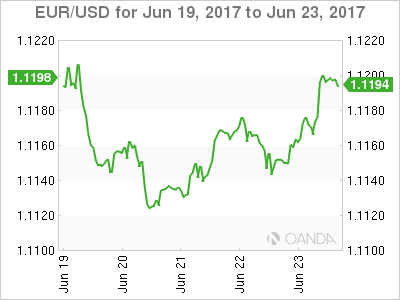
The EUR/USD gained 0.037 percent in the last five days. The single pair is trading at 1.1202 and will end the week near where it started on Monday. There was little in the way of economic releases that involved the pair. European manufacturing flash PMI data on Friday helped the EUR overcome the USD strength from Fed member comments suggesting the US central bank will raise the interest rate more this year. Economic fundamentals in the US have been questionable but the resolve of the Fed remains solid. Europe on the other hand is riding a wave of optimism form strong data and a reduction of political risk after the Emmanuel Macron victory in the French elections.
The last week of June will be devoid of major indicators with the spotlight once again directed at US political drama with only the German Ifo business climate survey to give insight into Europe.
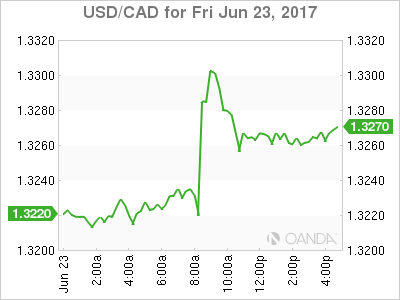
The USD/CAD gained 0.275 percent on Friday. The currency is trading at 1.3263 after a disappointing CPI reading of 0.1 percent putting inflationary pressures at a slow pace. The soft inflation data reduced the possibility of a July interest rate hike by the Bank of Canada (BoC).
The loonie is being guided by X factors. 1)The price of oil has historically shared a strong correlation given the importance of the commodity as part of GDP. Oil prices have been weaker as low demand has been met with steady supply creating a glut. 2)NAFTA renegotiations are hovering over the currency as the Trump administration started the process in a combative mode. Three quarter of Canadian exports go to the United States and a change in that trade relationship would be significant on either direction. 3) Monetary policy winds have shifted starting the Fed. Single rate hikes per year in 2015 and 2016 have been followed by 2 rate hikes this year by the Fed putting the Fed funds rate in a 100-125 basis points. The BoC first put another rate cut off the table earlier in the year as the economy had a strong first quarter and hints of a continuation of the trend in the second quarter triggered the hawkish comments. Rising household debt could trump weak inflation as the central bank would rather introduce gradual change to avoid a sudden impact to Canadians.
The USD/CAD has gone from a high of 1.3350 to a low of 1.3220 after the BoC comments only to slowly climb back as Fed speakers have mostly been repeating the same comments. More rate hikes coming and a reduction of the balance sheet sooner rather than later. Only a few dovish members have strayed from those comments, and even then only walking back the aggressive rate hike path, but agreeing on the need to reduce the 4 trillion accumulated during its quantitative easing program.
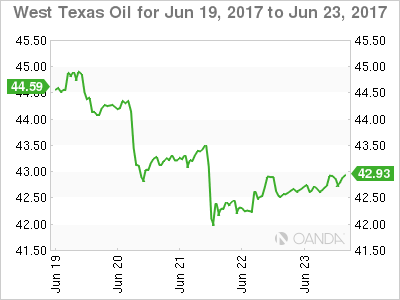
The price of energy fell 4.184 percent in the last 24 hours. West Texas Intermediate is trading at $42.79 due to oversupply concerns. The weakness of the USD has kept the price of oil near the $42 price level, but growing supply from US producers has been offsetting the effect of the oil production cut extension between OPEC and other major producers.
Oil started the week around the $44.59 price level before losses accumulated on a daily basis and not even the drawdown of US crude inventories on Wednesday was enough to reverse the trend. Uncertainty about the stability of the Organization of the Petroleum Exporting Countries (OPEC) after the appointment of the new Saudi Arabia crown prince did not boost prices as OPEC members Libya and Nigeria have sorted their supply disruptions leaving the market still caught in a glut of crude.
Market events to watch this week:
Monday, June 26
- 4:00 am EUR German Ifo Business Climate
- 8:30 am USD Core Durable Goods Orders m/m
- 1:30pm EUR ECB President Draghi Speaks
Tuesday, June 27
- 10:00 am USD CB Consumer Confidence
- 1:00pm USD Fed Chair Yellen Speaks
Wednesday, June 28
- 10:30 am USD Crude Oil Inventories
Thursday, June 29
- 8:30 am USD Final GDP q/q
- 8:30 am USD Unemployment Claims
Friday, June 30
- 4:30 am GBP Current Account
- 8:30 am CAD GDP m/m
*All times EDT