Sample Category Title
How Will FOMC Minutes Affect USD Post Slump On Trump’s Scandal ?
Recently Trump's leak scandal has been leading the USD move instead of economic performance. Last week USD had its biggest weekly fall since the US presidential election because of the scandal.
The markets are concerned it will result in Trump's plans not being able to be executed and worsen the economic slowdown. In addition, North Korea launched its second ballistic missile towards Japan on Sunday further lifting regional tension.
The dollar index hit a new post presidential low of 96.68 on Monday, due to extended market concerns over the FBI investigation on Trump's Russia leak scandal. On Tuesday, during early European session, it rebounded, however then followed by a retracement after testing the resistance level at 97.00.
On Tuesday, EUR/USD hit a new high of 1.1267 last seen on November 9. Per CFTC data released last Friday Euro long positions have reached a 3-year high. Gold has rebounded over the past two trading sessions touching a 3-day high of $1263.64 this morning.
The next move of USD will likely depend on the FOMC, the progress of the FBI investigation into Trump's Russia leak scandal, and upcoming economic data. If there are further adverse findings from the FBI's investigation USD will likely see a further fall. Conversely, without further adverse findings, we will likely see a rebound of USD.
Despite the Trump scandal and soft economic data, per the CME FedWatch tool, the probability for a rate hike in June only saw a modest drop to 78.5%. That said, markets are assuming the Fed will stick to its rate hike pace regardless of political turmoil and economic slowdown. The FOMC May Meeting Minutes will be released at 19:00 BST on Wednesday May 24, we will likely get further clues about a June rate hike and economic outlook.
We will see a set of US economic data to be released between 14:45 – 15:00 BST this afternoon. It will likely affect USD and USD crosses.
Euro Climbs Further After Merkel Says It’s ‘Too Weak’
The common European currency extended its recent gains yesterday, following some remarks from German Chancellor Angela Merkel. Speaking about the causes of Germany's large trade surplus, she indicated that the euro is 'too weak' due to the ECB's policy, which makes German products relatively cheaper. Even though such rhetoric is not particularly new coming from Germany, considering that Finance Minister Schauble has repeatedly made similar comments, it was enough to add further fuel to the recent bullish sentiment surrounding the euro.
Moving forward, we stick to our guns that the near-term path of the least resistance for the euro is to the upside. Diminished political risks in the Eurozone, prospects for a more optimistic tone by the ECB at one of its upcoming meetings, and continued strength in the bloc's economic data support our view. Our favorite proxy for further euro gains remains EUR/USD. Political risks remain elevated in the US, generating market skepticism over Trump's ability to push his tax plans through Congress, something evident by the decline in both US Treasury yields and the recent plunge in 5y5y inflation expectations. In addition, given the elevated expectations for a June rate hike (78.5% according to the Fed funds futures), we think that near-term risks surrounding the USD from monetary policy may be asymmetrical. Any signs the Fed may not hike in June could generate a bigger negative market reaction than the corresponding positive one in case policymakers raise rates.
EUR/USD surged from near the 1.1170 (S2) support territory after Merkel's comments, breaking above the resistance (now turned into support) level of 1.1230 (S1), before finding fresh sell orders near 1.1270 (R1) and subsequently pulling back somewhat. Given that the price structure on the 4-hour chart remains higher peaks and higher troughs, we would expect the bulls to seize control again soon and push the rate higher for another test near 1.1270 (R1). If they manage to overcome that resistance level, they could initially aim for the 1.1300 (R2) area, marked by the peak of the 9th of November.
Today's highlights:
During the European day, we get the preliminary manufacturing and services PMIs for May from many European nations and the Eurozone as a whole. Most of these indices are expected to have remained unchanged or to have ticked down, but to still remain at elevated levels. Thus, despite some marginal declines, such prints could indicate that the bloc's economic recovery remains on track, and may enhance further speculation regarding an increasingly more optimistic ECB. Something like that could bring the euro under renewed buying interest.
EUR/JPY spiked higher after the German Chancellor's remarks as well, to break above the resistance (now turned into support) obstacle of 124.60 (S1). The rate hit resistance at 125.30 (R1) and then retreated. In case the PMIs are encouraging today, we could see the pair surge and perhaps test the 125.30 (R1) zone again, where a decisive break could pave the way for the 125.80 (R2) resistance territory.
We also get Germany's Ifo survey for May. The forecast is for both the current conditions and the expectations indices to have risen, albeit marginally. The case for an increase in these figures is supported by similar upticks in the ZEW indices for the month. Coming on top of potentially encouraging PMIs, this could be another factor that enhances the case for Draghi & Co. to shift to a more hawkish tune soon.
In the US, the preliminary Markit manufacturing PMI for May and new home sales for April are due out, though neither of these indicators is usually a major market mover.
We have three speakers on the agenda: BoE Governor Mark Carney, ECB Executive Board member Benoit Coeure and Minneapolis Fed President Neel Kashkari.
EUR/USD
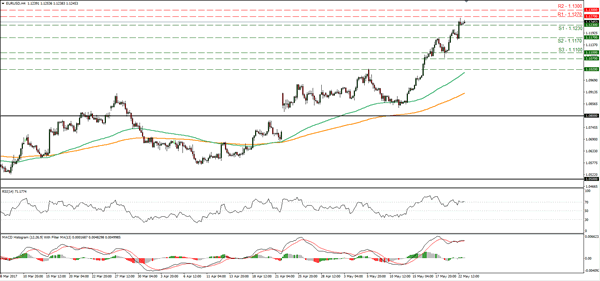
Support: 1.1230 (S1), 1.1170 (S2), 1.1100 (S3)
Resistance: 1.1270 (R1), 1.1300 (R2), 1.1340 (R3)
EUR/JPY
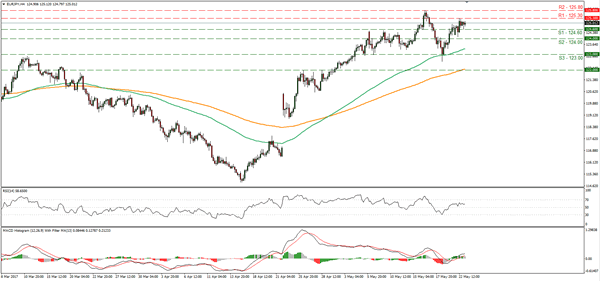
Support: 124.60 (S1), 124.00 (S2), 123.00 (S3)
Resistance: 125.30 (R1), 125.80 (R2), 126.50 (R3)
British Prime Minister To Create Higher Paid Jobs And Put Control On Energy Prices
'On the cost of living, what I want to see is building a strong economy with higher paid jobs.' - Theresa May, British Prime Minister
On Monday, the British Prime Minister Theresa May had an interview with the BBC channel's Andrew Neil. The interviewer asked the UK Prime Minister why the Conservative Party included a social care cap in its campaign, while it refused to do so at the very beginning of the rally, but May said she was honest with the nation and just wanted to clarify what the Party put in its manifesto. During the interview, the British PM stated that people wanted to see the stronger economy that could pay for the National Health Service and the public services. As to rising inflation, frozen in-work benefits and falling living standards, the UK PM said she would create higher paid jobs and put control on energy prices to help people pay bills. Andrew Neil noted that the Tories failed to lower migration and end the budget deficit by 2015; however, Theresa May stated that the Conservatives would continue working on the following issues if they wing the June 8 Election, highlighting the Labour Party's intentions to increase borrowing and ignore the country's debt and the budget deficit.
Swiss Trade Data Disappoints, CAD Rises Amid Positive OPEC Rumours
CHF immune to lacklustre trade data
Swiss trade data came on the soft side in April, highlighting the negative effects of a high level of political uncertainty that stemmed from the French elections and Brexit talks. Exports contracted 2.5% m/m in April compared to a downwardly revised reading of 1.8% in the previous month. On the contrary, imports rose 2.6% from 0.6% a month earlier. Accordingly, the trade balance printed at CHF 1.97 billion, the lowest level since December 2014 when it came in at CHF 1.51 billion.
After a short but encouraging recovery in March, the Swiss Watch industry experienced rough market conditions in April. Exports contracted 5.7% y/y as the demand from Hong Kong and the USA, the two largest importers, contracted significantly: -16.8% and -19% respectively. On a more positive note, the exports to mainland China and the United Kingdom kept their positive momentum, thereby limiting the damage. The disappointing April trade figures are a good reminder that a unified and stable European Union is a necessary ingredient for a successful Swiss economy.
EUR/CHF was treading water at around 1.0935 this morning. From a technical standpoint, the 200dma currently lying at 1.0784 remains the strongest short-term support, while on the upside the 1.10 psychological threshold will act as resistance.
Canada: OPEC rumours send the loonie higher
Canada's central bank will decide about its rate tomorrow and financial markets expect it to remain unchanged at 0.50%. The cost of borrowing should then stay low for some more time and underpin the housing bubble. Since 2009, the average price of a home has increased by more than 40% in nominal terms. In terms of economic data, annualised inflation (1.6%) is declining and is still below the central bank's target midpoint. Retail sales (excluding Auto) is also on the soft side with -0.2% y/y performance.
We believe that the major CAD drivers are US President Donald Trump and OPEC. The market is pricing in more difficulties for Trump to achieve its reforms. There are now more downside pressures on the US dollar. The loonie has been strengthening since the start of this month and is now trading around one-month highs against the US dollar below 1.35. However, there are rumours that OPEC may continue to cut production beyond June, and for the next nine months, so this is also sending the loonie higher. There is definitely more downside risk on the USDCAD pair.
Carry looks solid
Volatility continued to decline as political concerns fade into the background. VIX is now at levels seen before the James Comey memo rocked equity markets. Despite the nervousness in markets we anticipate investors will become numb to the scandal plaguing President Trump's administration as investigations tend to be protracted events.
In the absence of Trump-fuelled political risks, carry trade has again become attractive. USDJPY remain the barometer for investors should President Trump's problems escalate. USDJPY's move off 110.24 indicates easing of political uncertainties. Sentiment around the greenback has weakened and it will take a significant upside surprise in economic data to give yields the necessary push higher to boost USD.
Dovish commentary from the Feds Evans and Brainard (both voters) has lowered expectation for the FOMC minutes being released tomorrow. Both speakers highlighted the lack of strong price pressures and a historical pattern of inflation to undershoot the 2% target. Yet strong data leading up to the June rate decision could quickly shift USD bias.
Today's US PMI and new homes sales could provide further clarity on US economic uncertainties. In addition, Fed Kashkari (voter) will speak. We see the current balanced environment positive for EM FX - specifically MXN, INR and IDR.
Eurozone GDP Jumps Along With Trade Surplus
Economic data out of the Eurozone continues to surprise to the upside with latest figures revealed over the week showed that the 19-member eurozone's trade surplus jumped alongside a pick-up in the region's economic activity.
Official data released last Tuesday by the European Union's Statistics agency, Eurostat showed that the region's combined gross domestic product (GDP) rose 0.5% in the quarter ending March 2017 from the previous quarter. On a year over year basis, the GDP rose 1.7%.
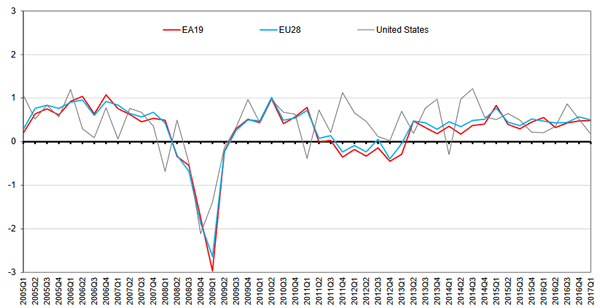
EU28, euro area and the United States GDP growth rates % change from previous quarter.
Exports also rose strongly leaving the region with a trade surplus which was the widest since 1999, when the common currency was launched.
Despite the cheer amid recent signals that the economic recovery in the eurozone was now firmly entrenched in growth, the data also raised concerns on the possible reactions from the U.S. administration, which has previously accused nations such as Germany for benefiting from a weaker exchange rate.
Eurozone exports rise to the highest level since 1999
Data from the Eurostat showed that export of goods from the eurozone was at €202.3 billion in the month ending March 2017. This was about 13% increase from the same month a year before. Imports to the eurozone also climbed steadily but were significantly lower compared to the exports.
The trade surplus in the eurozone rose to €30.9 billion in March 2017.
Among the €202.3 billion in exports, data showed that the 28-member European Union exported €30.6 billion in goods to the U.S. more than the imports. It was an increase from €23.6 billion that was registered the year before.
While concerns remain on the possible implications of the trade surplus figures and the reaction from the U.S. officials, ECB members continue to maintain that the central bank's policies did not have much effect on the euro's exchange rate.
ECB's governing council member, Philip Lane said in a speech last Friday that the central bank's policies had a direct effect on improving the financial conditions in the euro area and that the policies were not aimed at deliberately influencing the exchange rate.
The latest figures in the GDP and exports come just a week after the Eurostat published the latest Spring Forecasts, where it upgraded growth forecasts for 2017 and 2018. The steady gains made so far this year was underpinned the confidence in the economic recovery of the region.
Growth is expected to rise 1.7% this year, slightly higher than 1.6% that was projected in the previous quarterly report.
The pace of recovery also managed to hold steady despite economists' view that higher energy prices would sap the consumer spending while also the political headwinds would keep recovery tepid.
The overall upbeat mood in the region has, however, put pressure on policy makers to cut back on the bond purchase program. It was only a week before that ECB President Mario Draghi was seen defending the central bank's policies to the Dutch lawmakers, who along with their German counterparts have increased pressure on the European Central Bank to reduce its balance sheet.
Despite the positive data, officials are however cautious noting that growth is yet to be confirmed all-around. Regional data suggests pockets of weakness such as Italy's economy which lagged the rest of the Eurozone. GDP growth was recorded at just 0.2% in Italy, over the first quarter.
The European banking sector is also another factor that could be an obstacle for policy makers while normalizing interest rates. This was something that was also highlighted by the EU Commission's spring report, citing that banking sector as one of the risks to the region.
Italy continues to remain at risk as the regional lenders continue to struggle with bad debt. Although the nation embarked on emergency measures just last year, the cracks remain which could pose systemic risks to the rest of the eurozone banking sector.
Technical Outlook: EURUSD Resumes Uptrend, German Ifo Eyed For Further Signals
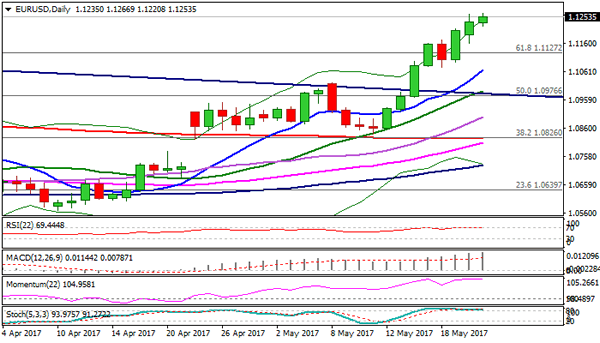
The Euro probes above Monday's high at 1.1262 in early European trading, on fresh bullish acceleration from session low at 1.1220.
Strong bullish sentiment was boosted by comments from German Chancellor Merkel who said that the Euro is too weak.
The single currency remains in steep ascend, driven by weak dollar and is currently reading on the wave C from 1.0838 (11 May trough) which may extend towards wave's 238.2% and 261.8% Fibonacci expansion at 1.1323 / 1.1372 respectively.
Firm bullish setup of daily studies remains supportive, however, overbought slow stochastic / RSI conditions warn of corrective action in the near-term, but no bearish signal seen so far.
The pair is eyeing German Ifo data for fresh signals. German business climate is forecasted at 113.1 in May, above April's 112.9 release that may lend further support to the Euro on release at / above consensus.
Res: 1.1270, 1.1300, 1.1323, 1.1372
Sup: 1.1220, 1.1160, 1.1127, 1.1100
Trade Idea: EUR/JPY – Stand aside
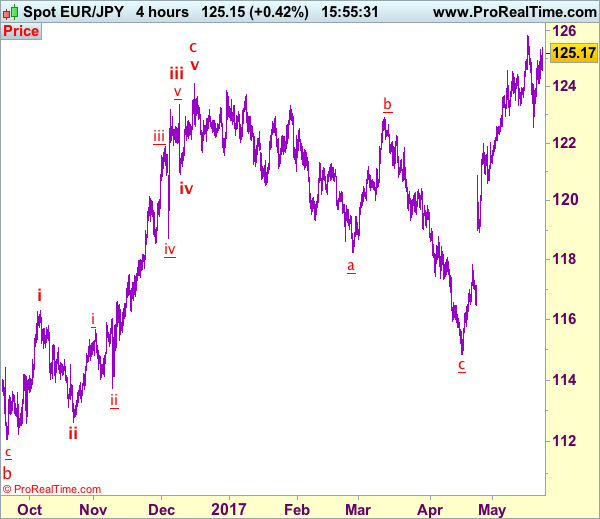
EUR/JPY - 125.08
Recent wave: wave v of (C) ended at 94.12 and major correction in wave A has ended at 149.79
Trend: Near term up
New strategy :
Stand aside
Position: -
Target: -
Stop:-
Although the single currency edged higher after staging a strong rebound from 122.56 (last week’s low) and marginal gain to 125.50-55 is likely, break of recent high at 125.82 is needed to signal recent upmove has resumed and extend further gain to 126.20-30 and possibly 126.60-70 but reckon 127.00-10 would hold from here due to near term overbought condition.
In view of this, would not chase this rise here and would be prudent to stand aside for now. Below 124.10-15 would bring retreat to 123.35-40 but reckon downside would be limited to 123.00 and said support at 122.56 should hold, bring another rebound. Only a break below this support would add credence to our view that top has been formed, bring retracement of recent upmove to 122.00-10 and then 121.50-60 but downside should be limited to 121.20-30.
Our latest preferred count is that wave (ii) is ABC-X-ABC which ended at 123.33 and wave (iii) is unfolding with wave iii ended at 100.77, followed by wave iv at 111.57 and wave v as well as the wave (iii) has ended at 97.04, followed by wave (iv) at 111.43 and wave (v) has ended at 94.12 which is also the end of the larger degree v, this also implied the major wave (C) has also ended there, hence major correction has commenced from there with (A) leg unfolding in its lower degree wave c which has possibly ended at 145.69. Under this count, A-B-C wave (B) has commenced with A leg ended at 136.23, wave B at 143.79 and wave C has possibly ended at 149.79.
Our larger degree count is that the decline from 139.26 is wave (C) and is sub-divided into a diagonal triangle i-ii-iii-iv-v with wave i - 105.44, wave ii- 123.33, wave iii - 97.03, wave iv - 111.43, followed by the final wave v as well as the end of wave (C) at 94.12, this also mark the bottom of larger degree wave B. Under this count, major rise in wave C has commenced as an impulsive wave with minor wave III ended at 145.69, wave V is still in progress for further gain to 150.00. Having said that, this so-called wave V could well be the first leg of larger degree 5-waver wave C and this wave C should bring at least a retest of wave A top at 169.97 (July 2008).
Trade Idea: AUD/USD – Buy at 0.7420
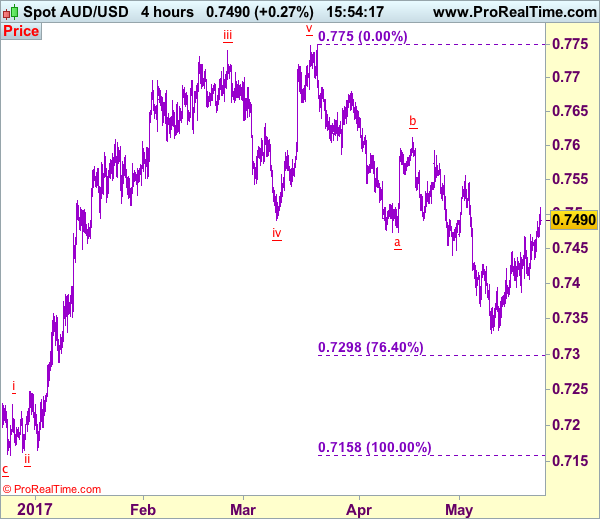
AUD/USD – 0.7495
Recent wave: Wave 5 ended at 1.1081 and major correction has commenced for fall to 0.7000 and then towards 0.6500-10
Trend: Near term down
Original strategy :
Buy at 0.7390, Target: 0.7540, Stop: 0.7330
Position: -
Target: -
Stop: -
New strategy :
Buy at 0.7420, Target: 0.7570, Stop: 0.7360
Position: -
Target: -
Stop:-
As aussie has risen again after brief pullback, adding credence to our view that low has been formed at 0.7329, hence consolidation with upside bias remains for further gain to resistance at 0.7556 but break there is needed to provide confirmation, bring subsequent rise towards 0.7595-00 which is likely to hold from here due to near term overbought condition.
In view of this, we are looking to buy aussie on dips but at a higher level as 0.7400-10 should limit downside and bring another rise. A break of support at 0.7388 would abort and signal top is formed, bring further fall to 0.7360 but said recent low at 0.7329 should remain intact. Only a drop below this support at 0.7329 would abort and signal recent decline has resumed and extend weakness to 0.7295-00 (76.4% retracement of 0.7158-0.7750).
On the 4-hour chart, the move from 0.8066 is the wave 5 with i: 0.8860, ii: 0.8315, wave iii is an extended move ended at 1.0183, iv: 0.9706 and wave v has ended at 1.1081 (also the top of entire wave 5). The subsequent selloff is the major correction which is unfolding as ABC-X-ABC and 2nd A leg has ended at 0.8848, followed by a-b-c wave B which ended at 0.9758, hence, 2nd C wave is now in progress and indicated downside target at 0.7000 and 0.6950 had been met, so further fall to 0.6710-20 cannot be ruled out.
Technical Outlook: Cable Slips After Manchester Attack, Risk Of Deeper Pullback Seen On Break Below 10/20SMA Pivots
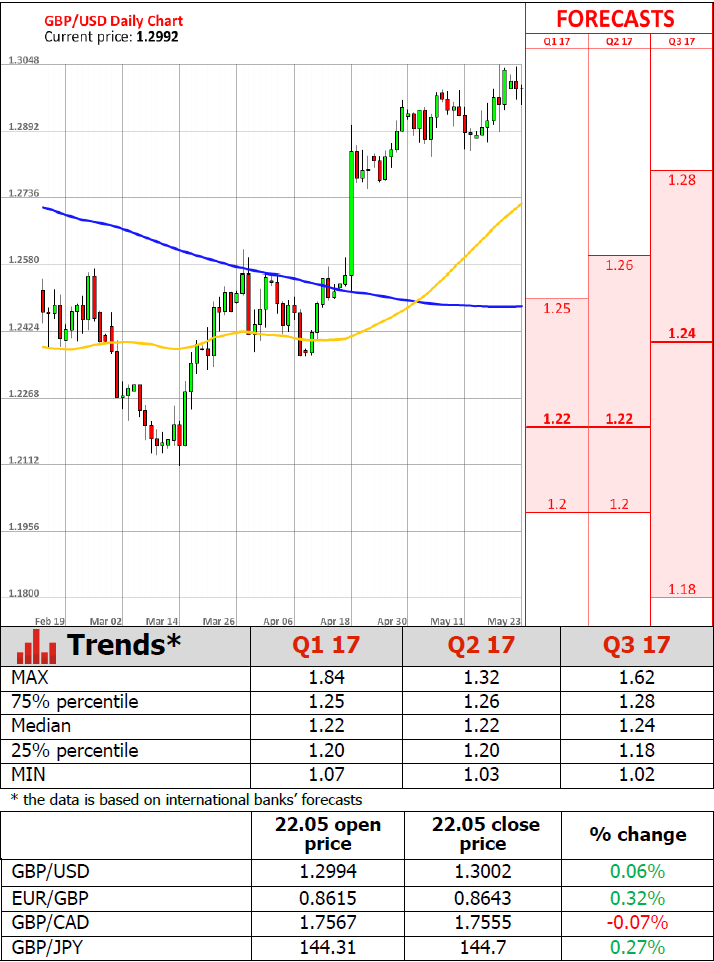
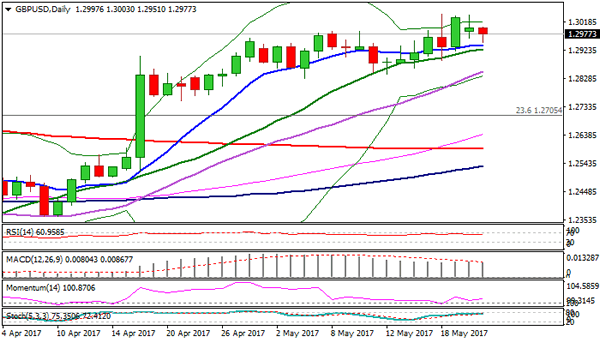
Sterling moved lower in early Tuesday's trading after deadly terrorist attack in Manchester and slipped below Monday's low at 1.2965 after hitting high at 1.3003 in Asia. Failure to close above 1.3000 on Monday and confirm break weighs, as the price action remains capped by falling thick weekly cloud. In addition, bearish divergence on daily MACD/slow stochastic warns of possible further easing. Overall bullish sentiment has been soured by Manchester blast that may add on risk of deeper pullback. Converging 10/20 SMA's at 1.2939/26 mark pivotal support, loss of which would generate bearish signal for further easing that may risk extension through pivots at 1.2920/1.2890, towards key near-term supports at 1.2843/30.
Res: 1.3000, 1.3022, 1.3046, 1.3100
Sup: 1.2944, 1.2920, 1.2889, 1.2843
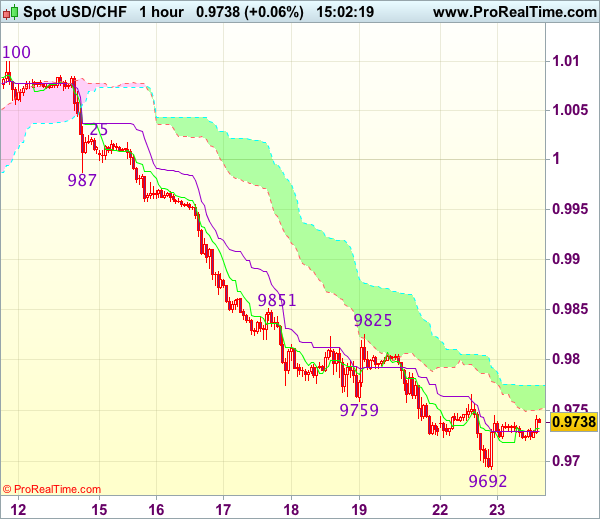
Trade Idea : USD/CHF – Hold long entered at 0.9700
USD/CHF - 0.9720
Most recent candlesticks pattern : N/A
Trend : Near term down
Tenkan-Sen level : 0.9728
Kijun-Sen level : 0.9729
Ichimoku cloud top : 0.9774
Ichimoku cloud bottom : 0.9751
Original strategy :
Bought at 0.9700, Target: 0.9800, Stop: 0.9690
Position : - Long at 0.9700
Target : - 0.9800
Stop : - 0.9690
New strategy :
Hold long entered at 0.9700, Target: 0.9800, Stop: 0.9690
Position : - Long at 0.9700
Target : - 0.9800
Stop : - 0.9690
Although dollar has remained under pressure and marginal weakness from here cannot be ruled out, as long as yesterday’s low at 0.9692 holds, prospect of another rebound remains, above 0.9765-70 would suggest low is possibly formed, bring subsequent bounce to 0.9800 but reckon upside would be limited to 0.9825 and previous resistance at 0.9851 should remain intact, bring another decline later.
In view of this, we are holding on to our long position entered at 0.9700. Below 0.9670-75 would risk weakness to 0.9650 but still reckon downside would be limited to 0.9620-25 and bring another rebound later.