Sample Category Title
Could ECB Up the Ante With a 50bps Rate Cut?
- ECB will meet on Thursday; markets expect a 25bps rate cut
- Doves are likely to push for a more aggressive rate cut
- President Lagarde’s negotiating skills will be put to the test
- The euro could suffer from a 50bps cut; muted impact likely from a smaller move
ECB will meet on Thursday
The ECB will hold its final meeting for 2024 on Thursday, one week before the Fed. Since the previous ECB gathering on October 17, several developments have occurred both domestically and externally.
The political turmoil continues in the eurozone’s two biggest economies. French President Macron remains under pressure to find a new PM and get the 2025 budget approved, and the German campaign for the February general election is fully underway. Meanwhile, President-elect Trump, in anticipation of his White House return on January 20, has already announced tariffs on the closest trade partners of the United States. Additionally, a regime change in Syria and a ceasefire in Lebanon have been added to the numerous changes on the geopolitical landscape.
Amidst these developments, the eurozone economy continues to experience a very soft patch with the PMI surveys painting a rather bleak picture. Considering the political situation, the burden once again falls on the ECB to keep the eurozone economy moving forward.
Four market moving factors on Thursday
Focusing on Thursday’s ECB meeting, there are four factors that could probably prove market moving. The size of the rate cut, the press statement, President Lagarde’s press conference, and the quarterly staff forecasts could increase the subdued volatility seen in euro/dollar over the past week.
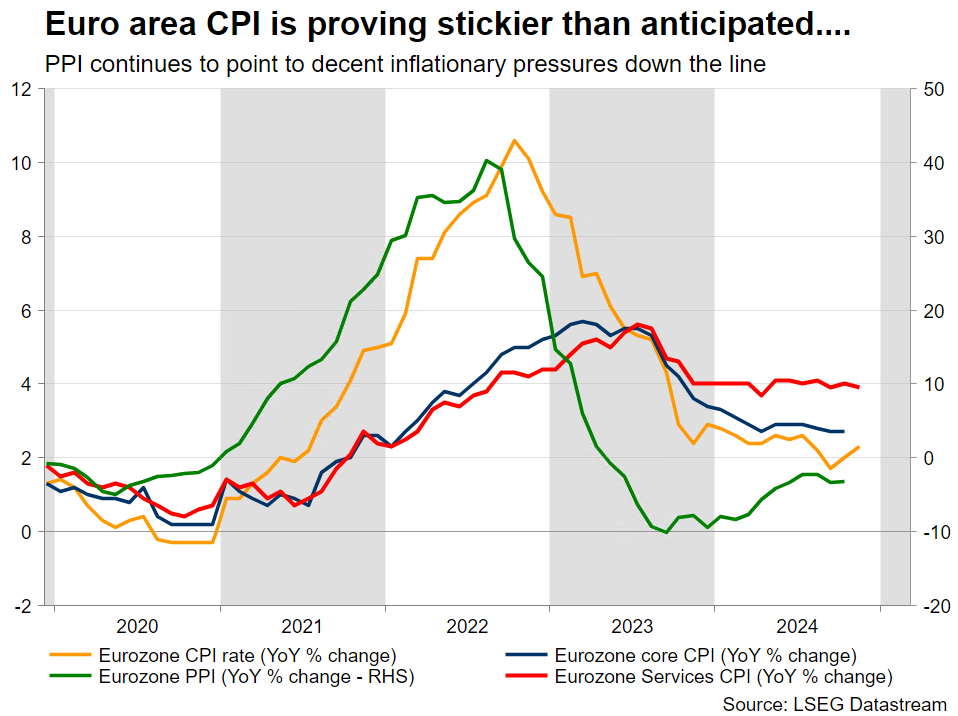
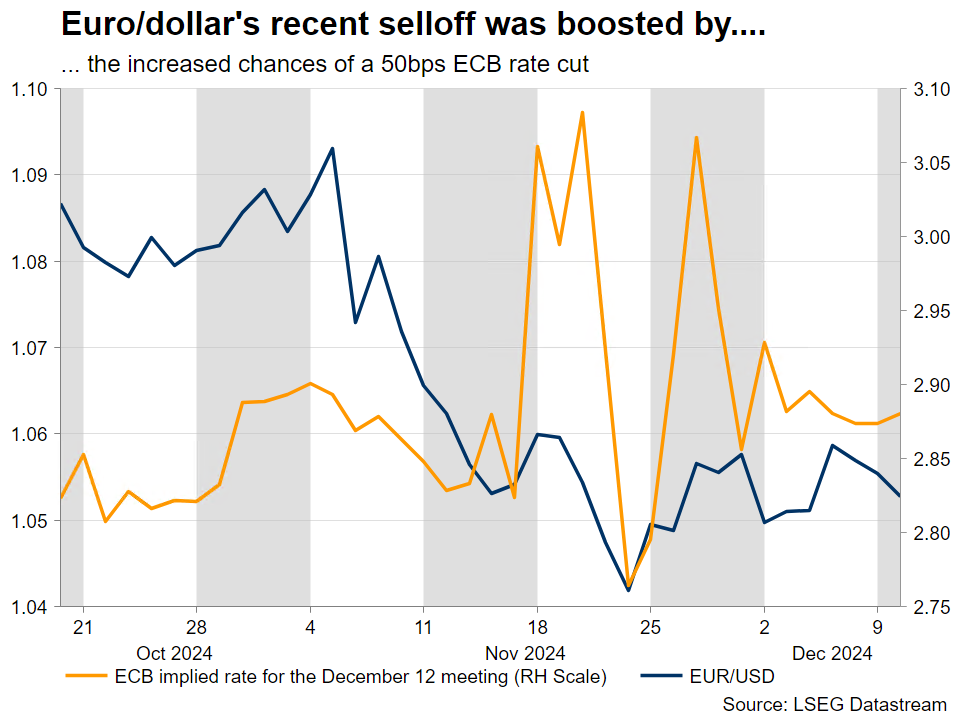
In more detail, leading up to the ECB meeting, market expectations fluctuated between 25bps and 50bps rate cuts. Inflation has proven stickier than anticipated, with services inflation edging only a tad lower in November to 3.9%. Both rate cut options have merit, with the doves pushing for a stronger move ahead of Trump’s second term and highlighting the eurozone economy’s need for extra accommodation.
The December staff forecast could point to the future path of ECB rates, with the market focusing on any downward revisions to the 2026 inflation figures. In September, the headline and core inflation forecast for 2026 were kept stable at 1.9% and 2% respectively, thus keeping the door open to further rate cuts. Interestingly, the 2027 figure will be printed for the first time, with the market keen to see how far below the 2% target this forecast could fall. Similarly, another downward revision to growth rates for both 2025 and 2026 could play a role in the discussion about the size of the rate cut.
Additionally, the press statement and, more importantly, Lagarde’s rhetoric at the Q&A session could reveal the thinking process behind Thursday’s decision. A unanimous rate decision could be seen as a personal success for Lagarde, especially since the doves are really worried about Trump’s trade strategy.
Finally, the ECB has adopted a voting pattern in the past few years. Interestingly, on December 12 three hawks, including uber-hawks Nagel and Wunsch, will not have a vote, making Thursday’s gathering one of the most dovish meetings of 2024.
Two main scenarios for the ECB meeting
Putting everything together, investors are faced with two main scenarios:
Scenario 1: The ECB announces a 25bps rate cut, maintains dovish rhetoric and signals its readiness for more aggressive actions if incoming President Trump kicks off a new trade war. The doves will be moderately pleased, with the euro suffering just a tad. The initial disappointment from the lack of a more aggressive rate cut could cause a small upleg against the US dollar, but the move will most likely quickly reverse as President Lagarde holds the press conference.
Scenario 2: Concerned about the underlying economic conditions and the increased possibility of tariffs imposed by Trump on eurozone products, the ECB cuts rates by 50bps and adopts an even more dovish stance. Boosted by the quarterly forecasts showing inflation in both 2026 and 2027 comfortably below 2%, Lagarde comments that the rate cuts will continue, with the ECB deposit rate potentially being pushed well below the neutral rate in 2025.
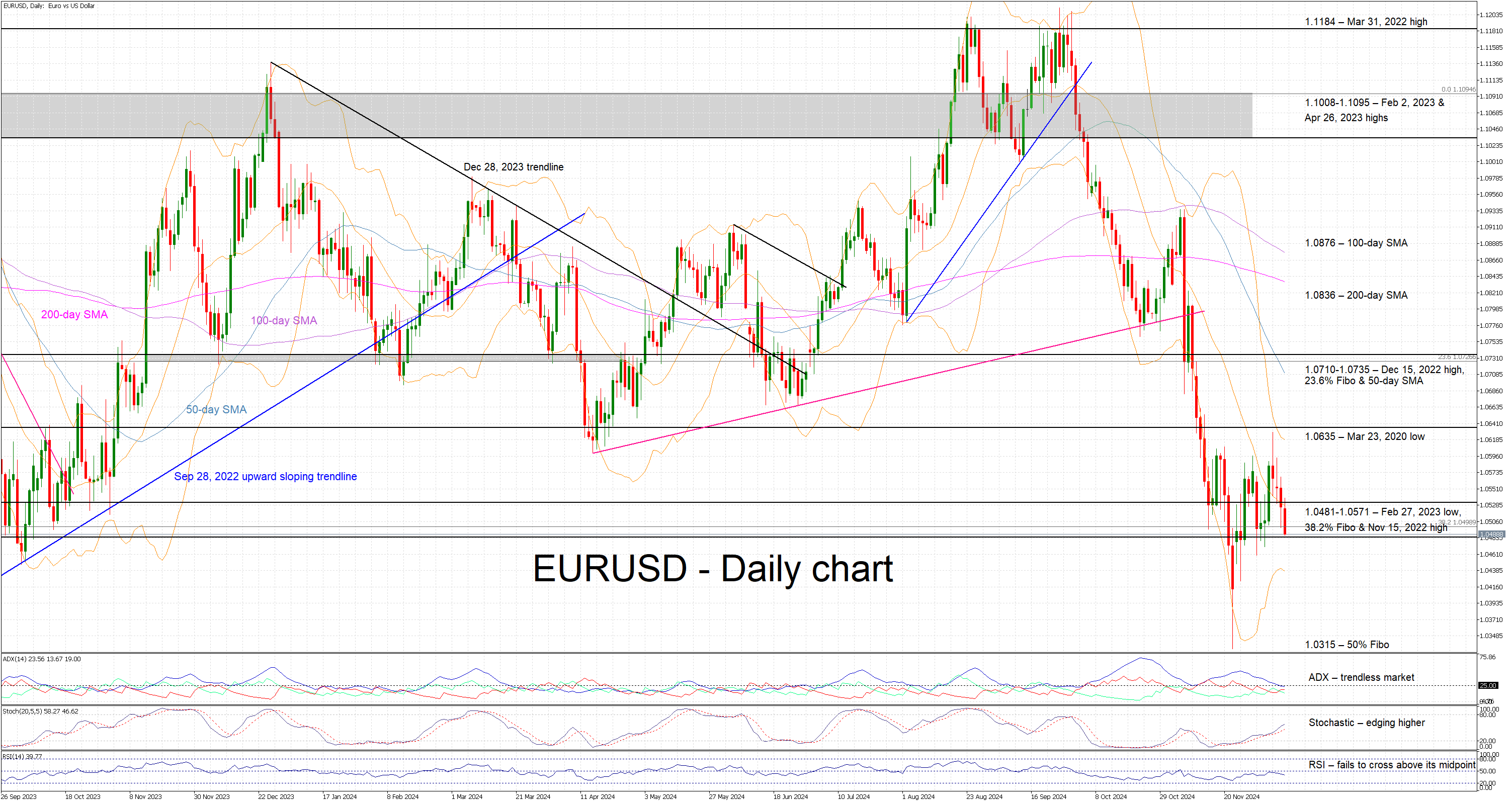
In this scenario, the euro will probably suffer across the board, with euro/dollar dropping like a stone below the 1.0481-1.0571 range and potentially retesting the 1.0315 level.
GBPCAD Wave Analysis
- GBPCAD reversed from strong resistance zone
- Likely to fall to support level 1.8000
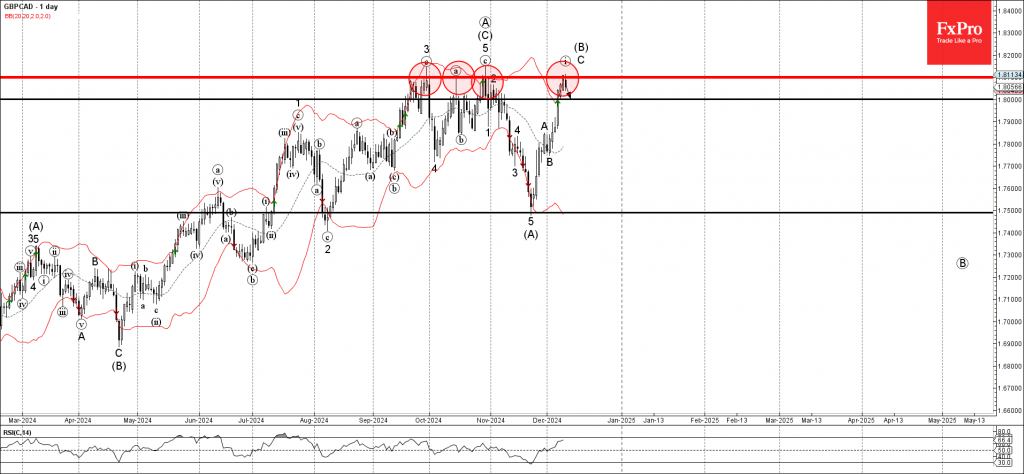
GBPCAD currency pair recently reversed down from the strong resistance zone located at the intersection of the upper daily Bollinger Band and the key resistance level 1.8100, which has been reversing the pair from September.
The downward reversal from this resistance zone stopped the C-wave of the previous ABC correction (B) from the end of November.
Given the strength of the resistance level 1.8100, GBPCAD currency pair can be expected to correct down to the next round support level 1.8000.
EURUSD Wave Analysis
- EURUSD reversed from resistance zone
- Likely to fall to support level 1.0450
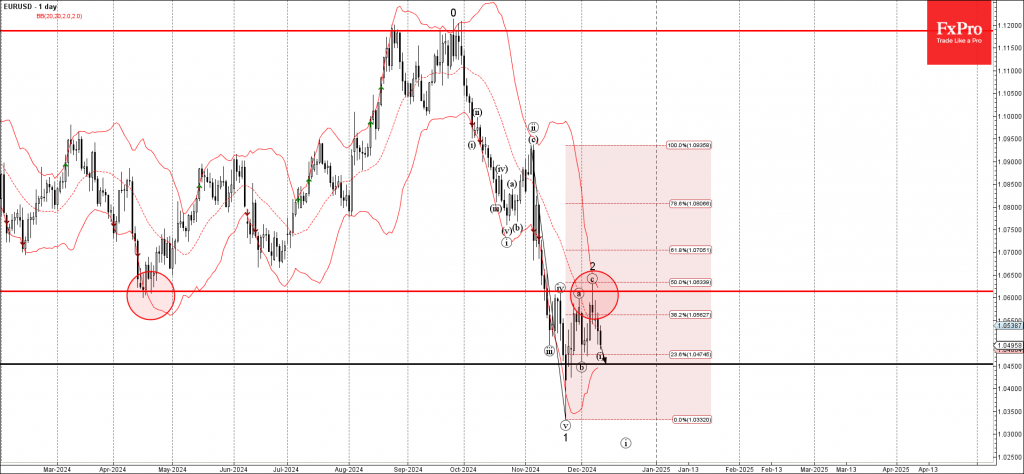
EURUSD currency pair recently reversed down with the long-legged Doji from the resistance area between the upper daily Bollinger Band, pivotal resistance level 1.0610 (former multi-month support from April) and the 50% Fibonacci correction of the downward impulse from the start of November.
The downward reversal from this resistance zone started the active minor downward impulse wave 3.
Given the strength of the aforementioned resistance area and the clear daily downtrend, EURUSD currency pair can be expected to fall further to the next support level 1.0450 (low of the earlier minor correction b).
EURGBP Plummets to 33-Month Low
- EURGBP posts another lower low
- Bearish sentiment endorsed by technical oscillators
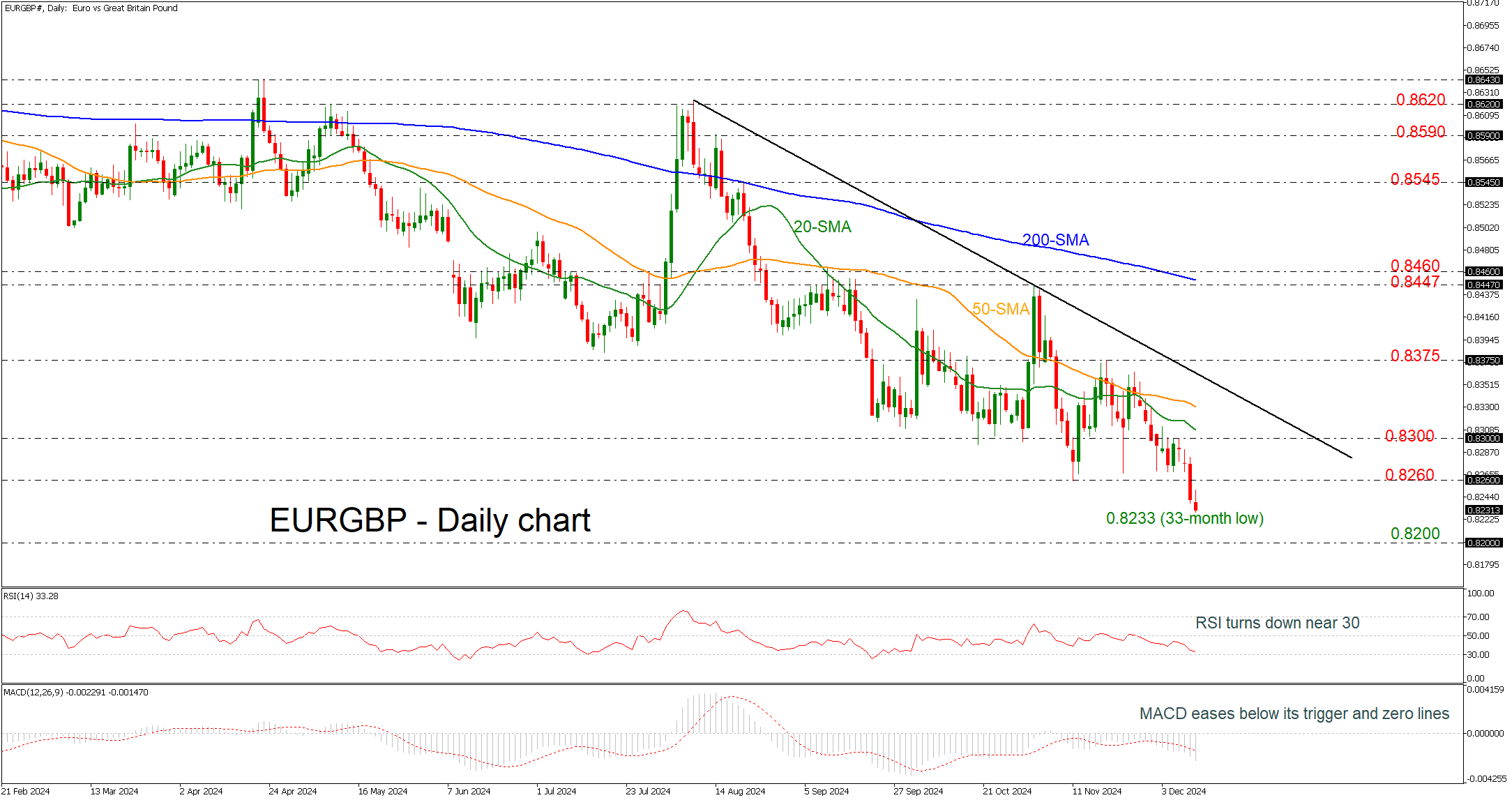
EURGBP plunged to a new 33-month low of 0.8233 earlier today, creating a lower low in the medium-term outlook and endorsing the strong negative tendency. The momentum oscillators mirror the latest bearish move with the RSI diving towards the 30 level and the MACD strengthening its bearish steam below its trigger and zero lines.
More downside pressure could send traders to the 0.8200 round number, which is the low from March 2022, while below that the inside swing high from March 2016 at 0.8130 could prove to be a turning point barrier.
In the case of a rebound from the latest trough, immediate resistance could be the 0.8260 mark ahead of the 0.8300 handle. Even higher, the 20- and 50-day simple moving averages (SMAs) at 0.8307 and 0.8330 may pause the short-term increase.
All in all, EURGBP has been experiencing an aggressive selling interest since August, and a break above the descending trend line might not be enough to switch the current outlook to positive.
EURJPY Aims for 161.00, Gets Blocked by 20-Day SMA
- EURJPY continues rebound from 2½-month low
- But meets obstacles in race towards 161 level
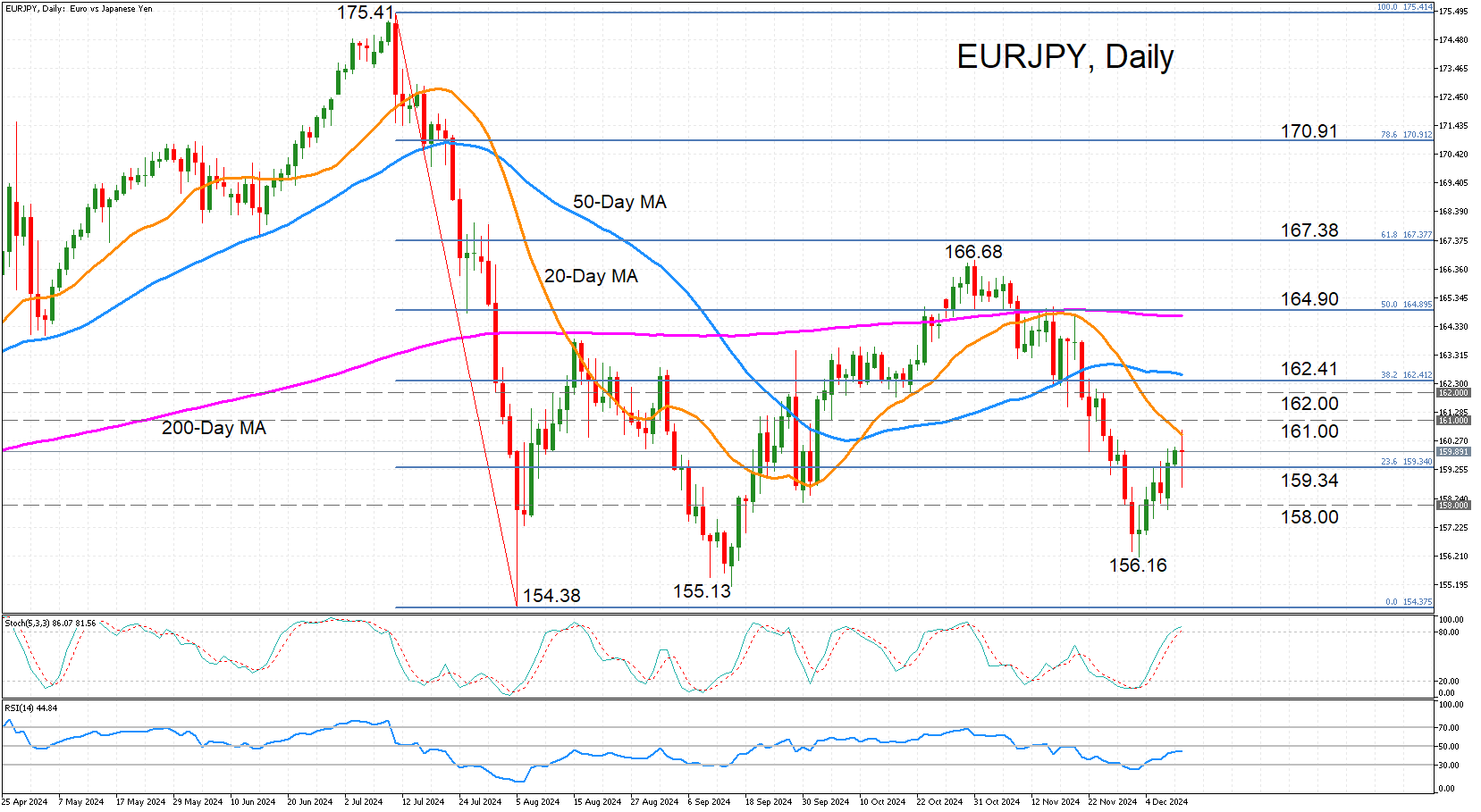
EURJPY has bounced back by more than 2% from the early December two-and-a-half-month low of 156.16. But the rebound has had a setback today, failing to get past the 20-day simple moving average (SMA) at 160.51.
The momentum indicators remain bullish, however, so there is a strong case for further gains in the short term. The stochastics have just entered the overbought region and a bearish crossover of the %K and %D lines doesn’t look imminent, while the RSI is steadily climbing below the 50 level.
If the bulls can overcome the immediate resistance at the 20-day SMA, the next hurdle is slightly higher at the 161.00 mark followed by the 162.00 level. Even higher, there’s likely to be some resistance around the 38.2% Fibonacci retracement of the July-August downleg at 162.41 and the 50-day SMA at 162.63. Clearing these obstacles would pave the way for the 200-day SMA at 164.70, which lies slightly below the 50% Fibonacci of 164.90.
However, for the medium-term picture to turn decisively bullish again, EURJPY would need to surpass the October 31 peak of 166.68.
On the other hand, if the positive momentum starts to wane and the price turns lower, there could be some support around 158.00 before attention turns to the December low of 156.16. A break beneath this trough would shift the medium-term outlook to bearish.
In a nutshell, EURJPY has a good chance of extending its rebound despite the several barriers ahead, but the medium-term trend will only be decided once there’s a climb above 166.68 or a drop below 156.16.
USD/CHF Edges up Ahead of SNB Rate Decision
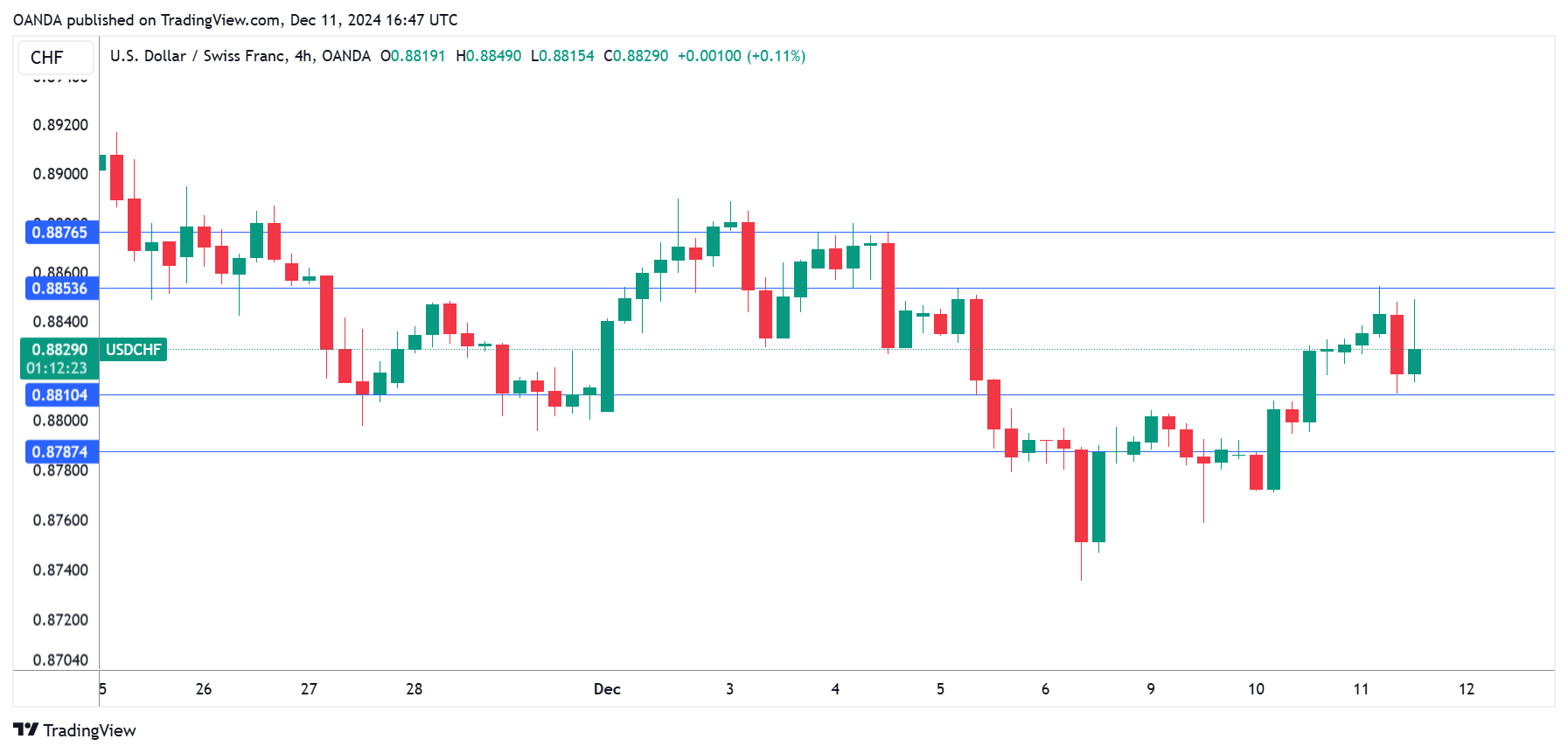
The Swiss franc is slightly lower on Wednesday. In the European session, USD/CHF is trading at 0.8845, up 0.19% on the day.
Swiss National Bank cut looms, but how much?
‘Tis the season of central bank decisions, with four major central banks making rate announcements this week. The Swiss central bank meets on Thursday and a rate cut has been fully priced, but what will the SNB do? The market has currently priced a 50-basis point cut at 60% and a modest 25-bp cut at 40%. Just one week ago, the odds were 70-30 in favor of a 50-bp cut.
Inflation declined by 0.1% in November and Switzerland hasn’t posted a gain in inflation since May. The signs of deflation support the case for a jumbo 50-bp cut. Still, central banks prefer modest rate moves in 25-bp increments and with the cash rate at just 1%, policymakers may opt for a 25-bp cut.
US inflation ticks higher, as expected
US inflation for November was a non-event for the US dollar, which has shown little movement today against the major currencies. Headline CPI ticked higher to 2.7% y/y up from 2.6% in October, while the core rate rose 3.3% y/y for a third straight month. Monthly, headline CPI rose from 0.2% to 0.3% and the core CPI rose was unchanged at 0.3%. The data matched expectations which explains the muted response of the US dollar.
In the aftermath of today’s inflation data, the market expectations for a rate cut at the Dec .18 meeting have jumped. The rate odds for a quarter-point have climbed to 97%, compared to 88% immediately prior to the release. The Fed has lowered rates twice this year and is poised for a third cut next week, even though the inflation downswing has stalled and inflation remains higher than the Fed’s 2% target.
USD/CHF Technical
- USD/CHF tested resistance at 0.8853 earlier. Above, there is resistance at 0.8876
- 0.8810 and 0.8787 are the next support levels
Japanese Yen Loses Ground on Shifting Interest Rate Expectations
The Japanese Yen has lost 2.3% against the US dollar since the end of last week, roughly twice as much as the rise in the dollar index against a basket of six developed market currencies. This change is due to a shift in interest rate expectations, with investors increasingly doubting an imminent rate hike in Japan and seeing fewer rate cuts from the Fed next year.
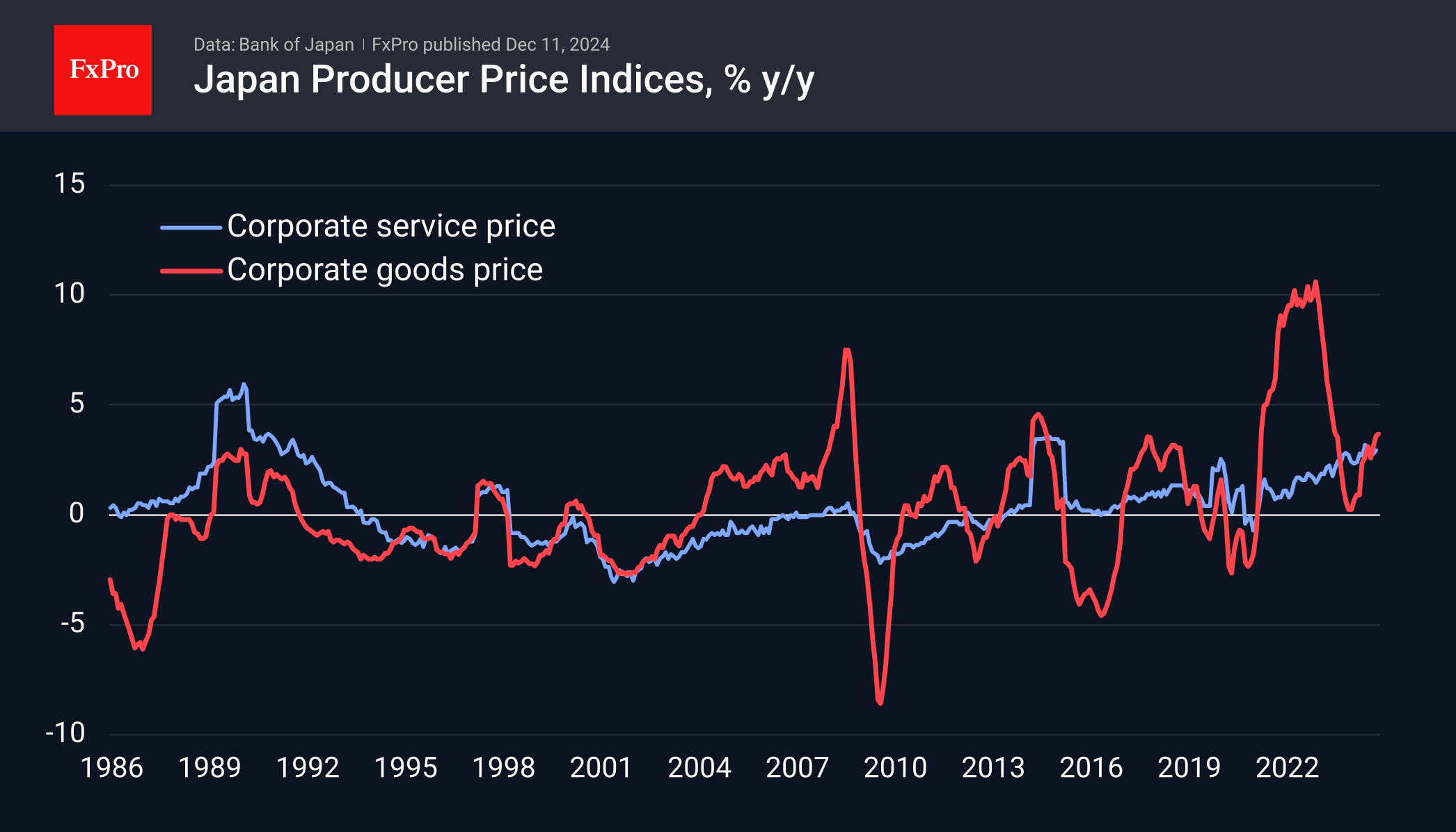
Interestingly, the latest inflation data does not help the Yen. November data showed an acceleration in Japanese business input prices to 3.7% y/y, the highest since the middle of last year. Corporate services price growth (October data) jumped 0.8% m/m to an annualised pace of 2.9%, maintaining levels near 3% y/y since April. These indices are important leading indicators of inflation, pointing to increasing pressure on retail prices and supporting a policy rate hike by the Bank of Japan.
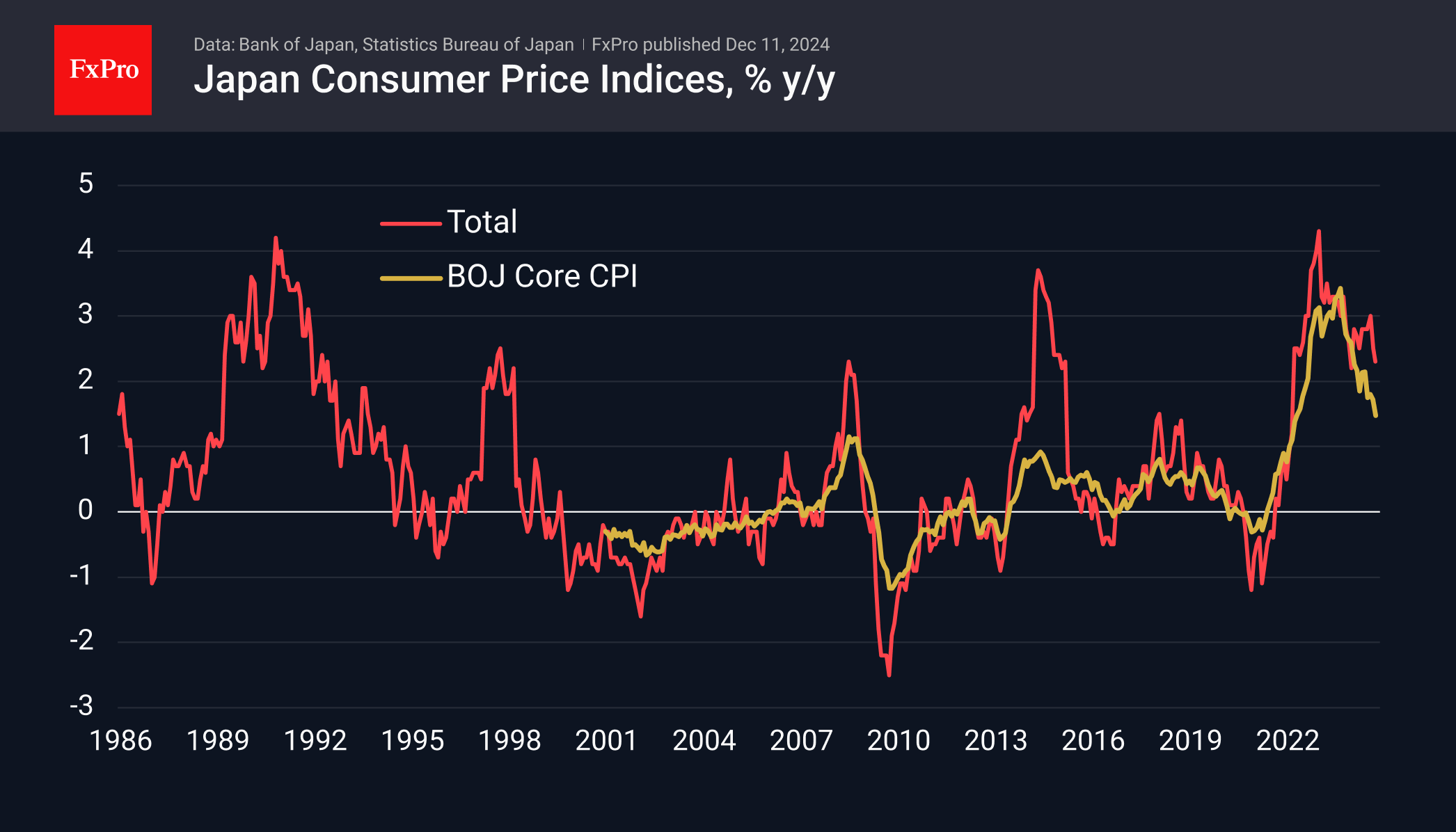
At the same time, the decline in core consumer inflation to 1.5%, as tracked by the BoJ, provides room to delay policy tightening. The BoJ can use this time to assess the economic outlook considering potential trade tariffs from the Trump administration.
For the bond markets, this slowness has the effect of pushing back expectations for a rate hike in Japan from mid-December to the end of January. For currency markets, this puts pressure on the JPY as accelerating inflation that does not lead to a rate hike leads to capital outflows from yen debt markets.
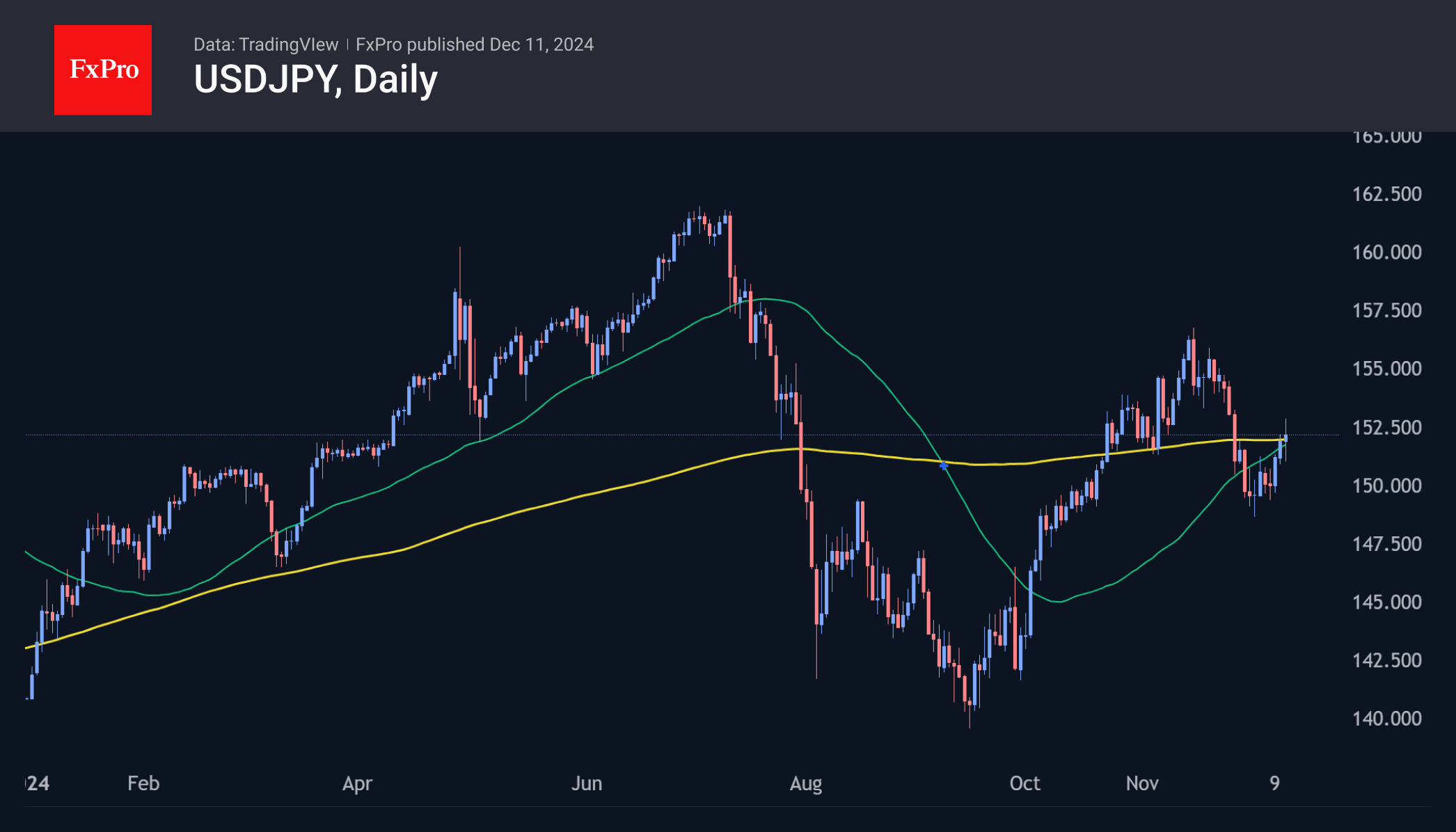
It would not be surprising to see an accelerated rise in the USDJPY. The technical picture has also turned bullish in recent days, as the pair has broken above its 200 and 50-day moving averages. In addition, a “golden cross” is forming as the 50-day is about to cross above the 200-day, which is a strong technical signal for further upside. The USDJPY could potentially reach levels of 156 before the end of the year and exceed 160 in the first quarter of 2025.
Sunset Market Commentary
Markets
Today’s November US CPI inflation numbers convinced final doubters that the Fed would stick to the plan set out in the September dot plot and lower rates by 25 bps at its policy meeting next year. The data printed bang in line with expectations: a 0.3% monthly increase in both headline and core CPI with annual readings respectively rising from 2.6% to 2.7% on a headline level and stabilizing at 3.3% for the core gauge. The stalling disinflation process equally boosts the case for a January pause by the Federal Reserve, awaiting the inauguration of president-elect Trump on January 20. Uncertainty on his future (fiscal) agenda favours erring on the side of keeping some powder dry. Other elements in favour of such scenario are stronger-than-expected growth, enthusiastic survey data since the Republican sweep, rising short term inflation expectations and Fed talk on a gradual approach. The US yield curve bull steepens today with yield changes ranging between -4.2 bps (2-yr) and -0.8 bps (30-yr). The long end of the curve still has an eye on tonight’s $39bn 10-yr Note auction and on tomorrow’s $22bn 30-yr Bond sale. Are investors keen to load up on more US Treasuries at current levels with a potential debt bonanza looming? The US dollar is marginally weaker on a trade-weighted basis. EUR/USD spiked very temporarily towards 1.0540, but is already back at 1.05 in anticipation of a dovish 25 bps rate cut at tomorrow’s ECB meeting. USD/JPY rose from 151.50 to 152.50 before returning some gains after the US CPI report. A Bloomberg report suggesting that BoJ official see a small cost to waiting before raising interest rates caused the initial JPY-weakness. Speculation on a December BoJ rate hike was recently rising following higher inflation & stronger growth numbers and some BoJ talk. At the same time, the article suggested that some aren’t against a rate hike on Friday if it is proposed, adding some ambiguity. USD/CAD tends to weaken after the Bank of Canada’s expected 50 bps rate cut to 3.25%. YtD highs around 1.42 hold and the recent failed test of this resistance area triggers some rebound action lower towards 1.4140. The BoC sees a gradual approach from here if the economy evolves broadly as expected. The central bank will be looking at core inflation to assess the inflation trend after some government tax breaks. BoC governor Macklem labels the US tariff threats as major new uncertainties.
News & Views
Chinese leaders and policymakers are contemplating to allow the yuan to depreciate in 2025, a Reuters exclusive reported citing people with knowledge of the matter. Doing so would mean breaking with the usual policy goal of keeping the exchange rate stable. The shift comes as China braces for US import duties under a second Trump presidency. The president-elect during his campaign threatened with tariffs up to 60% on Chinese imports. Allowing CNY depreciation would blunt some of the impact and protect the one sector (ie export) of the economy that has been doing well. The matter is all the pressing given that Chinese authorities are said to set next year’s growth target in the same ambitious 5% range as this year’s. China’s yuan slid after Reuters ran the report with USD/CNY jumping from the 7.25 area towards 7.275 before paring gains (CNY losses) to 7.264 currently. A source tapped by Reuters said the PBOC has considered the possibility the yuan could drop to USD/CNY 7.5 to counteract any trade shocks. That would be the weakest level since 2007.
Strike 5. OPEC for a fifth straight month slashed its oil demand forecasts for this year and the next. Lowering consumption growth by 210k barrels a day to 1.6mn for 2024 marked the deepest cut so far. Demand growth has been reduced 27% since it started adjusting projections downwardly from July on. For 2025 it reduced growth by 90k barrels a day to 1.4mn. The move “takes into account recently received bearish data” for Q3 including “downward revisions to OECD Americas and OECD Asia Pacific”. Despite the string of cuts, OPEC remains considerably more bullish on oil demand compared to others in the oil industry, including the IEA. OPEC+ last week decided for a third time to postpone the removal of some oil production curbs while also slowing the pace of increases once they start doing so somewhere next year. Oil prices grind higher in choppy trading. Brent currently is sold for $73/b.
Bank of Canada Delivers Another Supersized Cut
The Bank of Canada (BoC) cut its overnight rate by 50 basis points, to 3.25%, while stating that it will continue with Quantitative Tightening (QT).
The bank highlighted that economic growth has been weaker than they expected, stating that "the economy grew by 1% in the third quarter, somewhat below the Bank’s October projection, and the fourth quarter also looks weaker than projected."
Inflation is less of a concern for the central bank, which was made clear when it stated "inflation has been about 2% since the summer, and is expected to average close to the 2% target over the next couple of years."
The bank referenced the confluence of factors that are muddying the outlook. These included the impact of the government's new immigration strategy, new mortgage rules, the GST holiday and one-time payments from governments, and the threat of tariffs.
On the future path of policy, the bank seems more cautious, stating that is has already "reduced the policy rate substantially since June" and that it "will be evaluating the need for further reductions in the policy rate one decision at a time."
Key Implications
The recent rise in the unemployment rate alongside weaker-than-expected GDP was enough to convince the BoC that another supersized rate cut was warranted. We think this misses the forest for the trees. The rise in the unemployment rate is missing the fact that hiring has reaccelerated over the last few months, while underlying growth momentum has been robust with consumer spending driving fundamental demand. Not to mention, the real estate market has caught fire once again.
We don't think the BoC will keep cutting at this current pace. The policy rate is in the bank's 'neutral' range (2.25% to 3.25%), which means it probably thinks its rate is no longer weighing on economic growth. The central bank will also be getting more evidence over the coming months that economic growth is stabilizing around trend. Stronger growth will validate that it can cut at a slower pace. If it doesn't, policy rate differentials with the U.S. will widen even more. And with tariffs potentially coming on Jan. 20th, the combination would likely push the loonie into the mid-60 U.S. cent range.
Australian Dollar Hits Four-Week Low Amid RBA Stance and US Dollar Strength
The AUD/USD pair continues its downward trajectory, reaching a four-week low of 0.6386 on Wednesday. This decline is primarily influenced by the Reserve Bank of Australia's (RBA) decision to maintain interest rates at 4.35% per annum for the ninth consecutive meeting. This decision, which was widely expected, reflects the central bank's cautious approach despite ongoing inflation concerns.
RBA Governor Michelle Bullock emphasised that the central bank's current stance on inflation is deliberate, aiming to signal responsiveness to softening economic indicators. The market currently anticipates a high likelihood of an RBA rate cut in February, with a 63% probability of a 25-basis-point reduction. Expectations are set for further cuts at subsequent meetings through May as investors and analysts factor in potential easing measures.
AUD supporters' focus is shifting towards Thursday's release of Australian employment data, which could provide further clues about the economic outlook and influence RBA policy decisions.
The Australian dollar is also experiencing significant pressure from a strengthening US dollar, which adds to its challenges.
Technical analysis of AUD/USD
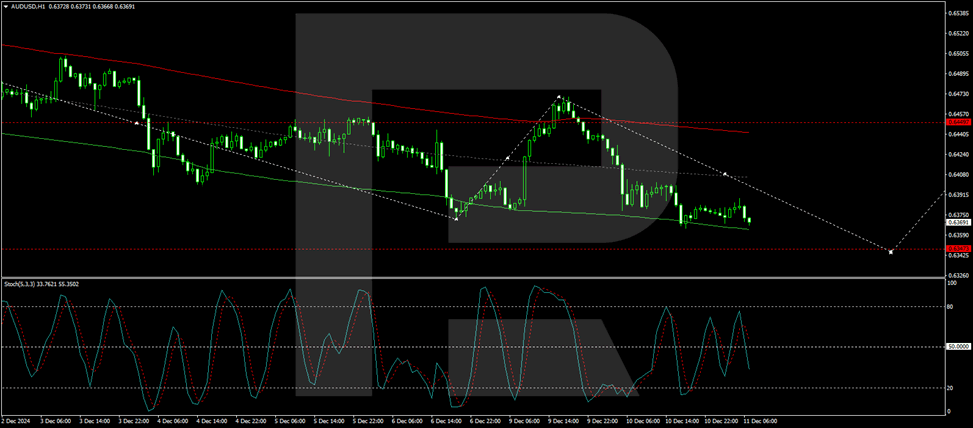
H4 chart: the AUD/USD is navigating a wide consolidation range centred around 0.6450. The pair is currently forming a downward movement towards 0.6347. Upon reaching this level, a corrective rise to 0.6450 is expected, potentially testing this resistance from below before possibly initiating a new decline towards 0.6215. This bearish outlook is supported by the MACD indicator, whose signal line is below zero and continues to trend downwards.
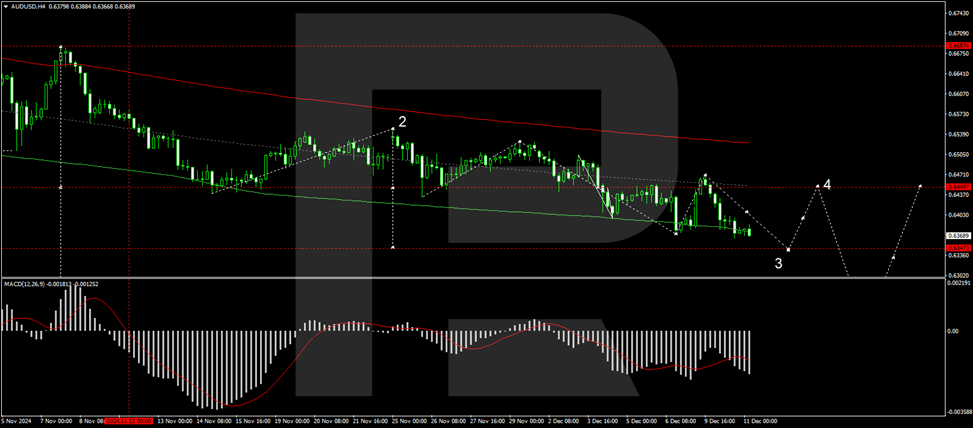
H1 chart: the market is actively developing a downward wave towards 0.6347. After hitting this target, a corrective movement towards 0.6450 could occur. The Stochastic oscillator, with its signal line below 50 and moving towards 20, confirms this scenario, indicating the potential for further downward pressure before any corrective rebound.