

Sample Category Title
Week Ahead All Eyes on Fed
March rate hike at 93 percent probability
The U.S. dollar is higher against most major pairs as the two day Federal Open Market Committee (FOMC) meeting is expected to bring forth the first U.S. interest rate hike of 2017. The FOMC statement will be released on Wednesday, March 13 at 2:00 pm EDT ( 7:00 pm GMT) with a scheduled press conference from Fed Chair Janet Yellen starting at 2:30 pm. The U.S. central bank is forecasted to hike the benchmark rate 25 basis points at <1.00%.
Fed members were instrumental in changing market perception around the March meeting. Back in February 14 the rate hike probabilities were low now according to the CME FedWatch tool there is a 93 percent probability the rate is raised on March 15. The Fed is also realizing an update to its economic projections that could give further insight on the pace of the rate hikes anticipated for this year. The market has already priced in a rate hike on Wednesday, but a more hawkish dot-plot upping the tempo to four rate hikes could further boost the greenback.
The European Central Bank (ECB) held rates on Thursday but the rhetoric from President Mario Draghi soothed market anxiety about risks to the end of the euro that have been rising as several elections are set to take place in 2017. A Bloomberg article about a possible discussion of the ECB Governing Council on a rate hike coming before the end of the stimulus program appreciated the EUR against the USD on Friday.
The EUR/USD gained 0.786 percent in the last week. The single currency is trading at 1.0686 after the ECB held rates steady and surprised markets with an optimistic outlook that could see it hike rates sooner than anticipated.
The ECB held rates unchanged on Thursday but did not call for further easing and President Draghi's comments on how the risks of the end of the euro are highly improvable at this stage. Political risk remains high with the French elections the ones to watch given the rhetoric from Marie LePen although Emmanuel Macro's rise has reduced some anxiety as he is now in the lead according to polls to win in the second round.
Despite a strong U.S. non farm payrolls (NFP) report on Friday the spotlight was on comments from the European Central Bank possible rate hike could come before the end of the QE program at the end of the year.
Investors are looking forward at the Fed's economic projections and the words from Fed Chair Janet Yellen for more details on future rate hikes as March was put on the table by Fed member comments and more information could be forthcoming on Wednesday.
West Texas lost 8.941 percent in the last 5 days. The price of WTI is trading at $48.22 after Wednesday's report of larger than forecasted U.S. crude inventories. The Energy Information Administration reported a weekly buildup of 8.2 million barrels when only 1.1 million was expected. The ninth consecutive weekly increase is casting doubt on how effective the Organization of the Petroleum Exporting Countries (OPEC) production cut deal can have if other producers ramp up their activity.
The OPEC deal has had little real impact on global inventories, but it manage to keep prices around $50 per barrel. The lack of demand for energy around the world and increased production from nations outside of the agreement have put downward pressure on crude prices. OPEC members could be questioning if sticking to the agreement if beneficial for them in the long term which could further drive prices down as the deal has been the main driver of price stability in the past two years.
Gold lost 2.65 percent in the last trading week. The price of the yellow metal is trading at $1,202.63 after the U.S. added 235,000 jobs in February and if Fed members comments are accurate a March rate hike is in the cards. Gold has been on the back foot since Fed speakers turned up their rate hike signalling ahead of the March FOMC. The CME FedWatch tool shows a 93 percent probability of a rate hike being announced on March 15.
Market events to watch this week:
Monday, March 13
- 9:30am EUR ECB President Draghi Speaks
- 10:00pm CNY Industrial Production y/y
Tuesday, March 14
- 6:00 am EUR German ZEW Survey
- 8:30am USD PPI m/m
Wednesday, March 15
- 8:30am USD CPI m/m
- 8:30am USD Core CPI m/m
- 8:30am USD Core Retail Sales m/m
- 8:30am USD Retail Sales m/m
- 10:30am USD Crude Oil Inventories
- 2:00pm USD FOMC Economic Projections
- 2:00pm USD FOMC Statement
- 2:00pm USD Federal Funds Rate
- 2:30pm USD FOMC Press Conference
- 5:45pm NZD GDP q/q
- 8:30pm AUD Employment Change
- 8:30pm AUD Unemployment Rate
- Tentative JPY BOJ Policy Rate
- Tentative JPY Monetary Policy Statement
Thursday, March 16
- 2:30am JPY BOJ Press Conference
- 4:30am CHF Libor Rate
- 4:30am CHF SNB Monetary Policy Assessment
- 8:00am GBP MPC Official Bank Rate Votes
- 8:00am GBP Monetary Policy Summary
- 8:00am GBP Official Bank Rate
- 8:30am USD Building Permits
- 8:30am USD Philly Fed Manufacturing Index
- 8:30am USD Unemployment Claims
Friday, March 17
- 8:30am CAD Manufacturing Sales m/m
- 10:00am USD Prelim UoM Consumer Sentiment
*All times EST
Weekly Market Outlook: The ECB Is Showing Some Hawkishness
SNB Could Be In A Corner
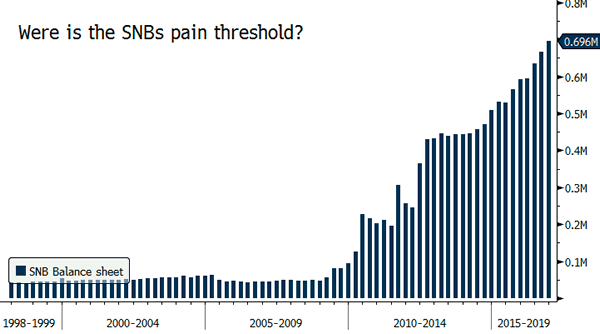
The ECB slightly hawkish policy meeting removed the selling pressure on the EURCHF in the near term. Yet with political risk in Europe increase the respite might not last. As everyone knows, the SNB has been intervening to protect the CHF from further "overvaluation". Today, the SNB released data indicating foreign exchange reserves surged 3.8% to 668.2bn CHF (Total balance sheet is over 115% of GDP). While the SNB does not generally comment on intervention, the size of the balance sheet expansion indicates that the SNB has been very active in FX markets (protecting 1.06 soft floor).
The problem is that the pace of purchases is unsustainable (printing unlimited CHF could lead to hyperinflation and credibility issues), yet demand for CHF is likely to increase (1. Rising political risk in Europe 2. EU-CH yield spread stable/narrowing 3. Swiss economic conditions are improving). The language of SNB around FX policy has softened (supported by a positive inflation outlook) adding to speculation of greater flexibility yet clearly demand for CHF has outstripped the SNB's view of smoothing. EURCHF has become the "go to" trade to hedge European political risk, so selling pressure should increase as we head into the Dutch and French elections. Now I'm sure I don't have to remind anyone that arguably the two biggest FX moves in the last few years have been created by the SNB (hence the concern), and their proactively addressing events/situation in Europe.
The problem is that, once again, the SNB is now "trapped" by their own policy. My concern is that the SNB's "soft" FX policy has become "hard" in the market's mind. When the SNB is forced to remove the verbiage/ physical intervention (not sure which comes first), we should see EURCHF move sharply lower. The longer the situation remains, the greater likelihood of an extreme event.
The ECB Is Showing Some Hawkishness
Last Thursday, the European Central Bank had its meeting and without no surprise, rates will remain unchanged. Plus, ECB President Mario Draghi did not mention anything regarding the monetary policy for next year after the end of the current QE program.
It is nonetheless clear that the ECB is rather positive on the outlook. Recent fundamental data has indicated some improvement. Industrial production growth is positive (+2% in December) and inflation has surged since the start of the year. Eurozone HCPI is now above the target of 2% according to Eurostat. It is the first time in four years that the central bank's target has been reached even though core inflation is stalling around 0.9%.
We believe that ECB-Fed monetary policy divergence is becoming a reality while a US rate hike next week is now certain. The ECB for the time being remains largely all-in. We recall that from April the ECB will start buying €60bn bonds instead of €80bn until the end of the year. This should not last forever, because of bonds scarcity and the better data.
The statement is showing the ECB's hawkishness
We consider that the ECB is now slightly hawkish as the statement did not mention that the central bank would use all available tools as it is normally the case.
We may now expect that the economic data, lower unemployment rate and greater inflation should push policymakers to envisage tightening in the medium-term. At the meeting, political uncertainties remained at the centre of attention, in particular the French and Dutch elections represents a risk for the Eurozone as nationalism is on the rise. Draghi replied that he does not see the Euro bloc breaking apart.
Out of the ECB meeting, the soft German's data appeared concerning. Indeed the country is clearly the locomotive of the European economy. In particular its industry is the strongest of the Eurozone. Earlier this week, factory orders data have been released and have shown a sharp decline to -7.4% which is the worst month decline since 2009. The read was well below the consensus as decline of -2.5% was expected. The low interest rates era has helped the German economy but this does not seem sufficient as the demand is clearly weakening. Fundamental data must be compared with survey such as the IFO business climate or expectations which are showing some positiveness.
The euro barely moved last week and is still trading around $1.06. Optimism still seems to prevail on the market. The German DAX index is trading at all-time high and there is no reason for this move to stop in the short-term as economic expectations are strong for the time being. The ECB monetary policy is set to remain the same at least until yearend and we believe that the euro should stay weak and stocks markets overvalued.
Oil Caps Worst Week Since November 2016
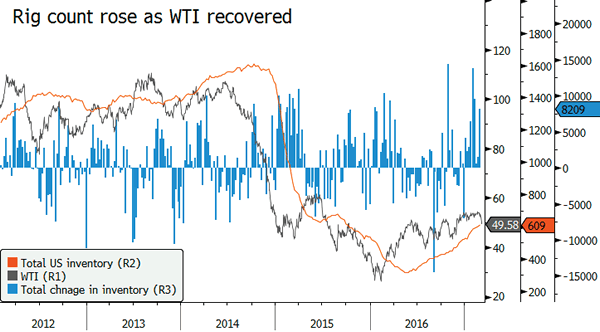
The West Texas Intermediate is about to post its largest weekly decline since the first week of November when it dropped 9.50% to below $45 a barrel. This week, the WTI slid almost 7% as it dipped below $50 a barrel for the first time since the November OPEC "supply cut" deal. The move was initiated on Wednesday after the EIA reported that US stockpiles had surged by 8.2 million barrels in the previous week, more than four times what the market was expecting, pushing US inventories (excluding strategic reserve) to an all-time high of 528 million barrels.
The market has begun to consider the possibility that OPEC and certain non-OPEC members such as Russia, who initially agreed to curb production back in November, may now be backtracking on their promise. Indeed, the US shale industry was the primary beneficiary of this "supply cut" as shown by the massive rise in rig count (+38% or 168 new wells since November last year). In this fight, the US has been continuously increasing their market share on the back of those who agreed to cut production.
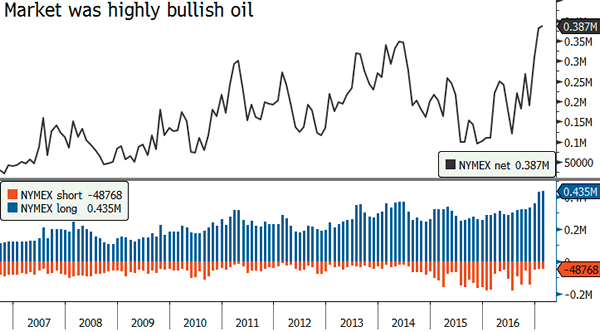
On the top of this, the market positioning on the NYMEX had reached extreme levels recently as the total net position hit 387k contracts. Even back in June 2014, the market wasn't that bullish (348k net long). Therefore, we believe that there is room for further downside move in crude oil prices. Investors were betting that the recovery in prices would be proven sustainable as the main oil producers seemed to have found an agreement. We would not be surprised to see OPEC and Russia backpedalling on the "supply cut" deal as it is clearly to the advantage of the US right now. We expect further weakness of crude prices as traders unwind their long positions, with $45 a barrel as the next target.
EUR/CZK Exit Date Debate Increases
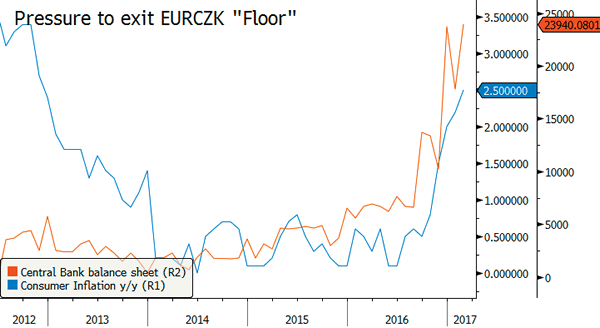
The SNB is not the only central bank whose FX policy is on a collision course with reality. The Czech Republic central bank (CNB) created a SNB style EURCZK minimum exchange rate in 2013. The CNB's objective was to prevent the euro from depreciating, derailing the small export drive economy growth outlook and triggering broad deflationary pressure. With mostly verbal interventions, the CNB has been able to accomplish its goal and there is little doubt that members are committed to scraping the floor. There are two primary issues for FX traders the process for exit and timing.
The CNB has highlighted that a Swiss style abandonment will not occur. The central bank will continue to intervene to smooth out excessive euro weakness and the CZK Strength. While the CNB FX reserves have significantly increased since the start of the floor, reserves are not excessive like in Israel, Norway and Switzerland. Should demand for CZK become extreme the CNB will have a difficult managing it.
Accelerating inflation, quicker than expected reserve accumulation to defend the floor and the need to protect credibility have pulled in forecasts from eliminating the minimum exchange rate. Interestingly, the element of surprise no longer seems to a primary consideration for the central banks. Headline inflation has risen to 2.5% y/y from 2.2% in February, driven by volatile food and energy but pressure on core supports sustained price pressure
However, inflation is expected to return to the central bank's target of 2.0% by early 2018. The highest probability trade, barring an extreme shock, is for exiting the floor at the scheduled monetary policy meeting on May 4th. By exiting the floor with clear guidance, the CNB will be projecting the greatest control over policy rather than being perceived as sneaking around and punishing markets. However, due primarily to currency accumulations, which is clearly making the CNB uncomfortable, an additional unscheduled meeting could also be called. This is an outside probability, yet should Dutch and French elections head in an anti EU direction, this option will become more likely.
AUD: Time To Reload Short Position ?
RBA stayed sidelined as expected
As broadly expected, the Reserve Bank of Australia kept its cash rate target unchanged at a record low of 1.5%. The RBA reiterated its wellknown view that the Aussie is overvalued and stated that an appreciating exchange rate would complicate the economic transition that followed the mining investment boost. However, the institution acknowledged the positive development in commodity prices that provided "a significant boost to Australia's national income".
Despite the RBA's positive assessment of the economy, Governor Lowe maintained a cautious stance about Australia's outlook, recalling that the "medium-term risks to Chinese growth remains". Indeed, China is Australia's biggest trade partner as it absorbs around 35% of Aussie total exports. From our standpoint, we suspect that the surge in commodity prices - more specifically iron ore prices - is coming to an end and that a reversal is looming as Chinese stockpiles went through roof while crude steel production remain subdued.
For all these reasons, we believe that the RBA is definitely not on its path to tighten its monetary policy as the inflation gauge is still well below the 2%-3% target band. The year-ended trimmed mean inflation reached 1.6% in December 2016, while the headline gauge hit 1.5%. There RBA is therefore in no hurry to tighten; however should commodity prices consolidate the recent gains, inflation will quickly start to pick-up. The latter scenario is seen as highly probable, meaning that the central bank will not be able to stand idle for an extended period of time. But this is a medium-term story.
AUD/USD under pressure ahead of FOMC meeting
In the short-term, this is a complete different story as investors await the first rate hike from the Fed as soon as Wednesday and continue to bet on an aggressive rate path. However, February NFP report acted as a reminder that the Fed may have to take a more balance approach for the rest of the year amid lacklustre wage growth. Average hourly earnings rose 0.2%m/m in the second month of the year and missed estimates of 0.3%m/m. In the short-term, we maintain our bearish view on AUD/USD with 0.75 as next target. On the technical side, the support area that lies at around 0.7530-40 (200dma and 50dma) and 0.7519 (Fibonacci 38.2% on December-February rally) held up well last Friday. Further Aussie weakness cannot be ruled out, especially if the Fed release and hawkish statement, together with aggressive forecast.
Jobs Report Removes the Last Obstacle for a Fed Hike
Solid jobs report overall
In our view, the jobs report for February was solid and in line with expectations after the strong ADP jobs report released on Wednesday. Employment rose by 235,000 in February (although partly driven by warm weather which boosted construction employment) which was enough for the unemployment rate to fall from 4.8% to 4.7% despite an increase in the participation rate to 63.0% from 62.9%. The Fed's favourite slack indicator, the underemployment rate, fell to 9.2% in February from 9.4% in January, the lowest rate in this cycle (tied with December), suggesting labour market slack continues to decline. Average hourly earnings disappointed slightly, as they rose +0.2% m/m in February, slightly below consensus of 0.3% m/m. The annual growth rate was 2.8% in line with expectations, which is close to postcycle high, but low from a historical perspective.
The jobs report removes the last obstacle for a Fed hike on Wednesday, in our view, in line with the message Fed Chair Yellen sent in her speech on Friday 3 March, see also our Flash Comment US of 5 March. A hike is the consensus among analysts and fully priced in by markets. The interesting question is how many hikes to expect for the rest of the year. Although the FOMC members have signalled a March hike, they have also repeated that they think three hikes are appropriate. We expect the Fed to maintain the 'dot' signal for this year unchanged at three hikes in the updated projections. Notice that Yellen in her speech said that four hikes is one too many as it would make monetary policy neutral instead of accommodative and the Fed has signalled that it still wants to support the economy through accommodative monetary policy. It is worth keeping in mind that the Fed is data dependent and will not hike unless data support the case - remember the Fed signalled four hikes during 2016 back in December 2015 but only delivered one.
We expect the Fed to hike three times this year in March, July and December, as the Fed seems less worried about inflation and has increased its weight on labour market and growth data. We stick to our view that the Fed is only set to hike once in H1 17 but now twice in H2 17 when we get more information about Trumponomics. By hiking at one of the small meetings in July, the Fed shows that it means that every meeting is 'live'. We expect the Fed to begin the reduction of its balance sheet in Q1 18.
Markets have fully priced in the Fed hike next week but note that markets price a 50% probability of the next hike in June (corresponding to a hike pace of every other meeting). The markets price in 2.7 hikes this year and nearly a total of five hikes before year-end 2018. We think it is difficult to see a more hawkish pricing of the Fed at the moment, although one trigger could be that the Fed begins to signal four hikes this year in the updated projections next week. However, we think this is unlikely, as it would make monetary policy neutral (according to Yellen's speech) and given comments from other FOMC members, we think the Fed will continue to signal three hikes.
Jobs: Labor Gains Support Economic Expansion
Over the past three months, labor market gains in the form of jobs and wages support consumer spending and a continued domestic economic expansion. Labor force participation remains a long-term issue.
Jobs Up 235,000 in February: Solid Hiring Start in 2017
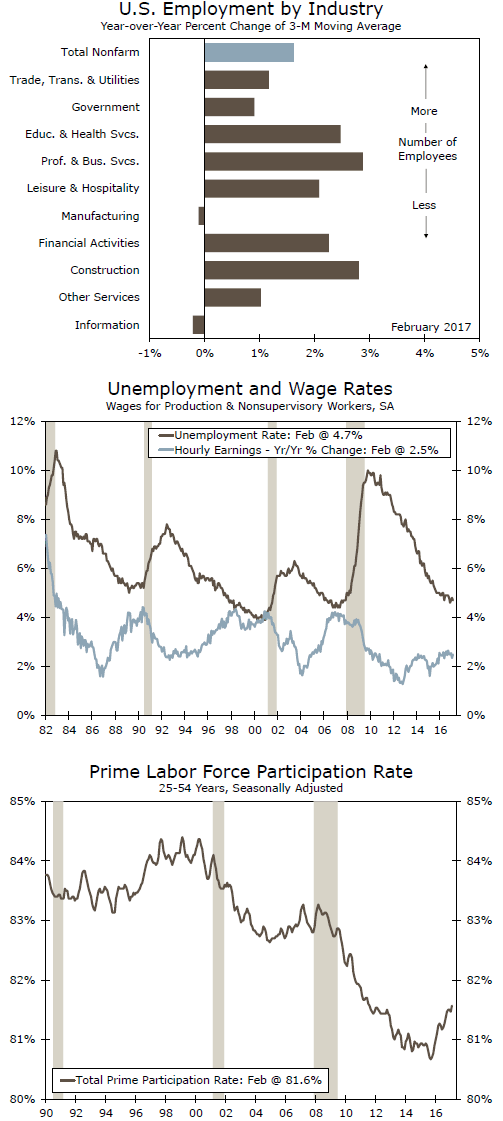
Nonfarm payrolls rose a solid 235,000 in February, boosting the three-month average to 209,000. Gains were strong across the private sector, with employment rising by 227,000 and an additional 8,000 jobs in the government sector. Retail was the one area of weakness–down 26,000. Manufacturing employment posted another monthly gain (up 28,000), matching the largest monthly increase since mid-2013. Construction hiring was solid at 58,000 but was likely helped by mild winter weather.
Outside the goods-producing industry, there has been broad-based strength in job growth over the past year, particularly in business services, education & health and leisure & hospitality (top chart). These gains are consistent with solid consumer spending and continued economic growth. Aggregate hours worked are up 3.1 percent on a three-month annualized rate, which is consistent with domestic strength. We currently project real final sales to grow 2.0-2.5 percent in the first quarter, but headline real GDP growth will likely be a lower 1.5-2.0 percent due to the drag on growth from trade and inventories.
Average Hourly Earnings Gains Sustained
Average hourly earnings rose 0.2 percent in February and are up 2.8 percent year-over-year, sustaining recent gains and providing further support for a March rate hike. As illustrated in the middle chart, the pickup in wages has been modest compared to prior cycles. With economic growth and wage growth still far from a break-out pace, the Fed will likely continue to take its time tightening policy for the remainder of the year.
However, the pace of wages does not reflect gains in benefits and the impact of longer hours worked, particularly in both durable and nondurable manufacturing. Our proxy for aggregate income growth is up 4.7 percent on a three-month average annualized basis, supporting the case for continued gains in consumer spending—no slow down there.
Aggregate Demand or Supply? Depends on Your Time Horizon
Growth does not live by stimulating aggregate demand alone. To achieve and maintain economic growth over three percent without accelerating prices, policymakers are challenged to stimulate the supply-side of the economy. The labor force participation rate rose again in February to 63.0 percent. The prime-age participation rate also increased slightly, reaching its highest level since 2011 (bottom chart).
However, labor force participation rates face long-run, secular headwinds that go beyond a short-run cyclical improvement drawing workers back into the labor market. There is no quick fix, but focusing on improving both the quality and quantity of the labor force will be key to driving faster, sustainable economic growth.
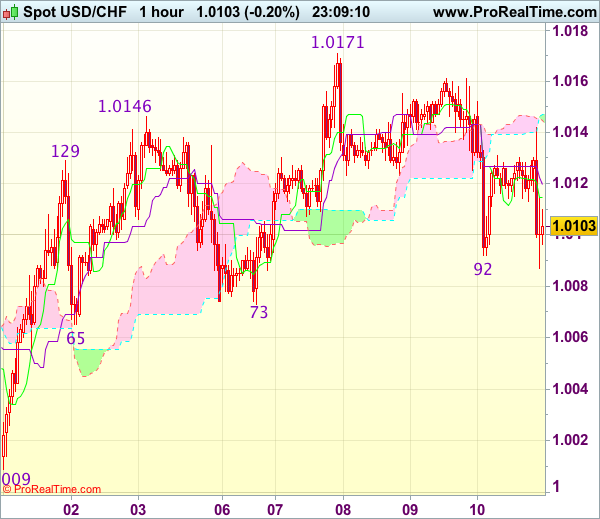
Trade Idea Wrap-up: USD/CHF – Hold long entered at 1.0100
USD/CHF - 1.0100
Most recent candlesticks pattern : N/A
Trend : Near term up
Tenkan-Sen level : 1.0115
Kijun-Sen level : 1.0120
Ichimoku cloud top : 1.0147
Ichimoku cloud bottom : 1.0145
Original strategy :
Bought at 1.0100, Target: 1.0200, Stop: 1.0070
Position : - Long at 1.0100
Target : - 1.0200
Stop : - 1.0070
New strategy :
Hold long entered at 1.0100, Target: 1.0200, Stop: 1.0070
Position : - Long at 1.0100
Target : - 1.0200
Stop : - 1.0070
As the greenback has slipped again after brief bounce to 1.0142, suggesting further consolidation would be seen but as long as support at 1.0073 holds, mild upside bias remains for another rebound, above said intra-day resistance would bring retest of 1.0171 but break there is needed to confirm recent erratic rise from 0.9861 low has resumed and extend further gain to 1.0200-10 but overbought condition should limit upside to 1.0220-25 and price should falter below previous chart resistance at 1.0248.
In view of this, we are holding on to our long position entered at 1.0100. Below said support at 1.0073 would abort and signal top has been formed instead, risk weakness to 1.0040-45 but reckon support at 1.0009 would remain intact.
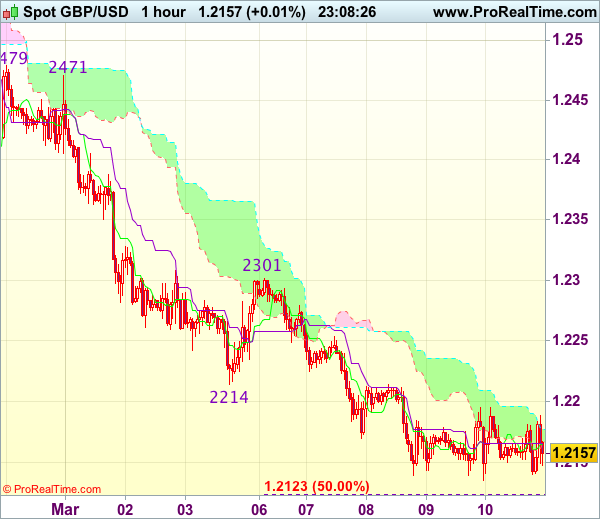
Trade Idea Wrap-up: GBP/USD – Stand aside
GBP/USD - 1.2157
Most recent candlesticks pattern : N/A
Trend : Near term down
Tenkan-Sen level : 1.2164
Kijun-Sen level : 1.2165
Ichimoku cloud top : 1.2177
Ichimoku cloud bottom : 1.2165
New strategy :
Stand aside
Position : -
Target : -
Stop : -
As cable has recovered after holding above support at 1.2135, suggesting consolidation above this level would be seen and corrective bounce to 1.2210-15 is likely, however, reckon upside would be limited to 1.2245-55 but price should falter well below resistance at 1.2301, bring another decline later.
In view of this, would not chase this fall here and would be prudent to stand aside in the meantime. Below said support at 1.2135 would signal recent decline has once again resumed and extend weakness to 1.2100, however, loss of near term downward momentum should prevent sharp fall below 1.2070-75 and price should stay above 1.2050, risk from there is seen for a rebound later.
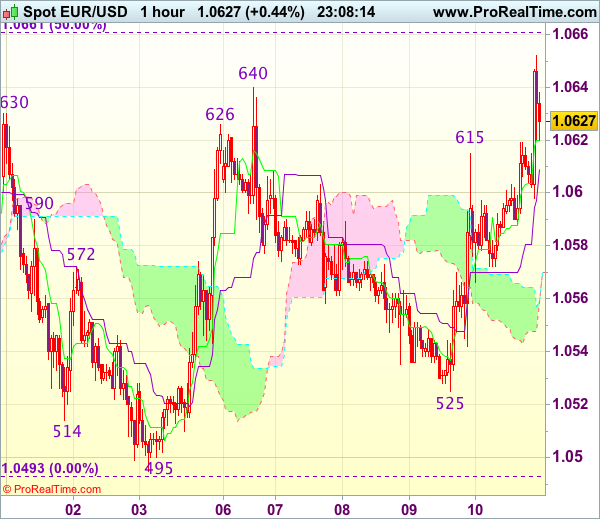
Trade Idea Wrap-up: EUR/USD – Buy at 1.0560
EUR/USD - 1.0629
Most recent candlesticks pattern : N/A
Trend : Sideways
Tenkan-Sen level : 1.0620
Kijun-Sen level : 1.0597
Ichimoku cloud top : 1.0557
Ichimoku cloud bottom : 1.0548
Original strategy :
Buy at 1.0560, Target: 1.0660, Stop: 1.0525
Position : -
Target : -
Stop : -
New strategy :
Buy at 1.0560, Target: 1.0660, Stop: 1.0525
Position : -
Target : -
Stop : -
As the single currency has surged again after brief pullback and broke above previous resistance at 1.0640, adding credence to our bullish view that the erratic rise from 1.0493 low is still in progress and may bring retracement of early decline to 1.0660-65 (50% Fibonacci retracement of 1.0829-1.0493) and possibly towards resistance at 1.0680 but price should falter well below 1.0700-05 (61.8% Fibonacci retracement).
In view of this, we are looking to buy euro on dips as 1.0560-70 should limit downside and bring another rise later. Below said support at 1.0525 would abort and risk test of 1.0493-96 but only break there would shift risk back to the downside and signal recent decline from 1.0829 has resumed for further selloff to 1.0470 and then towards previous support at 1.0454.
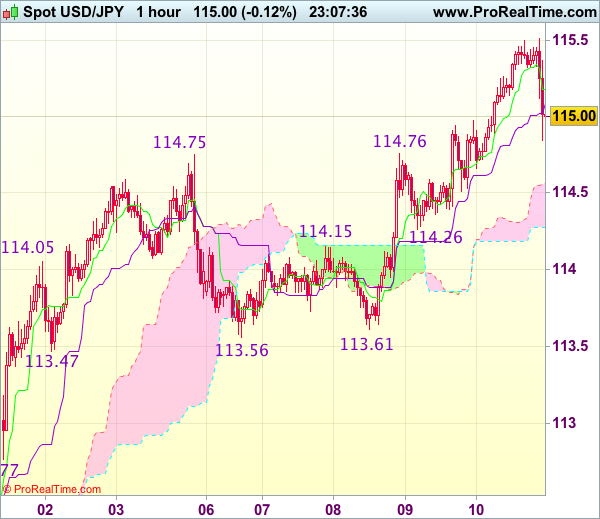
Trade Idea Wrap-up: USD/JPY – Buy at 114.50
USD/JPY - 115.28
Most recent candlesticks pattern : N/A
Trend : Near term up
Tenkan-Sen level : 115.29
Kijun-Sen level : 115.02
Ichimoku cloud top : 114.56
Ichimoku cloud bottom : 114.28
Original strategy :
Buy at 114.90, Target: 115.90, Stop: 114.55
Position : -
Target : -
Stop : -
New strategy :
Buy at 114.50, Target: 115.50, Stop: 114.15
Position : -
Target : -
Stop : -
As the greenback has retreated after intra-day marginal rise to 115.51, suggesting consolidation below this level would be seen and pullback to 115.00- cannot be ruled out, however, reckon downside would be limited to 114.75 (previous resistance now support) and bring another rise later, above said resistance at 115.51 would extend recent upmove to previous resistance at 115.62, then towards 115.90-00 which is likely to hold from here.
In view of this, would not chase this rise here and we are looking to buy dollar on pullback as 114.70 should limit downside and bring another rise. Below 114.40 would risk test of support at 114.26 but break there is needed to signal top is formed instead, bring correction to 113.90-95 first.
Solid NFP Seals March Hike Deal
The market expectations of a probable US interest rate increase in March were fully cemented by February's solid NFP headline figure of 235k which illustrated steady growth in the US labour markets. Although average hourly earnings may have missed expectations, the unemployment rate fell to 4.7% simply displaying US labour force resilience in a period of uncertainty. Economic data from the States continues to follow a positive trajectory and with the positive US jobs data adding to the basket, the prerequisites needed for the Fed to pull the trigger next week have been successfully achieved.
Although some concerns may still linger in the background regarding the ongoing Trump uncertainties, today's data has visually shown that wages grew and employment rose in the first month of Donald Trump's presidency. The overall economic outlook for the US continues to look encouraging with further gains expected on the Dollar as speculators bet on the Fed raising US interest rates beyond March.
It should be kept in mind that the depreciation of the Dollar following the firm US jobs data has nothing to do with a change in sentiment, but potential profit-taking ahead of the weekend. The technical correction may come to an abrupt end with bulls back in action when the Federal Reserve raises US interest rates next week.
From a technical standpoint, the Dollar Index bulls need a solid break and weekly close above 102.00 to open a path higher towards 102.50.
U.S. Payroll Employment Up Solidly in February
- Employment rose 235k following a revised 238k (was 227k) increase in January. Private-sector jobs rose 227k (up from 221k in January) with government jobs up 8k following a 17k January gain.
- The unemployment rate declined to 4.7% from 4.8% in January
The February employment gain was boosted by a 95k surge in private sector goods-producing jobs (the largest monthly gain since March 2000) with construction employment up 58k (to build on a 40k jump in January) and manufacturing sector headcount up 28k to mark a third consecutive solid monthly gain. Private service-sector job growth slowed to 132k from 167k in January. Employment in the retail sector declined 26k after a 40k jump in January.
The dip in the unemployment rate (calculated from the separate household survey) occurred despite a tick higher in the participation rate to 63.0% from 62.9% in January.
Hours worked inched up 0.2% in February and 1.4% from a year ago. Hourly wages also rose 0.2% from January and the year-over-year rate ticked up to 2.8% to retrace most of a dip to 2.6% in January from (a cycle high) 2.9% in December.
Our Take:
Given comments from Fed officials, including Chair Yellen, in recent weeks, it would likely have taken a significant downside surprise to derail market expectations that were already pricing in about 90% odds of a 25 basis point hike to the fed funds target range following next week's FOMC meeting before the release of today's numbers. Although the earlier-reported 299k surge in private employment in the ADP report earlier this week may have boosted some expectations for today's job growth numbers to unrealistic levels, solid employment growth (well-above the underlying 'trend' rate), a dip in the unemployment rate, and a tick higher in wage growth should all provide reassurance that labour markets continue to tighten. We continue to expect a 25 basis point rate hike from the Fed next Wednesday. With an increase in rates, barring some unexpected shock, appearing very likely, attention is likely to shift to the expected pace of future hikes (Previous Fed projections suggested three hikes were felt to be appropriate this year) with a stronger economy arguing higher rates are needed but with considerable uncertainty remaining in the outlook, particularly around the future of U.S. government policy.