Thu, Apr 09, 2026 11:17 GMT
More

    Sample Category Title

    EUR/USD Daily Outlook

    ActionForex

    Daily Pivots: (S1) 1.1479; (P) 1.1521; (R1) 1.1596; More….

    EUR/USD's rebound stalled at 1.1626 and reversed, but it's still bounded in established range. Intraday bias stays neutral first. With 1.1666 cluster resistance (38.2% retracement of 1.2081 to 1.1408 at 1.1665) intact, further decline is expected. On the downside, firm break of 1.1408 will resume the fall from 1.2081 to 38.2% retracement of 1.0176 to 1.2081 at 1.1353. However, decisive break of 1.1666 will argue that the fall from 1.2081 has completed, and turn bias back to the upside for 61.8% retracement of 1.2081 to 1.1408 at 1.1824.

    In the bigger picture, prior break of 55 W EMA (now at 1.1497) should confirm rejection by 1.2 key cluster resistance level. The whole up trend from 0.9534 (2022 low) might have completed as a three wave corrective rise too. Deeper fall is expected to long term channel support (now at 1.0535). Meanwhile, risk will stay on the downside as long as 1.2081 holds, even in case of strong rebound.

    USD/JPY Daily Outlook

    Daily Pivots: (S1) 158.33; (P) 158.67; (R1) 159.12; More...

    Intraday bias in USD/JPY is turned neutral first with break of 159.31 minor resistance. Consolidations from 160.45 could extend further with another falling leg. But overall outlook will remain bullish as long as 157.49 cluster support (38.2% retracement of 152.25 to 160.45 at 157.31) holds. Firm break of 160.45 will resume the rise from 152.25 to retest 161.94 high.

    In the bigger picture, outlook is unchanged that corrective pattern from 161.94 (2024 high) should have completed with three waves at 139.87. Larger up trend from 102.58 (2021 low) could be ready to resume through 161.94. This will remain the favored case as long as 55 W EMA (now at 152.97) holds. Firm break of 161.94 will pave the way to 61.8% projection of 102.58 to 161.94 from 139.87 at 176.75.

    GBP/USD Daily Outlook

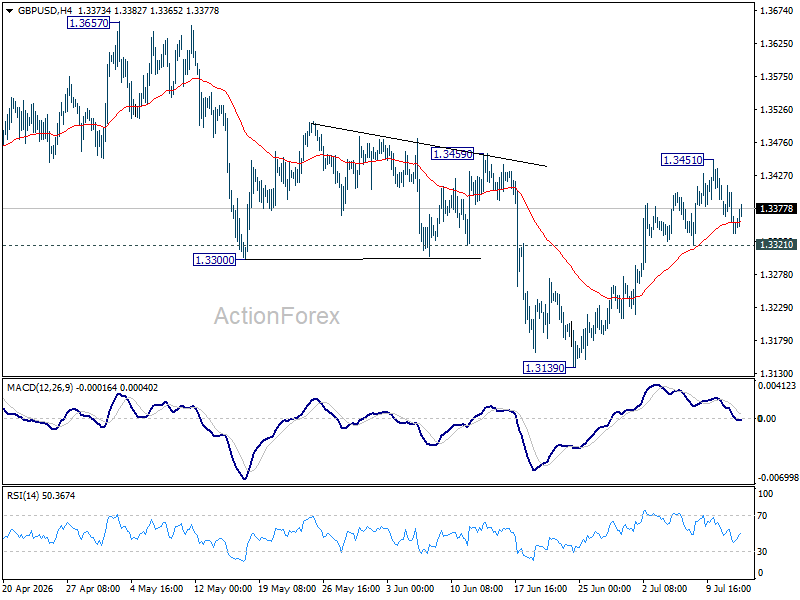
    Daily Pivots: (S1) 1.3235; (P) 1.3290; (R1) 1.3362; More...

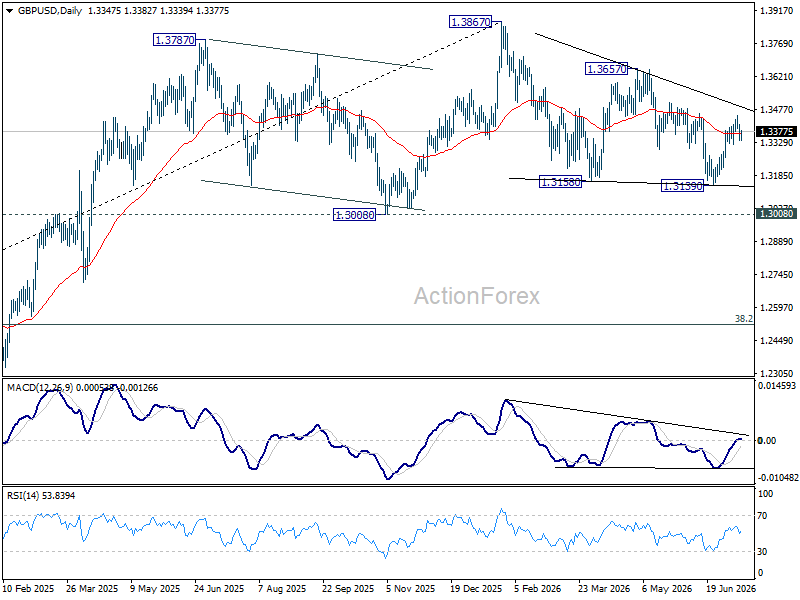
    GBP/USD's rebound stalled at 1.3345 and reversed, but downside is contained above 1.3158 temporary low. Intraday bias remains neutral and further decline is in favor. Below 1.3158 will resume the fall from 1.3867 to 1.3008 structural support. However, firm break of 1.3479 will indicate that the fall from 1.3867 has completed, and turn bias back to the upside for stronger rally.

    In the bigger picture, considering bearish divergence condition in both D and W MACD, a medium term top should be in place at 1.3867. Firm break of 1.3008 support will argue that fall from 1.3867 is at least correcting the rise from 1.0351 (2022 low) with risk of bearish reversal. That would open up further decline to 38.2% retracement of 1.0351 to 1.3867 at 1.2524. For now, medium term outlook will be neutral at best as long as 1.3867 resistance holds, or until further development.

    USD/CHF Daily Outlook

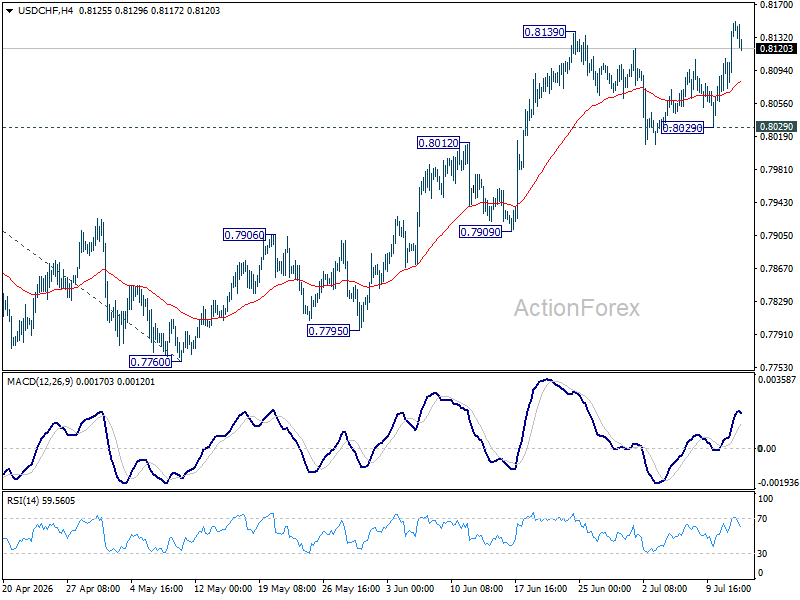
    Daily Pivots: (S1) 0.7895; (P) 0.7953; (R1) 0.8001; More….

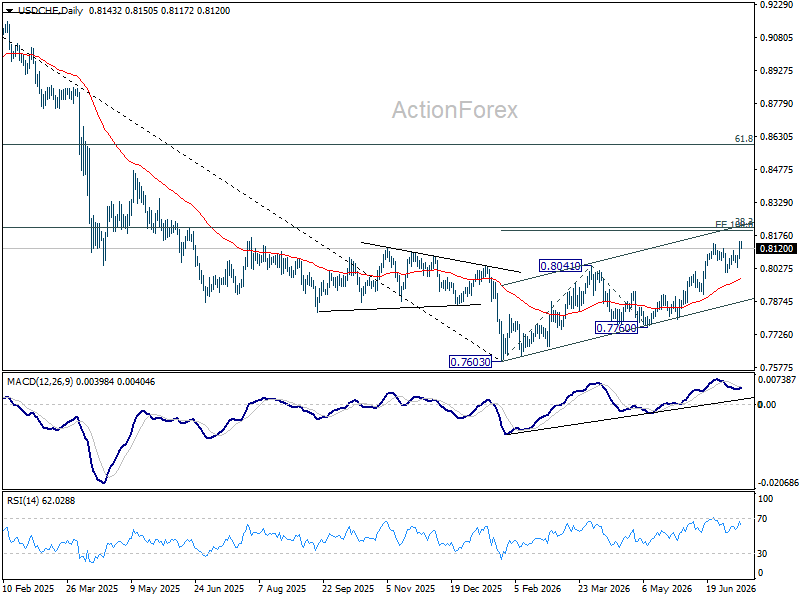
    USD/CHF recovered after drawing support from near-term rising channel floor, but stays below 0.8041 temporary top. Intraday bias remains neutral first and further rally is in favor. On the upside, break of 0.8041 will resume the whole rally from 0.7603, and target 38.2% retracement of 0.9200 to 0.7603 at 0.8213. However, decisive break of 0.7833 support will argue that the rebound has completed, and turn bias back to the downside for deeper fall.

    In the bigger picture, a medium term bottom should be in place at 0.7603 on bullish convergence condition in D MACD. Rebound from there is seen as correcting the fall from 0.9200 only. However, decisive break of 55 W EMA (now at 0.8088) will suggest that it's probably correcting the larger scale down trend from 1.0146 (2022 high). On the other hand, rejection by the 55 W EMA will setup down trend resumption to 100% projection of 1.0146 (2022 high) to 0.8332 from 0.9200 at 0.7382 at a later stage.

    USD/CAD Daily Outlook

    Daily Pivots: (S1) 1.3858; (P) 1.3890; (R1) 1.3907; More...

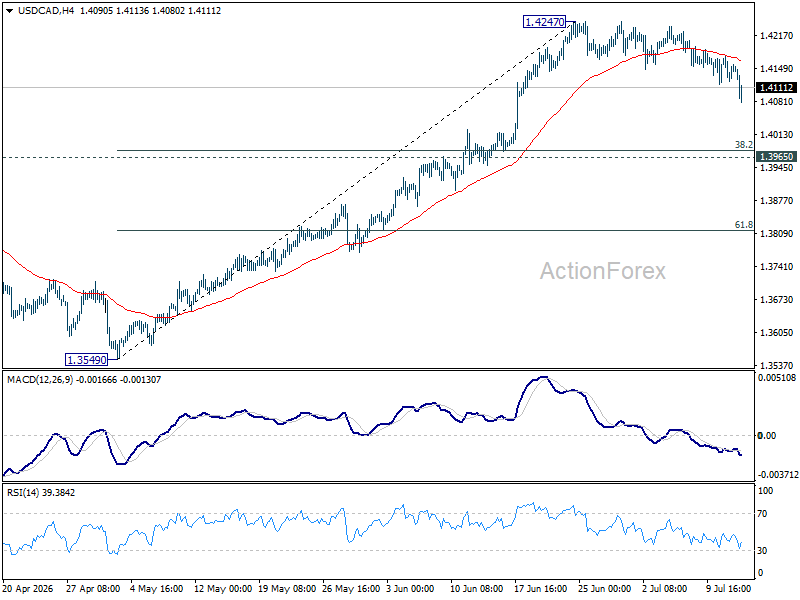
    Intraday bias in USD/CAD stays neutral for the moment, and some more consolidations could be seen below 1.3965 temporary top. In case of another fall, downside should be contained above 1.3751 resistance turned support. On the upside, decisive break of 38.2% retracement of 1.4791 to 1.3480 at 1.3981 will argue that it's already reversing the whole down trend from 1.4791, and target 61.8% retracement at 1.4290. However, firm break of 1.3751 should indicate rejection by 1.3981, and keep the fall from 1.4791 intact. Bias will be back on the downside for retesting 1.3480 low.

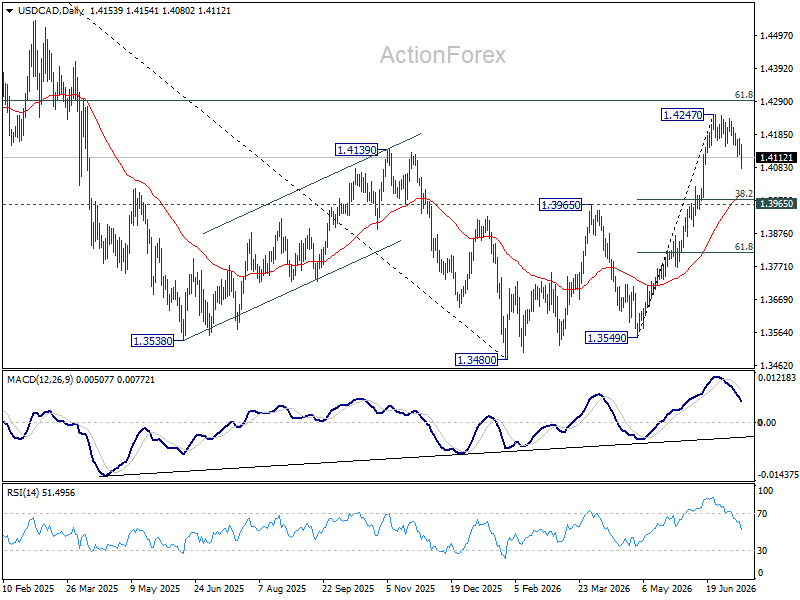
    In the bigger picture, price actions from 1.4791 are seen as a corrective pattern to the whole up trend from 1.2005 (2021 low). Deeper fall could be seen, as the pattern extends, to 61.8% retracement of 1.2005 to 1.4791 at 1.3069. However, decisive break of 1.3927 resistance will argue that the correction has completed with three waves down to 1.3480 already. Further break of 1.4139 will confirm and bring retest of 1.4791 high.

    Swiss CPI Rises to 0.3% yoy, But Underlying Inflation Stays Soft

    Swiss inflation remained subdued in March, with CPI rising 0.2% mom, below expectations of 0.5% mom. Annual inflation edged up from 0.1% yoy to 0.3% yoy, also missing forecasts of 0.5% yoy. The data highlights a continued lack of underlying price pressure despite some pickup in energy-related components.

    The breakdown shows a clear divergence. Imported product prices rose sharply by 1.8% mom, driven by higher costs for heating oil and fuel. However, domestic product prices fell -0.2% mom, and core CPI was flat at 0.0% mom, signaling that internal inflation dynamics remain weak.

    On a yearly basis, core CPI held steady at 0.4% yoy, while domestic price growth eased slightly from 0.6% yoy to 0.5% yoy. Import prices, although still negative at -0.3% yoy, rose significantly from -1.6% yoy, reflecting external cost pressures.

    Overall, the data suggests that inflation in Switzerland is being driven by imported factors rather than domestic demand, keeping underlying price trends contained.

    Full Swiss CPI release here.

    AUD/USD Daily Report

    Daily Pivots: (S1) 0.6895; (P) 0.6930; (R1) 0.6964; More...

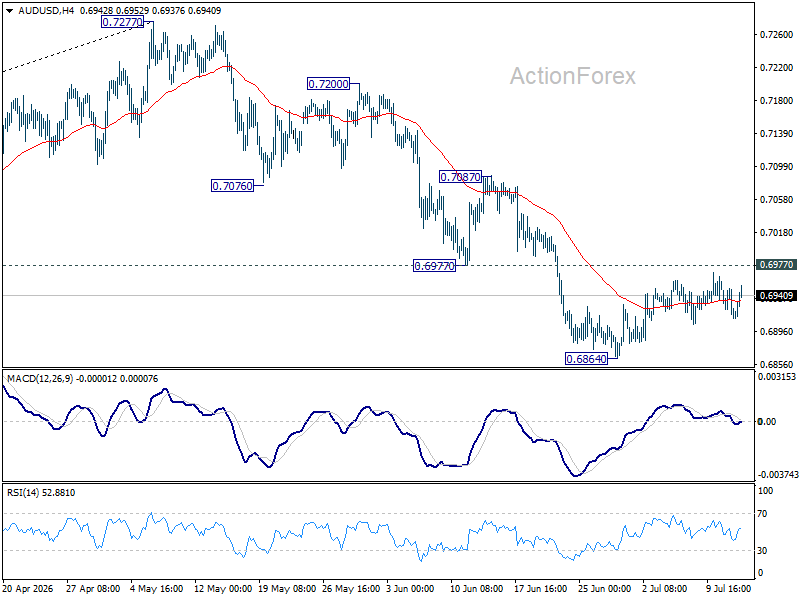
    AUD/USD's recovery stalled at 0.6962 and reversed. But downside is contained above 0.6832 temporary low. Intraday bias remains neutral. first. Below 0.6832 will extend the decline from 0.7187 to 38.2% retracement of 0.5913 to 0.7187 at 0.6700. However, firm break of 0.6978 will argue that the correction has completed, and bring retest of 0.7817 high.

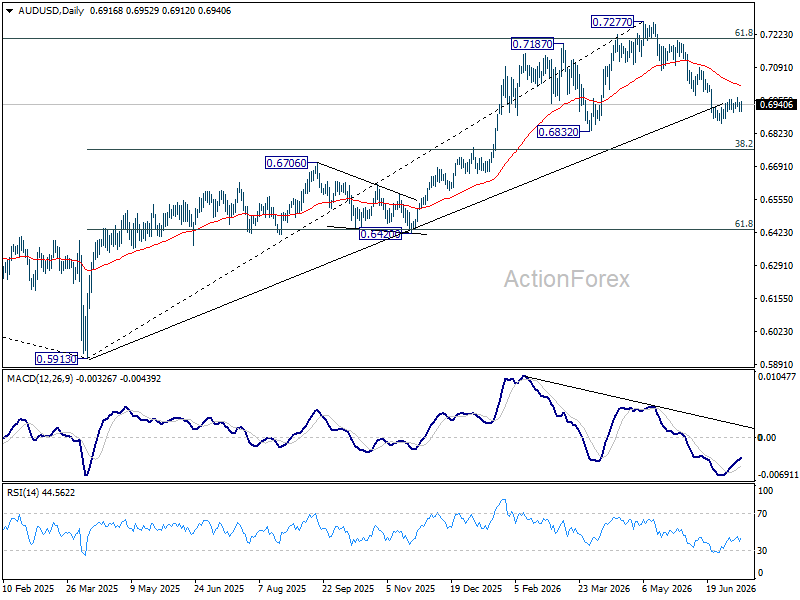
    In the bigger picture, as long as 0.6706 cluster support holds, rise from 0.5913 (2024 low) should still be in progress. Decisive break of 61.8% retracement of 0.8006 to 0.5913 at 0.7206 will solidify the case that it's already reversing the down trend from 0.8006 (2021 high). However, firm break of 0.6706 will dampen this bullish case, and bring deeper fall back to 0.6420 support, and possibly below.

    After Trump’s Iran War Address, Markets Price Pain—But Not Catastrophe Yet

    Markets have flipped back into risk-off mode as oil rebounds above $110 following US President Donald Trump’s escalation signals at his highly anticipated Iran War update. Investors are now pricing a stagflation shock, with oil surging, stocks falling, and Dollar rebounding. However, the risk of a more catastrophic escalation remains underappreciated.

    What makes the current moment particularly dangerous is timing. The next 72 hours, leading into a long weekend, present a high-risk window for escalation. With global markets set to close, the US, Israel, and Iran all have strategic incentives to act when immediate market reaction is limited.

    Trump’s rhetoric has already laid the groundwork. His pledge to “hit them extremely hard over the next two to three weeks” defines a clear escalation window. Combined with the threat to “bring them back to the Stone Ages,” it signals a move toward broader infrastructure targeting rather than limited strikes.

    If such actions begin, the nature of the conflict changes fundamentally. A coordinated campaign against infrastructure would likely trigger retaliation beyond Iran’s borders, particularly against regional oil producers. This is the scenario that markets are not yet fully pricing.

    Iran’s response options would be increasingly asymmetric. With conventional capabilities degraded, retaliation could come through cyber attacks on US systems or targeted strikes on oil facilities in Saudi Arabia and the UAE. These actions would directly impact global supply and amplify the energy shock.

    Despite these risks, current market pricing remains focused on inflation. The stagflation trade is back, with oil as the inflation trigger driving higher-for-longer interest rate expectations. Markets are pricing inflation and recession—and not yet disruption.

    Brent above $110 reflects inflation fears, but a move above $120 would signal that markets are beginning to price physical supply disruption—something not yet fully embedded. The $120 level is the canary level for whether escalation risk becomes systemic.

    Asset price moves reflect this partial adjustment. Asian equities are under pressure, led by a sharp drop in KOSPI, while Dollar is rebounding strongly. Loonie is supported by oil, and Yen is benefiting from risk aversion, while high-beta currencies such as Kiwi and Aussie are weakening.

    The broader environment is one of maximum uncertainty. The gap between official messaging and operational signals has left markets without clarity. For now, markets remain in a transitional phase—adjusting to higher inflation risks but not yet to the possibility of systemic disruption. This creates a dangerous imbalance in expectations.

    The key risk is not what markets are pricing now, but what they are not. If escalation intensifies, the current stagflation narrative could quickly give way to a more severe shock.

    In Asia, at the time of writing, Nikkei is down -2.49%. Hong Kong HSI is down -1.43%. China Shanghai SSE is down -1.15%. Singapore Strait Times is down -0.90%. Japan 10-year JGB yield is up 0.087 at 2.391. Overnight, DOW rose 0.48%. S&P 500 rose 0.72%. NASDAQ rose 1.16%. 10-year yield rose 0.008 to 4.319.

    From Exit Hopes to Escalation: Trump Address Raises Risk of Brent Break Above $120–125

    Oil is back near $110—and the risk is now higher. Trump’s escalation signals have shifted markets sharply, with Brent potentially breaking above $120–125 as supply fears surge. Read more.

    AUD/USD Daily Report

    Daily Pivots: (S1) 0.6895; (P) 0.6930; (R1) 0.6964; More...

    AUD/USD's recovery stalled at 0.6962 and reversed. But downside is contained above 0.6832 temporary low. Intraday bias remains neutral. first. Below 0.6832 will extend the decline from 0.7187 to 38.2% retracement of 0.5913 to 0.7187 at 0.6700. However, firm break of 0.6978 will argue that the correction has completed, and bring retest of 0.7817 high.

    In the bigger picture, as long as 0.6706 cluster support holds, rise from 0.5913 (2024 low) should still be in progress. Decisive break of 61.8% retracement of 0.8006 to 0.5913 at 0.7206 will solidify the case that it's already reversing the down trend from 0.8006 (2021 high). However, firm break of 0.6706 will dampen this bullish case, and bring deeper fall back to 0.6420 support, and possibly below.


    Economic Indicators Update

    GMT CCY EVENTS Act Cons Prev Rev
    23:50 JPY Monetary Base Y/Y Mar -11.60% -10.40% -10.60%
    00:30 AUD Trade Balance (AUD) Feb 5.69B 2.55B 2.63B 2.26B
    06:30 CHF CPI M/M Mar 0.50% 0.60%
    06:30 CHF CPI Y/Y Mar 0.50% 0.10%
    12:30 USD Initial Jobless Claims (Mar 27) 215K 210K
    12:30 USD Trade Balance (USD) Feb -59.2B -54.5B
    12:30 CAD Trade Balance (CAD) Feb -1.8B -3.65B
    14:30 USD Natural Gas Storage (Mar 27) 38B -54B


    Chart Alert: Risk Off After Trump’s Speech – Intraday Outlook on S&P 500, Nasdaq 100, AUD/USD, Gold (XAU/USD), and...

    Key takeaways

    • Risk-off sentiment returns: Trump’s hawkish rhetoric on Iran dashed de-escalation hopes, reigniting stagflation concerns and triggering a broad risk-off move, equities, AUD/USD, and Asian markets fell, while oil surged and the US dollar strengthened.
    • Equities and risk assets remain under pressure: S&P 500, Nasdaq 100, and AUD/USD show renewed bearish momentum after failed rebounds, with technical setups pointing to further downside unless key resistance levels are reclaimed.
    • Divergence in commodities: WTI crude oil remains supported in a bullish uptrend above key levels, while gold’s recent rally appears corrective, with risks of a bearish breakdown as momentum weakens.

    US President Trump’s evening prime-time speech on Wednesday, 1 April at 9.00 p.m. Washington time does not offer any new information to global financial markets. A quick recap: Trump highlighted earlier on Tuesday, March 31, that the US-Iran war will “end soon” within the next two to three weeks.

    Interestingly, Trump has indirectly issued a more “hawkish rhetoric” towards the Iranian leadership in his prime-time national address, stating that the US will hit Iran “extremely hard” in the next two to three weeks, and added that the US will also strike Iran’s electric plants if there is no deal.

    Overall, there is no clear indication of a forthcoming “de-escalation” from Trump, which in turn brings the stagflation risk narrative back to the forefront again.

    How do the markets react? Risk-off mode at this time of writing.

    • WTI crude oil +5.8% at around $104 per barrel
    • Brent crude oil +6.4% at around $106 per barrel
    • US Dollar Index +0.4%
    • AUD/USD -0.6%
    • Gold (XAU/USD) -1.7%
    • S&P 500 & Nasdaq 100 E-mini futures -1.1% & -1.3%
    • Japan’s Nikkei 225 -2.2%
    • Hong Kong’s Hang Seng Index -1.1%
    • China’s CSI 300 -0.7%
    • South Korea’s KOSPI 200 -4.7%
    • Singapore’s Straits Times Index -0.7%

    We have highlighted in our earlier detailed report that the prior three-day rebound seen on the three major benchmark US stock indices, S&P 500, Nasdaq 100, and Dow Jones Industrial Average are likely a mean reversion rebound sequence (dead cat bounces) within their respective medium-term downtrend phases.

    Let’s focus now on the short-term trajectory (1 to 3 days) on the S&P 500, Nasdaq 100, AUD/USD, Gold (XAU/USD), and WTI crude oil from a technical analysis perspective.

    S&P 500 - Bearish reaction at descending channel resistance with bearish momentum

    Fig. 1: US S&P 500 CFD index minor trend as of 2 Apr 2026 (Source: TradingView)

    The price actions of the US S&P 500 CFD index (a proxy of the S&P 500 E-mini futures) have staged a bearish reaction right after a retest on its 20-day moving average and upper boundary of a descending channel in place since 26 February 2026 high (see Fig. 1).

    In addition, the hourly RSI momentum indicator has staged a bearish breakdown below its former ascending trendline support after it flashed a bearish divergence condition at its overbought zone.

    Watch the 6,600 key short-term pivotal resistance, and a break below 6,455 near-term support is likely to trigger another potential bearish impulsive down move sequence to expose the next intermediate supports at 6,327/6,290 and 6,218/6,210.

    However, a clearance above 6,600 invalidates the near-term bearish scenario for an extension of the mean reversion rebound towards 6,648/6,730 zone.

    Nasdaq 100 – Bearish reaction below 20-day moving average with bearish momentum

    Fig. 2: US Nasdaq 100 CFD index minor trend as of 2 Apr 2026 (Source: TradingView)

    The price actions of the US Nasdaq 100 CFD index (a proxy of the Nasdaq 100 E-mini futures) have staged a bearish reaction below its downward-sloping 20-day moving average, coupled with the hourly RSI momentum indicator’s bearish breakdown below its key ascending trendline support (see Fig. 2).

    Watch the 24,047/24,177 key short-term pivotal resistance, and a break below 23,400 near-term support is likely to trigger another potential bearish impulsive down move sequence to expose the next intermediate supports at 23,085 and 22,800/22,680.

    On the other hand, a clearance above 24,177 invalidates the near-term bearish scenario for an extension of the mean reversion rebound towards the 24,355/24,537 zone.

    AUD/USD – En route towards the lower limit of the descending channel

    Fig. 3: AUD/USD minor trend as of 2 Apr 2026 (Source: TradingView)

    The minor corrective mean reversion rebound seen on the AUD/USD from its swing low of 0.6838 printed on Monday, 30 March 2026, is likely to be over (see Fig. 3).

    Watch the 0.6910/0.6938 key short-term pivotal resistance, and a break below 0.6838 is likely to trigger a potential fresh bearish impulsive down move sequence to expose the next intermediate supports at 0.6780/0.6760 and 0.6710 (also close to the key 200-day moving average).

    However, a clearance above 0.6938 invalidates the near-term bearish scenario for an extension of the mean reversion rebound towards the next intermediate resistance at 0.7000/0.7015 (also the 50-day moving average).

    Gold (XAU/USD) – At risk of a “bearish flag” breakdown below $4,775 key resistance

    Fig. 4: Gold (XAU/USD) minor trend as of 2 Apr 2026 (Source: TradingView)

    The recent seven-day rally (high to low) of 17% from the 23 March 2026 low seen in Gold (XAU/USD) is likely to be a corrective mean reversion rebound in the form of a “bearish flag” within its medium-term downtrend phase (see Fig. 4).

    The bullish momentum of the 7-day rally is getting exhausted. The hourly RSI momentum indicator has just staged a bearish breakdown below its key ascending trendline support after a prior bearish divergence condition at its overbought zone

    Watch the $4,775 key medium-term pivotal resistance, and a break below $4,524/4,486 support (the lower boundary of the “bearish flag”) is likely to trigger another potential minor bearish impulsive down move sequence in the first step to expose the next intermediate supports at $4,319 and $4,167/4,099 (also the key 200-day moving average).

    On the flip side, a clearance above $4,775 invalidates the near-term bearish scenario for an extension of the mean reversion rebound towards the next intermediate resistance at $4,980/5,039 (also the 50-day moving average).

    WTI crude oil – Bulls find support above 20-day moving average, traded back above $102.25

    Fig. 5: West Texas oil CFD minor trend as of 2 Apr 2026 (Source: TradingView)

    The intraday sell-off seen on Wednesday, 1 April 2026, for West Texas oil CFD (a proxy of the WTI crude oil futures) has been erased as its price actions trade back above $102.25 (see Fig. 5).

    Watch the $96.44/93.70 key short-term pivotal support (close to the 20-day moving average) to maintain a potential fresh minor impulsive up move sequence towards $116.56/119.54 in the first step within its medium-term uptrend phase.

    A clearance above $116.56/119.54 opens scope for the next intermediate resistance to come in at $124.40 follow by the major resistance of $131.30/132.67, seen during the onset of the Russia-Ukraine war.

    On the other hand, a break below $93.70 negates the bullish tone for a slide towards the medium-term pivotal support zone of $88.36/86.50.

    From Exit Hopes to Escalation: Trump Address Raises Risk of Brent Break Above $120–125

    Instead of confirming a near-term exit from the Iran War, US President Donald Trump’s address has triggered a sharp repricing of war risk, with markets shifting from de-escalation expectations to renewed escalation. Hopes for any diplomatic resolutions were dashed. Brent oil price surged back toward $110, and risks are now skewed toward a further move through $120 to $125.

    The key shift lies in Trump’s explicit commitment to further military action. While he noted progress toward US objectives, his statement that forces will “hit them extremely hard over the next two to three weeks” signals a clear intensification phase. This two-to-three-week escalation window effectively delays any prospect of stabilization. The Strait of Hormuz will remain closed for at least that duration.

    The most alarming element came from Trump’s “bring them back to the Stone Ages” remark. This "scorched-earth" rhetoric implies a shift from targeted military operations toward broader infrastructure destruction, including strikes on energy facilities, power grids, and logistics networks. Such a strategy significantly raises the risk of collateral damage across the region.

    This escalation risk extends beyond Iran itself. If infrastructure is heavily targeted, the probability increases that Iran could retaliate against regional oil assets in Saudi Arabia or the UAE. That scenario would transform the conflict into a wider supply shock, which explains why oil reacted so quickly and aggressively. More importantly, it eliminates the hope of a diplomatic de-escalation in the near term

    Technically, Brent oil's strong rebound raises the chance that consolidation pattern from 119.24 has completed with three waves to 102.28. Risk will stay on the upside as long as 102.28 holds. Firm break of 113.93 will argue that the whole rise from 81.41 is ready to resume. In this case, 120 psychological level will likely be breached, at least briefly, as Brent targets 61.8% projection of 81.41 to 119.24 from 102.28 at 125.65.