

Sample Category Title
USD/JPY Mid-Day Outlook
Daily Pivots: (S1) 156.63; (P) 156.94; (R1) 157.46; More...
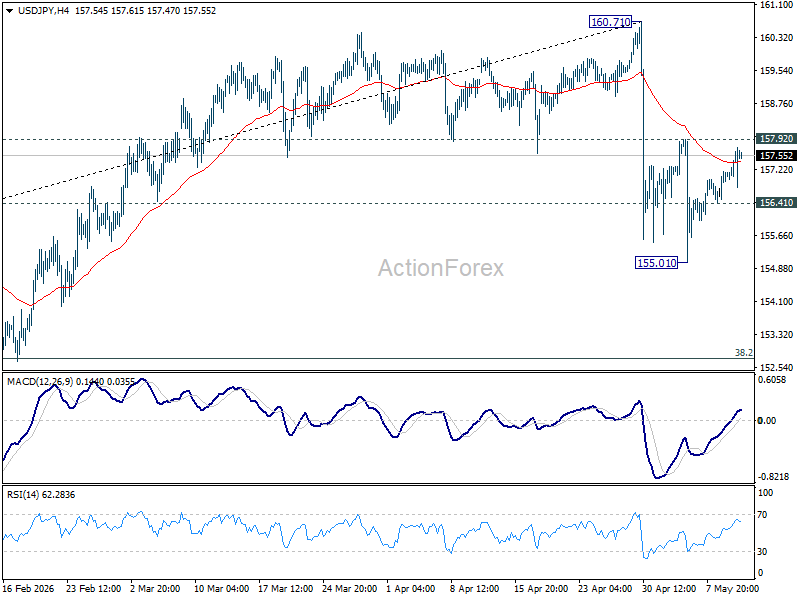
Intraday bias in USD/JPY stays neutral and outlook is unchanged. On the downside, below 156.41 minor support will bring retest of 155.01. Firm break there will resume the fall from 160.71 to 152.25 support next. On the upside, however, firm break of 157.92 will indicate that pullback from 160.71 has completed, and turn bias back to the upside for stronger rebound.
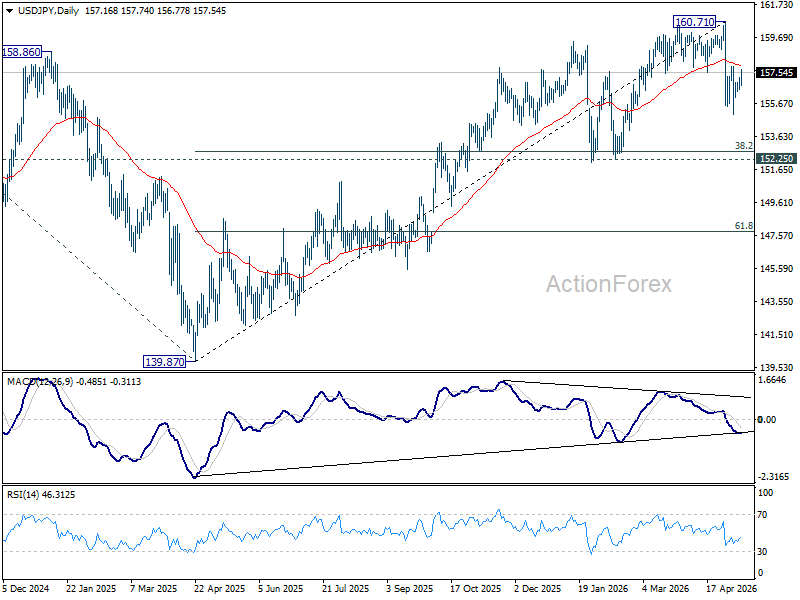
In the bigger picture, for now, corrective pattern from 161.94 (2024 high) is still seen as completed at 139.87. Rise from there is seen as resuming the long term up trend. So, break of 161.94 is expected at a later stage to resume the long term up trend. However, sustained break of 55 W EMA (now at 154.13) will dampen this view and bring deeper fall back towards 139.87 to extend the pattern from 161.94.
USD/CHF Mid-Day Outlook
Daily Pivots: (S1) 0.7759; (P) 0.7776; (R1) 0.7791; More….
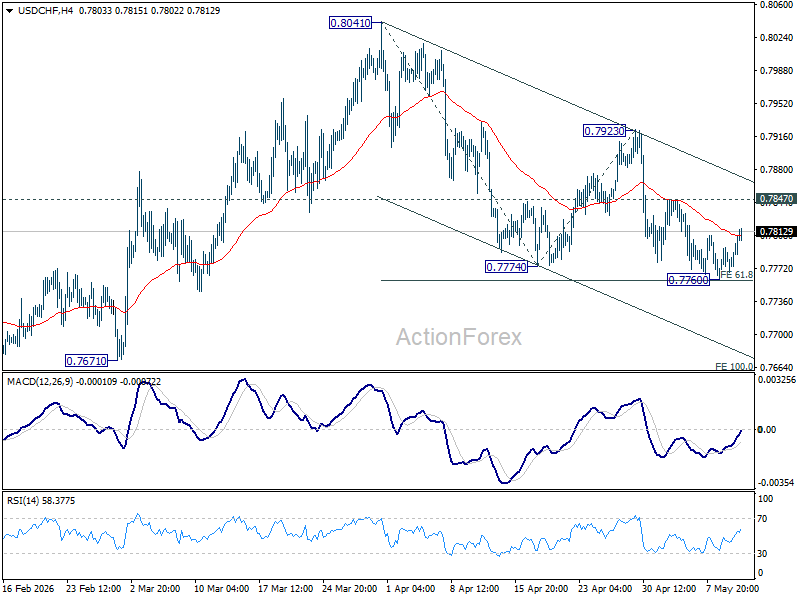
USD/CHF's rec continues today but stays below 0.7847 resistance. Intraday bias remains neutral and further decline is expected. On the downside, decisive break of 0.7760 will resume the whole decline form 0.8041, and target 100% projection of 0.8041 to 0.7774 from 0.7923 at 0.7656. However, firm break of 0.7847 resistance will indicate short term bottoming, and bring stronger rebound back to 0.7923 resistance.
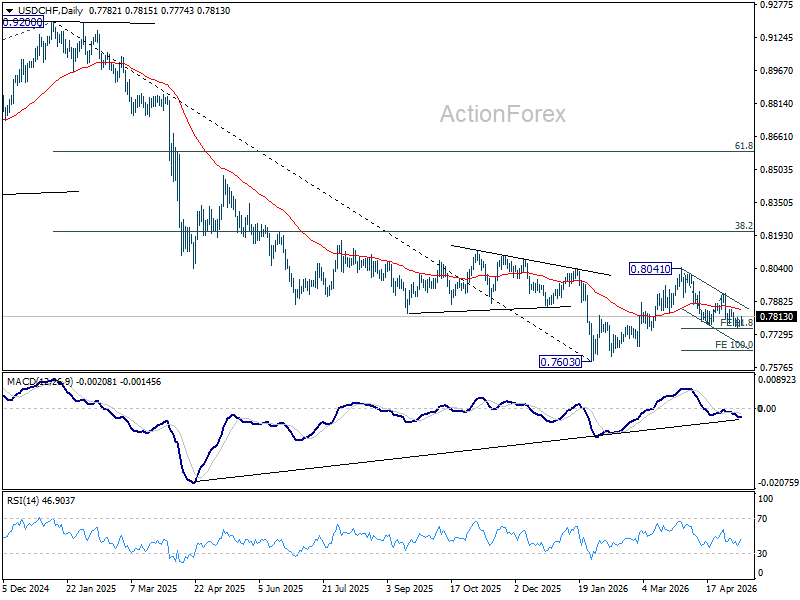
In the bigger picture, as long as 55 W EMA (now at 0.8051) holds, fall from 0.9200 is expected to continue, as part of the larger down trend. Firm break of 0.7603 will target 100% projection of 1.0146 (2022 high) to 0.8332 from 0.9200 at 0.7382.
EUR/USD Mid-Day Outlook
Daily Pivots: (S1) 1.1752; (P) 1.1769; (R1) 1.1799; More….
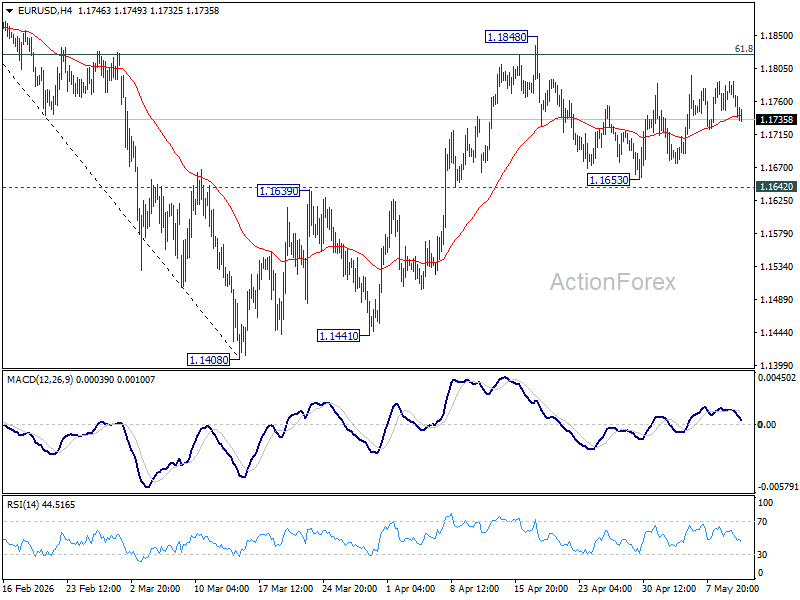
EUR/USD is still bounded in established range below 1.1848 and intraday bias remains neutral. Further rise is expected with 1.1642 support intact. On the upside, firm break of 1.1848 will target 1.2081 high next. However, firm break of 1.1662 support will indicate the the rebound from 1.1408 has completed, and bring deeper decline back towards this low instead.
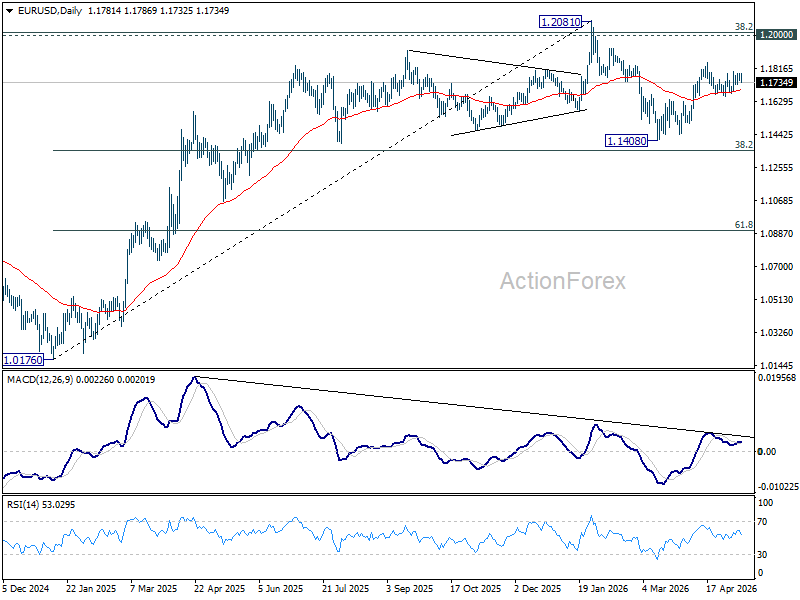
In the bigger picture, the strong support from 38.2% retracement of 1.0176 to 1.2081 at 1.1353 suggests that the pullback from 1.2081 is more likely a corrective move. Strong support was also found in 55 W EMA (now at 1.1539). Focus is back on 1.2 key cluster resistance level. Decisive break there will carry long term bullish implications. Nevertheless, break of 1.1408 support will revive the case of medium term bearish trend reversal.
GBP/USD Mid-Day Outlook
Daily Pivots: (S1) 1.3555; (P) 1.3603; (R1) 1.3656; More...
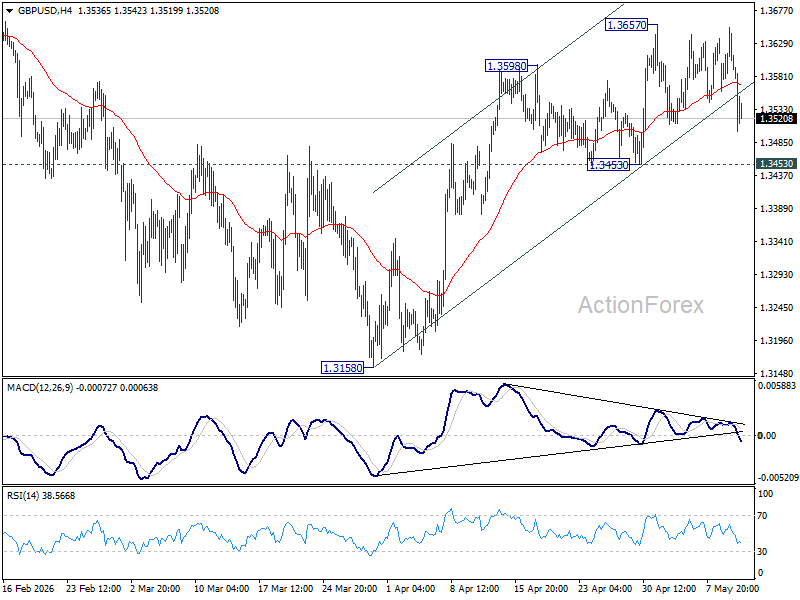
GBP/USD falls notably today but stays above 1.3453 support. Intraday bias remains neutral and further rally is in favor. On the upside, firm break of 1.3657 will resume the rally fro 1.3158 to retest 1.3867 high. However, decisive break of 1.3453 will argue that the rebound has already completed, and turn bias to the downside for retesting 1.3158 instead.
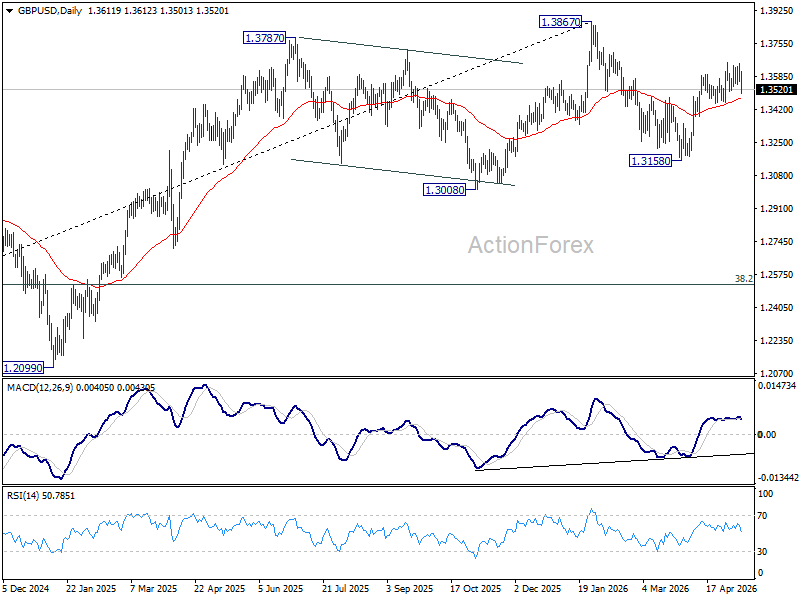
In the bigger picture, current development suggests that price actions from 1.3867 are merely a corrective pattern within the broader up trend from 1.0351 (2022 low). With 1.3008 support intact, medium term bullishness is maintained and break of 1.3867 is in favor for a later stage, towards 1.4248 key resistance (2021 high).
Dollar Gains as Oil and CPI Lift Fed Hike Bets, but Risk Appetite Holds Firm
Dollar strengthened broadly today as rising oil prices and firmer-than-expected US inflation data continued pushing markets toward a more hawkish Federal Reserve outlook. However, the overall move remained relatively measured as broader risk sentiment stayed resilient, with investors still reluctant to fully embrace defensive positioning ahead of the Trump-Xi summit later this week.
Oil prices remained a key driver. Brent crude climbed back above %107 while WTI traded above %100 as stalled US-Iran peace negotiations continued sustaining geopolitical risk premium in energy markets. Nevertheless, both benchmarks remain largely trapped within the broad consolidation ranges established after the sharp March spike, suggesting traders still see the Hormuz crisis as unresolved but not yet spiraling into a full-scale crisis. The eventual direction of the Strait of Hormuz situation may depend heavily on the outcome of Thursday’s Trump-Xi summit.
The second major support for Dollar came from US inflation data. April CPI showed headline inflation accelerating from 3.3% yoy to 3.8% yoy, while core CPI rose from 2.6% yoy to 2.8% yoy, both slightly above expectations. The firmer core readings in particular raised concern that energy-driven inflation pressures may now be spreading more broadly into underlying consumer prices. Fed fund futures subsequently pushed further toward pricing no rate cuts this year, while implied odds of a rate hike rose toward 28%.
Still, Dollar’s rally remained restrained overall. US equities held relatively firm, and broader risk appetite continued receiving support from ongoing optimism surrounding AI-related investment themes and semiconductor demand. The market tone suggests investors are pricing higher inflation risk without yet fully shifting toward outright crisis positioning.
Sterling was among the weakest major currencies earlier in the session as UK political concerns intensified following the first ministerial resignation calling for Prime Minister Keir Starmer to step down. Markets had already become uneasy after Labour’s poor local election results last week, but Miatta Fahnbulleh’s resignation turned the leadership crisis into a more immediate market concern. However, the Pound later stabilized after senior Cabinet ministers rallied behind Starmer following a critical internal meeting where he insisted he would not resign voluntarily without a formal leadership challenge.
Yen also experienced significant intraday volatility. Initially, the currency weakened alongside rising oil prices, continuing the recent pattern where higher energy costs pressure Japan’s import-heavy economy. However, Yen later rebounded strongly after US Treasury Secretary Scott Bessent reaffirmed that both the United States and Japan believe excessive currency volatility is undesirable.
Speaking after meeting Prime Minister Sanae Takaichi, Bessent said Washington remained in close contact with Japanese authorities on exchange rate developments and expressed confidence that BOJ Governor Kazuo Ueda would successfully avoid falling behind the curve on inflation. The remarks were interpreted by markets as broad US support for Japan’s recent Yen-buying intervention efforts. The comments followed similar remarks earlier from Japanese Finance Minister Satsuki Katayama, who confirmed close coordination with Washington on currency market developments.
In the currency markets, Dollar is the strongest one for the day so far, followed by Kiwi, and then Loonie. Sterling is the worst, followed by Swiss Franc, and then Aussie. Euro and Yen are positioning in the middle of the pack.
In Europe, at the time of writing, FTSE is down -0.30%. DAX is down -0.95%. CAC is down -0.57%. UK 10-year yield is up 0.105 at 5.11. Germany 10-year yield is up 0.049 at 3.092. Earlier in Asia, Nikkei rose 0.52%. Hong Kong HSI fell -0.22%. China Shanghai SSE fell -0.25%. Singapore Strait Times rose 0.07%. Japan 10-year JGB yield rose 0.019 to 2.544.
US CPI Hits Highest Since 2023, Core Inflation Beats Expectations
April’s US CPI report reinforced the “higher for longer” inflation narrative as both headline and core prices accelerated faster than expected. Rising gasoline, shelter, and food costs suggest inflation pressures are broadening beyond energy alone, further reducing expectations for Fed rate cuts this year. Read More.
EUR/GBP Surges as Markets Price “Zombie Government” Risk as Starmer Crisis Deepens
Sterling came under intense pressure after the first ministerial resignation demanding Keir Starmer’s departure transformed Labour’s political crisis into a broader market concern. With more than 80 MPs reportedly calling for a leadership transition, traders are increasingly pricing “zombie government” risk into UK assets. Read More.
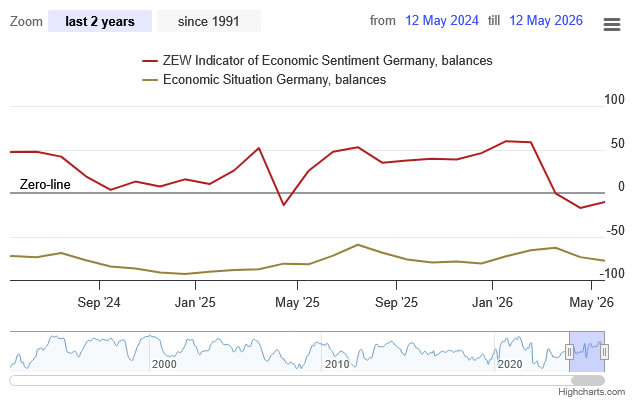
German ZEW Sentiment Rises to -10.2, But Economy Still Burdened by Energy Shock
Germany’s ZEW survey showed investor sentiment recovering modestly in May as markets increasingly hoped for eventual de-escalation in the Iran conflict. However, weak industrial activity, rising energy costs, and deteriorating current conditions continued highlighting the fragile state of Europe’s largest economy. Read More.
BoJ Summary Shows Growing Support for Near-Term Rate Hike
The BOJ’s April meeting summary revealed a noticeably more hawkish debate inside the board, with several policymakers openly discussing the possibility of another rate hike as the Iran-driven oil shock lifts inflation risks. Markets are increasingly pricing a potential move as early as June. Read More.
Australia NAB Survey Shows Cost Growth Jumps to 4.5% as Margin Squeeze Intensifies
Australia’s April NAB survey painted an increasingly stagflationary picture as purchase cost growth surged to 4.5% following the Middle East energy shock. While firms continued facing rising input costs, weaker trading, employment, and activity indicators suggested margin pressure is beginning to weigh more heavily on the broader economy. Read More.
GBP/USD Mid-Day Outlook
Daily Pivots: (S1) 1.3555; (P) 1.3603; (R1) 1.3656; More...
GBP/USD falls notably today but stays above 1.3453 support. Intraday bias remains neutral and further rally is in favor. On the upside, firm break of 1.3657 will resume the rally fro 1.3158 to retest 1.3867 high. However, decisive break of 1.3453 will argue that the rebound has already completed, and turn bias to the downside for retesting 1.3158 instead.
In the bigger picture, current development suggests that price actions from 1.3867 are merely a corrective pattern within the broader up trend from 1.0351 (2022 low). With 1.3008 support intact, medium term bullishness is maintained and break of 1.3867 is in favor for a later stage, towards 1.4248 key resistance (2021 high).
US CPI Hits Highest Since 2023, Core Inflation Beats Expectations
US inflation accelerated further in April as rising energy and shelter costs kept price pressures elevated. Headline CPI rose 0.6% mom, matching expectations, while core CPI increased 0.4% mom, above the expected 0.3% gain and signaling broader underlying inflation momentum beyond energy alone.
The energy component remained the dominant driver of the monthly increase. The energy index rose 3.8% mom after surging 10.9% in March, accounting for more than 40% of the overall monthly rise in consumer prices. Gasoline prices alone climbed 5.4% during the month and were up 28.4% compared with a year earlier as the Middle East conflict continued disrupting global energy markets. Shelter costs also remained firm, rising 0.6% mom, while food prices increased 0.5% mom.
On an annual basis, headline CPI accelerated from 3.3% yoy to 3.8% yoy, above expectations of 3.7% yoy and marking the highest reading since May 2023. Core CPI also strengthened from 2.6% yoy to 2.8% yoy, exceeding forecasts of 2.7% yoy.
The report is likely to further reduce expectations for Fed rate cuts this year and may even revive market discussion around the possibility of additional tightening if energy-driven inflation pressures continue broadening into core categories.
| Indicator | Previous | Latest | Expectation |
|---|---|---|---|
| Headline CPI (MoM) | 0.9% | 0.6% | 0.6% |
| Core CPI (MoM) | 0.2% | 0.4% | 0.3% |
| Headline CPI (YoY) | 3.3% | 3.8% | 3.7% |
| Core CPI (YoY) | 2.6% | 2.8% | 2.7% |
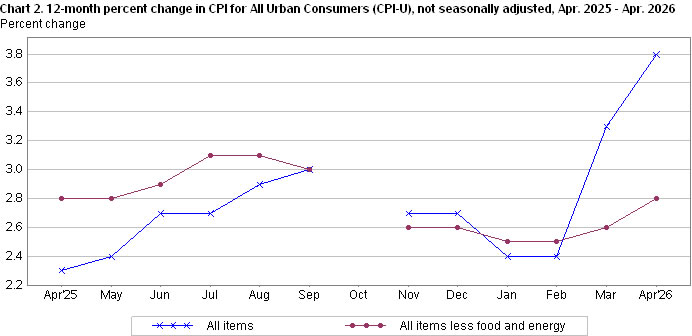
Chart Alert: WTI Crude Is Poised for a Potential Volatility Bullish Breakout Above $102.54/bbl
Key Takeaways
- West Texas Intermediate crude oil remains strongly supported by ongoing geopolitical tensions after hopes for renewed US-Iran peace talks faded, increasing the risk of a prolonged Strait of Hormuz disruption and sustained global energy supply tightness.
- Prediction market data from Polymarket shows sharply declining probabilities of shipping traffic normalising in the Strait of Hormuz by May and June 2026, reinforcing elevated geopolitical risk premiums in oil markets.
- Technically, WTI crude is showing bullish breakout conditions above its 20-day and 50-day moving averages, supported by bullish candlestick formations and positive RSI momentum, with $102.54 acting as the key breakout resistance level.
The optimism that was being priced in by global markets last week for an imminent second round of US-Iran peace deal talks to take place this week has fizzled out after US President Trump rejected Tehran’s response to the latest US proposal on Sunday.
The key hurdle is the transfer of Iran’s enriched uranium. In a nutshell, without any set dates for peace talks emerging on the near-term horizon, the ongoing two-month-plus closure in the Strait of Hormuz is likely to extend, which may aggravate the global energy and oil crunch as oil flows continue to dwindle.
Prolonged Strait of Hormuz Closure May Sustain Elevated Oil Prices
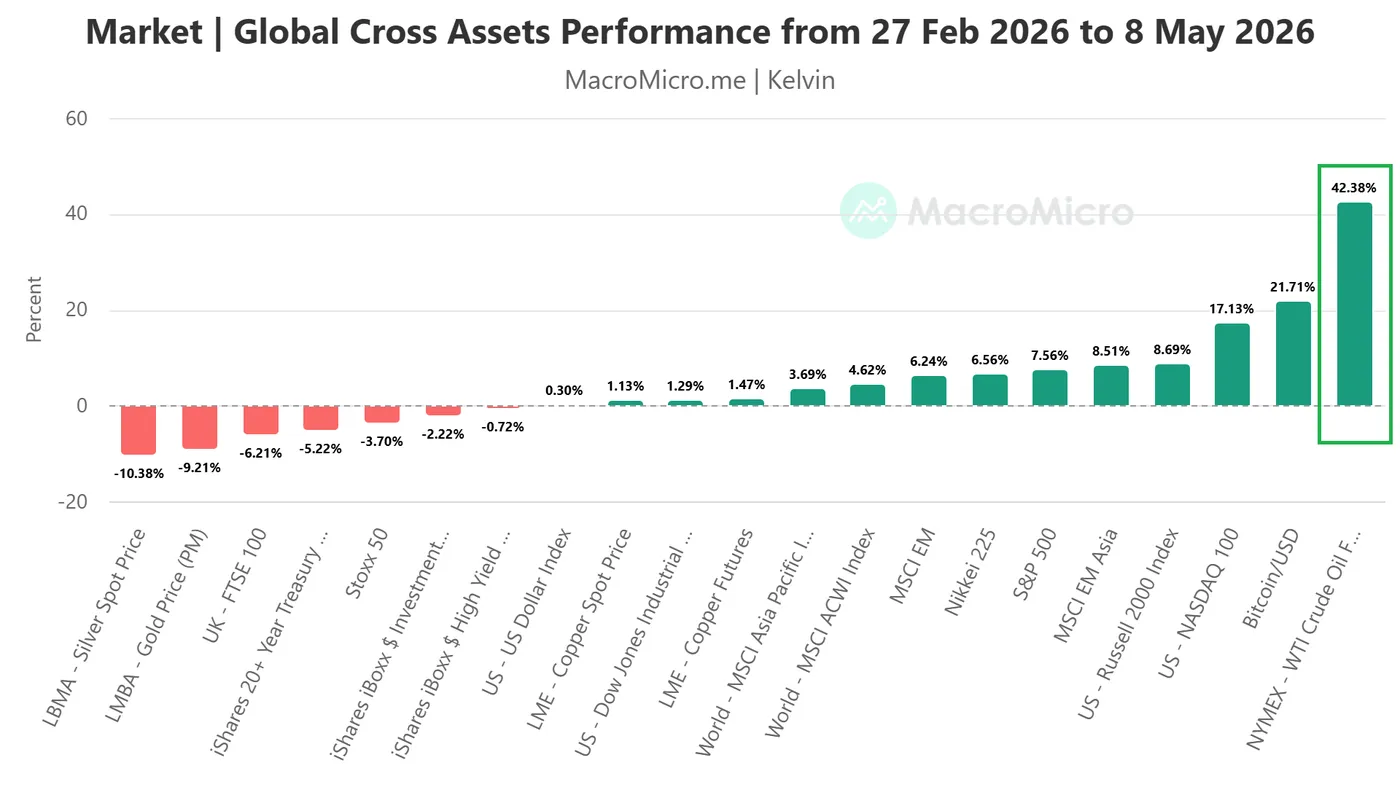
Fig. 1: WTI crude oil futures and other cross-asset performances from 27 February 2026 to 8 May 2026. Source: MacroMicro.
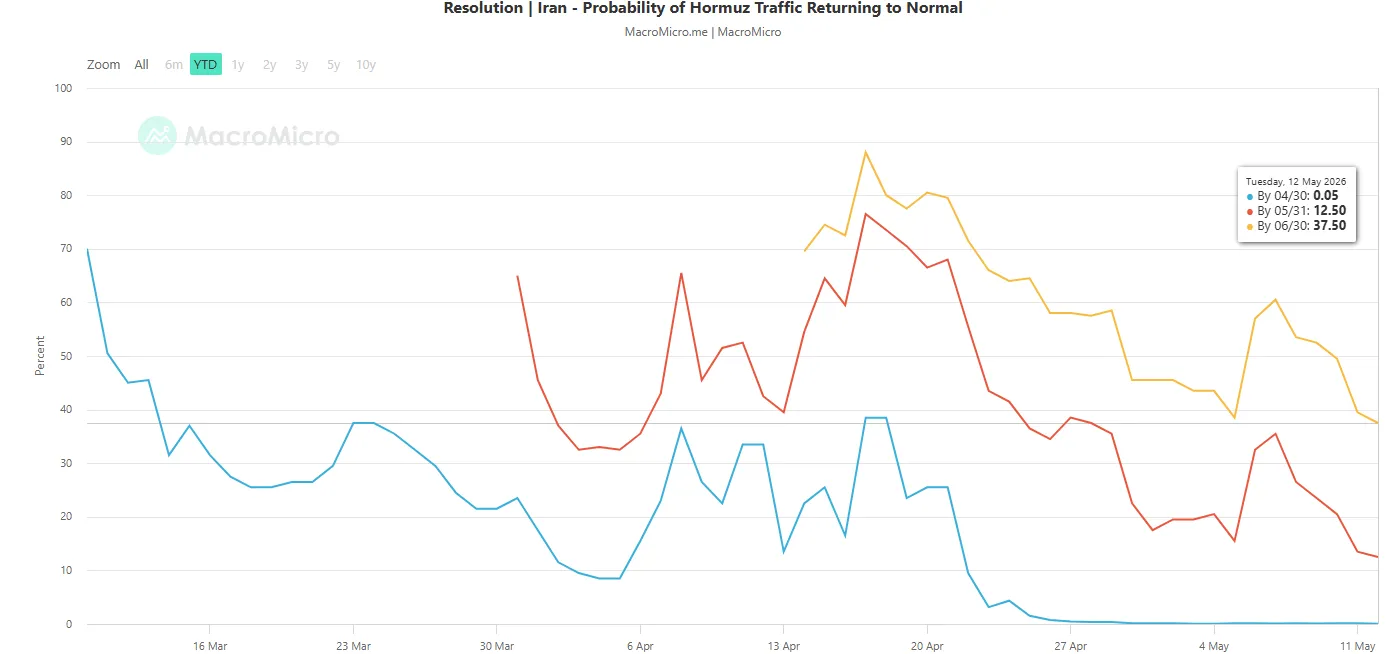
Fig. 2: Polymarket probability of Strait of Hormuz traffic returning to normal as of 12 May 2026. Source: MacroMicro.
Despite the fragile US-Iran ceasefire that has remained in place since 8 April 2026, oil continues to be the top-performing asset class.
From the pre-war baseline of 27 February 2026 through Friday, 8 May 2026, WTI crude oil futures surged by 42%, underscoring persistent supply disruption concerns and elevated geopolitical risk premiums in the energy market.
Betting data from Polymarket, a major prediction market platform, suggests a low probability of a return to normal shipping traffic in the Strait of Hormuz.
The probability of Hormuz traffic returning to normal by the end of May 2026 has been reduced to 12.5% as of 12 May 2026 from 35.5% printed on 7 May 2026.
A similar trend is evident for the end of June 2026, where the probability has fallen sharply to 37.5% from 60.5% over the same period.
Let’s now focus on the 1- to 3-day trajectory of WTI crude oil from a technical analysis perspective.
WTI Crude: Bullish Expansion Above 20-Day and 50-Day MAs
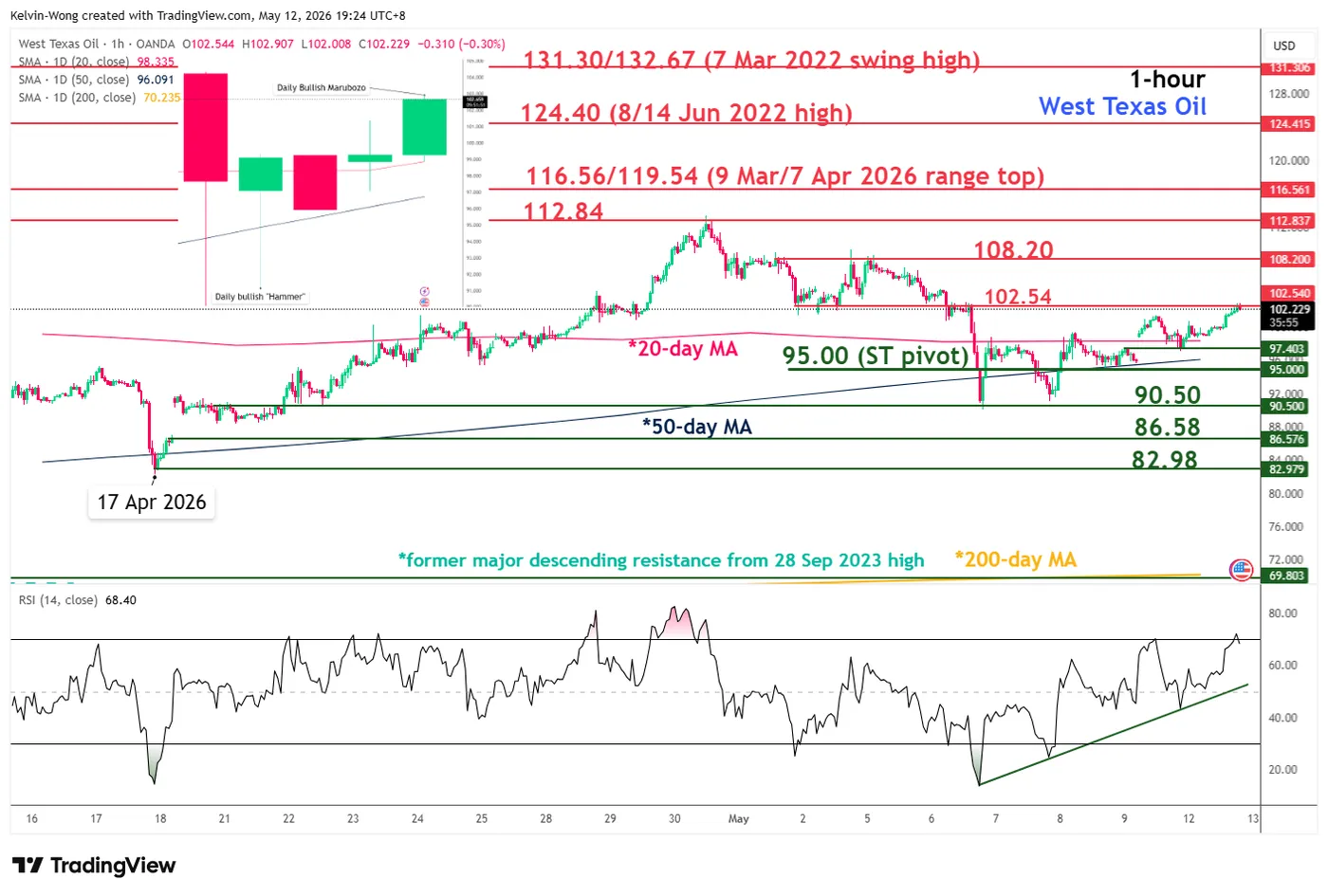
Fig. 3: West Texas oil CFD as of 12 May 2026. Source: TradingView.
Trend bias: Rebound towards the March/April 2026 medium-term range top with 95.00 as key short-term pivotal support.
Resistances: 102.54, 108.20, and 112.84.
Next supports: 90.50, 86.58, and 82.89.
Key Elements Supporting the Near-Term Bullish Bias on WTI Crude
- The price actions of the West Texas oil CFD, a proxy for WTI crude oil futures, have started to accelerate higher above their 20-day and 50-day moving averages following a brief period of subdued volatility observed on Friday, 8 May, and Monday, 11 May.
- The current daily candlestick on Tuesday, 12 May, has transformed into an impending “Bullish Marubozu” pattern after a prior daily bullish “Hammer” seen on 7 May, coupled with a retest of its key 50-day moving average. This is a sign of positive follow-through that may lead to higher prices.
- The hourly RSI momentum indicator continues to exhibit bullish momentum conditions as it remains supported by an ascending trendline.
US Inflation Will Put Everything into Perspective
- An acceleration in the US CPI will support the US dollar.
- Currency interventions have provided temporary relief for the yen.
The US dollar has been stuck within a 0.4% range over the past week, amid a stalemate in the Middle East. NACHO or ‘Not a chance Hormuz Opens’ has replaced TACO. Investors are coming to terms with the idea that the blockade of the main oil artery is here to stay. Under such conditions, the chances of a rise in Brent and a strengthening of the USD are increasing, especially as the latter is fuelling expectations of a new batch of US inflation data.
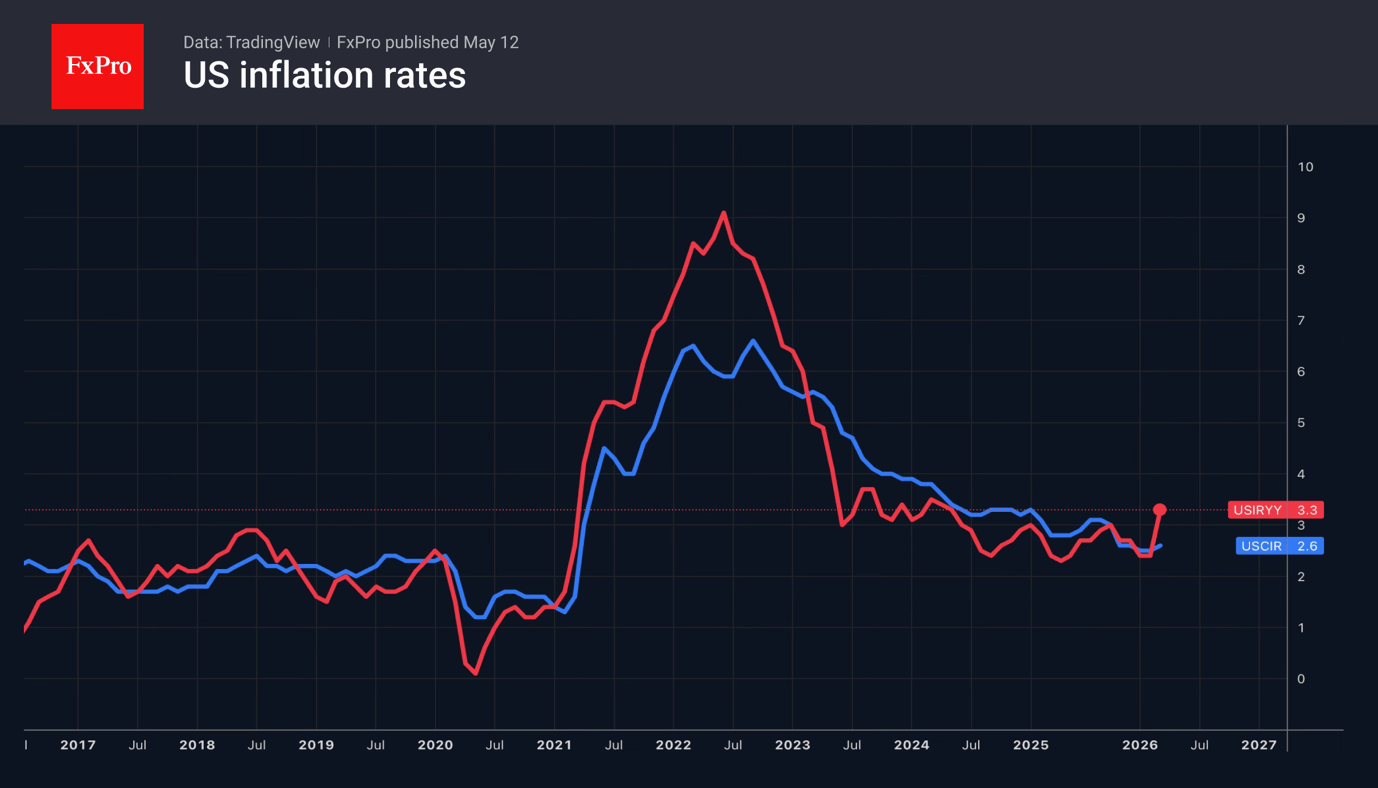
Growing expectations of a key rate hike are supporting the euro. Economists surveyed by Bloomberg expect two rate hikes this year, from 2% to 2.5%, compared to just one in the previous similar survey. Economists expect inflation in the eurozone to accelerate to 2.9% by the end of the year.
CME derivatives suggest the federal funds rate will remain unchanged in 2026 and rise to 4% with a 50-50 probability by April 2027. The timing of monetary policy tightening could be brought forward if inflation accelerates in April, which could put pressure on EURUSD.
According to Bank of America, the data does not justify the Fed resuming its cycle of monetary easing this year. Core inflation is too high, and the strong April jobs report has put an end to the idea of rate cuts. The bank has pushed back its forecast for monetary policy easing from September 2026 to July 2027.
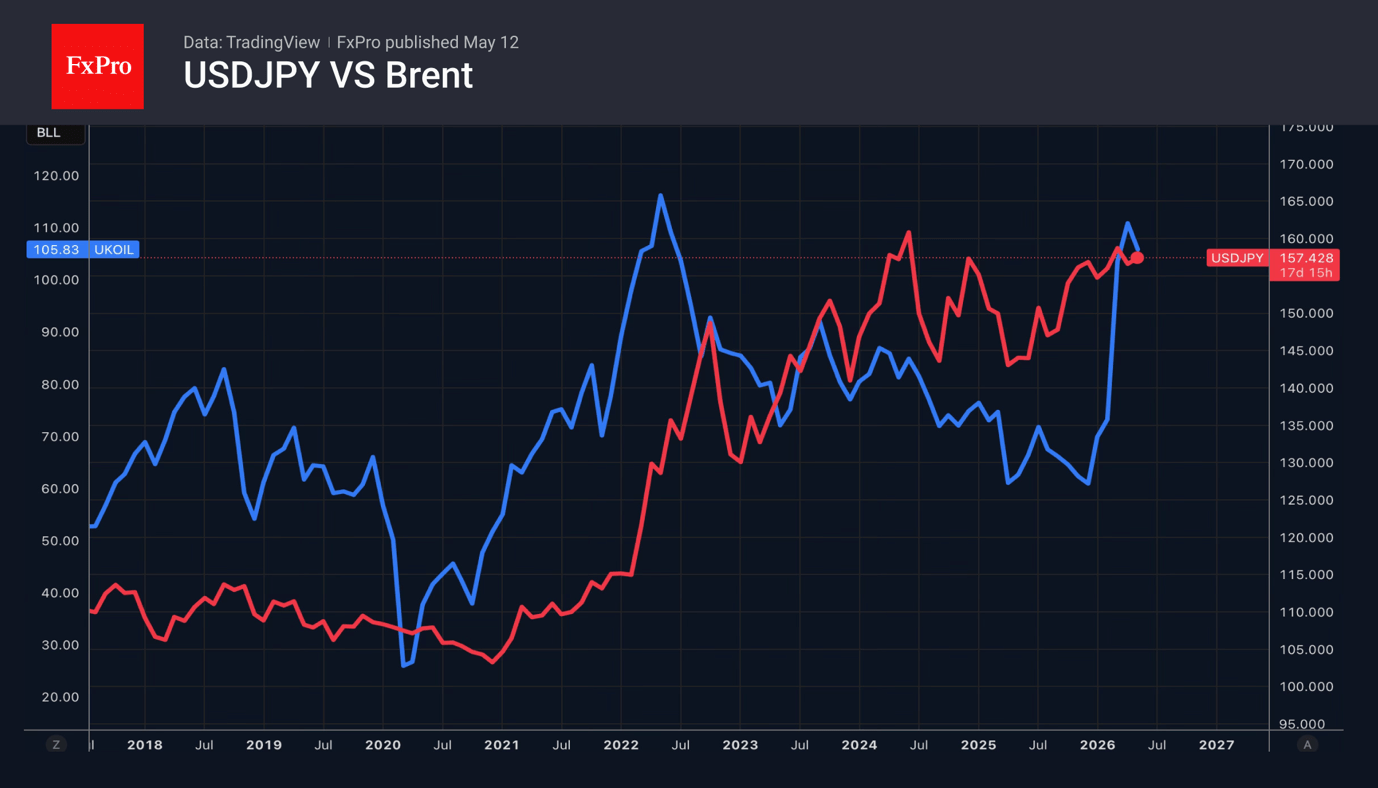
Meanwhile, the USDJPY bulls are regaining their footing. The scale of currency interventions is estimated at ¥8.65–10.08 trillion, comparable to the ¥9.74 trillion recorded in 2024. These interventions have led to a reduction in speculative yen shorts to monthly lows. Nevertheless, given the upward trend in Brent and strong demand for the US dollar as a safe-haven currency, Japan’s funds may not be sufficient to deter hedge funds and asset managers.
The minutes of the latest Governing Board meeting may have supported the yen. One of its members stated that an overnight rate hike could be on the cards, even if the situation in the Middle East remains unclear. The futures market is pricing in a 72% probability of monetary tightening in June. However, the Bank of Japan has repeatedly pushed back the timing of expected monetary tightening, and the wide interest rate differential favours USDJPY.
Bitcoin Hits the Pause Button at $80k
Market Overview
The crypto market capitalisation has stalled at around $2.70 trillion, reflecting Bitcoin’s indecision around $80,000. At the same time, risk aversion is mounting in global markets, which can be easily linked to profit-taking following the rally and the US dollar’s upward momentum. Among the top coins, the leaders over the past day were Theta (+8.5%), Toncoin (+4.9%) and NEAR Protocol (+2.1%). The underperformers were Dash (-4.2%), Official Trump (-3.5%) and Zcash (-3.5%).
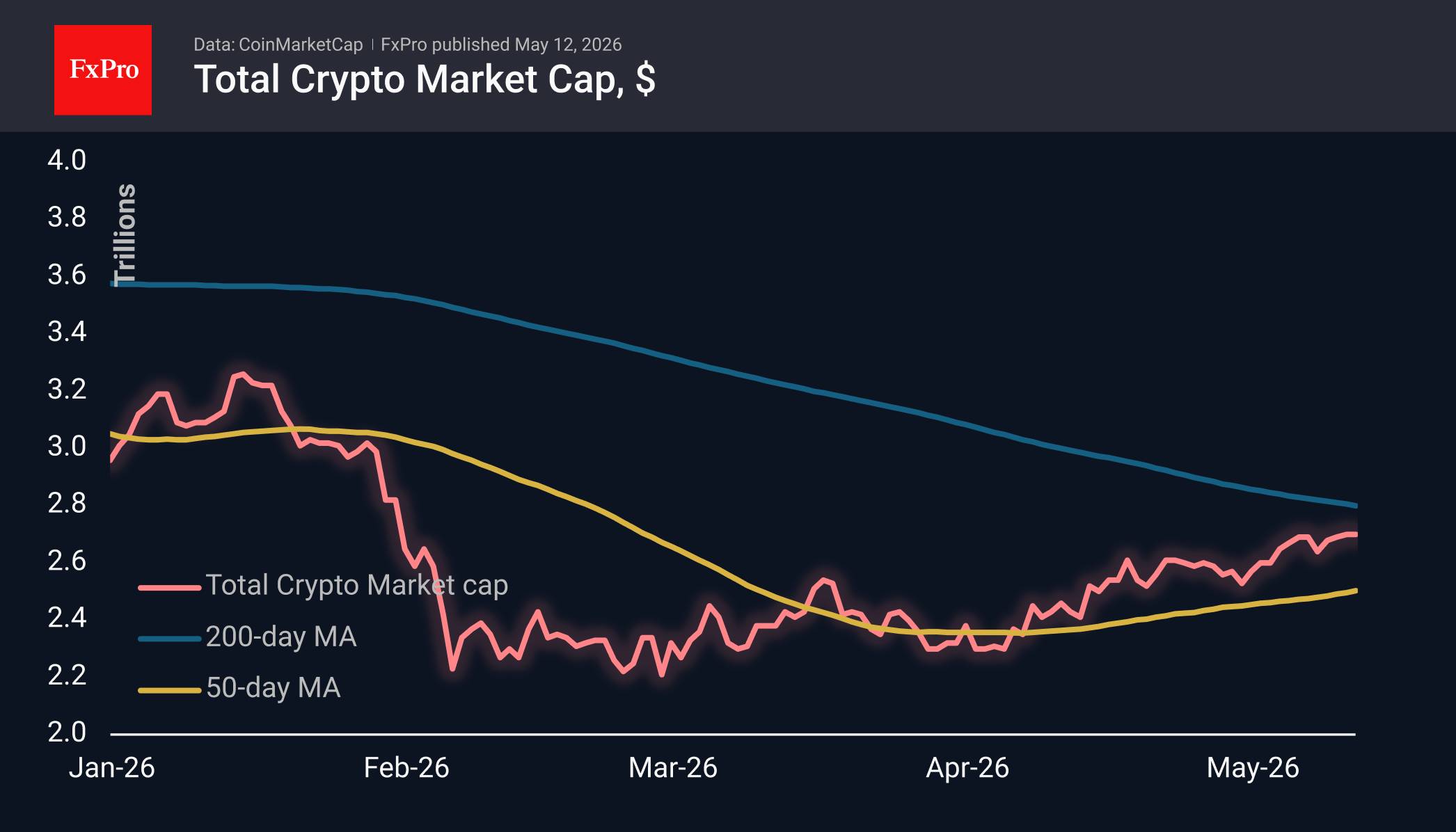
The sentiment index has settled just below the midpoint of the range, recording readings of 47, 48 and 49 over the last three days. At the same time, we continue to note how difficult it is for the crypto market to consolidate at the upper end of the spectrum, which indicates a predominance of bears.
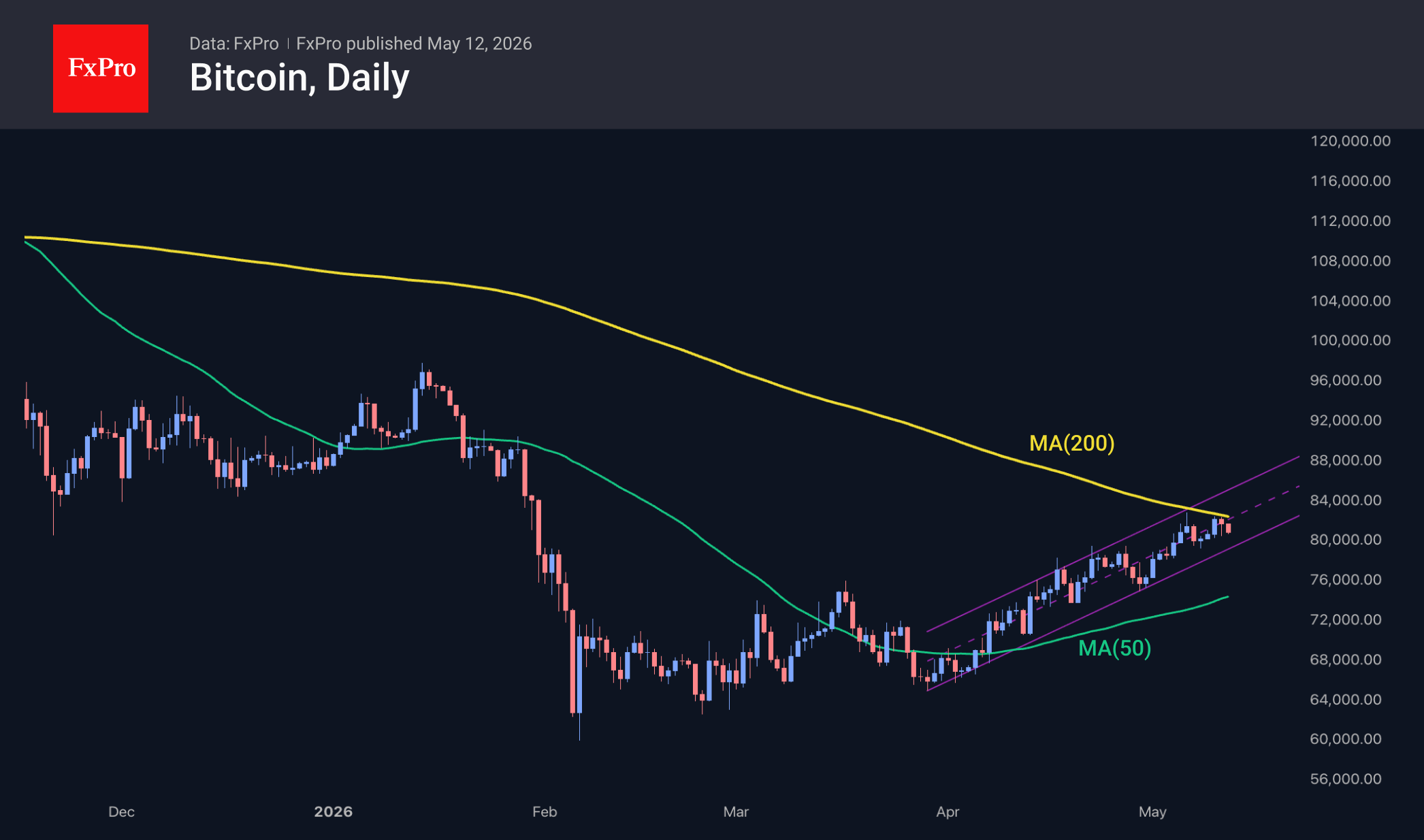
Bitcoin points to much the same thing, having lost its upward momentum as it approached the 200-day moving average. Although this line is trending downwards, the market has failed to break through it for the past six days. On the other hand, as the decline is quite modest, it resembles nothing more than a breather following a rally, leaving a strong chance of growth resuming.
News Background
According to CoinShares, global investments in crypto funds rose by $858 million last week. Investments in Bitcoin increased by $706 million, in Ethereum by $77 million, in Solana by $48 million, and in XRP by $40 million. Outflows from Bitcoin short positions totalling $14 million marked the largest of the year.
Investments rose amid a compromise on stablecoin yields under the CLARITY Act. The Senate Banking Committee is expected to consider the bill next week, CoinShares notes.
Strategy acquired 535 BTC for $43 million last week — at an average price of $80,340 per coin. The week before, the company skipped its weekly BTC purchase ahead of its quarterly report. Strategy now holds 818,869 BTC, purchased for $61.86 billion at an average price of $75,540 per Bitcoin.
Strategy will continue to build up its reserves of the leading cryptocurrency. At the same time, the volume of purchases will significantly exceed any potential sales, stated the company’s founder, Michael Saylor. According to him, it is important to remain a ‘net buyer’ and end each year with more coins than at the start.
Jordi Visser, founder of 22V Research, has increased his investment in Ethereum. In his view, this year will see the start of mass asset tokenisation, which will form the basis for payments by AI agents. For autonomous transactions, they will need digital assets such as Ethereum or stablecoins.
German ZEW Sentiment Rises to -10.2, But Economy Still Burdened by Energy Shock
Germany’s ZEW Economic Sentiment index improved from -17.2 to -10.2 in May, beating expectations of -20.5 and signaling a modest improvement in investor confidence despite ongoing economic pressures linked to the Middle East conflict. Eurozone ZEW Economic Sentiment also rose sharply from -20.4 to -9.1, while the Eurozone current conditions gauge improved slightly by 1.6 points to -41.4.
However, the underlying picture for Germany’s economy remained weak. The Current Situation index deteriorated further from -73.7 to -77.8, slightly worse than expectations, highlighting the continued strain from weak industrial production, elevated energy costs, and soft domestic demand.
ZEW President Achim Wambach said financial market experts are increasingly hoping the Iran war will end soon, but warned that rising energy prices and inflation above 2% continue to burden the German economy.
The industry breakdown showed a highly uneven recovery outlook. Germany’s automotive sector deteriorated sharply, with the industry indicator falling to -57.2, while mechanical engineering also weakened further to -32.1. Private demand conditions remained deeply negative and deteriorated further.
By contrast, sentiment improved strongly in information technology, where the indicator jumped to 56.6, while construction and metal production also showed signs of stabilization.
ZEW said there is "cautious hope" for a recovery in the second half of 2026 if Middle East tensions ease and government stimulus measures begin supporting growth more effectively.
| Indicator | Previous | Latest | Expectation |
|---|---|---|---|
| German ZEW Economic Sentiment | -17.2 | -10.2 | -20.5 |
| German Current Situation | -73.7 | -77.8 | -77.5 |
| Eurozone ZEW Economic Sentiment | -20.4 | -9.1 | |
| Eurozone Current Situation | -43.0 | -41.4 | |
| German Automotive Sector Indicator | -44.2 | -57.2 | |
| Mechanical Engineering Indicator | -22.9 | -32.1 | |
| Private Demand Indicator | -33.4 | -41.6 | |
| Information Technology Indicator | 44.5 | 56.6 |