

Sample Category Title
GBP/USD Outlook: Limited Negative Impact from BoE Rate Cut
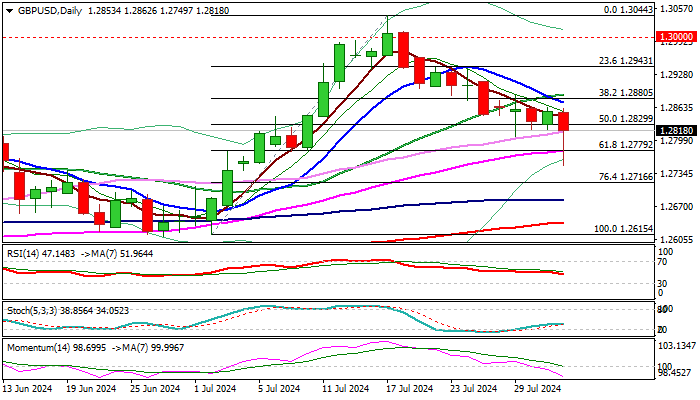
Cable traded in a choppy mode with limited downside after BOE rate cut and regained traction on much higher than expected US jobless claims.
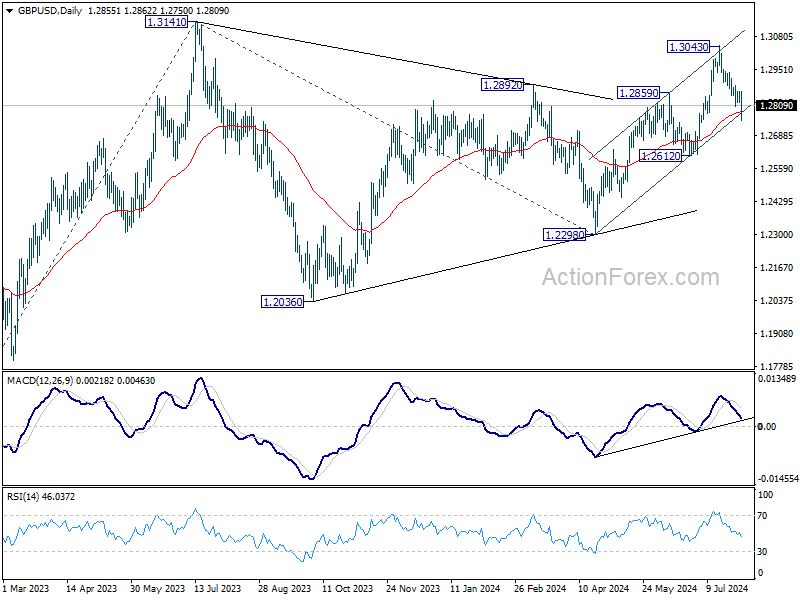
The pair returned above 1.2800 mark after hitting the lowest in almost one month (1.2750), with subsequent bounce signaling formation of a bear-trap on daily chart (below Fibo support at 1.2779, reinforced by 55DMA).
This may generate initial signal of formation of reversal pattern, although with more work at the upside needed to validate signal (close above 20DMA at 1.2888 seen as minimum requirement).
Until then, the downside will remain vulnerable, as negative momentum continues to strengthen on daily chart).
Look for firmer direction signals on break of either pivot (1.2779 or 1.2888).
US Manufacturing PMI data (today) and Labor report (Friday) expected to provide fresh signals.
Res: 1.2830; 1.2873; 1.2888; 1.2943.
Sup: 1.2779; 1.2750; 1.2706; 1.2683.
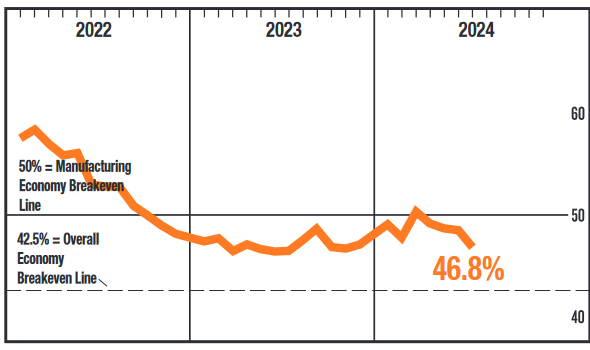
US ISM manufacturing drops to 46.8, reflecting deepening contraction
US ISM Manufacturing PMI dropped from 48.5 to 46.8 in July, falling below the expected 48.8. This marks the fourth consecutive month of contraction for the manufacturing sector, with the decline accelerating.
New orders fell from 49.3 to 47.4, indicating that demand has not seen consistent growth since May 2022. Production also decreased significantly, dropping from 48.5 to 45.9, the lowest performance since May 2020. Employment saw a sharp decline from 49.3 to 43.4, reaching its lowest level since June 2020. Prices, however, rose slightly from 52.1 to 52.9.
Timothy Fiore, Chair of the ISM Manufacturing Business Survey Committee, commented, "After breaking a 16-month streak of contraction by expanding in March, the manufacturing sector has contracted the last four months, and at a faster rate in July." Notably, none of the six biggest manufacturing industries registered growth in July.
Historically, the relationship between the Manufacturing PMI and the overall economy suggests that the July reading of 46.8 corresponds to a change of plus-1.2 percent in real GDP on an annualized basis.
Bank of England Review – Easing Commences But No Game-Changer for GBP
- At today's monetary policy meeting, the Bank of England decided to cut the Bank Rate by 25bp to 5.00%.
- A tight vote split, the notion of it being a finely balanced decision to cut rates and a mention of upside risks to the inflation forecast, gave the cut a slight hawkish twist.
- Gilt yields tracked lower and EUR/GBP moved higher on the cut, but GBP more than fully retraced the move during the press conference.
The Bank of England (BoE) decided to cut the Bank Rate by 25bp to 5.00% at today's meeting. The vote split was very tight with 5 members voting for a cut and 4 members voting for an unchanged decision. Pill joined the hawkish camp consisting of Greene, Haskel and Mann in voting for an unchanged decision, dissenting from Governor Bailey for the first time since he joined the MPC.
Delivering its first cut today following a hiking cycle, the BoE noted that "it is now appropriate to reduce slightly the degree of policy restrictiveness" but that "monetary policy will need to continue to remain restrictive for sufficiently long until the risks to inflation returning sustainably to the 2% target in the medium term have dissipated further". The committee further signalled a cautious approach with Bailey wary on cutting "too quickly or by too much" and that for some of the members who decided to vote for a cut "the decision was finely balanced ... and there remained some upside risks to the outlook." On the forecasts, GDP forecast was revised up to 1.25% for 2024 (from 0.5%) as expected with upside risks around the output gap. The central (modal) projection on inflation was revised lower but with upside risks across the forecast horizon.
Given the notion of it being a finely balanced decision, upside risks to the inflation forecast and the tight vote split, we think that this suggests that the BoE will take a more gradual approach to a cutting cycle. We expect the next 25bp cut in November with the Bank Rate ending the year at 4.75%.
Rates. 2Y Gilt yields moved lower on the statement but overall, the reaction in rates markets was muted. While markets price a probability for a move in September (7bp), it sees it as more likely that the next cut will be later in the year (November).
FX. EUR/GBP moved higher on the announcement of a cut but given the tight vote split and the more cautious approach on monetary easing, EUR/GBP more than fully retraced the move. We see relative rates as rather neutral for EUR/GBP, given our hawkish call on the ECB. We expect EUR/GBP to continue its move lower driven by indicators pointing to a continued (modest) rebound in the global manufacturing cycle, tight credit spreads and low FX volatility. The key risk is policy action from the BoE.
Our call. We expect the BoE to deliver one additional cut this year at the November meeting with risks skewed towards an additional cut. Markets are pricing 40bp for the remainder of the year with the next cut 25bp cut fully priced by November.
Sunset Market Commentary
Markets
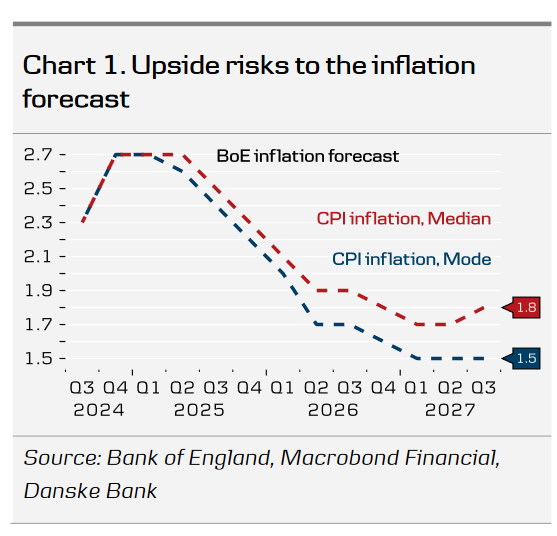
After the Fed’s most clear pivot towards imminent rate cuts yesterday, the Bank of England thought it could do even better. It cut the policy rate by 25 bps to 5% in a 5-4 split vote. For “some” in the group of 5 it was a finely balanced decision - similar to what was the case in June when the majority decided to keep rates unchanged. This was also reflected in the rationale to “reduce slightly the degree of policy restrictiveness”. It was the result of a balancing act that leads us to label it a “hawkish cut”. Several inflation indicators, including services and core inflation, are still too high and risks remain tilted to the upside. But they are expected to normalize further. Based on the market implied interest rate path, headline CPI would – after temporarily bouncing back to 2.7% by the end of the year – ease towards 1.7% and 1.5% in respectively two and three years time. This disinflation is facilitated by the economy growing below potential, creating a margin of slack under the weight of a still-restrictive monetary policy. This feels at odds with the recent data. Indeed, the BoE noted that GDP has picked up sharply so far this year before downplaying it by saying that underlying momentum appeared weaker. GDP is seen growing 0.8% by 2025Q3 and will pick up to 1.4% and 1.7% in the years after. The economy will be in excess supply all this time. Given how the decision was not at all a straightforward one, the BoE abstained from any forward guidance. Instead, it opted to continue “to monitor closely the risks of inflation persistence” and to “decide the appropriate degree of monetary policy restrictiveness at each meeting.” The Bank of England basically copy-pasted the ECB strategy of very gradually unwinding peak restrictiveness, on a pace determined by incoming data. Both inflation and economic data give the BoE less room to maneuver compared to Frankfurt though. Markets nevertheless add rate cutting bets, particularly for the second half of next year. Front end yields drop 11.8 bps, though a large chunk already occurred prior to the BoE while weak (but second tier) US data a bit later accelerated the downleg. Sterling lost some ground in the wake of a decision that was not a 100% expected, but losses could have been larger given the sizeable yield drop. EUR/GBP only trades marginally higher around 0.843. US unit labor costs came in to the low side of expectations (0.9% in Q2) and weekly jobless claims rose to the highest in 11 months (249k, topping 236k estimates). The latter add to growing labour market concerns and comes a day after the Fed said it turned attentive to both sides of its dual mandate. US yields swapped 2 bps gains for losses after already declining >10 bps yesterday. German yields gapped lower at the open, catching up with the US late yesterday. Moves down amount to slightly over 3 bps. The dollar mostly gained, including against the Japanese yen (USD/JPY 150.57) and the euro (EUR/USD 1.08 is fighting for survival). Stock markets drop less than 1% in Europe but open higher in the US.
News & Views
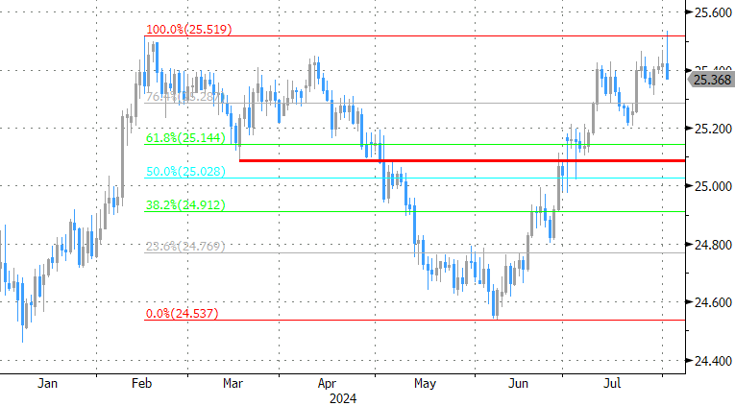
The Czech National Bank cut the policy rate 25 bps to 4.50% today. The press conference as well as statement is due later today. In the run-up to today’s decision markets were split on a 25 or 50 bps outcome after, amongst others, the CNB vice governor flagged the possibility of another big step at this meeting. Until then, markets didn’t really consider the option given that the previous 50 bps cut was already not as straightforward as the previous ones and given the recent CZK depreciation move. It appears that the latter now convinced CNB policymakers to take a more cautious cutting approach. EUR/CZK earlier on the day briefly jumped to the highest since March 2022 before paring gains to trade little changed around 25.43 on a daily basis.
The OPEC+’s monitoring committee did not issue any specific recommendation during today’s meeting. A statement on the website noted the “high overall conformity” to the current output curbs and reiterated the possibility to pause or even reverse the planned unwinding of voluntary production cuts. In June, OPEC+ agreed to first extend some 2.2 mln of voluntary output curbs that were originally scheduled to end that month to September 2024 and then to roll them back gradually on a monthly basis through September 2025. The move roiled the oil market as increased supply was expected against the background of weakening demand (especially from China). After plummeting to as low as $77/b prices then recovered $10 only to slide again in recent weeks. The recent geopolitical developments have supported oil again somewhat in recent days.
Graphs
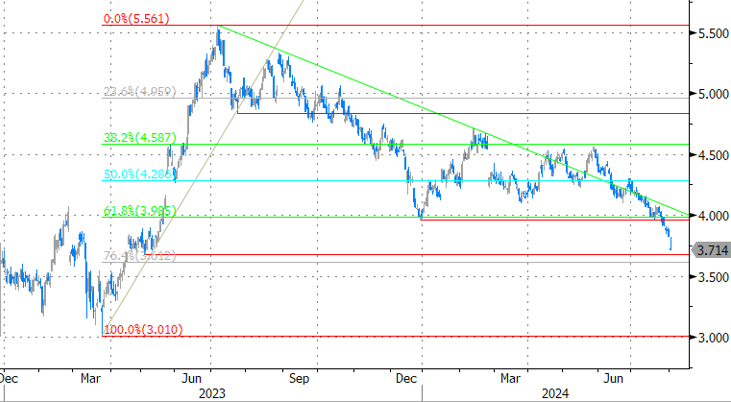
UK 2-yr yield hits new YtD low as Bank of England delivers “hawkish cut”
EUR/CZK: sigh of relief for the Czech crown as CNB slows down cutting pace from 50 to 25 bps
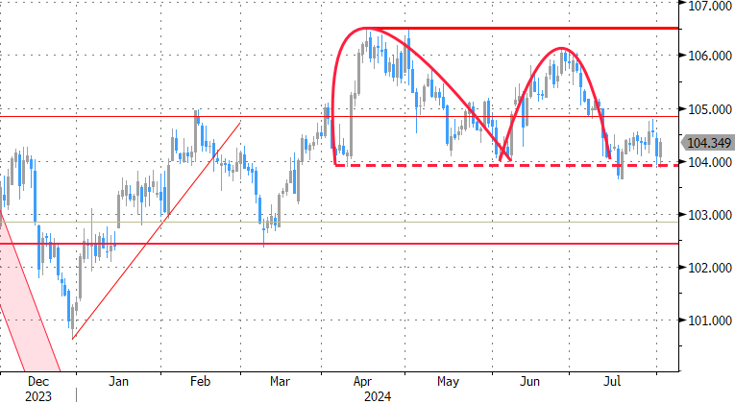
DXY: trade-weighted dollar is holding up well despite Fed readying first (but priced in) rate cut for September
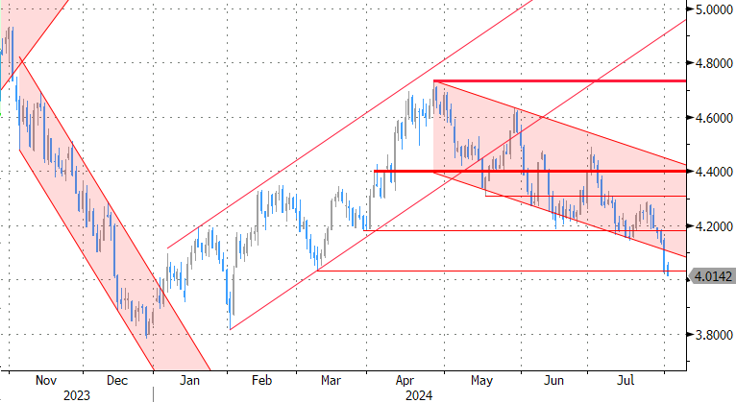
US 10-yr yield is heavily testing support around 4% as weak jobless claims add to growing labour market concerns/risks
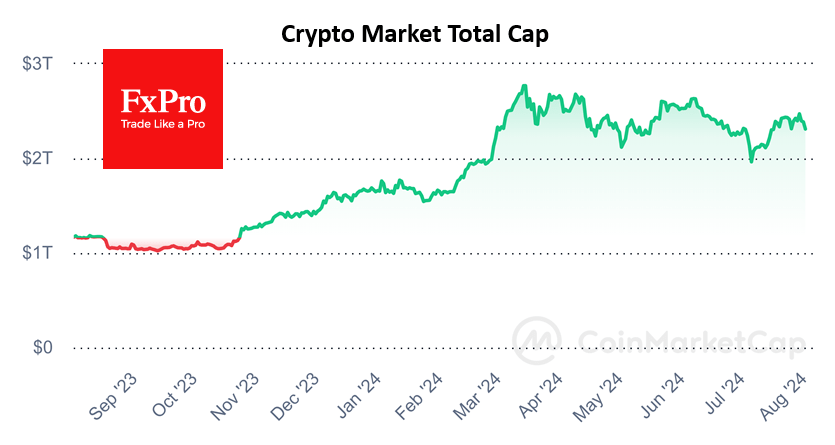
The Crypto Market Pulled Back Further into the Range
Market picture
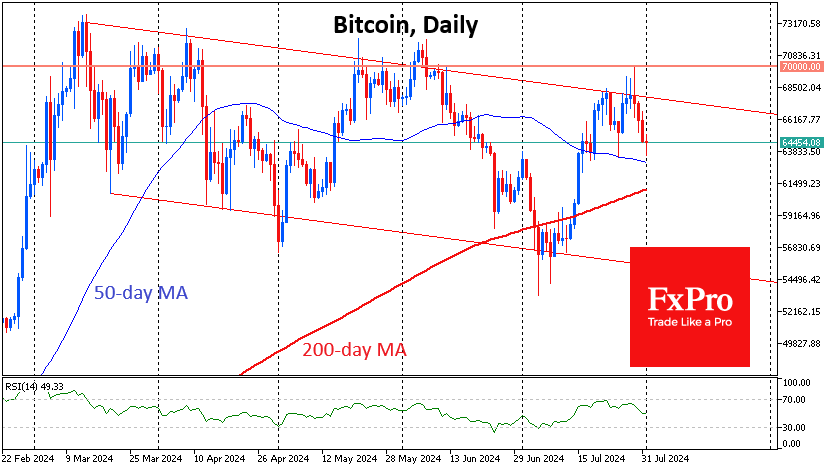
Cryptocurrencies continued to sag, failing to support gains in the stock market, returning the crypto market cap to $2.30trn levels seen a week ago. The market formed another lower local peak, a sequence that has been in place since March. A move towards the lower end of the sloping range suggests the potential for another 20% decline. This is a pessimistic, non-mainstream scenario given Bitcoin’s historically strong performance in these months post-halving and the good risk appetite in stocks and commodities.
Bitcoin was down to $63.7K on Thursday morning, once again near the 50-day moving average, which remains a tactical support line. If the decline develops, dynamics around the $63K and $61K levels, near where the 50 and 200-day moving averages are, will be important. A failure of this support will open the way to $55K, which is quite frightening.
Bitcoin ended July up 4.4% to $64,600. In terms of seasonality, August is considered one of the two worst months for BTC. Over the past 13 years, bitcoin has ended the month up only five times and down eight times. The average decline was 15.4% and the average rise was 26%.
News background
Ethereum is expected to experience greater price fluctuations than Bitcoin. QCP Capital noted that the monthly volatility premium for the asset in “long-distance” options increased from 4% to 8%.
Another recalculation saw the first cryptocurrency’s mining difficulty increase by 10.5% to 90.67T. The average hashrate for the period since the previous value change was 933.84 EH/s.
Bankrupt cryptocurrency exchange Mt.Gox sent another 33,964 BTC ($2.25bn) to an unknown address and made an internal transfer of 47,229 BTC ($3.13bn). According to Arkham, Mt.Gox-related wallets still hold 80,128 BTC worth $5.32bn. The majority of Mt.Gox investors receiving payouts can be classified as hodlers. This potentially mitigates the scale of selling pressure in the coming weeks.
A forthcoming bill from Senator Cynthia Lummis would allow the US to create the first cryptocurrency reserve, The Block reported, citing a draft document.
USD/JPY Mid-Day Outlook
Daily Pivots: (S1) 148.42; (P) 151.16; (R1) 152.72; More...
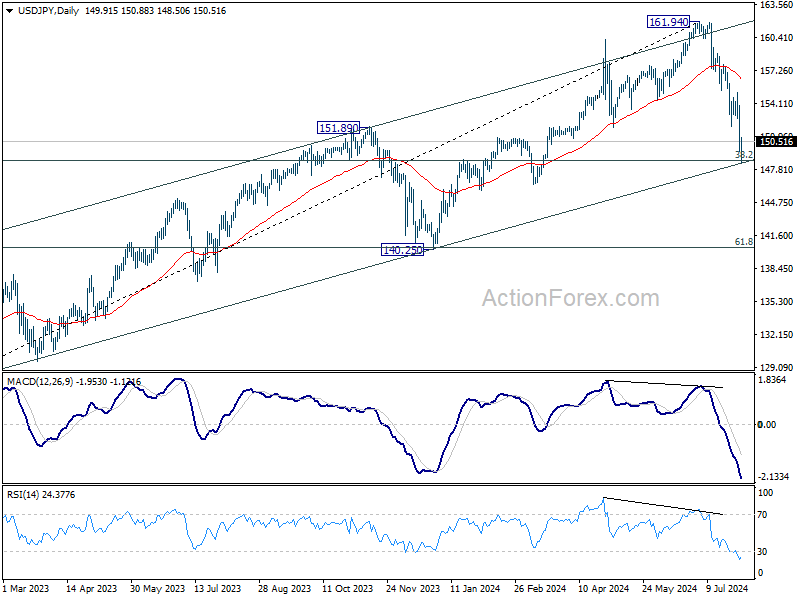
Intraday bias in USD/JPY remains on the downside for the moment. Strong support could be seen from 148.66 fibonacci level to bring consolidations. On the upside, above 151.93 support turned resistance will turn bias back to the upside for stronger recovery. Nevertheless, sustained break of 148.66 will pave the way to next support at 140.25.
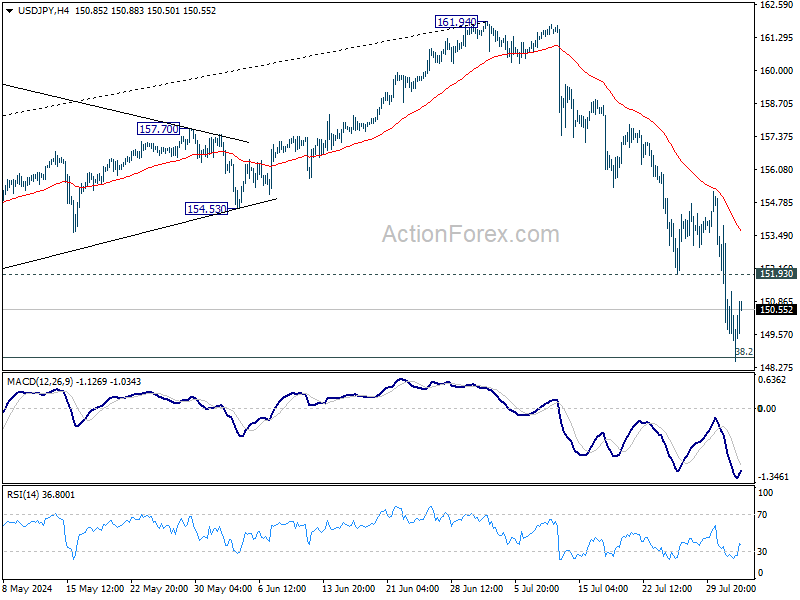
In the bigger picture, considering the depth and momentum of the current decline, 161.94 should be a medium term top already. Fall from there is seen as correcting the whole rise from 127.20 (2023 low) at least. Next target is 38.2% retracement of 127.20 to 161.94 at 148.66. Decisive break there will pave the way to 140.25 support next. Risk will now stay on the downside as long as 55 D EMA (now at 156.42) holds, in case of rebound.
USD/CHF Mid-Day Outlook
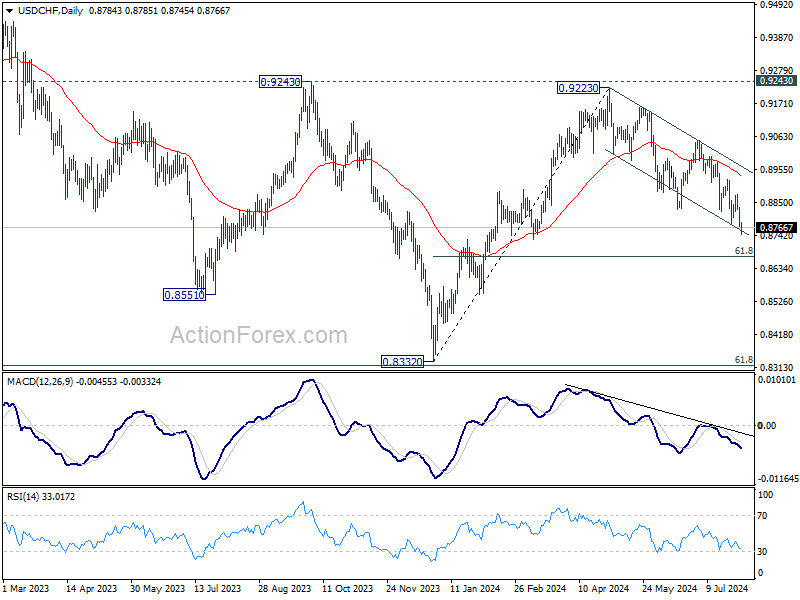
Daily Pivots: (S1) 0.8753; (P) 0.8797; (R1) 0.8823; More…
Intraday bias in USD/CHF remains on the downside for the moment. Current fall from 0.9223 is in progress for 61.8% retracement of 0.8332 to 0.9223 at 0.8672 next. For now, risk will stay on the downside as long as 0.8874 resistance holds, in case of recovery.
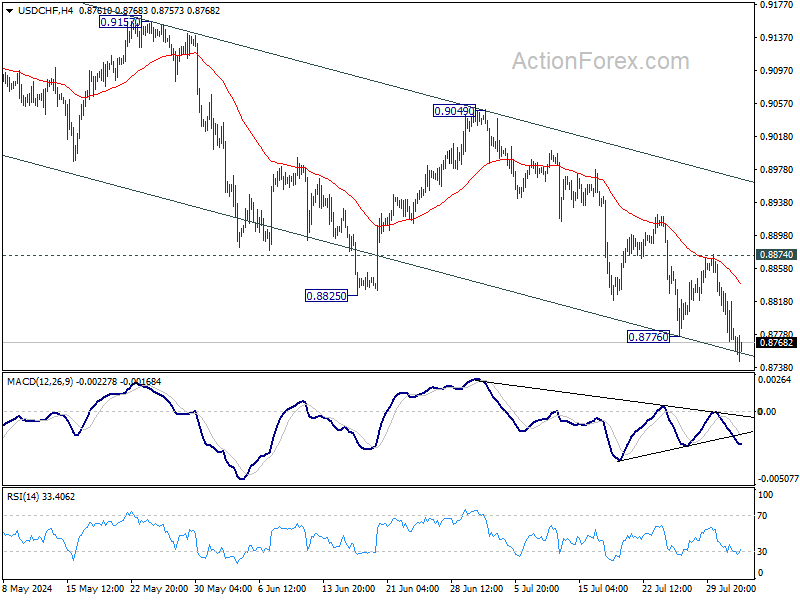
In the bigger picture, with 0.9243 resistance intact, medium term outlook in USD/CHF is neutral at best. For now, more sideway trading is likely between 0.8332/9243. However, firm break of 0.9243 will indicate larger bullish trend reversal.
EUR/USD Mid-Day Outlook
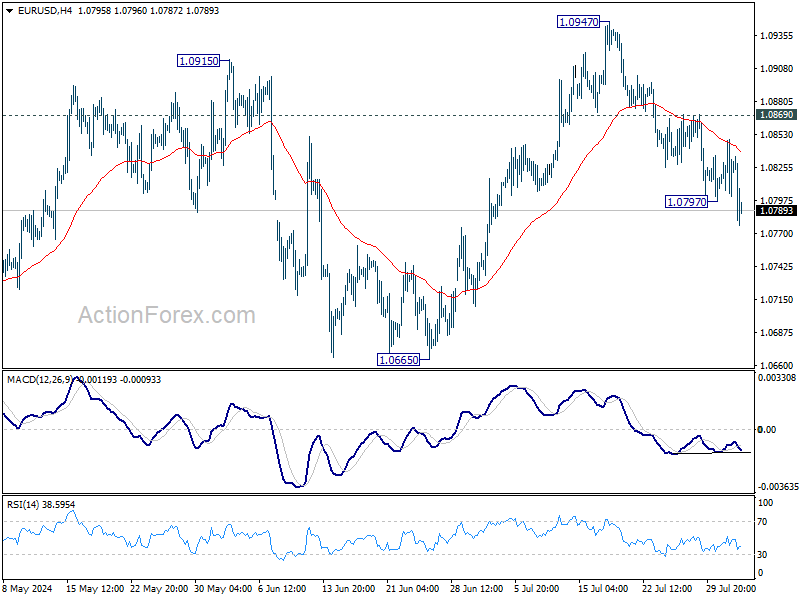
Daily Pivots: (S1) 1.0802; (P) 1.0826; (R1) 1.0849; More.....
EUR/USD's fall from 1.0947 resumed by breaking through 1.0797 temporary low and intraday bias is back on the downside. Current development suggest that rebound from 1.0601 has completed with three waves up to 1.0947. Deeper decline should be seen to 1.0665 support next. For now, risk will stay on the downside as long as 1.0869 resistance holds, in case of recovery.
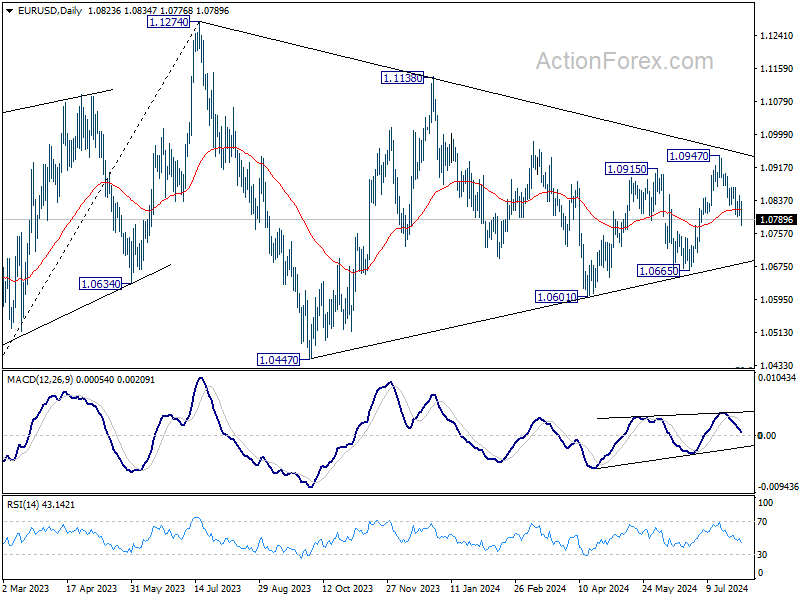
In the bigger picture, price actions from 1.1274 are viewed as a corrective pattern that's still be in progress. Break of 1.1138 resistance will be the first signal that rise from 0.9534 (2022 low) is ready to resume through 1.1274 (2023 high). However, break of 1.0665 support will extend the correction with another falling leg back towards 1.0447 support.
GBP/USD Mid-Day Outlook
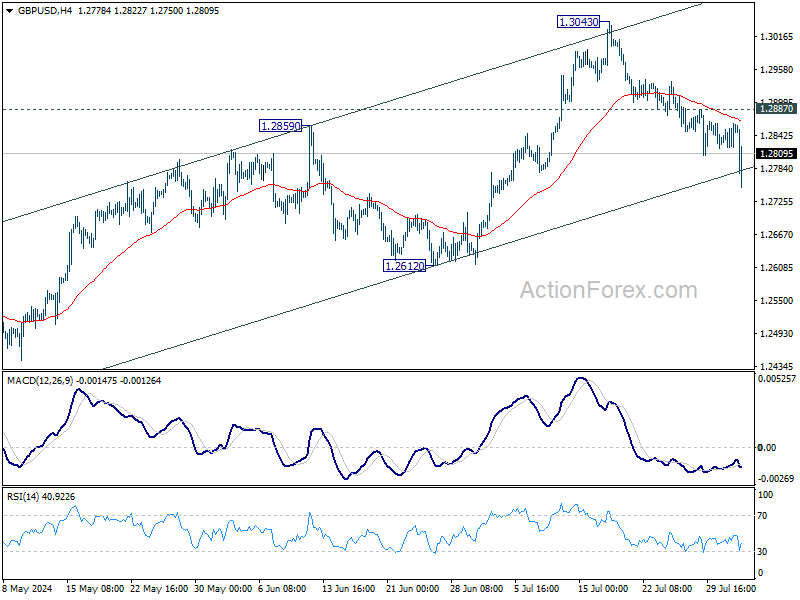
Daily Pivots: (S1) 1.2830; (P) 1.2847; (R1) 1.2873; More...
Intraday bias in GBP/USD remains on the downside for the moment. Fall from 1.3043 is in progress. Decisive break of 55 D EMA (now at 1.2782) will suggest that rise from 1.2298 has completed with three waves up to 1.3043. Deeper fall would be seen to 1.2612 support and below. On the upside, above 1.2887 minor resistance will turn intraday bias back to the upside for stronger rebound.
In the bigger picture, corrective pattern from 1.3141 medium term top (2023 high) could have completed with three waves to 1.2298 already. This will now remain the favored case as long as 1.2612 support holds. Firm break of 1.3141 will target 61.8% projection of 1.0351 (2022 low) to 1.3141 from 1.2298 at 1.4022. However, break of 1.2612 support argue that this corrective pattern is extending with another falling leg.
Sterling Stabilizes After Initial Selloff, BoE Easing Not Automatic Despite First Cut
Sterling suffered an initial sell-off in European trading and remained weak following BoE's decision to cut the Bank Rate by 25 basis points to 5.00%. However, it stabilized during Governor Andrew Bailey's press conference. The tight 5-4 vote to cut the rate underscored that monetary policy easing is not on auto-pilot for BoE. Bailey highlighted that today's reduction is a slight easing of policy restriction, maintaining that the policy must stay restrictive for sufficiently long. He stressed that the MPC remains "highly alert" to the risks of inflation persistence and will make future decisions on a "meeting to meeting" basis.
Meanwhile, Yen softened today, digesting the gains it made earlier in the week. With USD/JPY touching a key Fibonacci level at 148.66, there is potential for a rebound in USD/JPY, i.e., a pullback in the Yen. Conversely, Swiss franc emerged as the strongest currency of the day, benefiting from safe-haven flows due to ongoing tensions in the Middle East.
Also in the currency markets, Dollar and commodity currencies are struggling to find clear direction. The greenback is particularly focused on the upcoming ISM manufacturing data and tomorrow's non-farm payroll data for further guidance.
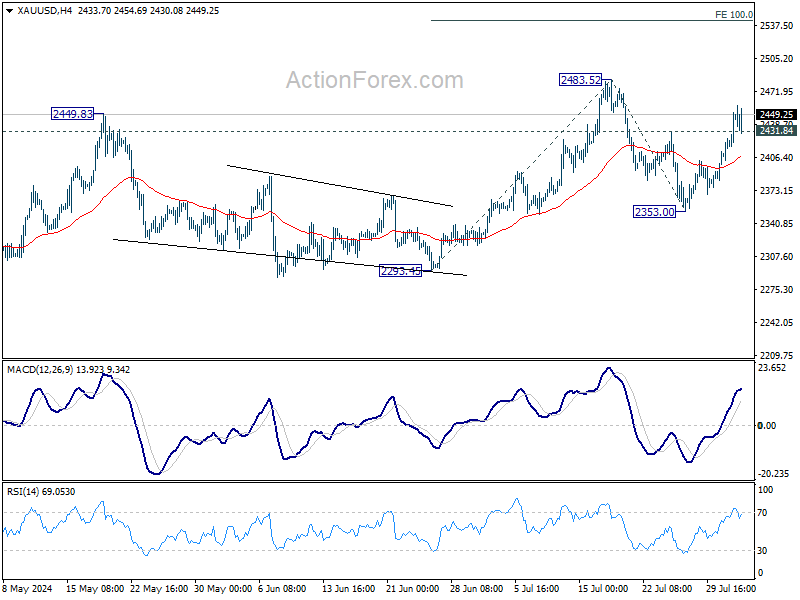
Technically, Gold's break of 2431.84 resistance suggests that correction from 2483.52 has completed at 2353.00. Further rise should be seen to retest 2483.52 first. Firm break there will resume larger up trend to 100% projection of 2293.45 to 2483.52 from 2353.00 at 2543.07.
In Europe, at the time of writing, FTSE is flat. DAX is down -1.07%. CAC is down -1.19%. UK 10-year yield is down -0.0575 at 3.912. Germany 10-year yield is down -0.0173 at 2.288. Earlier in Asia, Nikkei fell -2.39%. Hong Kong HSI fell -0.23%. China Shanghai SSE fell -0.22%. Singapore Strait Times fell -1.04%. Japan 10-year JGB yield fell -0.0263 to 1.035.
BoE cuts Bank Rate by 25bps to 5.00% in 5-4 tight vote
BoE cut the Bank Rate by 25 bps to 5.00% today, in a closely contested 5-4 vote. Governor Andrew Bailey, Deputy Sarah Breeden, new Deputy Clare Lombardelli, known dove Swati Dhingra, and Dave Ramsden voted in favor of the cut. Chief Economist Huw Pill, Megan Greene, Jonathan Haskel, and Catherine Mann voted against the change.
In the accompanying statement, BoE stated it is now "appropriate to reduce slightly the degree of policy restrictiveness." The central bank noted that the impact of past external shocks "has abated" and there has been "some progress" in moderating inflation risks.
Despite the cut, BoE emphasized that restrictive policy will continue to weigh on economic activity, leading to a looser labor market and reducing inflationary pressures.
UK manufacturing PMI finalized at 52.1, inflation pressure moving to manufacturing sector
UK PMI Manufacturing was finalized at 52.1 in July, up from June's 50.9. Production growth was the fastest since February 2022, while input price inflation hit an 18-month high.
Rob Dobson, Director at S&P Global Market Intelligence, noted that UK manufacturing has started the H2 on an "encouragingly solid footing." July saw increased production and new orders, with staffing levels rising for the first time since September 2022. Confidence reached its highest level in two-and-a-half years, with 60% of companies expecting output to rise over the next 12 months.
However, inflationary pressures are a "blot on the copybook", with input costs rising at the highest rate in 18 months. The ongoing Red Sea crisis and related freight issues are driving up prices. Selling prices also increased at the fastest rate since mid-2023. BoE is likely to remain cautious about loosening monetary policy due to these inflationary pressures "pivoting away from services and towards manufacturing."
Eurozone PMI manufacturing finalized at 45.8, recovering taking a hit
Eurozone's PMI Manufacturing was finalized at 45.8 in July, unchanged from June, indicating ongoing contraction. PMI Manufacturing Output fell from 46.1 to 45.6, a 7-month low. Input costs increased at the fastest rate in a year and a half.
Among countries, Greece led with a PMI of 53.2, a 7-month low. Spain recorded 51.0, a 6-month low. Ireland reached a 5-month high at 50.1, but the Netherlands fell to 49.2, a 6-month low. Italy showed a 4-month high at 47.4, France hit a 6-month low at 44.0, Germany a 3-month low at 43.2, and Austria a 4-month low at 43.1.
Cyrus de la Rubia, Chief Economist at Hamburg Commercial Bank, noted that the belief in the Eurozone's recovery "is taking a hit." He emphasized that the decline in production has "intensified" doubts, prompting a likely downgrade in GDP growth forecast from 0.8%. Industrial activity weakened broadly, with only Greece and Spain seeing meaningful growth, though momentum there also slowed. Austria and Germany displayed the greatest weakness.
Japan's PMI manufacturing finalized at 49.1 in Jul, back in contraction
Japan's PMI Manufacturing was finalized at 49.1 in July, down from June's 50.0, indicating that the sector is back in contraction streak since early 2023.
Usamah Bhatti of S&P Global Market Intelligence described the sector's performance as "downbeat" at the start of Q3. The decline was driven by a stronger reduction in new orders, leading to a renewed fall in production levels.
Inflationary pressures remained high, with input price inflation reaching a 15-month peak. Despite this, firms raised their selling prices more cautiously to stay competitive.
The near-term outlook appears "muted" due to the lack of new order inflows, allowing firms to clear outstanding business at the fastest rate since March. However, firms are optimistic that this period will pass within the coming year, expecting business expansion and new product launches to coincide with a broader economic recovery.
China's Caixin PMI manufacturing drops to 49.8, below expectations
China's Caixin PMI Manufacturing dropped from 51.8 to 49.8 in July, falling below the expected 51.6. S&P Global noted that output expanded at the slowest pace in nine months, average selling prices declined, and input cost inflation eased. However, business confidence showed improvement.
Wang Zhe, Senior Economist at Caixin Insight Group, commented, "Overall, the manufacturing sector largely stabilized in July. Supply expanded slightly, while domestic demand declined and external demand was steady. The reduction in business purchases was coupled with decreases in raw material stocks. The job market contraction was steady. Price levels faced pressure while market optimism improved slightly."
GBP/USD Mid-Day Outlook
Daily Pivots: (S1) 1.2830; (P) 1.2847; (R1) 1.2873; More...
Intraday bias in GBP/USD remains on the downside for the moment. Fall from 1.3043 is in progress. Decisive break of 55 D EMA (now at 1.2782) will suggest that rise from 1.2298 has completed with three waves up to 1.3043. Deeper fall would be seen to 1.2612 support and below. On the upside, above 1.2887 minor resistance will turn intraday bias back to the upside for stronger rebound.
In the bigger picture, corrective pattern from 1.3141 medium term top (2023 high) could have completed with three waves to 1.2298 already. This will now remain the favored case as long as 1.2612 support holds. Firm break of 1.3141 will target 61.8% projection of 1.0351 (2022 low) to 1.3141 from 1.2298 at 1.4022. However, break of 1.2612 support argue that this corrective pattern is extending with another falling leg.
Economic Indicators Update
| GMT | Ccy | Events | Actual | Forecast | Previous | Revised |
|---|---|---|---|---|---|---|
| 00:30 | JPY | Manufacturing PMI Jul F | 49.1 | 49.2 | 49.2 | |
| 01:30 | AUD | Trade Balance (AUD) Jun | 5.59B | 4.95B | 5.77B | 5.05B |
| 01:30 | AUD | Import Price Index Q/Q Q2 | 1.00% | -0.70% | -1.80% | |
| 01:45 | CNY | Caixin Manufacturing PMI Jul | 49.8 | 51.6 | 51.8 | |
| 07:45 | EUR | Italy Manufacturing PMI Jul | 47.4 | 46.2 | 45.7 | |
| 07:50 | EUR | France Manufacturing PMI Jul F | 44 | 44.1 | 44.1 | |
| 07:55 | EUR | Germany Manufacturing PMI Jul F | 43.2 | 42.6 | 42.6 | |
| 08:00 | EUR | Italy Unemployment Jun | 7.00% | 6.80% | 6.80% | 6.90% |
| 08:00 | EUR | ECB Economic Bulletin | ||||
| 08:00 | EUR | Eurozone Manufacturing PMI Jul F | 45.8 | 45.6 | 45.6 | |
| 08:30 | GBP | Manufacturing PMI Jul F | 52.1 | 51.8 | 51.8 | |
| 09:00 | EUR | Eurozone Unemployment Rate Jun | 6.50% | 6.40% | 6.40% | |
| 11:00 | GBP | BoE Interest Rate Decision | 5.00% | 5.00% | 5.25% | |
| 11:00 | GBP | MPC Official Bank Rate Votes | 0--5--4 | 0--6--3 | 0--2--7 | |
| 11:30 | USD | Challenger Job Cuts Y/Y Jul | 9.20% | 19.80% | ||
| 12:30 | USD | Initial Jobless Claims (Jul 26) | 249K | 239K | 235K | |
| 12:30 | USD | Nonfarm Productivity Q2 P | 2.30% | 1.50% | 0.20% | |
| 12:30 | USD | Unit Labor Costs Q2 P | 0.90% | 1.60% | 4.00% | |
| 13:30 | CAD | Manufacturing PMI Jul | 49.3 | |||
| 13:45 | USD | Manufacturing PMI Jul F | 49.5 | 49.5 | ||
| 14:00 | USD | ISM Manufacturing PMI Jul | 48.8 | 48.5 | ||
| 14:00 | USD | ISM Manufacturing Prices Paid Jul | 52.5 | 52.1 | ||
| 14:00 | USD | ISM Manufacturing Employment Index Jul | 49.3 | |||
| 14:00 | USD | Construction Spending M/M Jun | 0.20% | -0.10% | ||
| 14:30 | USD | Natural Gas Storage | 22B |