Sample Category Title
More Verbal Intervention Warnings by Japanese Top Officials
Markets
The sell-off at the long end of the US Treasury curve was the odd one out yesterday. The US Note future slid from start to finish with tenors from 7- to 30-yr adding around 8 bps. From a technical point of view, this lifts the 10-yr yield away from the recent lows/support zone near 4.20%. The front end of the curve (2-yr) is still stuck near 4.70%. Yesterday’s move stood out given that it occurred in what was mostly a risk-off session with European stock markets throwing away opening losses, the dollar marching to new short-term highs and French assets underperforming. The move also occurred in the run-up to tomorrow’s May PCE deflators which should be a benign outcome after May CPI releases. On top, it coincides with the traditional build-up towards the end-of-quarter which often sees beneficial flows towards bonds. Our best guess for yesterday’s underperformance of US Treasuries has to do with tonight’s presidential debate between Biden and Trump. None of them seems to have reigning in ailing public finances as a top priority. On the contrary, fiscal policy could remain expansionary. Former NY Fed governor Dudley highlighted the matter again yesterday in an opinion piece. Markets tend to forget that the CBO last week upgraded the fiscal 2024 budget deficit forecast from $1.5tn to $1.9tn. To know that longer-term studies by that same Congressional Budget Office already point at budget deficits of more than 5% of GDP for the next 30 years. In this respect, Dudley warns that the more the government borrows, the greater the change it’ll end up in a vicious cycle in which government debt and interest rates drive one another inexorably upward. “It’s impossible to know when investors will decide that such risks are too much to bear, as the bond vigilantes famously did in the 1990s. When it happens, it tends to be sudden and brutal”.
News flow is thin this morning apart from more verbal intervention warnings by Japanese top officials as USD/JPY holds above 160. EUR/USD trades south of 1.07 and is likely to stay there ahead of and after the first round of French parliamentary elections (Sunday). We keep a close eye at the long end of core bond curves to see whether yesterday’s move was a one-off repositioning or whether more is at hand. Apart from the above-mentioned presidential debate, the eco calendar contains EC confidence data, US weekly jobless claims and durable goods orders. We don’t expect these figures to be of any importance. The US Treasury concludes its end-of-month refinancing operation with a $44bn 7-yr Note sale and there are policy meetings in Sweden, Turkey and the Czech Republic.
News & Views
In its yearly regular stress test of US largest banks, the Fed concluded that “while large banks would endure greater losses than last year's test, they are well positioned to weather a severe recession and stay above minimum capital requirements”. The greater loss compared to last year comes from substantial increases in banks’ credit card balances with higher delinquency rates, riskier corporate credit portfolios and higher expenses and lower fee income in recent years. The hypothetical scenario includes a severe global recession with a 40% decline in commercial real estate prices, a substantial increase in office vacancies, and a 36% decline in house prices. The unemployment rate rises nearly 6-1/2 percentage points to a peak of 10%, and economic output declines commensurately. The Board also conducted an exploratory analysis, including two funding stresses to all banks tested and two trading book stresses to only the largest and most complex banks. The two funding stresses include a rapid repricing of deposits, combined with a more severe and less severe recession. The trading book stresses included the failure of five large hedge funds under different market conditions.
Japanese retail sales beat consensus in May, rising by 1.7% M/M and 3% Y/Y, compared to 0.8% M/M and 2% Y/Y in April. Even as some of the gains might be due to price increases, the data are supportive for the BOJ’s aim to support domestic consumption via higher wages. The data also suggest that Japanese consumption might support Q2 economic growth after a contraction the first quarter. (Q1 GDP contracted 0.5% with consumption even declining 0.7% Q/Q).
Graphs
GE 10y yield
The ECB cut its key policy rates by 25 bps at the June policy meeting. A more bumpy inflation path in H2 2024, the EMU economy gradually regaining traction and the Fed’s higher for longer US strategy make follow-up moves difficult. Markets are coming to terms with that. For the time being, though, the political narrative (France) dominates. After hitting a new YtD top at 2.7%, the German 10-yr yield corrected lower on safe haven bids.

US 10y yield
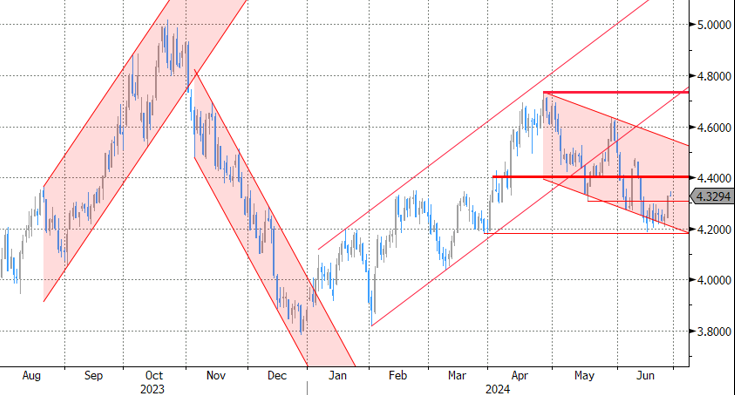
The Fed is seeking more evidence than just one slower-than-expected (May) CPI is providing. Upgraded inflation forecasts and a higher neutral rate complicate the exact timing of a first cut further. June dots suggest one move in 2024 followed by four more next year. Markets are positioned more aggressively, turning the recent low in yields into a technical support zone. The US 10-y yield is testing the downside of the 4.2/4.7% trading range.
EUR/USD
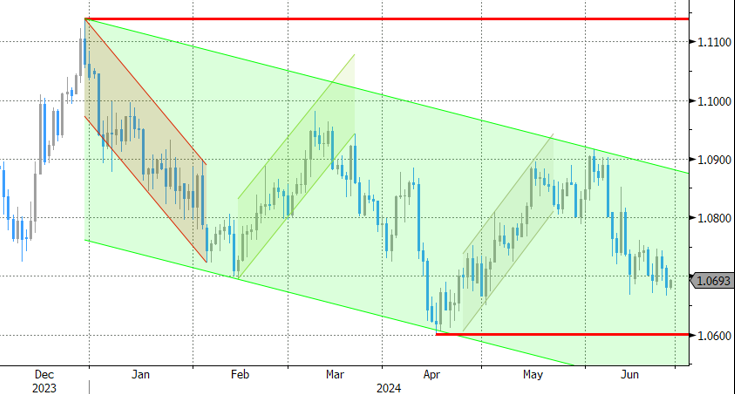
EUR/USD is stuck in the 1.06-1.09 range. The desynchronized rate cut cycle with the ECB exceptionally taking the lead, strong US May payrolls and a swing to the right in European elections pulled the pair away from 1.09 resistance. The Fed meeting balanced the weaker than expected US CPI outcome. Euro fragility makes a return to the 1.06 downside more likely than not.
EUR/GBP
Debate at the BOE is focused at the timing of rate cuts. May headline inflation returned to 2%, but core measures weren’t in line with inflation sustainably returning to target any time soon. Still some BoE members at the June meeting appeared moving closer to a rate cut. This might cap further sterling gains. At the same time, the euro remains vulnerable to political event risk going into the French elections. EUR/GBP 0.84 is becoming solid support.

Yen Drops to 1986 Low
In focus today
Today focus will be on the Riksbank's policy rate announcement at 09.30 CEST followed by a press conference at 11.00 CEST. The Riksbank is widely expected to leave the policy rate unchanged at 3.75%. We stick to our call for the next rate cut coming in September, followed by quarterly cuts of 25bp, bringing the policy rate to 2.25% at the end of 2025. Market focus will instead be on the updated rate path projection and inflation forecast, however no major revisions to the March forecast seem warranted as May inflation surprised to the upside. For Sweden, NIER's Economic Tendency Survey is also published at 09.00 CEST.
In the US, President Biden faces former President Trump for the first time this election campaign in a 90-minute televised debate hosted by the CNN. The debate may shed more light on each of their ambitions for fiscal policy and regulation in the coming years. The debate begins at 21.00 ET (Friday 03.00 CEST).
In the euro area, we look out for the May monetary aggregates and lending data. Our focus is on the lending data as we have recently seen a rebound in the credit impulse.
The Central Bank of Turkey will announce their policy rate at 13.00 CEST. In line with consensus, we expect them to keep the policy rate unchanged at 50.0%.
Overnight we get some interesting Japanese data. These include Tokyo May inflation and industrial production. Price pressures have muted in Japan recently and Tokyo data will indicate whether this trend continued in June. Japan has been less affected by the global manufacturing recession than most due to support from the weak yen. With manufacturing PMIs close to 50 in June, we are looking for some comeback in industrial production.
Danske Morning Mail will take a summer break from 1 July to 12 August.
Economic and market news
What happened overnight
In Japan, authorities issued fresh warnings that they may soon intervene in FX markets, as the JPY continued to weaken and fell to its lowest level against the US dollar (USD/JPY) since 1986. Japanese Finance Minister Shunichi Suzuki said the government would take 'necessary steps', as one-sided rapid currency moves were undesirable, and a cause for concern in regard to the wider economy. When the yen hit a 34-year low against the US dollar at the end of April, Japanese authorities spent USD61bn intervening. The yen dropped to a low of 160.88 last night, and this morning the USD/JPY cross is trading not far from this level at around 160.4.
In China, growth in industrial profits slowed down in May, as they stood at 3.4% YTD y/y (prior: 4.3% YTD y/y). On a sector basis profits in mining had fallen the most at -16.2% YTD y/y, whereas manufacturing had increased the most at 6.3% YTD y/y.
What happened yesterday
In Europe, Italian central bank chief Fabio Panetta said that 'the current macroeconomic picture is consistent with a normalization of the monetary policy stance'. He argued that the stickiness seen in service prices was 'not abnormal in any way', saying the persistence in inflation was 'only apparent' as it merely reflected service prices rising, peaking, and falling later than goods prices.
GBP/JPY Daily Outlook
Daily Pivots: (S1) 202.14; (P) 202.43; (R1)202.90; More...
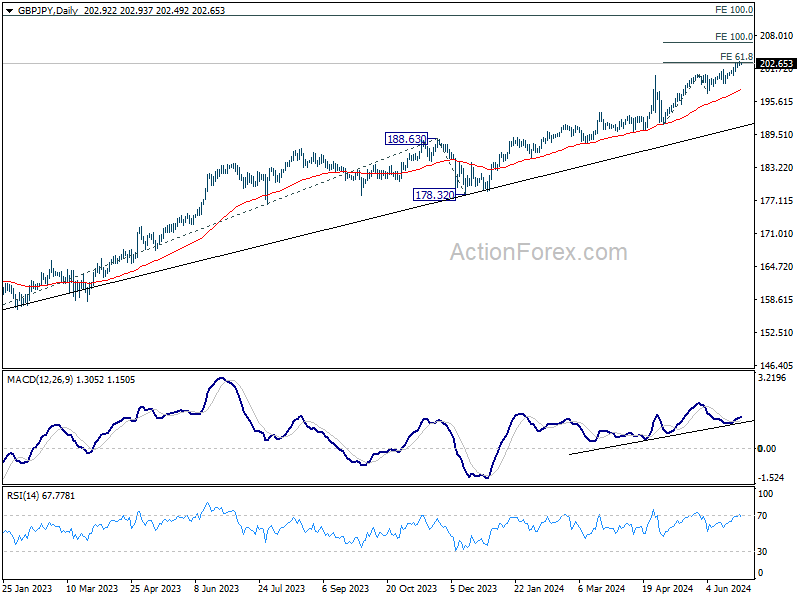
Intraday bias in GBP/JPY remains on the upside for the moment. Firm break of 61.8% projection of 191.34 to 200.72 from 197.18 at 202.97. will pave the way to 100% projection at 206.56 next. On the downside, below 201.95 minor support will turn intraday bias neutral first. But outlook will remain bullish as long as 198.90 support holds, in case of retreat.
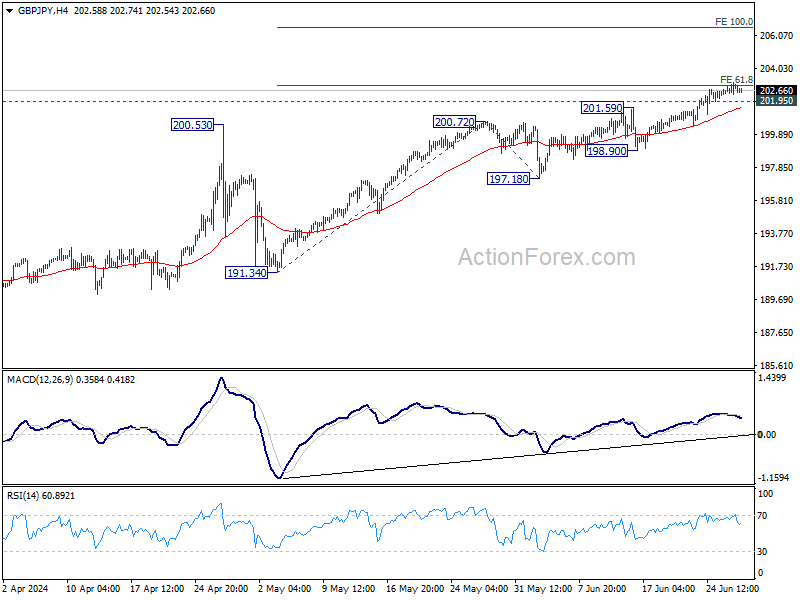
In the bigger picture, long term up trend is still in progress. Next target is 100% projection of 155.33 to 188.63 from 178.32 at 211.62. Outlook will stay bullish as long as 191.34 support holds, even in case of deep pullback.
EUR/JPY Daily Outlook
Daily Pivots: (S1) 171.11; (P) 171.45; (R1) 172.06; More...
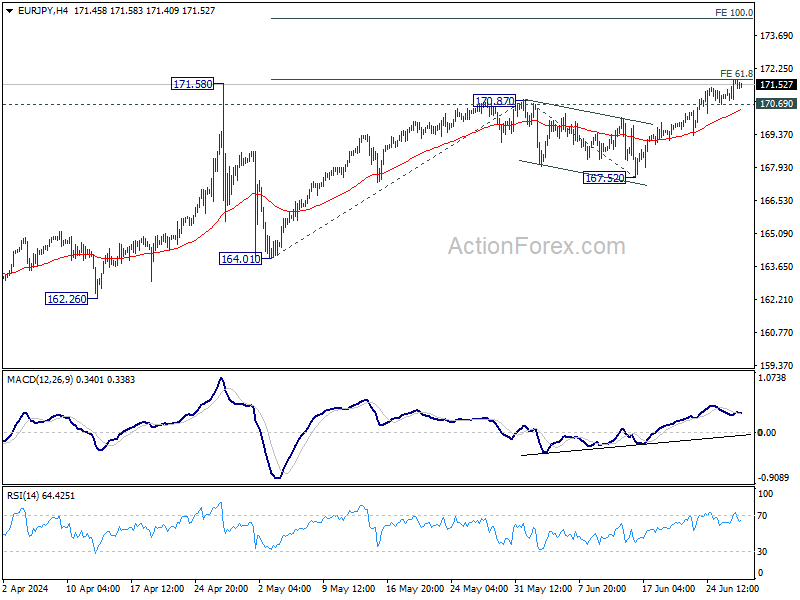
Intraday bias in EUR/JPY is back on the upside as recent rally resumed after brief consolidations. Sustained break of 61.8% projection of 164.01 to 170.87 from 167.52 at 171.75 will target 100% projection at 174.38. On the downside, below 170.69 minor support will turn intraday bias neutral against first.
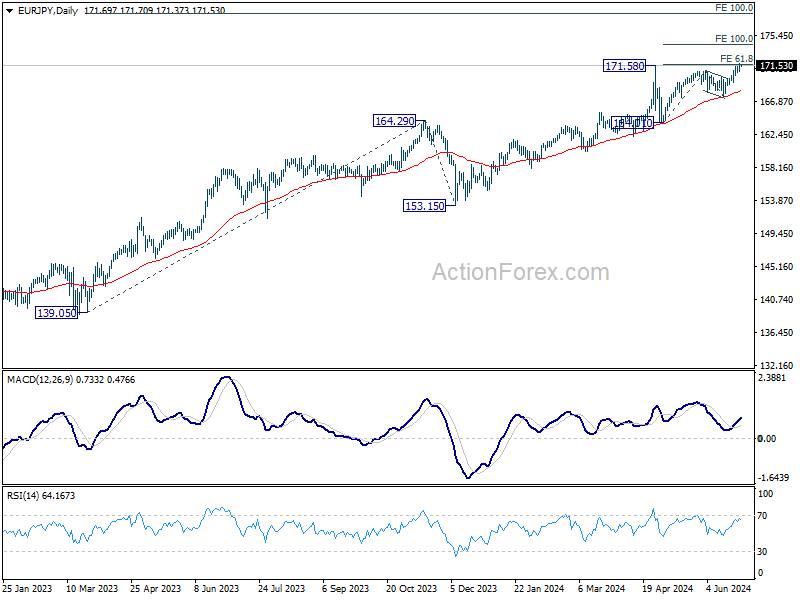
In the bigger picture, strong support from 55 D EMA indicates that the long term up trend is still in progress. Decisive break of 171.58 will confirm resumption and target 100% projection of 139.05 to 164.29 from 153.15 at 178.38. For now outlook will stay bullish as long as 164.01 support holds, even in case of deep pullback.
EUR/GBP Daily Outlook
Daily Pivots: (S1) 0.8442; (P) 0.8453; (R1) 0.8473; More...
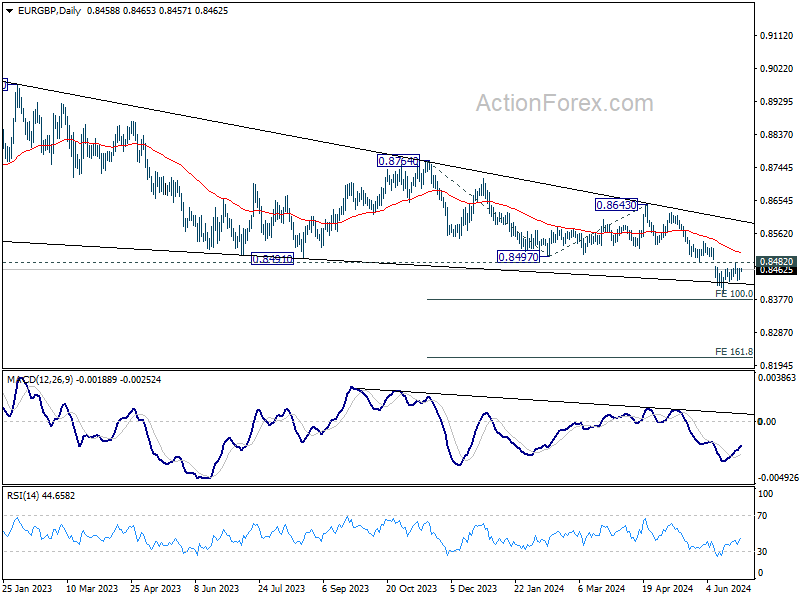
Intraday bias in EUR/GBP remains neutral for the moment. Also, outlook stays bearish with 0.8482 support turned resistance intact. On the downside, below 0.8429 minor support will bring retest of 0.8396 low first. Further break there will resume larger down trend to 0.8376 projection level next.
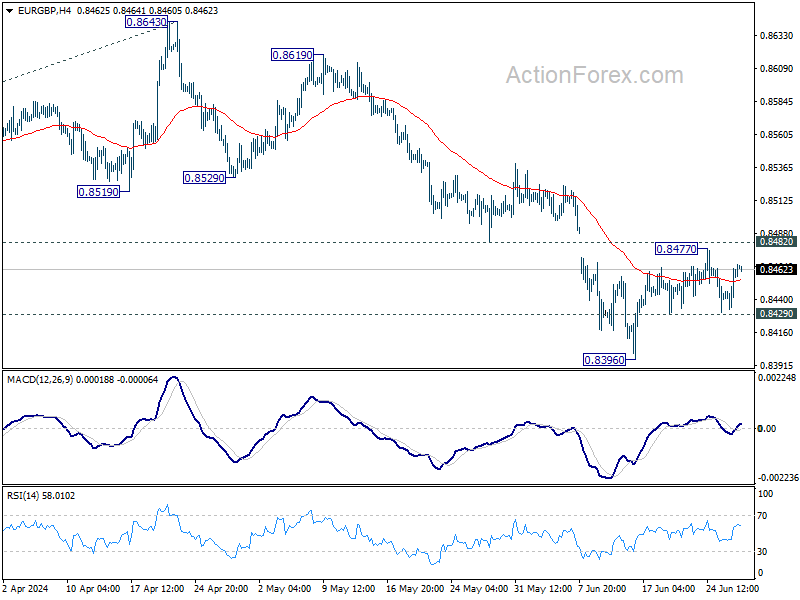
In the bigger picture, down trend from 0.9267 (2022 high) is in progress. Next target is 100% projection of 0.8764 to 0.8497 from 0.8643 at 0.8376. Sustained break there will target 161.8% projection at 0.8211 next. For now, outlook will remain bearish as long as 0.8643 resistance holds, even in case of stronger rebound.
EUR/AUD Daily Outlook
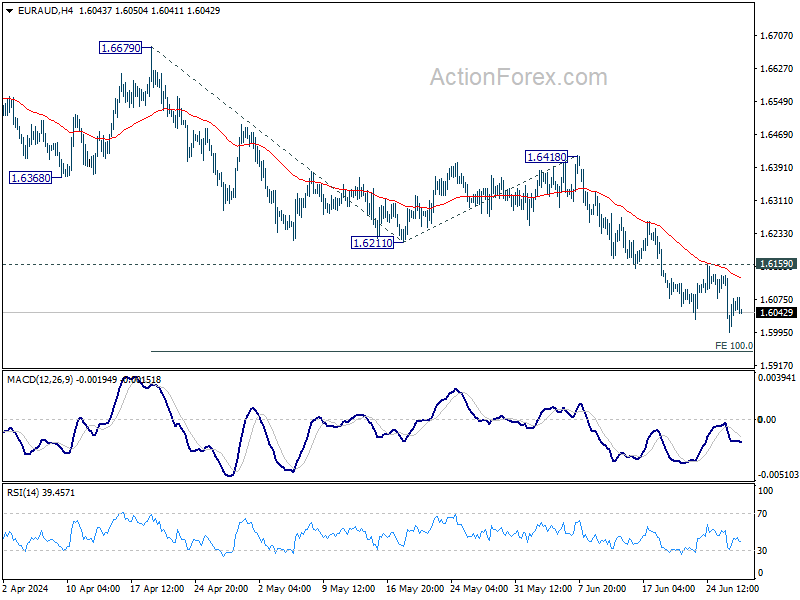
Daily Pivots: (S1) 1.5995; (P) 1.6068; (R1) 1.6137; More...
Intraday bias in EUR/AUD stays on the downside for the moment. Current decline is expected to continue to 100% projection of 1.6679 to 1.6211 from 1.6418 at 1.5950. Firm break there will target 1.5846 key support next. For now, risk will stay on the downside as long as 1.6159 resistance holds, in case of recovery.
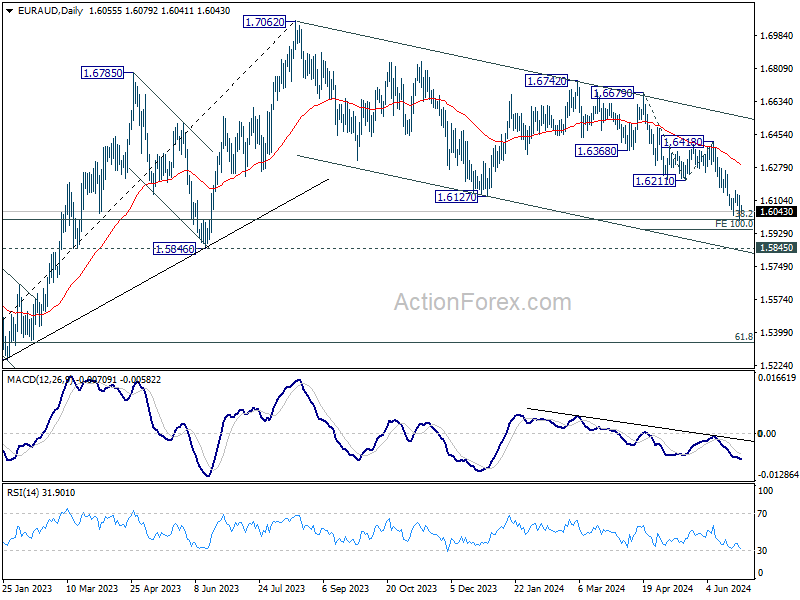
In the bigger picture, fall from 1.7062 medium term top is seen as a correction to the up trend from 1.4281 (2022 low) only. Strong support is still expected between 1.5846 and 38.2% retracement of 1.4281 to 1.7062 at 1.6000 to bring rebound. Break of 1.7062 is in favor at a later stage.
EUR/CHF Daily Outlook
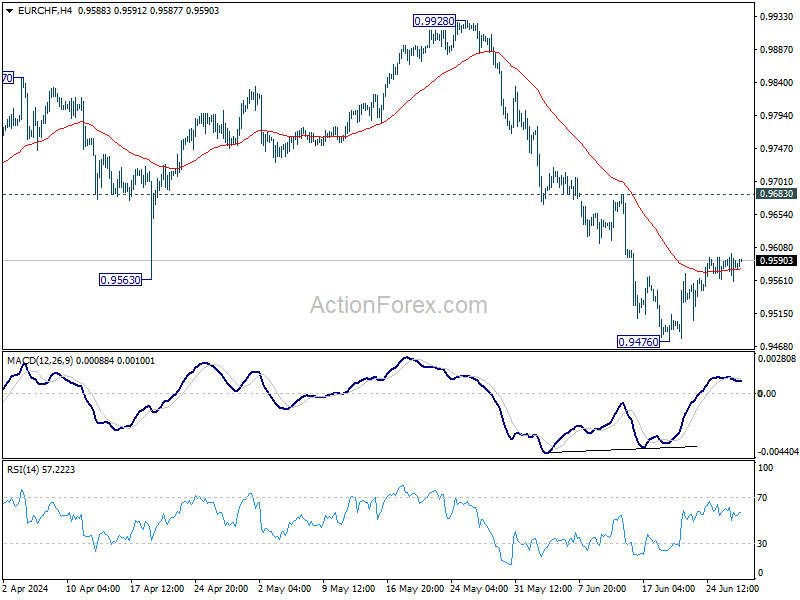
Daily Pivots: (S1) 0.9564; (P) 0.9582; (R1) 0.9603; More....
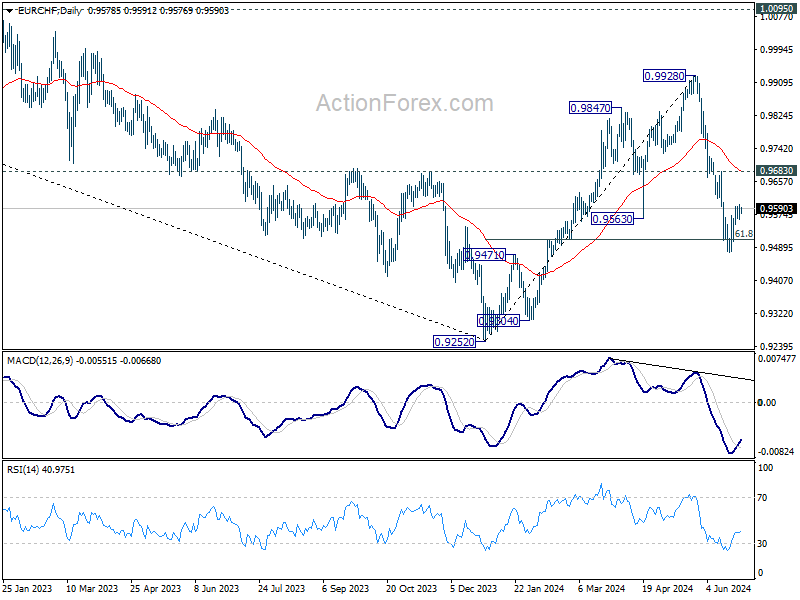
No change in EUR/CHF's outlook as consolidation from 0.9476 is extending. Intraday bias remains neutral for the moment. Outlook will remain bearish as long as 0.9683 resistance holds. On the downside, break of 0.9476, and sustained trading below 61.8% retracement of 0.9252 to 0.9928 at 0.9510 will bring retest of 0.9252 low next.
In the bigger picture, rebound from 0.9252 should have completed at 0.9228. Medium term outlook remains bearish with 1.0095 resistance intact. Firm break of 0.9252 will resume the down trend from 1.2004 (2018 high).
Elliott Wave Intraday Analysis on AUDJPY Looking to End Wave 5
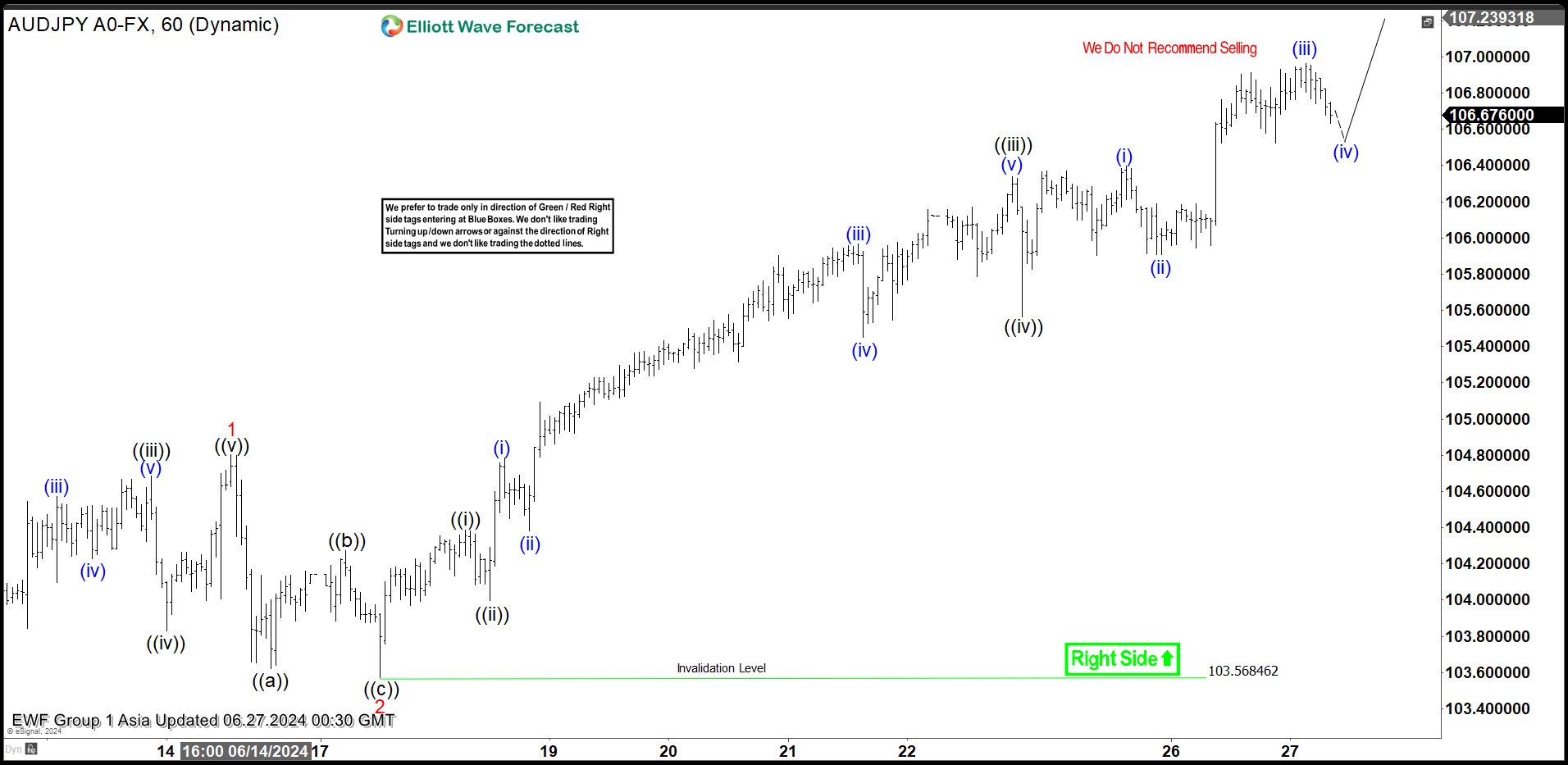
Short Term Elliott Wave in AUDJPY suggests rally from 6.4.2024 low is in progress as a 5 waves impulse structure. Up from 6.4.2024 low, wave 1 ended at 104.8 and pullback in wave 2 ended at 103.57. Internal subdivision of wave 2 unfolded as a zigzag where wave ((a)) ended at 103.6, wave ((b)) ended at 104.27, and wave ((c)) lower ended at 103.56. This completed wave 2 in higher degree and the pair has turned higher in wave 3. Up from wave 2, wave ((i)) ended at 104.38 and pullback in wave ((ii)) ended at 104.
Pair has extended higher in wave ((iii)). Up from wave ((ii)), wave (i) ended at 104.78 and dips in wave (ii) ended at 104.38. Pair extended higher in wave (iii) towards 105.96 and pullback in wave (iv) ended at 105.45. Final leg wave (v) ended at 106.33 which completed wave ((iii)). Pullback in wave ((iv)) ended at 105.56. Pair has extended higher in wave ((v)) with internal as another impulse in lesser degree. Up from wave ((iv)), wave (i) ended at 106.39 and dips in wave (ii) ended at 105.90. Wave (iii) higher ended at 106.96. Expect pullback in wave (iv) before it resumes higher. Near term, as far as pivot at 103.56 low stays intact, expect dips to find support in 3, 7, or 11 swing for further upside.
AUDJPY 60 Minutes Elliott Wave Chart
AUDJPY Elliott Wave Video
https://www.youtube.com/watch?v=vv4Ut_3b2gA
Need Morphine
The selloff in Japanese yen extended yesterday sending the currency to the lowest levels since 1986 against the US dollar and to the lowest levels against the euro. The EURJPY is now flirting with the 172 level, while the USDJPY is consolidating gains above the 160 level. The only thing that prevents the yen from a further fall is the direct intervention risk. But other than that, the yen deserves to lose more blood. One-year risk reversals, which show how traders feel about the yen over a longer time, hint that they're still kind of excited about the yen compared to the dollar. But that excitement is fading fast as the Bank of Japan (BoJ) keeps delaying its intervention plans meanwhile the Federal Reserve delays its rate cutting plans. The BoJ is expected – is obliged – to give a clearer roadmap regarding how it will reduce its bond purchases in July meeting. They might also be obliged to hike rates given that the pressure on the yen won’t ease until concrete steps are taken on the policy front. Everyone knows that a direct FX intervention will be nothing more than just another morphine injection: it won’t give the yen more than a temporary relief.
Elsewhere, the euro remains under the pressure of French political shenanigans. The EURUSD gets comfortable below the 1.07 level and the downside pressure will likely mount from now to the weekly close as many investors will probably chose to exit their long euro exposure before the first round of the legislative election that’s due this weekend in France (and which will likely confirm the French preference for Marine Le Pen’s party). Sentiment data due this morning from the Eurozone could also put numbers on the European political worries.
Across the Channel, the British pound also comes under pressure. Cable cleared important technical supports yesterday as it slid below the 100 and 50-DMAs and below the major 38.2% Fibonacci retracement on April to June rally, meaning that the pair has now stepped into the medium term bearish consolidation zone and is vulnerable to a further fall against the US dollar. The next support zone sits at 1.2560/80, the zone that shelters the 200-DMA and the 50% retracement. We could see the pound bears take aim at this range given that the general election in the UK is approaching. There is not much doubt about a Torie washout. This being said, there is a problem that the FT summarizes very well in just one sentence: Labour and the Conservatives are on course to register their lowest combined vote share in a century, according to pre-election polls. The latter could leave the country with a lot of political uncertainties moving forward.
Far, far away from home, the Australian dollar is among rare major currencies that challenge the dollar’s strength, after the Australian inflation hit 4% in May, leaving the RBA doves with no more energy to fly. But overall, the weakness in euro, pound and yen sent the US dollar index to the highest levels since the beginning of May, and expect more inflows into the greenback before the French election weekend.
One thing that could derail the US dollar’s positive trajectory this week is economic data. Due today, the US will reveal its latest GDP update, and tomorrow we will have a look at the core PCE – the Federal Reserve’s (Fed) favourite gauge of inflation. What the Fed doves want to see is a reasonably softer economic growth combined with softening inflation. The risk is seeing a softening growth with insufficient retreat in inflation. Good news is that the inflation component in the GDP report won’t matter much as inflation has started to ease after an early uptick in Q1, so we won’t have the full picture to speculate on new Fed scenarios before tomorrow’s PCE release. In all cases, rising bets that the Fed could cut rates by 300bp in the next nine months is overdone unless a big, big problem emerges in the US economy.
In equities and bonds, the US 2-year yield was slightly higher yesterday, the 5 and 10-year yields rose to the highest levels in two weeks despite a good 5-year bond auction as the rising Japanese yields rose anxiety among bond investors, but not among stock buyers. The S&P500 and Nasdaq closed slightly higher on Wednesday thanks to a late rally, as Amazon hit a record high following a 3.9% rally and reached the $2 trillion mark in terms of market cap for the very first time after announcing its plans to launch a Temu-like discount section that ships goods directly from China. Temu’s owner PDD plunged below its 50-DMA on the news. Rivian rose 23% after Volkswagen said it will invest $5bn to a joint venture to produce the next generation EVs with the struggling Rivian, while Micron fell 8% in late trading despite better-than-expected earnings and revenue, because the revenue forecast for the current quarter just met analyst expectations of $7.6bn for the current quarter. Yes, anything less than fantastic is not good enough when your share price got multiplied by three in just about 18 months. Finally, FedEx jumped 15% and Novo Nordisk – the biggest European company that sells weight-loss drugs – hit a fresh record after announcing that it could finally got the approval from Chinese authorities to sell its drugs to the Chinese (who wouldn’t need them if they stuck to their own delicious diet… )
USD/CAD Daily Outlook
Daily Pivots: (S1) 1.3663; (P) 1.3685; (R1) 1.3725; More...
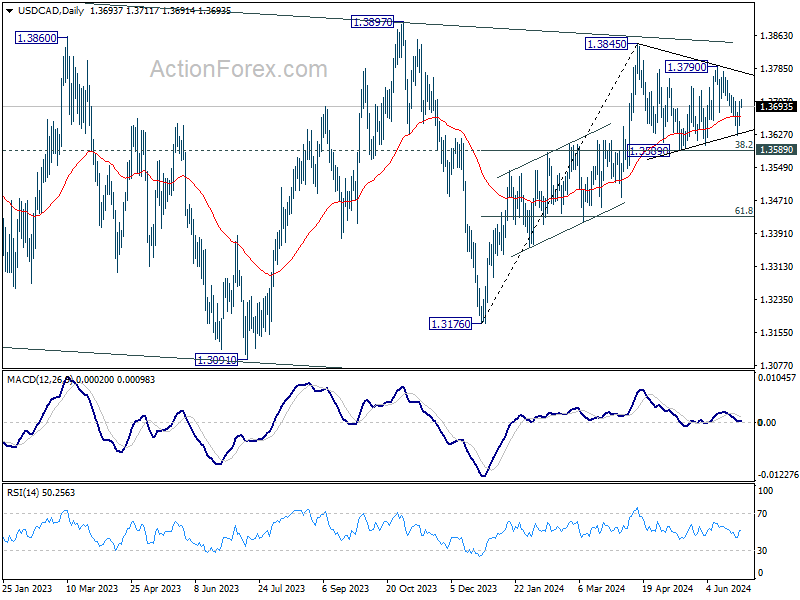
Intraday bias in USD/CAD is turned neutral with current rebound. Outlook is unchanged that corrective pattern from 1.3845 is still extending. Below 1.3626 will target 1.3589 cluster support. Nevertheless, break of 1.3717 will turn bias back to the upside for 1.3790 resistance instead.
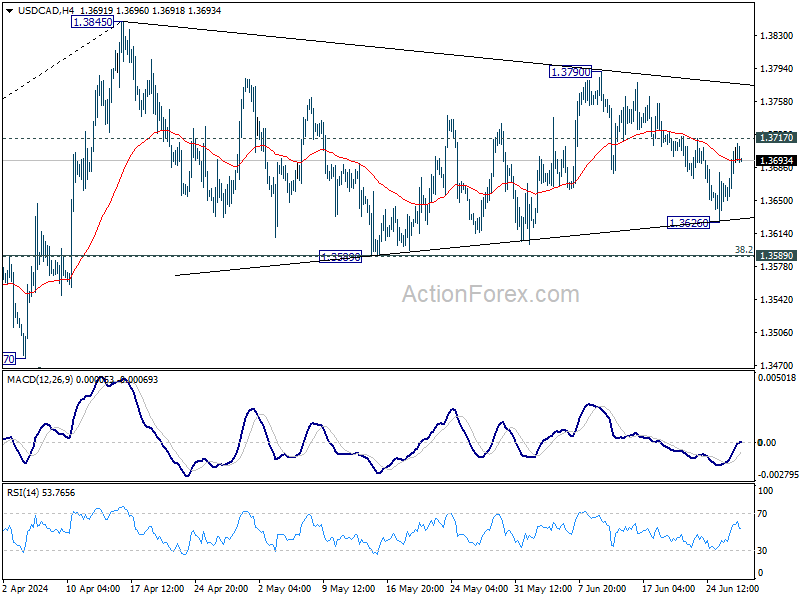
In the bigger picture, price actions from 1.3976 (2022 high) are viewed as a corrective pattern. In case of another fall, strong support should emerge above 1.2947 resistance turned support to bring rebound. Firm break of 1.3976 will confirm up resumption of whole up trend from 1.2005 (2021 low). Next target is 61.8% projection of 1.2401 to 1.3976 from 1.3176 at 1.4149.