Sample Category Title
USD/JPY Mid-Day Outlook
Daily Pivots: (S1) 141.57; (P) 142.02; (R1) 142.61; More...
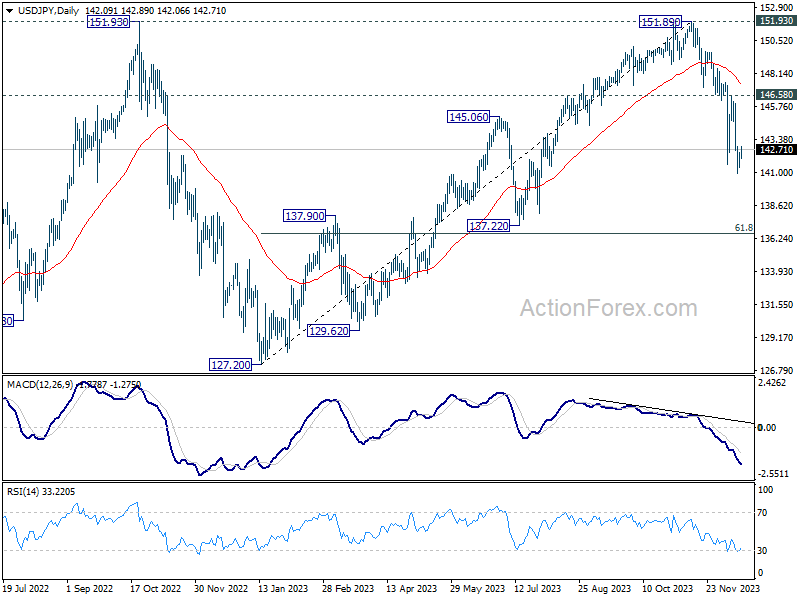
USD/JPY is still extending consolidation from 140.95 and intraday bias remains neutral. Stronger recovery cannot be ruled out. But upside should be limited well below 146.58 resistance to bring another decline. On the downside, break of 140.94 will resume the fall from 151.89 to next fibonacci level at 136.63.
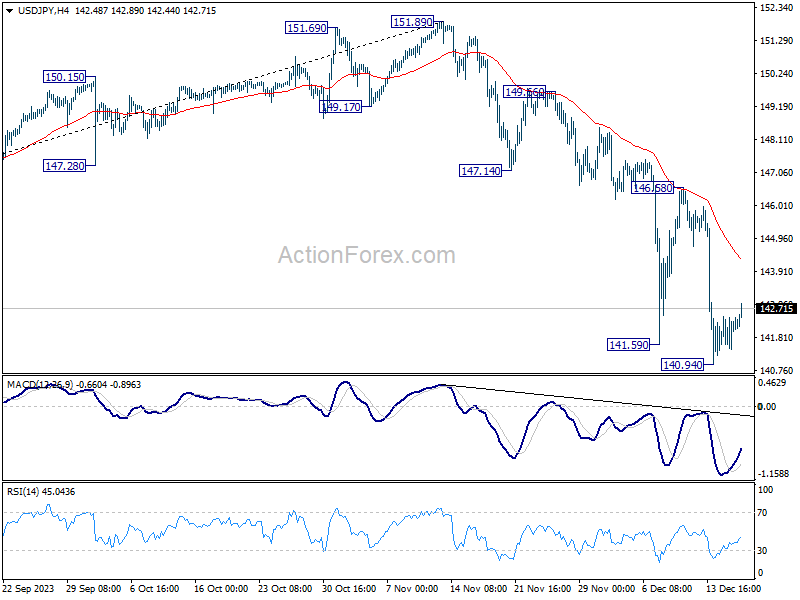
In the bigger picture, fall from 151.89 is seen as the third leg of the corrective pattern from 151.93 (2022 high). Deeper decline would be seen to 61.8% retracement of 127.20 to 151.89 at 136.63, sustained break there will pave the way to 127.20 support (2022 low). This will now remain the favored as long as 146.58 resistance holds.
Central Banks Look to Spoil the Party, BoJ Eyed Tonight
Not the most thrilling start to the week but that's to be expected given the number of major events over the last few sessions and the absence of anything significant today.
The second half of last week was quite the ride, with the Fed going further than many expected on rate cuts for next year, the ECB then pushing back stronger than anticipated, and the BoE proving they're not even up for discussion yet as three policymakers voted to hike.
That said, it's almost like the latter two never happened as markets are still pricing 150 basis points of cuts from the Fed and ECB next year and 100 basis points from the BoE.
There's every chance the ECB messaging was designed to prevent a repeat performance of how markets responded to the Fed. And with the former not releasing a dot plot as their US counterparts do, it was easier to take that position. A lot is now priced in and the ECB was likely driven by the desire to stop conditions easing any further.
We've seen more pushback from policymakers on both sides since which suggests no one is particularly pleased with just how carried away investors have got. But as yet, it hasn't had too great an impact and it may take a much bigger effort and some disappointing economic figures to kill the buzz.
We have inflation data from the US and UK this week which could easily do just that, although in the case of the former, the CPI numbers released a couple of weeks earlier tend to be more impactful even if these are the Fed's preferred measure.
The BoJ overnight tonight will also be interesting given the amount of speculation about ending negative interest rates in the new year and further tweaks to yield curve control. This week probably still comes too soon but I would say this is still very much a live meeting that could surprise a few, if not in the form of the decisions then potentially the messaging.
Oil recovers as markets price in more rate cuts
Oil prices are recovering a little but remain broadly under pressure after falling 20% over two months from the middle of October. There's still a lot of uncertainty and debate around the demand outlook for next year and it would appear the prospect of many rate cuts has boosted the odds of a softer landing which could support demand and may have done the same to the price in recent days.
But there are clearly risks to that, not least that markets may have become overly optimistic about cuts next year. Then there's also the risk that past cuts could have an even more dampening impact on the global economy or that OPEC+ compliance is as weak as the deal indicated it could be. There are of course upside risks too, that demand and the economy outperform as they have this year which much lower interest rates could support.
Gold back above $2,000 but can it hold?
December has been a volatile month for gold, with the yellow metal kicking things off with new record highs before immediately giving those gains back to move below $2,000. The last week has seen it bounce back above $2,000, the question now is whether it's a sustainable rebound. While the environment looks favorable for gold, recent moves suggest traders aren't convinced at these levels and I'm not sure how much more optimistic on rates markets can reasonably become. A weaker dollar could help but if recent days are anything to go by, this may well become the season of pushback from central banks desperately trying to manage expectations.
NIKKEI (NKD_F) Forecasting The Rally After 3 Waves Pull Back
Hello fellow traders. In this technical article we’re going to take a look at the Elliott Wave charts charts of NIKKEI Futures published in members area of the website. As our members know NIKKEI Futures has been giving us good trading setups recently. We have been favoring the long side due to impulsive bullish sequences the futures is showing. In further text we’re going to explain the short term Elliott Wave forecast.
NIKKEI Elliott Wave 1 Hour Chart 12.14.2023
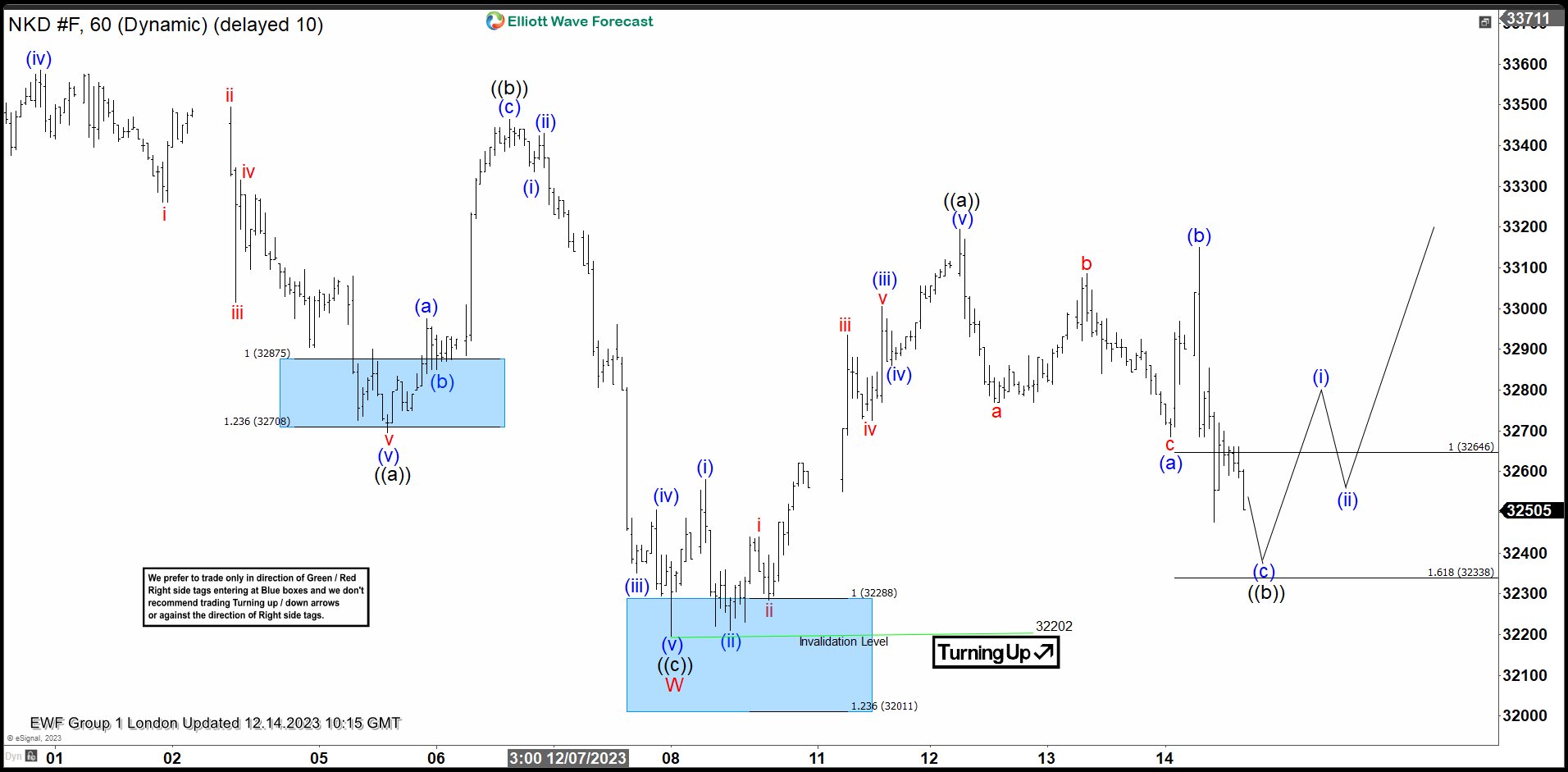
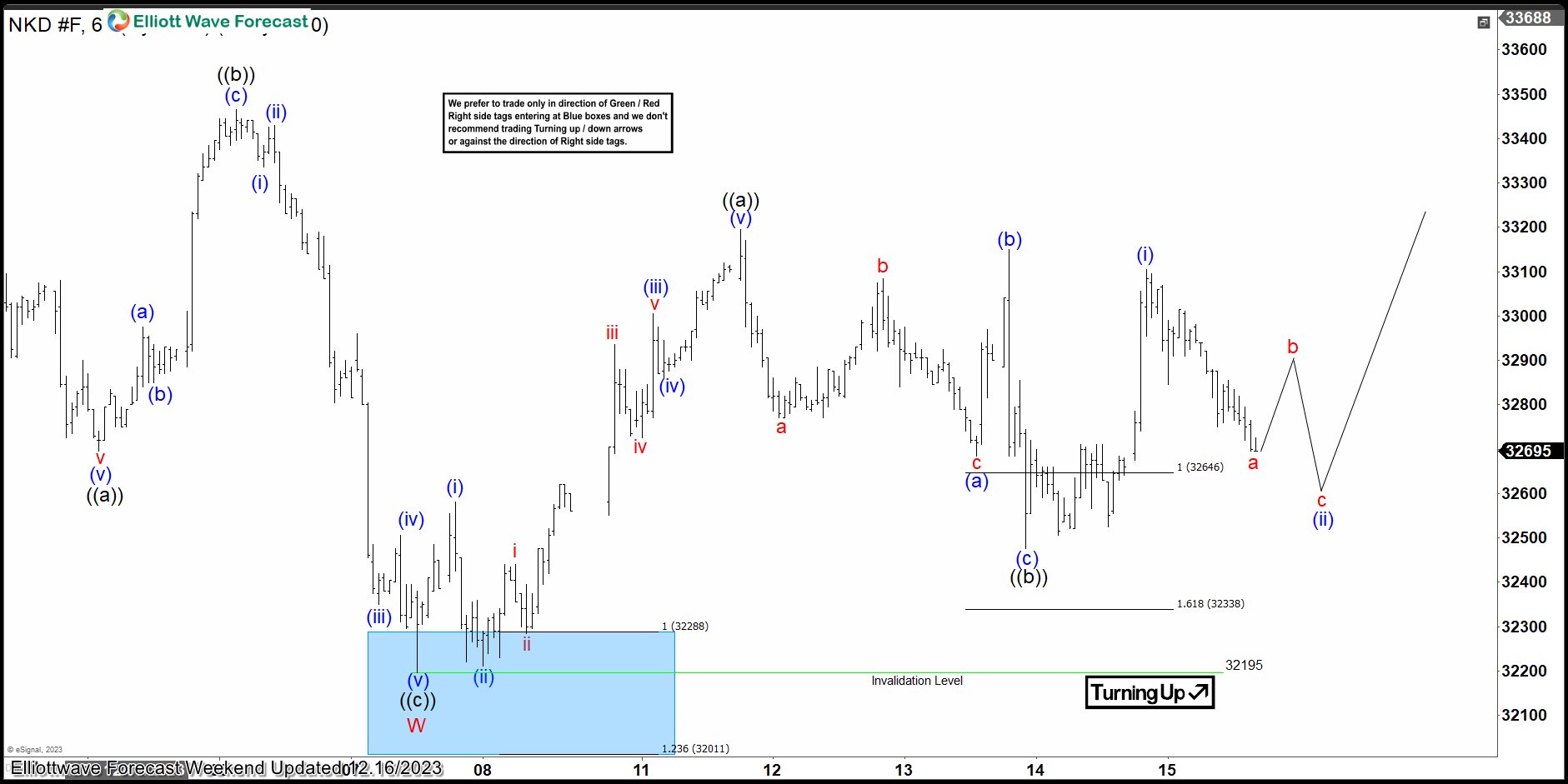
NIKKEI ended cycle from the 11.20. peak at the 32202 low. We got 5 waves up in the rally from the short term low. Currently the futures is doing intraday pull back that seems to be unfolding as potential flat pattern , wave ((b)). Pull back already shows 3 waves down from the last peak. The price has reached intraday equal legs area at 32646-32338. At that zone we expect buyers to appear for a 3 waves bounce at least or further rally ideally.
Note: Keep in mind not every chart is trading recommendation. Official trading strategy on How to trade 3, 7, or 11 swing and equal leg is explained in details in Educational Video, available for members viewing inside the membership area.
NIKKEI Elliott Wave 1 Hour Chart 12.16.2023
The futures found buyers at the marked equal legs area as expected and we got good reaction from there. We count pull back completed at 32470 low. Short term rally made 5 waves up from the 32470 low, and now we are getting 3 waves pull back in (ii) blue. We don’t recommend selling in any proposed pull back.
Fed’s Mester: The next phase is not when to reduce rates
In a Financial Times interview, Cleveland Fed President Loretta Mester put emphasis on the duration of maintaining restrictive monetary policy to ensure that inflation reliably returns to the 2% target. That's contrary to market expectations, which centers on timing and extent of rate cuts.
Mester's key statement, "The next phase is not when to reduce rates... It's about how long do we need monetary policy to remain restrictive in order to be assured that inflation is on that sustainable and timely path back to 2%,"
"The markets are a little bit ahead. They jumped to the end part, which is 'We're going to normalize quickly', and I don't see that," she added.
When the discussion eventually shifts to the timing and pace of rate cuts, Mester highlighted the importance of one-year forward inflation expectations and their alignment towards the 2% target.
"If you don't take action as expected inflation comes down, then you're really firming policy," she warned. "You don't want to inadvertently become more restrictive than you think is appropriate."
EUR/USD: Regains Traction But Recovery Faces Strong Headwinds
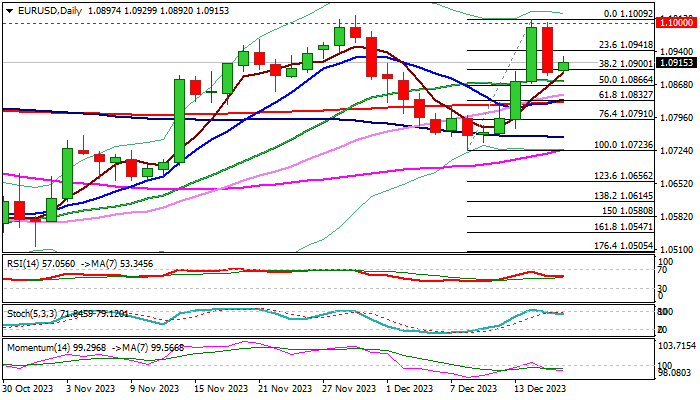
EURUSD found a footstep and firmed on Monday after 0.9% drop last Friday, following a double failure at psychological 1.10 barrier.
However, recovery is unlikely to extend much as near-term action is weighed by much weaker-than-expected German Ifo data and rising bearish momentum on daily chart.
Also, long upper shadow on last week’s candlestick and repeated failure to register a weekly close above 1.10 barrier, add to negative signals.
Slight bullish bias can be expected while the price holds above cracked Fibo pivot at 1.0900 (38.2% retracement of 1.0723/1.1009 upleg), but more work at the upside will be required (close above 1.0950) to sideline downside threats.
Caution on break of 1.0900 handle and nearby 20DMA (1.0875) which would risk deeper drop on completion of reversal pattern and a double-top (1.1009/03).
Res: 1.0942; 1.0965; 1.1000; 1.1017.
Sup: 1.0900; 1.0875; 1.0866; 1.0832.
Euro Stabilizes Despite Weak German Business Confidence
- German business confidence weaker than expected
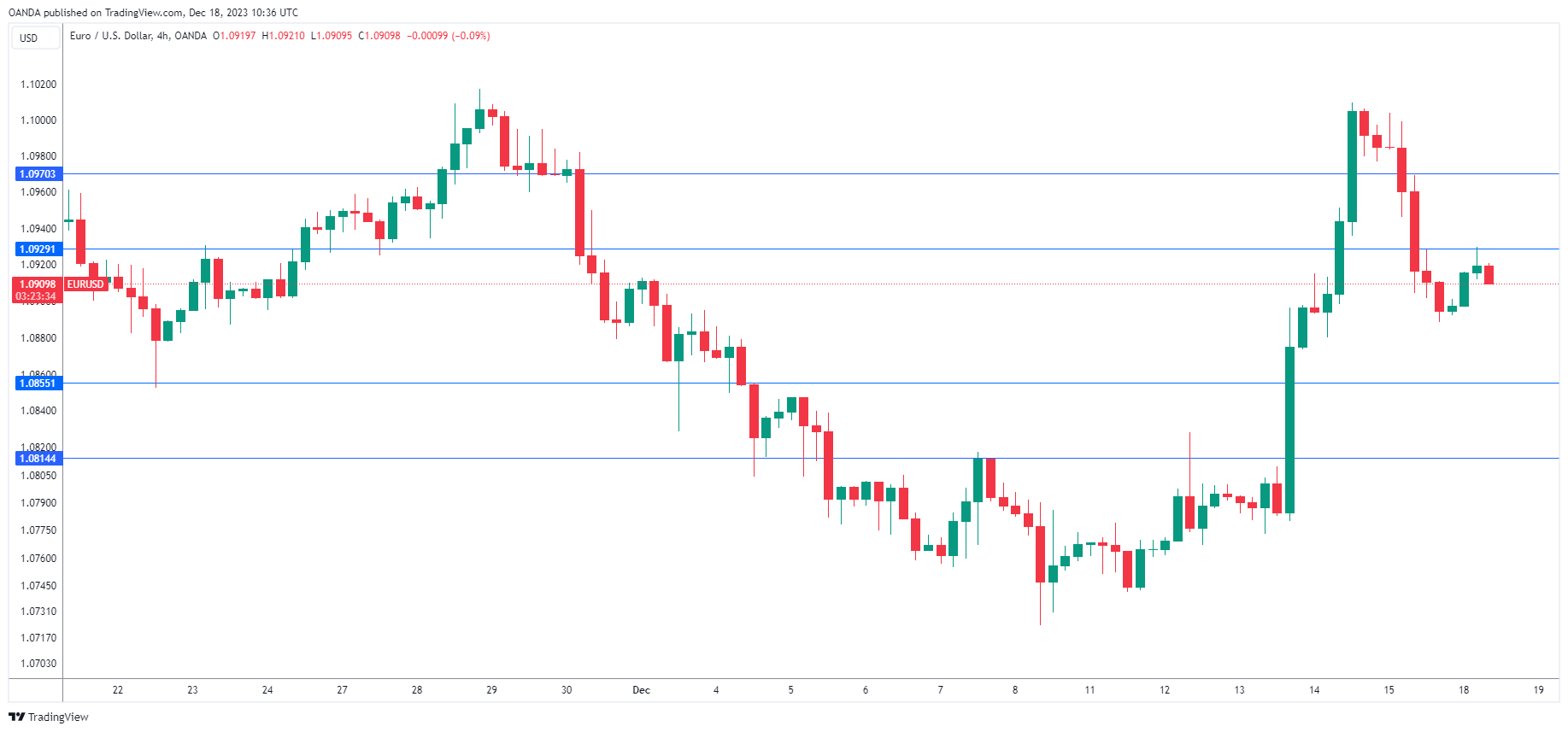
The euro has started the week in positive territory on Monday. In the European session, EUR/USD is trading at 1.0914, up 0.18%.
It was a week of sharp swings for the euro, which posted strong gains during the week but reversed directions on Friday and declined 0.88%. Still, the euro posted a winning week, rising 1.2% against the US dollar.
German business confidence dips
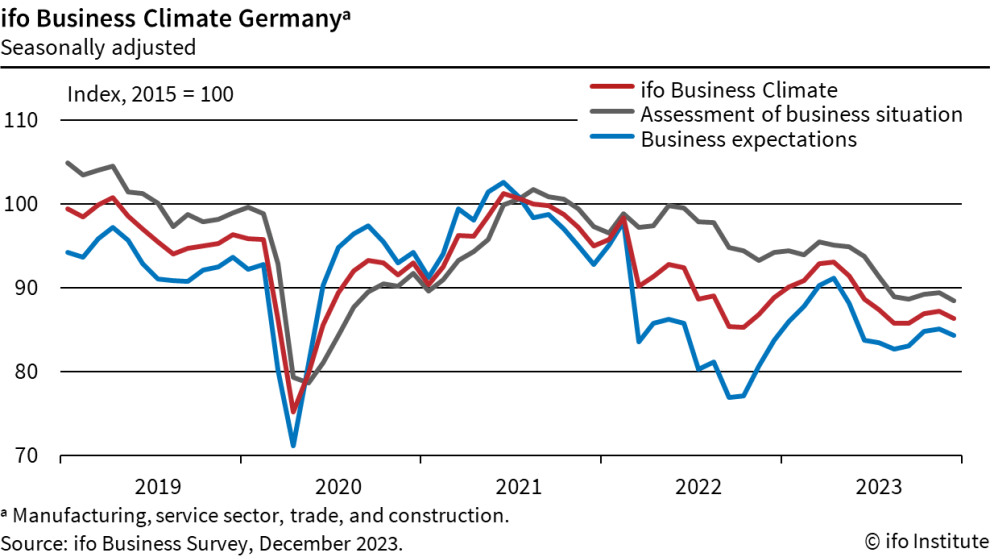
Germany’s Ifo Business Climate was softer than expected, dropping to 86.4 in December. This was down from a revised 87.2 in November and missed the market consensus of 87.8. Business conditions and business expectations also eased in December and were shy of the forecast, as companies remain pessimistic about the German economy. The lack of confidence mirrors the prolonged weakness in the German economy.
December PMIs indicated contraction in both the services and manufacturing sectors. Germany, the largest economy in the eurozone, also reported a decline, with the PMI falling to 48.4, down from 49.6 in November and short of the consensus estimate of 49.8. The services industry has contracted for five straight months while manufacturing has been mired in contraction since June 2022.
ECB stays hawkish
The European Central Bank held the benchmark rate at 4.0% for a second straight time on Thursday. This move was expected but the central bank pushed back against market expectations for interest rate cuts next year, sending the euro soaring over 1% against the US dollar after the announcement.
There is a deep disconnect between the markets and the ECB with regard to rate policy. The ECB remains hawkish and Reuters reported on Friday that ECB governors are unlikely to cut rates before June. The markets are marching to a very different tune and have priced in at least in around six rate cuts in 2024, with the initial cut expected around March. Lagarde has insisted that the central bank’s decisions will be data-dependent rather than time-dependent and she may have to join the rate-cut bandwagon if inflation continues to fall at a brisk pace.
EUR/USD Technical
- EUR/USD is putting pressure on resistance at 1.0929. Above, there is resistance at 1.0970
- 1.0855 and 1.0814 are providing support
ECB’s Vasle cautions against premature rate cut expectations
ECB Governing Council member Bostjan Vasle expressed skepticism about market expectations for imminent interest rate cuts, considering them "premature," both in terms of timing and the overall scope of such moves. This perspective challenges the market's anticipation of monetary easing, which currently sees 50-50 chance of a rate cut by March, with a full cut expected by April
Vasle emphasized that the current market pricing "has lowered the level of restriction". Additionally, the accommodation priced into by interest rate expectations seems to be at odds with the monetary stance required to steer inflation back to the target.
Additionally, Vasle indicated that ECB would likely wait until at least the end of Q1 before considering any changes to its stance. This approach is grounded in the need for more comprehensive data, which will only be available around March or April. he added, "We will need to understand the underlying trends better, and we need the new projections, too."
On the inflation front, Vasle posited that inflation could rebound at the year's turn, potentially hovering between 2.5% to 3% through the first half of the next year. Vasle said, "So it's appropriate to wait and observe price growth through this period and reassess our outlook."
Germany’s Ifo business climate dips to 86.4, economy remains weak
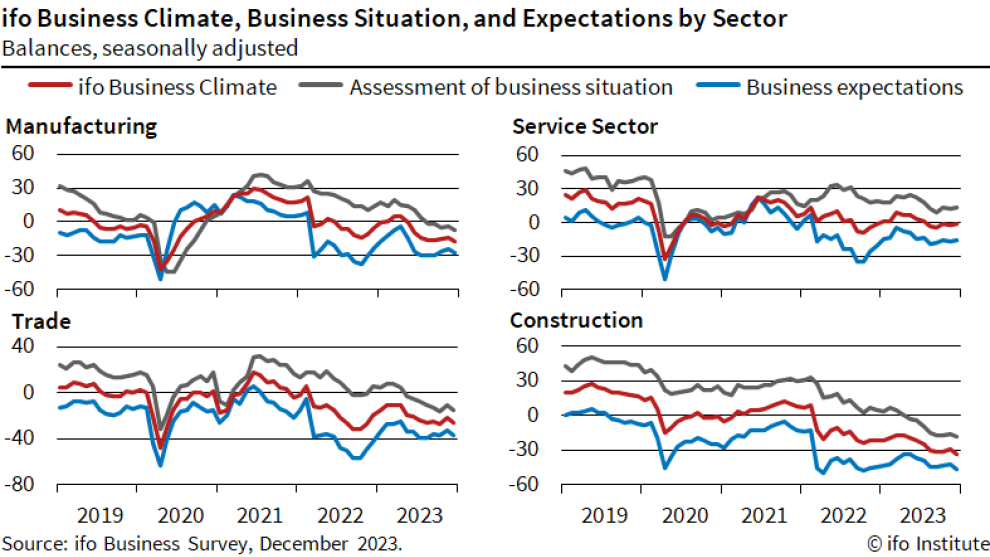
Germany's Ifo Business Climate fell from 87.3 to 86.4 in December, below expectation of 87.8. Current Assessment index fell from 89.4 to 88.5, below expectation of 89.5. Expectations index fell from 85.2 to 84.3, below expectation of 85.8.
By sector, manufacturing fell from -13.8 to -17.2. Services rose from -2.5 to -1.7. Trade fell from -22.2 to -26.6. Construction fell from -29.5 to -33.1.
The Ifo Institute's statement encapsulates the current sentiment, noting that "companies were less satisfied with their current business" and expressing a more skeptical view of the first half of 2024. The acknowledgment that "the German economy remains weak as the year draws to a close" is telling of the challenges facing Europe's largest economy.
Market’s Move Back to Reality May Heal the Dollar
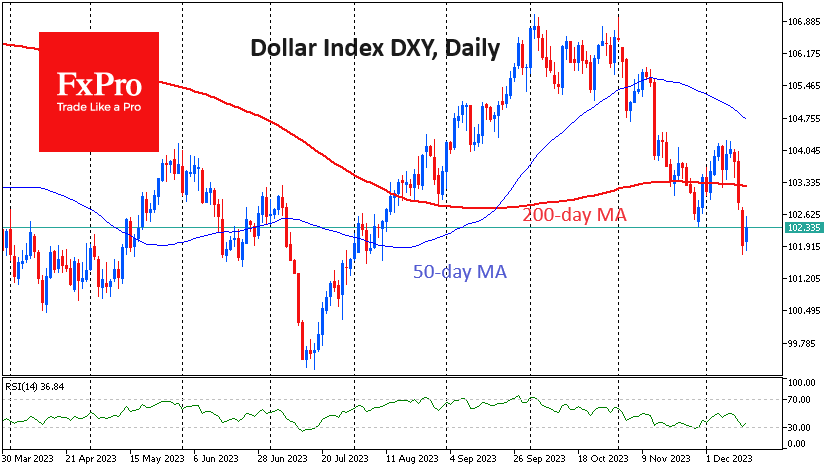
The Dollar made a crucial technical breakdown the previous week following a public admission from the Fed of a policy reversal. The Fed’s comments and subsequent press conference pressed the Dollar index under its 200-day moving average. The decline continued on Thursday as neither the Bank of England nor the ECB acknowledged that they were ready to cut rates as the Fed.
As a result, the dollar index collapsed 2% in two days, the sharpest sell-off since July. Back then, it was the final chord of the Dollar’s fall before the start of a long climb. There is no slight chance that a bottom will begin to form in the Dollar near current levels and a subsequent reversal to growth.
The fundamental reason for the dollar’s sell-off was a powerful reassessment of interest rate expectations. As soon as the Fed agreed with the markets to build 3 rate cuts into the forecasts in 2024, the markets demanded twice as many – six rate cuts. According to FedWatch, futures are pledging a 15% chance of a rate cut on 31 January and an 80% chance on 20 March 2024. Two months ago, when the dollar index was forming a peak, it assumed a 40% chance rate would be higher than current rates in March and a 50% chance in January.
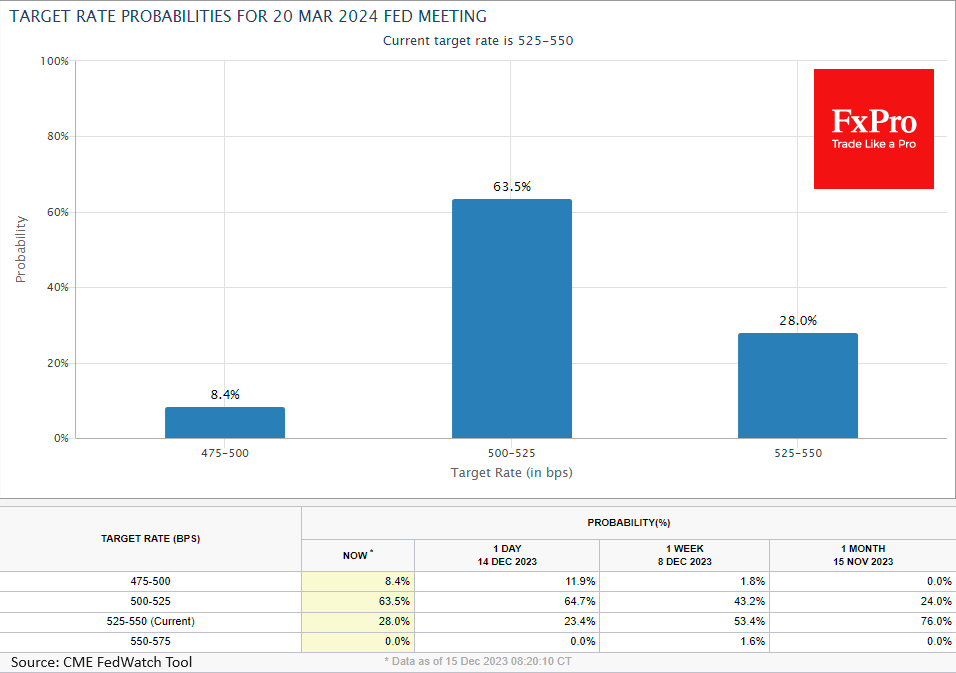
Six rate cuts are hard to justify against a background of an economy growing beyond expectations: retail sales are increasing, wages are rising faster than inflation, and jobs are being created at a healthy pace.
It’s more likely that the ‘rate expectations’ are the result of technical factors at work, as too many investors sold US government bonds before October but have found them attractive in recent weeks. The speed of recovery in US equity and bond markets has created an environment of not just FOMO but shorts’ destruction, intensifying amplitude, and helping markets jump above headwinds or reasonable macroeconomic valuations.
We may well see a normalisation of expectations in the coming days and weeks, which will work for the Dollar and probably deflate excessive optimism from the equity market. Added to this is the difference between how badly Europe is doing (except for the pace of wage growth) and how well the US is doing (except for housing sales). The current situation can be compared to the recovery from the financial crisis, when the chronically weak growth of the Eurozone crystallised with the very buoyant growth of America, forming a long-term trend of strengthening the dollar index since 2011.
Gold Retraces Lower after Hitting Crucial Ascending Trendline
- Gold manages to halt the pullback from its recent record high
- But rebound meets strong resistance at important ascending trendline
- Momentum indicators suggest that positive momentum is fading
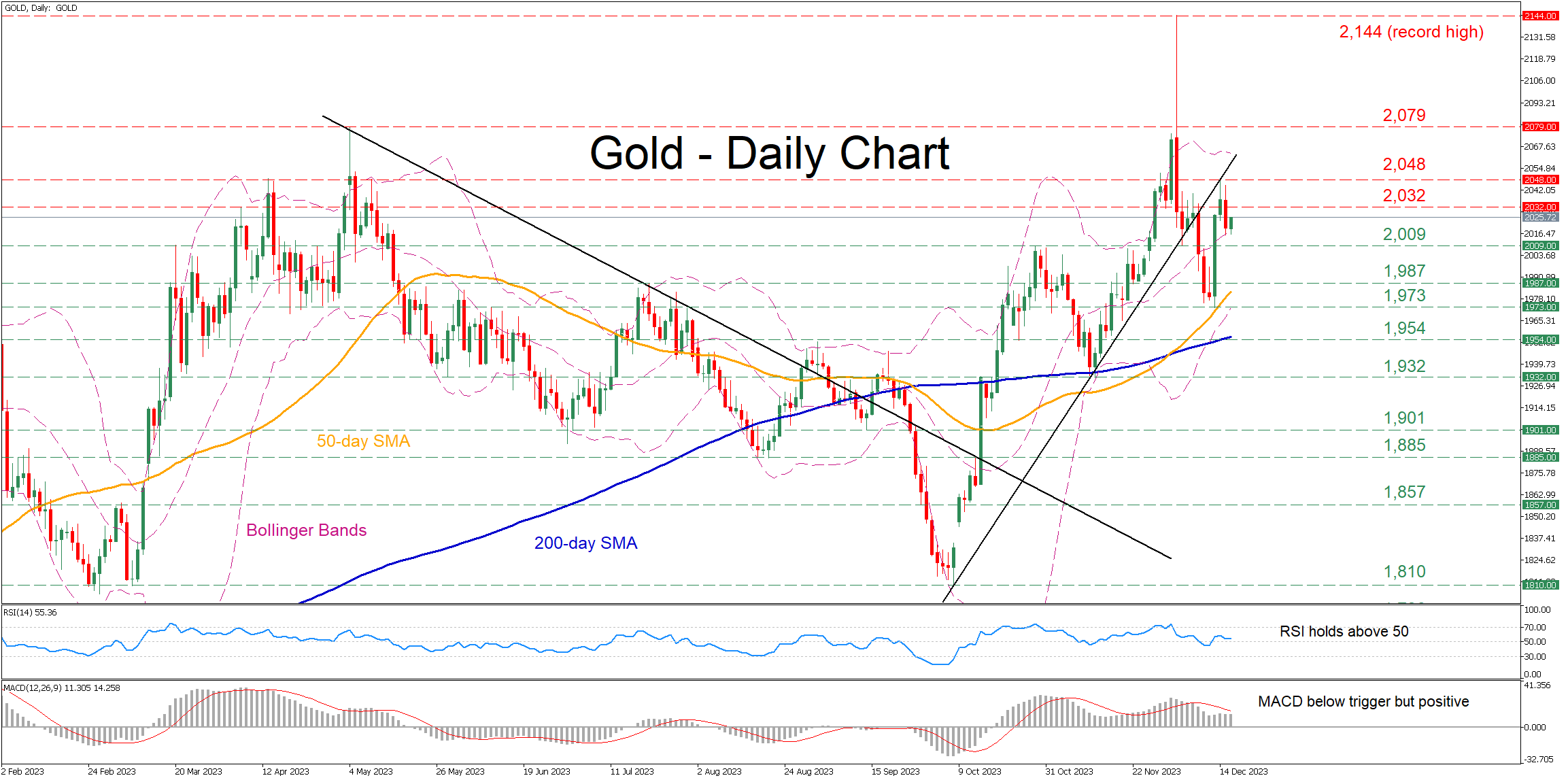
Gold had been in a steep uptrend since November 10, recording a fresh all-time high of 2,144 before experiencing a solid correction. Although the bulls attempted to erase this pullback, the upward sloping trendline drawn from its October lows, which previously acted as support, rejected further advances.
Given that both the RSI and MACD remain in their positive zones, the price could edge higher to challenge the April resistance of 2,032. A violation of that zone could pave the way for the recent rejection region of 2,048, which also held strong in April and May. Further upside attempts could cease at the April peak of 2,079 ahead of the record high of 2,144.
Alternatively, if the price reverses lower, a couple of previous resistance regions such as 2,009 and 1,987 could act as the initial lines of defence. Sliding beneath that floor, bullion could test the December bottom of 1,973. Even lower, the October support of 1,954 may provide downside protection.
In brief, gold seems to be trading back and forth after posting a fresh all-time high. However, the positive technical picture remains intact as the price holds comfortably above the 2,000 psychological mark.