Sample Category Title
BoE Policy Decision: Keep It Neutral As It Can Go
- BoE to keep rates steady at 5.25% and stick to existing guidance
- Avoid rate cut signals as no press conference or new projections scheduled
No rate cut surprises expected; UK economy is still resilient
The Bank of England (BoE) will review its monetary policy during the last meeting of the year on Thursday after the Fed and the ECB have their say. Investors are certain that interest rates will remain steady for another month, but they will probably stay clueless about whether rate cuts are in the cards next year.
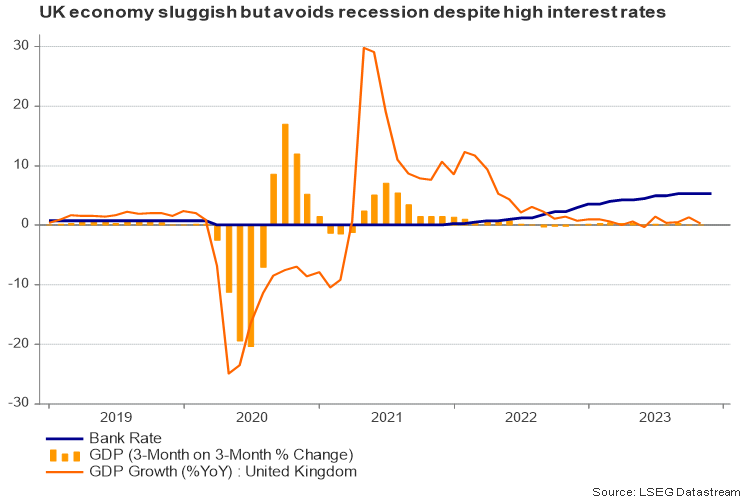
Investors price in a total of around 85 bps of monetary easing by the end of 2024 in rising expectations the global economy could suffer a blow in the aftermath of an extraordinary monetary tightening. In the UK, GDP growth has been sluggish throughout the year compared to the 2021-2022 booming period, remaining downbeat below 1.0% y/y.
Yet the economy has been more resilient than analysts anticipated, narrowly avoiding a recession while achieving substantial progress on the inflation front. The headline CPI plunged to a two-year low of 4.6% y/y in October from 6.7% y/y previously led by housing and household services, boosting hopes of soft landing. While this adds credence to the existing monetary tightening policy and makes additional rate increases unnecessary, the job is far from done for rate cuts to kick in.
Watch out for wage-spiral inflation
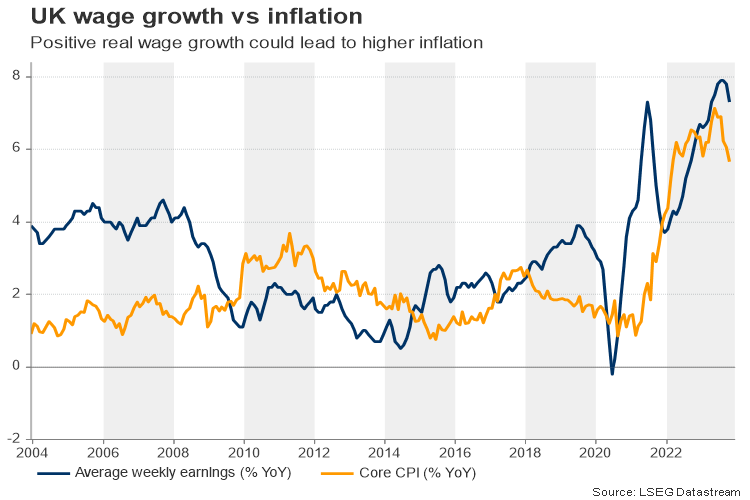
UK’s inflation is still more than double the BoE’s 2.0% target and higher than the one in the US and the eurozone. Perhaps higher mortgage rates could further limit buyers’ affordability in the coming months but with wages rising by 7.2% y/y and faster than consumer prices despite falling from July’s record high of 8.9% y/y, consumption could keep inflation above the target. Wage pressures might also induce businesses to transfer costs to consumers or delay any price cuts.
Will the hawkish camp stay united?
Note that there is no press conference and new economic projections on the agenda. So, traders might pay extra attention to the voting structure to get a better view of the central bank’s thinking.
Expectations are for two hawkish central bankers to vote for a rate hike compared to three in November. Jonathan Haskel and the deputy governor Dave Ramsden could represent this minority, with Catherine Mann likely changing camp to join holders, though their latest comments urged the need for higher rates for longer and provided no direction for more tightening. Therefore, a voting structure of 9-0 cannot be excluded.
EUR/GBP could be a key pair to watch
As regards the market reaction, the British pound could retreat if the team of rate hike supporters narrows or dissolves. However, the absence of any rate cut signals or signs monetary easing is not in sight could add a strong footing under the currency. Recall that the BoE expects inflation to cool to 3.1% by the end of 2024, higher than previously expected and slip to 1.9% by the end of 2025.
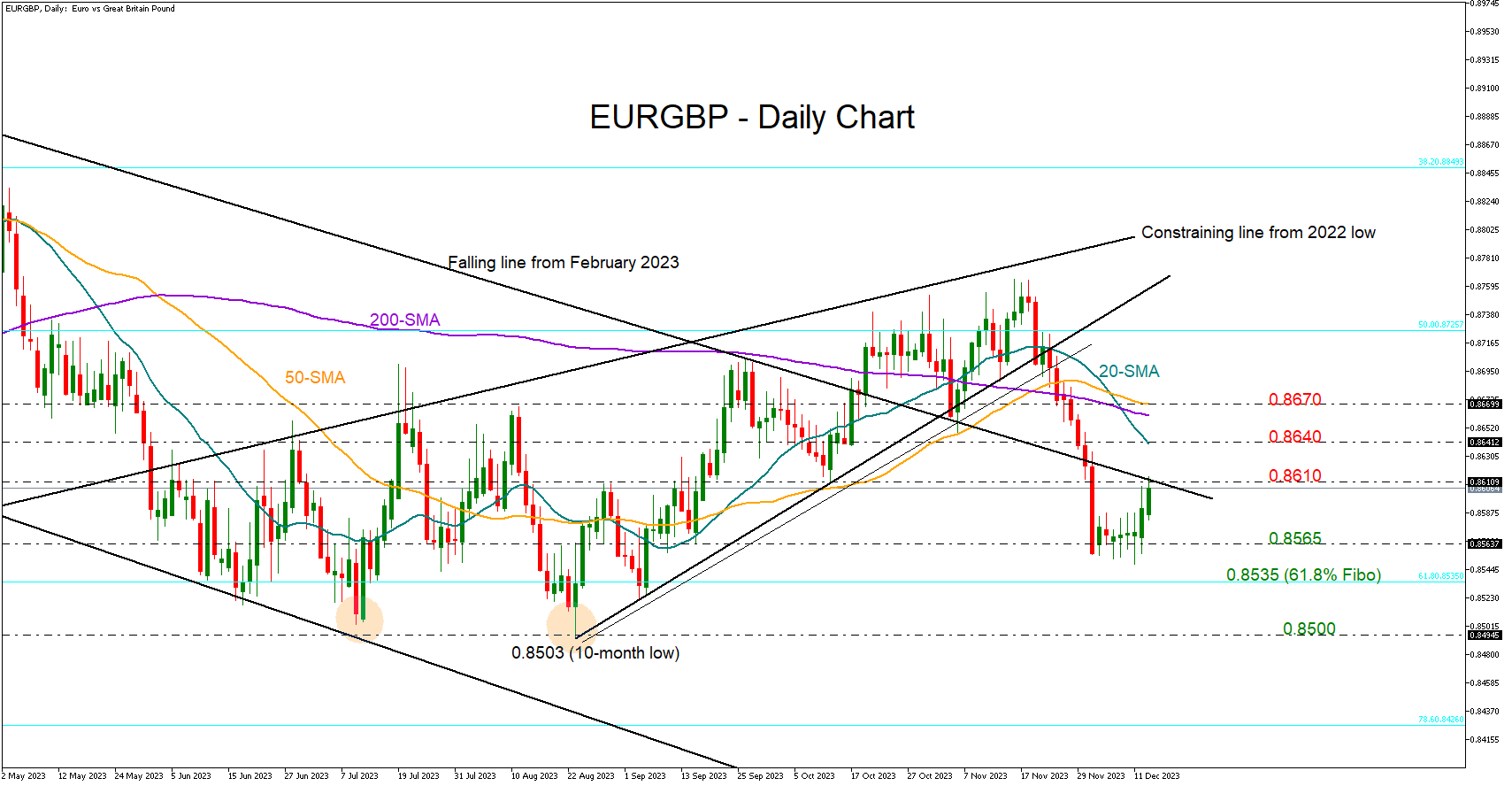
EUR/GBP could be interesting to watch if the BoE preserves some hawkishness, and the ECB confirms the end of the rate hike cycle. In this case, the pair could give up its weekly gains to test the important 0.8565 support zone. A steeper decline below 0.8535 could bring the 2023 floor of 0.8500 under examination.
Alternatively, if the BoE rate statement convinces traders that the tightening era is over, the pair could move towards its simple moving averages (SMAs) seen within the 0.8640-0.8670 zone.
NZDUSD Corrects Lower But 200-day SMA Curbs Retreat
- NZDUSD experiences a sharp pullback from its 4-month peak
- But the 200-day SMA acts as a strong floor for now
- Momentum indicators deteriorate but remain in positive areas
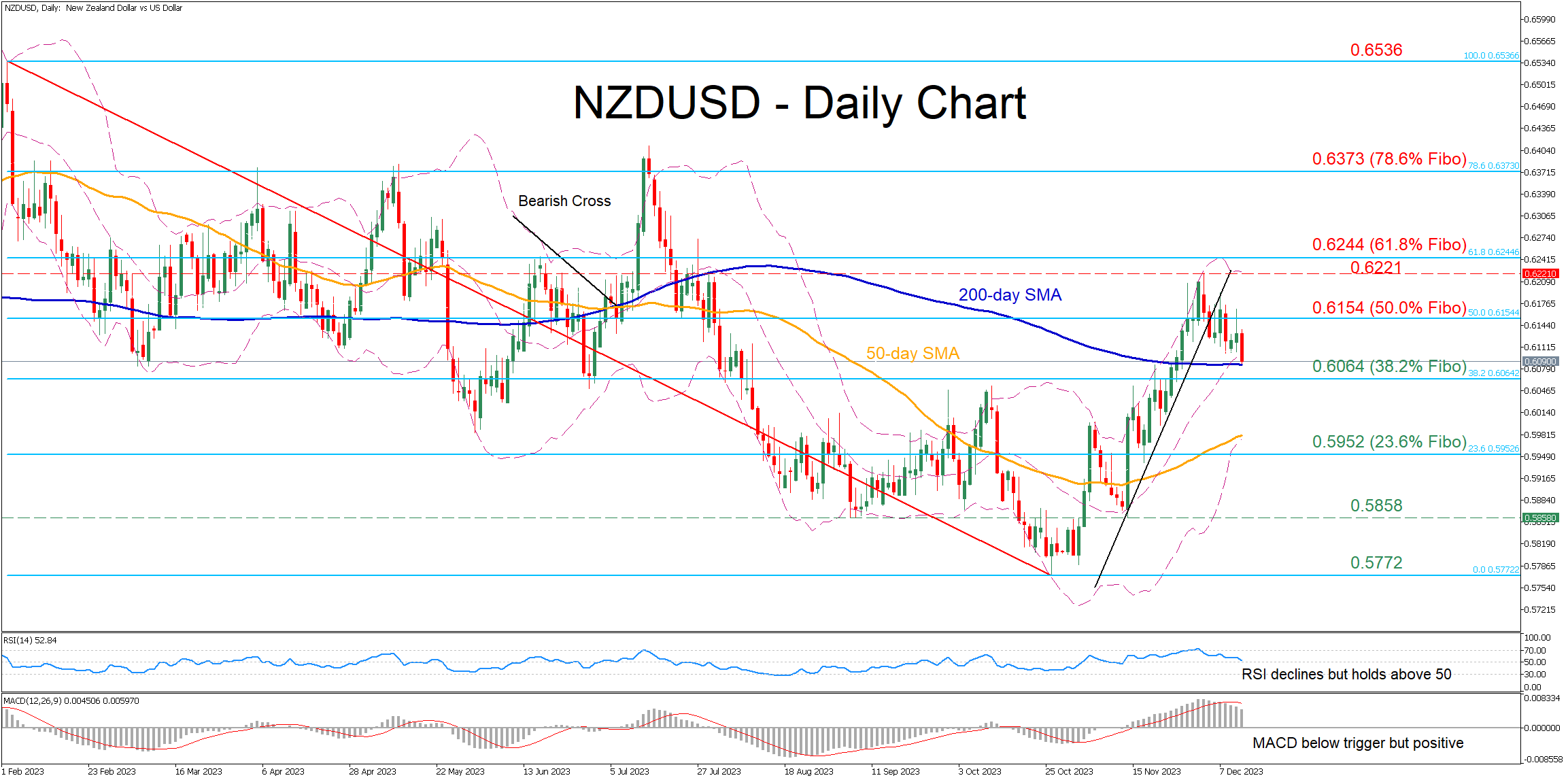
NZDUSD had been staging a solid rebound from its 2023 low of 0.5772, peaking at a fresh four-month high of 0.6221 in early December. Since then, the pair retraced lower, with the 200-day simple moving average (SMA) preventing further declines.
Should the price break below the crucial 200-day SMA, immediate support could be met at 0.6064, which is the 38.2% Fibonacci retracement of the 0.6536-0.5772 downtrend. Violating that hurdle, the pair could then descend towards the 23.6% Fibo of 0.5952. A violation of that region could pave the way for the September low of 0.5858.
Alternatively, if the pair attempts to erase the recent correction, the 50.0% Fibo of 0.6154 could prove to be the first barricade for the bulls to clear. Further advances might then cease at the recent four-month high of 0.6221. Failing to halt there, the price could then challenge the 61.8% Fibo of 0.6244.
Overall, NZDUSD experienced a pullback after reaching extremely overbought conditions. Moving forward, the decline could accelerate if the price breaks profoundly below the crucial 200-day SMA.
Gold Eases from Record Highs in 2023
- Gold jumped to new highs last week
- Overall trend remains positive
- But RSI and stochastic suggest bearish correction
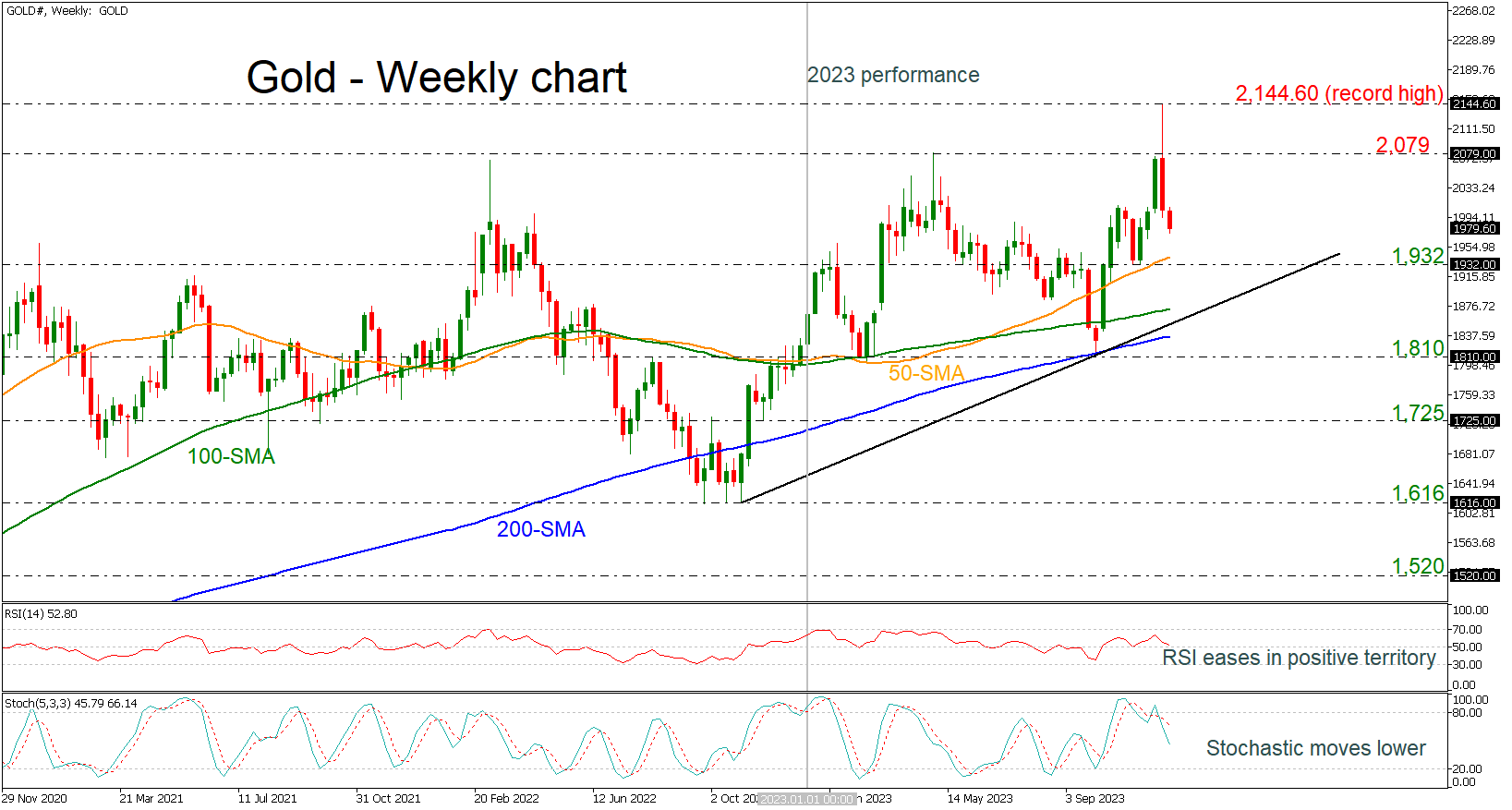
Gold prices climbed to a high of 2,144.60 last week before falling. The price has been clearly on an uptrend since October 2022, and the long-term structure of rising highs and rising lows is still in place.
On the weekly chart, the technical oscillators are reflecting the most recent market retreat. While the Relative strength index (RSI) is moving lower in positive territory, the stochastic is maintaining its downward trend following the bearish crossover between its %K and %D lines.
It may retest the all-time high of 2,144.60 if buyers regain control and break over the 2,079 resistance level, which is derived from the April 30 highs. With more positive moves, the price would enter unknown territory and shift attention to round psychological numbers, where traders might set stop-loss orders, creating barriers for further increases. Thus, the 2,200 and 2,300 areas would be the levels to keep an eye on at the outset.
The 50-week simple moving average (SMA) near the 1,932 support level would be the initial downward barrier, should sellers maintain their control. If broken, the focus would shift to the 100-week SMA at 1,870, and a subsequent decline to the 200-week SMA and the long-term rising trend line, both near 1,835, would be next.
To sum up, the outlook in the long-term picture is still strongly positive. To cast doubt on that, a clear break below the uptrend line is required, however substantially steeper drops would be necessary for a trend reversal.
USDJPY Bulls Show Further Signs of Life
- USDJPY in the green today ahead of this week’s key events
- It is now hovering below a key support area
- Momentum indicators confirm the weakening bearish pressure
USDJPY is trying to record a green candle today as it trades a tad below a strong support area. The bulls have managed to react to the sizeable correction from the November 13, 2023, high of 151.90, by defending the 200-day simple moving average (SMA) and then staging a small rally towards current levels. At the moment, market participants appear to be mostly on the sidelines and preparing for the upcoming key events.
In the meantime, the momentum indicators are confirming the evaporating bearish pressure. The Average Directional Movement Index (ADX) is edging lower, towards its 25-threshold and thus signaling a weakening bearish trend. Interestingly, the RSI has failed to climb above its 50-midpoint, revealing the presence of bearish pressure. Crucially, the stochastic oscillator has climbed above the oversold area, but it appears to lack the strength for a sizeable move higher.
Should the bears remain hungry, they could first try to break below the September 7, 2022, high at 144.99. They could then face strong support at the busy 142.49-142.50 range, which is populated by 61.8% Fibonacci retracement of the October 21, 2022 - January 16, 2023, downtrend and the 200-day SMA. Even lower, a move towards the 139.38-140.69 area could allow the bears to record a new 4-month low.
On the flip side, the bulls are keen to recover part of their recent losses. They could successfully push USDJPY above the 146.65-147.71 area, but the March 24, 2023, ascending trendline could prove a stronger resistance area than currently foreseen. Even higher, they could have a go at the 50-day SMA and October 3, 2023, high at 149.53 and 150.15 respectively.
To sum up, USDJPY has recorded a small rebound, but market participants appear to be in a waiting mode ahead of the next key market events. 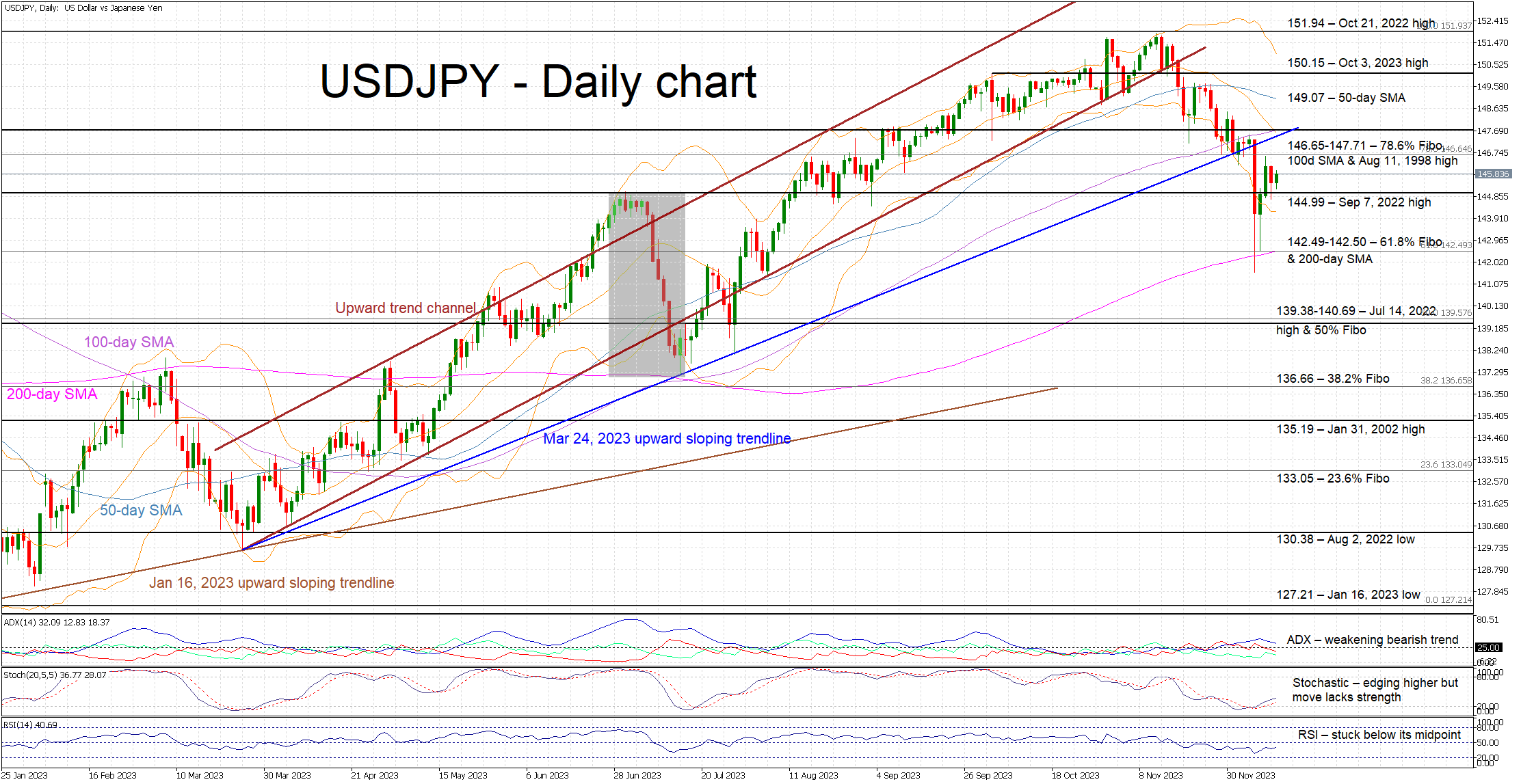
SECO downgrades 2024 Swiss growth outlook
Swiss State Secretariat for Economic Affairs has revised down its 2024 economic growth forecast for Switzerland, now expecting a growth of 1.1% instead of previous 1.2%. This revision indicates an expectation of below-average growth for the Swiss economy for a second consecutive year. A key factor influencing this outlook is the expected slow growth in the eurozone in 2024, which is anticipated to impact Swiss exports.
Looking ahead to 2025, SECO forecasts an economic recovery with growth projected at 1.7%, driven by a gradual global economic rebound. On the inflation front, SECO anticipates deceleration from 2.1% in 2023 (revised down from 2.2%) to 1.9% in 2024, followed by a further reduction to 1.1% in 2025.
SECO's report also underscores several considerable risks to the economic outlook. Ongoing conflict in the Middle East poses geopolitical risks that could lead to surge in oil prices and, consequently, higher inflation. Additionally, the report warns of possibility of tighter international monetary policy in response to sustained core inflation.
Other highlighted risks include global debt, potential market corrections in real estate and finance, and balance sheet vulnerabilities at financial institutions. Further, economic developments in Germany and China are noted as potential risks for the international economy that could adversely affect Swiss foreign trade.
Energy security remains a concern for Switzerland. Significant energy shortage in Europe, leading to widespread production stoppages and a severe economic downturn, could push Switzerland into a recession coupled with high inflation.
GBP/USD Dips While USD/CAD Could Extend Gains
GBP/USD is moving lower from the 1.2650 resistance. USD/CAD is rising and might aim for more gains above the 1.3620 resistance.
Important Takeaways for GBP/USD and USD/CAD Analysis Today
- The British Pound started a fresh decline below the 1.2615 support zone.
- There is a key bearish trend line forming with resistance near 1.2565 on the hourly chart of GBP/USD at FXOpen.
- USD/CAD is showing positive signs above the 1.3580 support zone.
- There was a break above a major bearish trend line with resistance near 1.3585 on the hourly chart at FXOpen.
GBP/USD Technical Analysis
On the hourly chart of GBP/USD at FXOpen, the pair started a fresh decline from the 1.2650 zone. The British Pound traded below the 1.2615 support to move into further a bearish zone against the US Dollar.
The pair even traded below 1.2565 and the 50-hour simple moving average. Finally, the bulls appeared near the 1.2515 level. A low was formed near 1.2514 and the pair is now attempting a recovery wave.
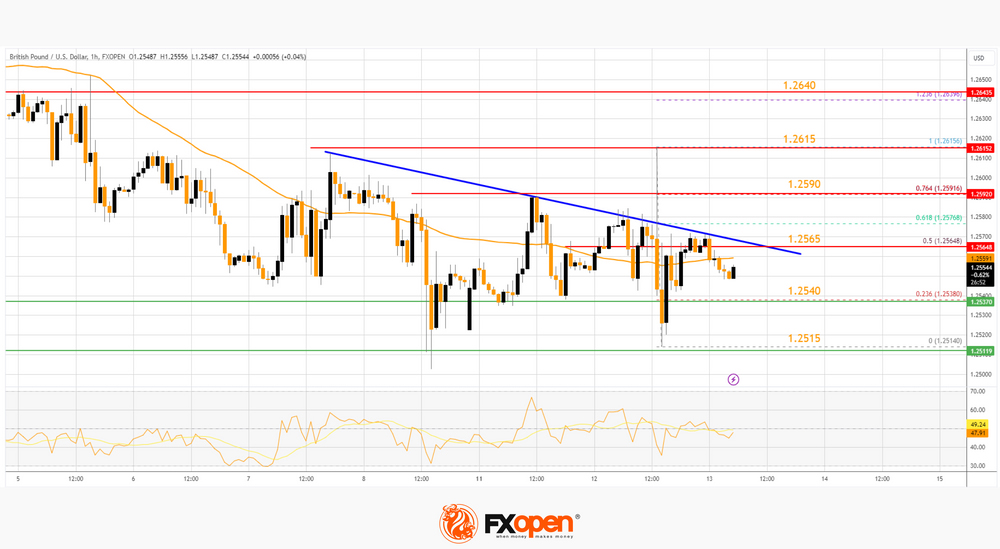
Immediate resistance on the upside is near a key bearish trend line at 1.2565 or the 50-hour simple moving average. It is close to the 50% Fib retracement level of the downward move from the 1.2615 swing high to the 1.2514 low.
The first major resistance on the GBP/USD chart is near the 76.4% Fib retracement level of the downward move from the 1.2615 swing high to the 1.2514 low at 1.2590.
A close above the 1.2590 resistance might spark a steady upward move. The next major resistance is near 1.2640. Any more gains could lead the pair toward the 1.2700 resistance in the near term.
Initial support sits near 1.2540. The next major support sits at 1.2515, below which there is a risk of another sharp decline. In the stated case, the pair could drop toward 1.2440.
USD/CAD Technical Analysis
On the hourly chart of USD/CAD at FXOpen, the pair formed a strong support base above the 1.3550 level. The US Dollar started a fresh increase above the 1.3575 resistance against the Canadian Dollar.
There was a break above a major bearish trend line with resistance near 1.3585. The pair cleared the 50-hour simple moving average and climbed above 1.3600. Finally, it tested the 1.3620 zone. A high was formed near 1.3618 before there was a downside correction.
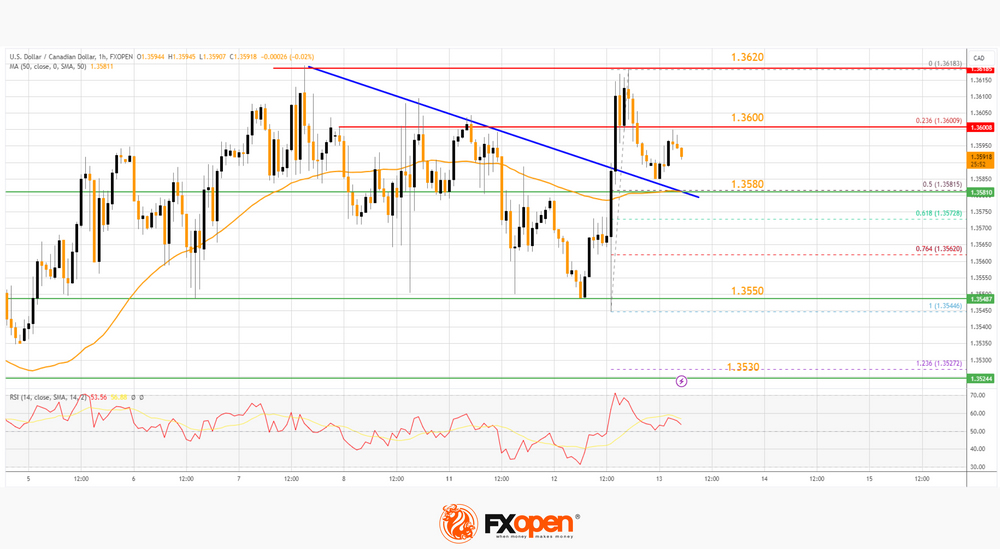
The pair dipped below the 1.3600 level and the 23.6% Fib retracement level of the upward move from the 1.3550 swing low to the 1.3620 high.
Initial support is near the 50-hour simple moving average and the 50% Fib retracement level of the upward move from the 1.3550 swing low to the 1.3620 high at 1.3580.
The next major support is near 1.3550 on the same USD/CAD chart. The main support sits near 1.3530. A downside break below the 1.3530 level could push the pair further lower. The next major support is near the 1.3480 support zone, below which the pair might visit 1.3420.
Initial resistance sits near the 1.3600 zone. A clear upside break above 1.3600 could start another steady increase. The next major resistance is the 1.3620 level. A close above the 1.3620 level might send the pair toward the 1.3680 level. Any more gains could open the doors for a test of the 1.3740 level.
This article represents the opinion of the Companies operating under the FXOpen brand only. It is not to be construed as an offer, solicitation, or recommendation with respect to products and services provided by the Companies operating under the FXOpen brand, nor is it to be considered financial advice.
Trading Probably a Long-Drawn Countdown to Fed Decision
Market
November US CPI yesterday was the final piece of the monetary puzzle before today’s Fed decision, but it didn’t change the global portrait. At 0.1% M/M and 3.1% Y/Y (headline) and 0.3% M/M and 4.0% for the core, the outcome was close to, maybe marginally higher than expected. Markets also didn’t know what conclusion to draw. A first Pavlov attempt of bonds to rally was immediately blocked, but the subsequent ‘rebound’ in yields was unconvincing too. US yields closed little changed on the day, but a few basis points higher compared to just before the CPI release. German Bunds again outperformed with yields easing between 0.1 bp (2-y) and 5.9 bps (30-y). Especially EMU/German LT yields struggle to leave recent lows behind. The dollar briefly recouped intraday losses post CPI, but couldn’t maintain its gains. DXY closed at 103.86 (from 104.1). EUR/USD also gained modestly despite a euro-negative interest rate differential (close 1.0794). Both moves are technically insignificant. Dollar ‘softness’ probably was inspired by a constructive risk sentiment as major US indices all closed at new 2023 peak levels. Also something to watch out for with respect to ST inflation (expectations) and purchasing power: oil again declined substantially (Brent $73 p/b). UK gilts strongly outperformed after softer than expected UK labour data. Sterling’s recent comeback (especially against the euro) was aborted; EUR/GBP rebounded to the 0.86 area.
Asian equities mostly trade in red. China underperforms as markets are disappointed on the few signs of stimulus coming from the annual economic work conference. Japan outperforms on a constructive BOJ Tankan rapport with both the large manufacturing (12 from 9) and the non-manufacturing indices (30 from 27) improving more than expected. However, this won’t be a decisive factor as to whether the BOJ will change its policy anytime soon.
Today, market trading probably will be a long-drawn countdown to the Fed decision. Anything different from an unchanged decision will be a massive surprise. Markets keep a close eye on ‘guidance’ from the summary of economic projections (dots). The Fed skipping previous guidance on one additional rate hike and sticking to 50 bps of cuts end 2024 might be an ‘equilibrium’ scenario for markets. Also keep an eye on whether the Fed will raise the neutral policy rate. In the press conference, we look out what Fed Chair Powell says on the substantially loosening of monetary conditions since the previous meeting. Is the market now working against the Fed’s efforts to cool demand and temper inflation? Maybe the Fed governor might also stress ongoing residence in economic activity, which might keep the supply-demand balance stretched for longer than expected. From a market point of view, however, the Fed probably will have to bring a very hawkish message to trigger a real countermove.
News headlines
Argentina’s new government under, Javier Milei, announced it’ll start a shock therapy to the country’s “addiction to fiscal deficits”. Economy minister Caputo outlined 10 initial measures. The peso will be devaluated by 54%, moving the USD/ARS exchange rate to 800 (366 today). The devaluation is massive but falls short of what the peso is traded for at the black market (USD/ARS rates above 1000). The government will allow the peso to weaken by further 2% per month. Capital controls remain in place to avoid a sudden sharp depreciation that would sent inflation (140%+), even higher. Fiscal spending will be slashed by halving the number of ministries, cutting transfers to provinces, suspending public works and reducing subsidies. The government estimates the measures at about 2.9% of GDP. It wants to eliminate the primary budget deficit in 2024. The likes of the IMF, which is owed $43bn by Argentina, hailed the package, even though it lacks details still. Others doubt whether there is enough popular and political support.
Hungary is prepared to drop its veto on a €50bn four-year support package for Ukraine in return for Hungarian funds held back by the EU over concerns of graft and the rule of law, news agency Bloomberg reported after an interview with PM Orban’s chief political advisor, Balazs Orban. Hungary in recent weeks blocked all issues related to Ukraine, with its position toughened over frustration of Ukraine potentially joining the European bloc. While the EU is about to release about €10bn in blocked financing by Wednesday after the Hungarian government passed laws to strengthen judicial independence, Budapest wants the block to hand over the full amount of €30bn. The olive branch (?) offered by Hungary comes ahead of a EU leader meeting on the broader budget starting Thursday.
GBP/JPY Daily Outlook
Daily Pivots: (S1) 182.14; (P) 182.87; (R1) 183.45; More...
Intraday bias in GBP/JPY stays neutral for the moment. On the downside, break of 181.66 minor support will suggest that rebound from 178.58 has completed. Intraday bias will be back to the downside for retesting 178.58 low. Overall outlook will stay bearish as long as 184.44 support turned resistance support turned resistance holds.
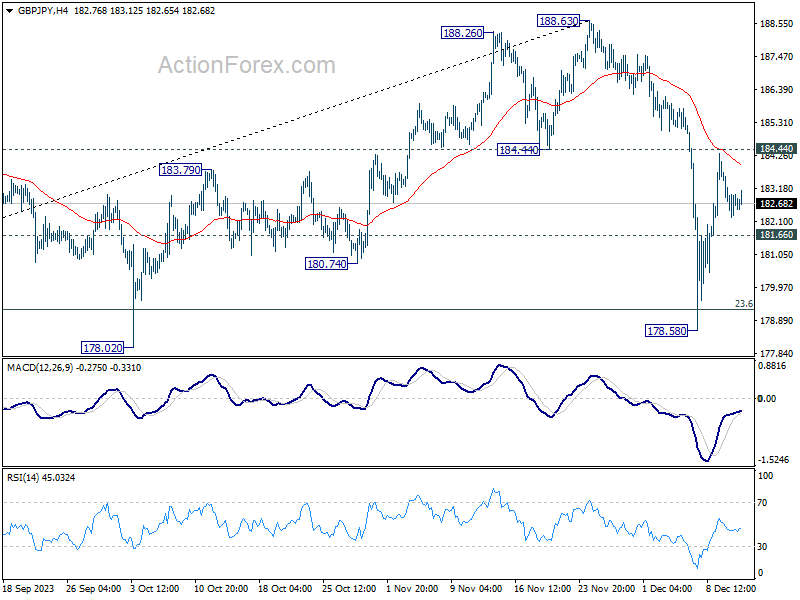
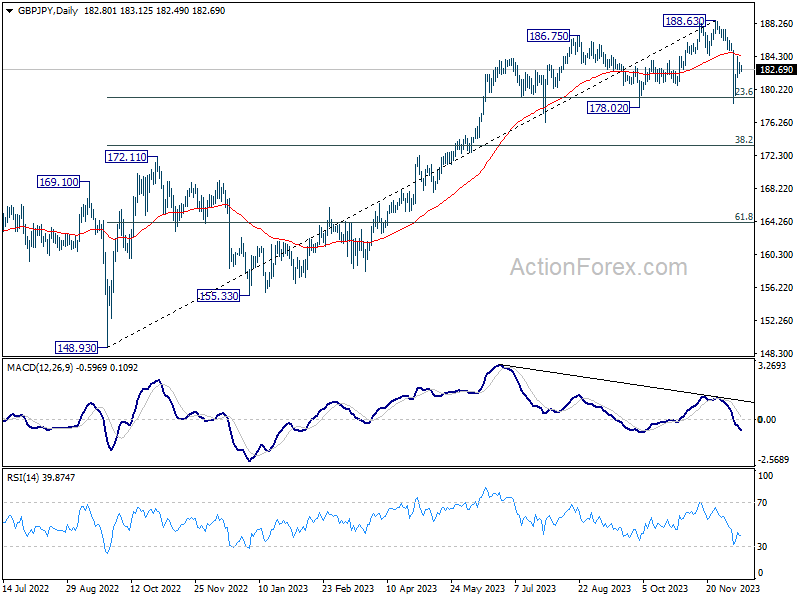
In the bigger picture, while a medium term top is in place at 188.63, there is no clear sign of long term bearish trend reversal yet. As long as 55 W EMA (now at 175.67) holds, price actions from 188.63 are seen as a corrective move only. Larger up trend from 123.94 (2022 low) could resume at a later stage.
EUR/JPY Daily Outlook
Daily Pivots: (S1) 156.57; (P) 156.95; (R1) 157.41; More..
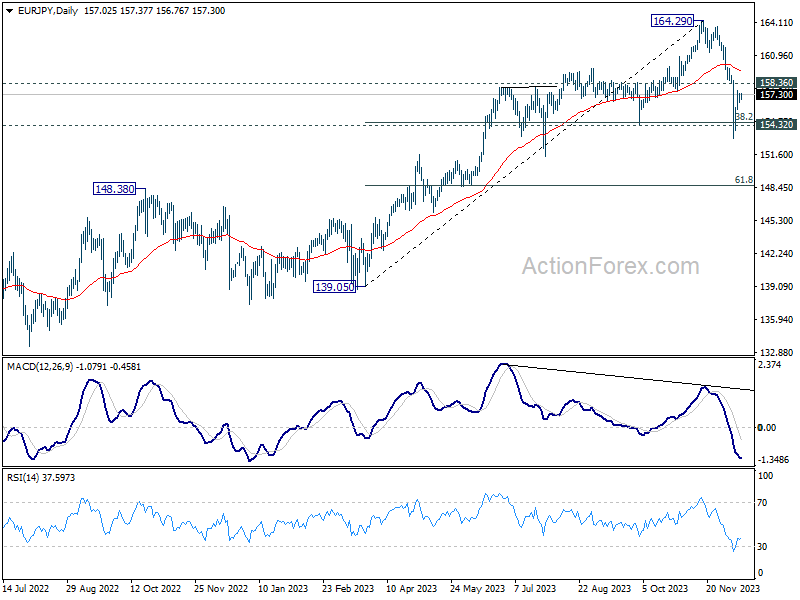
Intraday bias in EUR/JPY remains neutral for the moment. While rebound from 153.15 could extend higher, upside should be limited below 158.36 minor resistance to bring another fall. On the downside, below 155.98 will turn bias to the downside for retesting 153.15.
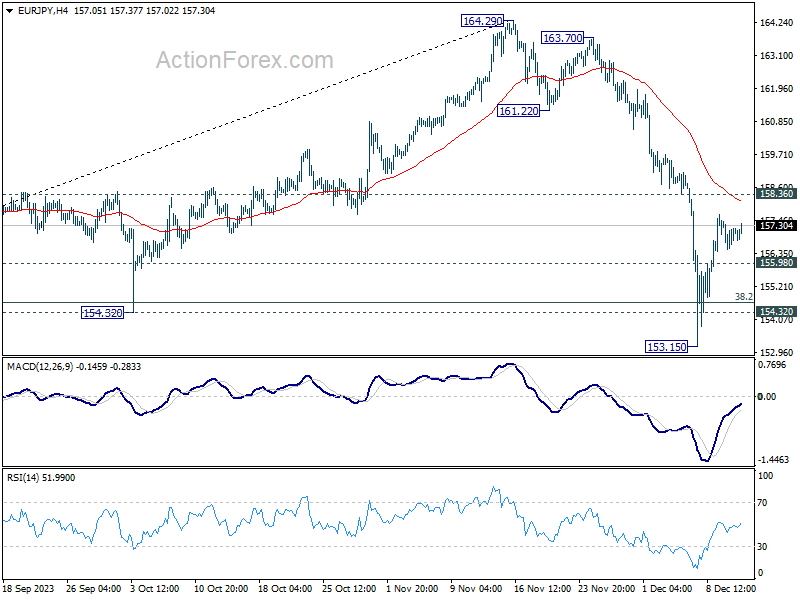
In the bigger picture, price actions from 164.29 medium term top are tentatively seen as a correction to rise from 139.05 for now. As long as 148.48 resistance turned support holds (2022 high), larger up trend from 114.42 (2020 low) could still resume through 164.29 at a later stage.
EUR/GBP Daily Outlook
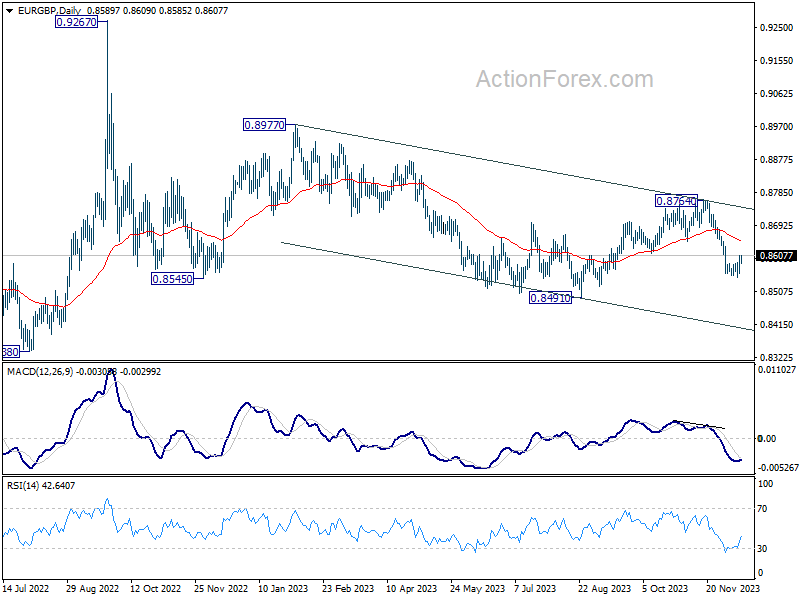
Daily Pivots: (S1) 0.8564; (P) 0.8587; (R1) 0.8615; More....
EUR/GBP's recovery from 0.8548 extends higher today but stays well below 0.8648 support turned resistance. intraday bias remains neutral and further decline is expected. On the downside, break of 0.8548 will target 0.8491 low first. Firm break there will resume larger down trend.
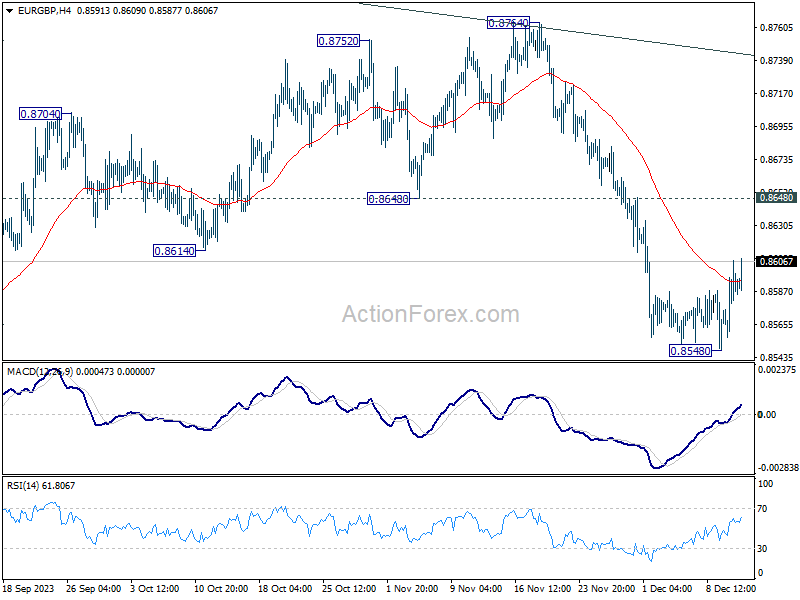
In the bigger picture, current development suggests that down trend from 0.9267 (2022 high) is still in progress. This decline is seen as the third leg of the pattern from 0.9499 (2020 high). Break of 0.8201 will target 100% projection of 0.9499 to 0.8201 from 0.9267 at 0.7969. In any case, outlook will stay bearish as long as 0.8764 resistance holds.