Sample Category Title
USD/JPY Mid-Day Outlook
Daily Pivots: (S1) 143.18; (P) 144.20; (R1) 145.89; More...
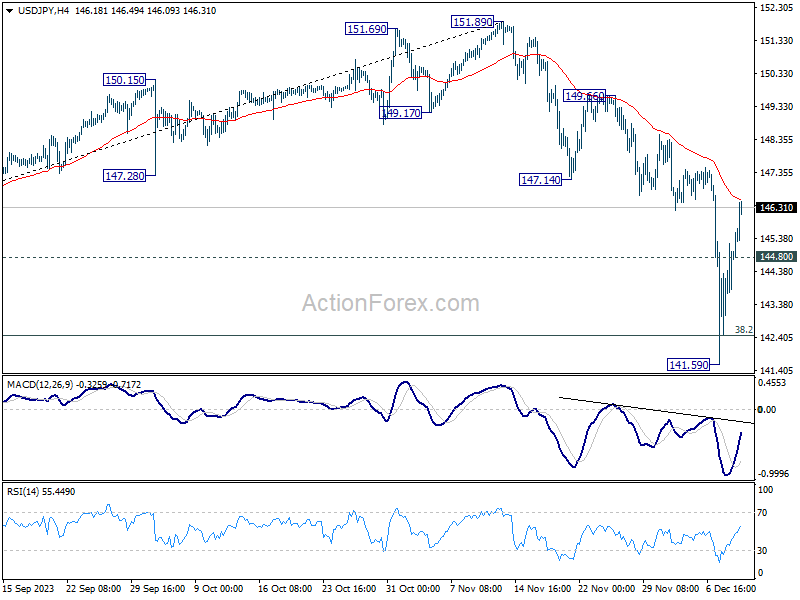
While USD/JPY's rebound from 141.59 is strong, outlook is unchanged for the moment. Upside should be limited be 147.14 support turned resistance. On the downside, below 144.80 minor support will turn bias to the downside for retesting 141.59. Break of 141.59 and sustained trading below 142.45 fibonacci level will pave the way to next fibonacci level at 136.63. However, firm break 147.14 will dampen the bearish view, and bring stronger rally to 149.56 resistance and above.
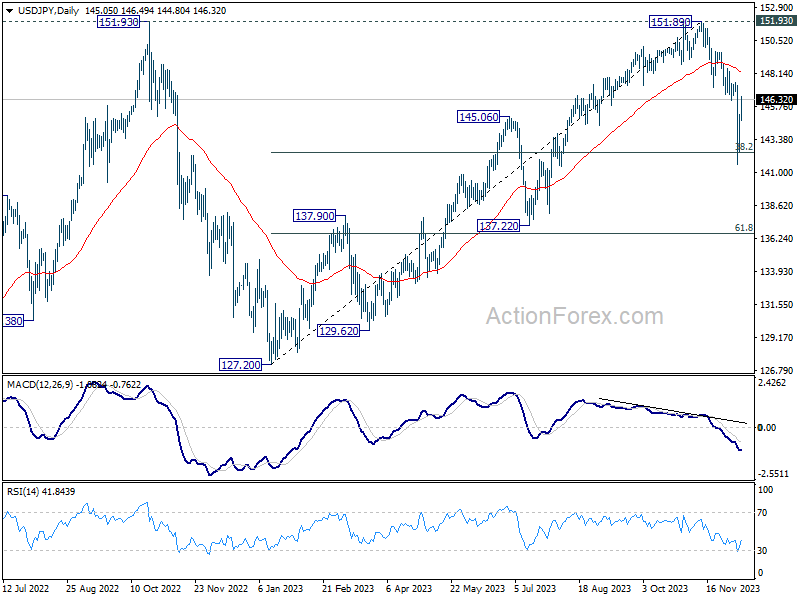
In the bigger picture, current fall from 151.89 is seen as the third leg of the corrective pattern from 151.93 (2022 high). Deeper decline would be seen through 38.2% retracement of 127.20 to 151.89 at 142.45 to 61.8% retracement at 136.63. This will now remain the favored as long as 147.14 support turned resistance holds.
Yen Pullback Persists as Sterling and Dollar Gain Ahead of Crucial Events
Yen's near-term pullback has notably accelerated today. Some reports surfaced suggesting that the BoJ is not poised to abandon its negative rate policy anytime soon, with the earliest potential shift expected no sooner than April meeting. This stance isn't fundamentally new, as BoJ has consistently indicated that it requires time to assess Spring's wage negotiations before considering any policy changes. Additionally, the timing of the new economic projections aligns with April meeting, making it an opportune moment for the bank to explain any significant policy shifts. Despite this, the resilience seen in 10-year JGB yields indicates that traders are still hopeful for a minor policy adjustment, particularly concerning the yield curve control, later this month.
In other developments, British Pound is currently leading as the strongest currency for the day, followed by Canadian Dollar and then US Dollar. The Pound faces several critical economic releases, including tomorrow's UK job data and Wednesday's GDP figures, before BoE rate decision on Thursday. Meanwhile, Dollar is gearing up for tomorrow's CPI release, followed by FOMC rate decision and new economic projections on Wednesday. These upcoming releases suggest a significant week ahead for these currencies, with potential for notable market movements.
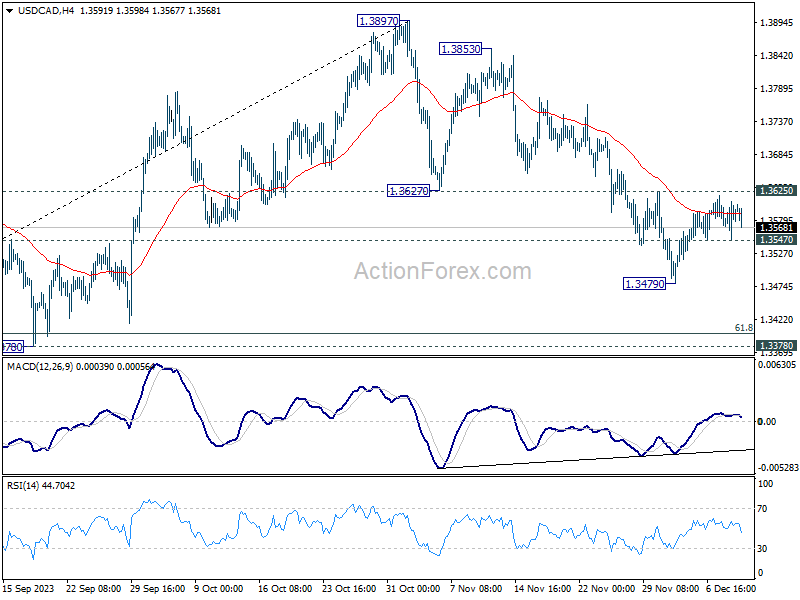
Technically, USD/CAD continued to lose upside momentum just ahead of 1.3625 support. Focus could be back to 1.3547 minor support in the next 24 hours. Break there will indicate rejection by 1.3625 resistance, and the fall from 1.3897 is in progress for another leg through 1.3479 towards 1.3378 support. Let's see how it goes.
In Europe, at the time of writing, FTSE is down -0.50%. DAX is up 0.10%. CAC is up 0.39%. Germany 10-year yield is down -0.016 at 2.264. UK 10-year yield is up 0.025 at 4.066. Earlier in Asia, Nikkei rose 1.50%. Hong Kong HSI fell -0.81%. China Shanghai SSE rose 0.74%. Singapore Strait Times fell -0.66%. Japan 10-year JGB yield rose 0.0052 to 0.779.
Q3 next year marked for SNB's first rate cut, economists predict
SNB is widely anticipated to maintain its key policy rate at 1.75%. However, the focus of market analysts and economists has shifted to speculating the timing of potential policy loosening. Recent polls conducted by Reuters and Bloomberg revealed a consensus among economists that SNB would only start cutting interest rates in Q3 next year.
The Reuters poll, conducted between December 5-11, gathered responses from 31 economists, all of whom unanimously agreed that SNB would hold the rate at 1.75% in the upcoming meeting. A substantial majority, approximately 70% (or 21 out of 31), predicted that SNB would maintain this rate until at least the third quarter of next year. Furthermore, a notable minority of 45% (or 13 out of 29) economists foresee the first rate cut by being pushed back to December 2024 or even later.
In comparison, a separate Reuters poll last week focusing on ECB revealed that around 57% of economists expect the ECB to implement at least one rate cut by the end of June. This comparison highlights expectations that SNB could starting cutting rates after ECB.
Additionally, a Bloomberg poll conducted from December 1-7 forecasts SNB initiate an interest rate cut in September next year. This would be followed by two more reductions of 25 bps each, anticipated in December 2024 and March 2025.
GBP/CHF rebounds, eyes 1.115 resistance
GBP/CHF stands as one of the focuses this week, particularly in light of the upcoming monetary policy decisions by both BoE and SNB. Market consensus widely anticipates that both central banks will maintain their current interest rates.
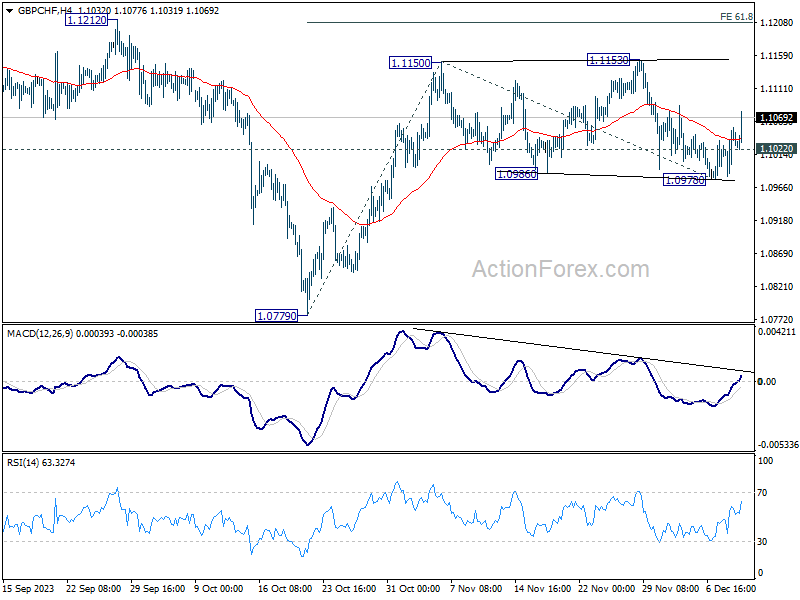
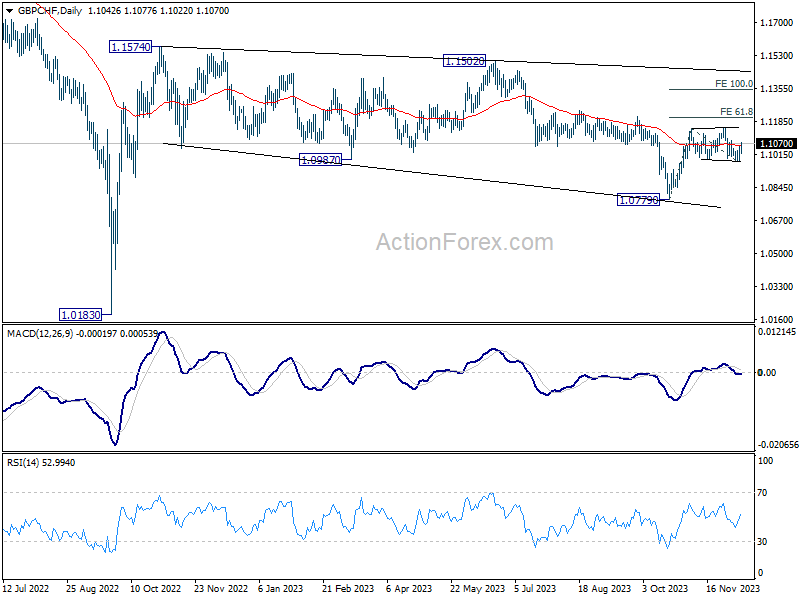
GBP/CHF's rebound from 1.0978 extends higher today. The development suggests that fall from 1.1153 has completed at 1.0978 already. More importantly, corrective pattern from 1.1150 might has completed with three waves down to 1.0978 too.
Further rise is now in favor as long as 1.1022 minor support hold. Decisive break of 1.1153 resistance will confirm resumption of whole rise from 1.0779. GBP/CHF should then target 61.8% projection of 1.0779 to 1.1150 from 1.0978 at 1.1199, or even further to 100% projection at 1.1341.
USD/JPY Mid-Day Outlook
Daily Pivots: (S1) 143.18; (P) 144.20; (R1) 145.89; More...
While USD/JPY's rebound from 141.59 is strong, outlook is unchanged for the moment. Upside should be limited be 147.14 support turned resistance. On the downside, below 144.80 minor support will turn bias to the downside for retesting 141.59. Break of 141.59 and sustained trading below 142.45 fibonacci level will pave the way to next fibonacci level at 136.63. However, firm break 147.14 will dampen the bearish view, and bring stronger rally to 149.56 resistance and above.
In the bigger picture, current fall from 151.89 is seen as the third leg of the corrective pattern from 151.93 (2022 high). Deeper decline would be seen through 38.2% retracement of 127.20 to 151.89 at 142.45 to 61.8% retracement at 136.63. This will now remain the favored as long as 147.14 support turned resistance holds.
Economic Indicators Update
| GMT | Ccy | Events | Actual | Forecast | Previous | Revised |
|---|---|---|---|---|---|---|
| 23:50 | JPY | BSI Large Manufacturing Index Q4 | 5.7 | 5.6 | 5.4 | |
| 23:50 | JPY | Money Supply M2+CD Y/Y Nov | 2.30% | 2.50% | 2.40% | |
| 06:00 | JPY | Machine Tool Orders Y/Y Nov P | -13.60% | -20.60% |
The Flash Sell-off in Crypto?
Market Picture
A wave of profit-taking hit the cryptocurrency market on Monday morning. It seems that the failure of cryptocurrencies to rise over the weekend caused players to pull stop orders very close to market prices, and we saw a massive exit from long positions in low liquidity before the regular session in Asia. Strong demand for risk assets in traditional markets suggests that the market will try to get back on its previous growth track.
Bitcoin started the day at $43.8K, soon fell to $40.7K, and then stabilised at $42.1K, losing 4% since the start of the day. This quick reload did not break the bullish trend. In our view, it will remain in force if Bitcoin manages to hold above $40K.
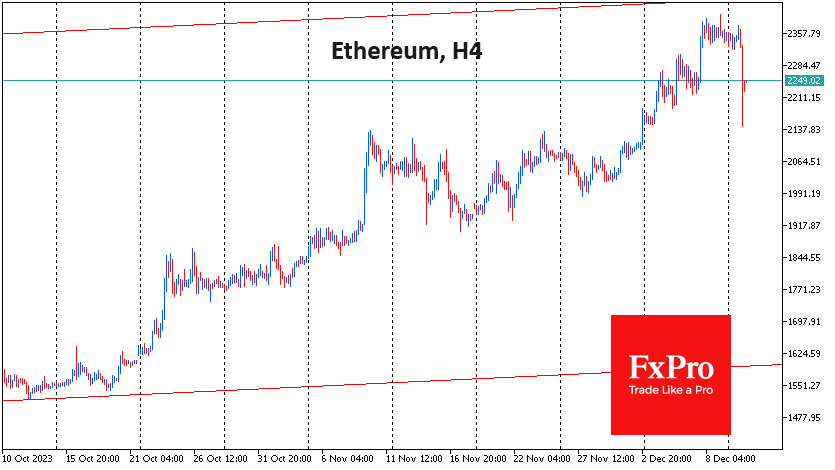
The sudden sell-off proved even harder for altcoins. At one point, Ethereum was losing over 9%, XRP was losing over 10%, Solana collapsed by 13%, and Cardano lost 14%. The largest altcoins have already recovered about half of those losses. The sell-off attracted buyers who were waiting for lower prices to enter the market, and the market gave them that chance.
News Background
Spot bitcoin ETFs could raise more than $2.4bn as early as the first quarter of 2024, according to asset management firm VanEck. Bitcoin is expected to take away a significant market share from gold. The inflow of funds may reach $40.4bn in two years.
Bitcoin will hit a new all-time high in the fourth quarter of 2024, potentially driven by ‘political events and regulatory changes following the U.S. presidential election’, VanEck predicts.
A new Glassnode report notes significant fund flows on cryptocurrency exchanges, which could suggest institutional investors are preparing for spot ETFs.
Société Générale, one of France’s largest banks, plans to become the first traditional financial institution to list its stablecoin on a cryptocurrency exchange.
CoinGecko estimates that more than half of the world’s countries have already legalised cryptocurrencies in some form. The best example is Europe, where 39 out of 41 countries have already legalised cryptocurrencies.
Authorities in El Salvador announced the launch of an emigration programme that will offer residency permits and a chance to obtain citizenship for crypto investments of $1m in Bitcoin or USDT.
GBP/CHF rebounds, eyes 1.115 resistance
GBP/CHF stands as one of the focuses this week, particularly in light of the upcoming monetary policy decisions by both BoE and SNB. Market consensus widely anticipates that both central banks will maintain their current interest rates.
GBP/CHF's rebound from 1.0978 extends higher today. The development suggests that fall from 1.1153 has completed at 1.0978 already. More importantly, corrective pattern from 1.1150 might has completed with three waves down to 1.0978 too.
Further rise is now in favor as long as 1.1022 minor support hold. Decisive break of 1.1153 resistance will confirm resumption of whole rise from 1.0779. GBP/CHF should then target 61.8% projection of 1.0779 to 1.1150 from 1.0978 at 1.1199, or even further to 100% projection at 1.1341.
GBP/USD – Pound Edges Higher ahead of UK Job Data
- UK to release employment report on Tuesday
- US nonfarm employment payrolls beats forecast and rise to 199,000
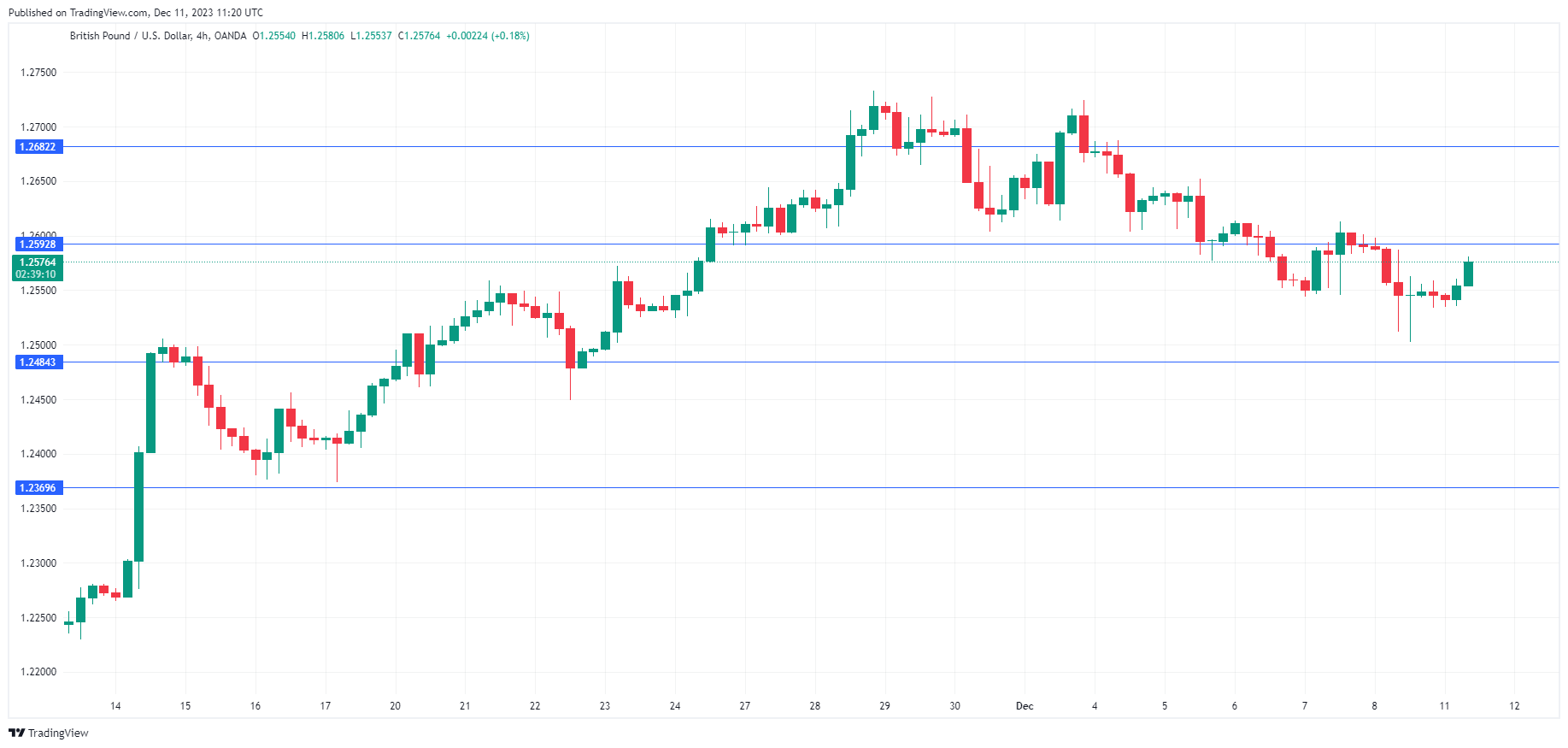
The British pound is showing little movement at the start of the week. In Monday’s European session, GBP/USD is trading at 1.2576, up 0.22%.
It’s a busy week for UK releases which could translate into volatility from the British pound. The UK releases employment data on Tuesday, GDP on Wednesday, followed by the Bank of England rate decision on Thursday.
BoE eyes employment report
The UK employment report will be closely watched by the BoE, which is expected to hold the cash rate at 5.25% for a third straight time. The UK labour market has remained strong despite the BoE’s aggressive tightening and high wage growth continues to drive inflation. The unemployment rate is expected to tick higher from 4.2% to 4.3% while wages including bonuses are expected to ease to 7.7%, down from 7.9%.
BoE Governor Bailey had a hawkish message for the markets last week, saying that interest rates could remain at current levels for “an extended period” in order to bring inflation back down to the 2% target. Inflation has been falling sharply, but the current clip of 4.9% remains much higher than the target and the BoE doesn’t want to encourage talk of a rate hike, which could ease financial conditions and push inflation higher. The markets, however, have priced in rate cuts in mid-2024.
US nonfarm payrolls dampens rate-cut expectations
Friday’s US nonfarm payrolls came in at 199 thousand in November, above the market consensus of 180,000 and higher than the October gain of 150,000. Unemployment dropped from 3.9% to 3.7% and average hourly earnings rose to 0.4% m/m, up from 0.2% in October and above the market consensus of 0.3%. The strong data points to a resilient labour market despite signs that the economy is cooling down, and has reduced fears of recession.
The markets are still expecting four or five rate cuts in 2024, pointing to a deep disconnect with the Fed, which is insisting that hikes remain on the table. The strong nonfarm payroll report is a reminder to the markets that the US labour market remains strong, even if there are clear signs that the economy is cooling down. Tuesday’s inflation report will be closely watched, as a stronger-than-expected reading would likely force the markets to temper expectations about rate hikes in 2024.
GBP/USD Technical
- GBP/USD is putting pressure on resistance at 1.2592, followed by 1.2682
- 1.2484 and 1.2369 are the next support levels
XAU/USD: Gold Stands at the Back Foot Ahead of Key Events
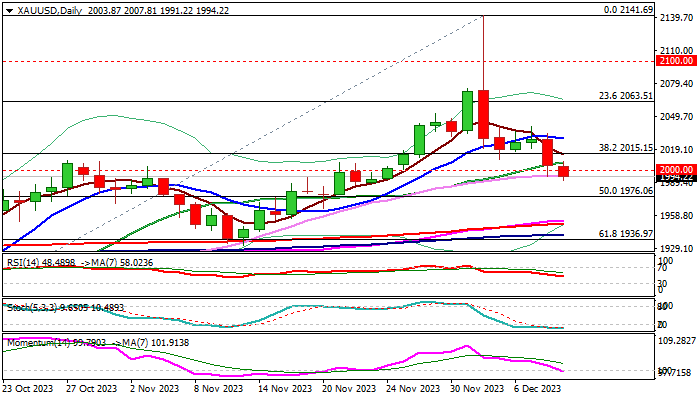
Gold remains in red for the second consecutive day and fell below $2000 early Monday, pressured by firmer dollar on solid US labor data.
Friday’s 1.2% drop generated fresh bearish signal on close below $2015 pivot (Fibo 38.2% of $1810/$2141), with extension lower adding to the strength of bearish continuation signal.
Near-term technical picture is weakening, as 14-d momentum is breaking into negative territory and 10/20 DMA’s turned to bearish configuration, although oversold conditions may produce headwinds and possibly slow bears.
Pullback from new all-time high ($2141, Dec 4 spike) could be seen for now as a healthy correction ahead of fresh push higher, as the correction is still within the limits, but could also signal reversal, after bears broke pivots at $2015/$2000 and look for confirmation on loss of $1976 (50% retracement of $1810/$2141).
Traders eye US inflation report and Fed policy decision, which could provide stronger direction signal.
The yellow metal may accelerate high if US inflation comes below expectations in November, with additional positive signal to be generated from Fed, as the central bank is widely expected to keep interest rates unchanged and stronger signals about rate cuts would deflate dollar.
Res: 2000; 2015; 2041; 2063.
Sup: 1990; 1976; 1955; 1951.
Q3 Next Year Marked for SNB’s First Rate Cut, Economists Predict
SNB is widely anticipated to maintain its key policy rate at 1.75%. However, the focus of market analysts and economists has shifted to speculating the timing of potential policy loosening. Recent polls conducted by Reuters and Bloomberg revealed a consensus among economists that SNB would only start cutting interest rates in Q3 next year.
The Reuters poll, conducted between December 5-11, gathered responses from 31 economists, all of whom unanimously agreed that SNB would hold the rate at 1.75% in the upcoming meeting. A substantial majority, approximately 70% (or 21 out of 31), predicted that SNB would maintain this rate until at least the third quarter of next year. Furthermore, a notable minority of 45% (or 13 out of 29) economists foresee the first rate cut by being pushed back to December 2024 or even later.
In comparison, a separate Reuters poll last week focusing on ECB revealed that around 57% of economists expect the ECB to implement at least one rate cut by the end of June. This comparison highlights expectations that SNB could starting cutting rates after ECB.
Additionally, a Bloomberg poll conducted from December 1-7 forecasts SNB initiate an interest rate cut in September next year. This would be followed by two more reductions of 25 bps each, anticipated in December 2024 and March 2025.
Gold Feels the Blues After Record Rally
- Gold starts a new bearish wave after record high
- A consolidation phase is likely; support at 1,970-1,990
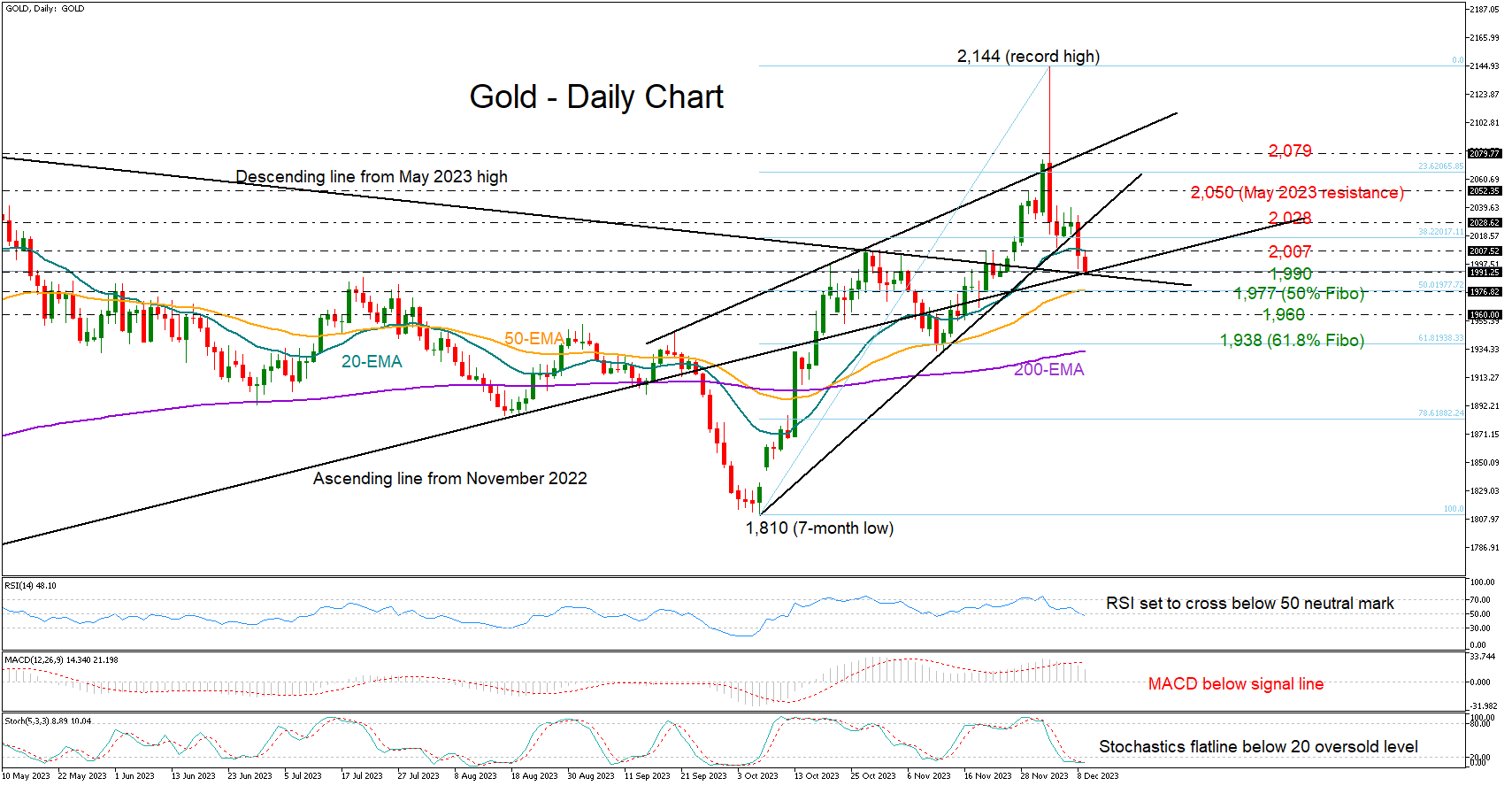
Despite its rocket rally to a new record high of 2,144 last Monday, gold could not successfully remain above the pandemic-era 2,070 bar, which caused a negative trend reversal in 2022 and 2023.
The precious metal has been trending southwards since then, feeding concerns that a new bearish trend could be underway as the price has slipped below a short-term support trendline and marginally beneath its 20-day exponential moving average (EMA) and the 2,000 number.
The technical signals are not very encouraging either as the RSI is looking to cross below its 50 neutral mark and the MACD keeps decelerating below its red signal line. Yet, the stochastic oscillator is already in the oversold area, while the ascending line from the November 2022 low seems to have resumed its protective role around 1,990. This is also where the 200-period EMA on the four-hour chart is blocking the way down, justifying some optimism for the coming sessions, too.
If the 1,990 floor cracks, the 50-day EMA, which overlaps with the 50% Fibonacci retracement of the latest upleg at 1,977, could be the next pivot point. Slightly lower, the 1,960 region has been a tough obstacle to upside movements during the past couple of years and will be closely watched before the 61.8% Fibonacci mark of 1,938 and the 200-day EMA attract attention.
In the opposite case, where the price jumps back above its 20-day EMA at 2,007, the rise could last till the 2,028 resistance region. A break higher could strengthen the bullish momentum towards the important barrier of 2,050. If that proves easy to overcome too, the spotlight will again turn to the critical 2023 top of 2,079.
Summing up, the yellow metal has a bearish tendency in the very short-term picture, but sellers may not act forcefully until a drop below 1,977-1,990 occurs.
Sharp Change in BTC/USD Price: Causes and Consequences
On Monday morning, the price of bitcoin fell sharply. As the chart shows, the BTC/USD rate fell below 42,000 on Monday during the Asian session. According to Coinglass, the decline resulted in about $400 million worth of positions being liquidated by about 100,000 traders on cryptocurrency exchanges. So far, the price has found support around the 41,200 level, where the lower border of the ascending channel lies (shown in blue).
What are the reasons for such a sharp decline? From a fundamental point of view, there are no triggers with the media associated with, for example, statements by officials. What then?
First of all, the idea comes with low liquidity in the financial markets at the beginning of Monday in the Asian session. A recent example is the gold market, when the price of the metal jumped at the opening of trading to $2,130, but then quickly fell to $2,060. By the way, we wrote on Tuesday that the bears may try to push the price of gold below the psychological level of $2,000. The scenario is still coming true.
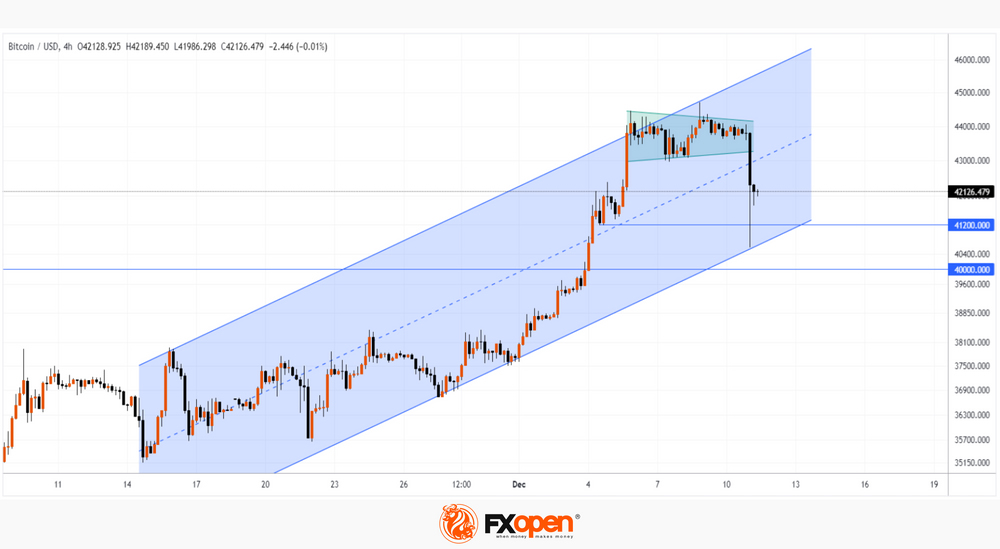
What will happen to bitcoin? The graph shows that:
→ the price was within consolidation for some time (shown in green);
→ On December 8, the year’s maximum was updated, which in fact turned out to be a trap, a false bullish breakout of the consolidation zone (a bearish sign);
→ this morning, there was a bearish breakdown of the consolidation zone.
After 8 weeks of gains, we can assume that the market is overbought and today's decline is an overdue correction after a rally of more than 70% from the September lows.
But corrections, as a rule, are characterized by smoother declines with decreasing volumes. And if we analyze the nature of the decline on Monday morning, it looks more like an impulse.
Of course, given the high leverage that is applied in the poorly regulated crypto market, it is reasonable to assume that the correction took this form due to the cascading triggering of buyers’ stop losses. On the other hand, what if insiders are actively selling bitcoin, knowing that the coming week will bring a dose of negativity on the fundamental background?
One way or another, if the price of bitcoin reaches a psychological level, then analyzing the patterns on the chart will provide important information. It is possible that the price will break below the $40k level, and it will provoke an upward rebound — the nature of which will provide valuable material for reasoning about whether the current decline is an overdue correction or a bearish reversal.
This article represents the opinion of the Companies operating under the FXOpen brand only. It is not to be construed as an offer, solicitation, or recommendation with respect to products and services provided by the Companies operating under the FXOpen brand, nor is it to be considered financial advice.
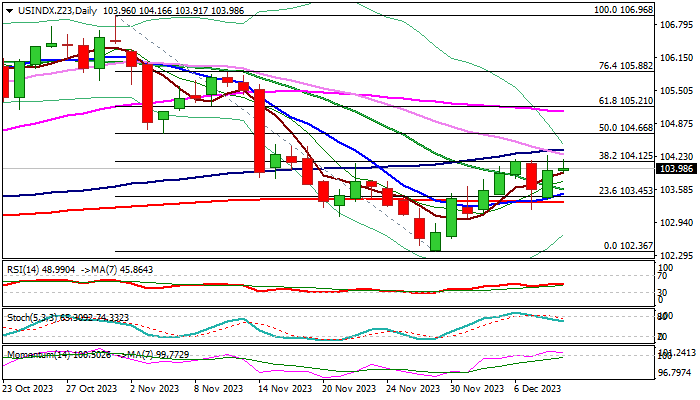
Dollar Index: Dollar Keeps Firm Tone and Attempts Again Through Pivotal Barriers at 104.10 Zone
The dollar index remains constructive at the start of the week, following Friday’s jump on robust US November labor data.
The greenback benefited from higher than expected US NFP and unemployment below consensus in November, which signaled that labor market remains resilient and softening narrative about rate cuts.
However, recovery faces headwinds from pivotal barrier at 104.10 zone (Fibo 38.2% of 106.96/102.36 / falling daily Kijun-sen / top of recent range) with firm break here needed to signal bullish continuation and expose targets at 104.66/94 (50% retracement / daily cloud base).
Bullishly aligned daily studies support this scenario, however repeated failure to register a clear break higher to signal prolonged consolidation, but with bullish bias above 103.50/57 (converging 10/20 DMA’s and on track to form bull-cross).
Caution on loss of 200DMA (103.33) which would weaken near-term structure and signal an end of near-term recovery phase.
Markets look for fresh signals from US inflation report (due on Tuesday) with inflation expected to ease further in November and Fed rate decision on Wednesday (the central bank is widely expected to keep rates unchanged in its December’s meeting).
Res: 104.12; 104.36; 104.66; 104.94.
Sup: 103.90; 103.50; 103.33; 103.19.