Sample Category Title
Dollar Index: Dollar Keeps Firm Tone and Attempts Again Through Pivotal Barriers at 104.10 Zone
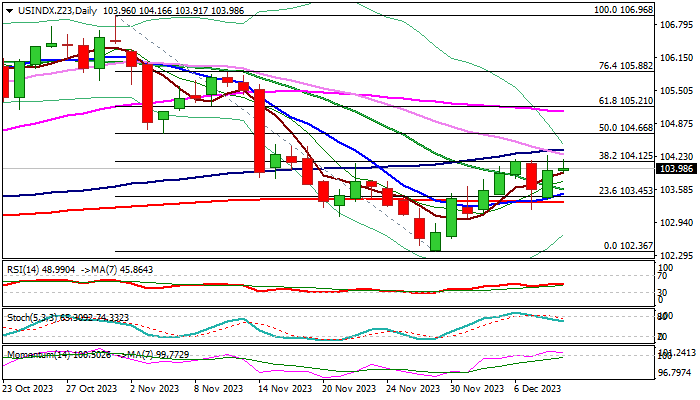
The dollar index remains constructive at the start of the week, following Friday’s jump on robust US November labor data.
The greenback benefited from higher than expected US NFP and unemployment below consensus in November, which signaled that labor market remains resilient and softening narrative about rate cuts.
However, recovery faces headwinds from pivotal barrier at 104.10 zone (Fibo 38.2% of 106.96/102.36 / falling daily Kijun-sen / top of recent range) with firm break here needed to signal bullish continuation and expose targets at 104.66/94 (50% retracement / daily cloud base).
Bullishly aligned daily studies support this scenario, however repeated failure to register a clear break higher to signal prolonged consolidation, but with bullish bias above 103.50/57 (converging 10/20 DMA’s and on track to form bull-cross).
Caution on loss of 200DMA (103.33) which would weaken near-term structure and signal an end of near-term recovery phase.
Markets look for fresh signals from US inflation report (due on Tuesday) with inflation expected to ease further in November and Fed rate decision on Wednesday (the central bank is widely expected to keep rates unchanged in its December’s meeting).
Res: 104.12; 104.36; 104.66; 104.94.
Sup: 103.90; 103.50; 103.33; 103.19.
Japanese Yen Correction Continues
- Japanese yen’s slide continues
- Markets walk back expectations of a change at BoJ December meeting
- US nonfarm payrolls rise to 199,000, better than expected
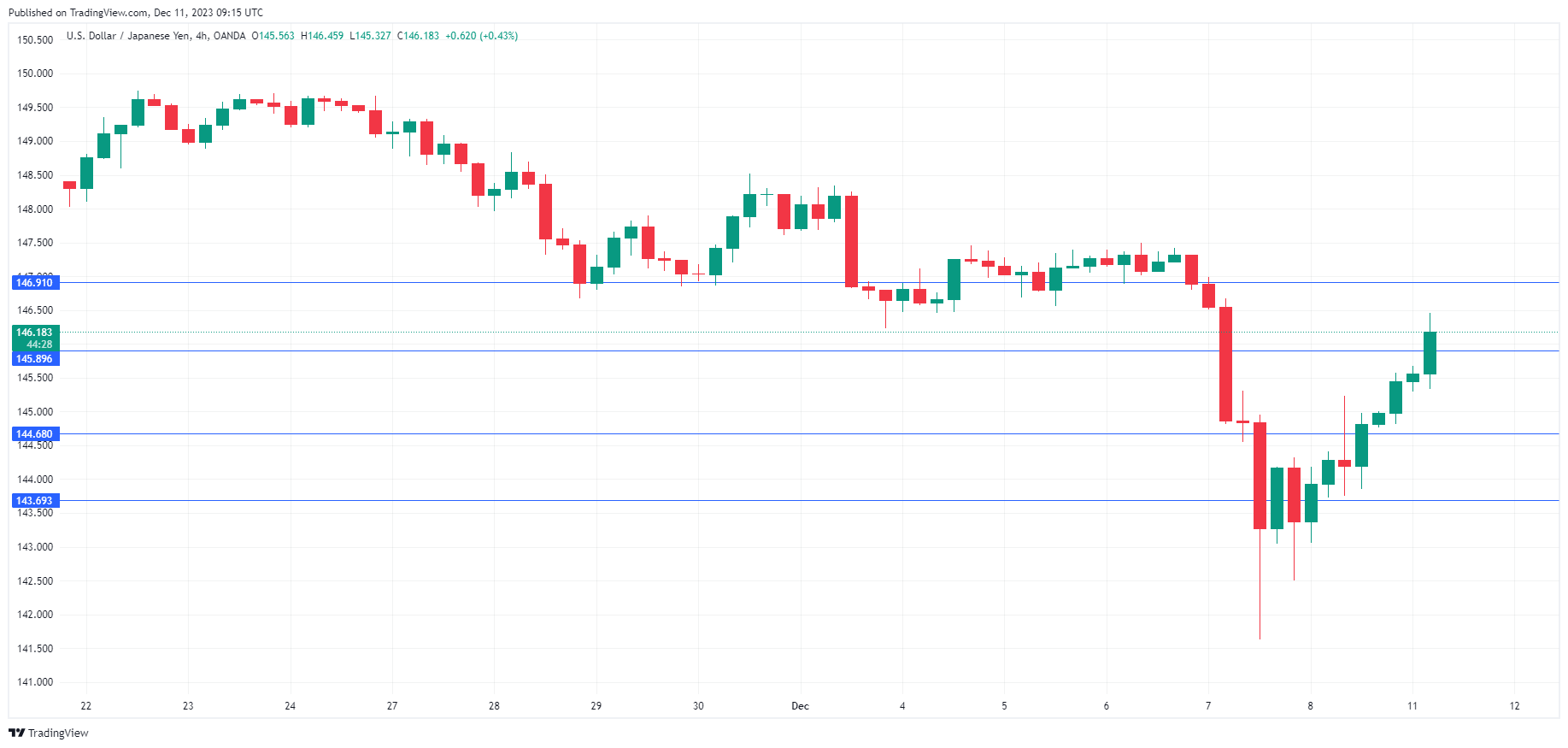
The Japanese yen has started the week where it left off on Friday, posting sharp losses. In the European session, USD/JPY is trading at 146.16, up 0.83%.
BoJ December mania wanes
The yen soared over 2% on Thursday, after comments by senior BoJ officials triggered speculation that Bank of Japan might exit negative interest rates at the December 18-19 meeting. BoJ officials are usually tight-lipped about any plans to change policy and last week’s signals were quickly picked up by investors and sent the yen flying. The BoJ has expressed concern over the depreciating yen and last week’s comments from Governor Governor Kazuo Ueda and BoJ Deputy Governor Ryozo Himino may have been a coordinated move to boost the Japanese currency.
The yen’s jump did not last long, as the US dollar has bounced back and recovered more than half of Thursday’s losses. The rally suffered a reversal on Friday after an anonymous source said that Ueda’s comments that the BoJ was facing “an even more challenging situation” in December and next year were taken out of context and were not meant as a signal of a policy shift.
What is noteworthy is that the strong swings we are seeing from the yen are completely based on speculation – last week’s BoJ comments raised expectations of a move at the December meeting and sent the yen higher. This was followed on Friday by an anonymous source that poured cold water on an imminent policy shift and sent the yen lower.
The weak Japanese economy is providing support for the view that the BoJ will not make any moves at the December meeting. Last week’s soft Q3 GDP reading, in which GDP contracted by 2.9% y/y is further reason for the central bank not to tighten until the economy shows signs of improvement.
Nonfarm payrolls beat expectations
Friday’s US nonfarm payrolls came in at 199 thousand in November, above the market consensus of 180,000 and higher than the October gain of 150,000. Unemployment dropped from 3.9% to 3.7% and average hourly earnings rose to 0.4% m/m, up from 0.2% in October and above the market consensus of 0.3%. The strong data points to a resilient labour market despite signs that the economy is cooling down, and has reduced fears of recession.
USD/JPY Technical
- USD/JPY is testing resistance at 145.89. This is followed by resistance at 146.91
- There is support at 144.68 and 143.69
Fed Decision and US Inflation Data Coming Up
- Fed set to hold interest rates steady on Wednesday
- USD reaction will depend on rate projections for next year
- Latest US inflation report to be released on Tuesday ahead of Fed
How many rate cuts will the Fed signal?
It’s been a great year for the American economy. Real growth is on track to hit 3% with some help from resilient consumer spending and an enormous government deficit. Meanwhile, inflation has been falling steadily, fueling speculation that the economy can achieve the elusive ‘soft landing’ that the Fed has been hoping for.
Against this backdrop, the Federal Reserve will announce its latest decision at 19:00 GMT on Wednesday. Markets are pricing in almost zero chances of a rate increase, so the focus will fall mostly on the updated interest rate projections and Chairman Powell’s commentary in his press conference.
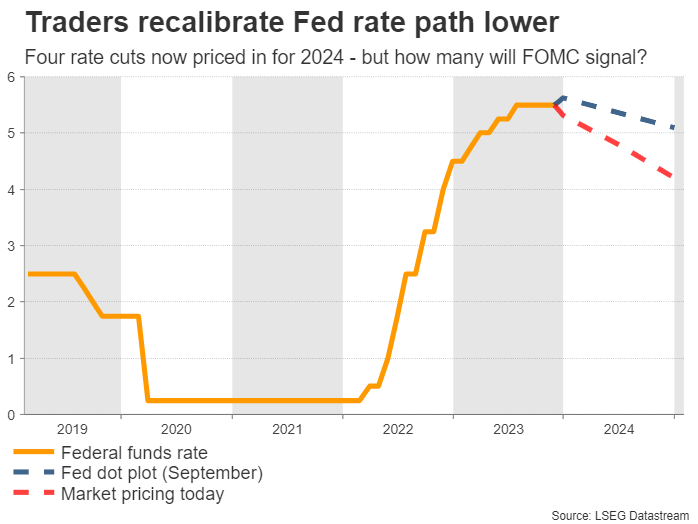
Specifically, the action will depend on whether Fed officials validate market pricing for aggressive rate cuts next year. Market pricing currently points to four rate cuts for the entirety of 2024, which would bring the Federal funds rate down to 4.2% next year.
In contrast, the latest Fed projections back in September showed interest rates closing next year at 5.1%. That’s a huge gap between FOMC forecasts and market pricing, which will probably narrow this time with the Fed coming closer to market expectations.
The question is, exactly how much will the Fed lower its rate projections? Judging by recent comments from various FOMC officials, many of whom have advocated for keeping rates steady for some time, it seems unlikely they will signal anything close to 4.2%. A more reasonable estimate might be around 4.6% instead.
Such a number might be perceived as ‘hawkish’ by investors, as the Fed would be implicitly pushing back against market pricing for such heavy rate cuts. In turn, that could be beneficial for the dollar.
Inflation and retail sales also in focus
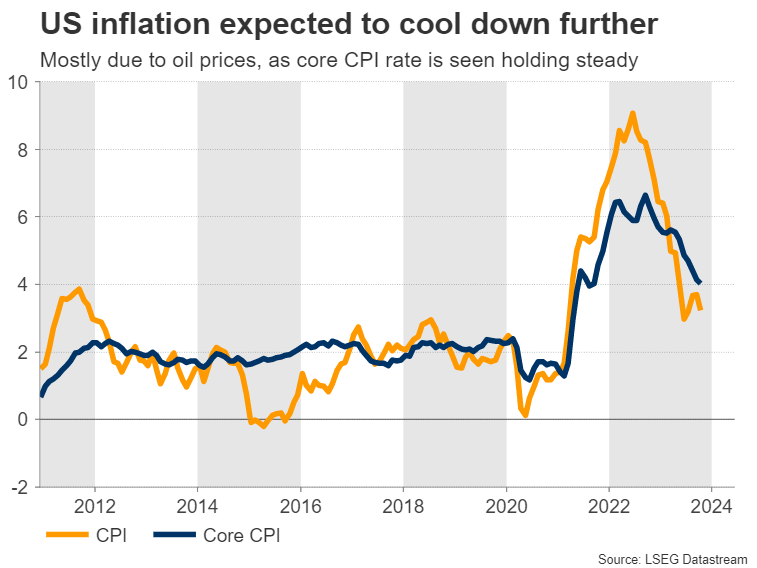
Ahead of the Fed decision, the latest US CPI inflation data will be published at 13:30 GMT on Tuesday. The headline CPI rate is forecast to have declined one tick to 3.1% in yearly terms from 3.2% earlier, mostly because of the recent decline in energy prices, as the core rate that excludes those effects is anticipated to have held steady at 4.0%.
As for any potential surprises, the risks seem tilted towards a hotter-than-expected inflation report, considering the signals from business surveys. Specifically, the S&P Global services PMI showed service providers raising their selling prices at the fastest pace since July, with the increase in prices paid of the ISM manufacturing PMI reflecting something similar.
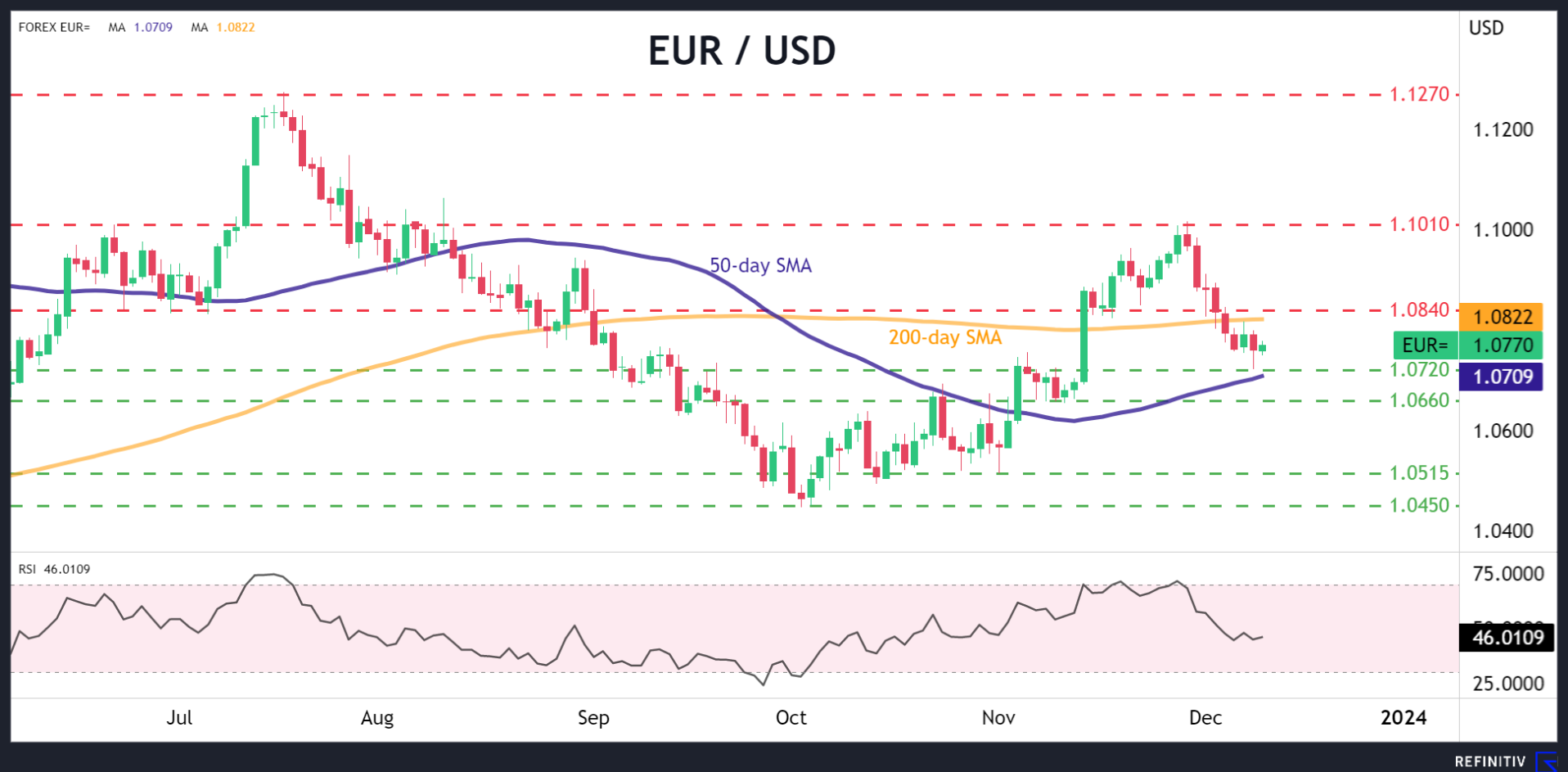
An upside surprise in inflation could dampen speculation for Fed rate cuts next year, and by extension allow the dollar to gain some ground ahead of the Fed decision. Looking at the euro/dollar chart, a potential drop below 1.0720 could open the door for downside extensions towards the 1.0660 zone.
Beyond that, the other key event will be the release of retail sales on Thursday, in the aftermath of the Fed. Forecasts point to a slight drop in monthly terms, although nothing too serious.
In conclusion, there is some scope for these events to boost the dollar, in case the inflation report exceeds estimates and the Fed signals fewer rate cuts than markets have baked into the cake for next year.
Will ECB Set the Stage for an Early 2024 Rate Cut?
- The final ECB rate-setting meeting for 2023 could hold surprises
- Market looks for rate-cut hints; extra focus on projections and overall rhetoric
- Decision will be announced on Thursday 12.15 GMT, press conference at 12:45 GMT
Is President Lagarde ready for a dovish tilt?
This week is shaping up to be a cracking one as the final ECB meeting for 2023 will be held on Thursday, a day after the respective Fed gathering. Armed with the latest projections and, following two days of intense discussions at the Frankfurt tower, the ECB is expected to keep its interest rates unchanged, but it could give strong hints about its 2024 strategy.
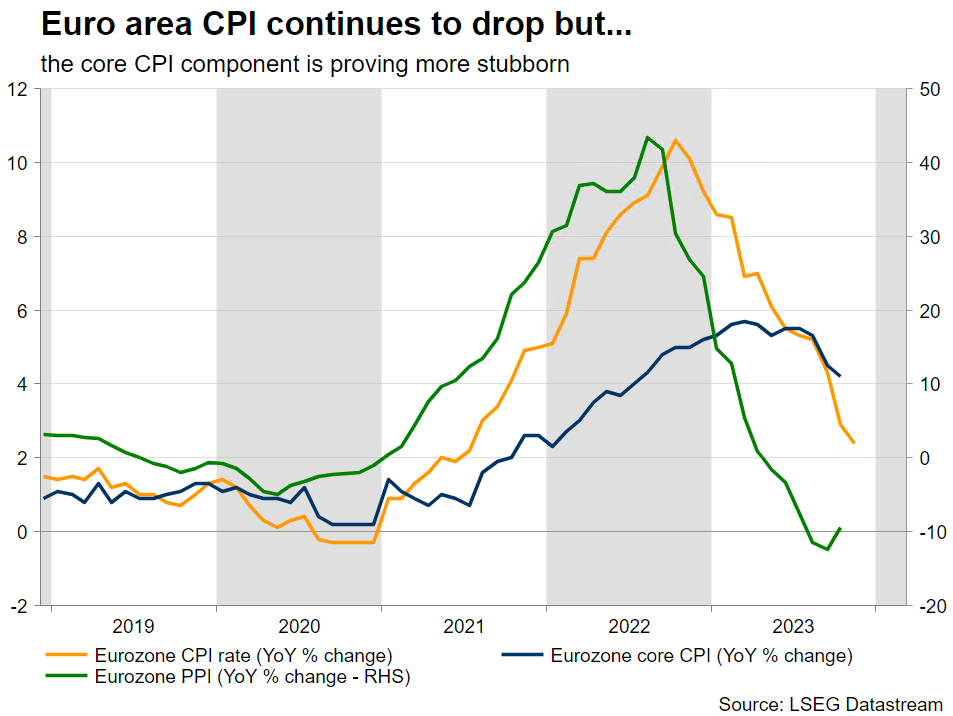
Going into the meeting, inflation continues to decelerate significantly. The preliminary report for the month of November for the euro area surprised on the downside with both the headline and core components dropping to 2.4% and 3.6% year-on-year respectively. While the former has been expected to ease considerably due to the weaker oil prices, the latter’s move caught some ECB officials by surprise.
Similar to other central banks, core inflation has been creating headaches during the second half of 2023. President Lagarde has not been extremely vocal about core inflation, understandably as the ECB’s remit refers to the headline figure. However, the recent weaker core inflation prints have forced a turn from the ECB hawks and, in a sense, have put the final nail in the coffin of rate hikes.
Projections are a very important piece of the puzzle
Having said that, is the ECB ready to signal that rate cuts are around the corner? The scheduled ECB staff projections, which will be released after the meeting, will probably play a key role. At the September edition, the inflation projection for 2025 was 2.1%. A downgrade of this figure, just below the 2% “threshold”, and an equally low CPI projection for 2026 would cement the ECB’s current stance, meaning that it is currently in a comfortable position to meet its 2% inflation target by 2025.
However, a 2025 projection dangerously close to 1.5% would not go down lightly. The market is expected to pick upon this figure in order to justify its aggressive easing expectations as the first 25bps rate cut is now priced in for the April meeting with an extra 110bps expected during 2024. As a comparison, the Fed is expected to ease monetary policy by only 110bps in 2024.
Some positive signs in the growth outlook
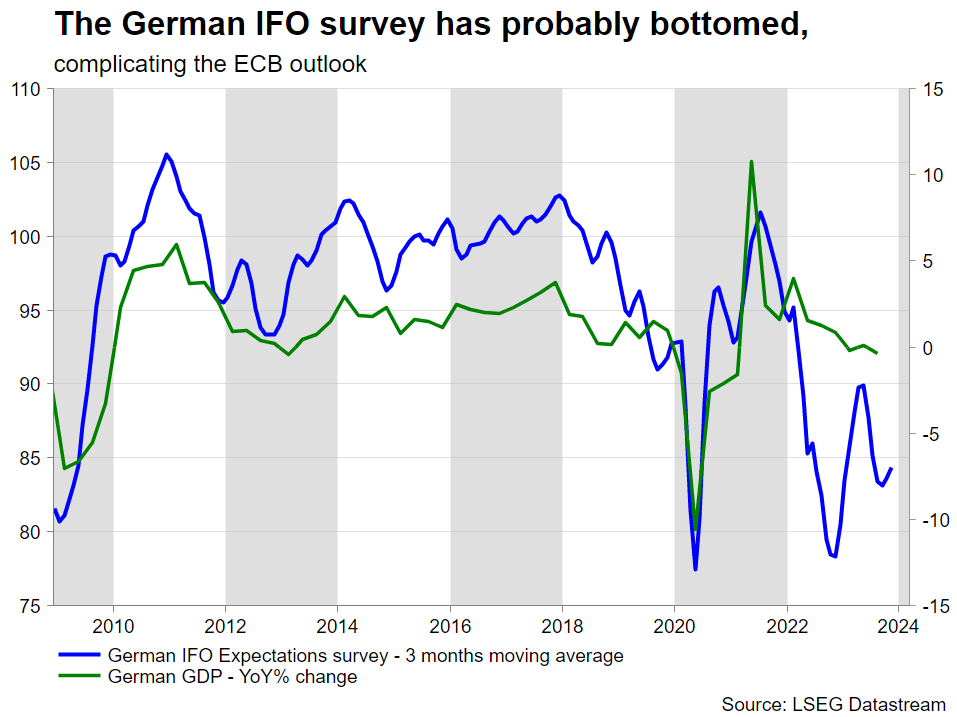
The market appears to be ignoring some bright spots in the forward-looking growth indicators. The latest PMIs and IFO surveys appear to have bottomed out. With Germany most likely contracting in 2023, the hawks could pin their hopes for a better start to 2024, especially following the latest positive news from China.
However, the latest figures show a negative annual growth rate for loans to non-financial corporations, with the full brunt of the 10 consecutive rate moves not yet fully felt by the system.
Putting everything together, the ECB is expected to remain balanced with a high risk of appearing a touch more dovish. An improbable announcement about an earlier stop in the reinvestment of PEPP principal payments could confuse the market but it might be largely ignored.
President Lagarde will be able to see the market reaction after the statement is released, potentially allowing her to rein in the market's expectations during the press conference and Q&A session.
Euro is trying to find its footing against the pound
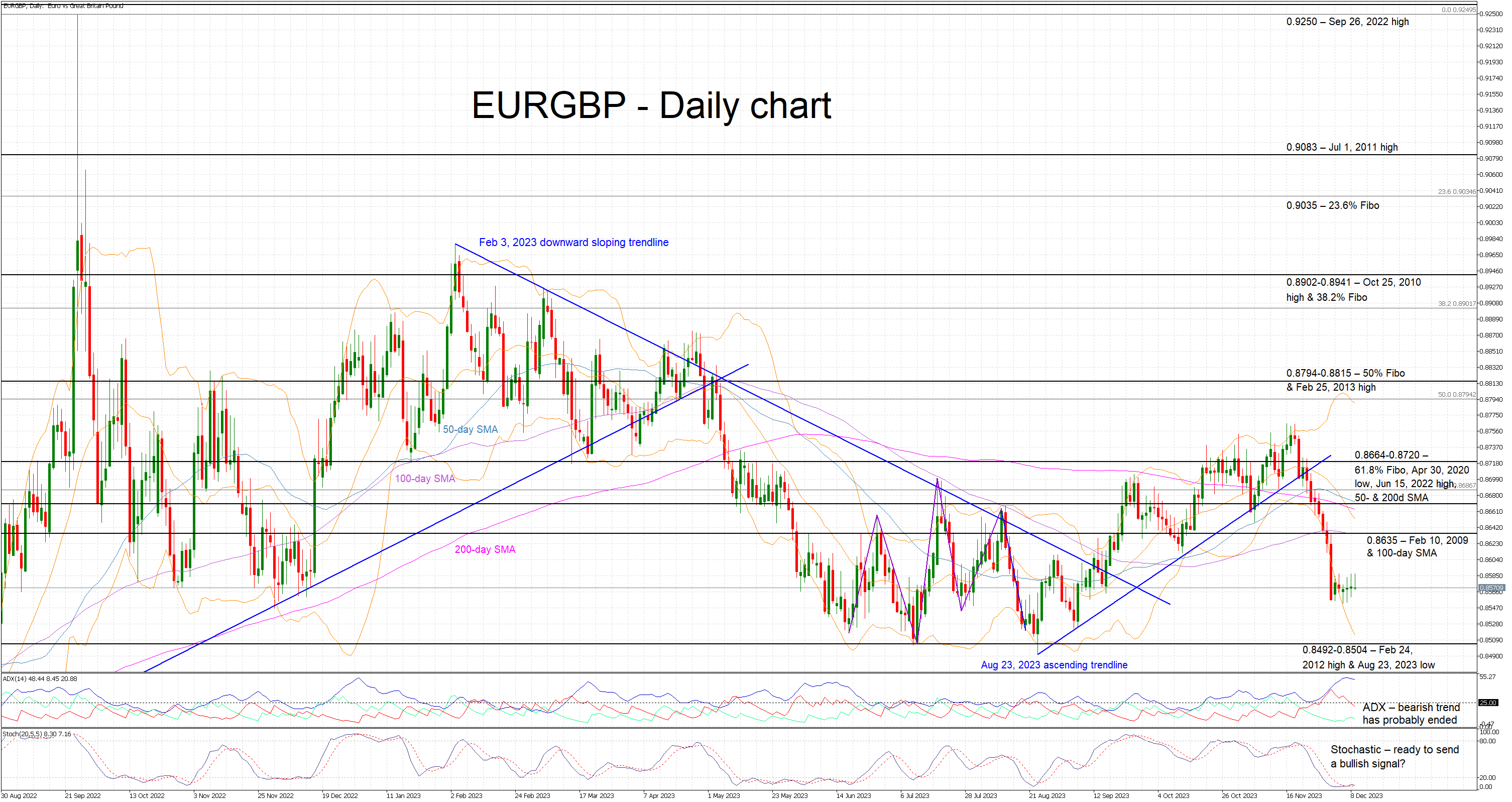
Euro’s hard-earned gains against the pound since late August have mostly evaporated. Seven straight red candles have pushed the euro-pound pair to new 3-month low, with the main reason most likely being the aggressive easing expectations built up for the ECB.
Focusing on this week, the performance of the euro-pound pair depends on the dovishness expressed at the ECB gathering. Should the ECB defy the dovish expectations, we could see a move towards the 0.8635 area. On the flip side, a truly dovish show on Thursday could open the door for a retest of the 2023 low at 0.8492.
GBP/JPY Daily Outlook
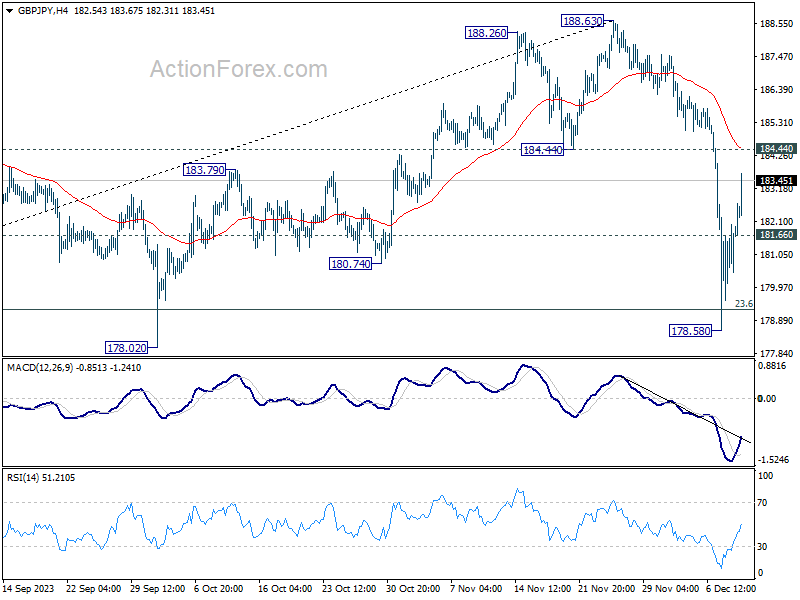
Daily Pivots: (S1) 180.22; (P) 181.14; (R1) 182.71; More...
GBP/JPY's recovery from 178.78 extends higher today but outlook is unchanged. Upside of recovery should be limited below 184.44 support turned resistance to bring another decline. On the downside, below 181.66 minor support will bring retest of 178.68 support first. Firm break of will resume the fall from 188.63 and target 38.2% retracement of 148.93 to 188.63 at 173.46 next.
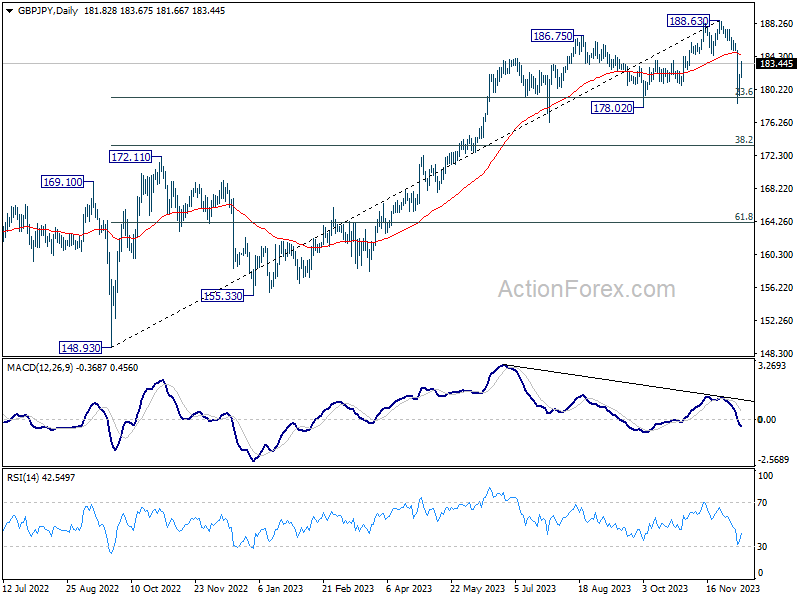
In the bigger picture, while a medium term top is in place at 188.63, there is no clear sign of long term bearish trend reversal yet. As long as 55 W EMA (now at 175.67) holds, price actions from 188.63 are seen as a corrective move only. Larger up trend from 123.94 (2022 low) could resume at a later stage.
EUR/JPY Daily Outlook
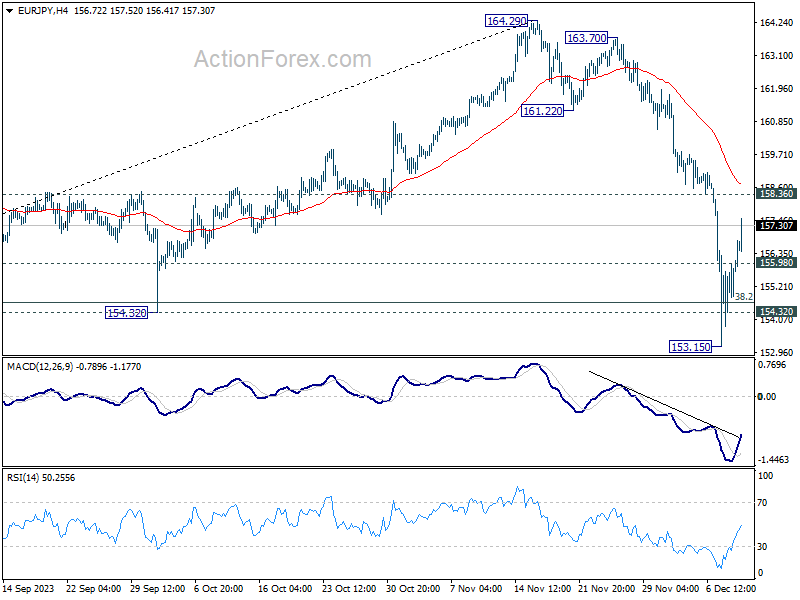
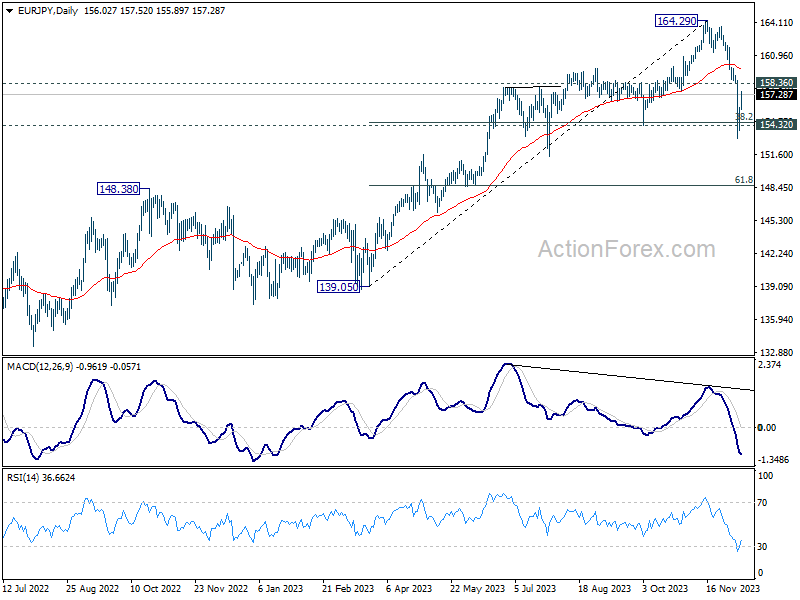
Daily Pivots: (S1) 154.54; (P) 155.32; (R1) 156.76; More..
EUR/JPY's recovery from 153.15 extends higher today but outlook is unchanged. Upside should be limited below 158.36 minor resistance to bring another fall. On the downside, below 155.98 will turn bias to the downside for retesting 153.15. Break of 153.15 and sustained trading below 38.2% retracement of 139.05 to 164.29 at 154.64 will target 61.8% retracement at 148.69 next.
In the bigger picture, price actions from 164.29 medium term top are tentatively seen as a correction to rise from 139.05 for now. As long as 148.48 resistance turned support holds (2022 high), larger up trend from 114.42 (2020 low) could still resume through 164.29 at a later stage.
EUR/AUD Daily Outlook
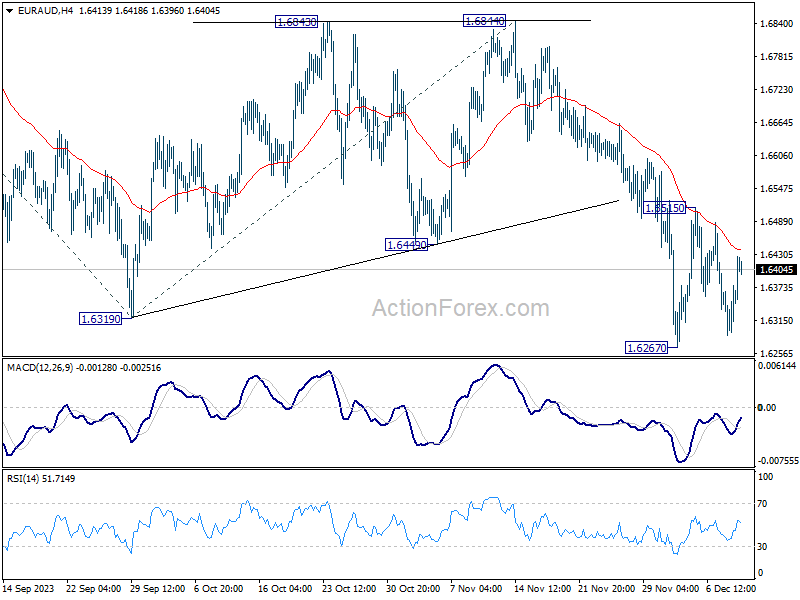
Daily Pivots: (S1) 1.6305; (P) 1.6342; (R1) 1.6392; More...
Intraday bias in EUR/AUD remains neutral for the moment, as consolidation from 1.6267 is extending. Outlook will stay bearish as long as 1.6515 resistance holds. On the downside, break of 1.6267 will resume the whole decline from 1.7062 to 100% projection of 1.7062 to 1.6319 from 1.6844 at 1.6106 next. However, break of 1.6515 resistance will turn bias back to the upside for stronger rebound.
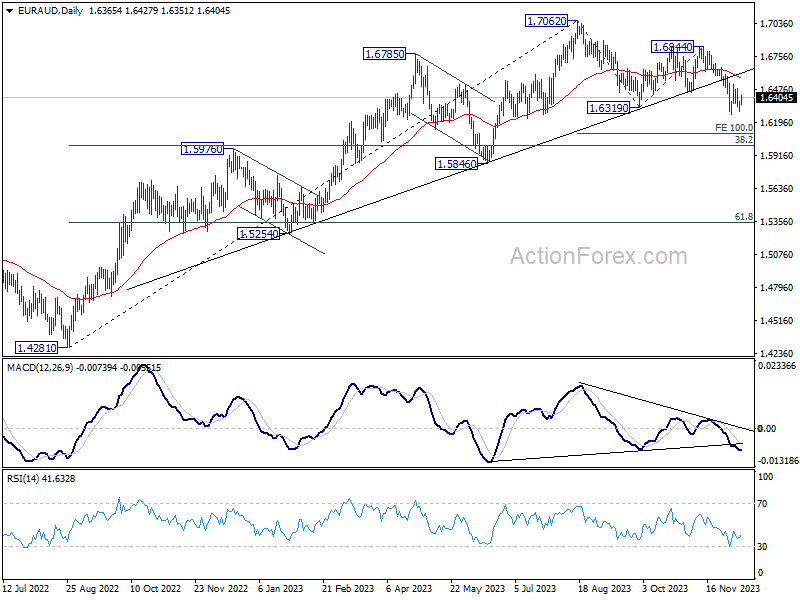
In the bigger picture, fall from 1.7062 medium term top is seen as correcting the whole up trend from 1.4281 (2022 low). Deeper decline would be seen to 38.2% retracement of 1.4281 to 1.7062 at 1.6000. Strong support could be seen there to bring rebound on first attempt. But risk will stay on the downside as long as 1.6844 resistance holds. Sustained break of 1.6000 would bring further fall to 61.8% retracement at 1.5343.
EUR/GBP Daily Outlook
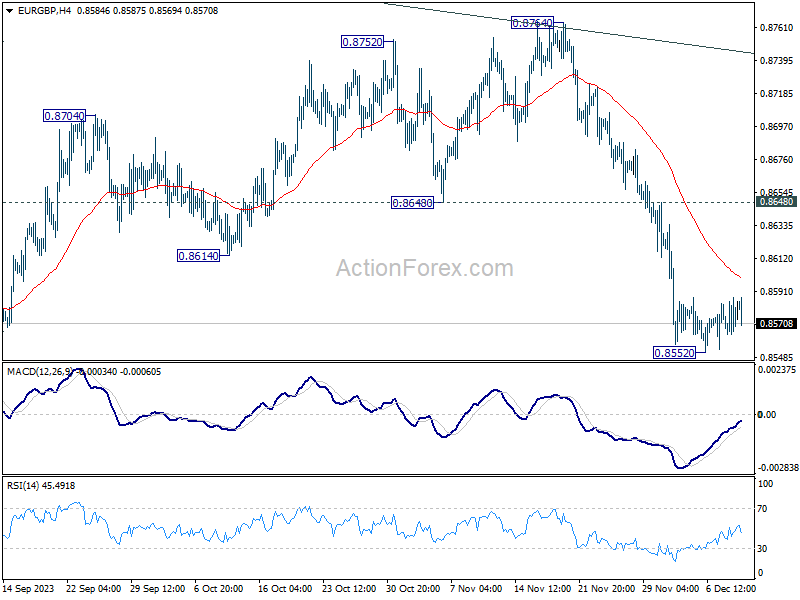
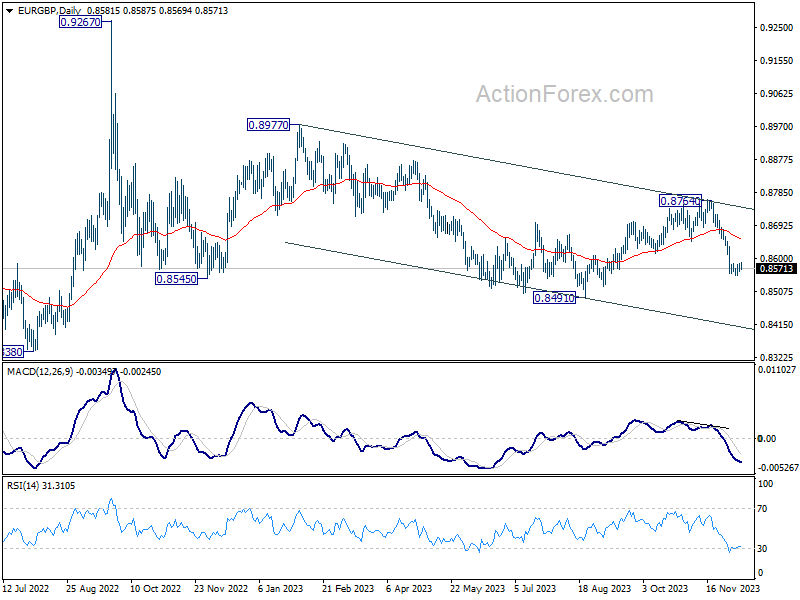
Daily Pivots: (S1) 0.8564; (P) 0.8577; (R1) 0.8589; More....
Intraday bias in EUR/GBP remains neutral as consolidation from 0.8552 is extending. IN case of another recovery, upside should be limited below 0.8648 support turned resistance to bring another decline. Below 0.8552 will target 0.8491 low first. Firm break there will resume larger down trend.
In the bigger picture, current development suggests that down trend from 0.9267 (2022 high) is still in progress. This decline is seen as the third leg of the pattern from 0.9499 (2020 high). Break of 0.8201 will target 100% projection of 0.9499 to 0.8201 from 0.9267 at 0.7969. In any case, outlook will stay bearish as long as 0.8764 resistance holds.
EUR/CHF Daily Outlook
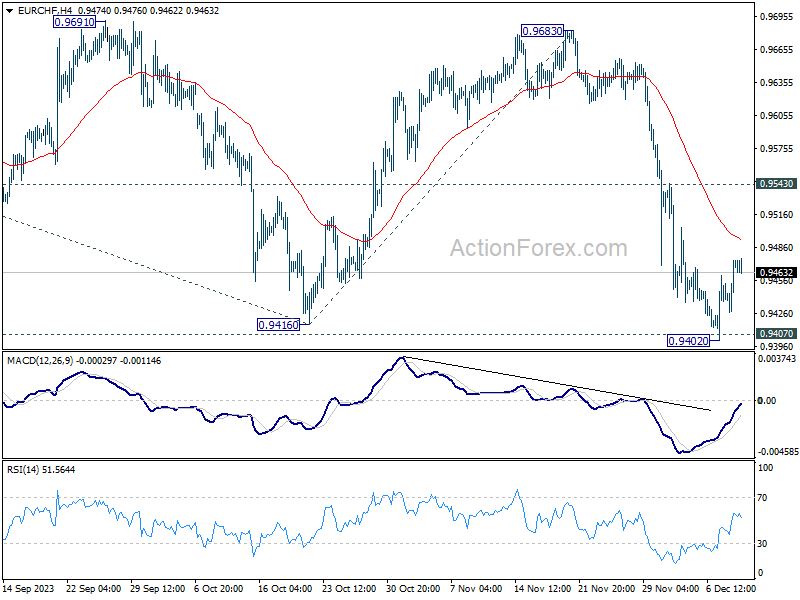
Daily Pivots: (S1) 0.9443; (P) 0.9459; (R1) 0.9490; More...
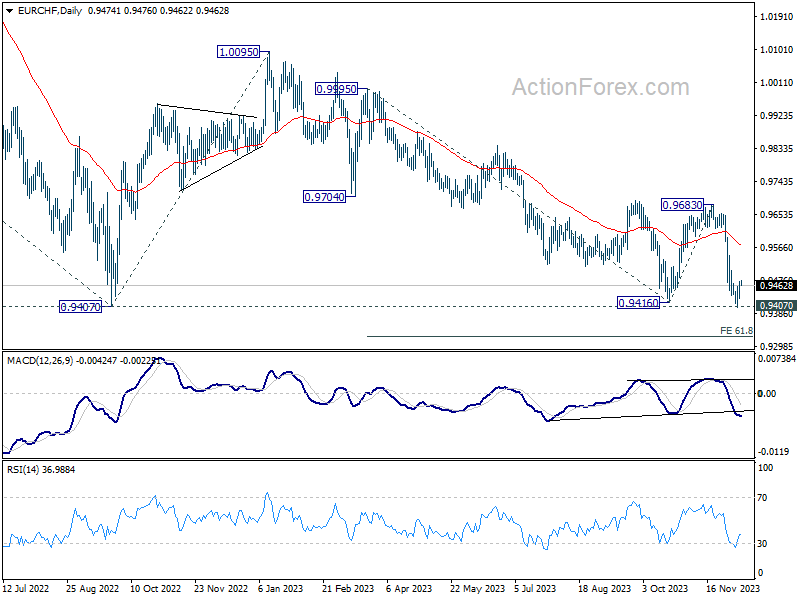
Intraday bias in EUR/CHF remains neutral for the moment and some consolidations would be seen above 0.9402 first. Further fall is expected as long as 0.9543 resistance holds. On the downside, decisive break of 0.9407 will confirm larger down trend resumption.
In the bigger picture, medium term outlook remains bearish as long as 0.9683 resistance holds. Firm break of 0.9407 (2022 low) will resume long term down trend. Next target will be 61.8% projection of 1.1149 (2020 high) to 0.9407 from 1.0095 at 0.9018.
USD/CAD Daily Outlook
Daily Pivots: (S1) 1.3552; (P) 1.3581; (R1) 1.3611; More...
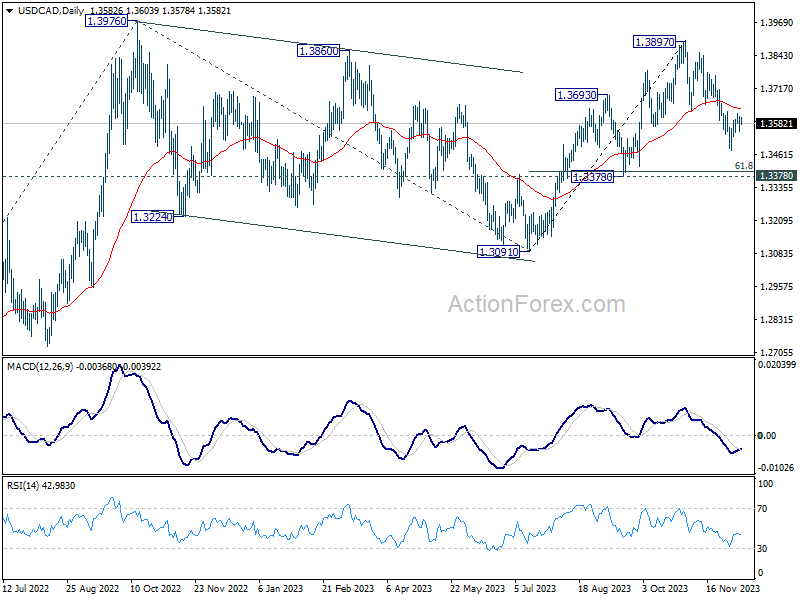
Intraday bias in USD/CAD remains neutral for the moment. On the downside, below 1.3479 will resume the corrective fall from 1.3897. But downside should be contained by 1.3378 support, which is close to 61.8% retracement of 1.3091 to 1.3897 at 1.3399, to bring rebound. On the upside, break of 1.3625 resistance will indicate short term bottoming, and turn bias back to the upside for stronger rise.
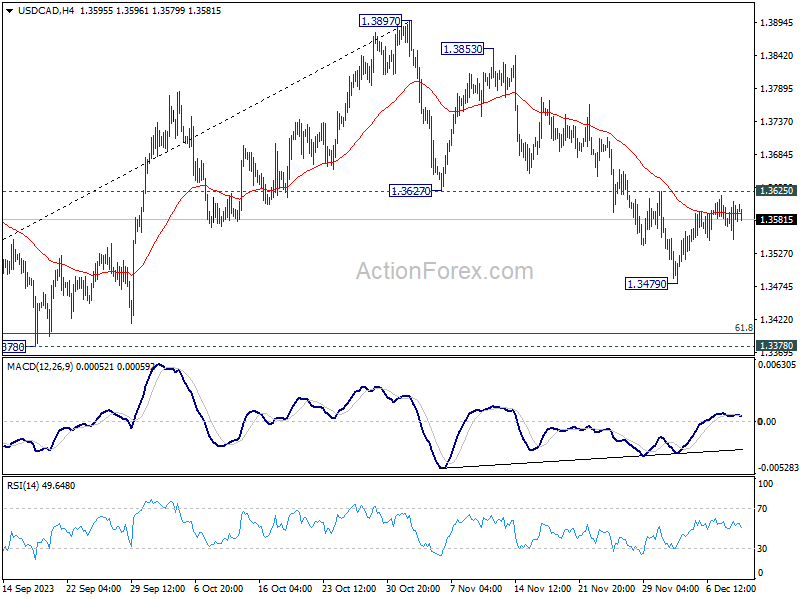
In the bigger picture, rise from 1.3091 is seen as the fifth leg of the whole rise from 1.2005 (2021 low). Further rally is expected as long as 1.3378 support holds, to 61.8% projection of 1.2401 to 1.3976 from 1.3091 at 1.4064. However, decisive break of 1.3378 will dampen this view and bring deeper fall back to 1.3091 instead.