Sample Category Title
USD/CHF Daily Outlook
Daily Pivots: (S1) 0.8973; (P) 0.8998; (R1) 0.9020; More....
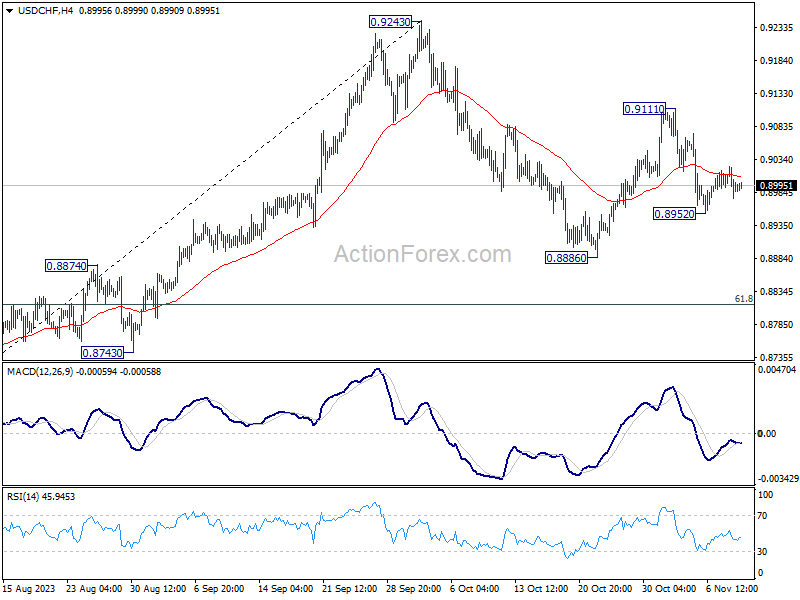
Range trading continues above 0.8952 and intraday bias in USD/CHF stays neutral. On the downside, below 0.8952 will target a test on 0.8886 support first. Break there will resume whole decline from 0.9243 to 0.8815 fibonacci level. However, break of 0.9111 will resume the rebound from 0.8886 instead, and target 0.9243 resistance.
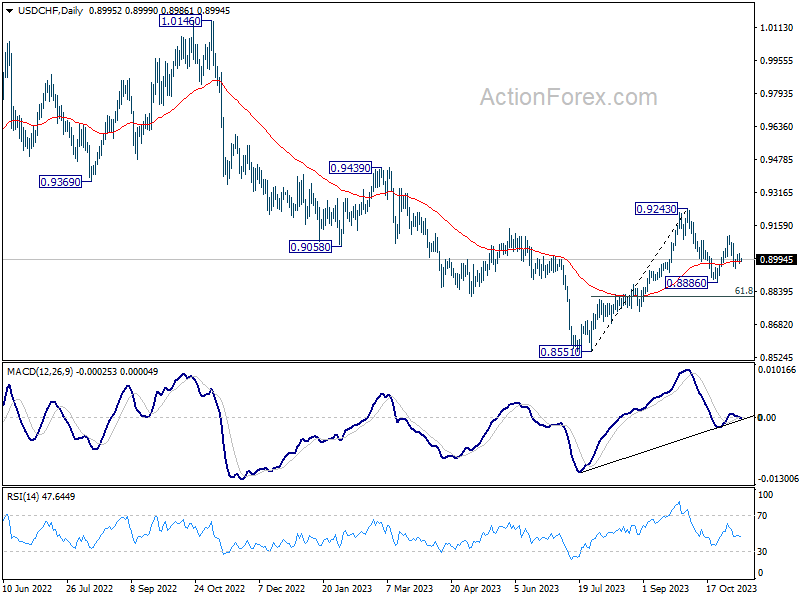
In the bigger picture, outlook is mixed up by the deeper than expected pull back from 0.9243. Yet there was no follow through selling after hitting 0.8886. On the upside, break of 0.9243 resistance will revive the case of medium term bottoming at 0.8851, and turn outlook bullish. However, sustained break of 61.8% retracement of 0.8551 to 0.9243 at 0.8815 will argue that larger decline from 1.0146 is ready to resume through 0.8551 low.
Central Bank Speak Will Again Dominate Market Headlines
Markets
Curve inversion/outperformance of the long end was the name of the game on core bond markets yesterday. US yields ceded between 1.4 bps (2-y) and 11 bps (30-y). The US 10-y yield closed near the key 4.50% reference. German yields showed a similar picture. The 2-y still gained 3.1 bps but the 30-y declined 8.1 bps. The German 10-y yield at 2.62% also closed below the 2.68% neckline, suggesting more downside might be on the cards short-term. The rise of short-term EMU yields was at least partially explained by the ECB consumer expectations survey. EMU consumers in September expected a sharp rise for the year ahead inflation at 4.0% vs 3.5% in August. If this trend persists, it gives the ECB little room to mitigate its anti-inflation campaign. At the same time, consumers turned more negative on the economy and on the labour market over the next 12 months. Uncertainty on (global) growth probably is a driver for recent rebound in bonds with long maturities. ECB speakers (Lane, Nagel, Vujcic, Makhlouf) yesterday at least kept the focus on inflation rather than on growth and indicated that it’s too early to start the debate on (potential) easing. The oil price continued its downtrend, which also might have supported momentum in bonds with longer maturities. Brent oil even closed below $80 p/b. On other markets, European equities enjoyed a constructive momentum. The EuroStoxx 50 gained 0.6% (and off the intraday peak levels). US indices showed no clear trend ending little changed. On FX markets, the dollar gave up early gains. DXY closed little changed at 105.6. After testing the 1.066 area, EUR/USD at 1.071 even closed with a small gain. USD/JPY still was the exception to the rule with the closing just below the 151 big figure. EUR/GBP regained the 0.87 barrier as markets ponder recent comments from the likes of BoE chief economist Pill on the timing of a potential BoE rate cut mid next year.
Asian equities indices mostly trade in positive territory this morning. China underperforms. China CPI (-0.2% Y/Y) and PPI (-2.6% Y/Y) moved (further) into deflation territory, suggesting a mediocre growth momentum. US Treasuries are trading little changed and so does the dollar (DXY 105.55, EUR/USD 1.071). Later today, weekly US jobless claims are interesting and might give some guidance for the intraday momentum on bond markets but evidently is no game changer. Central bank speak will again dominate market headlines, with plenty of ECB and Fed governors giving their view, including ECB Chair Lagarde and Fed Chair Powell. ECB speakers recently mostly pushed back against bets that tightening is done and we don’t expect that to change anytime soon. Fed Powell will speak at an IMF conference debating monetary policy challenges in the global economy. Markets will look out for his assessment on financial conditions after recent market repositioning. A wait-and-see attitude in current environment might extend the bond market rebound and be a tentative negative for the dollar. The US Treasury also will sell $24 bln 30-y bonds.
News & Views
Data from the US Department of Agriculture showed average prices of beef sold in US shops and supermarkets rising to nearly $8 per pound, a record high. Live cattle prices trade near $1.8 per pound at the Chicago Mercantile Exchange, also near highs ($1.87). Years of low rainfall and rising costs for hay and other feeds used for fattening in absence of grass pushed farmers to reduce their cattle stocks. Arabica coffee prices rose to their highest level since June (topping $1.7 per pound) despite good crops in top exporter Brazil. As stronger Brazilian real and port congestion (delay shipments) might be at play. Soy bean prices rose to their highest level since mid-September ($13.85 a bushel) on the back of strong Chinese demand and on fears that dry weather in the northwest of Brazil could reduce production over there.
Minutes of the previous Bank of Canada policy meeting showed that policy makers were split on the need of an additional rate hike following their October pause at 5%. They are keeping the door open as the transmission from higher rates to weaker growth and lower inflation is rather slow. Officials raised their expectations for inflation in the near term, saying higher oil prices, rent and housing costs and the slow normalization of corporate pricing are limiting the disinflation process. They also noted elevated inflation expectations and wage growth. Canadian money markets think we’ve seen peak rates with a first policy rate cut discounted by early H2 next year.
Houston, We Have a Problem
US bond traders are getting ahead of themselves, and it’s about to become a serious problem for the Federal Reserve’s (Fed) ‘last mile’ efforts – as the Fed officials should think carefully how to contain a too-early and too-high optimism from the bond markets – which will unwantedly loosen the financial conditions in the US before the Fed reaches its 2% inflation goal.
The US 10-year yield plunged below the 4.5% mark yesterday, even after a 40-billion-dollar sale of US 10-year papers saw lower-than-expected demand and resulted in a slightly higher-than-anticipated yield of 4.519%. Today, all eyes are on the $24 billion worth of US 30-year bond auction. The US 30-year bond yield plunged to 4.60% yesterday, after rising to 5.17% last month.
That’s disquieting; the US 10-year yield has now fallen more than 50bp in less than 2 weeks. Yes, a part of it is a correction of the accelerated rise that we observed starting from September. But that rise partly explains why the Fed members decided to refrain from announcing another rate hike at the latest policy meeting. As such, the recent fall in long-term yields will certainly get them back to a high alert level.
For now, investors count on the idea that the US jobs market has started slowing and that will continue. But sufficiently loose market conditions could keep the US jobs market in a health place, and spoil sentiment.
China has a different problem
China doesn’t have inflation and it can’t create it; that’s a problem. Released today, the latest Chinese CPI data came in worse than expected. The Chinese consumer prices fell 0.2% in October, on a yearly basis, versus no change expected, and producer prices fell 2.6%, slightly better than expected but not encouraging.
The soft CPI figures boost expectations for more Chinese stimulus and more interest rate cuts. And the news that high-level Chinese and US officials including Xi Jinping will wine and dine to improve their shaky relationship is encouraging, but the CSI 300 index remains poorly bid. The IMF recently rose its growth outlook for China to 5.4% this year, and 4.6% for next year, mostly on Beijing’s plans to issue more debt to get things going. But China’s severe property crisis, broken household and investor confidence warn that Beijing must either throw in mega stimulus measures or proceed with understandable structural reforms to bring investors back to China. In numbers, China recorded its first capital outflows on record, since 1998. Investors sold $11.8 billion more Chinese assets last quarter than they bought, and the outflows will continue unless something dramatically changes.
Oil’s race to the bottom
Worries regarding the Chinese economy don’t help lift sentiment in oil markets. The barrel of US crude fell to $75pb yesterday as the selloff continued at full speed. The selloff should slow as the market is now at the limit of oversold conditions, but investors are increasingly concerned about slowing global demand. Therefore, the supply side shocks, or potential supply side shocks are being mostly ignored. A fall below the $75pb level should open the door of a deeper fall to $70bp. We could however see a minor rebound to around the $78/80pb region before a deeper selloff.
JPY Weakness
Market movers today
With no market movers in the calendar focus will be on central bank comments as both Lagarde and Powell will speak this evening.
The 60 second overview
China: Chinese economies remains on the brink of deflation after CPI inflation dropped to -0.2% y/y in October and thus back to negative territory. The drop was slightly bigger than expected by consensus.
Japan: Bank of Japan chair Ueda reiterated that the central bank will keep easy policy until inflation target is in sight, while adding that the order of the normalisation process for the yield curve control and negative interest rate policies had not been decided yet.
Oil: Oil prices fell further yesterday with Brent dropping below USD80/bbl. With no oil specific news to report, it may be that the oil market has started to price a bigger downturn in global economic growth, which would likely hit global oil demand along the way.
Equities: Global equities were almost unchanged yesterday. Relatively big regional differences with Asia trailing especially Europe. It is maybe worth nothing that Denmark was outperforming because of mostly well received earnings. On that note, it is rare to see 4 stocks up almost 10% and 1 down 12% in just one day for the OMXC25 index. Globally, energy was again lagging the rest as the oil price continues to drop. Elsewhere the preference for cyclical growth is still dominating with yields ticking lower. In the US: Dow -0.1%, S&P 500 +0.1%, Nasdaq +0.1%, Russell 2000 -1.1%. Asian markets are catching up this morning, mostly driven by the renewed appetite for tech and cyclical stocks. Futures in Europe and US are roughly unchanged.
FI: Yesterday was mostly about lower rates, lower inflation (with 5y5y EUR swap touching 2.43%, lowest since June) and flattening of the euro curves from the long end. We saw a number of ECB hawks on the wires, not least Wunsch pointing to downside risks to growth and upside risks to inflation, yet they were largely ignored by markets. Similar was the tier2 releases yesterday, captured by the ECB's Consumer expectations survey, ticked higher for the 12m ahead.
FX: The persistent JPY weakness is a bit of a puzzle to us. The combined drop in US yields and the oil price would normally provide tailwind for JPY, but USD/JPY still hovers above 150. Scandies performed somewhat yesterday, where in particular we note that the slide in NOK came to a halt. On the news front, the Polish central bank surprisingly kept interest rates unchanged, which led to a bounce in PLN.
Credit: A positive tone in the corporate bond market supported by overall risk-on sentiment. Yesterday iTraxx Main was 2bp tighter at 75bp while iTraxx X-over was 6bp tighter at 410bp. The positive tone led to a number of new issues including Heineken, Swedavia and Sandoz. Notably UBS came to the bond market with two USD denominated bonds (including AT1's) for USD3.5bn in total. The combined order book was more than USD36bn according to Bloomberg! According to Bloomberg the UBS AT1 issue contains a mechanism that would allow the bonds to be converted into ordinary shares once the bank's articles of association are amended to provide enough conversion capital. In March 2023 Credit Suisse AT1 holders were left with a complete write-down of outstanding AT1's while the bank's shareholders managed to retain some value. The equity trigger in the newly issued UBS AT1's would cushion potential investor losses.
Nordic macro
Statistics Norway will publish wage and employment figures for Q3. Please note that the wage growth will probably be above 6 % y/y in Q3, partly due to the effects from the central wage negotiations in the spring. The figure will still be well in line with Norges Bank's estimate from the September MPR at 5.5 % for 2023. Any signs of employment stalling could be more important to Norges Bank, as this will indicate that the output gap is falling.
Riksbank releases the second Financial Stability Report this year 09.30 CET, press conference at 11.00 CET with Governor Thedeén. He later presents the report at a meeting 17.00 CET at the Swedish Bankers' Association. The previous June Report concluded that the Swedish financial system works well despite high inflation and rising rates, but at the same time acknowledged vulnerabilities in the form of high debt burden at real estate companies and banks' high exposure to this sector. We expect a similar message this time.
AUD/USD Daily Report
Daily Pivots: (S1) 0.6384; (P) 0.6417; (R1) 0.6435; More...
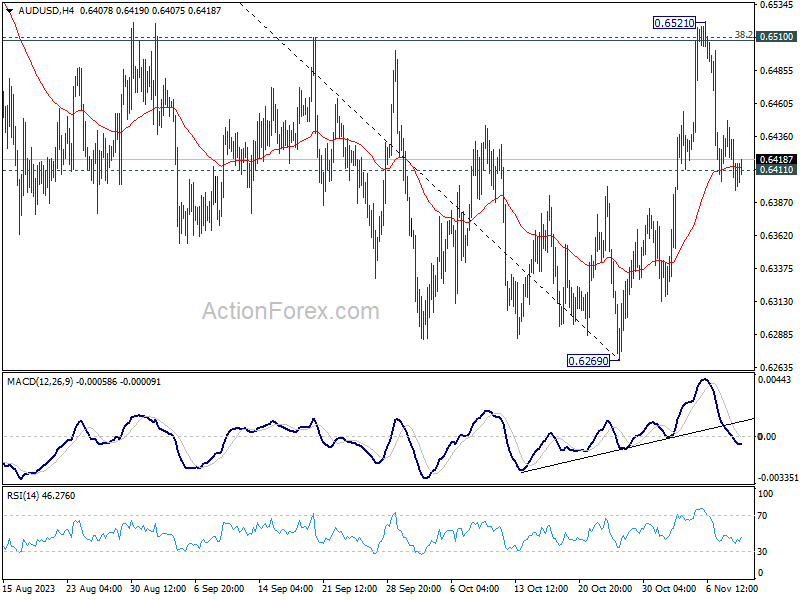
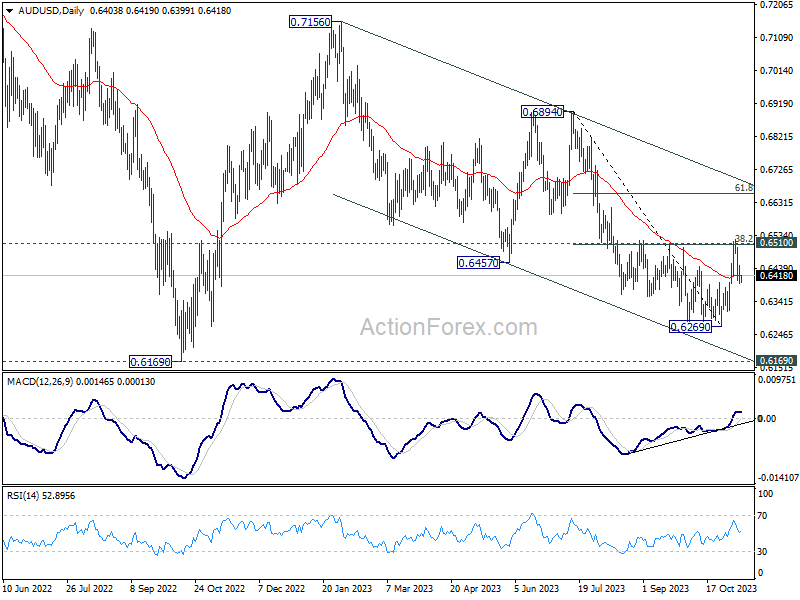
Intraday bias in AUD/USD stays neutral with focus on 0.6411 support and 55 4H EMA. On the downside, firm break of 0.6411 will indicate rejection by 0.6510 cluster resistance (38.2% retracement of 0.6894 to 0.6269 at 0.6508) , and turn bias back to the downside for retesting 0.6269 low. Nevertheless, decisive break of 0.6508/10 will argue that whole decline from 0.7156 might be completed with three waves down to 0.6269. Stronger rally should then be seen to medium term trend line resistance (now at 0.6700).
In the bigger picture, there is no confirmation that down trend from 0.8006 (2021 high) has completed. While current rebound from 0.6269 might extend higher, it could be the third leg of a corrective pattern from 0.6169 (2022 low) only. For now, medium term bearishness will remain as long as 0.6894 resistance holds.
USD/CAD Daily Outlook
Daily Pivots: (S1) 1.3760; (P) 1.3787; (R1) 1.3820; More...
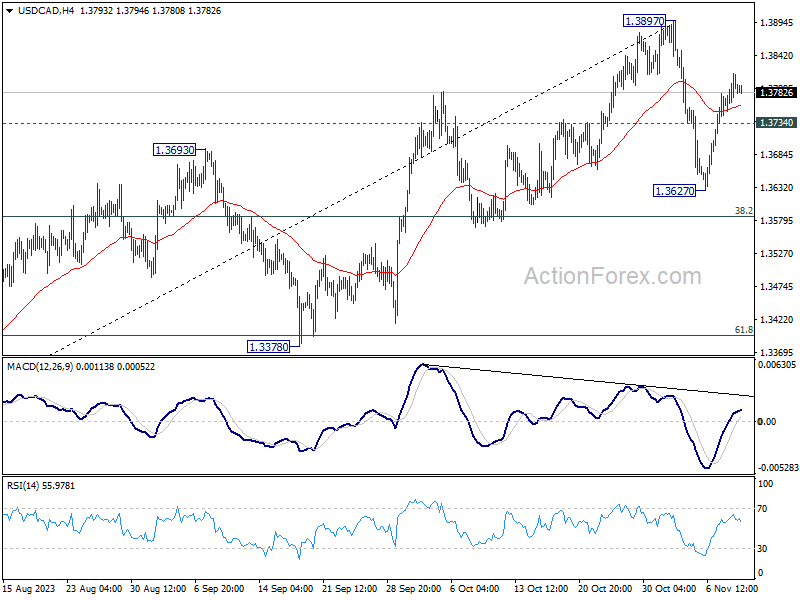
Intraday bias in USD/CAD remains mildly on the upside at this point. Rebound from 1.3627 is in progress for retesting 1.3897 resistance. On the downside, below 1.3734 minor support will turn bias back to the downside, to extend the corrective pattern from 1.3897 with another leg. But in this case, strong support should be seen from 38.2% retracement of 1.3091 to 1.3897 at 1.3589 to bring rebound.
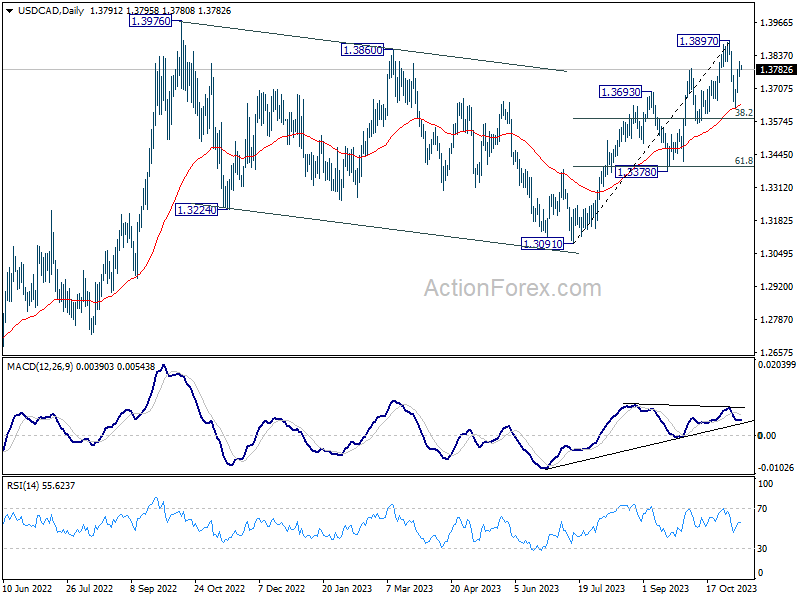
In the bigger picture, corrective pattern from 1.3976 (2022 high) should have completed with three waves down to 1.3091. Decisive break of 1.3976 high will confirm resumption of up trend from 1.2005 (2021 low). This will now remain the favored case as long as 1.3378 support holds. However, firm break of 1.3378 will argue that the pattern from 1.3976 is indeed still extending.
EUR/CHF Daily Outlook
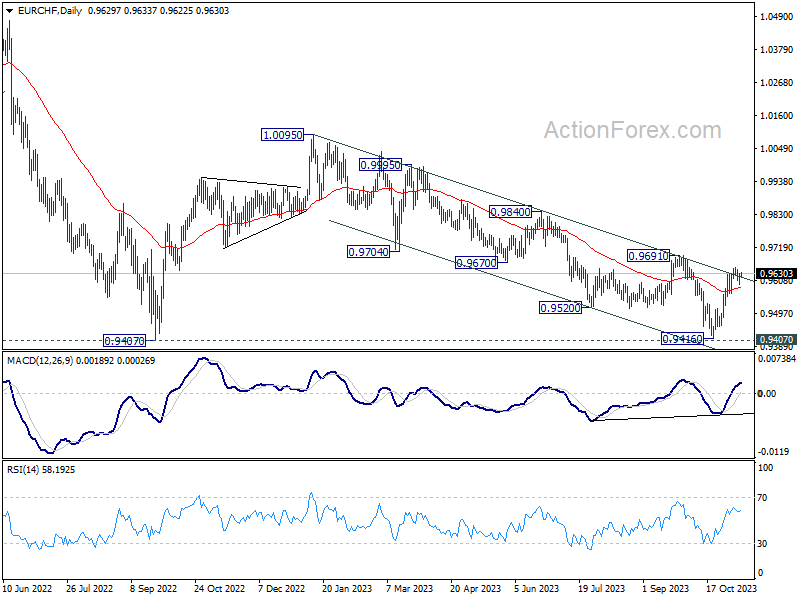
Daily Pivots: (S1) 0.9607; (P) 0.9621; (R1) 0.9645; More...
Intraday bias in EUR/CHF remains neutral as consolidation from 0.9651 is extending. Further rally is in favor as long as 0.9564 minor support holds. Above 0.9651 will resume the rebound form 0.9416 to 0.9691 resistance first. Firm break there will argue that whole decline from 1.0095 has completed at 0.9416, just ahead of 0.9407 support (2022 low). Nevertheless, break of 0.9564 will turn bias back to the downside for deeper fall.
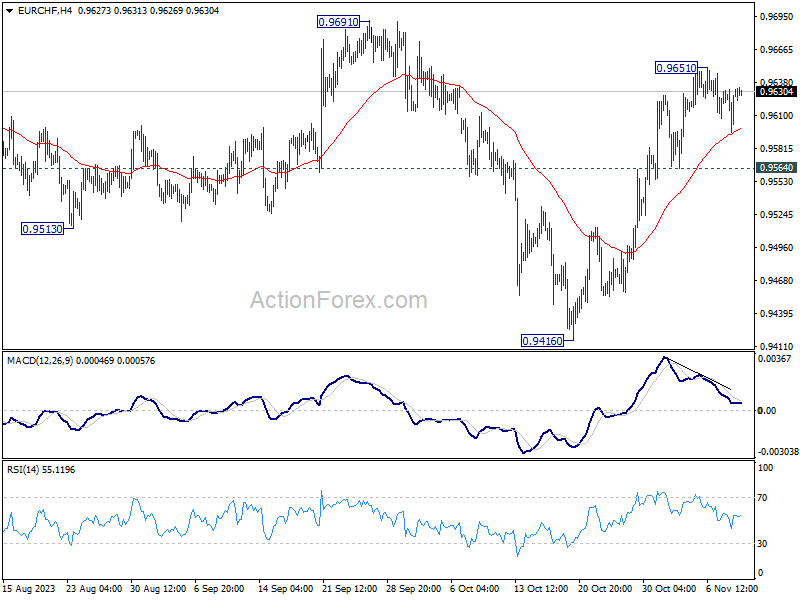
In the bigger picture, as long as 1.0095 resistance holds, price actions from 0.9407 are viewed as a three-wave consolidation pattern first. Current rise from 0.9416 might be the third leg. That is, larger down trend from 1.2004 (2018 high) might still resume through 0.9407 at a later stage. However, decisive break of 1.0095 will argue that the long term down trend is reversing.
EUR/GBP Daily Outlook
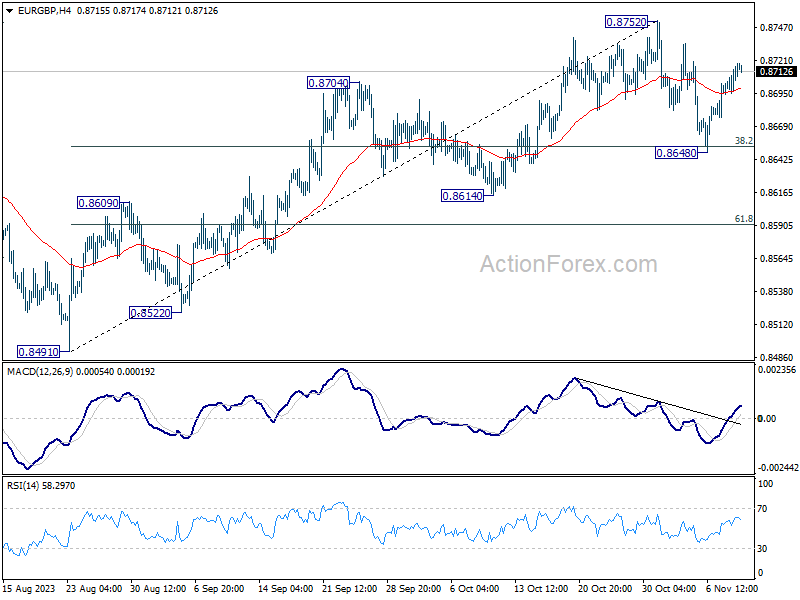
Daily Pivots: (S1) 0.8698; (P) 0.8708; (R1) 0.8727; More....
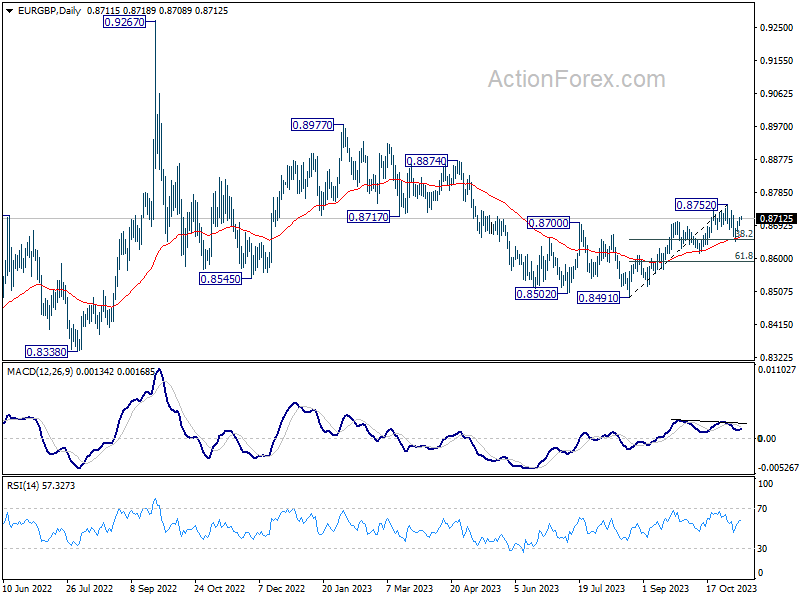
Intraday bias in EUR/GBP stays neutral for the moment. Consolidation from 0.8752 could extend with another falling leg. But in that case, downside should be contained by 0.8614 support to bring rebound. Break of 0.8752 resistance to resume the rally from 0.8491 is expected at a later stage.
In the bigger picture, current development suggests that whole down trend from 0.9267 (2022 high) has completed with three down to to 0.8491. Rise from 0.8491 is seen as another leg inside that pattern from 0.9499 (2020 high). Further rally should be seen to 0.8977 resistance and above. This will remain the favored case as long as 0.8614 support holds.
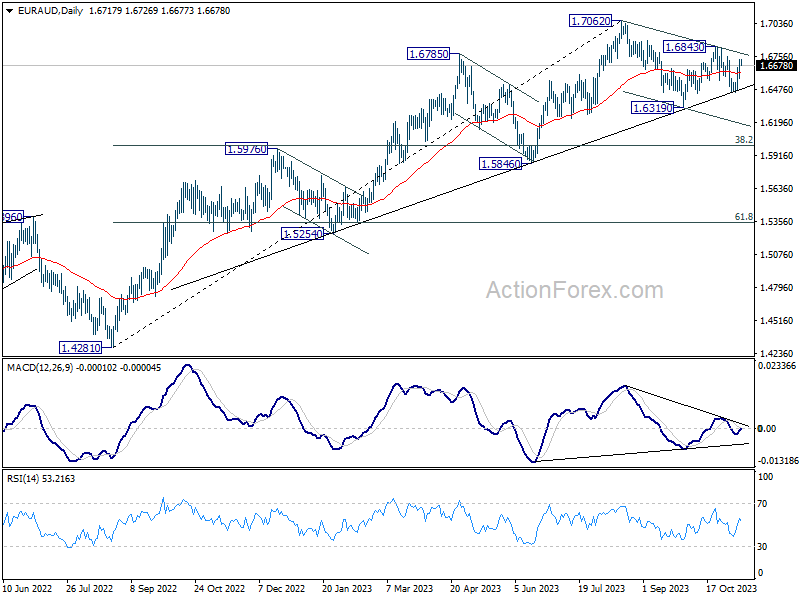
EUR/AUD Daily Outlook
Daily Pivots: (S1) 1.6622; (P) 1.6676; (R1) 1.6781; More...
While EUR/AUD's rebound from 1.6449 extends, it's capped below 1.6843 resistance so far. Near term outlook is mixed and intraday bias stays neutral. On the downside, break of 1.6449 will target 1.6319 support first. Firm break there will resume the whole decline from 1.7062. However, above 1.6843 will resume the rebound from 1.6319 towards 1.7062 resistance instead.
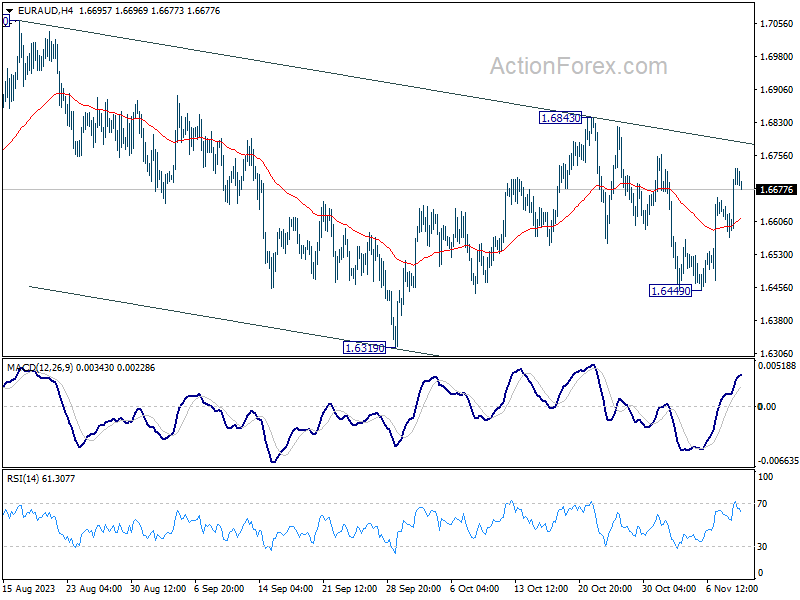
In the bigger picture, current development suggests that 1.7062 is already a medium term top. Fall from there is seen as a correction to the up trend from 1.4281 (2022 low). While deeper decline might be seen, strong support should emerge from 38.2% retracement of 1.4281 to 1.7062 at 1.6000 to contain downside. On the other hand, break of 1.6843 resistance will revive medium term bullishness that larger up trend is still in progress.
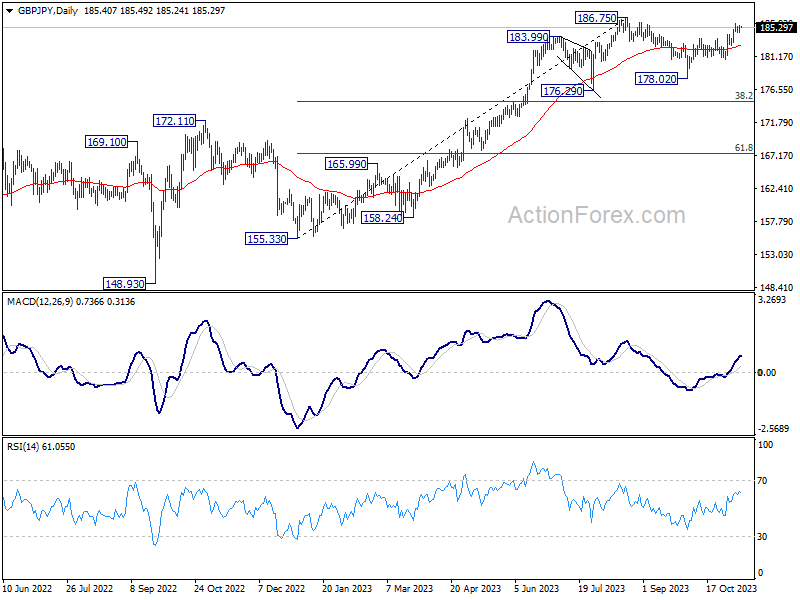
GBP/JPY Daily Outlook
Daily Pivots: (S1) 184.79; (P) 185.23; (R1) 185.92; More...
Intraday bias in GBP/JPY remains neutral and some more consolidations could be seen below 185.94 temporary top. But further rally is expected as long as 182.71 support holds. Above 185.94 will resume the rebound from 178.02 to retest 186.76 resistance first. Decisive break there will resume larger up trend.
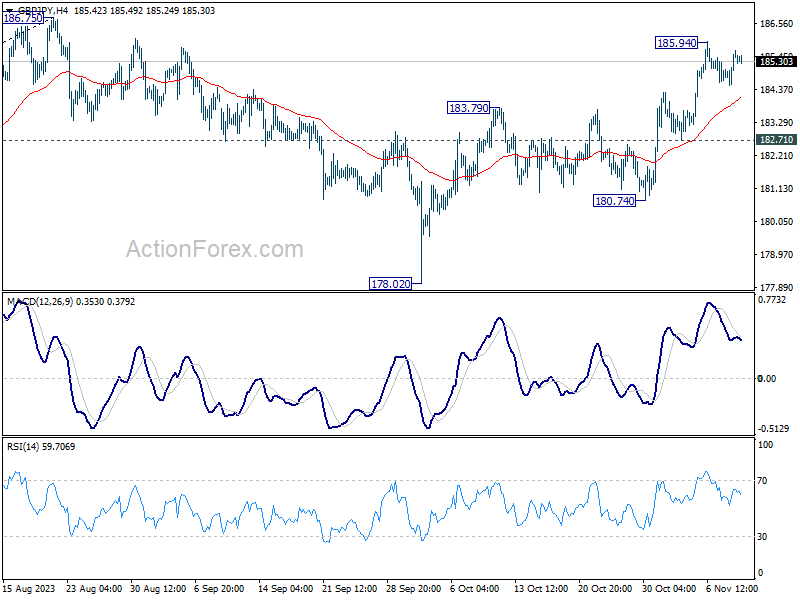
In the bigger picture, as long as 176.29 support holds, larger up trend from 123.94 (202 low) should still be in progress. Break of 186.75 will target 195.86 (2015 high). Nevertheless, firm break of 176.29 will confirm medium term topping, and bring lengthier and deeper consolidations.