

Sample Category Title
Dollar Facing Headwinds, Swiss Franc Rebounding
Dollar making efforts to continue this week's rebound, but momentum appears to be lacking, except against Yen. Additionally, its ascent is being challenged by Swiss Franc, which currently stands as the day's strongest performer, propelled by substantial buying against Euro and Sterling. Commodity currencies are capitalizing on the stabilizing risk sentiment, slowly clawing back against Dollar's advances.
Investors are now turning their attention to the forthcoming comments from Fed officials, including Chair Jerome Powell and New York Fed President John Williams. Although Fed funds futures suggest only a modest 10% probability of a rate increase in December, the door remains open, and traders are eager for any hints about the leanings of each Fed member.
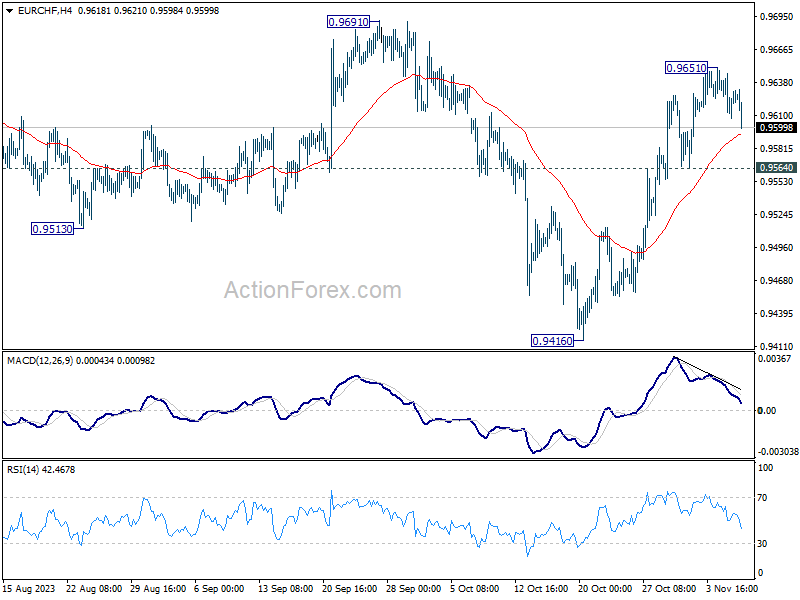
Technically, EUR/CHF's retreat from 0.9651 is extending today. The first line of defense is on 55 4H EMA (now at 0.9593). Ideally, selling should slow below the EMA, and gradually, a base is build at around 0.9564 support for resuming the rally from 0.9416. However, firm break of 0.9564 will argue that the rally is indeed over, and risk deeper fall. In the bearish case, extended selloff in EUR/CHF could drag EUR/USD down through 55 4H EMA too.
In Europe, at the time of writing, FTSE is up 0.05%. DAX is up 0.15%. CAC is up 0.30%. Germany 10-year yield is down -0.022 at 2.643. Earlier in Asia, Nikkei dropped -0.33%. Hong Kong HSI dropped -0.58%. China Shanghai SSE dropped -0.16%. Singapore Strait Times dropped -1.39%. Japan 10-year JGB yield fell -0.0276 to 0.849.
ECB's Lane: Some progress on underlying inflation, but not enough
ECB Chief Economist Philip Lane indicated that although there is "some progress" in mitigating underlying inflationary, he is not fully convinced of the sufficiency of these efforts to date.
"This is why we are in this period now of holding interest rates at a significantly high level until this process makes further progress," Lane explained,
Lane also conveyed his reservations about the steep decline in headline inflation numbers, attributing the fall primarily to the base effect from last year's energy price surges.
Looking ahead, Lane projected that the descent in inflation rates might pause, with inflation likely hovering in the "high twos or low threes" range in 2024.
He anticipates that a reversion to the ECB's desired 2% inflation target would not materialize until 2025, suggesting a prolonged journey ahead for the central bank in its fight against persistent inflation.
Bundesbank's Nagel stresses final push to inflation target as toughest hurdle
Bundesbank President Joachim Nagel likened the journey toward ECB's inflation target to an arduous "last mile," which "may well be the hardest".
Nagel pointed out that a key strategy for businesses would involve absorbing recent wage hikes—a move that will necessitate accepting slimmer profit margins.
On the other side, he emphasized the necessity of a more restrained fiscal approach from governments.
While wage increases are anticipated to exert some pressure on pricing, Nagel reassured that currently, there's no sign of a "self-reinforcing spiral" in wage-price dynamics. This suggests a cautious optimism that, while the path forward is steep, runaway inflation is not an imminent threat.
ECB Kazaks advocates for certainty over inflation before rate cut
ECB Governing Council member Martins Kazaks has expressed a steadfast stance on interest rates, emphasizing the need for absolute certainty that inflation is under control before considering any reductions.
Kazaks highlighted, "This decision right now to keep rates at current levels is to be really convinced inflation won't rise again."
"We have to be convinced that inflation has been beaten — then we can step by step lower rates," he articulated, pointing out the distinction between short-term suppression of inflation rates and the long-term confidence required to ensure they do not resurge.
Kazaks further clarified, "One thing is to push inflation lower; another is to be convinced inflation won't rise again."
Thus, "that's why there's this cautiousness."
ECB survey reveals heightened short-term inflation expectations and economic pessimism
ECB's latest Consumer Expectations Survey has provided a snapshot of the current economic mood, characterized a heightened anticipation of inflation pressures in the near term juxtaposed with a more pessimistic outlook on economic growth.
The survey results for September show a discernible uptick in median consumer inflation expectations for the coming year, escalating from 3.5% to 4.0%. However, that consumers' median inflation expectations over a three-year horizon held steady at 2.5%.
Contrastingly, the survey indicates no change in the mean expectations for nominal income growth, which remains anchored at 1.2%. This static view on income growth, coupled with the slight increase in anticipated nominal spending growth from 3.3% to 3.4%, hints at a potential squeeze on real consumer spending power.
The more negative tilt in expectations for economic growth, which have slipped from -0.8% to -1.2%, reflects an escalating concern over the economic direction. Furthermore, the anticipated unemployment rate has edged up from 11.1% to 11.4% for the coming year.
Eurozone retail sales down -0.3% mom in Sep, EU fell -0.2% mom
Eurozone retail sales volume fell -0.3% mom in September, worst than expectation of -0.2% mom. Volume of retail trade decreased by -1.9% for non-food products and by -0.9% for automotive fuels, while it increased by 1.4% for food, drinks and tobacco.
EU retail sales volume was down -0.2% mom, Among Member States for which data are available, the largest monthly decreases in the total retail trade volume were registered in Slovakia (-2.0%), Sweden (-1.1%), Germany and the Netherlands (both -0.8%). The highest increases were observed in Slovenia (+1.1%), Poland (+1.0%) and Denmark (+0.9%).
BoJ Ueda suggests easy policy exit could precede real wage gecovery
In an address to the parliament today, BoJ Governor Kazuo Ueda indicated a forward-looking approach to monetary policy, wherein the anticipation of rising real wages could be a determinant for policy normalization, rather than their current state.
Ueda posited, "Real wages would likely have turned positive when a positive wage-inflation cycle kicks off."
Delving into the timing of potential policy shifts, Ueda mentioned, "But in terms of how long we maintain our massive monetary easing... real wages don't necessarily have to turn positive before that decision is made."
Clarifying this point, he further elaborated that "The decision could be made if we can foresee with some certainty that real wages will turn positive ahead."
Ueda also addressed the persistent gap between current inflation rates and the bank's longstanding target, stating, "When looking at trend inflation, there's still some distance towards our 2% target. That is why we are continuing with massive easing."
Short-term inflation fears abate according to RBNZ survey
In the latest RBNZ quarterly Business Survey of Expectations, near-term outlook for inflation has cooled, with one-year-ahead expectations retreating from 4.17% to 3.60%, a significant decline of 57 basis points. On a two-year horizon, the expectation for inflation has seen a marginal dip of 7 basis points to 2.76%.
Conversely, expectations for inflation over a five and ten-year span have inched upwards. The survey revealed a mean five-year-ahead annual inflation expectation of 2.43%, marking an 18 basis points increase from the previous quarter's estimate. Ten-year expectations also saw a modest rise of 6 basis points to 2.28%.
With regard to the Official Cash Rate (OCR), the consensus is that it would hover at 5.50% by the end of December 2023. Looking one year ahead, the mean OCR expectation has fallen to 4.99%, indicating that businesses anticipate a loosening of monetary policy in the future once the immediate inflationary pressures have been mitigated.
On the growth front, respondents to the survey are more bullish. The mean one-year-ahead GDP growth expectation increased to 1.26%, up from 1.02%. The forecast for two-year-ahead GDP growth also saw an uptick, rising to 2.15% from the prior 1.95%.
EUR/USD Mid-Day Outlook
Daily Pivots: (S1) 1.0668; (P) 1.0696; (R1) 1.0727; More...
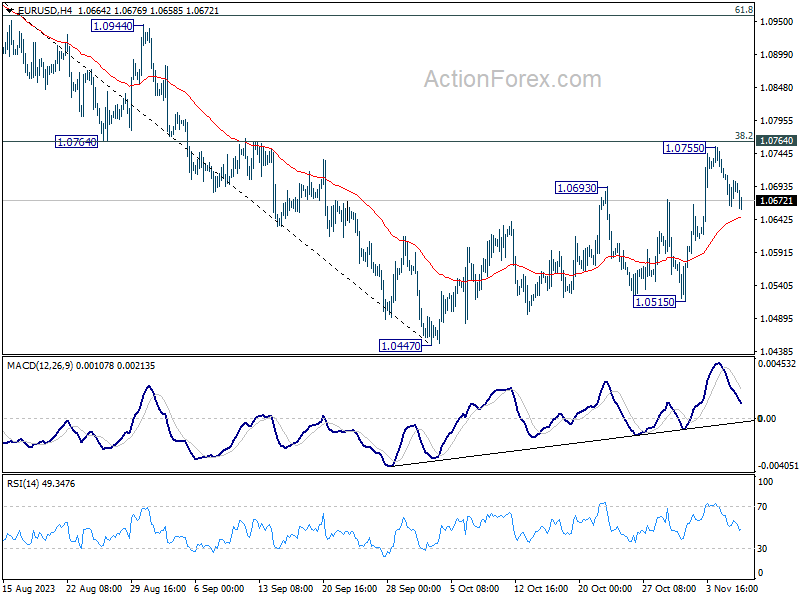
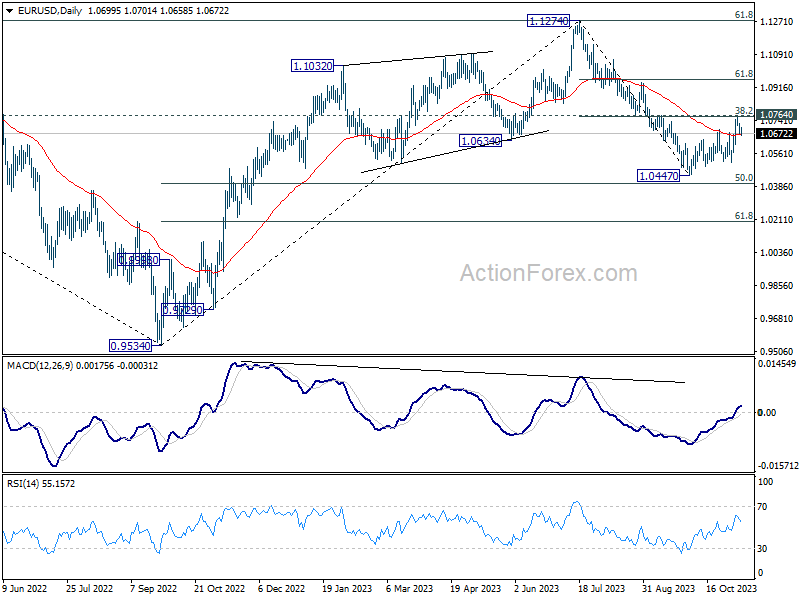
No change in EUR/USD's outlook and intraday bias remains neutral. Further rally is in favor as long as 55 4H EMA (now at 1.0646) holds. Decisive break of 1.0764 cluster resistance (38.2% retracement of 1.1274 to 1.0447 at 1.0763) will extend the rise from 1.0447 to 61.8% retracement at 1.0958 next. However, sustained break of 55 4H EMA will argue that the rebound has completed, and target 1.0515 support, and then 1.0447 low.
In the bigger picture, price actions from 1.1274 are viewed as a corrective pattern to rise from 0.9534 (2022 low). Rise from 1.0447 is tentatively seen as the second leg. Hence while further rally could be seen, upside should be limited by 1.1274 to bring the third leg of the pattern.
Economic Indicators Update
| GMT | Ccy | Events | Actual | Forecast | Previous | Revised |
|---|---|---|---|---|---|---|
| 02:00 | NZD | RBNZ Inflation Expectations Q4 | 2.76% | 2.83% | ||
| 05:00 | JPY | Leading Economic Index Sep P | 108.7 | 108.8 | 109.2 | |
| 07:00 | EUR | Germany CPI M/M Oct | 0.00% | 0.00% | 0.00% | |
| 07:00 | EUR | Germany CPI Y/Y Oct | 3.80% | 3.80% | 3.80% | |
| 07:45 | EUR | France Trade Balance (EUR) Sep | -8.9B | -8.1B | -8.2B | -8.3B |
| 09:00 | EUR | Italy Retail Sales M/M Sep | -0.30% | -0.20% | -0.40% | -0.70% |
| 10:00 | EUR | Eurozone Retail Sales M/M Sep | -0.30% | -0.20% | -1.20% | |
| 13:30 | CAD | Building Permits M/M Sep | 1.20% | 3.40% | ||
| 15:00 | USD | Wholesale Inventories Sep F | 0.00% | 0.00% |
Bundesbank’s Nagel stresses final push to inflation target as toughest hurdle
Bundesbank President Joachim Nagel likened the journey toward ECB's inflation target to an arduous "last mile," which "may well be the hardest".
Nagel pointed out that a key strategy for businesses would involve absorbing recent wage hikes—a move that will necessitate accepting slimmer profit margins.
On the other side, he emphasized the necessity of a more restrained fiscal approach from governments.
While wage increases are anticipated to exert some pressure on pricing, Nagel reassured that currently, there's no sign of a "self-reinforcing spiral" in wage-price dynamics. This suggests a cautious optimism that, while the path forward is steep, runaway inflation is not an imminent threat.
EUR/USD Mid-Day Outlook
Daily Pivots: (S1) 1.0668; (P) 1.0696; (R1) 1.0727; More...
No change in EUR/USD's outlook and intraday bias remains neutral. Further rally is in favor as long as 55 4H EMA (now at 1.0646) holds. Decisive break of 1.0764 cluster resistance (38.2% retracement of 1.1274 to 1.0447 at 1.0763) will extend the rise from 1.0447 to 61.8% retracement at 1.0958 next. However, sustained break of 55 4H EMA will argue that the rebound has completed, and target 1.0515 support, and then 1.0447 low.
In the bigger picture, price actions from 1.1274 are viewed as a corrective pattern to rise from 0.9534 (2022 low). Rise from 1.0447 is tentatively seen as the second leg. Hence while further rally could be seen, upside should be limited by 1.1274 to bring the third leg of the pattern.
GBP/USD Mid-Day Outlook
Daily Pivots: (S1) 1.2258; (P) 1.2305; (R1) 1.2348; More
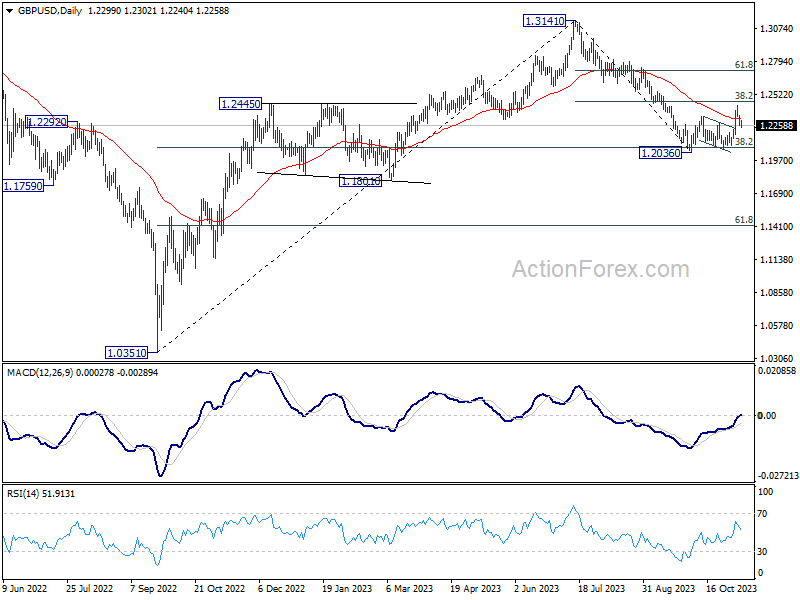
Intraday bias in GBP/USD remains neutral first, with focus on 55 4H EMA (now at 1.2239). Strong rebound from this EMA will maintain near term bullishness for another rise to 38.2% retracement of 1.3141 to 1.2036 at 1.2458. However, sustained break of 4H 55 EMA will revive near term bearishness and bring retest of 1.2036 low instead.
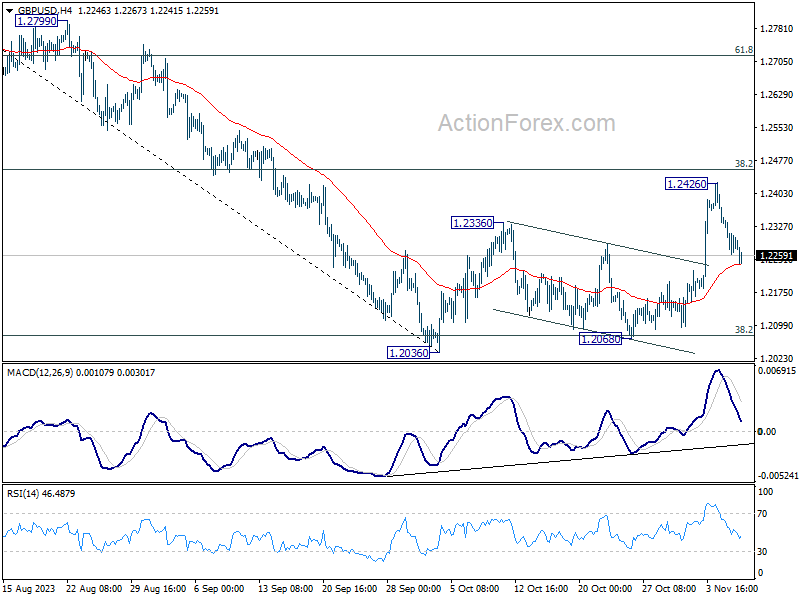
In the bigger picture, the strong rebound from 38.2% retracement of 1.0351 to 1.3141 at 1.2075 argues that price action from 1.3141 are merely a correction to rise from 1.0351 (2022 low). Current rally from 1.2036 is tentatively seen as the second leg of the pattern. Hence, while further rally is in favor, upside should be limited by 1.3141 to start the third leg.
USD/CHF Mid-Day Outlook
Daily Pivots: (S1) 0.8967; (P) 0.8982; (R1) 0.9010; More....
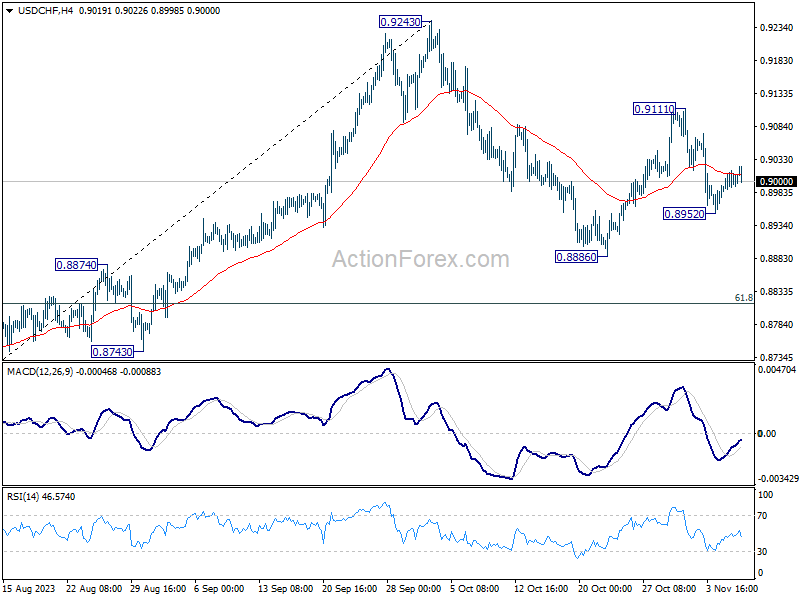
Intraday bias in USD/CHF stays neutral as range trading continues above 0.8952 temporary low. On the downside, below 0.8952 will target a test on 0.8886 support first. Break there will resume whole decline from 0.9243 to 0.8815 fibonacci level. However, break of 0.9111 will resume the rebound from 0.8886 instead, and target 0.9243 resistance.
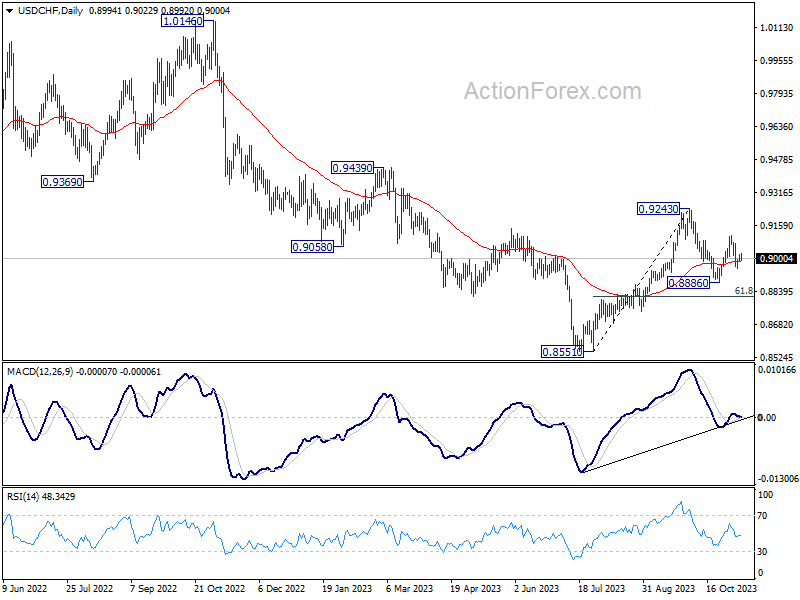
In the bigger picture, outlook is mixed up by the deeper than expected pull back from 0.9243. Yet there was no follow through selling after hitting 0.8886. On the upside, break of 0.9243 resistance will revive the case of medium term bottoming at 0.8851, and turn outlook bullish. However, sustained break of 61.8% retracement of 0.8551 to 0.9243 at 0.8815 will argue that larger decline from 1.0146 is ready to resume through 0.8551 low.
USD/JPY Mid-Day Outlook
Daily Pivots: (S1) 150.01; (P) 150.35; (R1) 150.77; More...
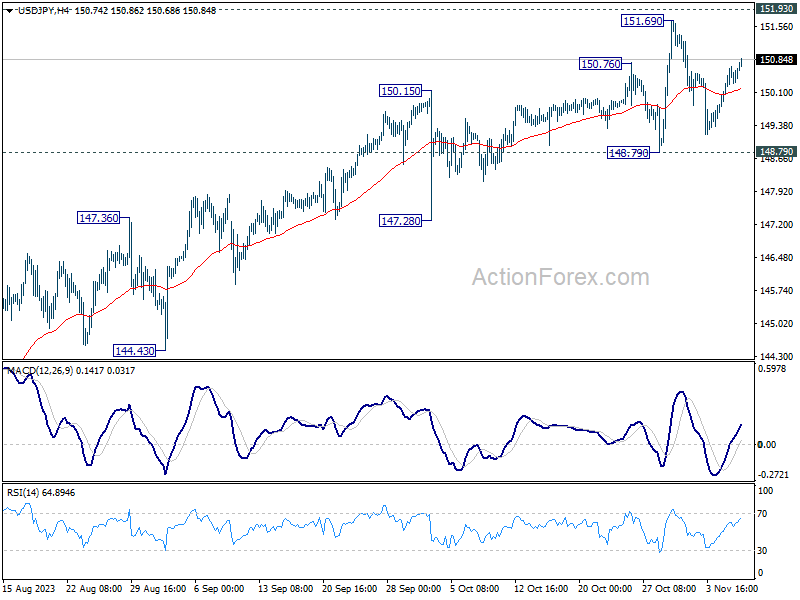
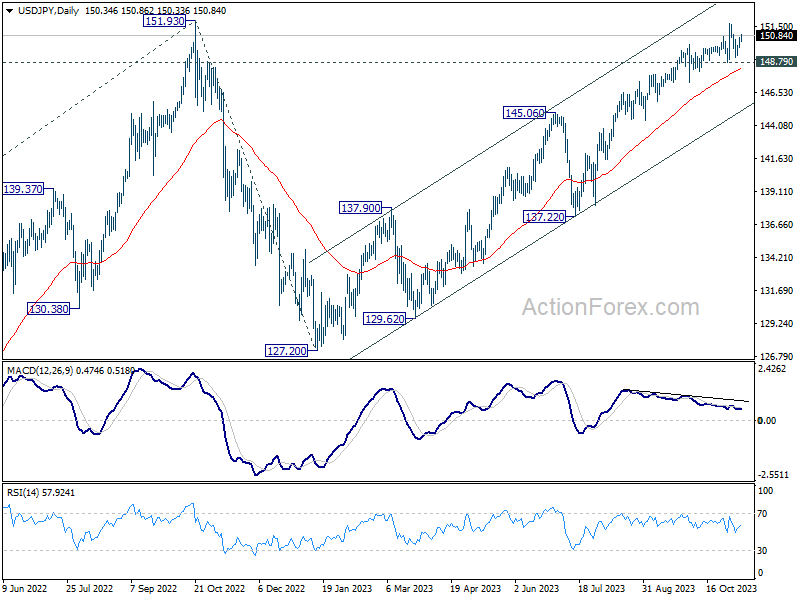
USD/JPY's rebound continues today but it's still bounded in range of 148.79/151.69. Intraday bias stays neutral and outlook is unchanged. Further rally is expected as long as 148.79 support holds. Firm break of 151.69 high will resume larger up trend. However, decisive break of 148.79 will indicate rejection by 151.93 key resistance, and bring deeper fall through 147.28 support.
In the bigger picture, immediate focus is on 151.93 resistance (2022 high). Rejection by 151.93, followed by sustained break of 145.06 resistance turned support will argue that rise from 127.20 has completed, and turn outlook bearish for 137.22 support and below. However, sustained break of 151.93 will confirm resumption of long term up trend. Next target will be 61.8% projection of 102.58 to 151.93 from 127.20 at 157.69.
Euro Extends Losses After Soft Eurozone Retail Sales
- Eurozone retail sales decline by 2.9%
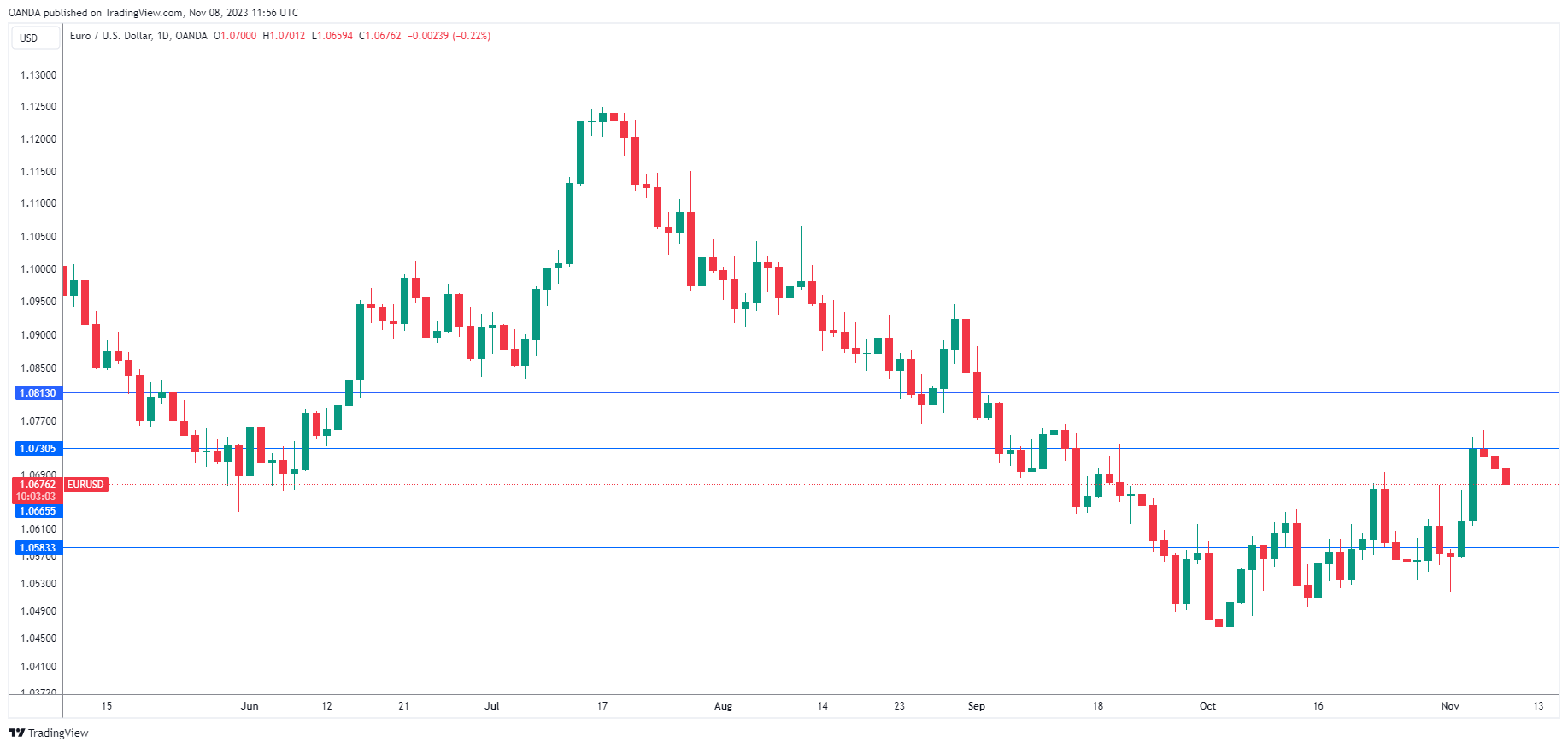
The euro is down on Wednesday, after a two-day losing streak. In the European session, EUR/USD is trading at 1.0675, down 0.23%.
Eurozone retail sales slide
The eurozone economy has been sputtering, so it’s no wonder that consumers are in a sour mood and holding tight on the purse strings. Eurozone retail sales slowed to -2.9% y/y in September, down from a revised -1.8% in August and just above the market consensus of -3.1%. This marked a twelfth straight month of decline, pointing to prolonged weakness in consumer demand, as consumers have been squeezed by high prices and elevated borrowing costs. On a monthly basis, retail sales declined by 0.3%, compared to -0.7% in August and below the market consensus of -0.2%.
Germany, the largest economy in the eurozone, continues to reel off soft numbers. On Tuesday, Industrial Production declined by 1.4%, and the most recent service and manufacturing PMIs were below 50, which points to contraction.
US exceptionalism has boosted the US dollar in recent months, and the euro has been steamrolled, falling as much as 9.5% since July. The US dollar has run into some headwinds since Friday’s soft nonfarm payrolls, but the US economy remains strong and the Fed isn’t likely to trim rates anytime soon. This means that the euro will be hard-pressed to keep pace with the greenback, barring a strong recovery in the eurozone.
Fed Chair Powell delivers public remarks later today and the markets will be all ears. Powell has tried to sound hawkish as he battles to bring inflation back down to the 2% target. The Fed has stuck to its “higher for longer” stance on interest rates, but the markets are increasingly convinced that the Fed has wrapped up its rate-tightening cycle. The soft nonfarm payrolls report on Friday provided support for the view that rates have peaked.
EUR/USD Technical
- There is resistance at 1.0727 and 1.0813
- EUR/USD continues to test support at 1.0665. Below, there is support at 1.0583
The Crypto Market is on the Rise Again
Market Picture
The crypto market cap added another 1.5% overnight to $1.34 trillion as the corrective reset quickly turned to buying. Bitcoin is up 2%, while Solana and Chainlink are up 6%. This pair also led the gains over the past 30 days, indicating robust demand for them. In contrast, BNB loses 0.6% in 24 hours and adds 17% in 30 days.
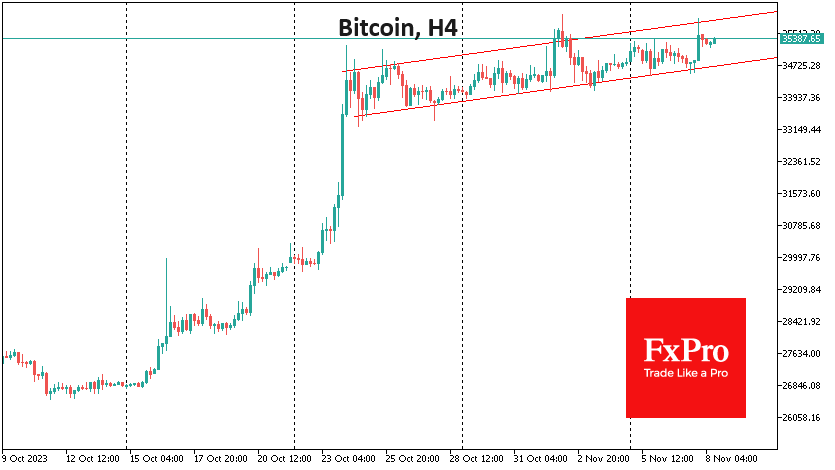
Bitcoin continues to trade in a bullish corridor, finding buyers on dips from slightly higher levels. A second failed attempt at $36,000 on Tuesday night suggests that most players are not looking to accelerate, further confirming a shift in focus to altcoins.
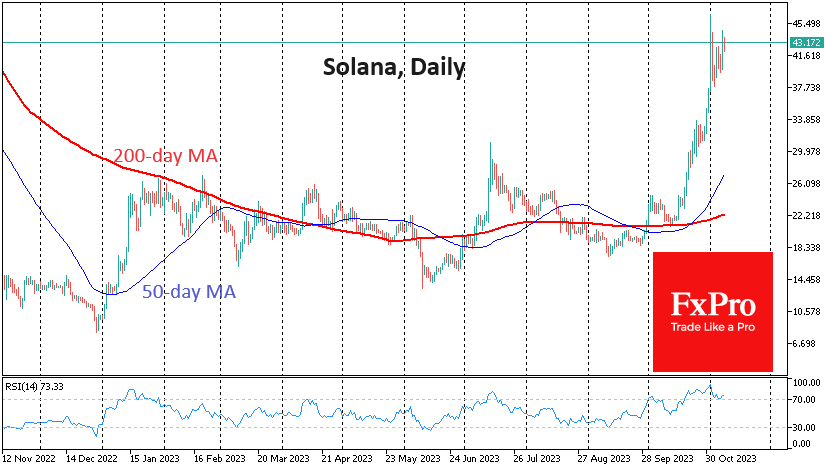
Solana has returned to growth quickly after a period of pressure earlier this month. At $43, it is trading close to a 15-month high. A locally important milestone for the coin could be the $48 level. An easy break of this level would open a direct path to $75.
News Background
The US Securities and Exchange Commission (SEC) is having difficulty hiring crypto experts because the right people are unwilling to sell their digital assets. This is according to a report from the agency’s Office of the Inspector General.
The capitalisation of the largest stablecoin, Tether (USDT), is up 22% since January to $85.42 billion, according to IntoTheBlock, and Tether has accumulated up to 69% of the funds placed in the real collateralised digital currency market, according to DeFiLlama.
Germany’s third largest bank, DZ Bank, announced the launch of its digital asset custody platform. The bank plans to offer institutional investors and private clients the opportunity to buy cryptocurrencies.
Rein Lõhmus, a co-founder of Estonia’s LHV Bank, lost the password to a wallet containing 250,000 ETH (over $473 million) and plans to use artificial intelligence to recover it.
New Zealand Dollar Shrugs as Inflation Expectations Dip
- Inflation expectations ease to a two-year low
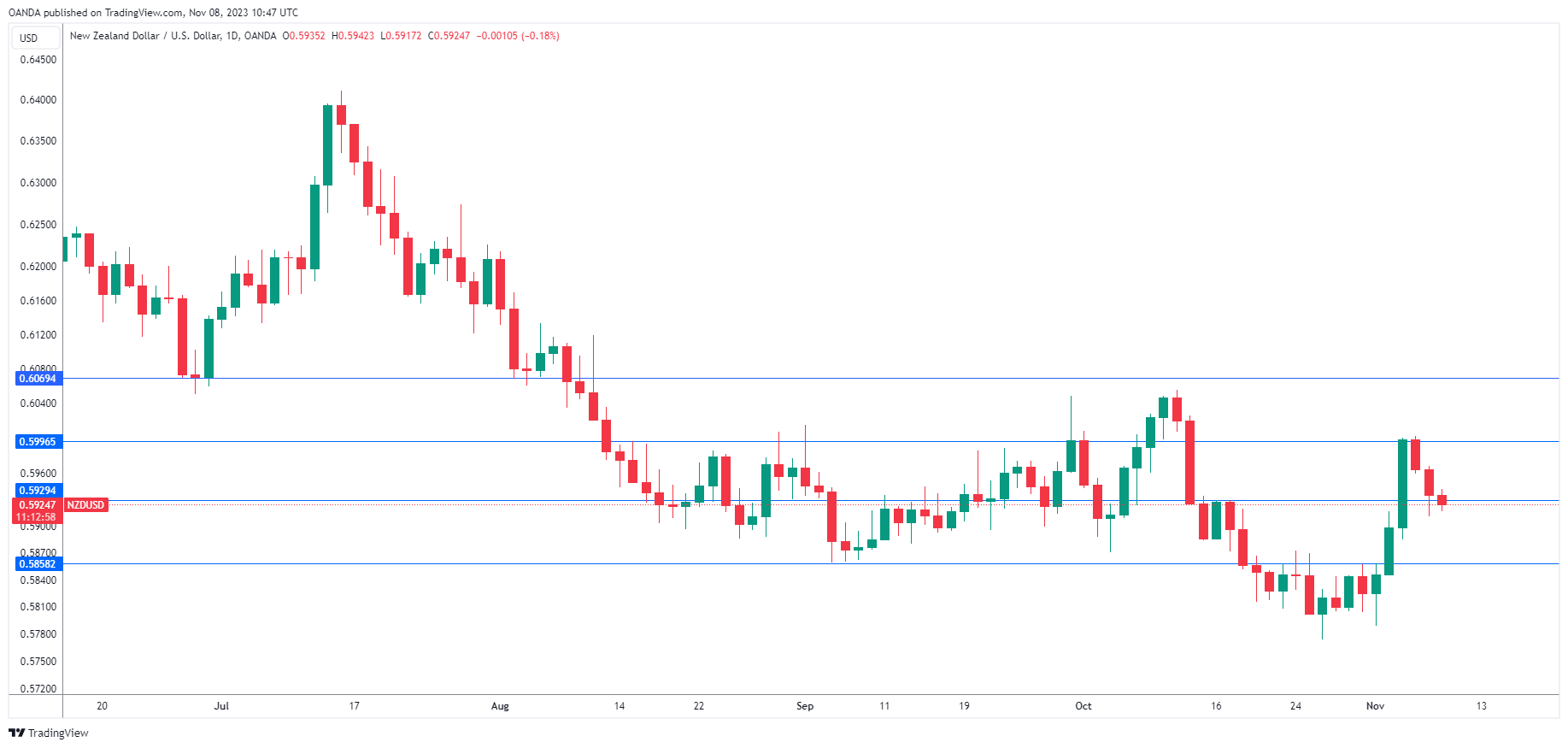
The New Zealand dollar is slightly lower on Wednesday. In the European session, NZD/USD is trading at 0.5924, down 0.19%.
NZ inflation expectations dip
New Zealand’s inflation rate has been dropping, albeit slowly. Inflation fell to 5.6% in the third quarter, down from 6.0% in Q4. The downward trend is certainly encouraging for the Reserve Bank of New Zealand but policy makers are also concerned about inflation expectations and not just the latest inflation numbers.
Inflation expectations are a primary driver of inflation and the central bank needs to ensure that high inflation expectations don’t get anchored; otherwise, the battle against inflation will become that much more difficult.
The fourth-quarter release was positive, as inflation expectations fell to 2.76%, down from 2.83% in Q3 and its lowest level in two years. As we saw with inflation data, the direction is downward, but slowly.
The RBNZ held rates for a third straight time at the October meeting, leaving the cash rate at 5.50%. The central bank meets next on November 29th and is expected to pause again. The RBNZ is confident that inflation will fall more quickly, projecting an inflation rate of 2.7% by Q3 of 2024.
China is New Zealand’s largest trading partner, which means the New Zealand dollar is sensitive to Chinese releases. China has been grappling with an economic slowdown, manifested by deflationary pressures. On Thursday, China releases consumer inflation data.
CPI came in at 0.0% y/y in September and the market consensus for October is -0.1%. On a monthly basis, inflation is expected to fall in October from 0.2% to 0.0%. A soft inflation release could unnerve investors and send the New Zealand dollar lower.
NZD/USD Technical
- NZD/USD continues to test support at 0.5929. The next support line is 0.5858
- There is resistance at 0.5996 and 0.6069
ECB’s Lane: Some progress on underlying inflation, but not enough
ECB Chief Economist Philip Lane indicated that although there is "some progress" in mitigating underlying inflationary, he is not fully convinced of the sufficiency of these efforts to date.
"This is why we are in this period now of holding interest rates at a significantly high level until this process makes further progress," Lane explained,
Lane also conveyed his reservations about the steep decline in headline inflation numbers, attributing the fall primarily to the base effect from last year's energy price surges.
Looking ahead, Lane projected that the descent in inflation rates might pause, with inflation likely hovering in the "high twos or low threes" range in 2024.
He anticipates that a reversion to the ECB's desired 2% inflation target would not materialize until 2025, suggesting a prolonged journey ahead for the central bank in its fight against persistent inflation.