

Sample Category Title
HK HSI dives as Yellen visit China amid rising US-China tensions
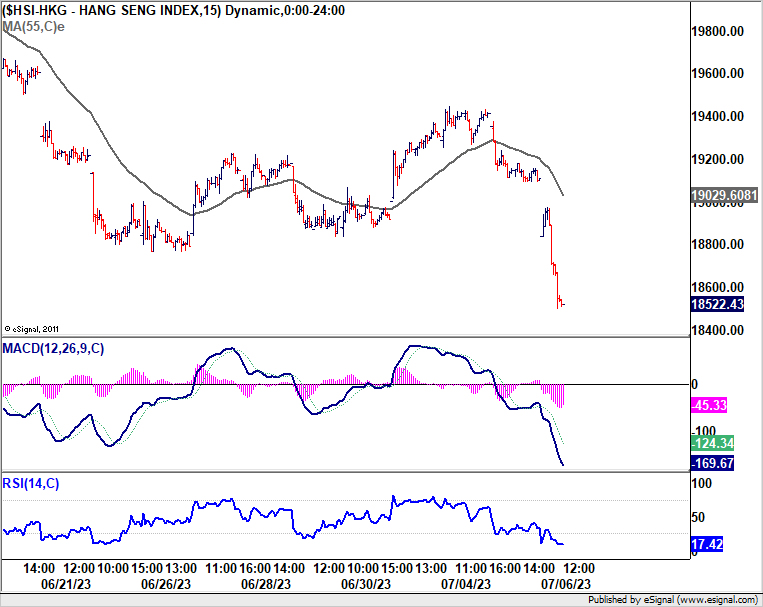
Hong Kong HSI is taking a hit today as it gapped down at open and further sell-offs materialized during the initial part of Asian trading session. This market movement mirrors intensifying investor concerns as US Treasury Secretary Janet Yellen starts a four-day visit to China. While the intention behind Yellen's visit is to de-escalate potential conflicts between these two economic behemoths, atmosphere has notably soured this week.
Earlier in the week, China struck a discordant note by announcing fresh restrictions on export of several critical minerals used in manufacture of semiconductors and solar panels. This move appears to be a tit-for-tat response to the tech export limitations that the US has imposed on China, limiting the sale of advanced computer chips. Further adding to the apprehension, US government is reported to be contemplating additional measures to restrict China's access to US-based cloud computing services.
On a separate front, China delivered another blow to international diplomatic relations when it abruptly canceled a visit by European Union foreign policy chief Josep Borrell, scheduled for next week, according to an EU spokesperson. The Chinese authorities have not yet disclosed the reasons behind this unexpected cancellation.
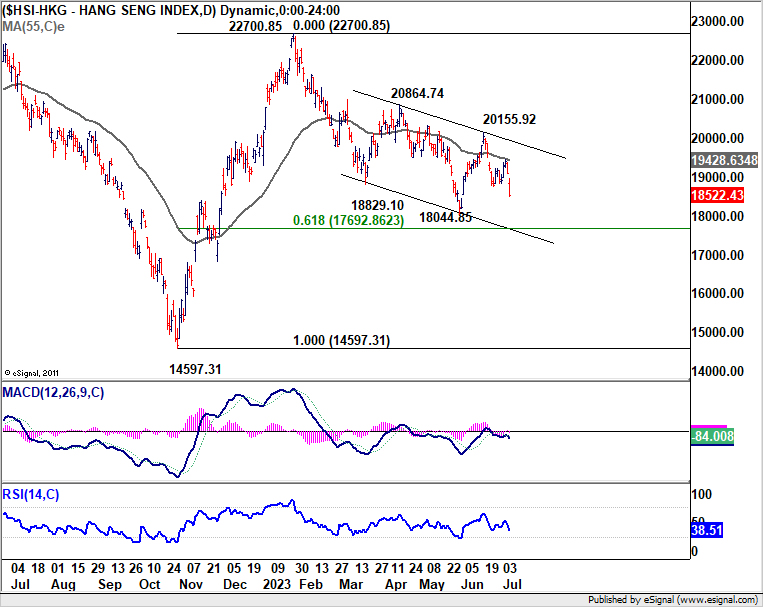
From a technical perspective, today's market turbulence in Hong Kong, marked by a gap down followed by a sharp drop, appears to validate rejection by 55 D EMA (now at 19428.57). Fall from 20155.92 is likely to be another chapter in the overall descent from 22700.85. As decline progresses, a drop below 18044.85 low is expected. However, substantial support is still expected from 61.8% retracement of 14597.31 to 22700.85 at 17692.86, and this could potentially spur a reversal. Let's see how it goes.
Fed Williams: Data support more rate hikes at some point
New York Fed President John Williams voiced his support for the decision to hold rates steady in June, stating yesterday that it was the right move to allow for further data collection and assessment.
"We can take some time and assess and collect more information and then be able to act, knowing that we also communicated through our projections that we don't think we're done, based on what we know," he said.
However, Williams hinted at further rate hikes while he reaffirmed his commitment to be "data dependent" in his decision-making. But he added that recent data "support the idea the Fed may need to raise rates further at some point."
Williams' statements were grounded in ongoing concerns about high core inflation, although he acknowledged the progress made in curtailing inflation so far. He highlighted a slowdown in the inflation of non-housing services prices, a key indicator closely watched by Fed officials. "Even in the category of core services excluding shelter, we're seeing some slowing of inflation," he added.
Fed minutes signal disagreement over rate pause
In a display of internal discord, Fed's June 13-14 meeting minutes indicate that while most officials deemed it "appropriate or acceptable" to maintain rates at 5% to 5.25% target range, a few would have backed a quarter-point increase.
"The participants favoring a 25 basis point increase noted that the labor market remained very tight, momentum in economic activity had been stronger than earlier anticipated, and there were few clear signs that inflation was on a path to return to the Committee's 2 percent objective over time," the minutes said.
Yet, many officials expressed concerns about an accelerated tightening pace. "Many also noted that, after rapidly tightening the stance of monetary policy last year, the Committee had slowed the pace of tightening and that a further moderation in the pace of policy firming was appropriate in order to provide additional time to observe the effects of cumulative tightening and assess their implications for policy," read the minutes.
Overall, these June minutes portray a Federal Reserve grappling with the delicate balancing act of controlling inflation while not excessively tightening monetary policy. The diverging views underscore the precarious position the central bank finds itself in as it navigates the complexities of the evolving economic landscape.
U.S. Dollar Strength to Continue Until Inflation Beast is Quelled
Highlights
- The U.S. dollar had an incredible run throughout much of 2022 as the Federal Reserve embarked on its historic rate hiking cycle to curtail the worst bout of inflation in forty years.
- With inflation pressures proving more persistent than anticipated, global central banks are poised to continue their rate hiking campaigns and keep policy rates higher for longer.
- The cumulative tightening of central banks will slow global economic activity, with the most deleterious effects in Europe, where central banks will remain in tightening mode for longer. Heightened uncertainty and relative U.S. economic outperformance is likely to push the trade-weighted dollar higher over the remainder of this year.
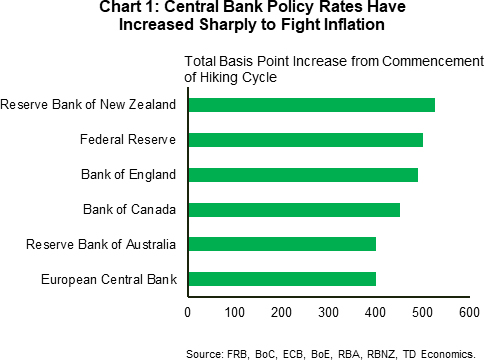
After a slow response to accelerating inflation, central banks have spent the last two years playing catch up with rapid increases in policy rates. The Federal Reserve has been one of the most aggressive, raising the federal funds rate from the zero lower bound to a range of 5.0%-5.25%, before pausing in June (Chart 1).
The Fed’s front-loaded rate increase led to hefty gains in the U.S. dollar against most major currencies over the course of last year. However, as other central banks caught up, the trade-weighted dollar retreated and has spent most of this year moving sideways.
This may be about to change. The swift actions of global central banks have started to show progress in bringing down inflation, but the job is not yet done. Wringing the remaining inflation out is likely to require a meaningful weakening in economic growth, with countries facing the stickiest price growth paying the highest costs. As recession fears mount, American economic outperformance in combination with the dollar’s safe-haven status is likely to lead to newfound U.S. dollar strength over the second half of this year.
Central Banks’ Job is Not Quite Done
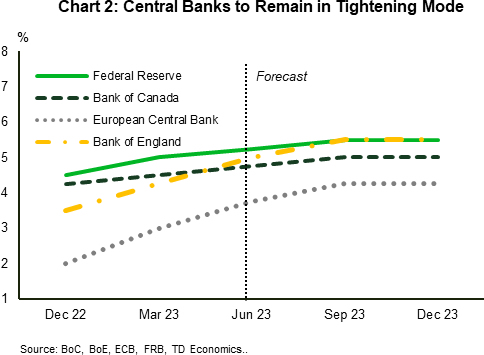
Central banks are poised to remain in tightening mode for the remainder of the year, with relatively more hikes in store from central banks in Europe and the UK, which have made slower progress on curtailing price pressures (Chart 2).
The Fed’s aggressive rate hikes to date mean it is close to the end of its journey. After pausing in June, the Federal Reserve is likely to raise the federal funds rate just one more time. This is as much a testimony to the resilience of economic activity in the face of higher interest rates as it is to stubborn inflation. Activity in several interest-rate sensitive sectors, most notably the U.S. housing sector, has accelerated in recent months.
Elsewhere, after pausing its rate hiking campaign in March, the Bank of Canada (BoC) surprised financial markets with a 25-basis point (bps) hike in June, responding to higher-than-anticipated inflation. The BoC is likely to administer one additional rate hike, though a pullback in inflation in May makes this a close call.
Across the pond, inflation in both the UK and euro area has proven to be more persistent than in North America with much of the retreat in the headline number coming from falling energy prices. Policy makers face an additional obstacle in curtailing price pressures with wage growth remaining elevated (Chart 3).
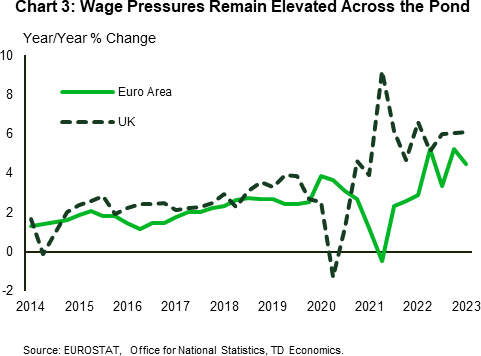
All this points to the European Central Bank (ECB) and the Bank of England (BoE) continuing their tightening campaigns longer than either the Fed or the BoC. We expect three additional rate hikes from the ECB, while the BoE will continue to be the most aggressive central bank even after surprising markets with a 50-bps hike at its June meeting.
Cloudy Economic Outlook Will Benefit the Greenback
With central banks at different points in their fight against inflation, the impact of additional tightening is likely to vary across countries. Economies that have been more resilient to the cumulative effects of central bank tightening and made the most progress in reducing inflation, are better positioned to withstand additional rate hikes.
The euro area is starting from a position of weakness, with real GDP having contracted in the final quarter of 2022 and the first quarter of 2023. While higher energy costs strained consumers wallets earlier this year, higher borrowing costs will exert further drag on economic growth. The euro area faces additional headwinds through trade channels as concerns over the economic recovery in China – one of its main trading partners, continue to mount. The uncertainty surrounding the euro area is likely to be reflected in a period of near-term weakness in the euro against the U.S. dollar (Chart 4).
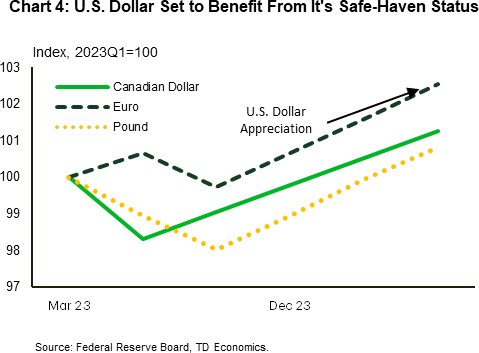
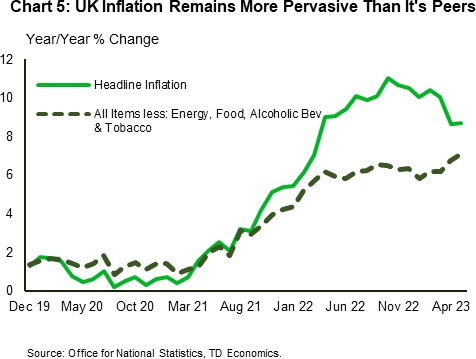
The story in the UK is also dour, with inflation remaining more pervasive than its peers and underlying price pressures reaching their highest levels since 1992 (Chart 5). Economic growth has slowed markedly and is expected to remain muted as the BoE pushes forward with additional rate hikes. The economy could face additional headwinds from rising mortgage costs that could put further stain on consumers. All told, softening economic growth in the UK will likely spell near-term downside risk for the pound against the dollar.
The Canadian dollar (CAD), meanwhile, looks set to extend the trend of near-term weakness against the dollar. While the aggressive actions of the BoC cushioned the CAD’s slide against the greenback, heightened global uncertainty and flight-to-safety flows are likely to benefit the U.S. dollar against the loonie over the next year.
Bottom Line
The performance of the dollar over much of 2022 was a classic case of textbook economics where relatively higher U.S. interest rates bolstered the dollar. While the dollar retreated from its 2022 highs as other central banks joined the fight against inflation, the higher interest rate environment has created headwinds for the global economy that are unlikely to abate any time soon. In this environment of heightened global uncertainty, flight-to-safety inflows are likely to push the dollar higher. Only once economic uncertainty abates is the dollar likely to see some reversal.
From “Fast and Furious” to “Frozen” – RBNZ to keep the OCR on hold
- The Reserve Bank will leave the OCR at 5.50% at its July policy review.
- The RBNZ likely sees recent data as in line with their projected peak in the OCR.
- The accompanying statement should be concise to avoid misinterpretation.
- The RBNZ might take the opportunity to communicate a more data-driven future approach than communicated in the May Monetary Policy Statement.
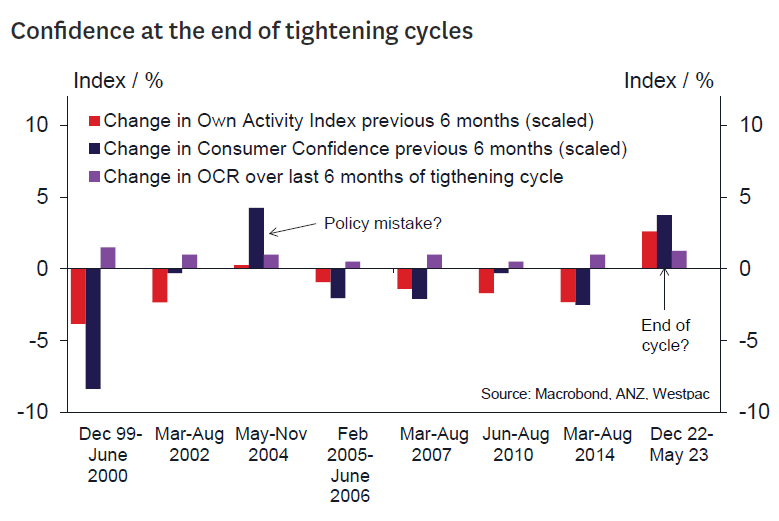
We expect the Reserve Bank to leave the OCR unchanged at 5.50% at next Wednesday's monetary policy review. In the May Monetary Policy Statement the RBNZ gave markets a strong steer that it expected that no further increases in the OCR would be required and that now is the time to "watch, worry and wait". In signalling this 'end of cycle' stance, the RBNZ was at pains to emphasize that there was no case to expect any cuts to the OCR for a good while yet. The RBNZ's forecasts indicated that the first easing in policy would need to wait until late next year.
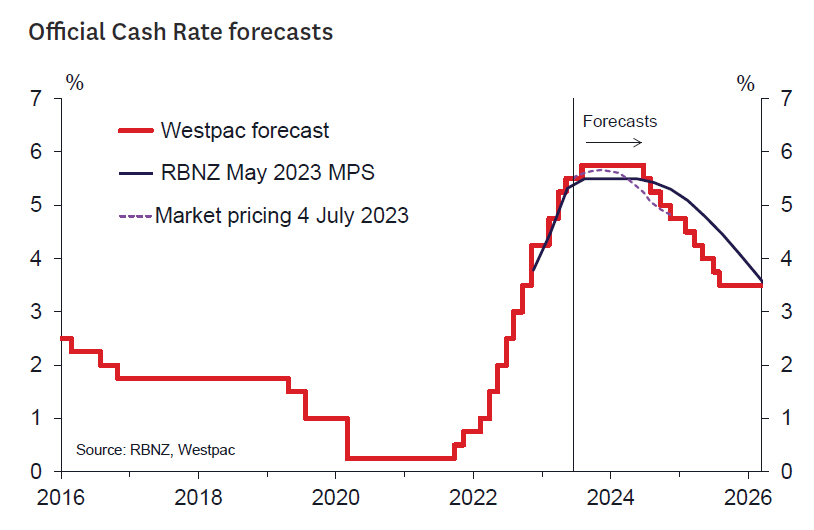
The data flow since May will likely have given comfort to the RBNZ that its on-hold stance is appropriate – at least for now. The key piece of information was the release of March quarter GDP which came in close to Westpac's own forecasts but was weaker than the RBNZ's. Hence from their perspective, the economy started the year in a slightly less overheated position than might have been feared when they produced their May
Statement. Given the RBNZ's strident on-hold stance this data alone will probably be enough to keep rates unchanged this time around.
Other recent developments paint a mixed picture of the risks for inflation and future interest rates. Some downside risks for domestic inflation and interest rates are accumulating in the form of the weaker than expected bounce back of the Chinese economy, with implications for export demand (reflecting this, in June Westpac revised down its forecast of the farmgate milk price). Many indicators of domestic demand seem consistent with a cooling economy – for example the retail and construction sectors seem to be evolving as one should expect given the interest rate increases that we have already seen. The corporate tax take is also weakening.
On the other side of the ledger, global central banks are generally finding inflation to be more resilient than anticipated and have upgraded their view of the likely peak in policy rates. The RBNZ will be aware of the risks of repeating the mistake of drawing the tightening cycle to an end too early and having to change tack should the economy and inflation prove more resilient. Some domestic indicators are consistent with lingering economic resilience. In particular, the labour market has not cracked yet – while migration has surged, jobs growth is still outstripping increases in the population. Consumer and business confidence looks to have found a base with the latter seeming quite strong if the top of the tightening cycle is really in place. The housing market has also found a bottom probably somewhat sooner than the RBNZ probably had factored in. Market pricing still reflects a risk of a further increase in the OCR this year (and Westpac retains its call for a 25-point increase in August).
It's likely the RBNZ's commentary accompanying the onhold stance will be brief. Saying too much raises the risk of misinterpretation and might lead markets to price in rate cuts or increases that the RBNZ won't want to endorse right now. The main message we might expect to see is that the future direction of interest rates is data-dependent, so as to to leave room for the RBNZ to shift tack should upside (or downside) risks to the inflation profile accumulate. We think that this "data-dependent" message may have gotten a bit lost in the on-hold messaging at the May Statement.
NZD/USD Consolidates Gains, US Jobs Report Next
Key Highlights
- NZD/USD climbed higher above the 0.6150 resistance.
- A major bullish trend line is forming with support near 0.6175 on the 4-hour chart.
- AUD/USD is facing a major hurdle near 0.6710 and 0.6745.
- The US ADP employment could change by 228K in June 2023, down from 278K.
NZD/USD Technical Analysis
The New Zealand Dollar found support near 0.6050 and started a fresh increase against the US Dollar. NZD/USD climbed above the 0.6100 and 0.6120 resistance levels.
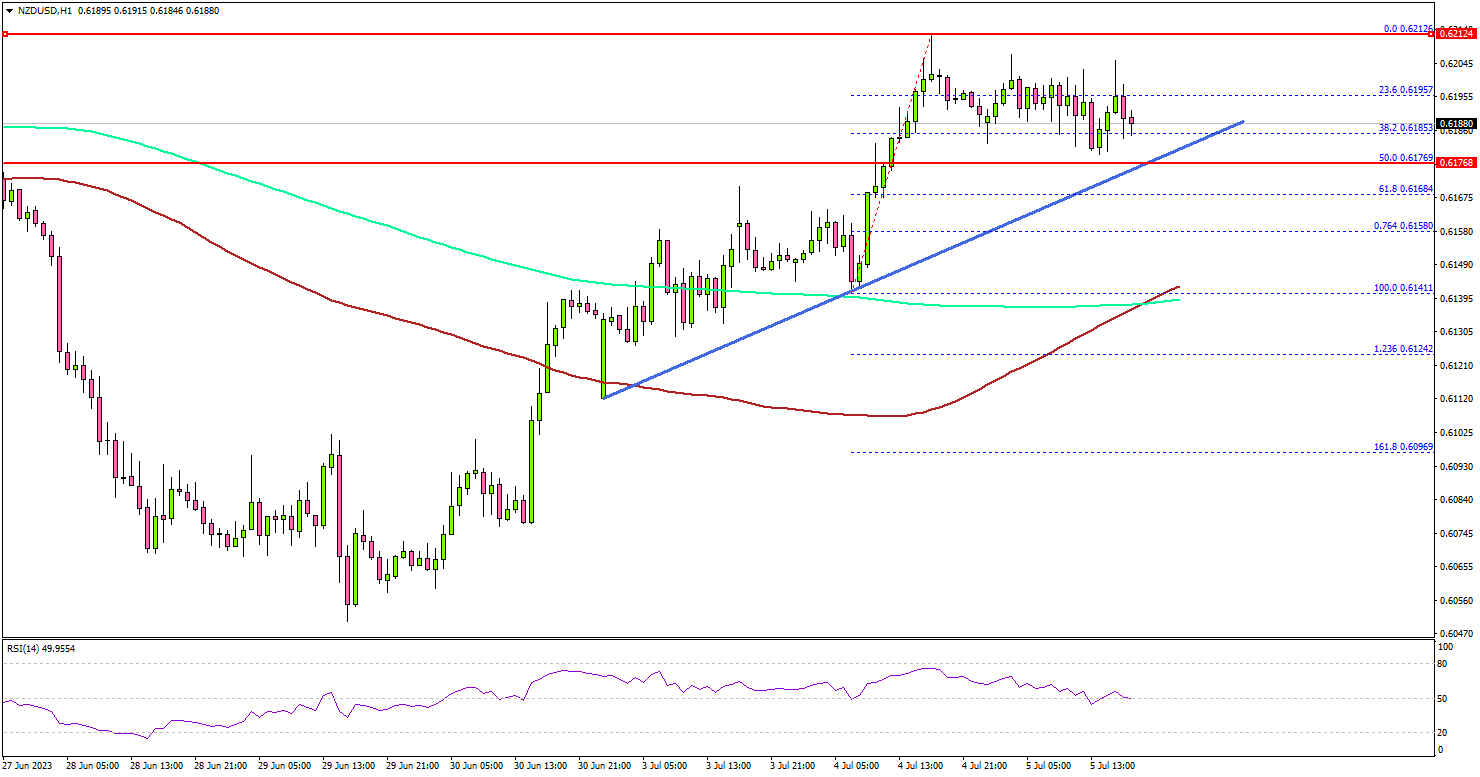
Looking at the 4-hour chart, the pair climbed above the 0.6150 resistance zone, the 200 simple moving average (green, 4 hours), and the 100 simple moving average (red, 4 hours).
The pair even spiked above the 0.6200 level. A high is formed near 0.6212 and the pair is now consolidating gains. There was a minor decline below 0.6200. The pair dipped below the 23.6% Fib retracement level of the upward move from the 0.6141 swing low to the 0.6212 high.
Immediate support is near the 0.6175 level. There is also a major bullish trend line forming with support near 0.6175 on the same chart.
The next major support is near the 0.6160 level or the 76.4% Fib retracement level of the upward move from the 0.6141 swing low to the 0.6212 high. If there is a downside break below the 0.6160 support, the pair could decline toward the 100 simple moving average (red, 4 hours).
On the upside, the first major resistance is near 0.6210. The next major resistance is near 0.6240. If there is a move above the 0.6240 resistance, the pair could rise toward 0.6300. Any more gains might send NZD/USD toward the 0.6350 level.
Looking at AUD/USD, the pair started an upside correction but it is still well below the key resistance at 0.6745.
Economic Releases
- US ADP Employment Change for June 2023 - Forecast 228K, versus 278K previous.
- US Initial Jobless Claims - Forecast 245K, versus 239K previous.
- US ISM Services Index for June 2023 – Forecast 51.0, versus 50.3 previous.
Fed Minutes Send Bond Yields Higher
The Fed minutes showed that policymakers were divided and that the hawks will still want to deliver more tightening. Fed Officials are concerned a tight labor market will make inflation tight throughout the rest of the year. If inflation remains persistent, that could be a gamechanger for inflation expectations. Wall Street was getting comfortable with higher for a little bit longer, but they are not ready to price in more than a half-point in rate hikes. In order to conquer inflation the Fed seems set on forecasting a mild recession, which is very much different than Powell’s slower growth call.
In the end, the fate of these Fed policy decisions will depend on the data and right now both the labor market and inflation readings are expected to soften over the next week. Friday’s NFP report is expected to show job growth cooled from 339,000 to 225,000, while the unemployment rate ticks lower to 3.6%. The June inflation report is going to show the base effects help the disinflation process as the headline year over year reading falls from 4.0% to 3.0%. Some analysts are making the case for a 2.8% reading, which seems relatively close to the Fed’s target. The problem for the Fed is that inflation will likely rise over the coming months.
The dollar will play tug-of-war with the majors as the risk of more Fed tightening is debated, while the Europeans struggle to bring inflation down.
Fed’s Williams spoke after the close and his comments support the case for more rate hikes. Williams noted that the data supports more action and that the Fed’s work is not done.
Fed rate hike expectations have edged a little higher for the July 26th meeting, but the peak rate remains steady. The yield on the 10-year Treasury yield rose 7.7 bps to 3.932%.
NZDCAD Wave Analysis
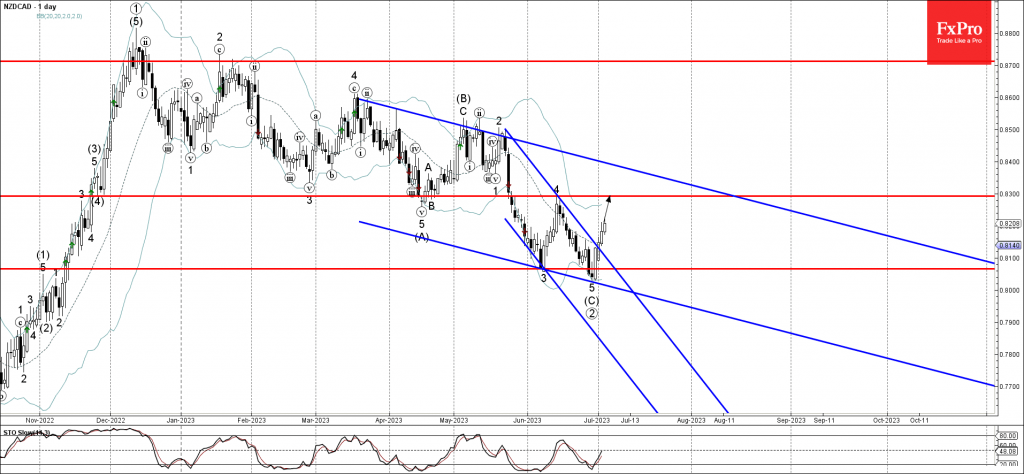
- NZDCAD broke accelerated down channel
- Likely to rise to resistance level 0.8300
NZDCAD currency pair continues to rise inside the minor impulse wave 1,which started earlier with the daily Morning Star from the key support level 0.8066.
The active impulse wave 1 belongs to the primary upward impulse sequence (3) from the end of June.
Having recently broken the accelerated down channel from May, NZDCAD currency pair can be expected to rise further toward the next resistance level 0.8300 (top of the earlier minor correction 4 from last month).
EURGBP Wave Analysis
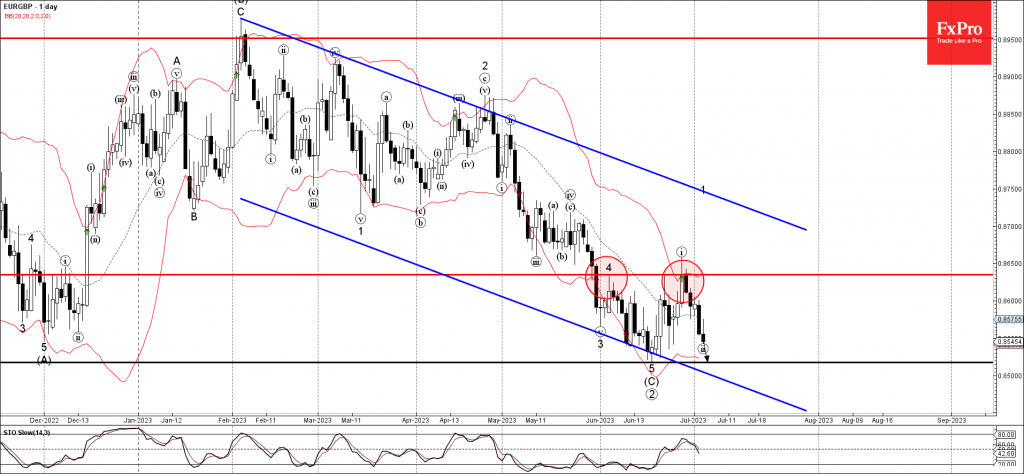
- EURGBP falling inside wave (ii)
- Likely to reach support level 0.8515
EURGBP currency pair continues to fall inside the minor corrective wave (ii), which started earlier from the key resistance level 0.8635 .
The active corrective wave (ii) belongs to the higher order upward impulse wave 1 from last month.
Given the multi-month downtrend and the continued euro sales across the FX markets, EURGBP currency pair can be expected to fall further toward the next support level 0.8515 (previous monthly low from June).
(FED) Minutes of the Federal Open Market Committee
June 13–14, 2023
A joint meeting of the Federal Open Market Committee and the Board of Governors of the Federal Reserve System was held in the offices of the Board of Governors on Tuesday, June 13, 2023, at 10:30 a.m. and continued on Wednesday, June 14, 2023, at 9:00 a.m.1
Attendance
Jerome H. Powell, Chair
John C. Williams, Vice Chair
Michael S. Barr
Michelle W. Bowman
Lisa D. Cook
Austan D. Goolsbee
Patrick Harker
Philip N. Jefferson
Neel Kashkari
Lorie K. Logan
Christopher J. Waller
Thomas I. Barkin, Raphael W. Bostic, Mary C. Daly, and Loretta J. Mester, Alternate Members of the Committee
James Bullard and Susan M. Collins, Presidents of the Federal Reserve Banks of St. Louis and Boston, respectively
Kelly J. Dubbert, Interim President of the Federal Reserve Bank of Kansas City
Joshua Gallin, Secretary
Matthew M. Luecke, Deputy Secretary
Brian J. Bonis, Assistant Secretary
Michelle A. Smith, Assistant Secretary
Mark E. Van Der Weide, General Counsel
Richard Ostrander, Deputy General Counsel
Trevor A. Reeve, Economist
Stacey Tevlin, Economist
Beth Anne Wilson, Economist
Roc Armenter, James A. Clouse, Brian M. Doyle, Beverly J. Hirtle, Andrea Raffo, Chiara Scotti, and William Wascher, Associate Economists
Roberto Perli, Manager, System Open Market Account
Julie Ann Remache, Deputy Manager, System Open Market Account
Jose Acosta, Senior Communications Analyst, Division of Information Technology, Board
Gianni Amisano, Assistant Director, Division of Research and Statistics, Board
Philippe Andrade, Senior Economist and Policy Advisor, Federal Reserve Bank of Boston
Alyssa Arute,2 Manager, Division of Reserve Bank Operations and Payment Systems, Board
Penelope A. Beattie,3 Section Chief, Office of the Secretary, Board
Carol C. Bertaut, Senior Adviser, Division of International Finance, Board
Jennifer J. Burns, Deputy Director, Division of Supervision and Regulation, Board
Marco Cagetti, Assistant Director, Division of Research and Statistics, Board
Mark A. Carlson, Adviser, Division of Monetary Affairs, Board
Juan C. Climent, Special Adviser to the Board, Division of Board Members, Board
Daniel M. Covitz, Deputy Director, Division of Research and Statistics, Board
Stephanie E. Curcuru, Deputy Director, Division of International Finance, Board
Ahmet Degerli, Economist, Division of Monetary Affairs, Board
Cynthia L. Doniger, Principal Economist, Division of Monetary Affairs, Board
Rochelle M. Edge, Deputy Director, Division of Monetary Affairs, Board
Jon Faust, Senior Special Adviser to the Chair, Division of Board Members, Board
Erin E. Ferris, Principal Economist, Division of Monetary Affairs, Board
Jonas Fisher, Senior Vice President, Federal Reserve Bank of Chicago
Glenn Follette, Associate Director, Division of Research and Statistics, Board
Jennifer Gallagher, Assistant to the Board, Division of Board Members, Board
Carlos Garriga, Senior Vice President, Federal Reserve Bank of St. Louis
David Glancy,4 Principal Economist, Division of Monetary Affairs, Board
Christopher J. Gust, Associate Director, Division of Monetary Affairs, Board
Valerie S. Hinojosa, Section Chief, Division of Monetary Affairs, Board
Jane E. Ihrig, Special Adviser to the Board, Division of Board Members, Board
Michael T. Kiley, Deputy Director, Division of Financial Stability, Board
Don H. Kim,2 Senior Adviser, Division of Monetary Affairs, Board
Edward S. Knotek II, Senior Vice President, Federal Reserve Bank of Cleveland
Andreas Lehnert, Director, Division of Financial Stability, Board
Paul Lengermann, Assistant Director, Division of Research and Statistics, Board
Kurt F. Lewis, Special Adviser to the Board, Division of Board Members, Board
Geng Li, Assistant Director, Division of Research and Statistics, Board
Laura Lipscomb, Special Adviser to the Board, Division of Board Members, Board
Brent Meyer, Assistant Vice President, Federal Reserve Bank of Atlanta
Bernardo C. Morais, Principal Economist, Division of International Finance, Board
Michelle M. Neal, Head of Markets, Federal Reserve Bank of New York
Edward Nelson, Senior Adviser, Division of Monetary Affairs, Board
Nicolas Petrosky-Nadeau, Vice President, Federal Reserve Bank of San Francisco
Achilles Sangster II, Senior Information Manager, Division of Monetary Affairs, Board
Zeynep Senyuz, Deputy Associate Director, Division of Monetary Affairs, Board
Margie Shanks, Deputy Secretary, Office of the Secretary, Board
Nitish Ranjan Sinha, Special Adviser to the Board, Division of Board Members, Board
A. Lee Smith, Senior Vice President, Federal Reserve Bank of Kansas City
Hiroatsu Tanaka,5 Senior Economist, Division of Monetary Affairs, Board
Mary H. Tian, Group Manager, Division of Monetary Affairs, Board
Robert L. Triplett III, First Vice President, Federal Reserve Bank of Dallas
Clara Vega, Special Adviser to the Board, Division of Board Members, Board
Daniel J. Vine, Principal Economist, Division of Research and Statistics, Board
Jeffrey D. Walker,2 Associate Director, Division of Reserve Bank Operations and Payment Systems, Board
Fabian Winkler, Principal Economist, Division of Monetary Affairs, Board
Alexander L. Wolman, Vice President, Federal Reserve Bank of Richmond
Paul R. Wood, Special Adviser to the Board, Division of Board Members, Board
Rebecca Zarutskie, Special Adviser to the Board, Division of Board Members, Board
Developments in Financial Markets and Open Market Operations
The manager turned first to a review of developments in financial markets. Policy-sensitive rates increased over the intermeeting period, reflecting indications of continued resilience in the economy, persistently elevated core inflation, and reduced downside tail risks following the resolution of the debt limit. The shift in policy expectations contributed significantly to higher Treasury yields. The increase in nominal yields primarily reflected higher real rates rather than inflation compensation. Broad equity prices rose, although the outperformance was concentrated in a handful of companies with a large market capitalization. Cyclical sectors fared better than sectors that tend to appreciate in a downturn, suggesting some reduced investor concern about downside risks to growth. Investor sentiment about the banking sector improved as perceived tail risks regarding regional banks appeared to have receded. Equity prices for regional banks rose over the intermeeting period but were still well below early March levels. Financial conditions indexes were roughly unchanged, as higher rates and a stronger dollar were offset by higher equity prices and narrower credit spreads.
The vast majority of respondents to the Open Market Desk's Surveys of Primary Dealers and Market Participants expected no rate change at this meeting. While the median path from the surveys pointed to no rate changes through early 2024, there was significant dispersion across respondents, and respondents saw a clear probability of additional tightening at coming meetings. Respondents' average probability distribution for the level of the peak policy rate shifted higher since the May meeting and respondents on average assigned about 60 percent probability to the peak being above the current target range. The market-implied path for the policy rate continued to show some decline this year but less so than it had in recent months. Measures of uncertainty about the path of the policy rate derived from options remained very elevated, though they came down some over the intermeeting period.
Desk survey respondents still saw a recession occurring in the near term as quite likely, but the expected timing was again pushed later, as economic data pointed to the continued resilience of economic activity. Overall, respondents generally continued to expect that any downturn would be neither deep nor prolonged. With regard to inflation expectations, respondents marked up their projections for quarterly core personal consumption expenditures (PCE) inflation in the second and third quarters of this year, while projections for later quarters were little changed.
The manager then turned to money market developments and policy implementation. The median respondent to the Desk surveys expected the three-month bill yield to increase slightly relative to the similar-maturity overnight index swap (OIS) rate and to remain above it into the fourth quarter. This expectation likely reflected a combination of rising net supply of bills as part of the Treasury Department's plan to rebuild the Treasury General Account (TGA) following the resolution of the debt limit and expectations for healthy investor demand for bills. The overnight reverse repurchase agreement (ON RRP) facility, which continued to support effective policy implementation and control over the federal funds rate, saw somewhat lower participation since the resolution of the debt limit, consistent with the historical experience that ON RRP participation is typically responsive to changes in money market conditions. The median respondent to the Desk's Survey of Primary Dealers expected ON RRP participation to trend lower over the rest of this year. The staff assessed that the replenishment of the TGA and the ongoing balance sheet runoff, among other factors, were likely to subtract from reserves more than the decline in ON RRP participation would add to them. On net, the staff judged that reserves at the end of the year were likely to remain abundant. Uncertainty surrounding the outlooks for both reserves and ON RRP participation was substantial.
By unanimous vote, the Committee ratified the Desk's domestic transactions over the intermeeting period. There were no intervention operations in foreign currencies for the System's account during the intermeeting period.
Staff Review of the Economic Situation
The information available at the time of the June 13–14 meeting suggested that real gross domestic product (GDP) was expanding at a modest pace in the second quarter. Labor market conditions remained tight in recent months, as job gains were robust and the unemployment rate was low. Consumer price inflation—as measured by the 12-month percent change in the price index for PCE—continued to be elevated in April.
Labor market conditions remained tight in April and May. Total nonfarm payroll employment increased at a robust pace during those two months. The unemployment rate edged up, on net, but was still at a low level of 3.7 percent in May. On balance, the unemployment rate for African Americans moved up to 5.6 percent, while the jobless rate for Hispanics moved down to 4.0 percent. In aggregate, the labor force participation rate held steady in April and May, and the employment-to-population ratio ticked down. The private-sector job openings rate in April—as measured by the Job Openings and Labor Turnover Survey—was unchanged from its relatively high first-quarter average, though it was lower than a year earlier.
Recent measures of nominal wage growth continued to be elevated, although lower than their highs last year. Over the 12 months ending in May, average hourly earnings for all employees increased 4.3 percent, below its peak of 5.9 percent early last year. Over the year ending in the first quarter, compensation per hour in the business sector increased 3.2 percent, down from 5.5 percent a year earlier.
Consumer price inflation remained elevated. Total PCE price inflation had eased since the middle of last year, reflecting declines in consumer energy prices and softening consumer food price inflation, but recent readings for core PCE price inflation—which excludes changes in consumer energy prices and most consumer food prices and usually provides a better signal about future inflation than the more volatile total inflation measure—were little changed. Total PCE price inflation was 4.4 percent over the 12 months ending in April, and core PCE price inflation was 4.7 percent—the same as the 12-month percent change recorded in January. In May, the 12-month change in the consumer price index (CPI) was 4.0 percent, and core CPI inflation was 5.3 percent—only slightly below its January reading. The trimmed mean measure of 12‑month PCE price inflation constructed by the Federal Reserve Bank of Dallas was 4.8 percent in April. Survey-based measures of longer-term inflation expectations in May from the University of Michigan Surveys of Consumers and the Federal Reserve Bank of New York's Survey of Consumer Expectations remained within the range of their values reported in the decade before the pandemic; near-term measures of inflation expectations from these surveys moved down in May and continued to be below their peaks seen last year.
Real GDP appeared to be increasing modestly in the second quarter following its stronger first-quarter gain. Private domestic final purchases (PDFP)—which includes PCE, residential investment, and business fixed investment and often provides a better signal of underlying economic momentum than GDP—looked to be expanding more slowly in the second quarter than its robust first-quarter pace. For the first half as a whole, PDFP growth seemed to be more resilient than in the second half of last year.
The annual revisions to international trade statistics suggested that net exports contributed positively to U.S. real GDP growth in the first quarter, with real exports rebounding more strongly than real imports following their fourth-quarter declines. In April, however, the nominal trade deficit widened notably, as nominal exports decreased and nominal imports rose further.
Foreign economic growth rebounded in the first quarter, reflecting in part the reopening of China's economy from its COVID-19-related shutdowns and strong services-sector activity in other Asian countries, Canada, and Mexico. In the euro area, however, real GDP contracted modestly for a second consecutive quarter amid a pullback in consumer spending. Indicators pointed to a step-down in the pace of foreign economic growth in the second quarter, with the impetus from China's reopening dissipating and global manufacturing activity remaining weak.
Global prices for energy and agricultural commodities were little changed, on net, over the intermeeting period, while prices for metals fell further. Declines in retail energy prices since the beginning of the year contributed to a notable easing in headline consumer price inflation in the foreign economies. By contrast, core inflation had yet to materially decline from its recent highs in many economies. In this context, and with tight labor market conditions, foreign central banks underscored the need to raise policy rates further or hold them at sufficiently restrictive levels to bring inflation back to their respective targets and be well positioned in case inflation failed to decline as expected.
Staff Review of the Financial Situation
Over the intermeeting period, market participants appeared to interpret incoming data as signaling, on balance, more resilience in economic activity than previously assumed and viewed communications from FOMC participants overall as pointing to a tighter path for policy than expected. As a result, Treasury yields and the expected future path for the federal funds rate shifted upward significantly. Meanwhile, broad equity prices also increased notably. Financing conditions remained moderately restrictive, but credit availability generally remained solid.
The expected path of the policy rate implied by market quotes moved up notably over the intermeeting period. A straight read of federal funds futures rates suggested that market participants expected that the federal funds rate would be roughly flat over the course of the rest of this year. The year-end expected rate was about 70 basis points higher than the year-end expectation before the May FOMC meeting. Beyond this year, the policy rate path implied by OIS quotes also moved up, to about 3.7 percent by the end of 2024. Similarly, nominal Treasury yields rose significantly. The rise in nominal yields mostly reflected an increase in real yields, as measures of inflation compensation were little changed, on net, amid somewhat mixed news on inflation. Measures of uncertainty about the path of interest rates remained very elevated by historical standards.
The S&P 500 stock price index increased sizably, on net, over the intermeeting period, led by technology-related stocks. The VIX—the one-month option-implied volatility on the S&P 500 index—edged down, on balance, and ended the period near the 30th percentile of its historical distribution. Bank equity price indexes moved up notably, on net, over the intermeeting period. Stock prices for large banks were only somewhat below their levels before the failure of Silicon Valley Bank (SVB), while those for regional banks remained below their levels in early March.
Market-based policy rate expectations rose notably in most advanced foreign economies, as core inflation data surprised to the upside in some countries and central bank communications were perceived as pointing to more restrictive policy than expected. Notwithstanding the rise in global yields, foreign equity prices, credit spreads, and risk sentiment in foreign markets were little changed over the intermeeting period. The staff's trade-weighted broad dollar index was also little changed, on net, but the exchange value of the dollar appreciated significantly against the Chinese renminbi amid increased investor concerns over China's economic growth prospects.
Conditions in overnight bank funding and repurchase agreement markets remained generally stable over the intermeeting period. The 25 basis point increase in administered rates at the May FOMC meeting fully passed through to overnight money market rates. Spreads and issuance volumes in unsecured short-term funding markets stayed within their typical ranges. In May, yields of Treasury bills maturing in June and thus potentially affected by the federal debt limit rose sharply before largely retracing those increases after an agreement was reached to suspend the debt limit.
In domestic credit markets, borrowing costs for businesses, households, and municipalities increased notably over the intermeeting period. Interest rates on newly originated bank loans to businesses and households in the first quarter rose further above their peaks from the previous tightening cycle, and yields on leveraged loans also rose, reaching levels close to their peak at the onset of the pandemic. Rates also moved up on a broad array of fixed-income securities, including investment- and speculative-grade corporate bonds, municipal bonds, both agency and non-agency commercial mortgage-backed securities (CMBS), and agency residential mortgage-backed securities. The increases in yields on these instruments over the intermeeting period were generally in line with, or less than, the changes in their Treasury benchmarks. Small businesses and households saw continued increases in their borrowing costs. Rates on 30-year conforming residential mortgages stepped up, broadly in line with increases in comparable-duration Treasury yields. Interest rates on credit card offers continued to rise through April, and auto loan interest rates moved sideways during the intermeeting period. Both credit card and auto loan interest rates stood at, or near, their highest levels since the Global Financial Crisis.
Banks' ability to fund loans to businesses and consumers appeared to have stabilized in recent weeks but remained somewhat strained relative to before the closure of SVB in March. Although banks continued to experience outflows of core deposits, the pace of those outflows moderated substantially relative to March, suggesting some easing of bank funding pressures. Banks also continued to attract inflows of large time deposits, reflecting higher interest rates on new certificates of deposit. Total bank assets were little changed, on net, over the intermeeting period.
In capital markets, funding had generally been resilient. Issuance of nonfinancial investment-grade corporate bonds rose at a robust pace in May after slowing in April, partly due to the "earnings blackout" period. Speculative-grade issuance increased in late April and in May but remained subdued by historical standards. Gross issuance of municipal bonds was solid in April and May.
Conditions in the leveraged loan and CMBS markets were somewhat more strained. Leveraged loan issuance remained subdued, reflecting weak investor demand amid concerns over the credit worthiness of borrowers. Both agency and non-agency CMBS issuance volumes were low in May relative to pre-pandemic levels. In addition, for small businesses, credit availability continued to show signs of tightening.
Credit remained easily available in the residential mortgage market for high credit score borrowers who met standard conforming loan criteria. For borrowers with lower scores, credit availability tightened slightly in April but remained close to pre-pandemic levels. In consumer credit markets, conditions stayed generally accommodative, with credit available for most borrowers.
The credit quality of most businesses and households remained solid, although market participants appeared to expect some deterioration in the coming quarters, which could weaken lender balance sheets and possibly weigh on credit availability. A measure of the May CMBS delinquency rate showed about a 50 basis point increase, driven by a sharp rise in the delinquency rate for office buildings.
Staff Economic Outlook
The economic forecast prepared by the staff for the June FOMC meeting continued to assume that the effects of the expected further tightening in bank credit conditions, amid already tight financial conditions, would lead to a mild recession starting later this year, followed by a moderately paced recovery. Real GDP was projected to decelerate in the current quarter and the next one before declining modestly in both the fourth quarter of this year and first quarter of next year. Real GDP growth over 2024 and 2025 was projected to be below the staff's estimate of potential output growth. The unemployment rate was forecast to increase this year, peak next year, and remain near that level through 2025. Current tight resource utilization in both product and labor markets was forecast to ease, with the level of real output moving below the staff's estimate of potential output in 2025 and the unemployment rate rising above the staff's estimate of its natural rate at that time.
The staff's inflation forecast was little revised relative to the previous projection, and supply–demand imbalances in both goods markets and labor markets were still judged to be easing only slowly. On a four-quarter change basis, total PCE price inflation was projected to be 3.0 percent this year, with core inflation at 3.7 percent. Core goods inflation was forecast to move down further this year and then remain subdued. Housing services inflation was considered to have about peaked and was expected to move down over the rest of the year. Core nonhousing services inflation was projected to slow gradually as nominal wage growth eased further. Reflecting the effects of the easing in resource utilization over the projection, core inflation was forecast to slow through next year but remain moderately above 2 percent. With expected declines in consumer energy prices and further moderation in food price inflation, total inflation was projected to run below core inflation this year and the next. In 2025, both total and core PCE price inflation were expected to be close to 2 percent.
The staff continued to judge that uncertainty around the baseline projection was considerable and still viewed the risks as being influenced importantly by the potential macroeconomic implications of banking-sector developments, which could end up being more, or less, negative than assumed in the baseline. Given the continued strength in labor market conditions and the resilience of consumer spending, however, the staff saw the possibility of the economy continuing to grow slowly and avoiding a downturn as almost as likely as the mild‑recession baseline. On balance, the staff saw the risks around the baseline inflation forecast as tilted to the upside, as economic scenarios with higher inflation appeared more likely than scenarios with lower inflation and because inflation could continue to be more persistent than expected and inflation expectations could become unanchored after a long period of elevated inflation.
Participants' Views on Current Conditions and the Economic Outlook
In conjunction with this FOMC meeting, participants submitted their projections of the most likely outcomes for real GDP growth, the unemployment rate, and inflation for each year from 2023 through 2025 and over the longer run. The projections were based on their individual assessments of appropriate monetary policy, including the path of the federal funds rate. The longer-run projections represented each participant's assessment of the rate to which each variable would be expected to converge, over time, under appropriate monetary policy and in the absence of further shocks to the economy. A Summary of Economic Projections (SEP) was released to the public following the conclusion of the meeting.
In their discussion of current economic conditions, participants noted that economic activity had continued to expand at a modest pace. Nonetheless, job gains had been robust in recent months, and the unemployment rate had remained low. Inflation remained elevated. Participants agreed that the U.S. banking system was sound and resilient. They commented that tighter credit conditions for households and businesses were likely to weigh on economic activity, hiring, and inflation. However, participants agreed that the extent of these effects remained uncertain. Against this background, participants concurred that they remained highly attentive to inflation risks.
In assessing the economic outlook, most participants noted that real GDP growth had been resilient in recent quarters. Participants generally judged that growth would be subdued over the remainder of this year. They assessed that the cumulative tightening of monetary policy over the past year had contributed significantly to more restrictive financial conditions and lower demand in the most interest rate sensitive sectors of the economy, especially housing and business investment. Participants also acknowledged uncertainty about the lags with which monetary policy affects the economy and discussed the extent to which the full effects of monetary tightening on the economy had been realized. While total inflation had moderated over the past year, core inflation had not shown a sustained easing since the beginning of the year. With inflation well above the Committee's longer-run 2 percent objective, participants expected that a period of below-trend growth in real GDP and some softening in labor market conditions would be needed to bring aggregate supply and aggregate demand into better balance and reduce inflationary pressures sufficiently to return inflation to 2 percent over time.
Participants generally noted that banking stresses had receded and conditions in the banking sector were much improved since early March. Participants generally continued to judge that a tightening in credit conditions spurred by banking-sector stress earlier in the year would likely weigh further on economic activity, but the extent remained uncertain. Several participants mentioned that credit conditions had not appeared to have tightened significantly beyond what would be expected in response to the monetary policy actions taken since early last year. Some participants judged that it was still too early to assess with confidence the eventual effects of tighter bank credit conditions on economic activity and noted that it would be important to monitor closely the potential effects of banking-sector developments on credit conditions and economic activity.
In their discussion of the household sector, participants generally noted that consumer spending so far this year had been stronger than expected. Several participants noted that aggregate household wealth remained high, as equity and home prices had not declined much from their recent highs. A few participants mentioned that while, overall, the household sector still retained much of the excess savings it had accumulated during the pandemic, there were signs that consumers were facing increasingly tighter budget constraints, given high inflation and, especially for low-income households, depleted savings.
Regarding the business sector, various participants said that reports from their contacts were mixed, with some pointing to softening economic conditions and others indicating greater-than-expected strength. Many participants noted that developments in the banking sector appeared to have had only a modest effect so far on credit availability for firms. Some participants remarked that the effect of high interest rates on the housing sector appeared to be bottoming out, with home sales, builder sentiment, and new construction all having improved a little since the start of the year.
In their discussion of economic activity, several participants pointed out that recent GDP readings had been stronger than expected earlier in the year, while gross domestic income (GDI) readings had been weak. Of those who noted the discrepancy between GDP and GDI, most suggested that economic momentum may not be as strong as indicated by the GDP readings. In discussing that possibility, a couple of these participants also cited the recent subdued growth in aggregate hours worked.
Participants noted that labor market conditions remained very tight, with robust payroll gains and the unemployment rate still near historically low levels. Nevertheless, they noted some signs that supply and demand in the labor market were coming into better balance, with the prime-age labor force participation rate moving up in recent months and further reductions in rates of job openings and quits, and declines in average weekly hours. A couple of participants conveyed that they heard at a recent Fed Listens event that, in various parts of the country, the lack of affordable housing in the area was preventing some lower-income workers from relocating to accept jobs. Similarly, a few participants noted that their District contacts reported less difficulty in hiring and retaining workers, lower turnover rates, and some layoffs. Some participants pointed out that payroll gains had remained robust but noted that some other measures of employment—such as those based on the Bureau of Labor Statistics' household survey, the Quarterly Census of Employment and Wages, or the Board staff's measure of private employment using data from the payroll processing firm ADP—suggested that job growth may have been weaker than indicated by payroll employment. Participants anticipated that employment growth would likely slow further, consistent with their projections of below-trend economic growth. Participants noted that nominal wage growth had shown signs of easing but observed that it was still running at a pace that, given current estimates of trend productivity growth, was above what would be consistent over the longer run with the Committee's 2 percent inflation objective. Participants expected supply and demand conditions in the labor market to come into better balance over time, easing pressures on wages and prices.
Participants agreed that inflation was unacceptably high and noted that the data, including the CPI for May, indicated that declines in inflation had been slower than they had expected. Participants observed that although core goods inflation had moderated since the middle of last year, it had slowed less rapidly than expected in recent months, despite data and reports from business contacts indicating that supply chain constraints had continued to ease. Some participants noted the recent moderation in housing services inflation and expected this trend to continue. However, a few participants pointed to upside risks to the outlook for housing services inflation associated with near-record low inventories of homes for sale, solid housing demand, and less-than-expected deceleration recently in measures of rents for leases signed by new tenants. Additionally, some participants remarked that core nonhousing services inflation had shown few signs of slowing in the past few months. Several participants noted that longer-term measures of inflation expectations from surveys of households and businesses remained well anchored. Participants emphasized that, with appropriate firming of monetary policy, well-anchored longer-term inflation expectations would support a return of inflation to the Committee's 2 percent longer-run goal over time.
Participants generally noted a high degree of uncertainty regarding the cumulative effects on the economy from both already-enacted monetary policy tightening and the potential additional tightening in credit conditions stemming from recent banking-sector developments. Participants noted that the full effects of monetary tightening had likely yet to be observed, though several highlighted the possibility that much of the effect of past monetary policy tightening may have already been realized. Regarding downside risks to economic activity, participants noted the possibility that the cumulative and rapid tightening of monetary policy would eventually affect economic activity more than expected, and that the additional effects of the tightening of bank credit conditions could prove more substantial than anticipated. Regarding risks to inflation, with inflation remaining well above the Committee's longer-run goal, some participants mentioned the possibility that longer-term inflation expectations could become unanchored, particularly in light of stronger-than-expected consumer demand and a still-tight labor market. Several participants cited the possibility of delayed effects of tighter credit conditions potentially contributing to a slowdown in economic activity that reduces inflationary pressures.
In their consideration of appropriate monetary policy actions at this meeting, participants concurred that while inflation had moderated since the middle of 2022, it remained well above the Committee's longer-run goal of 2 percent. Economic activity had continued to expand at a modest pace. The labor market remained very tight, with robust job gains in recent months and the unemployment rate still low, but there were some signs that supply and demand in the labor market were coming into better balance. The economy was facing headwinds from tighter credit conditions, including higher interest rates, for households and businesses, which would likely weigh on economic activity, hiring, and inflation, although the extent of these effect remained uncertain. Against this backdrop, and in consideration of the significant cumulative tightening in the stance of monetary policy and the lags with which policy affects economic activity and inflation, almost all participants judged it appropriate or acceptable to maintain the target range for the federal funds rate at 5 to 5-1/4 percent at this meeting. Most of these participants observed that leaving the target range unchanged at this meeting would allow them more time to assess the economy's progress toward the Committee's goals of maximum employment and price stability. Some participants indicated that they favored raising the target range for the federal funds rate 25 basis points at this meeting or that they could have supported such a proposal. The participants favoring a 25 basis point increase noted that the labor market remained very tight, momentum in economic activity had been stronger than earlier anticipated, and there were few clear signs that inflation was on a path to return to the Committee's 2 percent objective over time. All participants agreed that it was appropriate to continue the process of reducing the Federal Reserve's securities holdings, as described in its previously announced Plans for Reducing the Size of the Federal Reserve's Balance Sheet.
In discussing the policy outlook, all participants continued to anticipate that, with inflation still well above the Committee's 2 percent goal and the labor market remaining very tight, maintaining a restrictive stance for monetary policy would be appropriate to achieve the Committee's objectives. Almost all participants noted that in their economic projections that they judged that additional increases in the target federal funds rate during 2023 would be appropriate. Most participants observed that uncertainty about the outlook for the economy and inflation remained elevated and that additional information would be valuable for considering the appropriate stance of monetary policy. Many also noted that, after rapidly tightening the stance of monetary policy last year, the Committee had slowed the pace of tightening and that a further moderation in the pace of policy firming was appropriate in order to provide additional time to observe the effects of cumulative tightening and assess their implications for policy. Participants agreed that their policy decisions at every meeting would continue to be based on the totality of incoming information and its implications for the economic outlook as well as the balance of risks. They also emphasized the importance of communicating to the public their data-dependent approach. Most participants observed that postmeeting communications, including the SEP, would help clarify their assessment regarding the stance of monetary policy that is likely to be appropriate to bring inflation down to 2 percent over time.
Participants also discussed several risk-management considerations that could bear on future policy decisions. Almost all participants stated that, with inflation still well above the Committee's longer-run goal and the labor market remaining tight, upside risks to the inflation outlook or the possibility that persistently high inflation might cause inflation expectations to become unanchored remained key factors shaping the policy outlook. Even though economic activity had been resilient recently and that the labor market remained strong, some participants commented that there continued to be downside risks to economic growth and upside risks to unemployment. Despite the receding of the stresses in the banking sector, some participants commented that it would be important to monitor whether developments in the banking sector lead to further tightening of credit conditions and weigh on economic activity. Some participants noted concerns about the potential risks stemming from weakness in commercial real estate.
A number of participants observed that the resolution of the federal government debt limit had removed one source of significant uncertainty for the economic outlook. A few participants noted that there could be some upward pressure on money market rates in the near term as the Treasury issued more bills to meet expenditures and return the balance in the TGA to the Treasury's preferred level. Those participants observed that upward pressure on money market rates relative to the rate offered on the ON RRP facility could lead to a decline in usage of the facility.
Committee Policy Actions
In their discussion of monetary policy for this meeting, members agreed that economic activity had continued to expand at a modest pace. They also concurred that job gains had been robust in recent months, and the unemployment rate had remained low. Inflation had remained elevated.
Members concurred that the U.S. banking system was sound and resilient. They also agreed that tighter credit conditions for households and businesses were likely to weigh on economic activity, hiring, and inflation, but that the extent of these effects was uncertain. Members also concurred that they remained highly attentive to inflation risks.
Members agreed that the Committee seeks to achieve maximum employment and inflation at the rate of 2 percent over the longer run. In support of these goals, the members agreed to maintain the target range for the federal funds rate at 5 to 5-1/4 percent. Members agreed that holding the target range steady at this meeting allowed the Committee to assess additional information and its implications for monetary policy. In determining the extent of additional policy firming that may be appropriate to return inflation to 2 percent over time, members concurred that they will take into account the cumulative tightening of monetary policy, the lags with which monetary policy affects economic activity and inflation, and economic and financial developments. In addition, members agreed that the Committee will continue to reduce the Federal Reserve's holdings of Treasury securities and agency debt and agency mortgage-backed securities, as described in its previously announced plans. All members affirmed that they are strongly committed to returning inflation to their 2 percent objective.
Members agreed that, in assessing the appropriate stance of monetary policy, they would continue to monitor the implications of incoming information for the economic outlook. They would be prepared to adjust the stance of monetary policy as appropriate if risks emerge that could impede the attainment of the Committee's goals. Members also agreed that their assessments will take into account a wide range of information, including readings on labor market conditions, inflation pressures and inflation expectations, and financial and international developments.
At the conclusion of the discussion, the Committee voted to direct the Federal Reserve Bank of New York, until instructed otherwise, to execute transactions in the System Open Market Account in accordance with the following domestic policy directive, for release at 2:00 p.m.:
"Effective June 15, 2023, the Federal Open Market Committee directs the Desk to:
- Undertake open market operations as necessary to maintain the federal funds rate in a target range of 5 to 5-1/4 percent.
- Conduct standing overnight repurchase agreement operations with a minimum bid rate of 5.25 percent and with an aggregate operation limit of $500 billion.
- Conduct standing overnight reverse repurchase agreement operations at an offering rate of 5.05 percent and with a per-counterparty limit of $160 billion per day.
- Roll over at auction the amount of principal payments from the Federal Reserve's holdings of Treasury securities maturing in each calendar month that exceeds a cap of $60 billion per month. Redeem Treasury coupon securities up to this monthly cap and Treasury bills to the extent that coupon principal payments are less than the monthly cap.
- Reinvest into agency mortgage-backed securities (MBS) the amount of principal payments from the Federal Reserve's holdings of agency debt and agency MBS received in each calendar month that exceeds a cap of $35 billion per month.
- Allow modest deviations from stated amounts for reinvestments, if needed for operational reasons.
- Engage in dollar roll and coupon swap transactions as necessary to facilitate settlement of the Federal Reserve's agency MBS transactions."
The vote also encompassed approval of the statement below for release at 2:00 p.m.:
"Recent indicators suggest that economic activity has continued to expand at a modest pace. Job gains have been robust in recent months, and the unemployment rate has remained low. Inflation remains elevated.
The U.S. banking system is sound and resilient. Tighter credit conditions for households and businesses are likely to weigh on economic activity, hiring, and inflation. The extent of these effects remains uncertain. The Committee remains highly attentive to inflation risks.
The Committee seeks to achieve maximum employment and inflation at the rate of 2 percent over the longer run. In support of these goals, the Committee decided to maintain the target range for the federal funds rate at 5 to 5-1/4 percent. Holding the target range steady at this meeting allows the Committee to assess additional information and its implications for monetary policy. In determining the extent of additional policy firming that may be appropriate to return inflation to 2 percent over time, the Committee will take into account the cumulative tightening of monetary policy, the lags with which monetary policy affects economic activity and inflation, and economic and financial developments. In addition, the Committee will continue reducing its holdings of Treasury securities and agency debt and agency mortgage-backed securities, as described in its previously announced plans. The Committee is strongly committed to returning inflation to its 2 percent objective.
In assessing the appropriate stance of monetary policy, the Committee will continue to monitor the implications of incoming information for the economic outlook. The Committee would be prepared to adjust the stance of monetary policy as appropriate if risks emerge that could impede the attainment of the Committee's goals. The Committee's assessments will take into account a wide range of information, including readings on labor market conditions, inflation pressures and inflation expectations, and financial and international developments."
Voting for this action: Jerome H. Powell, John C. Williams, Michael S. Barr, Michelle W. Bowman, Lisa D. Cook, Austan D. Goolsbee, Patrick Harker, Philip N. Jefferson, Neel Kashkari, Lorie K. Logan, and Christopher J. Waller.
Voting against this action: None.
Consistent with the Committee's decision to leave the target range for the federal funds rate unchanged, the Board voted unanimously to maintain the interest rate paid on reserve balances at 5.15 percent, effective June 15, 2023. The Board also voted unanimously to approve the establishment of the primary credit rate at the existing level of 5.25 percent.
It was agreed that the next meeting of the Committee would be held on Tuesday–Wednesday, July 25–26, 2023. The meeting adjourned at 10:20 a.m. on June 14, 2023.
Notation Vote
By notation vote completed on May 23, 2023, the Committee unanimously approved the minutes of the Committee meeting held on May 2–3, 2023.
_______________________
Joshua Gallin
Secretary
1. The Federal Open Market Committee is referenced as the "FOMC" and the "Committee" in these minutes; the Board of Governors of the Federal Reserve System is referenced as the "Board" in these minutes. Return to text
2. Attended through the discussion of developments in financial markets and open market operations. Return to text
3. Attended through the discussion of the economic and financial situation and all of Wednesday's session. Return to text
4. Attended Tuesday's session only. Return to text
5. Attended from the discussion of the economic and financial situation through the end of Tuesday's session. Return to text