Sample Category Title
Pound Eyes UK GDP and Jobs Data for Clues on BoE Rate Path
The Bank of England doesn’t meet for another couple of weeks and there is quite a bit of data for traders to sift through until then, including employment and GDP numbers for April. The employment report is out on Tuesday followed by the GDP estimate on Wednesday, both due at 06:00 GMT. With inflation still running hot, the choice for the BoE isn’t so much between a hike and a pause but rather, between a small rate increase and a larger one. Stronger-than-expected readings could boost the odds for the latter, lifting the pound.
Some cracks are forming in the labour market
The UK economy has so far avoided a technical recession but nevertheless it ended the first quarter on a weak note. The April stats will therefore be vital to see whether economic output bounced back after the March dip, as despite defying the odds of a recession, the risk of one hasn’t entirely dissipated and even the labour market is showing some signs of a crack.
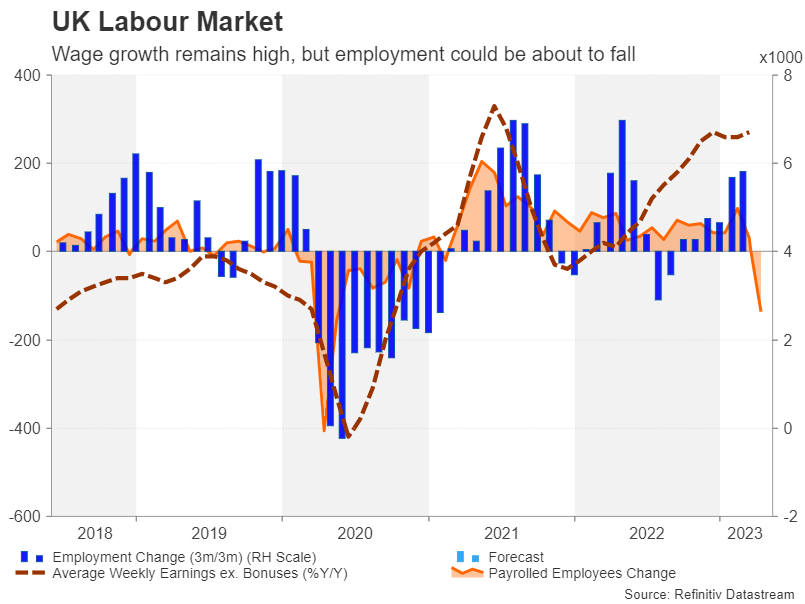
The unemployment rate has been edging higher since September and could reach 4.0% in the April quarter, having risen to 3.9% in the three months to March. Unusually, total employment has also been growing during this period and was up an impressive 182k in March. However, the more up-to-date payrolls estimate, which is based on data of payrolled employees collected from the UK tax office, points to a sharp deterioration.
BoE wants to see lower wage growth
Payrolled employees fell by 135k in April, suggesting that the official employment figure for the same period will also be weaker. A slowdown in jobs growth would be good news for policymakers, however, as a tight labour market has kept wage growth running around 6% since last August.
When excluding bonuses, average weekly earnings growth has been even stronger and is forecast to hit 6.9% y/y in the three months to April. Without a substantial deceleration in pay growth, the Bank of England will feel pressured to keep hiking rates amid a stubbornly high inflation rate.
A resilient economy
The expectation that UK interest rates will have to rise a lot higher than in other advanced economies has had a mixed effect on sterling as a recession might be the only eventual outcome should inflation not come down fast enough. The Bank of England has been trying to strike a careful balance to not completely choke off growth as it fights high inflation. But the longer sticky inflation remains a problem, the less accommodative monetary policy needs to become.
On the other hand, if the economy continues to withstand everything that is being thrown at it, the farther the BoE will be willing to go with its tightening campaign.
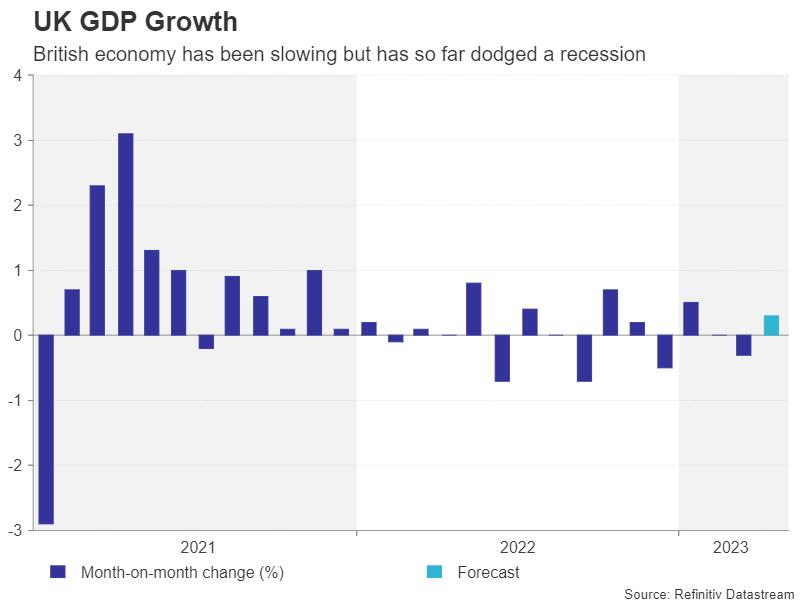
GDP likely expanded by a decent 0.3% month-on-month at the start of Q2 after shrinking by 0.3% in March. Separate figures on industrial and manufacturing production will also be released. If the economy fails to rebound in April, the probability of a 50-bps hike by the BoE on June 22, which currently stands at less than 10%, could evaporate, weighing on the British currency.
Higher rates not a guarantee for pound uptrend
The pound is consolidating at the moment after touching a one-year peak of $1.2679 on May 10. The 50% Fibonacci retracement of the June 2021-September 2022 downleg at $1.2315 managed to halt the correction at the end of May and could again prevent a steep selloff induced by disappointing numbers. Below that, the 200-day moving average in the $1.2000 region would be an obvious target for the bears.
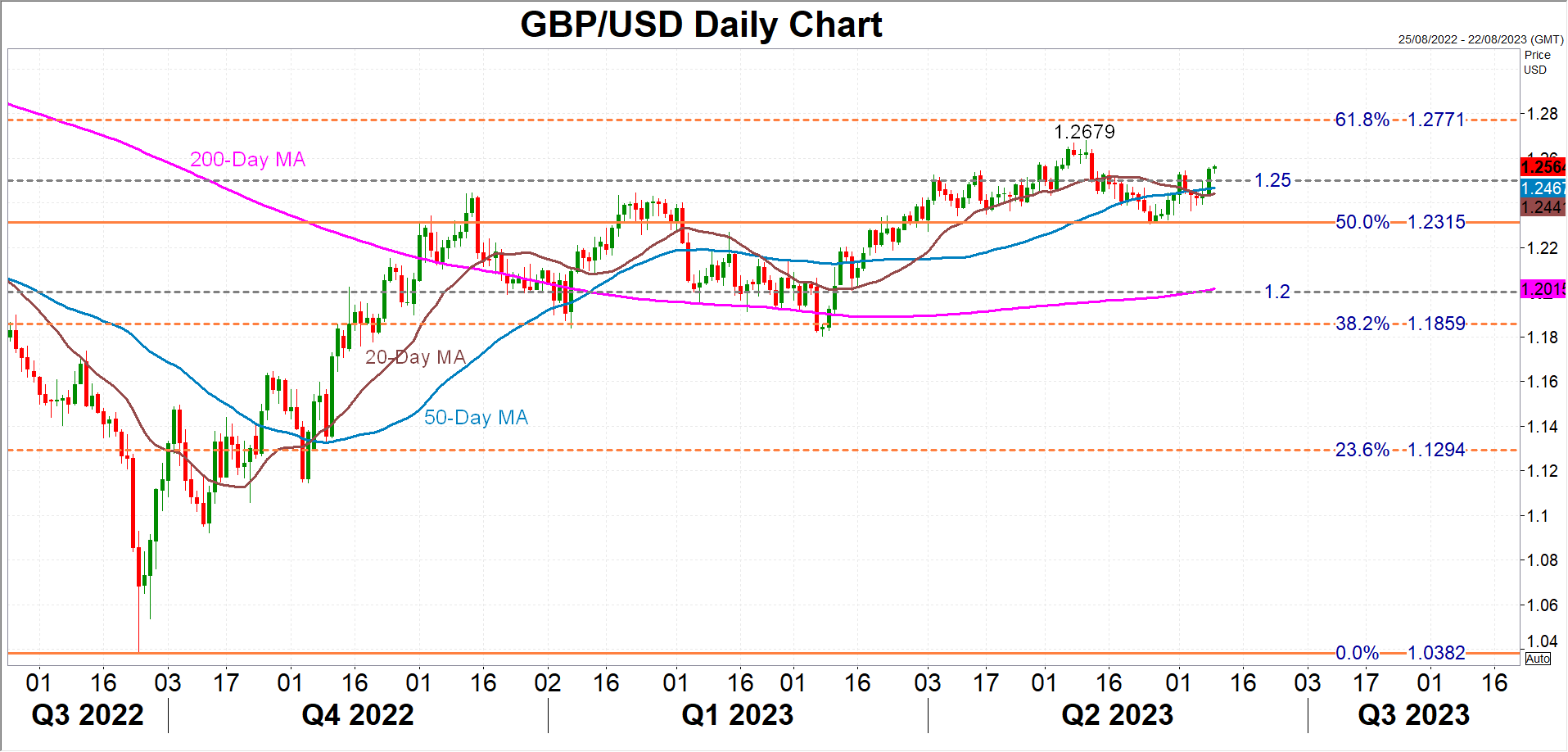
In the event, however, that the data exceeds expectations, bolstering the ‘higher for longer’ case for the Bank of England, the pound could re-challenge the May top and aim for the 61.8% Fibonacci of $1.2771.
Still, big moves are not very likely from next week’s releases as most traders will be putting more weight on the May CPI report due on June 21. Core CPI shot up to 6.8% y/y in April, in a massive setback for the BoE. Unless this trend reverses quickly in the coming months, UK rates are seen peaking well above 5%. Yet, for the pound to be able to stay on an upward path against the US dollar, the growth side of the story additionally has to hold up.
Will Fed Pause After 10 Straight Hikes?
The FOMC will announce its interest rate decision on Wednesday at 18:00 GMT, with most market participants anticipating the Committee to hit the brakes on rate increases for the first time since March 2022. Having said that, market expectations could very well change just the day before the decision, when the US CPIs for May are due out, thereby impacting the way the dollar may react to the outcome of the meeting. So, what could officials decide and how may the US dollar perform post this gathering?
Investors convinced the Fed will skip a hike
The last time Fed officials met, they delivered the broadly anticipated 25bps hike, but they removed from the statement the part saying that some additional policy firming may be appropriate and instead turned data dependent. As such, market participants started to raise bets that policymakers could take their hands off the hike button as soon as at the next gathering.
After the meeting though, strong economic data and hawkish remarks by Fed officials have encouraged investors to price in a hike either in June or July, with expectations of massive rate cuts by the end of the year being scaled back.
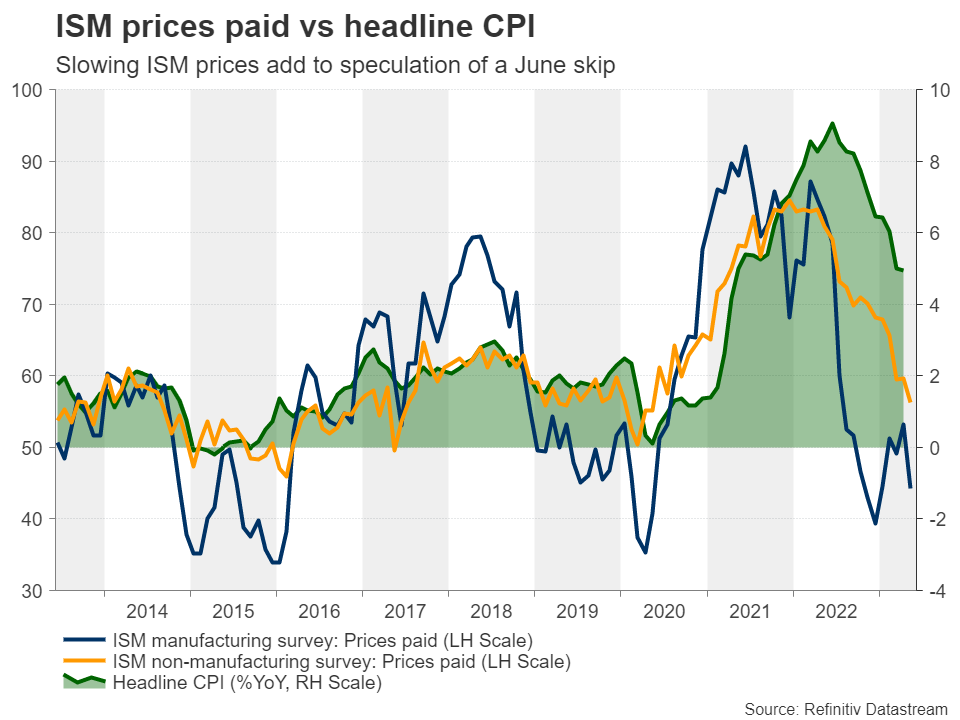
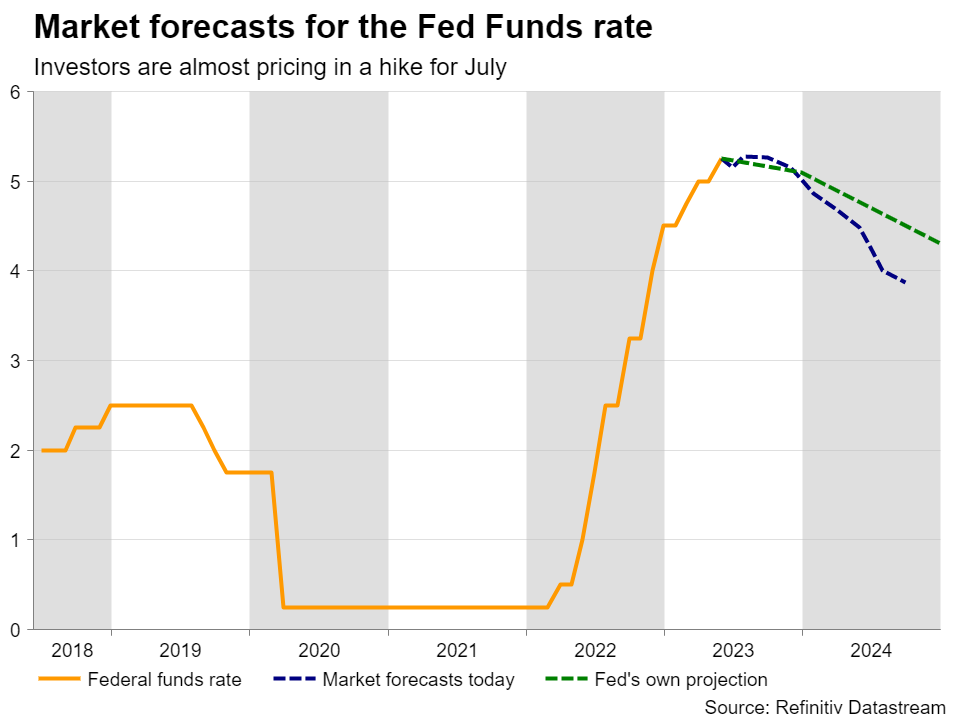
This allowed the dollar to stage a comeback against all its major peers. However, that recovery stalled the last couple of weeks as data pointing to slowing wage growth and subdued prices charged in the manufacturing and service sectors convinced traders that the Fed will skip hiking in June and perhaps do so in July. Specifically, investors are now assigning a 75% probability of no change on Wednesday, while they are penciling in 20bps worth of a hike for July.
As for thereafter, conditional upon a summer hike materializing, market participants foresee nearly two quarter-point cuts by January. Thus, apart from focusing on whether the Committee will press the hike button now, the financial community may also pay attention to the updated macroeconomic projections and especially the new dot plot.
Inflation data to reshape bets just a day before
Having said all that though, how the dollar will react to any outcome will depend on the market expectations heading into the meeting, and those expectations could very well be altered the day before the decision, when the US CPIs for May are released. No forecasts are available for the year-on-year rates yet, but with the y/y change in WTI crude oil staying in negative territory, it seems that the limelight is likely to fall on the core rate once again.
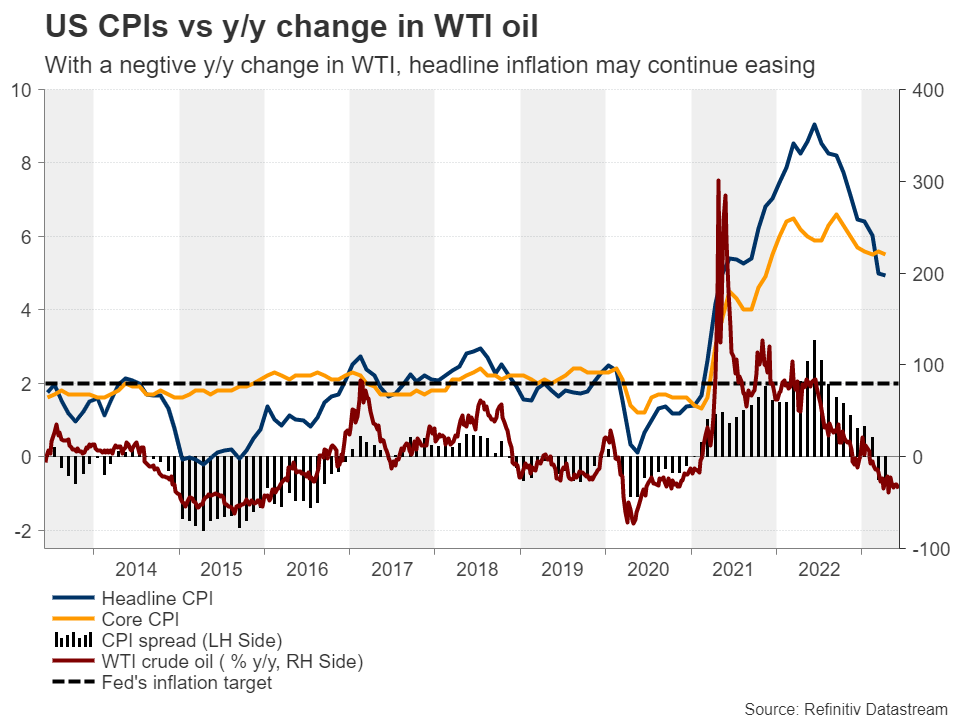
A slowdown in underlying price pressures could further diminish the probability of a rate hike on Wednesday and may also lessen the likelihood of that happening in July. The opposite may be true if the core CPI rate accelerates.
Dollar dependent on a combination of outcomes
Therefore, if inflation slows, the Fed will be more tempted to stay sidelined. However, if the updated dot plot shows a higher median rate for this year, the dollar is still likely to rally despite skipping a hike this month, as this will mean a hike in July and no cuts this year. Now, conditional upon inflation accelerating, the only decision that could support the dollar may be a rate increase, as a skip could disappoint those adding to their hike bets just the day before. For the greenback to come under strong selling interest no matter what the results of the inflation report are, the Fed may need to stay sidelined and indicate that no more hikes are needed, which appears to be the least likely scenario at the moment.
So, with the forthcoming direction of the US dollar dependent on many variables and several combinations of outcomes, the outlook doesn’t seem crystal clear now. The greenback’s comeback has stalled the last couple of weeks, with the currency coming under selling interest on Thursday after initial jobless claims spiked to a 20-month high. This makes the retreat in euro/dollar look like a correction for now.
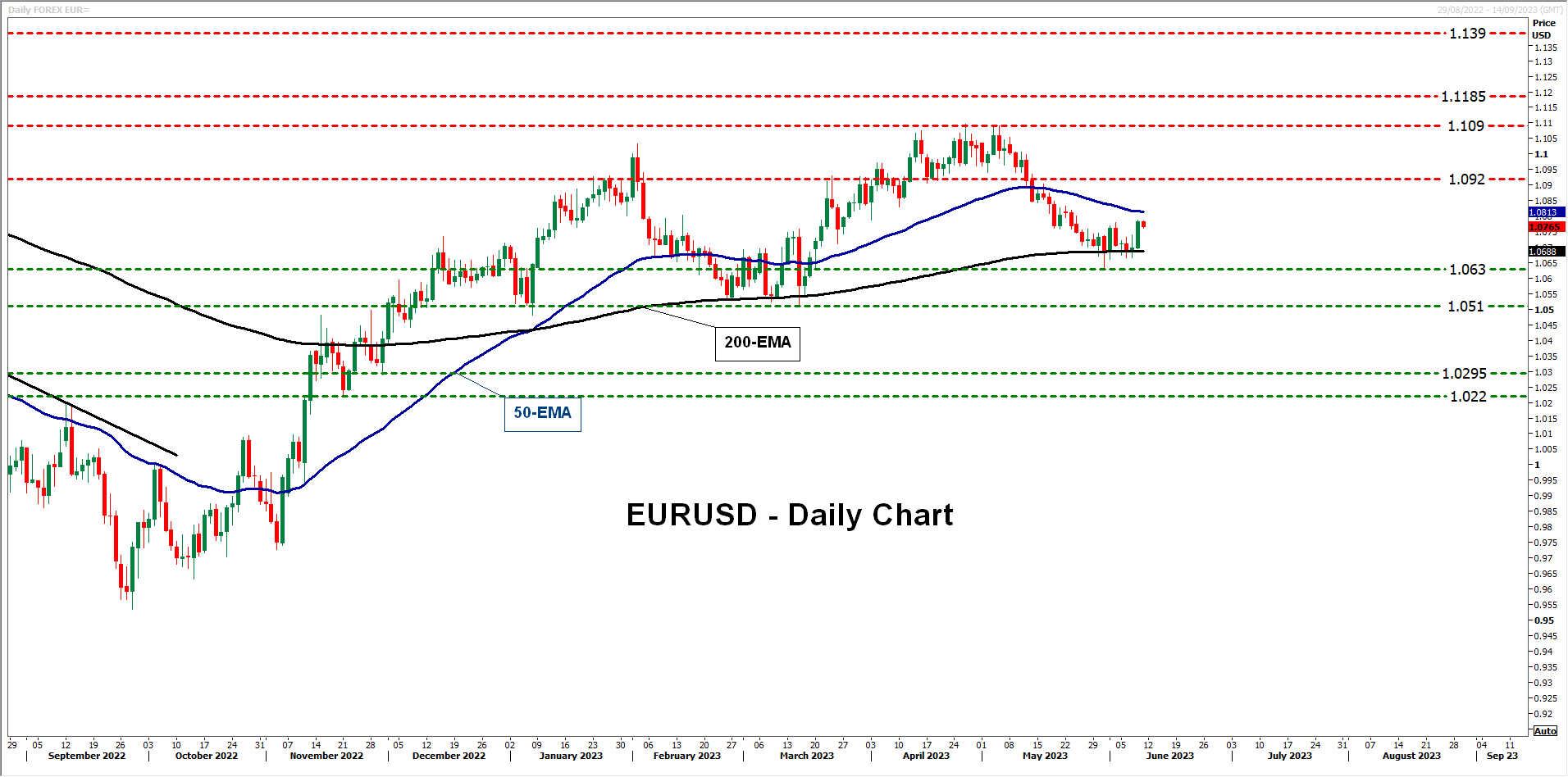
For a bearish reversal to start being examined, the pair may need to fall below the key zone of 1.0510, which offered strong support between January and March. Something like that could set the stage for declines all the way down to the 1.0295 area, marked by the low of November 30.
On the other hand, a dovish decision could result in advances, but for the picture to be painted with bullish colors, euro/dollar may need to overcome the key resistance zone of 1.1090. If at some point in the not-too-distant future this happens, the bulls may challenge the 1.1185 area, the break of which could carry extensions towards the high of February 21, 2022, at 1.1390.
Week Ahead – Fed, ECB, and BoJ Meet after US Inflation Report
A bombshell week is coming up, featuring rate decisions in the United States, Eurozone, and Japan. The Fed is likely to ‘pause’ according to market pricing, but the decision might ultimately depend on the inflation stats that will be released the previous day, fueling volatility in the dollar. By contrast, there isn’t much scope for surprises in Europe or Japan, leaving those currencies mostly in the hands of other forces.
Split Fed decision?
It will be a difficult decision for Fed officials on Wednesday. By most indications, the US economy is in good shape. The labor market is firing on all cylinders, economic growth is on track to hit 2% this quarter, the housing sector has staged a recovery, and the resilience in demand means that core inflation continues to burn hot.
Hence, the economic data pulse argues for another rate increase next week, although some Fed officials have expressed caution. Led by Chairman Powell, there is a large group within the FOMC that favors “skipping” a rate increase this month, effectively postponing the decision until July.
One of the main elements behind this ‘take it slow’ approach is that the Fed has already raised rates by 5% since last year. The full impact of all this tightening hasn’t been felt yet, and unleashing even more could inflict unnecessary damage on the US economy. Hence, several Fed officials would like some extra time to examine incoming data.
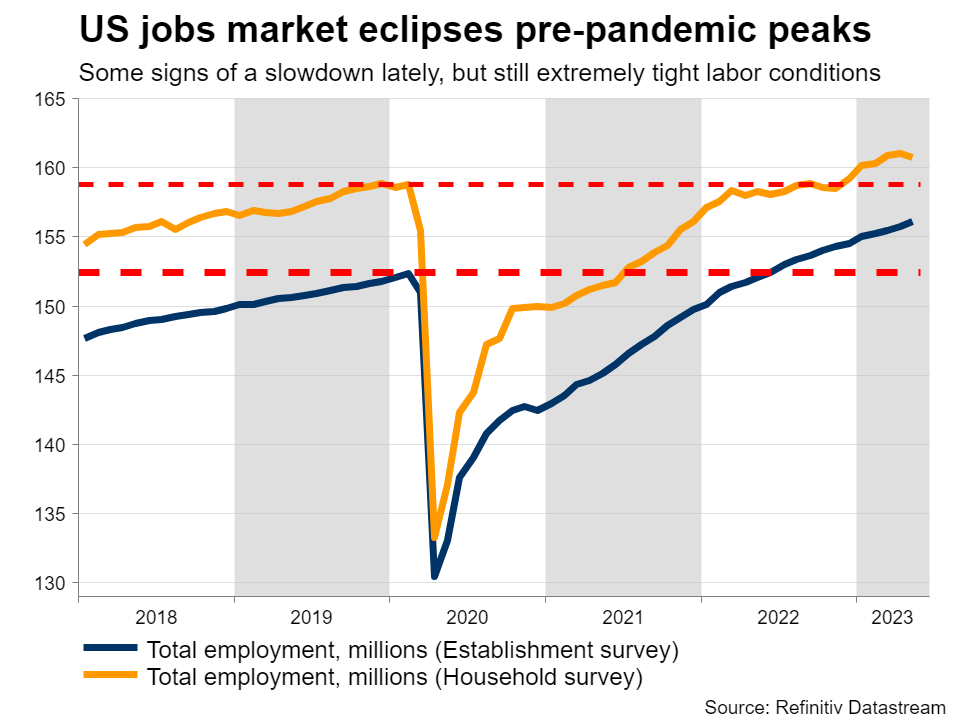
The sharp slowdown in the manufacturing sector has amplified these concerns. Manufacturing is usually seen as a leading recession indicator, so this is worrisome. But in this case, the manufacturing weakness might reflect a hangover following the pandemic boom, as consumption globally switches from goods towards services. As such, it doesn’t seem too scary.
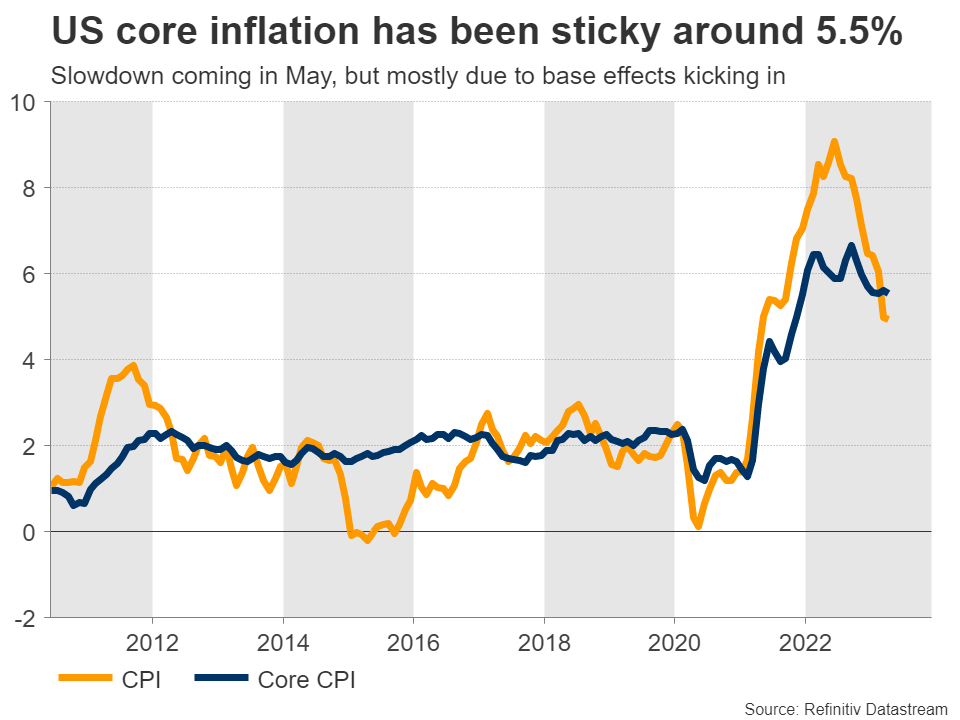
Markets currently assign a 25% probability for a rate increase next week, which increases to 80% for the July meeting. What might influence these percentages though, and the Fed decision itself, is the CPI inflation report on Tuesday.
Both headline and core inflation are likely to have cooled in May on a yearly basis. Yet, that’s mostly mechanical, as some very hot prints from last year will be dropping out of the 12-month calculation. In other words, this is probably a story of base effects, not an ‘organic’ cooldown in inflationary pressures.
As for the Fed decision, it might be a split affair, with a few officials voting for a rate increase but most of them voting for no action. The camp that favors a ‘pause’ is larger and more influential, so that’s the most likely endgame.
Such an outcome might hurt the dollar initially, although whether any weakness persists will depend on the rate projections in the new ‘dot plot’ and Powell’s commentary. If he keeps the door wide open for July, the dollar could bounce back quickly.
In other releases, producer prices for May are due out Wednesday ahead of the Fed decision, while retail sales for the same month are out Thursday.
ECB set to hike despite technical recession
Over in the euro area, the main event will be the European Central Bank meeting on Thursday, where markets have fully priced in a 25bps rate increase. Therefore, the euro’s reaction will depend mostly on any messages about future moves, not the rate hike itself.
The Eurozone economy has fallen into a technical recession according to the latest revised GDP figures, as the troubles in the manufacturing sector left their marks on Germany. Meanwhile, inflation finally seems to be cooling, something reflected in the latest CPI data.
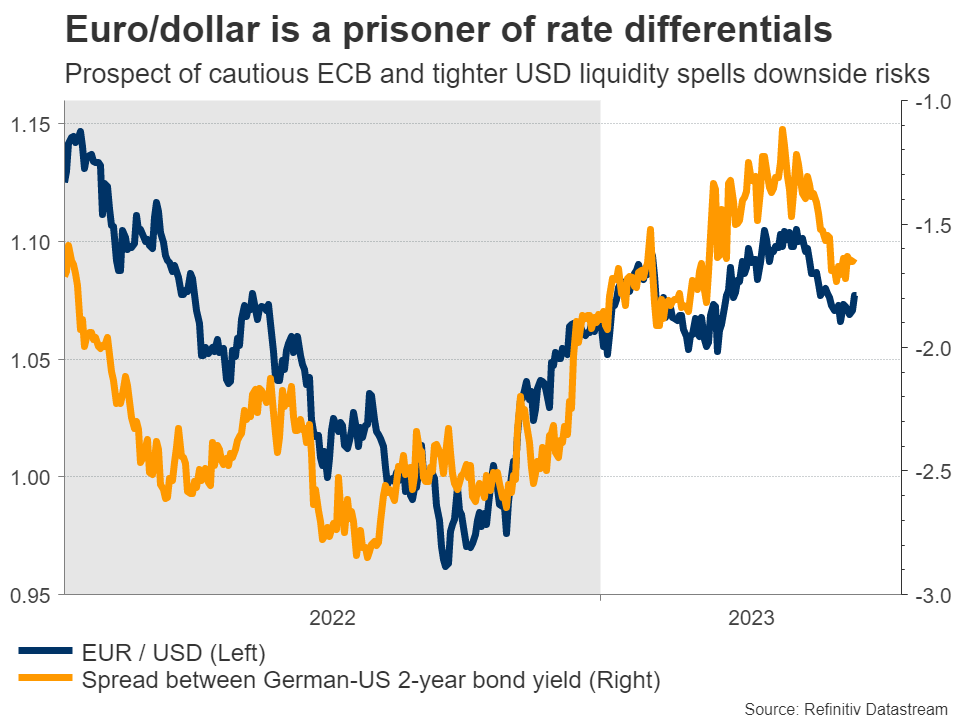
With economic growth rolling over and inflation moderating, it’s likely that the ECB will preach caution and patience. The economy is already contracting and the last thing the central bank wants is to pour gasoline on the recessionary fire.
Market pricing suggests another rate hike is in the pipeline for July, but under these circumstances, the ECB is unlikely to validate that. Officials probably want to keep their options open, and if they signal that they could ‘take a break’ next month, that might come as a disappointment for the euro.
BoJ to bide its time
Wrapping up the week will be the Bank of Japan on Friday. Looking at economic data alone, it’s tempting to speculate that some tightening is warranted. Economic growth turned positive in Q1, inflation is near its highest levels in three decades, and the outlook for wage growth has brightened after the results of the spring wage negotiations.
However, the BoJ is not convinced this is sustainable. Governor Ueda has warned that inflation would likely cool off later this year and that it’s doubtful whether the victories on the wage front will persist. Additionally, the BoJ is concerned about a global slowdown that inflicts collateral damage on Japan.
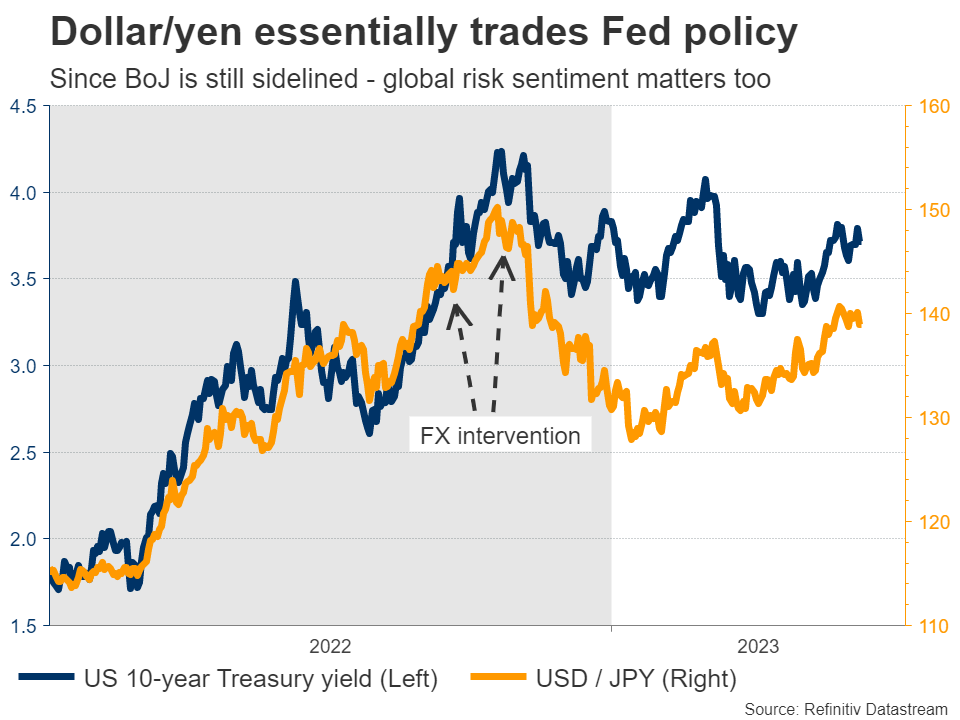
It’s essentially a game of patience. The BoJ wants credible evidence that inflation will remain sustainably above 2% before it phases out its massive stimulus, so any policy tweaks might take some time. Simply waiting until July would allow policymakers to access new economic forecasts, which makes that meeting a more realistic candidate for any tightening decisions.
This means that for now, the yen is mostly at the mercy of external forces, namely how foreign central banks act and how global risk sentiment evolves, given its status as a safe haven.
British and Chinese data releases
Elsewhere, it will be a busy week in terms of economic data, starting with monthly GDP data from the UK on Wednesday. Then on Thursday, there will be a deluge of releases from China that include retail sales and industrial production.
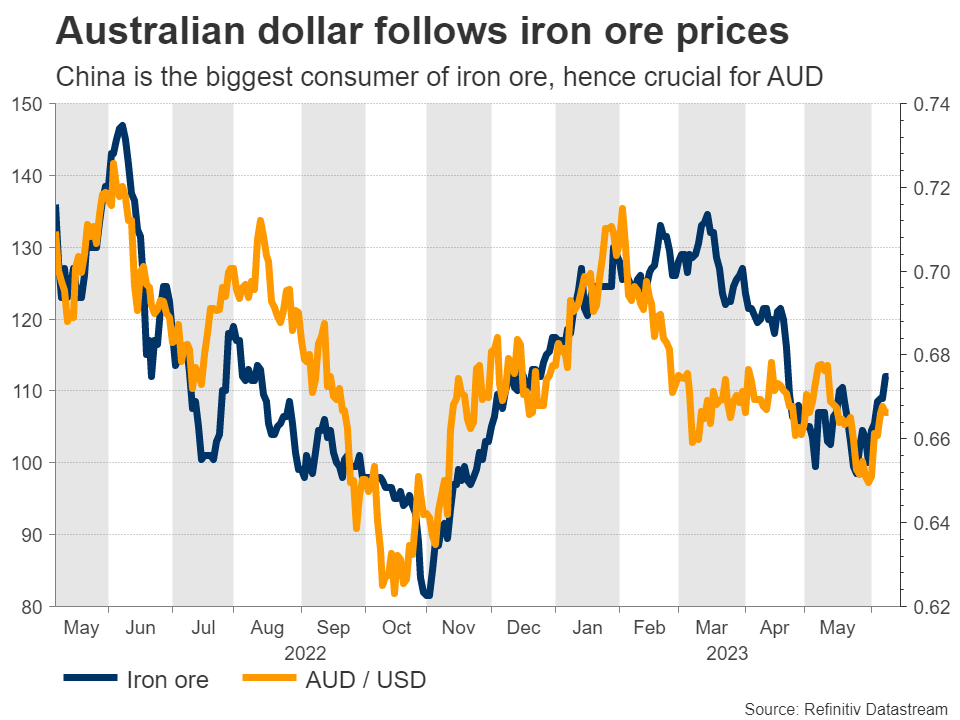
Amid signs that the Chinese economy is losing steam as the manufacturing downturn deepens, these figures will be closely watched and could impact commodity-linked currencies like the Australian and New Zealand dollars.
Those economies will also be on the receiving end of crucial data, with Australia’s monthly jobs report and New Zealand’s quarterly GDP numbers both hitting the markets on Thursday as well.
Weekly Focus – ECB Hike Coming Up, What About the Fed?
We are entering a big central bank week, with rate decisions from the US Federal Reserve, the European Central Bank and the Bank of Japan. It seems highly likely that the ECB will deliver another 25bp rate hike, but the Fed outlook is a bit more uncertain. We expect that this will be the first FOMC meeting since January 2022 where there is no rate hike, but market pricing is not ruling out a hike on Wednesday.
Central banks in both Australia and Canada hiked rates in the past week, with Canada's hike being especially surprising. It was the first increase in the country's overnight rate since January, taking it to its highest level in 22 years and sending market rates higher also in the US and Europe.
In the US, the job report for May was clearly stronger than expected in terms of payroll growth, but also showed increasing slack in the labour market from an increasing work force and slowing wage growth. Also, jobless claims were higher than expected this week. In our view, the Fed can afford to pause rate hikes now. Just before the decision next week, we will get the CPI for June, where we can see monthly inflation decline to just 0.2%, also reducing the need for further hikes. Apart from the rate decision, we will also get projections from FOMC members, and there is chance that they will point towards a hike in July.
The ECB has quite clearly signalled that there will be a 25bp rate hike on Thursday which is also fully priced by markets, and an end to APP reinvestment from July. We will get new staff projections and policy signals at the meeting. With the current market mood focusing on signs of decreasing inflation, the market could react strongly on dovish signals from the ECB, while hawkish tones are more likely to be ignored. In the hawkish direction, though, new data show a 5.2% y/y increase in wages in Q1 measured as compensation per employee, the ECB's preferred measure.
We expect the Bank of Japan to tweak the yield curve control at one of the upcoming meetings. Widening of the yield curve control band to e.g. +/-100bps can be explained as a move to improve market functioning, but will essentially be tightening. We still deem it most likely that the BoJ will stay put at the Friday meeting, though.
In China, producer prices declined 4.6% y/y, the biggest decline since 2016. This puts further downwards pressure on consumer prices, which are barely increasing in China and it is possible that we will get more central bank easing. Credit data will be out during the coming week and could be key to watch.
The Turkish lira weakened significantly this week as local banks stopped intervening. Hopes are building up that Erdogan's newly appointed economic team would soon take steps towards normalizing policies. This week's move in the lira can perhaps be seen as an 'intentional devaluation' as opposed to a full loosening of controls. In the absence of interventions, we think there is still room for significant lira depreciation until the central bank credibility is restored and we see interest rate hikes.
USD/CAD: Canadian Dollar Keeps Firm Tone Despite Downbeat Canada’s Labor Data
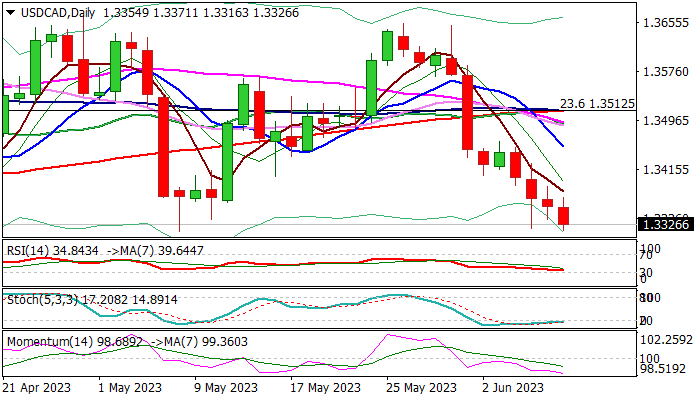
The USDCAD continues to trend lower and on track for the second straight big weekly loss, as Canadian dollar received fresh boost from unexpected BOC rate hike earlier this week and renewed hawkish stance, which suggests that further tightening is likely, as the central bank estimates that recent measures were not enough efficient to curb high inflation.
Bears were interrupted by negative Canada’s May labor report, released today and showing higher than expected rise in a number of jobless, while employment slumped by 17.3K in May after adding 41.4K new jobs previous month and strongly missed expectations for 23.2K rise.
However, downbeat labor data so far showed limited negative impact on CAD and likely to be insufficient to stronger counter very positive signals from BOC, as policymakers expected inflation to remain elevated and well above 2%, which will likely require further action from the central bank, as markets fully price for another 25 basis points hike in July.
Daily studies show strong rise in negative momentum and MA’s in bearish setup fueling bears, though a number of solid supports within 1.3315/1.3225 zone is expected to produce headwinds, along with oversold daily studies and probably slow bears in coming sessions.
Larger bears are expected to remain in play as long as upticks stay capped under 1.3440 zone.
Next week’s key events (US inflation/Fed rate decision) are expected to provide fresh signals.
Res: 1.3371; 1.3396; 1.3445; 1.3484.
Sup: 1.3320; 1.3301; 1.3262; 1.3225.
USD/CAD – Canadian Dollar Extends Gains Despite Weak Job Data
- Canada’s economy sheds 17K jobs, unemployment rate climbs
- US dollar under pressure after unemployment claims jump
- Canadian dollar rallies for a third straight day
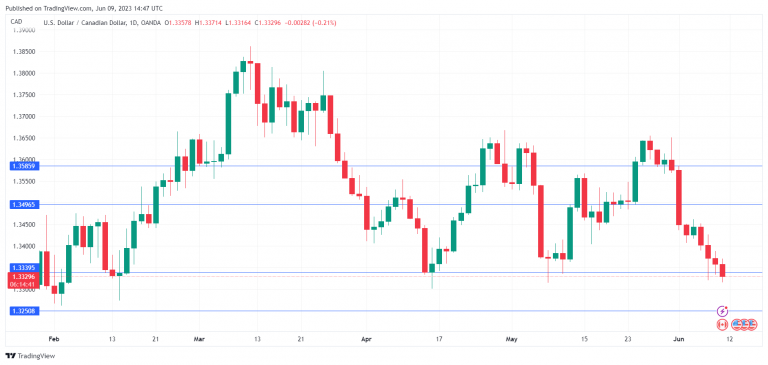
The Canadian dollar continues to rally. USD/CAD is trading at 1.3328 in the North American session, down 0.22% on the day.
Canada’s labour market softens
The week wrapped up with Canada’s May employment report, which usually is released at the same time as the US job data, but had the spotlight to itself today. The data was a disappointment. Canada’s economy shed 17,300 jobs, all of which were full-time positions. This followed an increase of 41,400 in April and missed the consensus of a gain of 23,200. The unemployment rate rose from 5.0% to 5.2%, the first rise since August 2022.
The weak job numbers could signal softness in the labour market, which would have major ramifications for the Bank of Canada’s rate path. The Canadian dollar lost 40 points in the aftermath of the release but quickly recovered these losses. We could see more movement from USD/CAD on Monday as the markets digest these numbers.
US dollar beats a retreat after jobless claims rise
The US labour market has shown resilience, as we saw last week with a red-hot nonfarm payroll report. Still, some cracks have appeared, such as the jump in the unemployment rate and a low participation rate. The markets are looking for signs that the labour market is cooling off and jumped all over unemployment claims, which surprised on the upside at 261,000, up from 233,000 a week earlier. A spike in one weekly report isn’t all that significant, but the timing of the release close to the Fed meeting may make a Fed pause more likely, and that has sent the US dollar lower against its major rivals.
Bank of Canada delivers a rate hike
Central banks continue to wrestle with high inflation, which has remained stubbornly high despite aggressive rate tightening. This week alone, the Reserve Bank of Australia and the Bank of Canada raised rates by 0.25%, surprising the markets which had expected a pause. The BoC has made clear that its “conditional pause” stance would be data-dependent and perhaps the markets should have paid more attention to the uptick in April inflation and strong GDP growth in the first quarter. The BoC highlighted both of these indicators in its rate statement as factors in its decision to hike rates, and the central bank will be keeping a close eye on economic growth and inflation ahead of the July meeting.
USD/CAD Technical
- USD/CAD is testing support at 1.3339. Below, there is support at 1.3250
- 1.3496 and 1.3585 are the next resistance lines
Sunset Market Commentary
Markets
US core bond yields recovered from what we consider an outsized market reaction to yesterday’s disappointing US weekly jobless claims. In a technical trading session stripped of any important data, US yields rise between 1.9 and 4.9 bps with the front underperforming, the Canadian payrolls (see below) only temporarily interrupting the move higher. German Bunds outperform US Treasuries though they did miss out partially on the core bond rally yesterday. Yields add 0.5-1.7 bps at the front while shedding 1.2-2.4 bps further out. Equity sentiment is fragile with the EuroStoxx50 shedding 0.2% after touching the upper bound of the downward sloping short-term trend channel. Wall Street opens with minor gains. The Norwegian crown on currency markets ends the week on a strong note following above-consensus inflation numbers (cf. infra). Its bigger brother, the SEK, could sure use some relief as well with EUR/SEK hovering near a 14-year low. Next week’s Swedish inflation numbers may perhaps do the (same) trick. The Canadian loonie forfeited earlier gains after the job numbers but manages to eke out a tiny gain still. Other majors including the US dollar and euro trade directionless. The Japanese yen is feeling some selling pressure. USD/JPY trades in the mid 139-area and EUR/JPY is testing the 150 barrier. Bloomberg cited officials as saying there’s little need to adjust the yield curve programme at the meeting next week. They recognize inflation is running stronger than expected but aren’t confident enough to say the 2% target is in sight. It does raise chances for some tweaks at the July meeting, when the BoJ is to deliver new quarterly forecasts. Other key events next week obviously include the ECB and Fed meeting. Both will bring updated projections. The former is sure to raise rates further, to strongly hint at another move in July while keeping a data-dependent approach for moves further out (including September). The Fed will probably skip hiking but we expect its updated dot plot to show higher policy rates than the current 5-5.25%. Reasons to do so include ongoing tightness on the labour market, economic resilience, an already bottoming out housing market and (core) inflation stalling at elevated levels. Regarding the latter, the Fed at day one of its two-day meeting gets the May CPI figure served.
News & Views
Consumer prices in Norway in May again printed substantially higher than expected. Headline inflation rose 0.5% M/M and 6.7% Y/Y (6.4% in April). Core CPI-ATE (adjusted for tax changes and ex. energy) jumped 0.7% M/M, raising the Y/Y measure to 6.7%, the highest on record. The rise was broad-based across sub-categories of the basket, with biggest monthly increases registered for food and non-alcoholic beverages (2.3%), clothing and footwear (2.1%), hotels and restaurants (0.9%) and health (0.5%). The May CPI also widely surpassed expectations of the Norges Bank (NB). In its latest monetary policy report (March) the NB saw May CPI-ATE inflation at 6.0%. Early May, the NB raised its policy rate by 25 bps to 3.25%. It flagged another step at the June meeting with according to the projections in the March report could be the cycle top (3.5%). However, NB in May already mentioned the risk that further tightening might be needed if, amongst others, the krone remains weak. Today’s data suggest that the policy rate might be raised to or even beyond 4%. The NB will published new forecasts at the June 22 meeting. The krone anticipates additional interest support rebounding from the EUR/NOK 11.76 area to 11.61 currently.
The May Canada Labour Market report was softer than expected. Net employment growth turned negative (-17.3K) to be compared with 41.4k jobs created in April. The decline was due to a loss in the services sector (-40.1k). Employment in goods producing sectors grew by 22.8k. It was the first negative job growth figure in 9 months. The number of unemployed rose by 34.8k. The unemployment rate rose from 5.0.% to 5.2%. The participation rate eased from 65.6% to 65.5%. Average hourly wage growth of permanent workers slowed to 5.1% from 5.2%. The softer data come in the wake of the Bank of Canada this week restarting its hiking cycle (+ 25 bps to 4.75%) on stronger than expected growth, a tight labour market and persist (core) price pressures. Canadian bonds outperform after the data with the 2-ycurrently ceding 4.0 bps. The report also slightly eased market expectations on further BoC rate hikes. However an additional 25 bps tightening is still discounted for the September meeting. The loonie is losing modest ground with CAD/USD rising from 1.332 to 1.335. This compared to a close of 1.3425 end last week.
Canada’s Labour Market Sheds Jobs in May
The Canadian labour market shed 17.3k positions in May, with full-time employment down 32.7k and part-time employment up 15.5k.
The unemployment rate rose 0.2 percentage points to 5.2% and the participation rate dropped 0.1 percentage point to 65.5%.
Employment declined in business, building and other support services (-31k) and in professional, scientific and technical services (-13k). On the positive side, employment rose in manufacturing (+13k), other services (+11k), and utilities (+4k).
Lastly, total hours worked were down 0.4% month-on-month and wages were up 5.1% year-on-year (vs 5.2% in April).
Key Implications
Today's negative print ends a streak of eight months of job gains. While most of the job losses were concentrated in the younger age cohort (15-24 year-olds), the drop in full-time jobs and reduction in hours worked point to weakness under the hood. The question is now: Is this a one off or the start of a trend? The labour market had been defying gravity for months and was bound for some giveback. Our forecast implies that the massive job gains of prior months are behind us, causing the unemployment rate to rise towards 6% by the end of this year.
The Bank of Canada couldn't have seen this coming when it decided to surprise markets with a 25 basis point rate hike on Wednesday. It decided to hike because economic/labour market growth was exhibiting stronger momentum than the Bank was anticipating. While one weak labour market report doesn't make a trend, the BoC will be closely watching to see if other cracks start to form.
EUR/USD Mid-Day Outlook
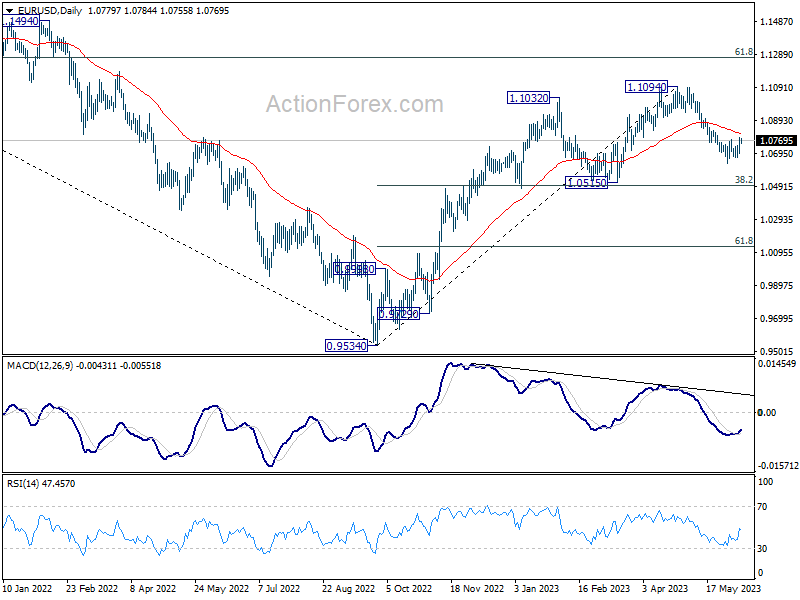
Daily Pivots: (S1) 1.0724; (P) 1.0755; (R1) 1.0815; More...
Intraday bias in EUR/USD remains mildly on the upside at this point. Rebound from 1.0634 is in progress. Sustained trading above 55 EMA (now at 1.0813) will pave the way back to retest 1.1094 high. Nevertheless, break of 1.0700 minor support should resume the fall from 1.1094 through 1.0634 support.
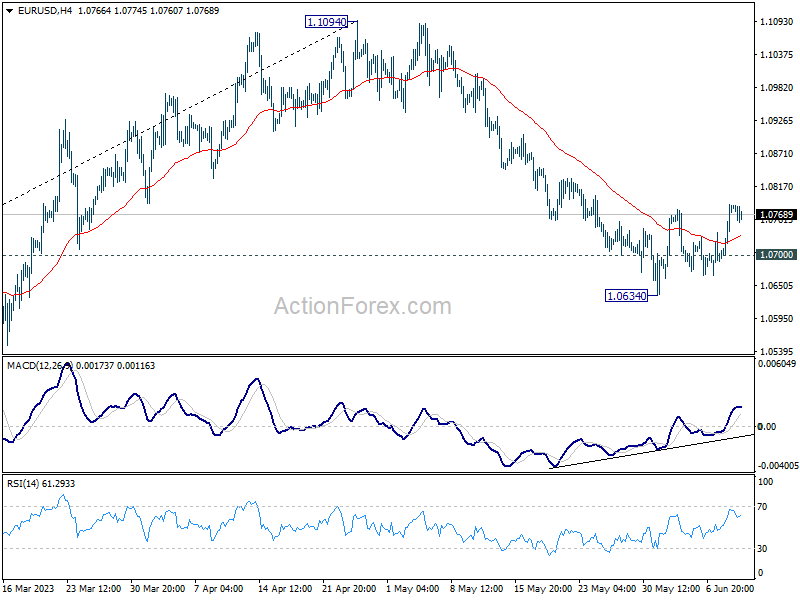
In the bigger picture, as long as 1.0515 support holds, rise from 0.9534 (2022 low) would still extend higher. Sustained break of 61.8% retracement of 1.2348 (2021 high) to 0.9534 at 1.1273 will solidify the case of bullish trend reversal and target 1.2348 resistance next (2021 high).
GBP/USD Mid-Day Outlook
Daily Pivots: (S1) 1.2475; (P) 1.2518; (R1) 1.2603; More...
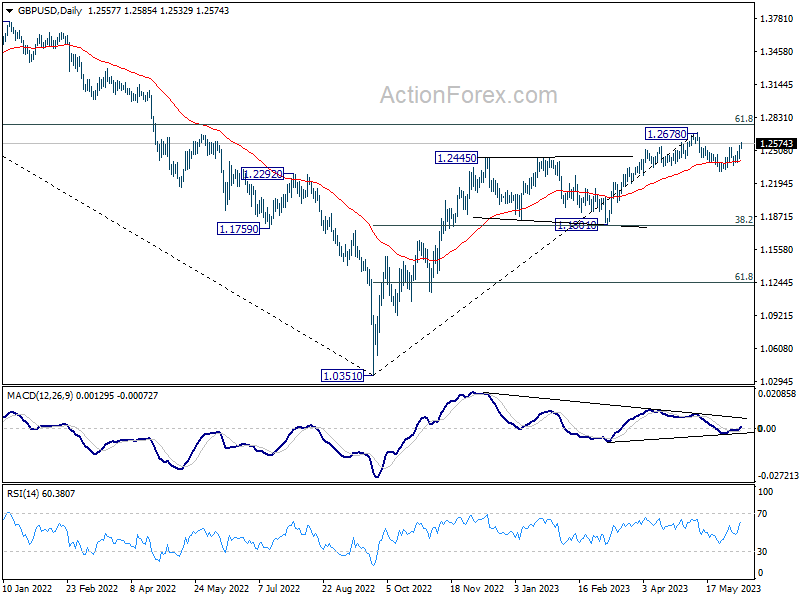
Intraday bias in GBP/USD remains mildly on the upside for the moment. Rebound from 1.2306 is in progress for retesting 1.2678 high. However, break of 1.2452 minor support will turn bias back to the downside, to extend the pattern from 1.2678 with another falling leg through 1.2306 support.
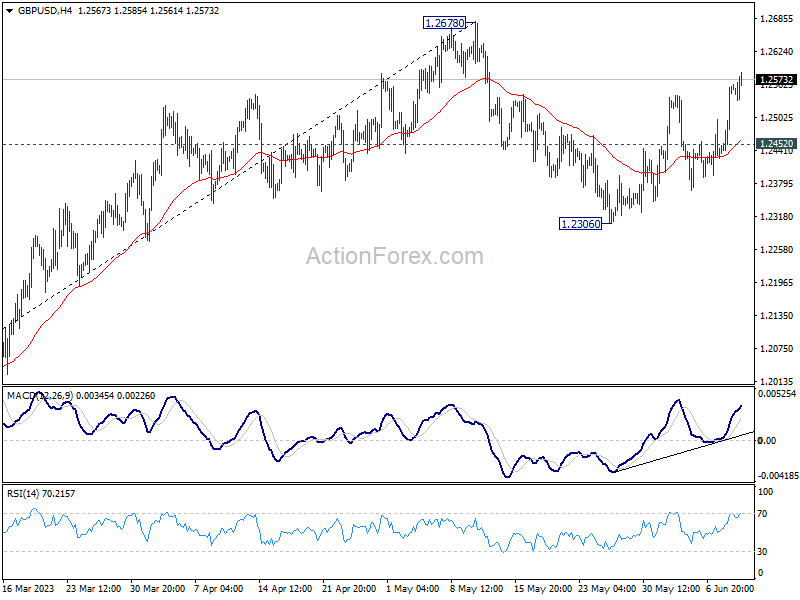
In the bigger picture, as long as 1.1801 support holds, rise from 1.0351 medium term bottom (2022 low) is expected to extend further. Sustained break of 61.8% retracement of 1.4248 (2021 high) to 1.0351 at 1.2759 will add to the case of long term bullish trend reversal. However, firm break of 1.1801 will indicate rejection by 1.2759, and bring deeper decline, even as a correction.