

Sample Category Title
EUR/JPY Weekly Outlook
EUR/JPY was bounded in range trading last week. Initial bias stays neutral this week first. On the downside, below 148.58 will extend the corrective pattern from 151.60 with another falling leg. Deeper fall would be seen to 146.12 support and possibly below. On the upside, however, above 151.05 will target 151.60 high. Firm break there will resume larger up trend to 153.64 projection level.
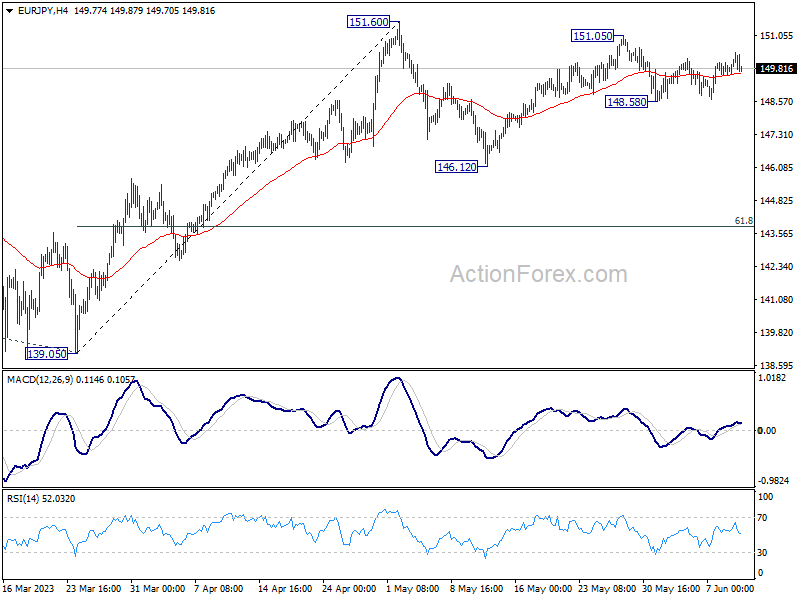
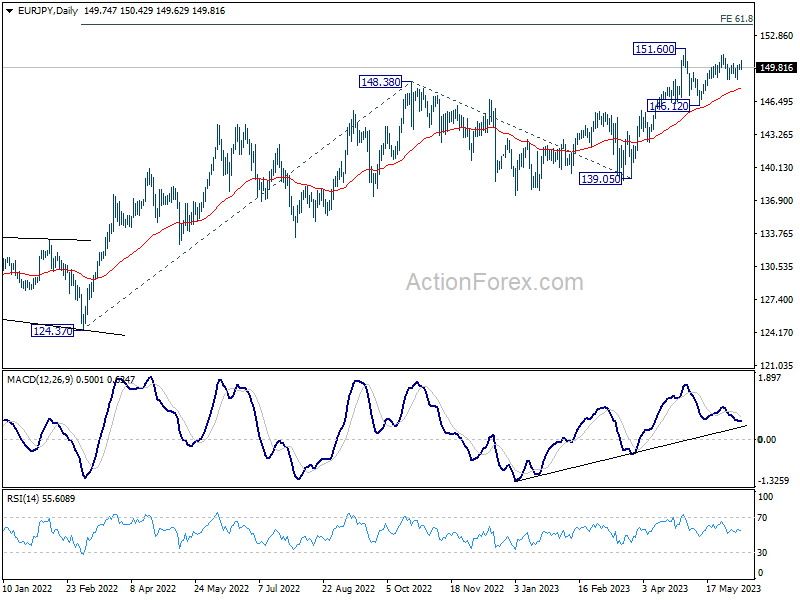
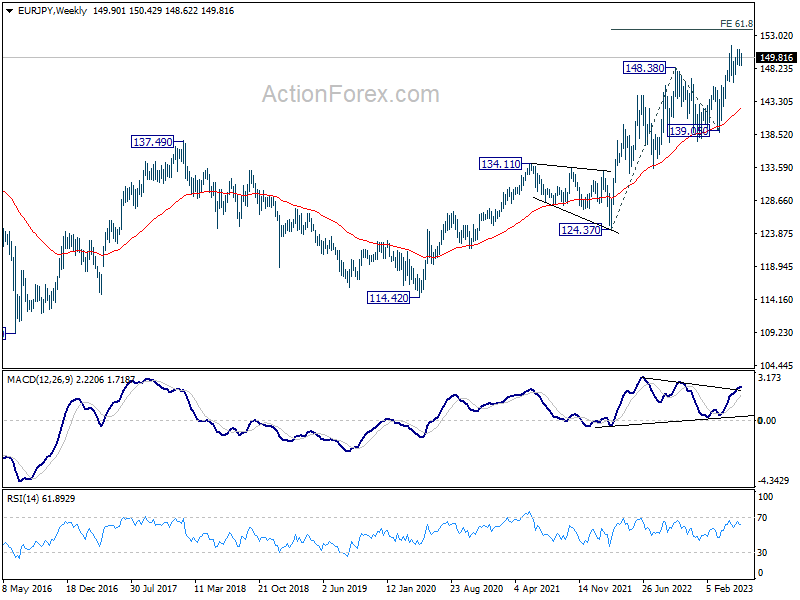
In the bigger picture, rise from 114.42 (2020 low) is in progress. Next target is 61.8% projection of 124.37 to 148.38 from 138.81 at 153.64. Sustained break there will pave the way to 100% projection at 162.82. For now, medium term outlook will remain bullish as long as 139.05 support holds, even in case of deep pull back.
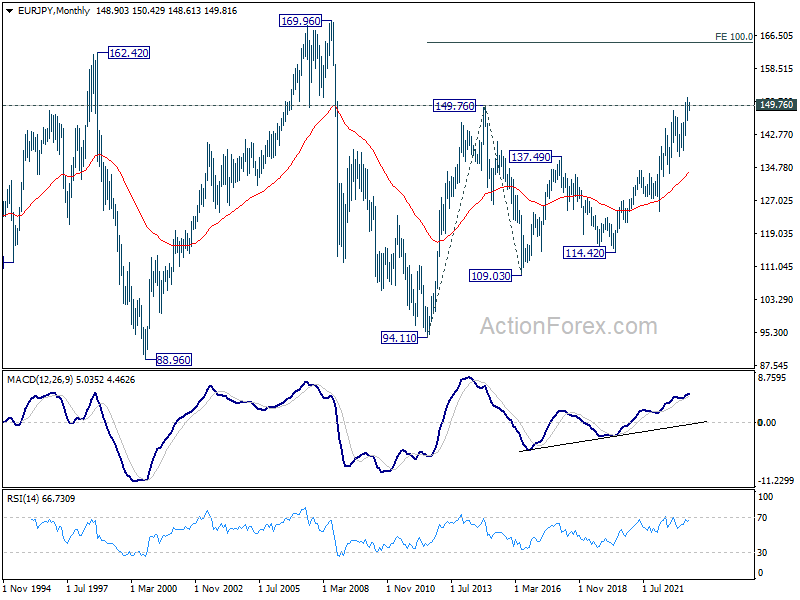
In the long term picture, break of 149.76 (2014 high) argues that whole up trend form 94.11 (2012 low) is resuming. Sustained trading above 149.76 will pave the way to 100% projection of 94.11 to 149.76 from 109.03 at 164.68, which is close to 169.96 (2008 high).
EUR/GBP Weekly Outlook
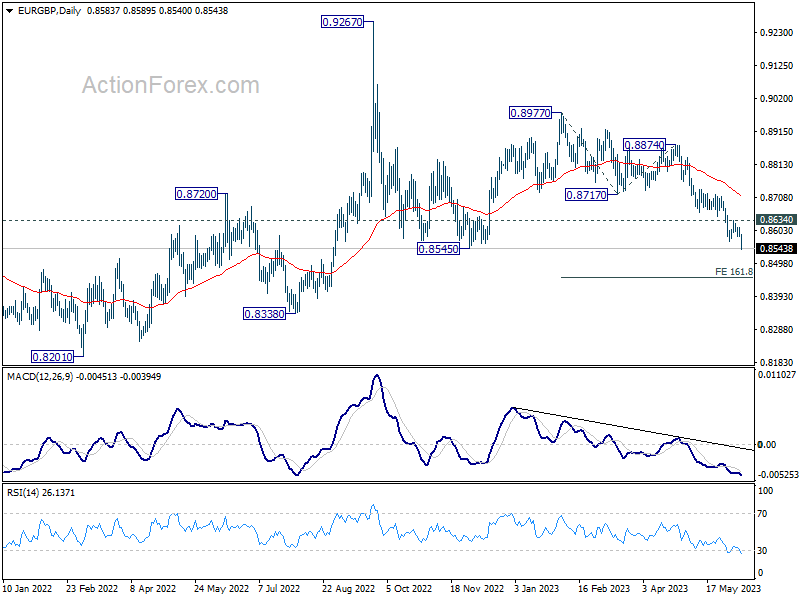
EUR/GBP's fall from 0.8977 continued last week and the close below 0.8545 support should confirm resumption of whole down trend from 0.9267. Intraday bias stays on the downside this week. Next target is 161.8% projection of 0.8977 to 0.8717 from 0.8874 at 0.8453. On the upside, break of 0.8634 resistance is needed to indicate short term bottoming. Otherwise, outlook will remain bearish in case of recovery.
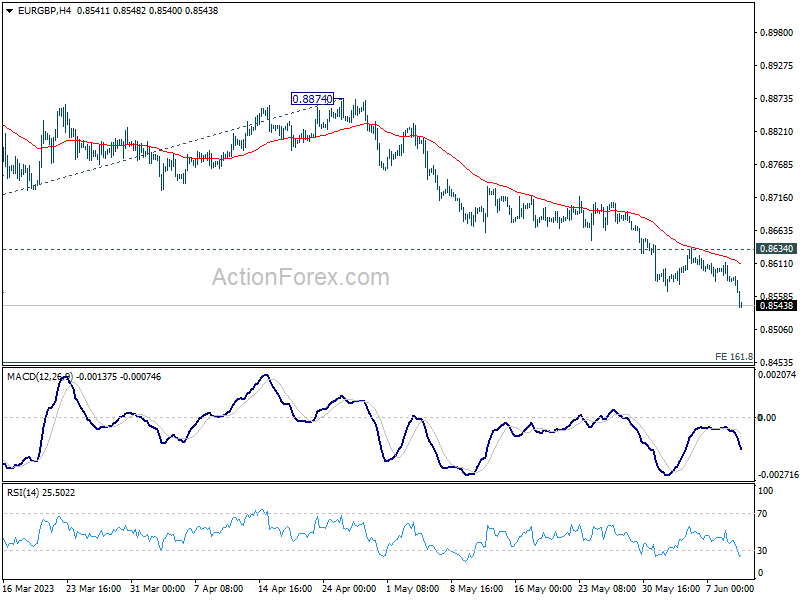
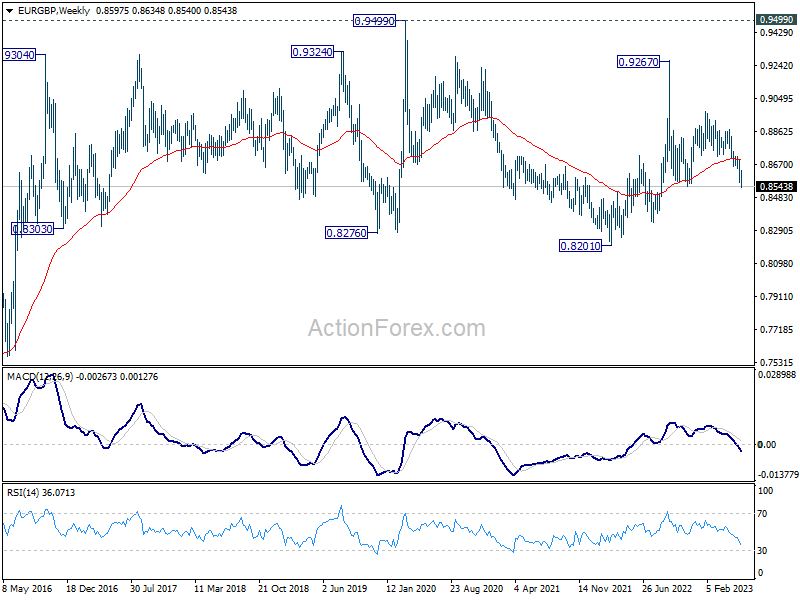
In the bigger picture, the down trend form 0.9267 (2022 high) is still in progress. It's seen as part of the long term range pattern from 0.9499 (2020 high). Deeper fall would be seen towards 0.8201 (2022 low). But strong support should be seen from there to bring reversal. This will now remain the favored case as long as 0.8717 support turned resistance holds.
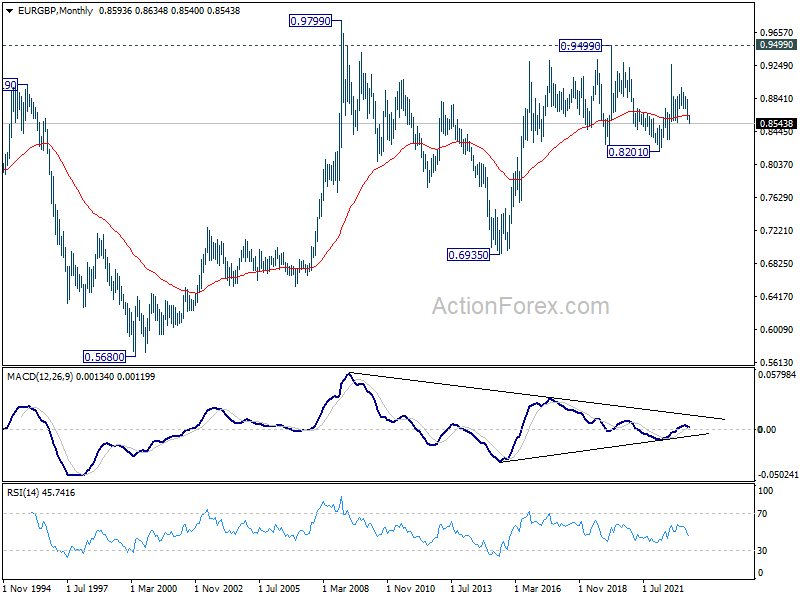
In the long term picture, long term range pattern is extending. But rise from 0.6935 (2015 low) is expected to extend at a later stage, to 0.9799 (2009 high).
EUR/AUD Weekly Outlook
EUR/AUD's fall from 1.6785 resumed last week by powering through 1.6134 support. Initial bias stays on the downside this week for 100% projection of 1.6785 to 1.6134 from 1.6513 at 1.5862. Strong support could be seen around there to bring rebound, at least on first attempt. On the upside, firm break of 1.6134 support turned resistance should confirm short term bottoming and bring stronger rebound.
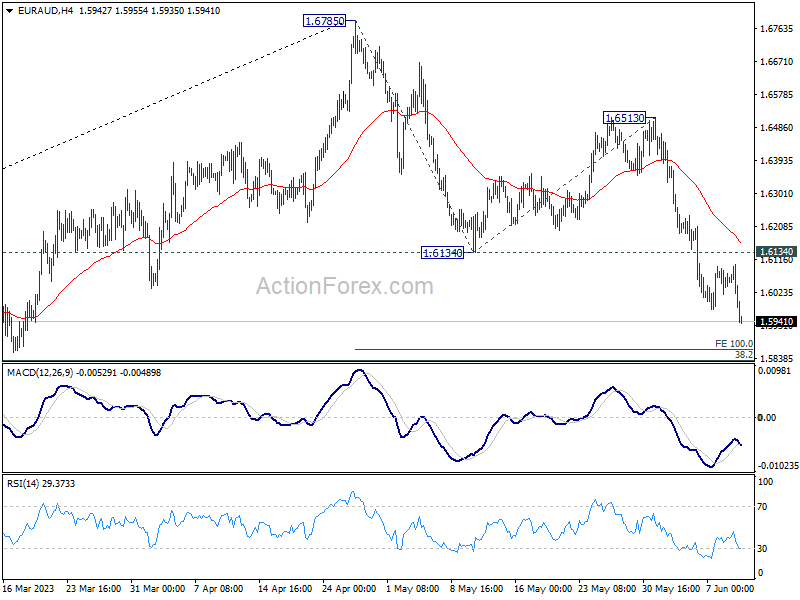
In the bigger picture, a medium term is possibly in place at 1.6785 already, on bearish divergence condition in D MACD. Fall from there is seen as corrective whole up trend from 1.4281 (2022 low). Deeper decline is expected as long as 1.6513 resistance holds, to 38.2% retracement of 1.4281 to 1.6785 at 1.5828. Strong support could be seen there to complete the first leg of the corrective pattern.
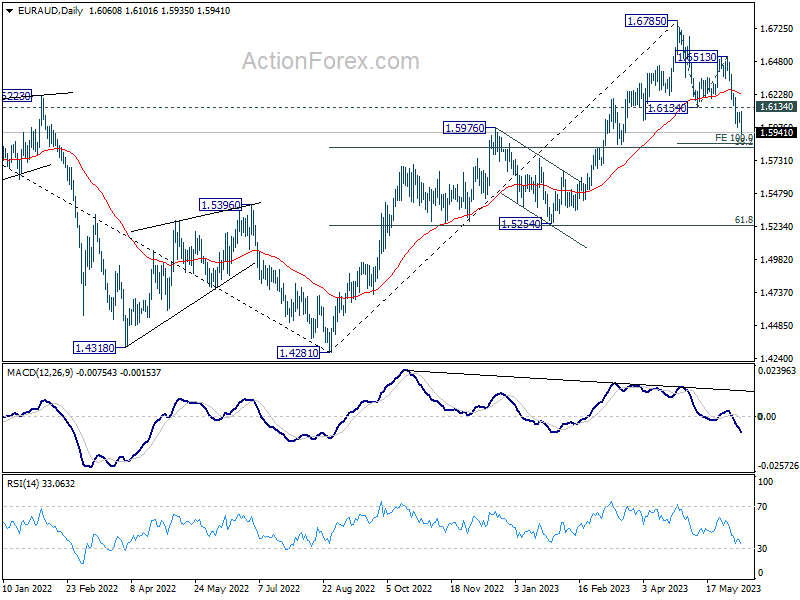
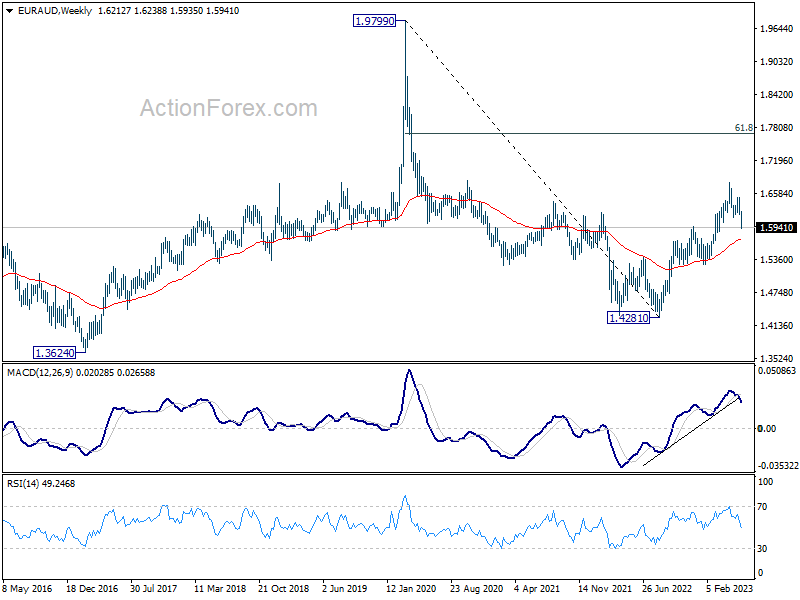
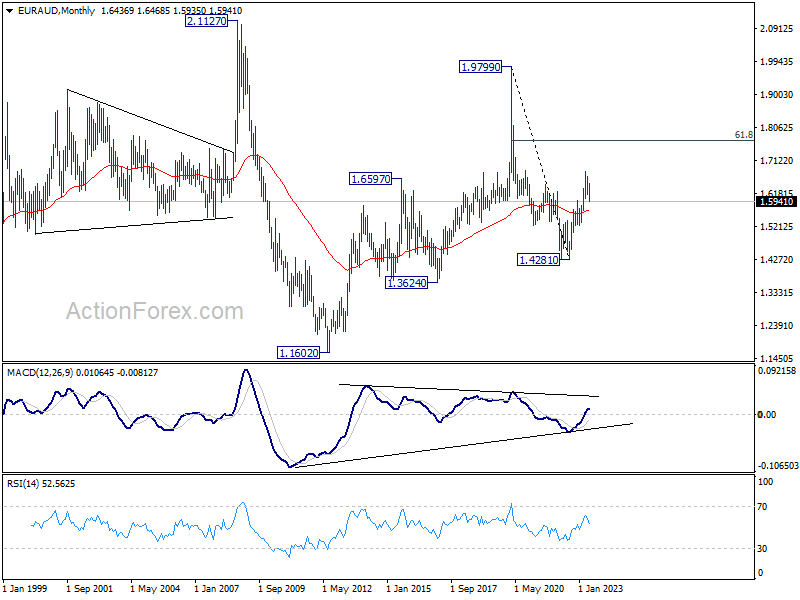
In the longer term picture, it's still early to decide if rise from 1.4281 is resuming whole up trend from 1.1602 (2012 low). But in either case, further rally is in favor as long as 1.5254 support holds. Next target is 61.8% retracement of 1.9799 to 1.4281 at 1.7691.
EUR/CHF Weekly Outlook
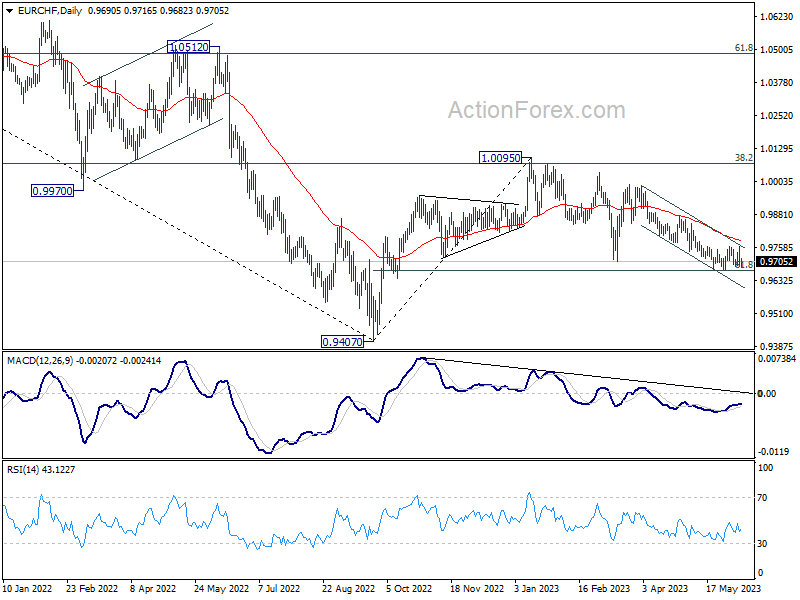
EUR/CHF extended sideway trading above 61.8% retracement of 0.9407 to 1.0095 at 0.9670 last week. Initial bias stays neutral this week first. On the upside, firm break of 0.9760 resistance should confirm short term bottoming, after drawing support from 0.9670. Intraday bias will be turned back to the upside for 0.9878 resistance next. Nevertheless, sustained break of 0.9670 will extend the whole decline from 1.0095 towards 0.9407 low instead.
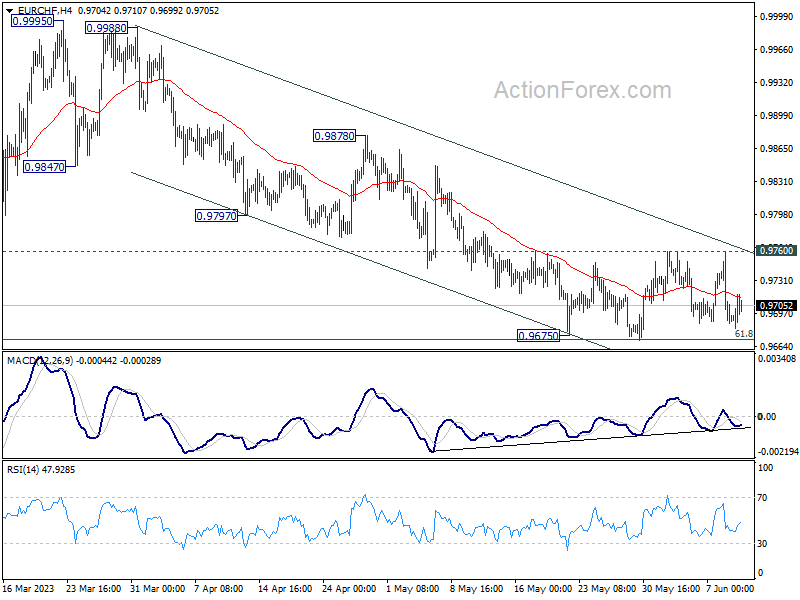
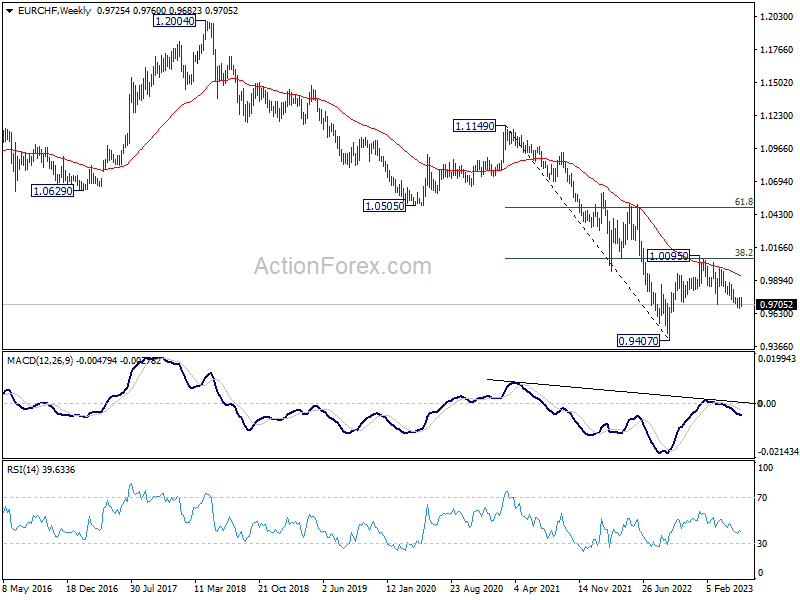
In the bigger picture, prior rejection by 38.2% retracement of 1.1149 to 0.9407 at 1.0072 suggests that medium term outlook is staying bearish. The pair is also capped below 55 W EMA (now at 0.9929). Down trend from 1.2004 (2018 high) is not complete yet and is in favor to resume through 0.9407 at a later stage. However, decisive break of 1.0095 resistance will raise the chance of bullish trend reversal. Rise from 0.9407 should then target 1.0505 cluster resistance (2020 low at 1.0505, 61.8% retracement of 1.1149 to 0.9407 at 1.1484).
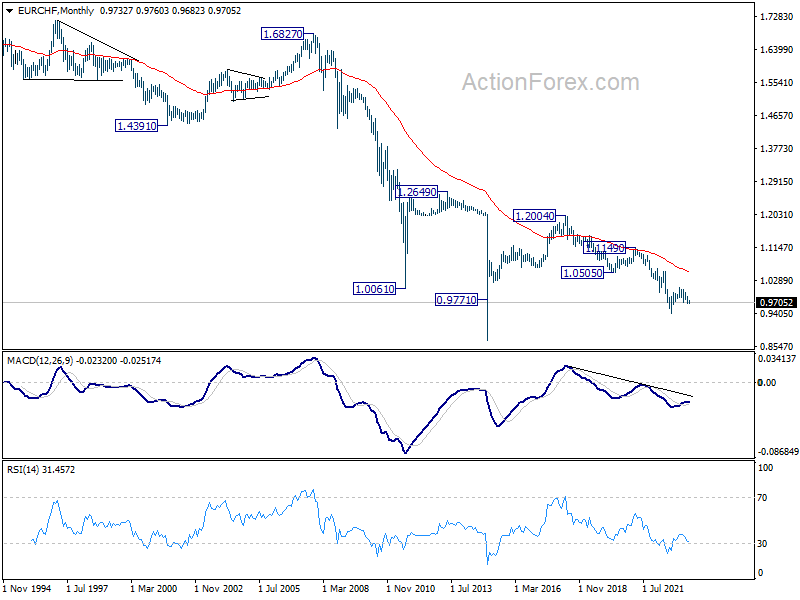
In the long term picture, it's still way too early too call for bullish trend reversal with upside capped well below 55 M EMA (now at 1.0484) and 1.0505 support turned resistance (2020 low). The multi-decade down trend could still continue.
Summary 6/12 – 6/16
Monday, Jun 12, 2023
| GMT | Ccy | Events | Consensus | Previous |
|---|---|---|---|---|
| 23:50 | JPY | PPI Y/Y May | 5.50% | 5.80% |
| 06:00 | JPY | Machine Tool Orders Y/Y May F | -14.40% | |
| 23:50 | JPY | BSI Large Manufacturing Index Q2 | -10.5 |
| GMT | Ccy | Events | |
|---|---|---|---|
| 23:50 | JPY | PPI Y/Y May | |
| Forecast: 5.50% | Previous: 5.80% | ||
| 06:00 | JPY | Machine Tool Orders Y/Y May F | |
| Forecast: | Previous: -14.40% | ||
| 23:50 | JPY | BSI Large Manufacturing Index Q2 | |
| Forecast: | Previous: -10.5 | ||
Tuesday, Jun 13, 2023
| GMT | Ccy | Events | Consensus | Previous |
|---|---|---|---|---|
| 00:30 | AUD | Westpac Consumer Confidence Jun | -7.90% | |
| 01:30 | AUD | NAB Business Conditions May | 14 | |
| 01:30 | AUD | NAB Business Confidence May | 0 | |
| 06:00 | GBP | Claimant Count Change May | 21.4K | 46.7K |
| 06:00 | GBP | ILO Unemployment Rate (3M) Apr | 4.00% | 3.90% |
| 06:00 | GBP | Average Earnings Excluding Bonus 3M/Y Apr | 6.90% | 6.70% |
| 06:00 | GBP | Average Earnings Including Bonus 3M/Y Apr | 6.10% | 5.80% |
| 06:00 | EUR | Germany CPI M/M May F | -0.10% | -0.10% |
| 06:00 | EUR | Germany CPI Y/Y May F | 6.10% | 6.10% |
| 09:00 | EUR | Germany ZEW Economic Sentiment Jun | -14.7 | -10.7 |
| 09:00 | EUR | Germany ZEW Current Situation Jun | -40 | -34.8 |
| 09:00 | EUR | Eurozone ZEW Economic Sentiment Jun | -13.1 | -9.4 |
| 10:00 | USD | NFIB Business Optimism Index May | 88.8 | 89.0 |
| 12:30 | USD | CPI M/M May | 0.30% | 0.40% |
| 12:30 | USD | CPI Y/Y May | 4.20% | 4.90% |
| 12:30 | USD | CPI Core M/M May | 0.40% | 0.40% |
| 12:30 | USD | CPI Core Y/Y May | 5.60% | 5.50% |
| 22:45 | NZD | Current Account Q1 | -6.95B | -9.46B |
| GMT | Ccy | Events | |
|---|---|---|---|
| 00:30 | AUD | Westpac Consumer Confidence Jun | |
| Forecast: | Previous: -7.90% | ||
| 01:30 | AUD | NAB Business Conditions May | |
| Forecast: | Previous: 14 | ||
| 01:30 | AUD | NAB Business Confidence May | |
| Forecast: | Previous: 0 | ||
| 06:00 | GBP | Claimant Count Change May | |
| Forecast: 21.4K | Previous: 46.7K | ||
| 06:00 | GBP | ILO Unemployment Rate (3M) Apr | |
| Forecast: 4.00% | Previous: 3.90% | ||
| 06:00 | GBP | Average Earnings Excluding Bonus 3M/Y Apr | |
| Forecast: 6.90% | Previous: 6.70% | ||
| 06:00 | GBP | Average Earnings Including Bonus 3M/Y Apr | |
| Forecast: 6.10% | Previous: 5.80% | ||
| 06:00 | EUR | Germany CPI M/M May F | |
| Forecast: -0.10% | Previous: -0.10% | ||
| 06:00 | EUR | Germany CPI Y/Y May F | |
| Forecast: 6.10% | Previous: 6.10% | ||
| 09:00 | EUR | Germany ZEW Economic Sentiment Jun | |
| Forecast: -14.7 | Previous: -10.7 | ||
| 09:00 | EUR | Germany ZEW Current Situation Jun | |
| Forecast: -40 | Previous: -34.8 | ||
| 09:00 | EUR | Eurozone ZEW Economic Sentiment Jun | |
| Forecast: -13.1 | Previous: -9.4 | ||
| 10:00 | USD | NFIB Business Optimism Index May | |
| Forecast: 88.8 | Previous: 89.0 | ||
| 12:30 | USD | CPI M/M May | |
| Forecast: 0.30% | Previous: 0.40% | ||
| 12:30 | USD | CPI Y/Y May | |
| Forecast: 4.20% | Previous: 4.90% | ||
| 12:30 | USD | CPI Core M/M May | |
| Forecast: 0.40% | Previous: 0.40% | ||
| 12:30 | USD | CPI Core Y/Y May | |
| Forecast: 5.60% | Previous: 5.50% | ||
| 22:45 | NZD | Current Account Q1 | |
| Forecast: -6.95B | Previous: -9.46B | ||
Wednesday, Jun 14, 2023
| GMT | Ccy | Events | Consensus | Previous |
|---|---|---|---|---|
| 06:00 | GBP | GDP M/M Apr | 0.20% | -0.30% |
| 06:00 | GBP | Industrial Production M/M Apr | -0.10% | 0.70% |
| 06:00 | GBP | Industrial Production Y/Y Apr | -2.60% | -2.00% |
| 06:00 | GBP | Manufacturing Production M/M Apr | -0.10% | 0.70% |
| 06:00 | GBP | Manufacturing Production Y/Y Apr | -1.80% | -1.30% |
| 06:00 | GBP | Goods Trade Balance (GBP) Apr | -16.5B | -16.4B |
| 09:00 | EUR | Eurozone Industrial Production M/M Apr | 1.20% | -4.10% |
| 12:30 | USD | PPI M/M May | 0.20% | 0.20% |
| 12:30 | USD | PPI Y/Y May | 1.10% | 2.30% |
| 12:30 | USD | PPI Core M/M May | 0.20% | 0.20% |
| 12:30 | USD | PPI Core Y/Y May | 0.50% | 3.20% |
| 14:30 | USD | Crude Oil Inventories | -0.5M | |
| 18:00 | USD | Fed Interest Rate Decision | 5.25% | 5.25% |
| 18:30 | USD | FOMC Press Conference | ||
| 21:45 | NZD | GDP Q/Q Q1 | -0.10% | -0.60% |
| 23:50 | JPY | Trade Balance (JPY) May | -0.78T | -1.02T |
| 23:50 | JPY | Machinery Orders M/M Apr | 3.00% | -3.90% |
| GMT | Ccy | Events | |
|---|---|---|---|
| 06:00 | GBP | GDP M/M Apr | |
| Forecast: 0.20% | Previous: -0.30% | ||
| 06:00 | GBP | Industrial Production M/M Apr | |
| Forecast: -0.10% | Previous: 0.70% | ||
| 06:00 | GBP | Industrial Production Y/Y Apr | |
| Forecast: -2.60% | Previous: -2.00% | ||
| 06:00 | GBP | Manufacturing Production M/M Apr | |
| Forecast: -0.10% | Previous: 0.70% | ||
| 06:00 | GBP | Manufacturing Production Y/Y Apr | |
| Forecast: -1.80% | Previous: -1.30% | ||
| 06:00 | GBP | Goods Trade Balance (GBP) Apr | |
| Forecast: -16.5B | Previous: -16.4B | ||
| 09:00 | EUR | Eurozone Industrial Production M/M Apr | |
| Forecast: 1.20% | Previous: -4.10% | ||
| 12:30 | USD | PPI M/M May | |
| Forecast: 0.20% | Previous: 0.20% | ||
| 12:30 | USD | PPI Y/Y May | |
| Forecast: 1.10% | Previous: 2.30% | ||
| 12:30 | USD | PPI Core M/M May | |
| Forecast: 0.20% | Previous: 0.20% | ||
| 12:30 | USD | PPI Core Y/Y May | |
| Forecast: 0.50% | Previous: 3.20% | ||
| 14:30 | USD | Crude Oil Inventories | |
| Forecast: | Previous: -0.5M | ||
| 18:00 | USD | Fed Interest Rate Decision | |
| Forecast: 5.25% | Previous: 5.25% | ||
| 18:30 | USD | FOMC Press Conference | |
| Forecast: | Previous: | ||
| 21:45 | NZD | GDP Q/Q Q1 | |
| Forecast: -0.10% | Previous: -0.60% | ||
| 23:50 | JPY | Trade Balance (JPY) May | |
| Forecast: -0.78T | Previous: -1.02T | ||
| 23:50 | JPY | Machinery Orders M/M Apr | |
| Forecast: 3.00% | Previous: -3.90% | ||
Thursday, Jun 15, 2023
| GMT | Ccy | Events | Consensus | Previous |
|---|---|---|---|---|
| 01:00 | AUD | Consumer Inflation Expectations Jun | 5.00% | |
| 01:30 | AUD | Employment Change May | 16.5K | -4.3K |
| 01:30 | AUD | Unemployment Rate May | 3.70% | 3.70% |
| 02:00 | CNY | Retail Sales Y/Y May | 13.90% | 18.40% |
| 02:00 | CNY | Industrial Production Y/Y May | 4.10% | 5.60% |
| 02:00 | CNY | Fixed Asset Investment YTD Y/Y May | 4.40% | 4.70% |
| 04:30 | JPY | Tertiary Industry Index M/M Apr | 0.50% | -1.70% |
| 06:30 | CHF | Producer and Import Prices M/M May | 0.10% | 0.20% |
| 06:30 | CHF | Producer and Import Prices Y/Y May | 1.00% | |
| 07:00 | CHF | SECO Economic Forecasts | ||
| 09:00 | EUR | Eurozone Trade Balance (EUR) Apr | 5.7B | 17.0B |
| 12:15 | EUR | ECB Main Refinancing Rate | 4.00% | 3.75% |
| 12:30 | CAD | Manufacturing Sales M/M Apr | 0.70% | |
| 12:30 | USD | Empire State Manufacturing Index Jun | -14.6 | -31.8 |
| 12:30 | USD | Retail Sales M/M May | 0.00% | 0.40% |
| 12:30 | USD | Retail Sales ex Autos M/M May | 0.10% | 0.40% |
| 12:30 | USD | Initial Jobless Claims (Jun 9) | 248K | 261K |
| 12:30 | USD | Import Price Index M/M May | -0.10% | 0.40% |
| 12:30 | USD | Philadelphia Fed Manufacturing Survey Jun | -12.7 | -10.4 |
| 12:45 | EUR | ECB Press Conference | ||
| 13:15 | USD | Industrial Production M/M May | 0.10% | 0.50% |
| 13:15 | USD | Capacity Utilization May | 79.70% | 79.70% |
| 14:00 | USD | Business Inventories Apr | 0.20% | -0.10% |
| 14:30 | USD | Natural Gas Storage | 104B | |
| 22:30 | NZD | Business NZ PMI May | 49.1 |
| GMT | Ccy | Events | |
|---|---|---|---|
| 01:00 | AUD | Consumer Inflation Expectations Jun | |
| Forecast: | Previous: 5.00% | ||
| 01:30 | AUD | Employment Change May | |
| Forecast: 16.5K | Previous: -4.3K | ||
| 01:30 | AUD | Unemployment Rate May | |
| Forecast: 3.70% | Previous: 3.70% | ||
| 02:00 | CNY | Retail Sales Y/Y May | |
| Forecast: 13.90% | Previous: 18.40% | ||
| 02:00 | CNY | Industrial Production Y/Y May | |
| Forecast: 4.10% | Previous: 5.60% | ||
| 02:00 | CNY | Fixed Asset Investment YTD Y/Y May | |
| Forecast: 4.40% | Previous: 4.70% | ||
| 04:30 | JPY | Tertiary Industry Index M/M Apr | |
| Forecast: 0.50% | Previous: -1.70% | ||
| 06:30 | CHF | Producer and Import Prices M/M May | |
| Forecast: 0.10% | Previous: 0.20% | ||
| 06:30 | CHF | Producer and Import Prices Y/Y May | |
| Forecast: | Previous: 1.00% | ||
| 07:00 | CHF | SECO Economic Forecasts | |
| Forecast: | Previous: | ||
| 09:00 | EUR | Eurozone Trade Balance (EUR) Apr | |
| Forecast: 5.7B | Previous: 17.0B | ||
| 12:15 | EUR | ECB Main Refinancing Rate | |
| Forecast: 4.00% | Previous: 3.75% | ||
| 12:30 | CAD | Manufacturing Sales M/M Apr | |
| Forecast: | Previous: 0.70% | ||
| 12:30 | USD | Empire State Manufacturing Index Jun | |
| Forecast: -14.6 | Previous: -31.8 | ||
| 12:30 | USD | Retail Sales M/M May | |
| Forecast: 0.00% | Previous: 0.40% | ||
| 12:30 | USD | Retail Sales ex Autos M/M May | |
| Forecast: 0.10% | Previous: 0.40% | ||
| 12:30 | USD | Initial Jobless Claims (Jun 9) | |
| Forecast: 248K | Previous: 261K | ||
| 12:30 | USD | Import Price Index M/M May | |
| Forecast: -0.10% | Previous: 0.40% | ||
| 12:30 | USD | Philadelphia Fed Manufacturing Survey Jun | |
| Forecast: -12.7 | Previous: -10.4 | ||
| 12:45 | EUR | ECB Press Conference | |
| Forecast: | Previous: | ||
| 13:15 | USD | Industrial Production M/M May | |
| Forecast: 0.10% | Previous: 0.50% | ||
| 13:15 | USD | Capacity Utilization May | |
| Forecast: 79.70% | Previous: 79.70% | ||
| 14:00 | USD | Business Inventories Apr | |
| Forecast: 0.20% | Previous: -0.10% | ||
| 14:30 | USD | Natural Gas Storage | |
| Forecast: | Previous: 104B | ||
| 22:30 | NZD | Business NZ PMI May | |
| Forecast: | Previous: 49.1 | ||
Friday, Jun 16, 2023
| GMT | Ccy | Events | Consensus | Previous |
|---|---|---|---|---|
| JPY | BoJ Interest Rate Decision | -0.10% | -0.10% | |
| 08:30 | GBP | Consumer Inflation Expectations | 3.90% | |
| 09:00 | EUR | Eurozone CPI Y/Y May F | 6.10% | 6.10% |
| 09:00 | EUR | Eurozone CPI Core Y/Y May F | 5.30% | 5.30% |
| 12:30 | CAD | Wholesale Sales M/M Apr | 0.00% | -0.10% |
| 14:00 | USD | Michigan Consumer Sentiment Index Jun P | 60.2 | 59.2 |
| GMT | Ccy | Events | |
|---|---|---|---|
| JPY | BoJ Interest Rate Decision | ||
| Forecast: -0.10% | Previous: -0.10% | ||
| 08:30 | GBP | Consumer Inflation Expectations | |
| Forecast: | Previous: 3.90% | ||
| 09:00 | EUR | Eurozone CPI Y/Y May F | |
| Forecast: 6.10% | Previous: 6.10% | ||
| 09:00 | EUR | Eurozone CPI Core Y/Y May F | |
| Forecast: 5.30% | Previous: 5.30% | ||
| 12:30 | CAD | Wholesale Sales M/M Apr | |
| Forecast: 0.00% | Previous: -0.10% | ||
| 14:00 | USD | Michigan Consumer Sentiment Index Jun P | |
| Forecast: 60.2 | Previous: 59.2 | ||
Weekly Economic & Financial Commentary: Fed Weighs a Potential Pause at Next Week’s Meeting
Summary
United States: Calm Before the Storm
- It was a light calendar of economic data this week. The ISM Services index fell to 50.8, showing that the service sector may be losing momentum. An unexpected spike in jobless claims is a sign that cracks are forming in the labor market. Higher mortgage rates look to be hindering a housing market rebound. Mortgage applications for purchase have now declined for four straight weeks. Net exports are setting up to be substantial drag on Q2 real GDP growth.
- Next week: CPI (Tue), Retail Sales (Thu), Industrial Production (Thu)
International: Hawkish Hikes from Bank of Canada and Reserve Bank of Australia
- Bank of Canada policymakers surprised market participants this week, coming out of a pause with a 25 bps rate hike to 4.75%. The BoC indicated that monetary policy was not sufficiently restrictive to bring supply and demand back into balance and return inflation sustainably to target. Elsewhere, the Reserve Bank of Australia also delivered a 25 bps rate hike at its June meeting, bringing the Cash Rate to 4.10%, in line with our expectations but a surprise to many market participants. Similarly to the Bank of Canada, the monetary policy announcement language was hawkish in nature, leading us to believe more monetary tightening is on its way.
- Next week: European Central Bank (Thu), China Activity Data (Thu), Bank of Japan (Fri)
Interest Rate Watch: The Fed Weighs a Potential Pause at Next Week's Meeting
- We see the most likely outcome for next week's meeting as the FOMC making no change to its policy rate, but making clear that another hike at its July 26 meeting remains a distinct possibility.
Credit Market Insights: Student Loan Debt Forgiveness Decision Nearing
- The Supreme Court of the United States is set to rule on President Biden's plan to forgive student loan debt in coming weeks. But regardless of that ruling, the end to the more than three-year payment pause is coming at the end of August and could provide a headwind to certain households.
The Weekly Bottom Line: Canada – Getting Back Into the Game
U.S. Highlights
- The ISM Services index surprised on the downside, falling 1.6 points to 50.3 in May. The employment sub-index drifted below the 50-point contractionary threshold for the first time since December.
- Initial jobless claims rose by 28,000 in the week ending on June 3rd, lifting initial claims to 261,000 – the highest level in 20 months. However, this week included the Memorial Day holiday, which may have distorted the data.
- The U.S. trade deficit jumped by $14 billion or 23% in April to $74.6 billion – the widest level in six months. The widening of the trade deficit in April indicates that trade is likely to subtract from growth in the second quarter.
Canadian Highlights
- The Bank of Canada (BoC) raised the overnight rate by 25 basis points to 4.75%, the highest level since early-2001. The BoC has left the door open to further interest rate hikes.
- The Canadian job market was set back -17.3k jobs in May, the first contraction in nine months. It is too early to tell if this crack will continue to grow in coming months.
- Next week’s national housing market data will be watched to see if home sales continued their rapid ascent in May.
U.S. – Mild Signs of a Slowdown Continue
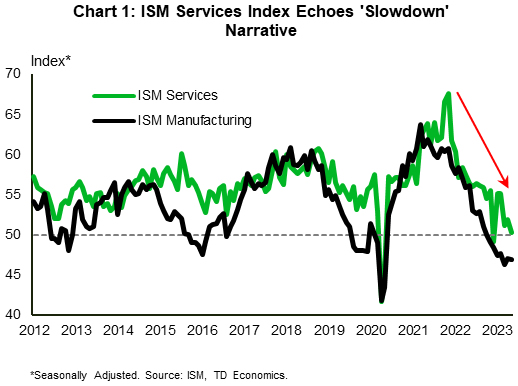
In the wake of last week’s debt ceiling deal, markets had the opportunity to catch their breath in a quiet week for data releases. The ISM Services report disappointed, with the headline index falling 1.6 points to 50.3 in May, instead of improving moderately to 52.4 as per market expectations. The recent downtrend reflects an economy that is gradually decelerating, echoing the ‘slowdown’ narrative advanced by its manufacturing counterpart (Chart 1). This theme was further supported by the report’s details, with all the main sub-indicators – including business activity, new orders, and employment – declining on the month. Of note, the employment index fell 1.6 points to 49.2, drifting below the 50-point contractionary threshold for the first time since December.
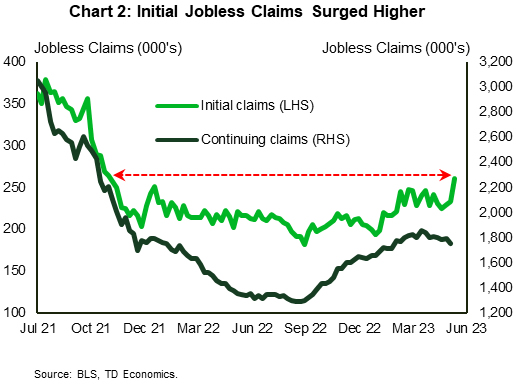
Continuing with signs for some potential softening in the labor market, initial jobless claims surged higher in the week ending on June 3rd, rising by 28,000 – much more than anticipated. This lifted initial claims to 261,000 – the highest level in 20 months (Chart 2). While the increase is substantial, for now we caution against reading too much into this. The weekly data can be noisy, and the week included the Memorial Day holiday, which may have also injected some volatility. Secondly, looking at seasonally unadjusted figures, the increase lacked breadth across states, as it was concentrated in Ohio, California, and Minnesota.
April’s international trade report did little to lift the mood. The U.S. trade deficit jumped by $14 billion or 23% in April to $74.6 billion – the widest level in six months. The most noticeable change was in the goods category. The U.S. goods deficit grew by close to 18%, as exports fell 5.3% and imports grew 2%, with the latter marking a rebound after two consecutive monthly declines. Trade made no contribution to economic growth in the first quarter of this year. The widening of the trade deficit in April indicates that it is likely to subtract from growth in the second quarter.
All told, the few reports that came out this week point to growth in the U.S. economy moderating. The Fed will take this information into account before it meets next week to set monetary policy. The last major piece of information on the docket before the Fed makes its decision is May’s CPI inflation report, which comes out one day ahead of the FOMC meeting. The market consensus forecast calls for core CPI to ease moderately to 5.3% year-on-year in May from 5.5% in April. Surprise rate hikes from the Reserve Bank of Australia and the Bank of Canada earlier this week serve as a reminder that amidst stubborn inflation there’s the potential for the Fed to opt for a hike too. That said, Fed officials have been vocal in signaling that they will forego a hike at next week’s meeting. Market odds are in tune with this view, attaching a 75% probability to a stand pat decision next week (as tracked by CME Group). However, markets still narrowly favor a hike at the next meeting in July (52% odds). In short, while next week is likely to be uneventful regarding policy changes, Fed communication may offer additional insight as to whether the FOMC sees the need for some further tightening over the near-term or not.
Canada – Getting Back Into the Game
The Bank of Canada (BoC) has made headlines once again. The Bank raised the overnight rate by 25 basis points (bps) to 4.75% as the conditions it had set to maintain a pause on interest rate hikes had been violated. The BoC will not step back to the sidelines, instead keeping the door open to further interest rate hikes should data reveal ongoing resiliency. Post-announcement, the Canadian two-year yield jumped by 20-bps to 4.58 (down to 4.50 by the end of the week) while the Canadian dollar rallied half a cent to 0.75 cents U.S. and has largely held at this level.
There has been plenty of justification for a rate hike on the data front so far in 2023. Notably inflation, especially core measures, proved stickier than expected in April. Labour markets wouldn't let up as monthly employment gains persistently surprised to the upside, contributing to resilient consumer spending. GDP for the first quarter clocked in at 3.1% quarter-on-quarter (q/q) annualized, above the 2.3% projected in the BoC's April Monetary Policy Rreport. The BoC also called out the recent pick up in spending on interest-sensitive goods and the housing market as evidence that "Excess demand… looks to be more persistent than anticipated".
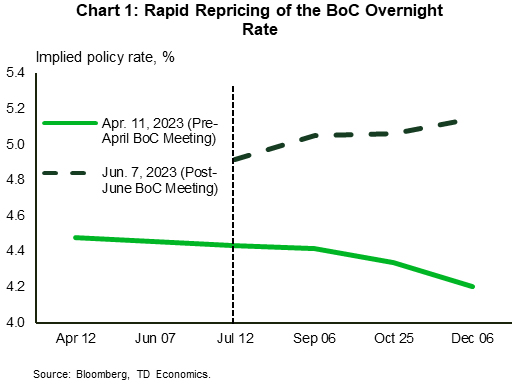
The question is where do they go from here? Chart 1 shows that prior to the April meeting, markets were anticipating the BoC to cut by 25–50 bps by the end of the year. Now, markets expect another 25-bps hike to come, with upside risk for 5.25%. We expect the BoC hike to 5.00% in July and hold at that level into 2024.
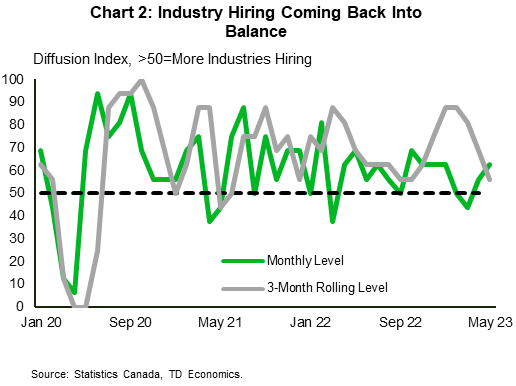
The policy rate announcement was delivered before Friday's labour market release for May, which saw Canada shed 17.3k jobs, ending the longest run of job gains since 2017. Full-time jobs contracted for a second straight month (-32.7k), while the unemployment rate ticked up two-tenths of a percent to 5.2%. Hours worked were down 0.4% month-on-month (m/m), potentially as a result of the Alberta wildfires, while wages clocked in at 5.1% year-on-year (y/y). At an industry level, Chart 2 shows that the breadth of employment change–measured on a three-month moving average basis–is coming back into balance. Productivity, measured as real output divided by hours worked, declined for a fourth straight quarter by 0.6%. Canada has been able to sustain a higher level of output through job creation even as productivity notoriously lags, but this trend is unsustainable as employment eventually moderates. All in all, it's too early to tell if May's jobs report signals the start of that trend, or if it is just a small chip on an otherwise super-tight labour market.
Next week features updates to May's housing data, where we expect home sales to continue their strong bounce back. We'll also get a pulse check on Canadian industrial activity via manufacturing and wholesale sales for the month of April.
Fed to ‘Skip’ June Interest Rate Hike Despite Higher Inflation
The U.S. Federal Reserve (Fed) looks likely to pass on raising interest rates next week—though policymakers are talking about a “skip” rather than a pause. The U.S. unemployment rate ticked higher in May, and job openings have continued to fall. But labour markets are still exceptionally tight and have been more resilient than expected despite higher interest rates. Still, it takes time for tighter monetary policy to impact the economy and there are signs that inflation pressures are easing, even if it’s happening more slowly than policymakers would like.
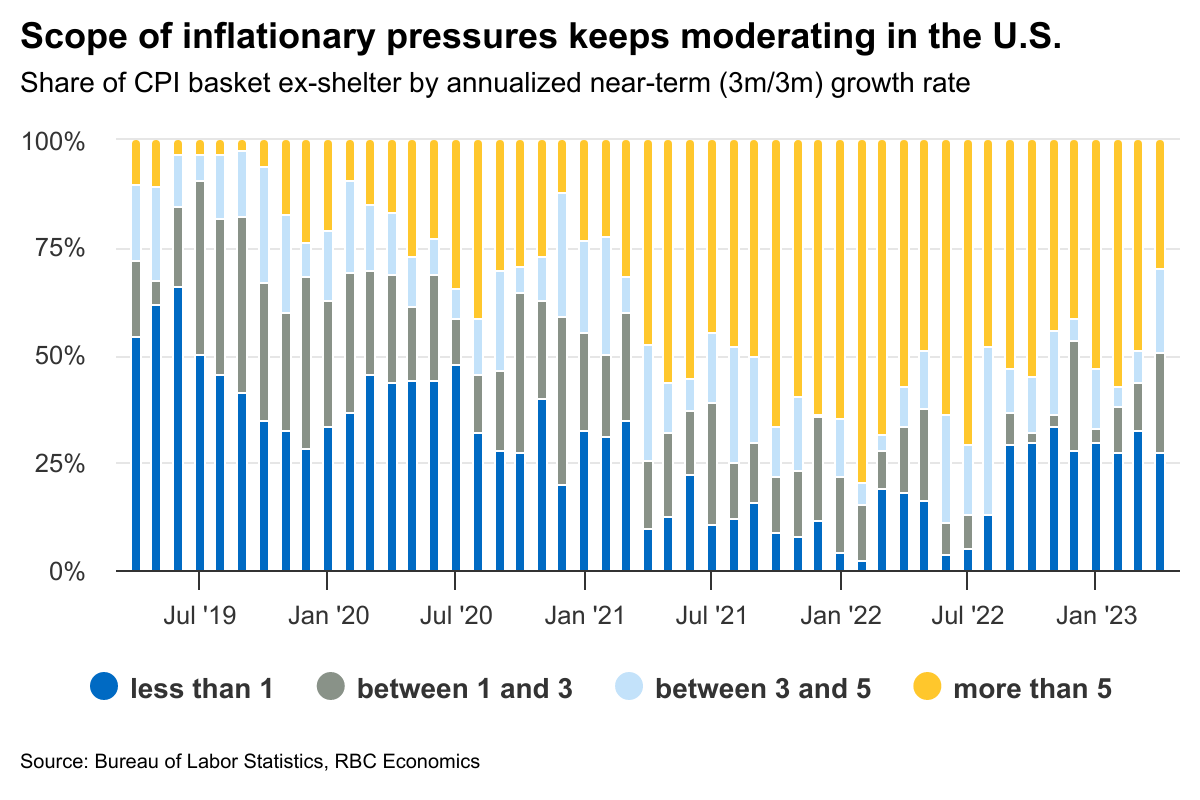
We expect year-over-year growth in the U.S. consumer price index (released a day ahead of the Fed’s rate decision) to slow substantially to 4.1% in May from 4.9% in April. Gas prices were 20% below year-ago levels in May. Oil prices are down after surging in the wake of Russia’s invasion of Ukraine. And soaring food inflation has cooled in recent months with back-to-back month-over-month declines in grocery prices over March and April. Slower food price growth should continue as supply chain pressures ease, and commodity and transport cost all move lower. Rent costs that drove core (ex-food & energy) price growth higher look to have turned a corner as an earlier decline in current market rent price growth ripples through to new leases. The share of goods and services with abnormally high inflation slowed over the spring. And the New York Fed’s inflation persistence index (based on PCE price deflators) also showed a significant deceleration in April. Still, progress has been slow and inflation pressures are still running well above the Fed’s 2% inflation target, making another rate hike in July look likely—even if the Fed takes a pass on a hike next week.
The impact of interest rate increases should be evident in next week’s Canadian National Balance Sheet Accounts data. The debt service ratio (the share of disposable household incomes eaten up by debt payments) almost certainly continued to rise in Q1 of this year—and we expect it to hit a record by the end of 2023. The Bank of Canada ended its conditional pause with a surprise 25 bp hike this week, citing a growing risk that inflation “could get stuck materially above the 2% target” amid persistent excess demand. But higher debt payments and prices are still likely to cut deeply enough into household purchasing power to slow consumer spending and ease inflation pressures over the second half of 2023.
Week ahead data watch
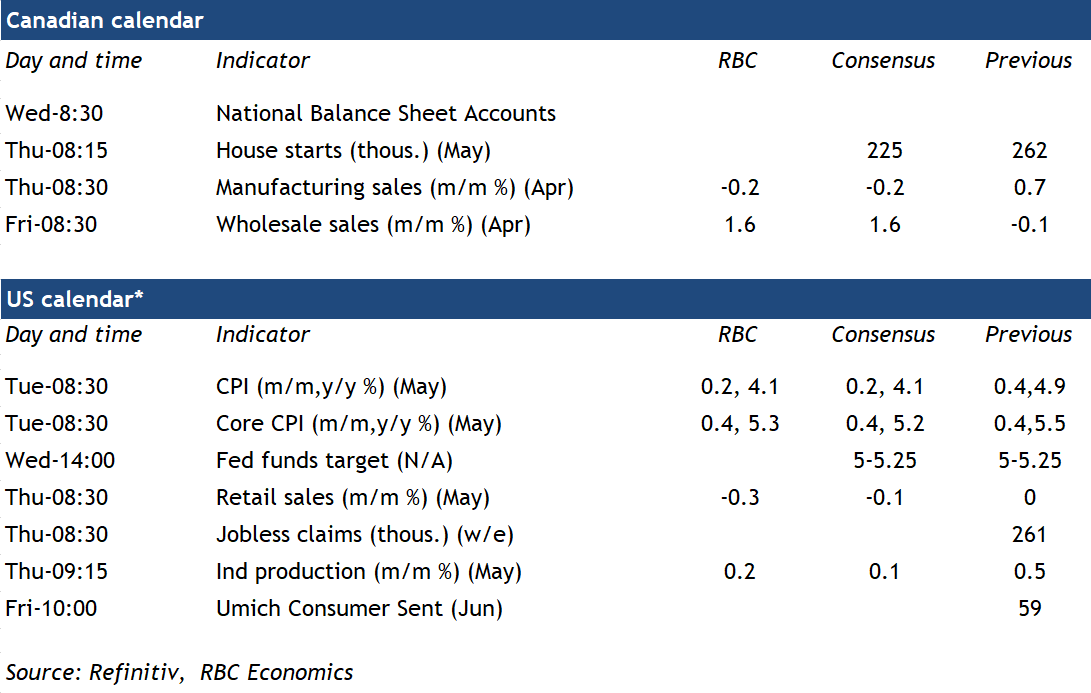
Manufacturing sales in Canada are expected to have declined by 0.2% in April despite strength in motor vehicle shipments, according to an advance estimate from Statistics Canada. That’s not the only soft spot in April. Oil production was flat on a seasonally adjusted basis month over month and the PSAC strike likely subtracted 0.3% from growth. We continue to expect a softer turnout for April GDP than the preliminary 0.2% growth reported by Statistics Canada.
U.S. retail sales likely edged lower in May on lower auto sales and a decline in gasoline prices. Industrial production likely edged higher in May on a weather-related increase in utilities output. Manufacturing hours worked were little-changed in May.
Week Ahead – Time for Fed But First, It’s US Inflation
US
The main event of the week is the FOMC decision, but before we get there, the May inflation report should show that inflation is cooling. Pricing pressures should ease as gasoline prices tumble and as demand destruction starts to become apparent in the data. The negative base effects start to help send the headline year-over-year inflation reading closer to 4.0%.
The Fed is expected to deliver a hawkish skip, but if inflation ends up being too hot, the Fed could opt to deliver a rate hike. This rate decision could be a close call and we should finally start to see some dissents. The US economy has been resilient for most of the year but signs are emerging that it is starting to weaken. If policymakers decide to hold off on another rate hike, there is a chance that this ‘skip’ could end up being a pause. While Wall Street seems confident that the end of tightening is near, sticky inflation in the fall could disrupt how this market has aggressively priced in rate cuts by the end of the year.
Eurozone
The ECB is expected to hike interest rates by another 25 basis points on Thursday is what is expected to be one of the final increases in the cycle. Markets are pricing one more in July but not fully, with the drop in inflation (including core) last month easing the pressure on the central bank to continue. I expect it will stress that there’s more to do and rate cuts are not even under consideration this year but they could indicate that a pause is now on the table.
UK
The biggest pre-BoE data release is the CPI the day before the 22 June meeting but next week offers of a host of other indicators that will attract plenty of attention. The most notable is the jobs data on Tuesday, with traders looking for any indication of slack appearing in the labor market and wage growth subsiding. Without it, the MPC will persevere with tightening. BoE Governor Andrew Bailey will appear before the House of Lords Economic Affairs Committee shortly after the release which could offer some fresh perspective on the data. GDP is also released on Wednesday.
Russia
Revised GDP data is the only noteworthy release next week. The CBR left interest rates unchanged on Friday at 7.5% but warned rate hikes remain on the table due to increased inflationary risks.
South Africa
Another quiet week with retail sales on Wednesday the only notable release. The country avoided recession in the first quarter, buoyed by resilient mining and manufacturing sectors. Rolling blackouts remain a massive constraint on the economy and company profits which will remain a huge headwind going forward.
Turkey
Now that President Erdogan has secured another term, it would seem he’s decided that more conventional fiscal and monetary policy measures may be in order. He’s ignored markets for as long as he could, burning through reserves in the process and now the job of clearing up the mess has been handed to new CBRT Governor, Hafize Gaye Erkan. The lira has sunk more than 10% to fresh lows in recent days so Erdogan’s new team has quite the job on their hands clearing up his mess. Jobs data the highlight of the economic calendar next week.
Switzerland
Very little on the calendar next week, with PPI the only notable highlight.
China
A key week ahead with a string of important economic data releases as well as a decision on the PBoC interest rate.
First up on Monday, we will have the release of several credit conditions data for May; new yuan loans, outstanding loan growth, and M2 money supply. Consensus estimates expect a contraction in credit growth where outstanding loan growth to dip to 11.6% year-on-year from 11.8% recorded in April in line with a reduction in M2 money supply to 12.1% year-on-year from 12.4% in April.
On Thursday, another set of key economic data to digest; retail sales, industrial production, and house price index for May. Industrial production is expected to slow down to 4.1% year-on-year from 5.6% in April, retail sales are also expected to grow at a slow pace of 13.9% year-on-year from 18.4% in April (its strongest pace since March 2021), and average new housing prices in China’s 70 major cities are being forecasted to increase slighted to 0.5% year-on-year from -0.2% in April.
Also on Thursday, the PBoC will announce its decision on its 1-year medium-term lending facility (MLF), the interest rate on loans that it lends to major financial institutions. It has been unchanged at 2.75% since its last cut on August 2022. Expectations have increased for a rate cut this time around due to a string of weak economic data and the recent deposit rate cut from China’s major state-owned banks by 15 basis points and 5 basis points on three-year and five-year term deposits, as per advice by PBoC.
India
A busy week ahead. On Monday, industrial production for April is expected to improve to 1.8% year-on-year from 1.1% printed in March, its lowest growth in industry activity since October 2022. Annual inflation growth for May is expected to slow for a second consecutive month to 4.42% year-on-year from 4.7% in April, its lowest since November 2021.
On Wednesday, we will have another set of inflation data; the wholesale prices, food Index and fuel for May. Consensus estimates for wholesale prices are pegged at -2.35% year-on-year, a deeper contraction from -0.92% in April. If it comes out as expected, it will be a second consecutive month of deflation for wholesale prices.
On Thursday, balance trade data for May is forecasted to show a wider deficit of US$17.4 billion from US$15.24 billion reported in April.
Lastly, June data on foreign exchange reserves and bank loan growth will be released on Friday.
Australia
Two key data to take note of. Firstly, Westpac’s consumer confidence Index on Tuesday where an improvement is forecasted to come in at 3.2% from a significant decline of -7.9% recorded in May.
On Thursday, the focus will be on the jobs market; employment change for May is expected to show an improvement with a gain of 20,000 jobs added after a surprise decline of 4,300 in April. The unemployment rate is expected to hold steady at 3.7%.
New Zealand
On Wednesday, Q1 current account data and food inflation for May will be released. Food prices is being forecasted to increase slightly to 12.9% year-on-year from 12.5% in April. If it turns out as expected, it will be the fourth consecutive month of growth acceleration in food prices.
On Thursday, first-quarter growth is expected to be 2.6% year-on-year, an improvement from the fourth quarter print of 2.2%.
Japan
The balance of trade data for May will be released on Thursday where a wider deficit of JPY1331.9 billion is expected from -JPY432.4 billion recorded in April. A contraction of 0.8% year-on-year in export growth is expected, that’s a significant swing from a growth of 2.6% recorded in April, its softest pace since a fall in February 2021.
On Friday, BoJ will announce the outcome of its monetary policy meeting. Given the recent mixed guidance from Governor Ueda on the future path of inflationary growth in Japan, the consensus is no change in its ultra-loose policy.
Singapore
One key data release to focus on is the balance of trade for May which will be released on Friday. A reduction in its surplus to S$4.2 billion is being forecasted versus a surplus of S$4.71 billion recorded in April.
Economic Calendar
Monday, June 12
Economic Data/Events
- India CPI, industrial production
- Japan PPI
- Turkey current account
- Denmark inflation
- Gas transits to resume for Hungary as maintenance expected to be completed for TurkStream pipeline
- BOE’s Mann speaks in a webinar hosted by Signum
- Asia New Vision Forum expected to host more than 300 business leaders, policymakers, industry practitioners, and opinion leaders
- NATO Secretary General Stoltenberg visits Washington to meet President Biden
Tuesday, June 13
Economic Data/Events
- US May CPI M/M: 0.2%e v 0.4% prior; Y/Y: 4.1%e v 4.9% prior; CPI ex-food and energy M/M: 0.4%e v 0.4% prior; Y/Y: 5.3%e v 5.5% prior
- Fed begins two-day policy meeting
- Australia consumer confidence
- Germany CPI, ZEW survey expectations
- Mexico international reserves
- Spain CPI
- UK jobless claims, unemployment
- BOE Gov Bailey testifies to the House of Lords economic affairs committee.
Wednesday, June 14
Economic Data/Events
- US FOMC rate decision: Expected to keep rates steady, along with updated economic forecasts and Fed Chair Powell’s press conference
- US PPI
- Eurozone industrial production
- India wholesale prices
- New Zealand food prices
- South Africa retail sales
- Sweden CPI
- UK monthly GDP, industrial production, trade
- Monthly IEA oil market report
- Swedish landlord SBBl holds an extraordinary general meeting to approve emergency cash-savings measures
Thursday, June 15
Economic Data/Events
- PBOC meeting to decide on one-year policy loan rate; 1-year Medium-term lending facilities volume could rise from 125B to 225B
- US initial jobless claims, retail sales, empire manufacturing, business inventories, industrial production
- Australia unemployment
- Canada housing starts, existing home sales
- China property prices, retail sales, industrial production
- Eurozone ECB rate decision: Expected to raise Main Refinancing Rate by 25bps to 4.00%, President Lagarde holds a press conference
- France CPI
- India trade
- Japan machinery orders, tertiary index, trade
- New Zealand GDP
- Poland CPI
- Russia GDP
- Spain trade
- NATO defense ministers meet in Brussels
- Fed’s Bullard to speak at Norges Bank, the International Monetary Fund, and the IMF Economic Review hold a joint conference on “The Future of Macroeconomic Policy” in Oslo
- BOE’s Cunliffe speaks at Politico Global Tech Summit — London Tech Week — on ‘Central banks and the future of payments’
Friday, June 16
Economic Data/Events
- BOJ rate decision: No changes expected with monetary policy
- US University of Michigan consumer sentiment
- Eurozone CPI
- Italy CPI, trade
- New Zealand PMI
- Singapore trade
- UK Bank of England inflation expectations survey
- ECB’s Holzmann speaks at the Austrian National Bank’s presentation of updated economic forecasts
- ECB’s Villeroy speaks at a tech conference in Paris
- UK BOE inflation attitudes survey
Sovereign Rating Updates
- Luxembourg (Fitch)
- Norway (Fitch)
- Turkey (Moody’s)
What BOC Surprise Could Mean For Fed
The BOC really shocked markets back on Wednesday when it hiked rates by 25bps. Pretty much everyone was expecting it to be a non-event. Given Canada's unique position, the move impacted how many analysts viewed central banks around the world. The number of traders expecting a "skip" at the next Fed meeting dropped dramatically (though it's still a majority).
What happened?
The BOC was the first G20 country to start pausing rates, all the way back in February. Canada had a spike in inflation like most major world economies, but it was starting to come down at the start of this year. That made Governor Macklem and his Board sufficiently confident to announce that there would be a pause to rate hikes. The bank did make it clear that more rate hikes were still on the table if necessary.
Since then, inflation did come down, in recent months it had started to creep back up. Particularly the core with relation to "second level" effects. That is, when inflation increases, it causes employees to demand higher wages. With relatively low unemployment, businesses are forced to raise wages to retain workers. This is a "secondary" effect of higher prices, and is generally a worrisome trend for central bankers, because it can mean the start of inflation potential spiraling out of control.
The reaction around the world.
The BOE has already acknowledged that inflation has spread to secondary effects, and just yesterday the SNB said it had moved to third level effects in Switzerland. That is when prolonged high interest rates start to slow economic growth. All of this leads to the increasing feeling that central banks are running out of time to get inflation under control. Pausing or "skipping" along the way might be counterproductive.
The rise in inflation in Canada made the BOC also the first of the G20 central banks to "restart" rate hikes. The idea is that they let up the pressure on inflation too soon, and as a consequence it started to rise again. This is something that former US Treasury Secretary Larry Summers has warned about the Fed's upcoming meeting. If there is a "skip", he said, then the Fed might have to hike by "double" at the next meeting to keep inflation under wraps.
Pause vs skip
With governments in high levels of debt and economic growth remaining sluggish, central banks are under increasing pressure to ease up on the tightening as soon as possible. The fear among those central bankers is that if they do, they will lose "credibility" in the fight against inflation. Letting up too soon means inflation can come back, and then monetary policy would have to be even more aggressive. The UK stands as a warning, going months with double-digit inflation despite being the first to start hiking. The slow rate of hikes apparently wasn't enough to suppress inflation and turn it around as fast as more aggressive central banks, like the BOC and Fed.
The BOC going from one of the more aggressive central banks to being the first to pause, and then having to restart hiking has left many investors a little concerned. The Fed might err on the side of "caution" and opt to forego the "skip" at the next meeting. It will likely all come down to the CPI data to be released the day before the FOMC meeting.