Sample Category Title
Stronger Earnings Growth Could be Signal BoJ Has Been Waiting For
Another month has started but the discussion about the BoJ still revolves around the same issues. With the largest central banks globally ready to pause their hiking cycle, can the BoJ map a way out of its ultra-loose monetary policy and finally boost the ailing yen?
What has been happening lately?
As we have been highlighting in recent previews, the BoJ remains in an uncomfortable position. With the largest central banks being very close to completing their rate hiking cycle, the BoJ is still looking for the light at the end of the decade-long tunnel. Its outlook was looking brighter a couple of months ago but, unfortunately for the BoJ, inflationary pressures globally appear to be abating. This was also evident at the recent Tokyo CPI print for May that surprised on the downside. So, how can the BoJ embark on some sort of monetary tightening with inflation on a downwards path?
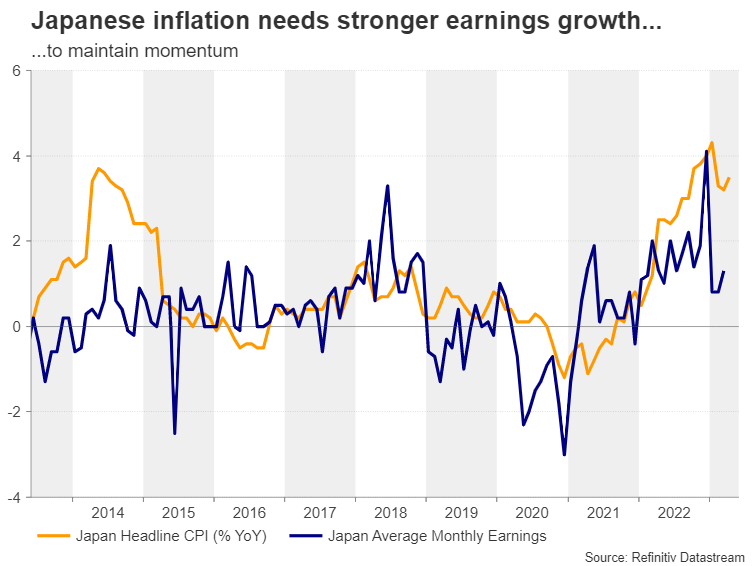
BoJ Governor Ueda has repeatedly highlighted the fact that the Japanese inflation rise is due to external, cost-push factors. Domestic demand has been playing a secondary, much weaker role, compared to what we have seen in other countries, tying the BoJ’s hands. The way out of the current deadlock is the consumer sector, thus raising the importance of the recent strong, above-inflation wage increases. The BoJ is expecting these increases to have a material impact on consumer spending and consumer sentiment going forward.
Amidst this challenging environment, there is increased nervousness about the BoJ’s next move. The market has gotten used to the ultra-loose monetary stance with the yen being the traditional funding currency for carry trades. Therefore, a change of policy by the BoJ or even adoption of a more hawkish stance is expected to have a stronger impact, especially on the FX markets. The ECB was quite vocal about this possibility at its most recent Financial Stability review. It was also highlighted that a wave of yen repatriation could create an investment gap in the European and US bond markets.
Plethora of data but two releases stand out next week
Understandably, next week's focus will be on Tuesday’s figures and, to a lesser extent, on Thursday’s releases. The final GDP print for the first quarter of 2023 and the current account figures for April, both released on Thursday, are critical pieces of the economic puzzle, but as described above the focus is squarely on domestic earnings and spending.
The year-on-year change in the labour cash earnings is forecast to moderate even further to 0.5%. If confirmed, this would be the lowest print since February 2022, and a potential signal that the optimism after the recent wage agreements might have been premature. Similarly, the overall household spending data for April is expected to show some improvement but remain in negative territory. A positive set of data figures on Tuesday would be greatly welcomed at the BoJ halls, but probably not by the bond markets.
Can the yen finally recover some of its 2023 losses?
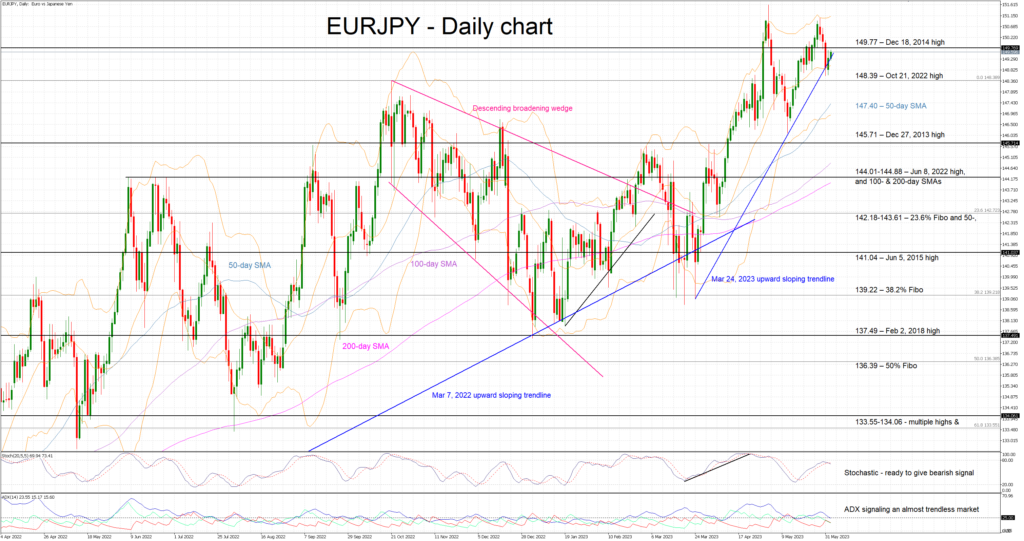
The 15-year high at 151.61 in euro/yen appears to have somewhat energized the yen bulls as they have been trying to stop this pair’s advance. Their effort has been fruitless up to now, but the formation of a double top pattern could be the answer to their prayers.
Should the data releases surprise to the upside and sentiment turn in favour of the yen, we would see a retreat towards the 148.39 level and a retest of the 147.22 level. A break of the neckline of the formed pattern at 146.13 could result in an even stronger correction. On the other hand, an upwards break of the 149.77 level could open the door for a higher high, above the recent 151.61.
Weekly Focus – Softer Inflation Prints Drive Yields Lower
Hopes for inflation coming down faster than expected drove market sentiment towards the end of the week. The euro area inflation print released on Thursday confirmed the disinflationary prints from country releases in previous days. HICP came in at 6.1%, which is a sharp drop from 7% in April. Core inflation also slowed more than anticipated to 5.3% from 5.6% in April. For now, the introduction of the EUR49 German transport ticket is likely to have been a key reason for this decline and hence we should be careful interpreting this core print. Nevertheless, stock markets cheered inflation coming lower faster than expected while yields drifted lower. The German 10y yield is trading almost 30bp lower compared to a week ago and the ECB peak rate is priced 9bp lower at 3.64%.
A financial market apocalypse in the US was avoided as the policymakers agreed on a deal to raise the country's debt ceiling. The bill passed the senate with 46 Democrats and 17 Republicans supporting it while five Democrats and 31 Republicans opposed the legislation. The debt ceiling driven drain in the Treasury General Account has supported liquidity, and hence, contributed to easing financial conditions lately, a development which we now expect to reverse.
Chinese PMI from NBS on Wednesday was weaker than expected across the board and pointed to new stimulus soon from the government and PBOC. The NBS PMI manufacturing PMI dropped from 49.2 to 48.8 (consensus 49.5) with details also being soft. Both new orders and export orders dropped. Then again, Caixin manufacturing PMI came out better than expected and in the expansionary territory. We still conclude that recovery in China is losing steam. Markets turning positive on Friday is more related to positioning and unlikely to be a sustainable phenomenon.
In Turkey's presidential run-off, Erdogan secured 52.2% of the votes and sealed his iron grip on power for the next five years. We think that in the absence of a turnaround in economic policy, Turkey could eventually end up in a currency crisis where lira's value would collapse, inflation would explode and even goods shortages could occur. Turkish corporates with large foreign liabilities would face substantial rollover risks. Read more in our election review Research Turkey - Time to fasten seat belts as Erdogan secures another term, 29 May.
Next week, we get the ISM services index from the US. Service PMI was fairly strong in May, so it will be interesting to see whether this is being reflected in the ISM as well. We are expecting the RBA to maintain rates unchanged on Tuesday. Markets are pricing a small (30-35%) risk of a 25bp hike. German factory orders for April are out on Tuesday as well. Orders fell a lot in March and now we are looking into more signals of whether this was a temporary thing or a sign of a more severe contraction. China will publish CPI data for May out on Friday. Inflation was 0.1% y/y in April, and a below zero print would create some headlines. On the geopolitical front, we continue to follow the events in Ukraine as the spring offensive is looming.
Sunset Market Commentary
Markets
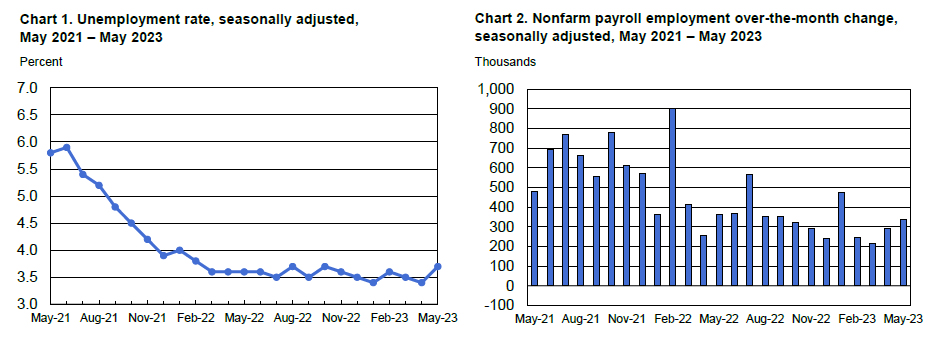
The US jobs report delivered yet another big beat in the headline figure, the 14th in a row. Employment grew a whopping 339k in May with the previous two months revised up by 93k. That brings about a total upward surprise of 237k. Average hourly earnings were more or less as expected, coming in at 0.3% m/m to be up 4.3% y/y. That’s one tenth below consensus and the April figure. There are some inconsistencies though with the unemployment rate rising from 3.4% to 3.7% vs 3.5% expected despite the bumper payrolls growth and a stable participation rate (62.6%). This is because the number is derived from a separate household survey where employment instead of rising, dropped by no less than 310k. After a kneejerk rate move higher which went to 10 bps and more at the front, gains were cut a bit to 2.9-7.5 bps across the curve as investors stick to the idea of a Fed June rate skip. There’s only one chance in three discounted for a hike. Fed governors including Jefferson and Harker in the run-up did their best to cement such a scenario in market thinking before the blackout period kicks in this weekend. The case for a July hike does strengthen again (about 80% chance). German Bund yields were rising a few bps earlier in the day before temporarily extending gains in sympathy with the US. They remain near the lows of this week though. Current changes vary between 2.3 (30-y) to 6.3 bps (2-y, 5-y).
Strong payroll growth and the yield advance has little effect on the US dollar. An attempt to recoup some of losses incurred against the euro yesterday was in vain. EUR/USD trades around opening levels in the 1.076/1.077 area. The trade-weighted index goes nowhere (103.58). Capping the dollar’s appeal except from US yields quickly retreating from intraday highs is the broad risk-on mood on equity markets. Stocks easily gain 1% and more. Markets cheer at a Bloomberg report citing people familiar with the matter that China is working on a new basket of measures to support the property market. Existing/previous plans including the 16-point rescue package have clearly failed to do the trick. The Chinese yuan rallied against the USD. USD/CNY trades at 7.072, down from 7.103. Commodities including Brent oil (+2.2%), copper (+1.5%) and iron (+2.55%) rally. The likes of the CAD and NZD eke out a small gain. AUD outperforms G10 peers following reports of a 5.75% minimum wage increase this morning.
News & Views
In May, the food price index of the UN Food and Agricultural Organization dropped another 2.6 M/M and stands 22.1% below the all-time high reached in March 2022. The May decline was driven by significant drops in the indices of vegetable oils, cereals and dairy which were partially counterbalanced by increases in the sugar and meat indices. The cereal price index dropped 4.8% M/M. Wheat prices declined 3.5% reflecting the prospects for ample global supplies in the 2023/24 season and the extension of the Black Sea initiative. Prices of maize dropped 9.8% on higher expected production in the US and Brazil. The price of rice was an exception to the broader decline. Vegetable oil price extended their downtrend (-9.8% M/M and 48.2% Y/Y). The decline in dairy prices was more modest (3.2% M/M) with milk powders even rebounding. Meat prices were up a modestly (1.0% M/M), the fourth consecutive monthly increase to be only 4.1% lower Y/Y. The sugar price remains on a sustained uptrend (5.5% M/M, fourth consecutive monthly rise) standing 30.9% higher compared to the same month last year. Rising concerns over the development of the El Niño phenomenon on 2023/24 crops, together with lower-than-earlier-expected availabilities in 2022/23 and shipping delays are said as causing the rise.
According to Reuters reporting, Vice Chairman of the Swiss National Bank (SNB), Martin Schlegel said the SNB remains ready to tighten policy further as it sees inflation spreading across the economy to other goods and services that are not linked to energy and supply bottlenecks. The Vice Chairman also mentioned the potential impact of higher interest rates on rents which could add to inflation later this year. Swiss inflation in April slowed to 0.0% M/M and 2.6% Y/Y. Core inflation was unchanged at 2.2%. The SNB aims to keep inflation between 0.0% and 2.0%. In its March quarterly Bulletin it forecasted inflation to ease for 2.6% this year to just the 2.0% top of the policy range in 2024/2025. The SNB holds its next policy meeting on 22 June, with May CPI data to be published Monday next week. The Swiss franc this week eased off the highest level in more than six months against the euro (EUR/CHF 0.9672) to currently trade near 0.976.
US: Strong May Payrolls Print Keeps Summer Rate Hike in Play
The U.S. economy added 339k jobs in May, well above the consensus forecast of 195k. Revisions to the two prior months were positive, adding a meaningful 93k from the previously reported figures. Hiring over the last three-months averaged 283k jobs per-month, an uptick from the 253k recorded in April.
Employment gains on the service side (+257k) were relatively broad based, with healthcare (+75k), professional & business services (+64k), leisure & hospitality (+48k) and transportation & warehousing (+24k) leading the charge. The goods sector (+26k) also added jobs last month, though gains were almost entirely concentrated in construction (+25k), while manufacturing shed 2k jobs. Hiring across government remained very strong, adding 56k jobs in May.
In the household survey, civilian employment fell by 310k while the labor force gained 130k – resulting in a sharp 0.3% percentage point (ppt) uptick in the unemployment rate to 3.7%. Meanwhile, the participation rate held steady at its cyclical high of 62.6%.
Average hourly earnings rose 0.3% month-on-month (m/m) – a deceleration from April's downwardly revised gain of 0.4% m/m. Relative to last May, hourly earnings slowed a tenth of a percentage point to 4.3%, though the more truncated three-month annualized change rose to 4.0% (from 3.8% in April).
Key Implications
Another strong reading on U.S. job creation! Over the last three months, job growth has averaged 283k jobs per-month. This marks an uptick from the steady downward trend seen over the last several months. At its current pace, job growth continues to run at a clip that's more than three-times what's required to meet trend growth in the labor force.
Beyond the healthy gain in employment, this morning's report also offered other evidence that the labor market remains hot. The breadth of hiring remained reasonably strong – with only two industries shedding jobs – while revisions to the two prior months were significantly higher, adding an additional 93k jobs. And while the unemployment rate jumped by 0.3 ppts, we will discount that for now given the inherent volatility in the household survey. Moreover, at 3.7%, the unemployment remains at the upper end of the very narrow range (3.4%-3.7%) where it has oscillated over the past 15 months.
While most Fed officials seem to support skipping a June rate hike to better assess the data flow, this morning's employment report certainly keeps the possibility of another 25-basis point (bps) hike in play later this summer. Irrespective of whether the Fed does eventually push ahead with another hike, the theme of 'higher for longer' seems to be reverberating through financial markets. Just a month ago, investors were pricing in 75 bps of rate cuts by year-end. Today, virtually no cuts are priced for 2023. With the labor market continuing to show incredible resilience and inflationary pressures persisting, we don't expect the Fed to begin easing the policy rate until at least Q1 of next year.
EUR/USD Mid-Day Outlook
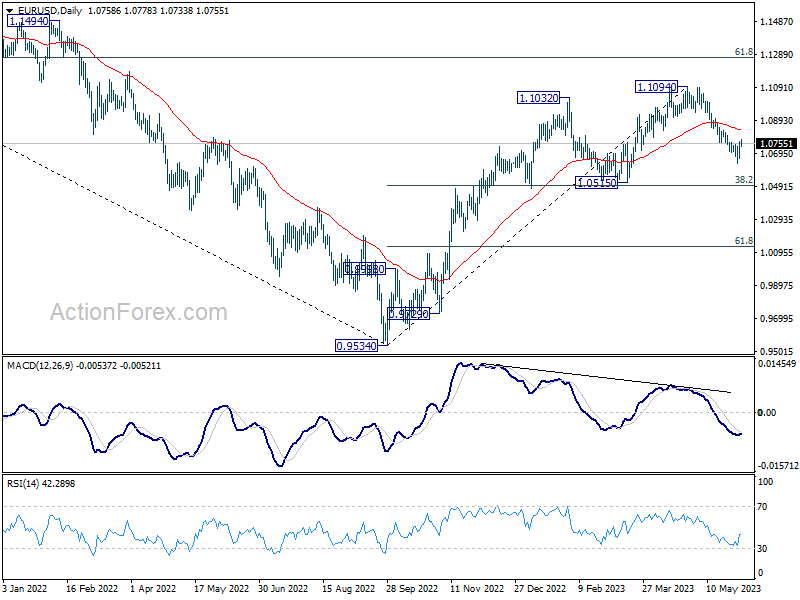
Daily Pivots: (S1) 1.0694; (P) 1.0731; (R1) 1.0800; More...
Intraday bias in EUR/USD stays mildly on the upside at this point. Rebound from 1.0634 short term bottom is in progress for 55 D EMA (now at 1.0836). On the downside, though, break of 1.0634 will resume the fall from 1.1094 to 1.0515 cluster support, 38.2% retracement of 0.9534 to 1.1094 at 1.0498.
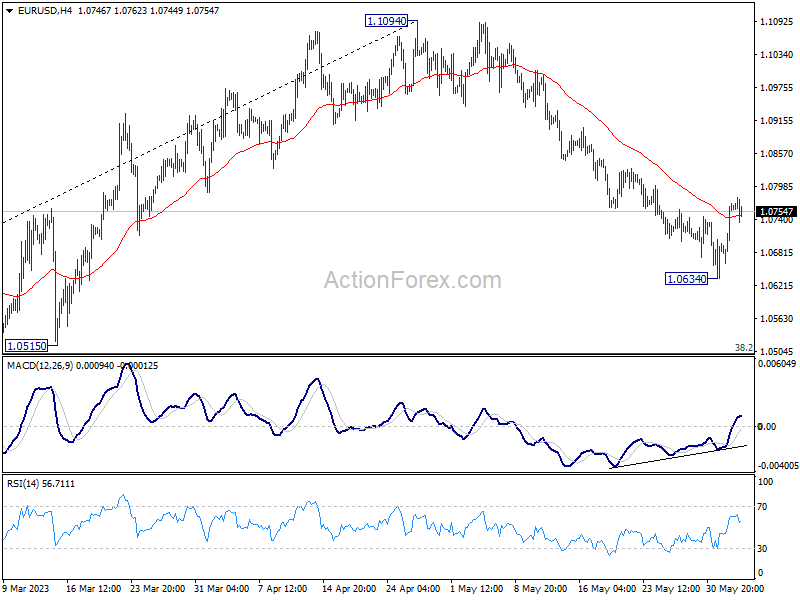
In the bigger picture, as long as 1.0515 support holds, rise from 0.9534 (2022 low) would still extend higher. Sustained break of 61.8% retracement of 1.2348 (2021 high) to 0.9534 at 1.1273 will solidify the case of bullish trend reversal and target 1.2348 resistance next (2021 high).
GBP/USD Mid-Day Outlook
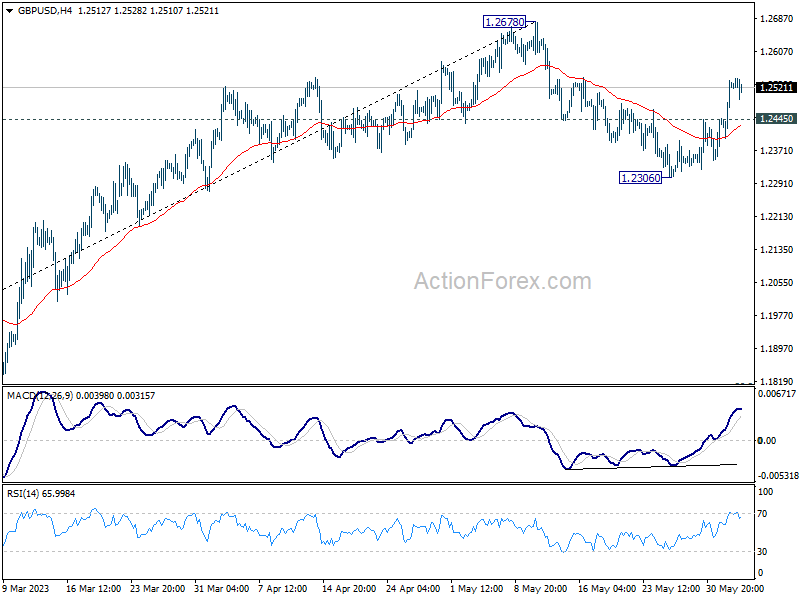
Daily Pivots: (S1) 1.2438; (P) 1.2489; (R1) 1.2577; More...
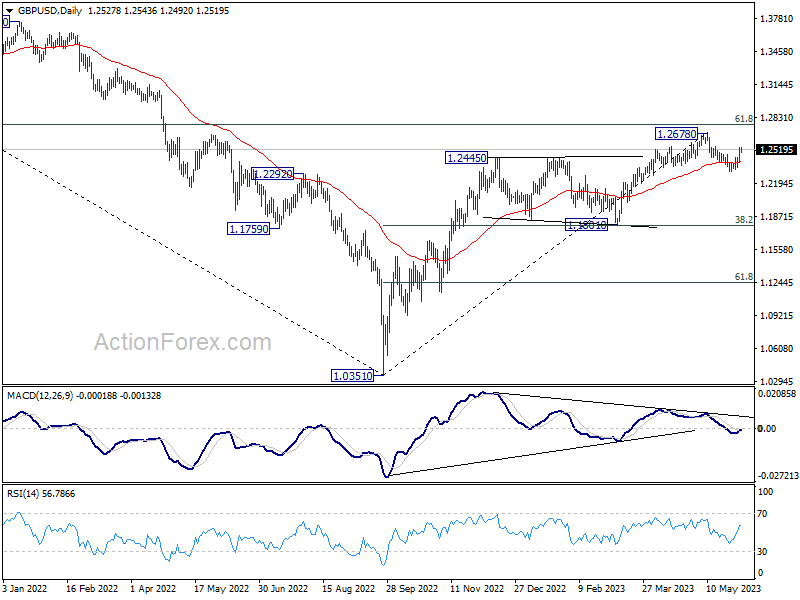
Intraday bias in GBP/USD stays mildly on the upside at this point. Rebound from 1.2306 is in progress for retesting 1.2678 high. Decisive break there would resume larger up trend from 1.0351 to 1.2759 fibonacci level. Meanwhile, below 1.2445 minor support will turn intraday bias neutral first. Further break of 1.2306 will resume the correction towards 1.1801 cluster support (38.2% retracement of 1.0351 to 1.2678 at 1.1789)
In the bigger picture, as long as 1.1801 support holds, rise from 1.0351 medium term bottom (2022 low) is expected to extend further. Sustained break of 61.8% retracement of 1.4248 (2021 high) to 1.0351 at 1.2759 will add to the case of long term bullish trend reversal. However, firm break of 1.1801 will indicate rejection by 1.2759, and bring deeper decline, even as a correction.
USD/JPY Mid-Day Outlook
Daily Pivots: (S1) 138.19; (P) 139.07; (R1) 139.68; More...
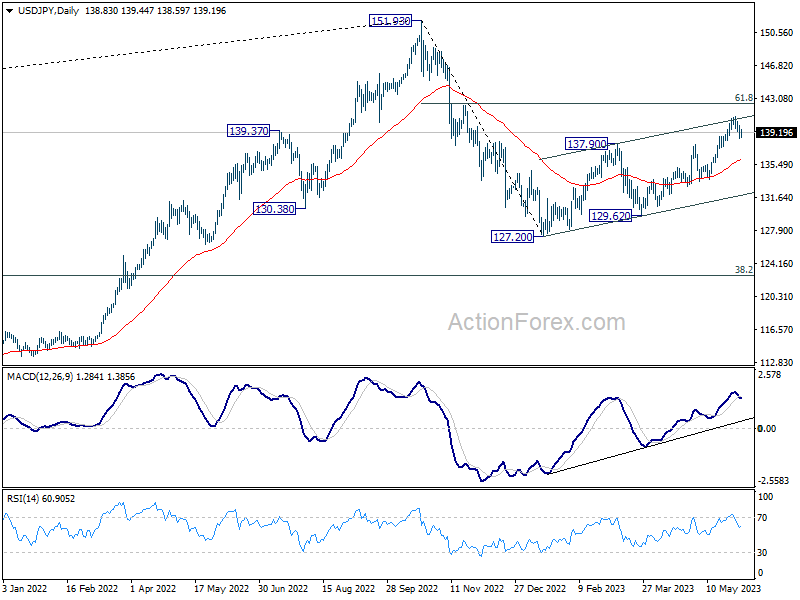
Intraday bias in USD/JPY remains neutral as range trading continues. Downside of retreat should be contained above 138.22 support to bring another rally. Break of 140.90 will resume larger rise from 127.20 to 142.48 fibonacci level. However, considering bearish divergence condition in 4 hour MACD, break of 138.22 will confirm short term topping, and turn bias back to the downside for 55 D EMA (now at 135.98).
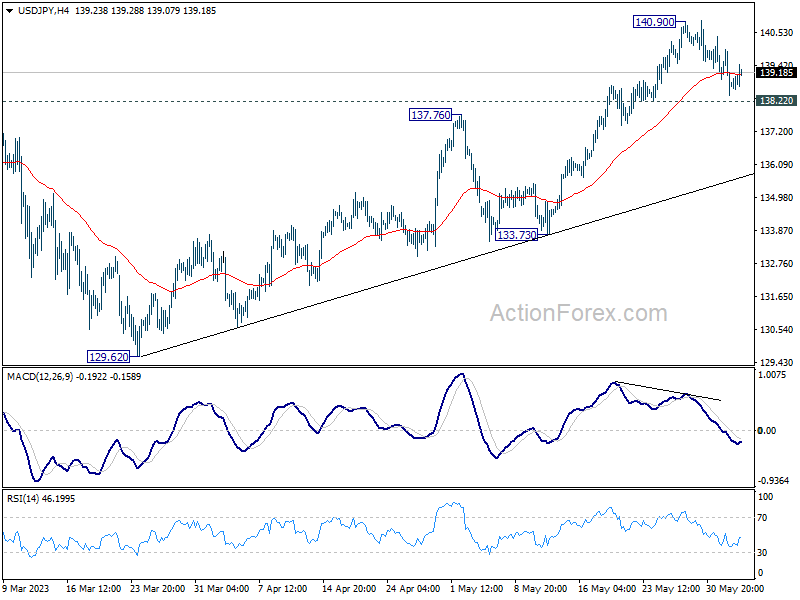
In the bigger picture, rise from 127.20 is seen as the second leg of the corrective pattern from 151.93 high. Stronger rally would be seen to 61.8% retracement of 151.93 to 127.20 at 136.34. Sustained break there will pave the way back to retest 151.93. On the downside, however, break of 133.73 support will argue that the pattern could have started the third leg through 127.20 low.
USD/CHF Mid-Day Outlook
Daily Pivots: (S1) 0.9034; (P) 0.9076; (R1) 0.9097; More...
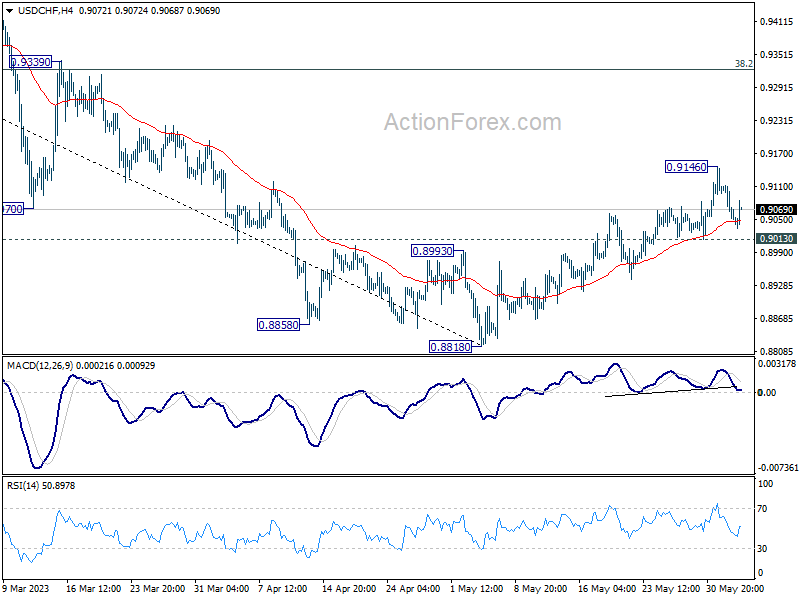
USD/CHF recovers ahead of 0.9013 minor support but stays below 0.9146 temporary top. Intraday bias remains neutral first. On the upside, break of 0.9146 will resume the rebound from 0.8818 to 38.2% retracement of 1.0146 to 0.8818 at 0.9325. On the downside, however, break of 0.9013 will turn bias back to the downside for retesting 0.8818 low instead.
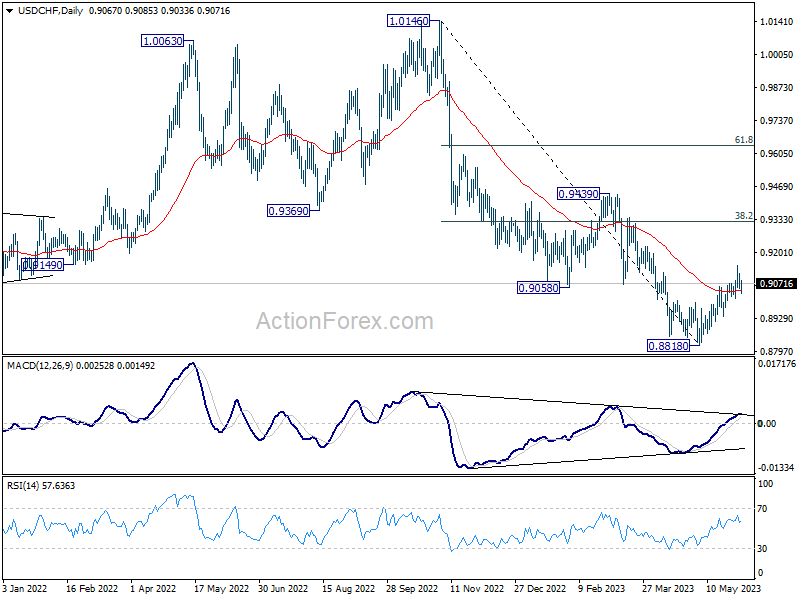
In the bigger picture, fall from 1.1046 (2022 high) is seen as a leg in the long term range pattern from 1.0342 (2016 high). So, downside should be contained by 0.8756 to bring reversal. Sustained break of 0.9058 support turned resistance will be the first sign of medium term bottoming. However, decisive break of 0.8756 will carry larger bearish implications.
Dollar Recovering after Strong NFP Growth, But Upside Capped
Dollar is trying to recover in early US session after much stronger than expected non-farm payroll job growth. Nonetheless, upside is capped so far, considering the surprised jump in unemployment rate too. For now, Aussie remains the strongest one for the day, followed by other commodity currencies. Yen is the worst performer, followed by Swiss Franc and then Euro.
In Europe, at the time of writing, FTSE is up 1.10%. DAX is up 1.10%. CAC is up 1.39%. Germany 10-year yield is up 0.0490 at 2.298. Earlier in Asia, Nikkei rose 1.21%. Hong Kong HSI rose 4.02%. China Shanghai SSE rose 0.79%. Singapore Strait Times rose 0.24%. Japan 10-year JGB yield dropped -0.0048 to 0.416.
US NFP rose 339k, unemployment rate rose to 3.7%
US non-farm payroll employment grew 339k in May, well above expectation of 180k. The figure was in line with the average monthly gain of 341k over the prior 12 months.
Unemployment rate rose from 3.4% to 3.7%, above expectation of 3.5%. Labor force participation rate was unchanged at 62.6%. Number of unemployed persons rose by 440k to 6.1m.
Average hourly earnings rose 0.3% mom, matched expectations. Average workweek edged down by -0.1 hour to 34.3 hours.
ECB Panetta: Policy debate to shift from 'how high?' to 'how long?'
In an interview with Le Monde, ECB Executive Board Fabio Panetta noted, "Given the extraordinary level of economic uncertainty, estimating the terminal rate is challenging."
"I don't think this is the time to be too hasty in raising rates, given the considerable ground we have already covered." He added "my intuition suggests that we have not reached the end of our rate-hike cycle, though we're not far away from it."
As for the future of ECB's monetary policy, Panetta indicated a shift in focus. "I think the policy debate will soon shift away from 'how high?' to 'how long?'," he stated.
He identified the strength of the labour market and firms' profit strategies as the main threats to price stability but pointed out, "so far there are no clear indications of a self-sustained wage-price spiral."
In addressing core inflation's lagging pattern behind headline inflation, Panetta observed, "it (core inflation) is now proving to be persistent even after energy inflation has gone down. But we can expect it to come down eventually too. In this respect, yesterday's figures are encouraging."
He concluded by warning that the effects of ECB's monetary tightening could potentially lead to "a prolonged weakness in economic activity or even a technical recession" if domestic demand continues to falter.
BoJ Ueda: No time frame to achieve inflation target, but not so long as 10 years
In a parliamentary address today, BoJ Governor Kazuo Ueda said "The time it takes for the impact of monetary policy to appear on the economy could move around a lot depending on circumstances."
"We therefore do not have any time frame in mind" in achieving the inflation target, he added.
"Having said that, our baseline view is that it won't take so long as over 10 years. We'll still seek to hit the target at the earliest date possible," he remarked.
Ueda reiterated that the Bank of Japan's purchases of Real Estate Investment Trusts (REITs) form part of their expansive monetary easing strategy. He noted, "We are conducting the purchases (of REITs) as part of our massive monetary easing program. Given it will take more time to achieve our price target, we will maintain the easy policy."
USD/CHF Mid-Day Outlook
Daily Pivots: (S1) 0.9034; (P) 0.9076; (R1) 0.9097; More...
USD/CHF recovers ahead of 0.9013 minor support but stays below 0.9146 temporary top. Intraday bias remains neutral first. On the upside, break of 0.9146 will resume the rebound from 0.8818 to 38.2% retracement of 1.0146 to 0.8818 at 0.9325. On the downside, however, break of 0.9013 will turn bias back to the downside for retesting 0.8818 low instead.
In the bigger picture, fall from 1.1046 (2022 high) is seen as a leg in the long term range pattern from 1.0342 (2016 high). So, downside should be contained by 0.8756 to bring reversal. Sustained break of 0.9058 support turned resistance will be the first sign of medium term bottoming. However, decisive break of 0.8756 will carry larger bearish implications.
Economic Indicators Update
| GMT | Ccy | Events | Actual | Forecast | Previous | Revised |
|---|---|---|---|---|---|---|
| 22:45 | NZD | Terms of Trade Index Q1 | -1.50% | -1.10% | 1.80% | 1.50% |
| 23:50 | JPY | Monetary Base Y/Y May | -1.10% | -1.40% | -1.70% | |
| 06:45 | EUR | France Industrial Output M/M Apr | 0.80% | 0.30% | -1.10% | |
| 12:30 | USD | Nonfarm Payrolls May | 339K | 180K | 253K | 294K |
| 12:30 | USD | Unemployment Rate May | 3.70% | 3.50% | 3.40% | |
| 12:30 | USD | Average Hourly Earnings M/M May | 0.30% | 0.30% | 0.50% |
US NFP rose 339k, unemployment rate rose to 3.7%
US non-farm payroll employment grew 339k in May, well above expectation of 180k. The figure was in line with the average monthly gain of 341k over the prior 12 months.
Unemployment rate rose from 3.4% to 3.7%, above expectation of 3.5%. Labor force participation rate was unchanged at 62.6%. Number of unemployed persons rose by 440k to 6.1m.
Average hourly earnings rose 0.3% mom, matched expectations. Average workweek edged down by -0.1 hour to 34.3 hours.