Sample Category Title
EUR/GBP Weekly Outlook
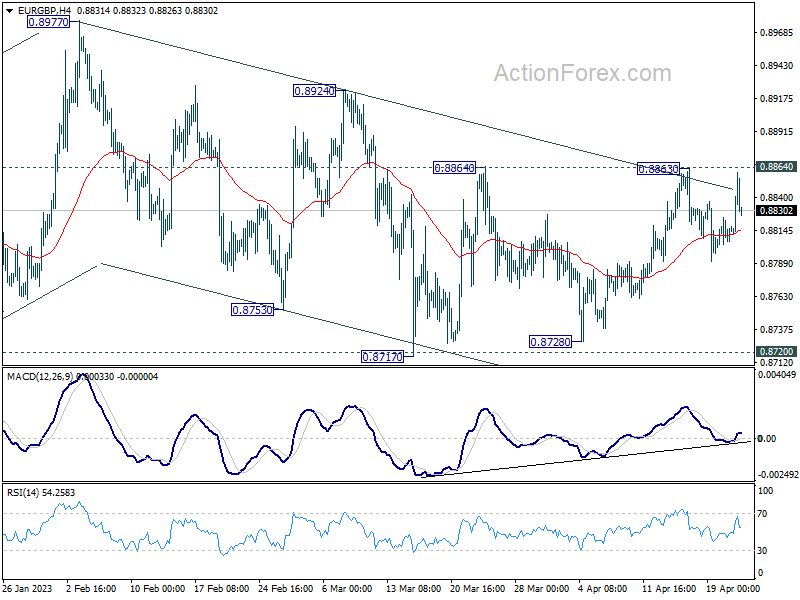
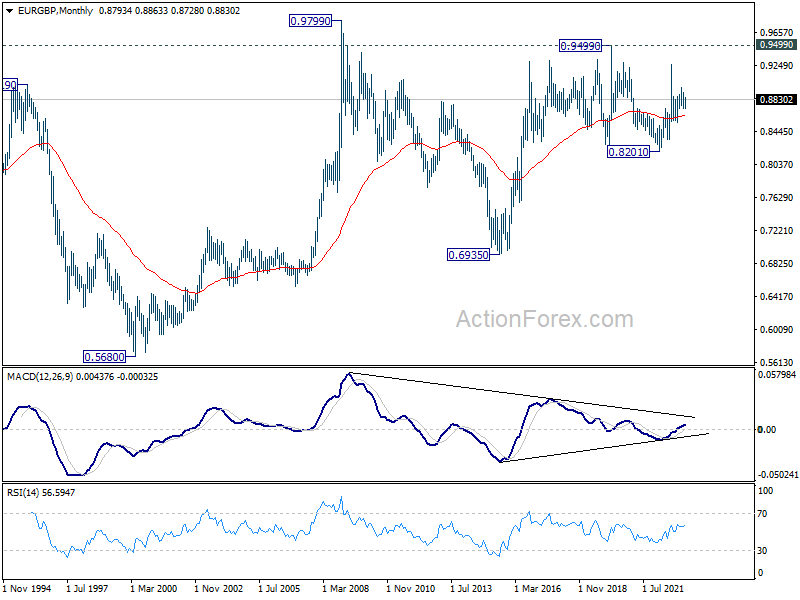
EUR/GBP failed to break through 0.8864 resistance last week and stayed in established range. Initial bias remains neutral this week first. On the upside, firm break of 0.8864 will extend the rebound from 0.8717 to 0.8924 resistance. Further break there should confirm completion of the choppy decline from 0.8977, and should resume larger rise from 0.8545 through 0.8977 high. However, decisive break of 0.8717 support will resume the decline from 0.8977 instead.
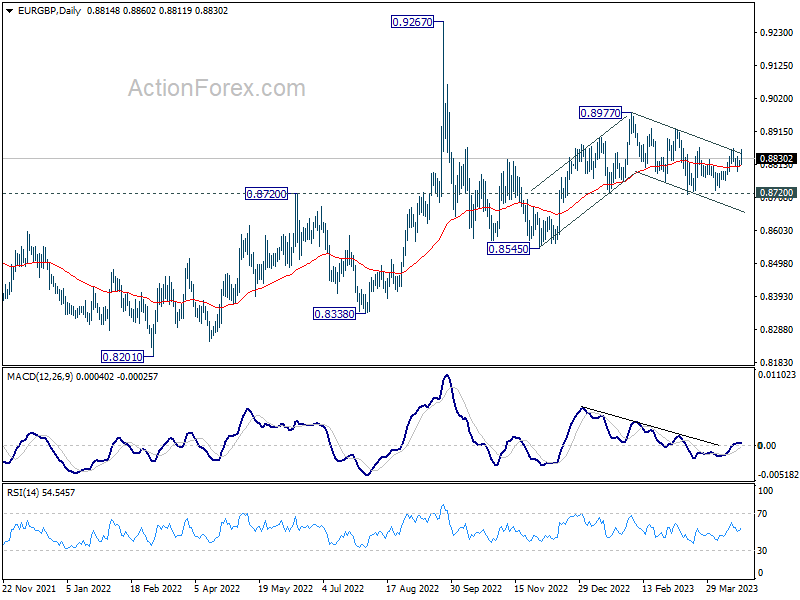
In the bigger picture, outlook remains rather mixed for now, except that price actions from 0.9267 (2022 high) are part of the long term range pattern from 0.9499 (2020 high). With 0.8720 support intact, rise from 0.8545 is in favor to continue through 0.8977. However, firm break of 0.8720 will argue that such rebound has completed, and open up deeper fall through this support level.
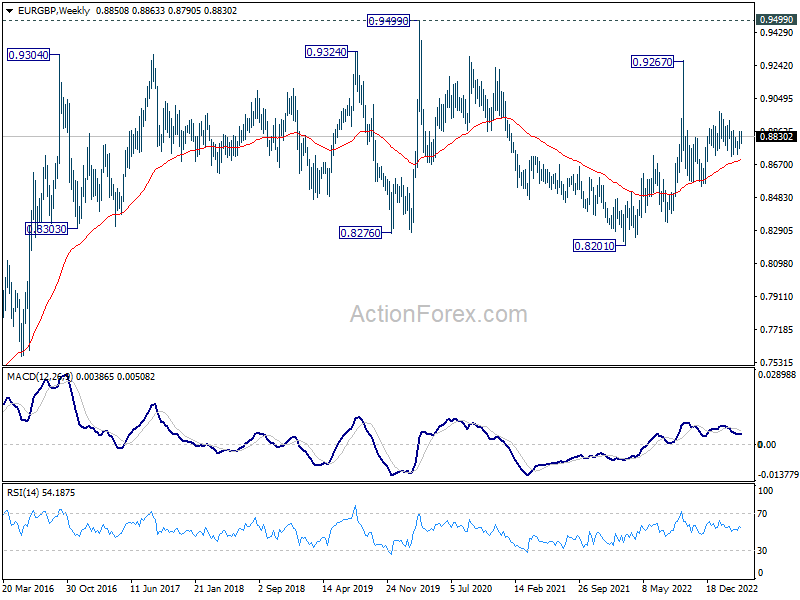
In the long term picture, long term range pattern is extending. But rise from 0.6935 (2015 low) is expected to extend at a later stage, to 0.9799 (2009 high).
EUR/AUD Weekly Outlook
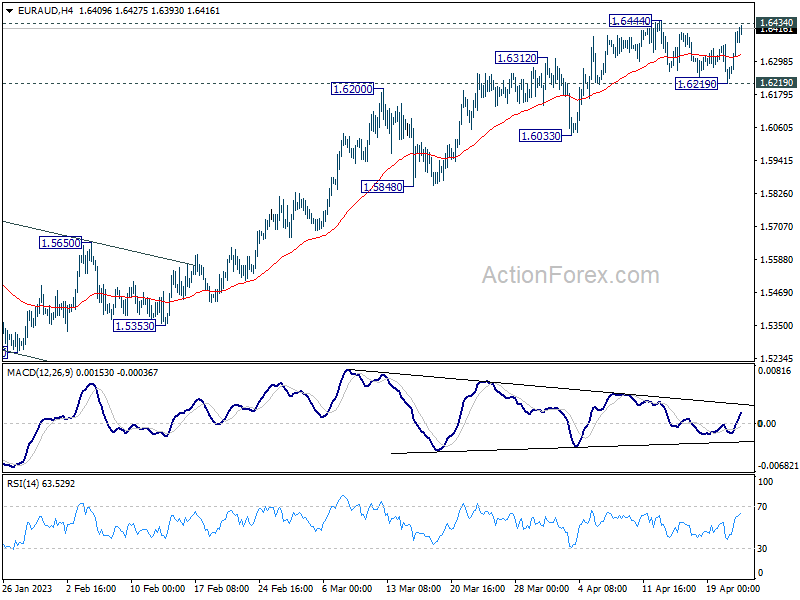
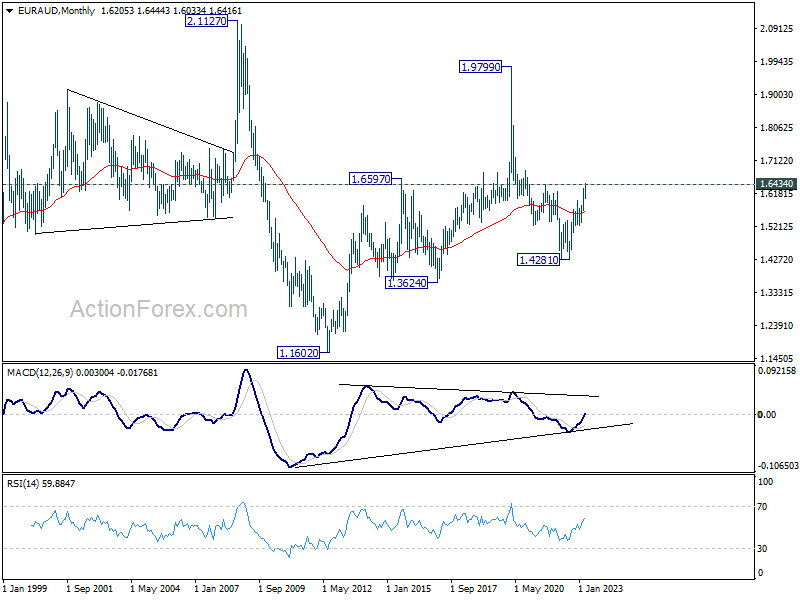
EUR/AUD extended the consolidation from 1.6444 last week. Immediate focus is now on 1.6444 after the strong rebound from 1.6219. Decisive break of 1.6434/44 resistance will carry larger bullish implications. Rally from 1.4281 should target 100% projection of 1.4281 to 1.5976 from 1.5254 at 1.6949. However, considering bearish divergence condition in 4H MACD, firm break of 1.6219 support should confirm short term topping, after rejection by 1.6389/6434 cluster resistance zone. Intraday bias will be back on the downside in this case, to 1.6033 support and possibly below.
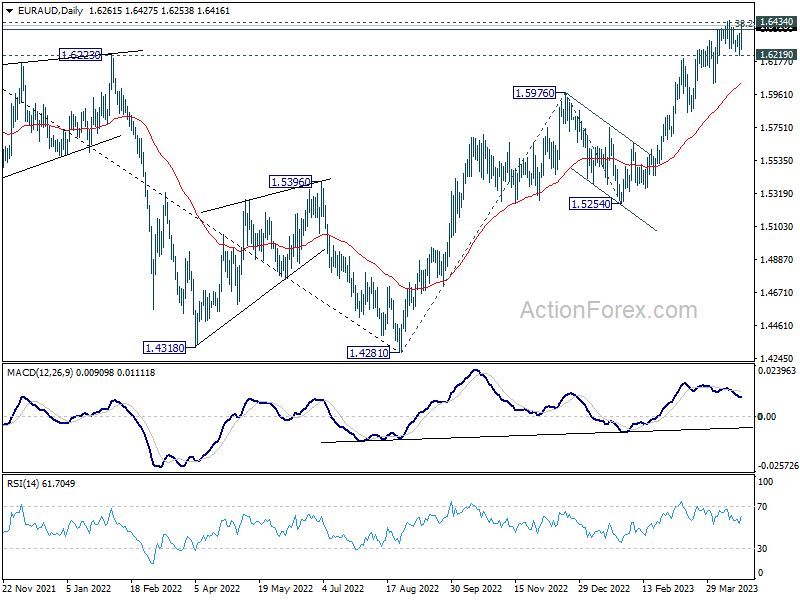
In the bigger picture, focus stays on 1.6389/6434 cluster resistance (38.2% retracement of 1.9799 to 1.4281 at 1.6389). Sustained break there should confirm that whole down trend from 1.9799 (2020 high) has completed. Further rally should then be seen to 61.8% retracement at 1.7691. However, rejection by this cluster resistance will make medium term outlook neutral at best.
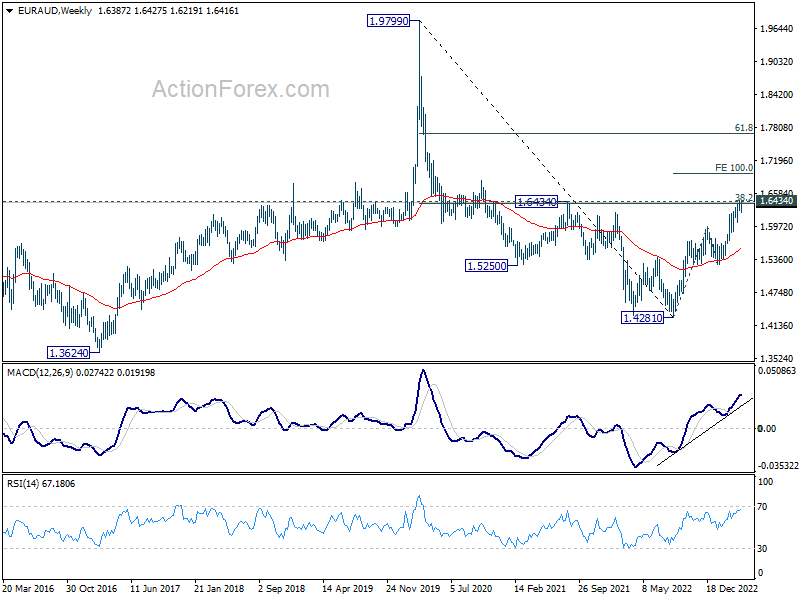
In the longer term picture, the strong break above 55 M EMA (now at 1.5646) raised the chance of bullish trend reversal. Firm break of 1.6434 resistance should confirm that the down trend from 1.9799 has completed. It's still early to decide if the up trend from 1.1602 (2012 low) is resuming. An assessment will be made after rise from 1.4281 reveals more of its structure.
EUR/CHF Weekly Outlook
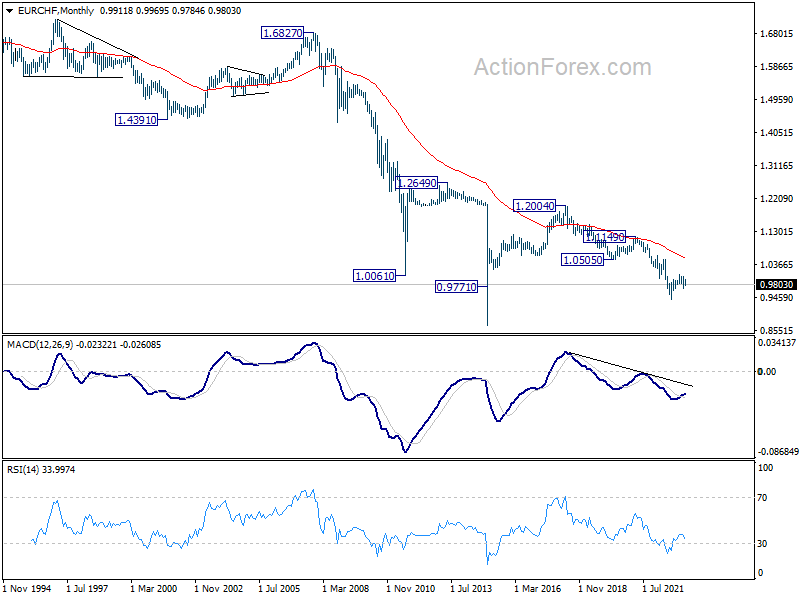
EUR/CHF's fall form 0.9996 continued last week and outlook is unchanged. This decline is seen as part of the whole correction from 1.0095. Deeper fall would be seen to 0.9704 and below. On the upside, however, break of 0.9846 resistance will indicate short term bottoming, and turn bias back to the upside for stronger rebound.
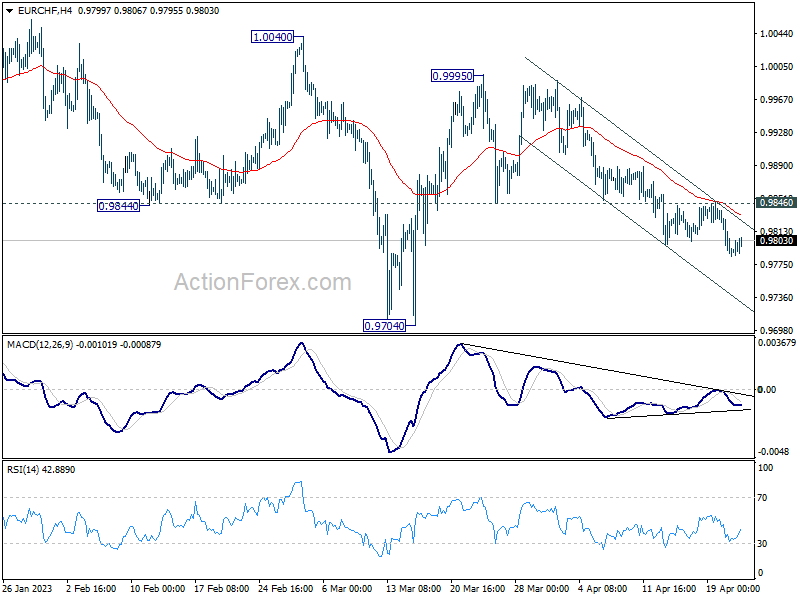
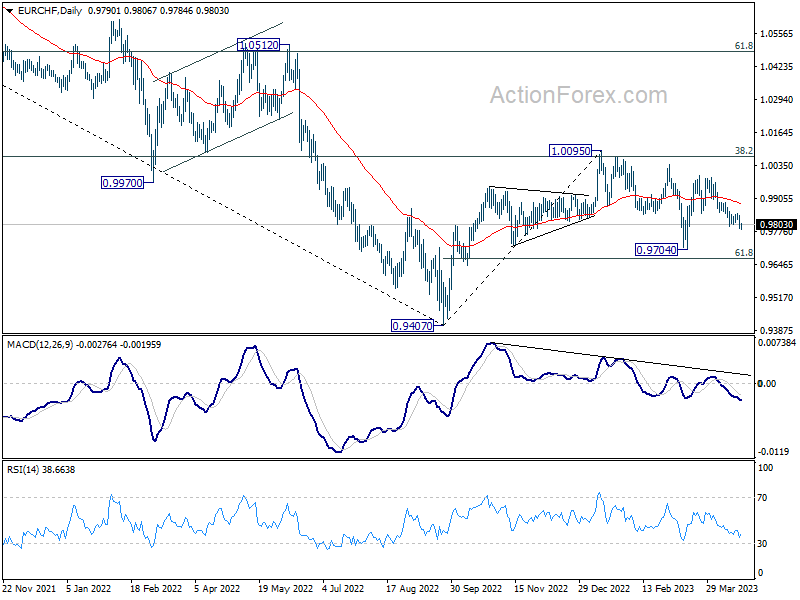
In the bigger picture, prior rejection by 55 W EMA (now at 0.9989) and 38.2% retracement of 1.1149 to 0.9407 at 1.0072 suggests that medium term outlook is staying bearish. That is, down trend from 1.2004 is not completed yet and is in favor to resume through 0.9407 at a later stage. However, decisive break of 1.0095 resistance will raise the chance of bullish trend reversal. Rise from 0.9407 should then target 1.0505 cluster resistance (2020 low at 1.0505, 61.8% retracement of 1.1149 to 0.9407 at 1.1484).
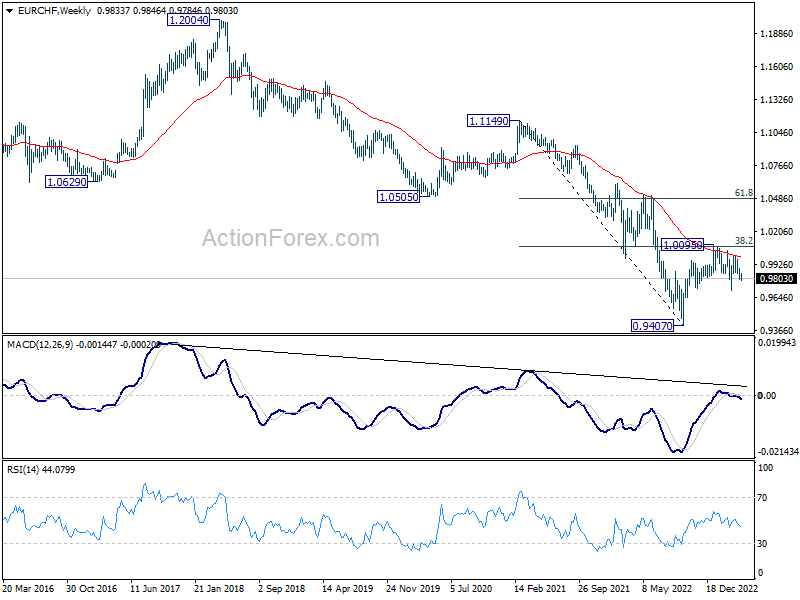
In the long term picture, it's still way too early too call for bullish trend reversal with upside capped well below 55 M EMA (now at 1.0566) and 1.0505 support turned resistance (2020 low). The multi-decade down trend could still continue.
Market Focused on Central Bank Expectations, Commodity Currencies Struggle
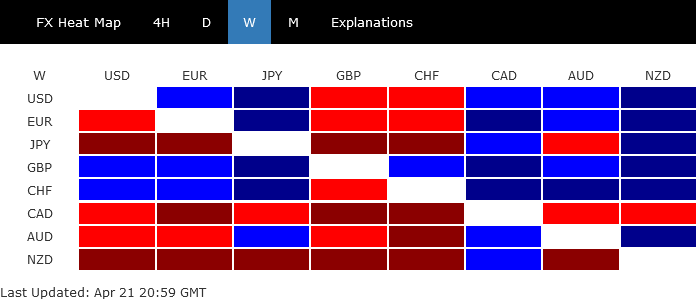
Last week, market movements centered around central bank policy expectations, with limited clear alternate influences. Comments from Fed officials and recent economic data suggest that Fed's tightening cycle is not over yet. This pushed US Treasury yields higher, but stock market indexes remained relatively stable. The steady market sentiment slightly restrained Dollar's rally momentum, leading to a mixed performance.
In the UK, higher-than-expected inflation figures reinforced the possibility of additional rate hikes. Swiss Franc also gained strength based on expectations of further SNB rate hikes in the second quarter. While Euro trailed behind the Pound and Franc, it held its ground against other currencies. It is important to note that Dollar, Euro, Sterling, and Swiss Franc all closed against each other within their previous week's range, indicating limited progress.
Conversely, commodity currencies and Yen struggled last week. Cooling inflation data weighed down Kiwi and Loonie, while Aussie fared slightly better. However, the prevailing view remains that any RBA rate hike in May would likely be the final one in this cycle. Despite Japan experiencing higher inflation by their own standards, it is not expected that BoJ will alter its ultra-loose monetary policy in the near future.
Commodity Currencies Struggle on Central Bank Policy Outlook
Commodity currencies closed the week as the worst performers, despite resilience in US and European equities. The selloff in commodity currencies was driven primarily by the anticipated monetary paths for their respective central banks rather than risk aversion.
BoC has held interest rates steady at 4.50% in their last two meetings. With March's CPI data showing a slowdown in inflation to 4.3% yoy, there is currently no significant evidence to "accumulate" to prompt BoC to reconsider tightening.
New Zealand's Q1 CPI rose by a mere 1.2% qoq, significantly lower than RBNZ's forecast of 1.8% qoq. Annual reading also slowed from 7.2% yoy to 6.7% yoy, missing expectation and was well below RBNZ's projection of a rise to 7.3% yoy. The data raised hopes that the next 25bps move in May to 5.50% could be the last in the tightening cycle. Some even speculate that RBNZ might pause next month.
RBA minutes revealed that a rate hike was considered at this month's meeting. Expectations for a final rate hike in May are contingent on Q1 CPI data to be released on April 26, and new economic projections at May meeting. Even if another raise is delivered, it would likely be the last in the RBA's tightening cycle.
On the other hand, in the UK CPI remained stubbornly high and just ticked slightly down from 10.4% to 10.1% yoy in March. Core CPI was unchanged at 6.2%. The case for another hike by BoE in May is strong, and there could be more onwards. ECB officials have made it clear that tightening is not finished, and the strong rebound in Eurozone growth, led by services, gives the ECB more room to focus on fighting inflation. Meanwhile, markets are pricing in an 89% chance of another 25bps Federal Reserve rate hike in May, with the probability of a rate cut in September dropping below 50%.
GBP/CAD and EUR/AUD Ready to Resume Up Trend, NZD/USD Down
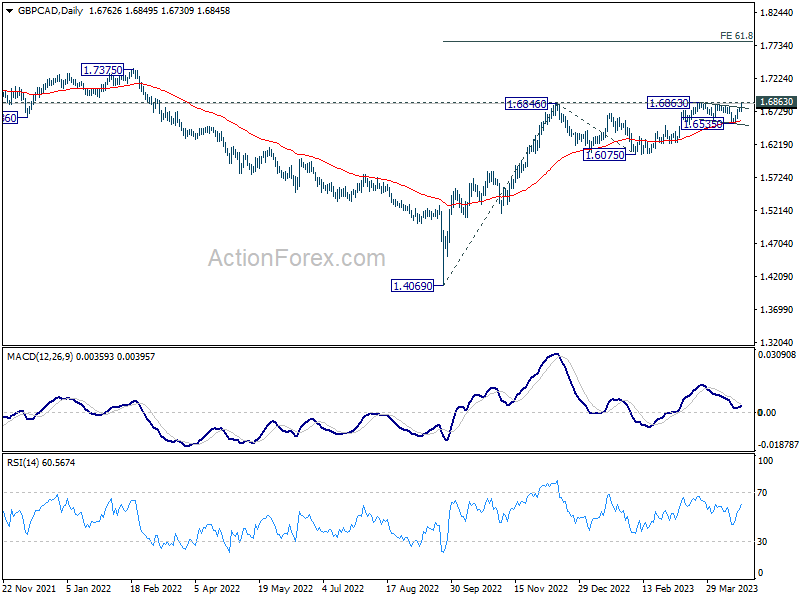
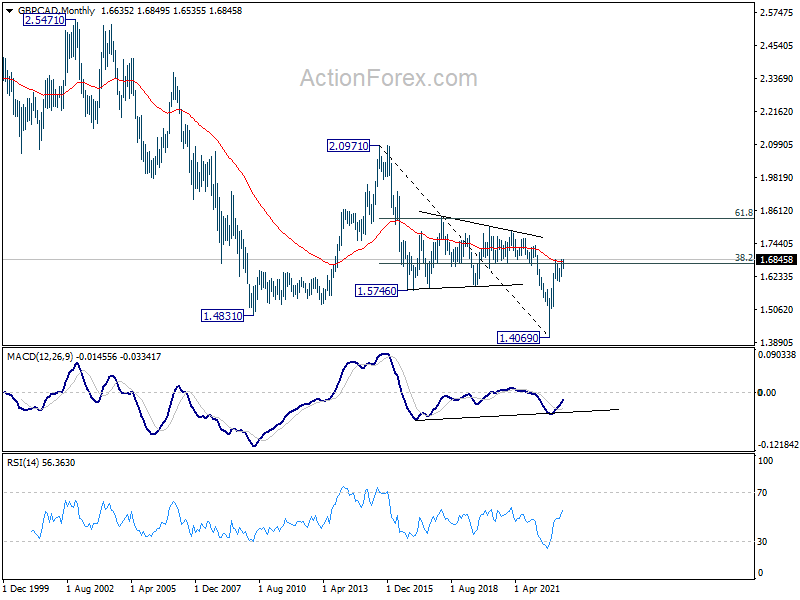
GBP/CAD's consolidation pattern from 1.6863 should have completed at 1.6536 after drawing support form 55 D EMA. Immediate focus is now on 1.6863 after last week's strong rally. Decisive break there will confirm resumption of whole up trend from 1.4069 (2022 low). Next target would be 61.8% projection of 1.4069 to 1.6846 from 1.6075 at 1.7791.
More importantly, it should be noted that both 55 W EMA (now at 1.6780) and 38.2% retracement of 2.0971 (2015 high) to 1.4069 at 1.6706 should be considered decisively taken out on up another sustainable upmove. That would add to the case of long term trend reversal, and bring further rise to 61.8% retracement at 1.8334 and above in the medium term.
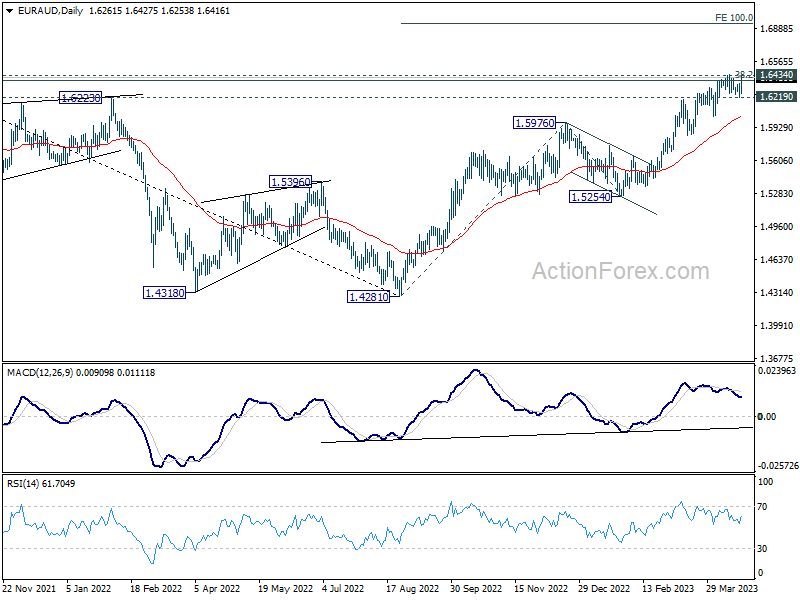
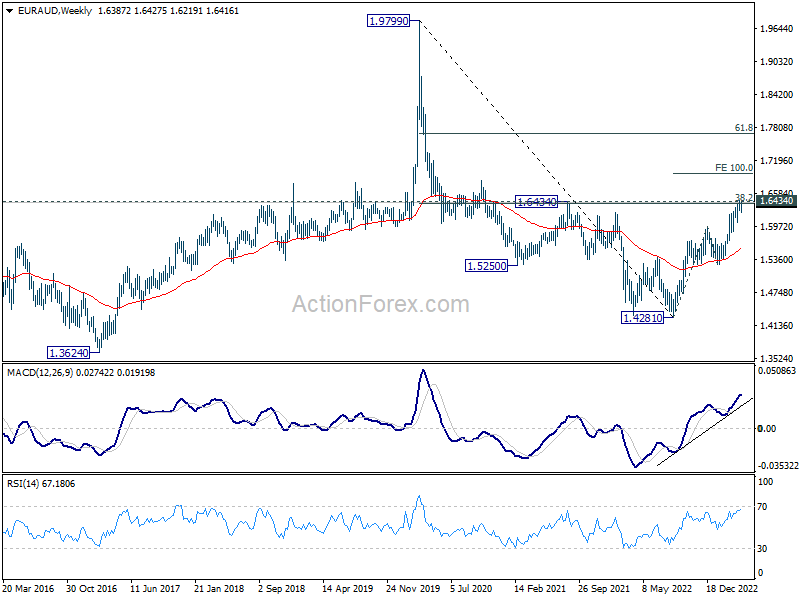
EUR/AUD's pull back from 1.6444 might have completed at 1.6219. With the late rebound, immediate focus is now on 1.6434/44 resistance zone. Decisive break there will resume the larger up trend from 1.4281 to 100% projection of 1.4281 to 1.5976 from 1.5254 at 1.6949.
More importantly, sustained break of 1.6434 cluster resistance (38.2% retracement of 1.9799 to 1.4281 at 1.6389) will add to the case that EUR/AUD is already reversing whole down trend from 1.9799 (2020 high). Stronger rally would be seen to 61.8% retracement at 1.7691 in the medium term.
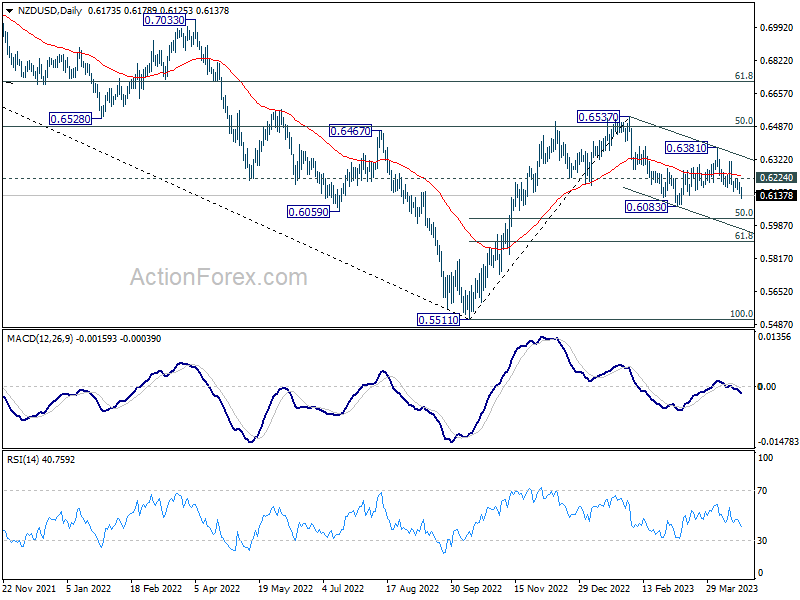
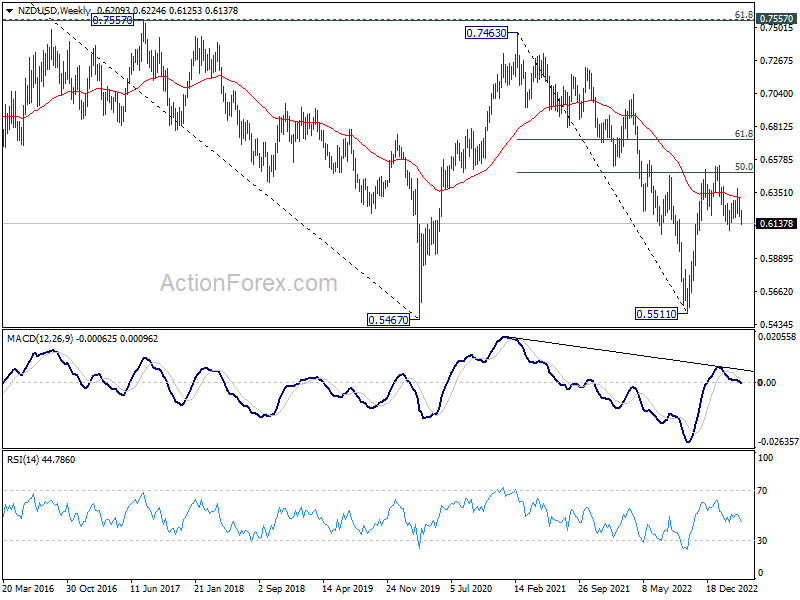
NZD/USD also gyrated lower last week. Current development suggests that the decline from 0.6537 is still in progress. Deeper fall is expected as long as 0.6224 resistance holds, to 0.6083 support and below. For now, such decline is seen as a corrective move. Without downside acceleration, strong support should be seen around 50% retracement of 0.5511 to 0.6537 at 0.6024 to bring rebound.
However, it should also be noted that medium term outlook in NZD/USD is leaning more towards the bearish side, after failing to sustain above 55 W EMA (now at 0.6307) on multiple attempts. Any downside acceleration could prompt more sustainable selloff through 61.8% retracement of 0.5511 to 0.6537 at 0.5903 towards 0.5511 low in the medium term.
US Stocks Resilient in Tight Range, Yields Attempting Rally
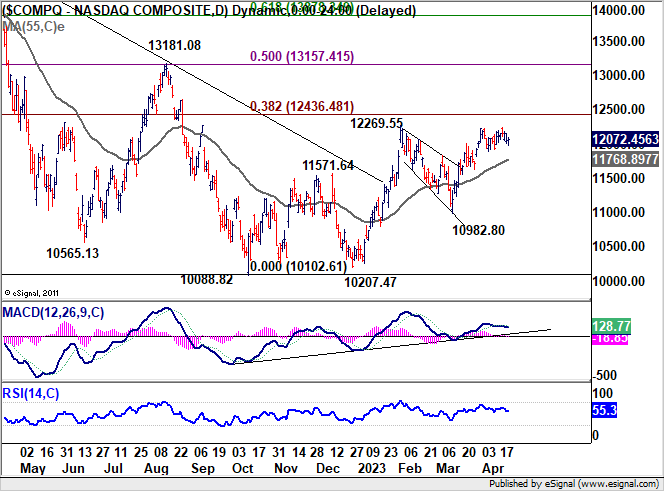
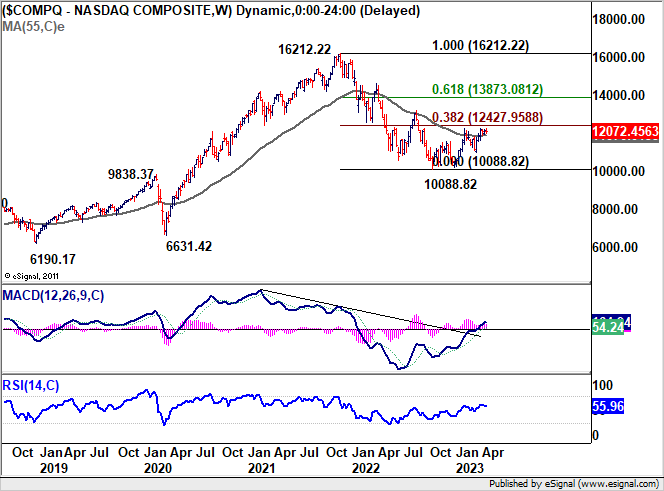
It was a relatively light week in the US last week. Major stock indexes were sluggish but stayed resilient in spite of expectations that interest rates will stay high for longer. NASDAQ lost some upside momentum just ahead of 12269.55 resistance and extended sideway trading. For now, near term outlook will remain bullish as long as 55 D EMA holds (now at 11768.89). The key barrier lies in 38.2% retracement of 16212.22 to 10088.82 at 12427.95. Rejection by this fibonacci resistance will keep the case of down trend resumption alive and favor another fall through 10088.82 at a later stage. However, sustained trading above 12427.95 will be a bullish signal that should at least set the stage for stronger rally to 61.8% retracement at 13873.08.
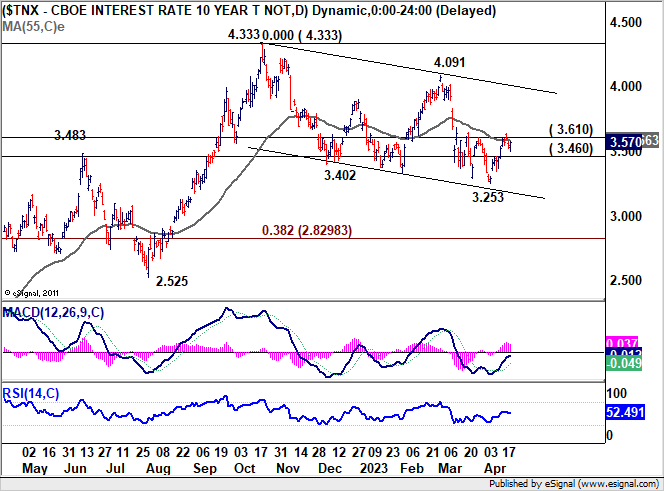
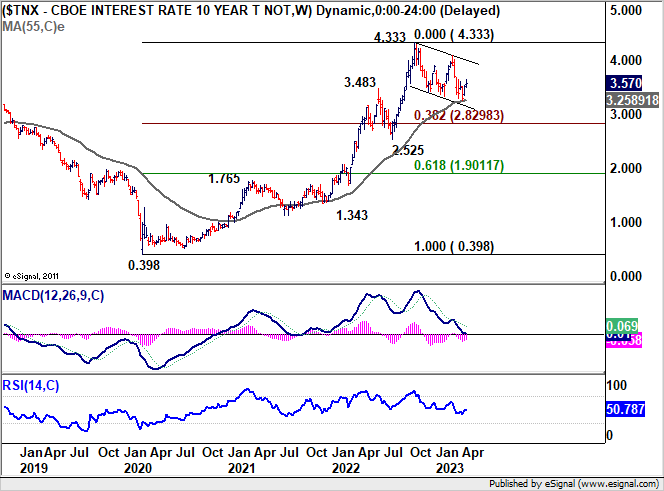
US 10-year yield hit as high as 3.639 last week but failed to close above 3.610 resistance, nor 55 D EMA (now at 3.582). For now, further rise is expected as long as 3.460 minor support holds. The favored case is that whole correction from 4.333 has completed with three waves down to 3.351, just ahead of 55 W EMA (now at 3.258). Sustained break of 3.610 will add to this bullish case and target 4.091 resistance next. However, break of 3.460 will indicate rejection by 3.610 and the 55 D EMA, and open up deeper fall through 3.351 to extend the correction from 4.333.
Dollar Index Struggles to Extend Gains, Outlook Depends on Risk Sentiment and Yields
Dollar index edged higher last week but struggled to extend gain. For now, the favored case is that fall from 105.88 is the second leg of the corrective pattern from 100.82, and has completed at 100.78. Break of 102.80 resistance would support this view and potentially trigger a stronger rally back to the 105.88 resistance as the third leg of the pattern.
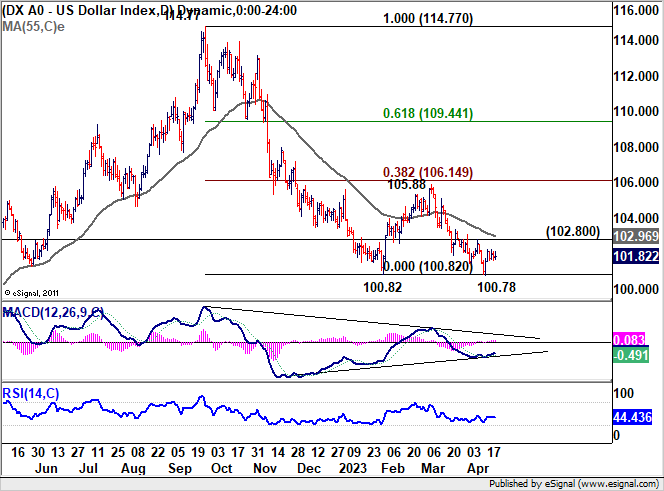
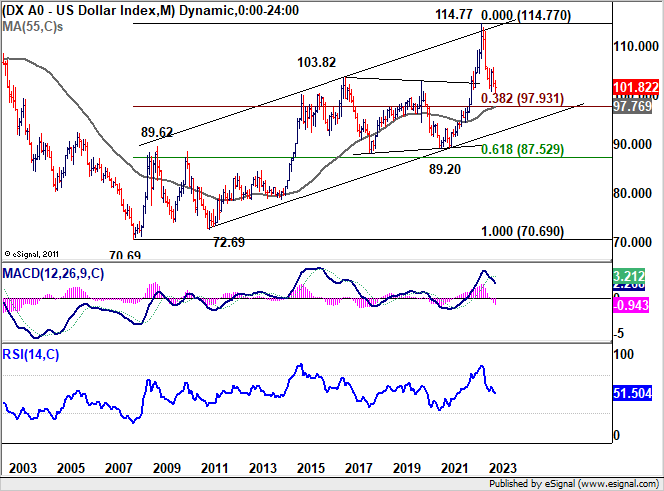
However, decisive break below 100.82 would dampen this view, and resume the whole down trend from 114.77 instead. In this case, DXY may only find enough support for rebound at 55 M EMA (now at 97.76), which is near to 38.2% retracement of 70.69 to 114.77 at 97.93.
Ultimately, Dollar Index's next move will depend heavily on both the trajectory of risk sentiment and treasury yields.
USD/CAD Weekly Outlook
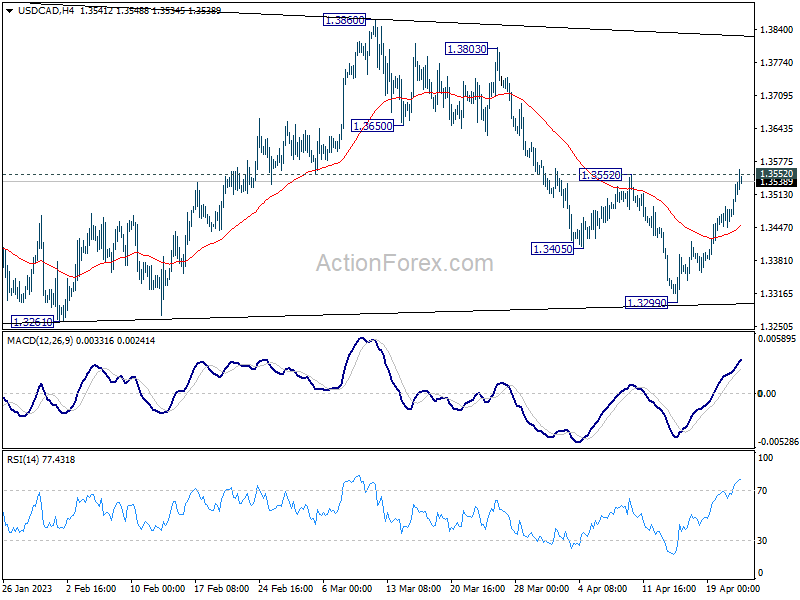
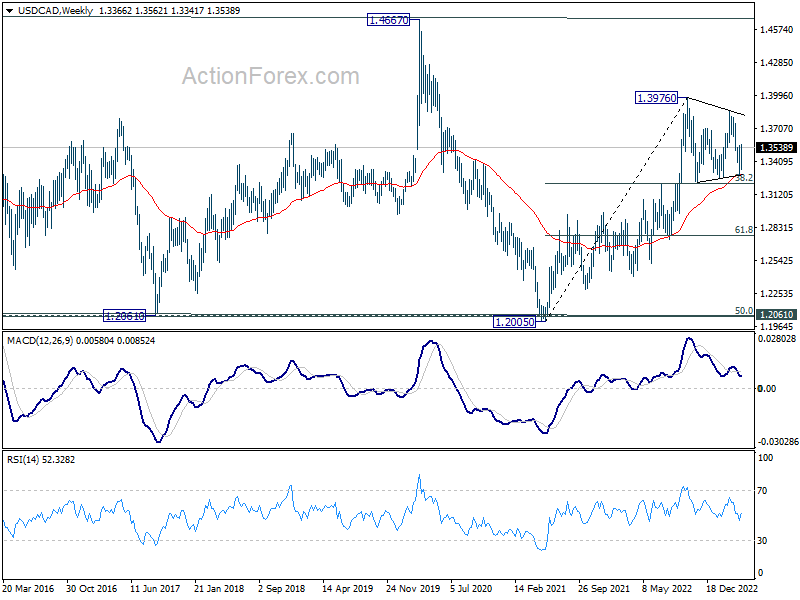
USD/CAD's rebound from 1.3299 extended higher last week. Immediate focus is now on 1.3352 resistance. As noted before, price actions from 1.3976 are seen as a corrective pattern with fall from 1.3860 as the third leg. Decisive break of 1.3552 will argue that such corrective pattern has completed. Further rally should then be seen back to 1.3860/3976 resistance zone.
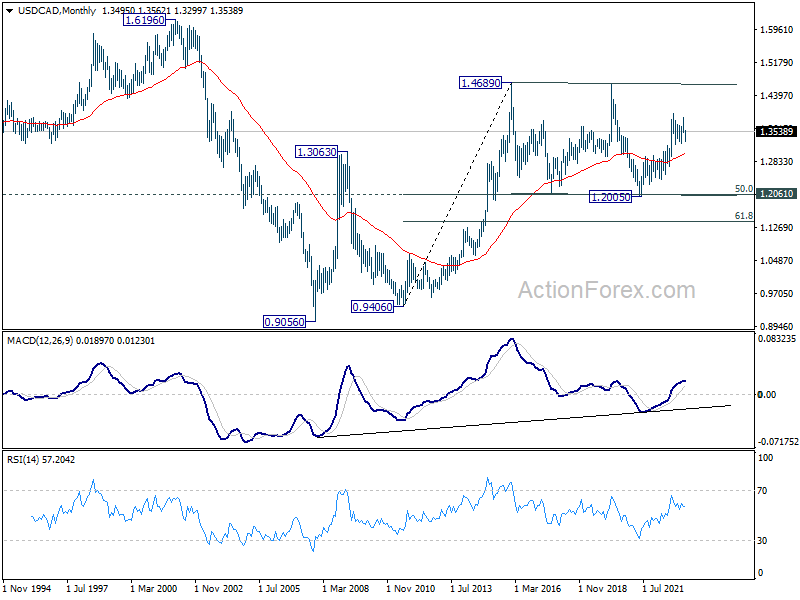
In the bigger picture, the up trend from 1.2005 (2021 low) is still in progress. Break of 1.3976 will confirm resumption and target 61.8% projection of 1.2401 to 1.3976 from 1.3261 at 1.4234. Firm break there will pave the way to long term resistance zone at 1.4667/89 (2016, 2020 highs). On the downside, sustained break of 55 W EMA (now at 1.3302) is needed to confirm medium term topping. Otherwise, outlook will remain bullish even in case of deep pull back.
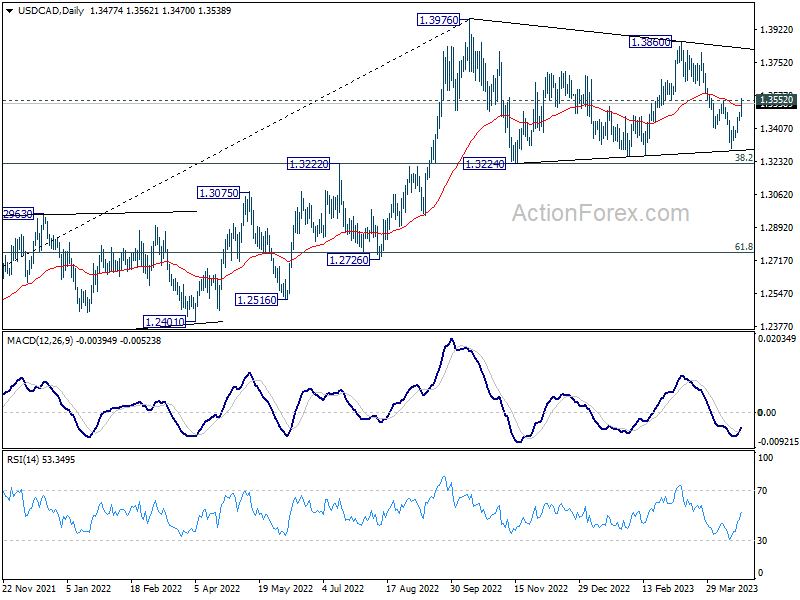
In the longer term picture, price actions from 1.4689 (2016 high) are seen as a consolidation pattern only, which might have completed at 1.2005. That is, up trend from 0.9506 (2007 low) is expected to resume at a later stage. This will remain the favored case as 55 M EMA (now at 1.3012) holds.
Summary 4/24 – 4/28
Monday, Apr 24, 2023
| GMT | Ccy | Events | Consensus | Previous |
|---|---|---|---|---|
| 08:00 | EUR | Germany IFO Business Climate Apr | 94.0 | 93.3 |
| 08:00 | EUR | Germany IFO Current Assessment Apr | 96.1 | 95.4 |
| 08:00 | EUR | Germany IFO Expectations Apr | 91.6 | 91.2 |
| 12:30 | CAD | New Housing Price Index M/M Mar | 0.10% | -0.20% |
| 23:50 | JPY | Corporate Service Price Index Y/Y Mar | 1.60% | 1.80% |
| GMT | Ccy | Events | |
|---|---|---|---|
| 08:00 | EUR | Germany IFO Business Climate Apr | |
| Forecast: 94.0 | Previous: 93.3 | ||
| 08:00 | EUR | Germany IFO Current Assessment Apr | |
| Forecast: 96.1 | Previous: 95.4 | ||
| 08:00 | EUR | Germany IFO Expectations Apr | |
| Forecast: 91.6 | Previous: 91.2 | ||
| 12:30 | CAD | New Housing Price Index M/M Mar | |
| Forecast: 0.10% | Previous: -0.20% | ||
| 23:50 | JPY | Corporate Service Price Index Y/Y Mar | |
| Forecast: 1.60% | Previous: 1.80% | ||
Tuesday, Apr 25, 2023
| GMT | Ccy | Events | Consensus | Previous |
|---|---|---|---|---|
| 06:00 | CHF | Trade Balance (CHF) Mar | 4.20B | 3.31B |
| 06:00 | GBP | Public Sector Net Borrowing (GBP) Mar | 12.2B | 15.9B |
| 13:00 | USD | S&P/Case-Shiller Home Price Indices Y/Y Feb | 1.80% | 2.50% |
| 13:00 | USD | Housing Price Index M/M Feb | -0.20% | 0.20% |
| 14:00 | USD | Consumer Confidence Apr | 104.1 | 104.2 |
| 14:00 | USD | New Home Sales Mar | 630K | 640K |
| 22:45 | NZD | Trade Balance (NZD) Mar | -500M | -714M |
| GMT | Ccy | Events | |
|---|---|---|---|
| 06:00 | CHF | Trade Balance (CHF) Mar | |
| Forecast: 4.20B | Previous: 3.31B | ||
| 06:00 | GBP | Public Sector Net Borrowing (GBP) Mar | |
| Forecast: 12.2B | Previous: 15.9B | ||
| 13:00 | USD | S&P/Case-Shiller Home Price Indices Y/Y Feb | |
| Forecast: 1.80% | Previous: 2.50% | ||
| 13:00 | USD | Housing Price Index M/M Feb | |
| Forecast: -0.20% | Previous: 0.20% | ||
| 14:00 | USD | Consumer Confidence Apr | |
| Forecast: 104.1 | Previous: 104.2 | ||
| 14:00 | USD | New Home Sales Mar | |
| Forecast: 630K | Previous: 640K | ||
| 22:45 | NZD | Trade Balance (NZD) Mar | |
| Forecast: -500M | Previous: -714M | ||
Wednesday, Apr 26, 2023
| GMT | Ccy | Events | Consensus | Previous |
|---|---|---|---|---|
| 01:30 | AUD | Monthly CPI Y/Y Mar | 6.50% | 6.80% |
| 01:30 | AUD | CPI Q/Q Q1 | 1.30% | 1.90% |
| 01:30 | AUD | CPI Y/Y Q1 | 6.90% | 7.80% |
| 01:30 | AUD | RBA Trimmed Mean CPI Q/Q Q1 | 1.40% | 1.70% |
| 01:30 | AUD | RBA Trimmed Mean CPI Y/Y Q1 | 7.20% | 6.90% |
| 06:00 | EUR | Germany Gfk Consumer Confidence May | -27.5 | -29.5 |
| 08:00 | CHF | Credit Suisse Economic Expectations Apr | -41.3 | |
| 12:30 | USD | Goods Trade Balance (USD) Mar P | -89.8B | -91.6B |
| 12:30 | USD | Wholesale Inventories Mar P | 0.00% | 0.10% |
| 12:30 | USD | Durable Goods Orders Mar | 0.80% | -1.00% |
| 12:30 | USD | Durable Goods Orders ex Transport Mar | -0.20% | -0.10% |
| 14:30 | USD | Crude Oil Inventories | -4.6M |
| GMT | Ccy | Events | |
|---|---|---|---|
| 01:30 | AUD | Monthly CPI Y/Y Mar | |
| Forecast: 6.50% | Previous: 6.80% | ||
| 01:30 | AUD | CPI Q/Q Q1 | |
| Forecast: 1.30% | Previous: 1.90% | ||
| 01:30 | AUD | CPI Y/Y Q1 | |
| Forecast: 6.90% | Previous: 7.80% | ||
| 01:30 | AUD | RBA Trimmed Mean CPI Q/Q Q1 | |
| Forecast: 1.40% | Previous: 1.70% | ||
| 01:30 | AUD | RBA Trimmed Mean CPI Y/Y Q1 | |
| Forecast: 7.20% | Previous: 6.90% | ||
| 06:00 | EUR | Germany Gfk Consumer Confidence May | |
| Forecast: -27.5 | Previous: -29.5 | ||
| 08:00 | CHF | Credit Suisse Economic Expectations Apr | |
| Forecast: | Previous: -41.3 | ||
| 12:30 | USD | Goods Trade Balance (USD) Mar P | |
| Forecast: -89.8B | Previous: -91.6B | ||
| 12:30 | USD | Wholesale Inventories Mar P | |
| Forecast: 0.00% | Previous: 0.10% | ||
| 12:30 | USD | Durable Goods Orders Mar | |
| Forecast: 0.80% | Previous: -1.00% | ||
| 12:30 | USD | Durable Goods Orders ex Transport Mar | |
| Forecast: -0.20% | Previous: -0.10% | ||
| 14:30 | USD | Crude Oil Inventories | |
| Forecast: | Previous: -4.6M | ||
Thursday, Apr 27, 2023
| GMT | Ccy | Events | Consensus | Previous |
|---|---|---|---|---|
| 01:00 | NZD | ANZ Business Confidence Apr | -43.4 | |
| 01:30 | AUD | Import Price Index Q/Q Q1 | 0.60% | 1.80% |
| 09:00 | EUR | Eurozone Economic Sentiment Indicator Apr | 99.9 | 99.3 |
| 09:00 | EUR | Eurozone Services Sentiment Apr | 9.5 | 9.4 |
| 09:00 | EUR | Eurozone Industrial Confidence Apr | 0.2 | -0.2 |
| 09:00 | EUR | Eurozone Consumer Confidence Apr F | -17.5 | -17.5 |
| 12:30 | USD | Initial Jobless Claims (Apr 21) | 245K | 245K |
| 12:30 | USD | GDP Annualized Q1 P | 2.00% | 2.60% |
| 12:30 | USD | GDP Price Index Q1 P | 3.70% | 3.90% |
| 14:00 | USD | Pending Home Sales M/M Mar | 1.00% | 0.80% |
| 14:30 | USD | Natural Gas Storage | 75B | |
| 23:30 | JPY | Tokyo CPI Core Y/Y Apr | 3.20% | 3.20% |
| 23:50 | JPY | Industrial Production M/M Mar P | 0.40% | 4.60% |
| 23:50 | JPY | Retail Trade Y/Y Mar | 6.50% | 6.60% |
| 23:30 | JPY | Unemployment Rate Mar | 2.50% | 2.60% |
| GMT | Ccy | Events | |
|---|---|---|---|
| 01:00 | NZD | ANZ Business Confidence Apr | |
| Forecast: | Previous: -43.4 | ||
| 01:30 | AUD | Import Price Index Q/Q Q1 | |
| Forecast: 0.60% | Previous: 1.80% | ||
| 09:00 | EUR | Eurozone Economic Sentiment Indicator Apr | |
| Forecast: 99.9 | Previous: 99.3 | ||
| 09:00 | EUR | Eurozone Services Sentiment Apr | |
| Forecast: 9.5 | Previous: 9.4 | ||
| 09:00 | EUR | Eurozone Industrial Confidence Apr | |
| Forecast: 0.2 | Previous: -0.2 | ||
| 09:00 | EUR | Eurozone Consumer Confidence Apr F | |
| Forecast: -17.5 | Previous: -17.5 | ||
| 12:30 | USD | Initial Jobless Claims (Apr 21) | |
| Forecast: 245K | Previous: 245K | ||
| 12:30 | USD | GDP Annualized Q1 P | |
| Forecast: 2.00% | Previous: 2.60% | ||
| 12:30 | USD | GDP Price Index Q1 P | |
| Forecast: 3.70% | Previous: 3.90% | ||
| 14:00 | USD | Pending Home Sales M/M Mar | |
| Forecast: 1.00% | Previous: 0.80% | ||
| 14:30 | USD | Natural Gas Storage | |
| Forecast: | Previous: 75B | ||
| 23:30 | JPY | Tokyo CPI Core Y/Y Apr | |
| Forecast: 3.20% | Previous: 3.20% | ||
| 23:50 | JPY | Industrial Production M/M Mar P | |
| Forecast: 0.40% | Previous: 4.60% | ||
| 23:50 | JPY | Retail Trade Y/Y Mar | |
| Forecast: 6.50% | Previous: 6.60% | ||
| 23:30 | JPY | Unemployment Rate Mar | |
| Forecast: 2.50% | Previous: 2.60% | ||
Friday, Apr 28, 2023
| GMT | Ccy | Events | Consensus | Previous |
|---|---|---|---|---|
| JPY | BoJ Interest Rate Decision | -0.10% | -0.10% | |
| 01:30 | AUD | Private Sector Credit M/M Mar | 0.30% | 0.30% |
| 01:30 | AUD | PPI Q/Q Q1 | 0.70% | |
| 01:30 | AUD | PPI Y/Y Q1 | 5.80% | |
| 05:00 | JPY | Housing Starts Y/Y Mar | -3.70% | -0.30% |
| 05:30 | EUR | France GDP Q/Q Q1 P | 0.10% | 0.10% |
| 06:00 | EUR | Germany Import Price Index M/M Mar | -0.90% | -2.40% |
| 06:30 | CHF | Real Retail Sales Y/Y Mar | 0.40% | 0.30% |
| 07:00 | CHF | KOF Leading Indicator Apr | 98.0 | 98.2 |
| 07:55 | EUR | Germany Unemployment Change Mar | 10K | 16K |
| 07:55 | EUR | Germany Unemployment Rate Mar | 5.60% | 5.60% |
| 08:00 | EUR | Italy GDP Q/Q Q1 P | 0.20% | -0.10% |
| 08:00 | EUR | Germany GDP Q/Q Q1 P | 0.10% | -0.40% |
| 09:00 | EUR | Eurozone GDP Q/Q Q1 P | 0.10% | 0.00% |
| 12:00 | EUR | Germany CPI M/M Apr P | 0.60% | 0.80% |
| 12:00 | EUR | Germany CPI Y/Y Apr P | 7.30% | 7.40% |
| 12:30 | CAD | GDP M/M Feb | 0.50% | |
| 12:30 | USD | Personal Income M/M Mar | 0.20% | 0.30% |
| 12:30 | USD | Personal Spending Mar | -0.10% | 0.20% |
| 12:30 | USD | PCE Price Index M/M Mar | 0.30% | 0.30% |
| 12:30 | USD | PCE Price Index Y/Y Mar | 4.60% | 5.00% |
| 12:30 | USD | Core PCE Price Index M/M Mar | 0.30% | 0.30% |
| 12:30 | USD | Core PCE Price Index Y/Y Mar | 4.50% | 4.60% |
| 12:30 | USD | Employment Cost Index Q1 | 1.10% | 1.00% |
| 13:45 | USD | Chicago PMI Apr | 43.7 | 43.8 |
| 14:00 | USD | Michigan Consumer Sentiment Index Apr F | 63.5 | 63.5 |
| GMT | Ccy | Events | |
|---|---|---|---|
| JPY | BoJ Interest Rate Decision | ||
| Forecast: -0.10% | Previous: -0.10% | ||
| 01:30 | AUD | Private Sector Credit M/M Mar | |
| Forecast: 0.30% | Previous: 0.30% | ||
| 01:30 | AUD | PPI Q/Q Q1 | |
| Forecast: | Previous: 0.70% | ||
| 01:30 | AUD | PPI Y/Y Q1 | |
| Forecast: | Previous: 5.80% | ||
| 05:00 | JPY | Housing Starts Y/Y Mar | |
| Forecast: -3.70% | Previous: -0.30% | ||
| 05:30 | EUR | France GDP Q/Q Q1 P | |
| Forecast: 0.10% | Previous: 0.10% | ||
| 06:00 | EUR | Germany Import Price Index M/M Mar | |
| Forecast: -0.90% | Previous: -2.40% | ||
| 06:30 | CHF | Real Retail Sales Y/Y Mar | |
| Forecast: 0.40% | Previous: 0.30% | ||
| 07:00 | CHF | KOF Leading Indicator Apr | |
| Forecast: 98.0 | Previous: 98.2 | ||
| 07:55 | EUR | Germany Unemployment Change Mar | |
| Forecast: 10K | Previous: 16K | ||
| 07:55 | EUR | Germany Unemployment Rate Mar | |
| Forecast: 5.60% | Previous: 5.60% | ||
| 08:00 | EUR | Italy GDP Q/Q Q1 P | |
| Forecast: 0.20% | Previous: -0.10% | ||
| 08:00 | EUR | Germany GDP Q/Q Q1 P | |
| Forecast: 0.10% | Previous: -0.40% | ||
| 09:00 | EUR | Eurozone GDP Q/Q Q1 P | |
| Forecast: 0.10% | Previous: 0.00% | ||
| 12:00 | EUR | Germany CPI M/M Apr P | |
| Forecast: 0.60% | Previous: 0.80% | ||
| 12:00 | EUR | Germany CPI Y/Y Apr P | |
| Forecast: 7.30% | Previous: 7.40% | ||
| 12:30 | CAD | GDP M/M Feb | |
| Forecast: | Previous: 0.50% | ||
| 12:30 | USD | Personal Income M/M Mar | |
| Forecast: 0.20% | Previous: 0.30% | ||
| 12:30 | USD | Personal Spending Mar | |
| Forecast: -0.10% | Previous: 0.20% | ||
| 12:30 | USD | PCE Price Index M/M Mar | |
| Forecast: 0.30% | Previous: 0.30% | ||
| 12:30 | USD | PCE Price Index Y/Y Mar | |
| Forecast: 4.60% | Previous: 5.00% | ||
| 12:30 | USD | Core PCE Price Index M/M Mar | |
| Forecast: 0.30% | Previous: 0.30% | ||
| 12:30 | USD | Core PCE Price Index Y/Y Mar | |
| Forecast: 4.50% | Previous: 4.60% | ||
| 12:30 | USD | Employment Cost Index Q1 | |
| Forecast: 1.10% | Previous: 1.00% | ||
| 13:45 | USD | Chicago PMI Apr | |
| Forecast: 43.7 | Previous: 43.8 | ||
| 14:00 | USD | Michigan Consumer Sentiment Index Apr F | |
| Forecast: 63.5 | Previous: 63.5 | ||
The Weekly Bottom Line: Housing Falls as the Fed Blackout Period Begins
U.S. Highlights
- China’s economy saw solid growth in the first quarter, with a strong rebound in consumption and exports after lockdowns were lifted at the end of last year.
- U.S. existing home sales fell by 2.4% month-on-month (m/m) in March, falling from February’s revised 13.8% m/m uptick as past mortgage rate increases weighed on demand.
- FOMC members noted that they continue to monitor credit conditions, but many seem to be in favor of further policy tightening at the next meeting in May.
Canadian Highlights
- Canadian inflation continued to ease in March, coming in at 4.3% year-on-year, as energy prices weighed on the overall index.
- Core inflation rates also fell, but to a lesser degree, as strength in the Canadian economy has led to an upturn in the cyclical components of inflation (supercore).
- Although today’s retail sales data showed that Canadians pared back on goods spending, our internal TD data revealed that this was more about consumers shifting to services rather than an outright pull back in spending.
U.S. - Housing Falls as the Fed Blackout Period Begins
As earnings season picked up pace this week, markets were closely attuned to the first quarter performance of U.S. companies. However, the net result on equity markets was muted, as results that were on aggregate moderately positive were partially overshadowed by the downbeat outlook for demand amid the expected economic slowdown later this year. As of the time of writing, the S&P 500 is down 0.5% on the week while the ten-year Treasury yield is up 5 basis-points (bps) to 3.57%.
On the global economic data front, we kicked off the week with first quarter Chinese GDP data, which grew by 4.5% from its year-ago level. The print was better than expected, as pent-up demand from consumers powered growth. China’s economic rebound is expected to be short-lived as consumer exuberance fades and structural headwinds continue to weigh on the economy in the back half of the year.
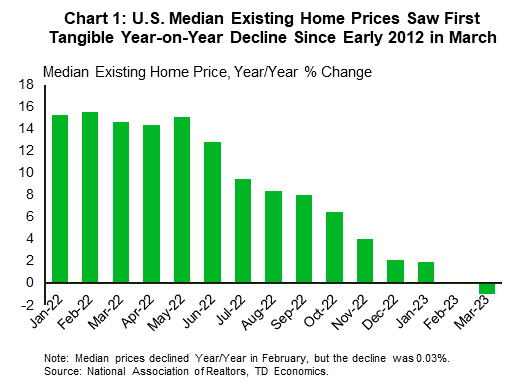
In the U.S. we had a housing-centric week for economic data, with updates on both existing home sales and residential construction. Data released on Thursday showed that existing home sales fell by 2.4% month-on-month (m/m) in March, pulling back from February’s revised 13.8% m/m increase. Month-to-month changes have been mirroring the volatility seen in mortgage rates (with a lag) as elevated prices have increased the reliance of buyers on financing conditions. While median home prices declined for a second consecutive month relative to year-ago levels (Chart 1), the seasonally adjusted change between February and March was slightly positive. Prices have been held up in part due to low inventory levels. However, new home construction is picking up, with single-family housing starts recovering for a second consecutive month in March, after eleven straight months of declines.
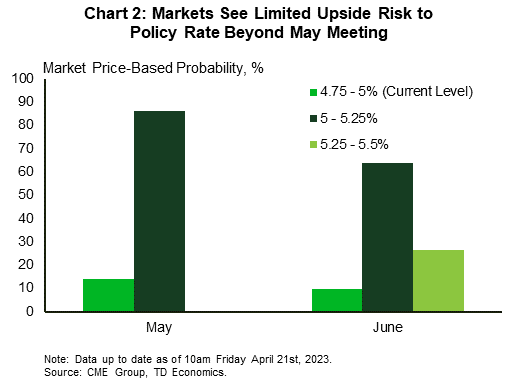
With the Federal Reserve’s pre-meeting blackout period starting on Saturday, we won’t hear from any FOMC members again until Chair Powell’s press conference on May 3rd. Luckily, we heard from ten Fed officials this week, six of whom are voting members. Most of the speakers noted that they were continuing to monitor credit conditions for signs of further stress. The Fed’s regional monitoring in April’s Beige Book stating that “several Districts noted that banks tightened lending standards amid increased uncertainty and concerns about liquidity”. Although this may aid the Fed in tightening credit conditions, as noted by Chicago Fed President Goolsbee this week, most members seemed to agree that further policy tightening would be required to sustainably return inflation to the Fed’s 2% target. As of the time of writing, markets are expecting the Fed to hike by 25bps in May, and then hold in June (Chart 2).
Next week we’ll get a first look at first quarter U.S. GDP and March PCE inflation, both of which are expected to show signs of cooling. Our forecast calls for activity to continue to slow through the remainder of 2023. This should help ease inflation pressures, enabling the Fed to keep the funds rate at 5.25% for the rest of the year.
Canada – It's a Bird, It's a Plane, It's Supercore!
March's inflation data was under the microscope this week, and it continued its steady deceleration. The headline Consumer Price Index (CPI) was up 4.3% year-on-year (y/y), a significant drop from its reading of 5.2% y/y in February and its peak of 8.1% y/y last June. This trend is likely to continue. We expect that inflation is on course to flirt with the 3% upper bound of the Bank of Canada's (BoC's) target range this summer.
So far, headline inflation has cooled largely due to an easing in supply chain bottlenecks and steep decline in commodity prices over the last eight months. As a result, goods inflation has fallen to 3.6% y/y (down from 11.2% in June 2022), while energy inflation has turned negative, at -6.9% y/y. Energy prices are expected to continue to weigh on goods inflation over the next few months. This is the main reason why we are confident that inflation is likely to slow to a 3% pace in short order.
However, the BoC has stated it won't be happy with 3% inflation. It wants to finish the job and get to 2%. Central bankers typically look at core inflation measures as a guidepost to underlying inflation pressures, since things like food and energy can be volatile. Core inflation has come down, but at a much slower pace than headline inflation. The BoC's preferred metrics, trimmed mean and median inflation, came in slightly higher than headline CPI, at 4.4% y/y and 4.6% y/y, respectively. The story is more concerning when we look at our index of 'supercore' inflation (cyclical inflation in services), which posted a 6.3% y/y print (Chart 1)! If these core metrics don't start to fall decisively, the BoC will be hard pressed to stabilize inflation at its 2% goal.
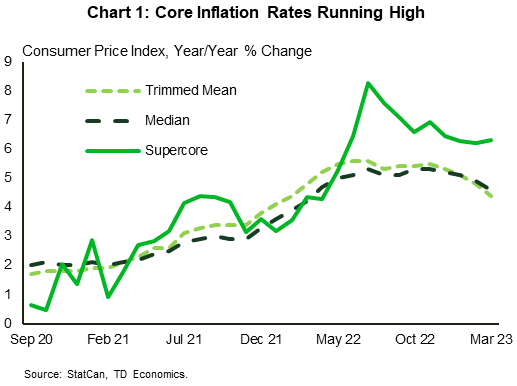
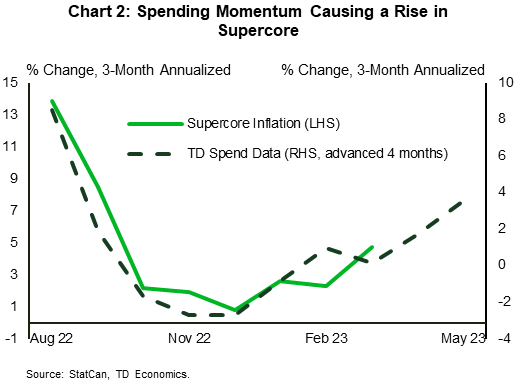
Core inflation rates have failed to move lower because consumer spending has seen a revival recently. Labour markets have continued to expand at an average pace of 62 thousand new jobs every month (4 times the trend pace) and governments are supporting peoples' incomes through debt financed transfers. No wonder our internal TD credit/debit card data have shown that total spending has been on the rise. Spending on services has fueled this growth – rising more than 4% month-on-month (m/m) in February, as Canadians shifted away from spending on goods. In that sense, today's retail sales data confirmed what we already knew, as retail spending (goods) fell 0.2% m/m in February. As we show in Chart 2, total spending in Canada is surging (Chart 2). And given that consumer demand is the main driver of cyclical inflation, we expect that supercore inflation will keep rising over the coming months.
The BoC is likely concerned about this. Although it has seen a cooling in interest rate sensitive parts of the economy like housing – as evidenced by the 11% drop in housing starts released this week – the cyclical thrust in other areas has intensified. This is likely why Governor Macklem has been reenforcing the message that rates will need to stay higher for longer. Or rather, rates will stay high for as long as it takes for renewed momentum to fizzle out.
Weekly Economic & Financial Commentary: Give Thought to the Pause
Summary
United States: A Downturn Is Still in the Cards
- Data released this week support our expectations for a recession in the second half of the year. The LEI continued to flash contraction as early signs of labor market weakening are starting to emerge. Meanwhile, a batch of housing data confirmed that a full-fledged housing market recovery is still far off.
- Next week: Durable Goods (Wed), GDP (Thu), Personal Income & Spending (Fri)
International: Global Growth Prospects Continue to Improve
- Early this week, China reported Q1-2023 GDP data, a widely anticipated data release. Q1 data offered markets an opportunity to gauge how China's economy performed after authorities lifted Zero-COVID policies around the end of last year. The key takeaway was that China's economy performed better than expected, growing 2.2% on a quarterly basis and 4.5% on a year-over-year basis.
- Next week: Central Bank of Turkey (Thu), Eurozone GDP (Fri), Bank of Japan (Fri)
Interest Rate Watch: Give Thought to the Pause
- The fastest pace of policy tightening since the early 1980s is winding down. Our forecast anticipates one more quarter-point rate hike at the upcoming FOMC meeting on May 3, after which we suspect the Fed will remain on hold until the fourth quarter. Had we not encountered a banking crisis, a few more rate increases might have been in the offing. However, the recent difficulties in the financial sector diminish the need for further hikes beyond May, in our view.
Credit Market Insights: Fed's Beige Book Brings Some Color to Recent Financial Turmoil
- On Wednesday, the latest edition of the Federal Reserve’s Beige Book was released, covering the month of March and through early April. The previous Beige Book was published in early March but quickly became stale following the failures of Silicon Valley Bank and Signature Bank. The latest read covers the period following recent financial turmoil and the fallout it has caused.
Week Ahead – Spotlight on BoJ’s Ueda as First Meeting Looms; US and Eurozone Data Eyed Too
The Bank of Japan will hold its first policy meeting under the stewardship of Kazuo Ueda next week, although it’s looking unlikely that he will kick things off with a bang. The focus may therefore quickly shift to GDP numbers out of the United States and Eurozone where both economies are expected to have dodged a recession, while the all-important PCE inflation report will be one of the final pieces of the rate puzzle before the Fed’s May decision.
Ueda to play it safe at his first meeting
The banking crisis may have been a blessing in disguise for the Bank of Japan as the turmoil sent Japanese government bond (JGB) yields diving, taking the pressure off policymakers to make any imminent tweaks to their controversial yield curve control policy. The 10-year yield, which the BoJ aims to keep below 0.50%, has not breached this cap since the crisis first unfolded.
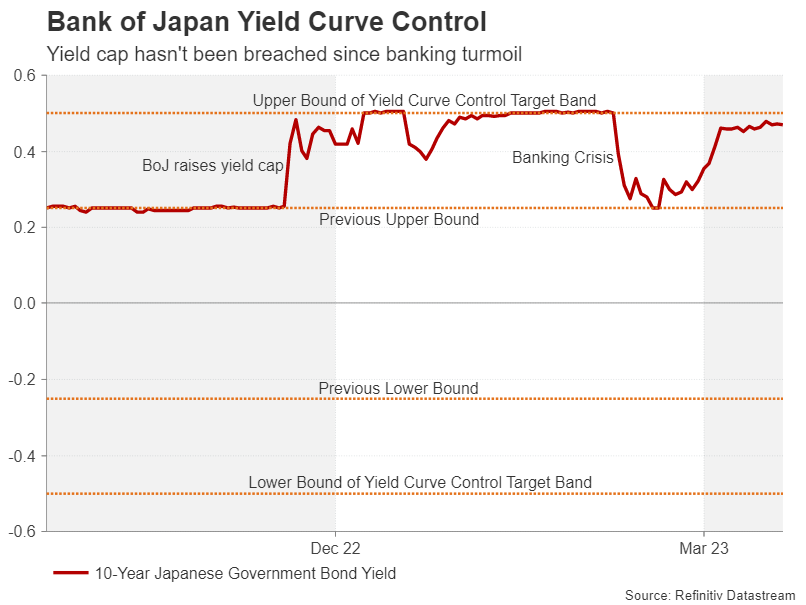
However, most market participants see it as only a matter of time before the Bank makes further adjustments to rein in its ultra-accommodative policies even though inflation now appears to be on the way down. If as expected, Ueda delivers no surprises in his inaugural meeting on Friday and keeps all of the BoJ’s monetary policy settings unchanged, investors will be hunting for clues about the timing of any possible tweak.
Ueda has so far not strayed too far from his predecessor’s stance, signalling that he wants to see stronger wage growth before altering the policy course. However, his tone on achieving this goal has been somewhat more optimistic and he may use his first post-meeting press conference to lay the groundwork for eventually phasing out yield curve control.
The Bank will also be publishing an updated set of quarterly projections, thus, the forecast on inflation will also guide the markets on where policy might be headed. In addition, there’s a barrage of Japanese economic indicators on the agenda too, the majority of which are due on Thursday and will include April CPI figures for Tokyo, preliminary industrial production readings, as well as retail sales and jobs stats.
The yen may not necessarily react much to the data but should Ueda hint at some kind of a change later in the year, the currency is likely to gain versus its peers.
Eurozone GDP probably rebounded mildly in Q1
The Eurozone economy grinded to a halt at the end of last year, but it’s expected to have eked out modest growth in the first three months of 2023. Lower fuel prices and a relatively mild winter that didn’t leave households completely out of pocket likely helped the euro area avoid a recession, at least for now. The flash GDP estimates out on Friday are forecast to show GDP rising by 0.2% over the quarter.
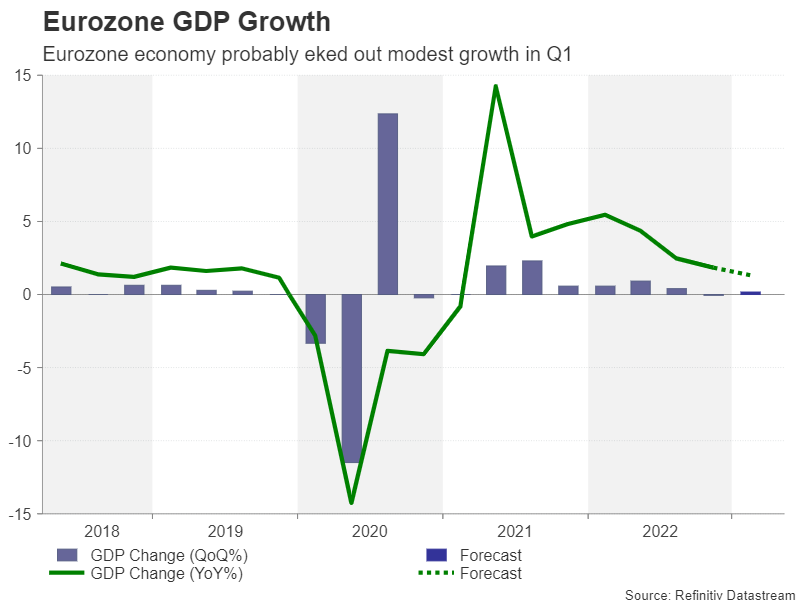
That’s not exactly cause for a huge celebration, but the outlook has improved dramatically from a few months ago, or even more recently when there was a real threat of the bank collapses in the US and Switzerland having a domino effect on Eurozone banks.
A notable miss in the GDP print might make the European Central Bank more hesitant about hiking rates by 50 basis points at its May meeting, whereas a bigger rebound would probably remove any doubts about going big.
However, ECB policymakers will also be monitoring the flash CPI figures out of Germany and France due the same day. The Eurozone-wide numbers will be released a few days later but Friday’s sneak peek still has the capacity to move the markets as a 50-bps move is only 30% priced in.
Should those odds creep up, the euro could climb higher as it fights to make a clear break above the $1.10 level.
PCE inflation to lead data-packed week in the US
Fed officials will be staying mum over the coming week as they enter the blackout period ahead of the May 2-3 policy meeting. However, there’s plenty on the US economic agenda that should provide some last-minute guidance as to what to expect from the Fed.
Starting things off is the consumer confidence index for April on Tuesday along with March new home sales. Durable goods orders will follow on Wednesday, but the first top tier release will land on Thursday with the advance estimate of Q1 GDP.
The American economy is expected to have expanded by an annualized pace of 2.0% over the period, which would imply that a recession is not imminent. Pending home sales are also due the same day.
The second highlight will be Friday’s personal income and outlays report that contains the all-important core PCE price index as well as consumption figures. Other data on Friday will include quarterly wages and the Chicago PMI.
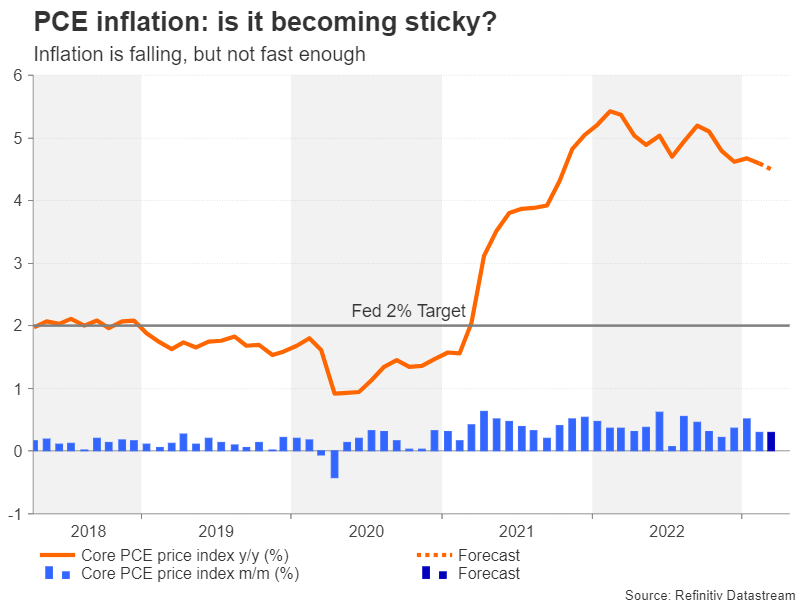
Although the Fed’s favourite price gauge has moderated significantly from its high of 5.4% in 2022, the downward progress has slowed in recent months. The core PCE price index is forecast to have edged down slightly to 4.5% y/y in March.
It is almost certain that the Fed will hike rates by 25 bps in March, but a bigger increment is highly unlikely. Nevertheless, a hotter-than-expected reading would reduce the chances of the Fed pausing in May, especially if the incoming data is overall positive.
The bigger question is whether the US dollar can enjoy a meaningful boost from a stronger set of numbers. Investors remain convinced the Fed will begin cutting rates in the second half of 2023 while other key central banks potentially remain on a hiking path.
So the data alone may not do much in tempering those dovish bets and the dollar may struggle to attract much upside unless Fed Chair Powell does a more convincing job of ratcheting up his hawkish rhetoric.
Inflation on tap in Australia
The Australian dollar regained some bullish impetus from the Reserve Bank of Australia’s latest meeting minutes that revealed that the decision to pause rate hikes was a close call. However, Wednesday’s CPI report might see some of those revived hawkish bets being wound back as inflation likely eased in the fourth quarter of 2022.
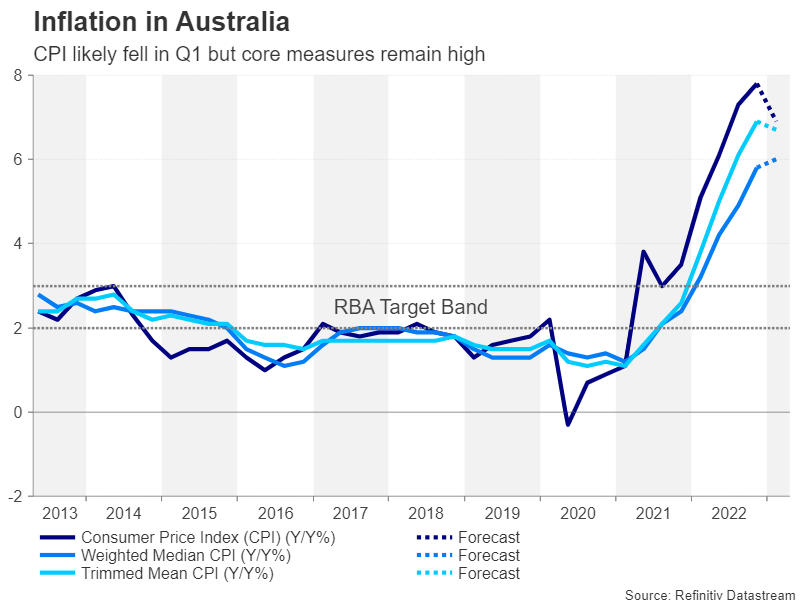
The headline rate of CPI reached a three-decade high of 7.8% at the end of 2022 but is expected to have fallen back to 6.9% in the first quarter of 2022. The March print is also due and investors will be watching to see if CPI continued to decline after the sharp drops in January and February, as well as keeping an eye on the core measures, which are only published quarterly.
If the latest price gauges reinforce the picture of subsiding inflationary pressures, the aussie might slip back against its US counterpart.
Letting the Euro Area Data Speak for Itself
With the market counting down the days to the first week of May, next week’s data releases will probably give us the strongest indication about the forthcoming ECB decision. Inflation and GDP figures set the scene for an exciting week especially as euro/dollar is trying to remain in the vicinity of 1.10.
CPI is the key for the May ECB meeting
At the March meeting the ECB announced its new data-dependent strategy. It essentially moved from the “hike-as-fast-as-possible” doctrine to a more mainstream central bank strategy. With the next meeting coming on May 4, next week's data is extremely crucial. ECB member and Dutch central bank chief Knot was quite explicit in his comment earlier this week that April inflation will determine the size of the May hike. While Knot is a known hawk, it appears that the hawks could potentially push for a stronger rate hike than the current market-anticipated move of 25bps.
While one could justify this inherent hawkishness on the fact that the ECB has the Bundesbank mentality imprinted in its DNA, it is worth considering that the inflation situation in the nearby UK might be also affecting the ECB's stance. The more hawkish members are determined to avoid high inflation becoming an everyday concern affecting long-term consumer perceptions.
Another drop in the German CPI?
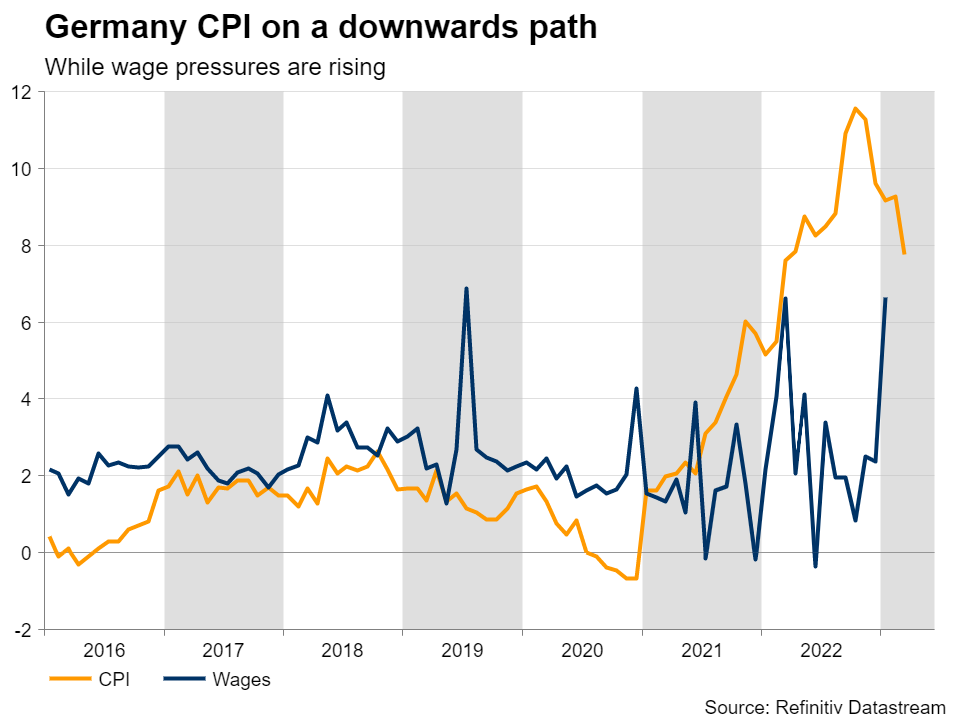
On Friday, April 28 we will get the usual release of the CPI figures for the key German states with the preliminary national print coming after midday. This is the key number by far for market sentiment. During 2022, inflation releases produced the strongest post-announcement volatility. The German CPI has been on a gentle downward trend, with the April figure expected to record another small dip to 7.2% year-on-year change. This is clearly elevated and not an easy reading for the hawks, but they can take some solace from the latest German PPI number showing a significant deceleration in the year-on-year print. On the other hand, a strong show at the German CPI would clearly open the floodgates with the immediate response being an increased possibility of a 50 bps move at the May meeting.
GDP figures might prove an unpleasant reading
Friday will commence with the preliminary GDP figures from the biggest euro area countries and the eurozone aggregate for the first quarter of 2023. Market eyes will understandably be on the German print with the consensus pointing to another negative quarter-on-quarter figure, but an improvement compared to the fourth quarter of 2022 print of -0.4% quarterly change. A second consecutive negative GDP quarter will allow for pompous headlines that Germany is officially in recession.
Semantics aside, the magnitude of the slowdown will be the key topic of discussion at the ECB halls. The IMF penciled in a -0.1% annual figure for 2023 in its April Outlook update, a view shared by the German IFO institution, and hence a weaker print at Friday’s figure will potentially open Pandora's box with more pessimistic views spreading quickly in the newswires.
Strong start of the week with the IFO survey
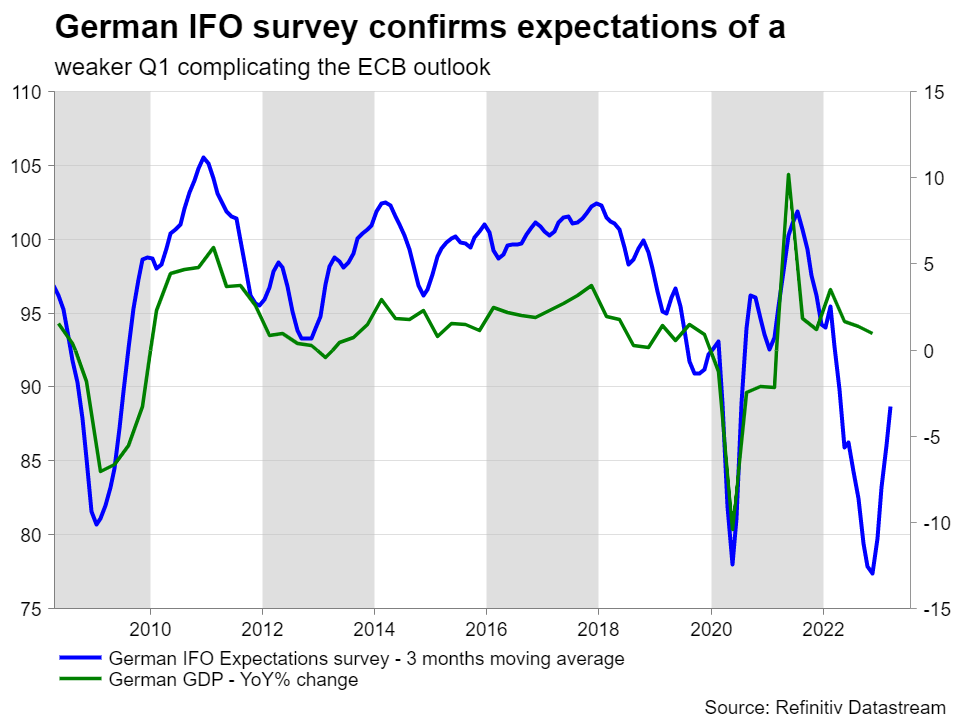
The week, though, will start on an equally high note as the German IFO survey for April will be published on Monday morning. One cannot fail to notice the impressive improvement in this survey since October 2022, but it is also true that the outright level of the Expectations component remains very low compared to its long-term average. The average of the IFO survey for the first quarter of 2023 is pointing to a downside risk in the current GDP forecast.
Similarly, the market is expecting a drop in the April IFO figures, which will not be a good discussion point for ECB hawks pushing for a 50 bps rate move in two weeks, especially as Friday's Manufacturing PMI release surprised on the downside.
Euro/pound in waiting mode
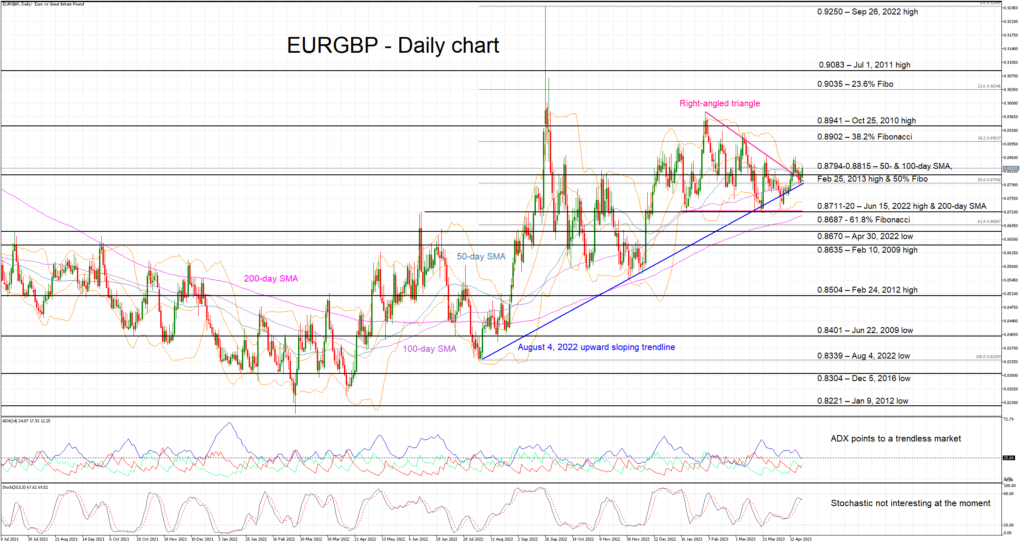
Euro/pound has been on an upward path since March 2022 lows, but it has obviously not been a one-way street. The recent range-trading activity has caused a build-up of key resistance and support points around the 0.8800 level. In addition, a right-angled triangle is trying to dictate market reaction.
With the momentum indicators confirming this delicate balance, next week’s data will most likely give the necessary push to market participants to make the first move. Euro bulls appear to have an easier path higher, at least until the 0.8902 area. On the other hand, euro bears will face considerable support at the 0.8794-0.8815 area defined by multiple SMAs and historical peaks.
Bank of Japan Preview: Risk of Tightening Too Soon Still Dominates
- We do not expect any changes to monetary policy on the new Governor Ueda's first monetary policy meeting on 28 April.
- Inflationary pressures seem persistent, especially fuelled by stronger-thanexpected wage growth, which could pave the way for the BoJ to at least tweak the Yield Curve Control (YCC) on either the June or the July meeting.
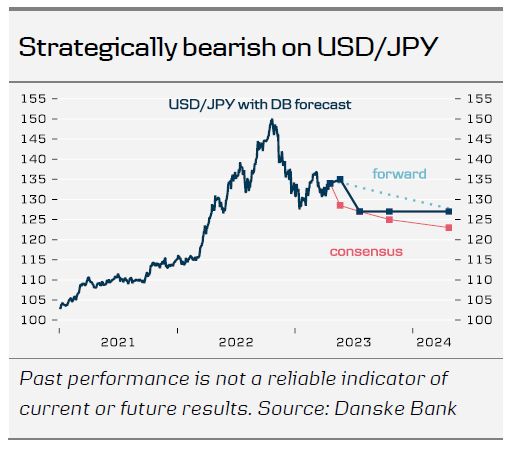
- We remain bearish on USD/JPY on a strategic horizon and expect the cross towards 127 in 3M.
Calling the timing of BoJ backtracking from its YCC is a difficult task. If the BoJ starts guiding the market by indicating a steeper JGB-curve, investors will immediately dump their bond holdings, and BoJ will be forced to throw in the towel. Thus, we should not expect any clues from the BoJ and we do not read too much into Governor Ueda's message to maintain monetary stimulus.
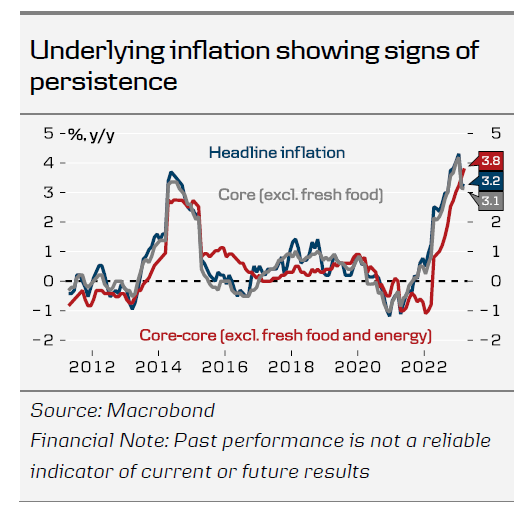
Recent CPI prints show more broad-based price pressures in Japan. Even though headline inflation fell slightly to 3.2% y/y in March, down from 3.3% in February, the core-core measure, which excludes fresh food and energy and more interesting for the BoJ, increased to 3.8% y/y in March, up from 3.5% in February, suggesting underlying price pressures are increasingly becoming more persistent. Latest figures for wage growth indicate increases well above consensus for the fiscal year of 2023. Currently the figures suggest 3.5% y/y broad nominal wage hikes, which is substantially above consensus and above the 3.0% the BoJ states is needed to obtain 2% inflation sustainably.
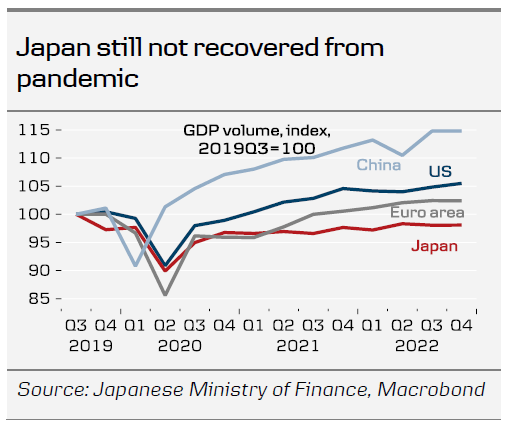
When discussing BoJ entering tightening mode, it is also important to remember that Japan, as opposed to the other big global economies, actually still has not recovered from the pandemic. Although improving, domestic private demand remains subdued due to VAThike, COVID-related lockdowns and higher inflation. Following decades with deflation, it remains a significant risk that tightening too soon sends the economy back in to deflation or low-inflation mode, before a sustainable price-wage dynamic is achieved. We think the BoJ will wait for confirmation of broad wage increases before it tightens policy. It is a fine balancing act, though, and we believe the BoJ will ultimately see the current situation as a good opportunity to finally loosen the grip on the yield curve and back away from a policy, which is highly distorting markets. However, we also know, there is no consensus on the policy board on the urgency to back off YCC.
We expect a cautious approach from the BoJ and see it slowly widening the tolerance band around the 0% 10-year JGB yield target at either the June or the July meeting. We think tweaks are more likely than an outright abandonment of the YCC – it could e.g. be by widening the YCC band from +/- 50bp to +/- 100bp.
We remain strategically bearish on USD/JPY; although we acknowledge there could be topside risk to the cross in the near-term on a relatively hawkish Fed and dovish BoJ. On the strategic horizon, our models suggest the cross is fundamentally overvalued, and together with monetary tightening from the BoJ, we forecast the cross lower at 127 in 3M.