

Sample Category Title
CAD Under Pressure
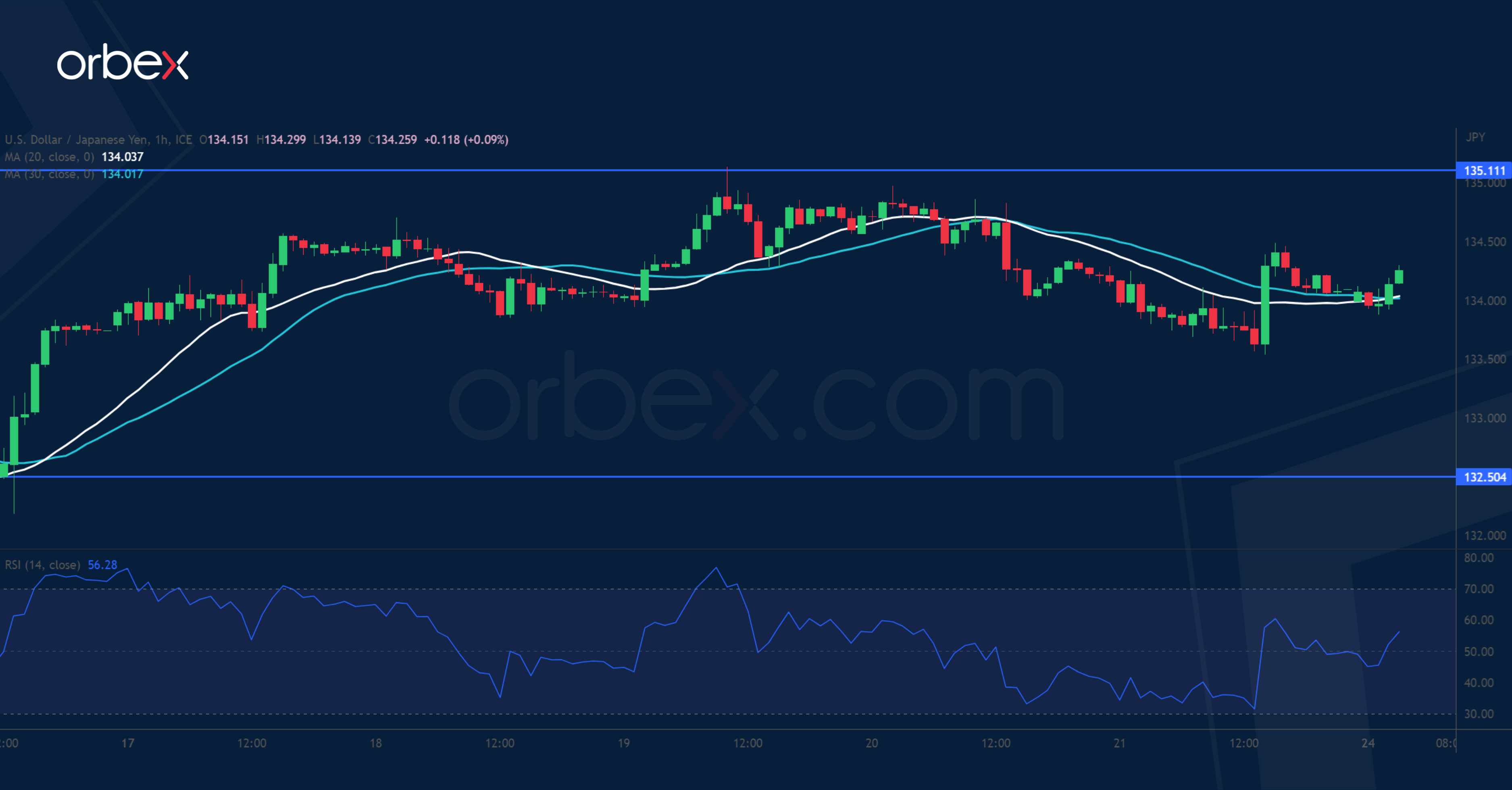
USD/JPY pulls back
The Japanese yen edged higher as inflation in March gathered speed. The price has met stiff selling pressure at the start of the mid-March sell-off at 135.10. A shooting star pattern in this supply zone carries weight and indicates a strong rejection of that level. A fall below the immediate support and the round number of 134.00 might have given short-term bulls a signal to bag their profits, driving the quote lower. 132.50 is a daily support which coincides with the base of the recent bullish momentum, making it an important floor.
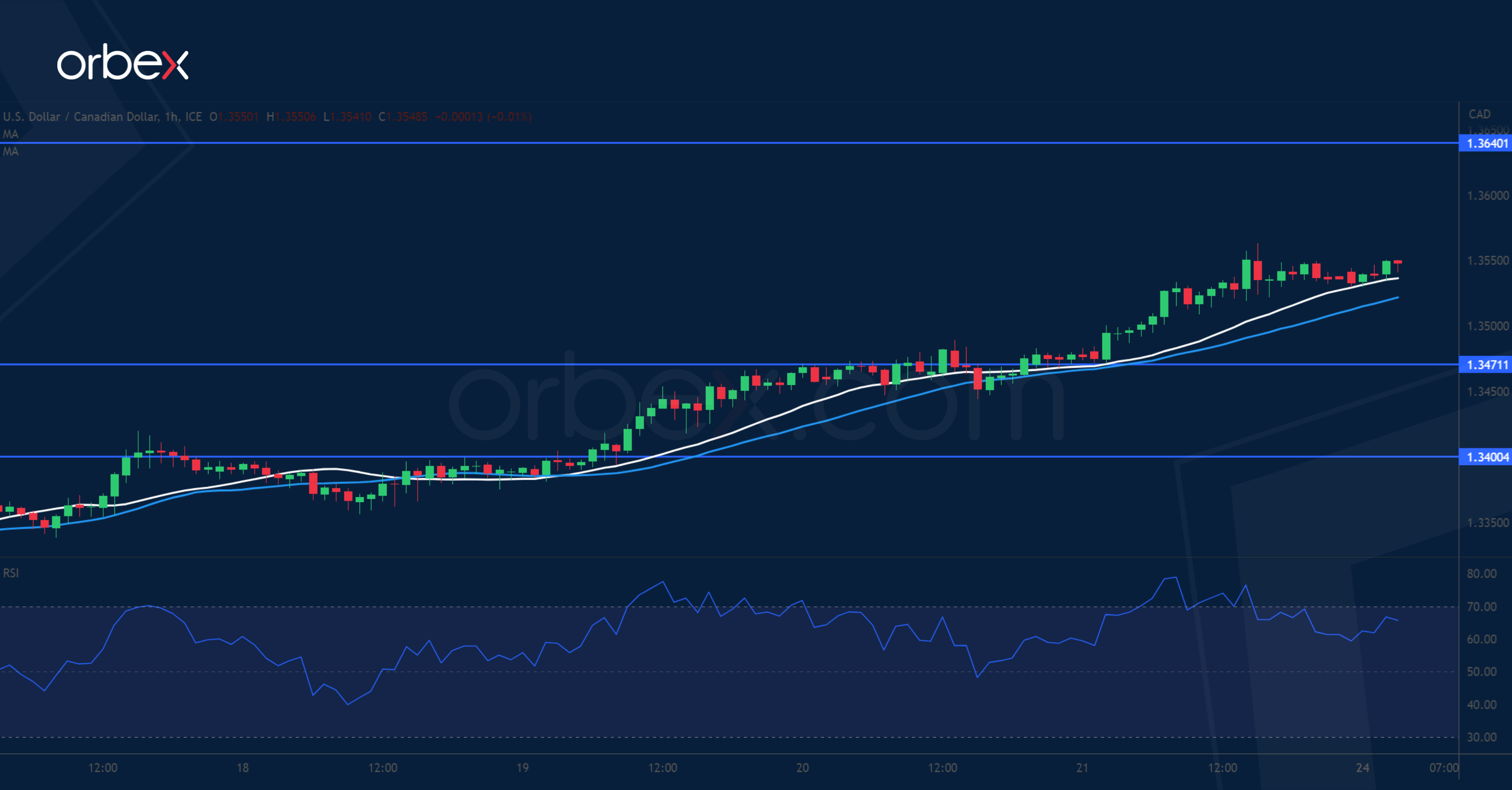
USD/CAD breaks key resistance
The Canadian dollar slipped after February’s retail sales fell well short of expectations. The pair has bounced back to the previous swing high of 1.3550 next to the 30-day SMA. A tentative breakout has prompted more sellers to cover and could pave the way for a potential extension towards 1.3640 and the recent peak near 1.3840. The RSI’s double top in the overbought area may temper the bullish drive. 1.3470 is the first level to expect a follow-through while 1.3400 is a second line of defence in case of a deeper pullback.
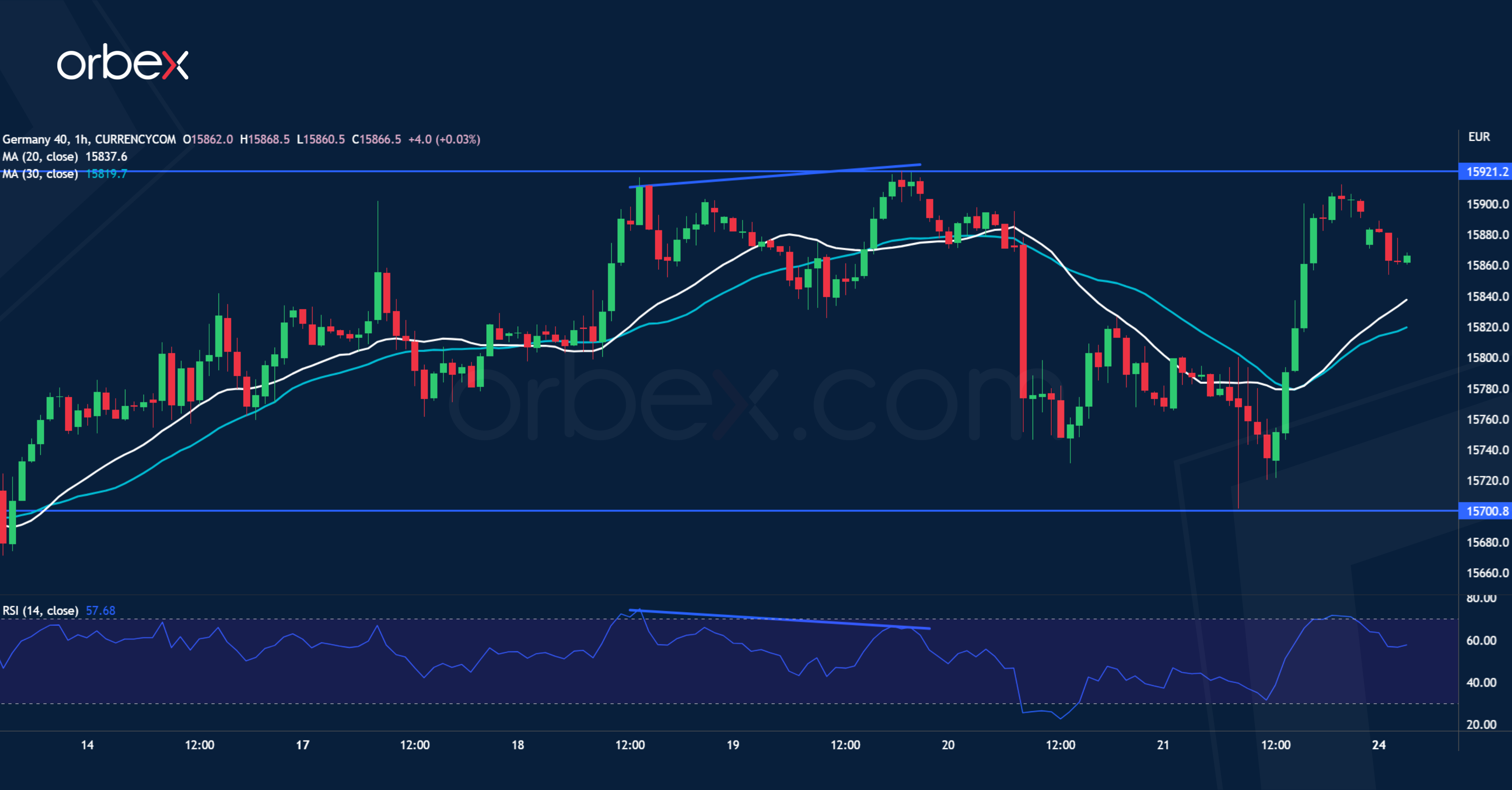
DAX 40 finds support
The Dax 40 bounces back on upbeat services PMI across Europe. Despite a bearish RSI divergence showing a slower momentum and a liquidation attempt below 15800, a sharp bounce off 15700 over the 20-day SMA suggests that trend followers were eager to buy the dip. A close above 15920 would resume the current rally and expose the psychological level of 16000 and the all-time high of 16300. On the downside, 15500 at the confluence of a previous swing low and the 30-day SMA is a major level to test the bulls’ resolve.
S&P Now Predicts Only a 0.5% Contraction in UK Real Output This Year
Markets
Friday’s consensus-beating EMU and US PMI’s caught the eye. European figures stressed the growing divergence between weakness in the manufacturing sector and resurging service sector activity. US data pointed to stronger demand conditions which support sharper growth in April and simultaneously bring around renewed inflation momentum. Markets especially responded to US figures given Fed market positioning. Markets discount a final 25 bps rate move by the Fed (as flagged in March dots), but also bet on significant rate cuts before year-end. After PMI’s, they stepped away from the latter idea somewhat. US Treasuries slightly underperformed German Bunds last Friday. US yields closed 3.5 bps to 4.2 bps higher across the curve. German yields increased by 2.6 bps (2-yr) to 4.4 bps (30-yr). Main US and European equity benchmarks gained up to 0.5%. EUR/USD’s attempt to regain the 1.10 figure was blocked by US PMI’s. Any rebound (USD supportive action) didn’t reach further than 1.0950 though. Fresh attacks are highly likely this week while the downside in EU and US yields should be protected ahead of next week’s policy meetings.
News flow is thin this weekend. We retain an FT article with active Belgian ECB member Wunsch. He wouldn’t be surprised if the ECB would have to go to 4%. Before the ECB can think about pausing its policy rate cycle, they need evidence that wage growth and core inflation are coming down. Our base case is for the ECB to deliver another 50 bps rate hike next week with a 4% peak rate likely during summer. Don’t look for that much additional clues on outcomes of next week’s ECB and Fed meetings this week. Fed members are already in their black-out period, with very few ECB policy makers scheduled on monetary-related topics ahead of Wednesday’s Purdah start.
Today’s eco calendar contains German Ifo business sentiment. Decent outcomes are expected after last week’s PMI’s. The Belgian debt agency holds its regular OLO auction. They tap OLO 85 (0.8% Jun2028), OLO 97 (3% Jun2033) and OLO 98 (3.3% Jun2054) for a combined €3-3.5bn. Year-to-Date, the Kingdom already raised €16.41bn in OLO funding compared to a €45bn target. Q1 earnings result from First Republic bank (after market close) are a wildcard for risk sentiment. Later this week, focus turns to US consumer confidence (tomorrow), Q1 GDP readings in the US (Thursday) and Europe (Friday), early national (April) European inflation figures (starting Thursday), PCE deflators (Friday) and the Bank of Japan policy meeting (Friday).
News and views
Rating Agency S&P upwardly revised the outlook on the UK’s AA credit rating from negative to stable as near term negative downside risks have reduced. The stable outlook reflects the UK’s stronger recent economic performance. S&P now predicts only a 0.5% contraction in UK real output this year. It also forecasts more contained budget deficits over the next two years as the UK government’s decision to abandon most of the unfunded budgetary measures proposed in September bolstered the fiscal outlook. S&P takes notice that the government’s energy support scheme has cost significantly less than anticipated because of the fall in energy prices. S&P now forecasts the general government deficit to average 3.7% of GDP over the 2023-25 period compared to 5.5% projected in September last year. S&P expects the government debt to begin declining from a high 97.7% of GDP in 2023.
Moody’s upwardly revised the Irish long term domestic and foreign credit rating to Aa3 from A1. The outlook on the rating was changed from positive to stable. Moody’s said the rating action was driven by a significant improvement of Ireland’s key fiscal and debt metrics and the agency’s expectation that this improvement will be resilient to potential shocks. S&P affirmed the long- and short-term local and foreign currency Greek credit ratings at BB+/B but revised its outlook to positive from stable Amongst others, the agency mentions structural reforms and economic resilience, along with EU support, have improved government finances and financial sector stability. S&P on Friday also affirmed Italy’s BBB rating. The outlook remains stable. The agency expects growth to decelerate in 2023 on the back of high inflation and tightening of credit conditions, before recovering in 2024. It mentions that fiscal consolidation is likely to be gradual and contingent upon growth outcomes or political pressures.
Modest Movements in Financial
Market movers today
The week starts off with a thin data calendar, German Ifo Index will be released for April, consensus is looking for a modest rise following the upbeat PMIs last Friday.
Later in the week, the focus turns to central banks. We expect Riksbank to hike rates by 50bp on Wednesday and Bank of Japan to make no changes on Friday (BoJ Preview, 21 April).
On the data front, Q1 GDP flash estimates will be released for euro area on Friday, and the US and Sweden on Thursday. On Friday, preliminary inflation data from Germany, France and Spain will also give us the first hints on how euro area inflation developed in April.
The FOMC has already entered the blackout period ahead of the meeting next week, but ECB's Panetta will be on the wires today.
The 60 second overview
It has been a mixed opening in the Asian equity markets with some modest gains in the Japanese equity market and modest losses in the Chinese and Hong Kong equity markets. US Treasury yield declined modestly this morning after having risen on Friday on the back of stronger US PMI data.
ECB's Wuncsh stated in a Financial Times interview that he could see ECB go to 4% and that ECB had to tighten monetary policy until they saw wage growth and core inflation decline. This supports our expectations that 4% will be the peak for ECB.
The cash balance at the US Treasury rose to the highest amount since March and is currently at USD 280bn. It was just USD 99bn on April 13. The recent rise was due to more tax payments rolling in, and help push the time limit further out before the Treasury runs out of money in order not reach the debt limit. Furthermore, the Republicans are looking to pass a bill that will increase the debt ceiling by USD 1.5tn, but President Biden is against the plan.
Ireland was upgraded on Friday by Moody from A1 to Aa3 and the outlook is stable. The upgrade was driven by the solid improvement in the public finances and reduction of the debt.
We have lifted our GDP forecast for 2023 to 6.2% from 5.5%, see China Macro Monitor - 2023 growth revised up to 6.2%, 24 April. It mainly reflects that Q1 was stronger than expected and thus provides a higher base for the year. However, we see growth momentum moving lower from here but still stay above potential growth for the rest of year. We see more pent-up demand in consumption, property and manufacturing investments. The recovery is still in its' early phase, though, where uncertainty and jitters over the sustainability is likely to remain. We expect the government will add more stimulus if needed to put the recovery on a firmer footing. For 2024 we have lowered the forecast from 5.2% to 5.0%.
Equities struggled for direction with bunches of earnings, a shift of tail risk focus from banks to debt ceiling and a difficult batch of macro data not providing much help either. S&P 500 closed up 0.1% and Stoxx 500 0.3%. With a lack of direction, defensives took the lead with staples and health care among the better performers. In fact, defensives beat the tape throughout the week with staples doing particularly well. US futures are a tad lower this morning too.
FI: US Treasury yields rose on Friday after stronger than expected US PMI data. 10Y Treasuries ended up 4bp higher and 2Y Treasuries ended up 3bp higher. However, the levels is still much lower than before the problems in the US banking sector, where 2Y US Treasury yields were up at 5% compared to today's level of 4.18%. This morning we have seen a modest decline in US Treasury yields in Asian trading hours.
FX: It is wait-and-see for FX markets before big central bank monetary policy meetings the coming weeks. EUR/SEK trades in the 11.30-35 range before the Riksbank meeting this week. USD/JPY holds steady close to 134 before Bank of Japan meets on Friday - new governor Ueda's first meeting. And EUR/USD trades in 1.09-1.10 range before next week's ECB and Fed meetings, where Fed may deliver the final hike of this cycle. NOK needs to clear this week's announcement on May's fiscal transactions by Norges Bank before attention turns to next week's meeting.
Credit: In an overall quite muted session, credit markets recovered somewhat from Thursday's sell-off, with iTraxx Xover 2bp tighter and Main 0.4bp. Primary market activity was subdued with only a couple of issuers coming to the market.
EUR/AUD Daily Outlook
Daily Pivots: (S1) 1.6299; (P) 1.6364; (R1) 1.6484; More...
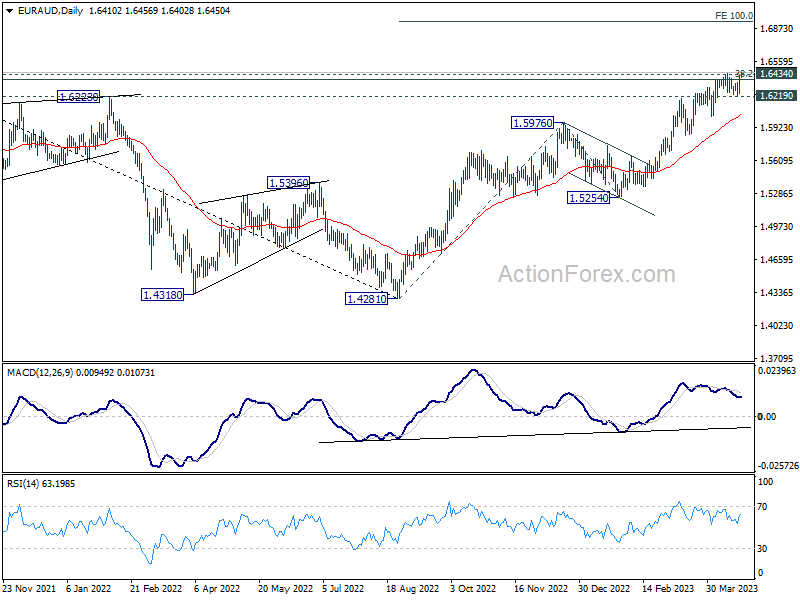
EUR/AUD's break of 1.6444 resistance suggests that up trend from 1.4281 is resuming. Intraday bias is now back on the upside for 100% projection of 1.4281 to 1.5976 from 1.5254 at 1.6949. For now, near term outlook will remain bullish as long as 1.6219 support holds, in case of retreat. Also, sustained trading above 1.6434/44 resistance will carry larger bullish implications.
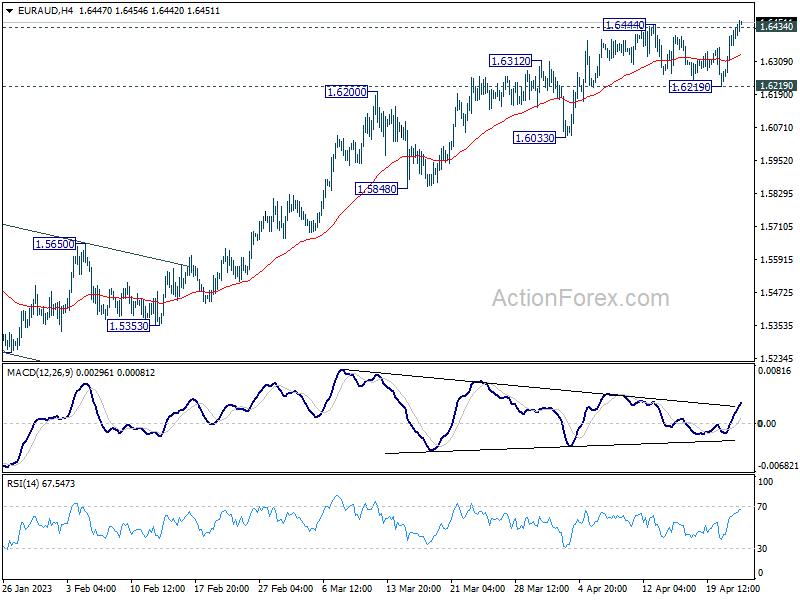
In the bigger picture, focus stays on 1.6389/6434 cluster resistance (38.2% retracement of 1.9799 to 1.4281 at 1.6389). Sustained break there should confirm that whole down trend from 1.9799 (2020 high) has completed. Further rally should then be seen to 61.8% retracement at 1.7691. However, rejection by this cluster resistance will make medium term outlook neutral at best.
Aussie and Kiwi Selloff Continues; Key Economic Events Expected Later This Week
In today's Asian trading session, Australian and New Zealand dollars extend their decline from late last week, weakening broadly. Concurrently, Japanese Yen is trailing as the next weakest currency. This picture aligns with the steady risk sentiment across Asia, except for Hong Kong stocks. On the other hand, Dollar, Euro, and Swiss Franc are showing strength, while British Pound and Canadian Dollar display are mixed.
The economic calendar appears light in the beginning but gradually fills with significant events towards the end. Notably, Australia's CPI, Q1 GDP figures from US and Eurozone, Canada's monthly GDP, and BoC minutes may induce volatility in their respective currencies.
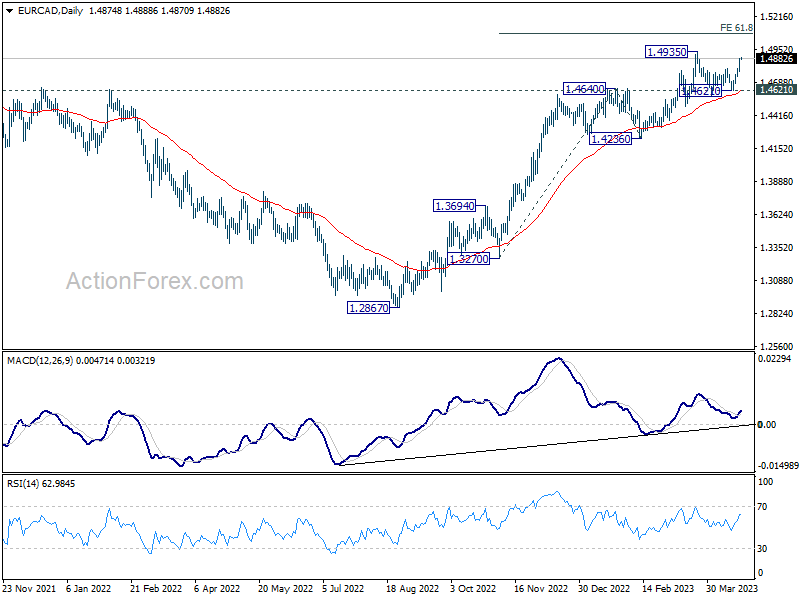
From a technical standpoint, EUR/AUD's break of 1.6444 resistance suggests resumption of the overall uptrend from 1.4281. Additionally, EUR/CAD is marching towards 1.4935 resistance level. Decisive break there would resume the larger uptrend from 1.2867, with next target at 61.8% projection of 1.3270 to 1.4640 from 1.4236 at 1.5083. A crucial question is whether EUR/USD will follow suit by breaking through 1.1075 resistance.
 In Asia, Nikkei closed up 0.10%. Hong Kong HSI is down -1.44%. China Shanghai SSE is down -0.82%. Singapore Strait Times is down -0.15%. Japan 10-year JGB yield is up 0.0061 at 0.468.
ECB's Wunsch awaits core inflation and wage growth to come down
In an interview with Financial Times, ECB Governing Council member Pierre Wunsch mentioned that the central bank is waiting for both wage growth and core inflation to decrease in conjunction with headline inflation before considering a pause.
Wunsch stated, "I would not be surprised if we had to go to 4 percent at some point." He emphasized that ECB aims for a soft landing, and "nobody is going to err on the side of destroying the economy for the sake of destroying the economy."
"But I have absolutely no indication that what we are doing (on interest rates) is too much," he added.
Regarding rate hikes, Wunsch clarified, "I'm not a fetishist. I'm not going to hike rates even in a recession just because we have 2.3 percent or 2.1 percent inflation in the two-year forecast. But I'm not seeing inflation numbers going in the right direction yet."
He also pointed out that if wage agreements persist around a 5 percent growth for an extended period, inflation may not return to 2 percent on a structural basis.
BoJ Ueda highlights importance of strong inflation projections in monetary policy decisions
BoJ Governor Kazuo Ueda emphasized today that the central bank's inflation forecasts must be "quite strong and close to 2%" within the coming year for the bank to consider adjusting its yield curve control policy.
Speaking to parliament, Ueda said that as "trend inflation is below 2%," BoJ must maintain its current monetary easing stance. However, he noted that when trend inflation is projected to reach 2% target, the central bank must normalize monetary policy.
When asked about the specifics of how BoJ might phase out YCC, Ueda opted not to provide explicit details, clarifying that such a decision would hinge on a variety of factors, encompassing the economy, inflation pace, and other elements at the time of the verdict.
"At this moment, I cannot provide a definitive answer regarding how this could be executed," he said, touching upon BoJ's exit strategy. Nonetheless, Ueda reassured that " BOJ has actively been conducting numerous evaluations on the potential impact of a monetary policy normalization on its financial situation."
Bitcoin in tight range as super cycle chat continues
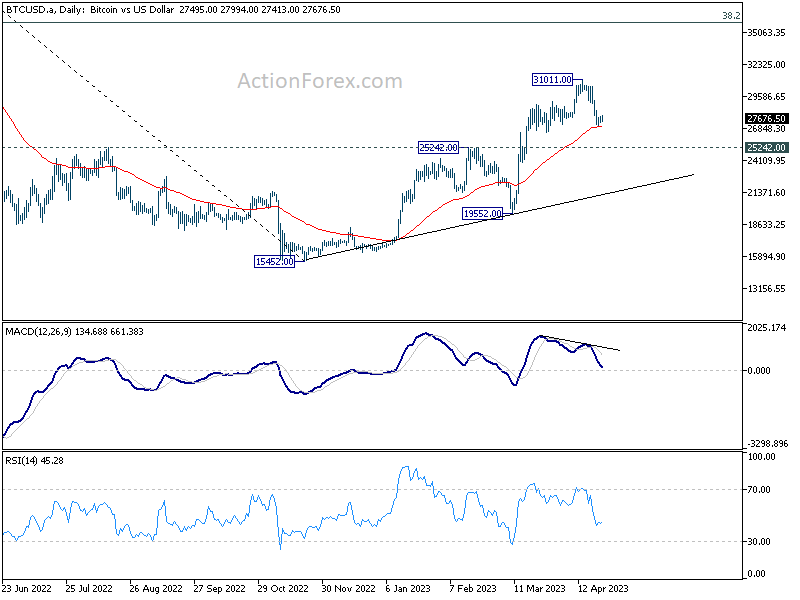
In today's Asian trading session, Bitcoin was navigating a rather narrow trading range, as it tries to lean on 55 D EMA for support. Just earlier this month, Bitcoin climbed up to 31,011, staging a comeback from last year's low of 15,452. Yet, the momentum has since waned, as it turned into a pullback. While the overall momentum of bitcoin isn't too convincing, there are market whispers about the start of a new "super cycle."
This super cycle conjecture is rooted in the anticipation of the "halving" event, which is predicted to take place around April 2024. The total supply of Bitcoin is capped at 21 million (hardcoded into the protocol by creator Satoshi Nakamoto). The halving event cuts the rate at which new bitcoins emerge and are awarded to miners, approximately every four years or after 210,000 blocks have been mined.
When Bitcoin was first launched in 2009, the block reward was 50 bitcoins. In 2012, the first halving transpired, slashing the reward to 25 bitcoins. Fast forward to 2016, and the reward was reduced once more, this time to 12.5 bitcoins. The latest halving took place in May 2020, leaving the current block reward at a modest 6.25 bitcoins.
Historically, Bitcoin has experienced significant price movements following halving events. In each cycle, the cryptocurrency's price bottomed out around 12-18 months before the halving, followed by a new record high in the subsequent months.
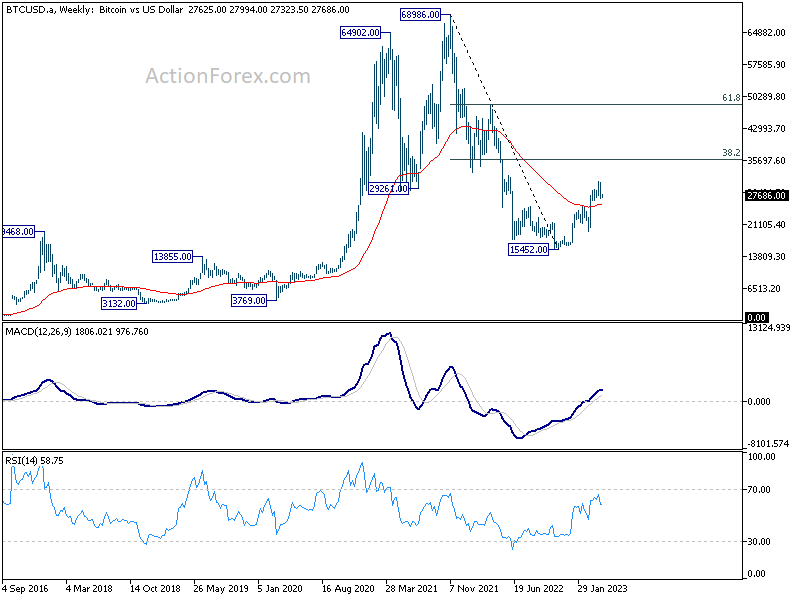
From a technical perspective, near term outlook of Bitcoin will remain bullish as long as 25242 resistance turned support holds, even in case of deeper pull back. Break of 31011 will resume the rebound from 15452 to 38.2% retracement of 68986 to 15452 at 35902. This is the key hurdle for Bitcoin to overcome if it's really developing into a "super cycle" up trend.
Meanwhile, decisive break 25242 support will argue that Bitcoin is vulnerable to hit another low below 15452 before building the base for the so-called "super cycle".
BoJ meeting, BoC minutes and GDP data loom
This week, new BoJ Governor Kazuo Ueda is set to preside over his first monetary policy meeting. It is anticipated that the yield curve control framework will remain unchanged, with short-term interest rate target of -0.1% and 0.5% cap on 10-year JGB yield. Ueda is also expected to uphold the dovish view that inflation will ease later in the year, with wage growth being insufficient to maintain inflation at the target. Recent development in 10-year JGB yield suggests that traders are also not betting on any alterations to the yield cap.
In other central bank activities, BoC will release meeting minutes, which are likely to reaffirm the need for a substantial accumulation of evidence before considering to resume tightening.
Data releases will also play a significant role this week, with Australian CPI potentially being the most impactful. While RBA is expected to resume tightening by implementing one more rate hike on May 2, the decision will depend on the Q1 CPI release and forthcoming economic projections based on the data.
Other noteworthy data releases include Q1 GDP figures from US and Eurozone, as well as monthly GDP data from Canada. Market participants will also be monitoring Germany's Ifo business climate and US consumer confidence reports.
Here are some highlights for the week:
- Monday: Germany Ifo business climate; Canada new housing price index.
- Tuesday: Swiss trade balance; UK public sector net borrowing; US house price index, consumer confidence, new home sales.
- Wednesday: New Zealand trade balance; Australian CPI; Germany Gfk consumer climate; Swiss Credit Suisse economic expectations; US durable goods orders, goods trade balance, BoC minutes.
- Thursday: Australia ANZ business confidence, Australia import prices; US Q1 GDP advance, jobless claims, pending home sales.
- Friday: BoJ rate decision, Japan industrial production, retail sales unemployment rate, housing starts, Tokyo CPI; Australia PPI, private sector credit; France GDP; Germany import prices, CPI flash, unemployment; Italy GDP; Eurozone GDP; Swiss retail sales, KOF; Canada GDP; US personal income and spending with PCE inflation, Chicago PMI.
EUR/AUD Daily Outlook
Daily Pivots: (S1) 1.6299; (P) 1.6364; (R1) 1.6484; More...
EUR/AUD's break of 1.6444 resistance suggests that up trend from 1.4281 is resuming. Intraday bias is now back on the upside for 100% projection of 1.4281 to 1.5976 from 1.5254 at 1.6949. For now, near term outlook will remain bullish as long as 1.6219 support holds, in case of retreat. Also, sustained trading above 1.6434/44 resistance will carry larger bullish implications.
In the bigger picture, focus stays on 1.6389/6434 cluster resistance (38.2% retracement of 1.9799 to 1.4281 at 1.6389). Sustained break there should confirm that whole down trend from 1.9799 (2020 high) has completed. Further rally should then be seen to 61.8% retracement at 1.7691. However, rejection by this cluster resistance will make medium term outlook neutral at best.
Economic Indicators Update
| GMT | Ccy | Events | Actual | Forecast | Previous | Revised |
|---|---|---|---|---|---|---|
| 08:00 | EUR | Germany IFO Business Climate Apr | 94.0 | 93.3 | ||
| 08:00 | EUR | Germany IFO Current Assessment Apr | 96.1 | 95.4 | ||
| 08:00 | EUR | Germany IFO Expectations Apr | 91.6 | 91.2 | ||
| 12:30 | CAD | New Housing Price Index M/M Mar | 0.10% | -0.20% |
ECB’s Wunsch awaits core inflation and wage growth to come down
In an interview with Financial Times, ECB Governing Council member Pierre Wunsch mentioned that the central bank is waiting for both wage growth and core inflation to decrease in conjunction with headline inflation before considering a pause.
Wunsch stated, "I would not be surprised if we had to go to 4 percent at some point." He emphasized that ECB aims for a soft landing, and "nobody is going to err on the side of destroying the economy for the sake of destroying the economy."
"But I have absolutely no indication that what we are doing (on interest rates) is too much," he added.
Regarding rate hikes, Wunsch clarified, "I'm not a fetishist. I'm not going to hike rates even in a recession just because we have 2.3 percent or 2.1 percent inflation in the two-year forecast. But I'm not seeing inflation numbers going in the right direction yet."
He also pointed out that if wage agreements persist around a 5 percent growth for an extended period, inflation may not return to 2 percent on a structural basis.
BoJ Ueda highlights importance of strong inflation projections in monetary policy decisions
BoJ Governor Kazuo Ueda emphasized today that the central bank's inflation forecasts must be "quite strong and close to 2%" within the coming year for the bank to consider adjusting its yield curve control policy.
Speaking to parliament, Ueda said that as "trend inflation is below 2%," BoJ must maintain its current monetary easing stance. However, he noted that when trend inflation is projected to reach 2% target, the central bank must normalize monetary policy.
When asked about the specifics of how BoJ might phase out YCC, Ueda opted not to provide explicit details, clarifying that such a decision would hinge on a variety of factors, encompassing the economy, inflation pace, and other elements at the time of the verdict.
"At this moment, I cannot provide a definitive answer regarding how this could be executed," he said, touching upon BoJ's exit strategy. Nonetheless, Ueda reassured that " BOJ has actively been conducting numerous evaluations on the potential impact of a monetary policy normalization on its financial situation."
EUR/USD Eyes Additional Gains Above 1.1000
Key Highlights
- EUR/USD is holding gains above the 1.0920 support.
- A key bullish trend line is forming with support near 1.0965 on the 4-hour chart.
- GBP/USD is also trading in a positive zone above 1.2380.
- USD/JPY tested the 133.60 support and started a consolidation phase.
EUR/USD Technical Analysis
The Euro started a downside correction from the 1.1075 zone against the US Dollar. EUR/USD declined below 1.1020 but the bulls were active near the 1.0920 zone.
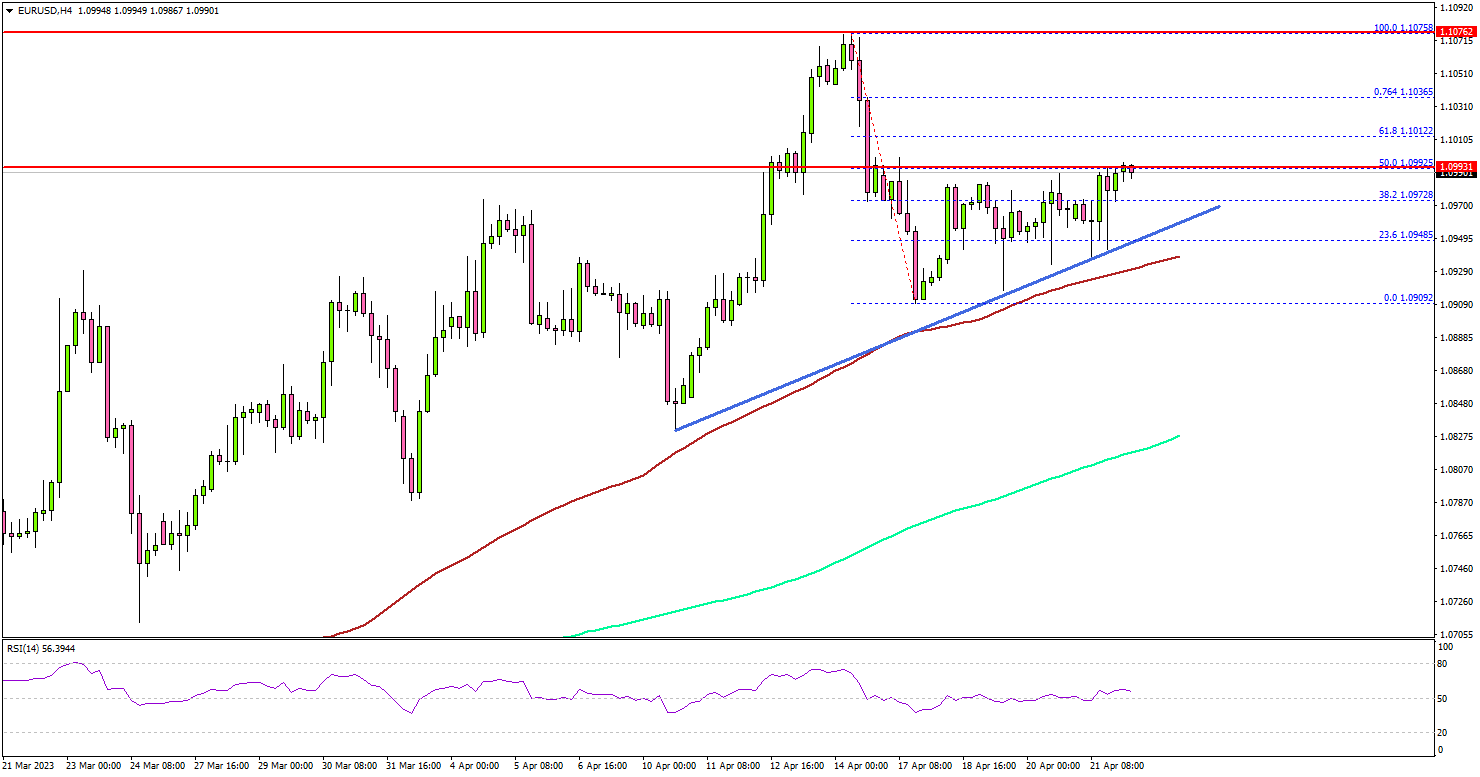
Looking at the 4-hour chart, the pair traded as low as 1.0909 and recently started a fresh upward move. The pair is now trading well above the 1.0940 level, the 200 simple moving average (green, 4 hours), and the 100 simple moving average (red, 4 hours).
It is testing the 1.1000 resistance zone and the 50% Fib retracement level of the downward move from the 1.1075 swing high to the 1.0909 low.
A clear upside break and close above the 1.1000 resistance might send the pair toward 1.1035 or the 76.4% Fib retracement level of the downward move from the 1.1075 swing high to the 1.0909 low.
The next key resistance is near the 1.1075 zone. A clear move above the 1.1075 resistance might send the pair toward the 1.1120 zone. Any more gains might send the pair toward 1.1200.
On the downside, there is a major support forming near 1.0960. There is also a key bullish trend line forming with support near 1.0965 on the same chart. The next major support sits near the 1.0920 level, below which the pair might accelerate lower.
In the stated case, EUR/USD could test the 1.0880 support. Any more losses might send the pair toward the 1.0840 support.
Looking at GBP/USD, the pair is holding gains above the 1.2380 support and might aim for more gains toward the 1.2620 level.
Economic Releases
- German IFO Business Climate Index for April 2023 – Forecast 94.0, versus 93.3 previous.
Bitcoin in tight range as super cycle chat continues
In today's Asian trading session, Bitcoin was navigating a rather narrow trading range, as it tries to lean on 55 D EMA for support. Just earlier this month, Bitcoin climbed up to 31,011, staging a comeback from last year's low of 15,452. Yet, the momentum has since waned, as it turned into a pullback. While the overall momentum of bitcoin isn't too convincing, there are market whispers about the start of a new "super cycle."
This super cycle conjecture is rooted in the anticipation of the "halving" event, which is predicted to take place around April 2024. The total supply of Bitcoin is capped at 21 million (hardcoded into the protocol by creator Satoshi Nakamoto). The halving event cuts the rate at which new bitcoins emerge and are awarded to miners, approximately every four years or after 210,000 blocks have been mined.
When Bitcoin was first launched in 2009, the block reward was 50 bitcoins. In 2012, the first halving transpired, slashing the reward to 25 bitcoins. Fast forward to 2016, and the reward was reduced once more, this time to 12.5 bitcoins. The latest halving took place in May 2020, leaving the current block reward at a modest 6.25 bitcoins.
Historically, Bitcoin has experienced significant price movements following halving events. In each cycle, the cryptocurrency's price bottomed out around 12-18 months before the halving, followed by a new record high in the subsequent months.
From a technical perspective, near term outlook of Bitcoin will remain bullish as long as 25242 resistance turned support holds, even in case of deeper pull back. Break of 31011 will resume the rebound from 15452 to 38.2% retracement of 68986 to 15452 at 35902. This is the key hurdle for Bitcoin to overcome if it's really developing into a "super cycle" up trend.
Meanwhile, decisive break 25242 support will argue that Bitcoin is vulnerable to hit another low below 15452 before building the base for the so-called "super cycle".