Sample Category Title
ECB’s Schnabel: Further rate hikes needed, 50 not off the table
ECB Executive Board member Isabel Schnabel said in a Politico interview that additional rate hikes are necessary, with the size of these hikes depending on incoming data. "The data we have so far shows that inflation is higher and the economy more resilient than projected," she added that "data dependence means that 50 basis points are not off the table" for May meeting.
She also noted that "it's far too early to declare victory on inflation." She explained that if core inflation remains high and persistent, even if it reaches a peak, the information content of that data point might be limited. "So what we really need is confidence that it's actually coming down in a sustained manner."
Schnabel acknowledged that she cannot predict the terminal interest rate, noting that rates must be set on a meeting-to-meeting basis. She also addressed concerns about a potential recession, stating, "So far, there are no particular signs of a weakening in economic developments. At this point in time, I have no reason to believe that a recession is coming."
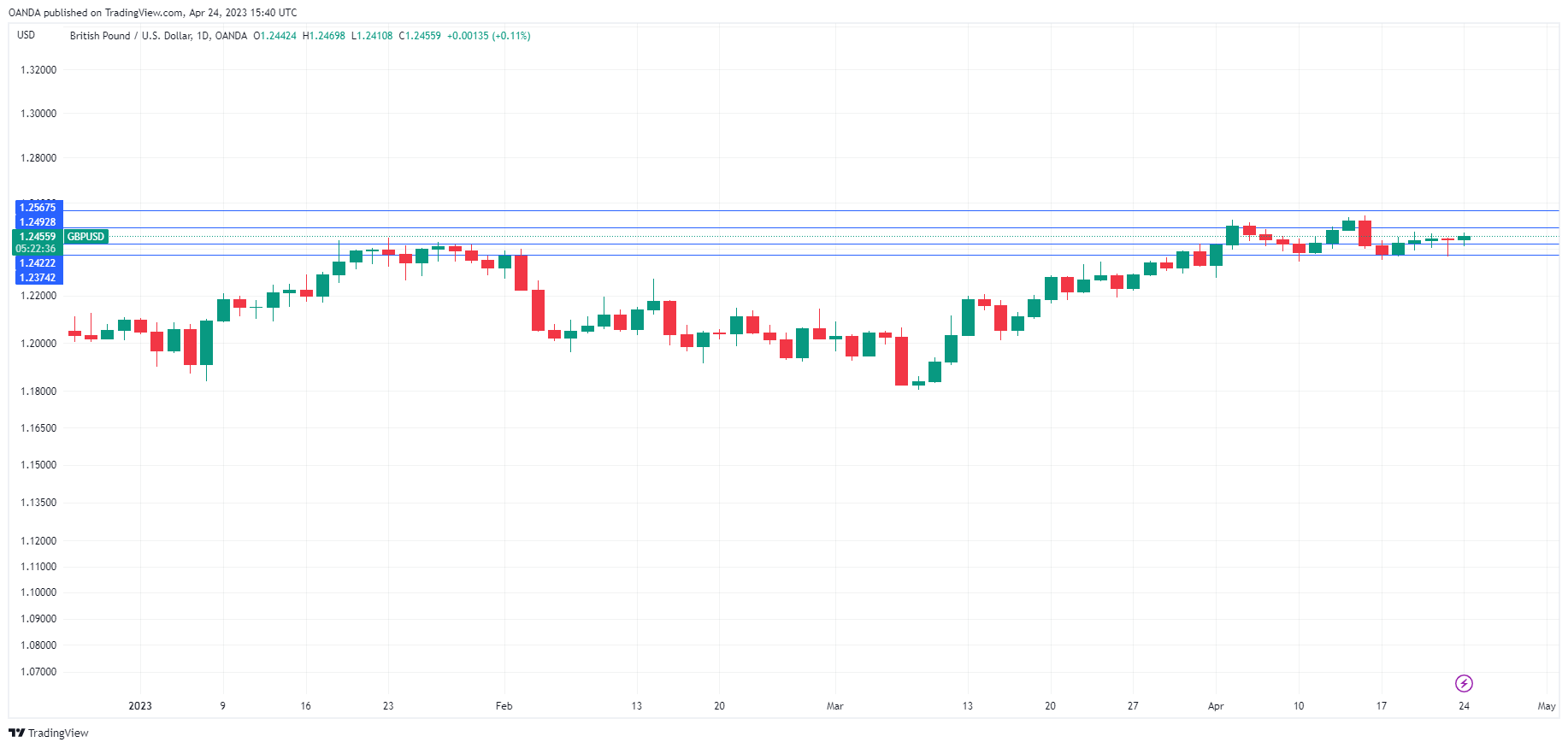
GBP/USD Drifting Continues
- British pound showing limited movement
- UK retail sales fall
- PMIs show manufacturing decline, services accelerate
British pound shrugs off weak retail sales, mixed PMI data
The week ended with mixed data out of the UK, and the British pound fell 0.80% but managed to recover and ended the Friday session unchanged. Retail sales fell by 3.1% y/y, matching the estimate and following -3.5% in February. The core rate slipped 3.2%, below the estimate of -3.1% and the previous release of -3.0%. On a monthly basis, retail sales fell by 0.9%, as the unusually rainy weather kept shoppers away.
The soft retail sales numbers are a result of high interest rates and double-digit inflation, which has taken a nasty bite of consumers’ disposable income. The cost of living crisis has caused consumers to slash household spending, which is a key driver of economic activity. There was a silver lining, as GfK Consumer Confidence improved in April from -36 to -30, its highest level since February 2022. This beat the estimate of -35 and the index rose for the third month in a row. This could be a signal that consumers, although struggling, believe the worst is over.
UK PMIs, also released on Friday, were a mixed bag. The numbers reflect a global trend, as manufacturing continues to struggle while the services sector is getting stronger. Manufacturing PMI slipped from 47.3 to 45.5, shy of the estimate of 48.0 points. It was a ninth straight decline, with readings below the 50.0 level. It’s the opposite story for business activity (services), which rose from 52.9 to 54.9, beating the estimate of 54.9. This was the fastest growth in a year as services continue to drive the UK economy.
GBP/USD Technical
- There is resistance at 1.2494 and 1.2568
- 1.2423 and 1.2373 are providing support
April Flashlight for the FOMC Blackout Period: Is the Tightening Cycle Coming to an End?
Summary
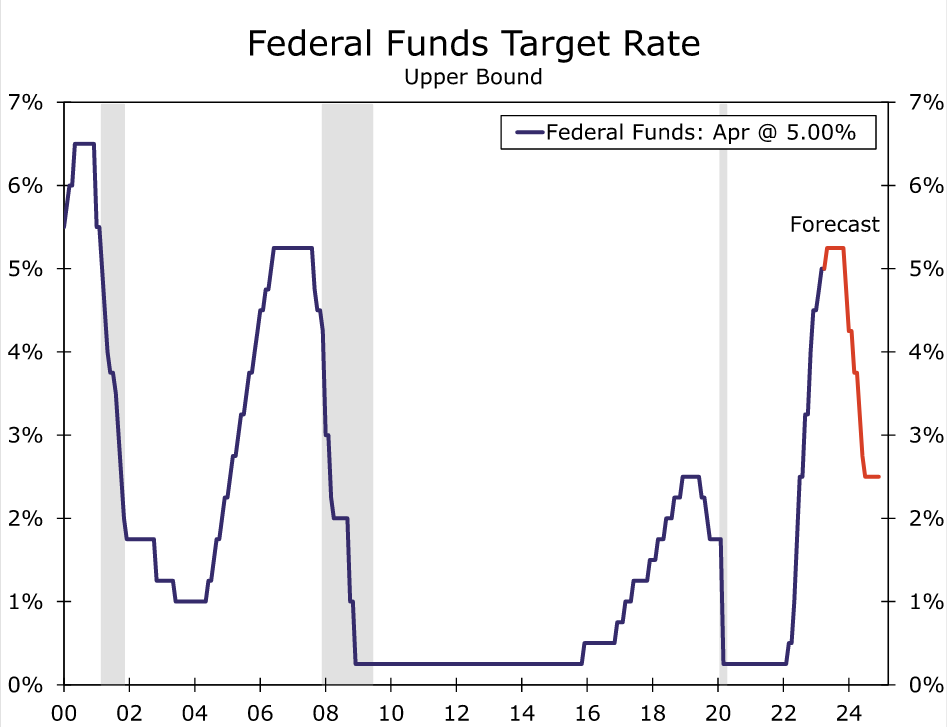
- We expect the FOMC to raise the target range for the fed funds rate by 25 bps on May 3, bringing it up to 5.00%-5.25% from 0.00%-0.25% only 14 months ago. We also anticipate that the Committee will continue quantitative tightening (QT) at its current pace.
- Stress in the financial system related to the failure of two regional banks in early March has eased over the inter-meeting period, alleviating concerns over a rapid tightening in credit conditions. The jobs market is cooling only gradually, and the unemployment rate is still near historic lows. The trend in inflation remains uncomfortably high, as evidenced by core CPI advancing at a 5.1% clip over the past three months.
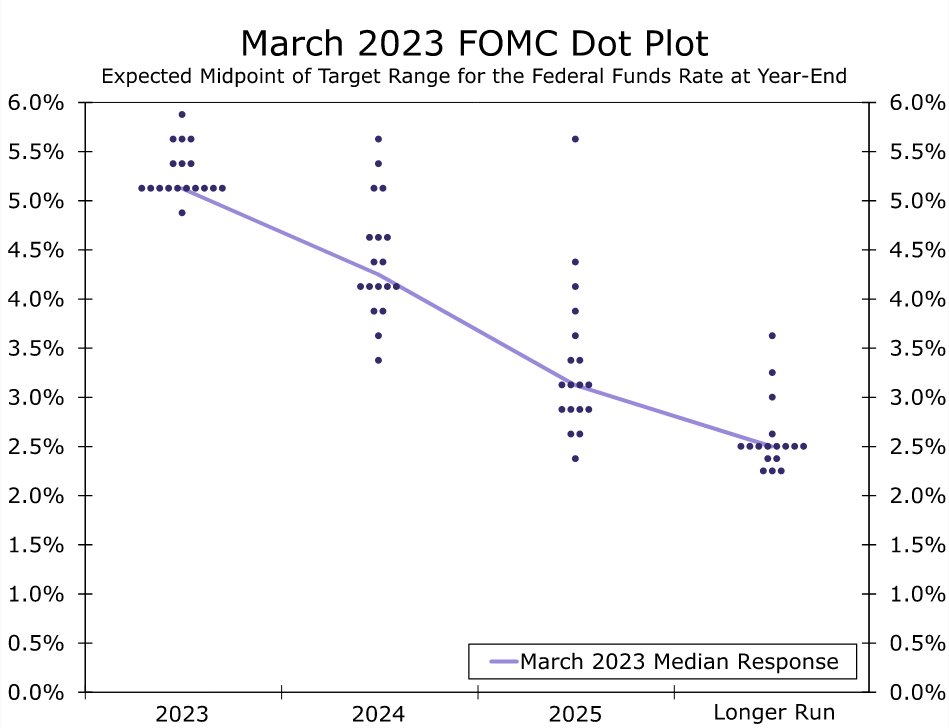
- However, we believe the statement and press conference likely will signal that May's hike may very well be the last of this tightening cycle. In March, the so-called "dot plot" showed that 11 of the Committee's 18 participants viewed a fed funds rate of 5.00%-5.25% or lower at year-end 2023 as the most likely outcome, a view that has not seemed to have been swayed by the latest data.
- If most officials see the May meeting as likely to be the final hike this cycle, then we would expect the statement to no longer include the phrase that "some additional policy firming may be appropriate."
- That said, we do not think the statement will fully close the door on further rate hikes, given that inflation remains well above target. Rather, the statement likely will include an acknowledgement that further adjustments in rates are possible. The outlook will be based on the Committee's assessment of cumulative tightening of monetary policy, the lags of policy on economic activity and inflation, and economic and financial developments.
- If, as we expect, the statement signals that additional increases are less likely, but not fully off the table, then dissents among voting participants are likely to be avoided.
- We do not think a technical tweak to the Fed's overnight repurchase agreement (RRP) facility is forthcoming, and in the final section of this report, we dive deeper into this tool in the central bank's toolkit.
We Look for the FOMC to Hike Rates by 25 bps on May 3
In light of the volatility that swept through financial markets only a month or so ago following the failure of two regional banks, market participants eagerly await the outcome of the next meeting of the Federal Open Market Committee (FOMC) on May 3. Actions taken by the Federal Reserve, the Treasury Department and the FDIC following the collapse of these regional banks appear to have stabilized financial markets. Major equity indices have trended higher over the past month, and credit spreads have generally narrowed. Unless turmoil were to grip the nation's banking system anew in coming days, we look for the Committee to raise its target range for the federal funds rate by another 25 bps on May 3. If the Committee does indeed hike rates by 25 bps, then it will have increased its target range by 500 bps since March 2022.
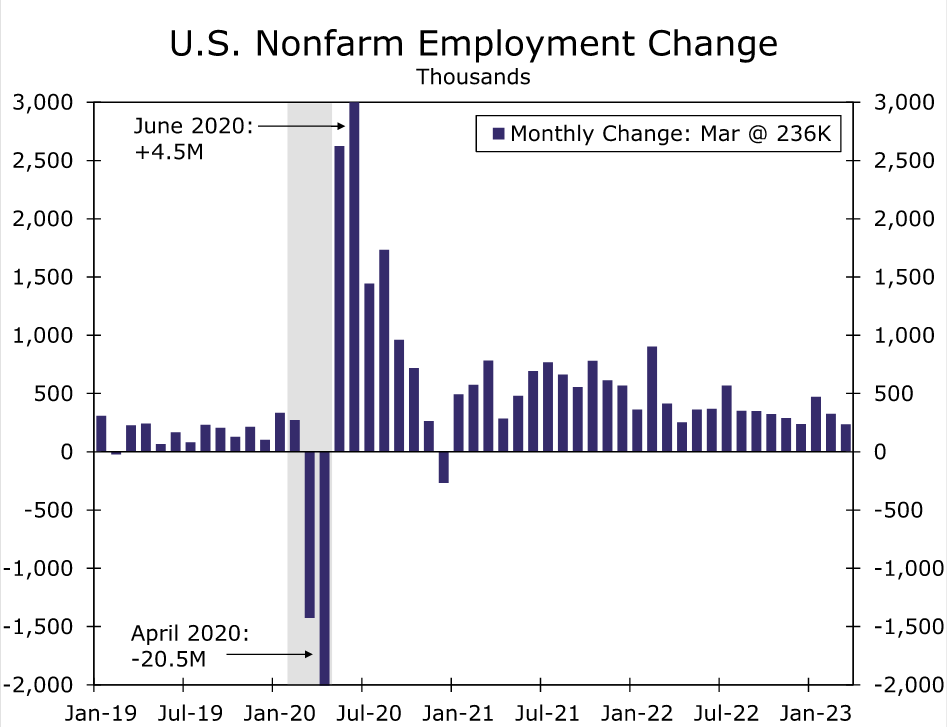
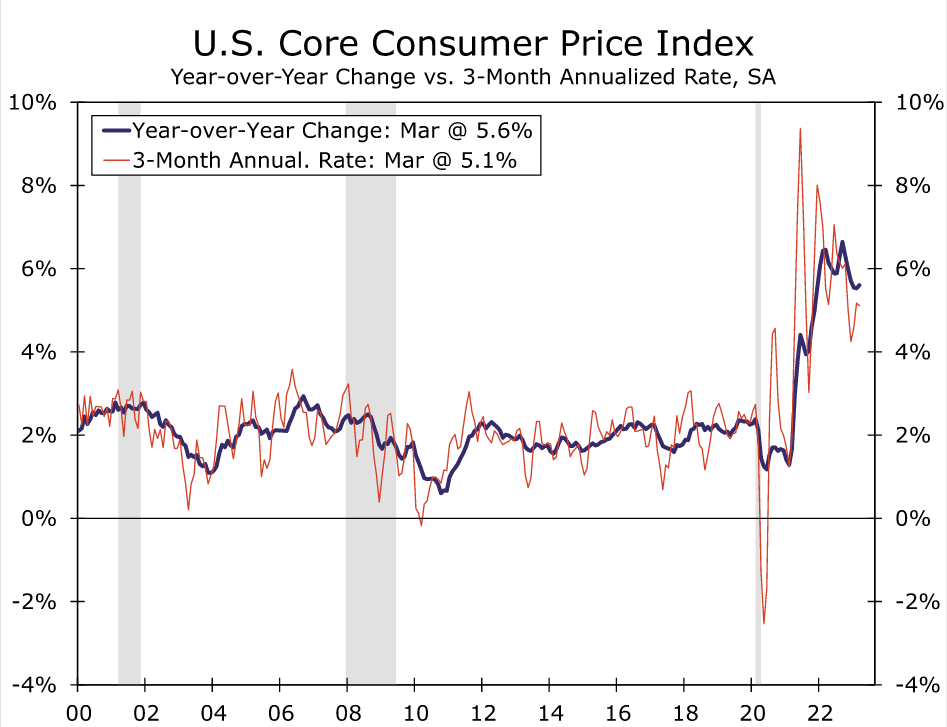
In our view, most FOMC members will support another 25 bps rate hike due to the aforementioned stability in financial markets and recent economic data indicating that the labor market remains strong and inflationary pressures are still acute. Data released on April 7 showed that employment rose by 236K in March (Figure 1). Although this was the smallest monthly increase in nonfarm payrolls in more than two years, it still exceeded the average gain of roughly 185K per month during the 2010s expansion. The unemployment rate ticked down to 3.5% from 3.6% in February, suggesting that the labor market generally remains tight. Overly tight labor markets could keep wage growth above what would be consistent with 2% inflation. In that regard, core CPI inflation, which printed at a year-over-year rate of 5.6% in March, remains elevated (Figure 2). Furthermore, consumer prices excluding food and energy rose at an annualized rate of 5.1% between December and March, indicating that core inflation over the past few months has only been incrementally slower than core inflation over the past year.
Reading the Tea Leaves in the Post-Meeting Statement
Market participants undoubtedly will parse the post-meeting statement for clues about the outlook for monetary policy in coming months. The statement on March 22 addressed the turmoil in the banking system by noting "recent developments are likely to result in tighter credit conditions for households and businesses and to weigh on economic activity, hiring, and inflation." But the statement also acknowledged that "the extent of these effects is uncertain." Although the situation in the banking system seems more stable today than it did on March 22, we think the FOMC will want to continue highlighting the heightened degree of uncertainty that surrounds the economic outlook at this time.
More important, we think that the FOMC will opt to change its "forward guidance" regarding the outlook for monetary policy. When the current tightening cycle commenced in March 2022, the FOMC stated it "anticipates that ongoing increases in the target range will be appropriate," and it continued to use this phrase in every post-meeting statement through February 2023. This phrase indicated that the Committee thought that a series of rate hikes would be needed "to return inflation to 2 percent over time." However, the Committee softened the language in the March 22 statement—the 25 bps rate hike on March 22 occurred when financial market volatility was still elevated in the aftermath of the bank failures—to "some additional policy firming may be appropriate." The Summary of Economic Projections (SEP) that the FOMC released after the March 22 meeting showed that 10 of the 18 Committee members thought that a target range of 5.00%-5.25% would be appropriate at the end of 2023 (Figure 3). If the FOMC does indeed hike by 25 bps on May 3, then the target range would rise to the level that just a month ago the majority of Committee members thought would be appropriate at the end of this year.
Therefore, we can envision the FOMC dropping the reference to "some additional policy firming" in the May 3 statement in a signal that the tightening cycle may be at its end. However, we would expect the statement to include that future adjustments to the fed funds target range—rather than future increases—will take into account the same factors listed in the March statement, "the cumulative tightening of monetary policy, the lags with which monetary policy affects economic activity an inflation, and economic and financial developments." The less specific language around the direction of future changes would keep the door open to additional tightening should conditions warrant, while acknowledging the change that rates could eventually be adjusted in a downward direction. That said, we believe the Committee will stress the need to keep policy "sufficiently restrictive to return inflation to 2 percent over time." In addition, the statement likely will continue to note that "the Committee remains highly attentive to inflation risks."
With the policy path nearing a turning point, the possibility of some disagreement among Committee members about next steps is growing. Chicago Fed President Austan Goolsbee, who is a voting member of the FOMC this year, has most vociferously called for the need to be cautious, given March's banking system events. However, a number of other Fed officials, including FOMC Vice Chair Williams and Governor Waller, have highlighted that with inflation still high and financial conditions not significantly tighter since early March, it is appropriate for the policy rate to move up more. We think the policy statement may thread the needle between these diverging views if it drops the reference to "additional policy firming" but does not fully dismiss the possibility of additional tightening. However, if the statement relays future increases as more likely than not, we would expect at least one dissent.
FOMC Likely Will Maintain Current Pace of QT
In addition to rate hikes, the FOMC has been tightening financial conditions by allowing previously purchased securities to roll off the central bank's balance sheet. At present, the Federal Reserve allows up to $60 billion of Treasury securities and up to $35 billion of mortgage-backed securities (MBS) to roll off the balance sheet every month. We believe the Committee will maintain this current pace of "quantitative tightening" (QT) until the economy shows unmistakable signs of entering recession and/or short-term funding markets show strains à la September 2019 when money market rates spiked. Assuming that short-term funding markets remain stable between now and the upcoming FOMC meeting, we would expect the Committee will reaffirm the current pace of QT tightening on May 3.
Rate Cuts Still Some Ways Off Into the Future
We believe that the increase in the fed funds target range that we anticipate on May 3 will most likely be the last rate hike in this tightening cycle. As noted previously, it appears that most FOMC members are comfortable with a target range of 5.00%-5.25% for the fed funds rate at the end of this year. Although this point estimate for year-end 2023 would not preclude the FOMC from taking rates above this range and then easing policy before the end of the year, our sense is that policymakers envision 5.00%-5.25% as the peak range in rates in this tightening cycle. Therefore, we believe the bar for further tightening beyond this range is high for many FOMC members.
After the May meeting, we think policymakers will pause to assess the impact of past policy tightening as well as tighter lending conditions in the wake of the recent banking system stress. The most recent Federal Reserve Beige Book signaled that banks had tightened lending standards in many parts of the country amid increased uncertainty and concerns about liquidity. If our current macroeconomic forecast, which is discussed in detail in our most recent U.S. Economic Outlook, is reasonably accurate, then we believe that the data on economic activity, the labor market and inflation that will be available at the time of the June 14 meeting will be soft enough to convince most policymakers to remain on hold at that meeting (Figure 4). Although we believe that signs of impending recession will be unmistakable by autumn, we suspect that the FOMC will refrain from cutting rates immediately because inflation likely will still be running well in excess of 2%. But we expect inflationary pressures to lessen as the downturn in economic activity gathers pace later this year. Therefore, we look for the FOMC to begin cutting rates at the end of 2023, and we forecast that the easing cycle will remain in place well into 2024.
Is a RRP Tweak Coming?
A common question we have been asked in recent months is whether the Federal Reserve would consider tweaking the terms of its overnight reverse repurchase agreement facility (RRP) at an upcoming meeting. This line of questioning has gathered steam as usage of the facility has skyrocketed and concerns have grown regarding deposit outflows from banks into money market funds (Figure 5). But first, what are reverse repurchase agreements, and why is the Federal Reserve conducting them to such scale?
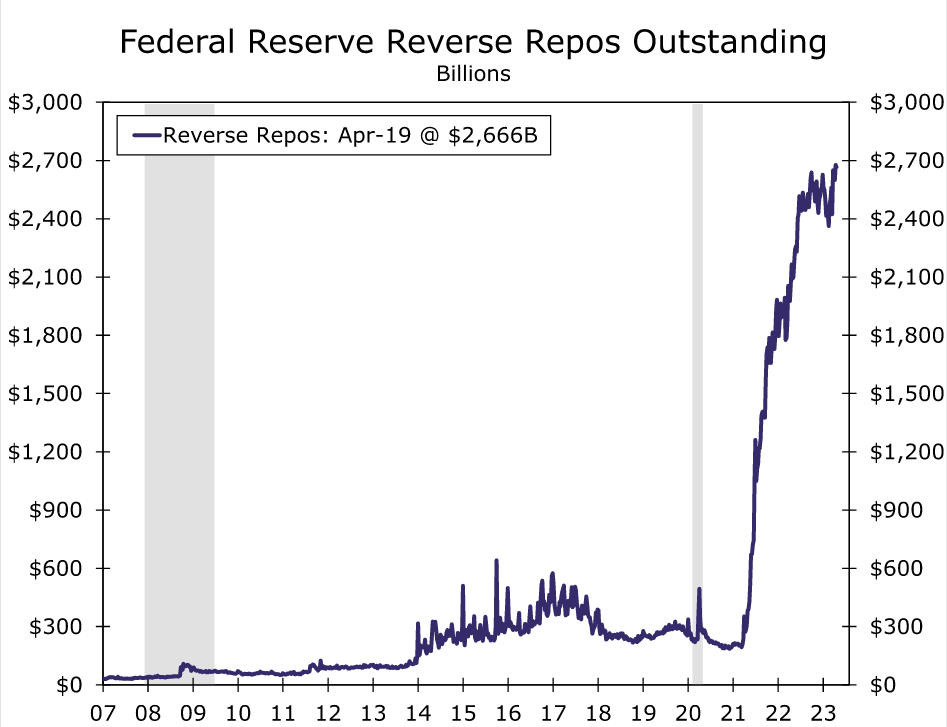
In a reverse repurchase agreement conducted with the Federal Reserve, a financial institution parks its cash at the central bank on an overnight basis and earns an interest rate that is set by the Fed.1 Eligible counterparties include many banks, money market funds and government-sponsored enterprises, but money market funds comprise the overwhelming share of the daily volume. Since government money market funds invest in government securities or repurchase agreements that are collateralized by government securities, the RRP facility is a natural home for these funds' investable cash. RRP usage has exploded over the past couple of years for several reasons: declining Treasury bill supply, debt ceiling challenges, regulatory considerations at banks and a desire to reduce interest rate risk in an environment of tremendous uncertainty about the outlook for short-term interest rates.
The Federal Reserve conducts RRPs in order to control short-term interest rates, such as the federal funds rate. Before 2008, the Federal Reserve would conduct open market operations to affect changes in money market rates. On any given day, the central bank would perform small purchases and sales of securities in the open market. These purchases/sales would add/drain reserves from the financial system and ensure that the federal funds rate was trading near the FOMC's target. This in turn would flow through to other key short-term interest rates, such as LIBOR or Treasury bill yields.
However, post-2008, the size of daily open market operations needed to affect the federal funds rate were too large to be practical, and a new framework was adopted. This new system was designed to put a "floor" under short-term interest rates.2 In theory, an institution with access to the RRP facility should have no incentive to lend money on an overnight basis for less than it can earn at RRP. In this sense, RRP is similar to the interest on reserve balances (IORB) that the Federal Reserve pays to banks when those institutions put money on deposit at the central bank. Together, IORB and RRP form the foundation of the Federal Reserve's framework for controlling the federal funds rate and, by extension, other key short-term interest rates, such as the Secured Overnight Financing Rate (SOFR).
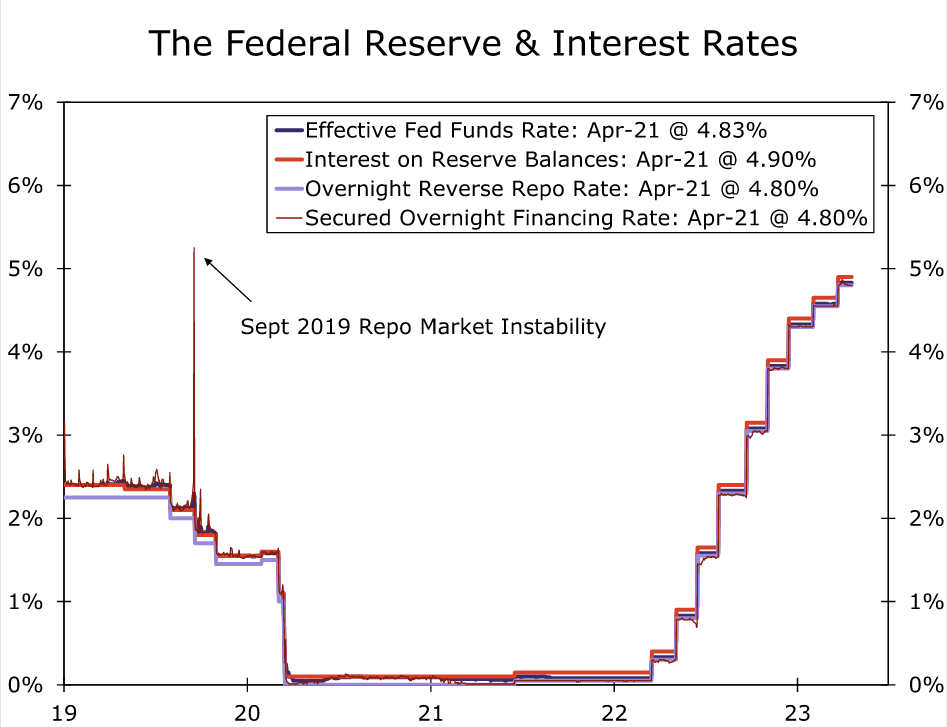
The current RRP rate is 4.80%, while the current IORB setting is slightly higher at 4.90%. Since IORB is set above the RRP rate, banks generally opt for the former, while money market funds invest in the latter, given that they do not have access to IORB. The Federal Reserve's use of these two administered rates has successfully pushed the federal funds rate, SOFR and many other money market rates up from near 0% as recently as March 2022 to nearly 5% today (Figure 6).
Some commentators have suggested that the FOMC could tweak the terms of the Fed's RRPs in order to make the facility less attractive and thus reduce RRP usage. For example, the Committee could approve a cut on the rate paid on RRPs, or it could reduce the counterparty limits, which currently stand at $160 billion. The argument generally goes that funds would then flow out of RRP and back into the banking system, where it might improve banking system stability or the flow of credit. A full debate of the pros and cons of such a move are beyond the purview of this report, but we believe it is important to bear in mind one very key drawback of cutting the RRP rate or reducing counterparty limits. As we have already discussed, the rate paid on RRPs is a key anchor that keeps the federal funds rate within the FOMC's target range. Thus, cutting the RRP rate in a material way would be a de facto rate cut, something the FOMC would very much like to avoid given its ongoing fight against high inflation.
A very small tweak is perhaps possible at some point, such as decreasing the RRP rate slightly while simultaneously increasing IORB by a commensurate amount. But it is not clear to us that this would have a material impact on RRP facility usage, if at all. For now, we suspect the FOMC is content to let the current framework operate as it has over the past year, with the hope that RRP balances will come down organically once a debt ceiling resolution is reached, T-bill supply expands, and more certainty emerges for the future path of monetary policy. If these developments occur, then money market funds may be more able and willing to allocate money away from RRP and towards T-bills and private repo. Governor Waller and other FOMC members have espoused a view along these lines, and the minutes from the most recent FOMC meeting showed few signs of any pending changes to IORB or RRP. The RRP facility may have its flaws, but for now it continues to perform its primary responsibility of keeping the fed funds rate where the FOMC wants it to be. As a result, we suspect policymakers will refrain from any technical tweaks at the May 3 FOMC meeting.
Sunset Market Commentary
Markets
Trading for the new week took a rather slow start today with little in the way from higher profile eco data. German Ifo business climate improved slightly more than expected from 93.2 to 93.6. Assessment of current conditions eased from 95.4 to 95 but this was compensated for by an improved in the expectations index (92.2 from 91.0). The details of the survey were slightly different from the EMU PMI’s last week. The manufacturing index rose as companies turned somewhat more optimistic on future activity. Contrary to the PMI’s, IFO indicated that the uptrend in business climate in the service sector over the recent months came to an end. The trade index also fell slightly. Business climate in construction improved on better expectations. The different nuances between the IFO and the PMI’s didn’t change market dynamics. German Bunds underperform US Treasuries. Comments from ECB’s Wunsch in the FT over the weekend (4.0% ECB depo rate not excluded) probably supported European yields compared to the US. German yields currently add between zero and 2.5 bps (2-y). At the same time, yields on US Treasuries are easing between 2.5 bps (2-y) and 4.5 bps (5-y). 10-y inter-EMU spreads versus Germany mostly were little changed even as rating agencies on Friday brought a reassessed of the rating or the outlook for the likes of Ireland, Italy and Greece. Ireland didn’t profit from the Moody’s rating upgrade from A1 to Aa3 (spread +1 bp). Greece was the exception to the rule (10-y spread narrowing 5 bps) as S&P raised the outlook on the BB+ rating from stable to positive. European equities (Eurostoxx 50 unchanged) stay in consolidation modus near recent/post corona peak levels. US indices also open little changed as markets are awaiting a heavy earnings calendar with several (tech) bellwethers later this week. Oil ($81/b) still struggles not to fall below last week’s low ($80.5 area).
On FX markets, EUR/USD returned north of 1.10 (currently 1.102). The move probably is more due to euro strength, rather than USD weakness as markets understand that the single currency will probably continue to receive ‘hard’ interest rate support at & beyond next week’s policy meeting (cf Wunsch comments), while the Fed will probably take a pause in its tightening cycle. DXY eases slightly (101.55), but USD/JPY even gains modestly (134.55 from 134.16 at the open this morning). EUR/JPY is testing the 148.4 2022 top. Euro strength is also visible in the EUR/GBP cross rate (0.8955 from 0.893 at the start of European dealings). Still cable also gained a few ticks (1.2445). S&P on Friday upwardly revised the UK rating outlook from negative to stable on a better economic and fiscal out outlook. Maybe the BoE will retain/join some of the S&P assessment when it meets on May 11. The UK 2-y yield rises 4.5 bps today, slightly more than EMU/Germany.
News & Views
The Belgian debt agency tapped OLO 85 (€1.15bn 0.8% Jun2028), OLO 97 (€1.37bn 3% Jun2033) and OLO 98 (€1bn 3.3% Jun2054). The combined amount sold was at the upper hand of the targeted €3-3.5bn. The auction bid cover was strong at 2.11 with a skew to strong demand for especially OLO 85. After today’s auction, the Kingdom of Belgium raised €20.42bn in long-term funding YTD, compared with a €45bn OLO funding target (45.38%). The bulk of the amount came from two syndicated deals in January and February (€12bn combined). In its funding plan, the debt agency suggested that a third syndicated deal was likely with the maturity being driven by investor demand and the yield environment. The 10- and 30-yr deals at the start of the year were well flagged.
Belgian business confidence deteriorated slightly in April (-7.8 from -7.6), ending a 4-month recovery. Improvements in business-related services (11.4 from 8.4) and trade (-15.9 from -21.6) were offset by a setback in the manufacturing industry (-12.1 from -10.8) and the building industry (-5.4 from -5). Both the assessment of activity levels and market demand expectations improved in the services sector. The very strong improvement in trade was mainly due to employment expectations and intentions of placing orders. Those very same factors declined in manufacturing. Belgian consumer confidence, released last week, improved from -9 to -6, the highest level in over a year. Belgian inflation and Q1 GDP data will be published respectively on Thursday and on Friday.
US Dollar is Under Pressure Due to the Fed
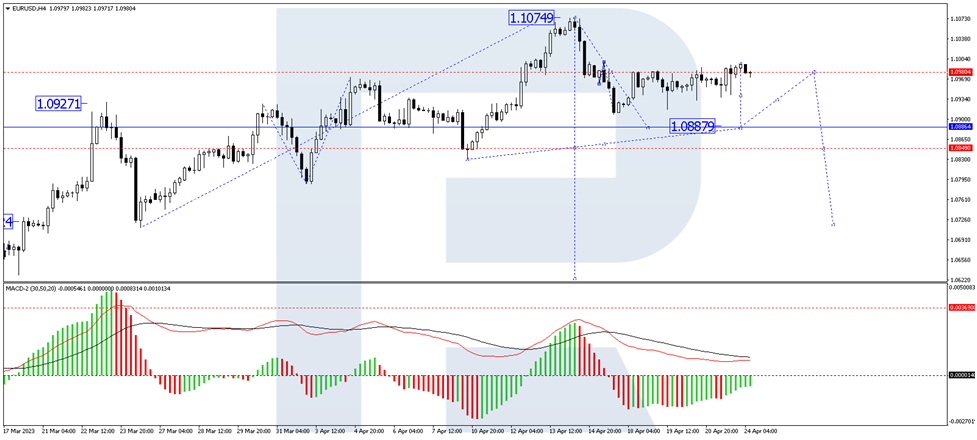
EURUSD started the final week of April with stable moves near 1.0980.
In the near term, the market's focus was on the upcoming US Federal Reserve System meeting, which will end on 3 May. Monetary policymakers are expected to further raise interest rates by 25 base points, although the focus will be on the future rate trajectory.
Investors believe the rate will remain unchanged until July and will drop by the end of the year. However, the state of the US economy might hinder this prediction. The latest statistics have shown that some sectors of the economy remain resilient, and inflation is declining.
The changes in the interest rate by the end of the year might turn out different from market expectations. At the same time, the market moods are quite vigorous.
On the H4 chart, the EURUSD pair has corrected to 1.0995. The market is now forming a consolidation range under this level. The price is expected to break the range downwards and form a descending wave structure to 1.0886. Technically, this scenario is confirmed by the MACD: its signal line is above zero, directed strictly downwards to renew the lows.
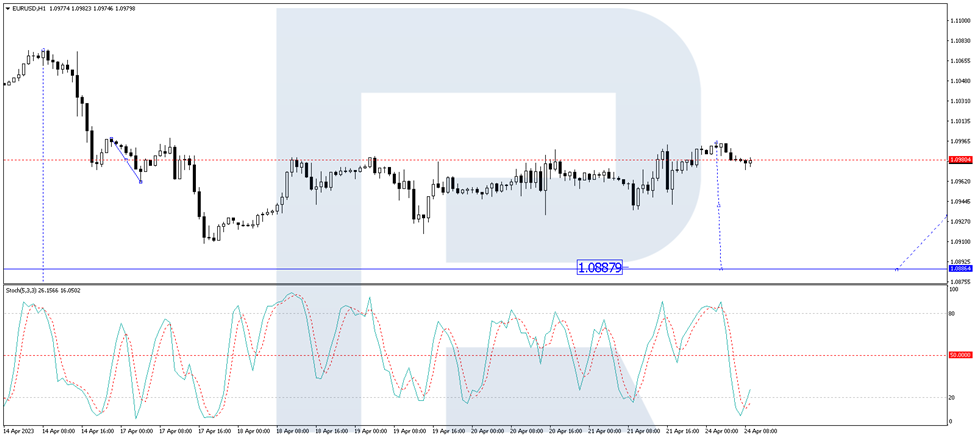
On the H1 chart, the EURUSD pair continues developing a consolidation range around the level of 1.0980. An exit from the range downwards is expected, followed by a descending wave structure to 1.0940. The target is the first one. Technically, this scenario is confirmed by the Stochastic oscillator. Its signal line is under 20, with growth to 50 expected, followed by a decline to the new lows of the indicator.
USD/JPY Extends Rally Ahead of BOJ Core CPI
- USD/JPY climbs for a third straight day
- BoJ Core CPI will be released Tuesday
- New BoJ Governor Ueda chairs his first meeting later this week
Japan inflation in focus
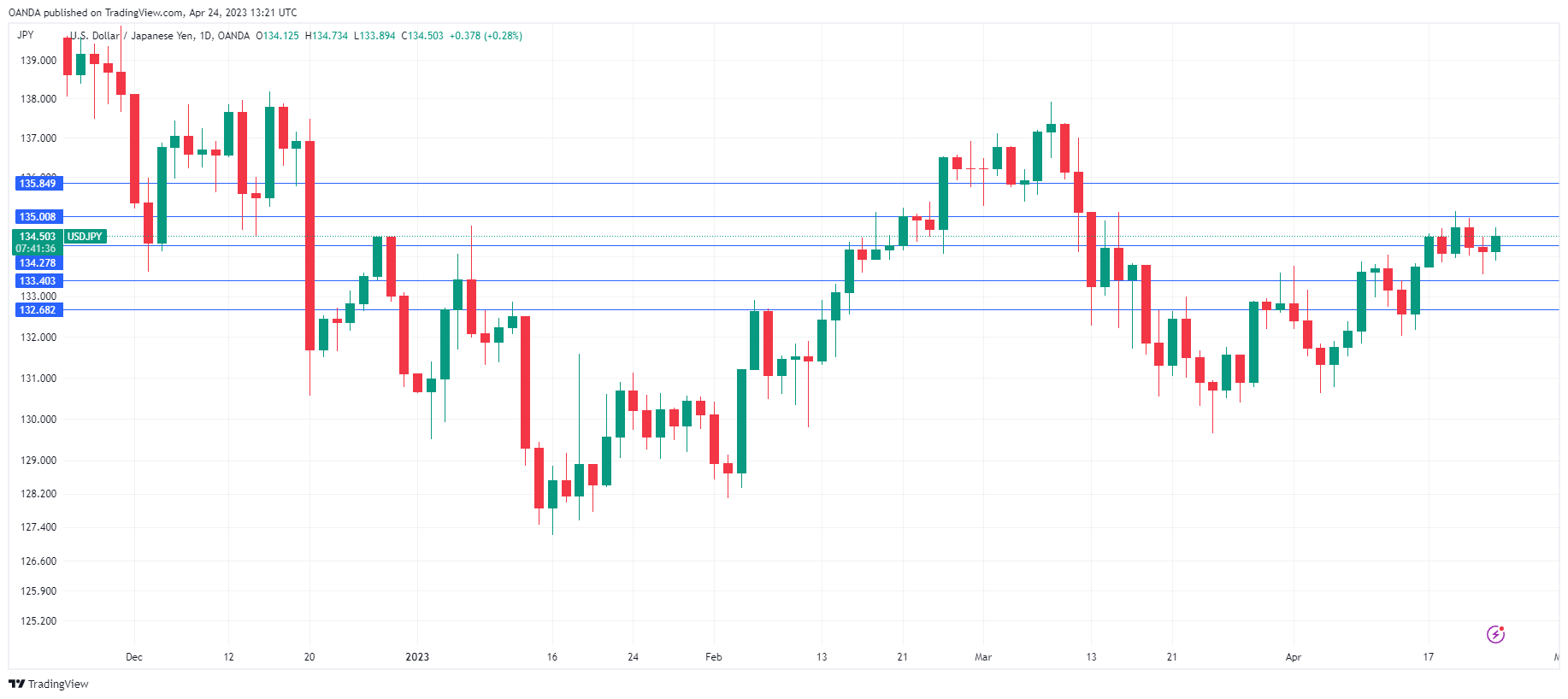
This week’s data calendar out of Japan will be dominated by inflation releases and the Bank of Japan’s two-day meeting at the end of the week. Traders will be keeping a close eye on BoJ Core CPI, which will be released on Tuesday. The index, which is the BoJ’s preferred inflation gauge, fell from 3.1% to 2.7% in February. Another drop would support the central bank’s view that inflation is falling back towards the 2% target.
Inflation has been running above 3% and this has raised speculation that the BoJ will respond by tightening policy, which would likely send the yen sharply higher. The BoJ has insisted that it will not tighten until it is convinced that higher inflation is sustainable and not a result of more expensive goods and raw materials. The uncertain outlook for global growth and a weak domestic economy means that the BoJ is in no rush to shift policy.
New Governor Ueda has been consistent in his message that he will maintain an ultra-loose policy, but nonetheless, speculation continues that the BoJ will tweak or even abandon its yield curve control, which has been criticised for distorting bond market pricing. I suspect that speculators hoping for a shift in policy that will send the yen higher will be disappointed after this week’s meeting, as Ueda is unlikely to rock the boat at his first meeting. The BoJ will provide updated quarterly growth and inflation forecasts, which could provide a hint as to future monetary policy.
USD/JPY Technical
- USD/JPY is testing resistance at 1.3427. Next, there is resistance at 1.3499
- 133.41 and 1.3269 are providing support
Yen Falls as BoJ Ueda Dims Hopes of Policy Shift; CHF/JPY Ready for New High
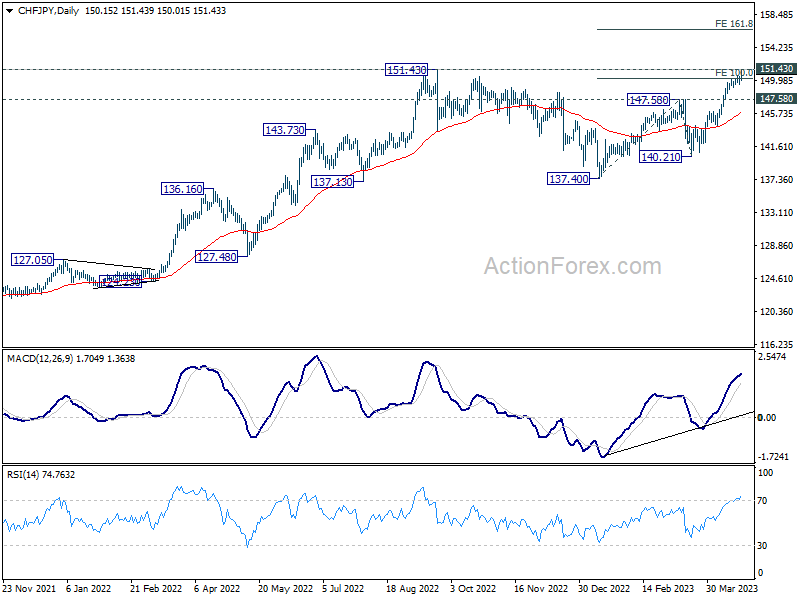
Japanese Yen suffers broad sell-off today, following comments from BoJ Governor Kazuo Ueda that seem to have quashed hopes of even a minor shift in monetary policy this week. Meanwhile, overall market sentiment remains steady, with Australian and Canadian Dollars also facing selling pressure. On the other hand, European majors are showing strength for the day, buoyed by optimism surrounding an improvement in economic momentum in the second quarter. Swiss Franc is currently outperforming Euro and Sterling, while Dollar remains mixed but vulnerable to a sell-off against European currencies.
From a technical perspective, CHF/JPY appears poised to resume its long-term uptrend through 151.43 high with strong momentum. Sustained trading above this level could pave the way to 161.8% projection of 137.40 to 147.58 from 140.21 at 156.68. A question now is when EUR/JPY will break through 148.38 resistance level to resume its long-term uptrend as well.
In Europe, at the time of writing, FTSE is down -0.13%. DAX is up 0.08%. CAC is down -0.08%. Germany 10-year yield is up 0.006 at 2.489. Earlier in Asia, Nikkei rose 0.10%. Hong Kong HSI dropped -0.58%. China Shanghai SSE dropped -0.78%. Singapore Strait Times rose 0.08%. Japan 10-year JGB yield rose 0.0099 to 0.472.
Germany Ifo rose to 93.6, worries abating, but lacks dynamism
Germany Ifo Business Climate rose slightly from 93.2 to 93.6 in April, below expectation of 94.0. Current Assessment index dropped from 95.4 to 95.0, below expectation of 96.1. Expectations index rose from 91.0 to 92.2, above expectation of 91.6.
By sector, manufacturing rose from 6.5 to 6.7. Services dropped from 8.8 to 6.8. Trade dropped from -10.1 to -10.7. Construction rose from -17.5 to -16.7.
Ifo said: "German business's worries are abating, but the economy is still lacking dynamism.
Bundesbank: Inflation to remain high overall in coming months
In its latest monthly report, Bundesbank revealed that German economy performed better than anticipated in the first quarter of 2023. Despite persistently high inflation negatively impacting private consumption, industry experienced a stronger recovery. Additionally, goods exports saw a sharp increase, and construction industry temporarily boosted production. Improved economic performance during the winter months was also reflected in the labor market. Early indicators suggest further positive developments ahead.
Inflation rate fell notably to 7.8% in March, a 1.5 percentage point decrease from February. Bundesbank attributes this decline to a base effect. However, core inflation rate, excluding energy and food, climbed by 0.5 percentage points to reach a historic high of 5.9%. In the coming months, Bundesbank expects inflation rate to continue falling somewhat, particularly due to decreasing energy prices and a potential gradual easing in prices of food, other goods, and services. However, underlying price pressure is expected to remain high overall in the coming months.
BoJ Ueda highlights importance of strong inflation projections in monetary policy decisions
BoJ Governor Kazuo Ueda emphasized today that the central bank's inflation forecasts must be "quite strong and close to 2%" within the coming year for the bank to consider adjusting its yield curve control policy.
Speaking to parliament, Ueda said that as "trend inflation is below 2%," BoJ must maintain its current monetary easing stance. However, he noted that when trend inflation is projected to reach 2% target, the central bank must normalize monetary policy.
When asked about the specifics of how BoJ might phase out YCC, Ueda opted not to provide explicit details, clarifying that such a decision would hinge on a variety of factors, encompassing the economy, inflation pace, and other elements at the time of the verdict.
"At this moment, I cannot provide a definitive answer regarding how this could be executed," he said, touching upon BoJ's exit strategy. Nonetheless, Ueda reassured that " BOJ has actively been conducting numerous evaluations on the potential impact of a monetary policy normalization on its financial situation."
EUR/JPY Daily Outlook
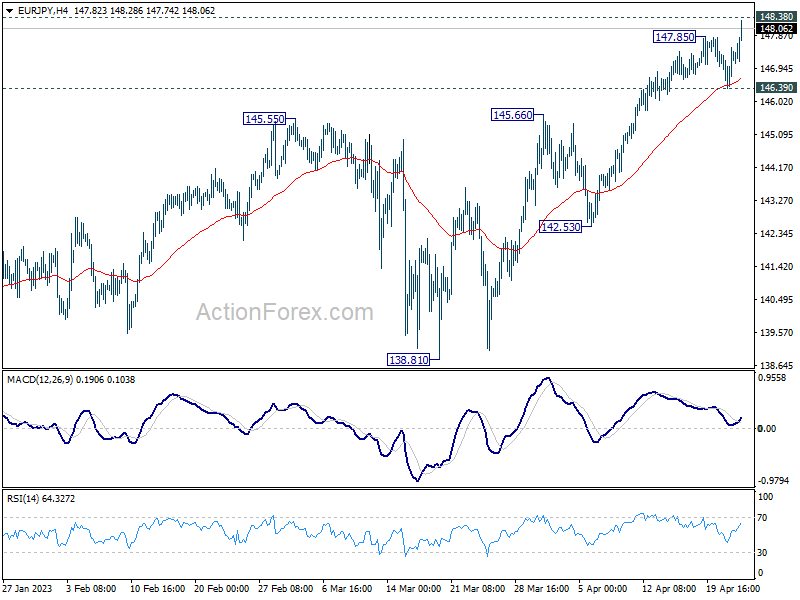
Daily Pivots: (S1) 146.68; (P) 147.12; (R1) 147.84; More....
EUR/JPY's rally resumed by breaking through 147.85 and intraday bias is back on the upside. Decisive break of 148.38 will resume larger up trend to 149.75 long term resistance. For now, outlook will remain bullish as long as 146.39 support holds, in case of retreat.
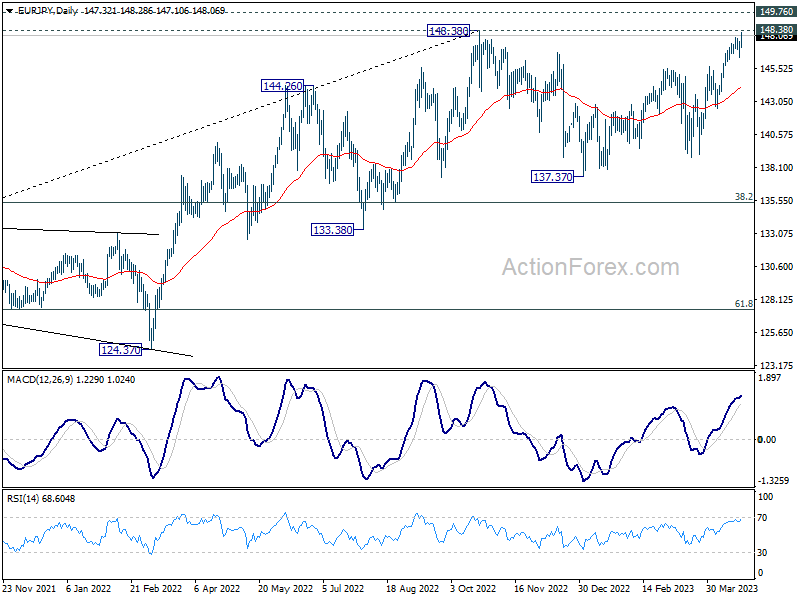
In the bigger picture, as long as 55 W EMA (now at 140.44) holds, larger up trend from 114.42 (2020 low) is still in progress for 149.76 long term resistance. Decisive break there will resume long term up trend. However, sustained break of 55 W EMA will bring deeper fall to 38.2% retracement of 114.42 to 148.38 at 135.40.
Economic Indicators Update
| GMT | Ccy | Events | Actual | Forecast | Previous | Revised |
|---|---|---|---|---|---|---|
| 08:00 | EUR | Germany IFO Business Climate Apr | 93.6 | 94 | 93.3 | 93.2 |
| 08:00 | EUR | Germany IFO Current Assessment Apr | 95 | 96.1 | 95.4 | |
| 08:00 | EUR | Germany IFO Expectations Apr | 92.2 | 91.6 | 91.2 | 91 |
| 12:30 | CAD | New Housing Price Index M/M Mar | 0.00% | 0.10% | -0.20% |
EUR/USD Daily Outlook
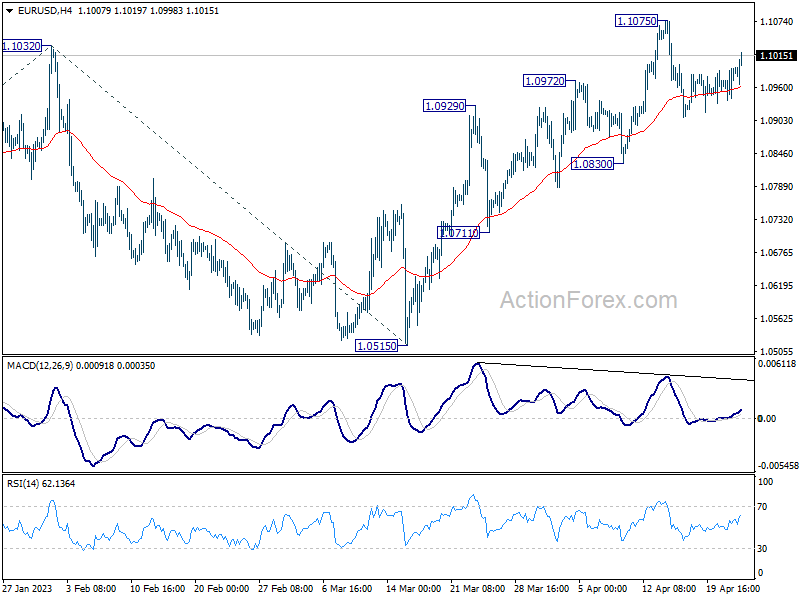
Daily Pivots: (S1) 1.0954; (P) 1.0974; (R1) 1.1009; More...
Intraday bias in EUR/USD stays neutral at this point. Outlook remains bullish with 1.0830 support intact. On the upside, break of 1.1075 will will resume larger up trend to 1.1273 fibonacci level. Break there will target 61.8% projection of 0.9534 to 1.1032 from 1.0515 at 1.1441. However, firm break of 1.0830 will confirm short term topping and bring deeper decline to 1.0711 support instead.
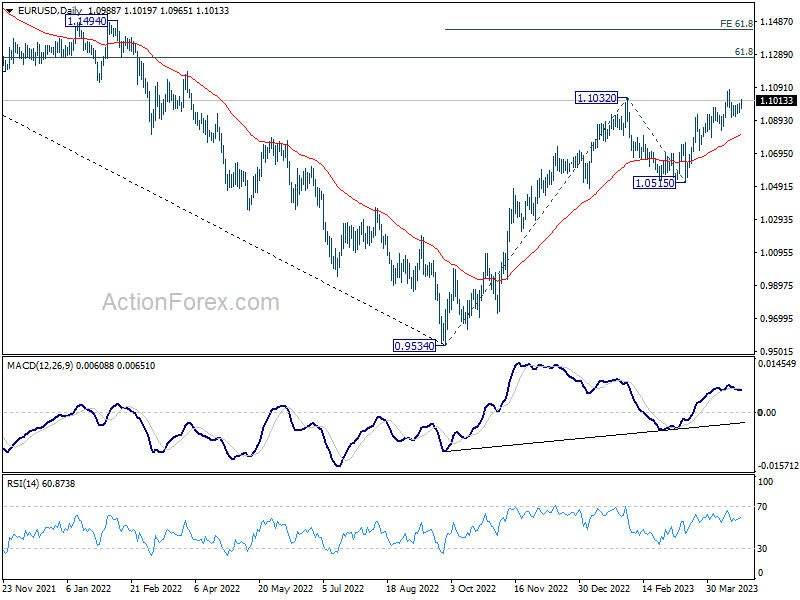
In the bigger picture, rise from 0.9534 (2022 low) is in progress for 61.8% retracement of 1.2348 (2021 high) to 0.9534 at 1.1273. Sustained break there will solidify the case of bullish trend reversal and target 1.2348 resistance next (2021 high). This will now remain the favored case as long as 1.0515 support holds, even in case of deeper pull back.
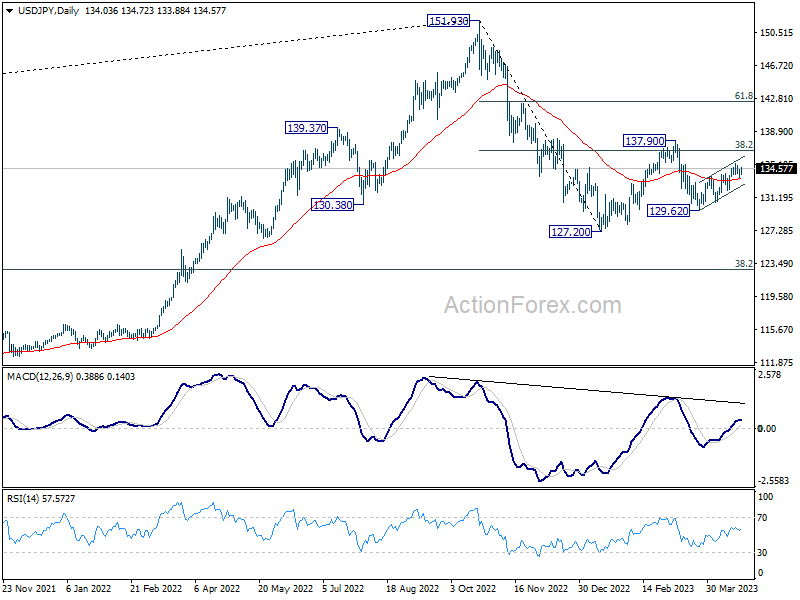
USD/JPY Daily Outlook
Daily Pivots: (S1) 133.85; (P) 134.41; (R1) 134.82; More...
Intraday bias in USD/JPY remains neutral at this point. Further rally is expected as long as 132.03 support holds. On the upside, break of 135.13 will resume the choppy rebound from 129.62 towards 137.90 resistance next. However, break of 132.03 will argue that the rebound has completed already and turn bias back to the downside for 129.62 and below.
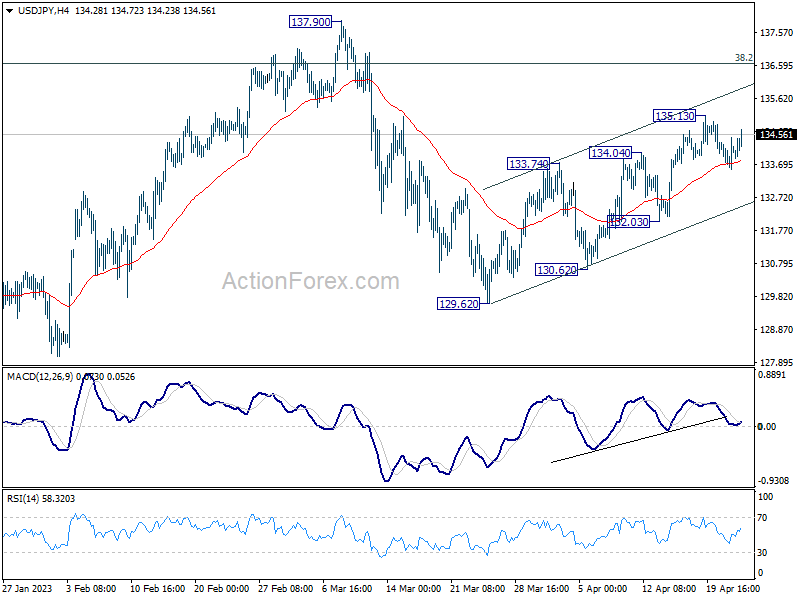
In the bigger picture, corrective pattern from 127.20 might be extending. But after all, down trend from 151.93 is expected to resume at a later stage. Break of 127.20 will resume this down trend and target 61.8% projection of 151.93 to 127.20 from 137.90 at 122.61. This will now be the favored case as long as 137.90 resistance holds.