

Sample Category Title
USD/JPY Daily Outlook
Daily Pivots: (S1) 133.86; (P) 134.29; (R1) 134.70; More...
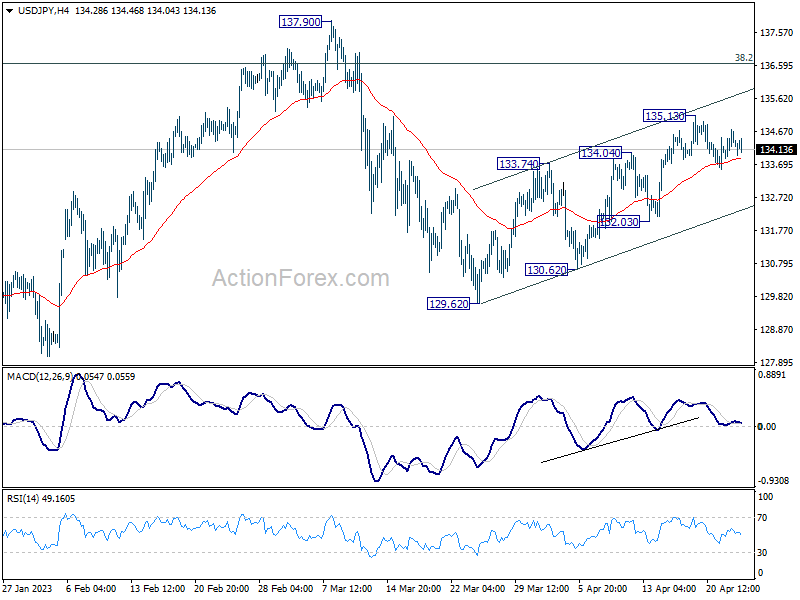
USD/JPY is still bounded in consolidation below 135.13 and intraday bias remains neutral for the moment. Further rally is expected as long as 132.03 support holds. On the upside, break of 135.13 will resume the choppy rebound from 129.62 towards 137.90 resistance next. However, break of 132.03 will argue that the rebound has completed already and turn bias back to the downside for 129.62 and below.
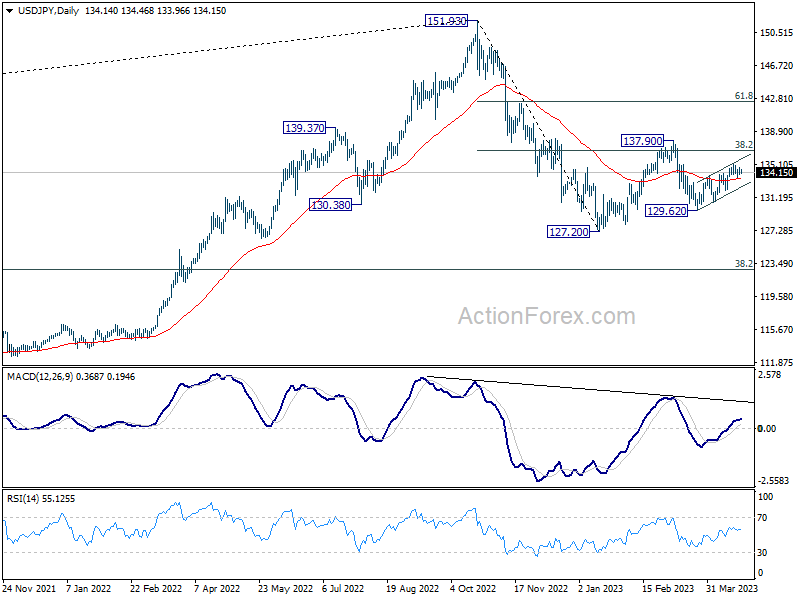
In the bigger picture, corrective pattern from 127.20 might be extending. But after all, down trend from 151.93 is expected to resume at a later stage. Break of 127.20 will resume this down trend and target 61.8% projection of 151.93 to 127.20 from 137.90 at 122.61. This will now be the favored case as long as 137.90 resistance holds.
USD/CHF Daily Outlook
Daily Pivots: (S1) 0.8858; (P) 0.8894; (R1) 0.8912; More...
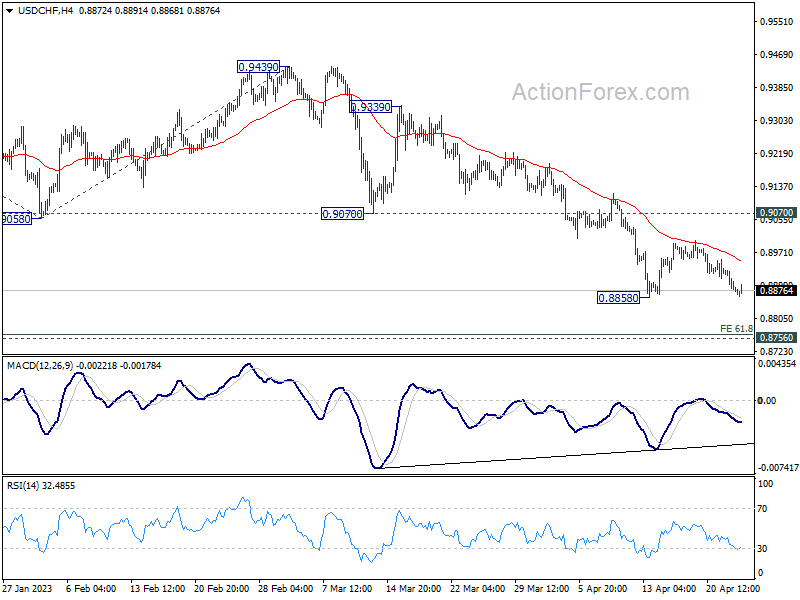
USD/CHF is still bounded in range above 0.8858 and more consolidations could be seen. But further decline is expected with 0.9070 support turned resistance intact. On the downside, below 0.8858 will resume the down trend from 1.0146 to 61.8% projection of 1.0146 to 0.9058 from 0.9439 at 0.8767, which is close to 0.8756 long term support. Strong support is expected there to bring rebound, at least on first attempt. On the upside, break of 0.9070 support turned resistance will confirm short term bottoming and turn bias back to the upside.
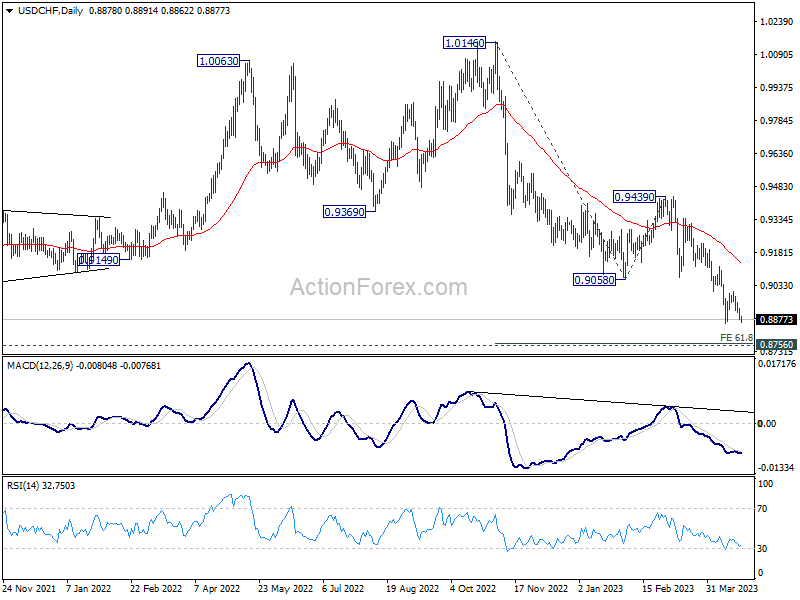
In the bigger picture, fall from 1.1046 (2022 high) is in progress for 0.8756 support (2021 low). But overall, this fall is still seen as a leg in the long term range pattern from 1.0342 (2016 high). So, downside should be contained by 0.8756 to bring reversal. Sustained break of 0.9058 support turned resistance will be the first sign of medium term bottoming. However, decisive break of 0.8756 will carry larger bearish implications.
GBP/USD Daily Outlook
Daily Pivots: (S1) 1.2436; (P) 1.2461; (R1) 1.2511; More...
No change in GBP/USD's outlook as range trading continues below 1.2545. Intraday bias remains neutral at this point. Also, outlook stays bullish with 1.2343 support intact. On the upside, above 1.2545 will target 1.2759 fibonacci level first. Firm break there will target 61.8% projection of 1.0351 to 1.2445 from 1.1801 at 1.3095. However, considering bearish divergence condition in 4H MACD, firm break of 1.2343 will confirm short term topping, and turn bias back to the downside for deeper pullback.
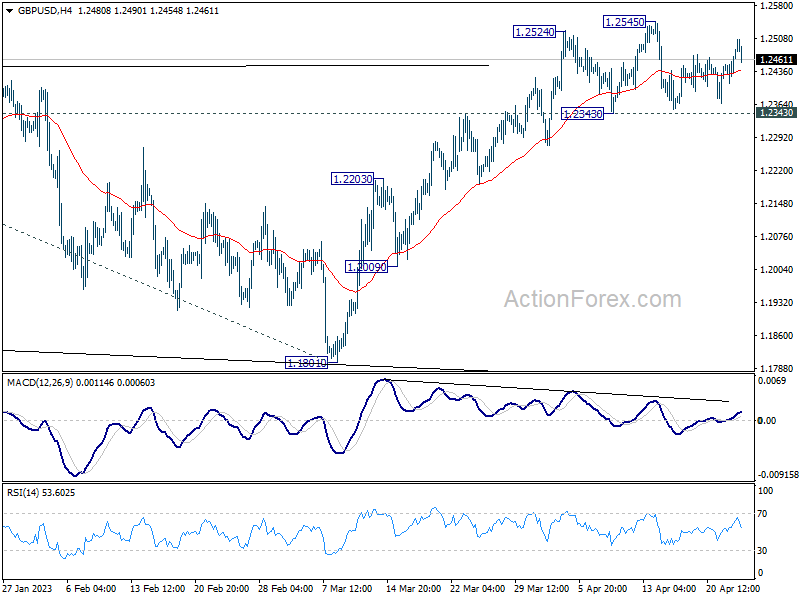
In the bigger picture, the rise from 1.0351 medium term term bottom (2022 low) is in progress for 61.8% retracement of 1.4248 (2021 high) to 1.0351 at 1.2759. Sustained break there will add to the case of long term bullish trend reversal. Further break of 61.8% projection of 1.0351 to 1.2445 from 1.1801 at 1.3095 could prompt upside acceleration to 100% projection at 1.3895. For now, this will remain the favored case as long as 1.1801 support holds, even in case of deep pull back.
GBPUSD Eyes April’s Bar; 2021 Trendline in Focus Too
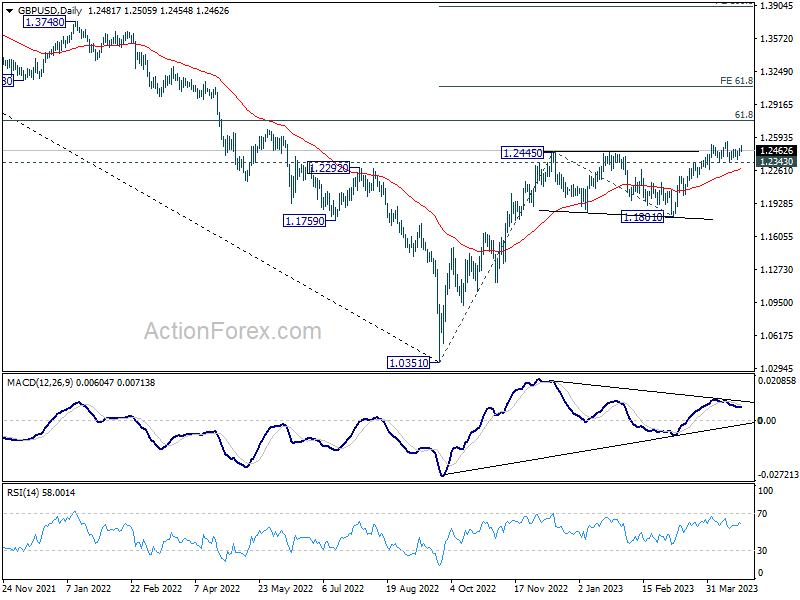
GBPUSD managed to close marginally above the December-January ceiling of 1.2445 on Monday after a three-day intense battle, shifting the spotlight to April’s bar of 1.2520.
Some caution is necessary as the RSI and the MACD have yet to correct their negative trajectory. Yet, with the price having recently secured another strong foothold around its 20-day simple moving average (SMA) and at the lower boundary of the seven-week-old bullish channel, a continuation higher seems to be very likely.
The bulls will need another win around the nearby monthly resistance of 1.2520 in order to advance towards the April-May 2022 peak of 1.2665. Strikingly, the long-term resistance trendline drawn from the 2021 top is also in the neighborhood. Hence, a victory at this point may push the price directly up to the channel’s upper line seen at 1.2775. Slightly higher, the 1.2885-1.3000 region, which includes the 61.8% Fibonacci retracement level of the 2021-2022 downtrend and the ascending line from October, could be another tough obstacle.
In the event the price flips backwards, exiting the channel on the downside at 1.2400, the 50% Fibonacci mark of 1.2285 could immediately come to the rescue. The 50-day SMA might be tested too before the bears attempt to reach the 1.2045-1.1975 constraining zone and the 200-day SMA.
All in all, GBPUSD is looking cautiously bullish in the short-term picture. A decisive close above 1.2520 could confirm additional gains towards a familiar resistance line near 1.2665.
EURJPY Surges to Fresh More-than-8-Year High
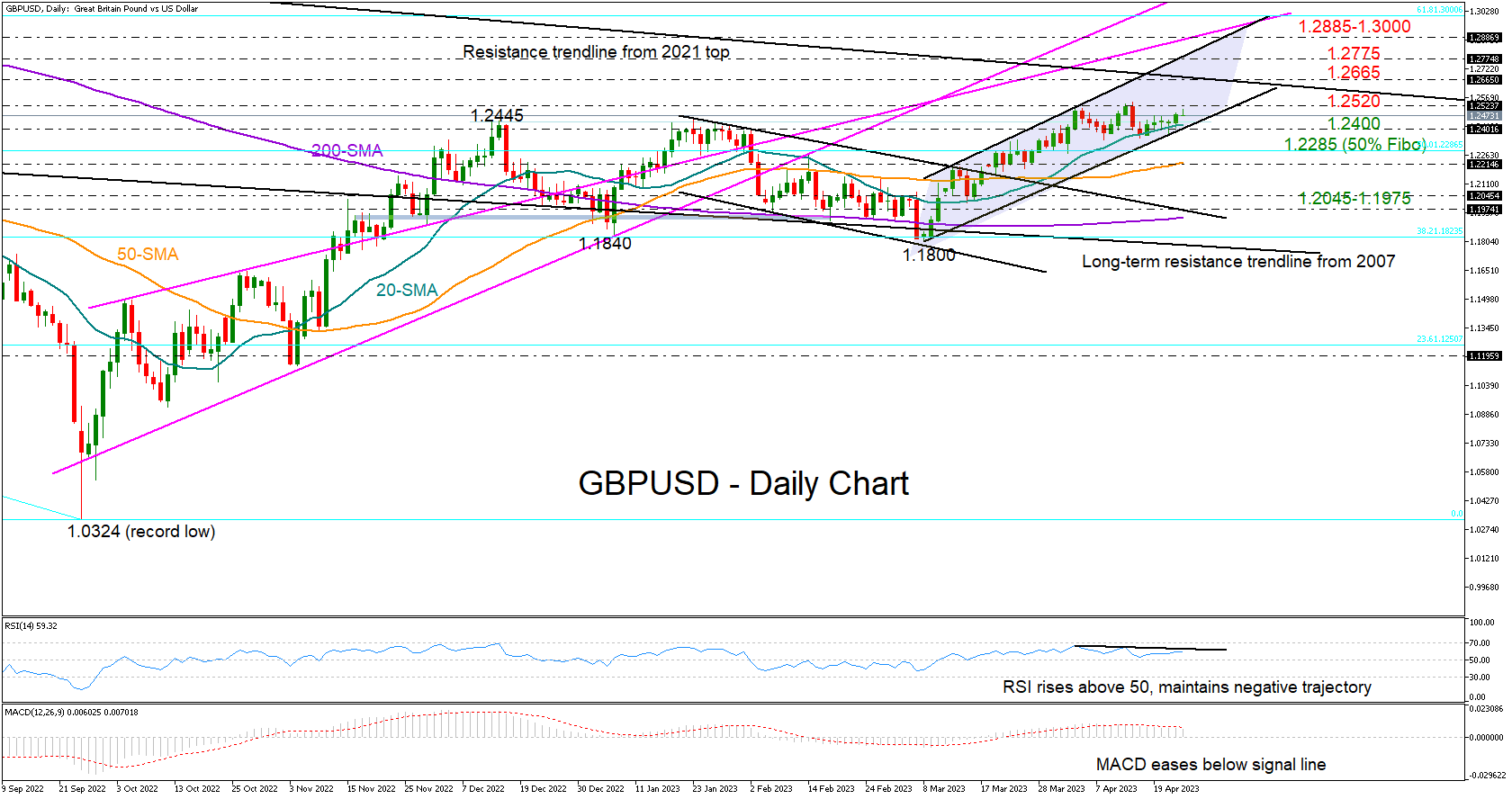
EURJPY skyrocketed to a fresh more than eight-year high of 148.60 earlier today but quickly returned some of the gains. The aggressive advance above the 146.35 support added 1.6% to the pair but the technical oscillators are looking overbought at the moment. The RSI found a strong obstacle near the 70 level and is pointing slightly down, while the MACD is still extending its upside pressure above its trigger and zero lines.
Should the pair manage to strengthen its positive momentum and jump above its intraday high, the next resistance could come around 149.75, taken from the peak in December 2014. The psychological mark of 150.00 would also be a key level for traders to have in mind.
However, if prices are unable to break higher, the risk would shift to the downside for a potential bearish correction, with the 147.85 support coming first into focus. A drop lower would signal deeper declines until the 146.35 barrier and the 20-day simple moving average (SMA) at 145.80 ahead of the 145.55 line, taken from the inside swing highs on March 2.
All in all, EURJPY is strongly bullish in the short-to-medium-term timeframes and only a slip beneath the SMAs and the Ichimoku cloud may switch the outlook to neutral.
NZD/USD Eyeing New 2023 Lows, Big Support is at 0.6
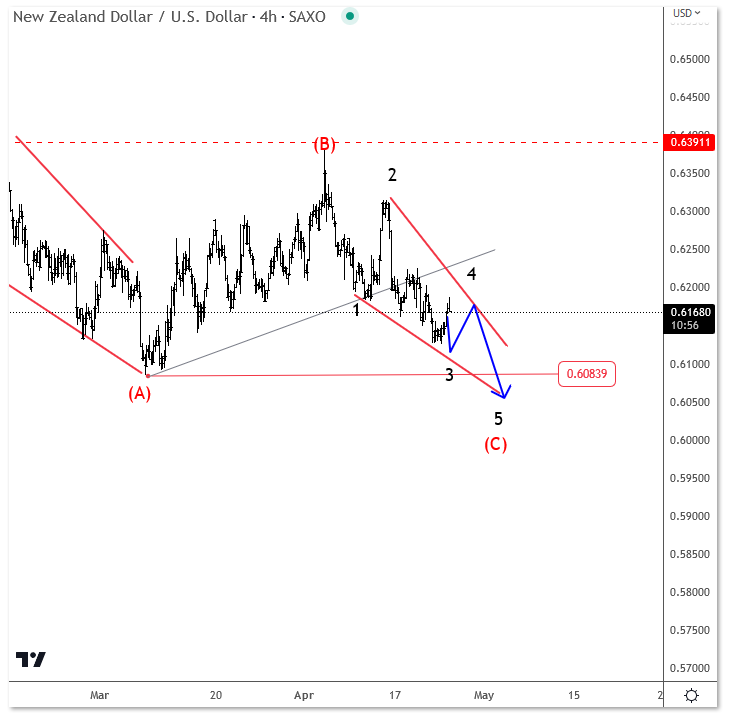
NZDUSD recovered nicely from 0.6083 but it's in three waves after recent rejection down from 0.6390 resistance. We see this as a potential corrective rally that represents (B) wave, possibly already completed after lower swing high and new swing low formed in the last few trading days. Ideally, pair is headed south for five wave drop within (C) which has room even for 0.6000. However, this wave (C) is still part of a higher degree contra-trend movement, so we believe that kiwi will turn bullish this year, but from lower support levels, according to daily count. The potential ending diagonal also suggests that support will be seen at a new 2023 low.
On a higher degree chart, we see pair turning up from an important trendline of a potential triangle, so wave (E) can be finished. As such, more gains will be expected in the upcoming weeks/months.
Gold Holds Ground
EUR/GBP tests resistance
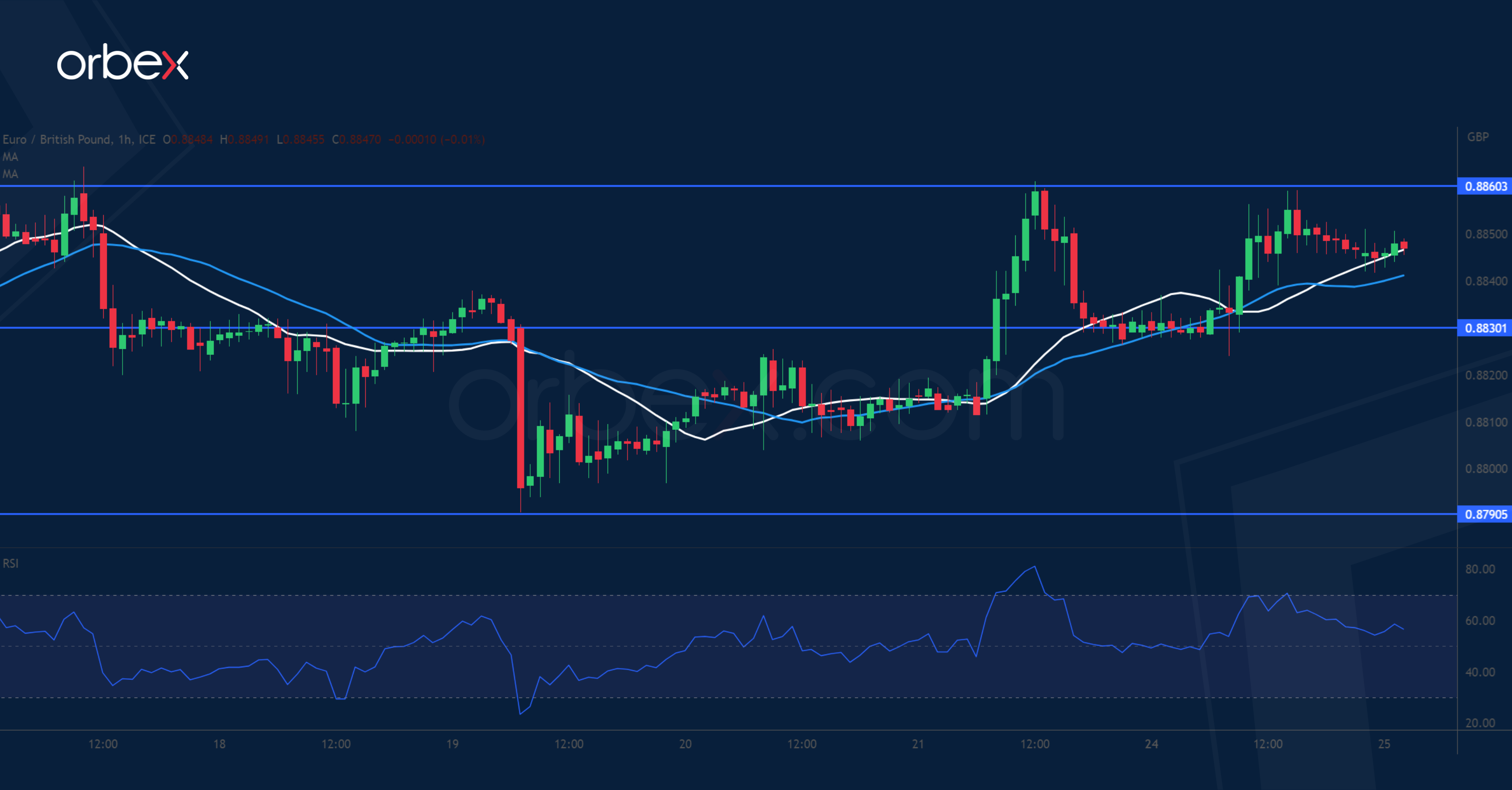
The euro advances as traders price in a 50-bps ECB hike next week. The pair’s third attempt at 0.8860 since late March shows strong buying interests especially when it is supported by a series of higher lows. A bullish breakout would send the single currency to 0.8890 at the origin of the mid-March sell-off where a breach could open the door to an extended rally above the daily double top around 0.8920. As the RSI ventures into the overbought area, 0.8830 is the first level to expect follow-up buying in case of a retracement.
XAU/USD seeks support
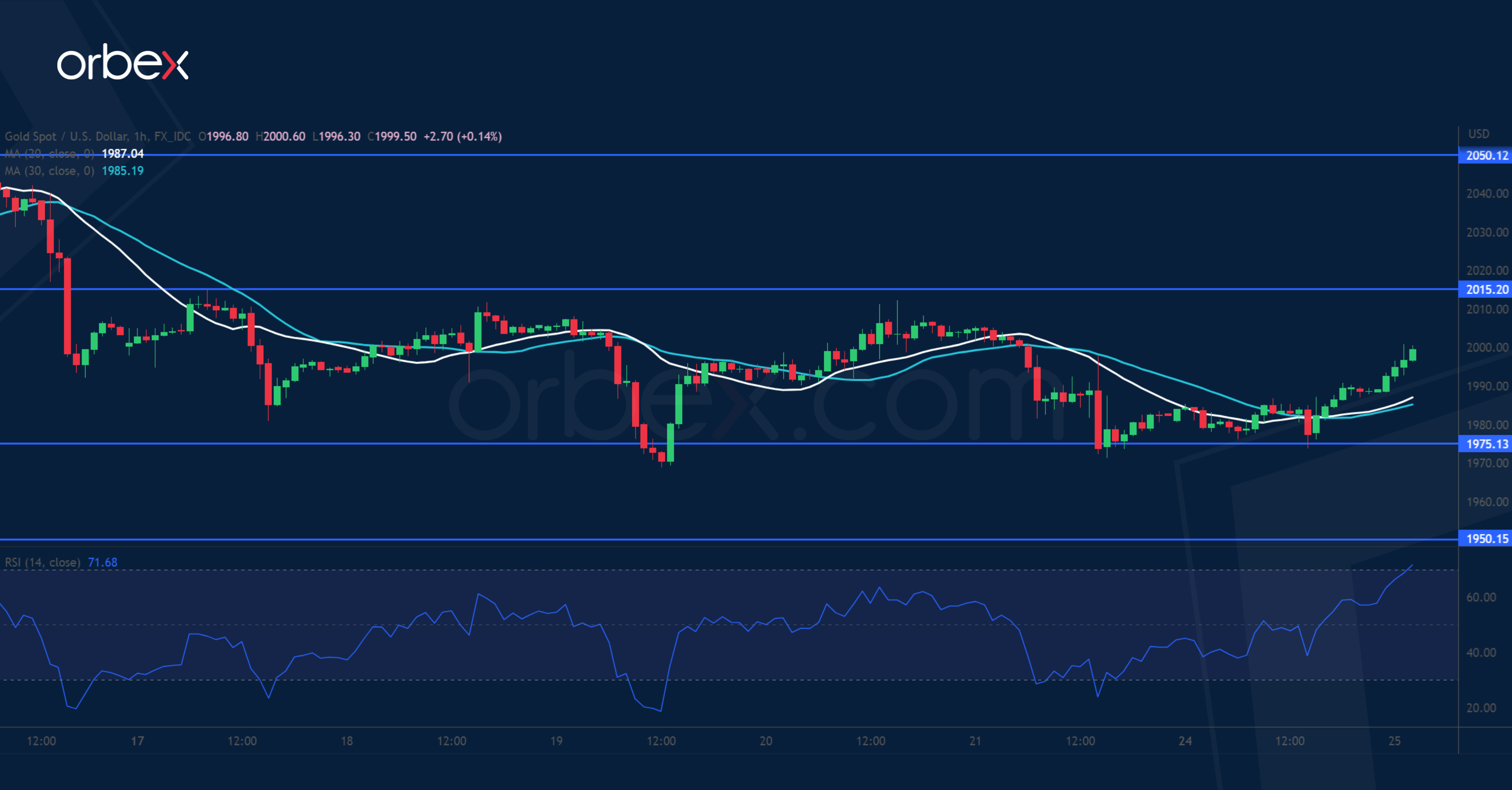
Gold inched higher as the US dollar fell across the board amid thin demand. The price continues to retreat from March 2022’s peak near 2050 while the daily RSI drops back to the neutral area. It would be too soon to call it a bearish reversal as there are multiple layers of support including 1975 and the daily level of 1950. The correction is likely to be driven by profit-taking as bullion approaches the all-time high and the price could be merely probing for support before another leg up. 2015 is the first resistance in case of a bounce.
Dow Jones 30 grinds support
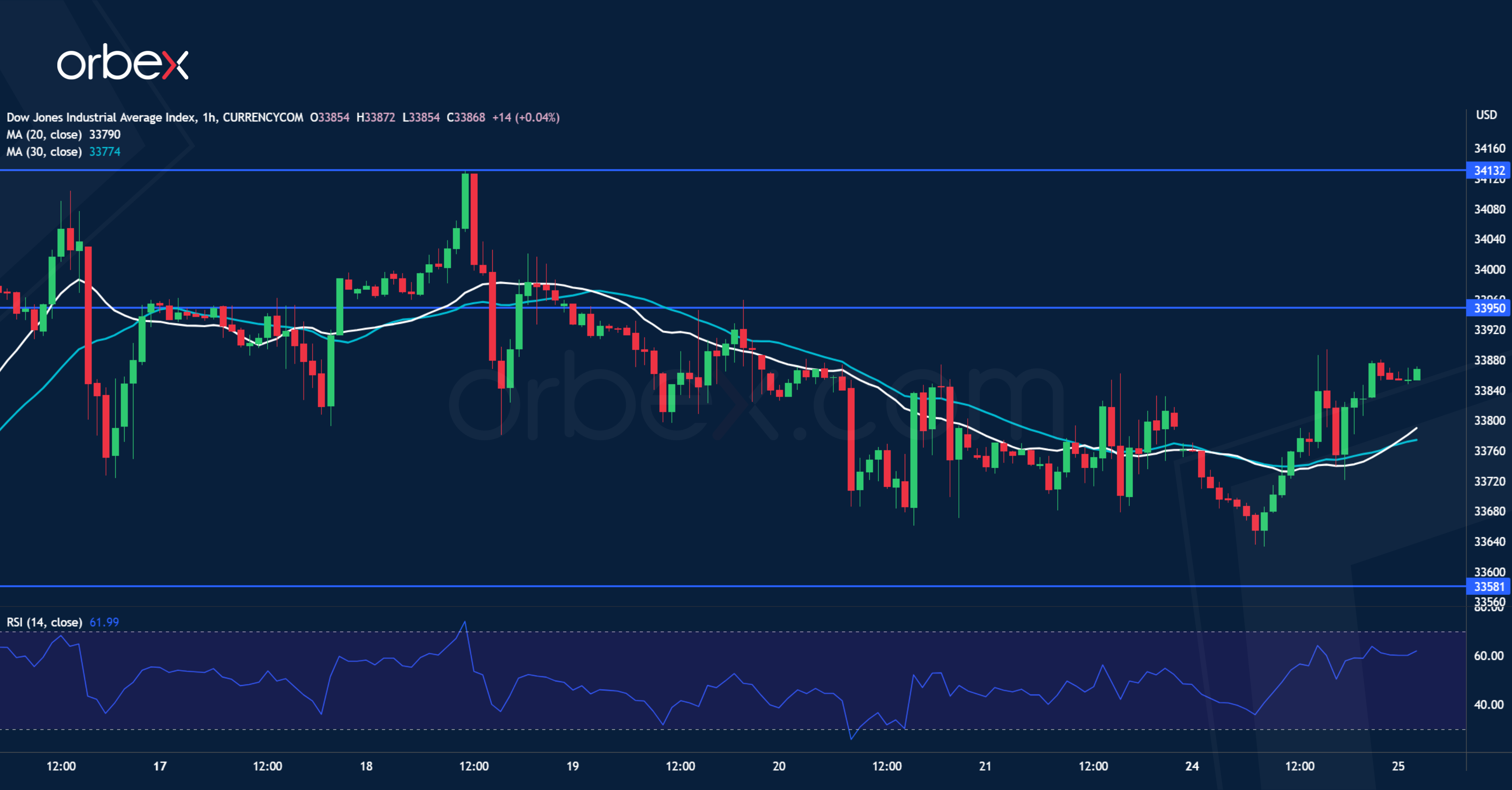
The Dow Jones 30 steadies as investors await high-profile earnings this week. The price has met strong supply around this year’s highs of 34100-34300 and a slide below 33800 has prompted short-term buyers to trim their exposure. Still, sentiment remains upbeat from the medium-term’s perspective after a sharp recovery from the March lows (31500). The index is testing 33580 at the confluence of the former March high and the 20-day SMA. A rebound will need to lift 33950 before it could signal a bullish continuation.
Caution Prevails Ahead of Big Tech Earnings
Most Asian equities flashed red on Tuesday, pressured by losses in Chinese shares as investors evaluated China’s re-opening story in the face of negative economic and geopolitical forces. European futures are pointing to a mixed open with market players guarded ahead of another event-heavy week for financial markets. Some of the largest companies in the world including the four Big Tech titans (Microsoft, Alphabet, Meta and Amazon) will be reporting their results this week. If the corporate earnings paint an overall encouraging picture, this could boost risk sentiment and support equity bulls. However, a set of disappointing results is likely to enforce renewed pressure on stock markets with the S&P500 and Nasdaq feeling the brunt.
In the currency space, the dollar attempted to stabilise during early trade after slipping in the previous session as more signs of slowing US economic growth cooled Fed hike bets. With markets now pricing in the peak for US interest rates in June, dollar bulls could be running on fumes. Gold drew strength from falling Treasury yields while oil prices steadied after two days of gains.
Dollar bears to hijack the scene?
Repeated signs of cooling price pressures and disappointing US economic data could add more fuel to expectations around the Fed pausing rate hikes and eventually cutting down the road. On Monday, softer US manufacturing data strengthened the argument for the Fed to pause. There are more major releases from the US economy this week including April consumer confidence data, Q1 GDP figures, and most importantly the Fed’s preferred inflation gauge, the Core Personal Consumption Expenditure.
US economic growth in the first quarter is expected to moderate from the 2.6% in the previous quarter while persistent price pressures may be present in Friday’s core PCE report. Ultimately, if the data supports expectations around the Fed taking a pause from rate hikes after May, this may drag the dollar lower.
Looking at the technical picture, the Dollar Index remains under pressure on the daily charts. Weakness below 102.00 could trigger a decline towards 100.79 and 100.00, a level not seen since April 2022.
Commodity spotlight – Gold
Gold briefly punched above the psychological $2000 level during early trade this morning as falling Treasury yields and dollar weakness sweetened appetite for the precious metal. Nevertheless, it still remains trapped within a sticky range thanks to the ongoing uncertainty over the Fed’s next move beyond May. With markets now expecting US rates to peak in the summer and a rate cut by December, gold has the thumbs up to push higher in the longer term. Meanwhile, volatility could be the name of the game due to shifting expectations around future Fed policy moves.
Turning to the technicals, price action suggests that a fresh catalyst is needed to trigger a bullish or bearish breakout. A strong move above $2000 may inspire a push towards $2025 and $2048. If prices remain below $2000, gold could test $1950 and $1900.
ECB Has No Other Choice But to Continue Inflation Battle
Markets
European and US yields parted ways yesterday with Europe underperforming. A thin eco calendar failed to inspire, but comments by ECB Wunsch in an FT interview managed to do the trick. They were released ahead of the European opening bell, but resonated throughout European dealings. Wunsch added to recent hawkish comments from him and several other ECB figures, arguing that the ECB has no other choice but to continue its inflation battle as core (services) inflation and wage inflation show no sign of abating yet. He wouldn’t be surprised to see the key ECB policy rate reach 4%. We also expect him to back another 50 bps rate hike next week, our preferred scenario. German yields rose between 0.9 bps (30-yr) and 5.8 bps (2-yr) yesterday with the front end of the curve obviously underperforming. US yields eventually closed 6.5 bps (30-yr) to 10 bps (3-yr) lower! They were already on a slippery slope throughout the day, but Q1 earnings from First Republic Bank delivered the final and strongest blow at the closing bell. The US regional bank was already on death row with earnings now revealing over $100bn of deposit outflows between mid-March ($138.1bn) and mid-April. This compares with mostly single-digit deposit outflow figures at other regional banks which already reported Q1 results. The Fed and big banks provided a liquidity stopgap to secure First Republic’s short-term survival, but long-term profitability is seriously at risk. First Republic bank shares fell around 20% in after-hours trading. We won’t get dragged away too far by moves in the transition from US to Asian dealings and don’t expect this to be the start of a new period of instability as witnessed in the wake of the collapse of Silicon Valley Bank. The US/German 2y yield spread dropped below 110 bps to the lowest level since October 2021. These relative yield dynamics translate into additional gains for EUR/USD. The pair took out the 1.10 big figure and tested the 1.1076 YTD top. Real resistance stands at 1.1274 which is 62% retracement on the EUR/USD decline between early 2021 and late 2022. (Temporary?) risk aversion related to US regional banking problems last month didn’t help the greenback with EUR and JPY the preferred safe haven currencies. On balance, the single currency even outperforms the Japanese yen as new BoJ governor Ueda sticks to previous governor Kuroda’s dovish policy stance. He said in front of parliament this morning that tightening now may cause inflation (currently above target led by cost-push factors) to weaken more than currently already expected and could have serious consequences in the future. EUR/JPY is testing the 2022 top at 148.40 with next resistance (2015 top) at 149.78. Apart from general risk sentiment, we look at US eco data to guide trading (Philly Fed business outlook, Richmond Fed manufacturing index and consumer confidence). Especially disappointing numbers could be picked up.
News and views
Q1 South Korean growth printed slightly stronger than expected at 0.3% Q/Q (from -0.4% Q/Q in Q4 2022). Demand was supported by a 0.5% rise in private consumption. However, capital investment contracted by 4%. Exports and imports respectively gained 3.8% and 3.5%. The Bank of Korea expects a further economic rebound in the second half of the year but uncertainty remains high both internally and externally. Earlier this month, the BOK for a second consecutive meeting left its policy rate unchanged at 3.5% as it indicated that growth this year might be slightly below its previous 1.6% forecast. At the same time March inflation (4.2% Y/Y) remained well above the 2% inflation target. The Korean won stays in the defensive easing to USD/KRW 1336, despite an overall soft USD.
A series of economic data published in Poland yesterday printed on the softer side of expectations. PPI producer prices dropped 0.8% M/M in March easing the Y/Y figure to 10.1% Y/Y (-0.5% and 18.2% Y/Y in February). The decline in industrial output also accelerated from -1.0% Y/Y in February to -2.9% Y/Y in March as a 14.1 M/M gain was not enough to compensate for a big positive base effect last year. Construction output also missed the consensus estimate, declining 1.5% Y/Y from a positive growth of 6.6% the previous month. Last but not least, retail sales showed a similar picture as was the case for production. A 14% monthly rise was not enough to compensate for a big monthly gain last year resulting in a further decline in the Y/Y measure from -5.0% to -7.3%. For now, the National Bank of Poland is keeping a wait-and-see approach as inflation (16.1% Y/Y in March) remains too high to start the debate on possible interest rate cuts even as activity slows. Weaker eco data didn’t hurt recent positive sentiment on the zloty. EUR/PLN closed below 4.60, testing the strongest levels for the zloty since June last year.
Big German Pay Rises
Market movers today
A quiet day in terms of data releases, US Conference Board's consumer confidence index will be released for April. The University of Michigan survey released earlier pointed towards modestly improving consumer sentiment.
The National Bank of Hungary is expected to maintain rates unchanged in its meeting today.
The 60 second overview
Pay rises: German public sector wage negotiations (covering some 2.5 million workers) has reached an agreement. The deal has several elements: (1) no permanent wage increase in 2023, but a EUR 1240 one-off payment in June 2023, followed by monthly payments of EUR 220 from July 2023-February 2024; and (2) from March 2024 a permanent wage increase of EUR 200 plus 5.5%. Overall, for a 24 month agreement the union talks about wage increases between 8.2% and 16.9%, with the average wage increase around 11.5%. Overall, it marks yet another agreement with significantly higher wage growth that could further delay the return of core inflation to ECB's target. Nor will it be the last high-wage agreement: Verdi union has just started with a 15% wage demand for the retail sector negotiations covering another 2.6 million workers.
German business climate: Ifo improved for a sixth straight month in April. While business expectations continued to improve, the current situation assessment weakened a tad, especially for construction, which is feeling the heat from higher rates. Overall, Ifo continues to send a less upbeat signal for the state of the economy than PMIs. The good news is that the German economy seems to have edged further away from recession territory at the start of Q2, but on the downside Ifo suggests a strong rebound in activity is not yet in sight either.
Bank of Japan: Once again, the new governor Ueda stressed the need to keep monetary policy accommodative for now. "We see the risk of inflation undershooting forecasts as bigger than the risk of overshooting", he said, ahead of the policy meeting ending Friday. "But if wage growth and inflation accelerates faster than expected and warrants tightening monetary policy, the BOJ stands ready to respond such as by raising interest rates". See Reuters. We expect the BoJ to stay put on Friday, see Bank of Japan Preview - Risk of tightening too soon still dominates, 21 April.
Equities: Global equities marginally higher yesterday lifted by Europe and US. Tech sector underperforming ahead of the pick-up in Q1 tech reporting season the coming days. Regional banks on the weak side as well and they could come in focus today after the earnings result from First Regional (came after the bell) showed as deposit outflow of 41% in Q1. Energy the biggest outperformer followed by the group of classic defensive sectors. In US Dow +0.2%, S&P 500 +0.1%, Nasdaq -0.3% and Russell 2000 -0.2%.
Asian markets are mostly lower this morning led by tech-heavy South Korea. European and US futures 0.2%-0.3% lower.
FI: It was a mixed day in the global bond markets, where European yields rose across the curve, while US Treasury yields declined across the curve. Hence, the 10Y US-German government yield spread is testing the 100bp-level, which we have not seen since the Covid crisis in the spring 2020.
FX: The EUR continues to shine and yesterday in particular vis-à-vis USD, JPY, AUD and CAD on a day where short-term EUR rates rose to the highest level in over a month ahead of next week's ECB meeting. Scandi currencies held steady for a change and looks to be in wait-and-see mode before the Riksbank meeting and the announcement on NOK fiscal transactions later this week.
Credit: Overall a quiet session in the credit market with limited activity in secondary markets. iTraxx Main was unchanged at 83bp while iTraxx Xover was 1bp tighter at 439bp. The primary market activity was relatively high with more than 10 new deals announced - among others the Federal Republic of Germany announced a 10-year EUR benchmark Green bond offering and in the Nordics TDC NET announced intention to issue an 8-year EUR benchmark senior secured sustainability-linked bond.