Sample Category Title
Bitcoin (BTCUSD) At Possible Support Area
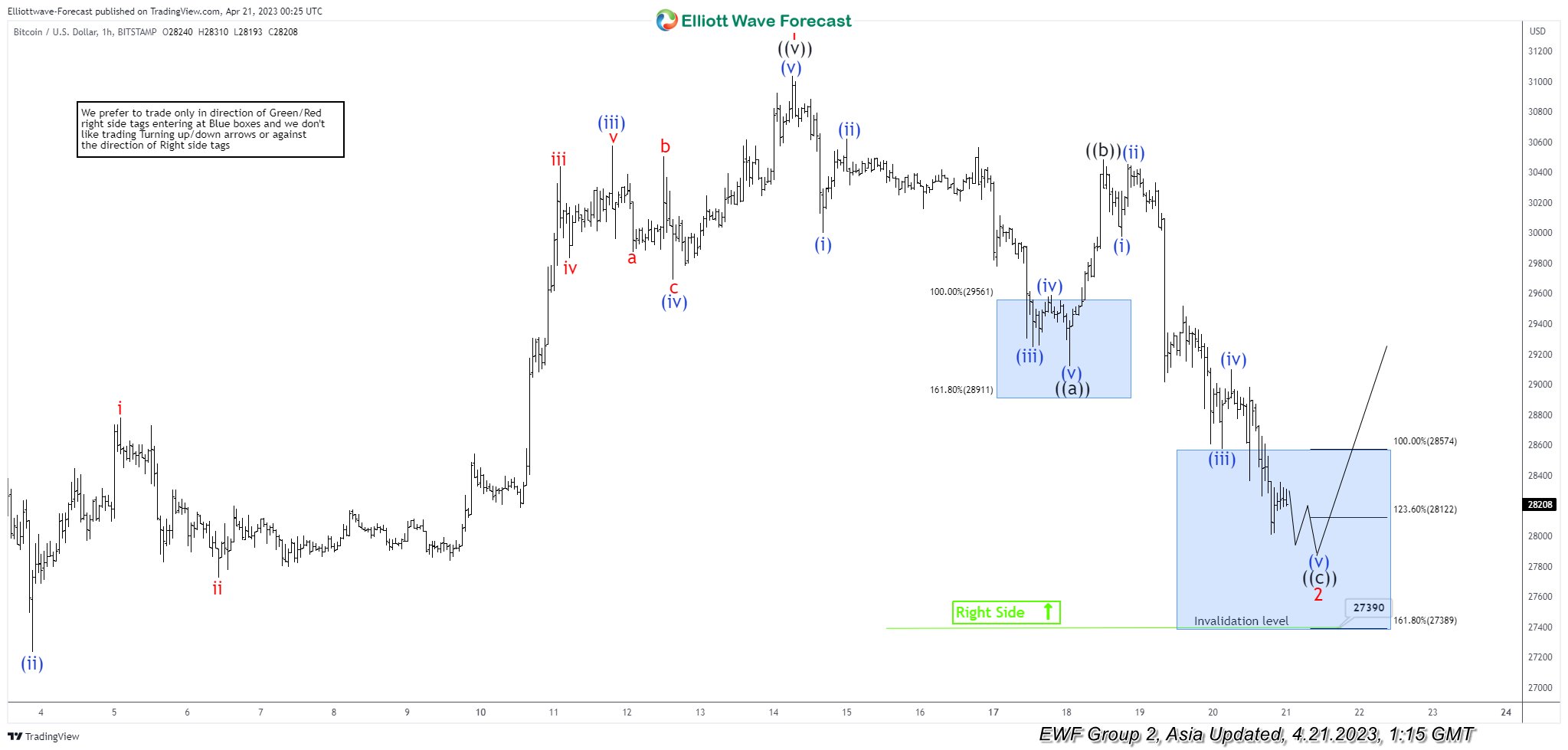
Bitcoin cycle from 3.10.2023 low has ended with wave 1 at 31035. Internal subdivision of wave 1 unfolded as a 5 waves impulse. Wave ((i)) ended at 20874 and pullback in wave ((ii)) ended at 19893. The crypto-currency extends higher in wave ((iii)) towards 29380 and pullback in wave ((iv)) ended at 26541. Final leg wave ((v)) ended at 31035 which completed wave 1 in higher degree. Pullback in wave 2 is in progress to correct cycle from 3.10.2023 low, but it’s near complete.
Internal subdivision of wave 2 is unfolding as a zigzag Elliott Wave structure. Down from wave 1, wave (i) ended at 30001 and wave (ii) ended at 30620. Wave (iii) ended at 29247 and wave (iv) ended at 29590. Final leg wave (v) ended at 29122 which completed wave ((a)). Rally in wave ((b)) ended at 30483. Bitcoin then extended lower in wave ((c)) and it has already reached the extreme area from 04.14.2023 high at 27390 – 28574. This area is measured from 100% – 161.8% Fibonacci extension of wave ((a)).Near term, while above 27390 (1.618 Fibonacci extension level), expect the crypto currency to extend higher or rally in 3 waves at least.
BTCUSD 60 Minute Elliott Wave Chart
BTCUSD Elliott Wave Video
https://www.youtube.com/watch?v=NGpQaoA6TJA
S&P 500 Grinds Major Resistance
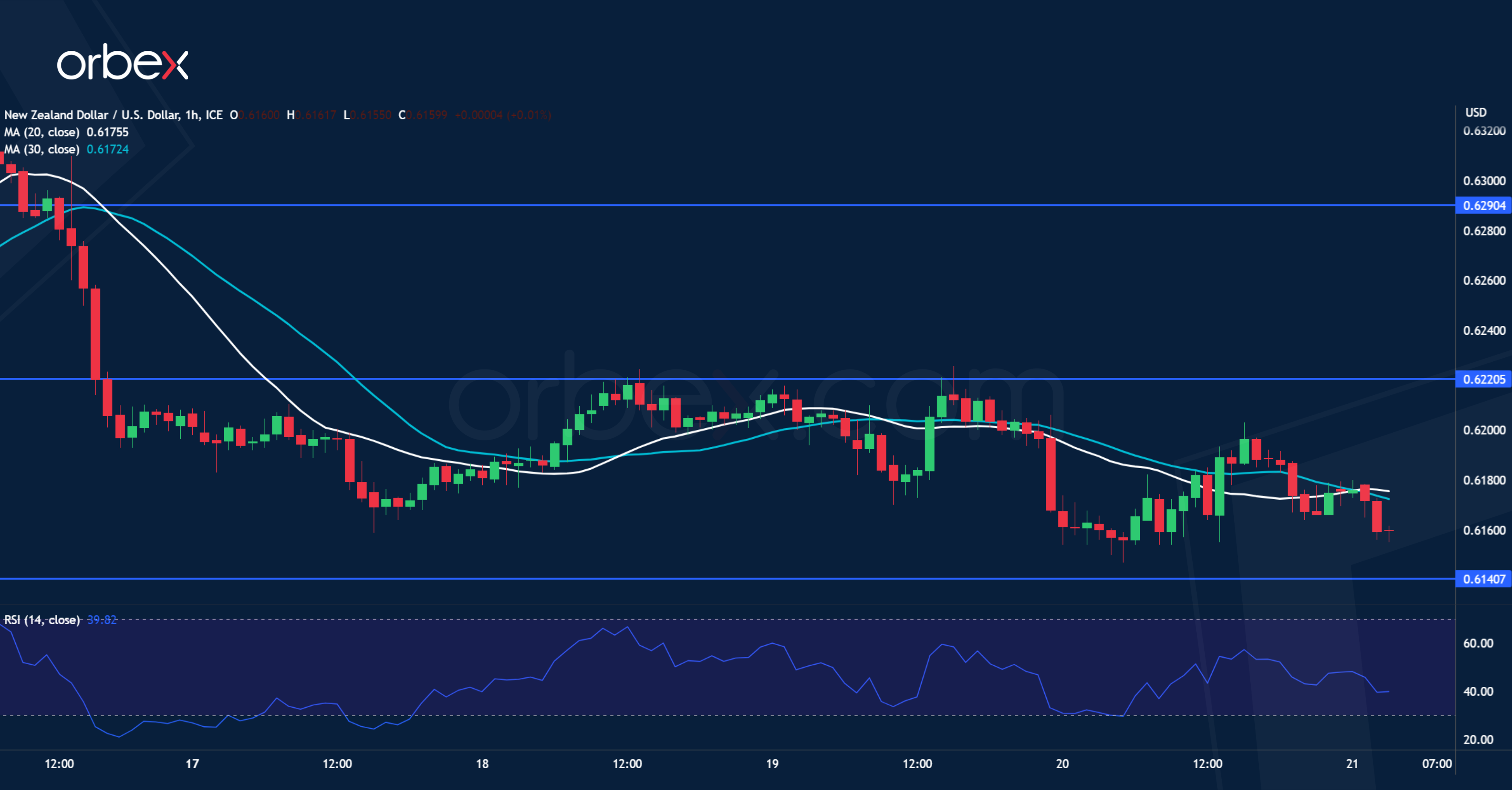
NZD/USD tests support
The New Zealand dollar fell after the Q1 data showed a clear slowdown in inflation. The pair is struggling to preserve its gains from the March rally with a drop below the base of the recent surge at 0.6180 suggesting that the path of least resistance might be down. A limited rebound came to a halt at 0.6220, turning it into a fresh supply zone. The bulls’ failure to push back would make the kiwi vulnerable to a broader sell-off. A break below 0.6150 may attract momentum sellers and send the pair past the March low of 0.6090.
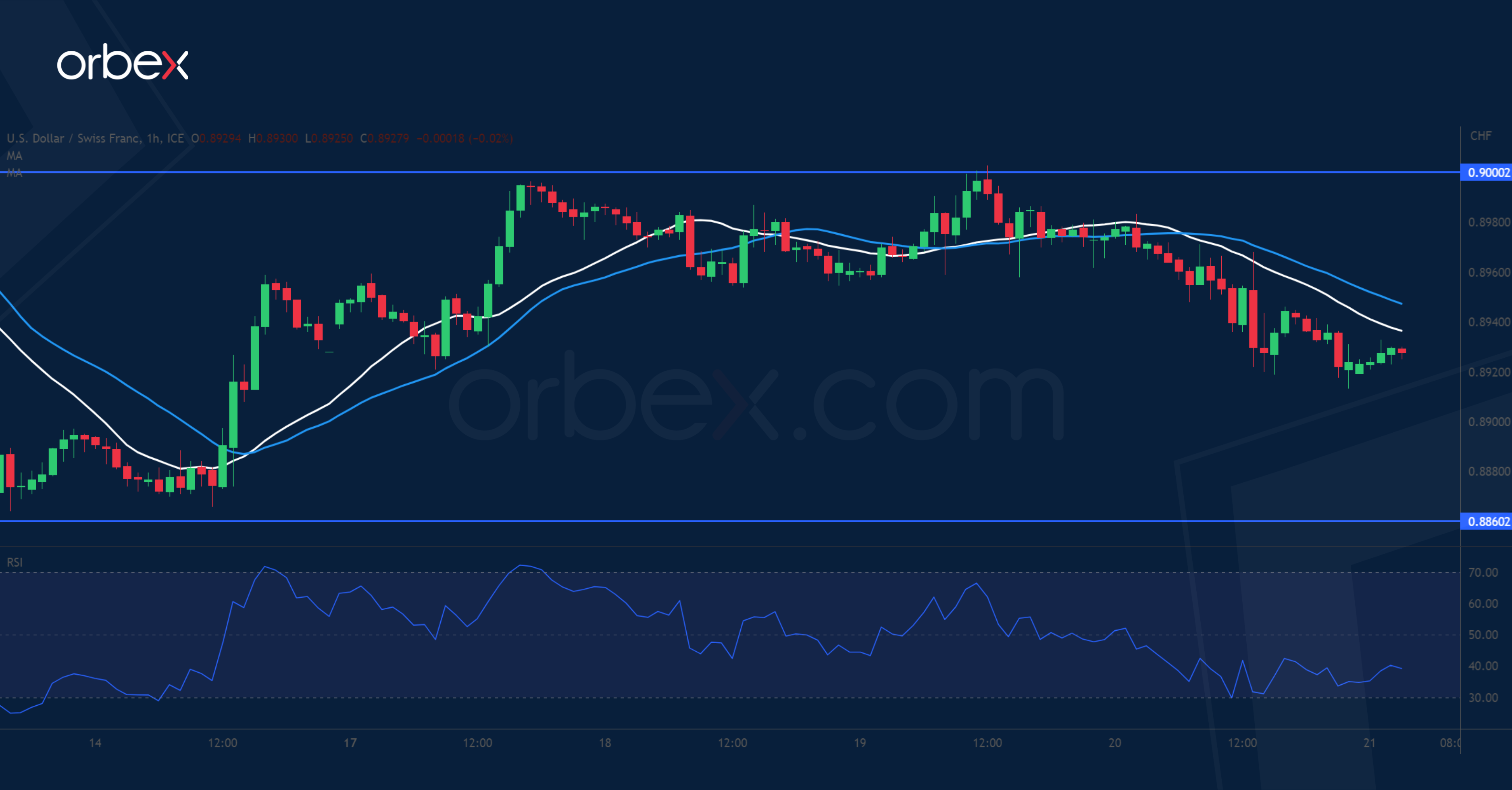
USD/CHF struggles for bids
The US dollar fell as rising jobless claims rekindled recession worries. This week’s rebound has struggled to conserve its momentum with the price turning lower at the psychological level of 0.9000. Medium-term sentiment has become downbeat following the breach of the daily support at 0.9080 and the bears are likely to sell into strength at rebounds. A fall below 0.8920 would reaffirm weakness and expose the greenback to another leg of decline past 0.8860 then towards January 2021’s lows around 0.8780.
US 500 seeks support
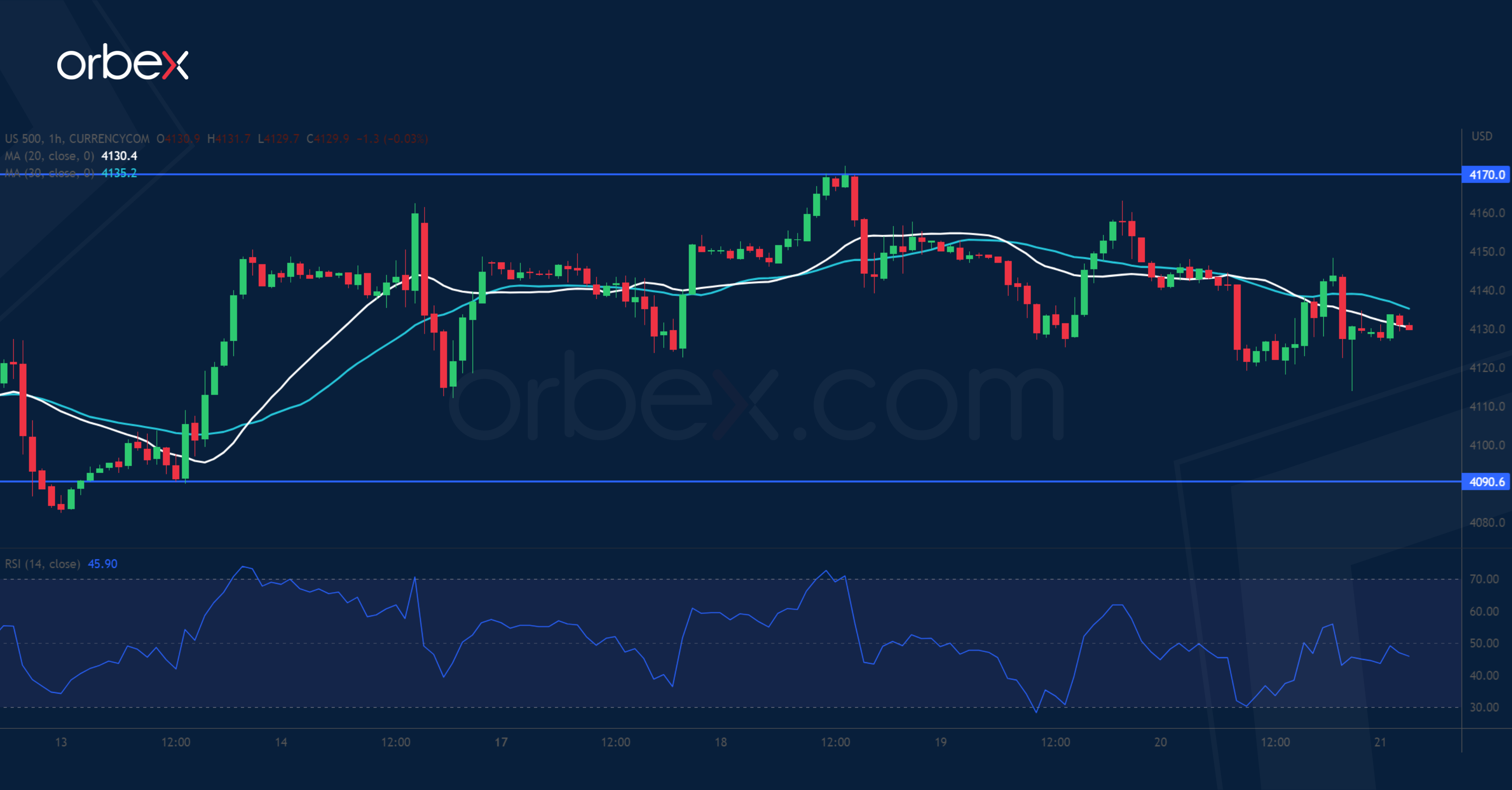
The S&P 500 edged lower, dragged by Tesla’s earnings miss. The price is grinding a key supply zone 4170- 4190 near this year’s peak. The choppy price action is a sign of hesitation as the bulls take some chips off the table. On the opposite side, offers could be expected from those looking to sell high and an initial break below 4125 may have given them an edge. 4090 on the 20-day SMA is a key level to keep the rally intact in the short-term and its breach may trigger a correction towards the psychological level of 4000.
The Dollar Still Looks Fragile
Markets
Recent hawkish repositioning yesterday did run into resistance. The US 2-y and 10-y yield failed to overcome resistance at 4.26% and 3.64% respectively. 3% also proved a too high bar for the German 2-y yield. The correction in yields already started in Europe and accelerated in the US. US jobless claims rose more than expected (245k) and the Philly Fed business outlook unexpectedly declined, supporting a rebound in bonds. In a steepening move, US yields ceded between 10.1 bps (2-y) and 4.6 bps (30-y). Most Fed governors (Mester, Bostic, Harker) ‘implicitly’ supported the case for the Fed hiking by 25 bps in May and then taking a pause to assess the potential tightening of monetary conditions (Mester). German yields eased between 7.3 bps (2-y) and 4.7 bps (30-y). The minutes of the March ECB meeting showed that a big majority supported a 50 bps step at that time. The ECB will keep a close eye at financial stability issues but the focus remains on inflation at the upcoming meeting(s). The decline in yields didn’t help equities. US indices lost between 0.33% (Dow) and -0.8% Nasdaq. The combination of lower yields and a mild equity correction still translated into a modest loss for the dollar. DXY closed near 101.84. EUR/USD finished the day at 1.097. USD/JPY eased from the high to the low 134 area. Oil also declined further (close $81.1) p/b).
Asian equities this morning join the risk-off correction on WS yesterday with most indices losing between 0.3% and 1.5%. US yields are declining marginally further (1.0-1.5 bps). The dollar shows no clear directional trend (DXY 101.85; USD/JPY 133.85; EUR/USD 1.096). Later today, the market focus will be on the PMI releases. The EMU composite index is expected unchanged at 53.7. We assume that only a big surprise will have an impact on the ECB assessment. The focus is on the April CPI data and the Lending survey to be published ahead of May meeting. The US composite PMI is expected at 51.2 from 52.3. In the wake of the financial turmoil and given the Fed focus on financial conditions, the market could be more sensitive to a negative surprise in US PMI’s. So, yields might ease a bit further going into the weekend. The dollar still looks fragile. In a ST perspective EUR//USD 1.0909 marks this week’s low with 1.0831 first important support. The topside of the ST range stands at 1.1076. After stronger/higher than expected labour data and inflation this week, UK retail sales printed on the soft side of expectations (sales ex-auto fuels 1.0% M/M). Sterling is losing marginally in a first reaction (EUR/GBP 0.882).
News and views
Japanese inflation came in higher than expected in March. Headline prices rose 3.2% y/y, (3.3% in February) amid government subsidies for utilities bills. If it weren’t for the measures, inflation would be about 4.3%. Excluding energy, inflation topped a 3% estimate to come in at 3.1% y/y (same as in February). Stripping the index down to a standard core gauge (ex. energy and food), inflation accelerated from 3.5% to 3.8% (vs 3.6% expected), the fastest since end 1981. The data come ahead of a Bank of Japan policy meeting next week. It’s the first one with the new governor Ueda at the helm. Today’s data pressures the BoJ’s ultra-easy policy stance. Bloomberg, citing sources, reported earlier this week that officials are wary of scrapping yield curve control so soon after the financial turmoil clouded the outlook. But they did add that the final policy decision will be made after assessing economic data and developments in financial markets up until the last moment. Japanese yields remain stoic, with moves confined between a tight -0.8 and +0.8 bps range. The yen appreciates a tad with USD/JPY easing from 134.24 at the open to 133.87 currently. EUR/JPY falls to 146.72 after having rallied almost 5 big figures since early April.
UK consumer confidence rebounded by more than expected in April. The GfK index rose from -36 to -30 (-35 expected). It’s the highest reading since February last year and a recovery for a third month straight. The series hit an all-time low in September 2022 (-49) in the midst of the cost-of-living crisis. While there’s still some way to go – confidence is barely better than just shortly after the start of the pandemic – Joe Staton at GfK said that especially the 8 point surge in consumer’s 12 month personal finance prospects is a dramatic change. It suggests that household finances are stronger and withstanding double-digit inflation better than thought. The assessment for the economy the year ahead also improved (-34 from -40) as did the view on buying major purchases (from -33 to -28).
Focus Increase on the US Debt Ceiling
Market movers today
PMI figures will draw markets' attention today. In the euro area, services will probably remain the main growth (and inflation) driver for now, but it will be interesting to see whether manufacturing finally shows some positive spill-over effects from the Chinese re-opening. US PMIs will shed some light on economic activity after a blurry March picture.
We also have several potential Moody's and S&P sovereign debt ratings coming out for Ireland, France and Italy among others. We expect an upgrade of Ireland.
The 60 second overview
The confrontation between US and China continues as US President Biden will try to limit US investments in several key parts of the Chinese economy.
Yesterday, we had a string of comments from various Federal Reserve officials stating the need for bringing down inflation; more tightening could be needed and thus pushing Fed funds above 5%. However, some also argued for prudence and the need to monitor the credit tightening from banks as well. Hence, this indicates that we are getting closer to the end of the tightening cycle.
US Treasury yields declined on the back of weaker US data and negative sentiment in the equity market and the comments from the Federal Reserve could not change this.
There is increasing focus on the debt ceiling after the lower than expected tax payments indicating that the Treasury may run out of money already in June as discussed in our note from yesterday, Research US - X-date looms closer as 'Tax Day' disappoints, 20 April. If we go back to 2011 during the debt ceiling "crunch" in July 2011 and until Mid-august, when the US Treasury was expected to "run out of money", 10Y US Treasury yields fell from 3% to 2.05%, while Bunds rallied some 70bp and the Bund spread widened from 45bp to 70bp. Hence, the debt ceiling debacle will not only have impact on US Treasuries but also a big impact of European government bond yields.
We have also had a string of comments from ECB officials regarding the need for tighter monetary policy among others Lagarde saying that there is "a little way to go on that path". There will be more speeches today from various ECB officials.
Equities: Global equities lower yesterday with consumer staples, utilities, and industrials higher. Hence, not a classic sector rotation but at the end of the day it was a defensive turn and risk-off tone dominating with VIX ticking higher. Many Fed speakers yesterday combined with a busy reporting schedule and eye-catching macro numbers did not make it easy for investors to find out which way to lean. In US Dow -0.3%, S&P 500 -0.6%, Nasdaq -0.8% and Russell 2000 -0.5%. Asian stocks are lower this morning and to a large extent matching the moves we saw on Wall Street yesterday. US and European futures are mixed this morning.
FI: US Treasury yields declined on the back of weaker US data and negative sentiment in the equity market and moderate hawkish comments from the Federal Reserve could not change this.
FX: US yields fell yesterday as macro data disappointed, but EUR/USD remains in consolidation around 1.0950. Japanese core inflation surprised to the upside during the night and we continue to expect the BoJ to phase out YCC in either June or July. Next round of QT from the Riksbank is on the cards today, but thus the FX impact of previous auctions has been muted.
Credit: Secondary credit spreads moved decisively higher yesterday, with iTraxx Xover widening almost 11bp and Main 2.3bp. The spread between Sr financials and iTraxx Main widened for the first day since early April, indicating slightly rising concern about the banking sector.
Nordic macro
Today, the Riksbank will sell SEK750m +/-750m each of SGB1061 (Nov-29) and SGB1056 (Jun-32). Note that the Riksbank has increased the tolerance interval for the volumes to +/-750m in each bond (previously +/-375m). This increases the flexibility for the Riksbank and as we interpret it, mean that they can abstain from selling any bonds if they do not find bids attractive enough. That said, we would expect to see good demand for the two SGBs up for sale today.
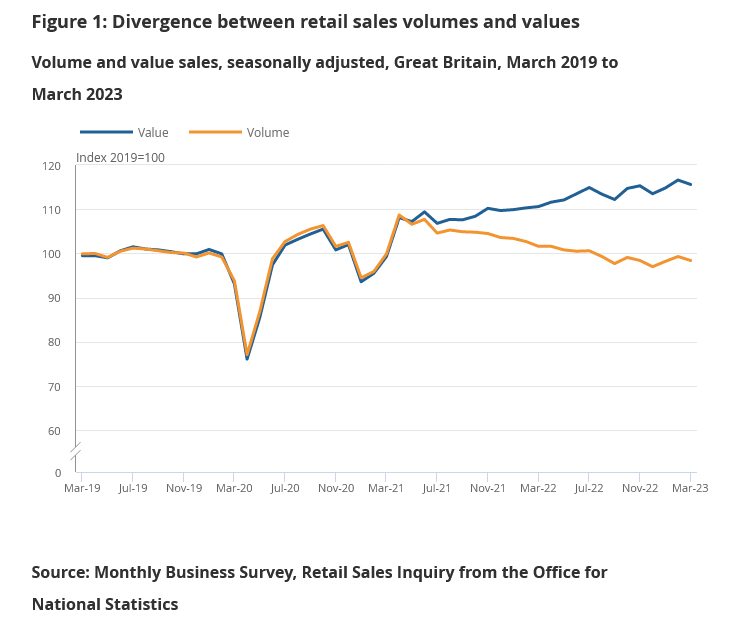
UK retail sales volume down -0.9% mom in Mar, value down -0.9% mom
In volume term, UK retail sales fell -0.9% mom in March, below expectation of -0.5% mom. Ex-fuel sales declined -1.0% mom, below expectation of -0.7% mom. For the year, retail sales was down -3.1% yoy while ex-fuel sales was down -3.2% yoy, versus expectation of -3.1% for both.
In value term, retail sales was down -0.9% mom and up 4.5% yoy. Ex-fuel sales was down -0.6% mom and up 6.0% yoy.
Yen Rises on Persistent Inflation, Focus Turns to PMI Data and Canada’s Retail Sales
Japanese Yen rose broadly in today's Asian trading session following the release of CPI data, indicating inflation remains persistently above BoJ's target. While it is still early for BoJ to make any changes to monetary policy, a case for a shift later this year is building. Meanwhile, Dollar and Euro are firmer in relatively quiet trading.
Overall sentiment is slightly risk-off, with Australian Dollar leading other commodity currencies lower. Canadian Dollar is also spiraling down alongside oil prices. Sterling the Swiss franc are currently mixed. Market focus will shift to PMI data from the UK, Eurozone, and the US, as well as Canada's retail sales report.
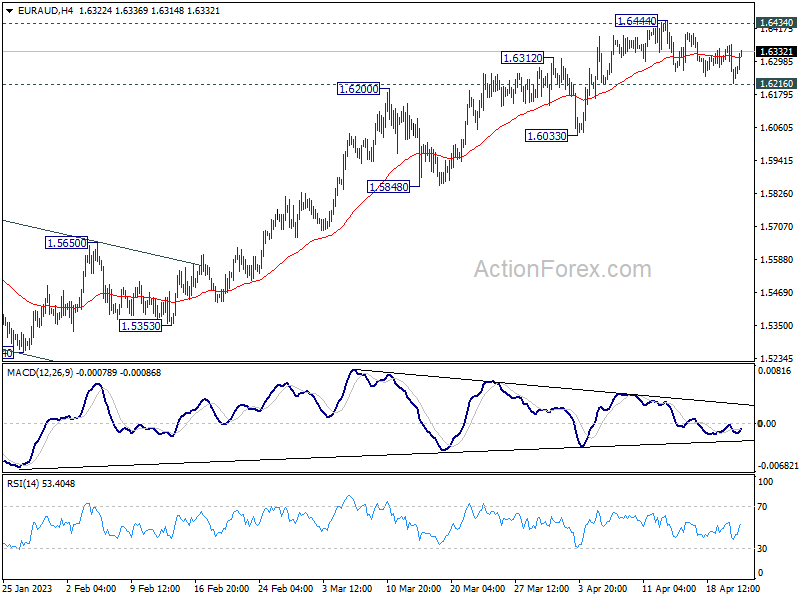
Technically, significant buying emerged in EUR/AUD as it approached a minor support level at 1.6216, keeping the near-term outlook bullish. Focus will return to the 1.6444 temporary top, which coincides with the 1.6434 long-term resistance (2021 high). A decisive break there will add to the case for long-term bullishness in the cross. Simultaneously, AUD/USD could also move in tandem with the Aussie selloff, potentially breaking the 0.6619 support level and reaching 0.6563 low.
In Asia, at the time of writing, Nikkei is down -0.24%. Hong Kong HSI is down -1.09%. China Shanghai SSE is down -1.40%. Singapore Strait Times is down -0.29%. Overnight, DOW dropped -0.33%. S&P 500 dropped -0.60%. NASDAQ dropped -0.80%. 10-year yield dropped -0.057 to 3.545.
Fed's Mester foresees further tightening to ensure downward trajectory of inflation
Cleveland Federal Reserve President Loretta Mester emphasized the need for further tightening in monetary policy to ensure a "sustained downward trajectory" of inflation. She pointed out that "demand is still outpacing supply in both product and labor markets and inflation remains too high."
To tackle the persistent inflation, Mester suggested that monetary policy will need to "move somewhat further into restrictive territory", with fed funds rate "moving above 5%" and "real fed funds rate staying positive for some time". However, she also acknowledged that the tightening journey is closer to its end than the beginning, with future rate decisions being dependent on the economy's performance.
Mester expects the unemployment rate to rise to between 4.5% and 4.75% and inflation to ease to 3.75% this year. She projects that inflation will reach the central bank's 2% target by 2025. In response to an audience question, Mester emphasized the Fed's aim for a "soft landing" and mentioned that she expects slow growth, well below 1%, in the current economic environment.
Fed's Harker: Some additional tightening may be needed
Philadelphia Fed President Patrick Harker has indicated that "some additional tightening may be needed to ensure policy is restrictive enough to support both pillars of our dual mandate." Harker expects that once this point is reached, which he believes should happen this year, the Fed will "hold rates in place and let monetary policy do its work".
Harker also noted that the economy remains strong and inflation is coming down, albeit slowly. He projected that inflation, currently at a 5% annualized rise in the personal consumption expenditures price index, would fall to 3% to 3.5% this year and reach 2% in 2025. The unemployment rate, currently at 3.5%, is expected to move up to around 4.4% this year amid tepid growth.
The bank president acknowledged the impact of last month's financial sector woes on the economy, stating that "it will take some time to evaluate how recent events may impact overall economic activity and inflation." Harker added that he expects to see tighter credit conditions for households and businesses, which may slow economic activity and hiring, but the full extent of this impact is still unclear.
Fed officials highlight the need for further action to tame inflation
Atlanta Fed President Raphael Bostic, Dallas Fed President Lorie Logan, and Fed Governor Michelle Bowman have all expressed concerns over the persistently high inflation rate.
Bostic, speaking on CNBC, said that "one more move should be enough for us to then take a step back and see how our policy is flowing through the economy, to understand the extent to which inflation is returning back to our target." He acknowledged that inflation has been much too high, with Fed having raised interest rates by 4.5 percentage points over the past year in an attempt to bring the economy into better balance.
Lorie Logan emphasized the need for sustained improvement in inflation statistics, an economy evolving as forecast, and a change in the factors underlying inflation, such as the hot labor market and imbalance in supply and demand. She reiterated the concern, stating, "As you surely know, inflation has been much too high."
Bowman also highlighted the importance of the Fed's focus on lowering inflation. She said, "Lately, as you know, the Fed has been focused on lowering inflation, which is essential if we want to support a growing economy and rising incomes." Bowman added, "We clearly need to continue to work to bring inflation down."
BoE Tenreyro: We may already have tightened too much
BoE MPC member Silvana Tenreyro, a known dove, said interest rates have already been raised more than enough.
"The shape of the inflationary shock stemming mostly from the large increase in energy prices, coupled with the long lags with which monetary policy affects the economy, means that the most likely scenario now is that we undershoot the inflation target in the medium term, meaning 2025," Tenreyro said.
"Given policy lags, policy needs to be based on forward looking forecasts and those forecasts at least for the UK are telling us that we may already have tightened too much."
Those who want to keep raising rates she likened to Milton Friedman's "fool in the shower." "When the fool starts the water and it runs cold, he keeps turning the faucet and, eventually, because he's impatient, he gets burned," she said.
Australian PMIs reveal divergence between manufacturing and services, RBA rate hike likely in May
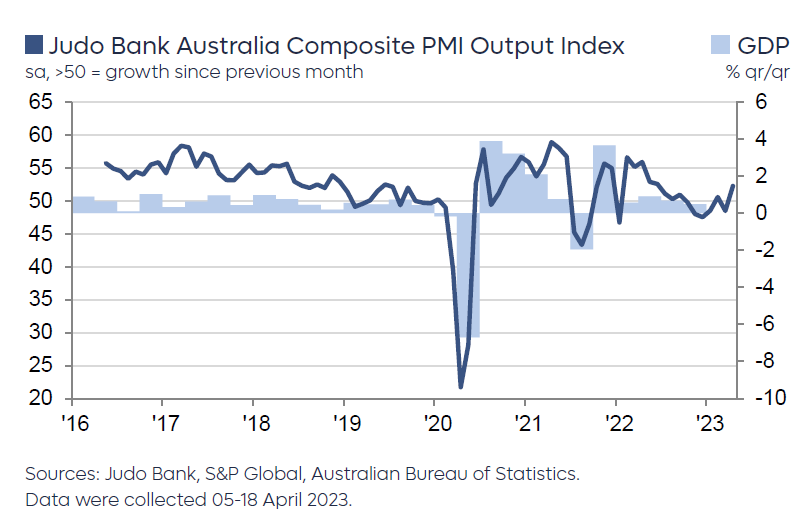
Australia's April PMI Manufacturing has dropped to a 35-month low at 48.1, down from 49.1, while PMI Services jumped to a 10-month high of 52.6, up from 48.6. The PMI Composite also reached a 10-month high at 52.2. The data reveals a growing divergence between the performance of Australia's manufacturing and service sectors.
Warren Hogan, Chief Economic Advisor at Judo Bank, said, "Manufacturing activity remains soft, a reflection of weaker demand for goods and a gradual slowdown in construction activity in Australia. The April flash results for the services sector have bounced strongly, bringing into question the broader economic slowdown."
Hogan dismissed the idea of a recession, stating that the results point to a lift in Australia's economic momentum through mid-2023. However, he noted that the risk to inflation is from excess demand in the economy, putting upward pressure on domestic prices in energy, housing, and labor markets.
With the RBA Board set to meet in early May, Hogan believes the April flash PMI, strong employment outcomes in March, and a resurgence in parts of the housing market all suggest that another 25bp rate hike in May is more likely than not, depending on the March quarter CPI to be released on April 26th.
Japan PMIs: Private sector expands driven by resurgent service economy
Japan's PMI Manufacturing in April slightly rose from 49.2 to 49.5, missing expectations of 49.9. PMI Services experienced a slight drop from 55.0 to 54.9, while PMI Composite fell from 52.9 to 52.5. Despite this, the country's private sector continued to expand solidly at the beginning of Q2, with the service economy's resurgence helping to offset the weak manufacturing sector performance.
Annabel Fiddes, Economics Associate Director at S&P Global Market Intelligence, said, "Inflows of total new business increased at the quickest pace for nearly a year-and-a-half as services companies registered a steep upturn in sales amid reports of stronger demand conditions and improved customer numbers." Fiddes also noted signs of cost pressures easing, with overall input costs rising to the weakest extent in 15 months in April.
Regarding the year-ahead outlook, optimism in the service sector hit a record high in April, but weakened among manufacturers. While service providers anticipate further improvements in demand and operating conditions as the impact of COVID-19 fades, some manufacturers expressed concerns over the economic outlook, rising costs, and component shortages.
Japan's CPI core unchanged at 3.1%, core-core at highest since 1981
Japan's CPI growth slowed from 3.3% yoy to 3.2% yoy, exceeding the expected 2.6% yoy increase. The CPI core (all items excluding food) remained unchanged at 3.1% yoy, in line with expectations. The CPI core-core (all items excluding food and energy) accelerated from 3.5% yoy to 3.8% yoy, surpassing the anticipated 3.4% yoy figure. This marks the 10th consecutive uptick and the highest level since December 1981.
New BOJ Governor Kazuo Ueda has recently committed to maintaining ultra-loose monetary policy. While no major changes to the bond yield control policy are expected at Ueda's first policy-setting meeting next week, the spreading inflation from energy to the broader economy may keep market expectations alive that BOJ could begin phasing out its massive stimulus later this year. However, this will depend on whether wages increase sustainably and support consumption.
Looking ahead
UK PMIs, as well as Eurozone PMIs are the main focus in European session. Later in the day, Canada will release retail sales while US will also publish PMIs.
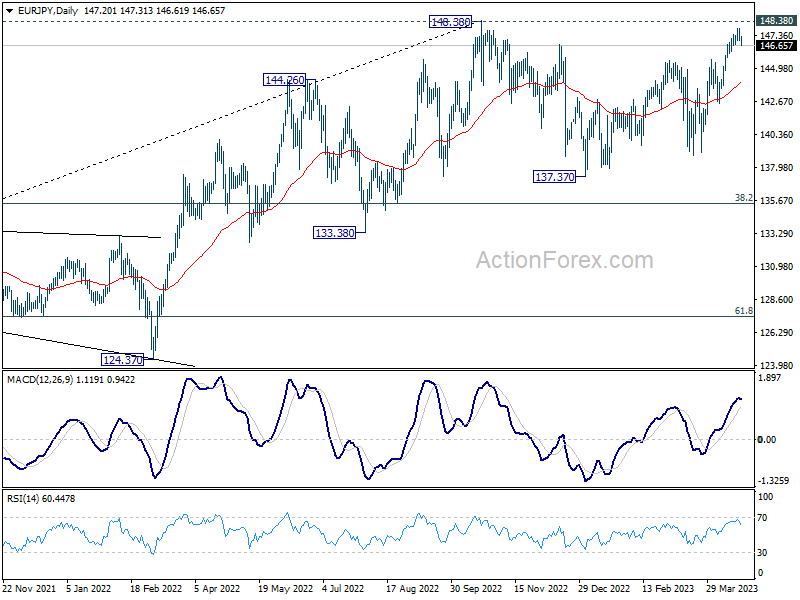
EUR/JPY Daily Outlook
Daily Pivots: (S1) 146.91; (P) 147.38; (R1) 147.73; More....
A temporary top is in place at 147.85 in EUR/JPY ahead of 148.38 high. Intraday bias is turned neutral first. Further rally will remain mildly in favor as long as 145.66 resistance turned support holds. Decisive break of 148.38 will resume larger up trend to 149.75 long term resistance. However, firm break of 145.66 will indicate that corrective pattern from 148.38 has started the third leg. Intraday bias will be back on the downside for 142.53 support first and possibly below.
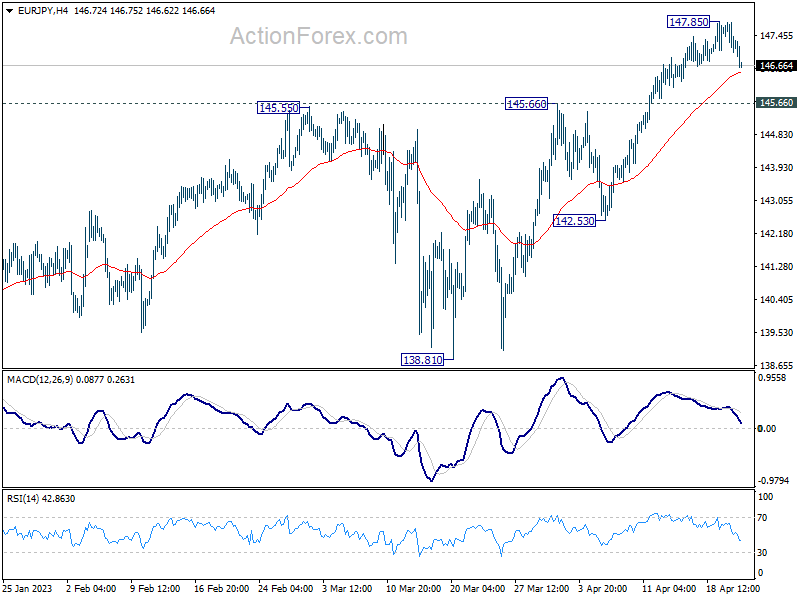
In the bigger picture, as long as 55 W EMA (now at 140.44) holds, larger up trend from 114.42 (2020 low) is still in progress for 149.76 long term resistance. Decisive break there will resume long term up trend. However, sustained break of 55 W EMA will bring deeper fall to 38.2% retracement of 114.42 to 148.38 at 135.40.
Economic Indicators Update
| GMT | Ccy | Events | Actual | Forecast | Previous | Revised |
|---|---|---|---|---|---|---|
| 23:00 | AUD | Manufacturing PMI Apr P | 48.1 | 49.1 | ||
| 23:00 | AUD | Services PMI Apr P | 52.6 | 48.6 | ||
| 23:01 | GBP | GfK Consumer Confidence Apr | -30 | -35 | -36 | |
| 23:30 | JPY | National CPI Y/Y Mar | 3.20% | 2.60% | 3.30% | |
| 23:30 | JPY | National CPI Core Y/Y Mar | 3.10% | 3.10% | 3.10% | |
| 23:30 | JPY | National CPI Core-Core Y/Y Mar | 3.80% | 3.40% | 3.50% | |
| 00:30 | JPY | Manufacturing PMI Apr P | 49.5 | 49.9 | 49.2 | |
| 00:30 | JPY | Services PMI Apr P | 54.9 | 55 | ||
| 06:00 | GBP | Retail Sales M/M Mar | -0.90% | -0.50% | 1.20% | 1.10% |
| 06:00 | GBP | Retail Sales Y/Y Mar | -3.10% | -3.10% | -3.50% | |
| 06:00 | GBP | Retail Sales ex-Fuel M/M Mar | -1% | -0.70% | 1.50% | 1.40% |
| 06:00 | GBP | Retail Sales ex-Fuel Y/Y Mar | -3.20% | -3.10% | -3.30% | -3.00% |
| 07:15 | EUR | France Manufacturing PMI Apr P | 47.5 | 47.3 | ||
| 07:15 | EUR | France Services PMI Apr P | 53.6 | 53.9 | ||
| 07:30 | EUR | Germany Manufacturing PMI Apr P | 45.6 | 44.7 | ||
| 07:30 | EUR | Germany Services PMI Apr P | 53.5 | 53.7 | ||
| 08:00 | EUR | Eurozone Manufacturing PMI Apr P | 48.2 | 47.3 | ||
| 08:00 | EUR | Eurozone Services PMI Apr P | 54.6 | 55 | ||
| 08:30 | GBP | Manufacturing PMI Apr P | 48.8 | 47.9 | ||
| 08:30 | GBP | Services PMI Apr P | 52.9 | 52.9 | ||
| 12:30 | CAD | Retail Sales M/M Feb | -0.60% | 1.40% | ||
| 12:30 | CAD | Retail Sales ex Autos M/M Feb | 0.00% | 0.90% | ||
| 13:45 | USD | Manufacturing PMI Apr P | 49.2 | 49.2 | ||
| 13:45 | USD | Services PMI Apr P | 51.8 | 52.6 |
EUR/JPY Daily Outlook
Daily Pivots: (S1) 146.91; (P) 147.38; (R1) 147.73; More....
A temporary top is in place at 147.85 in EUR/JPY ahead of 148.38 high. Intraday bias is turned neutral first. Further rally will remain mildly in favor as long as 145.66 resistance turned support holds. Decisive break of 148.38 will resume larger up trend to 149.75 long term resistance. However, firm break of 145.66 will indicate that corrective pattern from 148.38 has started the third leg. Intraday bias will be back on the downside for 142.53 support first and possibly below.
In the bigger picture, as long as 55 W EMA (now at 140.44) holds, larger up trend from 114.42 (2020 low) is still in progress for 149.76 long term resistance. Decisive break there will resume long term up trend. However, sustained break of 55 W EMA will bring deeper fall to 38.2% retracement of 114.42 to 148.38 at 135.40.
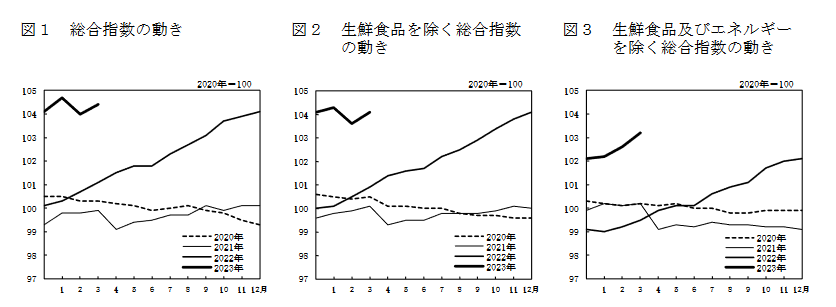
Japan’s CPI core unchanged at 3.1%, core-core at highest since 1981
Japan's CPI growth slowed from 3.3% yoy to 3.2% yoy, exceeding the expected 2.6% yoy increase. The CPI core (all items excluding food) remained unchanged at 3.1% yoy, in line with expectations. The CPI core-core (all items excluding food and energy) accelerated from 3.5% yoy to 3.8% yoy, surpassing the anticipated 3.4% yoy figure. This marks the 10th consecutive uptick and the highest level since December 1981.
New BOJ Governor Kazuo Ueda has recently committed to maintaining ultra-loose monetary policy. While no major changes to the bond yield control policy are expected at Ueda's first policy-setting meeting next week, the spreading inflation from energy to the broader economy may keep market expectations alive that BOJ could begin phasing out its massive stimulus later this year. However, this will depend on whether wages increase sustainably and support consumption.
Japan PMIs: Private sector expands driven by resurgent service economy
Japan's PMI Manufacturing in April slightly rose from 49.2 to 49.5, missing expectations of 49.9. PMI Services experienced a slight drop from 55.0 to 54.9, while PMI Composite fell from 52.9 to 52.5. Despite this, the country's private sector continued to expand solidly at the beginning of Q2, with the service economy's resurgence helping to offset the weak manufacturing sector performance.
Annabel Fiddes, Economics Associate Director at S&P Global Market Intelligence, said, "Inflows of total new business increased at the quickest pace for nearly a year-and-a-half as services companies registered a steep upturn in sales amid reports of stronger demand conditions and improved customer numbers." Fiddes also noted signs of cost pressures easing, with overall input costs rising to the weakest extent in 15 months in April.
Regarding the year-ahead outlook, optimism in the service sector hit a record high in April, but weakened among manufacturers. While service providers anticipate further improvements in demand and operating conditions as the impact of COVID-19 fades, some manufacturers expressed concerns over the economic outlook, rising costs, and component shortages.
Australian PMIs reveal divergence between manufacturing and services, RBA rate hike likely in May
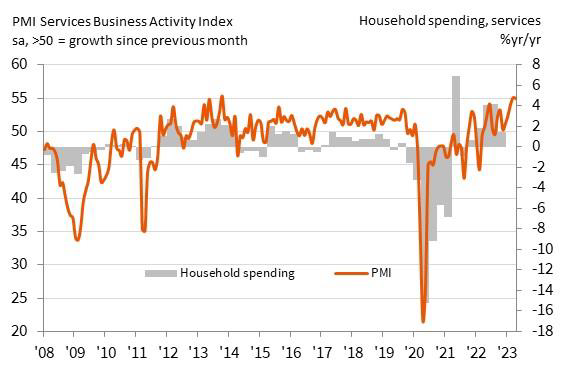
Australia's April PMI Manufacturing has dropped to a 35-month low at 48.1, down from 49.1, while PMI Services jumped to a 10-month high of 52.6, up from 48.6. The PMI Composite also reached a 10-month high at 52.2. The data reveals a growing divergence between the performance of Australia's manufacturing and service sectors.
Warren Hogan, Chief Economic Advisor at Judo Bank, said, "Manufacturing activity remains soft, a reflection of weaker demand for goods and a gradual slowdown in construction activity in Australia. The April flash results for the services sector have bounced strongly, bringing into question the broader economic slowdown."
Hogan dismissed the idea of a recession, stating that the results point to a lift in Australia's economic momentum through mid-2023. However, he noted that the risk to inflation is from excess demand in the economy, putting upward pressure on domestic prices in energy, housing, and labor markets.
With the RBA Board set to meet in early May, Hogan believes the April flash PMI, strong employment outcomes in March, and a resurgence in parts of the housing market all suggest that another 25bp rate hike in May is more likely than not, depending on the March quarter CPI to be released on April 26th.