Sample Category Title
Eurozone PMIs Eyed as ECB Ponders Size of Next Rate Hike
Having defied recession predictions, the Eurozone economy will attract some headlines on Friday when the latest flash PMI readings are due (08:00 GMT). Growth in the euro area has been slowly gaining momentum since late 2022 when the impact of the energy crisis started to dissipate. But there are some doubts as to how strongly the economy can bounce back when interest rates continue to go up. With the European Central Bank’s next policy decision approaching, how important will the data be, and can it help the euro make a convincing break above $1.10?
Relief as Europe avoids a recession
Summer is just around the corner and it’s looking like European economies managed to exit the winter season with only a few minor bruises. Yes, energy bills remain too high for most households and businesses and higher prices in general have been a heavy burden, hampering growth. But inflation in the euro area is on its way down and a recession isn’t on the near-term horizon.
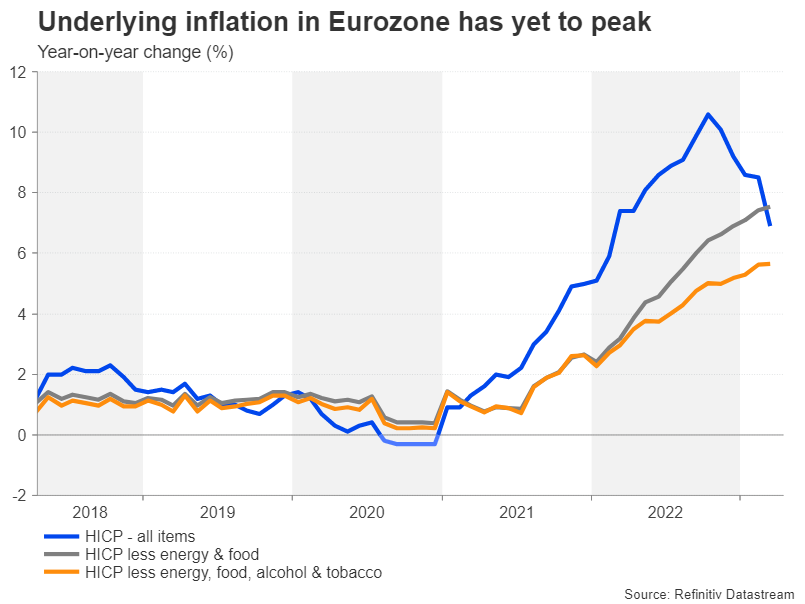
However, the ECB is not done raising rates and growth has been quite sluggish in the last three quarters, so a brighter outlook is far from certain. The most pressing issue for policymakers is the stickiness in core inflation (excluding food, energy, alcohol & tobacco prices), which currently stands at 5.7%.
But more rate hikes to come
Given all the hawkish soundbites coming from the Governing Council, it’s clear that the ECB won’t be satisfied until underlying price indicators have made more progress in edging closer to the 2% target. At the moment, the Eurozone’s two core inflation measures have yet to show a definite sign of having peaked, despite the significant drop in headline CPI in recent months.
What this means is that a 50-basis-point rate hike is essentially at play at the May 4 policy meeting. It wasn’t so long ago in the aftermath of the banking turmoil that investors had priced out the likelihood of large rate increases. But recent remarks from policymakers suggest that the option is firmly on the table in May and Friday’s data may help sway some minds.
Risk of growth stagnating again
After an impressive rebound, the services sector might have lost some steam in April as analysts expect the services PMI to edge lower slightly from 55.0 to 54.5. Any figure above 50 indicates expansion and that hasn’t been the case for the manufacturing sector. Weak domestic and overseas demand have been a drag on business orders, but the manufacturing PMI is forecast to improve somewhat to 48.0 in April from 47.3 previously. This modest uptick is expected to keep the composite PMI unchanged at 53.7.
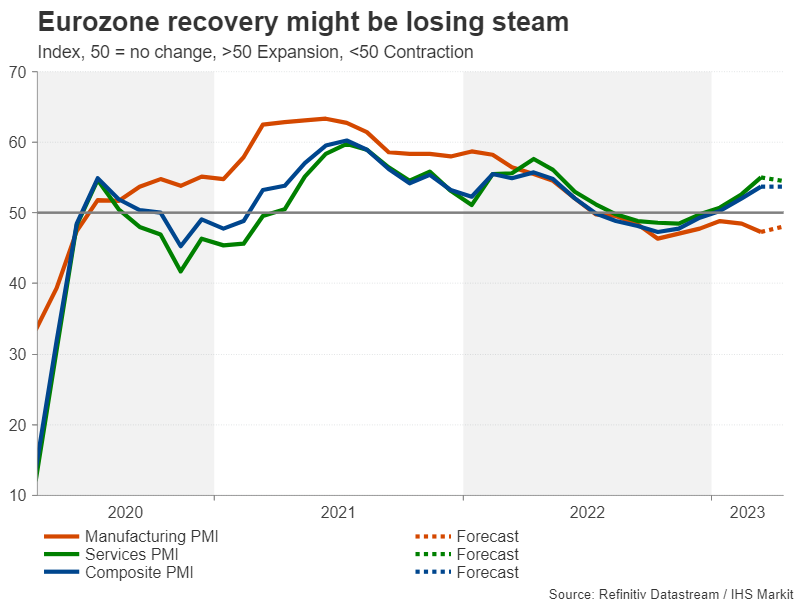
There are other data coming up ahead of the May decision that will be important, particularly the flash CPI numbers on May 2. But the PMI surveys will nevertheless offer a crucial insight on how well optimism is holding up, as well as the direction the various components such as input prices and employment are headed in.
Euro outlook positive amid hawkish ECB, soft dollar
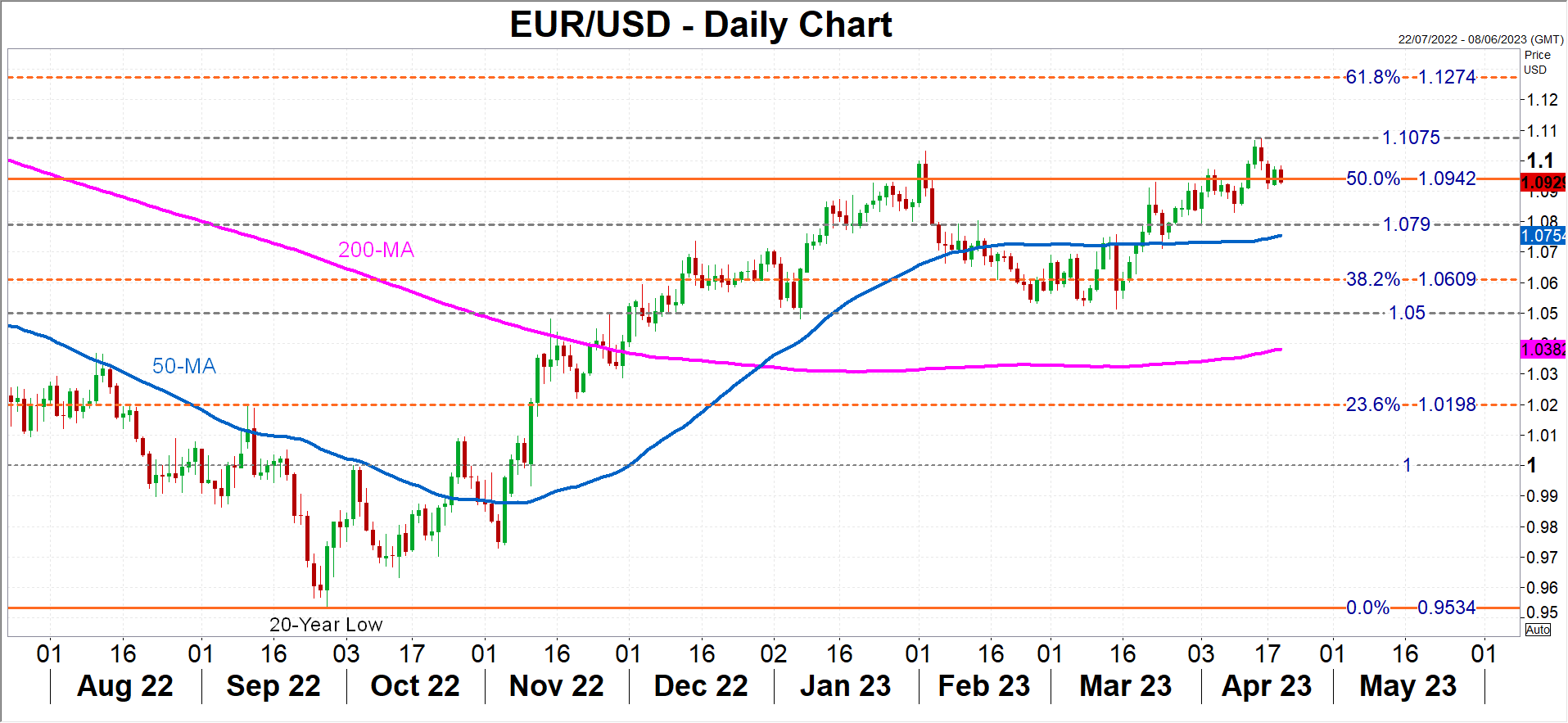
Stronger-than-expected PMI figures could push up bets for a 50-bps hike at the next meeting, which at the moment is only about 35% priced in, setting the stage for another leg up for the euro. The single currency suffered a mild pullback after hitting a wall at $1.1075. Hawkish expectations could enable a break above this key resistance, bringing the 61.8% Fibonacci retracement level of the 2021-2022 downtrend at $1.1274 into view.
However, any disappointment in the PMI indicators may facilitate a deeper downside correction, forcing the 50% Fibonacci to give way. Immediate support is likely to form in the $1.0750-$1.0790 region, comprising the 50-day moving average and a recent congestion point, after which, the $1.05 level would come into focus.
Yet, traders should be wary about anticipating an even sharper slide, as in the bigger picture, the US dollar’s heydays seem to be over. Yield spreads between US and European government bonds have been steadily narrowing over the past few months amid the growing expectation that the Fed will pause its tightening cycle before the ECB does. Unless that view starts to alter, the euro’s downside will be limited.
EUR/USD: Euro Looks for Fresh Direction Signals
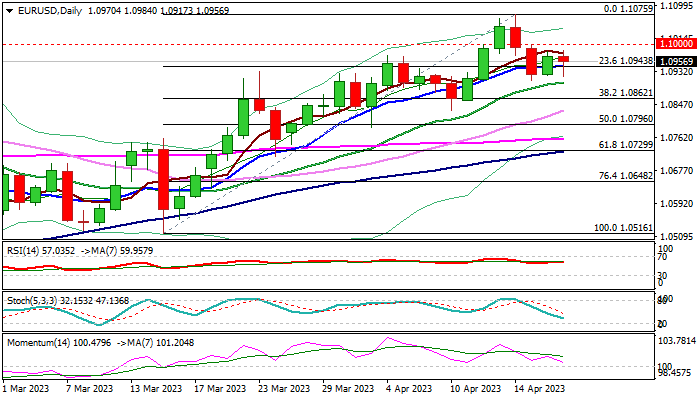
The Euro remains constructive and returns above 10DMA (1.0947) in early US session, but continues to move within 1.1000/1.0910 congestion, which extends into third straight day.
Eurozone March inflation report showed persistently high underlying inflation which adds to expectations of more than one ECB rate hike in coming months and offers support to the single currency.
Renewed risk appetite started to fade and weigh on recovery attempts, along with weakening positive momentum on daily chart, although overall bullish structure is expected to remain intact while the price stays above 20DMA (1.0902), but sustained break above psychological 1.10 barrier needed to shift focus to the upside.
Caution on break of 20DMA, with stronger bearish signal expected on break below pivotal Fibo support at 1.0862 (38.2% of 1.0516/1.1075).
Res: 1.1000; 1.1041; 1.1075; 1.1100.
Sup: 1.0902; 1.0862; 1.0831; 1.0796.
Sunset Market Commentary
Markets
The reaction to strong data UK labour data yesterday was mainly confined to underperformance of UK gilts and an unconvincing attempt of sterling to profit from a rising interest rate support. With few other data or eco news in the US and Europe, the impact of higher than expected UK price data this time also left its traces outside the UK. The monthly dynamics of headline inflation hardly slowed (0.8% M/M from 1.1%) keeping the Y/Y measure north of 10% (10.1% from 10.4% vs 9.8% expected). The rise was still broad-based with subcategories food, alcohol & tobacco, clothing & footwear, household goods, recreation and restaurants & hotels all showing a monthly rise of 1.0%+. Core inflation was unchanged at 6.2%. So, the cycle peak reached in autumn last year (6.5%) still isn’t that far behind. In the March policy statement, the BoE made further tightening conditional on evidence of more persistent inflationary pressures, ‘including the tightness of labour market conditions and behaviour of wage growth and services inflation’. After yesterday’s and today’s data, this condition is (more than) fulfilled. A May 11 rate hike is now fully discounted an markets see the BoE peak cycle policy rate close to 5.0% in September. UK government bond yields add between 10 bps (2-y) and 7.0bps (30-y) (was more intraday). Sterling strengthened below EUR/GBP 0.88 after the release, but again still struggles to hold on to these gains (currently near 0.8805). The UK data also provided a reality check for global (interest rate) markets. US yields add between 4.5 bps (2-y) and 2 bps (30-y), with key resistance at 4.26% (2y) and 3.64% now under test intraday. German yields in a similar move are rising between 5.4 bps (2-y) and 1.6 bps (30-y). The prospect a further/long-lasting tightening also dampened stock market sentiment, but for now losses remain contained (Euro Stoxx 50 -0.2%). Higher core yields and a hesitant risk sentiment slightly favour the dollar. DXY trades near 101.90 from 101.70 this morning. EUR/USD slipped from the 1.0970/80 area this morning to current currently trade near 1.095. Even gains in USD/JPY (134.4) stay modest. Among the smaller currencies, underperformance of the Canadian dollar (USD/CAD 1.343) and the Norwegian krone (EUR/NOK 11.55) is catching the eye as oil dropped from near $85 p/b to the low $83 area.
In central Europe, the forint at some point ceded about 2.0%. Vice governor Virag of the Hungarian central bank (MNB) overnight in an interview signaled that recent improvement in sentiment opened the way to start policy normalization. The multi-step move might already include a reduction in the top of the rate corridor (currently 25%) next week. A reduction in the key 18% deposit rate can be put on the agenda of subsequent policy meeting. Inflation in Hungary still printed at 25.2% Y/Y in March but Vice governor Virag indicated this was expected and still expects a sharp disinflation later this year. At EUR/HUF 376 the forint currently recouped part of the early losses.
News & Views
Swiss National Bank governing board member Maechler commented on the central bank’s latest inflation forecasts (March 23). “We use the conditional inflation forecast as an important communication tool. Even with our last 50 bps rate hike, we only get down to exactly 2% by the end of the forecasting horizon (2025)”. It signals that another rate increase at the June 22 policy meeting will be needed to bring inflation fully under control. SNB chair Jordan last Friday also suggested that more tightening is possible. SNB vice-chair Schlegel is scheduled to speak after European close tonight. The Swiss franc doesn’t move today with EUR/CHF trading around 0.9830. The SNB warned in March that it is actively preventing the currency from becoming too weak as it interferes with actions taken via policy rates to achieve a tighter monetary framework and curb inflation.
Bloomberg cites sources close to the Bank of Japan in an article suggesting that the first meeting under new governor Ueda won’t bring any changes (to yield curve control) so soon after the banking crisis overseas which clouded the economic outlook. There’s a preference to keep current yield caps in place to support the economy while buying some more time on how inflation’s behaving. BoJ governor Ueda in an earlier appearance before parliament also hinted to a preference to stick with current monetary policy settings for the time being. JPY was losing ground against the dollar, touching the psychologic 135 barrier. The move didn’t persist with the greenback coming under pressure as the US trading session got started.
EUR/USD Mid-Day Outlook
Daily Pivots: (S1) 1.0936; (P) 1.0960; (R1) 1.0997; More...
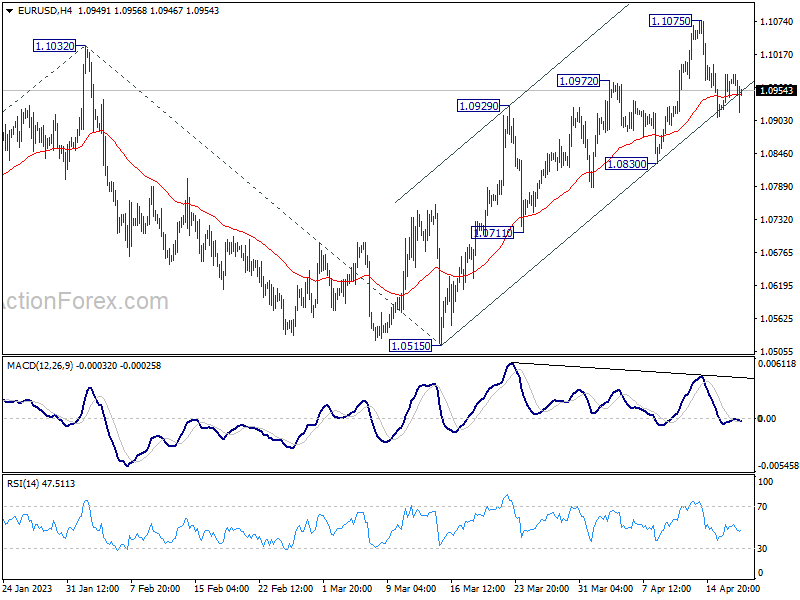
Range trading continues in EUR/USD and intraday bias stays neutral. Outlook remains bullish with 1.0830 support intact. On the upside, break of 1.1075 will will resume larger up trend to 1.1273 fibonacci level. Break there will target 61.8% projection of 0.9534 to 1.1032 from 1.0515 at 1.1441. However, firm break of 1.0830 will confirm short term topping and bring deeper decline to 1.0711 support instead.
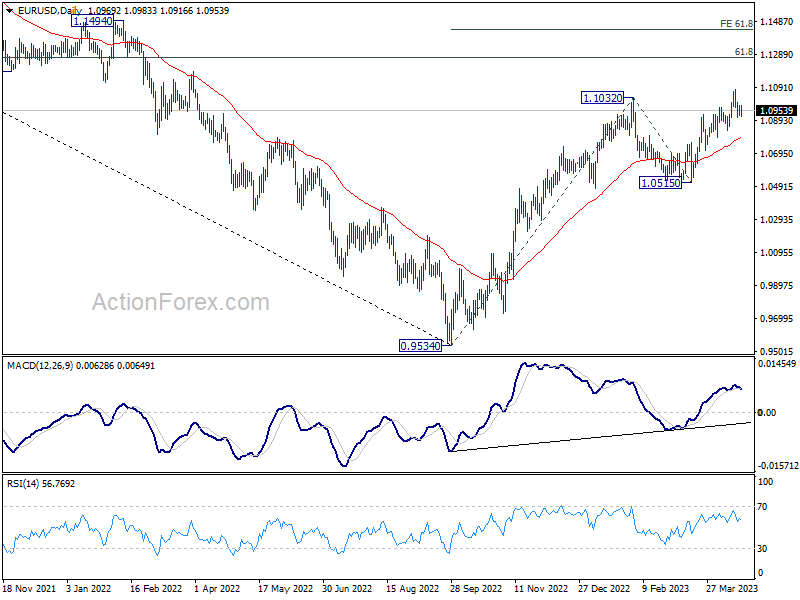
In the bigger picture, rise from 0.9534 (2022 low) is in progress for 61.8% retracement of 1.2348 (2021 high) to 0.9534 at 1.1273. Sustained break there will solidify the case of bullish trend reversal and target 1.2348 resistance next (2021 high). This will now remain the favored case as long as 1.0515 support holds, even in case of deeper pull back.
GBP/USD Mid-Day Outlook
Daily Pivots: (S1) 1.2379; (P) 1.2414; (R1) 1.2461; More...
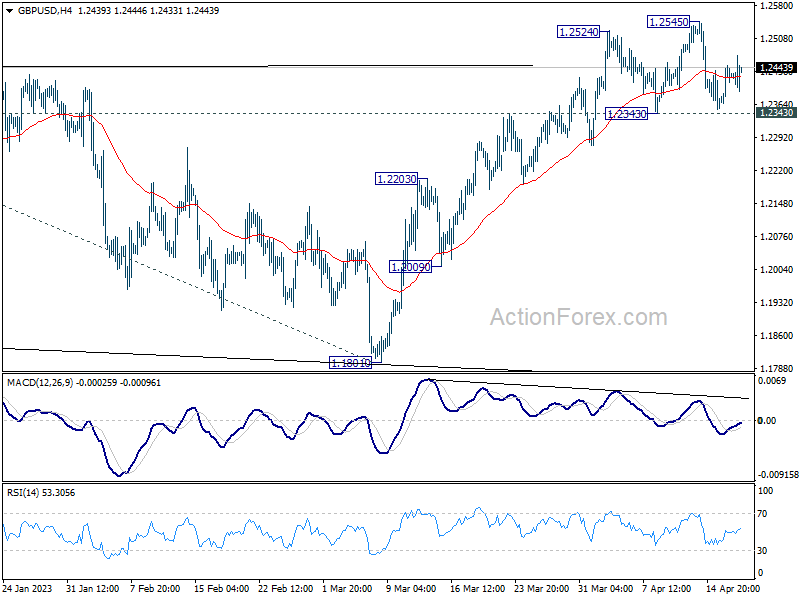
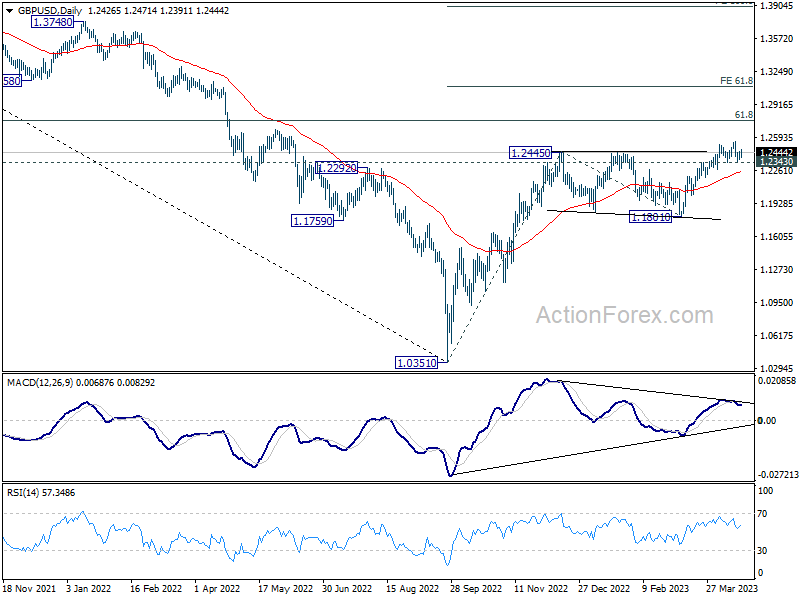
GBP/USD is still staying in sideway trading and intraday bias remains neutral at this point. Another rise is in favor with 1.2343 support intact. On the upside, above 1.2545 will target 1.2759 fibonacci level first. Firm break there will target 61.8% projection of 1.0351 to 1.2445 from 1.1801 at 1.3095. However, considering bearish divergence condition in 4H MACD, firm break of 1.2343 will confirm short term topping, and turn bias back to the downside for deeper pullback.
In the bigger picture, the rise from 1.0351 medium term term bottom (2022 low) is in progress for 61.8% retracement of 1.4248 (2021 high) to 1.0351 at 1.2759. Sustained break there will add to the case of long term bullish trend reversal. Further break of 61.8% projection of 1.0351 to 1.2445 from 1.1801 at 1.3095 could prompt upside acceleration to 100% projection at 1.3895. For now, this will remain the favored case as long as 1.1801 support holds, even in case of deep pull back.
USD/CHF Mid-Day Outlook
Daily Pivots: (S1) 0.8947; (P) 0.8970; (R1) 0.8985; More...
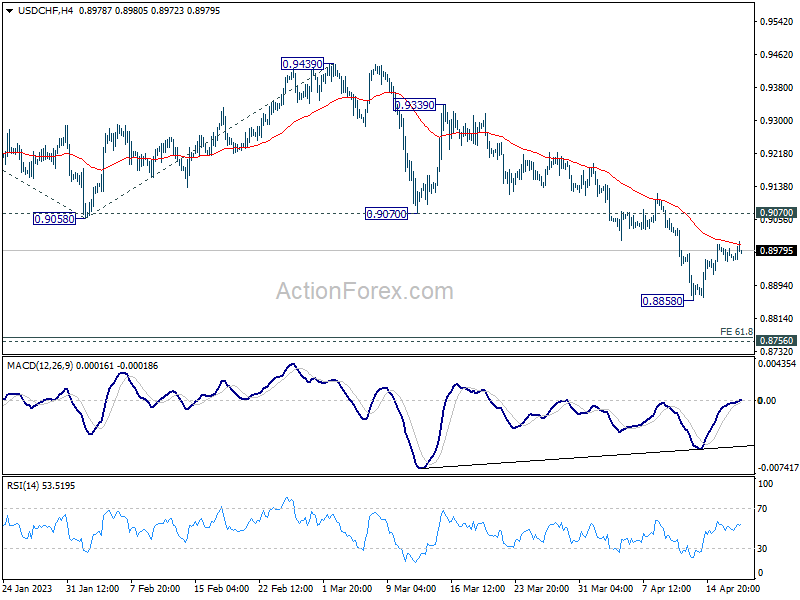
Outlook in USD/CHF is unchanged and intraday bias remains neutral. Another decline cannot be ruled out with 0.9070 support turned resistance intact. On the downside, below 0.8858 will resume the down trend to 61.8% projection of 1.0146 to 0.9058 from 0.9439 at 0.8767, which is close to 0.8756 long term support. Strong support is expected there to bring rebound, at least on first attempt. On the upside, break of 0.9070 support turned resistance will confirm short term bottoming and turn bias back to the upside.
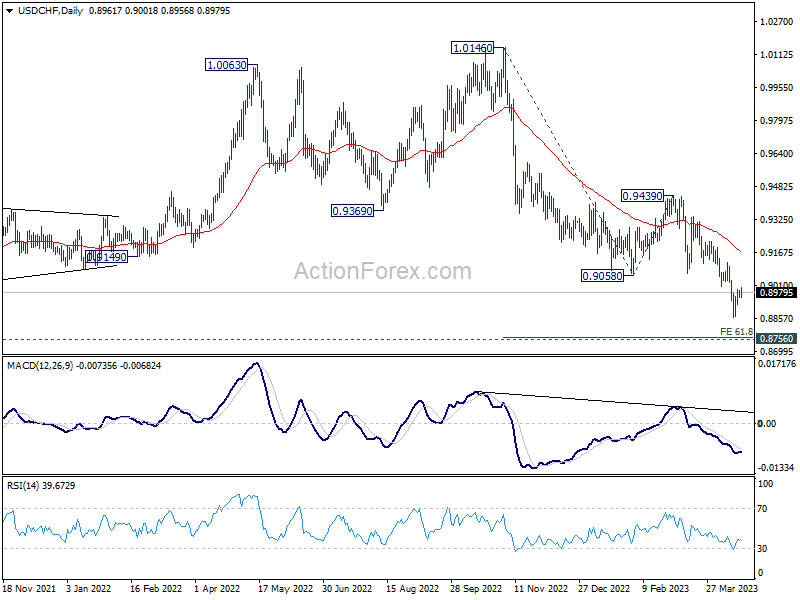
In the bigger picture, fall from 1.1046 (2022 high) is in progress for 0.8756 support (2021 low). But overall, this fall is still seen as a leg in the long term range pattern from 1.0342 (2016 high). So, downside should be contained by 0.8756 to bring reversal. Sustained break of 0.9058 support turned resistance will be the first sign of medium term bottoming. However, decisive break of 0.8756 will carry larger bearish implications.
USD/JPY Mid-Day Outlook
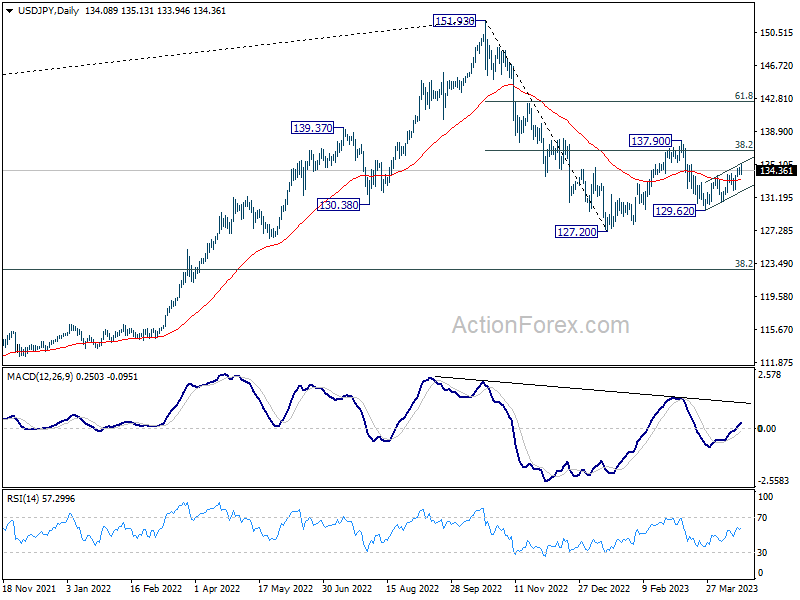
Daily Pivots: (S1) 133.74; (P) 134.23; (R1) 134.58; More...
Intraday bias in USD/JPY stays on the upside as rally from 129.62 is in progress. Further rise should be seen towards 137.90 resistance. On the downside, below 133.85 minor support will turn intraday bias neutral again. But further rally will remain in favor as long as 132.03 support holds.
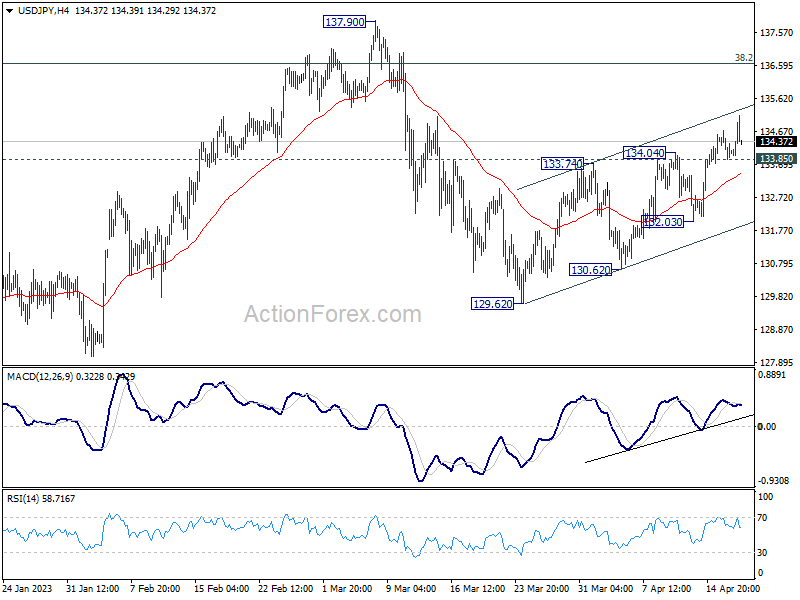
In the bigger picture, corrective pattern from 127.20 might be extending. But after all, down trend from 151.93 is expected to resume at a later stage. Break of 127.20 will resume this down trend and target 61.8% projection of 151.93 to 127.20 from 137.90 at 122.61. This will now be the favored case as long as 137.90 resistance holds.
GBP/JPY Mid-Day Outlook
Daily Pivots: (S1) 166.20; (P) 166.60; (R1) 167.04; More...
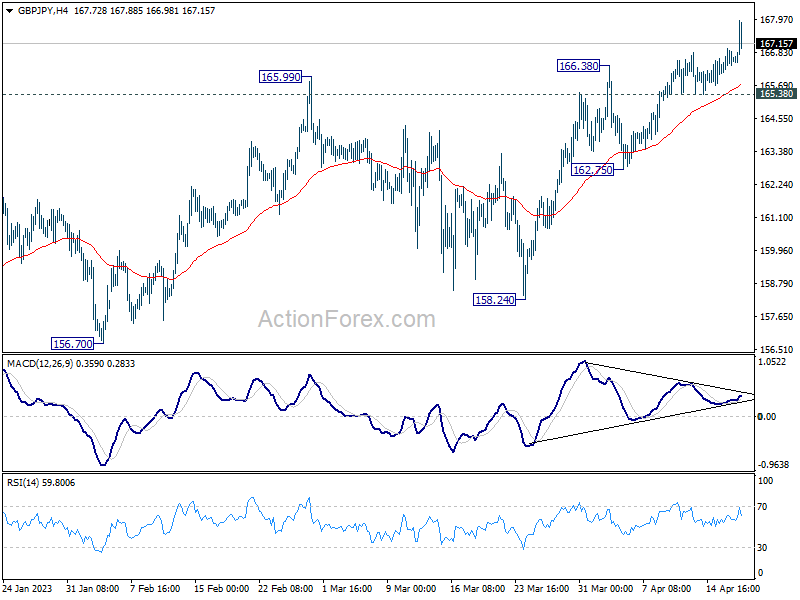
GBP/JPY's rally continues today and hit as high as 167.95 so far. Intraday bias remains on the upside for the moment. Current rally is part of the whole rise from 155.33. Next target is 169.26 resistance first. However, considering bearish divergence condition 4 H MACD. Break of 165.38 minor support will argue that a short term top was already formed. Intraday bias will be turned back to the downside for 162.75 support instead.
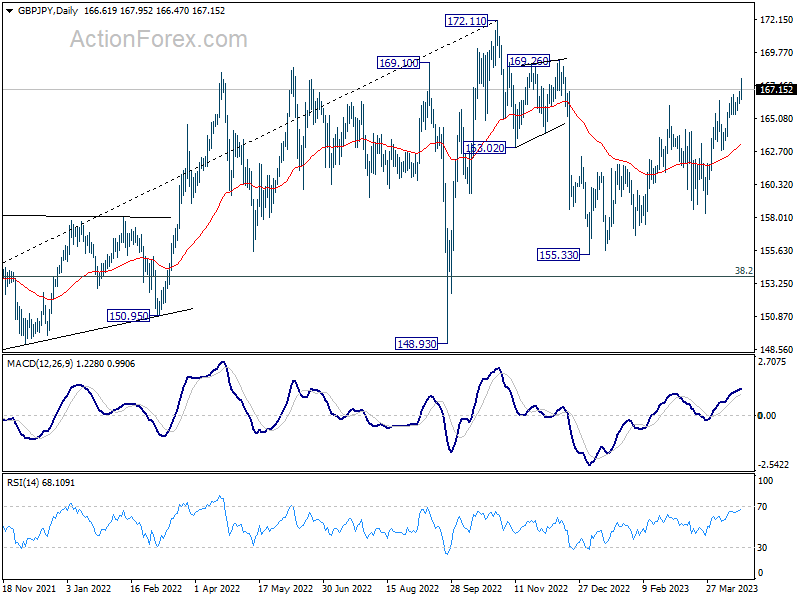
In the bigger picture, as long as 38.2% retracement of 123.94 (2020 low) to 172.11 (2022 high) at 153.70 holds, medium term bullishness is retained. That is, larger up trend from 123.94 (2020 low) is still in progress. Break of 172.11 high to resume such up trend is expected at a later stage.
Sterling Strengthens on Inflation Data, More BoE Hike(s) Expected
Sterling climbed broadly today following the release of data showing that March's inflation slowed less than expected, with CPI remaining in double digits. This development supports expectations of a further 25bps rate hike by BOE in May, with some speculating that an additional increase could bring the terminal rate to 4.75% in June. Despite this, Dollar is slightly strong due thanks to rising treasury yields. Canadian Dollar is currently the weakest performer for the day, followed by Japanese Yen and Euro, while Australian and New Zealand Dollars are mixed.
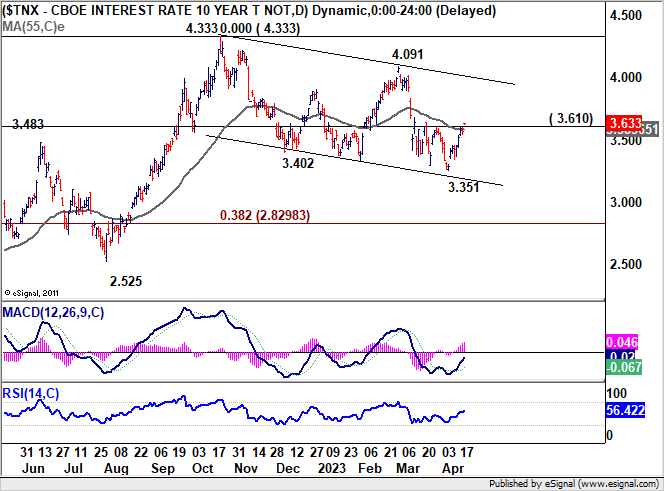
From technical perspective, 10-year treasury yield saw a notable rise in early US session. A close above 3.610 resistance level should confirm short-term bottoming at 3.351, increasing the likelihood that the whole corrective decline from 4.333 has completed with three waves down to 3.51. A stronger rally is expected to return to 4.091 resistance level. If realized, this development could provide additional lift to USD/JPY.
In Europe, at the time of writing, FTSE is down-0.21%. DAX is down -0.17%. CAC is up 0.01%. Germany 10-year yield is up 0.026 at 2.505. Earlier in Asia, Nikkei dropped -0.18%. Hong Kong HSI dropped -1.37%. China Shanghai SSE dropped -0.68%. Singapore Strait Times rose 0.44%. Japan 10-year JGB yield rose 0.0023 to 0.478.
ECB Lane: Markets expect rates to remain at elevated levels for an extended period
ECB Chief Economist Philip Lane noted in a speech that "since the cut-off date for the March 2023 projections, the incoming data have been mixed."
Lane pointed out the ongoing divergence in sectoral performance, as services business activity experiences accelerated expansion due to strong reopening effects and increased incomes. In contrast, manufacturing output remained stagnant in the first quarter. He also indicated that the consistent improvement in business and consumer sentiment, despite remaining at low levels, appears to have reached a plateau.
Lane mentioned that market pricing and the ECB's Survey of Monetary Analysts (SMA) foresee that the "policy rate will rise further in the near term and will remain at elevated levels for an extended period."
He explained that once inflation stabilizes at the 2% target in the medium term, it is projected that the policy rate will settle around 2% instead of returning to ultra-low levels. This expectation is primarily driven by the re-anchoring of long-term inflation expectations at the ECB's 2% target, indicating that market participants and monetary analysts anticipate the longer-term equilibrium real rate to hover around zero per cent.
Eurozone CPI finalized at 6.9% yoy in Mar, core CPI at 5.7% yoy
Eurozone CPI was finalized at 6.9% yoy in March, down from February's 8.5% yoy. Core CPI (all items excluding energy, food, alcohol & tobacco) was finalized at 5.7%, up from prior month's 5.6% yoy. The highest contribution to the annual Eurozone inflation rate came from food, alcohol & tobacco (+3.12%), followed by services (+2.10%), non-energy industrial goods (+1.71%) and energy (-0.05%).
EU CPI was finalized at 8.3% yoy, down from prior month's 9.9% yoy. The lowest annual rates were registered in Luxembourg (2.9%), Spain (3.1%) and the Netherlands (4.5%). The highest annual rates were recorded in Hungary (25.6%), Latvia (17.2%) and Czechia (16.5%). Compared with February, annual inflation fell in twenty-five Member States and rose in two.
UK CPI slowed to 10.1% yoy, core CPI unchanged at 6.2% yoy
UK CPI slowed from 10.4% yoy to 10.1% yoy in march, above expectation of 9.8% yoy. CPI all goods index slowed from 13.4% yoy to 12.8% yoy. But CPI all services was unchanged at 6.6% yoy. On a monthly basis, CPI rose 0.8% mom, above expectation of 0.5% mom. Core CPI (CPI excluding energy, food, alcohol and tobacco) was unchanged at 6.2% yoy, above expectation of 6.0% yoy.
Also released, RPI was up 0.7% mom, 13.5% yoy, above expectation of 0.6% mom, 13.3% yoy. PPI input was at 0.2% mom, 7.6% yoy, versus expectation of -0.4% mom, 9.8% yoy. CPI output was at 0.1% mom, 8.7% yoy, versus expectation of -0.1% mom, 8.7% yoy. PPI core output was at 0.3% mom, 8/.5% yoy, versus expectation of 0.2% mom, 9.8% yoy.
Australia's Westpac Leading Index signals below-trend growth, RBA expected to hike rates in May
Australia Westpac-Melbourne Institute Leading Index rose slightly from -0.79% to -0.75% in March, marking the eighth consecutive negative reading. This indicates below-trend growth throughout 2023. Westpac forecasts a modest 1% growth for Australia in 2023, while IMF recently revised its growth forecast for the country from 1.9% to 1.6%. RBA also predicts just 1.6% growth in 2023.
Westpac anticipates a further 25bps increase in the cash rate to 3.85% at RBA's May 2 meeting. The April RBA minutes revealed additional concerns about the inflation outlook, including rising demand due to increased immigration, pressures in the housing market, and risks associated with growing wage growth, particularly in the public sector. The March quarter inflation report, scheduled for release on April 26, will be a crucial data point for the central bank's decision-making process.
GBP/JPY Mid-Day Outlook
Daily Pivots: (S1) 166.20; (P) 166.60; (R1) 167.04; More...
GBP/JPY's rally continues today and hit as high as 167.95 so far. Intraday bias remains on the upside for the moment. Current rally is part of the whole rise from 155.33. Next target is 169.26 resistance first. However, considering bearish divergence condition 4 H MACD. Break of 165.38 minor support will argue that a short term top was already formed. Intraday bias will be turned back to the downside for 162.75 support instead.
In the bigger picture, as long as 38.2% retracement of 123.94 (2020 low) to 172.11 (2022 high) at 153.70 holds, medium term bullishness is retained. That is, larger up trend from 123.94 (2020 low) is still in progress. Break of 172.11 high to resume such up trend is expected at a later stage.
Economic Indicators Update
| GMT | Ccy | Events | Actual | Forecast | Previous | Revised |
|---|---|---|---|---|---|---|
| 00:30 | AUD | Westpac Leading Index M/M Mar | 0.00% | -0.06% | ||
| 04:30 | JPY | Industrial Production M/M Feb F | 4.60% | 4.50% | 4.50% | |
| 06:00 | GBP | CPI M/M Mar | 0.80% | 0.50% | 1.10% | |
| 06:00 | GBP | CPI Y/Y Mar | 10.10% | 9.80% | 10.40% | |
| 06:00 | GBP | Core CPI Y/Y Mar | 6.20% | 6.00% | 6.20% | |
| 06:00 | GBP | RPI M/M Mar | 0.70% | 0.60% | 1.20% | |
| 06:00 | GBP | RPI Y/Y Mar | 13.50% | 13.30% | 13.80% | |
| 06:00 | GBP | PPI Input M/M Mar | 0.20% | -0.40% | -0.10% | 0% |
| 06:00 | GBP | PPI Input Y/Y Mar | 7.60% | 9.80% | 12.70% | 12.80% |
| 06:00 | GBP | PPI Output M/M Mar | 0.10% | -0.10% | -0.30% | -0.40% |
| 06:00 | GBP | PPI Output Y/Y Mar | 8.70% | 8.70% | 12.10% | 11.90% |
| 06:00 | GBP | PPI Core Output M/M Mar | 0.30% | 0.20% | -0.20% | |
| 06:00 | GBP | PPI Core Output Y/Y Mar | 8.50% | 9.80% | 10.40% | 10.20% |
| 08:00 | EUR | Eurozone Current Account (EUR) Feb | 24.3B | 10.3B | 17.1B | 18.6B |
| 09:00 | EUR | Eurozone CPI Core Y/Y Mar F | 6.90% | 6.90% | 6.90% | |
| 09:00 | EUR | Eurozone CPI Y/Y Mar F | 5.70% | 5.70% | 5.70% | |
| 12:15 | CAD | Housing Starts Mar | 214K | 260K | 244K | 241K |
| 12:30 | CAD | Industrial Product Price M/M Mar | 0.10% | -0.40% | -0.80% | |
| 12:30 | CAD | Raw Material Price Index Mar | -1.70% | -0.70% | -0.40% | |
| 14:30 | USD | Crude Oil Inventories | -0.4M | 0.6M | ||
| 18:00 | USD | Fed's Beige Book |
Gold Wave Analysis
- Gold reversed from major resistance level 2050.00
- Likely to fall to support level 1953.00
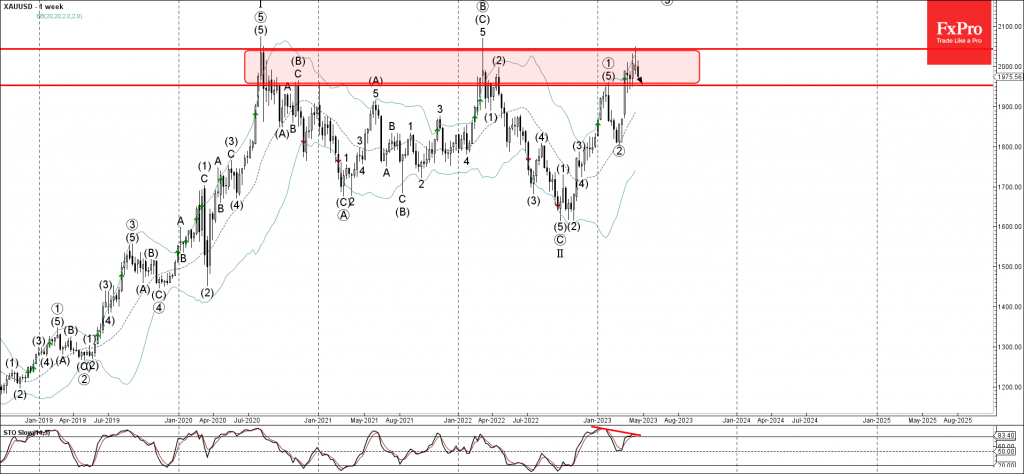
Gold continues to fall after the price reversed down from the major resistance level 2050.00 (which is the upper boundary of the powerful resistance zone, which has been reversing the price from the middle of 2020) coinciding with the upper weekly Bollinger Band.
The downward reversal from the resistance level 2050.00 created the weekly Japanese candlesticks reversal pattern Shooting Star.
Given the bearish divergence on the weekly Stochastic, Gold can be expected to fall further toward the next support level 1953.00 (lower boundary of this resistance zone).