

Sample Category Title
New Zealand BNZ manufacturing rose to 52, gearshift but not strong
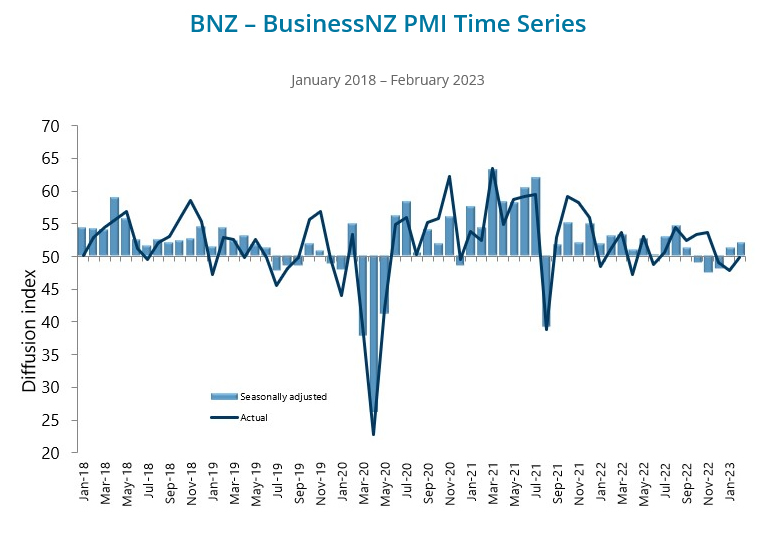
New Zealand BusinessNZ Performance of Manufacturing Index rose from 51.2 to 52.0 in February, signalling further increase in expansion. But the reading was still below its long-term average of 53.0.
Looking at some details, production dropped from 52.0 to 49.4. Employment rose from 51.6 to 54.0. New orders rose from 49.2 to 52.0. Finished stocks rose from 52.7 to 55.8. Deliveries was unchanged at 51.8.
BNZ Senior Economist, Craig Ebert stated that "it's been a New Year gearshift, out of reverse. However, these are not what you'd call strong results – in total, and especially when delving into the details. That said, February's PMI, like January's, did denote expansion, overall, and is not all that far shy of its long-term average of 53.0".
BoC Rogers: More evidence needed to decide whether policy is restrictive enough
BoC Senior Deputy Governor Carolyn Rogers reiterated in a speech yesterday that tightening is in a "conditional pause". More evidence is needed to decide whether policy is restrictive enough. Services price inflation will need to cool further.
The decisive to leave policy rate unchanged at 4.50% on Wednesday was a "conditional pause". "If economic developments unfold as we projected and inflation comes down as quickly as we forecast in the January Monetary Policy Report (MPR), then we shouldn't need to raise rates further," she said. "But if evidence accumulates suggesting inflation may not decline in line with our forecast, we're prepared to do more."
Economic data since January showed a "mixed picture". While "things are unfolding broadly in line with our outlook," she added, " We'll need to see more evidence to fully assess whether monetary policy is restrictive enough to return inflation to 2%."
Rogers also noted that inflation is "coming down largely as expected" with a "clear momentum shift in goods prices". However, "services price inflation needs to cool further". Companies need to "return to more normal pricing behavior".
"Year-over-year and three-month rates of core inflation will both need to come down more than they have for inflation to return sustainably to 2%, as will short-term inflation expectations," she said.
Cliff Notes: A Diverging Economic and Policy Outlook
Key insights from the week that was.
With the domestic and international data calendar light, the actions and rhetoric of policymakers was the key focus for markets this week.
While the RBA’s decision to deliver a 25bp rate hike in March was widely expected, the dovish guidance in the decision statement was a surprise to markets, with the Governor opening the door for a pause potentially as soon as April by noting that the Board would be assessing “when and how much” to increase interest rate hence. This compares to only “how much” in February. Coming updates on household spending, inflation and the labour market will be crucial to the RBA’s decision making in the months ahead. The greater degree of comfort shown by the RBA over the Australian CPI as the FOMC once again asserted their concerns over US inflation hit the Australian dollar hard, AUD/USD falling below USD0.66. Australian yields also fell, the AU/US 10yr spread widening to -25bps.
It is important to recognise, however, that the RBA still has a strong tightening bias given inflation is not expected to return to 3% until mid-2025. This represents three years in which inflation is outside of the RBA’s 2-3% target band, the key reason a pause was dismissed in December. Hence, we continue to expect 25bp rate hikes in both April and May, producing a peak cash rate of 4.10% which will be held through the remainder of 2023 and followed by gradual policy easing over the course of 2024 and 2025.
On the limited data received this week, Australia’s trade surplus printed a little below expectations, down from $13.0bn in December to $11.7bn in January. The main surprise centred on a burst in transport equipment imports thanks to improved supply and ahead of Lunar New Year, up 29% in the month. While total imports rose 4.6%, the downtrend in goods imports excluding transport remains well entrenched, the 6.8% fall pointing to a softening in consumer spending in early 2023. Our Westpac Card Tracker broadly corroborates this, with a clear stalling in nominal spending activity.
In the US, FOMC Chair Powell's appearance before both the Senate Banking Panel and the House Financial Service Committee were this week’s highlights. His comments before the Senate Banking Panel were construed by the market as hawkish, with a clear focus on inflation’s persistence following upward revisions to annual CPI and PCE inflation to December 2022 as well as stronger-than-expected readings for January. Also called out by Chair Powell was the labour market’s persistent strength and evidence of a bounce back in consumer spending as 2023 begins. For policy, the intent was clear: the FOMC will do what it takes to bring inflation back to target within a reasonable timeframe.
In his follow-up appearance before the House Committee, Chair Powell conveyed the same concerns over inflation as well as confidence in the robust health of the US economy; but on policy, he was a little more circumspect, making clear that the FOMC’s decisions are not on a pre-set path and will instead be determined by the strength of the data. While the market continues to hedge its bets between a 25bp and 50bp hike at the March meeting, arguably Chair Powell’s tone means that the payroll and CPI data to come over the next week will have to outperform to warrant the larger move.
Also evident in Chair Powell’s remarks this week was a belief that the Committee has already tightened policy and financial conditions materially, and that the full effect on the economy will come with a lag. So, as long as coming labour market and inflation data point to decelerating momentum, this cycle likely only has a few more hikes left in it before a lengthy pause to March quarter 2024. A similar state of affairs is evident in Euro Area monetary policy; while, in Canada, a pause has already commenced. For each of these markets, it is our expectation that inflation will ebb back towards target in 2023 without need for a recession. The longer-term concern is whether these nations are dynamic enough to rebound to, or above, trend growth once financial conditions ease. If not, faced with high debt burdens, their futures are likely to prove very challenging.
Though China’s 2023 growth target of ‘only’ 5% disappointed the market this week, it should have been seen as a reason for confidence. From the detail of the accompanying remarks, it is clear authorities do not see a need to pump up economic growth with aggressive public infrastructure spending. While this type of investment continues at a robust pace, it is the strength of the private sector (and efficient SOEs) that will dictate the scale of China’s outperformance, both in the near term and further out.
In our view, having shown considerable strength amid tremendous uncertainty in 2020-22, and with burgeoning export opportunities across the developing world, China’s industry has a high probability of delivering national growth outcomes well above authorities’ stated 2023 ambition. Importantly, being driven by productivity and capacity and with benefits flowing through to the Government and households, this momentum should prove sustainable and non-inflationary.
How Can NFP Release Affect the USD?
In February, the NFP (Non-Farm Payrolls) delivered a great shock, surpassing the forecast by over 400%. The forecast for this month's NFP is currently tied at half of the actual figure from last month's release, which means we can expect the US Dollar to get considerably lower. Despite this sentiment, it is imperative to vet the fundamental sentiment from a technical point of view.
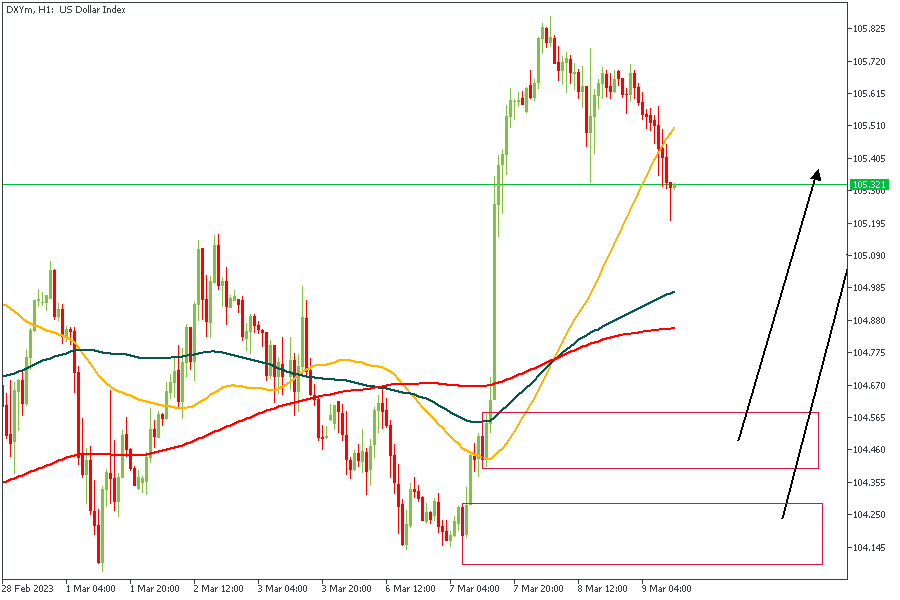
DXY - US DOLLAR
DXY can dip lower after breaking above the previous high, as seen above. The retracement is clearly in line with my previous analysis. I expect the Dollar to drop toward either of the two demand zones highlighted in the chart above.
Analysts’ Expectations:
- Direction: Bearish
- Target: 104.5
- Invalidation: 106.0
EURUSD
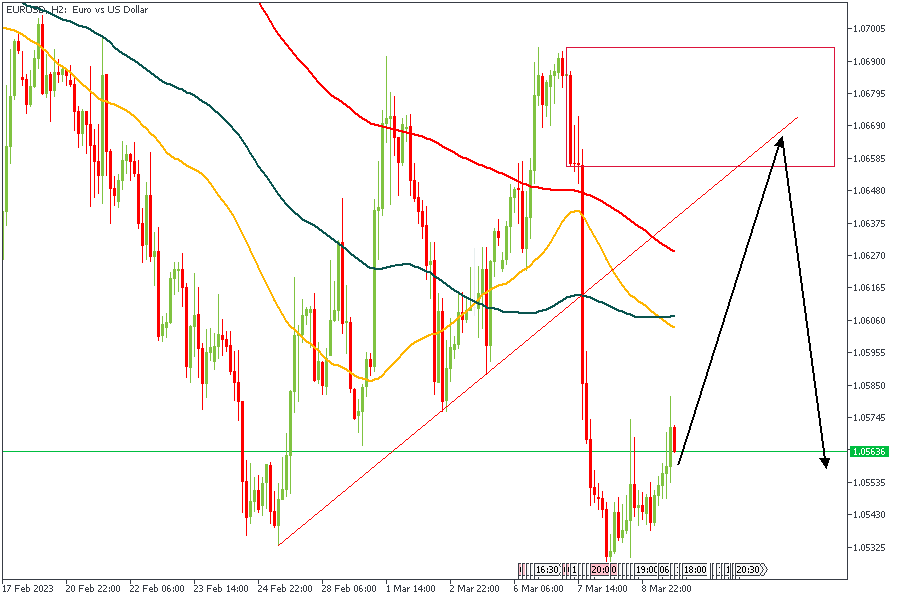
Generally speaking, a weaker dollar usually has a bullish consequence on the EURUSD and most major currency pairs. Based on this, I expect to see EURUSD climb into the highlighted supply zone before any possible drop occurs.
Analysts’ Expectations:
- Direction: Bullish
- Target: 1.0640
- Invalidation: 1.0549
GBPUSD
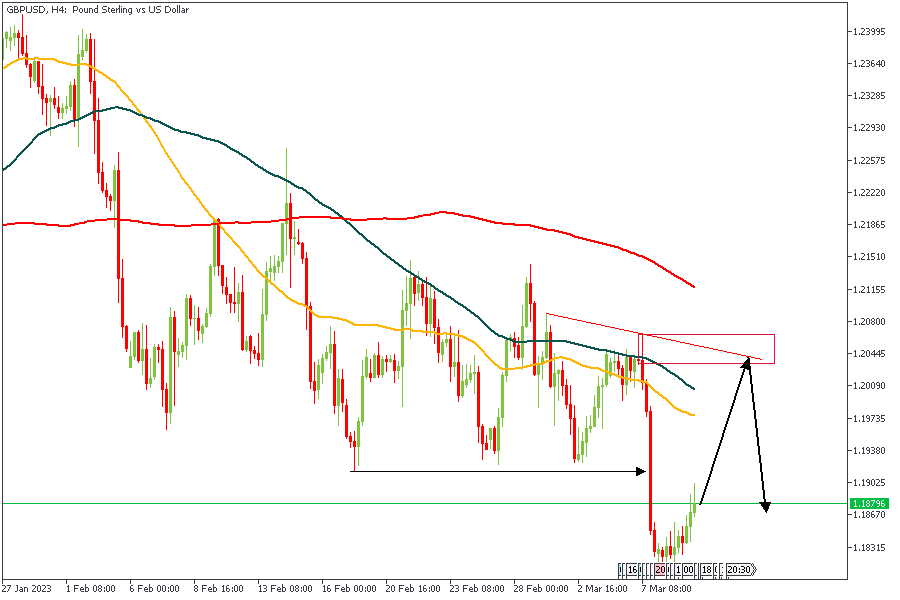
After the bearish break below the previous low, we see that price has created a rally-base-drop supply zone that needs to be mitigated. The supply zone also coincides with 88% of the Fibonacci retracement. Moreover, the arrangement of the moving averages suggests that the price would need to reach the marked zone to find a good enough cause for a bearish continuation.
Analysts’ Expectations:
- Direction: Bullish
- Target: 1.20100
- Invalidation: 1.18310
AUDUSD
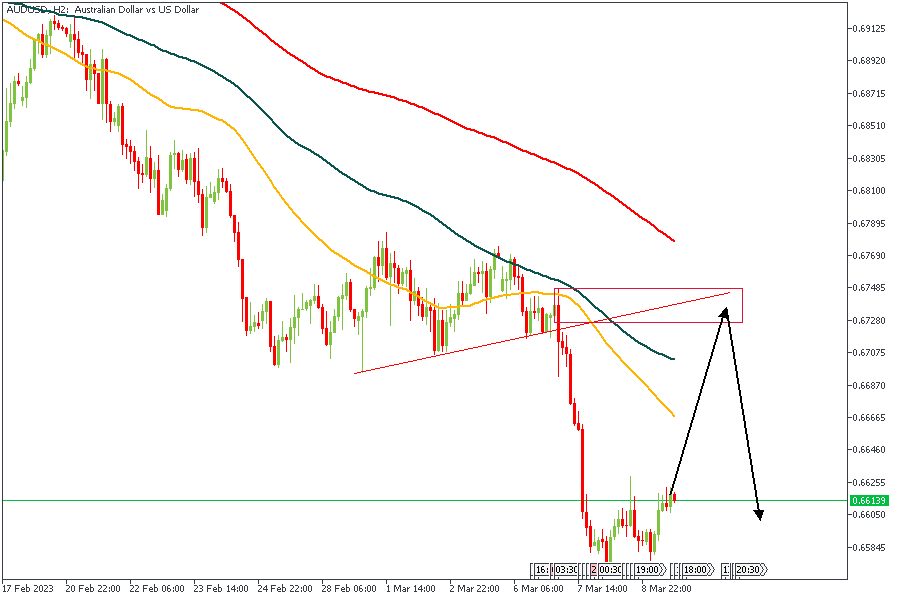
AUDUSD has the clearest picture of the bearish break below the previous low. We have also seen a double-bottom pattern at the most recent low, indicating a high likelihood that the price will retrace to the 0.6700 price region to find a reliable supply zone. After that, we may see a continuation of the bearish trend.
Analysts’ Expectations:
- Direction: Bullish
- Target: 0.67000
- Invalidation: 0.65600
If you would like to trade the NFP with a professional FBS analyst, don't forget to join our live trading broadcast of the NFP release on our YouTube channel.
CONCLUSION
The trading of CFDs comes at a risk. Thus, to succeed, you have to manage risks properly. To avoid costly mistakes while you look to trade these opportunities, be sure to do your due diligence and manage your risk appropriately.
GBPUSD Wave Analysis
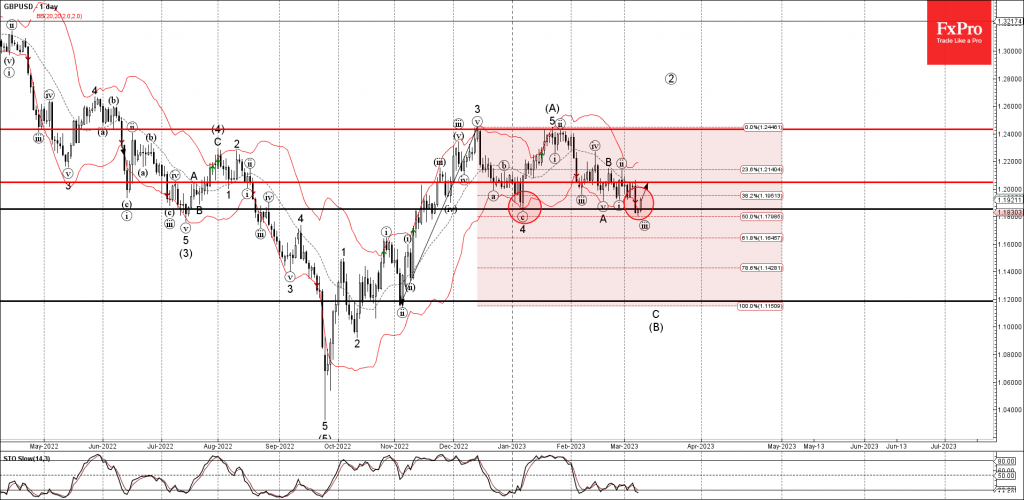
- GBPUSD reversed from support level 1.1855
- Likely to rise to resistance level 1.2050
GBPUSD recently reversed up from the powerful support level 1.1855 (previous monthly low from January) – coinciding with the lower daily Bollinger Band and the 50% Fibonacci correction of the upward impulse from November.
The upward reversal from the support level 1.1855 stopped the previous impulse waves (iii) and C.
Given the still oversold daily Stochastic, GBPUSD currency pair can be expected to rise further toward the next resistance level 1.2050.
GBPCHF Wave Analysis
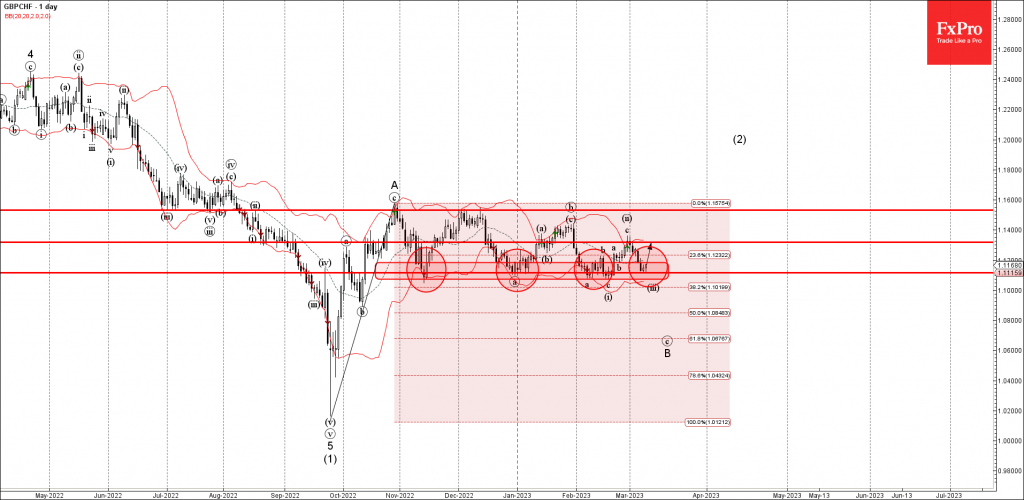
- GBPCHF reversed from support level 1.1115
- Likely to rise to resistance level 1.1320
GBPCHF currency pair recently reversed up from the key support level 1.1115 (which has been reversing the price from the start of November) – coinciding with the lower daily Bollinger Band.
The upward reversal from the support level 1.1115 stopped the previous minor impulse waves (iii) and B.
Given the strength of the support level 1.1115, GBPCHF currency pair can be expected to rise further toward the next resistance level 1.1320 (top of the earlier correction (ii)).
Sunset Market Commentary
Markets
Where to begin. There’s so much that didn’t happen today. Let’s take a look at equity markets. European stocks opened in red. The likes of the Euro Stoxx 50 (-0.25%) were off intraday lows but never left negative territory. Wall Street loses between 0.1-0.5% in a session devoid of important news or data. We did have weekly jobless claims coming in above the symbolical 200k for the first time in almost two months. It even pulled US yields a bit lower for the day. The move feels exaggerated but note that labour market tightness is the number one key concern to the Fed. Any sign of job market conditions softening is going to be picked up, no matter what. Markets were also put on high alert by Powell after the Fed chair said that “the totality” of the data will decide over the central bank’s next move (25 or 50 bps). We’d be cautious to read a lot in the move though. Tomorrow’s payrolls report combined with next week’s CPI reading are the critical data points. Current yield changes range between -0.3 bps to -5.6 bps with the front-end outperforming. Losses are building as the first US investors are joining. The 2y yield is testing the recently conquered 5% barrier. European yields follow the flattening trend with a remarkable underperformance of the long end of the curve (German and European (swap) yield +5 bps). Currency markets have little going on too. The dollar faces a bit more selling pressure following the jobless claims. EUR/USD advances from 1.0545 to 1.057 currently. The trade-weighted DXY finds support at 105.34 (November 2022 interim low). The Japanese yen is taking the lead on the G10 scoreboard. The decline in core bond yields as well as vulnerable risk sentiment aids the currency. USD/JPY eases to 136.48 after hitting resistance at the 200dMA yesterday and this morning around 137.15. EUR/JPY drifted south to 143.98. The Bank of Japan convenes for a last time under governor Kuroda tomorrow. There are no policy changes expected but markets stick to the idea that it is only a matter of time before the central bank will ditch yield curve control when Ueda takes over. Japan’s 10y yield continues to hit the upper bound of the 0% +/- 50 bps tolerance range. After hitting a 49 bps high mid-January, the spread with the Japanese 10y swap yield, which is out of the BoJ’s scope, remains at an elevated 37 bps today. Sterling is able to eke out some gains against a lackluster dollar and euro. EUR/GBP eases from 0.89 to 0.8878 currently.
tldr; come back tomorrow with the much-anticipated February US jobs report scheduled for release.
News & Views
European energy chief Simson said that the EC will propose to extend the current voluntary consumption cut target (15%) by a year after its expiry end March. Beneficial winter weather helped to reduce demand by nearly 20% over the past months. Simson said that “it’s the best guarantee to achieve another great level storage by November.” The EC aims to fill its storage sites to 90% before next winter. The energy chief also vowed to get rid of Russian LNG completely, as soon as possible. “Committing not to renew existing contracts with Russia is the best way to give a long-term assurance to our reliable partners that meaningful demand will stay.” Benchmark European gas prices (Dutch TTF future) keep setting new cycle lows on a daily basis, approaching €40/MWh for the first time since September 2021.
National Bank of Poland governor Glapinski sounded somewhat more dovish at today’s press conference compared to yesterday’s policy meeting. Glapinski expects Polish inflation to drop very quickly to target and slow more than expected in yesterday’s new projections (2023: 11.9%; 2024: 5.7%; 2025: 3.5%). He’s not calling the formal end to the tightening cycle yet, but is clearly looking in the direction of rate cuts. It’s too early to say whether this will happen this year still or next. Polish money markets were already playing with the notion that a first policy rate cut could happen around the turn of next year. The Polish zloty holds its ground around 4.68.
February NFP and Chance of a Surprise
Following Fed Chair Powell's comments on Capitol Hill last Tuesday, there is a lot of expectation around the upcoming NFP figures. Powell essentially said that if economic data came in well above expectations, then there would be a 50bps hike at the next FOMC meeting. He stressed that the decision hasn't been made yet (otherwise, why have the meeting?) But the potential for increasing the pace of hikes is definitely there, and the market has been pricing it in.
NFP are the first of the two major macroeconomic data points that are scheduled before the next Fed meeting. The other is Feb flash CPI, which will come out next week. Now, all the focus is on the jobs figures, particularly after ADP came in above expectations and JOLTs showed that there were more open jobs at the end of February than in January.
What's expected?
The consensus among analysts was that around 210K jobs were created in February, which would be in line with the last months of 2022. But it's still down from the 517K number reported in January which more than doubled expectations. The unemployment rate, however, is expected to remain steady at the historic low of 3.4%.
There were a couple of factors that led to the surprise jobs number last time, and a couple of them might repeat this month, while others will not. In the latter category is the return of 74K government workers in California as part of a labor dispute resolution, which helped boost the NFP last time.
Why is the jobs market so good?
The surprise last time had more to do with technical adjustments than the total number of jobs created. More specifically, it's not that more people got jobs; fewer than the normal amount of people lost their jobs. Particularly in the more populous areas of New England.
Normally, there is a loss of jobs in January as the holiday shopping comes to an end, and the weather causes a reduction in business activity. That is accounted for in the adjustment made by the BLS in preparing the NFP. But last January was an extraordinarily warm month, which means the ground in the northeast of the country didn't freeze, and activities such as construction and drilling were able to continue.
What about February?
The weather in February was also unseasonably warm, but there was a major winter storm that affected the north and Western areas of the country. The two events could end up canceling out the weather impact on the jobs numbers.
The other thing is that last month already included the adjustment for seasonality, so there is unlikely to be another adjustment boost to the numbers this time around. And, given the large number in January, the prior month could also be revised lower, as typically happens with this way out of the mean results.
Chinese Deflation as Good News
China’s consumer price growth fell to 1.0% y/y, a sharp slowdown from 2.1% y/y and against expectations of 1.9% y/y. Producer prices continued their deflationary slide in February, falling 1.4% y/y, versus -0.8% in the previous month and a slightly stronger than expected 1.3%.
The opening up of the Chinese economy has a deflationary effect on the domestic economy. In contrast, easing restrictions has had a pronounced pro-inflationary impact in Europe and the US. This effect is easily explained by the fact that the Middle Kingdom remains the “world factory”, and the opening of the economy boosts the supply more than the demand, which also helps to restore supply chains.
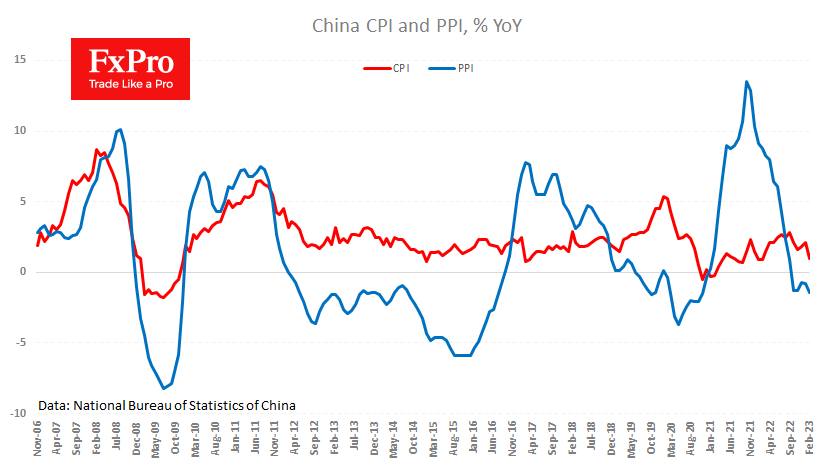
Over the past 20 years, China has been blamed for the spread of global deflation. In the current situation, this is a desirable side effect. Falling producer prices are also likely to help contain the global inflation problem. This is good news for risk demand, even if it does not appear so at first glance. Often, weak price pressures are associated with low demand. We have yet to see the February retail sales figures next week, but it is unlikely that the lifting of closures will suppress demand.
If we are right and the price fall is a sign of a return to the Chinese norm, this should support equity prices and the renminbi exchange rate.