

Sample Category Title
USD/CAD Breaks Higher
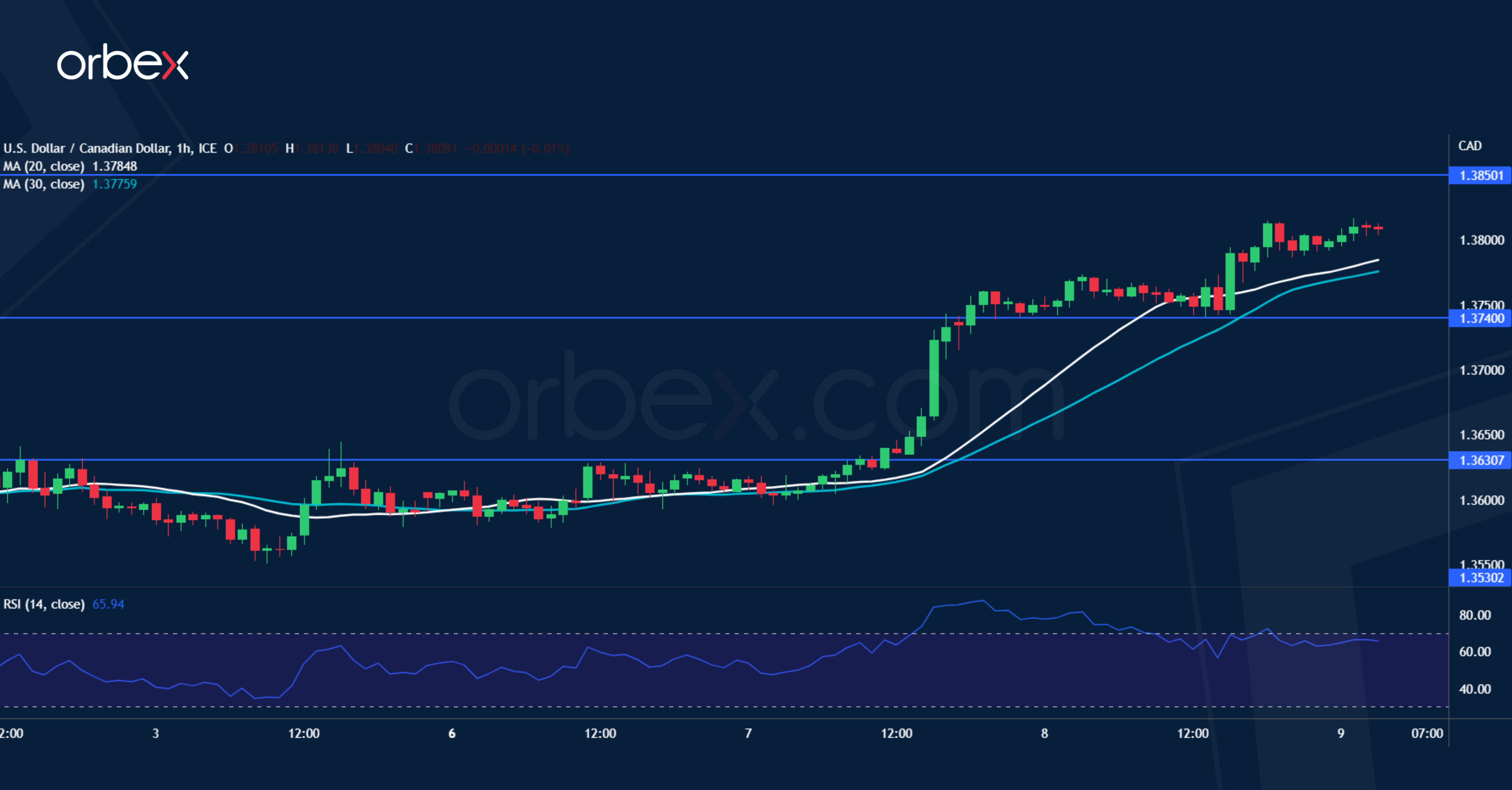
The Canadian dollar softened as the Bank of Canada left its interest rate unchanged. A convincing break above December’s high (1.3700) would signal the end of the flag-shaped consolidation on the daily chart, bringing most buyers out of their hibernation. A bullish continuation would send the greenback to its five-month high of 1.3980 with 1.3850 as the immediate resistance. On the hourly chart, 1.3740 is the closest support and 1.3630 at the base of the current surge is a key level to keep the momentum going.
EUR/USD Tests Critical Floor
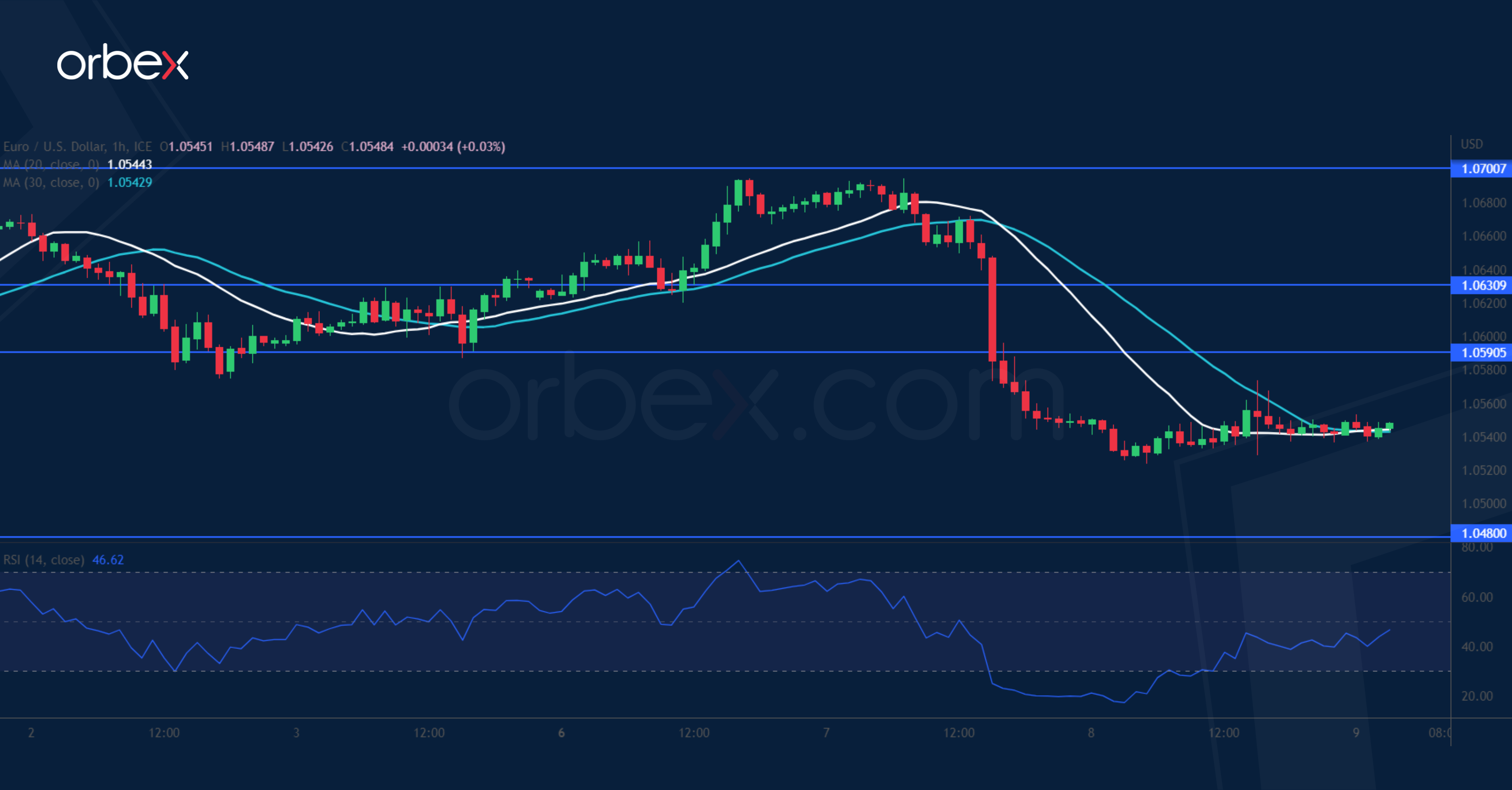
The euro dips further over weaker-than-expected eurozone GDP in Q4. On the daily chart, the pair came under pressure on the 30-day SMA (1.0700). A subsequent liquidation below 1.0630 then 1.0550 has invalidated the rebound from the end of February. The pair is hovering above this year’s low and the daily support of 1.0480. A break below this critical floor might trigger a bearish reversal in the weeks to come. As the RSI recovers into the neutral area, short-covering may send the euro to the first resistance at 1.0590.
ECB Villeroy: Inflation will halve by year end
ECB Governing Council member Francois Villeroy de Galhau said "what is very important is the inflation expectations".
"The peak will come this semester, and then inflation will halve by the end of the year," he added.
The Bank of France head also expect France's inflation to peak in first half of the year.
Solid Payrolls Report Needed for EUR/USD to Test 1.0484/61 support
Markets
US and European interest rate markets diverged further yesterday. German/EU yields didn’t see much spill-over from Tuesday’s sharp post-Powell repositioning in US markets. The German curve inverted further (2-y yield up 2.5 bps, 30-y minus 6.4 bps) in a session deprived of data. US yields initially corrected lower, but fortunes again changed in US dealings. ADP private job growth came in at a solid 242K. Higher than expected JOLTS job openings, laid the groundwork for an intraday reversal in US yields. Fed Chair Powell in his hearing before the House stressed that no decision has been made on the magnitude of the March 22 rate hike as it remains conditional to the totality of incoming data, including tomorrow’s payrolls and next week’s February inflation. This ‘conditionality’ didn’t change markets’ assessment that the bar will be high for the Fed not to return to a 50 bps step. The Beige book, preparing the March 22 Fed meeting, showed (anecdotic) evidence that the US economy held up well at the start of the year. A $32bn 10-y auction only drew mediocre investor interest. In the end, US yields gained 6.2 bps (2-y) to 2.2 bps (30-y). The real 10-y yield also made another step higher (1.66%, +8.5 bps). Still, this hardly had any impact on equities (Dow +0.18%; Nasdaq +0.4%) or the dollar. DXY closed almost unchanged at 105.66. Similar conclusion for EUR/USD (close 1.0545). Given additional interest rate support over the previous two sessions, this is slightly disappointing for USD bulls. EUR/GBP holds a tight range close to, mostly north of 0.89, but finished at the big figure.
Asian equities mostly show modest losses this morning with Japan outperforming. Chinese CPI inflation unexpectedly dropped from 1.9% Y/Y to 1%. PPI factory prices drifted further into negative territory (-1.4% Y/Y). The yuan eases marginally to USD/CNY 6.97. Later today, the eco calendar is very thin with only US jobless claims. ECB governors from today on will abstain from comments on monetary policy ahead of next week’s interest rate decision. We expect mainly technical trading ahead of tomorrow’s US payrolls. Some consolidation on the recent rally in yields is likely, but we see the downside well protected. Regarding the dollar, additional interest rates support apparently isn’t enough to attract strong buying interest as long as equity resilience mitigates safe haven demand. Apparently, a solid payrolls report is needed for EUR/USD to go for a test of the EUR/USD 1.0484/61 support.
News Headlines
The Bank of Canada stood pat in March, keeping the policy rate at 4.50%. It’s the first time that no back-to-back hike occurred since the BoC started the tightening cycle in March last year. The decision was no surprise. In January, the BoC said it expected to keep rates stable after the hike back then, provided the economy evolved broadly in line with its outlook. Employment growth was surprisingly strong but growth in Q4 was slightly weaker than expected. The economic drag will last for several quarters, which should ease pressures in the labour market and moderate wage growth, the BoC said. Taking all the data into account, the central bank sticks to the idea that inflation (currently 5.9% headline, +- 5% core) is on track to hit 3% by the middle of this year. That said, the BoC keeps the option of further hikes on the table if necessary. The Canadian dollar underperformed global peers yesterday. USD/CAD closed above 1.38 for the first time since mid-October. Canadian yields tanked in a knee-jerk reaction before paring losses to some extent. They eventually closed 2.2 to 6.8 bps lower with the front end underperforming.
Poland’s central bank (NBP) stuck to a 6.75% policy rate, the rate applicable since September last year. Polish activity slowed down on the back of weakening consumption. Investment continued to increase though. The labour market remains strong, resulting in low unemployment. Inflation shot up in January to 17.2% y/y. In part due to a VAT reversal but also due to companies still able to pass through higher input costs. That said, the NBP noted that the observed PPI decline together with weakening economic activity and the delivered monetary tightening will support a decline in domestic CPI inflation in coming quarters. This will be a gradual process, with the updated inflation forecast not showing a return to (the upper bound of the) target before 2025. Growth forecasts were marginally lifted across the policy horizon. The Polish zloty traded stoic in the wake of the decision. EUR/PLN closed a little lower, at 4.68, in a move that started earlier..
EUR/USD Daily Outlook
Daily Pivots: (S1) 1.0521; (P) 1.0548; (R1) 1.0570; More...
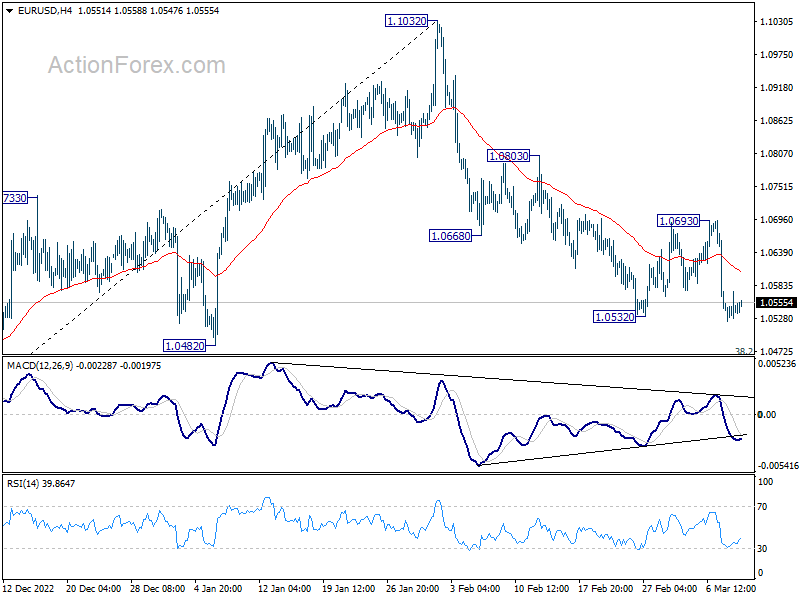
Intraday bias in EUR/USD stays on the downside at this point. Fall from 1.1032 is in progress for 38.2% retracement of 0.9534 to 1.1032 at 1.0463. Strong support could be seen there to bring reversal. But break of 1.0693 resistance is needed to indicate short term bottoming first. Meanwhile, sustained break of 1.0463 will carry larger bearish implications.
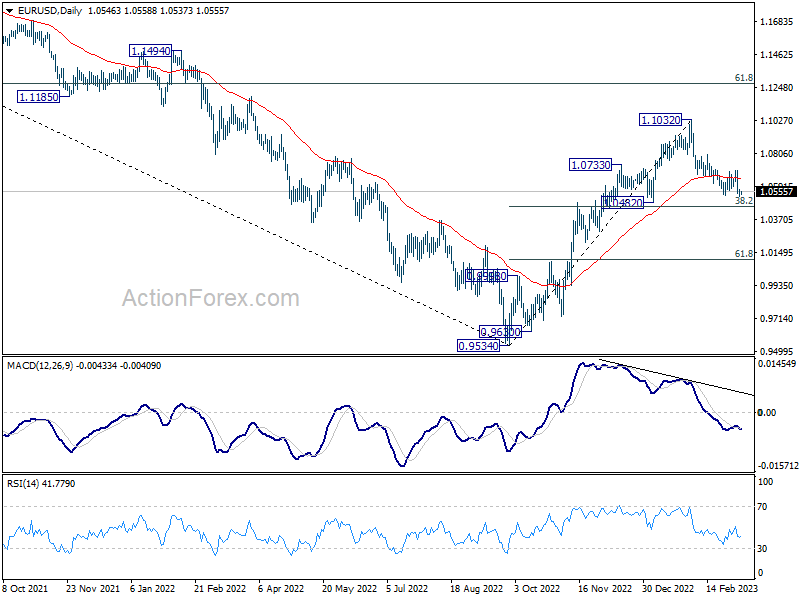
In the bigger picture, as long as 1.0482 support holds, rise from 0.9534 (2022 low) should continue to 61.8% retracement of 1.2348 (2021 high) to 0.9534 at 1.1273. However, sustained break of 1.0482 will bring deeper fall to 61.8% retracement of 0.9534 to 1.1032 at 1.0106, even as a corrective pull back.
GBP/USD Daily Outlook
Daily Pivots: (S1) 1.1813; (P) 1.1836; (R1) 1.1868; More...
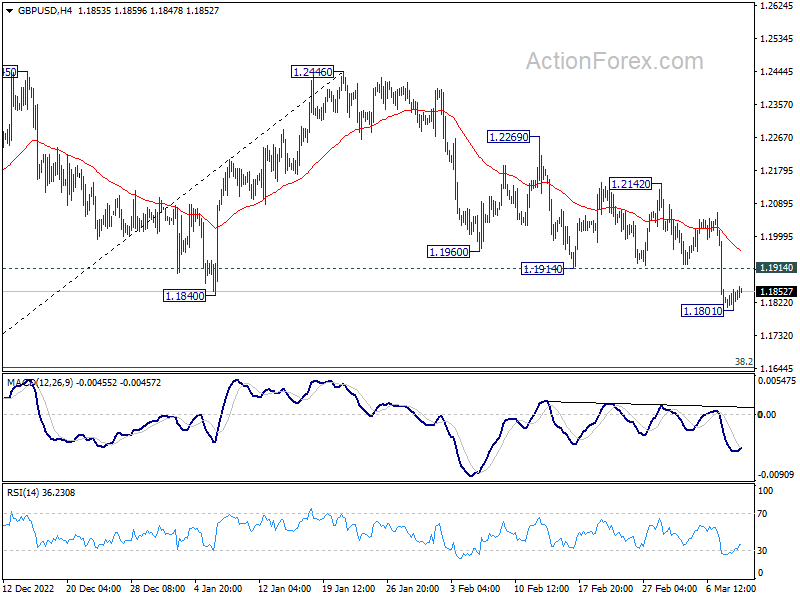
A temporary low is formed at 1.1801 with current recovery and intraday bias in GBP/USD is turned neutral first. Another fall could be seen as long as 1.1914 support turned resistance holds. Below 1.1801 will target 38.2% retracement of 1.0351 to 1.2446 at 1.1646. Firm break there would carry larger bearish implications. Nevertheless, break of 1.1914 will turn bias back to the upside for stronger rebound.
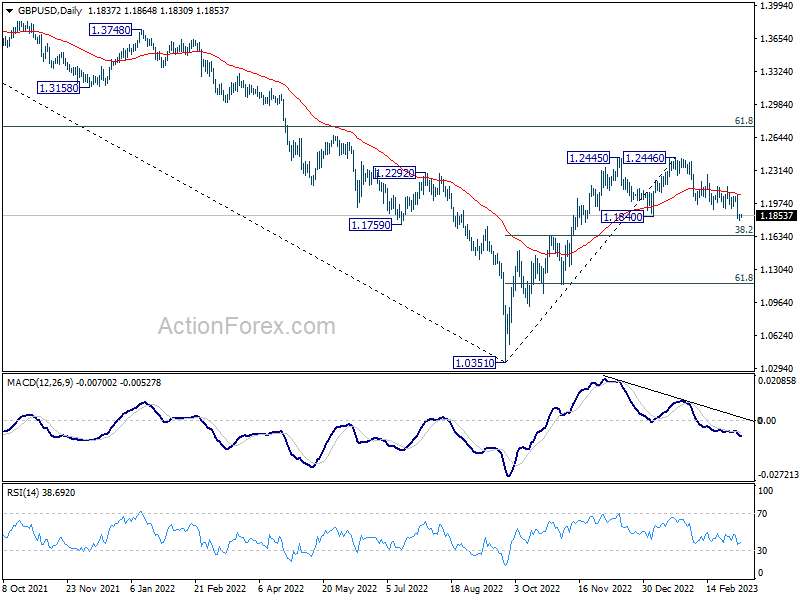
In the bigger picture, break of 1.1840 support argues that a double top pattern (1.2445, 1.2446) was formed after rejection by 55 week EMA (now at 1.2228). Deeper decline should be seen back to 38.2% retracement of 1.0351 to 1.2446 at 1.1646. Sustained break there will raise the chance of trend reversal and target 61.8% retracement at 1.1151.
USD/CHF Daily Outlook
Daily Pivots: (S1) 0.9390; (P) 0.9414; (R1) 0.9440; More...
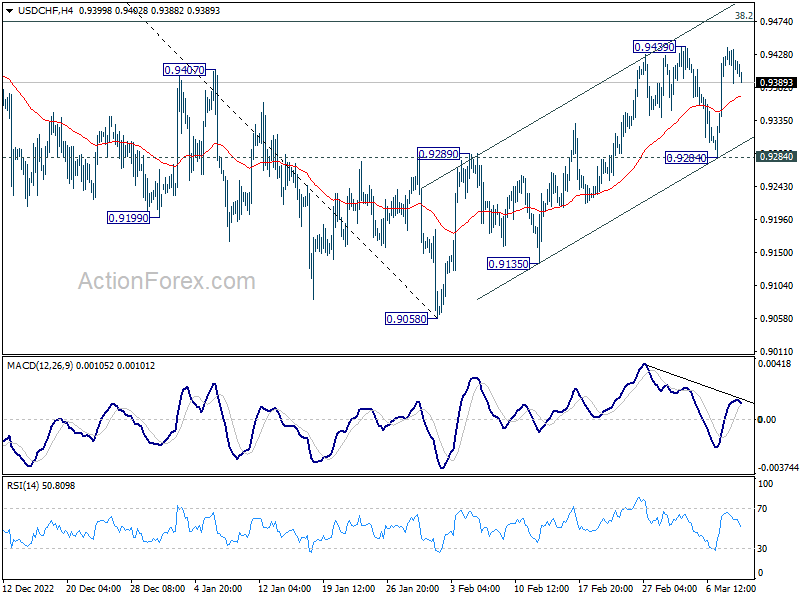
USD/CHF retreated after failing to break through 0.9439 resistance and intraday bias is turned neutral first. On the upside, break of 0.9439 will resume the rise from 0.9058 for 38.2% retracement of 1.0146 to 0.9058 at 0.9474. Decisive break there will carry larger bullish implications. On the downside, break of 0.9284 will turn bias back to the downside for retesting 0.9058 low instead.
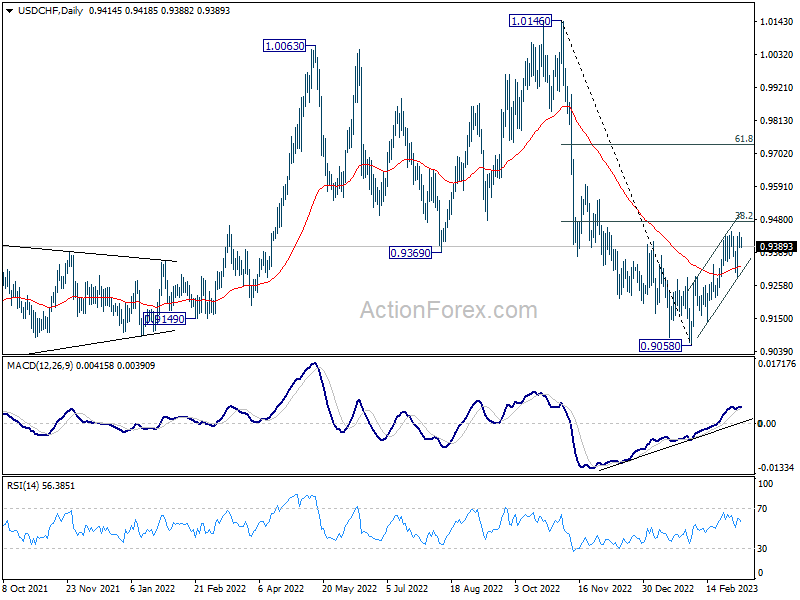
In the bigger picture, decline from 1.0146 is seen as part of a long term sideway pattern. As long as 38.2% retracement of 1.0146 to 0.9058 at 0.9474 holds, another fall is in favor through 0.9058. However, sustained trading above 0.9474 will indicate that the medium term trend has reversed, and open up further rally to 61.8% retracement at 0.9730 and above.
USD/JPY Daily Outlook
Daily Pivots: (S1) 136.59; (P) 137.25; (R1) 138.02; More...
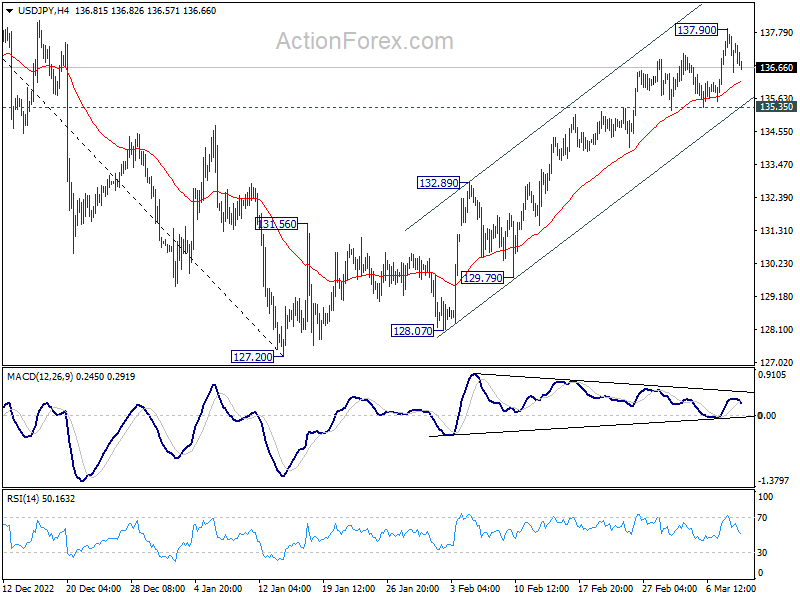
Intraday bias in USD/JPY is turned neutral with current retreat and some consolidations could be seen first. But further rally is expected as long as 135.35 support holds. Break of 137.90 will resume the rally from 127.20 to next fibonacci level at 142.48. However, break of 135.35 will bring deeper pull back to 55 day EMA (now at 134.30).
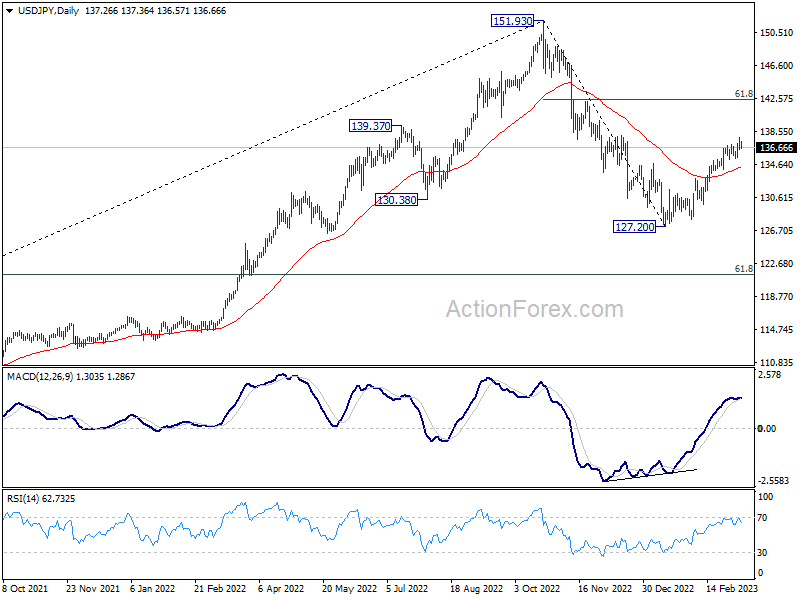
In the bigger picture, the break of 38.2% retracement of 151.93 to 127.20 at 136.64 suggests that whole down trend from 151.93 has completed at 127.20 already. Tentatively, rise from 127.20 is seen as the second leg the medium term pattern from 151.93. Further rally is expected to 61.8% retracement at 142.48. This will now remain the favored case as long as 55 day EMA (now at 134.10) holds.
AUD/USD Daily Report
Daily Pivots: (S1) 0.6562; (P) 0.6595; (R1) 0.6623; More...
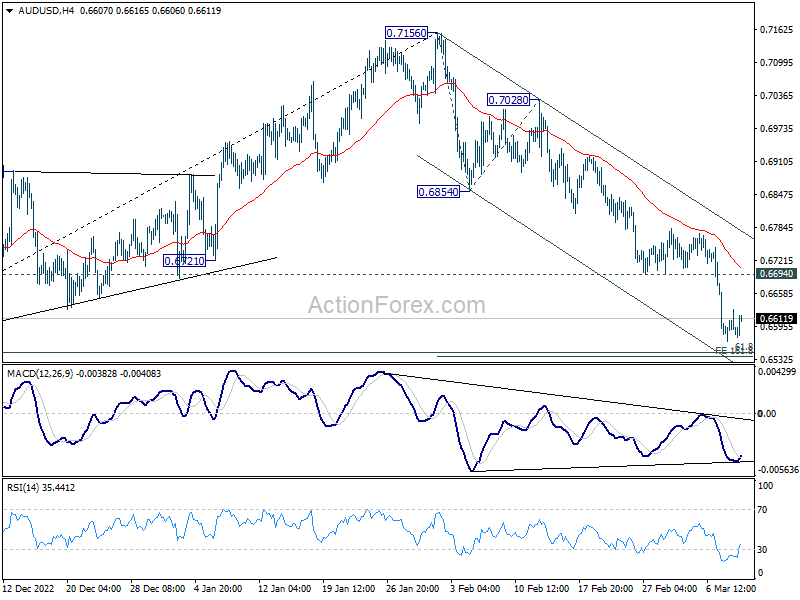
Intraday bias in AUD/USD is turned neutral first as it recovered ahead of 161.8% projection of of 0.6854 to 0.7028 from 0.6854 at 0.6539, with 4 hour MACD crossed above signal line. On the upside, break of 0.6694 support turned resistance will indicate short term bottoming, and turn bias back to the upside for rebound to 55 day EMA (now at 0.6825). On the downside, however, sustained break of 0.6539 will pave the way to retest 0.6169 low.
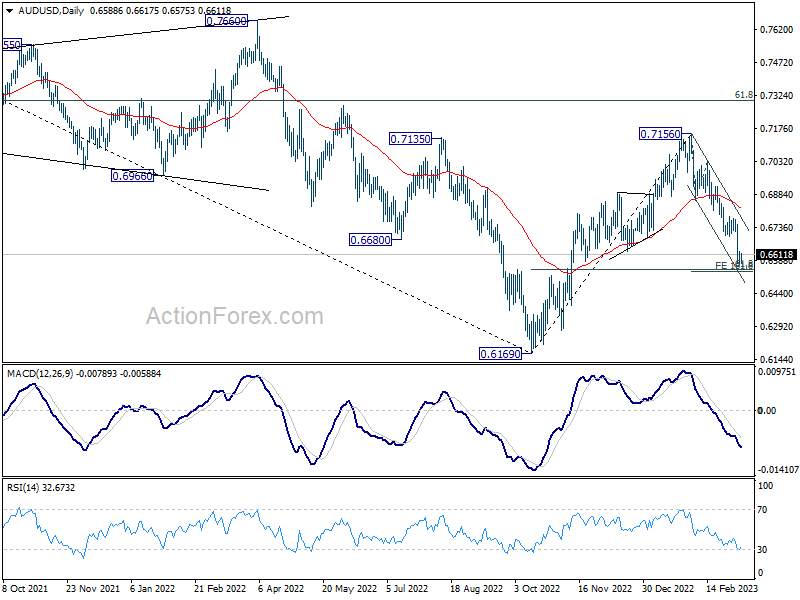
In the bigger picture, rise from 0.6169 (2022 low) has completed at 0.7156, after rejection by 55 month EMA (now at 0.7164). Deeper decline would then be see back to 61.8% retracement of 0.6169 to 0.7156 at 0.6546, even as a corrective fall. Sustained break there will raise the chance of long term down trend resumption through 0.6169 low.
Powell Says ‘No Decision’, But Strong Data Tells Another Story
Bulls in European equities didn’t’ really get washed out by the Federal Reserve (Fed) hawks; the DAX index closed higher at the wake of Powell’s first day of testimony before the Senate – which went badly hawkish on the other side of the Atlantic.
The better-than-expected jump in January industrial production in Germany may have helped send the DAX higher on Wednesday, along with a further decline in the German 10-year yield from the March peak levels.
But beyond Germany, the GDP growth in the Eurozone was null in Q4, and slowed more than expected on a yearly basis, and the European Central Bank 8ECB) won’t move a finger to boost economy because all the European policymakers want is… to abate inflation.
And the expectation is that, not only that the ECB will hike by 50bp at this month’s meeting, but there will be 150bp hike from now till summer.
The ECB hawks fueled the European yields to fresh highs since the Eurozone’s debt crisis– which is fundamentally not good news for equity traders.
And the euro is losing ground against the US dollar, as the hawks on the other side of the Atlantic Ocean look very threatening.
Even though a softer euro could be good for some businesses as a cheaper euro boosts sales abroad, it is obviously bad for abating inflation; it makes the cost of energy and raw materials more expensive for European businesses and boosts inflation. And rising inflation means higher rate hikes, and prospects of slower economy.
As a consequence, the European stocks should be more worried faced with a sinking euro and rising yields.
No decision yet
Fed Chair Jerome Powell’s second day of testimony was as hawkish as the first one, with one little exception.
Powell added a very small tweak to his Tuesday language, and said that the data will determine whether the Fed would increase the pace of the interest rate hikes, BUT that ‘no decision has been made on this’ yet.
If Powell’s intention was to cool down the 50bp hike bets yesterday, it didn’t go according to the plan. That probability went above 80% yesterday, as both the ADP report and the JOLTS data came in hotter-than-expected. The ADP printed 242K new private job additions in February versus 200K expected by analysts, while job openings in the US eased from last month’s peak, but not as much as expected.
In other words, the jobs data was again too strong to soften the Fed hawks’ hand.
The US 2-year yield extended its advance above the 5% mark, the 10-year yield hovered around the 4% level. The widening gap between the 2 and the 10-year yield boosts recession odds.
Note that the 4% mark for the US10-year yield has become a line in the sand that bond investors don’t want to breach.
The S&P500 swung between small gains and small losses yesterday, as the strong jobs data didn’t let much space for funded gains, but Powell’s ‘indecision’ about the next rate hike helped the S&P500 eke out a small gain to the end of the session.
In the FX, the US dollar index extended gains above the 100-DMA. Catch your breath before Friday!
Today, investors will mostly spend the session digesting Powell’s hawkish testimony, the major shift in US rate expectations, and the strong jobs data. They will also watch the US weekly jobless claims and pray that the February NFP print doesn’t surprise to the upside as did the ADP report.
As such, we could see some relief, and correction after two difficult days for risk assets, but investors will likely refrain from opening fresh positions before Friday’s US jobs data, because only God knows what could happen when the data falls in. Risks are two-sided, as soft data could easily spur a risk rally.
Gold and energy
The rapid surge in the US dollar and the rising US yields weigh on precious metals. Gold, which was supposed to have a great year, is now in the bearish consolidation zone, below the major 38.2% Fibonacci retracement on November to February rally, and is now testing the 100-DMA, which stands a couple of dollars above the $1800 level, to the downside. A strong data between today and Tuesday could rapidly send the price of an ounce below the $1800 mark. The next natural target for gold bears is the 200-DMA, at $1775 per ounce.
American crude on the other hand failed big time holding on to the gains above the 100-DMA and dropped nearly $5 per barrel although crude oil inventories in the US unexpectedly fell last week.
Rising recession odds due to hawkish Fed expectations is why the bears are out and selling.