

Sample Category Title
AUD/USD Daily Report
Daily Pivots: (S1) 0.6737; (P) 0.6756; (R1) 0.6788; More...
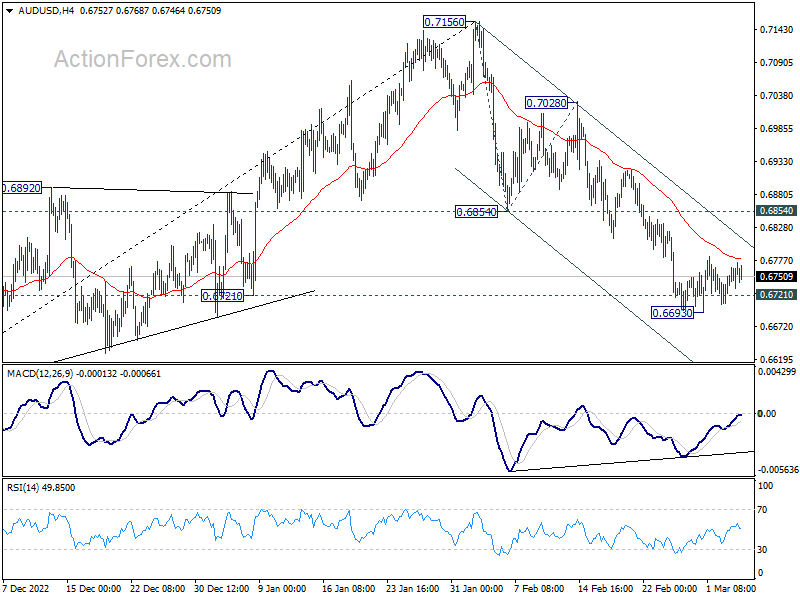
Intraday bias in AUD/USD remains neutral for the moment. Deeper decline is expected as long as 0.6854 support turned resistance holds. Break of 0.6693 will resume the fall from 0.7156 to 161.8% projection of of 0.6854 to 0.7028 from 0.6854 at 0.6539. Nevertheless, firm break of 0.6854 will argue that such decline is finished, and revive near term bullishness.
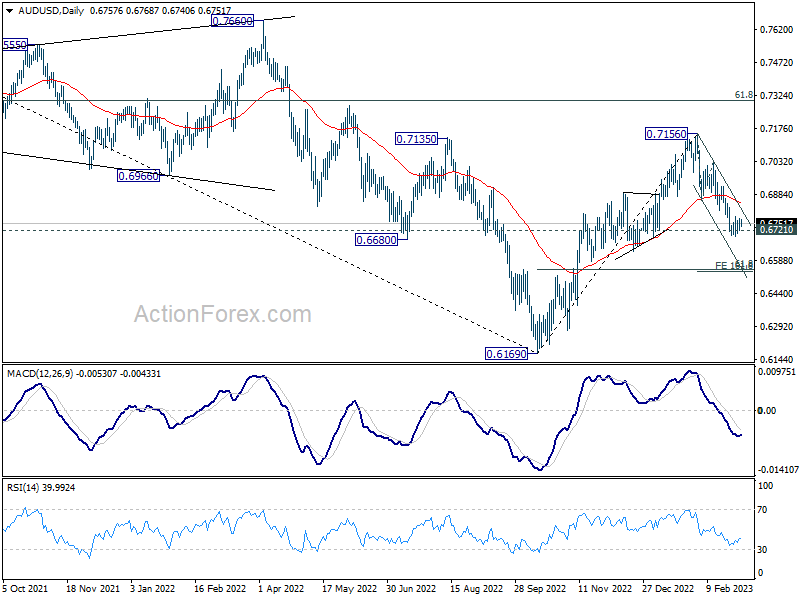
In the bigger picture, focus is staying on 0.6721 structural support. Sustained break there will argue that whole rise from 0.6169 (2022 low) has completed at 0.7156, after rejection by 55 month EMA (now at 0.7164). Deeper decline would then be see back to 61.8% retracement of 0.6169 to 0.7156 at 0.6546, even as a corrective fall. Nevertheless, strong rebound from current level will retain medium term bullishness for another rise through 0.7156 later.
EUR/USD Daily Outlook
Daily Pivots: (S1) 1.0602; (P) 1.0621; (R1) 1.0652; More...
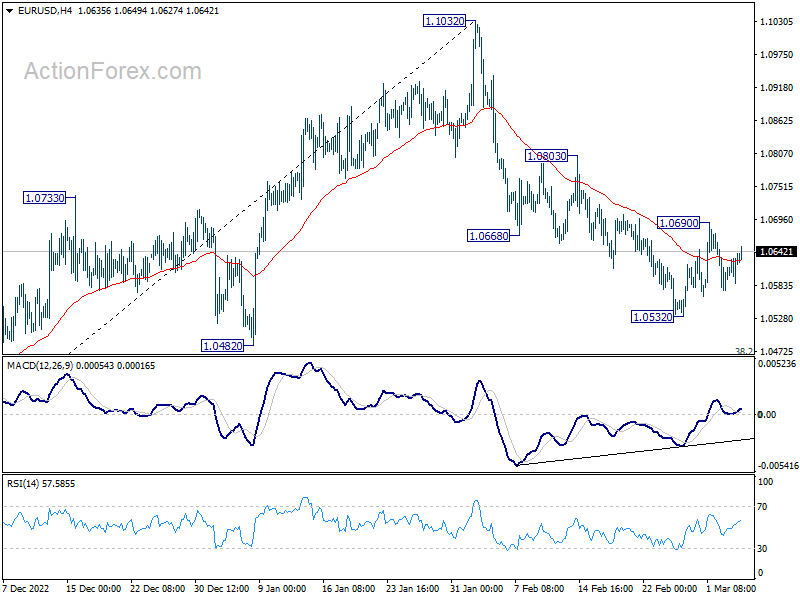
Intraday bias in EUR/USD remains neutral for the moment. Fall from 1.1032 could still extend lower. But strong support is expected from 38.2% retracement of 0.9534 to 1.1032 at 1.0463 to bring rebound. Break of 1.0690 will turn bias back to the upside for 1.0803 resistance first. However, sustained break of 1.0463 will carry larger bearish implication and bring deeper decline.
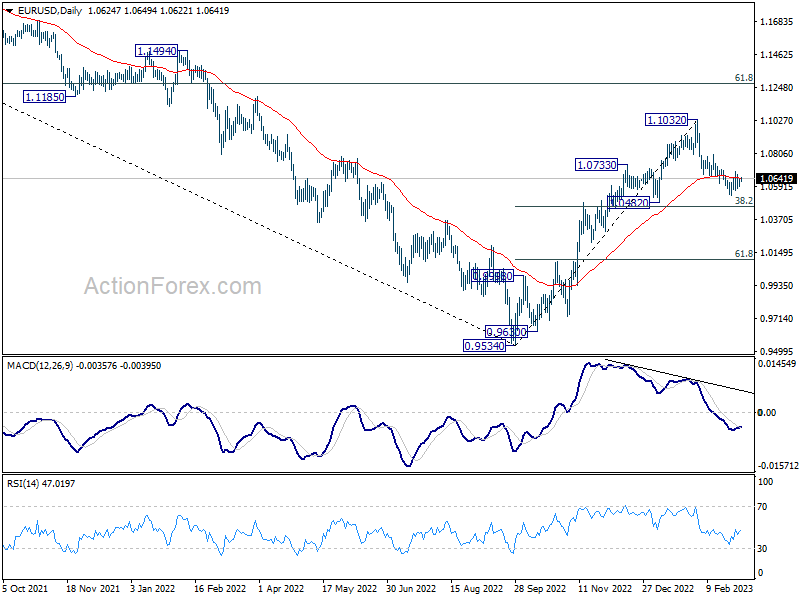
In the bigger picture, as long as 1.0482 support holds, rise from 0.9534 (2022 low) should continue to 61.8% retracement of 1.2348 (2021 high) to 0.9534 at 1.1273. However, sustained break of 1.0482 will bring deeper fall to 61.8% retracement of 0.9534 to 1.1032 at 1.0106, even as a corrective pull back.
GBP/USD Daily Outlook
Daily Pivots: (S1) 1.1975; (P) 1.2012; (R1) 1.2082; More...
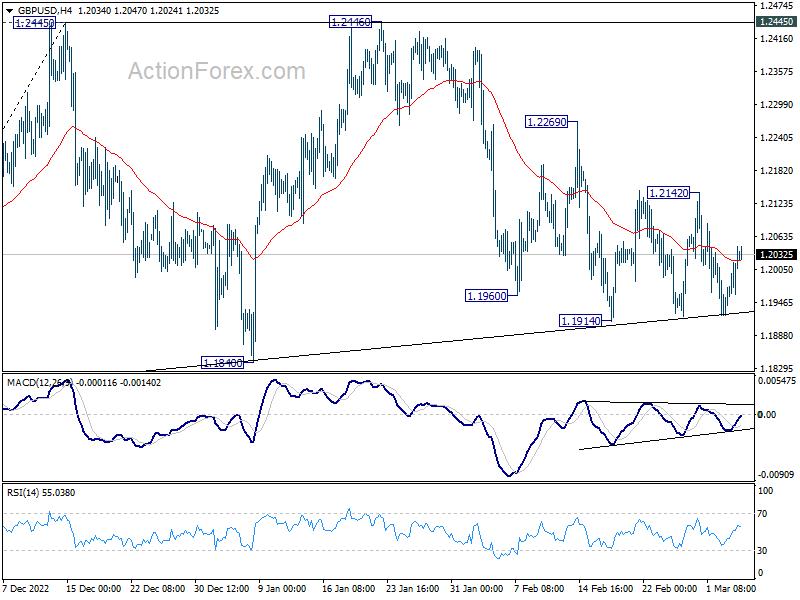
Intraday bias in GBP/USD remains neutral as sideway trading continues. On the downside, break of 1.1914 will resume the decline from 1.2446, as the third leg of the corrective pattern from 1.2445, for 1.1840 support and possibly below. On the upside, break of 1.2142 resistance will turn bias back to the upside for further rebound to 1.2269 and above.
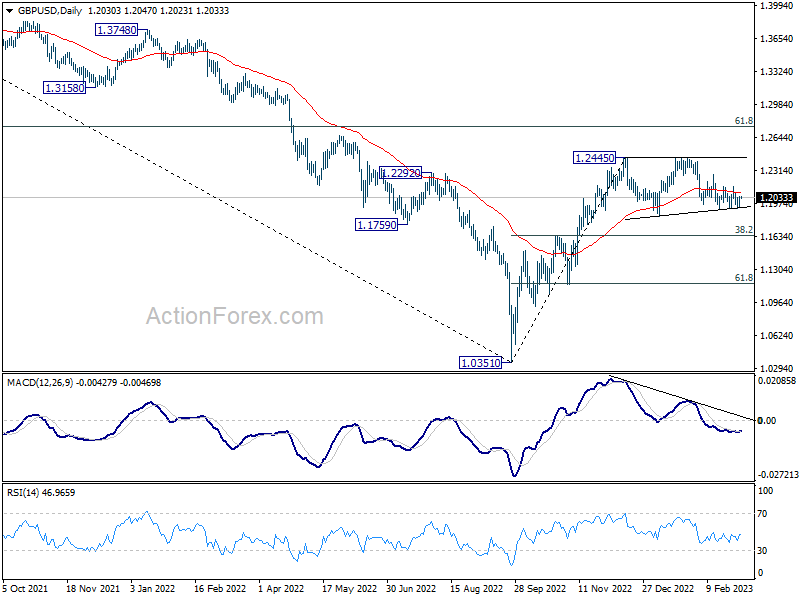
In the bigger picture, as long as 1.1840 support holds, rise from 1.0351 medium term bottom (2022 low) should still continue to 61.8% retracement of 1.4248 (2021 high) to 1.0351 at 1.2759. However, decisive break of 1.1840 will complete a double top pattern (1.2445, 1.2446) after rejection by 55 week EMA (now at 1.2243). Deeper decline should be seen back to 38.2% retracement of 1.0351 to 1.2445 at 1.1645.
USD/CHF Daily Outlook
Daily Pivots: (S1) 0.9336; (P) 0.9384; (R1) 0.9408; More...
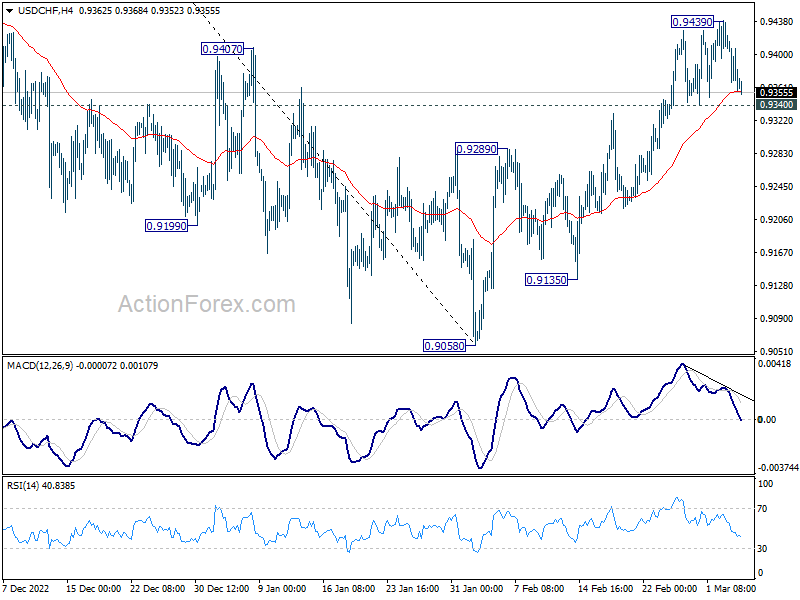
Intraday bias in USD/CHF remains neutral for the moment. While further rise cannot be ruled out, strong resistance could be seen from 38.2% retracement of 1.0146 to 0.9058 at 0.9474 to complete the rebound from 0.9058. Break of 0.9340 minor support will turn bias back to the downside. However, decisive break of 0.9474 will carry larger bullish implications and target 61.8% retracement at 0.9730.
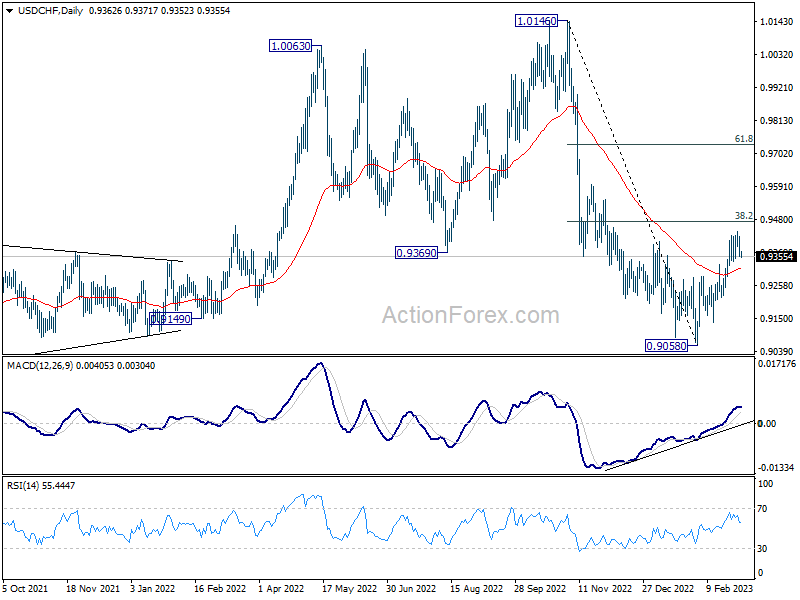
In the bigger picture, decline from 1.0146 is seen as part of a long term sideway pattern. As long as 38.2% retracement of 1.0146 to 0.9058 at 0.9474 holds, another fall is in favor through 0.9058. However, sustained trading above 0.9474 will indicate that the medium term trend has reversed, and open up further rally to 61.8% retracement at 0.9730 and above.
USD/JPY Daily Outlook
Daily Pivots: (S1) 135.45; (P) 136.12; (R1) 136.50; More...
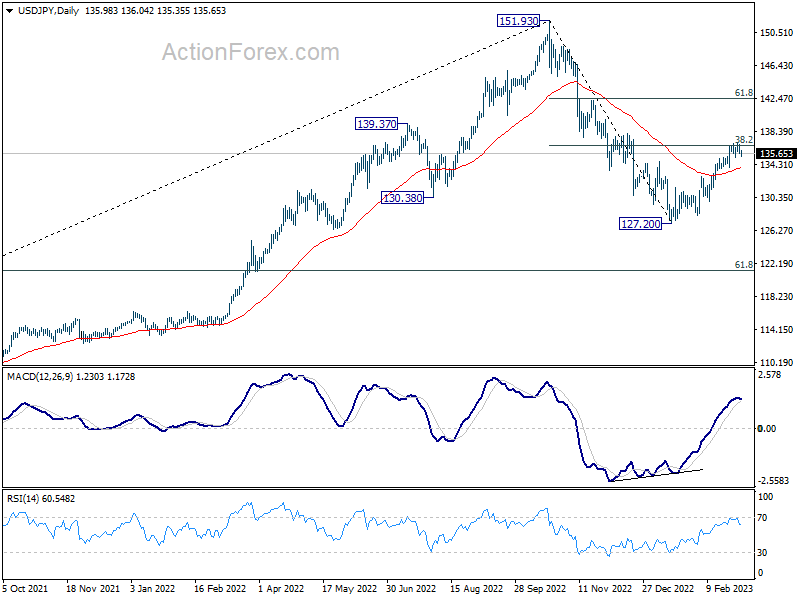
Intraday bias in USD/JPY stays neutral for the moment. On the downside, break of 135.24 support will indicate short term topping, after rejection by 38.2% retracement of 151.93 to 127.20 at 136.64. Intraday bias will be turned back to the downside for 55 day EMA (now at 133.96) first. Sustained break of 55 day EMA will indicate that whole rebound from 127.20 has completed. On the upside, however, sustained break of 136.64 will indicate that fall from 151.93 has completed, and bring further rally to 61.8% retracement at 142.48.
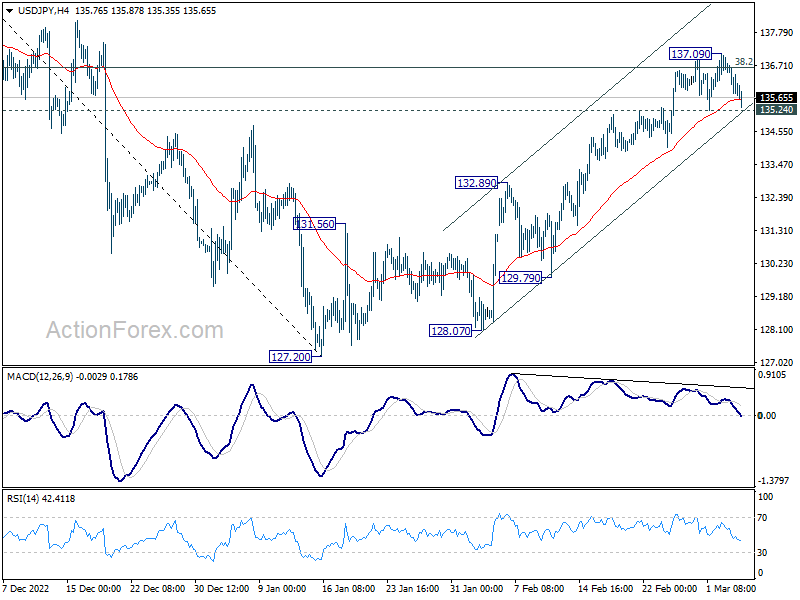
In the bigger picture, focus remains on 38.2% retracement of 151.93 to 127.20 at 136.64. Sustained break there will indicate that price actions from 151.93 medium term are merely a corrective pattern. Such development will maintain long term bullishness. Rejection by 136.64 will, on the other hand, extend the fall from 151.93 to 61.8% retracement of 102.58 to 151.93 at 121.43 at a later stage.
Yen Gains Traction on Mixed Market Sentiment
Mixed market sentiment led to a recovery in Yen during Asian session. Nikkei opened higher following a strong close in Wall Street on Friday. Meanwhile, stocks in Hong Kong and China were sluggish despite China's announcement of an ambitious growth target of around 5% this year. Euro and Swiss Franc are trailing the Yen higher, with the help of buying against the Sterling, Australian Dollar is leading New Zealand Dollar lower, despite expectations of another RBA rate hike tomorrow. Dollar is mixed ahead of Fed Chair Jerome Powell's testimony and non-farm payroll report later in the week.
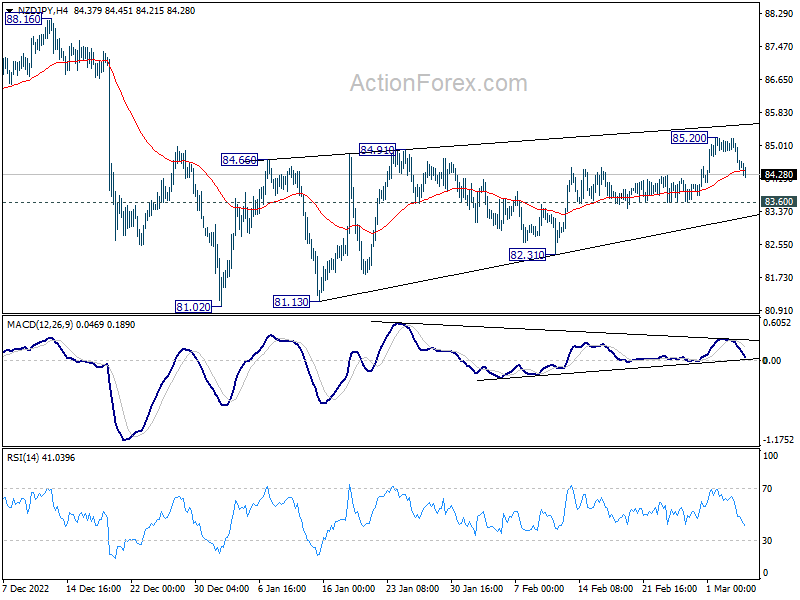
From a technical standpoint, the price actions of NZD/JPY from 81.02 are likely corrective in nature, in form of a five-way triangle pattern that may have completed at 85.20 already. The focus is now on 83.60 support, and a decisive break could add to the bearish view and bring deeper decline to retest 81.02 low. Another rise could still occur as long as 83.60 holds, but upside potential should be limited. Additionally, a break through the 135.24 support in USD/JPY could accelerate the selloff in NZD/JPY.
In Asia, at the time of writing, Nikkei is up 1.16%. Hong Kong HSI is up 0.04%. China Shanghai SSE is down -0.24%. Singapore Strait Times is down -0.17%. Japan 10-year JGB yield is up 0.0043 at 0.510.
ECB Lagarde: Recent economic indicators confirming 50bps hike in March
ECB President Christine Lagarde reiterated that it's "very, very likely" for the central bank to raise interest rate by 50bps this month. The decision was indicated at the last monetary policy meeting, and all recent economic indicators are confirming that this interest rate hike is likely.
"It is very likely that we will raise interest rates by 50 basis points," she said in an interview published on Sunday. "This was a decision that was indicated at our last monetary policy meeting and all the numbers we have been seeing in recent days are confirming that this interest rate hike is very, very likely."
"Headline inflation has gone down in recent months, and will continue to decline in the next few months," she said. However, "core inflation, which in the euro area excludes energy and food, is too high."
"The way forward is clear: we have to continue to take the measures needed to bring inflation back to 2%. And we will do so," she added.
"My main concern is inflation. We don't want to break the economy; that's not our goal." Lagarde said. "Our goal is to tame inflation."
"As a central bank, interest rate hikes are our main tool to achieve that. Raising interest rates dampens demand and reduces inflationary pressures," she added.
Fed Daly: Disinflation momentum uncertain, further tightening necessary
San Francisco Fed President Mary Daly said that the uptick in headline and core inflation rates in January indicates that disinflation momentum is uncertain, and further policy tightening is necessary to combat high inflation.
"After months of decline, headline and core inflation both ticked up in January on a 12-month basis, and the monthly inflation rate rose at its fastest pace in seven months," Daly said in a speech on Saturday. "This suggests that the disinflation momentum we need is far from certain."
"It's clear there is more work to do," she added. "In order to put this episode of high inflation behind us, further policy tightening, maintained for a longer time, will likely be necessary."
"Achieving our mandated goals takes time and a broader view," she said. "As policymakers, we have to respond to an economy that is evolving in real time and prepare for what the economy will look like in the future."
RBA to tighten further, BoC and BoJ to stand pat, Fed Powell to testify
This week, focus in the financial world will be on the meetings of three central banks, as investors keenly await their decisions on interest rates. RBA is widely expected to continue its tightening policy and raise the cash rate by a further 25bps to 3.60%.
The big question is whether RBA will revert to hinting at a pause in rate hikes. In December, the central bank indicated that rate hikes were "not on a pre-set course," but then dropped this language in February's statement, with minutes suggesting a pause was not being even considered. The indication of an imminent pause, of the lack thereof, could be a sign of whether rate will peak at 3.85% in April or 4.10% in May.
Meanwhile, BoC and the BoJ are both expected to keep their monetary policies unchanged. The BoC has indicated that it is now in a conditional pause in tightening, while the BoJ is likely to leave any potential adjustments to its incoming governor, Kazuo Ueda.
In the US, Federal Reserve Chair Jerome Powell will testify before Congress, where market participants will be looking for clues on the potential for a 50bps rate hike this month and where interest rates may peak. However, Powell is likely to hold his cards until the Fed's announcement on March 22, two weeks away.
In terms of data, US non-farm payrolls will be a major highlight, while Canada will also publish its employment report. UK GDP and production data, Eurozone Sentix investor confidence and retail sales, Australia retail sales, and China inflation data will also be watched closely.
Here are some highlights for the week:
- Monday: Swiss CPI; Eurozone Sentix investor confidence, retail sales; UK PMI construction; Canada Ivey PMI; US factory orders.
- Tuesday: Japan average cash earnings; RBA rate decision, Australia trade balance, retail sales; Swiss unemployment rate, foreign currency reserves; Germany factory orders
- Wednesday: Japan current account, leading indicators; Germany industrial production, retail sales; Eurozone GDP final; US ADP employment, trade balance, Fed Beige Book; BoC rate decision, Canada trade balance.
- Thursday: Japan GDP final, M2 money supply; China CPI, PPI; US Challenger job cuts, jobless claims.
- Friday: New Zealand BusinessNZ manufacturing, manufacturing sales; BoJ rate decision, Japan PPI, household spending; Germany CPI final; UK GDP, trade balance, productions; Canada employment; US non-farm payrolls.
USD/JPY Daily Outlook
Daily Pivots: (S1) 135.45; (P) 136.12; (R1) 136.50; More...
Intraday bias in USD/JPY stays neutral for the moment. On the downside, break of 135.24 support will indicate short term topping, after rejection by 38.2% retracement of 151.93 to 127.20 at 136.64. Intraday bias will be turned back to the downside for 55 day EMA (now at 133.96) first. Sustained break of 55 day EMA will indicate that whole rebound from 127.20 has completed. On the upside, however, sustained break of 136.64 will indicate that fall from 151.93 has completed, and bring further rally to 61.8% retracement at 142.48.
In the bigger picture, focus remains on 38.2% retracement of 151.93 to 127.20 at 136.64. Sustained break there will indicate that price actions from 151.93 medium term are merely a corrective pattern. Such development will maintain long term bullishness. Rejection by 136.64 will, on the other hand, extend the fall from 151.93 to 61.8% retracement of 102.58 to 151.93 at 121.43 at a later stage.
Economic Indicators Update
| GMT | Ccy | Events | Actual | Forecast | Previous | Revised |
|---|---|---|---|---|---|---|
| 00:00 | AUD | TD Securities Inflation M/M Feb | 0.40% | 0.90% | ||
| 07:30 | CHF | CPI M/M Feb | 0.40% | 0.60% | ||
| 07:30 | CHF | CPI Y/Y Feb | 2.90% | 3.30% | ||
| 09:30 | EUR | Eurozone Sentix Investor Confidence Mar | -5.6 | -8 | ||
| 09:30 | GBP | Construction PMI Feb | 48.5 | 48.4 | ||
| 10:00 | EUR | Eurozone Retail Sales M/M Feb | 1.00% | -2.70% | ||
| 15:00 | USD | Factory Orders M/M Jan | -1.50% | 1.80% | ||
| 15:00 | CAD | Ivey PMI Feb | 55.9 | 60.1 |
ECB Lagarde: Recent economic indicators confirming 50bps hike in March
ECB President Christine Lagarde reiterated that it's "very, very likely" for the central bank to raise interest rate by 50bps this month. The decision was indicated at the last monetary policy meeting, and all recent economic indicators are confirming that this interest rate hike is likely.
"It is very likely that we will raise interest rates by 50 basis points," she said in an interview published on Sunday. "This was a decision that was indicated at our last monetary policy meeting and all the numbers we have been seeing in recent days are confirming that this interest rate hike is very, very likely."
"Headline inflation has gone down in recent months, and will continue to decline in the next few months," she said. However, "core inflation, which in the euro area excludes energy and food, is too high."
"The way forward is clear: we have to continue to take the measures needed to bring inflation back to 2%. And we will do so," she added.
"My main concern is inflation. We don't want to break the economy; that's not our goal." Lagarde said. "Our goal is to tame inflation."
"As a central bank, interest rate hikes are our main tool to achieve that. Raising interest rates dampens demand and reduces inflationary pressures," she added.
Fed Daly: Disinflation momentum uncertain, further tightening necessary
San Francisco Fed President Mary Daly said that the uptick in headline and core inflation rates in January indicates that disinflation momentum is uncertain, and further policy tightening is necessary to combat high inflation.
"After months of decline, headline and core inflation both ticked up in January on a 12-month basis, and the monthly inflation rate rose at its fastest pace in seven months," Daly said in a speech on Saturday. "This suggests that the disinflation momentum we need is far from certain."
"It's clear there is more work to do," she added. "In order to put this episode of high inflation behind us, further policy tightening, maintained for a longer time, will likely be necessary."
"Achieving our mandated goals takes time and a broader view," she said. "As policymakers, we have to respond to an economy that is evolving in real time and prepare for what the economy will look like in the future."
EUR/USD Bears Remain Active Below 1.0700
Key Highlights
- EUR/USD extended its decline and tested the 1.0535 zone.
- It cleared a key bearish trend line with resistance near 1.0595 on the 4-hours chart.
- GBP/USD found support near 1.1940 and is currently consolidating losses.
- Gold price started a fresh increase above the $1,830 resistance zone.
EUR/USD Technical Analysis
The Euro found support near the 1.0535 zone against the US Dollar. EUR/USD remained bid and recently started an upside correction above 1.0580.
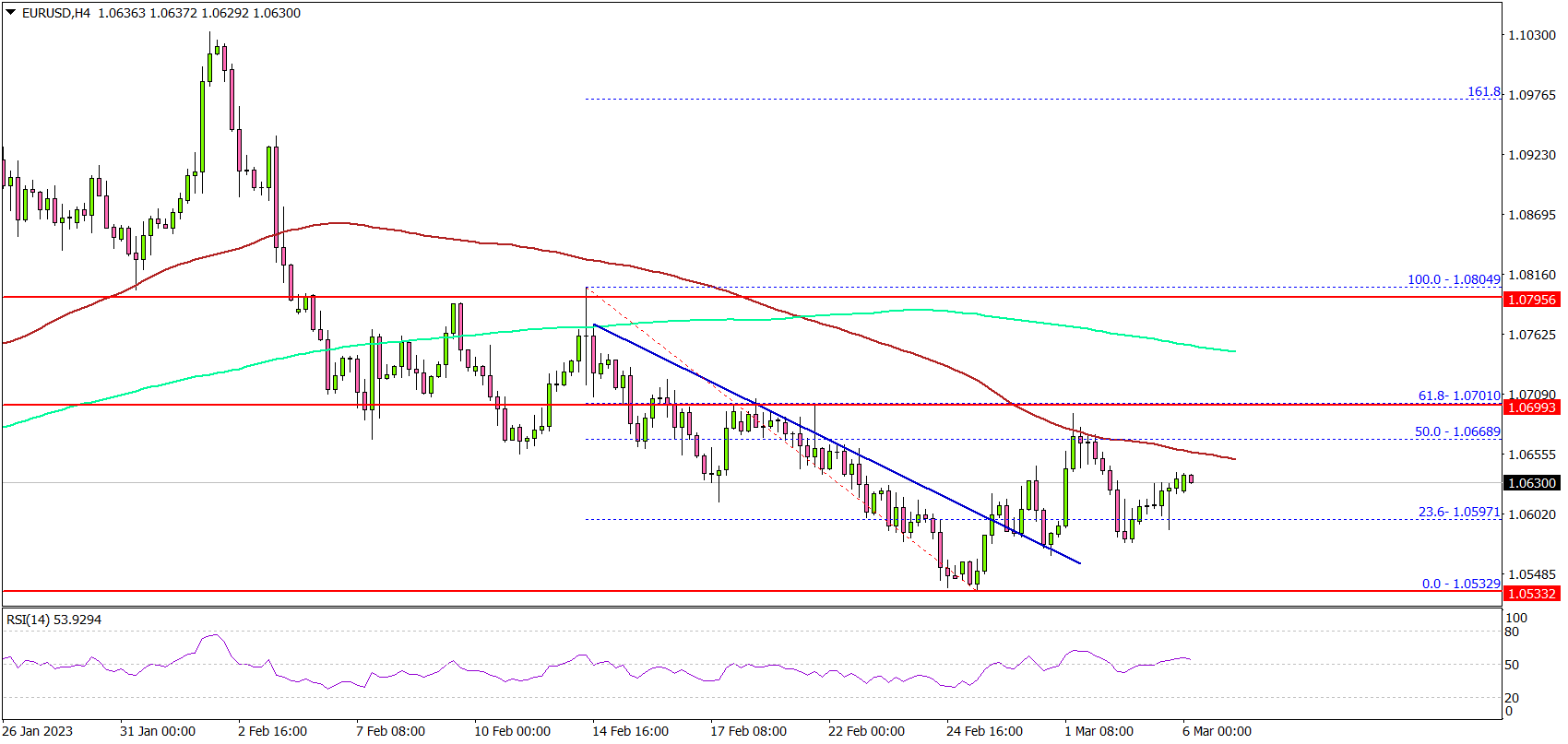
Looking at the 4-hours chart, the pair started an upside correction above the 1.0600. There was a break above a key bearish trend line with resistance near 1.0595 on the same chart.
There was a spike towards the 1.0665 resistance zone and the 100 simple moving average (red, 4-hours). The pair tested the 50% Fib retracement level of the downward move from the 1.0804 swing high to 1.0539 low.
On the upside, the pair is facing resistance near the 1.0655 zone. The next major resistance is near the 1.0750 level and the 200 simple moving average (green, 4-hours).
A clear move above the 1.0750 resistance might start a steady increase towards the 1.0800 zone. On the downside, an immediate support is near the 1.0600 level.
The next major support is near the 1.0550 level, below which there is a risk of a move towards the 1.0480 level. Any more losses could open the doors for a drop towards 1.0420.
Looking at gold price, the price started an upside correction and there was a clear move above the $1,830 resistance zone.
Economic Releases
- Euro Zone Retail Sales for Feb 2023 (YoY) - Forecast +1.9%, versus -2.8% previous.
- Euro Zone Retail Sales for Feb 2023 (MoM) - Forecast +1.0%, versus -2.7% previous.
- US Factory Orders for Jan 2023 (MoM) - Forecast 0%, versus +1.8% previous.
Platinum (PL) Ended Correction and Resumes Higher
In our last blog from December 2022, we wrote that Platinum is ready to rally in 2023 after a 3 waves pullback. Fast forward 3 months later, the pullback has likely completed. The metal can start to resume higher in months to come. Below we will look at the technical outlook using Elliott Wave.
Platinum Monthly Elliott Wave Chart
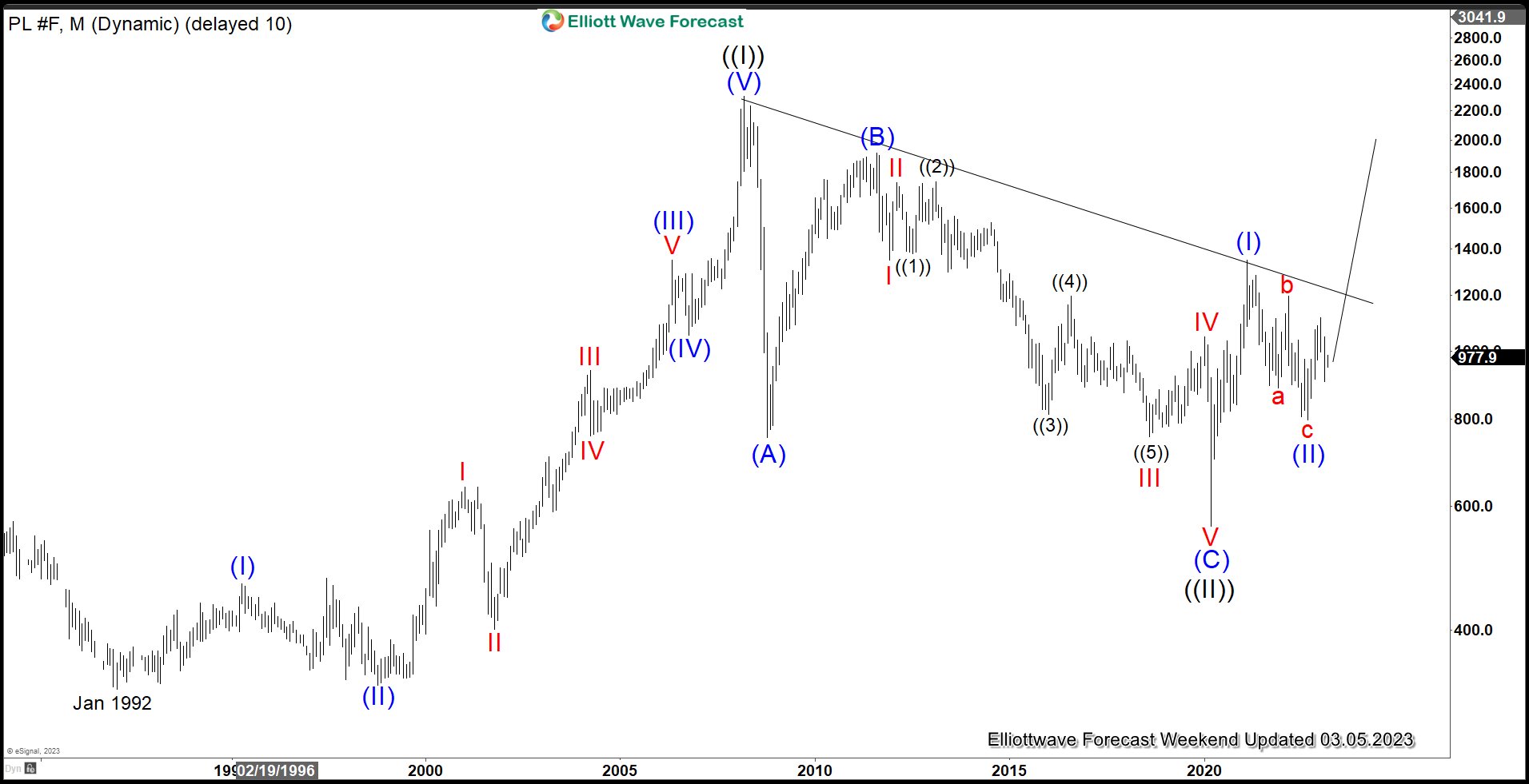
Monthly Elliott Wave Chart of Platinum above suggests that the metal did an all-time correction to cycle from January 1992. The correction nded a major low at 562 in 2020 where we labelled as wave ((II)). Wave ((III)) higher is currently in progress with subdivision as an impulse structure. Up from wave ((II)), wave (I) ended at 1348.2 and pullback in wave (II) ended at 796.8. Expect Platinum to extend higher as long as it stays above wave (II) low at 796.8.
Platinum Daily Elliott Wave Chart
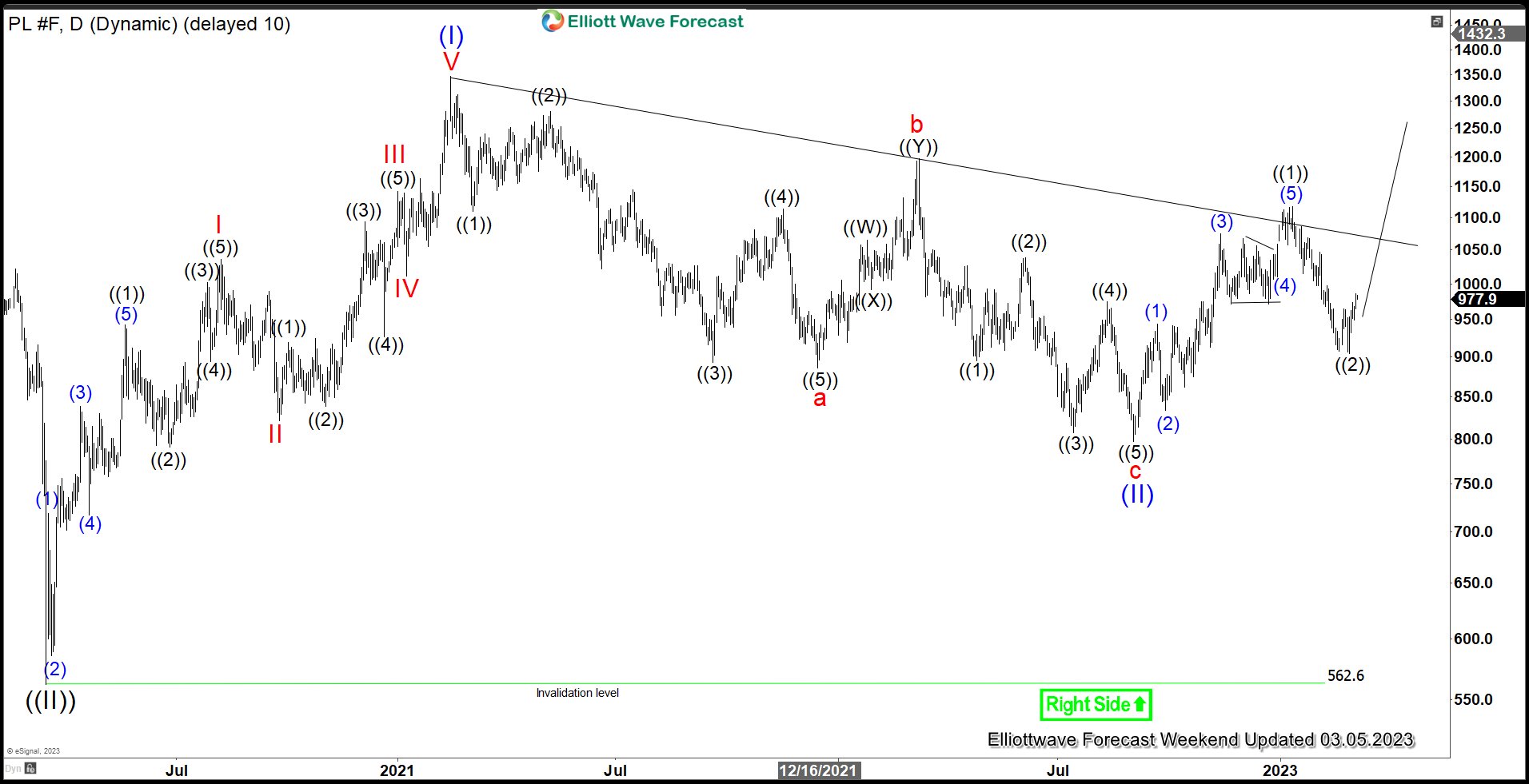
Daily Chart of Platinum above suggests that the metal ended correction to cycle from 3.11.2020 low at 796.8 on September 1. We labelled this low as wave (II). Up from there, wave (1) ended at 943.5 and pullback in wave (2) ended at 833.7. Wave (3) ended at 1074.1 and wave (4) ended at 1006.3. Final leg higher wave (5) ended at 1117 which completed wave ((1)). Pullback in wave ((2)) has likely completed at 903.9 even though the metal still needs to break above the previous wave ((1)) high at 1117 to confirm this view and rules out a double correction. Near term, expect the metal to continue the rally higher as long as dips stay above 1117 in the first degree.