Sample Category Title
ECB Lane: Appropriate to raise interest rates further beyond March
ECB Chief Economist Philip Lane indicated that it's "appropriate" to raise interest rates further beyond March meeting. But the "exact calibration" will depend on the upcoming macroeconomic projections and incoming data on inflation and the monetary transmission mechanism.
Lane said in a speech, "the current information on underlying inflation pressures suggests that it will be appropriate to raise rates further beyond our March meeting".
"By bringing the key policy rates to a sufficiently restrictive level and fostering a period of below-trend growth through the dampening of demand, we will counter-act above-target medium-term inflation pressures and also ensure that the prolonged phase of above-target inflation does not become embedded through a de-anchoring of inflation expectations," he explained.
Eurozone retail sales volume rose 0.3% mom in Feb
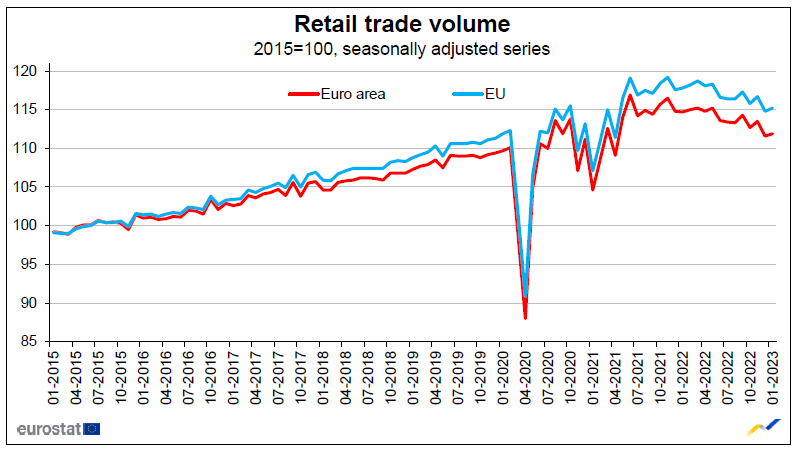
Eurozone retail sales volume rose 0.3% mom in February, well below expectation of 1.0% mom. Volume of retail trade increased by 1.8% for food, drinks and tobacco and by 0.8% for non-food products, while it decreased by -1.5% for automotive fuels.
EU retail sales volume rose 0.3% mom. Among Member States for which data are available, the highest monthly increases in the total retail trade volume were registered in the Netherlands (+4.9%), Luxembourg (+4.6%) and Slovenia (+4.1%). The largest decreases were observed in Austria (-9.8%), Slovakia (-1.4%) and Hungary (-0.6%).
Death Cross Continues to Hang Over Bitcoin
Market Picture
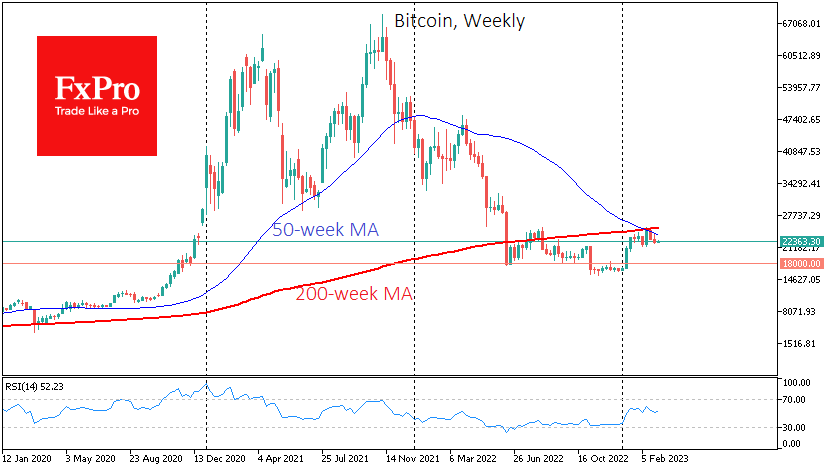
Bitcoin fell 5.2% last week to close at $22,400. Ethereum lost 4.4% to $1570. Other leading altcoins in the top 10 fell between 2.9% (XRP) and 11.5% (Polygon).
The total capitalisation of the crypto market fell 5% over the week to $1.03 trillion, according to CoinMarketCap.
Bitcoin’s most significant drop last week came on Friday amid reports of the possible bankruptcy of Silvergate, a bank that services major cryptocurrency companies. The bank announced the closure of its cryptocurrency payment service.
While BTCUSD has held up during furious sellers’ attacks, it is in no hurry to bounce back from the bottom. Technically, the 50-week moving average continues to act as a valid resistance from which the selling intensifies. The Death Cross formed on the weekly timeframe makes for a cautious view of the near-term outlook and keeps the potential for a return to the $16.3-18.0 level.
News Background
According to media reports, global giant market-maker Citadel Securities plans to increase its stake in Silvergate Bank to help it out of its liquidity crisis. Other rumours suggest that Wells Fargo is a potential buyer.
SEC chief Gary Gensler has warned cryptocurrency exchanges against failing to comply with custodian status. He said that if an exchange collapses, “customer funds often become the property of the bankrupt entity”.
Brad Garlinghouse, CEO of Ripple, said that more and more cryptocurrency and fintech companies are leaving the US, which is stifling innovation in the country. Around 300 payment providers from 45 countries believe blockchain and cryptocurrencies can improve traditional finance, according to a survey conducted by Ripple.
The UK’s Nationwide Building Society and HSBC have imposed restrictions on card purchases of cryptocurrencies.
US 500 Index Slices Above 50-day SMA
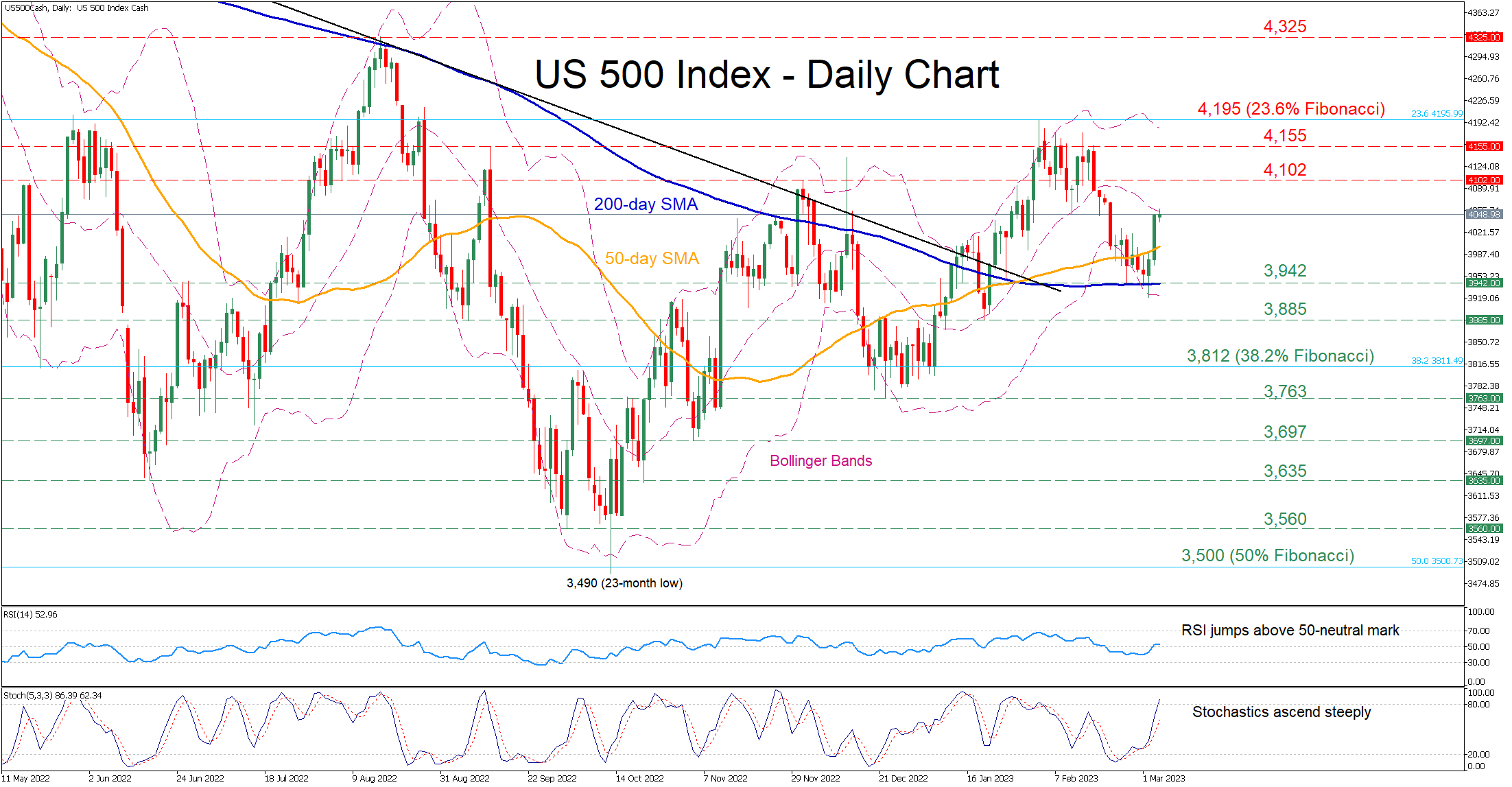
The US 500 stock index (cash) experienced a significant pullback after its latest advance came to a halt at the 4,195 region. However, the index managed to bounce back and recoup some losses in the last couple of daily sessions, jumping decisively above its 50-day simple moving average (SMA).
The momentum indicators currently suggest that the buying interest is intensifying. Specifically, the RSI crossed above its 50-neutral mark, while the stochastic oscillator is ascending steeply near the 80-overbought zone.
If bullish pressures persist, the December resistance of 4,102 might act as the first upside barrier. Piercing through that zone, the price could challenge the September peak of 4,155. Even higher, the bulls could aim for the 4,195 region, which is the 23.6% retracement of the 2,183-4,818 uptrend that extended from the pandemic low till the all-time high in November 2021.
Alternatively, bearish actions could send the price towards its 200-day SMA, currently at 3,942. Should that floor collapse, the price could descend towards the January support of 3,885 before the 38.2% Fibo of 3,812 comes under examination. Failing to halt there, the December low of 3,763 could then provide downside protection.
To conclude, the US 500 index bounced off the congested region that includes the 200-day SMA and the lower Bollinger band, indicating that its pullback could be overstretched. Nevertheless, a strong move above the recent rejection region of 4,195 is needed to alter its short-term picture back to bullish.
Aussie Lower ahead of RBA Decision
The Australian dollar is under pressure at the start of the new trading week. AUD/USD is trading at 0.6735 in Europe, down 0.50%.
RBA expected to hike by 25 bp
The RBA is widely expected to raise rates by 25 basis points on Tuesday, which would bring the cash rate to 3.60%, the highest level in a decade. The RBA’s aggressive rate tightening cycle has not been as effective as the central bank had hoped, as inflation has been stickier than expected. Australia’s monthly CPI for January dropped to 7.4%, down from 8.4% a month earlier. This drop indicates that rate hikes are having an impact on the economy, but there is a long road ahead before inflation falls back to the RBA’s target of 2-3%.
There was some positive news on Monday, as the Melbourne Inflation gauge for February showed a drop in core inflation to 4.9% y/y, down from 5.3% in January. The headline figure remained unchanged at 6.3% y/y.
Australian Treasurer Jim Chalmers has said he is “cautiously hopeful” that inflation has peaked, but it’s likely that the RBA will have to hike rates at least one more time before it can hit the pause button. Investors will be keeping a close eye on Governor Lowe’s rate statement, which will likely be hawkish given the stubbornly high inflation levels. Any hints about the need for further rate increases would likely be bullish for the Australian dollar.
In the US, it promises to be a busy week. The key events are Fed Chair Powell’s semi-annual testimony before Congress and the nonfarm payroll report, both of which could move the US dollar. The markets will be keeping a close eye on Powell’s remarks and whether he will sound less hawkish, given the recent string of unexpectedly strong US releases.
Nonfarm payrolls sizzled in January with 517,000 new jobs, but this is expected to be a one-time bump, with the estimate for February standing at 200,000. The surprisingly resilient labour market has the Fed concerned about wage pressures, and a strong wage growth release could raise expectations for further rate hikes.
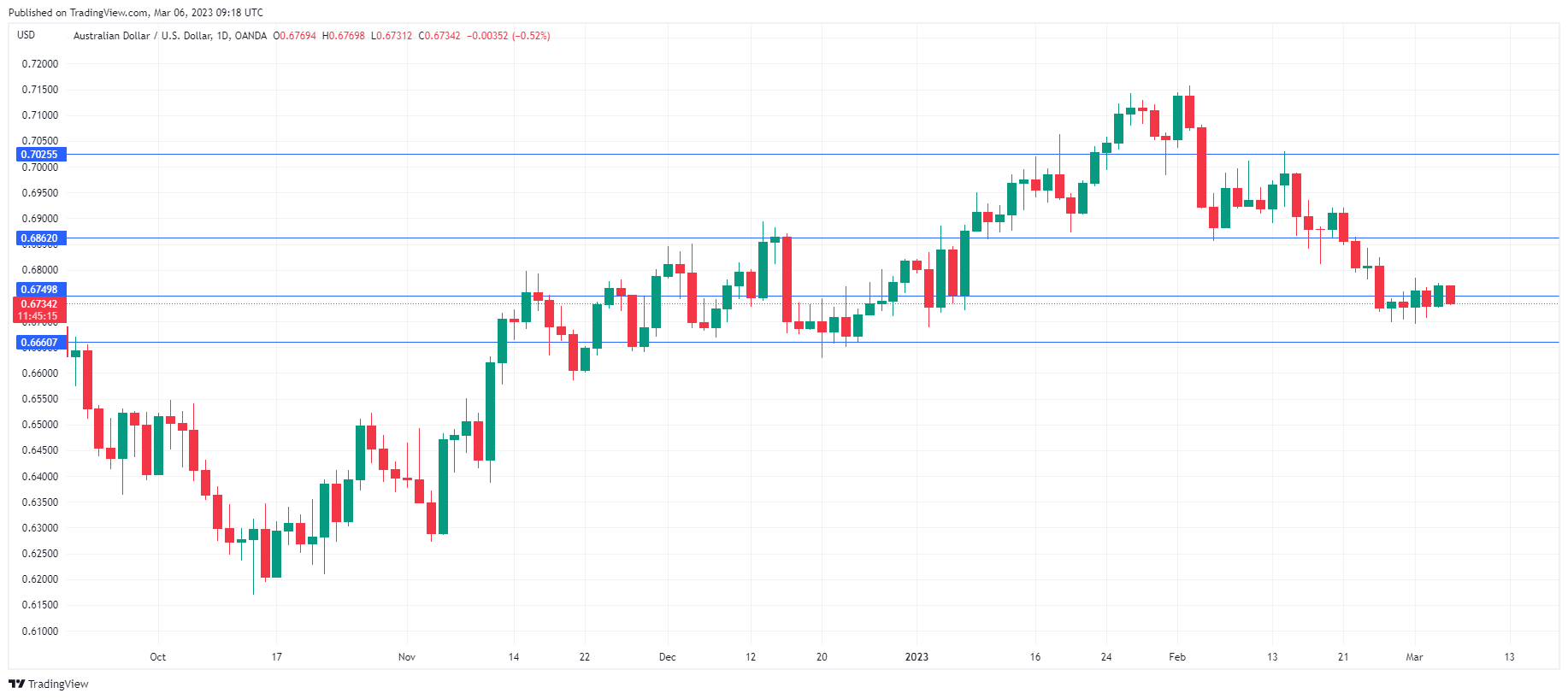
AUD/USD Technical
- AUD/USD is testing support at 0.6749. Below, there is support at 0.6660
- There is resistance at 0.6862 and 0.7025
XAU/USD: Gold Rose to Three-Week High ahead of Key Events – Fed Powell’s Testimony/US Labor Report
Gold is holding positive tone in early Monday, with price action consolidating within a narrow range, under new three-week high.
The metal rallied 1.1% on Friday and advanced 2.5% last week, though investors remain cautious and focus on this week’s key events – Fed Chair Powell’s testimony to Congress on Tue/Wed and US labor report, due on Friday, which are expected to provide fresh direction signals.
Weaker dollar lifted gold in past few sessions, but the greenback’s outlook remains positive on prospects for further rise in US interest rates, which would diminish gold’s appeal.
Recent economic data showed that inflation is stubbornly high and the US economy remains resilient, setting the stage for the central bank’s action in further tightening of the monetary policy.
Bullish scenario for the yellow metal will require calmer tones from Fed Powell and weaker than expected US non-farm payrolls numbers in February, to offer fresh support and lift gold price further.
Conversely, recent bulls are expected to face strong headwinds and likely stall, if Fed’s Chief remains hawkish and NFP report beats expectations.
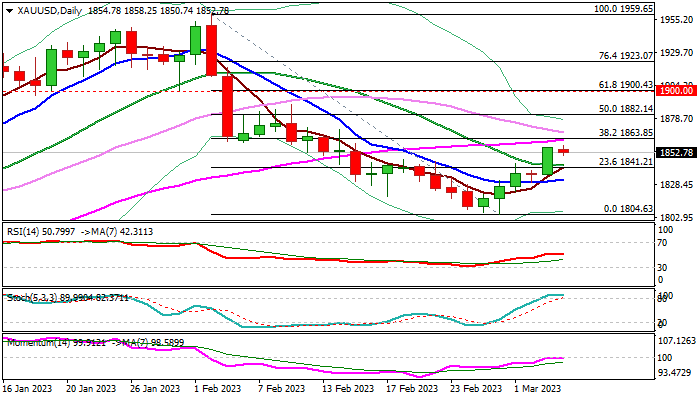
Technical studies on daily chart are bullishly aligned (14-d momentum broke into positive territory, price action closed above 20DMA on Friday and rose further into thick and ascending daily Ichimoku cloud), though still require more evidence to confirm bullish stance that keeps the downside vulnerable.
Last week’s rally formed a bullish engulfing pattern on weekly chart, which adds to supportive factors, with near-term bullish bias expected to hold while the price stays above daily cloud base ($1836).
Immediate resistance lays at $1863 (Fibo 38.2% retracement of $1959/$1804 descend / weekly Ichimoku cloud top), break of which would firm near-term structure for extension towards $1882 (50% retracement/daily Kijun-sen) and unmask next pivotal barriers $1894/$1900 (daily cloud top/Fibo 61.8%/psychological).
On the other hand, return below the base of rising daily cloud ($1836) would generate initial signal of recovery stall, with extension and close below 10DMA ($1832) to confirm and increase risk of renewed attack at key $1800 support zone.
Res: 1863; 1870; 1882; 1894.
Sup: 1850; 1843; 1836; 1832.
Eurozone Sentix dropped to -11.3, stagnation could turn into renewed recession worries
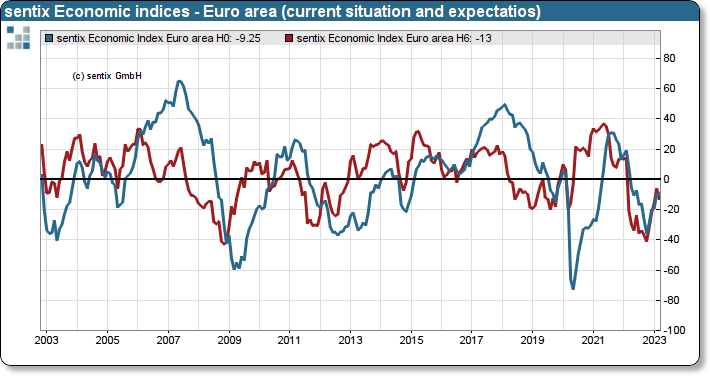
Eurozone Sentix Investor Confidence index dropped from -8 to -11.1, much worst than expectation of an improvement to -5.6.
Current Situation index rose from -10.0 to -9.3, hitting the highest level since June 2022. But that means the economy is "currently in a stagnation phase at best".
Expectations index dropped notably from -6.0 to -13.0. "Over the next six months, investors expect the Eurozone economy to deteriorate."
Sentix added, "this stagnation phase could soon turn into renewed recession worries if the negative economic expectations materialise."
UK PMI construction rose to 54.6, returned to growth with increasing optimism
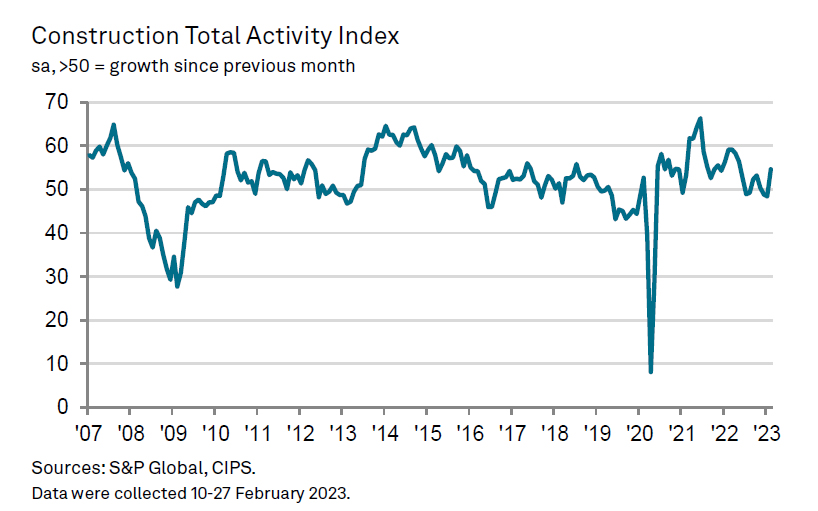
UK PMI Construction rose sharply from 48.4 to 54.6 in February, well above expectation of 48.5. It's also the first expansion reading in three months, and highest since May 2022. S&P Global also noted greater commercial work helped to offset drop in housing activity. Input cost inflation was the lowest since November 2020.
The construction sector returned to growth as commercial work and civil engineering output increased, offsetting a continued weakness in the housing market. Firms attributed the growth to improving global economic conditions and increased client confidence in the commercial segment. Construction companies are increasingly optimistic about the year ahead and expect business to expand, helped by softer inflationary pressures and fewer supplier delays.
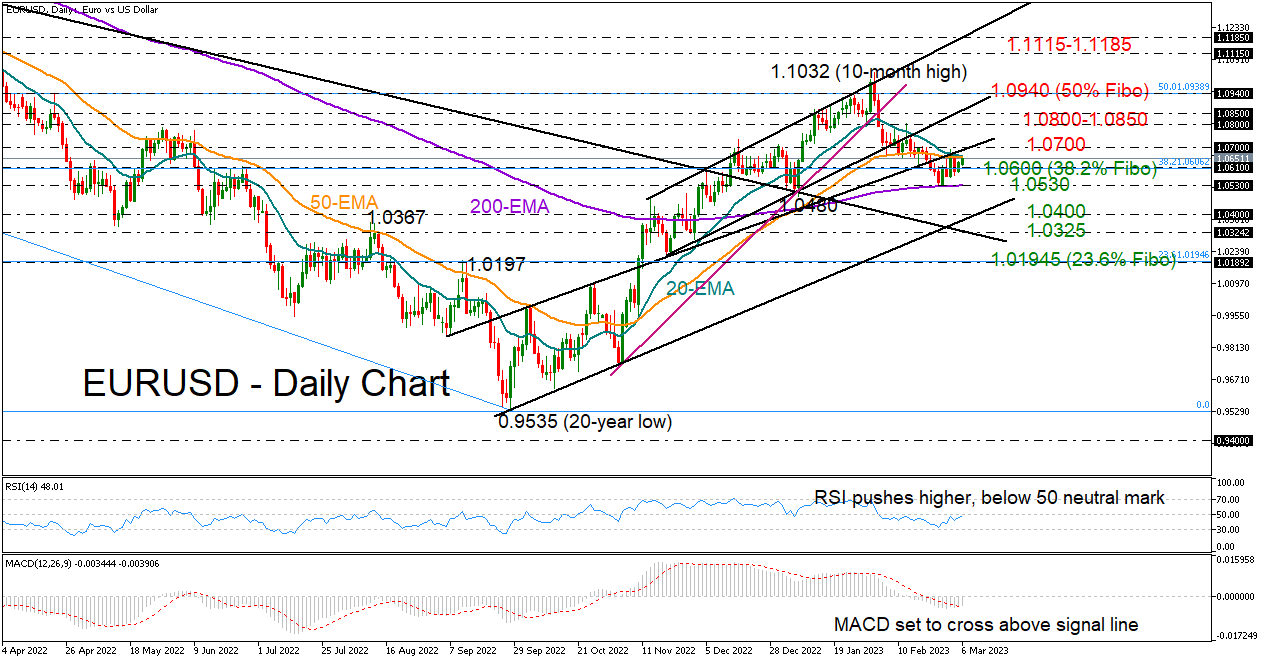
EURUSD Faces Limited Bull Pressure Below 1.0700
EURUSD started the week with minor gains, trading at the crossroads of the 20- and 50-day exponential moving averages (EMAs) at 1.0660, which have been navigating the price southwards over the past month.
Previously, the pair refused to close below January’s low and the 200-day EMA, reducing the risk of a worsening outlook in the medium-term picture. Technically, there might be more push for improvement in the coming sessions as the RSI is strengthening its uptrend in the bearish area, while the MACD is set to climb above its red signal line, reflecting persisting buying interest.
Yet only a sustainable move above the 1.0700 mark could boost buying confidence, sending the price towards the 1.0800-1.0850 resistance region. If the bulls continue higher from here, the 50% Fibonacci retracement of the 1.2348-0.9535 downleg could add some downside pressure around 1.0940, delaying an extension towards the 1.1115-1.1185 area.
Alternatively, a close below 1.0600 could bring the 200-day EMA back on the radar at 1.0530. In case that floor cracks this time, the price could plummet towards the support trendline from September at 1.0400, while a more aggressive decline could re-challenge the constraining line from May 2021 seen at 1.0325.
In a nutshell, EURUSD is showing some encouraging signs of stability after its downtrend paused at 1.0530. Despite that, traders may stay on the sidelines until the price breaks decisively above the 1.0700 number.
AUD/USD Pair Gained Pace above 0.6740 to Move into a Positive Zone
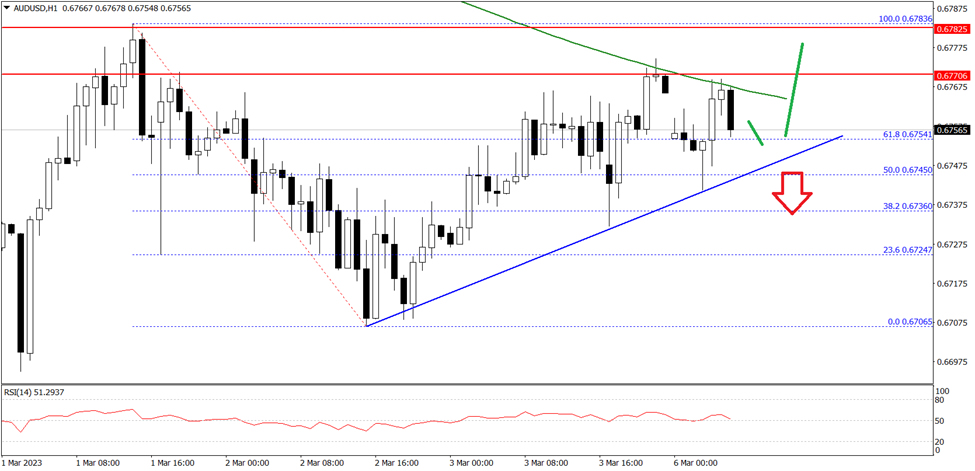
The Aussie Dollar started a fresh increase above the 0.6720 resistance against the US Dollar. The AUD/USD pair gained pace above 0.6740 to move into a positive zone.
The pair even climbed above the 0.6750, but the bears seem to be active near the 0.6765 zone. The pair is now consolidating below the 0.6765 zone and the 50 hourly simple moving average. The next major resistance is near the 0.6780 level.
If there is an upside break above the 0.6780 zone, the pair could rise steadily towards the 0.6840 level in the near term. The next major resistance sits near 0.6880 on FXOpen.
An immediate support is near the 0.6750 level. The next key support is near the 0.6720 level. A downside break below the 0.6720 support could lead the pair towards the 0.6660 support.