

Sample Category Title
EUR/GBP Weekly Outlook
EUR/GBP rebounded strongly to 0.8895 last week but failed to sustain above near term channel resistance, and retreated sharply. Initial bias is neutral this week first. On the upside, break of 0.8895 will affirm the case that correction from 0.8977 has completed at 0.8753. Further rally should be seen to retest 0.8977.
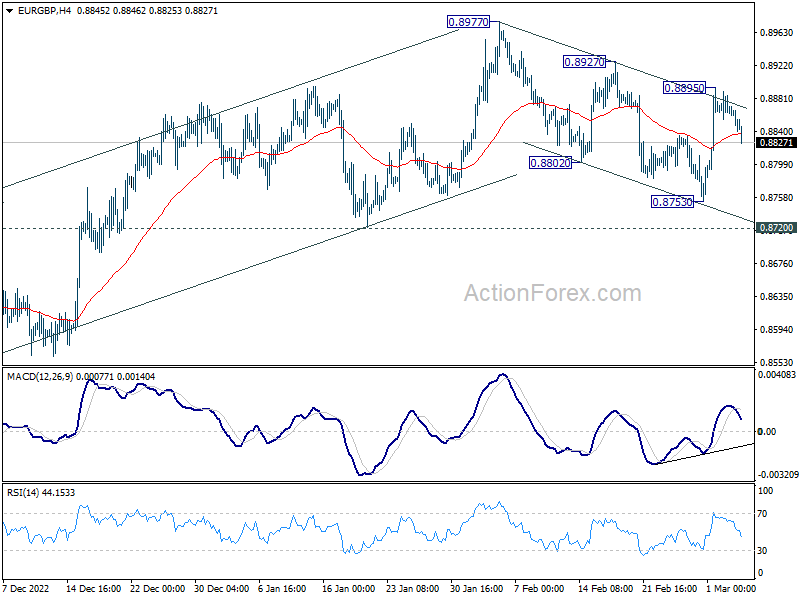
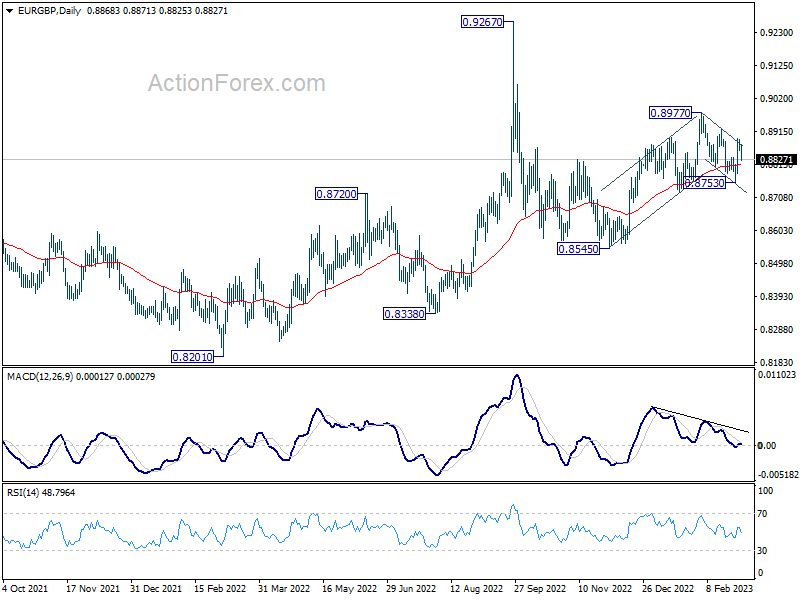
In the bigger picture, outlook is rather mixed for now, except that price actions from 0.9267 (2022 high) are part of the long term range pattern from 0.9499 (2020 high). With 0.8720 support intact, rise from 0.8545 is in favor to continue through 0.8977. However, firm break of 0.8720 will argue that such rebound has completed, and open up deeper fall through this support level.
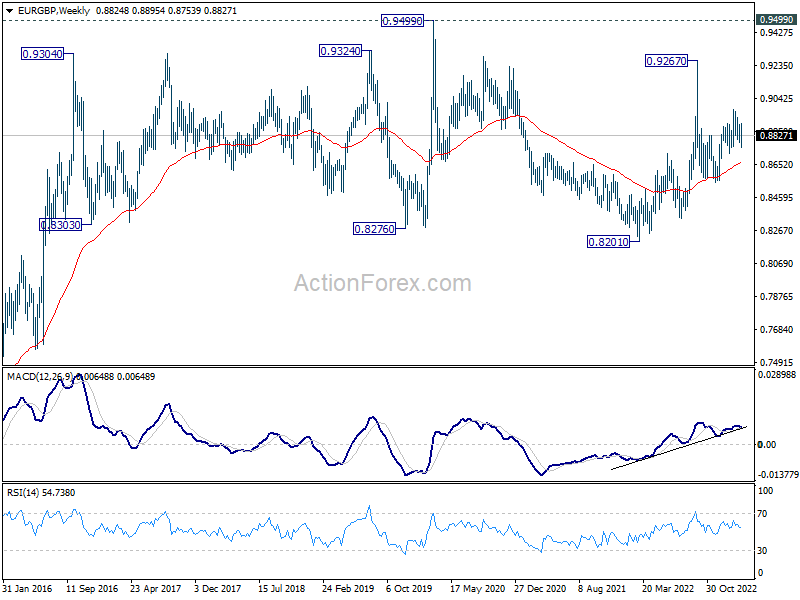
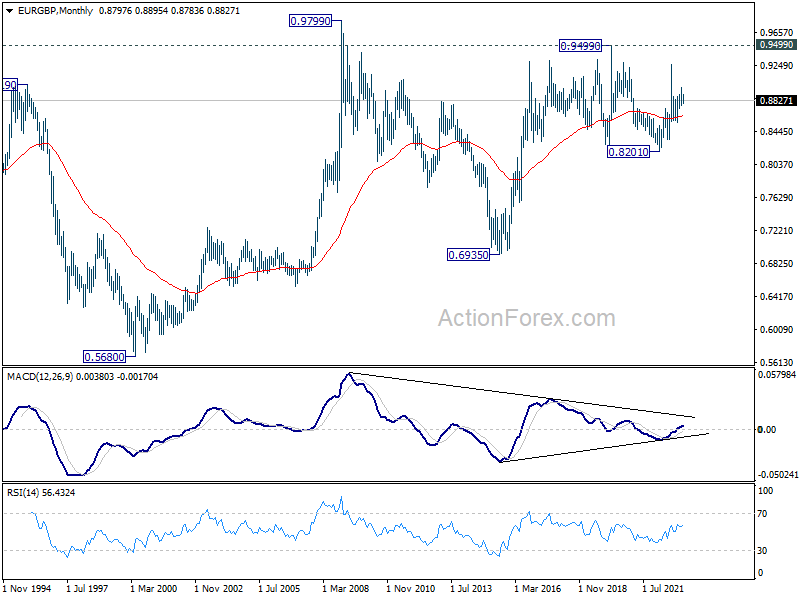
In the long term picture, long term range pattern is extending. But rise from 0.6935 (2015 low) is expected to extend at a later stage, to 0.9799 (2009 high).
EUR/AUD Weekly Outlook
EUR/AUD rose further to 1.5826 last week but retreated since then. Initial bias stays neutral this week first. Outlook is unchanged that corrective fall from 1.5976 has completed at 1.5254. Further rally is expected as long as 1.5650 resistance turned support holds. Break of 1.5826 will target a test on 1.5976 high. However, firm break of 1.5650 will delay the bullish case and extend the corrective pattern from 1.5976 with another falling leg.
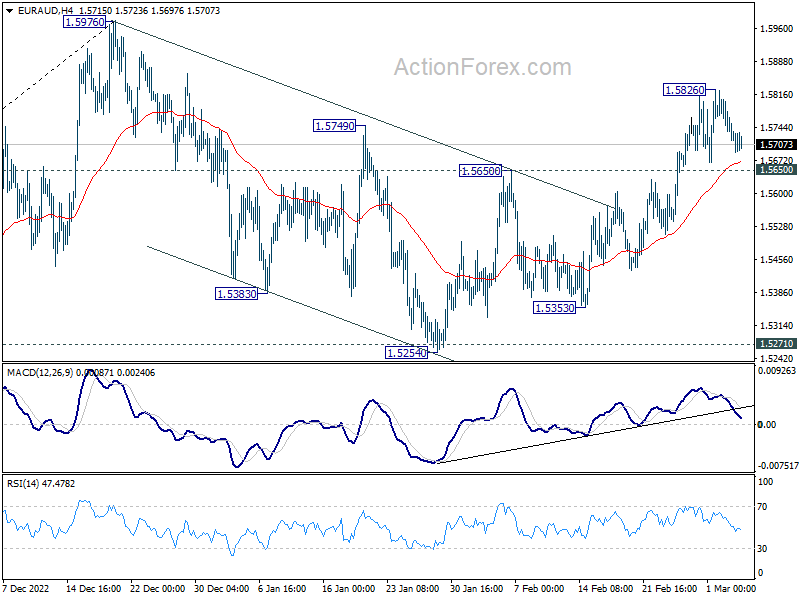
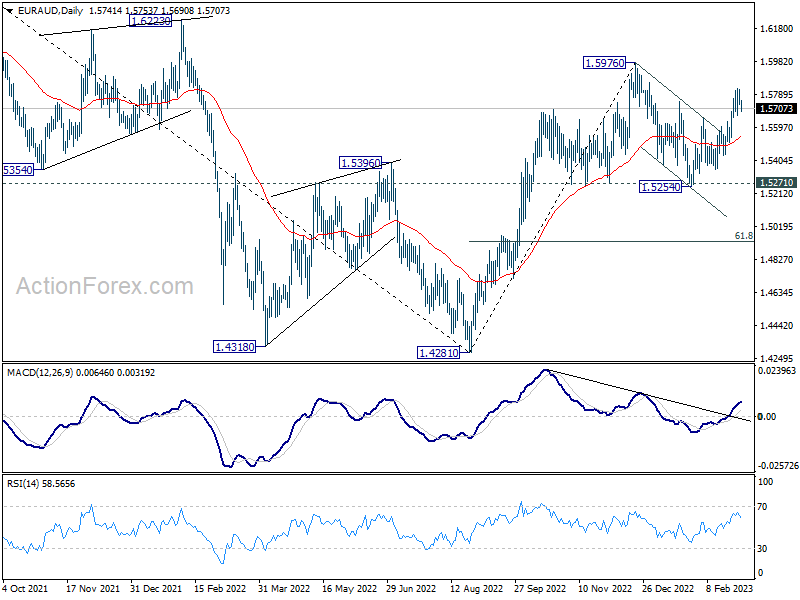
In the bigger picture, it's still early to confirm if rise from 1.4281 represents bullish trend reversal. But as long as 1.5271 support holds, such rally is in favor to continue. Break of 1.5976 will target 1.6434 key resistance next. On the other hand, firm break of 1.5271 will retain medium term bearishness instead.
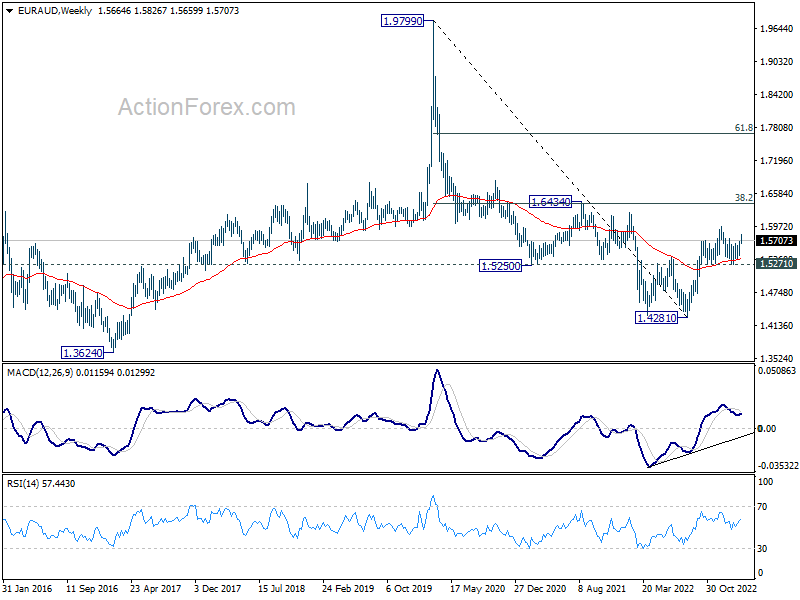
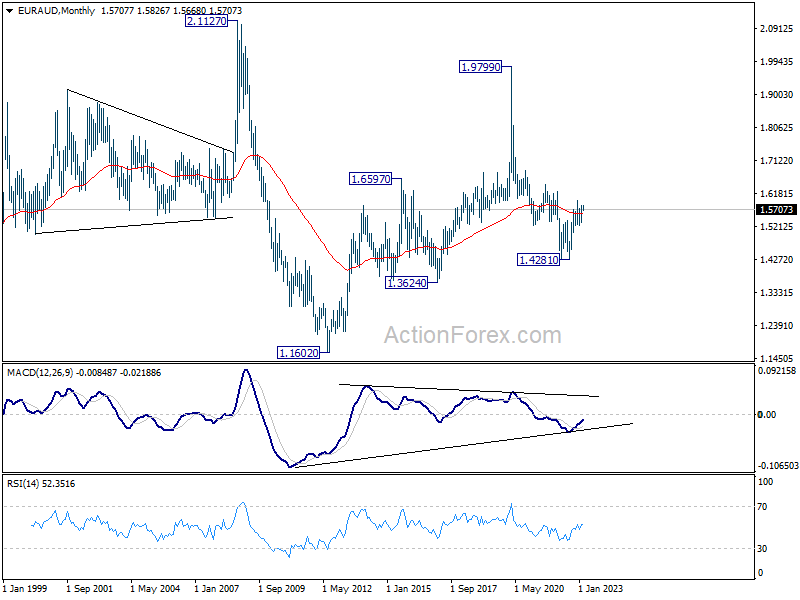
In the longer term picture, focus stays on 55 month EMA (now at 1.5596). Sustained trading above there will raise the chance of bullish trend reversal, and at least bring further rally to 1.6434 cluster resistance, 38.2% retracement of 1.9799 (2020 high) to 1.4281 at 1.6389. However, rejection by 55 month EMA will suggest that down trend from 1.9799 is still in progress for another low below 1.4281.
EUR/CHF Weekly Outlook
EUR/CHF surged to as high as 1.0040 last week but retreated sharply since then. Initial bias remains neutral this week first. The favored case is that corrective pattern from 1.0095 has completed at 0.9844 already. Above 1.0040 will target a test on 1.0095. However, sustained break of 4 hour 55 EMA (now 0.9941) will delay the bullish case and bring deeper pull back first.
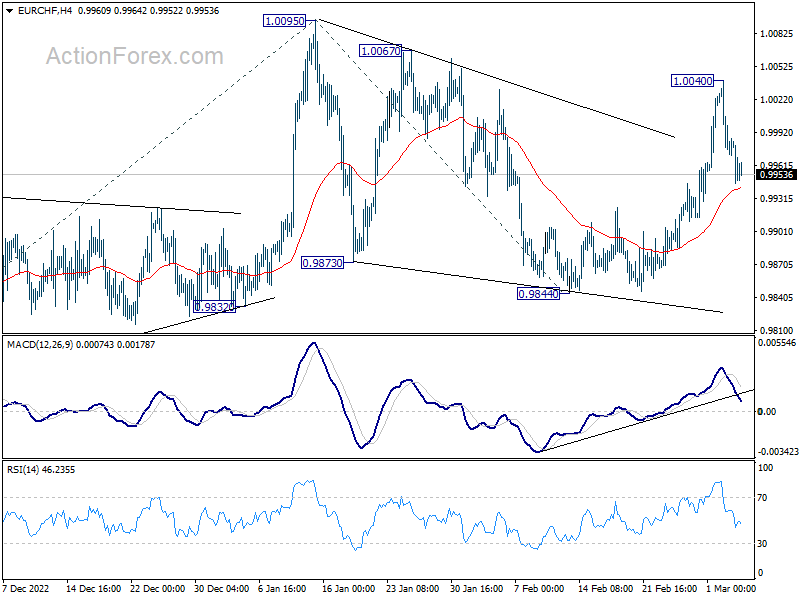
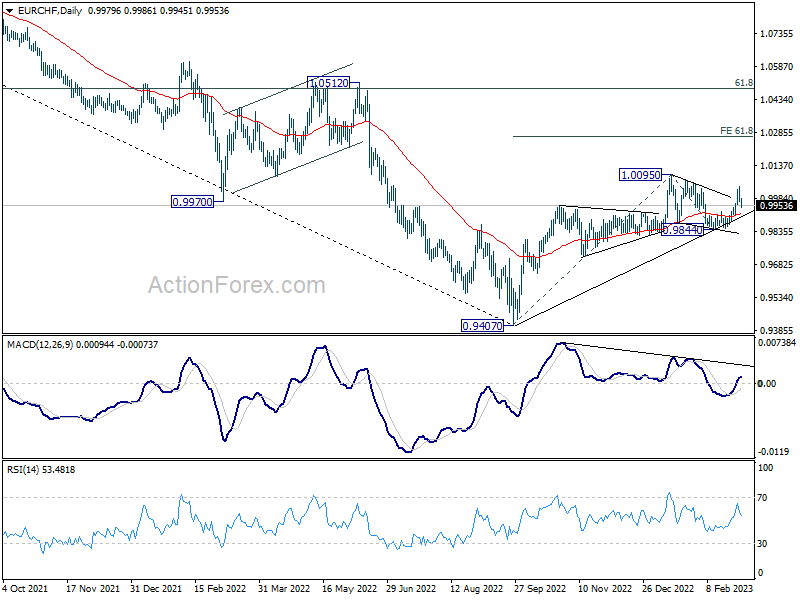
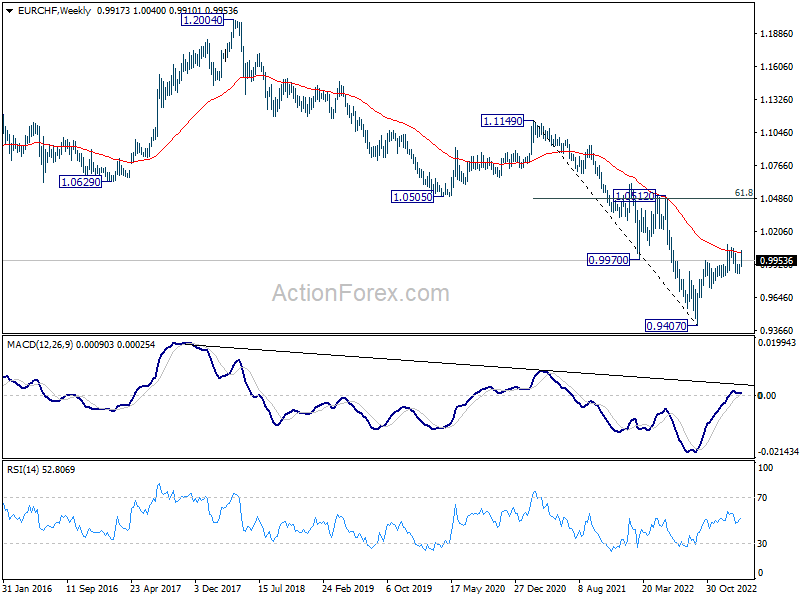
In the bigger picture, with 0.9832 support intact, rise from 0.9407 (2022 low) is still expected to continue. Break of 1.0095 and sustained trading above 55 week EMA (now at 1.0021) will be a medium term bullish signal, and bring further rally to 1.0505 cluster resistance (2020 low at 1.0505, 61.8% retracement of 1.1149 to 0.9407 at 1.1484). However, firm break of 0.9832 support will revive medium term bearishness and bring retest of 0.9407 low instead.
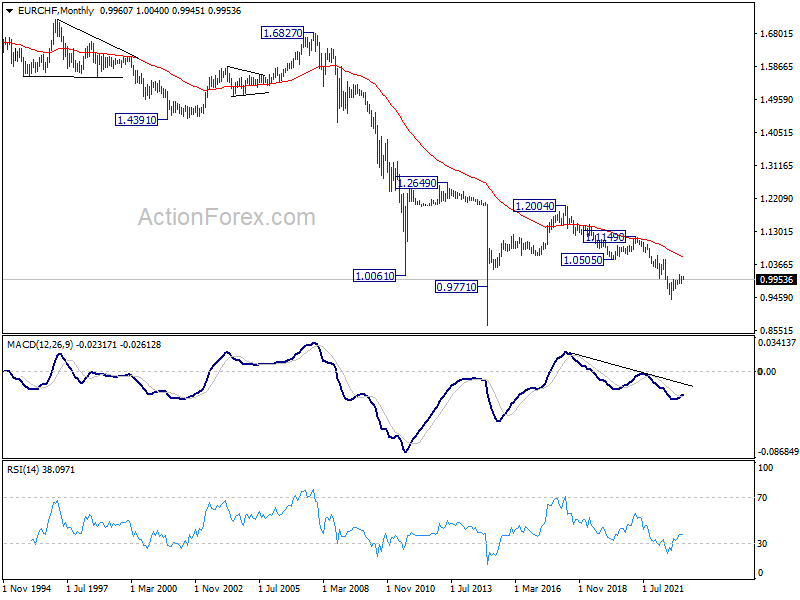
In the long term picture, it's still way to early too call for bullish trend reversal with upside capped well below 55 month EMA and 1.0505 support turned resistance (2020 low).
Dollar Struggled on Resilient Risk Sentiment Despite Expectations of Higher Interest Rates
The likelihood of higher and sustained interest rates in the US and Europe is increasing as time goes on. This expectation has led to some volatility in risk markets, but the late rally in stocks indicates that sentiment remains resilient. Despite a rally in treasury yields, Dollar ended the week as the worst performer, with risk-on sentiment out-weighing. The near term corrective rebound in the greenback might still extend, but upside is potential is looking limited.
New Zealand dollar came out on top, followed by Sterling and Euro. Canadian dollar was the second-worst performer, followed by Yen and Swiss Franc. Australian dollar had a mixed performance, despite optimism surrounding China's economic recovery providing some support.
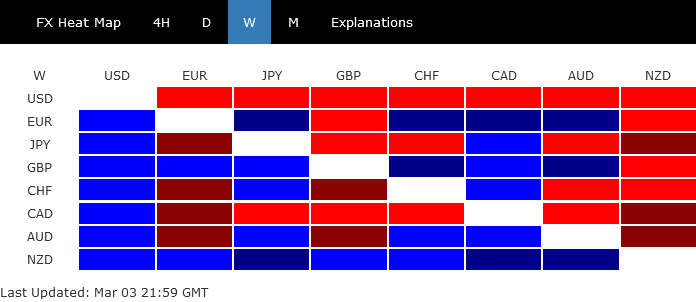
Stock markets showed resilience despite expectations of higher interest rates
While there was some volatility in recent weeks, investor sentiment showed much resilience. There was optimism that both the US and Europe would avoid a recession with much help from the service sectors. Inflation is still expected to ease, albeit slowly. That somewhat overshadowed the path to higher interest rate peaks, and the longer to stay there.
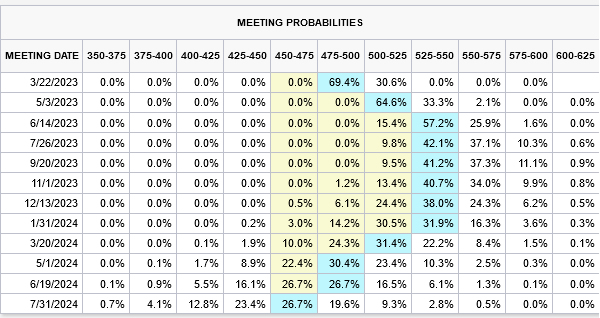
As with Fed, markets are now pricing in 84.6% chance of peaking at 5.25-5.50% in June, and just slightly lower than 50% chance of hitting 5.50-5.75% in either July or September. A rate cut will probably not happen at least March 2024.
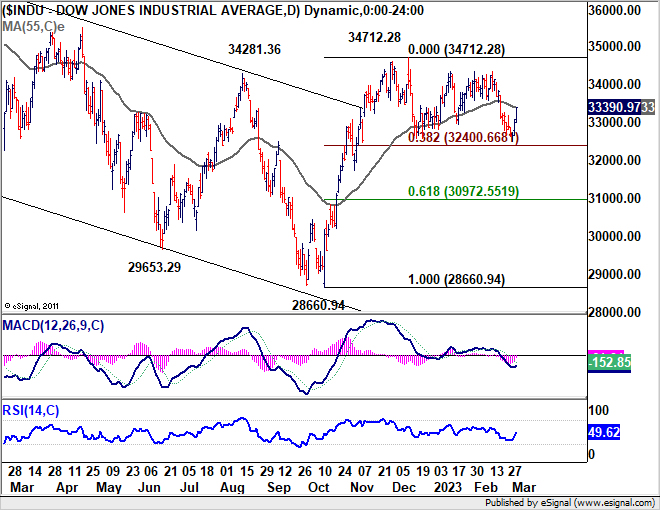
DOW ended the week higher with strong rebound on both Thursday and Friday. The development suggests that 38.2% retracement of 28660.94 to 37412.28 at 32400.66 was defended. Price actions from 34712.28 are just a sideway consolidation pattern. Immediate focus is now on 55 day EMA (now at 33400.21). Sustained break there will bring further rally towards 34712.28 high, and raise the chance of resuming whole rally from 28660.94 in Q2.
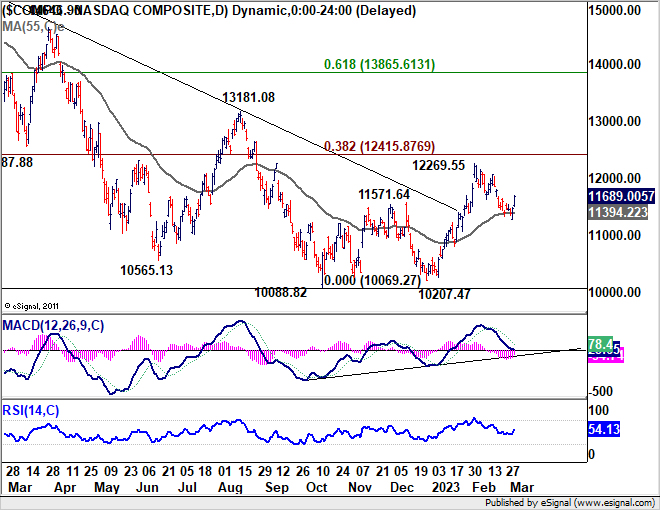
NASDAQ might have defended 55 day EMA (now at 11394.22) too, keeping the rise from 10207.47 intact. There is prospect of further rally through 12269.55 in the near term.
In Eurozone, after stronger than expected CPI, most analysts raised their expectation on the terminal rate for ECB to 4%. A rate cut this year is also basically ruled out. Yet, investors reacted more to positive data like PMIs, which painted an upbeat picture as lead by expansion in services.
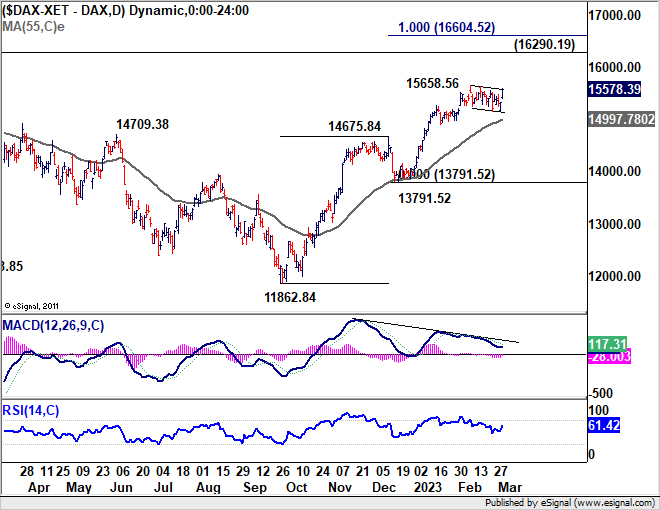
DAX's price actions from 15658.56 has been corrective look, and the retreat is held well above 55 day EMA (now at 14997.78), keeping near term outlook bullish. Indeed, Friday's gap up and rally suggests that an upside breakout is due. Break of 15658.56 will resume whole rise from 11862.84 to 16290.19 record high, or even further to 100% projection of 11862.84 to 14675.83 from 13791.52 at 16604.52.
US 10-year yield breached 4%, staying near term bullish
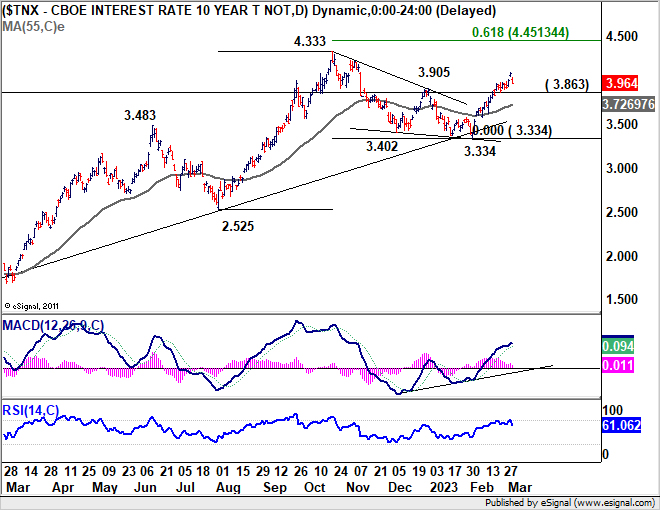
Major benchmark treasury yields also jumped on expectations of higher interest rate. In the US, 2-year yield hit the highest level since 2007, reaching 4.966, before closing at 4.871. US 10-year yield also breached 4.000 handle to 4.091 before closing at 3.964. In Germany, 10-year yield rose to 2.774, hitting the highest level since 2011, before closing at 2.719.
Outlook in US 10-year yield is unchanged that rise from 3.334 is in progress, and should extend higher as long as 3.863 support holds. Further rally should be seen to retest 4.333 high. A break there is not envisaged for now, but even in that case, strong resistance should be seen from 61.8% projection of 2.525 to 4.333 from 3.334 at 4.451 to limit upside. Meanwhile, break of 3.863 will bring some consolidations first before staging another rise.
Dollar index's corrective rise might still have another leg
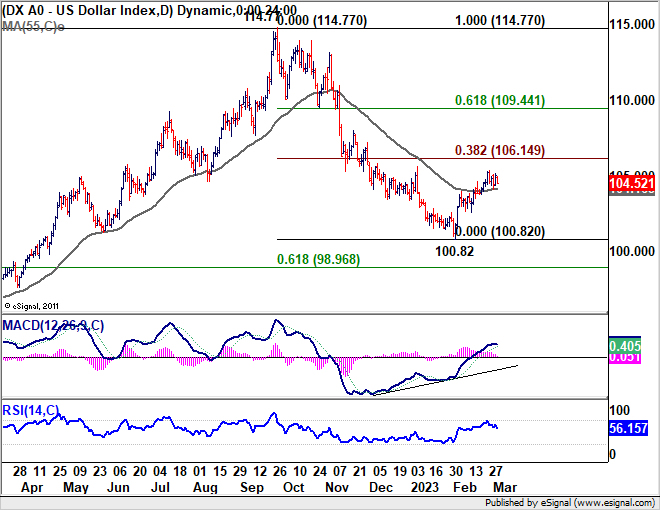
Dollar index struggled to extend the rebound from 100.82 last week but there was no apparent selloff yet. Such rebound remains seen as a corrective move. Thus, even in case of another rise, strong resistance should be seen from 38.2% retracement of 114.77 to 100.82 at 106.14 to limit upside. Firm break of 55 day EMA (now at 104.16) will bring deeper fall back towards 100.82 low.
This view is in-line with the outlook in other markets as mentioned above. Extended rally in US treasury yield could keep Dollar afloat, but not much against Euro as German yield is strong too. Additionally, underlying bullish sentiment in stocks would cap the greenback's upside. Near term fortune of Dollar could turn if yields turn into a retreat, which also drag USD/JPY down.
Gold's rebound could hint on more Dollar weakness
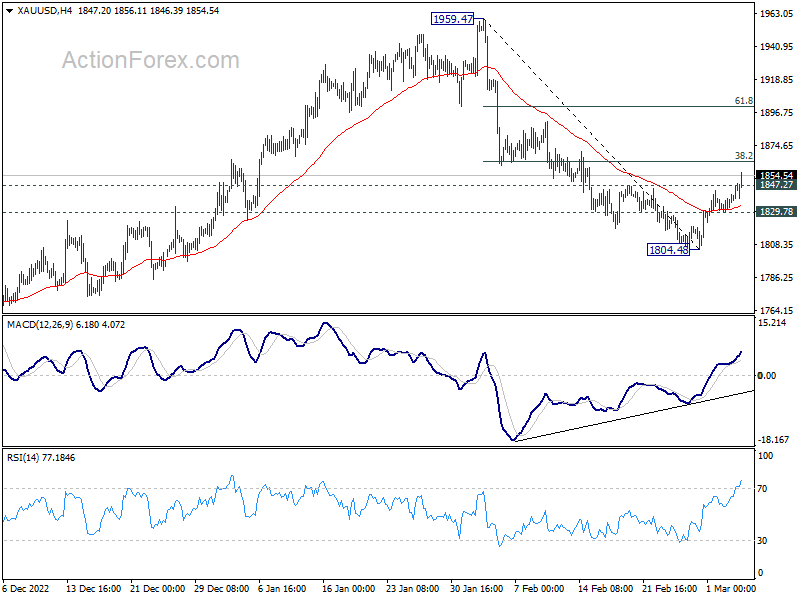
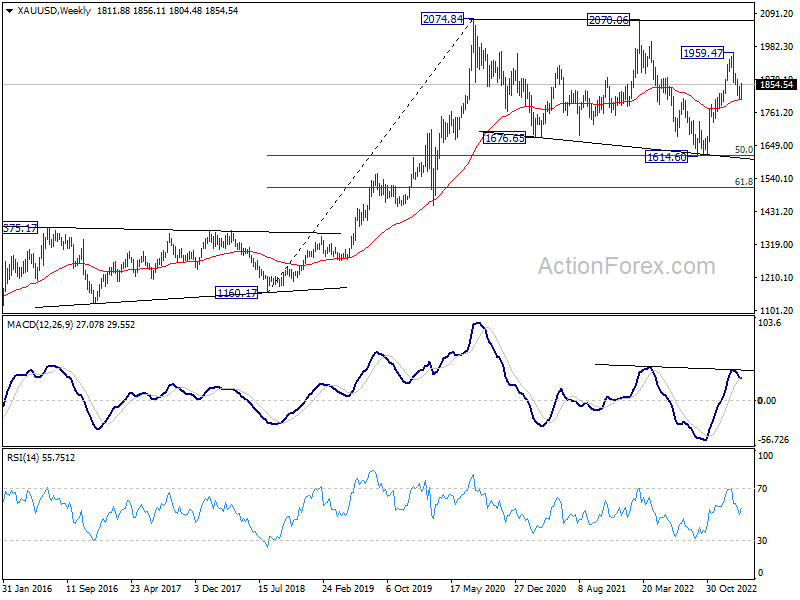
Gold's extended rebound last week could be seen as an early sign of Dollar weakness. The break of 1847.27 resistance indicates short term bottoming at 1804.48, on bullish convergence condition in 4 hour MACD. That also came after drawing support from 55 week EMA (now at 1804.37). Further rise is expected as long as 1829.78 support holds. Decisive break of 38.2% retracement of 1959.47 to 1804.48 at 1863.68 could prompt upside acceleration to 61.8% retracement at 1900.26 Also, break of 1863.68 could come with near term reference in Dollar Index.
USD/JPY Weekly Outlook
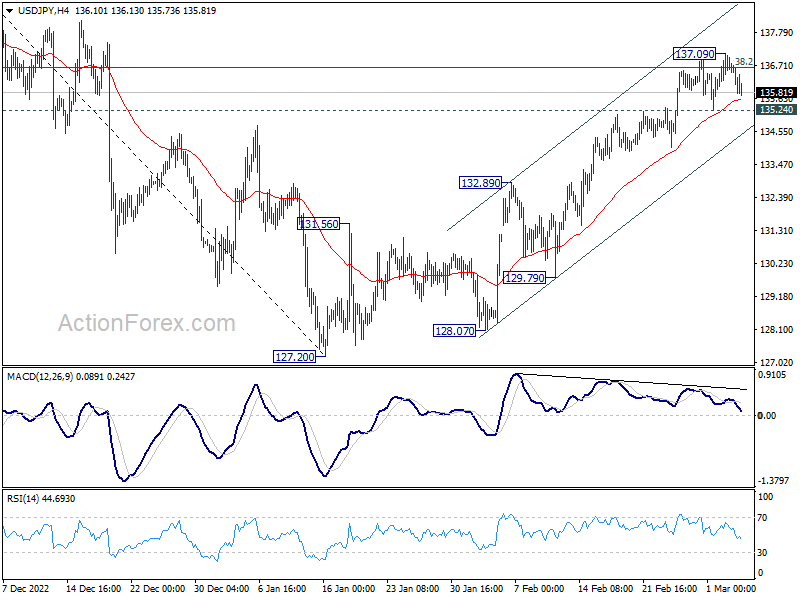
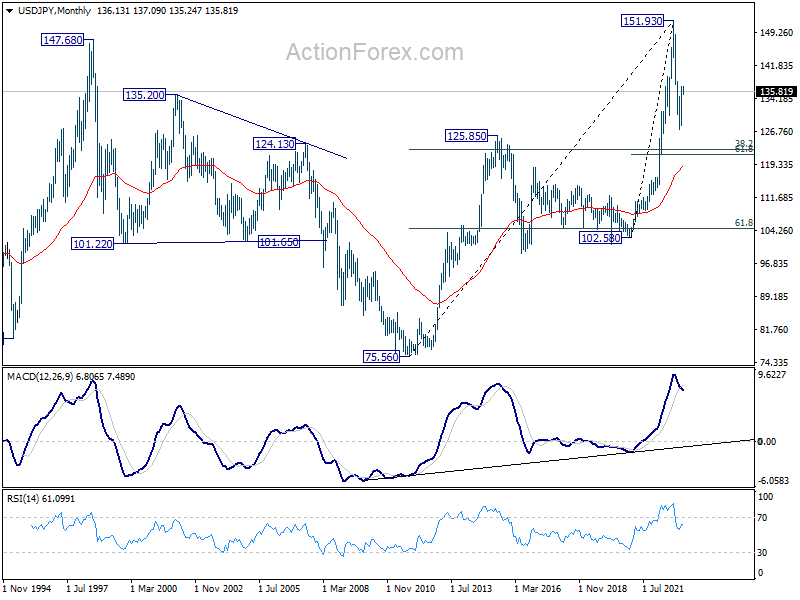
USD/JPY edged higher to 137.09 last week but struggled to sustain above 38.2% retracement of 151.93 to 127.20 at 136.64. Initial bias remains neutral this week first. On the downside, break of 135.24 support will indicate rejection by 136.64, and turn bias back to the downside for 55 day EMA (now at 133.92) first. Sustained break of 55 day EMA will indicate that whole rebound from 127.20 has completed. On the upside, however, sustained break of 136.64 will indicate that fall from 151.93 has completed, and bring further rally to 61.8% retracement at 142.48.
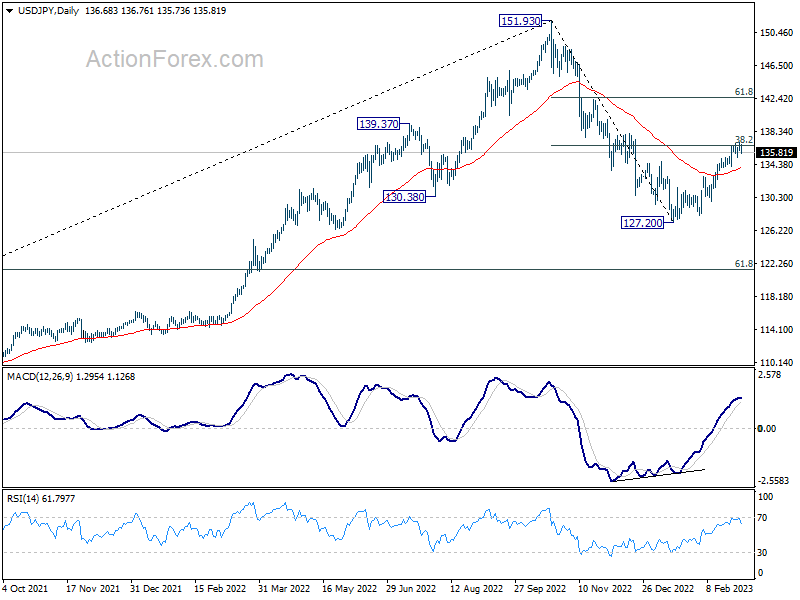
In the bigger picture, focus remains on 38.2% retracement of 151.93 to 127.20 at 136.64. Sustained break there will indicate that price actions from 151.93 medium term are merely a corrective pattern. Such development will maintain long term bullishness. Rejection by 136.64 will, on the other hand, extend the fall from 151.93 to 61.8% retracement of 102.58 to 151.93 at 121.43 at a later stage.
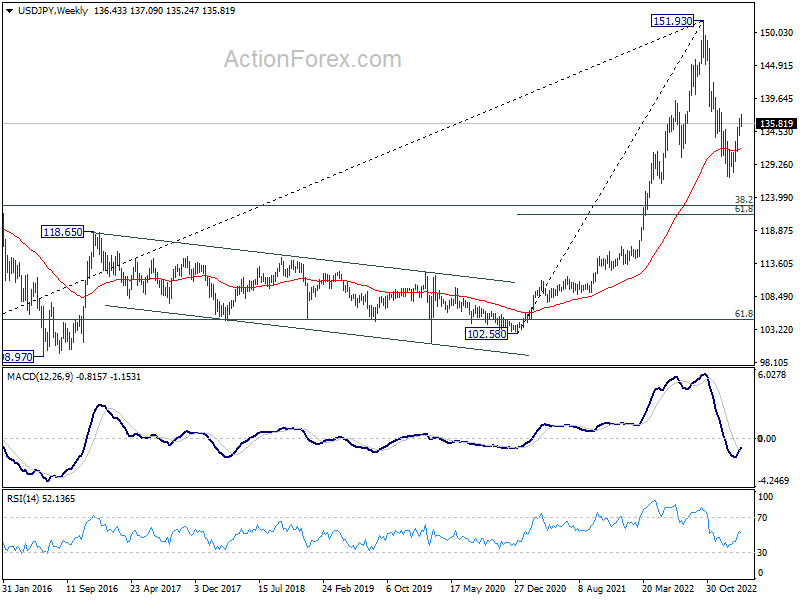
In the long term picture, 151.93 looks increasingly likely a major top. But it's too early to call for long term bearish reversal at this point. Rebound from around 38.2% retracement of 75.56 to 151.93 at 122.75 will keep the case open for price action from 151.93 to be just a corrective pattern.
Summary 3/6 – 3/10
Monday, Mar 6, 2023
| GMT | Ccy | Events | Consensus | Previous |
|---|---|---|---|---|
| 00:00 | AUD | TD Securities Inflation M/M Feb | 0.90% | |
| 07:30 | CHF | CPI M/M Feb | 0.40% | 0.60% |
| 07:30 | CHF | CPI Y/Y Feb | 2.90% | 3.30% |
| 09:30 | EUR | Eurozone Sentix Investor Confidence Mar | -5.6 | -8 |
| 09:30 | GBP | Construction PMI Feb | 48.5 | 48.4 |
| 10:00 | EUR | Eurozone Retail Sales M/M Feb | 1.00% | -2.70% |
| 15:00 | USD | Factory Orders M/M Jan | -1.50% | 1.80% |
| 15:00 | CAD | Ivey PMI Feb | 55.9 | 60.1 |
| 23:30 | JPY | Labor Cash Earnings Y/Y Jan | 1.90% | 4.80% |
| GMT | Ccy | Events | |
|---|---|---|---|
| 00:00 | AUD | TD Securities Inflation M/M Feb | |
| Forecast: | Previous: 0.90% | ||
| 07:30 | CHF | CPI M/M Feb | |
| Forecast: 0.40% | Previous: 0.60% | ||
| 07:30 | CHF | CPI Y/Y Feb | |
| Forecast: 2.90% | Previous: 3.30% | ||
| 09:30 | EUR | Eurozone Sentix Investor Confidence Mar | |
| Forecast: -5.6 | Previous: -8 | ||
| 09:30 | GBP | Construction PMI Feb | |
| Forecast: 48.5 | Previous: 48.4 | ||
| 10:00 | EUR | Eurozone Retail Sales M/M Feb | |
| Forecast: 1.00% | Previous: -2.70% | ||
| 15:00 | USD | Factory Orders M/M Jan | |
| Forecast: -1.50% | Previous: 1.80% | ||
| 15:00 | CAD | Ivey PMI Feb | |
| Forecast: 55.9 | Previous: 60.1 | ||
| 23:30 | JPY | Labor Cash Earnings Y/Y Jan | |
| Forecast: 1.90% | Previous: 4.80% | ||
Tuesday, Mar 7, 2023
| GMT | Ccy | Events | Consensus | Previous |
|---|---|---|---|---|
| 00:01 | GBP | BRC Like-For-Like Retail Sales Y/Y Feb | 3.90% | |
| 00:30 | AUD | Trade Balance (AUD) Jan | 12.25B | 12.24B |
| 03:30 | AUD | RBA Interest Rate Decision | 3.60% | 3.35% |
| 06:45 | CHF | Unemployment Rate Feb | 1.90% | 1.90% |
| 07:00 | EUR | Germany Factory Orders M/M Jan | -0.90% | 3.20% |
| 08:00 | CHF | Foreign Currency Reserves (CHF) Feb | 784B | |
| 15:00 | USD | Fed Chair Powell Testifies | ||
| 15:00 | USD | Wholesale Inventories Jan F | -0.40% | -0.40% |
| 23:50 | JPY | Bank Lending Y/Y Feb | 3.20% | 3.10% |
| 23:50 | JPY | Current Account (JPY) Jan | 0.85T | 1.18T |
| GMT | Ccy | Events | |
|---|---|---|---|
| 00:01 | GBP | BRC Like-For-Like Retail Sales Y/Y Feb | |
| Forecast: | Previous: 3.90% | ||
| 00:30 | AUD | Trade Balance (AUD) Jan | |
| Forecast: 12.25B | Previous: 12.24B | ||
| 03:30 | AUD | RBA Interest Rate Decision | |
| Forecast: 3.60% | Previous: 3.35% | ||
| 06:45 | CHF | Unemployment Rate Feb | |
| Forecast: 1.90% | Previous: 1.90% | ||
| 07:00 | EUR | Germany Factory Orders M/M Jan | |
| Forecast: -0.90% | Previous: 3.20% | ||
| 08:00 | CHF | Foreign Currency Reserves (CHF) Feb | |
| Forecast: | Previous: 784B | ||
| 15:00 | USD | Fed Chair Powell Testifies | |
| Forecast: | Previous: | ||
| 15:00 | USD | Wholesale Inventories Jan F | |
| Forecast: -0.40% | Previous: -0.40% | ||
| 23:50 | JPY | Bank Lending Y/Y Feb | |
| Forecast: 3.20% | Previous: 3.10% | ||
| 23:50 | JPY | Current Account (JPY) Jan | |
| Forecast: 0.85T | Previous: 1.18T | ||
Wednesday, Mar 8, 2023
| GMT | Ccy | Events | Consensus | Previous |
|---|---|---|---|---|
| 05:00 | JPY | Leading Economic Index Jan P | 97.1 | 97.2 |
| 05:00 | JPY | Eco Watchers Survey: Current Feb | 48.3 | 48.5 |
| 07:00 | EUR | Germany Industrial Production M/M Jan | 1.50% | -3.10% |
| 07:00 | EUR | Germany Retail Sales M/M Jan | 2.00% | -5.30% |
| 09:00 | EUR | Italy Retail Sales M/M Jan | 0.20% | -0.20% |
| 10:00 | EUR | Eurozone GDP Q/Q Q4 F | 0.10% | 0.10% |
| 10:00 | EUR | Eurozone Employment Change Q/Q Q4 F | 0.40% | 0.40% |
| 13:15 | USD | ADP Employment Change Feb | 200K | 106K |
| 13:30 | USD | Trade Balance (USD) Jan | -69.0B | -67.4B |
| 13:30 | CAD | Trade Balance (CAD) Jan | -0.2B | -0.2B |
| 15:00 | USD | Fed's Chair Powell testifies | ||
| 15:00 | CAD | BoC Interest Rate Decision | 4.50% | 4.50% |
| 15:30 | USD | Crude Oil Inventories | 1.2M | |
| 18:00 | USD | Fed's Beige Book | ||
| 23:50 | JPY | GDP Q/Q Q4 F | 0.20% | 0.20% |
| 23:50 | JPY | GDP Deflator Y/Y Q4 F | 1.10% | 1.10% |
| 23:50 | JPY | Money Supply M2+CD Y/Y Feb | 2.80% | 2.70% |
| GMT | Ccy | Events | |
|---|---|---|---|
| 05:00 | JPY | Leading Economic Index Jan P | |
| Forecast: 97.1 | Previous: 97.2 | ||
| 05:00 | JPY | Eco Watchers Survey: Current Feb | |
| Forecast: 48.3 | Previous: 48.5 | ||
| 07:00 | EUR | Germany Industrial Production M/M Jan | |
| Forecast: 1.50% | Previous: -3.10% | ||
| 07:00 | EUR | Germany Retail Sales M/M Jan | |
| Forecast: 2.00% | Previous: -5.30% | ||
| 09:00 | EUR | Italy Retail Sales M/M Jan | |
| Forecast: 0.20% | Previous: -0.20% | ||
| 10:00 | EUR | Eurozone GDP Q/Q Q4 F | |
| Forecast: 0.10% | Previous: 0.10% | ||
| 10:00 | EUR | Eurozone Employment Change Q/Q Q4 F | |
| Forecast: 0.40% | Previous: 0.40% | ||
| 13:15 | USD | ADP Employment Change Feb | |
| Forecast: 200K | Previous: 106K | ||
| 13:30 | USD | Trade Balance (USD) Jan | |
| Forecast: -69.0B | Previous: -67.4B | ||
| 13:30 | CAD | Trade Balance (CAD) Jan | |
| Forecast: -0.2B | Previous: -0.2B | ||
| 15:00 | USD | Fed's Chair Powell testifies | |
| Forecast: | Previous: | ||
| 15:00 | CAD | BoC Interest Rate Decision | |
| Forecast: 4.50% | Previous: 4.50% | ||
| 15:30 | USD | Crude Oil Inventories | |
| Forecast: | Previous: 1.2M | ||
| 18:00 | USD | Fed's Beige Book | |
| Forecast: | Previous: | ||
| 23:50 | JPY | GDP Q/Q Q4 F | |
| Forecast: 0.20% | Previous: 0.20% | ||
| 23:50 | JPY | GDP Deflator Y/Y Q4 F | |
| Forecast: 1.10% | Previous: 1.10% | ||
| 23:50 | JPY | Money Supply M2+CD Y/Y Feb | |
| Forecast: 2.80% | Previous: 2.70% | ||
Thursday, Mar 9, 2023
| GMT | Ccy | Events | Consensus | Previous |
|---|---|---|---|---|
| 00:01 | GBP | RICS Housing Price Balance Feb | -50% | -47% |
| 01:30 | CNY | CPI Y/Y Feb | 1.90% | 2.10% |
| 01:30 | CNY | PPI Y/Y Feb | -1.20% | -0.80% |
| 06:00 | JPY | Machine Tool Orders Y/Y Feb P | -9.70% | |
| 12:30 | USD | Challenger Job Cuts Y/Y Feb | 440.00% | |
| 13:30 | USD | Initial Jobless Claims (Mar 3) | 195K | 190K |
| 15:30 | USD | Natural Gas Storage | -81B | |
| 21:30 | NZD | Business NZ PMI Feb | 50.8 | |
| 21:45 | NZD | Manufacturing Sales Q4 | 5.10% | |
| 23:30 | JPY | Overall Household Spending Y/Y Jan | -0.20% | -1.30% |
| 23:50 | JPY | PPI Y/Y Feb | 8.60% | 9.50% |
| GMT | Ccy | Events | |
|---|---|---|---|
| 00:01 | GBP | RICS Housing Price Balance Feb | |
| Forecast: -50% | Previous: -47% | ||
| 01:30 | CNY | CPI Y/Y Feb | |
| Forecast: 1.90% | Previous: 2.10% | ||
| 01:30 | CNY | PPI Y/Y Feb | |
| Forecast: -1.20% | Previous: -0.80% | ||
| 06:00 | JPY | Machine Tool Orders Y/Y Feb P | |
| Forecast: | Previous: -9.70% | ||
| 12:30 | USD | Challenger Job Cuts Y/Y Feb | |
| Forecast: | Previous: 440.00% | ||
| 13:30 | USD | Initial Jobless Claims (Mar 3) | |
| Forecast: 195K | Previous: 190K | ||
| 15:30 | USD | Natural Gas Storage | |
| Forecast: | Previous: -81B | ||
| 21:30 | NZD | Business NZ PMI Feb | |
| Forecast: | Previous: 50.8 | ||
| 21:45 | NZD | Manufacturing Sales Q4 | |
| Forecast: | Previous: 5.10% | ||
| 23:30 | JPY | Overall Household Spending Y/Y Jan | |
| Forecast: -0.20% | Previous: -1.30% | ||
| 23:50 | JPY | PPI Y/Y Feb | |
| Forecast: 8.60% | Previous: 9.50% | ||
Friday, Mar 10, 2023
| GMT | Ccy | Events | Consensus | Previous |
|---|---|---|---|---|
| JPY | BoJ Interest Rate Decision | -0.10% | ||
| 07:00 | EUR | Germany CPI M/M Feb F | 0.80% | 0.80% |
| 07:00 | EUR | Germany CPI Y/Y Feb F | 8.70% | 8.70% |
| 07:00 | GBP | GDP M/M Jan | 0.10% | -0.50% |
| 07:00 | GBP | Manufacturing Production M/M Jan | -0.10% | 0.00% |
| 07:00 | GBP | Manufacturing Production Y/Y Jan | -5.70% | |
| 07:00 | GBP | Industrial Production M/M Jan | -0.10% | 0.30% |
| 07:00 | GBP | Industrial Production Y/Y Jan | -4.00% | |
| 07:00 | GBP | Goods Trade Balance (GBP) Jan | -17.5B | -19.3B |
| 12:00 | GBP | NIESR GDP Estimate (3M) Feb | -0.10% | |
| 13:30 | USD | Nonfarm Payrolls Feb | 200K | 517K |
| 13:30 | USD | Average Hourly Earnings M/M Feb | 0.30% | 0.30% |
| 13:30 | USD | Unemployment Rate Feb | 3.40% | 3.40% |
| 13:30 | CAD | Net Change in Employment Feb | 2.5K | 150.0K |
| 13:30 | CAD | Unemployment Rate Feb | 5.10% | 5.00% |
| 13:30 | CAD | Capacity Utilization Q4 | 83.30% | 82.60% |
| GMT | Ccy | Events | |
|---|---|---|---|
| JPY | BoJ Interest Rate Decision | ||
| Forecast: | Previous: -0.10% | ||
| 07:00 | EUR | Germany CPI M/M Feb F | |
| Forecast: 0.80% | Previous: 0.80% | ||
| 07:00 | EUR | Germany CPI Y/Y Feb F | |
| Forecast: 8.70% | Previous: 8.70% | ||
| 07:00 | GBP | GDP M/M Jan | |
| Forecast: 0.10% | Previous: -0.50% | ||
| 07:00 | GBP | Manufacturing Production M/M Jan | |
| Forecast: -0.10% | Previous: 0.00% | ||
| 07:00 | GBP | Manufacturing Production Y/Y Jan | |
| Forecast: | Previous: -5.70% | ||
| 07:00 | GBP | Industrial Production M/M Jan | |
| Forecast: -0.10% | Previous: 0.30% | ||
| 07:00 | GBP | Industrial Production Y/Y Jan | |
| Forecast: | Previous: -4.00% | ||
| 07:00 | GBP | Goods Trade Balance (GBP) Jan | |
| Forecast: -17.5B | Previous: -19.3B | ||
| 12:00 | GBP | NIESR GDP Estimate (3M) Feb | |
| Forecast: | Previous: -0.10% | ||
| 13:30 | USD | Nonfarm Payrolls Feb | |
| Forecast: 200K | Previous: 517K | ||
| 13:30 | USD | Average Hourly Earnings M/M Feb | |
| Forecast: 0.30% | Previous: 0.30% | ||
| 13:30 | USD | Unemployment Rate Feb | |
| Forecast: 3.40% | Previous: 3.40% | ||
| 13:30 | CAD | Net Change in Employment Feb | |
| Forecast: 2.5K | Previous: 150.0K | ||
| 13:30 | CAD | Unemployment Rate Feb | |
| Forecast: 5.10% | Previous: 5.00% | ||
| 13:30 | CAD | Capacity Utilization Q4 | |
| Forecast: 83.30% | Previous: 82.60% | ||
The Weekly Bottom Line: Higher Rates Abound
U.S. Highlights
- Pending home sales rose 8.1% in January, however with mortgage rates now back up around 7% this is unlikely to be sustained moving forward.
- The ISM Manufacturing Index improved for the first time in six months but continued to indicate contraction in the sector.
- Fed speakers this week noted the upside risk to the policy rate path posed by recent economic data, pushing the 10-year Treasury yield above 4%.
Canadian Highlights
- GDP was flat in the fourth quarter of 2022, yet the details paint a slightly better picture. Most notably, consumer spending increased 2% annualized, goosed by autos.
- Statcan’s preliminary estimate suggests a 0.3% gain in monthly, industry-based GDP in January. However, some caution is warranted in interpreting this figure, as industry-based GDP growth has been outstripping the expenditure-based measure (which is what the Bank of Canada forecsats).
- The Bank of Canada meets next week, and a pause is all but assured. We think policymakers are done hiking rates, although are ready to adjust should growth and/or inflation surprise.
U.S. - Higher Rates Abound
Congratulations on successfully making it to the third month of 2023. We are now just two and a half weeks away from economists’ most anticipated day of 2023. No, not the first day of Spring, the next FOMC rate announcement on March 22nd. This week we got a peek into six different FOMC members thinking on the expected path of policy and got pulse checks on the housing, manufacturing, and service sectors. In financial markets, Treasury yields continued their upward march, with the ten-year Treasury yield rising above 4% while the S&P 500 has clawed back earlier losses and is up 1% on the week as of the time of writing.
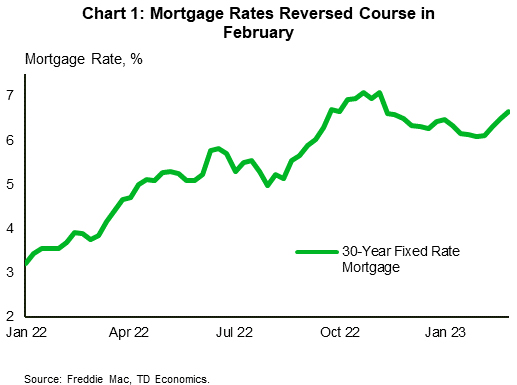
Pending home sales in January increased for the second consecutive month, rising by 8.1% month-on-month (m/m). Falling mortgage rates in late 2022 helped slow the year-long decline in sales activity, despite prices continuing to sink through the end of the year. Seasonally adjusted national home prices, as measured by the S&P CoreLogic Case-Shiller index, continued to decline in December (-0.3% m/m), matching the decline seen in November. With the 30-year mortgage rate rising to 7% in February this reprieve is likely to prove temporary (Chart 1).
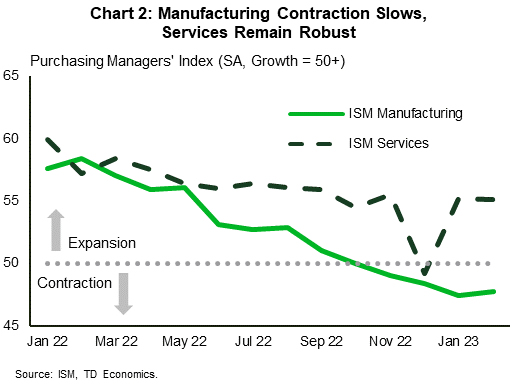
On Wednesday, the ISM Manufacturing Index improved for the first time since August, though the sector remained in contractionary territory for the fourth consecutive month (Chart 2). New orders and backlogged orders continued to contract, albeit at a slower pace. In contrast, the ISM Services Index reading on Friday showed that the industry is still expanding, with new orders growing at a faster pace.
Supplier delivery times continued to see improvement in both sectors with ocean freight costs declining for a sixth consecutive month. However, the manufacturing prices paid subindex increased for the first time since September, reflecting higher raw material prices. Although the subindex remained below the historical level associated with an uptick in the Producer’s Price Index, Treasury yields rose in response to the possible implications this could have on inflation and the Federal Reserve’s policy path.
Speaking of the Fed, we heard from seven different Federal Reserve officials this week, six of whom are current voting FOMC members. Their talking points covered a range of topics, from Governor Jefferson pushing back against calls for the Fed to raise its inflation target to Chicago Fed President Goolsbee saying it would be a mistake for the Fed to rely too heavily on financial market reactions. We also received policy specific comments, with Minneapolis Fed President Kashkari noting that he is open to a 50 basis point hike at the next meeting and Atlanta Fed President Bostic (a 2024 FOMC member) saying in an essay that he sees the policy rate going to 5.00 - 5.25% and staying there well into 2024.
Members made it clear that they are not yet convinced of the downward trajectory in inflation and upside risks to the policy rate path remain. All eyes will be on next week’s February employment data, which will show whether January’s blowout job growth was just a blip or something more concerning altogether for the Fed.
Canada – The Devil is in the Details
The release of this week's fourth quarter GDP report likely brought some level of comfort to a Canadian central bank that is trying to cool economic growth and inflation. A flat performance (the economy recorded 0% growth in 2022Q4) is about as slow as it gets without the economy dipping into outright contraction.
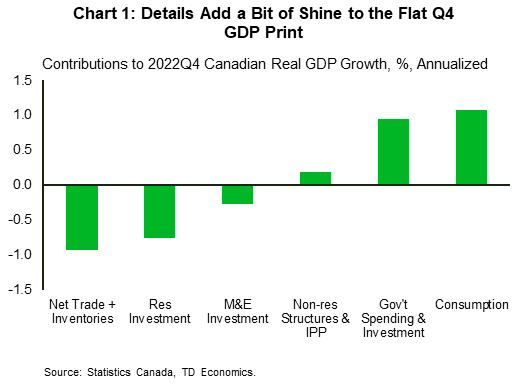
The details could best be characterized as "lukewarm". However, they did paint a slightly better picture of the economy's performance heading into 2023 than the headline figure would suggest (Chart 1). The headline was held back by a normalization in inventories, which subtracted 5.6 percentage points from growth. Inventories often experience large swings, and the drag in the fourth quarter came after the largest two quarter inventory build in decades through the middle of 2022. Final domestic demand was up 1% (quarter-on-quarter annualized (q/q)) - again, lukewarm, but not a disaster. Underlying this was a decent 2% q/q showing in consumer spending, supported by a pop in auto sales as improving supply chains fed pent-up demand. Moving forward, this could be one area of consumption that shows some strength as auto supply chains continue to normalize. Elsewhere, there were encouraging signs (from the Bank of Canada's perspective) that higher rates weighed on interest-sensitive spending last quarter. For example, residential investment dropped 9%.
The fourth quarter stall in activity was a much softer performance than what the Bank expected in their January Monetary Policy Report (1.3%). It also undershot consensus, which was looking for a similar print. Part of the consensus call was probably conditioned on monthly, industry-based GDP data that was flagging a much stronger gain. GDP by industry increased 1% in the fourth quarter. This isn't the first time the two series have diverged, and industry-based GDP outpaced its expenditure-based counterpart every quarter last year. We should keep this in mind when assessing Statcan's preliminary estimate that industry-based GDP expanded 0.3% m/m in January. Assuming no growth in February and March, industry-based GDP is on track to record a 1% gain in the first quarter of this year. However, expenditure-based GDP (which is what the Bank of Canada forecasts) could be weaker if the recent divergence between the two GDP measures persists.
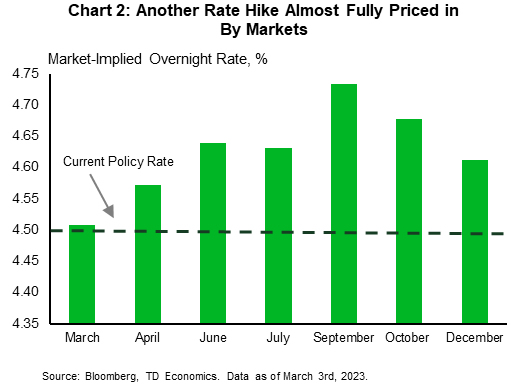
The Bank of Canada announces its interest rate decision next Wednesday, and given its recent communication of a (conditional) pause in January, there's almost no chance it deviates from that stance. However, markets don't agree that policymakers are quite done yet, with another hike fully priced-in by later this year (Chart 2). We view this week's flat GDP print as supporting our case that the Bank of Canada is done hiking rates. This view is conditioned on a continued cooling in inflation and softening in the job markets.
Weekly Economic & Financial Commentary: Global Recession Risks Are Receding
Summary
United States: First Looks Point to February Activity Holding Firm
- Data this week did little to alter the picture that, to the extent the underlying trend in the economy is softening, it is not weakening nearly enough to put a quick end to inflation. Manufacturing activity is contracting only gradually, while the service sector continues to expand at a solid clip according to the February ISM releases.
- Next week: Consumer Credit (Tue), JOLTS (Wed), Employment (Fri)
International: Major Economies See Slower Growth, Slowing but Still High Inflation
- With China being a notable exception, this week's news largely consisted of slower growth late in 2022 for many of the major developed economies. Looking at Q4 GDP, Australia's economy grew by less than expected, GDP was flat for the quarter in both Canada and Switzerland, and Sweden's economy contracted in the final quarter of last year. Eurozone headline inflation eased only slightly, while core inflation firmed to the fastest pace on record.
- Next week: Reserve Bank of Australia (Tue), Bank of Canada (Wed), Mexico CPI (Thu)
Interest Rate Watch: Growing Interest in Credit Card Debt
- The cost of financing credit card debt has surged with the average interest rate reaching the highest in data going back to the mid-1990s. The share of credit card balances transitioning into early delinquency is rising, and all else equal, rising debt and rising financing costs for that debt could be a negative factor for consumer spending later this year.
Credit Market Insights: Student Loan Forgiveness Arrives at the Supreme Court
- On Tuesday, the Supreme Court heard opening arguments for two cases involving the Biden administration’s proposed student loan relief program. Last summer, we wrote a report on the potential economic impact of student debt cancellation, but how has the situation evolved in the six months since?
Topic of the Week: Global Recession Risks Are Receding
- We have upgraded our China forecast following strong sentiment data in February. We now expect Chinese GDP to expand 5.5% in 2023, up from our previous forecast of 5.2%. China's economy has experienced a rebound following the end of Zero-COVID policies, increasing the likelihood that the global economy can skirt a recession this year.
Week Ahead – A Pivotal Moment
The US has a very busy week ahead. The two main events are Fed Chair Powell’s semi-annual testimony to Congress and the nonfarm payroll report. Powell’s two days at Capitol Hill will undoubtedly draw scrutiny from lawmakers as more tightening will raise the risk this economy is recession bound. Traders will look to see how hawkish Powell will remain given the mostly strong data, recently.
The nonfarm payroll report is the main economic release of the week. After a jaw-dropping 517,000 jobs were created in January, traders will look to see if that number gets a serious downward revision and if February’s job growth slows to 200,000. Wage pressures are also key and if average hourly earnings come in hotter-than-expected that could fuel more Fed rate hiking bets.
President Biden is also expected to release his budget for fiscal 2024, which might include higher taxes. Republicans are calling for sharp spending cuts, but that is not expected to be in this version. Raising the US debt limit will start to become a focal point, but this is still the early stages.
Earnings season is coming to an end with key updates from Adidas, Brown-Forman, CrowdStrike, Daimler Truck, Deutsche Post, and JD.com.
Christine Lagarde’s appearance in the middle of next week will be highly anticipated following the February inflation data. The ECB President has insisted repeatedly that the central bank has a lot more to do, and the latest figures – especially the core which unexpectedly spiked to a new high – will reinforce that. That aside, there’ll be some interesting data points but nothing tier-one.
UK
Not the busiest week coming, with GDP data on Friday probably the only notable event on the calendar. The UK avoided a recession in the second half of last year and everyone will be looking for early signs of the economy performing better again at the start of 2023. That aside, any BoE appearances will naturally get a lot of attention.
Russia
The February CPI number is the big release next week, with pressures continuing to abate with an expected reading of 10.8%, down from 11% the week before.
That aside, the focus remains on the war in Ukraine and any sanctions that will follow. Oil output has already been hit, with another 500,000 barrel daily drop this month and some are expecting that to double by the end of the year.
South Africa
Fourth-quarter GDP data is the only highlight this coming week and it’s expected to show a contraction in the fourth quarter of last year, meaning the country is at risk of being in recession if it hasn’t bounced back since January.
Turkey
Labor market figures are eyed alongside industrial production on Friday. That aside it’s looking fairly quiet.
Switzerland
SNB Chair Thomas Jordan’s appearance on Tuesday is probably the most notable event next week, coming a day after the latest inflation release. The CPI figure is expected to show price pressures easing but probably not enough to put the central bank at ease. Markets are still fully pricing in a 50 basis point hike on 23 March.
China
All eyes will be on the National People’s Congress (NPC), as it kicks off its annual session. This will set the tone in Asia as China will announce major personnel changes, government policy goals, and growth targets.
It will also be a busy week filled with economic releases. Some of the data however will be impacted by the Lunar New Year holiday. The February trade balance is expected to decline, while both CPI and PPI soften. China’s credit last month was most likely reined in as aggregate financing and new yuan loans declined.
India
It is likely to be a relatively quiet week for India, with the exception of January Industrial production, which is expected to improve from 4.3% to 5.6%.
Australia & New Zealand
The RBA is expected to deliver another quarter-point rate rise and maintain a hawkish stance as inflation remains elevated. Analysts are unanimous in expecting rates to rise by 25bps to 3.60%.
In New Zealand, it will be a week filled with a few economic releases. The ANZ commodity price reading occurs on Monday. In the middle of the week, we get a look at February card spending. Friday includes the manufacturing PMI release.
The end of Kuroda’s tenure is here. In his last meeting, the BOJ is expected to stay the course and have no changes with YCC or with rates. Governor Kuroda is widely expected to stick to his stance of maintaining monetary easing to aim for sustainable, stable 2% inflation. BOJ Governor nominee Kazuo Ueda has already hinted he will stay the course, but currency traders are eagerly awaiting any signs on how the BOJ will exit this ultra-easy policy.
Singapore
No major releases are expected.
Economic Calendar
Saturday, March 4
Economic Events
- Fed’s Daly gives a speech on inflation at Princeton University
Sunday, March 5
Economic Events
- China’s National People’s Congress begins in Beijing
Monday, March 6
Economic Data/Events
- US factory orders, durable goods
- Australia inflation gauge
- Euro area retail sales
- Mexico vehicle production/exports
- New Zealand commodity prices
- SNB releases 2022 results
- CERAWeek energy conference by S&P Global
- JPMorgan’s Global High Yield & Leveraged Finance Conference
- International Atomic Energy Agency board of governors meeting
Tuesday, March 7
Economic Data/Events
- Fed’s Powell presents his semi-annual Monetary Policy Report to the Senate Banking Committee
- US wholesale inventories, consumer credit
- Australia trade balance, reserves
- China trade balance, reserves
- Germany factory orders
- Greece GDP
- Japan cash earnings
- Mexico consumer confidence, international reserves
- South Africa GDP
- Singapore reserves
- Spain industrial production
- Thailand CPI
- RBA decision: Expected to raise cash rate target 25bps to 3.60%
- ECB consumer expectations survey
- Poland Monetary Policy Council rate meeting
- Riksbank Governor Thedeen speaks on the current economic situation
- House Ways and Means Committee has a field hearing on the state of the US economy
Wednesday, March 8
Economic Data/Events
- Fed’s Powell presents his semiannual Monetary Policy Report to the House Financial Services Committee
- US MBA mortgage applications, ADP employment change, trade balance, JOLTS job openings
- Canada merchandise trade
- Euro area GDP
- Germany industrial production
- Indonesia consumer confidence
- Japan BoP, bank lending, leading index
- BOC rate decision: Expected to leave rates unchanged at 4.50%
- Poland rate decision: Expected to leave rates unchanged at 6.75%
- EIA crude oil inventories
- RBA Governor Lowe speaks at the AFR Business Summit in Sydney
- ECB President Lagarde speaks alongside WTO Director-General Ngozi Okonjo-Iweala at an International Women’s Day event
- Riksbank’s Breman speaks on the economy
- BOE’s Dhingra speaks at the Resolution Foundation
- BOE’s Tenreyro speaks at Conference of British Industry event
Thursday, March 9
Economic Data/Events
- US Challenger job cuts, initial jobless claims, household change in net worth
- China CPI, PPI, aggregate financing, money supply, new yuan loans
- Japan GDP, money stock, machine tool orders
- Mexico CPI
- New Zealand heavy traffic index, card spending
- South Africa current account balance
- President Biden to release his US budget proposal for fiscal 2024
- Riksbank’s Bunge speaks on the economic and monetary policy outlook
- Riksbank’s Jansson speaks on central bank digital currencies
- BOE’s Breeden speaks on macro-prudential and monetary policy interactions
Friday, March 10
Economic Data/Events
- US Feb change in nonfarm payrolls: 215Ke v 517K prior, unemployment rate, average hourly wages, monthly budget statement
- Bank of Japan policy rate decision: No changes expected to YCC or balance rate in Kuroda’s last meeting
- Canada unemployment
- France trade balance
- Germany CPI
- India industrial production
- Japan household spending, PPI
- Mexico nominal wages
- New Zealand PMI, house sales
- Russia CPI
- Thailand consumer confidence, foreign reserves, forward contracts
- Turkey industrial production
- UK industrial production, services index, trade balance
- Apple annual meeting of shareholders
Sovereign Rating Updates
- Belgium (Fitch)
- Norway (S&P)
- Portugal (S&P)
- Greece (DBRS)
Dollar Likely to Have Completed Corrective Bounce
The S&P500 and Nasdaq100 indices staged a solid intraday rebound yesterday, digesting the initial drop and closing the day higher. Along with the rebound in equities, a reversal to the downside is forming in the Dollar Index.
Technically, the dollar’s rebound in February has cleared the oversold conditions accumulated during the decline since late September last year. The RSI on the daily timeframe touched the overbought territory and was turned down precisely a week ago, leaving room for further declines.
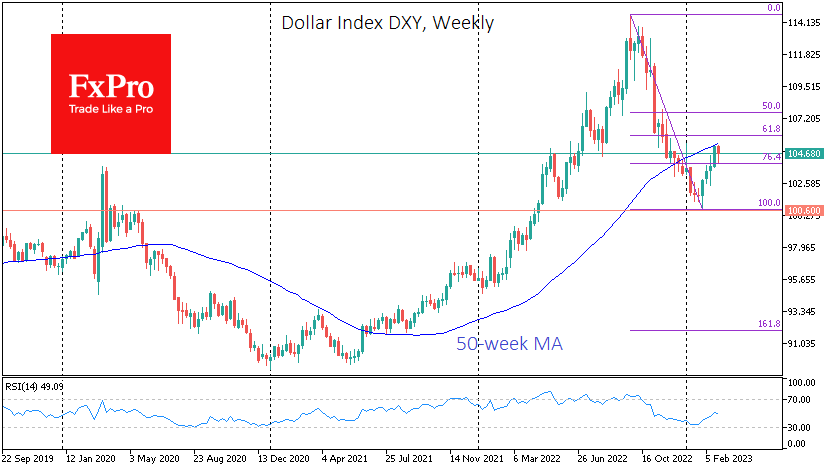
Strictly speaking, the pullback is below 61.8% of the initial decline that passes through the 106 level. Below that is the 200 SMA, but the USD bulls didn’t have enough power to push the American currency into the area now, as in January. The 105 territory is interesting, as it has seen several reversals in the past.
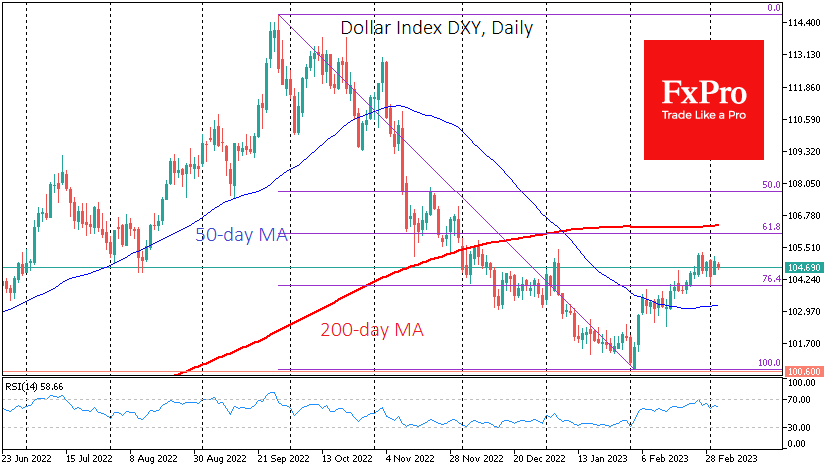
A possible intermediate target for the US currency is 103.2, the 50-day average. Also, here, the DXY stopped rising in March 2020. It is very likely that the dollar will continue its slide at this level and will test the February lows of 100.6 before the end of April.
The view that the dollar is weakening against its major rivals fits well with historical examples. Often the Fed is the first to tighten monetary policy, triggering a wave of dollar strength. But a few months later, other central banks followed suit or moved ahead of the Fed.
Compared with January, the bond markets have priced in the Fed’s expectations quite well. In turn, the ECB and the Bank of England continue to push up expectations in their markets. As in previous similar episodes, this reassessment of expectations by the Fed’s “competitors” promises to be a driving force in the currency markets.
The picture in EURUSD and GBPUSD is also bullish, as the pairs received strong support from buyers on dips to psychological and technical levels near 1.05 and 1.20, respectively.
Week Ahead – Will BoJ Shock Markets Ahead of US Payrolls?
Market participants are in for a wild ride, as the coming week is loaded with promising events. The ball will get rolling with central bank meetings in Australia and Canada. Those will serve as appetizers for the Bank of Japan’s decision, which might be a close call, feeding volatility in the yen. In the US, the latest employment report and testimony by the Fed chief before Congress will decide whether the dollar’s recovery still has miles left in the tank.
Yen braces for turbulence
A difficult decision lies ahead for Bank of Japan officials. They will have to decide on Friday whether to take the next step in their tightening campaign, amid conflicting signals around the Japanese economy and the inflation outlook.
On the bright side, inflation and wage growth have fired up, both running above 4%. In fact, wages rose faster than inflation in January, which means real wage growth finally turned positive. That’s good news for Japanese consumers, and something the central bank has long waited for.
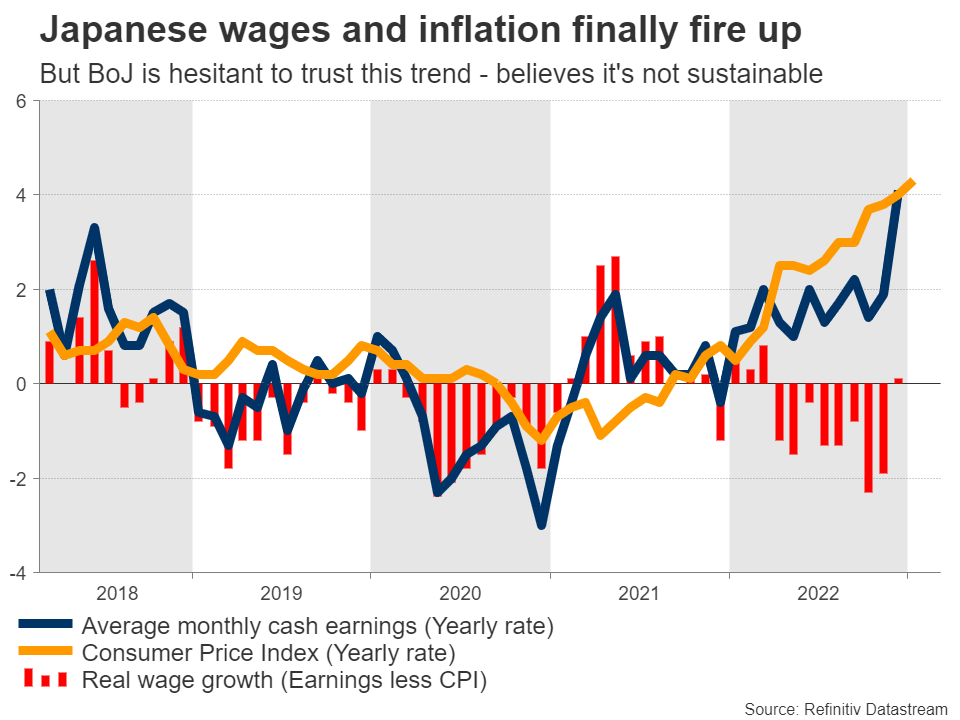
However, several BoJ members - including future Governor Ueda - believe this inflation spell is driven mostly by supply shocks and energy prices, so it won’t last. Energy subsidies from the government finally came into effect last month, driving electricity prices much lower.
Therefore, the logic is that inflation might be high today, but is destined to fall soon. Indeed, incoming data support this notion as the forward-looking Tokyo CPIs fell sharply in February. There are similar questions about wages, since the spring wage negotiations between unions and businesses have just started.
Another issue to consider is that this is the last meeting of outgoing BoJ Governor Kuroda, and he might prefer to leave any major decisions to his successor who will take over next month.
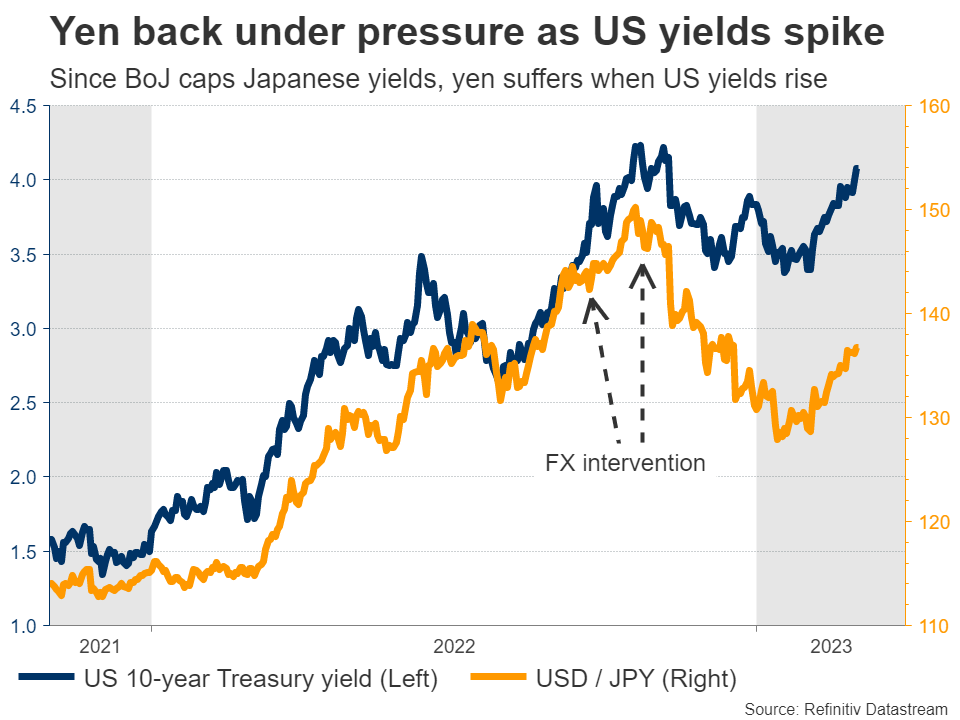
It’s a close call but weighing everything up, it seems more prudent for the BoJ to be patient. While economic data currently warrants further action, there’s heightened uncertainty around inflation and the ongoing wage negotiations. There’s always a chance the BoJ decides to pull the trigger now, but waiting until April would give the officials more clarity.
A decision to do nothing would spell bad news for the yen. That said, it’s probably only a matter of time until the BoJ does raise its yield ceiling again or abandons it completely, so it might not be a game changer for the yen’s trend.
US nonfarm payrolls, another solid print?
In the United States, the underlying theme lately has been how resilient the economy is. Consumer demand, inflationary pressures, and the labor market have not shown any real signs of damage yet despite the Fed’s relentless rate increases, fueling bets that interest rates will need to go higher and stay elevated for a longer period.
This coming week, the show will get started with Fed Chairman Powell, who will testify before Congress on Tuesday and Wednesday. Markets usually react to the Q&A session of his first testimony, and the risk is that he strikes a more hawkish tone following the recent barrage of strong data.
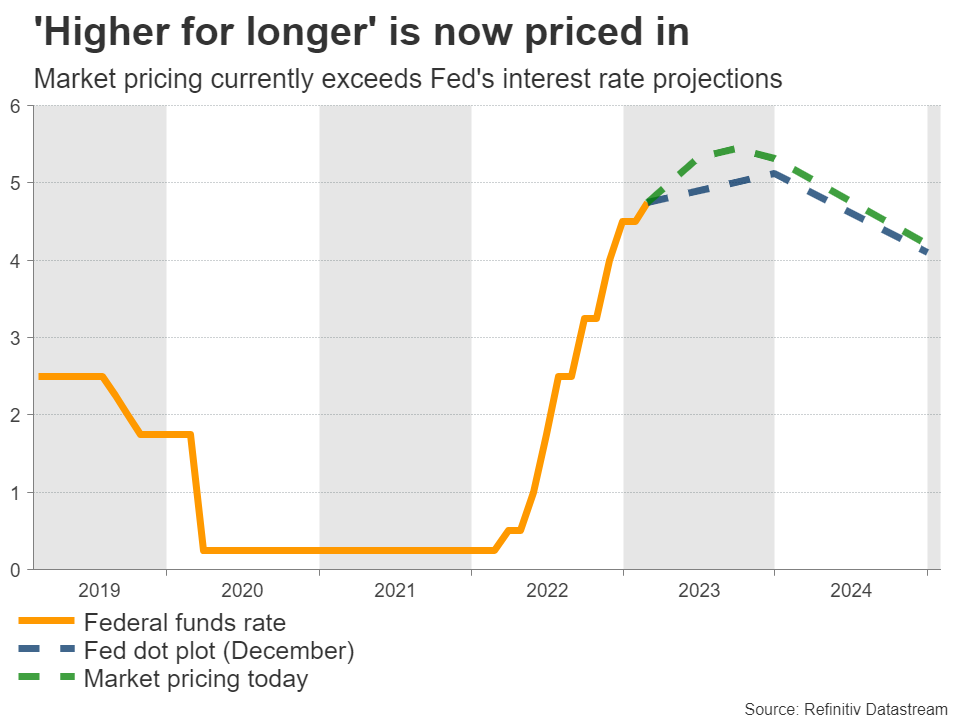
Beyond that, the spotlight will fall on the employment data out on Friday. Forecasts point to another solid report, with nonfarm payrolls seen at 200k in February after printing an astonishing 517k last month. The unemployment rate is expected to tick up to 3.5%, while wage growth is projected to accelerate.
Indeed, most early indicators suggest it was a strong month for the jobs market. Business surveys from S&P Global pointed to an acceleration in hiring, while applications for unemployment benefits remained historically low.
Still, there’s a risk that nonfarm payrolls disappoint. When an NFP report is as strong as it was last month, it is often followed by a weaker number - a correction back to the prevailing trend. Since warm weather played a huge role in boosting the last number, it wouldn’t be surprising to see some ‘payback’ this time.
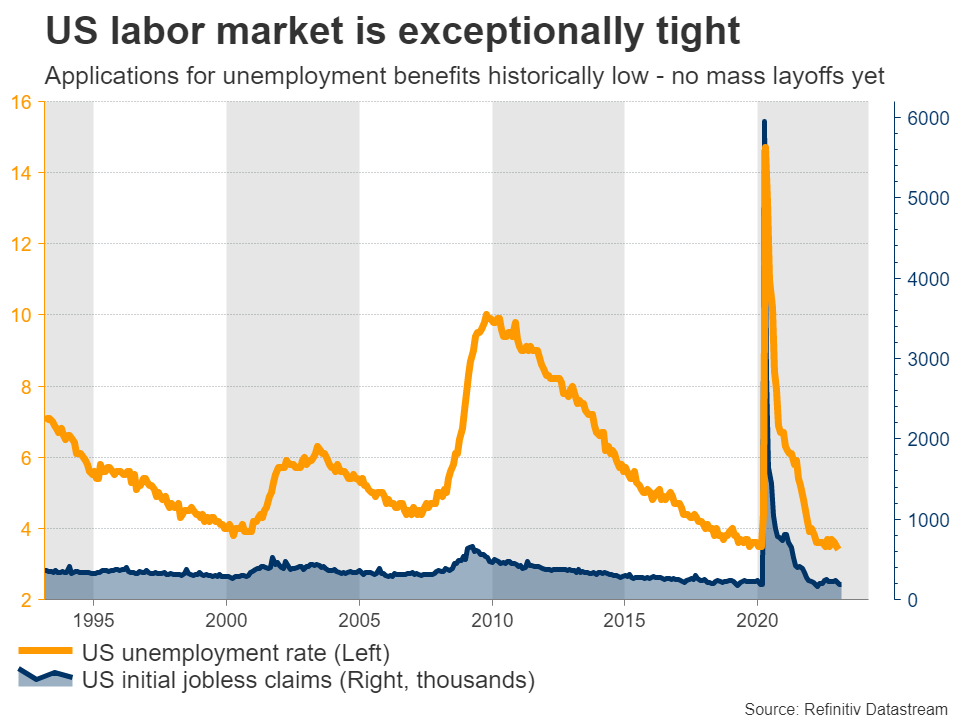
As for the dollar, the outlook seems positive, even if there is a setback next week. With the Fed expected to stay restrictive for longer, US yields have started to race higher, reinforcing the dollar’s rate advantage. This dynamic has also weighed on stock markets, where any further losses could inflict collateral damage on currencies such as the euro or sterling, indirectly benefiting the greenback.
BoC and RBA rate decisions
Crossing into Canada, the central bank is expected to take the sidelines when it meets on Wednesday following a series of disappointing data releases, most notably the latest GDP growth report.
With high interest rates restraining consumers and pressuring the nation’s housing market, the Canadian economy has stalled and inflationary pressures are cooling off. Investors have gotten the message, as market pricing implies almost no chance of a rate increase next week.
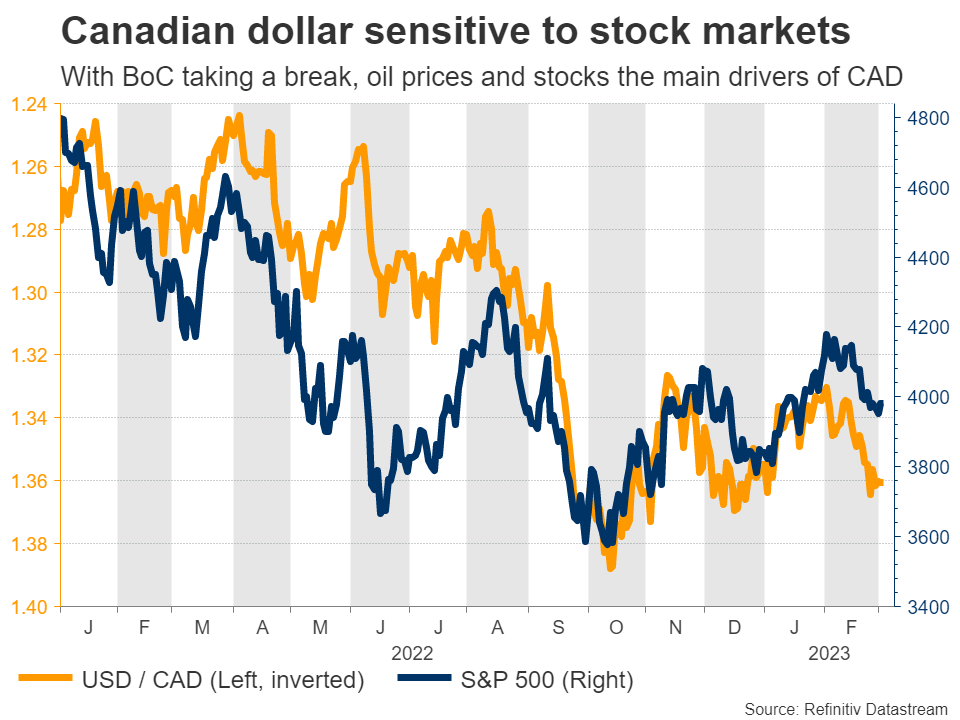
Now that monetary policy has taken a back seat, the primary drivers of the Canadian dollar moving forward might be the performance of oil prices and global risk sentiment, neither of which seems favorable at this stage. Beyond the Bank of Canada decision, the nation’s employment stats will also be in focus on Friday.
Over in Australia, the main event will be the Reserve Bank’s decision on Tuesday. Markets assign a 75% probability for a quarter-point rate increase, after the minutes of the previous meeting showed the Board envisioned “further increases”.
Since it is not fully priced in, a decision to raise rates could briefly boost the Australian dollar, although the currency’s overall trajectory will depend mostly on any signals around the terminal rate.
Developments in China will also be crucial for the Australian dollar, given the close trade links between the two economies. China will release its latest trade data on Tuesday and inflation stats on Thursday, which are likely to reflect the reopening boom seen in other indicators lately.