Sample Category Title
USD/JPY Regains Strength, US GDP Expands 2.7%
Key Highlights
- USD/JPY climbed higher above the 132.50 resistance zone.
- A connecting bullish trend line is forming with support near 134.50 on the 4-hours chart.
- EUR/USD slowly moved below the 1.0620 support zone.
- The US GDP grew 2.7% in Q4 2022 (Prelim), less than the 2.9% forecast.
USD/JPY Technical Analysis
The US Dollar gained strength for a steady increase above the 132.50 resistance against the Japanese Yen. USD/JPY even broke the 133.20 level to move into a positive zone.
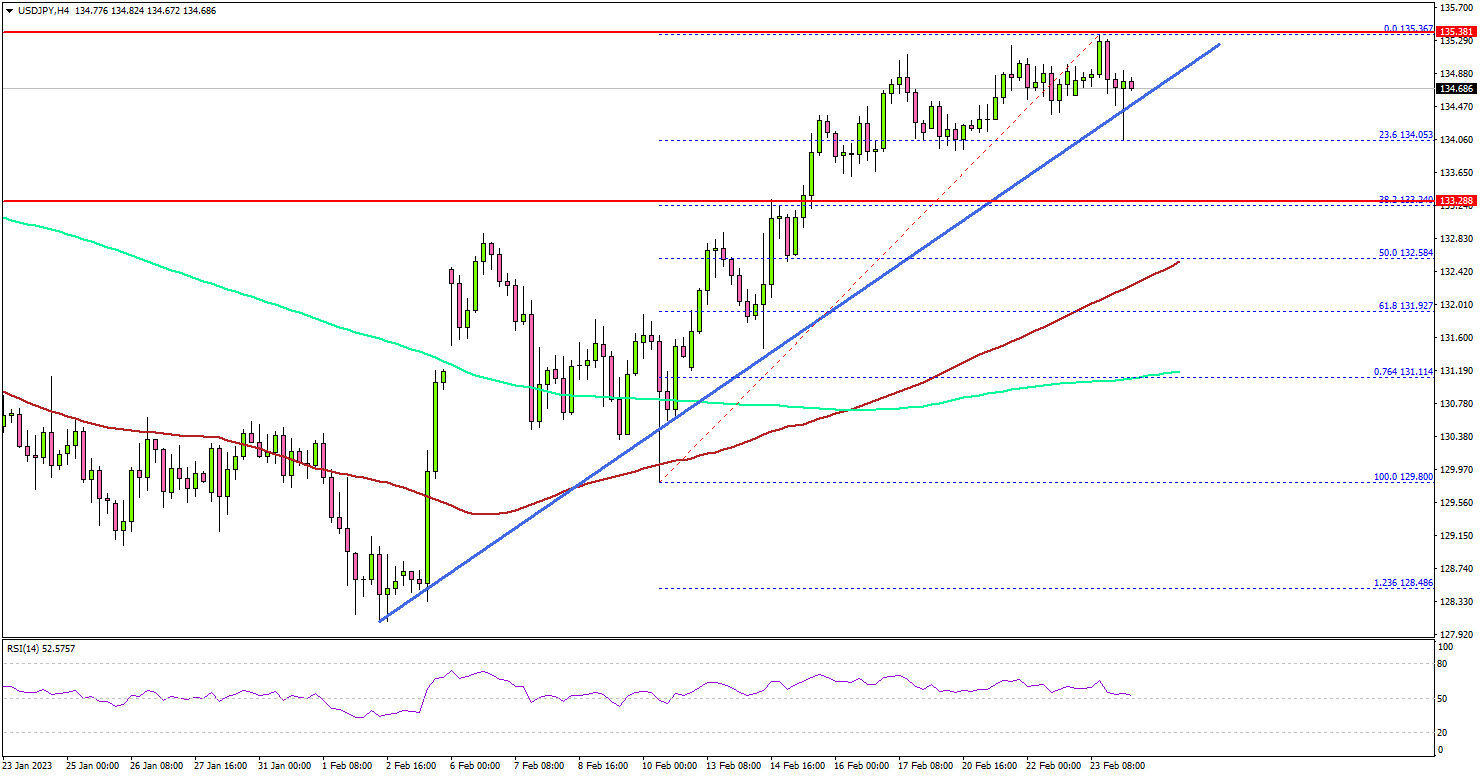
Looking at the 4-hours chart, the pair settled above the 133.50 level, the 100 simple moving average (red, 4-hours), and the 200 simple moving average (green, 4-hours).
The upward move was such that the pair even climbed above the 135.00 level. It is now showing positive signs above 134.50. There is also a connecting bullish trend line forming with support near 134.50 on the same chart.
On the downside, an immediate support is near the 134.50 level. The next major support is near the 134.00 level, below which there is a risk of a move towards the 133.30. Any more losses could open the doors for a drop towards 132.50.
On the upside, an immediate resistance is near the 135.50 level. The next major resistance is near the 136.20 level. A clear move above the 136.20 resistance might start a steady increase towards the 138.00 resistance zone. Any more gains could open the doors for a move towards the 140.00 level.
Looking at EUR/USD, the pair slowly declined below 1.0620 and there is a risk of more losses in the coming days.
Economic Releases
- US New Home Sales for Jan 2023 (MoM) – Forecast 2.5% versus 2.3% previous.
- US Personal Income for Jan 2023 (MoM) - Forecast +0.9%, versus +0.2% previous.
GBPJPY Wave Analysis
- GBPJPY reversed from key resistance level 163.00
- Likely to fall to support level 160.50
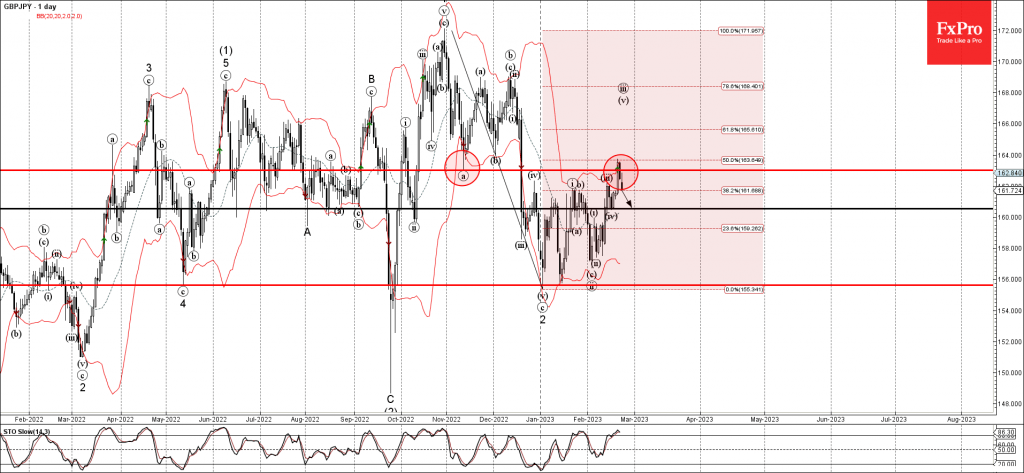
GBPJPY currency pair recently reversed down from the key resistance level 163.00 (former monthly low from November) coinciding with the upper daily Bollinger Band and the 50% Fibonacci correction of the downward impulse from November.
The downward reversal from the resistance level 163.00 stopped the previous impulse waves (iii) and 3, which belong to wave 3 from the start of January.
Given the overbought reading on the daily Stochastic, GBPJPY can be expected to fall further toward the next support level 160.50 (low of the previous minor wave (iv)).
WTI Wave Analysis
- WTI reversed from support level 74.00
- Likely to rise to resistance level 80.00
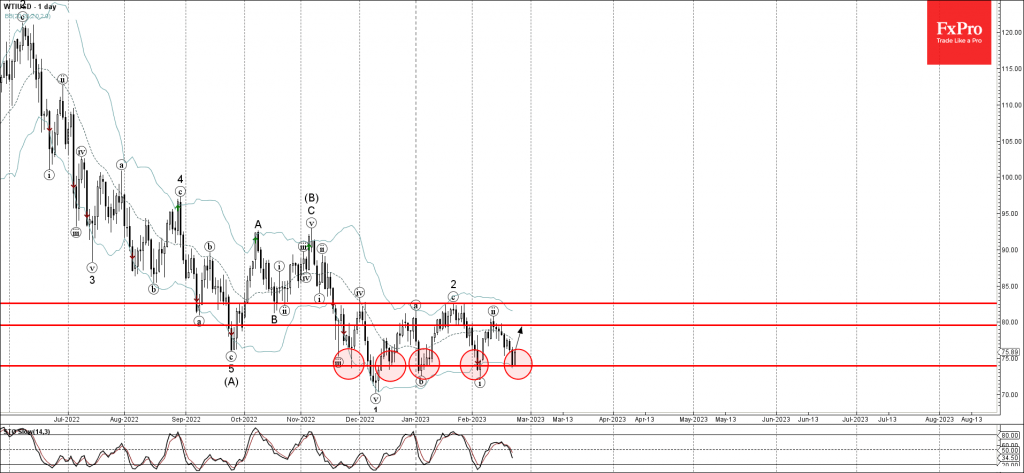
WTI crude oil recently reversed up from the pivotal support level 74.00 (which has been reversing the price from the end of November).
The support level 74.00 was further strengthened by the lower daily Bollinger Band.
WTI crude oil can be expected to rise further toward the next round resistance level 80.00 (which stopped the previous short-term correction (ii)).
US Labour Market Remains Strong
Weekly jobless claims in the US were once again better than expected. This further confirms that the economy remains in a state where domestic inflationary pressures are building up, requiring the Fed to go further than expected.
Initial jobless claims fell from 194K to 192K, against expectations for an increase to 200K. Continuing claims came in at 1654K versus 1696K the previous week and the expected 1700K. Current levels are extremely low by historical standards.
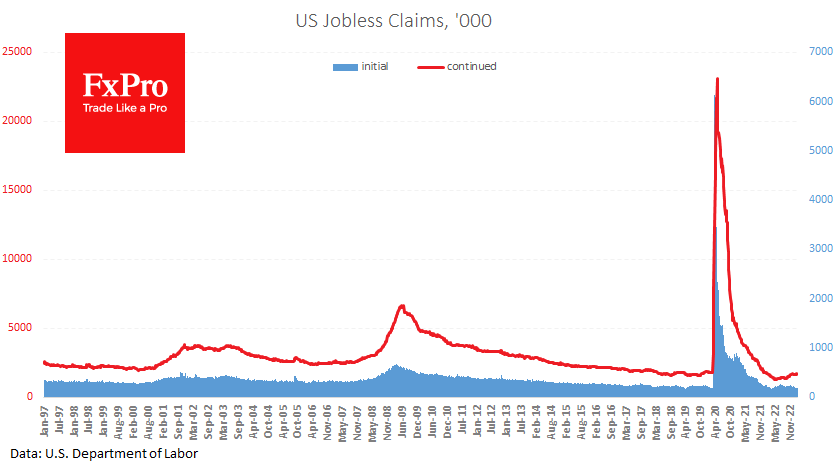
As energy prices have fallen significantly since the middle of last year and logistical problems have largely been resolved, labour costs are becoming the primary driver of price increases. In most cases, a strong labour market is good news for risk demand, but now such data could raise the Fed’s estimate of the endpoint of the current tightening cycle, putting pressure on equities.
This is potentially positive news for the dollar as it suggests higher yields on dollar-denominated debt. However, the impact of today’s particular release is likely insignificant, given the only slight deviation from expectations and the high frequency of these releases.
BTCUSD Consolidates as Advance Pauses
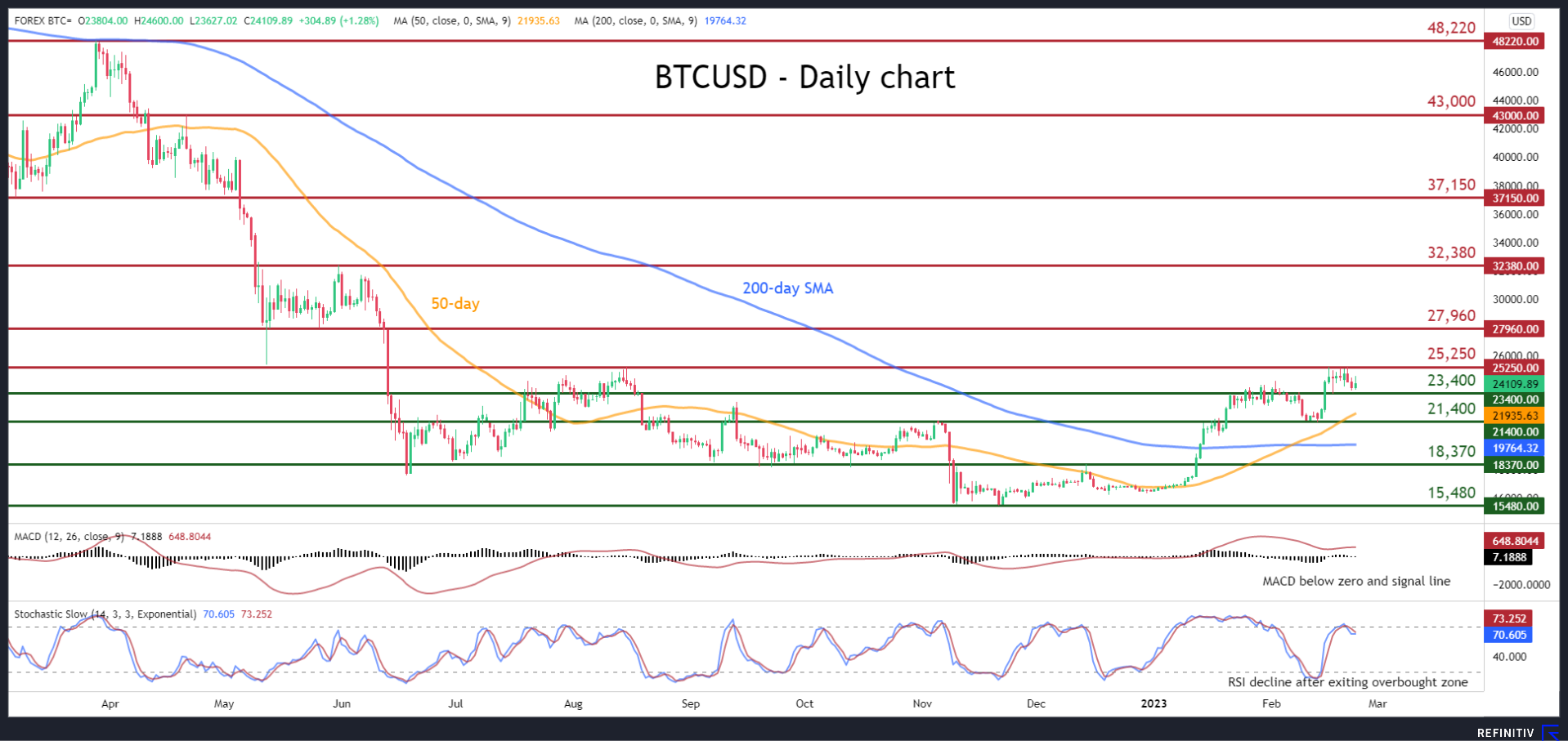
BTCUSD (Bitcoin) has been trending upwards since the beginning of the year, posting a 10-month high of 25,250 on Tuesday. However, the king of cryptocurrencies seems to be lacking the necessary momentum to march higher and has been trading sideways for the past few daily sessions.
The momentum indicators are depicting this loss of positive momentum for the digital asset. Specifically, the MACD histogram dropped beneath both zero and its red signal line, while the stochastic oscillator is sloping downwards after exiting the 80-overbought zone.
Should the bearish tendency strengthen, the price could move lower to test the recent support of 23,400. A break below that region could shift the spotlight to the February low of 21,400. Failing to halt there, further declines may cease at the December resistance of 18,370, which could act as support in the future.
To the upside, if Bitcoin regains lost ground, the recent rejection region of 25,250 might act as the first line of defence. Higher, the bulls could aim for 27,960 before the May resistance of 32,380 appears on the radar. Even higher, the 37,150 barrier could prove to be a tough one for the price to overcome.
Overall, BTCUSD has been moving without clear direction in the past few daily sessions, unable to extend its recent uptrend. Nevertheless, a profound break above the 25,250 ceiling might revive bulls' hopes for a sustained rally.
Sunset Market Commentary
Markets
When Germany announced a delay in its January CPI publication, Eurostat used an own estimate to fill in the gap for the euro area wide figure, published early February. When the biggest economy released the actual number, statistical eggheads soon found out that Eurostat’s guesstimate was too low. They turned out to be correct. Final EMU HICP came in at 8.6% y/y compared to 8.5% in the preliminary release. Core inflation was also revised upwards, from 5.2% to 5.3%. A marginal adjustment indeed, but nevertheless one with psychological implications because the 0.1 ppt revision made the difference between core inflation stabilizing in y/y terms (December reading stood at 5.2% too) or further increasing to a new record high. The US eco calendar contained second GDP and price deflator readings for Q4 last year. The former came in lower (2.7% vs 2.9% q/q annualized) but the latter was revised quite a bit higher (core PCE from 3.9% to 4.3% q/q). Combined with slightly lower-than-expected weekly jobless claims, running sub 200k for a sixth month straight, it supported an ongoing UST yield rise. Rates at some point rose between 2.3 and 4.7 bps but pared most gains as US dealings got going. European rate dynamics were similar to those in the US. German bonds slightly outperform with declines of less than 1 bp. The very long end (30y, -3.5 bps) is tainted by today’s syndicated tap. UK gilts underperform once again. It follows a hawkish speech from Bank of England’s Catherine Mann. Having Tuesday’s surprise PMI recovery at the back of her mind, she said monetary policy has not been aggressive enough. Further tightening is needed, citing risks for increasingly persistent inflation. Mann also referred to financial conditions as being looser than what is needed and is worried that this may extend the inflation problem well into next year. UK yields advance 4.4-5.4 bps through the curve with the belly slightly underperforming the wings. Money markets now consider a terminal rate of 4.75% as more likely than the 4.5%.
Mann’s speech and the resulting UK yield surge doesn’t help sterling though, nor does the upbeat risk sentiment (Euro Stoxx 50: +0.7%). EUR/GBP ekes out a tiny gain to hold north of 0.88. Moves in most other cross rates are close to non-existent too. EUR/USD tested intermediate support at 1.0595 but steers clear from a break lower. DXY stands pat at 104.51. The yen is losing some ground (USD/JPY tentatively surpasses 135). Weighing on the currency is the rise in core bond yields and some nervousness, perhaps, in the run-up to BoJ governor-elect Ueda’s confirmation hearing tomorrow. The BoJ’s ultra-low rate policy still serves as some kind of a global anchor point. Any clues for abandoning this stance somewhere in the (near) future will definitely be picked up by markets, inside and outside Japan.
News & Views
The Turkish central bank (CBRT) cut its policy rate by 50 bps, from 9% to 8.5%, indicating that the current monetary policy stance is adequate to support the necessary recovery in the aftermath of the earthquake. It is generally assumed though that governor Kavcioglu and co might (be pushed into) slash(ing) policy rates further ahead of the May general election. The Committee vows that it will prioritize the creation of supportive financial conditions in order to minimize the effects of the disaster and support the necessary recovery even as inflation was still running at 57.68% Y/Y in January, more than tenfold the CBRT’s inflation target. In order to mitigate the impact on the currency, the central bank will stick with and extend its Liraization Strategy. The Turkish lira isn’t impacted by today’s decision. EUR/TRY continues trading above the 20-mark after testing the all-time TRY-low at 20.75 earlier this month.
The ECB published its financial statements for 2022. The central bank’s profit fell to zero (from €192mn in 2021), implying no profit distribution to national central banks. The result takes into account a release of €1.6bn from the provision for financial risks to cover losses incurred during the year, shrinking the reserves to €6.6bn. Writedowns, meanwhile, surged to €1.8bn (only €0.13bn in 2021), “mainly stemming from unrealized price losses on securities held in the own funds and US dollar portfolios owing to increased bond yields”. The size of the consolidated balance sheet of the Eurosystem declined from €8564bn to €7956bn, mainly due to early repayments of TLTRO’s, which were partially offset by higher holdings of monetary policy securities as a result of purchases under the APP (+€130bn to €3254bn) and the PEPP (+€100bn to €1681bn).
US: Fourth Quarter Growth Appeared Strong on the Surface, But Underlying Details Remain Soft
The second estimate of fourth quarter real GDP expanded by 2.7% quarter-over-quarter (q/q, annualized) – a slight downward revision from the 2.9% reported in the Bureau of Economic Analysis's advance estimate.
Consumer spending growth was revised down from 2.1% in the advance estimate, to 1.4%. Gains were entirely concentrated in services (+2.4%), while goods spending was revised down, recording a modest pullback (-0.5%). Spending on durables goods (-1.8%) was lower on the quarter, while non-durables (+0.2%) were flat.
Non-residential investment (+3.3%) saw an upgrade (previously +0.7%), which was largely due to stronger growth in non-residential structures (+8.5%) and intellectual property products (+7.4%). Equipment expenditures (-3.2%) remained soft.
Residential investment fell 25.9% and shaved 1.2 percentage points (pp) from headline growth.
Government spending expanded by 3.6%, with gains seen at both the federal (+5.9%) and state & local (+2.3%) level.
Both exports (-1.6%) and imports (-4.2%) were lower on the quarter, though a stronger pullback in the latter meant net exports added 0.5pp to economic growth.
Inventory investment made an outsized contribution to fourth quarter growth, adding 1.5pp – the largest quarterly contribution since 2021-Q4.
The BEA also included revised estimates for third quarter Gross Domestic Income (GDI), with Q3 GDI now estimated to have expanded by 2.8% (as opposed to the previously reported 0.8%).
Key Implications
The second estimate of fourth quarter GDP showed the U.S. economy having ended last year on a slightly softer footing, with the bulk of the downward revisions concentrated in consumer spending. While GDP still appeared to expand at an above trend pace, nearly three-quarters of the gains were concentrated in net exports and inventory investment, which continue to experience distortions as supply chains normalize. Meanwhile, private sales to domestic purchasers – the best gauge of underlying domestic activity – was flat in the fourth quarter.
Looking into the first quarter of this year, we expect consumer spending to remain somewhat resilient. The labor market remains incredibly hot, which is helping to fuel both household incomes and consumer confidence and should keep spending humming somewhere closer to last quarter's pace of growth. However, this cannot be sustained indefinitely. We suspect the labor market will soon start to cool, helping to curb domestic activity and lead to a more meaningful slowdown in economic growth. Our current forecast assumes the U.S. economy will expand by somewhere close to 1% in each of the next two-years, which his roughly half the pace of growth seen in 2022.
Japan Jan Inflation and Ueda Testimony
After taking a break on Wednesday for the Emperor's birthday, the yen could be in for some substantial volatility for the rest of the week. On Tuesday, the BOJ was forced to step in to defend the bounds of its YCC, buying up ¥400B in bonds. The markets are clearly anxious to see when and how Japan will exit its ultra-easing policy.
Answers to those questions could come on Friday as the nominee for the top job at the BOJ is expected to deliver testimony at the upper house of Japan's parliament. Remember that Kazuo Ueda has been a relatively unknown academic, with hardly any public statements on monetary policy over the last ten years. This makes scrutinizing his outlook a little difficult. But, there are some things that can help give some insight into how the yen pairs might react over the coming days.
First, the data
The main problem the BOJ is facing, of course, is rising inflation. It already doubled the bank's target in December. January CPI change is forecasted to accelerate to 4.2% from 4.0%, despite a tweak of policy by the BOJ previously.
Japan has for decades kept interest rates low as the BOJ fought deflation for years. Almost the entire tenure of Kuroda at the head of the BOJ has been about getting inflation up. But now that inflation is higher, the BOJ is really uncomfortable, because it's the "wrong" kind of inflation.
The easing dilemma
Prices have been rising in Japan due to external factors, principally the rising cost of goods and services. That effect was exaggerated by the large drop in the value of the yen last year, making imported goods significantly more expensive. That is seen as "unhealthy" inflation, because it's not driven by increased domestic demand, fueled by a vibrant economy. In fact, the higher prices could pose an additional drag on the economy.
For this reason, it's not a simple thing for the BOJ to start hiking like other central banks have. GDP grew by an annual rate of just 0.6% last quarter and is forecast to grow at an anemic 1.8% for this year. Other central banks have hiked substantially and are still expected to be able to skate by with minor economic slowdowns. But if the BOJ were to hike rates even in the relatively slow pace of the ECB, it could have much more severe consequences for the economy.
So tightening, but…
That's why there was an initial bullish reaction in the yen upon hearing that Ueda was nominated, because it was seen as a move away from Kuroda's ultra-easing, and Ueda had criticized easing in the past. But that move was short-lived. Ueda gave an interview later in which he affirmed support for the current policy, but admitted that it needed to end sometime in the future.
Ueda's comments before parliament could follow a similar "dovish" line. While he might agree academically that ultra-low rates are a long-term problem, how to change policy without hurting the economy is a much trickier question. With the government having a majority in Parliament, it's also unlikely that the Government's nominee will face especially difficult questions at the hearing.
EUR/USD Mid-Day Outlook
Daily Pivots: (S1) 1.0581; (P) 1.0623; (R1) 1.0646; More...
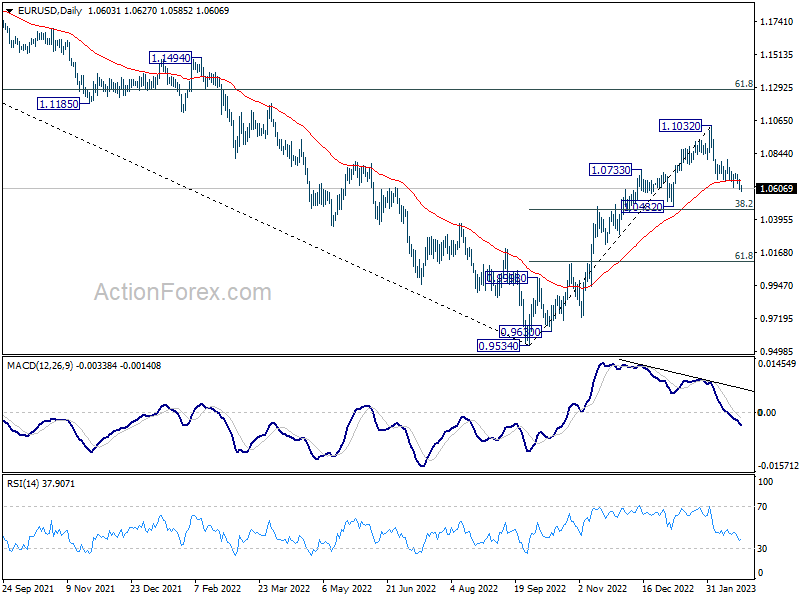
Intraday bias in EUR/USD remains on the downside. Corrective decline from 1.1032 is in progress for 38.2% retracement of 0.9534 to 1.1032 at 1.0463. Strong support should be seen around there to bring rebound, at least on first attempt. On the upside, above 1.0703 minor resistance will turn intraday bias neutral first. But risk will continue to stay on the downside as long as 1.0803 resistance holds.
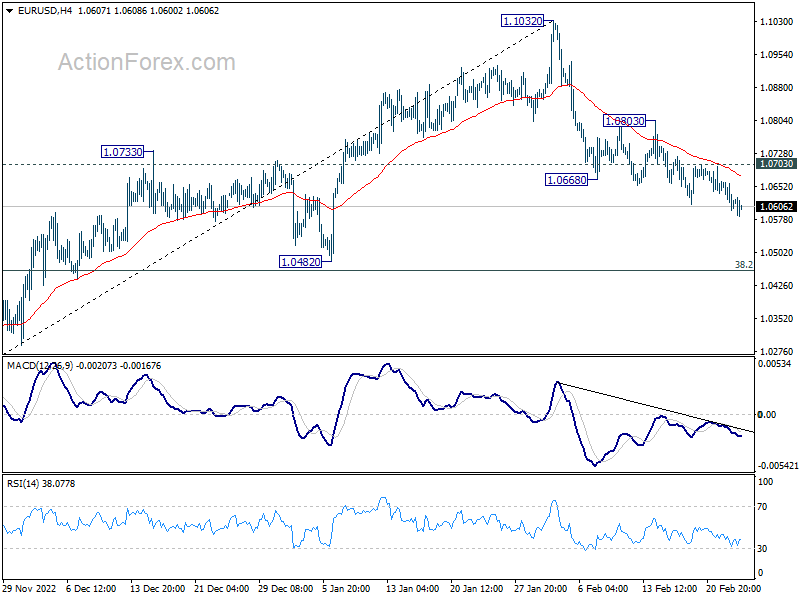
In the bigger picture, the rally from 0.9534 low (2022 low) is a medium term up trend rather than a correction. Further rise is in favor to 61.8% retracement of 1.2348 (2021 high) to 0.9534 at 1.1273 next. This will remain the favored case as long as 1.0482 support holds.