Sample Category Title
Fed Would Much Rather Implement a Rate Hike Too Much
Markets
Minutes of the early February FOMC meeting didn’t reveal much new yesterday following last week’s revelation by St. Louis Fed Bullard and Cleveland Fed Mester (both non-voters this year). They argued against downshifting the tightening pace from 50 bps to 25 bps at that meeting and will do so again in March. FOMC Minutes effectively referred to “a few” in favor of or agreeing to support a 50 bps step. A number of participants also observed that a policy stance that proved insufficiently restrictive could halt recent progress in moderating inflationary pressures, in another sign that the Fed would much rather implement a rate hike too much rather than stopping too early. Speeches by Fed governors this year suggested that the median expected policy rate peak for this year will be lifted in the March “dot plot” compared to December. The median peak rate was 5-5.25% though already 7 out of 19 governors expected it to be at least 25 bps higher. A final passage worth mentioning was one on financial conditions, given Chair Powell’s somewhat off the mark remarks on the topic at the Q&A session (suggestion that they had tightened despite weaker dollar, yield correction and stock surge). Some officials at the meeting observed that any continued easing in financial conditions could require the Fed to raise rates to higher levels or keep them at higher levels for longer than anticipated. The post-Minutes market reaction was muted overall, with the exception of an underperformance at the front end of the US Treasury curve which eventually helped the dollar close on the intraday highs and stocks at the intraday low. Daily changes on the US yield curve varied between -1.2 bps (3-yr) and -5.9 bps (30-yr). The US 10-yr yield is still pushing to get beyond 3.9% resistance on a sustained basis. German yield changes ranged between -2.8 bps (2-yr) and -0.9 bps (10-yr) with a strange underperformance of the very long end of the curve (30-yr: +4.2 bps). EUR/USD closed the session at 1.0605 from an open at 1.0648. It’s the weakest close for the pair since January 5 which, slowly but gradually, creeps towards 1.0484/66 support. The trade-weighted greenback (DXY) tested the February high at 104.67. Main US equity benchmarks closed near opening levels. NY Fed Williams in a speech after US close on inflation said that strong demand in the US economy continues to exceed supply, pointing to persistent price pressures in the services sector, excluding food, energy and shelter. Continued demand for goods, as well as ongoing supply-chain issues in the global economy, may keep prices from falling as quickly as some have expected. Today’s eco calendar is extremely thin with only final EMU CPI data, weekly jobless claims and some central bank speeches. In such context, the proximity of key technical levels (in yield terms) might prevail as market driver.
News Headlines
The central bank of South Korea this morning for the first time in year kept the policy rate steady (at 3.5%). The status quo was expected with two members already voting against the rate hike at the previous meeting. But Governor Rhee was keen to stress that today’s decision shouldn’t be seen as the official end to the rate-hike stance. Indeed, one member dissented, voting for a 25 bps increase. And when he polled the board, five members were open to a peak policy rate of 3.75%, two more than in the January meeting. Just one board member favoured having 3.5% as the terminal rate, down from three people last month. The BoK’s updated forecasts differ little from the November projections. Growth for this year and the next is seen at 1.6% and 2.4% vs 1.7% and 2.3% before. Inflation forecasts for 2023 and 2024 stand at 3.5% and 2.6% (vs 3.6% and 2.5%). The South Korean won strengthens on the idea of a higher terminal rate than what was expected after the January meeting. USD/KRW drops below 1300.
Inflation in Singapore rose 6.6% Y/Y on a 0.2% M/M increase in January. That’s faster than in December (6.5%) though below the peak seen in August (7.5%). Core inflation (excluding private road transport and accommodation costs but including food and fuel) jumped from 5.1% in December to 5.5%. The acceleration was largely due to one-offs including a sales tax hike and seasonal effects and was also below analyst estimates. That said, with core inflation at the fastest in 14 years, the Monetary Authority of Singapore is likely to keep the policy stance tight at its April policy meeting. MAS sets policy through the exchange rate instead of using interest rates. The Singapore dollar is trading stable against the US dollar his morning at around but just below USD/SGD 1.34.
Nasdaq Futures Boosted by Nvidia
Hawkish were the minutes from the latest FOMC meeting. They confirmed that the Federal Reserve (Fed) officials are indeed not lying when they say that they will continue hiking the interest rates to tame inflation toward the 2% mark.
And the minutes show that they reckon it will take ‘some time’.
How much time? We don’t know. Even they don’t know.
But we know that the job is not done yet, and the next meeting’s 25bp increase won’t be the last one.
We also know that most officials remain favourable for small increases – for longer. But some think that a 50bp hike would be appropriate. The odds for a 50bp hike for the March FOMC meeting now climbed to 24%.
But more importantly, odds for a peak Fed rate went from 4.90% at the start of the year to around 5.36% yesterday after the release of the latest minutes. There is no more expectation of a rate cut before the year end – which was anyway a bit out of context.
Of course, the latest minutes came as no surprise, and investors had already cut their dovish positioning the day before the release. This is certainly why the market reaction to the minutes wasn’t bloody.
Both the US 2 and 10-year yields bounced lower from early-week highs. A part of it was perhaps explained by the rising tensions between the US and China after China said that their relation with Russia is ‘rock solid’.
The S&P500 eased another 0.16% and flirted with the 50-DMA support. The next important support range is the 3925/3940 band, which includes the 200-DMA and the major 38.2% Fibonacci retracement that should distinguish between the actual positive trend, and a medium-term bearish reversal.
Nasdaq 100 stocks on the other hand tipped a toe into the bearish consolidation zone, but managed to close yesterday’s session above this level.
Nvidia boosts Nasdaq futures
US equity futures are in the positive this morning, with Nasdaq futures leading gains at the time of writing.
The tech-heavy index is certainly boosted by an almost 9% jump in Nvidia shares in the afterhours trading, after the company announced soft, but better than expected results. The gaming revenue collapsed by nearly 50%, but the data center revenue increased 11%, and that segment includes the … AI chips!
The company CEO said The Thing that investors wanted to hear: ‘AI is at an inflection point, setting up for broad adoption reaching into every industry’ and they ’are seeing accelerated interest in the versatility and capabilities of generative AI from startups to major companies’.
And even if JP Morgan banned ChatGPT at its offices – as a part of standard procedure - the AI is certainly here to stay, and Nvidia here to surf on the wave.
But the outlook for the rest of the stock market doesn’t look as brilliant as Nvidia, nor as it did at the start of the year. High inflation and hawkish Fed hammer optimism on strong economic data.
What do we wish for at today’s US GDP update?
The US GDP is expected to have expanded 2.9% in the Q4, which is a fairly strong number. A read above expectations will certainly boost the Fed hawks on the idea that the US economy is resilient enough to withstand more hikes and could be bad news for stock investors. Even though a strong economy is good news per se, the Fed hawks are in charge of the market, and equity bulls may not have enough strength to get back on their feet on a strong GDP read.
A number below expectations however could ease the hawkish Fed tensions. But the days when bad news was good news are gone. At this point, we can’t really bet that a soft growth would soften the Fed’s hand. Only soft inflation could do so.
FX and energy
The US dollar consolidates gains. Although the rebound looks contained, the dollar index is now above the minor 23.6% Fibonacci retracement on the end of September to the beginning of February selloff.
The EURUSD briefly stepped below the 1.06 mark yesterday, then rebounded. The Eurozone January inflation figures are out this morning, and the expectation is that inflation in Europe eased to around 8.5% last month, thanks to softer energy prices and stronger euro.
A higher-than-expected read could revive the European Central Bank (ECB) hawks, but the ECB hawks are powerless when the Fed hawks are flying in the skies. Therefore, the EURUSD is somehow set to extend losses faced with the stronger Fed hike expectations.
One good piece of news for the euro area is that the Europeans have successfully lowered their gas demand since last summer. They consumed 19% below the 5-year average. Finland even halved its consumption. A part of it was thanks to the strong willpower to show Russia that the continent could survive without their gas. But a part of it was due to a lucky, mild winter. Weather experts expect a few cold days ahead, but at this point, Europe likely has enough reserves to avoid an energy shortage.
As a result, the European nat gas prices remain under pressure, which is certainly one of the reasons why crude oil remains under decent selling pressure as well. The barrel of American crude sank below the $75pb yesterday, as the latest API data showed an almost 10mio barrel increase in the US oil inventories last week. The more official EIA data is due today but will hardly want the oil bulls’ heart.
Financial Conditions Tighten Again
Market movers today
It will be a quiet day on the data front but we do get the euro area final CPI figures for January, including details for different components. In the US, it is time for the second release for the Q4 GDP.
The central bank of Turkey (CBRT) is expected to cut rates by 100bp to 8.0% today. Under political pressure, the CBRT has been one of the few central banks globally that has kept their dovish bias. They have been on hold since November but now they are expected to resort to cuts again as a part of the government's response on the devastating earthquakes a few weeks back which affected provinces that account for app. 10% of the nation's output.
ECB's de Cos and FOMC members Bostic and Daly are scheduled to speak today.
The 60 second overview
Pricing in 'higher for longer' still remains the name of the game. Compared to a month ago, markets are currently pricing in a 50bp higher peak rate for the Fed and 30bp higher peak for the ECB. Same time, markets have basically priced out any expectations of rate cuts for later this year. As often, volatility in rates and bond markets has coincided with a negative sentiment in the stock market while in FX markets USD has again gained traction.
FOMC minutes: The February FOMC minutes came out slightly on the hawkish side. While most of the discussion on economic developments was outdated in light of the recent upbeat data, the minutes revealed that 'a few' participants had favoured a larger 50bp hike. Furthermore, all participants expected further rate hikes in coming meetings, despite the fact that markets had speculated on a pause in March prior to the meeting. Some participants also noted that the pre-meeting easing in financial conditions could warrant a tighter monetary policy stance, even though Powell has downplayed the risk in the past. Markets responded by pricing in a slightly higher probability of a 50bp hike in March, and EUR/USD touched below 1.06 for the first time since early January. That said, we still look for a 25bp hike in the Fed's March meeting, and see a longer hiking cycle (into summer) as more likely than a return back to larger hikes.
Bank of Korea kept its policy rate unchanged at 3.5% this morning as widely expected but left the door open for further hikes. The Korean economy declined in Q4 last year and house prices are falling rapidly.
FI: The minutes from the FOMC meeting showed that the Federal Reserve is likely to raise rates until they are confident that inflation "was a sustained downward path to 2%". The minutes also showed that they prefer to move in steps of 25bp rather than 50bp although a few members would prefer 50bp. The reaction in the US bond and rates markets was limited despite the hawkish "twist".
FX: In a relatively quiet session yesterday primarily the late USD move higher set the scene with EUR/USD falling to 1.06. AUD, SEK and GBP had a fairly weak session yesterday although losses were contained vs EUR. EUR/SEK has bounced slightly off the 11.00-threshold while EUR/NOK keeps trading south of the same level leaving NOK/SEK just north of parity.
Credit: Following the widening on Tuesday, CDS indices held broadly stable yesterday with iTraxx Main ending the day at 81bp (-1bp) and Xover at 419bp (-6bp). In the primary market Danish utility company Ørsted took centre stage by launching an EUR deal with a total volume of EUR2bn split on three green tranches. Demand was decent with combined books closing at over EUR5.2bn. Other than that no issuance took place in the EUR corporate market.
Nordic macro
The Swedish Debt Office will release its new borrowing forecast at 09.30 CET followed by a press conference at 10.00 CET. We believe that the total borrowing requirement will be relatively unchanged for 2023 at this point given the surplus carried over from 2022, but if anything we see upside risks for 2023. We would find it reasonable for the Debt Office to shift from T-bills to SGBs in its borrowing plan, but it is possible this will have to wait until the May update.
Riksbank Deputy Governor Martin Flodén will hold a lunch talk on the economic situation and current monetary policy at 12.00 CET. This will not be published on the website but look out for potential flashes.
GBP/JPY Daily Outlook
Daily Pivots: (S1) 162.09; (P) 162.84; (R1) 163.29; More...
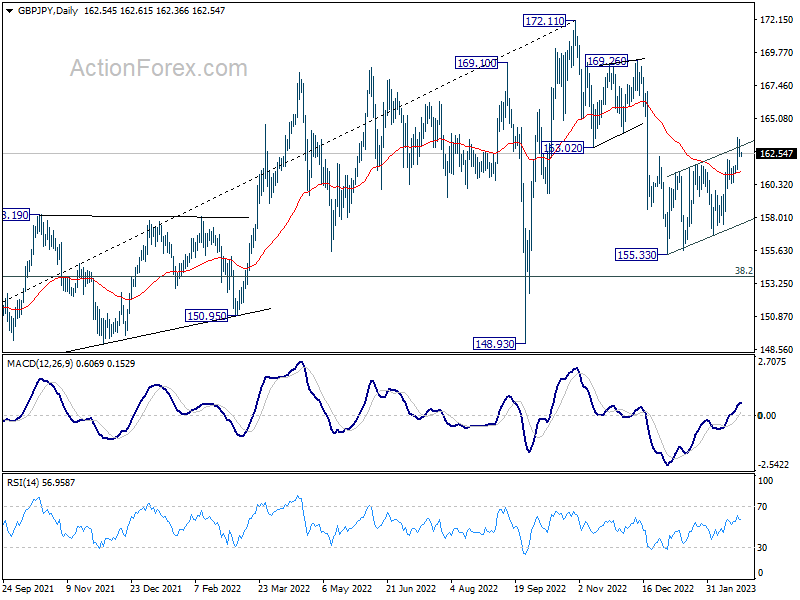
Intraday bias in GBP/JPY is turned neutral with a temporary top formed at 163.73. The favored case is still that correction from 172.11 has completed with three waves down to 155.33. Above 163.73 would resume the rebound from1 55.33 to 169.26/172.11 resistance zone. However, break of 160.44 minor support will dampen this case and bring retest of 155.33 low instead.
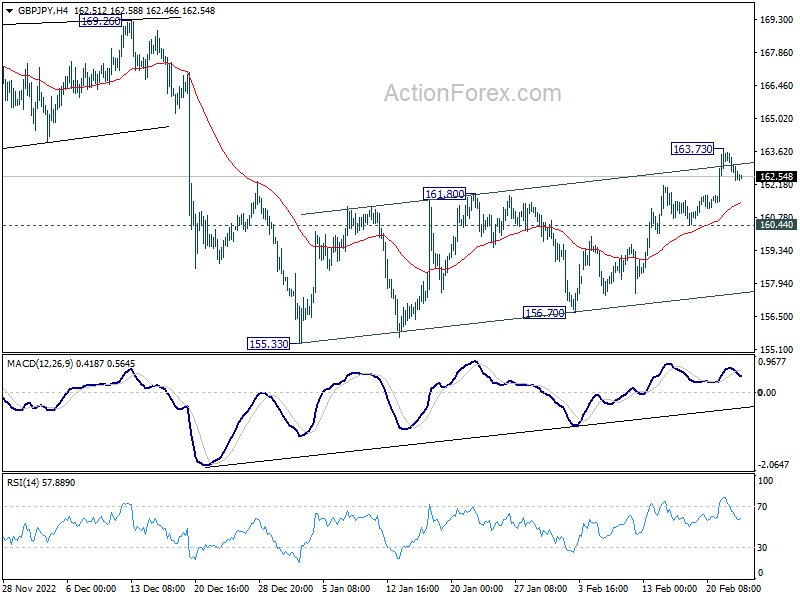
In the bigger picture, corrective decline from 172.11 medium term should have completed at 155.33. With 38.2% retracement of 123.94 to 172.11 at 153.70 intact, medium term bullishness is retained. That is, larger up trend from 123.94 (2020 low) is still in progress. Break of 172.11 high to resume such up trend is expected at a later stage.
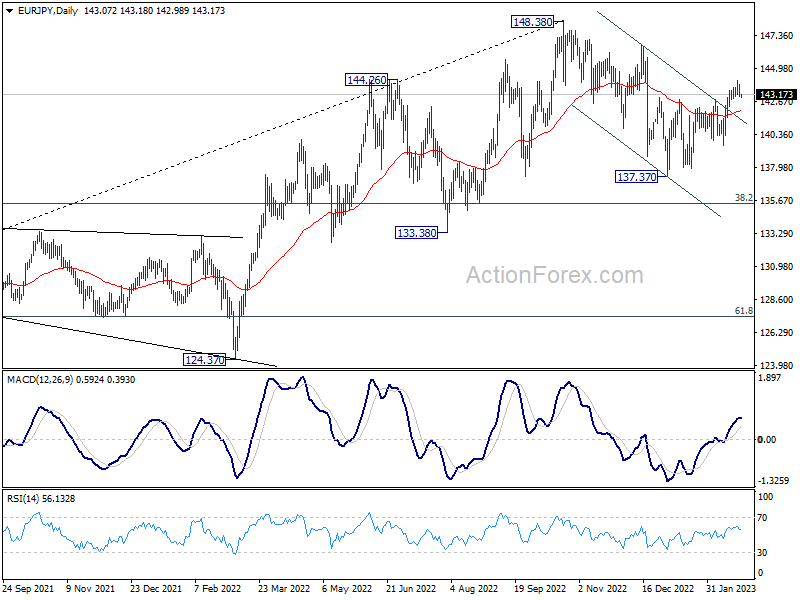
EUR/JPY Daily Outlook
Daily Pivots: (S1) 142.80; (P) 143.35; (R1) 143.64; More....
A temporary top should be made at 144.15 and intraday bias in EUR/JPY is turned neutral first. For now, the favored case is that whole corrective fall from 148.38 has completed at 137.37. Break of 144.15 will extend the rebound from 137.37 to 146.71 resistance next. However, sustained trading below 55 day EMA (now at 141.99) will argue that the correction from 148.38 is still in progress and target 137.37 low again.
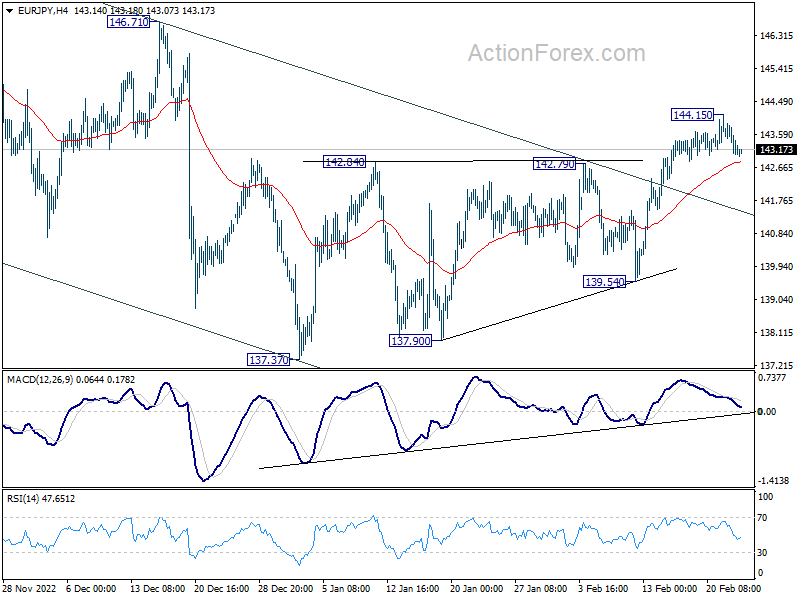
In the bigger picture, as long as 55 week EMA (now at 139.03) holds, larger up trend from 114.42 (2020 low) is still in progress for 149.76 long term resistance. However, firm break of 55 week EMA will bring deeper fall to 38.2% retracement of 114.42 to 148.38 at 135.40. Sustained break there will raise the chance of trend reversal, and target 61.8% retracement at 127.39.
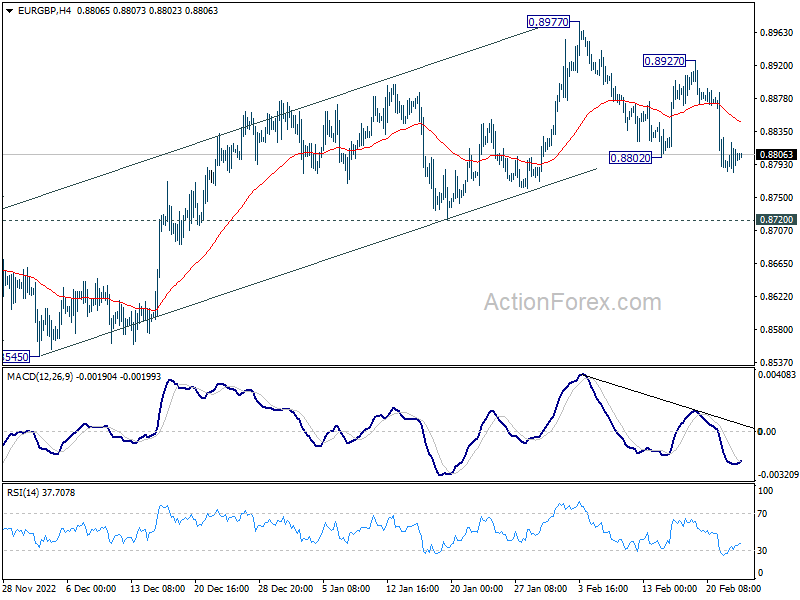
EUR/GBP Daily Outlook
Daily Pivots: (S1) 0.8785; (P) 0.8803; (R1) 0.8823; More...
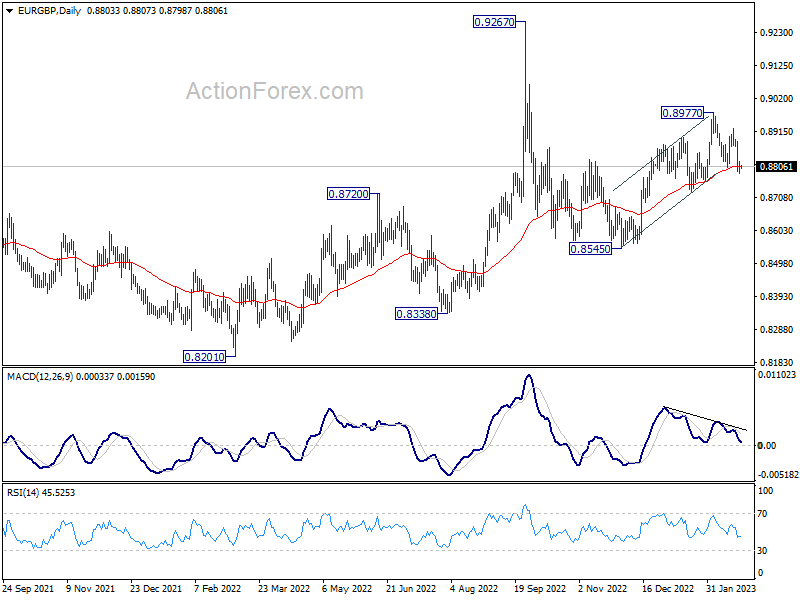
Intraday bias in EUR/GBP remains mildly on the downside for the moment. Fall from 0.8977 would target 0.8720 support first. Decisive break there will argue that whole rebound from 0.8545 has completed, and bring retest to this low. For now, risk will stay on the downside as long as 0.8927 resistance holds, in case of recovery.
In the bigger picture, focus is back on 55 day EMA (now at 0.8804). Sustained trading below there will argue that fall from 0.9267 is in progress. Such decline is seen as a leg inside long term range pattern from 0.9499 (2020 high). Break of 0.8545 will pave the way back to 0.8201 (2022 low).
EUR/AUD Daily Outlook
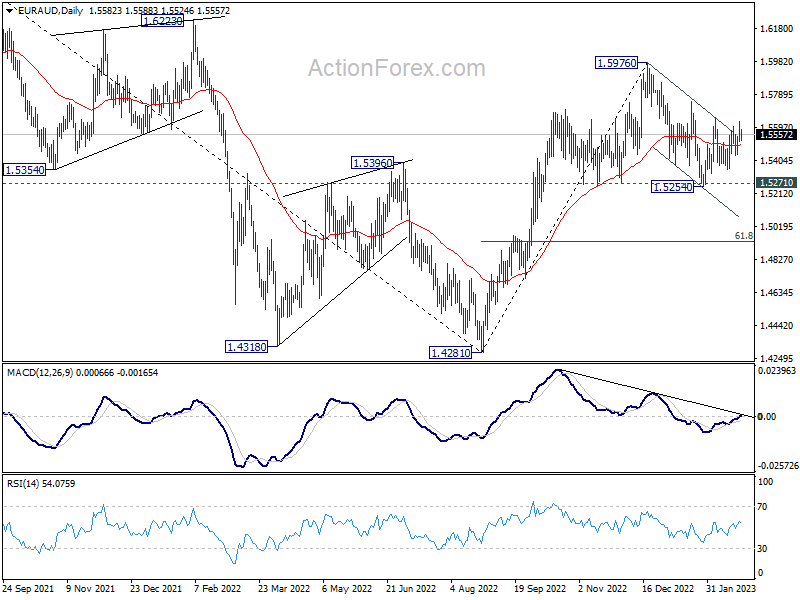
Daily Pivots: (S1) 1.5523; (P) 1.5578; (R1) 1.5639; More...
Intraday bias in EUR/AUD remains neutral for the moment. On the upside, break of 1.5650 resistance will revive that case that correction from 1.5976 has completed at 1.5254. Intraday bias will be back on the upside for 1.5749 resistance first. On the downside, firm break of 1.5254/71 will carry larger bearish implication and resume the fall from 1.5976.
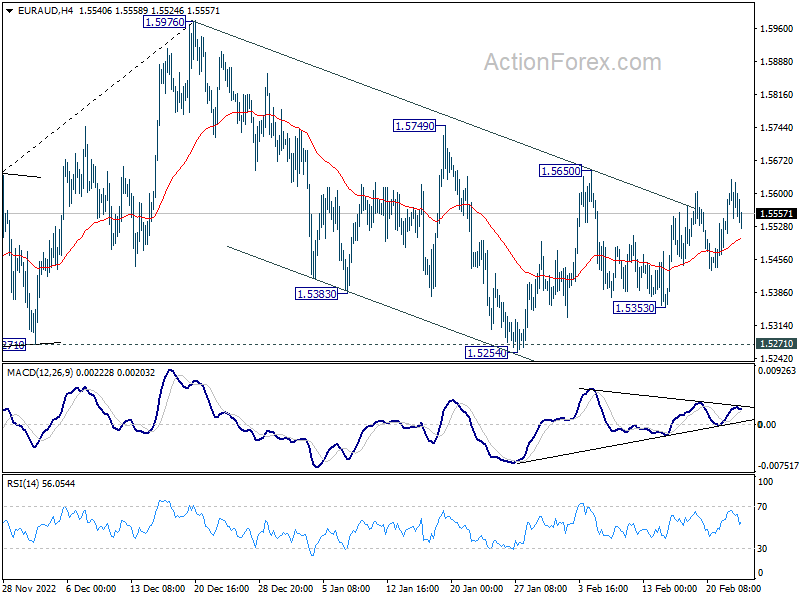
In the bigger picture, it's still early to confirm if rise from 1.4281 represents bullish trend reversal. But as long as 1.5271 support holds, such rally is in favor to continue. Break of 1.5976 will target 1.6434 key resistance next. On the other hand, firm break of 1.5271 will retain medium term bearishness instead.
EUR/CHF Daily Outlook
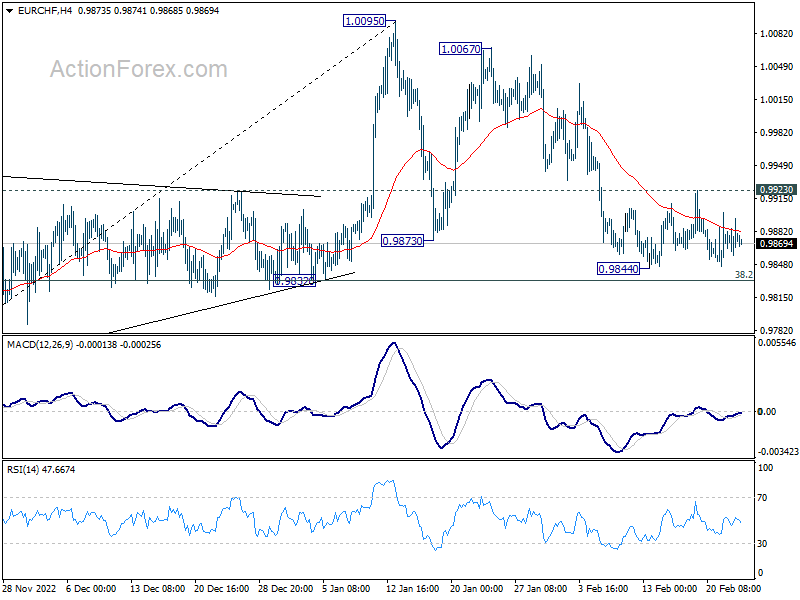
Daily Pivots: (S1) 0.9859; (P) 0.9878; (R1) 0.9896; More....
Range trading continues in EUR/CHF and intraday bias remains neutral. In case of another fall, downside should be contained by 38.2% retracement of 0.9407 to 1.0095 at 0.9832, to complete the corrective pattern from 1.0095. Break of 0.9923 will turn bias back to the upside for stronger rebound towards 1.0067/0095 resistance zone.
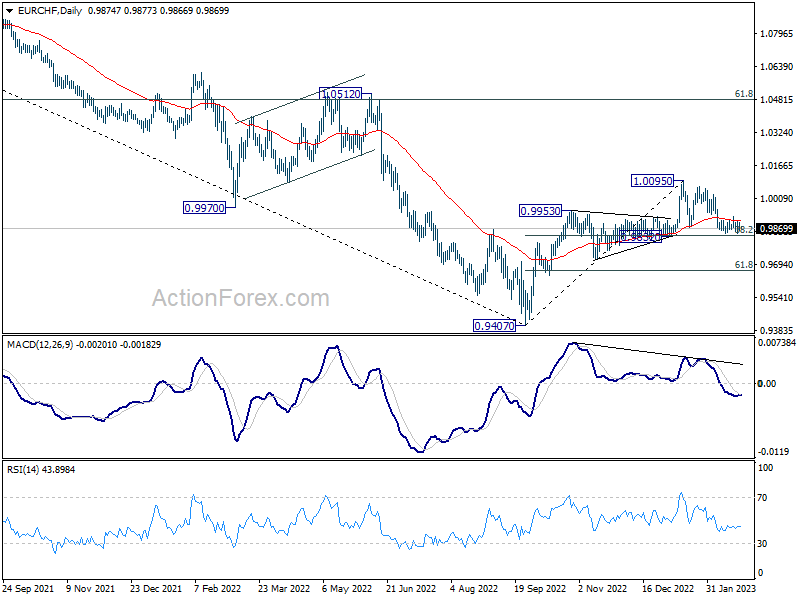
In the bigger picture, the rejection by 55 week EMA (now at 1.0025) mixed up the outlook. On the upside, sustained trading above 55 week EMA will raise the chance of bullish trend reversal. Rise from 0.9407 should then target 1.0505 cluster resistance (2020 low at 1.0505, 61.8% retracement of 1.1149 to 0.9407 at 1.1484). However, firm break of 0.9832 support will revive medium term bearishness and bring retest of 0.9407 low instead.
USD/CAD Daily Outlook
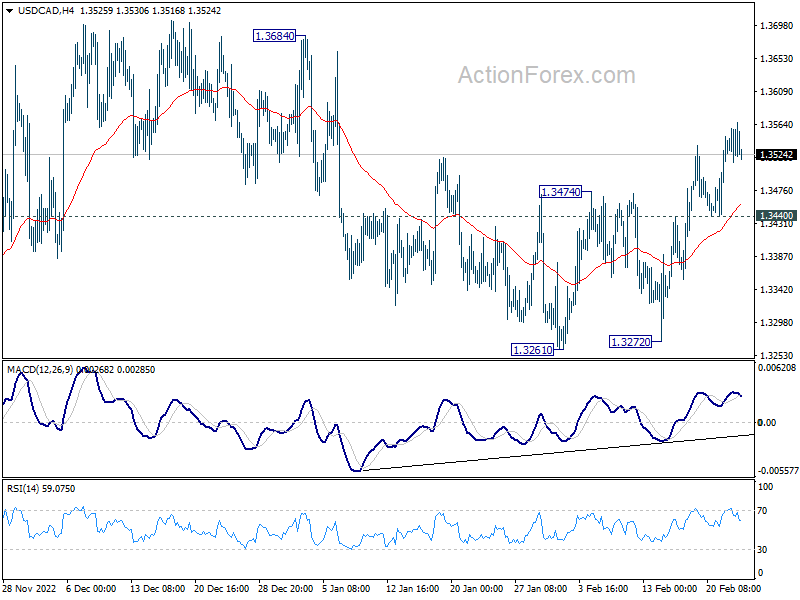
Daily Pivots: (S1) 1.3521; (P) 1.3545; (R1) 1.3575; More....
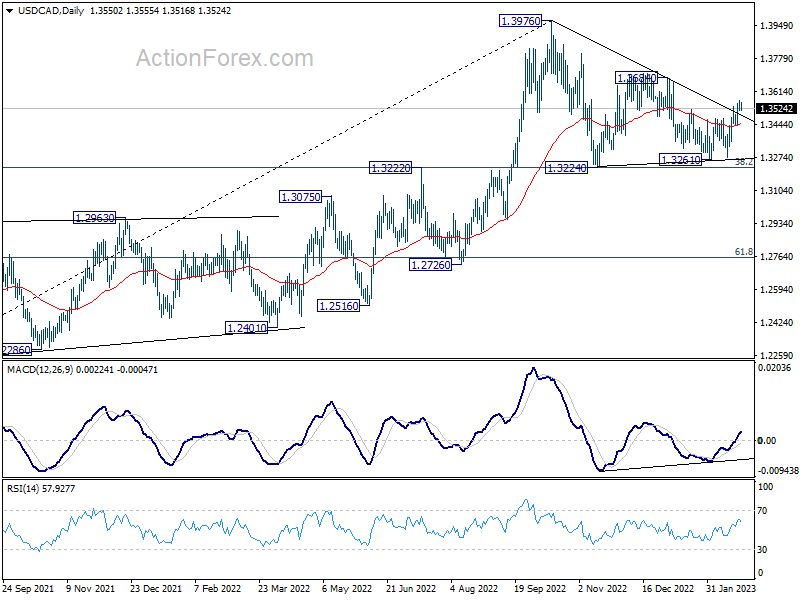
Intraday bias in USD/CAD remains on the upside as rebound from 1.3261 is still in progress. Further rally should be seen to 1.3684 resistance first. Sustained break there will pave the way back to retest 1.3976 high. On the downside, however, break of 1.3440 support will dampen this bullish cas and turn intraday bias neutral first.
In the bigger picture, as long as 1.3222 cluster support (38.2% retracement of 1.2005 to 1.3976 at 1.3223) holds, larger up trend from 1.2005 (2021 low) is still expected to resume through 1.3976 high at a later stage. However, firm break of 1.3222/3 will indicate that the trend might have reversed. Deeper fall would be seen to next cluster support at 1.2726 (61.8% retracement at 1.2758).
AUD/USD Daily Report
Daily Pivots: (S1) 0.6778; (P) 0.6822; (R1) 0.6848; More...
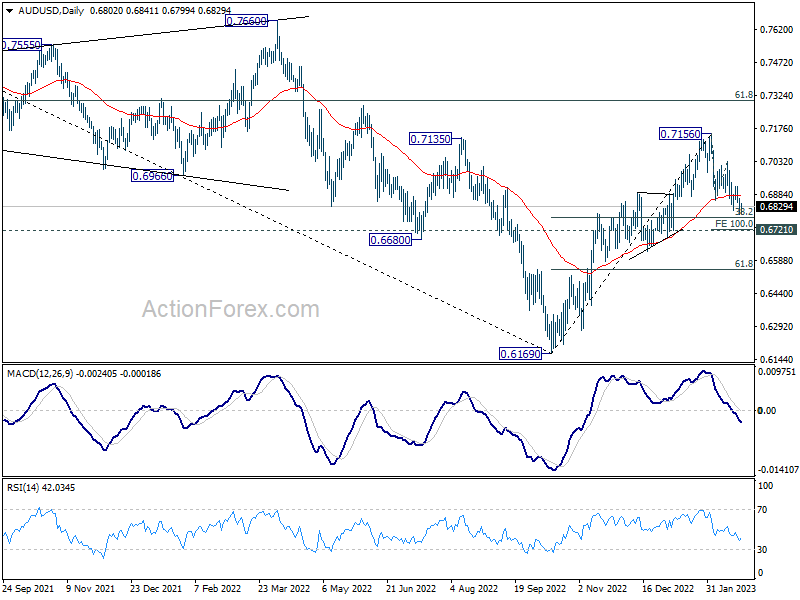
AUD/USD's fall from 0.7156 resumed by breaking 0.6810 and intraday bias is back on the downside. Deeper decline would be seen to 100% projection of 0.6854 to 0.7028 from 0.6854 at 0.6736, which is close to 0.6721 key structural support. Strong support is expected there to bring rebound. But for now, risk will stay on the downside as long as 0.6919 minor resistance holds, in case of recovery.
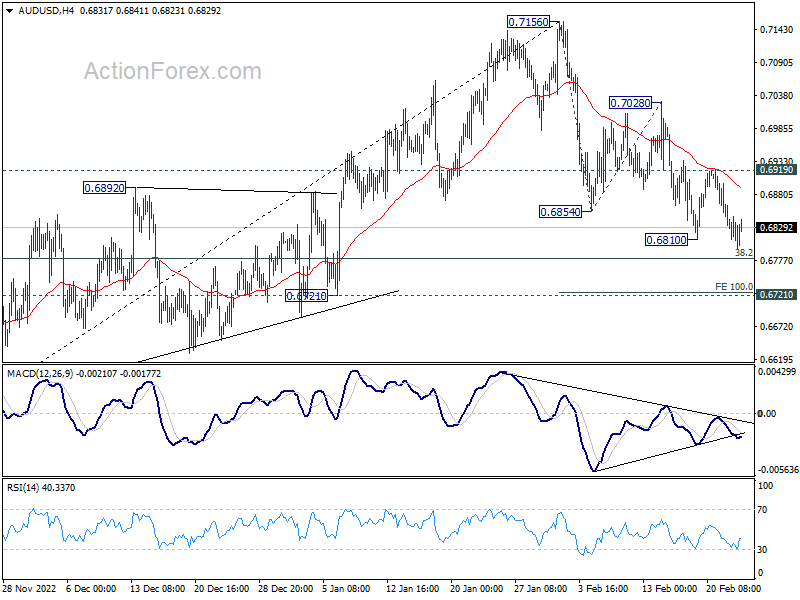
In the bigger picture, corrective decline from 0.8006 (2021 high) should have completed with three waves down to 0.6169 (2022 low). Further rally should be seen to 61.8% retracement of 0.8006 to 0.6169 at 0.7304. Sustained break there will pave the way to retest 0.8006. This will now remain the favored case as long as 0.6721 support holds.