Sample Category Title
Crude Oil Price Remains Supported As US GDP Approaches
Key Highlights
- Crude oil price is facing resistance near the $82.40 zone.
- A key bullish trend line is forming with support near $79.25 on the 4-hours chart.
- Gold price is consolidating gains above the $1,920 support zone.
- The US GDP could grow 2.6% in for Q4 2022 (Preliminary), down from 3.2%.
Crude Oil Price Technical Analysis
Crude oil price remained strong above the $76.50 resistance against the US Dollar. The price extended gains above the $80.00 resistance zone before it faced sellers.
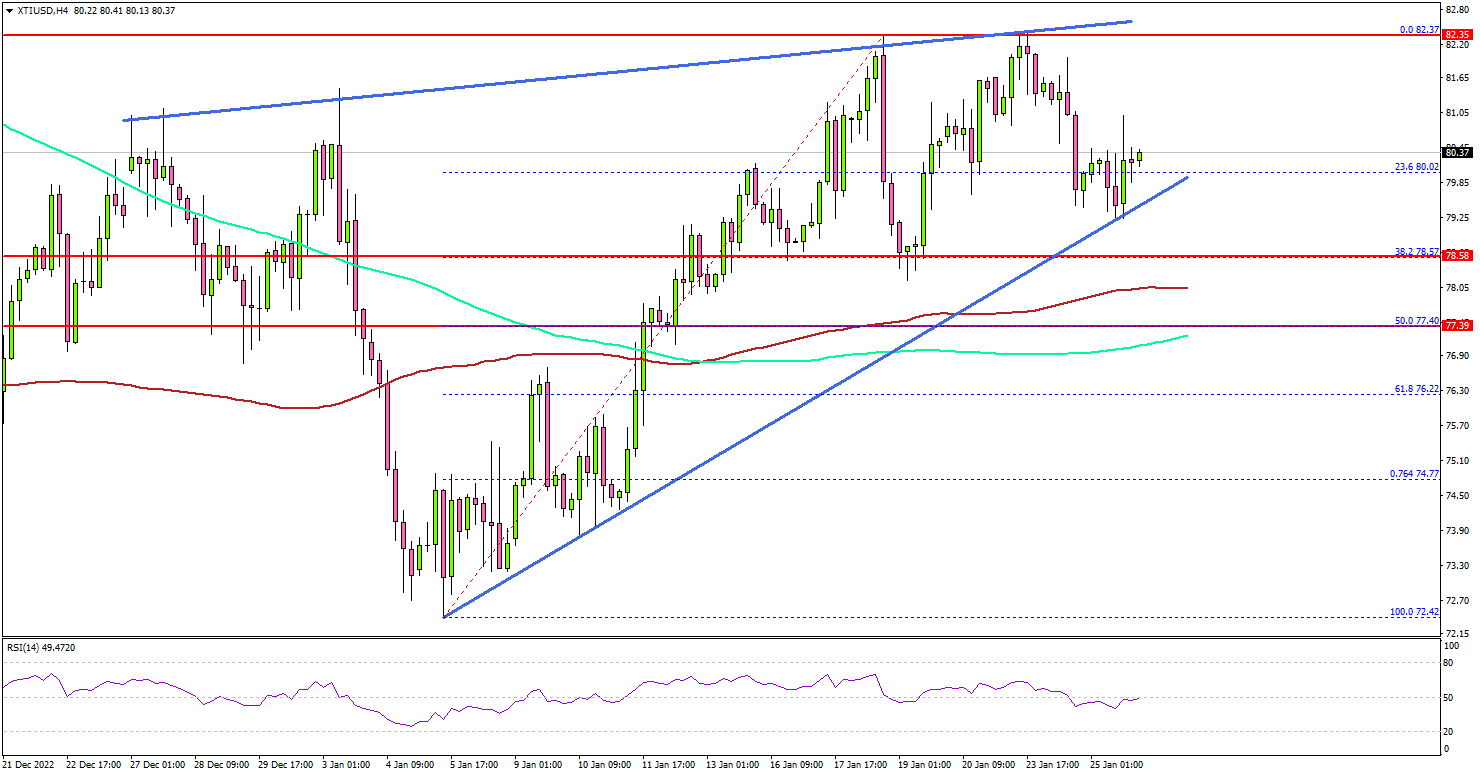
Looking at the 4-hours chart of XTI/USD, the price traded as high as $82.37. Recently, there was a downside correction below the $81.20 support, but the price stayed well above the 100 simple moving average (red, 4-hours) and the 200 simple moving average (green, 4-hours).
There is also a key bullish trend line forming with support near $79.25 on the same chart. On the upside, the price is facing resistance near the $81.20 zone.
The next major resistance is near the $82.40 zone. A clear move above the $82.40 resistance could open the doors for another steady increase towards $85 or even $88.
If not, the price might drop again from $81.20. An immediate support is now forming near the $79.50 zone. The next major support sits near the $77.40 level. Any more losses might call for a test of the $76.20 support zone in the coming days.
Looking at gold price, the bulls are in action above the $1,920 level and they might aim more gains in the near term.
Economic Releases to Watch Today
- US Durable Goods Orders for Dec 2022 – Forecast +2.5% versus -2.1% previous.
- US Gross Domestic Product for Q4 2022 (Preliminary) – Forecast 2.6% versus previous 3.2%.
GBPNZD Wave Analysis
- GBPNZD reversed from support level 1.9000
- Likely to rise to resistance level 1.9330
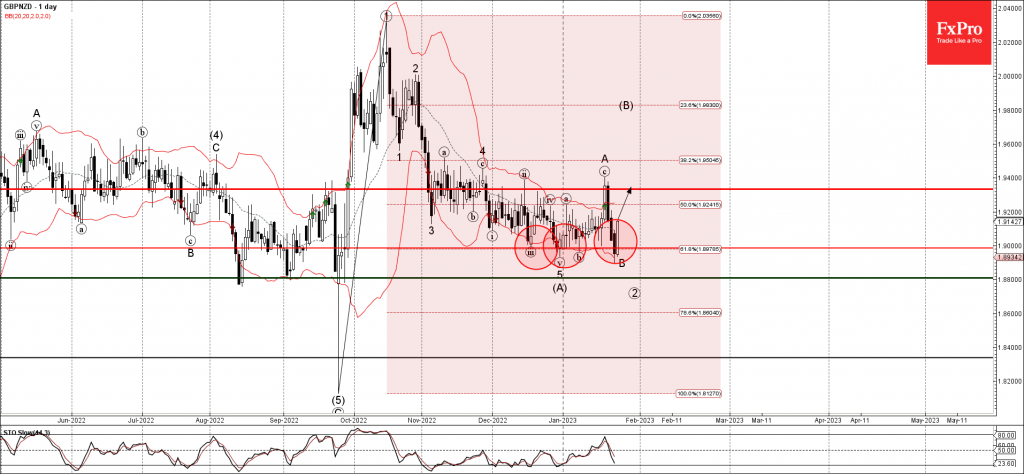
GBPNZD currency pair recently reversed up from the round support level 1.9000 (which has been reversing the price from December) intersecting with the lower daily Bollinger Band and the 61.8% Fibonacci retracement of the previous upward impulse from September.
The upward reversal from the support level 1.9000 stopped the B-wave of the previous ABC correction (B).
GBPNZD currency pair can be expected to rise further toward the next resistance level 1.9330 (which stopped the previous waves (ii) and A).
EURNZD Wave Analysis
- EURNZD reversed from support level 1.670
- Likely to rise to resistance level 1.7000
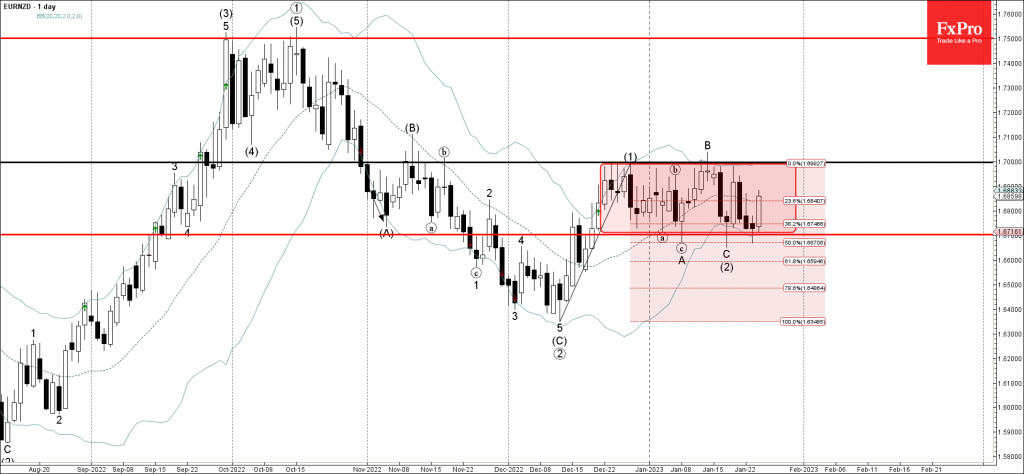
EURNZD currency pair recently reversed up from the key support level 1.670 (which stopped the previous waves (a), A and (2)) intersecting with the lower daily Bollinger Band and the 38.2% Fibonacci correction of the previous sharp upward impulse (1) from December.
The upward reversal from the support level 1.670 continues the active intermediate impulse wave (C)
EURNZD currency pair can be expected to rise further toward the next resistance level 1.7000 (top of the sideways price range inside which the pair has been moving from December).
Bank of Canada delivers a final 25 basis point hike
The Bank of Canada (BoC) raised the overnight rate to 4.5%, while stating that it will continue with Quantitative Tightening (QT).
On rising prices, it stated that "inflation is projected to come down significantly this year. Lower energy prices, improvements in global supply conditions, and the effects of higher interest rates on demand are expected to bring CPI inflation down to around 3% in the middle of this year and back to the 2% target in 2024."
On economic growth, the Bank stated that "recent economic growth has been stronger than expected and the economy remains in excess demand. Labour markets are still tight…However, there is growing evidence that restrictive monetary policy is slowing activity, especially household spending."
On the future path of policy, the Bank noted that "if economic developments evolve broadly in line with the MPR outlook, Governing Council expects to hold the policy rate at its current level while it assesses the impact of the cumulative interest rate increases."
Key Implications
The BoC's first meeting of 2023 looks to be the last in which it will raise its policy rate. Heading into today, the Bank had communicated that it could go either way with today's decision - deciding between a final hike or a pause. Given the robustness of consumer spending and employment trends, the BoC clearly felt it needed this final hike to solidify the turn in economic momentum.
Looking at the Bank's forecast, the economy is set for a consumer led slowdown, with GDP likely to "stall through the middle of 2023." Greater conviction in this has also led the BoC to cut its inflation forecast. With the belief that the economy is on the path to price stability, the BoC can now step to the sidelines and let its restrictive policy filter through the economy. Though it does have the option to hike again should inflation prove uncooperative, we are expecting it to hold rates at this level for most of 2023, before cutting at the end of the year to drive a better balance between interest rates being too far in restrictive territory and a weakening economy.
BoC hikes 25bps, confirms a pause
BoC raises overnight rate by 25bps to 4.50% as widely expected. The Bank Rate and deposit rate are also lifted to 4.75% and 4.50% respectively.
In the statement, BoC said, "If economic developments evolve broadly in line with the MPR outlook, Governing Council expects to hold the policy rate at its current level while it assesses the impact of the cumulative interest rate increases."
That is, a pause is going to follow. But, BoC is still "prepared to increase the policy rate further if needed to return inflation to the 2% target."
BoC also noted, that recent economic growth has been "stronger than expected" with the economy remains in "excess demand" Labor markets are "still tight". But there is "growing evidence that restrictive monetary is slowing activity". It expects the effects of tightening to "continue to work through the economy" while weaker foreign demand will weigh on exports.
BoC projects growth of about 1% in 2023 and 2% in 2024. Inflation is projected to fall to around 3% in the middle of 2023, and then 2% in 2024.
(BOC) Bank of Canada increases policy interest rate by 25 basis points, continues quantitative tightening
The Bank of Canada today increased its target for the overnight rate to 4½%, with the Bank Rate at 4¾% and the deposit rate at 4½%. The Bank is also continuing its policy of quantitative tightening.
Global inflation remains high and broad-based. Inflation is coming down in many countries, largely reflecting lower energy prices as well as improvements in global supply chains. In the United States and Europe, economies are slowing but proving more resilient than was expected at the time of the Bank's October Monetary Policy Report (MPR). China's abrupt lifting of COVID-19 restrictions has prompted an upward revision to the growth forecast for China and poses an upside risk to commodity prices. Russia's war on Ukraine remains a significant source of uncertainty. Financial conditions remain restrictive but have eased since October, and the Canadian dollar has been relatively stable against the US dollar.
The Bank estimates the global economy grew by about 3½% in 2022, and will slow to about 2% in 2023 and 2½% in 2024. This projection is slightly higher than October's.
In Canada, recent economic growth has been stronger than expected and the economy remains in excess demand. Labour markets are still tight: the unemployment rate is near historic lows and businesses are reporting ongoing difficulty finding workers. However, there is growing evidence that restrictive monetary policy is slowing activity, especially household spending. Consumption growth has moderated from the first half of 2022 and housing market activity has declined substantially. As the effects of interest rate increases continue to work through the economy, spending on consumer services and business investment are expected to slow. Meanwhile, weaker foreign demand will likely weigh on exports. This overall slowdown in activity will allow supply to catch up with demand.
The Bank estimates Canada's economy grew by 3.6% in 2022, slightly stronger than was projected in October. Growth is expected to stall through the middle of 2023, picking up later in the year. The Bank expects GDP growth of about 1% in 2023 and about 2% in 2024, little changed from the October outlook.
Inflation has declined from 8.1% in June to 6.3% in December, reflecting lower gasoline prices and, more recently, moderating prices for durable goods. Despite this progress, Canadians are still feeling the hardship of high inflation in their essential household expenses, with persistent price increases for food and shelter. Short-term inflation expectations remain elevated. Year-over-year measures of core inflation are still around 5%, but 3-month measures of core inflation have come down, suggesting that core inflation has peaked.
Inflation is projected to come down significantly this year. Lower energy prices, improvements in global supply conditions, and the effects of higher interest rates on demand are expected to bring CPI inflation down to around 3% in the middle of this year and back to the 2% target in 2024.
With persistent excess demand putting continued upward pressure on many prices, Governing Council decided to increase the policy interest rate by a further 25 basis points. The Bank's ongoing program of quantitative tightening is complementing the restrictive stance of the policy rate. If economic developments evolve broadly in line with the MPR outlook, Governing Council expects to hold the policy rate at its current level while it assesses the impact of the cumulative interest rate increases. Governing Council is prepared to increase the policy rate further if needed to return inflation to the 2% target, and remains resolute in its commitment to restoring price stability for Canadians.
Information note
The next scheduled date for announcing the overnight rate target is March 8, 2023. The Bank will publish its next full outlook for the economy and inflation, including risks to the projection, in the MPR on April 12, 2023.
BoC Rates Could Alter The Trend on USDCAD and Others
Today, at 5:00 pm (GMT +2), the Bank of Canada will publish the Overnight Rate, which represents short-term interest rates, and is pivotal to the overall pricing of the Canadian Dollar in the global markets. Let's look at how the markets are faring ahead of the BoC rates release.
USDCAD
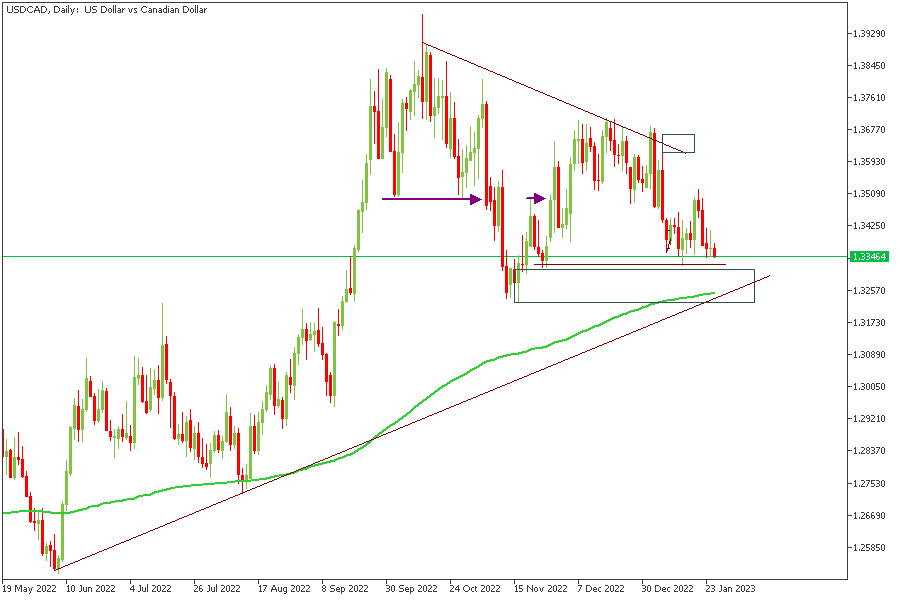
USDCAD is currently trading around a Daily drop-base-rally demand zone above the 200-EMA (Exponential Moving Average). The moving averages suggest that we are currently bullish on price action. Moreover, coupled with the trendline support, bullish break of structure (marked by the short arrowed line), and the demand zone region, we can expect a bullish reaction from the marked rectangular area.
GBPCAD
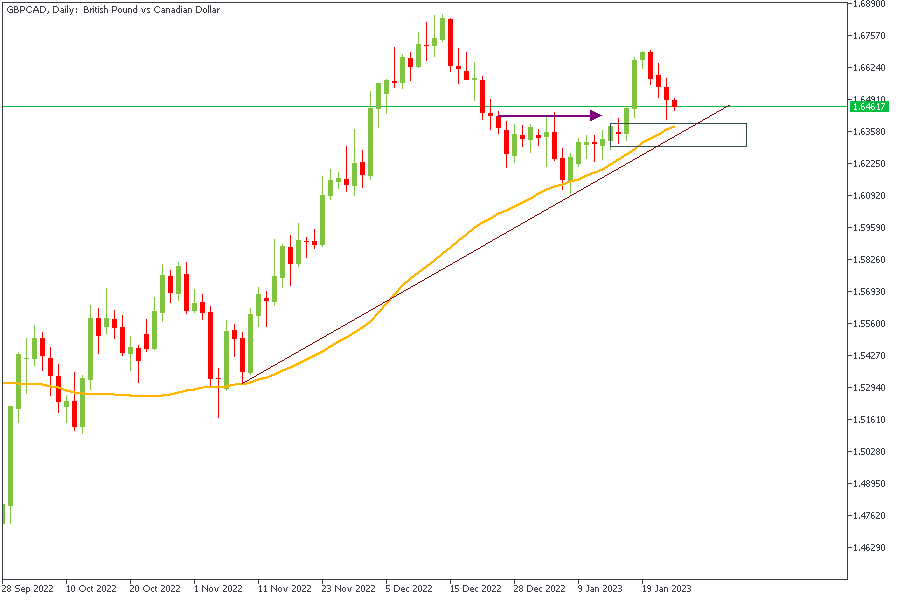
GBPCAD has recently broken structure bullish, as shown by the arrowed line to the left. There is also trendline support overlapping with the 50-SMA right around 61.8% of the Fibonacci retracement level. Thus, the price would deliver a bullish reaction from the marked demand zone.
EURCAD
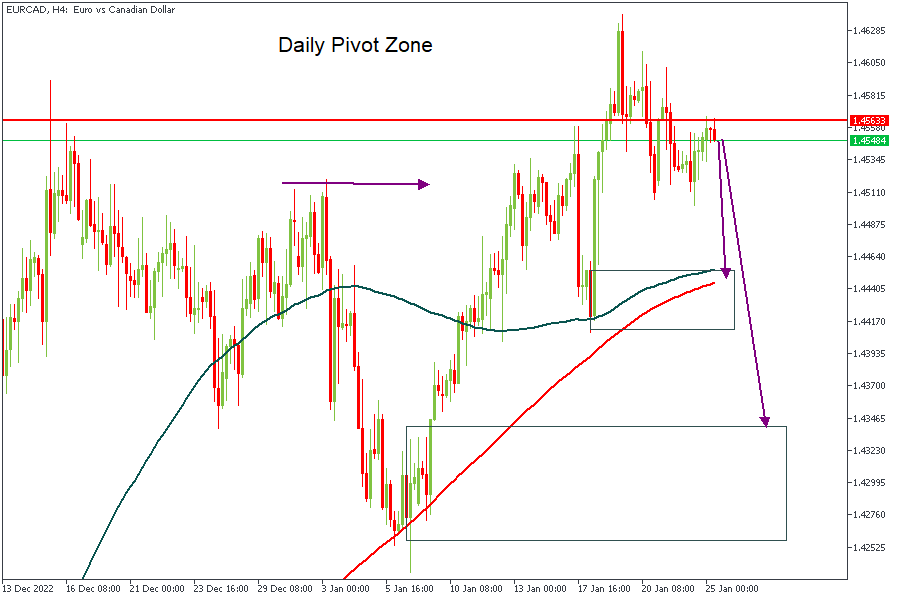
EURCAD has been trading around a Pivot zone on the Daily timeframe. Considering the bullish lay of the Moving Averages, we may not see the bearish move extend below 1.44640. The interest rates will bring clarity to the direction in the future.
AUDCAD
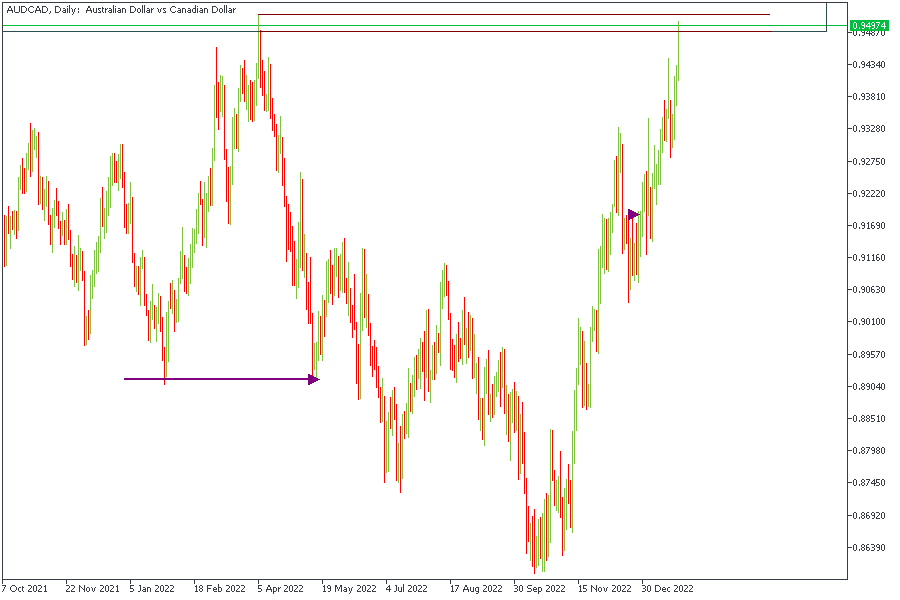
The daily timeframe of AUDCAD shows the price currently within a supply zone. It seems logical to expect some bearish relief from the last bullish run. My target for the bearish retracement would be 0.93810.
Analysts’ Expectations:
- Previous: 4.25%
- Forecast: 4.50%
CONCLUSION
The trading of CFDs comes at a risk. Thus, to succeed, you have to manage risks properly. To avoid costly mistakes while you look to trade these opportunities, be sure to do your due diligence and manage your risk appropriately.
ECB Makhlouf: Need to take similar steps to Dec in Feb and Mar
ECB Governing Council member Gabriel Makhlouf said, "We need to continue to increase rates at our meeting next week – by taking a similar step to our December decisions – and also at our March meeting, although our future policy decisions need to continue to be data-dependent given the prevailing uncertainty."
"Raising the policy rate also signals our commitment to price stability," Makhlouf added. "It sends a clear message that we will not allow inflation to stay above 2 per cent and helps to contain inflation expectations, guarding against the emergence of self-reinforcing inflation dynamics and tackling the risk of a persistent increase in inflation expectations."
Separately, Bundesbank President Joachim Nagel said, "For February and March, we have announced that we will raise interest rates sharply again. Then we will look at where the inflation rate is in the spring and what our experts' forecast looks like. I wouldn't be surprised if we have to keep raising rates even after the two announced steps."
Australian Inflation Surprise
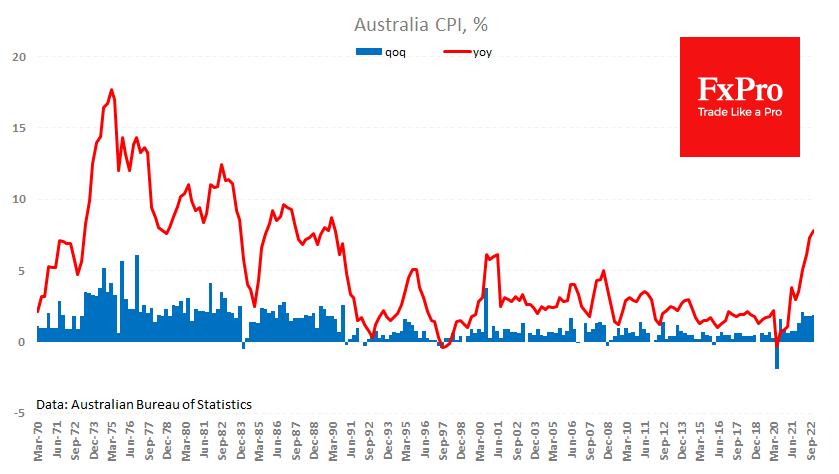
Inflation data continues to be the main driver of the markets. This morning the currency market focused on a surprise out of Australia, where the annual CPI growth rate for the fourth quarter accelerated from 7.3% to 7.8%, against expectations of only 7.5%. Inflation hit its highest level since 1990. Moreover, a 1.9% rise in prices in the final three months of last year shows that inflationary pressures have stayed the same.
The significant outperformance of the data compared to expectations triggered a wave of Aussie buying. AUDUSD climbed to 0.7120 by the start of the European session as traders reassessed the outlook for policy tightening, suggesting a higher interest rate.
From a broader perspective, the Australian data and today’s stronger-than-expected numbers from New Zealand and earlier from Japan should remind the market that inflation is sticky and there is a long fight ahead. This is true now that employment levels in the developed world have been near their highest for decades. If high inflation is a global phenomenon, it has the potential to regain some of the traction the dollar has lost since October.