Sample Category Title
Australian Inflation Surprise
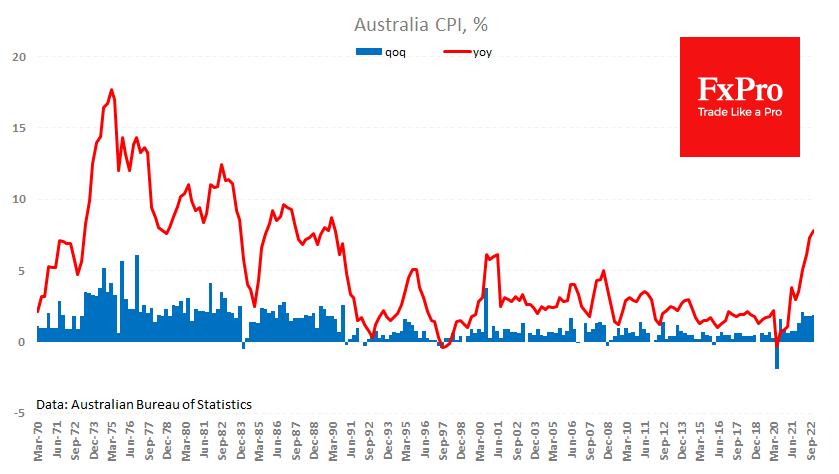
Inflation data continues to be the main driver of the markets. This morning the currency market focused on a surprise out of Australia, where the annual CPI growth rate for the fourth quarter accelerated from 7.3% to 7.8%, against expectations of only 7.5%. Inflation hit its highest level since 1990. Moreover, a 1.9% rise in prices in the final three months of last year shows that inflationary pressures have stayed the same.
The significant outperformance of the data compared to expectations triggered a wave of Aussie buying. AUDUSD climbed to 0.7120 by the start of the European session as traders reassessed the outlook for policy tightening, suggesting a higher interest rate.
From a broader perspective, the Australian data and today’s stronger-than-expected numbers from New Zealand and earlier from Japan should remind the market that inflation is sticky and there is a long fight ahead. This is true now that employment levels in the developed world have been near their highest for decades. If high inflation is a global phenomenon, it has the potential to regain some of the traction the dollar has lost since October.
Earnings Dampening the Mood
Equity markets are back in the red on Wednesday, as investors appear to prepare themselves for a disappointing earnings season for big tech.
The last few weeks may turn out to perfectly encapsulate how the year will be as a whole, fluctuating significantly and suddenly between optimism and pessimism as the data and headlines dictate.
We appear to have entered the latter phase now after starting the year in a very buoyant mood, with earnings painting a more realistic picture of the outlook for this year than investors appeared to be convincing themselves was the case. Layoffs, missed headline numbers and downbeat forecasts are quickly becoming the norm.
Results coming from big finance were not great and have probably set the tone for the season. Big tech is up next and if Microsoft is anything to go by, we're in for another bumpy ride. The cloud business has been a hugely important growth area of the business and the prospect of this slowing at a time when the company has announced plans to lay off 10,000 staff is a concern. And the share price is feeling the burn pre-market after initially jumping on better earnings.
Concerning inflation data
Inflation data from Australia and New Zealand overnight won't fill investors with optimism either. While every country has its own challenges, New Zealand in particular, they also have a lot in common and stubborn inflation will cast doubt on expectations for it to fall more aggressively this year allowing for lower terminal rates and even rate cuts.
Especially coming at a time when economies are displaying a little more resilience - the US could achieve a soft landing, the eurozone could avoid recession, the UK may not be in recession already, etc - meaning central banks may feel less pressured to ease up. It isn't ideal.
Case for a rebound?
Oil prices are marginally higher after paring gains on Tuesday. It's been on a good run lately, buoyed by the prospect of a softer landing, globally, and a stronger rebound in China. There is some technical resistance around $88-89 in Brent which, combined with weakening economic sentiment, may have triggered some profit-taking. Marginal gains so far don't fill me with confidence that a deeper correction isn't possible if sentiment continues to be hit by weaker earnings.
Preparing for correction?
The gold rally appears to have stalled, with any gains coming on softer momentum and the last eight days being equally split between winning and losing days. Coming after such a strong rebound and as data becomes slightly less favourable, it's no surprise to see the trend weakening. If we do see a correction, the first test will come around $1,900 followed by $1,880.
Holding on
Bitcoin is continuing to trade in a roughly $1,000 range between $22,300 and $23,300 and is down a little over 1% so far on the day. Under the circumstances, we're seeing decent resilience with sentiment elsewhere turning more negative. Considering the gains that preceded it as well, the longer it can hold onto them, the more confident the crypto community will feel in its sustainability and be tempted back in. Of course, that's all headline-dependent, which has been less of a headwind recently.
USD/JPY Mid-Day Outlook
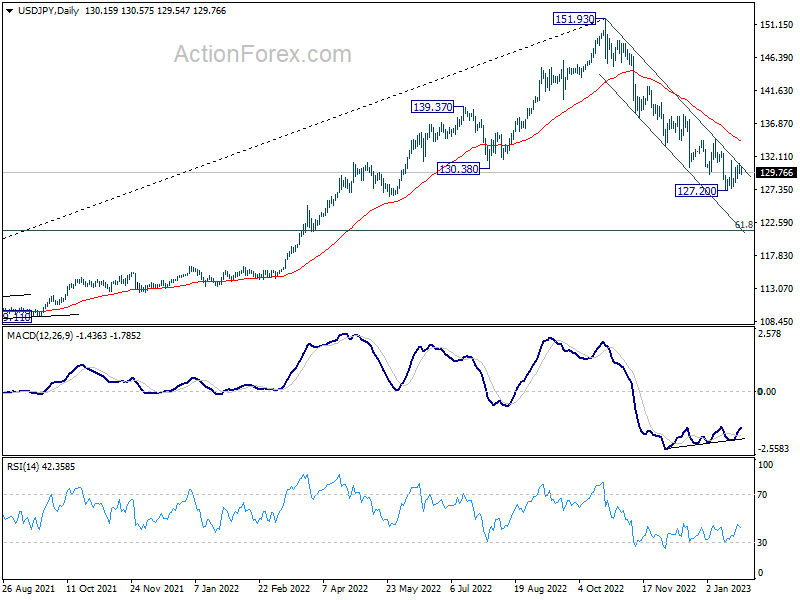
Daily Pivots: (S1) 129.57; (P) 130.34; (R1) 130.96; More...
Intraday bias in USD/JPY stays neutral and outlook is unchanged. On the downside, break of 127.20 will resume the whole decline from 151.93 and target 121.43 fibonacci level. Nevertheless, on the upside, break of 131.56 should confirm short term bottoming, and turn bias back to the upside for stronger rebound to 55 day EMA (now at 134.34).
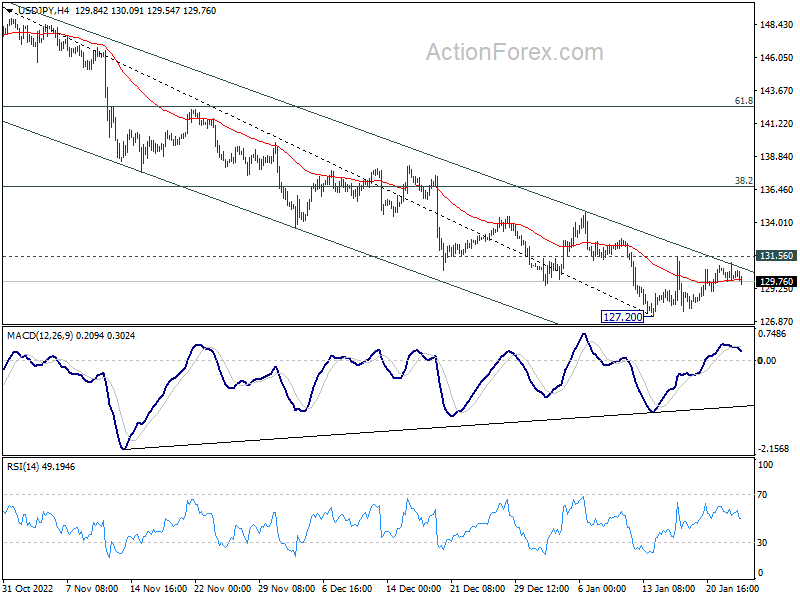
In the bigger picture, the break of 55 week EMA (now at 131.47) raises the chance of medium term bearish reversal, but that's not confirmed yet. Strong support could be seen around 61.8% retracement of 102.58 to 151.93 at 121.43 and 38.2% retracement of 75.56 to 151.93 at 122.75 to bring rebound. But break of 131.56 resistance is needed to indicate bottoming first. Otherwise further fall will remain in favor.
USD/CHF Mid-Day Outlook
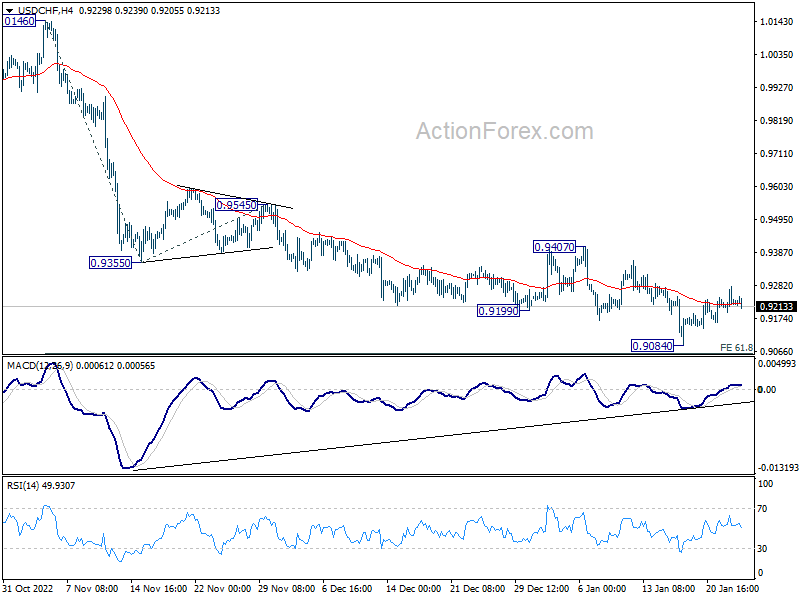
Daily Pivots: (S1) 0.9185; (P) 0.9232; (R1) 0.9273; More...
Outlook in USD/CHF remains unchanged and intraday bias stays neutral. On the downside, sustained break of 61.8% projection of 1.0146 to 0.9355 from 0.9545 at 0.9056 will pave the way to 100% projection at 0.8754, which is close to 0.8756 long term support. Nevertheless, on the upside, break of 0.9407 should confirm short term bottoming and turn bias back to the upside.
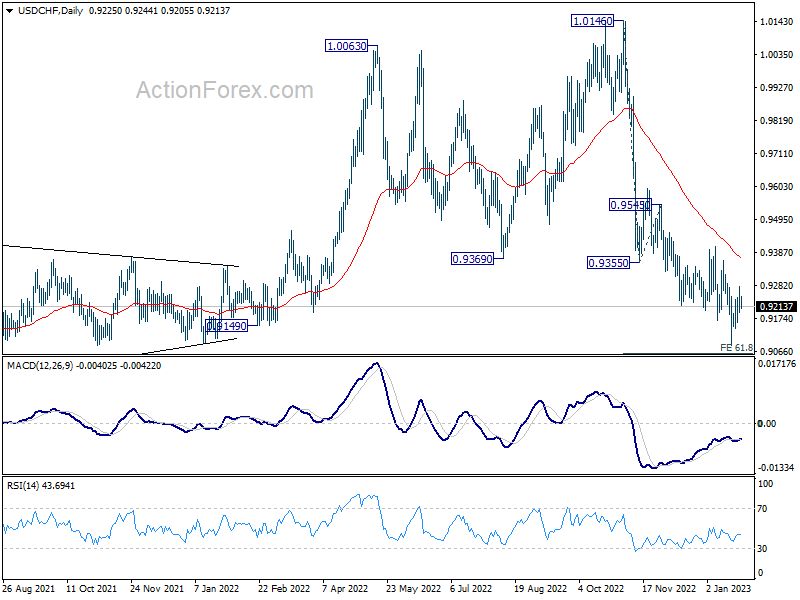
In the bigger picture, rise from 0.8756 (2021 low) has completed at 1.0146, well ahead of 1.0342 long term resistance (2016 high). Based on current downside momentum, fall from 1.0146 should be a medium term down trend itself. Next target is a test on 0.8756 low. Strong support should be seen there to bring rebound. Still, further decline will now be expected as long as 0.9407 resistance holds, in any case.
GBP/USD Mid-Day Outlook
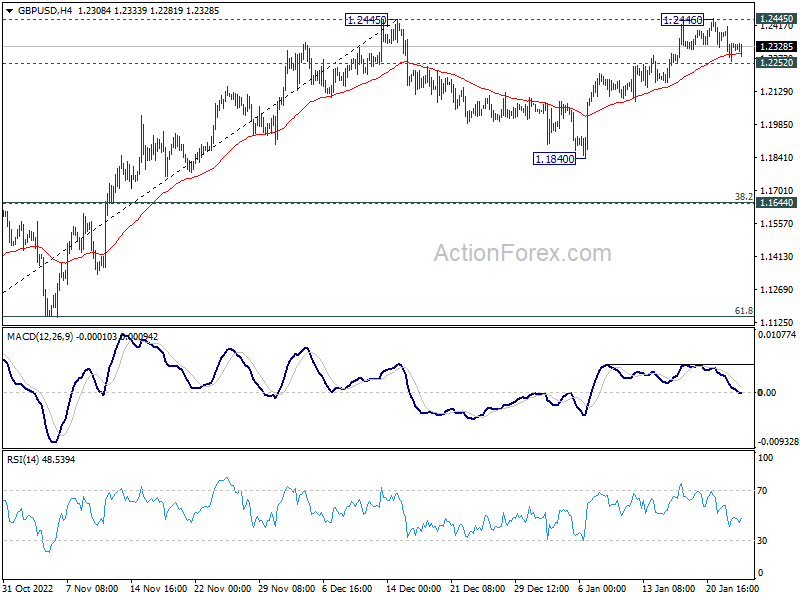
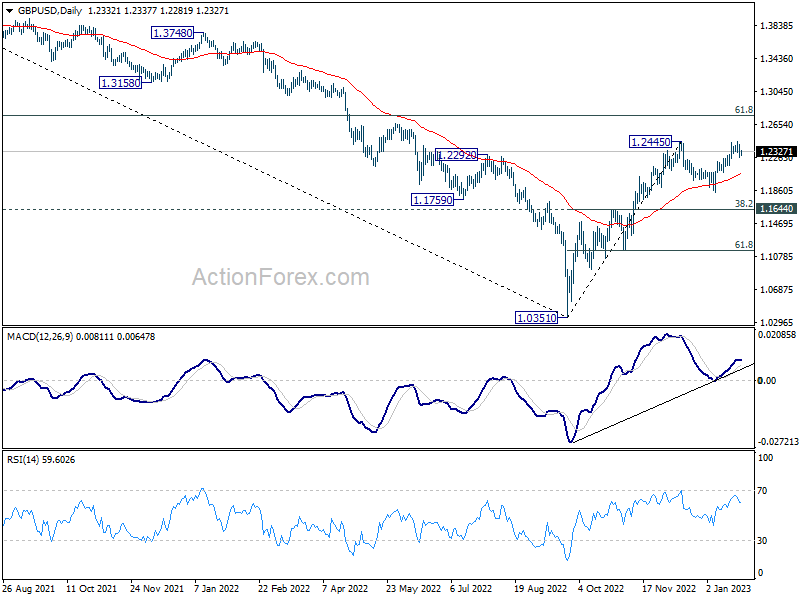
Daily Pivots: (S1) 1.2264; (P) 1.2339; (R1) 1.2415; More...
GBP/USD is staying in range of 1.2252/2446 and intraday bias remains neutral first. On the downside, firm break of 1.2252 minor support will turn bias to the downside, and extend the corrective pattern from 1.2445 with another falling leg. On the upside, decisive break of 1.2445 will confirm resumption of whole rise from 1.0351. Next target will be 1.2759 fibonacci level.
In the bigger picture, rise from 1.0351 medium term bottom is at least correcting whole down trend from 1.4248 (2021 high). Further rise is expected as long as 1.1644 resistance turned support holds. Next target is 61.8% retracement of 1.4248 to 1.0351 at 1.2759. Sustained break there will pave the way back to 1.4248.
EUR/USD Mid-Day Outlook
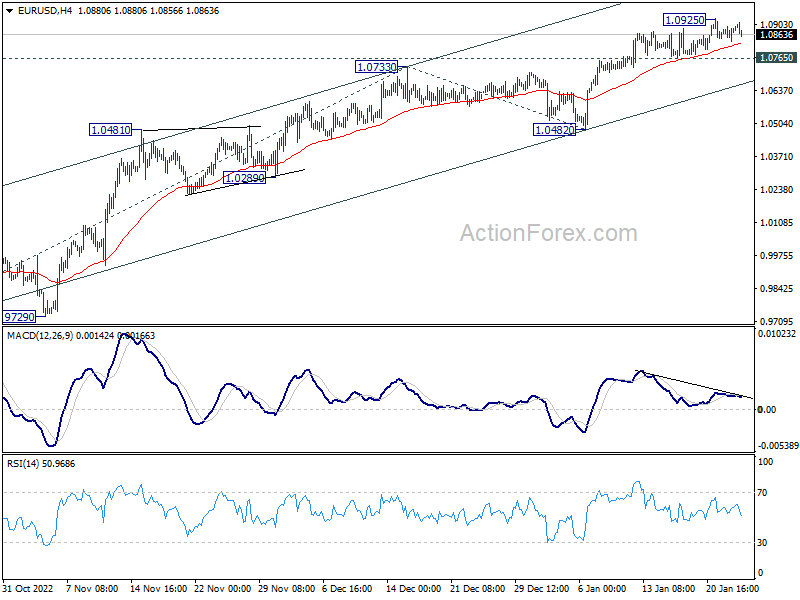
Daily Pivots: (S1) 1.0850; (P) 1.0874; (R1) 1.0913; More...
Intraday bias in EUR/USD is turned neutral first but further rally is expected with 1.0765 support intact. Break of 1.0925 will resume the rally from 0.9534 to 61.8% projection of 0.9630 to 1.0733 from 1.0482 at 1.1164 next. On the downside, though, break of 1.0765 support should now indicate short term topping, and turn bias back to the downside for 55 day EMA (now at 1.0557).
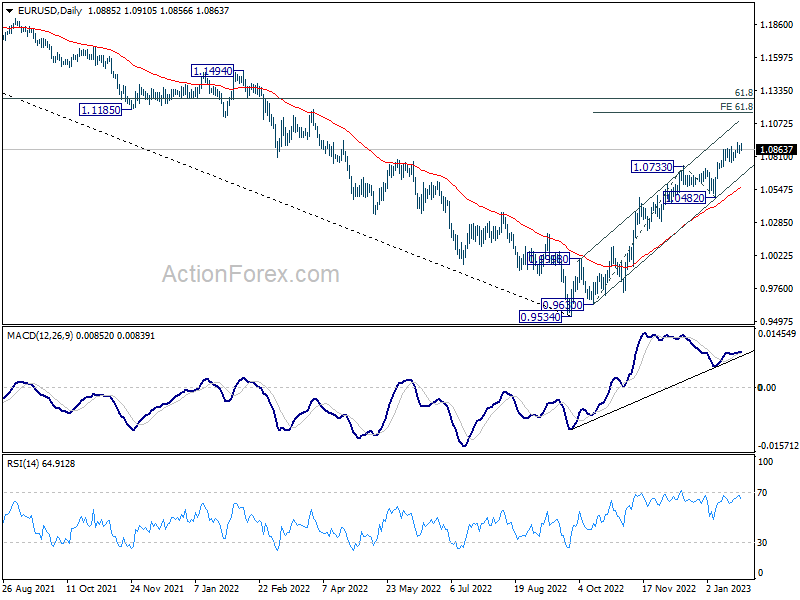
In the bigger picture, current development suggests that the rally from 0.9534 low (2022 low) is a medium term up trend rather than a correction. Further rise is in favor to 61.8% retracement of 1.2348 (2021 high) to 0.9534 at 1.1273 next. This will remain the favored case as long as 1.0482 support holds.
Euro Softens Despite Improvement in German Business Sentiment
Australian Dollar remains the strongest one for today, maintaining most of post-CPI gains. But Yen is catching up with broad based recovery. Euro softens despite improvement in German business climate, and Sterling is trading lower too, while Kiwi stays as the worst. Dollar and Canadian are mixed awaiting BoC rate decision.
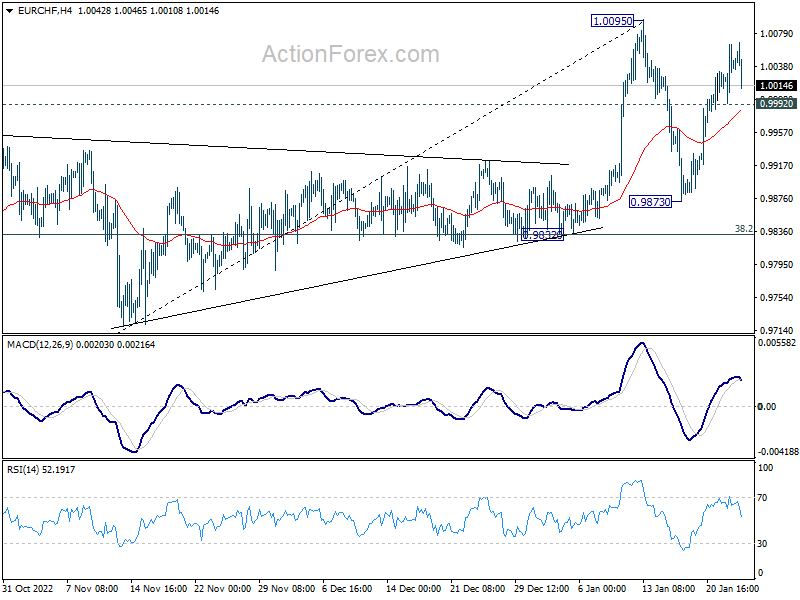
Technically, EUR/CHF is worth a watch in the upcoming session. Up trend resumption through 1.0095 is not envisaged in the first attempt. Indeed, break of 0.9992 minor support will argue that corrective pattern from 1.0095 is already starting the third leg. Deeper decline would then be seen back towards 0.9873 support. If happens, that might be accompanied by weakness in Euro elsewhere, in particular a deeper pull back in EUR/USD.
In Europe, at the time of writing, FTSE is down -0.11%. DAX is down -0.39%. CAC is down -0.32%. Germany 10-year yield is down -0.073 at 2.082. Earlier in Asia, Nikkei rose 0.35%. Japan 10-year JGB yield rose 0.0319 to 0.444. Singapore Strait Times rose 1.79%. Hong Kong and China were still on holiday.
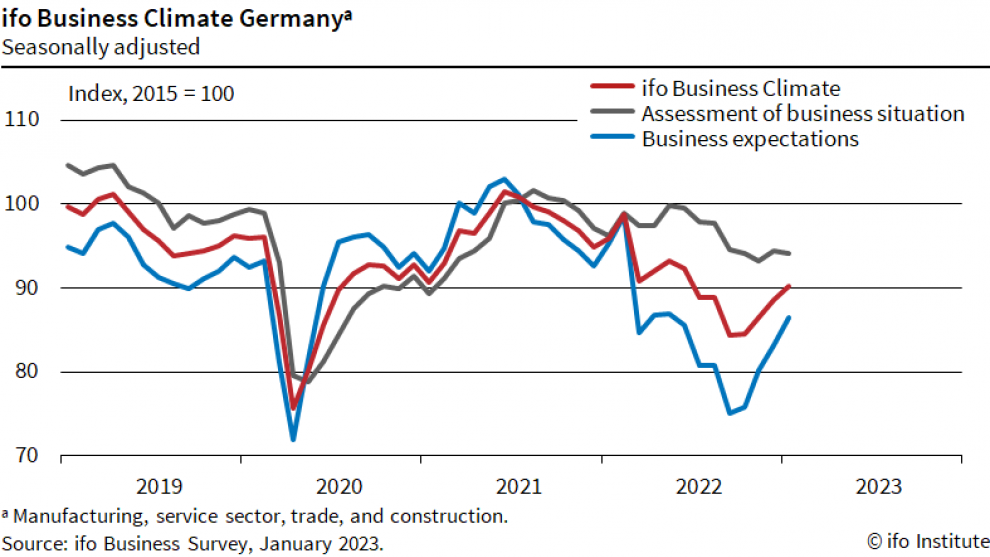
Germany Ifo business climate rose to 90.2, starting new year with more confidence
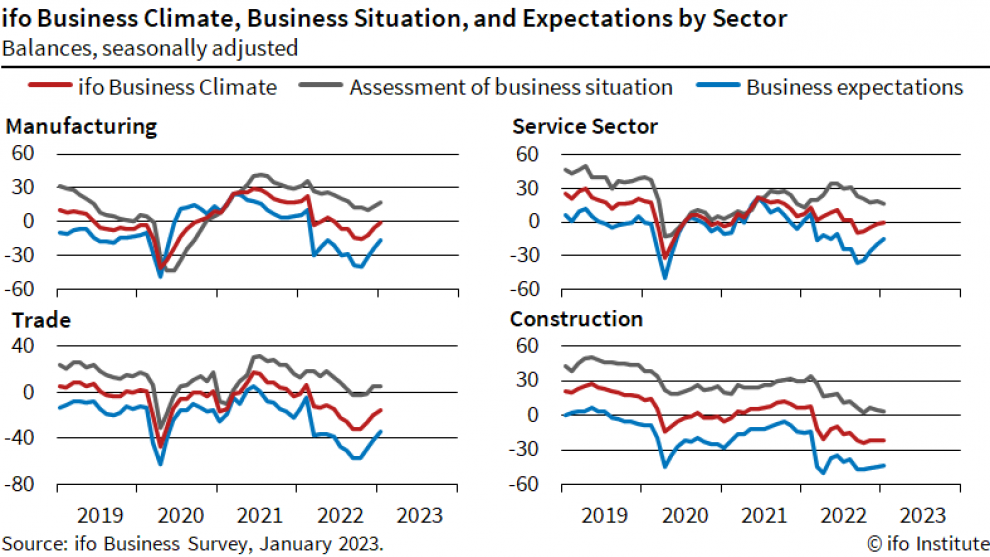
Germany Ifo Business Climate rose slightly from 88.6 to 90.2 in January, below expectation of 90.5. Current Assessment ticked down from 94.4 to 94.1, below expectation of 95.0. Expectations index, on the other hand, improved from 83.2 to 86.4, above expectation of 85.0.
By sector, manufacturing rose from -5.7 to -0.7. Services rose from -1.2 to 0.2. Trade rose from -20.0 to -15.4. Construction also rose slightly from -21.9 to -21.6.
Ifo said: "Sentiment in the German economy has brightened. The ifo Business Climate Index rose to 90.2 points in January, up from 88.6 points in December. This is due to considerably less pessimistic expectations. Companies were, however, somewhat less satisfied with their current situation. The German economy is starting the new year with more confidence."
Japan government downgrades economic assessment
Japan Cabinet Office lowers its monthly economic assessment for the first in 11 months. It said, "the economy is recovering moderately but some weakness is seen recently."
Also assessment on exports was downgraded for the first time since 2011. Both exports and imports are "weakening recently" compared with its previous view of "almost flat" last month.
"China's coronavirus rebound could affect Japan's exports and production and such a possibility has become clearer than last month," said an official at the Cabinet Office.
Assessment on domestic demand and private consumption was maintained as "picking up moderately".
New Zealand CPI unchanged at 7.2% yoy in Q4
New Zealand CPI rose 1.4% qoq in Q4, slightly below expectation of 1.5% qoq. Annual CPI was unchanged at 7.2% yoy, above expectation of 7.1% yoy, comparing to the peak at 7.3% yoy in Q2.
StatsNZ said, "Housing and household utilities was the largest contributor to the December 2022 annual inflation rate. This was due to rising prices for both constructing and renting housing."
The quarterly rise in inflation was "influenced by rising prices in the housing and household utilities, food, and recreation and culture groups."
Australia CPI rose to 8.4% yoy in Dec, 7.8% yoy in Q4
Australia CPI rose 1.9% qoq in Q4, above expectation of 1.7% qoq. Annual CPI accelerated from 7.3% yoy to 7.8% yoy, above expectation of 7.5% yoy. RBA trimmed mean CPI also accelerated from 6.1% yoy to 6.9% yoy, above expectation of 6.5% yoy.
Michelle Marquardt, ABS head of prices statistics, said "This is the fourth consecutive quarter to show a rise greater than any seen since the introduction of the Goods and Services Tax (GST) in 2000. The increase for the quarter was slightly higher than the quarterly movements for the September and June quarters last year (both 1.8 per cent)."
"The annual increase for the CPI is the highest since 1990. Annual inflation for goods such as new dwellings and automotive fuel steadied this quarter, however we saw an uptick in inflation for services such as holidays and restaurant meals," Marquardt said.
Monthly CPI accelerated from 7.3% yoy to 8.4% yoy in December, well above expectation of 7.7% yoy.
Marquardt said, "The monthly indicator recorded the largest annual rise in the series in December. The most significant contributors in the 12 months to December were New dwellings, up 16.0 per cent, and Holiday travel and accommodation, up 29.3 per cent. Airfare and accommodation prices rose in response to strong demand over the Christmas holiday period."
EUR/USD Mid-Day Outlook
Daily Pivots: (S1) 1.0850; (P) 1.0874; (R1) 1.0913; More...
Intraday bias in EUR/USD is turned neutral first but further rally is expected with 1.0765 support intact. Break of 1.0925 will resume the rally from 0.9534 to 61.8% projection of 0.9630 to 1.0733 from 1.0482 at 1.1164 next. On the downside, though, break of 1.0765 support should now indicate short term topping, and turn bias back to the downside for 55 day EMA (now at 1.0557).
In the bigger picture, current development suggests that the rally from 0.9534 low (2022 low) is a medium term up trend rather than a correction. Further rise is in favor to 61.8% retracement of 1.2348 (2021 high) to 0.9534 at 1.1273 next. This will remain the favored case as long as 1.0482 support holds.
Economic Indicators Update
| GMT | Ccy | Events | Actual | Forecast | Previous | Revised |
|---|---|---|---|---|---|---|
| 21:45 | NZD | CPI Q/Q Q4 | 1.40% | 1.50% | 2.20% | |
| 21:45 | NZD | CPI Y/Y Q4 | 7.20% | 7.10% | 7.20% | |
| 23:30 | AUD | Westpac Leading Index M/M Dec | -0.10% | -0.10% | ||
| 00:30 | AUD | CPI Q/Q Q4 | 1.90% | 1.70% | 1.80% | |
| 00:30 | AUD | CPI Y/Y Q4 | 7.80% | 7.50% | 7.30% | |
| 00:30 | AUD | RBA Trimmed Mean CPI Q/Q Q4 | 1.70% | 1.60% | 1.80% | 1.90% |
| 00:30 | AUD | RBA Trimmed Mean CPI Y/Y Q4 | 6.90% | 6.50% | 6.10% | |
| 00:30 | AUD | Monthly CPI Y/Y Dec | 8.40% | 7.70% | 7.30% | |
| 07:00 | GBP | PPI Input M/M Dec | -1.10% | 0.90% | 0.60% | -0.20% |
| 07:00 | GBP | PPI Input Y/Y Dec | 16.50% | 19.20% | 19.20% | 18.00% |
| 07:00 | GBP | PPI Output M/M Dec | -0.80% | 0.70% | 0.30% | -0.10% |
| 07:00 | GBP | PPI Output Y/Y Dec | 14.70% | 13.90% | 14.80% | 16.20% |
| 07:00 | GBP | PPI Core Output M/M Dec | 0.10% | 1.10% | 0.50% | |
| 07:00 | GBP | PPI Core Output Y/Y Dec | 12.40% | 13.90% | 13.30% | 13.00% |
| 09:00 | CHF | Credit Suisse Economic Expectations Jan | -40 | -42.8 | ||
| 09:00 | EUR | Germany IFO Business Climate Jan | 90.2 | 90.5 | 88.6 | |
| 09:00 | EUR | Germany IFO Current Assessment Jan | 94.1 | 95 | 94.4 | |
| 09:00 | EUR | Germany IFO Expectations Jan | 86.4 | 85 | 83.2 | |
| 15:00 | CAD | BoC Rate Decision | 4.50% | 4.25% | ||
| 15:30 | USD | Crude Oil Inventories | 1.2M | 8.4M | ||
| 16:00 | CAD | BoC Press Conference |
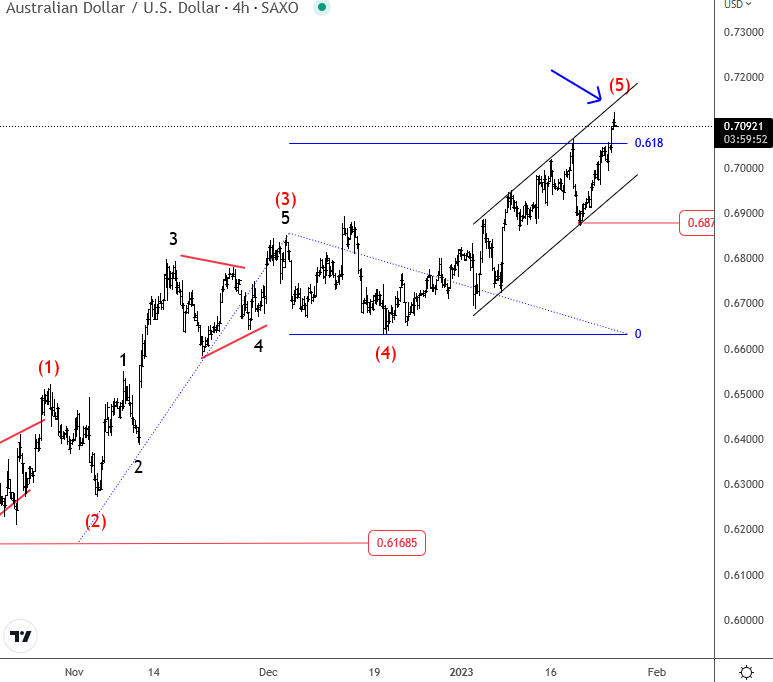
AUD CPI Causes More Upside into Fifth Wave
AUD is the mover of the day after CPI yoy jumped unexpectedly to 8.4% in Australia up from 7.3%. Thats big and can potentially mean that RBA will be foreced to riase rates further. AUDUSD is moving aggressively higher, but still trading at some key trendline up here, with fifth wave. A lot of majors are trading at resistance vs USD, so if suddenly USD index would rally, then Aussie can come back down, but would most likely suffer less than others. From a longer term perspective we see AUDUSD clearly in bullish mode for much more upside, but ideally after a higher degree pullback.
NZ Dollar Dips after CPI Unchanged
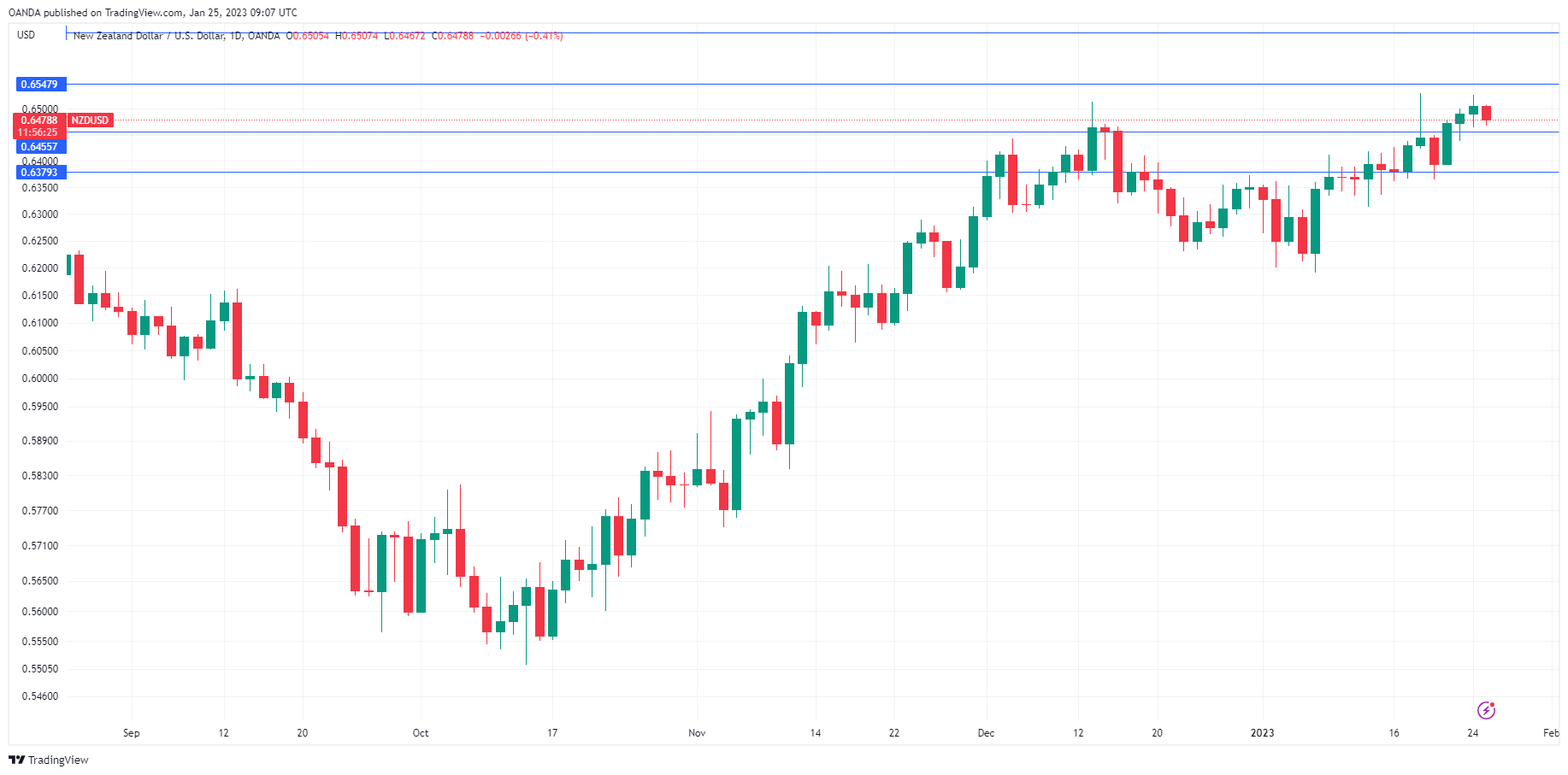
The New Zealand dollar is under pressure on Wednesday. In the European session, NZD/USD is trading at 0.6478, down 0.41%.
Markets eye New Zealand CPI
The New Zealand dollar reacted negatively to today’s CPI release, falling as much as 0.60% before paring these losses. Fourth-quarter CPI remained unchanged at 7.2%, a notch above the consensus of 7.1%. More importantly, the reading was below the Reserve Bank of New Zealand’s forecast of 7.5%, which could mean that the central bank will ease up on the pace of rate hikes.
The central bank has been aggressive, as it raised rates by some 325 basis points in 2022, bringing the cash rate to 4.25%. Similar to the Fed’s experience, the markets aren’t buying into the RBNZ’s hawkish message and are betting that rates will peak at 5.0%, lower than the RBNZ’s projection of 5.5%. The central bank delivered a supersize 75-basis point hike in November, and prior to the inflation release, the market had priced in a 75 bp or 50 bp hike as a 50/50 toss-up. Following the CPI reading, that has changed to 70/30 in favour of a 50-bp move. Inflation has been falling globally while domestically, consumer spending and confidence have fallen due to the rising cost of living. This has raised speculation that the RBNZ could wind up its current rate cycle earlier than it anticipated.
The US releases GDP for the fourth quarter on Thursday and we could see some volatility from the US dollar. GDP is expected to slow to 2.8%, down from 3.2% in Q3 but still a respectable pace of growth. On Wednesday, US PMIs pointed to contraction in the manufacturing and services sectors, pointing to cracks in the US economy as high rates continue to take their toll. The US dollar remains under pressure as soft readings have raised hopes that the Fed will ease up on rate policy due to the slowing economy.
NZD/USD Technical
- 0.6455 is under pressure in support. The next support line is 0.6379
- There is resistance at 0.6547 and 0.6648
Germany Ifo business climate rose to 90.2, starting new year with more confidence
Germany Ifo Business Climate rose slightly from 88.6 to 90.2 in January, below expectation of 90.5. Current Assessment ticked down from 94.4 to 94.1, below expectation of 95.0. Expectations index, on the other hand, improved from 83.2 to 86.4, above expectation of 85.0.
By sector, manufacturing rose from -5.7 to -0.7. Services rose from -1.2 to 0.2. Trade rose from -20.0 to -15.4. Construction also rose slightly from -21.9 to -21.6.
Ifo said: "Sentiment in the German economy has brightened. The ifo Business Climate Index rose to 90.2 points in January, up from 88.6 points in December. This is due to considerably less pessimistic expectations. Companies were, however, somewhat less satisfied with their current situation. The German economy is starting the new year with more confidence."