Sample Category Title
EUR/CHF Daily Outlook
Daily Pivots: (S1) 1.0003; (P) 1.0035; (R1) 1.0076; More....
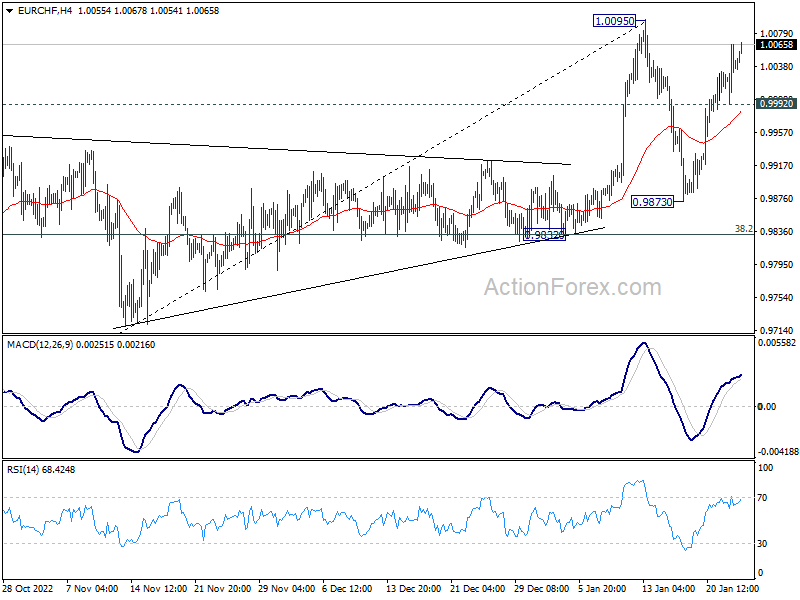
EUR/CHF's rebound from 0.9873 is still in progress and intraday stays on the upside for resting 1.0095. Firm break there will resume whole rally from 0.9407 low. On the downside, though, break of 0.9952 minor support will turn bias back to the downside, to extend the corrective pattern from 1.0095 with another leg, back towards 0.9873 support.
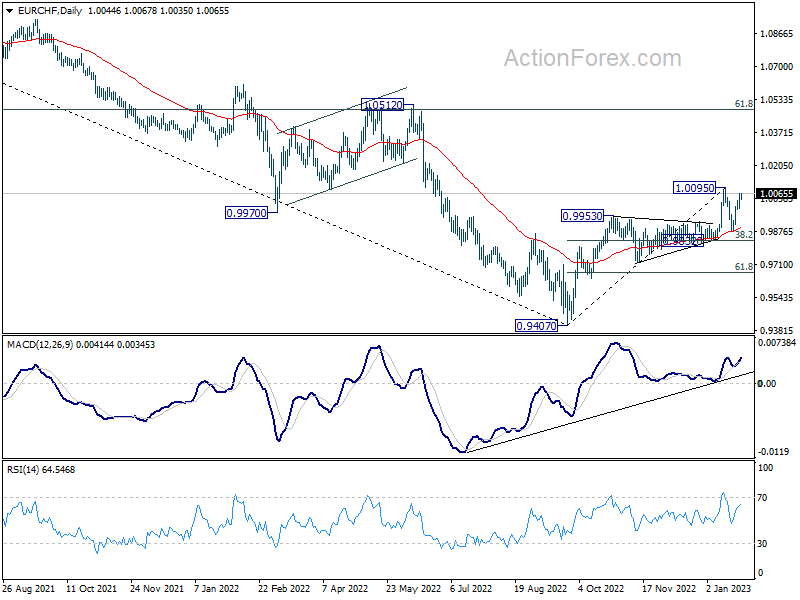
In the bigger picture, the initial rejection by 55 week EMA (now at 1.0039) mixed up the outlook. On the upside, sustained trading above 55 week EMA will raise the chance of bullish trend reversal. Rise from 0.9407 should then target 1.0505 cluster resistance (2020 low at 1.0505, 61.8% retracement of 1.1149 to 0.9407 at 1.1484). However, firm break of 0.9832 support will revive medium term bearishness and bring retest of 0.9407 low instead.
BOC Interest Rate Decision: Another Hike?
After its last meeting, the BOC Governor Macklem said that the likely course would be a pause, unless there was a major change in the data. Of course he said it with a lot more words and technical jargon, but that was the essence of the message. Naturally, the markets adjusted the expectation to the BOC holding rates steady.
The latest inflation data pointed to a strong deceleration. Even though the rate remains well above target, there is always some delay between when rates are raised and when inflation comes down to an acceptable range. So, it's expected that the central bank will stop raising when inflation starts to show signs it's coming under control, and not necessarily has reduced all the way.
What changed?
Inflation figures were in line with expectations, confirming the view for the BOC. But, the unemployment rate showed a surprise build. Over 100K people found jobs in December, well above the 7K expected. It is true that Canada has some wildly fluctuating jobs numbers. But given the context of the BOC saying it was going to be data dependent for the next meeting, the consensus now shifted to expect a 25bps hike at the next meeting.
The context has implications beyond Canada, since the US faces similar economic conditions, and often the two central banks move in tandem. Inflation in the US has been coming down, but the jobs market remains surprisingly resilient. The prior months had seen slow jobs growth in Canada, leaving the impression that Canada could exit the rate hiking cycle sooner than its southern neighbor. But, if the BOC raises rates, it could have a somewhat diminished impact on the USDCAD, as traders weigh whether the strong jobs numbers seen in the US would also imply the Fed will move higher as well.
What about further down the road?
The other aspect is the global economy. Most of the reduction in inflation came from lower fuel prices. Wholesale food prices diminished, but not what shoppers were paying at stores. Meaning that the average Canadian might not notice the improving price situation, and in turn that could continue to impact consumer demand.
What is more directly correlated to the currency market, however, is the price of crude. As Canada's main export the drop in petroleum prices naturally affected the CAD. But, now that China is reopening faster than expected, there is renewed speculation that crude prices could continue to appreciate. Particularly in the context of the latest IEA report, which forecasts demand for crude to reach a historic peak in the next year, while supplies remain constrained.
Potential market reaction
It's expected that after this rate hike, the BOC will once again say that it expects a pause, depending on the data. The other option is that it could surprise the markets by not raising rates. That could be because it discounts the jobs data as a one-off, and heavily imply that it could rates rates at the next meeting. Both courses of action would likely leave the long-term outlook for the CAD in the same place, but could provide some short-term volatility.
EUR/USD Daily Outlook
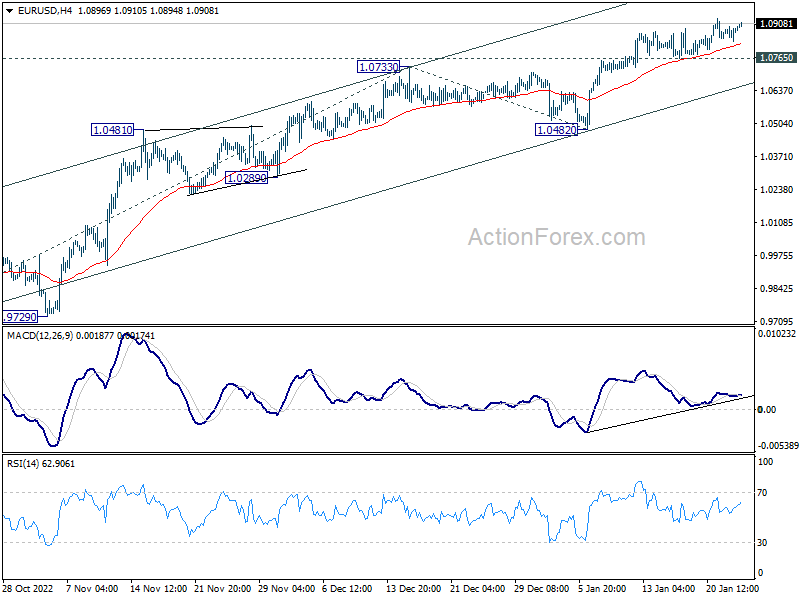
Daily Pivots: (S1) 1.0850; (P) 1.0874; (R1) 1.0913; More...
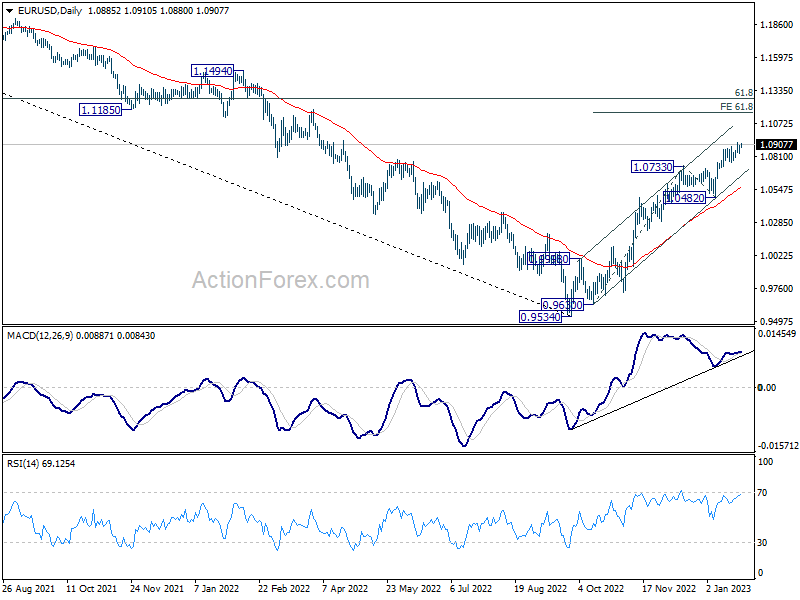
Further rally is expected in EUR/USD with 1.0765 support intact. Current rise from 0.9534 should target 61.8% projection of 0.9630 to 1.0733 from 1.0482 at 1.1164 next. On the downside, though, break of 1.0765 support should now indicate short term topping, and turn bias back to the downside for 55 day EMA (now at 1.0557).
In the bigger picture, current development suggests that the rally from 0.9534 low (2022 low) is a medium term up trend rather than a correction. Further rise is in favor to 61.8% retracement of 1.2348 (2021 high) to 0.9534 at 1.1273 next. This will remain the favored case as long as 1.0482 support holds.
GBP/USD Daily Outlook
Daily Pivots: (S1) 1.2264; (P) 1.2339; (R1) 1.2415; More...
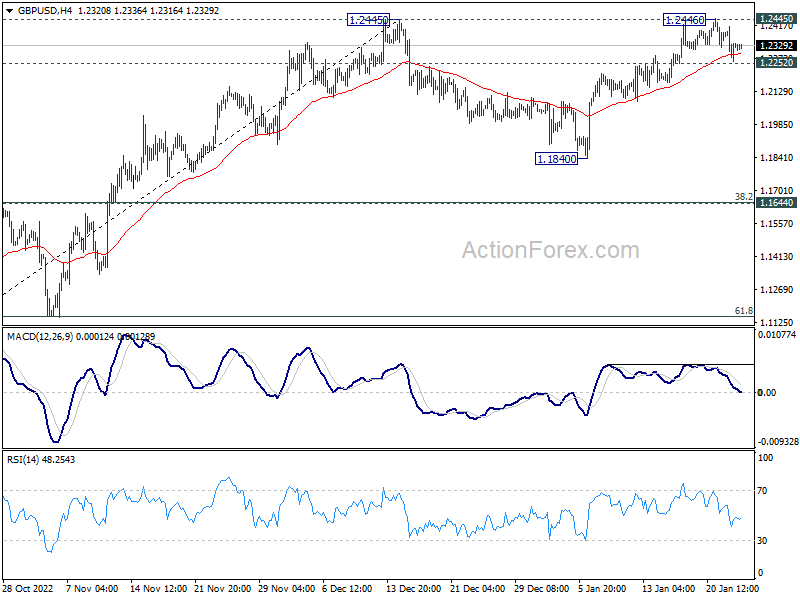
Intraday bias in GBP/USD stays neutral as range trading continues. On the downside, firm break of 1.2252 minor support will turn bias to the downside, and extend the corrective pattern from 1.2445 with another falling leg. On the upside, decisive break of 1.2445 will confirm resumption of whole rise from 1.0351. Next target will be 1.2759 fibonacci level.
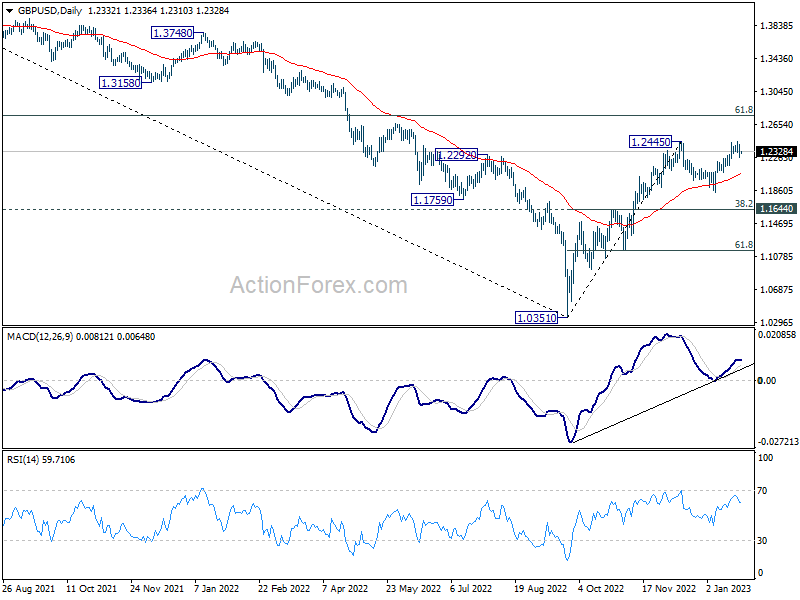
In the bigger picture, rise from 1.0351 medium term bottom is at least correcting whole down trend from 1.4248 (2021 high). Further rise is expected as long as 1.1644 resistance turned support holds. Next target is 61.8% retracement of 1.4248 to 1.0351 at 1.2759. Sustained break there will pave the way back to 1.4248.
USD/CHF Daily Outlook
Daily Pivots: (S1) 0.9185; (P) 0.9232; (R1) 0.9273; More...
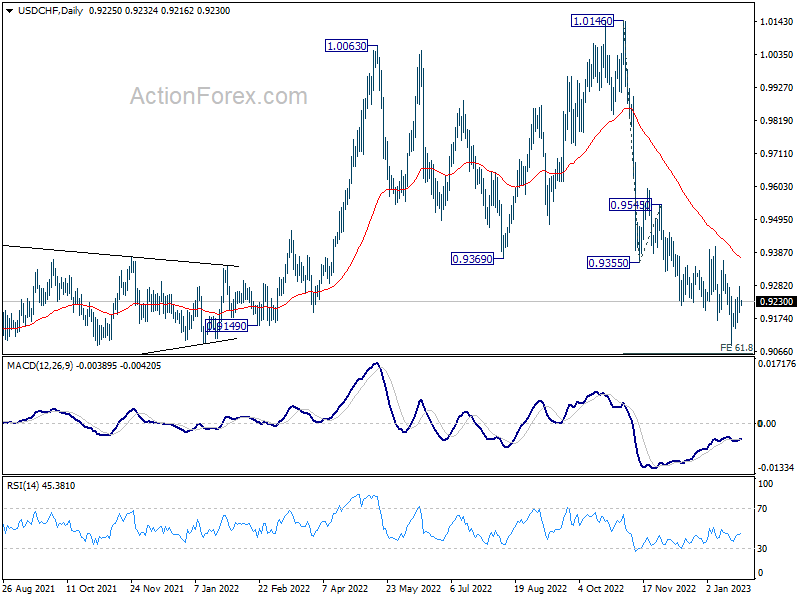
Intraday bias in USD/CHF remains neutral and outlook is unchanged. On the downside, sustained break of 61.8% projection of 1.0146 to 0.9355 from 0.9545 at 0.9056 will pave the way to 100% projection at 0.8754, which is close to 0.8756 long term support. Nevertheless, on the upside, break of 0.9407 should confirm short term bottoming and turn bias back to the upside.
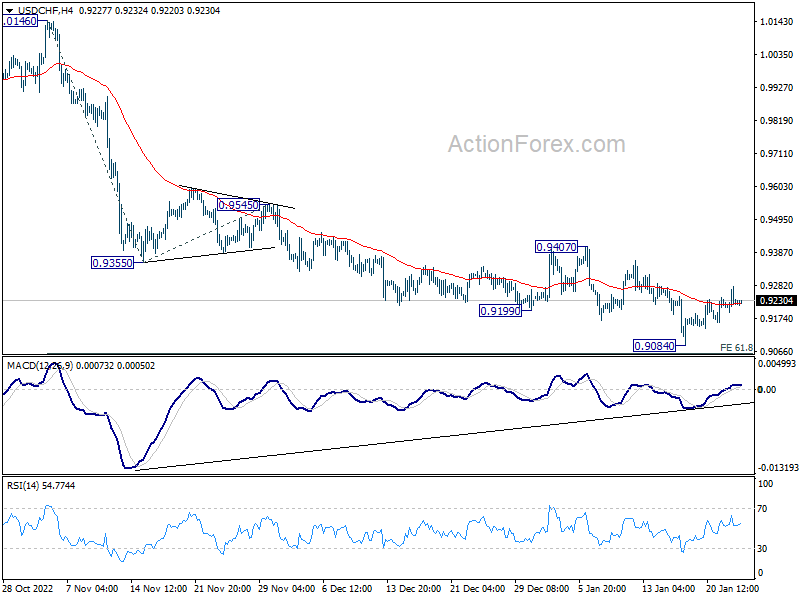
In the bigger picture, rise from 0.8756 (2021 low) has completed at 1.0146, well ahead of 1.0342 long term resistance (2016 high). Based on current downside momentum, fall from 1.0146 should be a medium term down trend itself. Next target is a test on 0.8756 low. Strong support should be seen there to bring rebound. Still, further decline will now be expected as long as 0.9407 resistance holds, in any case.
USD/JPY Daily Outlook
Daily Pivots: (S1) 129.57; (P) 130.34; (R1) 130.96; More...
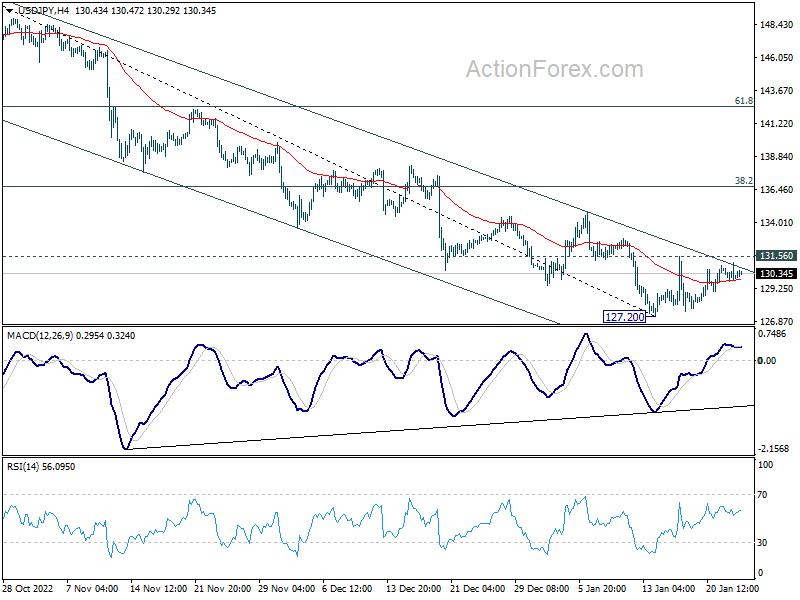
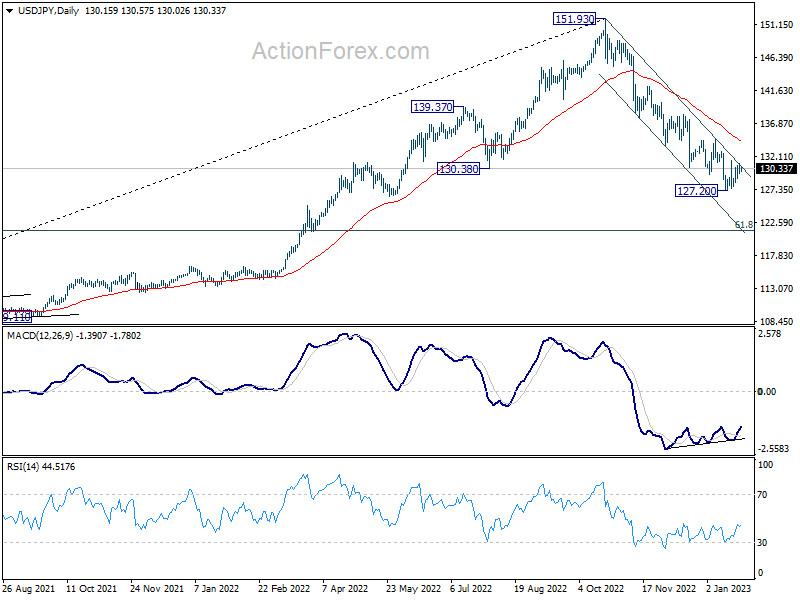
Range trading continues in USD/JPY and intraday bias remains neutral for the moment. On the downside, break of 127.20 will resume the whole decline from 151.93 and target 121.43 fibonacci level. Nevertheless, on the upside, break of 131.56 should confirm short term bottoming, and turn bias back to the upside for stronger rebound to 55 day EMA (now at 134.34).
In the bigger picture, the break of 55 week EMA (now at 131.47) raises the chance of medium term bearish reversal, but that's not confirmed yet. Strong support could be seen around 61.8% retracement of 102.58 to 151.93 at 121.43 and 38.2% retracement of 75.56 to 151.93 at 122.75 to bring rebound. But break of 131.56 resistance is needed to indicate bottoming first. Otherwise further fall will remain in favor.
USD/CAD Daily Outlook
Daily Pivots: (S1) 1.3339; (P) 1.3376; (R1) 1.3405; More....
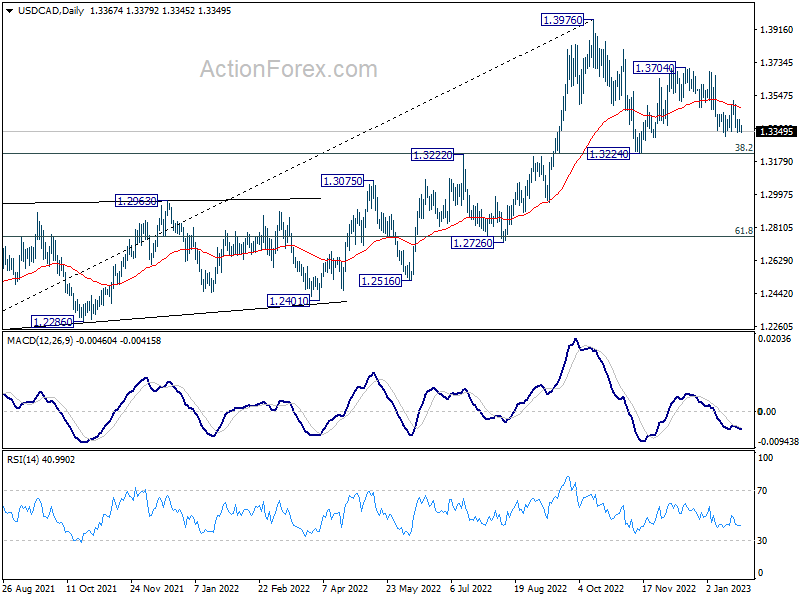
USD/CAD is still bounded in range of 1.3320/3519 and intraday bias remains neutral first. On the downside, break of 1.3320 will resume the fall from 1.3704 to 1.3224 key support level. On the upside, though, above 1.3519 will turn bias back to the upside for 1.3704 resistance.
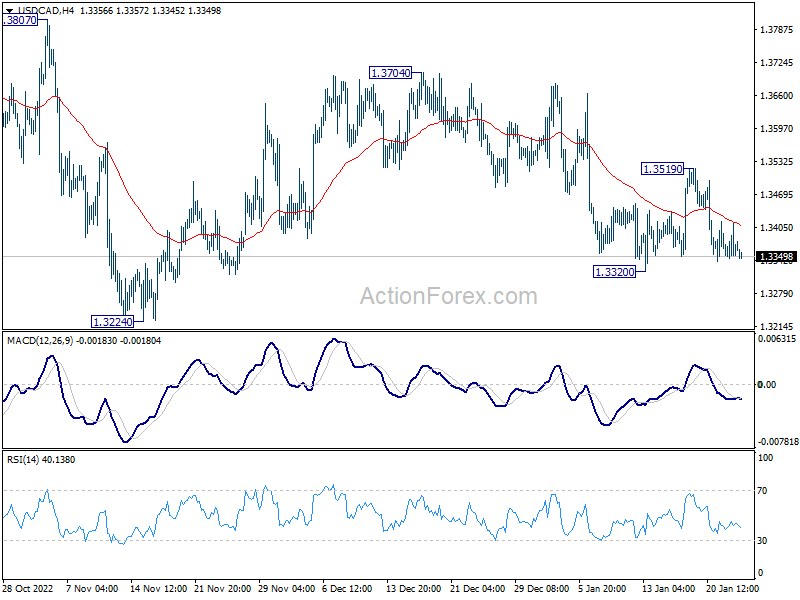
In the bigger picture, as long as 1.3222 cluster support (38.2% retracement of 1.2005 to 1.3976 at 1.3223) holds, larger up trend from 1.2005 (2021 low) is still expected to resume through 1.3976 high at a later stage. However, firm break of 1.3222/3 will indicate that the trend might have reversed. Deeper fall would be seen to next cluster support at 1.2726 (61.8% retracement at 1.2758).
Mixed Results, Mixed Data, Mixed Sentiment
Trading in the US was eventless, except for the wild moves that marked the opening bell at the NYSE.
The S&P 500 swung around the 4000, without any major moves up or down, as investors remained undecided faced with mixed company earnings, and mixed economic data.
Both US services and manufacturing PMI came in better than expected in January, but both remain in the contraction zone. While the Richmond Manufacturing index fell to -11, significantly lower than -5 expected by analysts.
In summary, the data confirmed a certain slowdown in US economic activity, but it didn’t point to a free fall.
The US 2-year yield fell for the second straight session, as the soft data kept the Federal Reserve (Fed) doves at a soft and warm spot.
But at the current levels, the swap market suggests around 48 bp rate increase over the next two FOMC meetings. This means that the present activity in the swap market gives around 8% probability for no rate hike at all after the Fed’s February meeting.
And if that’s what keeps the S&P500 bid around the 4000 mark, it’s worrying.
Earnings, earnings
The S&P 500 could or could not get a boost from Microsoft at today’s session, as Microsoft announced better-than-expected results yesterday after the market close, but the results were not all rosy. The revenue – which grew at its slowest pace since 2016 - slightly missed expectations, but the earnings beat estimates. The Intelligent Cloud segment grew 18%, as the Azure services grew 31% - slower than the past quarter but better than expected with the prospects of being further boosted by the ChatGPT deal. The shares rallied 5% in the afterhours, but gains were mostly given back.
S&P 500 futures are down -0.40% at the time of writing.
Today, it’s Tesla’s turn to go to the earnings confessional after the bell, and nobody can tell you with confidence what will happen to the share price once the results are freshly out of the oven.
Tesla is doing very well, the company announced record car deliveries quarter after quarter, but the record deliveries weren’t enough to meet the market expectations over the past three quarters. And unfortunately, the expectations make the market price, and missing them is no good thing for the share price.
In the FX
The US dollar remains under the pressure of soft data, and worryingly softening Fed expectations, while the euro got the boost that we were hoping for at yesterday’s PMI release.
The EURUSD is again testing the 1.09 level to the upside this morning. And the gently widening divergence between the hawkish European Central Bank (ECB) expectations and the dovish Fed expectations remains supportive of a further advance. But be careful, the pair is about to step into the overbought market, which could slow the rally into the 1.10 target.
Across the Channel, the numbers were not as enchanting as on the main continent, and no one is surprised I guess to see the services PMI plunge to 48 in January with all the strikes going on. The manufacturing PMI on the other hand contracted less than expected but a new report suggested that the number of UK firms facing collapse jumped by more than a third at the end of last year.
Cable plunged below its year-to-date ascending channel, and the euro-pound is bought without much hesitation at the 50, 100-DMA levels, and should continue pressuring higher on a broadly stronger euro.
In Canada, the Bank of Canada (BoC) is preparing to announce its final 25bp hike. The dollar-CAD puts more weight into clearing the 1.3350 support, but crude oil is not helping, as the price of a barrel of American crude continues bumping its head against the solid $82pb wall, the 100-DMA, without being able to break it to the upside.
The API data showed almost 3.4-million-barrel build in the US inventories last week, hinting that the more official EIA data could also disappoint the bulls at today’s read.
But the medium term outlook for crude oil remains positive, therefore, price pullbacks remain interesting dip buying opportunities as long as the 50-DMA support, which stands a touch below the $78pb mark, holds.
Upbeat PMIs Ease Recession Fears
Market movers today
The German IFO index for January is on the agenda today. The German economy has been holding up better than feared in Q4 22, thanks to a range of tailwinds from mild weather to a large order backlog and easing supply bottlenecks in industry. A further improvement in the IFO business climate would add to the positive signals from other leading indicators such as ZEW and PMI, supporting easing recession risks in the market.
In Sweden, December PPI is likely to show a high print again, after electricity prices rose sharply.
The 60 second overview
Euro area: Both manufacturing and service sector PMIs came out stronger than expected, which pushed the composite index above 50 ie. to a level no longer pointing towards economic contraction. That said, the figures were a 'two-sided sword' for the ECB as euro area still appears caught in stagflationary environment in early 2023. Strong labour market, improved consumer confidence and the reopening in China could give a further boost to PMIs over the coming months, but at the same time selling price pressures increased for both goods and services from December. In our view, the combination of a resilient economy yet still elevated inflation risks supports our call for 50bp ECB hikes at both February and March meetings.
US: Also US Flash PMIs ticked higher from December, although the levels still remain consistent with a modest recession. While it seems that the risk of a hard landing has eased, input price pressures rose both in manufacturing, and especially services sector (63.7, from 58.3). Employment indices eased just slightly, but overall labour market conditions still appear tight, and wage-driven inflation risks have not yet eased completely. We expect Fed to hike its policy rate to 5.00-5.25% with three consecutive 25bp hikes, but markets' focus has already shifted towards the looming rate cuts. We take a look at the factors which will eventually determine the pace and timing of the cuts in our preview for the next week's meeting, see Research US - Fed preview: What it takes for the Fed to cut rates, 24 January.
Australian CPI: Overnight, the Reserve Bank of Australia's (RBA) preferred trimmed-mean measure of inflation picked up more than expected in Q4 to 6.9% y/y (from 6.1%), which is the highest level since 1988. Despite the cooling labour markets, the figures increased the risk of RBA continuing its hiking cycle in February (with markets now pricing around 80% probability of a 25bp hike) and supported AUD/USD close to our 1M target of 0.71.
FI: It was a rather choppy trading session yesterday through most of the day amid mixed European PMIs. In the late afternoon, US treasuries' volatile reaction to the US PMIs initially sent yields higher, but spreads were marginally tighter on the day and did not seem affected by Spain mandating banks for a new 10y. Curves recorded a minor flattening from the long end. The long end tap from EU (2053) saw strong demand and is likely to have supported the demand for long end papers.
FX: In a fairly uneventful session the HUF stood out as the session winner while NOK and GBP traded slightly on the back-foot. EUR/USD started the session by moving lower but later erased losses leaving the cross virtually unchanged on the day just below the 1.09 threshold. EUR/SEK is hovering just north of 11.10, which marks the lowest level so far this year.
Credit: Credit markets were jittery on Tuesday on the back of a softish overall market for risk assets. Itrax main widened 0.6bp to close at 79.0bp while Itrax xover widened 3.9bp to close at 416.5bp. Primary markets remained open but were still somewhat muted due to reporting season being in full swing currently.
AUD/USD Daily Report
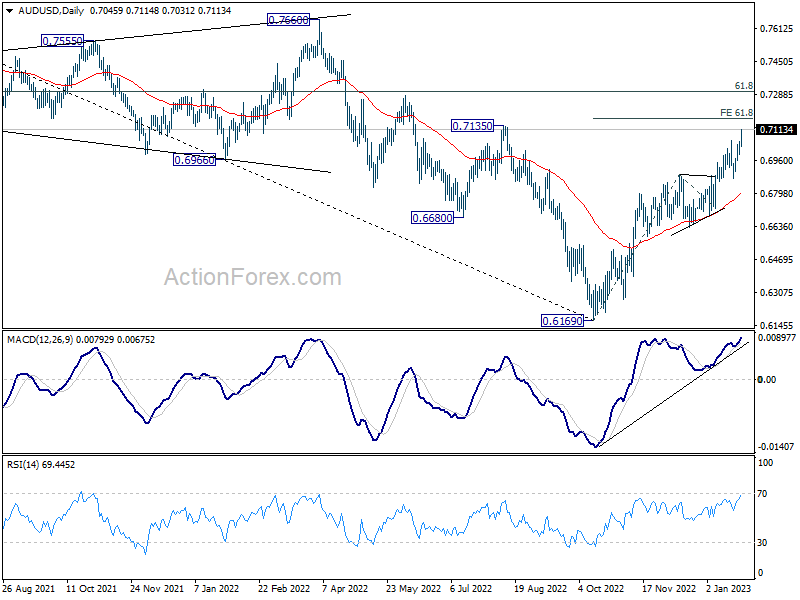
Daily Pivots: (S1) 0.7007; (P) 0.7032; (R1) 0.7071; More...
AUD/USD's rally resumes by breaking through 0.7062 and intraday bias is back on the upside. Current rise from 0.6169 should target 61.8% projection of 0.6169 to 0.6892 from 0.6721 at 0.7168 next. Break there will target 0.7304 fibonacci level. On the downside, break of 0.6871 support is needed to indicate short term topping. Otherwise, outlook will stay bullish in case of retreat.
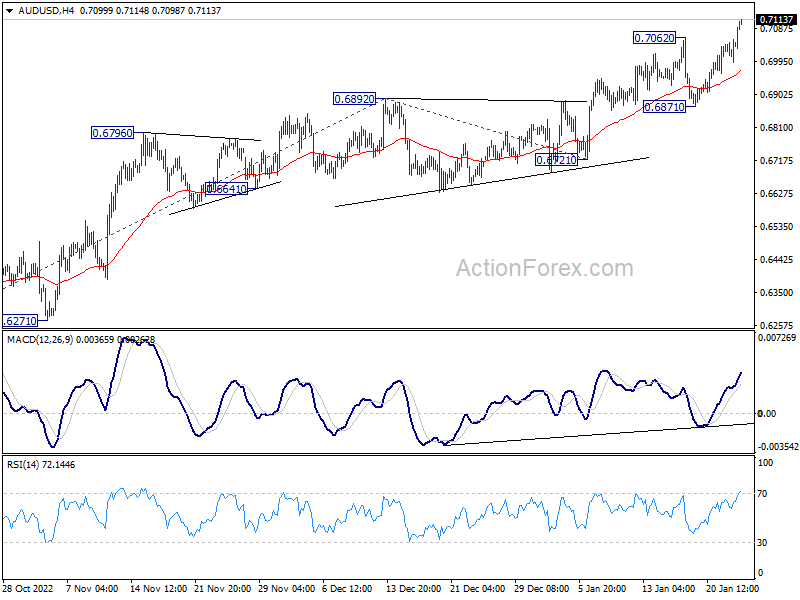
In the bigger picture, corrective decline from 0.8006 (2021 high) should have completed with three waves down to 0.6169 (2022 low). Further rally should be seen to 61.8% retracement of 0.8006 to 0.6169 at 0.7304. Sustained break there will pave the way to retest 0.8006. This will now remain the favored case as long as 0.6721 support holds.