

Sample Category Title
Aussie Soars, Kiwi Tumbles, Loonie Awaits BoC
Australian Dollar rises broadly today after strong CPI data supports continuation of tightening by RBA. On the other hand, New Zealand CPI didn't accelerate as RBNZ projected, and markets are lowering their expectation on the terminal rate. Kiwi, thus falls broadly. Canadian Dollar is firm as focus turns to BoC rate decision, where a final "insurance" hike is expected in the current cycle. As for the week, Aussie is the strongest, followed by Euro. Yen is the worst, followed by Sterling. Dollar is mixed in between.
In Asia, Nikkei closed up 0.35%. Japan 10-year JGB yield rose 0.249 to 0.437. Singapore Strait Times is up 1.66%. Hong Kong and China are still on holiday. Overnight, DOW rose 0.31%. S&P 500 dropped -0.07%. NASDAQ dropped -0.27%. 10-year yield fell -0.056 to 3.469.
New Zealand CPI unchanged at 7.2% yoy in Q4
New Zealand CPI rose 1.4% qoq in Q4, slightly below expectation of 1.5% qoq. Annual CPI was unchanged at 7.2% yoy, above expectation of 7.1% yoy, comparing to the peak at 7.3% yoy in Q2.
StatsNZ said, "Housing and household utilities was the largest contributor to the December 2022 annual inflation rate. This was due to rising prices for both constructing and renting housing."
The quarterly rise in inflation was "influenced by rising prices in the housing and household utilities, food, and recreation and culture groups."
Australia CPI rose to 8.4% yoy in Dec, 7.8% yoy in Q4
Australia CPI rose 1.9% qoq in Q4, above expectation of 1.7% qoq. Annual CPI accelerated from 7.3% yoy to 7.8% yoy, above expectation of 7.5% yoy. RBA trimmed mean CPI also accelerated from 6.1% yoy to 6.9% yoy, above expectation of 6.5% yoy.
Michelle Marquardt, ABS head of prices statistics, said "This is the fourth consecutive quarter to show a rise greater than any seen since the introduction of the Goods and Services Tax (GST) in 2000. The increase for the quarter was slightly higher than the quarterly movements for the September and June quarters last year (both 1.8 per cent)."
"The annual increase for the CPI is the highest since 1990. Annual inflation for goods such as new dwellings and automotive fuel steadied this quarter, however we saw an uptick in inflation for services such as holidays and restaurant meals," Marquardt said.
Monthly CPI accelerated from 7.3% yoy to 8.4% yoy in December, well above expectation of 7.7% yoy.
Marquardt said, "The monthly indicator recorded the largest annual rise in the series in December. The most significant contributors in the 12 months to December were New dwellings, up 16.0 per cent, and Holiday travel and accommodation, up 29.3 per cent. Airfare and accommodation prices rose in response to strong demand over the Christmas holiday period."
AUD/NZD and AUD/CAD extends up trend
Australian Dollar surges broadly after much stronger than expected CPI reading in December in particular dented any hope for an imminent RBA pause. Meanwhile, New Zealand Dollar is just mixed as CPI didn't accelerate as RBNZ projected, raising hope of a lower terminal rate.
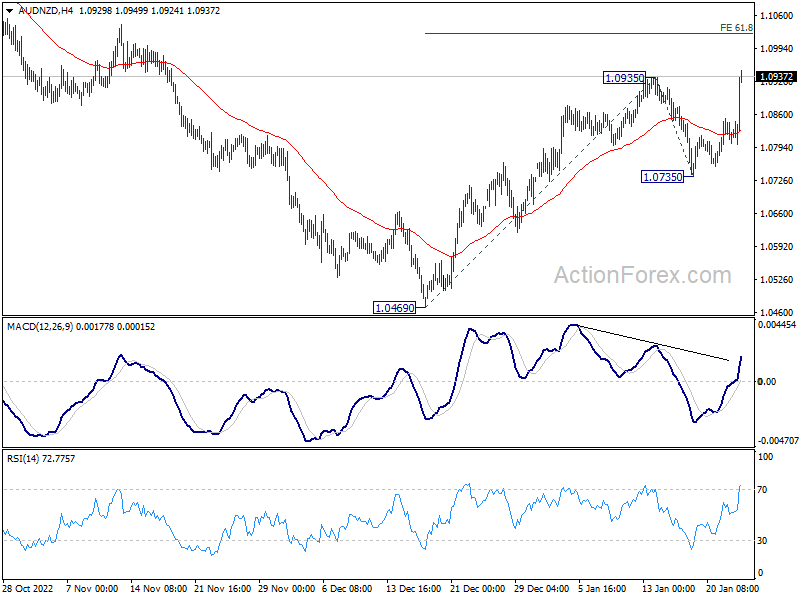
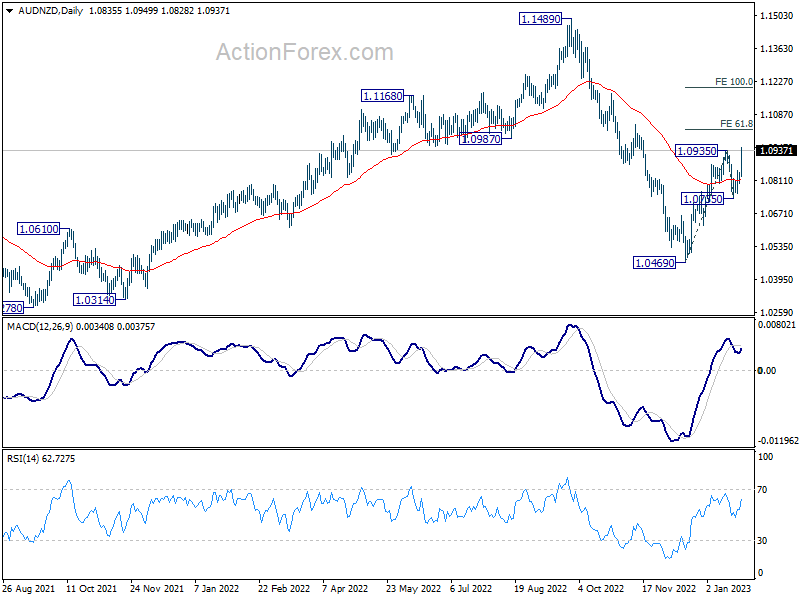
AUD/NZD breaks through 1.0935 resistance to resume the whole rally from 1.0469. The support from 55 day EMA is seen as a near term bullish favor. Further rise is now expected as long as 1.0735 support holds. Next target is 61.8% projection of 1.0469 to 1.0935 from 1.0735 at 1.1023. Firm break there would prompt upside acceleration to 100% projection at 1.1201 next.
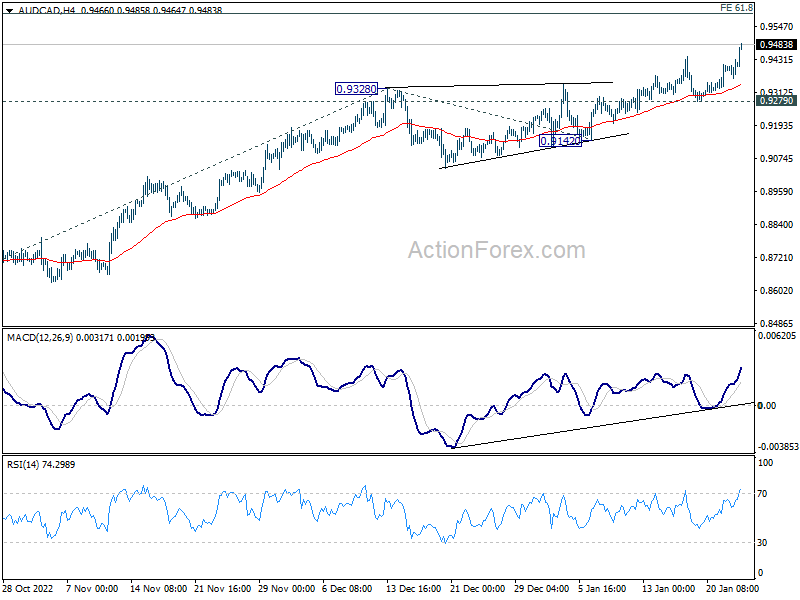
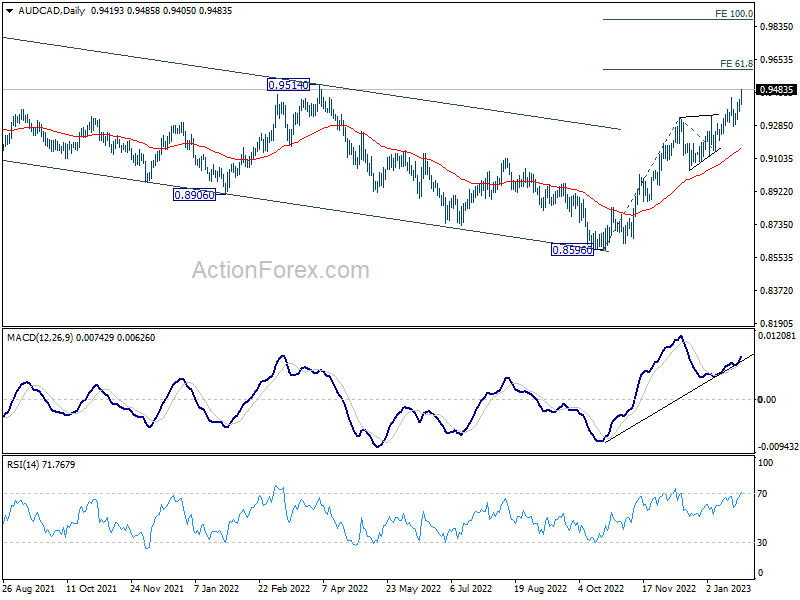
AUD/CAD also breaks through 0.9442 temporary top to resume the rally from 0.8596. Near term outlook will stay bullish as long as 0.9279 support holds. Next target is 61.8% projection of 0.8596 to 0.9328 from 0.9142 at 0.9594. Sustained break there would also prompt upside acceleration to 100% projection at 0.9874 next.
ECB Simkus backs hikes of 50bps in the coming meetings
ECB Governing Council member Gediminas Simkus said yesterday, "core inflation remains strong and demonstrates that the fight against inflation is not over."
"There's a strong case for staying on the course that's been set for the coming meetings of 50 basis-point increases. In my opinion, these 50 basis-point increases must be taken unequivocally," he added.
"Pressures in wage growth are increasing — I expect wage increases to exceed historical averages in the euro area," he said. "It's something that's happening and something we need to take into account because it affects core inflation."
"It's clear to me that the current economic environment requires us to deliver increases of 50 basis points in the coming meetings," he said. "When we move to the more distant periods of the summer or next autumn, we need to wait and see."
SNB Schlegel: Cannot rule out further interest increases
SNB Vice Chairman Martin Schlegel said yesterday, "we cannot rule out further interest increases at present," even though inflation is forecast to fall back to 2.4% in 2023, and 1.8% in 2024.
"The maintenance of price stability has absolute priority for the SNB," he added.
Meanwhile, Schlegel also expects a weak growth dynamic in the coming quarters.
BoC Previews: One more insurance hike before pausing
BoC is expected to deliver an "insurance" rate hike of 25bps today, to bring policy rate to 4.50%. After this eighth consecutive increase, the central bank is expected to pause the tightening cycle.
It's already indicated in the December statement that the bank will be "considering whether the policy interest rate needs to rise further". BoC should more explicitly indicate that it's now the time to let pass rate hikes work through the economy.
The question would then shift to the time interest rate is going to stay at this level, but no answer is expected any time soon.
Here are some previews on BoC:
- Will BoC Press the Hike Button One More Time?
- Market Pricing and Economists Favour a 25bp Hike from the BOC Tomorrow
- Bank of Canada Likely to Make One Last Rate Hike—Then Take a Breather
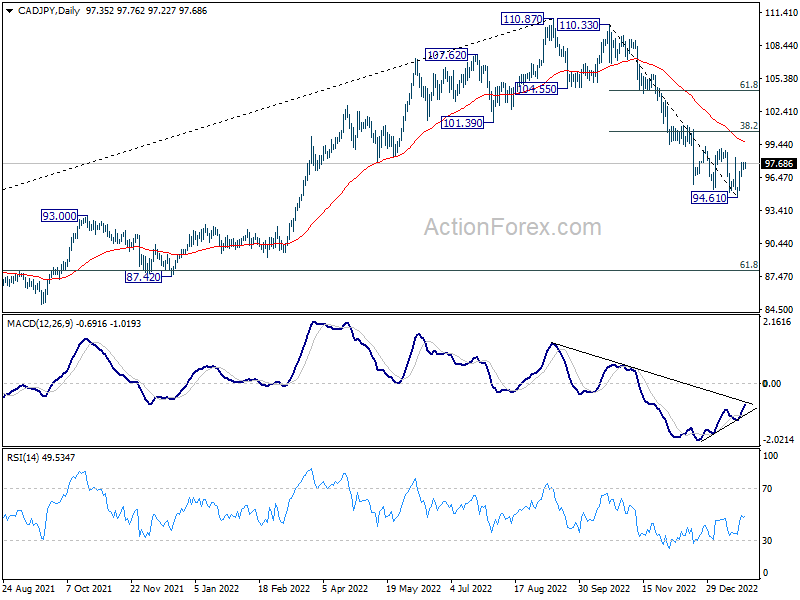
CAD/JPY has been losing downside momentum for some time, as seen in daily MACD and a bounce is overdue. Yet, even in case of a rebound, strong resistance could be seen between 55 day EMA (now at 99.65) and 38.2% retracement of 110.33 to 94.61 at 100.61 to cap upside. Until 100.61 is taken out decisively, any bounce is more of a short opportunity than a turnaround.
Elsewhere
UK PPI, Swiss Credit Suisse economic expectations and Germany Ifo business climate will also be featured today.
AUD/USD Daily Report
Daily Pivots: (S1) 0.7007; (P) 0.7032; (R1) 0.7071; More...
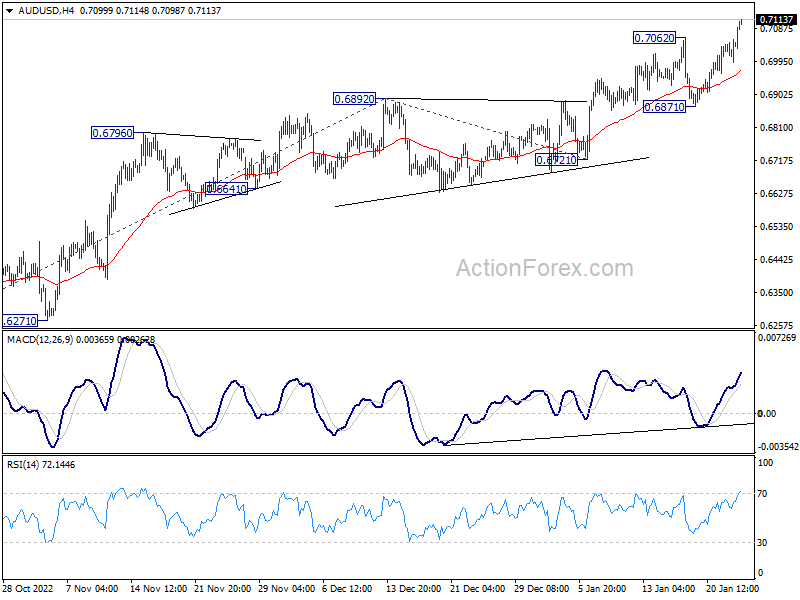
AUD/USD's rally resumes by breaking through 0.7062 and intraday bias is back on the upside. Current rise from 0.6169 should target 61.8% projection of 0.6169 to 0.6892 from 0.6721 at 0.7168 next. Break there will target 0.7304 fibonacci level. On the downside, break of 0.6871 support is needed to indicate short term topping. Otherwise, outlook will stay bullish in case of retreat.
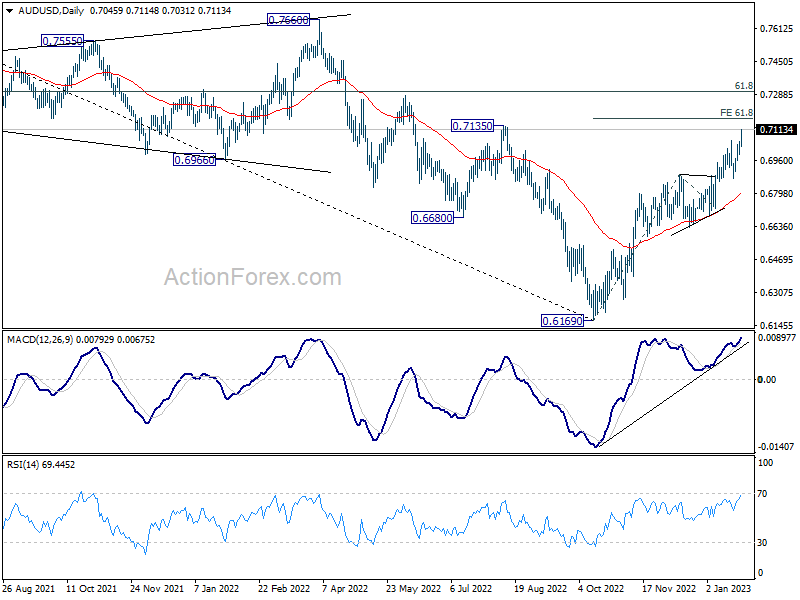
In the bigger picture, corrective decline from 0.8006 (2021 high) should have completed with three waves down to 0.6169 (2022 low). Further rally should be seen to 61.8% retracement of 0.8006 to 0.6169 at 0.7304. Sustained break there will pave the way to retest 0.8006. This will now remain the favored case as long as 0.6721 support holds.
Economic Indicators Update
| GMT | Ccy | Events | Actual | Forecast | Previous | Revised |
|---|---|---|---|---|---|---|
| 21:45 | NZD | CPI Q/Q Q4 | 1.40% | 1.50% | 2.20% | |
| 21:45 | NZD | CPI Y/Y Q4 | 7.20% | 7.10% | 7.20% | |
| 23:30 | AUD | Westpac Leading Index M/M Dec | -0.10% | -0.10% | ||
| 00:30 | AUD | CPI Q/Q Q4 | 1.90% | 1.70% | 1.80% | |
| 00:30 | AUD | CPI Y/Y Q4 | 7.80% | 7.50% | 7.30% | |
| 00:30 | AUD | RBA Trimmed Mean CPI Q/Q Q4 | 1.70% | 1.60% | 1.80% | 1.90% |
| 00:30 | AUD | RBA Trimmed Mean CPI Y/Y Q4 | 6.90% | 6.50% | 6.10% | |
| 00:30 | AUD | Monthly CPI Y/Y Dec | 8.40% | 7.70% | 7.30% | |
| 07:00 | GBP | PPI Input M/M Dec | 0.90% | 0.60% | ||
| 07:00 | GBP | PPI Input Y/Y Dec | 19.20% | 19.20% | ||
| 07:00 | GBP | PPI Output M/M Dec | 0.70% | 0.30% | ||
| 07:00 | GBP | PPI Output Y/Y Dec | 13.90% | 14.80% | ||
| 07:00 | GBP | PPI Core Output M/M Dec | 1.10% | 0.50% | ||
| 07:00 | GBP | PPI Core Output Y/Y Dec | 13.90% | 13.30% | ||
| 09:00 | CHF | Credit Suisse Economic Expectations Jan | -42.8 | |||
| 09:00 | EUR | Germany IFO Business Climate Jan | 90.5 | 88.6 | ||
| 09:00 | EUR | Germany IFO Current Assessment Jan | 95 | 94.4 | ||
| 09:00 | EUR | Germany IFO Expectations Jan | 85 | 83.2 | ||
| 15:00 | CAD | BoC Rate Decision | 4.50% | 4.25% | ||
| 15:30 | USD | Crude Oil Inventories | 1.2M | 8.4M | ||
| 16:00 | CAD | BoC Press Conference |
BoC Previews: One more insurance hike before pausing
BoC is expected to deliver an "insurance" rate hike of 25bps today, to bring policy rate to 4.50%. After this eighth consecutive increase, the central bank is expected to pause the tightening cycle.
It's already indicated in the December statement that the bank will be "considering whether the policy interest rate needs to rise further". BoC should more explicitly indicate that it's now the time to let pass rate hikes work through the economy.
The question would then shift to the time interest rate is going to stay at this level, but no answer is expected any time soon.
Here are some previews on BoC:
- Will BoC Press the Hike Button One More Time?
- Market Pricing and Economists Favour a 25bp Hike from the BOC Tomorrow
- Bank of Canada Likely to Make One Last Rate Hike—Then Take a Breather
CAD/JPY has been losing downside momentum for some time, as seen in daily MACD and a bounce is overdue. Yet, even in case of a rebound, strong resistance could be seen between 55 day EMA (now at 99.65) and 38.2% retracement of 110.33 to 94.61 at 100.61 to cap upside. Until 100.61 is taken out decisively, any bounce is more of a short opportunity than a turnaround.
Technical Outlook and Review
USD/JPY:
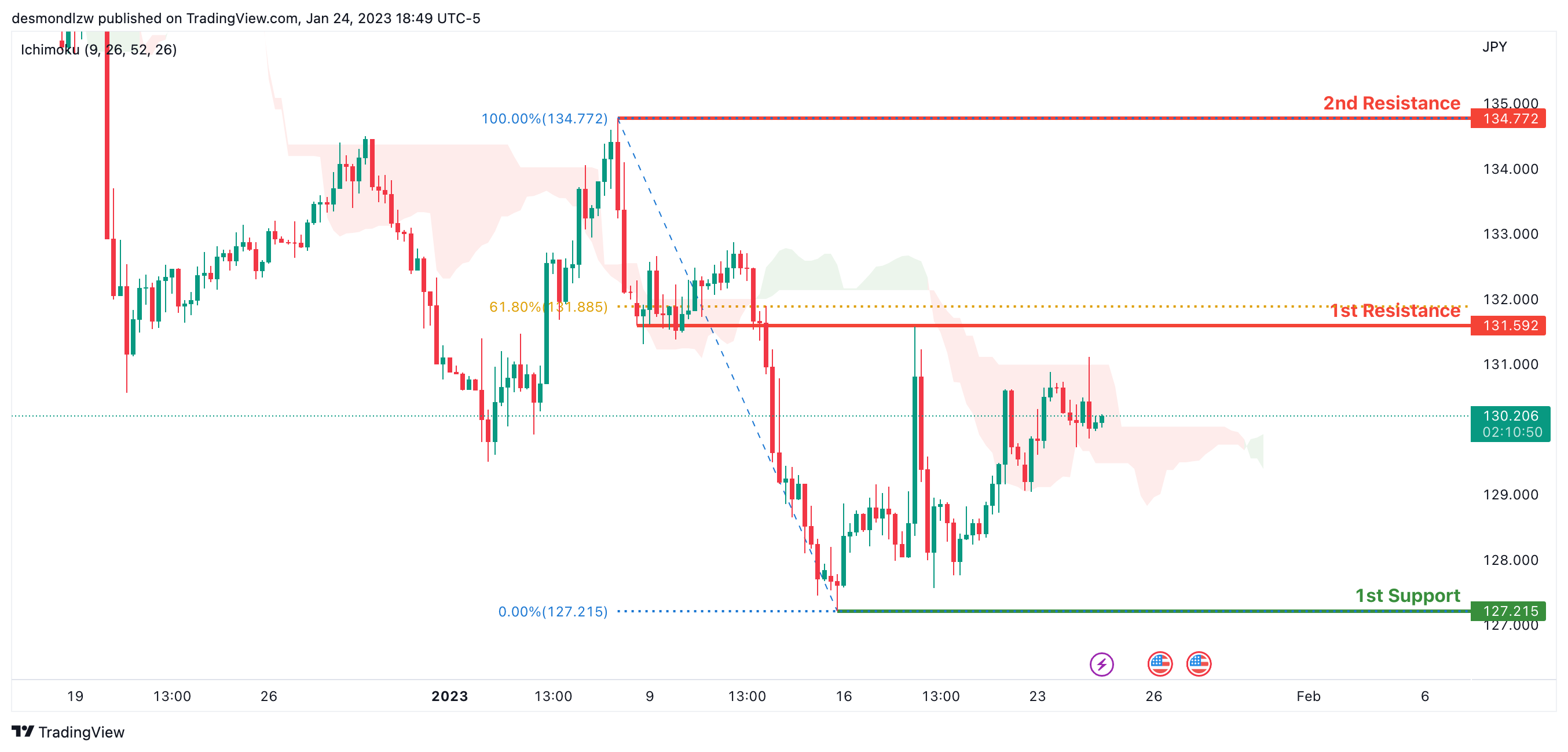
Looking at the H4 chart, my overall bias for USDJPY is bullish due to the current price crossing above the Ichimoku cloud, indicating a bullish market. If this bullish momentum continues, expect the price to possibly continue heading towards the 1st resistance level at 131.592, where the 61.8% Fibonacci line is. In an alternate scenario, price could possibly head back down to retest the 1st support at 127.215, where the previous swing low is.
Areas of consideration:
- H4 time frame, 1st resistance at 131.592
- H4 time frame, 1st support at 127.215
DXY:
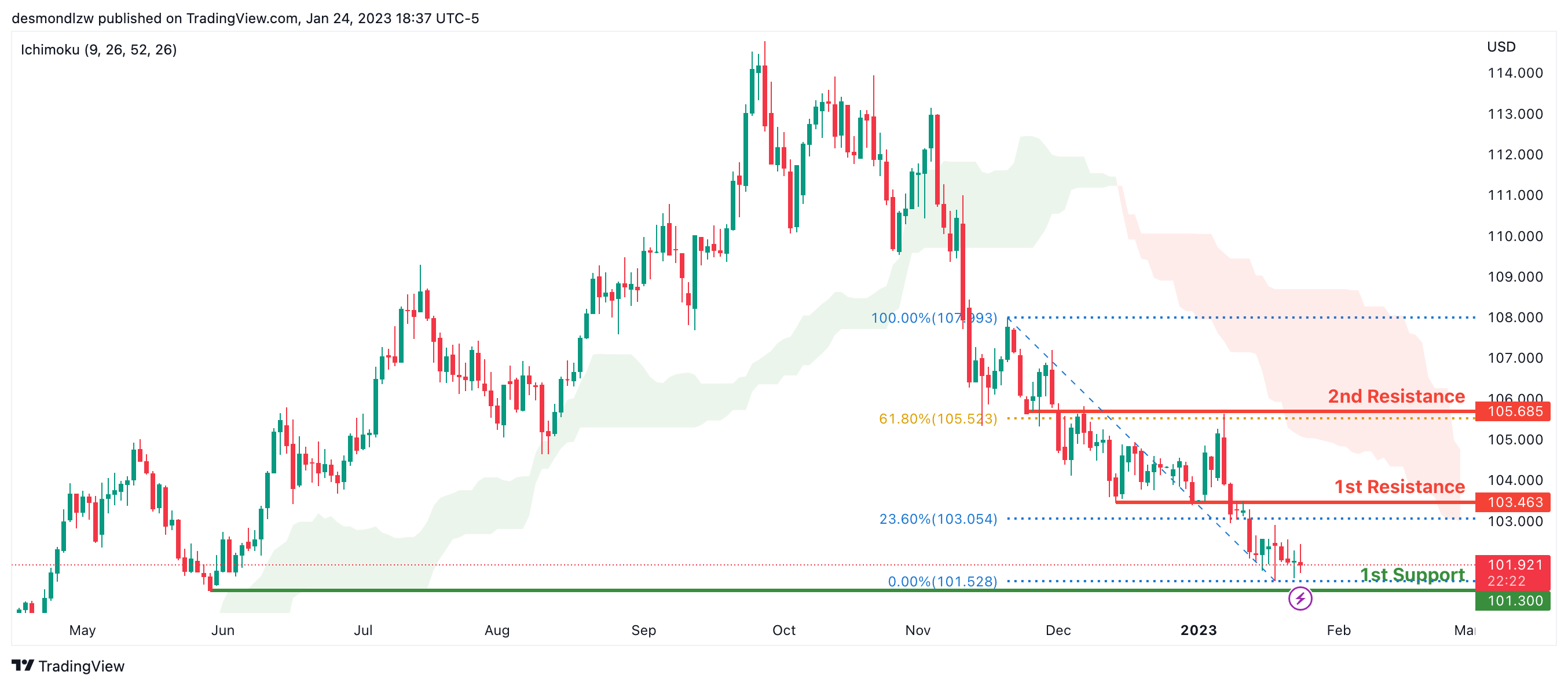
Looking at the Daily chart, my overall bias for DXY is bearish due to the current price being below the Ichimoku cloud, indicating a bearish market. If this bearish momentum continues, expect the price to possibly continue heading towards the 1st support at 101.300, where the previous low is. . In an alternative scenario, price could head back up to retest the 1st resistance at 103.463, where the 23.6% Fibonacci line is.
Areas of consideration:
- H4 time frame, 1st resistance at 103.463
- H4 time frame, 1st support at 101.300
EUR/USD:
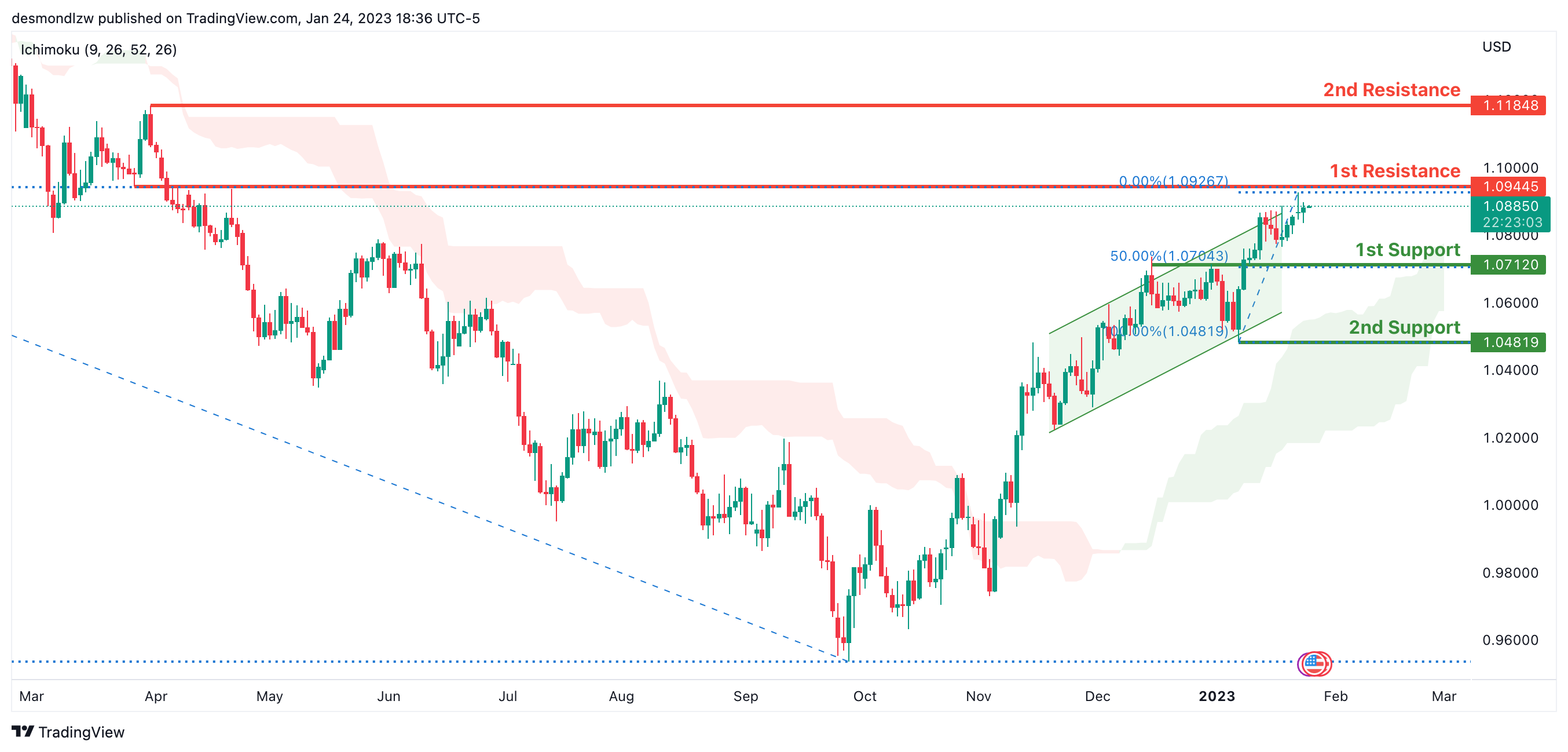
Looking at the Daily chart, my overall bias for EURUSD is bullish due to the current price being above the Ichimoku cloud, indicating a bullish market structure. To add confluence to this bias, price is also within an ascending channel. If this bullish momentum continues, expect the price to possibly continue heading towards the 1st resistance at 1.09445, where the 50% Fibonacci line is. In an alternate scenario, price could possibly head back down to retest the 1st support level at 1.07120, where the 50% Fibonacci line is.
Areas of consideration :
- H4 1st resistance at 1.09445
- H4 1st support at 1.07120
GBP/USD:
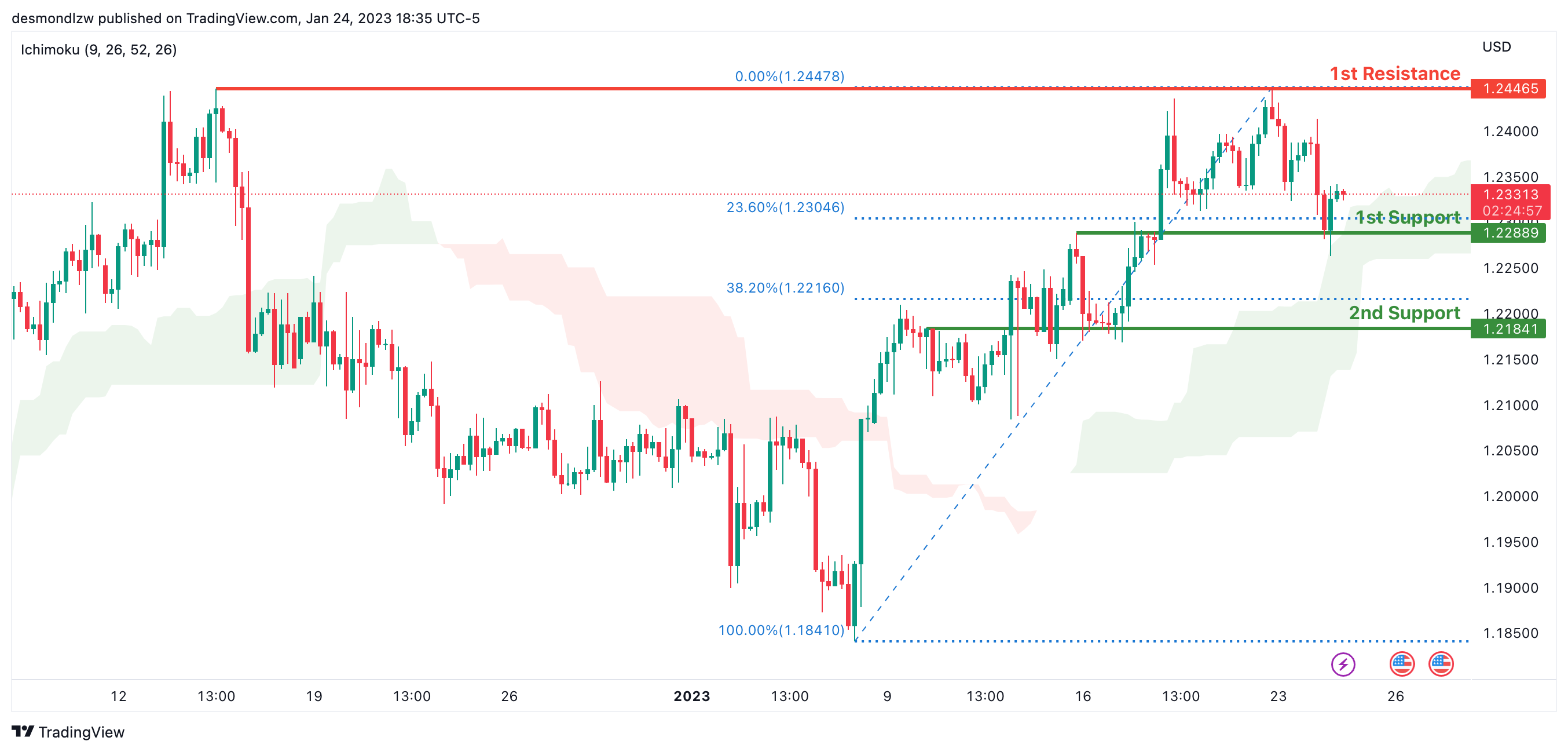
Looking at the H4 chart, my overall bias for GBPUSD is bullish due to the current price being above the Ichimoku cloud, indicating a bullish market. If this bullish momentum continues, expect price to possibly continue heading towards the 1st resistance line at 1.24465, where the previous swing high is. In an alternate scenario, price could possibly head back down and retest the 1st support at 1.22889, where the 23.6% Fibonacci line is.
Areas of consideration:
- H4 1st resistance at 1.24465
- H4 1st support at 1.22889
USD/CHF:
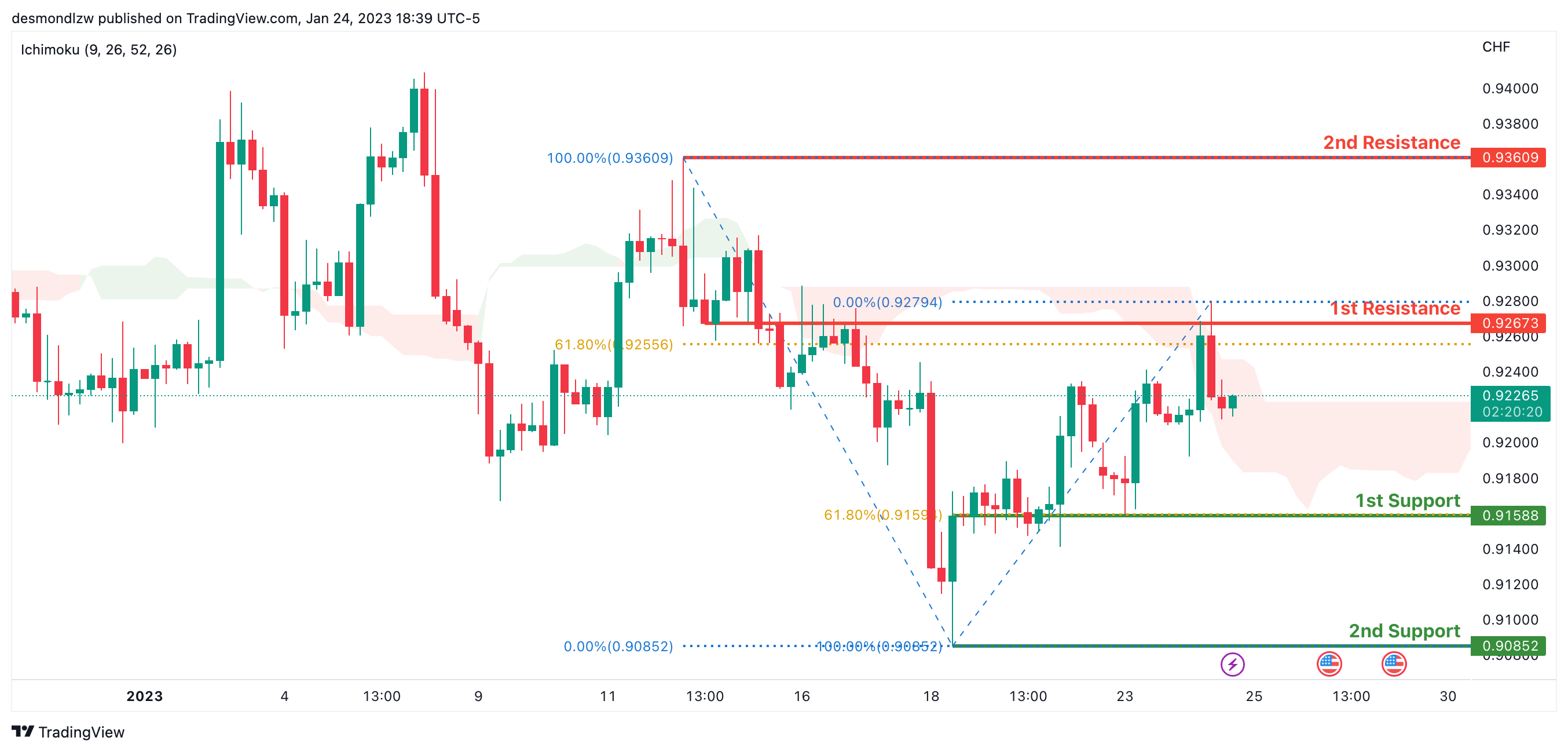
Looking at the H4 chart, my overall bias for USDCHF is bullish due to the current price crossing above the Ichimoku cloud, indicating a bullish market. If the current bullish trend continues, expect the price to possibly continue to head towards the 1st resistance at 0.92673, where the 61.8% Fibonacci line is. In an alternative scenario, price could possibly head back down to retest the 1st support at 0.91588, where the 61.8% Fibonacci line is.
Areas of consideration
- H4 1st support at 0.91588
- H4 1st resistance at 0.92673
XAU/USD (GOLD):
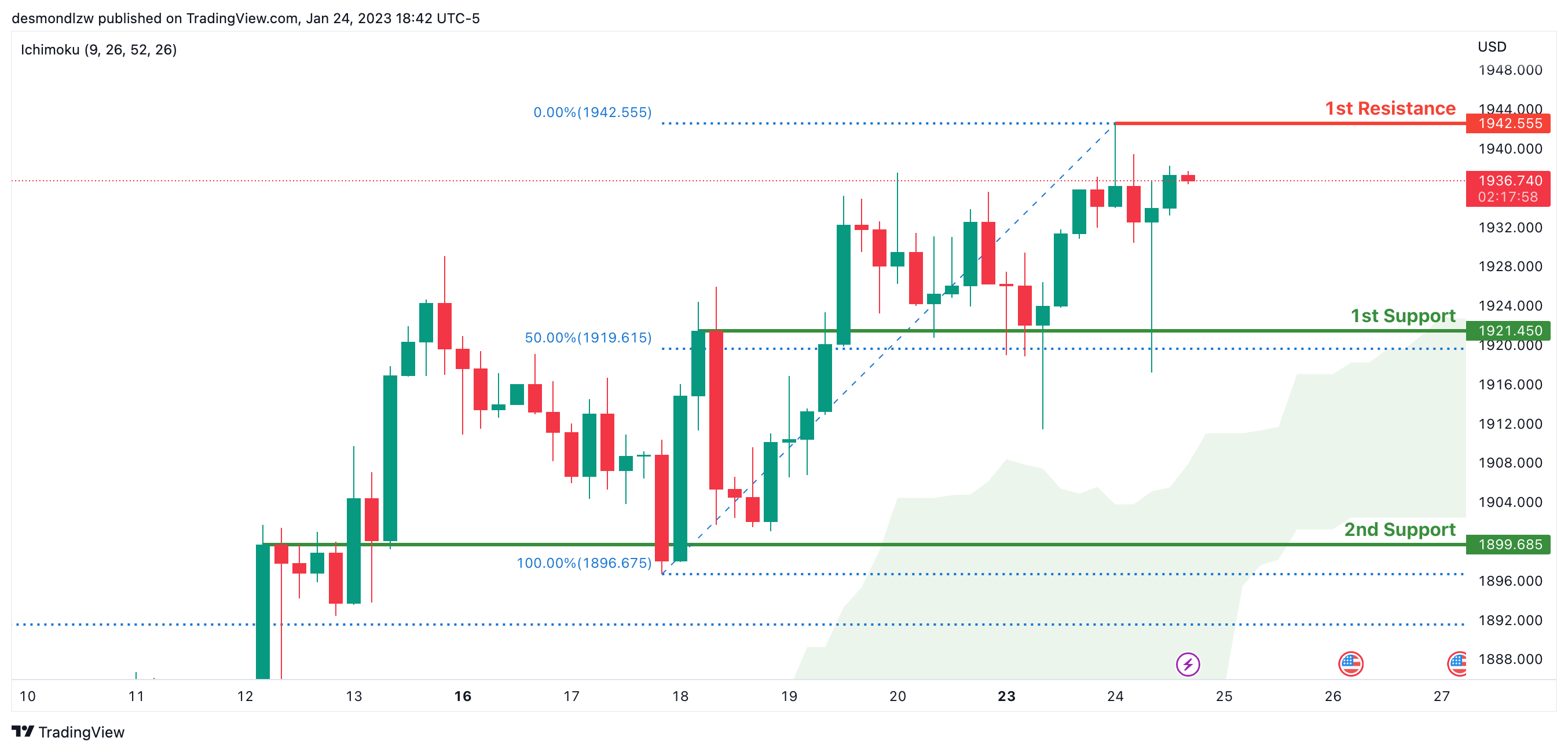
Looking at the H4 chart, my overall bias for XAUUSD is bullish due to the current price being above the Ichimoku cloud, indicating a bullish market. If this bullish momentum continues, expect the price to possibly continue heading towards the 1st resistance at 1942.555, where the recent high is. In an alternative scenario, price could possibly head back down to retest the 1st support at 1921.450 where the 50% Fibonacci line is.
Areas of consideration:
- H4 time frame, 1st resistance at 1942.555
- H4 time frame, 1st support at 1921.450
AUD/USD:
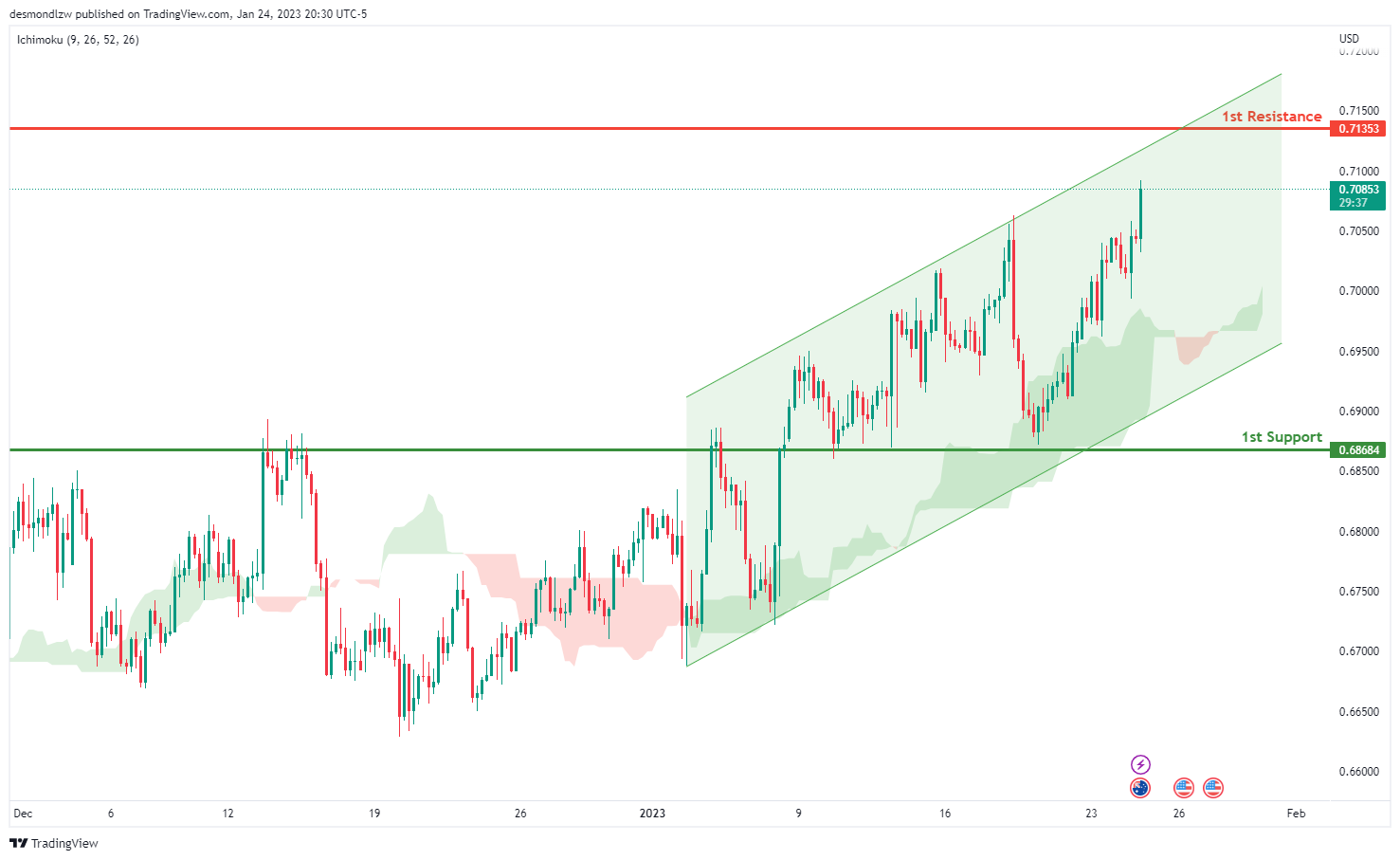
Looking at the H4 chart, we can see that the 1st support is at 0.68684 which is a strong overlap support. There is an ascending channel . the current price is now above the Ichimoku Cloud. Expecting the price is moving towards the 1st resistance is at 0.71353 which is recent swing high.
Areas of consideration
- H4. 1st resistance at 0.71353
- H4, 1st support at 0.68684
NZD/USD:
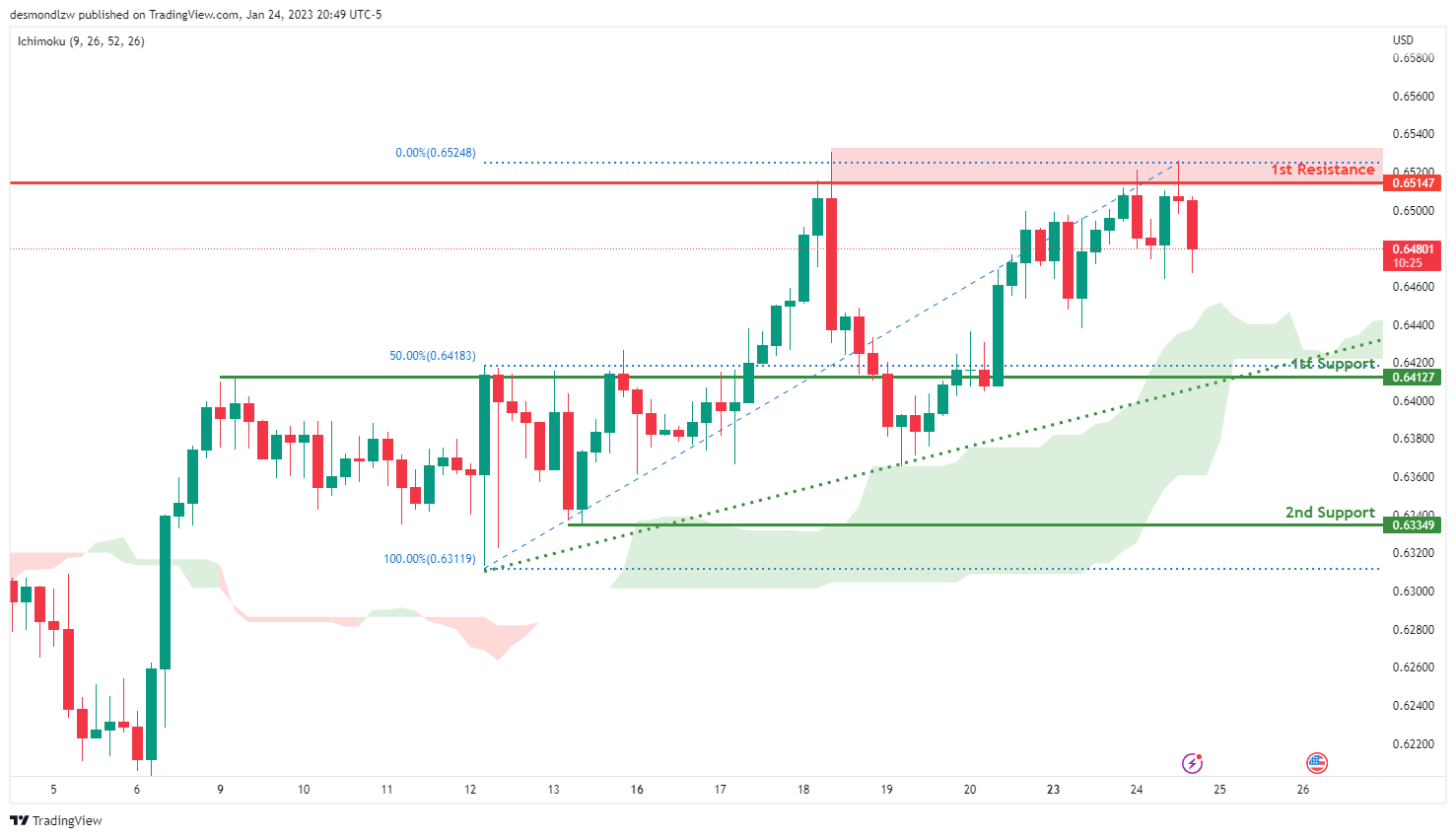
Looking at the H4 chart, we can see that the 1st support is at 0.64127 which is overlap support that is in line with the 50% Fibonacci line. If the price breaks this level, we could see it drop to 2nd support is down at 0.63349. As the current price is above the Ichimoku cloud and there is an ascending trend line, which suggests bullish momentum.
For the resistance, our 1st resistance is at 0.65147 which is a recent swing high resistance area.
Areas of consideration:
- H4 time frame, 1st resistance at 0.65147
- H4 time frame, 1st support at 0.64102
- H4 time frame, 2nd support at 0.63349
USD/CAD:
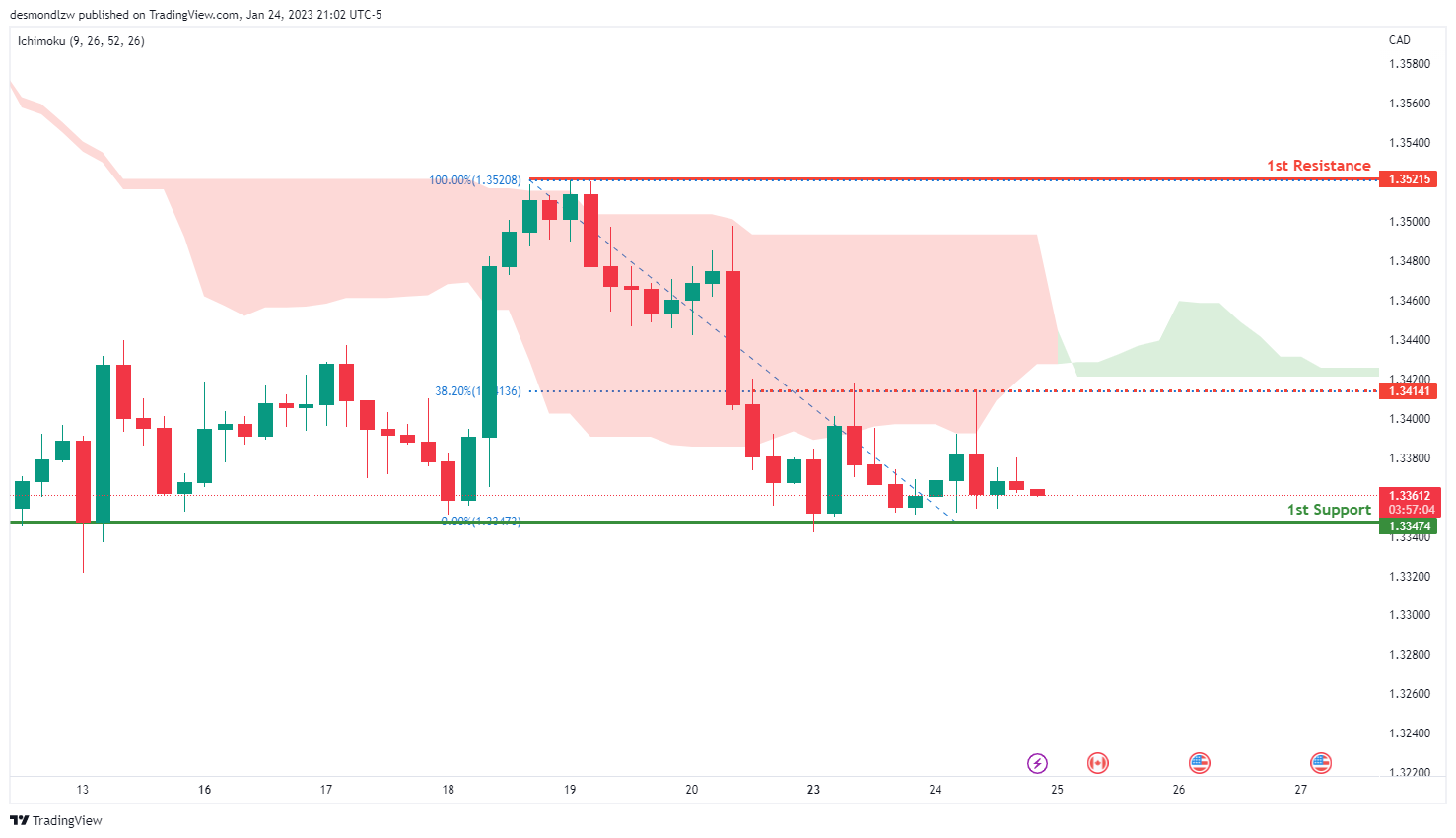
On the H4 chart, the 1st support is at 1.33474 which is an overlap support and recent swing low.
In terms of resistance, the 1st resistance we can see is at 1.35208 which is the recent swing high. There is an intermediate resistance which is in line with 38.2% Fibonacci retracement at 1.35208.
Areas of consideration:
- H4 time frame, 1st resistance at 1.35208
- H4 time frame. Intermediate resistance at 1.35208
- H4 time frame, 1st support at 1.33474
OIL:
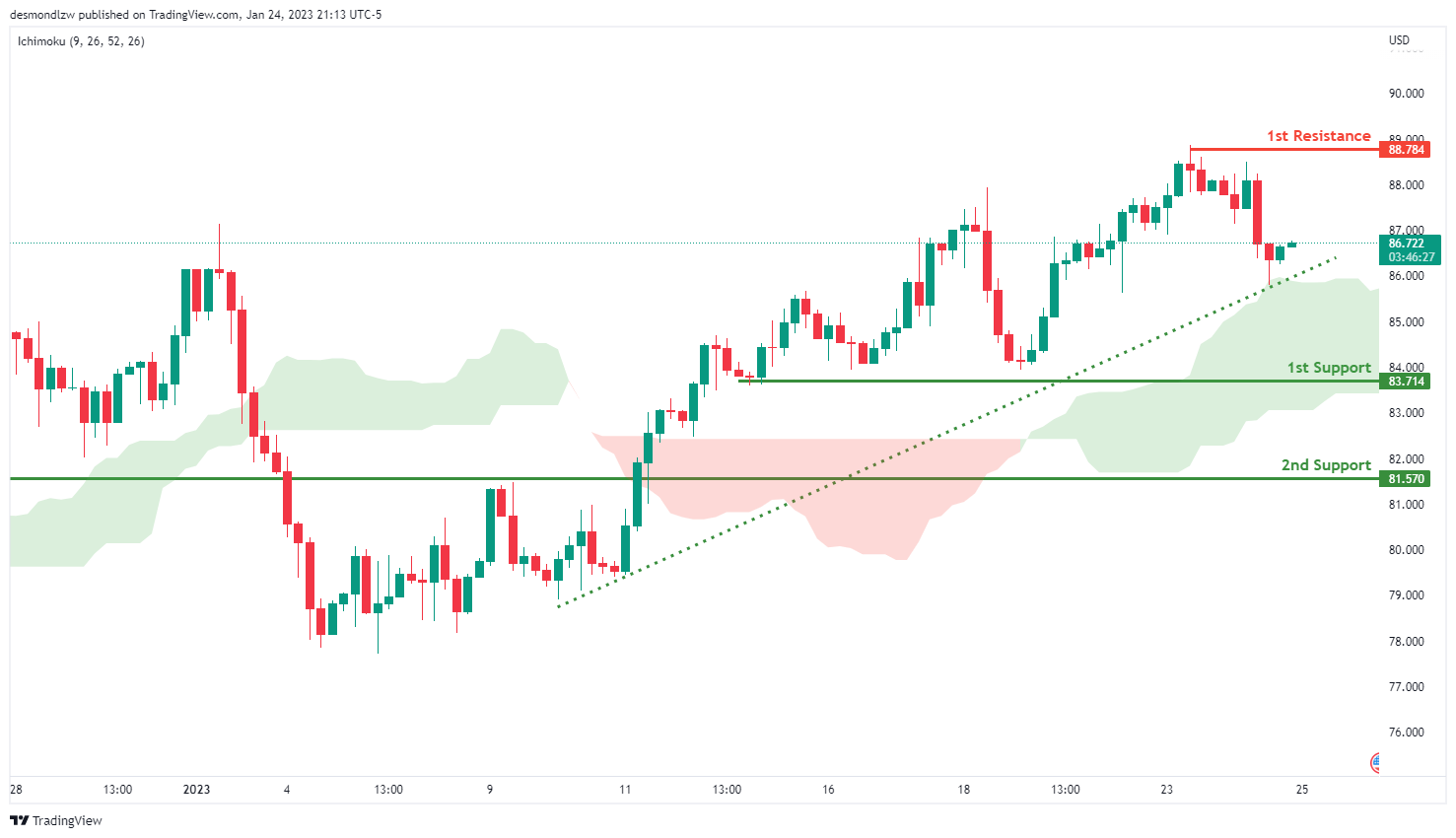
Looking at the H4 chart, we can see that the 1st resistance is at 88.784 which is recent swing high. As the price is above the Ichimoku Cloud and uptrend line is suggesting the bulilish momentum.
In terms of support, we can see our 1st support at 83.714 which is overlap support. Breaking this level would trigger a further drop to our 2nd support at 81.704.
Areas of consideration:
- H4 time frame, 1st resistance at 88.784
- H4 time frame,1st support at 83.714
- Hr time frame, 2nd support at 81.704
Dow Jones Industrial Average:
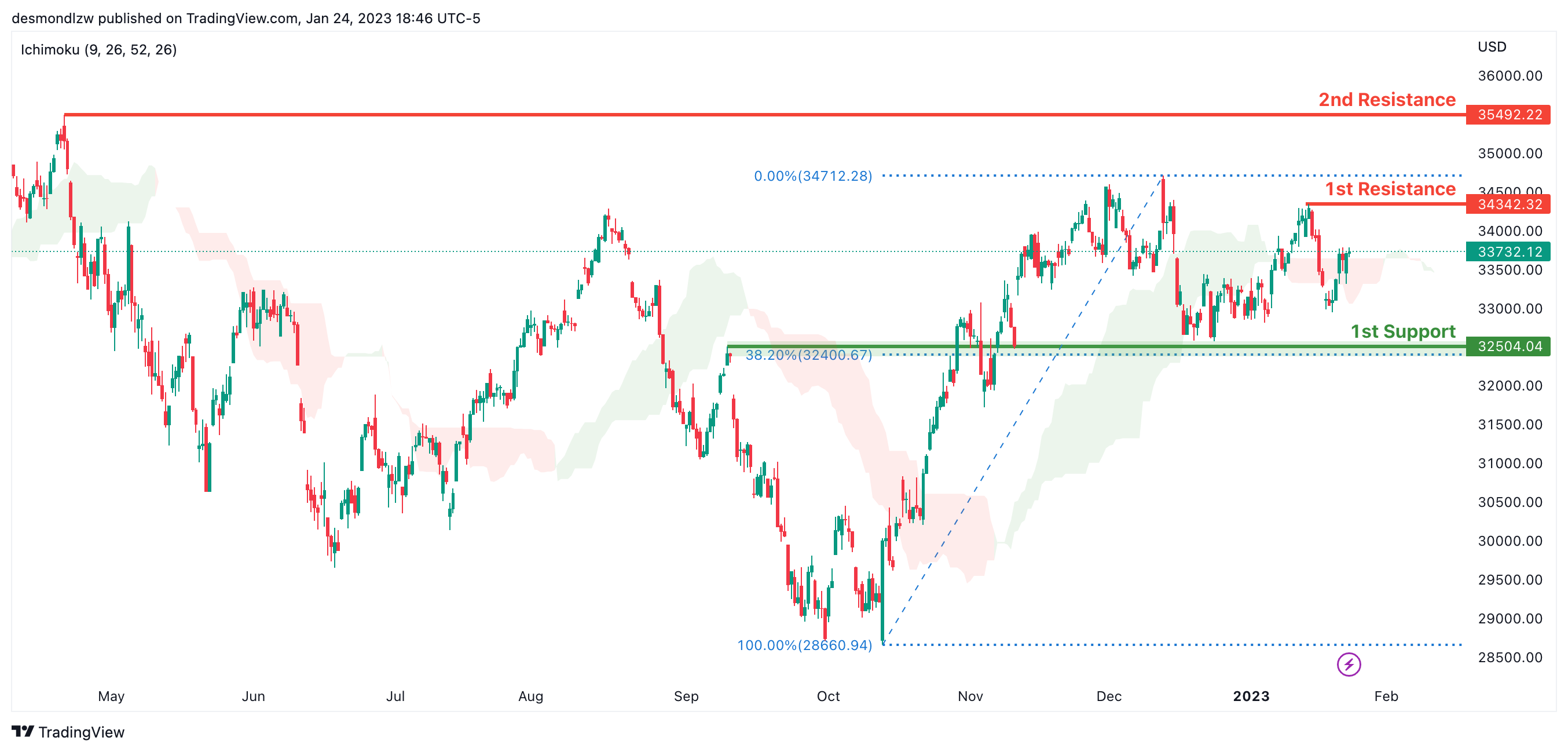
On the H4 chart, the overall bias for DJI is bullish. To add confluence to this, the price is crossing above the Ichimoku cloud which indicates a bullish market. If this bullish momentum continues, expect the price to possibly continue heading towards the 1st resistance line at 34712.28, where the recent swing high is. In an alternative scenario, price could possibly head back down towards the 1st support at 32581.97, slightly above where the 38.2% Fibonacci line is.
Areas of consideration:
- H4 time frame, 1st support at 32581.97
- H4 time frame, 1st Resistance at 34712.28
DAX:
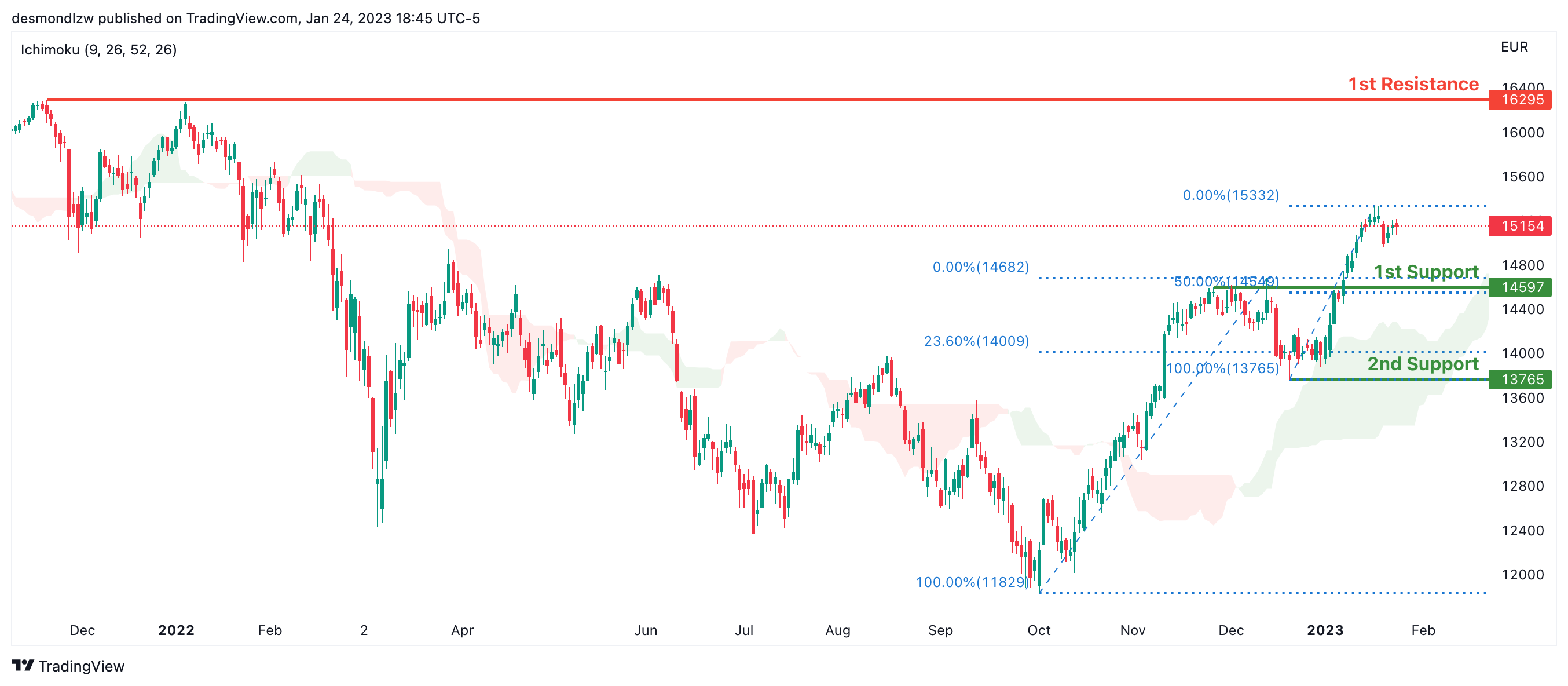
Looking at the Daily chart, my overall bias for DAX is bullish due to the current price crossing above the Ichimoku cloud, indicating a bullish market. If this bullish momentum continues, expect the price to possibly head towards the 1st resistance line at 16295, where the previous swing high is. In an alternative scenario, price could possibly head down to retest the 1st support at 14597, where the 50% Fibonacci line is.
Areas of consideration:
- H4 time frame, 1st resistance is at 16295
- H4 time frame, 1st support is at 14597
ETHUSD:
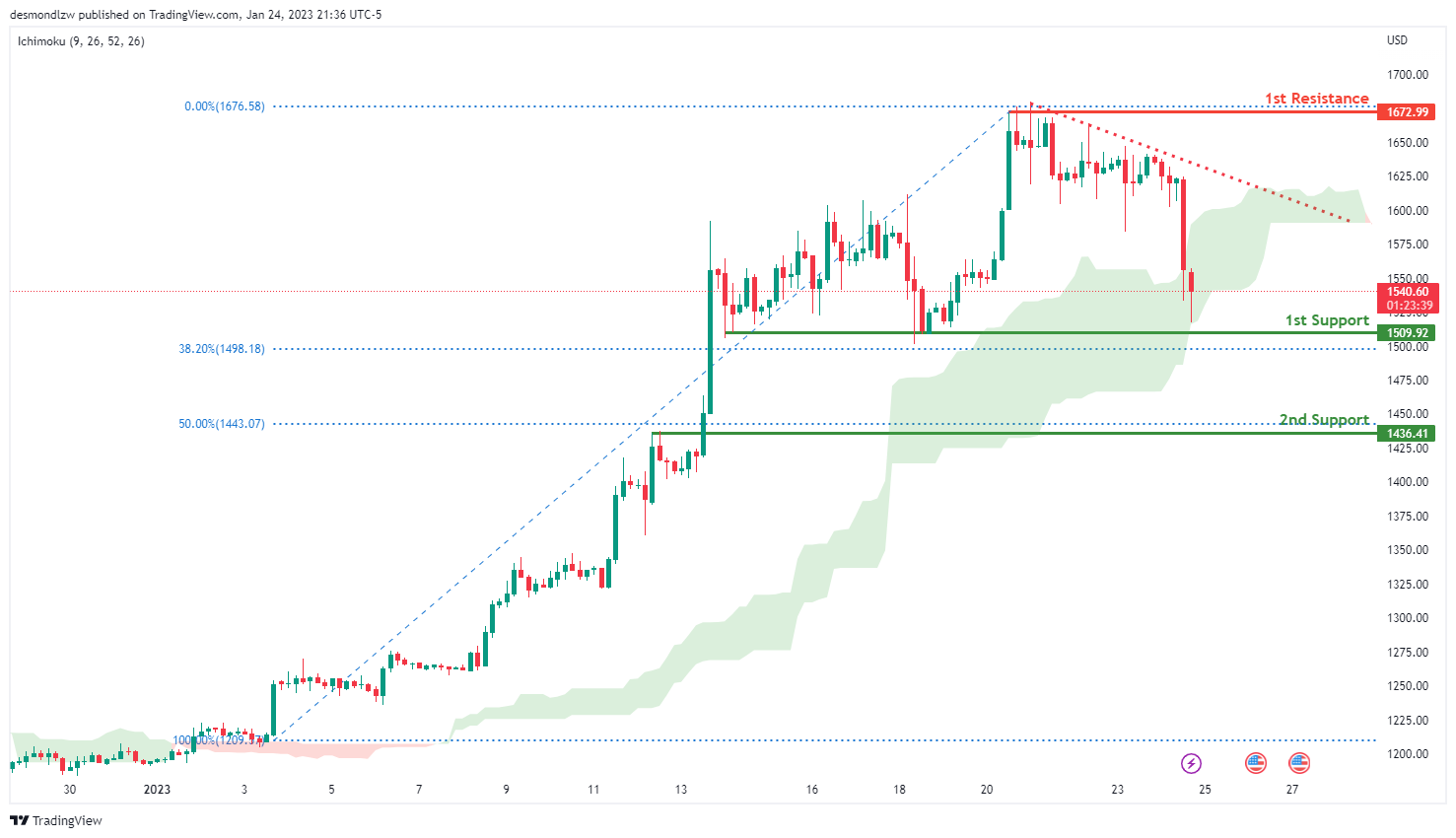
Looking at the H4 chart, my overall bias for ETHUSD is bearish, as there is an downside trend line. Expecting the price is move towards the 1st support at 1509.92 which is overlap support. It is also line with 38.2% Fibonacci retracement. Once the price is break the 1st support, it will head towards 2nd support at 1436.41. The 1st resisitanace is at 1672.99 which is the recent swing high.
Areas of consideration:
- H4 time frame, 1st resistance of 1672.99
- H4 time frame, 1st support at 1509.92
- H4 time frame, 2nd support at 1436.41
BTCUSD:
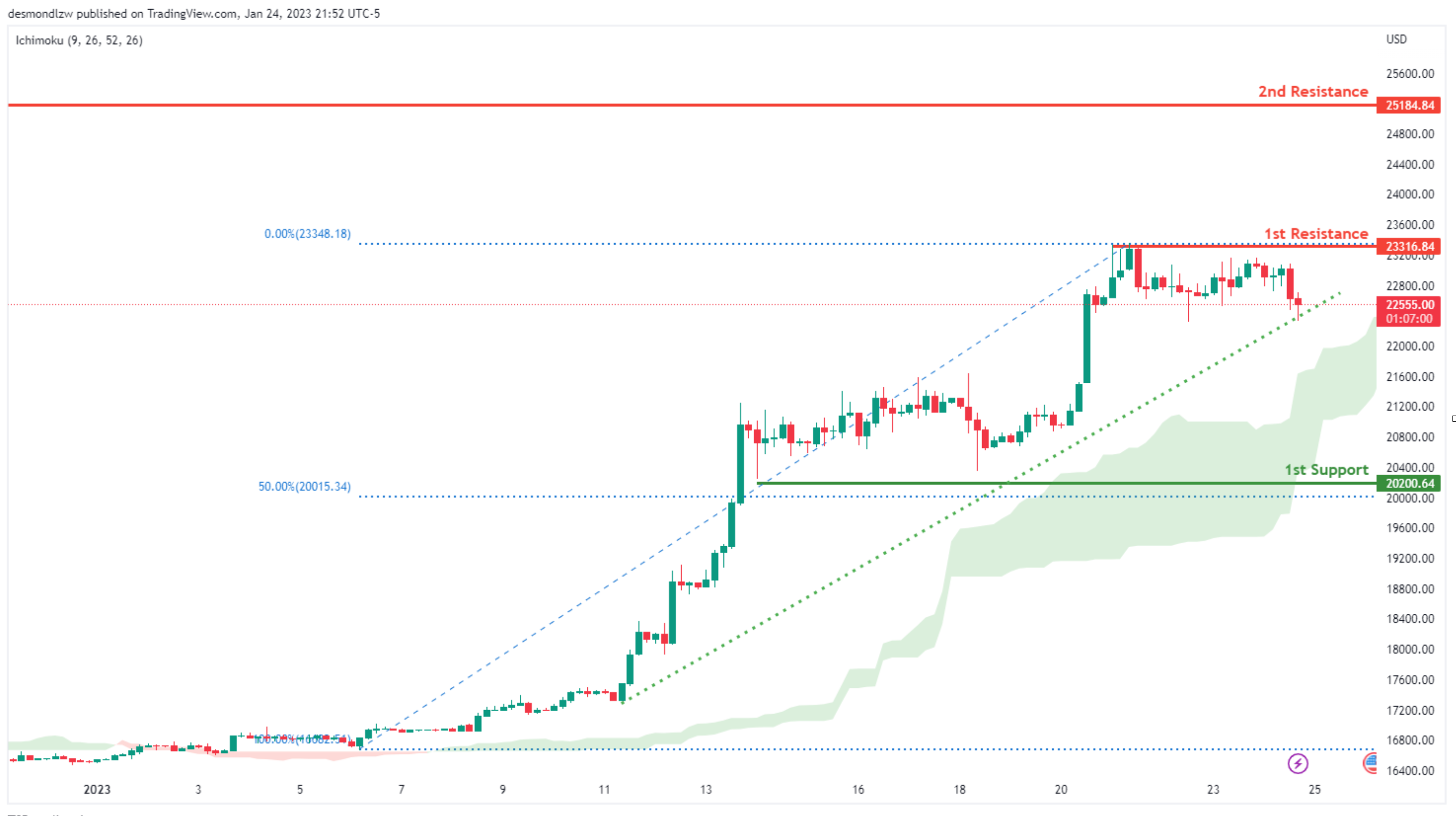
Looking at the H4 chart, my overall bias for BTCUSD is bullish due to the current price being above the Ichimoku cloud, and there is an upside trend line, indicating a bullish market. If this bullish momentum continues, expect the price to possibly break the 1st resistance at 23316.84 which is the recent swing high. The 2nd resistance is at 25184.84.
In an alternative scenario, the price could possibly head back down to retest the 1st support at 20200.64 which is in line with the 50% Fibonacci retracement.
Areas of consideration:
- H4 time frame, 2nd resistance 25184.84
- H4 time frame, 1st resistance 23316.84
- H4 time frame, 1st support at 20200.64
S&P 500:
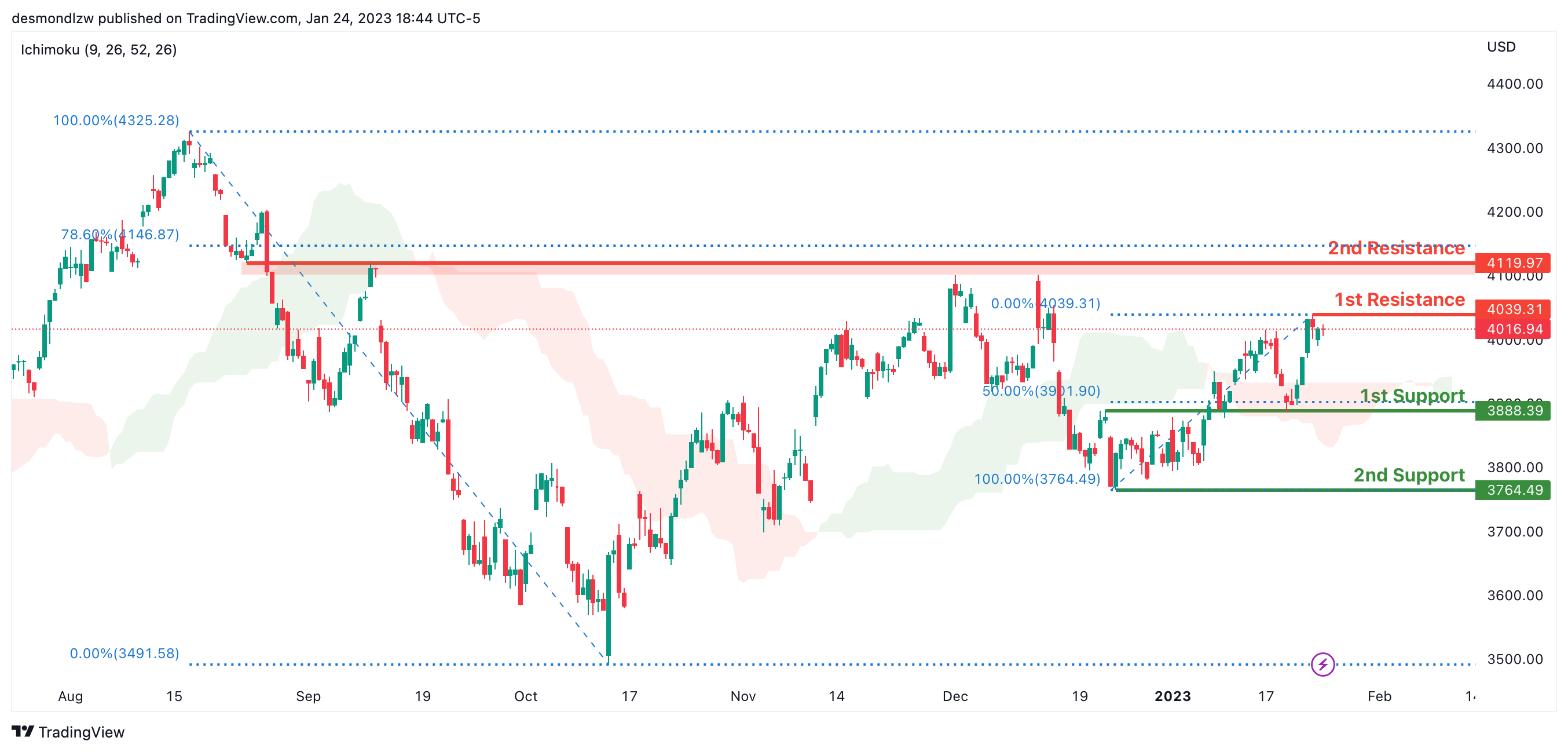
Looking at the H4 chart, my overall bias for S&P500 is bullish due to the current price being above the Ichimoku cloud, indicating a bullish market. If this bullish momentum continues, expect the price to continue heading towards the 1st resistance at 4039.31, where the recent high is. In an alternative scenario, price could possibly head back down to break the 1st support at 3888.39, where the 50% Fibonacci line is, before heading towards the 2nd support at 3764.49, where the recent swing low is.
Areas of consideration:
- H4 time frame, 1st support at 3888.39
- H4 time frame, 2nd support at 3764.49
- H4 time frame, 1st resistance at 4039.31
AUD/NZD and AUD/CAD extends up trend
Australian Dollar surges broadly after much stronger than expected CPI reading in December in particular dented any hope for an imminent RBA pause. Meanwhile, New Zealand Dollar is just mixed as CPI didn't accelerate as RBNZ projected, raising hope of a lower terminal rate.
AUD/NZD breaks through 1.0935 resistance to resume the whole rally from 1.0469. The support from 55 day EMA is seen as a near term bullish favor. Further rise is now expected as long as 1.0735 support holds. Next target is 61.8% projection of 1.0469 to 1.0935 from 1.0735 at 1.1023. Firm break there would prompt upside acceleration to 100% projection at 1.1201 next.
AUD/CAD also breaks through 0.9442 temporary top to resume the rally from 0.8596. Near term outlook will stay bullish as long as 0.9279 support holds. Next target is 61.8% projection of 0.8596 to 0.9328 from 0.9142 at 0.9594. Sustained break there would also prompt upside acceleration to 100% projection at 0.9874 next.
Australia CPI rose to 8.4% yoy in Dec, 7.8% yoy in Q4
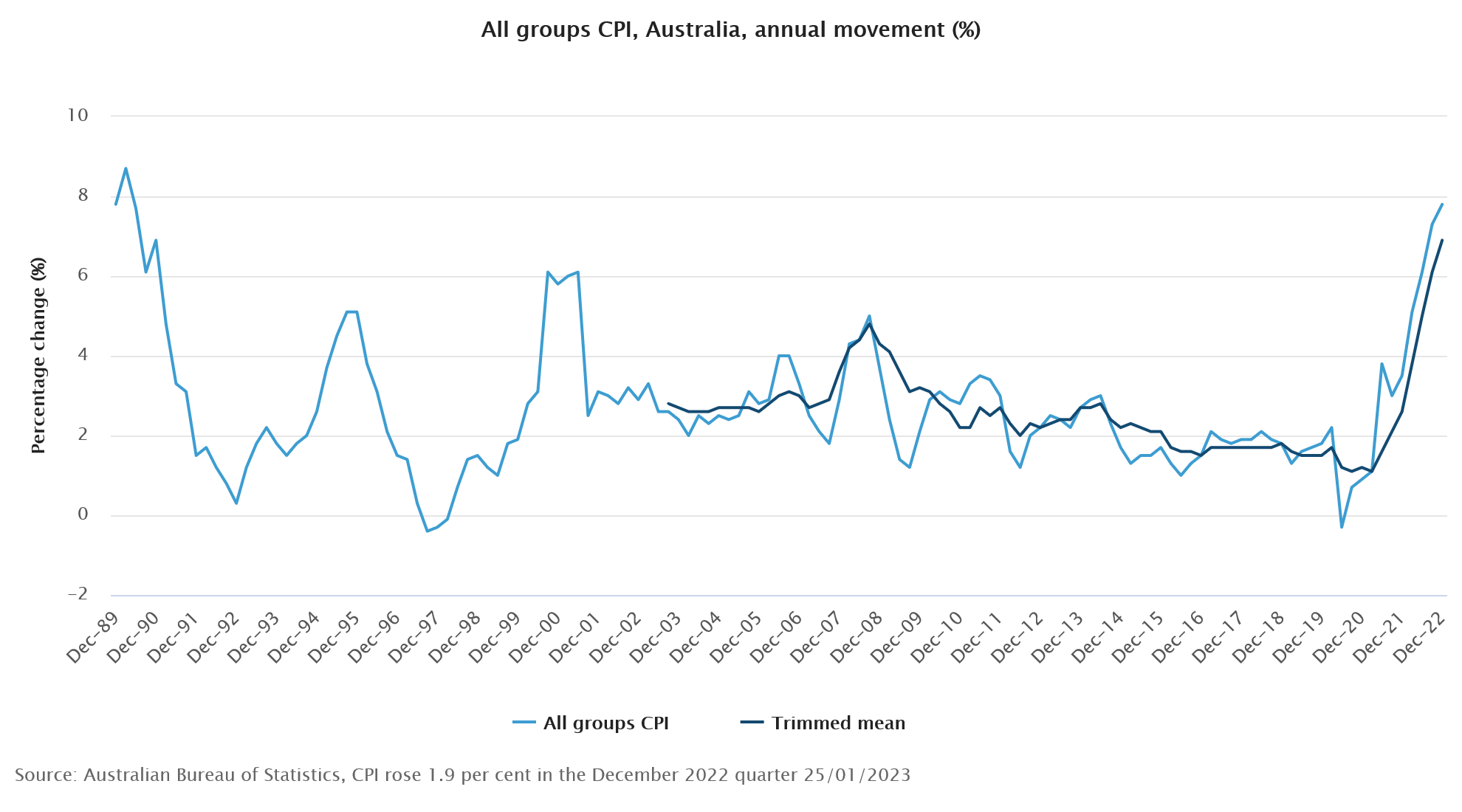
Australia CPI rose 1.9% qoq in Q4, above expectation of 1.7% qoq. Annual CPI accelerated from 7.3% yoy to 7.8% yoy, above expectation of 7.5% yoy. RBA trimmed mean CPI also accelerated from 6.1% yoy to 6.9% yoy, above expectation of 6.5% yoy.
Michelle Marquardt, ABS head of prices statistics, said "This is the fourth consecutive quarter to show a rise greater than any seen since the introduction of the Goods and Services Tax (GST) in 2000. The increase for the quarter was slightly higher than the quarterly movements for the September and June quarters last year (both 1.8 per cent)."
"The annual increase for the CPI is the highest since 1990. Annual inflation for goods such as new dwellings and automotive fuel steadied this quarter, however we saw an uptick in inflation for services such as holidays and restaurant meals," Marquardt said.
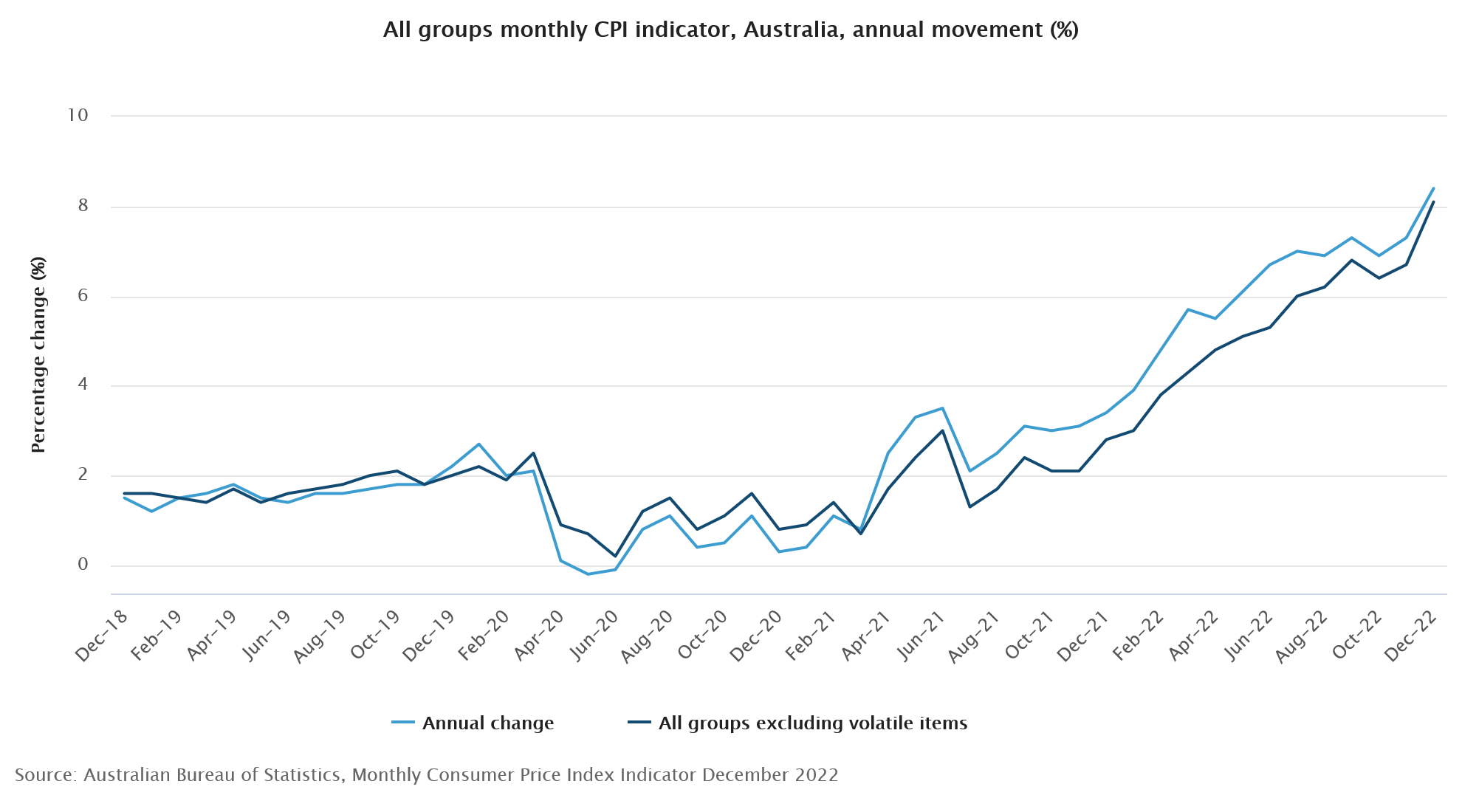
 Monthly CPI accelerated from 7.3% yoy to 8.4% yoy in December, above expectation of 7.7% yoy.
Marquardt said, "The monthly indicator recorded the largest annual rise in the series in December. The most significant contributors in the 12 months to December were New dwellings, up 16.0 per cent, and Holiday travel and accommodation, up 29.3 per cent. Airfare and accommodation prices rose in response to strong demand over the Christmas holiday period."
Australia CPI: Hospitality Prices Surge While Dwelling Price Inflation Eases Back
Headline CPI 1.9%qtr/7.8%yr; Trimmed Mean 1.7%qtr/6.9%yr; Weighted Median 1.6%qtr/5.8%yr. Hospitality services most important factor in the upside surprise in the December quarter but with the Trimmed Mean coming in broadly as expected this suggests the pace of core inflation is generally unfolding as we expected.
The CPI lifted 1.9% in the December quarter with the most significant contributions coming from domestic holiday travel & accommodation (+13.3%), electricity (+8.6%), and international holiday travel & accommodation (+7.6%).
The ABS noted that “strong demand, particularly over the Christmas holiday period, contributed to price rises for domestic holiday travel and international airfares.” The rises seen for domestic & international travel were notably higher than the historical norm for the December quarter.
We did see the expected unwinding of the $400 electricity credit offered by the Western Australian Government. There was some offset from the Queensland Government's $175 Cost of Living rebate and the introduction of the Tasmanian Government's $119 Winter Bill Buster electricity discount for concession households.
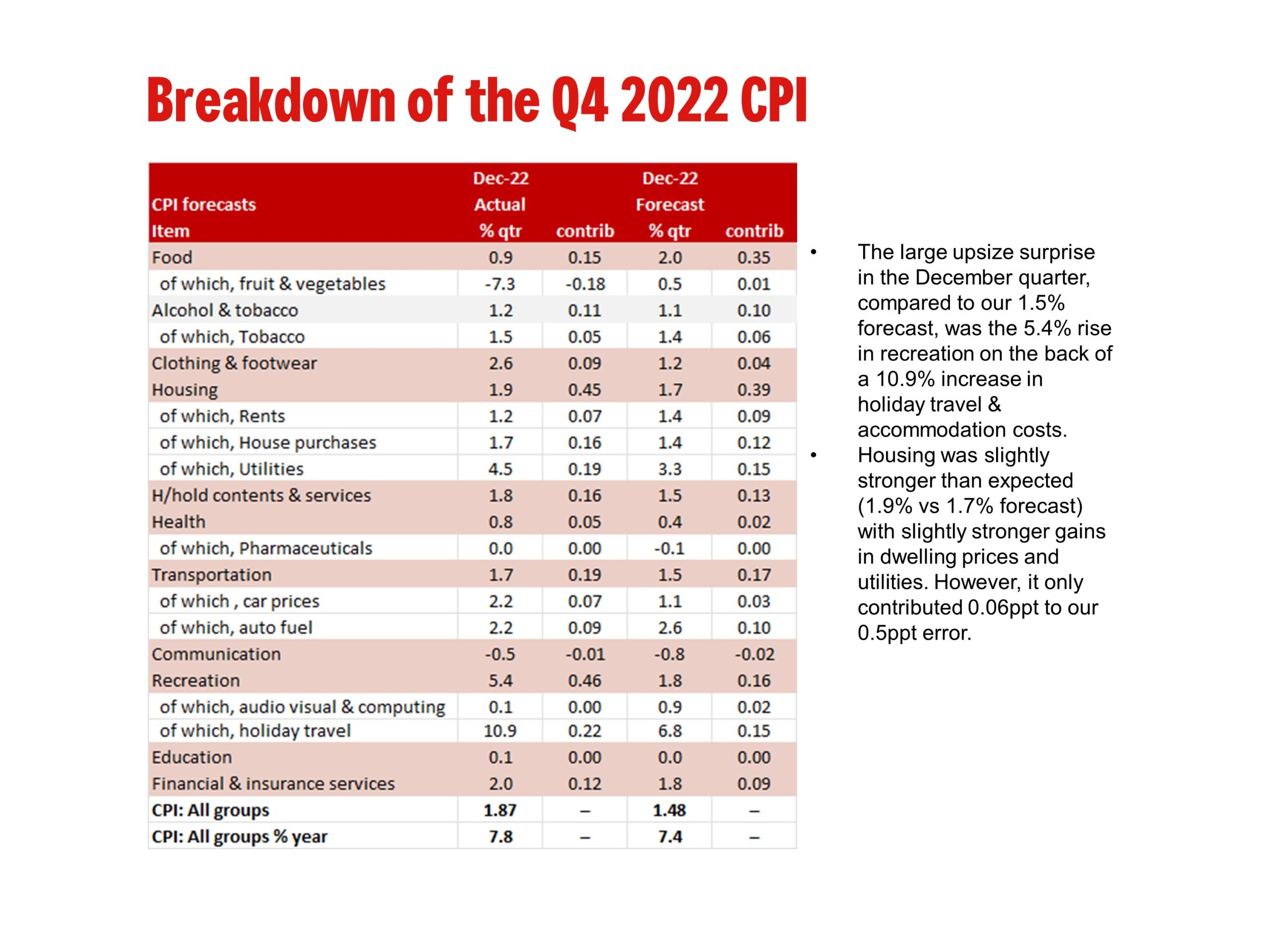
The large upsize surprise in the December quarter, compared to our 1.5% forecast, was the 5.4% rise in recreation on the back of a 10.9% increase in holiday travel & accommodation costs. Housing was slightly stronger than expected (1.9% vs 1.7% forecast) with slightly stronger gains in dwelling prices and utilities. However, it only contributed 0.06ppt to our 0.5ppt error confirming that housing is no longer the inflationary story but pressures are shifting more towards services and, in particular, tourism and hospitality services.
Even though food prices continued to rise, driven by meals out & takeaway foods (+2.1%) as restaurants/cafes passed on rising ingredients and labour costs, the 0.9% increase was less than our 2.0% forecast. The main downside surprise in food was the 7.3% fall in fruit & vegetables reflecting the increase in supply due to improved weather conditions.
The Trimmed Mean rose 1.7%, a touch more than Westpac’s 1.6% forecast but 0.2ppt more than the market’s 1.5% forecast. This suggests the overall momentum of underlying inflation is broadly as we expected.
We are processing the numbers and working through how they will impact on our current inflation forecasts.
New Zealand CPI unchanged at 7.2% yoy in Q4
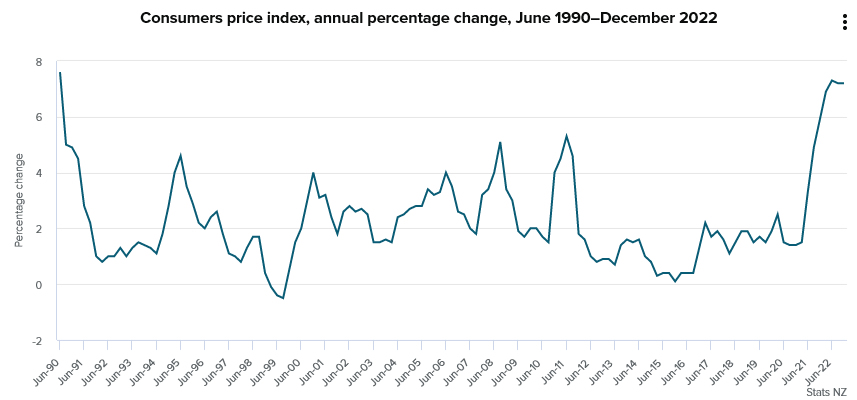
New Zealand CPI rose 1.4% qoq in Q4, slightly below expectation of 1.5% qoq. Annual CPI was unchanged at 7.2% yoy, above expectation of 7.1% yoy, comparing to the peak at 7.3% yoy in Q2.
StatsNZ said, "Housing and household utilities was the largest contributor to the December 2022 annual inflation rate. This was due to rising prices for both constructing and renting housing."
The quarterly rise in inflation was "influenced by rising prices in the housing and household utilities, food, and recreation and culture groups."
ECB Simkus backs hikes of 50bps in the coming meetings
ECB Governing Council member Gediminas Simkus said yesterday, "core inflation remains strong and demonstrates that the fight against inflation is not over."
"There's a strong case for staying on the course that's been set for the coming meetings of 50 basis-point increases. In my opinion, these 50 basis-point increases must be taken unequivocally," he added.
"Pressures in wage growth are increasing — I expect wage increases to exceed historical averages in the euro area," he said. "It's something that's happening and something we need to take into account because it affects core inflation."
"It's clear to me that the current economic environment requires us to deliver increases of 50 basis points in the coming meetings," he said. "When we move to the more distant periods of the summer or next autumn, we need to wait and see."
SNB Schlegel: Cannot rule out further interest increases
SNB Vice Chairman Martin Schlegel said yesterday, "we cannot rule out further interest increases at present," even though inflation is forecast to fall back to 2.4% in 2023, and 1.8% in 2024.
"The maintenance of price stability has absolute priority for the SNB," he added.
Meanwhile, Schlegel also expects a weak growth dynamic in the coming quarters.
NZ CPI Review: Lower RBNZ OCR Peak Now Expected
NZ CPI Review: Lower RBNZ OCR Peak Now Expected
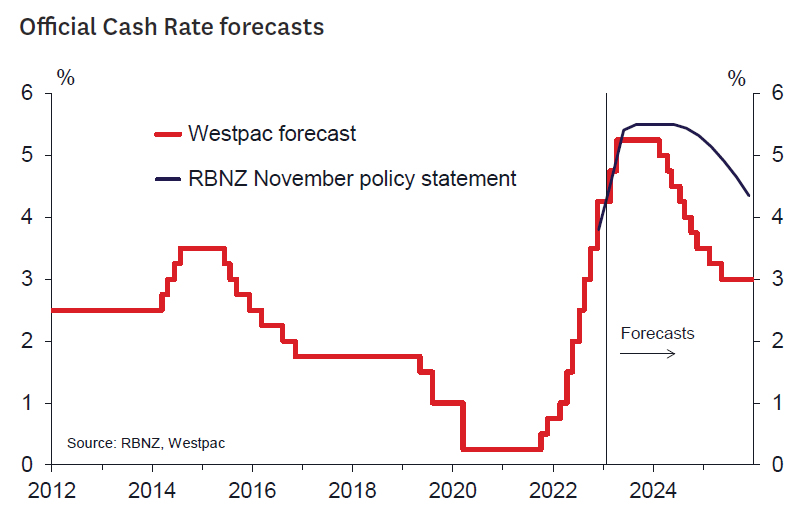
- We have revised down our forecast for Official Cash Rate hikes from the RBNZ. We now expect a 50 bp rise in the OCR at the February policy meeting (previously we expected a 75 bp rise).
- We continue to expect another 50 bp increase in April, but that will be dependent on the strength of economic conditions.
- Inflation pressures have remained strong. However, the acceleration in inflation that the central bank was forecasting has not eventuated.
- At the same time, signs of a downturn in demand are developing. And with mounting pressure on household balance sheets, a stark slowdown in economic activity is expected over the coming year.
- Against this backdrop, further increases in the OCR are still required to bring inflation back inside the RBNZ's target band. However, it now appears that the extent of those increases doesn't need to be as large as we (or the RBNZ) had previously assumed.
Inflation remains strong. However, it has fallen short of the Reserve Bank's forecast. At the same time, a slowdown in demand is taking shape and economic growth is set to slow sharply over 2023. Against this backdrop, further hikes in the Official Cash Rate are still needed to get inflation back inside the target band. However, the extent of policy tightening required to do that now looks like it will be more moderate than the central bank had previously signalled.
The Consumers Price Index rose 1.4% in the December quarter. That left the annual inflation rate at 7.2%, just slightly below the 32-year high that was reached in June.
December quarter inflation was boosted by unusually large increases in some specific prices, with food prices up a massive 11% and large increases in both domestic and international airfares. But even adjusting for those sorts of swings in specific areas, there's no denying that the underlying trend in inflation remains strong and that pressures are widespread. In fact, most measures of core inflation are continuing to track around 6%.
That continued firmness in underlying inflation pressures isn't a surprise. We weren't expecting to see an easing in inflation just yet.
However, the RBNZ didn't just expect that inflation pressures would remain strong: the central bank actually expected an acceleration in inflation in the December quarter. In its last policy statement, the RBNZ forecast that the annual inflation rate would rise to 7.5%, and that it would remain around that level through the early part of 2023.
Instead, inflation has fallen short of the RBNZ's forecast. Annual inflation peaked at 7.3% back in June. And while still elevated, it doesn't look like it's pushing higher. Rather, the annual inflation rate has held steady at 7.2% for the past six months.
Looking ahead, inflation looks set to ease (albeit gradually) back over the year ahead. We're still updating our forecasts for today's result, but at this stage it looks like inflation will track well below the RBNZ's forecast over 2023.
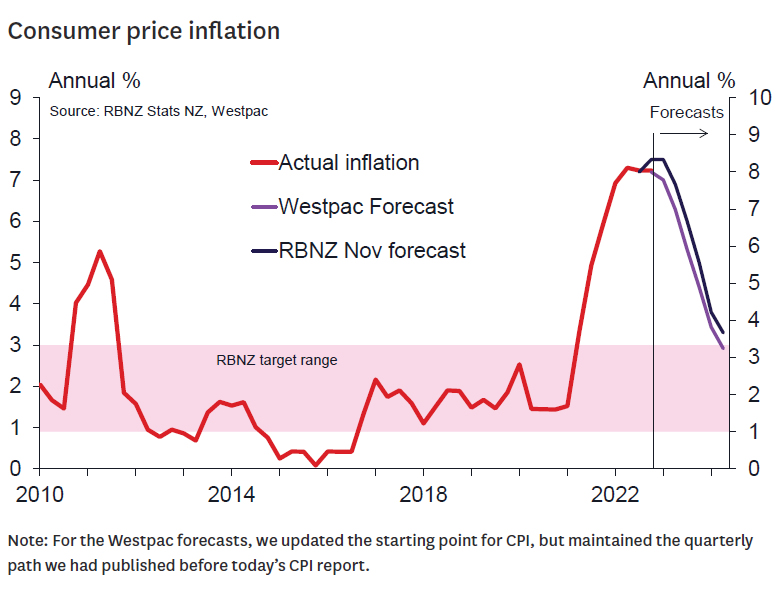
We're still looking at a strong inflation outlook, with the labour market and businesses' productive capacity still highly stretched, and international tourism on the rise. On top of that, disruptions to food production and the end of the Government's fuel excise reductions will both add to inflation over the coming months. Against that backdrop, annual inflation is set to remain over 6% through the first half of this year. But that would still be much lower than the RBNZ had been expecting in November when they delivered a jumbo size 75 bp rise in the OCR and signalled further large increases would be coming in short order.
The past few weeks have also seen some notable developments in terms of economic activity, with signs that the long forecast slowdown in demand is now taking shape. In the household sector, retail card spending declined 2.5% in December, with softness in spending seen across a range of discretionary categories. At the same time, businesses are reporting a downturn in trading activity and forward orders. We've also seen job advertisements dropping back.
On top of that, the coming year will see increasing pressure on households' finances. In part, that's due to the continued rapid increases in consumer prices that is squeezing households' purchasing power. In addition, around half of fixed rate mortgages will come up for re-pricing within the next 12 months. In many cases, borrowers will face refixing at interest rates that are 3 percentage points higher than those they are currently on. Those financial pressures, along with the related downturn in the housing market, will be a significant drag on demand – and inflation – over the coming year.
Putting this altogether, we're still left with a strong inflation outlook and the need for continued interest rate increases to get inflation back inside the 1% to 3% target band. However, the extent of further policy tightening required to do that doesn't look like it will be as large as the RBNZ had previously assumed. As a result, we've revised down our forecast for the peak in the Official Cash Rate.
We're now forecasting a 50 bp rise in the OCR at the RBNZ's February policy meeting (previously we forecast a 75bp increase). We continue to expect a 50 bp rise in April with a pause after that time. Those increases would take the cash rate to a peak of 5.25% - lower than the 5.50% peak we previously projected. That's also below the 5.50% peak that the RBNZ had signalled in their last published forecasts from November.
While we are continuing to forecast a 50 bp hike in April, that will be dependent on the strength of economic conditions over the next few months. If the downturn in demand is sharper than we expect, or if inflation pressures start to cool sooner than anticipated, the RBNZ could opt for a smaller 25 bp hike.