Sample Category Title
Gold Moving into Technical Resistance – Five Waves Up Can Cause a Slow Down
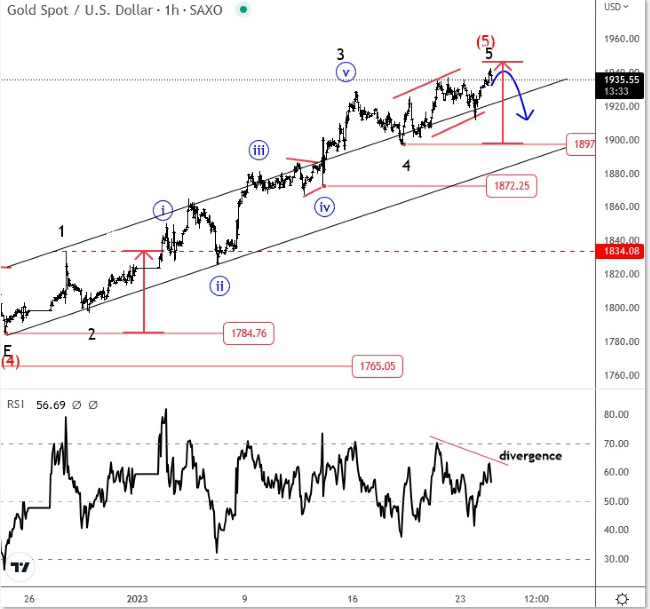
Gold came to new highs, but it's seen in late stages of a final fifth wave that belongs to an impulse from 1784, so we should be aware of a bearish reversal since we know that after every five waves new correction can show up. We can also see price now testing fifth wave Fib target at 1940 while RSI shows a divergence so there is s chance that bulls will slow down, especially if the USD will find some support now when US yields are turning slightly lower.
If you want to and here more about gold and also silver check the video below.
https://www.youtube.com/watch?v=vVvBAtXZQ-w&t=402s
GBP/USD Slips on Record Debt, Soft PMIs
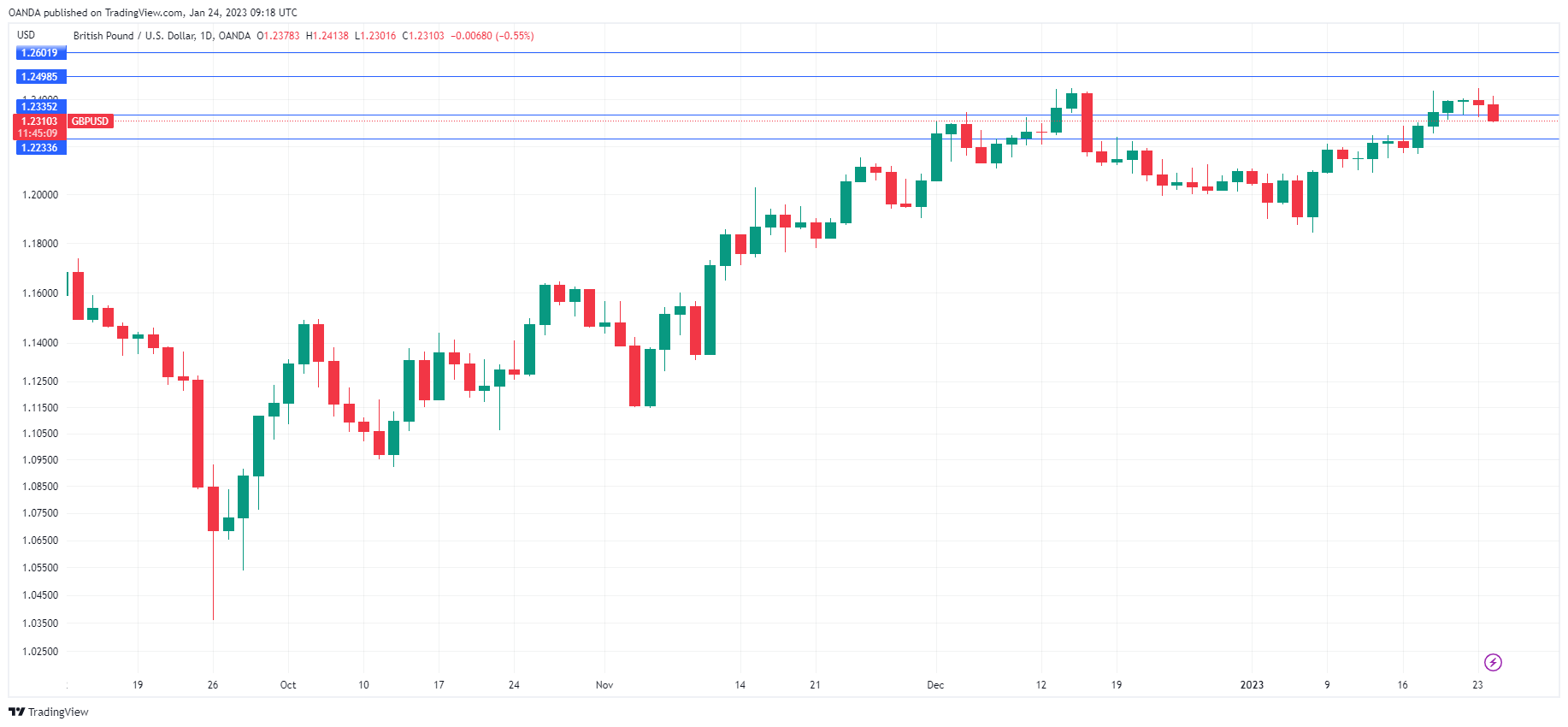
The British pound has posted slight gains on Tuesday. In the European session, GBP/USD is trading at 1.2302, down 0.60%.
UK debt hits record
UK debt costs soared in December, sending the budget deficit to a record 27.4 billion pounds. This was sharply higher than the November reading of 18.8 billion pounds and the consensus of 17.3 billion pounds. The drivers behind the sharp upturn were rising interest payments and government subsidies for gas and electricity. The government’s bill for the subsidies in December was some 7 billion pounds. Despite the grim debt news, the pound remains steady, thanks to broad US dollar weakness.
UK PMIs for December didn’t help matters, as both the Services and Manufacturing PMIs came in below the 50 level, which indicates contraction. Manufacturing rose slightly to 46.7, up from 45.3 in November and above the forecast of 45.0 points. The Services PMI fell to 48.0, down from the November read and the forecast, both of which were 49.9 points.
The soaring debt and soft PMIs are further signs of a weak UK economy. These are clearly not ideal conditions for raising interest rates, but with inflation at 10.5%, the Bank of England doesn’t really have much choice, as entrenched inflation could cause more damage to the economy than high interest rates. The road back to low inflation promises to be a long one, with the BoE projecting that inflation won’t drop to 5% until late this year.
The US will release Manufacturing and Services PMIs which are expected to remain in contraction territory. Manufacturing is expected to tick lower to 46.1 (46.2 prev.), while Services is forecast to dip to 44.5 (44.7 prev.). If the releases are softer than expected, the US dollar could lose ground as speculation will rise that the Fed may have to ease up on the pace of rates.
GBP/USD Technical
- GBP/USD is testing support at 1.2335. Below, there is support at 1.2233
- There is resistance at 1.2499 and 1.2601
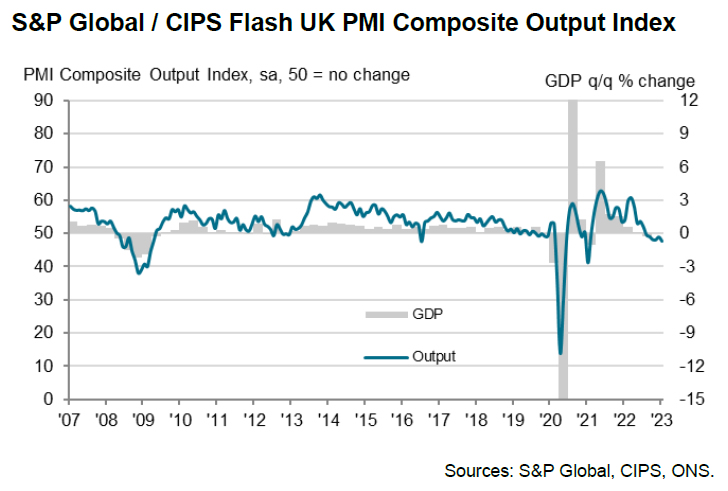
UK PMI composite hit 24-month low, decline rate remains only modest
UK PMI Manufacturing rose from 45.3 to 46.7 in January, above expectation of 45.4. However, PMI Services dropped from 49.9 to 48.0, below expectation of 49.6, hitting a 24-month low. PMI Composite dropped from 49.0 to 47.8, a 24-month low too.
Chris Williamson, Chief Business Economist at S&P Global Market Intelligence said: "Weaker than expected PMI numbers in January underscore the risk of the UK slipping into recession... There were some bright spots in the survey, including improved business expectations for the year ahead and a further cooling of inflationary pressures. The overall rate of decline indicated also remains only modest. But this is undeniably a disappointing start to the year for the UK."
GBPUSD Stays Bullish Near December’s High
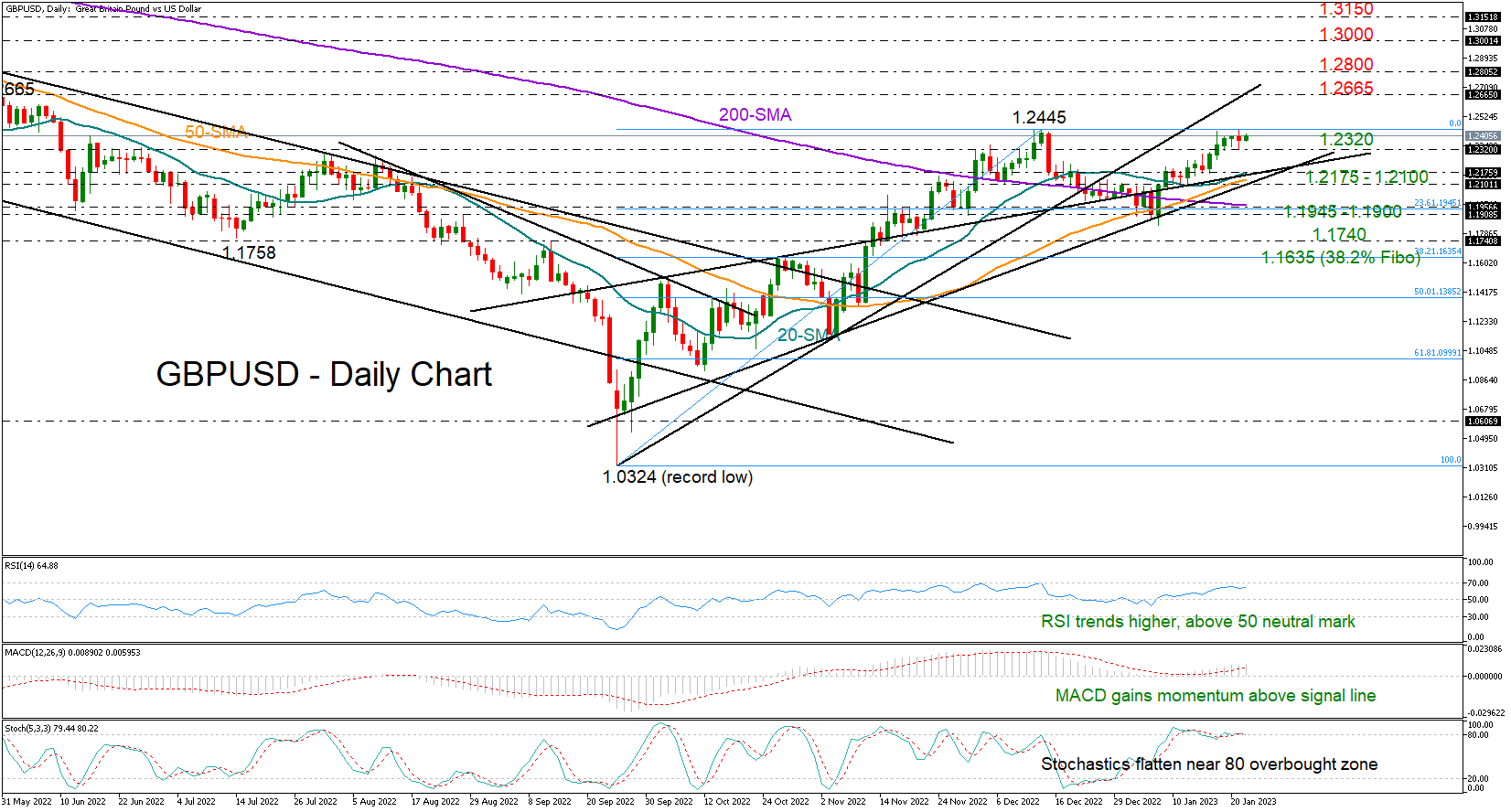
GBPUSD could not find enough buyers to pierce through December’s high of 1.2445, finishing Monday’s session with mild losses at 1.2375.
The bulls, however, may not give up the battle, as the clear positive trajectory in the RSI and the MACD mirrors persisting buying interest. Yet, with the Stochastic oscillator flattening within the overbought region above 80, some caution is required.
In other encouraging signals, the 50- and 200-day simple moving averages (SMAs) have logged a golden cross recently for the first time in more than two years, indicating a strengthening bull market.
A forceful move above 1.2445 could lift the price straight up to May’s resistance zone of 1.2665, where the steep ascending line drawn from the record low of 1.0324 is positioned. The 1.2800 territory had been limiting upside and downside movements during the 2019-2020 period and may next attract attention before the door opens for the 1.3000-1.3150 constraining area.
On the downside, a close below 1.2320 may squeeze the price into the 1.2175-1.2100 region, where the 20- and 50-day simple moving averages (SMAs) and two constraining lines are placed. If the bears claim that territory, the sell-off could stretch towards the 200-day SMA and the 23.6% Fibonacci retracement of the 1.0324-1.2445 upleg at 1.1945. The 1.1900 psychological mark could also come under consideration given its protective role at the start of January.
All in all, GBPUSD is expected to remain attractive to buyers in the short term. An extension above 1.2445 is needed to upgrade the short-and medium-term outlook. Otherwise, a pullback below 1.2320 may bring the bears back into play.
GBP/JPY: Minor Double Zigzag WXY Likely to Complete Bullish Trend Near 176.41
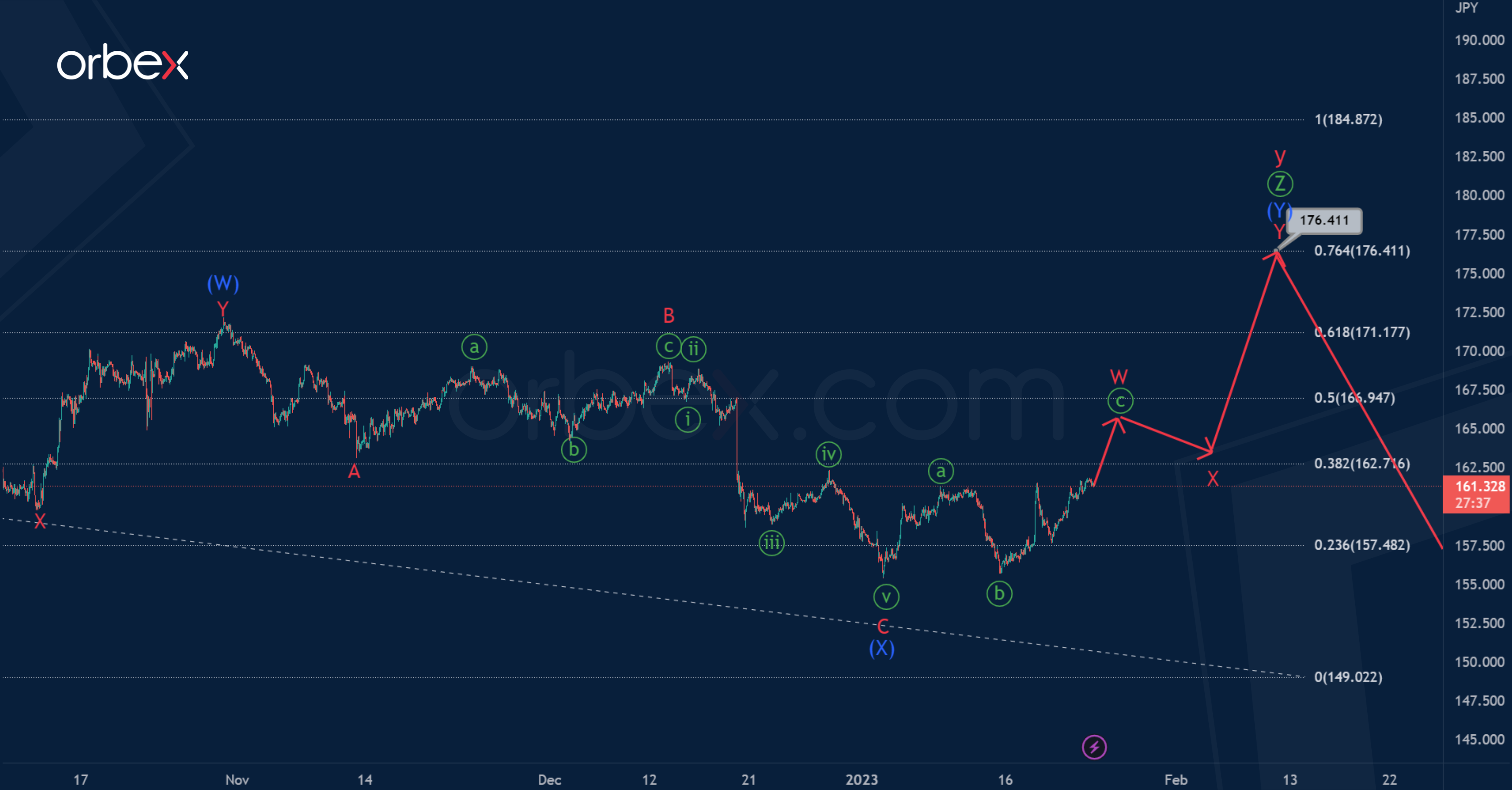
The GBPJPY currency pair is presumably in the final part of a major correction pattern - a triple zigzag Ⓦ-Ⓧ-Ⓨ-Ⓧ-Ⓩ. That is, an actionary wave Ⓩ is formed. It seems to take the form of an intermediate double zigzag (W)-(X)-(Y).
The intermediate wave (W) looks fully completed at the time of writing. And this makes the next few trading days interesting, since a bullish trend is expected within the final actionary sub-wave (Y), which may take the form of a double zigzag W-X-Y.
Most likely, the bulls are aiming for 176.41. At that level, wave (Y) will be at 76.4% of previous actionary wave (W).
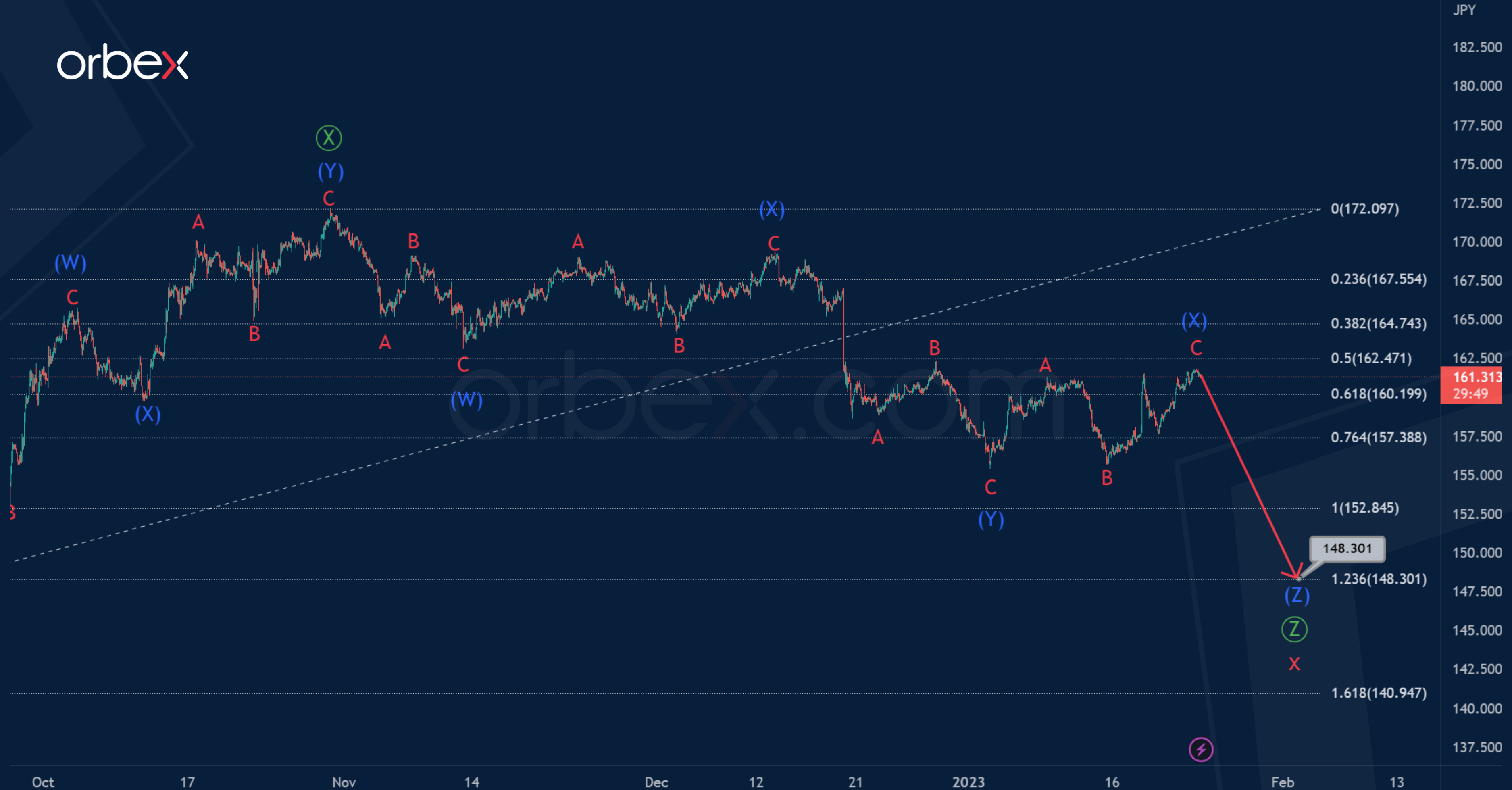
In an alternative scenario, it is assumed that a large bearish intervening wave x is currently forming. It may end in the form of a triple zigzag, for the construction of which a final sub-wave Ⓩ is needed.
The current structure of the primary wave Ⓩ suggests an intermediate triple zigzag (W)-(X)-(Y)-(X)-(Z). The first four zigzag sub-waves have already been completed. We are waiting for a drop in the sub-wave (Z) to 148.30.
At the specified level, wave Ⓩ will be at 123.6% of actionary wave Ⓨ.
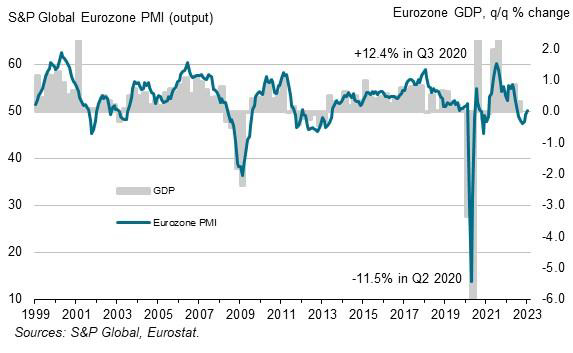
Eurozone PMI composite rose to 50.2, escaping recession but renewed contraction shouldn’t be ruled out
Eurozone PMI Manufacturing rose from 47.8 to 48.8 in January, above expectation of 48.1. PMI services rose from 49.8 to 50.7, above expectation of of 49.4, and back in expansion. PMI Composite rose from 49.3 to 50.2, a 7-month high.
Chris Williamson, Chief Business Economist at S&P Global Market Intelligence said:
"A steadying of the eurozone economy at the start of the years adds to evidence that the region might escape recession.... The region is by no means out of the woods yet, however, as demand continues to fall – merely dropping at a reduced rate... The case for higher interest rates is fuelled further by the upturn in employment growth recorded during the month and signs of higher wages driving the latest upturn in price pressures.
"A case for policy caution is supported by the survey merely indicating a stagnation of the eurozone economy, hinting that a renewed slide into contraction should not be ruled out as borrowing costs rise, but the survey undoubtedly brings welcome good news to suggest that any downturn is likely to be far less severe than previously feared and that a recession may well be avoided altogether."
Positive US Rate Outlook Boosts Risk Sentiment
Asian shares rose on Tuesday, following the positive cues from Wall Street overnight as growth stocks looked enticing ahead of major tech earnings. Mounting expectations over a less aggressive Federal Reserve stimulated appetite for risk, magnetising investors towards the equity space. However, markets in mainland China and Taiwan remain closed for the Lunar New Year holiday and reopen for trading on January 30. European futures are pointing to a positive open this morning after finishing higher in the previous session, and this could trickle back down to Wall Street later today.
In the currency space, the dollar ticked lower while the euro is lingering below 1.09 after yesterday’s attempted breakout. Oil bulls seem to be drawing strength from rising demand hopes as China’s economy reopens, while gold remains supported by US recession fears and bets of slower rate hikes in 2023.
The next few days promise to be eventful for equity markets thanks to corporate earnings, with Microsoft reporting its results after the bell today and Tesla releasing its earnings late Wednesday. It is also a data-heavy week with economic reports from Europe and the United States in sharp focus, including PMI surveys today and US fourth quarter GDP on Thursday. Regarding central bank meetings, all eyes will be on the Bank of Canada rate decision tomorrow which is expected to conclude with a 25-basis point rate hike.
EURUSD gearing up for a breakout?
This could be a volatile week for EURUSD thanks to key economic data and speeches from financial heavyweights.
The discussions around monetary policy among officials at the Federal Reserve and European Central Bank continue, with focus increasingly drawn to their policy meetings next week. On one side of the coin, the euro continues to draw strength from a weaker dollar, high inflation in the Eurozone, and a hawkish ECB. On the other side, repeated signs of easing inflation in the US have fueled speculation around a less aggressive Fed. The narrowing monetary policy divergence between the Fed and ECB could translate to further upside for the already bullish EURUSD.
Much attention will be directed towards not only the pending Eurozone and US January PMIs today, but also ECB President Lagarde’s speech which may influence the currency pair. Regarding the technical picture, prices remain bullish on the daily charts with resistance found at 1.09. A solid breakout and daily close above this point could signal a move toward the next key level of interest at 1.12.
Currency spotlight – GBPUSD
Yesterday was a choppy affair for the GBPUSD as prices bounced within a range just below 1.24. Nevertheless, the outlook remains bullish on the daily charts due to the recent series of consistent higher highs and higher lows. There could be some action on the GBPUSD this morning thanks to the UK and US January PMIs. However, bulls remain in a position of power with support found just above 1.23. If the currency pair has the strength to advance decisively beyond 1.24, an incline toward the 1.26 region could become reality. Should the upside lose steam and dip below 1.23, prices could sink back towards 1.2170.
Commodity spotlight – Gold
Gold bulls continue to draw confidence from US recession fears and expectations around a less aggressive Federal Reserve. The precious metal certainly remains on a roll, securing five consecutive weekly gains, and could push higher if the fundamental drivers remain unchanged. A weaker dollar and soft US economic data could further sweeten appetite for gold over the next few days. Looking at the technical picture, prices remain bullish making fresh 9-month highs this morning and could test $1950 and beyond.
Dow Jones 30 Tests Resistance
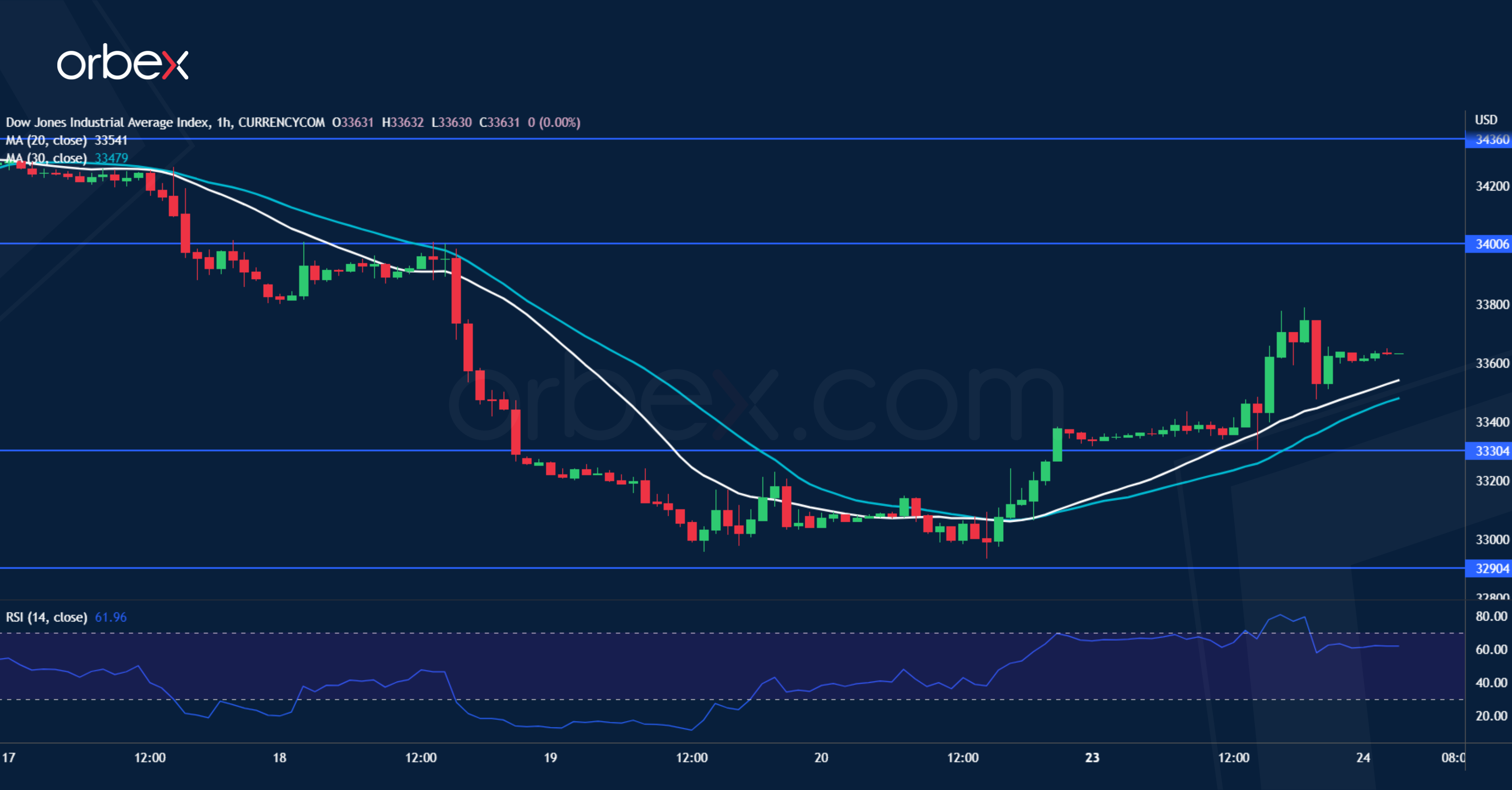
The Dow Jones 30 popped higher driven by hopes that US inflation has peaked. On the daily chart, the index is consolidating within 32500 and 34800 after clearing the mid-August high of 34200. This provides a wide swing range on the hourly chart as bulls and bears wrestle for control. The base of the January take-off 32900 is a key support and triggered traders’ ‘buy-the-dips’ instinct. 33300 is a fresh support and renewed buying interest would pave the way for a recovery to 34000 where selling pressure could start to reappear.
NZD/USD Finds Support
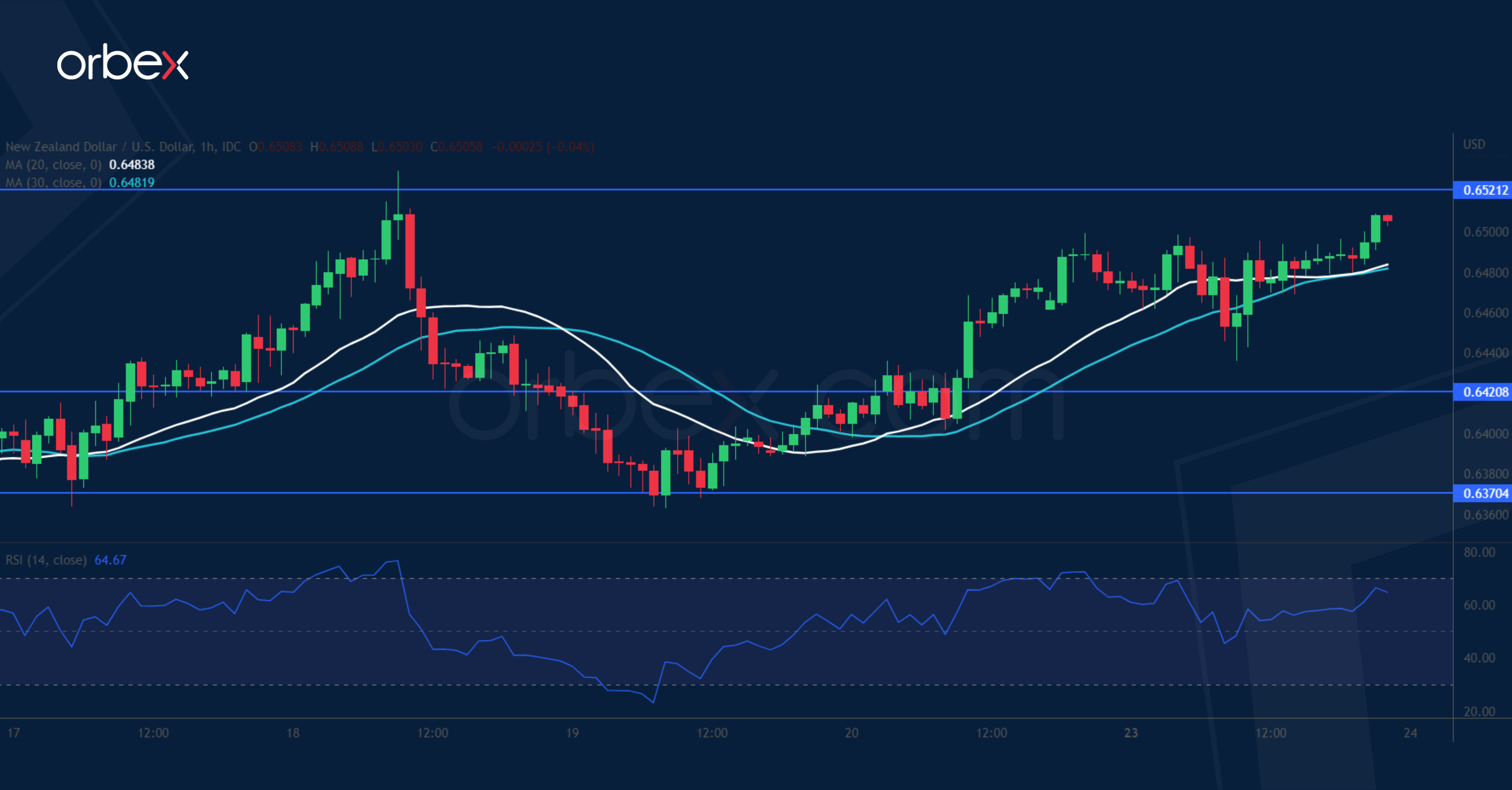
The New Zealand dollar inched higher as risk appetite gained traction across the board. On the daily chart, a bullish MA cross following a brief consolidation suggests that the rally may have picked up speed again. The previous swing low was contained within the demand zone 0.6330-0.6370, helping the bulls retain control of the price action. A break above the recent high of 0.6520 could trigger a runaway rally above 0.6600. 0.6420 is the immediate support in case the kiwi needs to build a stronger base.
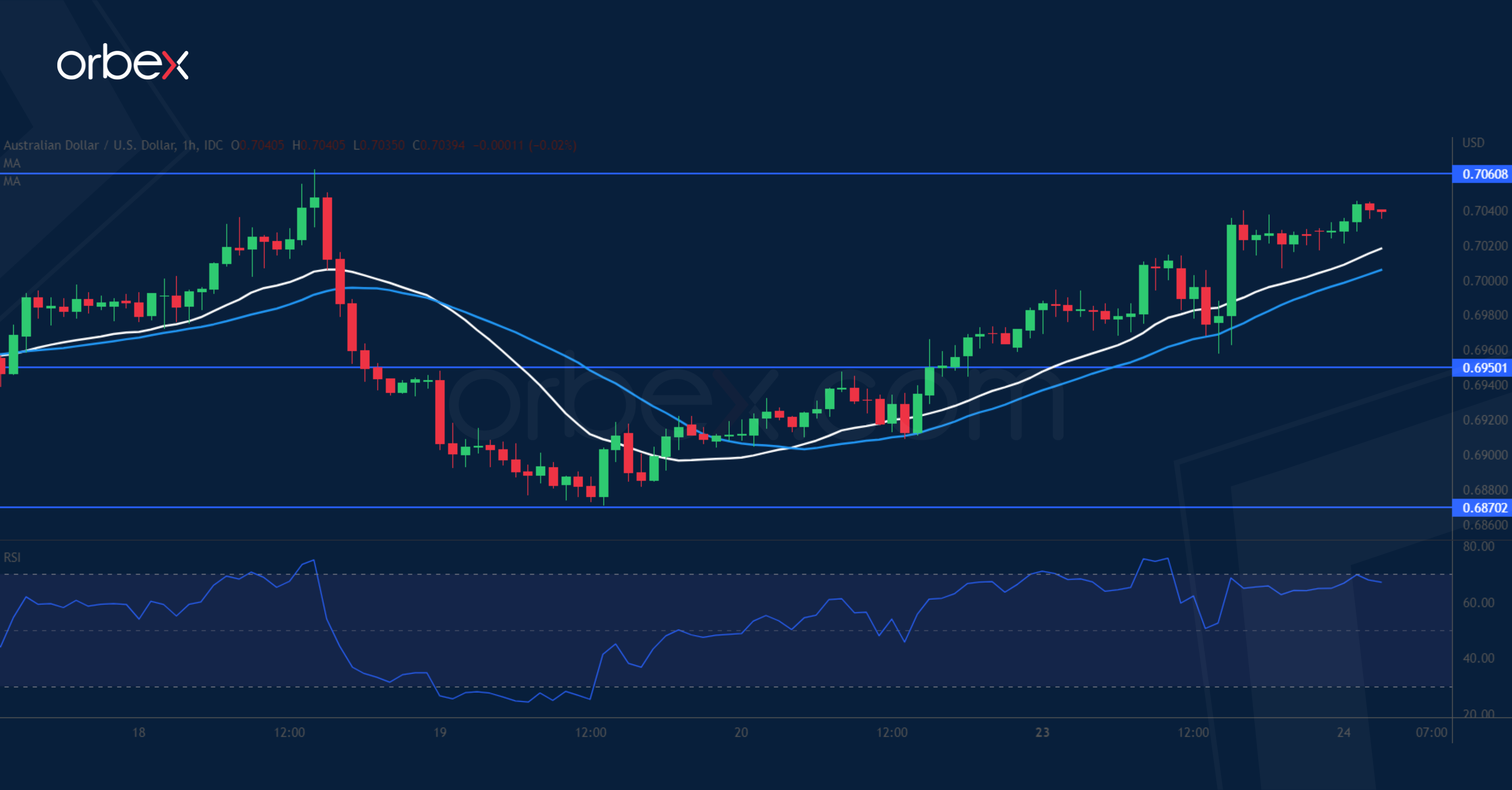
AUD/USD Rallies Back
The US dollar continues downward as the market rules out a 50 basis point hike next month. The pair has recouped most of the losses from last week’s sell-off after bouncing off 0.6870 which coincides with the 20-day moving average. This is a sign that the directional bias has remained upward despite a speed bump. Momentum buyers may double down if the aussie closes above 0.7060, putting the August high of 0.7130 in the crosshairs. As the RSI retraces into neutral territory, 0.6950 is a fresh level to expect follow-up bids.