

Sample Category Title
EUR/GBP Daily Outlook
Daily Pivots: (S1) 0.8774; (P) 0.8822; (R1) 0.8847; More...
Intraday bias in EUR/GBP stays neutral for the moment. Further rally is expected as long as 55 day EMA (now at 0.8724) holds. Break of 0.8876 will resume the rise from 0.8545 to 61.8% retracement of 0.9276 to 0.8545 at 0.8997 and possibly above. However, sustained trading below 55 day EMA will bring retest of 0.8545 low instead.
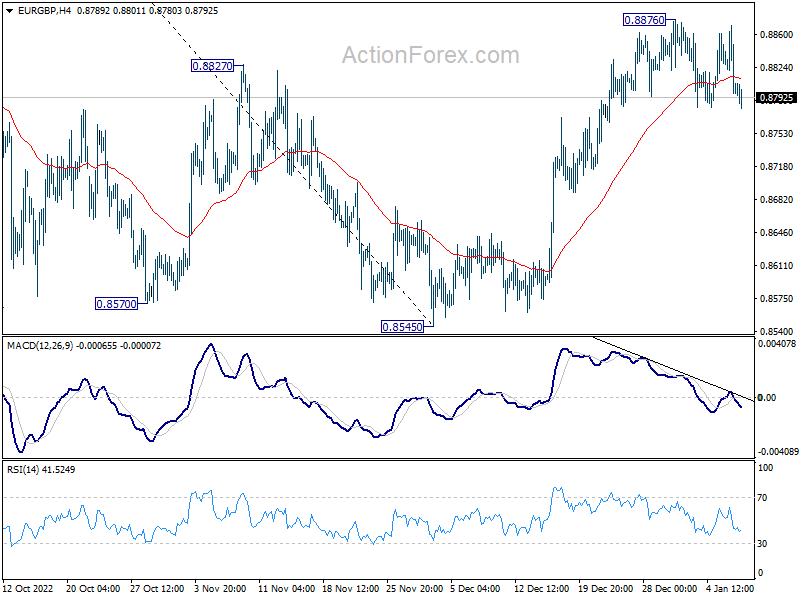
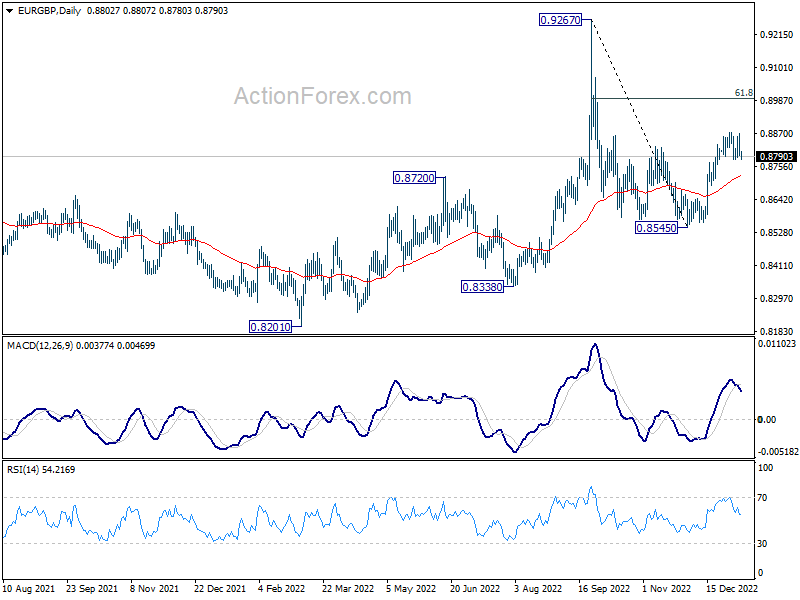
In the bigger picture, outlook is mixed for now as rise from 0.8545 would either be part of the up trend from 0.8201 (2022 low), or just a correction to 0.9267 (2022 high). As long as 55 week EMA (now at 0.8616) holds, the former case is in favor, and break of 0.9267 should be seen next as up trend resumes at a later stage. However, sustained break of 55 week EMA will shift favor to the latter case, for another decline back towards 0.8201.
EUR/AUD Daily Outlook
Daily Pivots: (S1) 1.5420; (P) 1.5516; (R1) 1.5573; More...
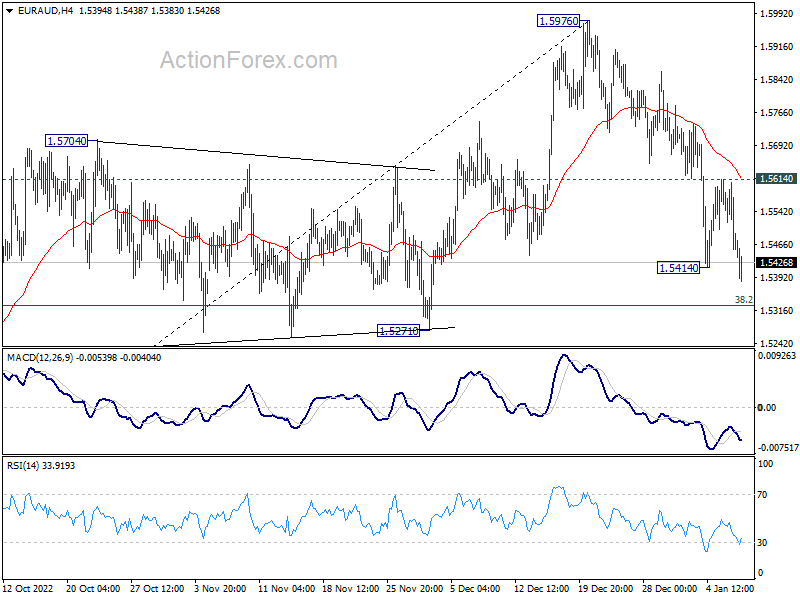
EUR/AUD's fall from 1.5976 resumed by breaking through 1.5414. Intraday bias is back on the downside for 38.2% retracement of 1.4281 to 1.5976 at 1.5329. Strong support could be seen there to bring rebound. Break of 1.5614 resistance will indicate that the correction has completed, and bring retest of 1.5976 high. However, sustained trading below 1.5329 will carry larger bearish implication and target 61.8% retracement at 1.4928.
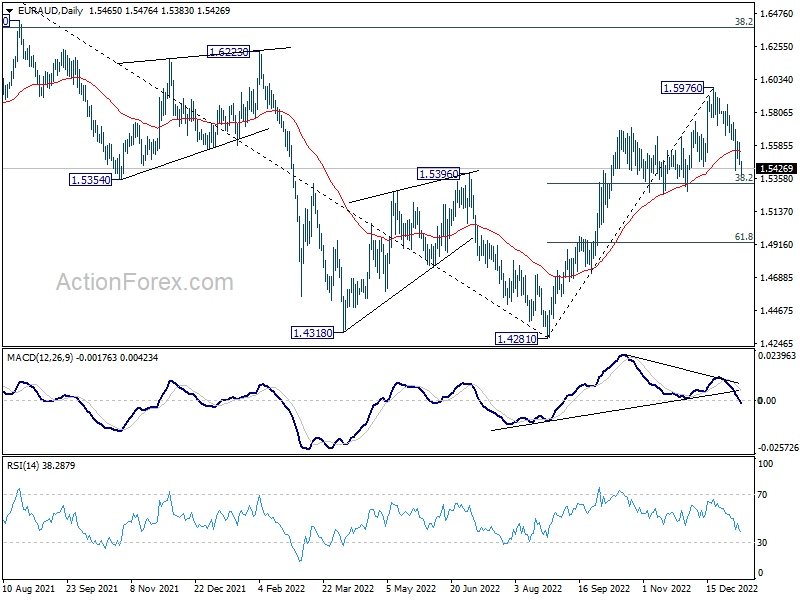
In the bigger picture, it's still early to confirm if rise from 1.4281 represents bullish trend reversal. But as long as 1.5271 support holds, such rally is in favor to continue. Break of 1.5976 will target 1.6434 key resistance next. On the other hand, firm break of 1.5271 will retain medium term bearishness instead.
EUR/CHF Daily Outlook
Daily Pivots: (S1) 0.9855; (P) 0.9869; (R1) 0.9892; More....
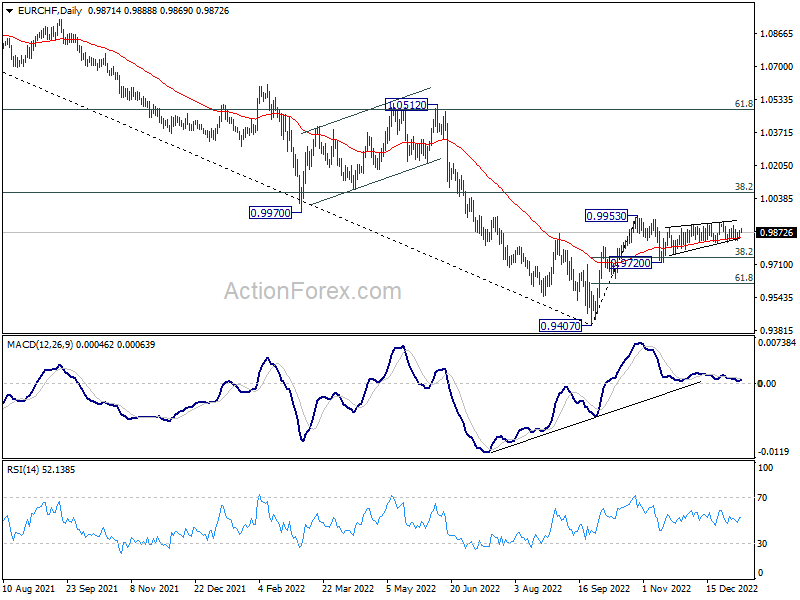
No change in EUR/CHF's outlook as consolidation form 0.9953 is extending. Intraday bias stays neutral. On the upside, firm break of 0.9953 resistance will resume larger rally from 0.9407 to 1.0072 fibonacci level. However, break of 0.9720 will extend the decline from 0.9953 to 61.8% retracement of 0.8407 to 0.9953 at 0.9616.
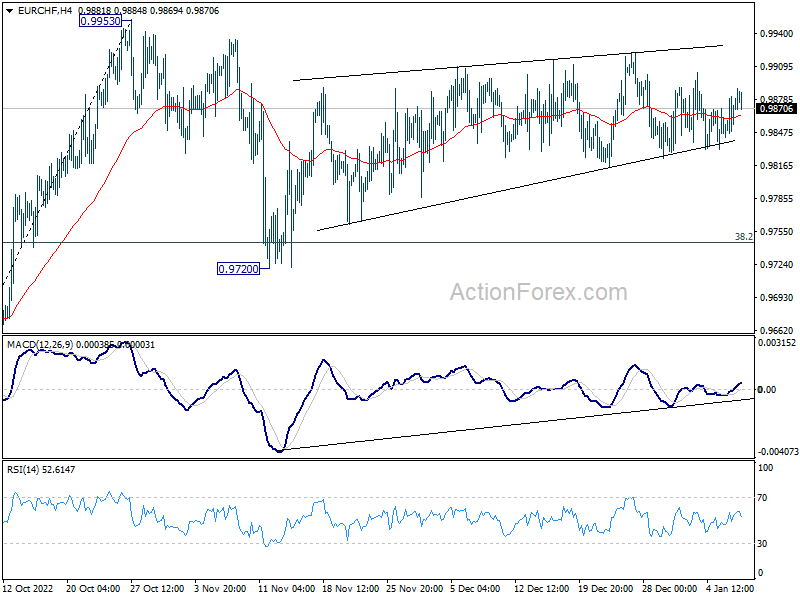
In the bigger picture, as long as 38.2% retracement of 1.1149 to 0.9407 at 1.0072 holds, price actions from 0.9407 medium term bottom will be treated as a corrective pattern. That is, long term down trend would resume through this low at a later stage. Nevertheless, firm break of 1.0072 will also have 55 week EMA (now at 1.0041) taken out. That would be an initial sign of long term bullish reversal.
EUR/USD Daily Outlook
Daily Pivots: (S1) 1.0537; (P) 1.0592; (R1) 1.0702; More...
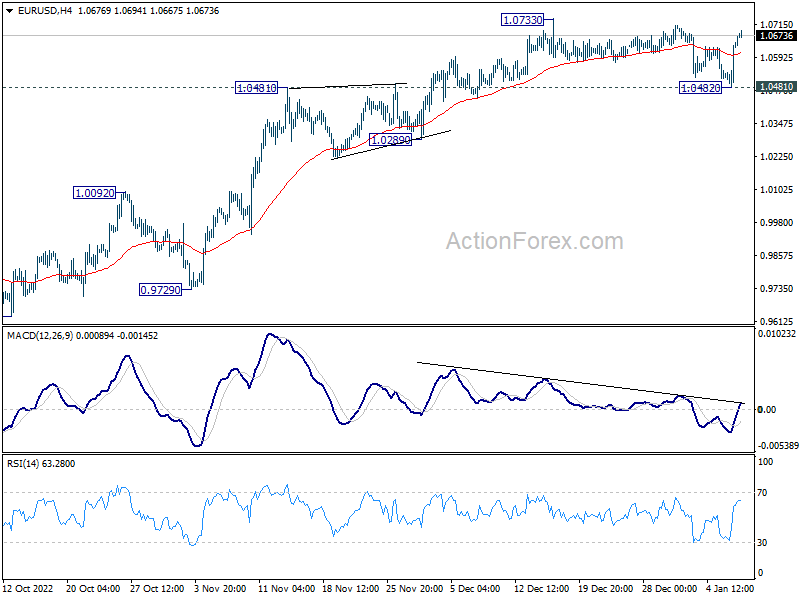
Intraday bias in EUR/USD remains neutral and outlook stays bullish with 1.0481 resistance turned support intact. On the upside, firm break of 1.0733 will resume whole rally from 0.9534. Nevertheless, sustained break of 1.0481 will extend the correction to 1.0289 support and below.
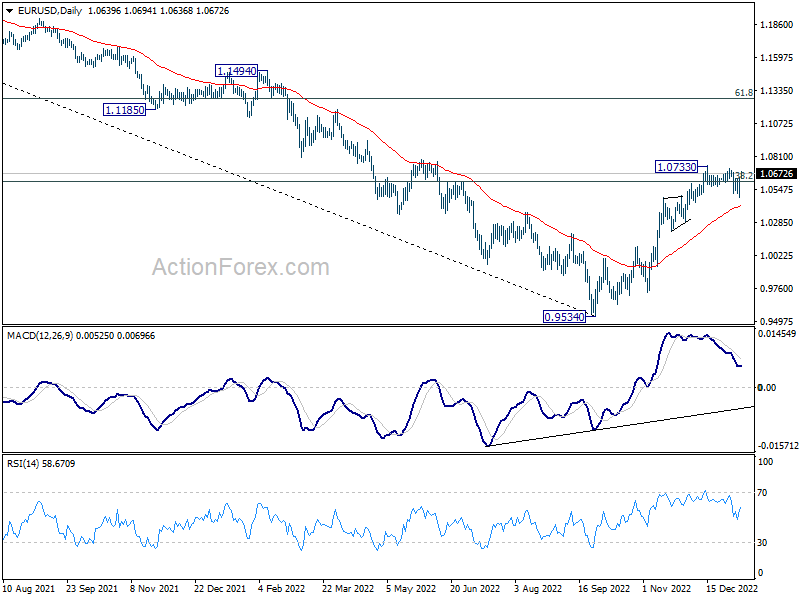
In the bigger picture, focus stays on 38.2% retracement of 1.2348 (2021 high) to 0.9534 at 1.0609. Rejection by 1.0609 will suggest that price actions from 0.9534 medium term bottom are developing into a corrective pattern. Thus, medium bearishness is retained for another fall through 0.9534 at a later stage. However, sustained break of 1.0609 will raise the chance of trend reversal and target 61.8% retracement at 1.1273.
GBP/USD Daily Outlook
Daily Pivots: (S1) 1.1924; (P) 1.2012; (R1) 1.2181; More...
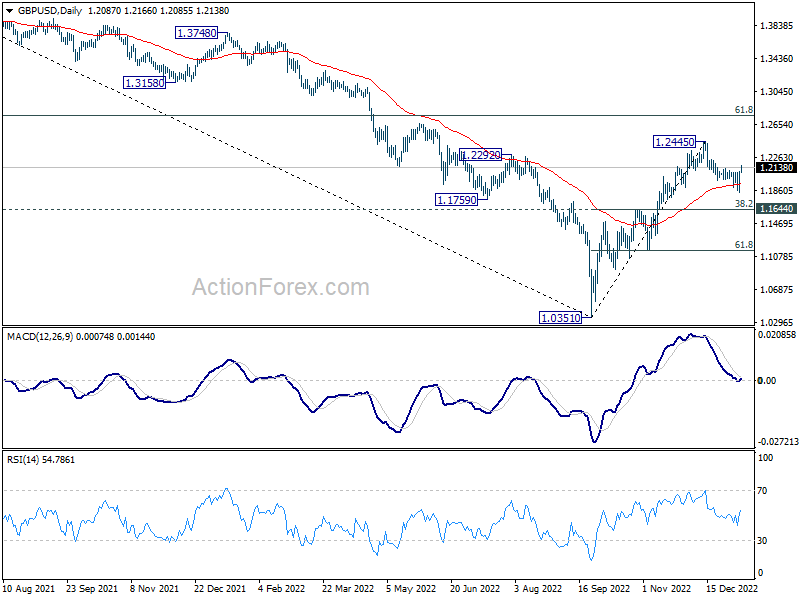
Intraday bias in GBP/USD remains mildly on the upside for the moment. Correction from 1.2445 could have completed after hitting 55 day EMA. Retest of 1.2445 high should be seen next. On the downside, however, break of 1.1840 will resume the decline to 38.2% retracement of 1.0351 to 1.2445 at 1.1645.
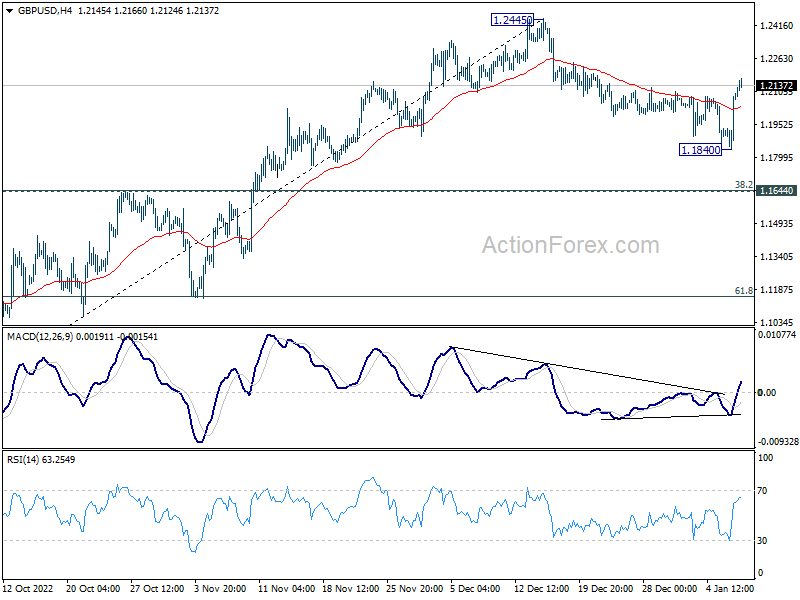
In the bigger picture, rise from 1.0351 medium term bottom is at least correcting whole down trend from 1.4248 (2021 high). Further rise is expected as long as 1.1644 resistance turned support holds. Next target is 61.8% retracement of 1.4248 to 1.0351 at 1.2759. Sustained break there will pave the way back to 1.4248.
USD/CHF Daily Outlook
Daily Pivots: (S1) 0.9228; (P) 0.9319; (R1) 0.9368; More...
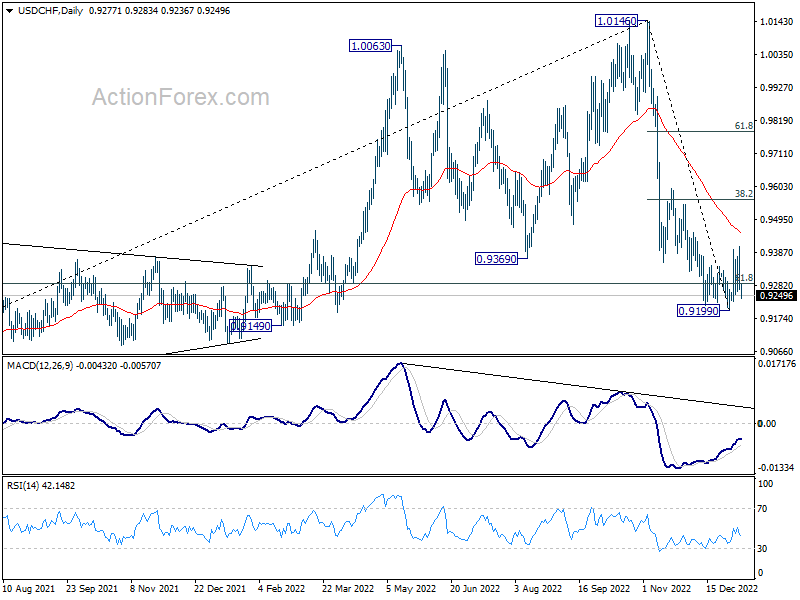
Intraday bias in USD/CHF remains neutral for the moment. On the upside, break of 0.9407 will resume the rebound to 38.2% retracement of 1.0146 to 0.9199 at 0.9561. However, firm break of 0.9199 will resume the whole decline from 1.0146 instead.
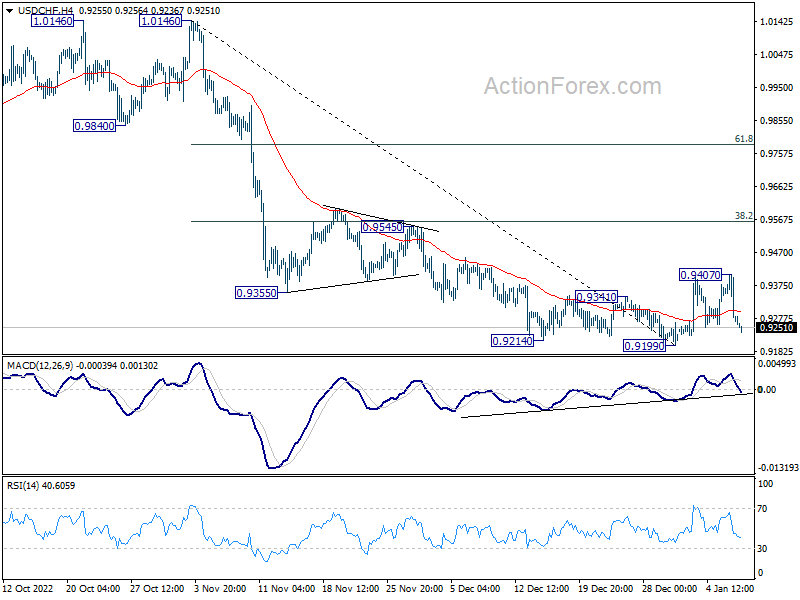
In the bigger picture, rise from 0.8756 (2021 low) has completed at 1.0146, well ahead of 1.0342 long term resistance (2016 high). Based on current downside momentum, fall from 1.0146 might be a medium term down trend itself. Sustained break of 61.8% retracement of 0.8756 to 1.0146 at 0.9287 will pave the way to 0.8756. In any case, risk will stay on the downside as long as 0.9545 resistance holds.
USD/JPY Daily Outlook
Daily Pivots: (S1) 131.14; (P) 132.96; (R1) 133.92; More...
Intraday bias in USD/JPY remains neutral for the moment. On the upside, firm break of 134.49 should confirm short term bottoming, and bring stronger rise to 138.16 cluster resistance (38.2% retracement of 151.93 to 129.49 at 138.06). However, break of 129.49 will resume the whole decline from 151.93 instead.
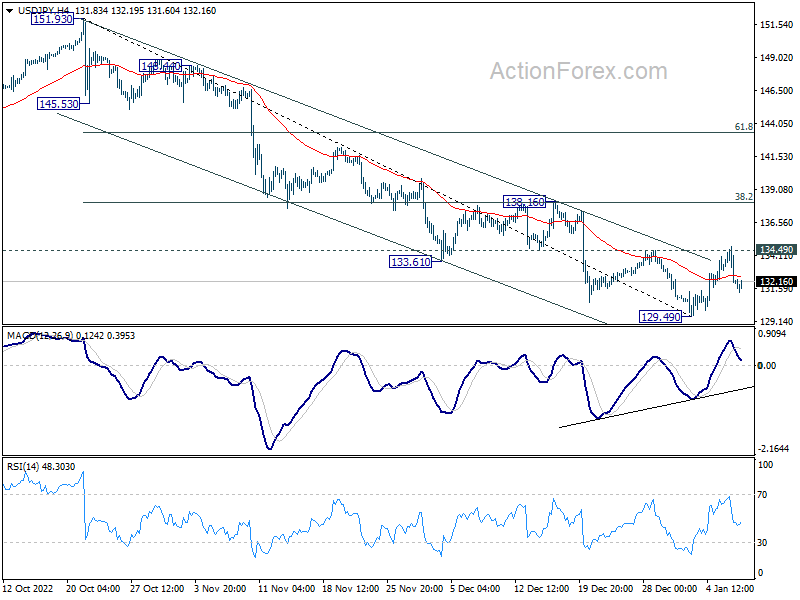
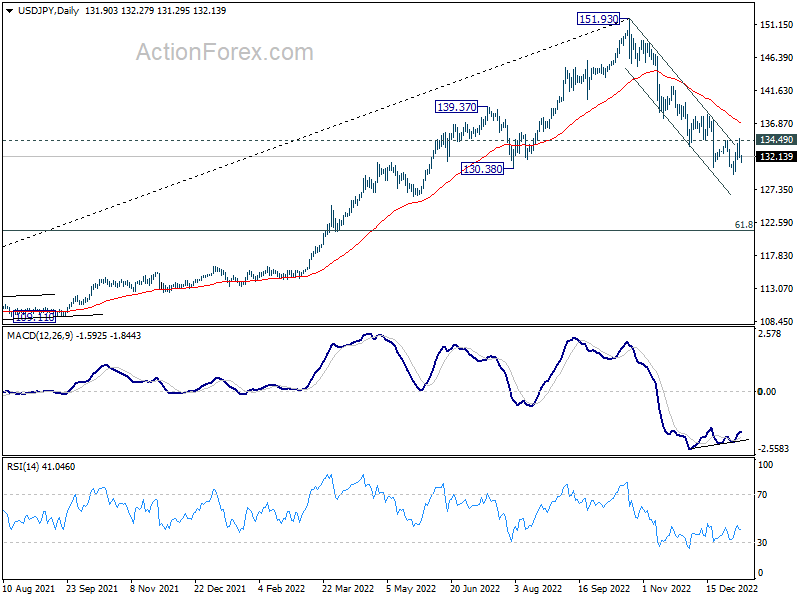
In the bigger picture, a medium term top was in place at 151.93. Sustained trading below 55 week EMA (now at 131.73) would raise the chance of bearish trend reversal. Deeper fall would be seen to 61.8% retracement of 102.58 to 151.93 at 121.43. This will now remain the favored case as long as 55 day EMA (now at 137.08) holds.
USD/CAD Daily Outlook
Daily Pivots: (S1) 1.3365; (P) 1.3515; (R1) 1.3596; More....
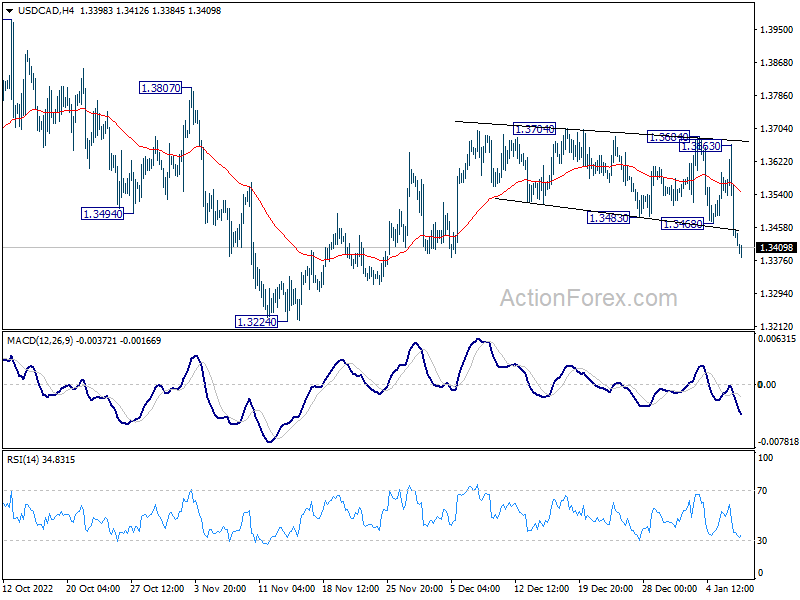
USD/CAD drops further today and intraday bias stays on the downside. For now, price actions from there are still more likely corrective than not. Hence, while deeper decline could be seen, downside should be contained well above 1.3224 low. On the upside, break of 1.3704 will confirm resumption of the rise from 1.3224.
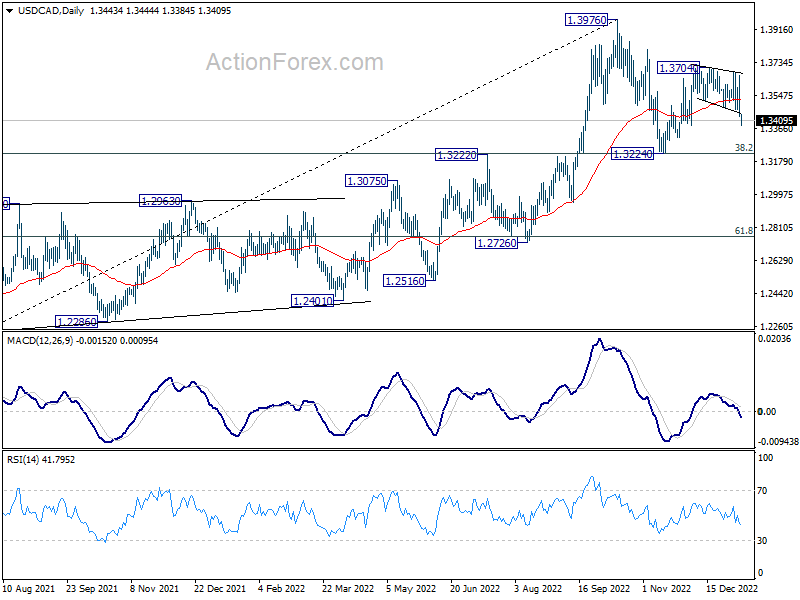
In the bigger picture, as long as 1.3222 cluster support (38.2% retracement of 1.2005 to 1.3976 at 1.3223) holds, larger up trend from 1.2005 (2021 low) is still expected to resume through 1.3976 high at a later stage. However, firm break of 1.3222/3 will indicate that the trend might have reversed. Deeper fall would be seen to next cluster support at 1.2726 (61.8% retracement at 1.2758).
Probability of a 50 bps Fed Rate Hike in February fell
Markets
It was not about the December US payrolls report last Friday, but about the non-manufacturing ISM. The post-payrolls reaction – zooming in on slightly disappointing wage growth rather than on all other strong employment components, especially in the household survey – already suggested a willingness to respond in case of a below-consensus ISM. And that’s exactly what happened when the ISM (49.6 from 56.5) was not only below consensus (55), but also below the lowest estimate from the economic panel (53.3) and even below the 50 boom/bust mark for the first time since May 2020. Details showed a steep decline in overall business activity (54.7 from 64.7) and new orders (45.2 from 56 and also first <50 outcome since May 2020). The employment component returned below par (49.8 from 51.5) with prices paid still high in absolute terms (67.6), but the dynamic slowing. Supplier deliveries fell from 53.8 to 48.8, the lowest since 2015, and suggesting that supply side bottlenecks are evaporating.
Based on US money markets, the probability of a 50 bps Fed rate hike in February fell from roughly 50% to roughly 25%. If Fed chair Powell stresses that core services inflation is the one to follow, then that’s the consequence of the awful services ISM. Looking beyond that early February Fed meeting, money markets put the policy rate peak at 5% while sticking with the view that rate cuts will follow in H2 2023. Both go firmly against all Fed guidance, including in several speeches delivered only a week ago, an our house view. Returning to Friday’s market moves, core bonds leaped higher with US Treasuries outperforming German Bunds. Daily changes on the US yield curve varied between -22.4 bps (3-yr) and -10.7 bps (30-yr) with the curve turning less inverse. German yields lost 5.9 bps (2-yr) to 10.5 bps (10-yr). The dollar lost out against all majors. The trade-weighted greenback closed the week below 104, with the December sell-off lows approaching (103.39). EUR/USD erased all of the early January losses, surging from 1.0522 to 1.0644 and extending the gains this morning. Equity markets embraced their goldilocks scenario (strong labour market, weakening inflation pressure and expectations on near Fed policy reversal), rebounding 2% to 2.5% for all major US indices.
Asian risk sentiment remains buoyant this morning. Japanese markets are closed for Coming-of-age day. Eco calendars are empty on both sides of the Atlantic and across the Channel apart from speeches by central bank governors. It suggests that the post-ISM momentum could be extended. Later this week, we pay attention to the US refinancing operation as well as to EMU (new) supply in light of the ECB’s exit as a net buyer. Eco data include US CPI inflation (Thursday) and University of Michigan consumer confidence (January) on Friday.
News Headlines
Czech Central Bank governor Michl reiterated the CNB baseline scenario that inflation is expected to slow considerably from spring, even as inflation might still go up in the first two months of the year. At the same time, the CNB governor stressed that spending from both consumers and the government needs to ease down in order to tame inflation and prevent that the CNB needs to raise rates further. Consumers should save and wage growth demands should stay moderate. The government should keep the budget deficit as low as possible and be cautious on boosting welfare spending and provide subsidies that go against the restrictive CNB policy. At EUR/CZK 23.96, the Czech korona currently trades near the strongest level since early 2011 when it touched the EUR/CZK 23.93 level.
The Indian government expects economic growth in the fiscal year 2022/23 ending in March to slow to 7%, compared to 8.7% in the fiscal year 2021/22. Earlier, the government expected growth in the 8-8.5% range. Construction growth was projected at 9.1%, electricity at 9% and agriculture at 3.5%. Manufacturing and mining growth were forecast at 1.6% and 2.4%. In an interview with the Financial Times, the governor of the Central Bank of India, Shaktikanta Das, indicated that he was optimistic about India’s growth and financial stability. However, the fall-out of growing debt distress among regional trading partner might have spillovers toward India’s economy. India’s foreign exchanges reserves have declined from a peak in 2021 due to interventions to stabilize the currency. However, at the current level of reserves of about $563 bln, Das sees this as a still ‘very comfortable level’.
Goldilocks?
Friday’s jobs data in the US, and more specifically, the market reaction to Friday’s jobs data helped stock markets to record their best boost since more than a month on Friday.
However, Friday’s jobs report was rather… mixed, and spurred a lot of discussions and debates regarding whether the data was soft enough to convince the Federal Reserve (Fed) officials that the inflation battle is over, or it was strong enough to make them further scratch their heads.
The NFP printed 223’000 nonfarm job additions last month versus 200’000 expected by analysts.
But the average job additions for the last three months of last year was a touch below 250’000, down from 366’000 from the prior three-month stretch, and less than half of around 540’000 jobs added each month in the first quarter of 2022.
Plus, the tech industry shed job - in line with the headlines we have been reading since months. Goldman just announce it will be cutting 3200 positions, on top of 18’000 job cuts announced by Amazon last week, among others.
So, the trend in the US jobs market is on a slowing path, even though, monthly job addition prints above 200’000 are far from numbers you expect to see in recession.
But that’s the good news. The Fed is not looking to push the US economy into recession for fun, it wants to see the jobs market tighter because, in theory, a tighter jobs market should help ease inflation.
But if inflationary pressures ease with little negative impact on jobs, that’s what we call the goldilocks scenario: a soft-landing from the ultra-supportive monetary policy euphoria, easing inflation without too much pain on jobs market.
In other words, it’s jackpot for the Fed!
This is why, the US markets gave such a strong positive reaction to Friday’s jobs data. Both the US 2 and 10-year yields fell more than 4% after the data, pulling the US dollar index lower along with them. The S&P500 jumped around 2.30%, while Nasdaq 100 rallied near 2.80%.
Gold reached our $1880 per ounce medium term target, boosted by lower US yields, which made the opportunity cost of holding the non-interest-bearing gold lower, and increased appetite.
But we should still not forget one thing: the US economy added around 4.5 million jobs last year- That was the second best year on record after 2021 – where 6.4 million Americans found jobs following the pandemic-shattered economy. The unemployment data hit 3.5%, a multi-decade low, and Atlanta Fed President Raphael Bostic said that the central bank still needs to keep raising the rates despite the cooler-than-expected wages data.
‘Good’ bad news is that the December services PMI fell to below 50, the contraction zone, in December, adding some more evidence that the US economic activity is slowing. And that’s something that the Fed is happy to hear.
Activity on Fed funds futures now price in a 25bp hike at the next FOMC meeting at around 75%, but the Fed has not hesitated to disappoint markets since last year to cool down the optimism and send the stocks to turmoil. So the dovish pricing in Fed expectations make the latest gains a bit bitter-sweet, as the slightest news, or hints that the Fed would not step back from its hawkish tone could vanish the latest rally.
So, this week’s US inflation data will be key in either giving the bulls a further boost or bringing back the bears with revenge.
On Tuesday, Fed Chair Jerome Powell will speak, and he may not hesitate to abate the Fed doves on rate expectations.
On Thursday, the US CPI data will likely reveal an encouraging easing. The US CPI is expected to have eased to 6.5% in December from 7.1% printed a month earlier, and from 9.1% printed last summer. If that’s the case, the rapid fall in inflation figures could further boost the Fed hawks and help stocks and bonds extend rally, and the dollar extend drop. But if we see a smaller easing in December inflation, or a figure higher than last month’s, the latest gains could rapidly vanish.
Earnings season kicks off
Earnings season kicks off this week, with Jefferies and Tilray due to report their latest earnings today, Bed, Bath and Beyond – which warned last week that it could go bankrupt – is due to reveal its latest results on Tuesday, while JP Morgan, Bank of America, Wells Fargo, Blackrock, Citigroup, Bank of New York and Delta Air Lines will announce their Q4 earnings on Friday.
For banks, investors will focus on the level of bad loan provisions and mortgages, as rising interest rates are good for earnings, but higher-than-expected interest rates threaten credit quality, loan growth, and net interest margins.