Sample Category Title
EUR/GBP Weekly Outlook
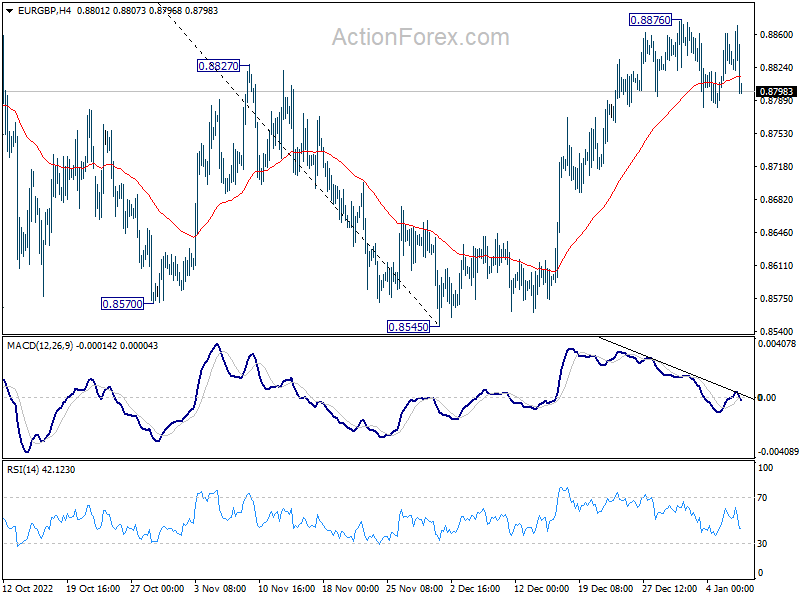
EUR/GBP stayed in consolidation below 0.8876 last week. Initial bias stays neutral this week first. Further rally is expected as long as 55 day EMA (now at 0.8719) holds. Break of 0.8876 will resume the rise from 0.8545 to 61.8% retracement of 0.9276 to 0.8545 at 0.8997 and possibly above. However, sustained trading below 55 day EMA will bring retest of 0.8545 low instead.
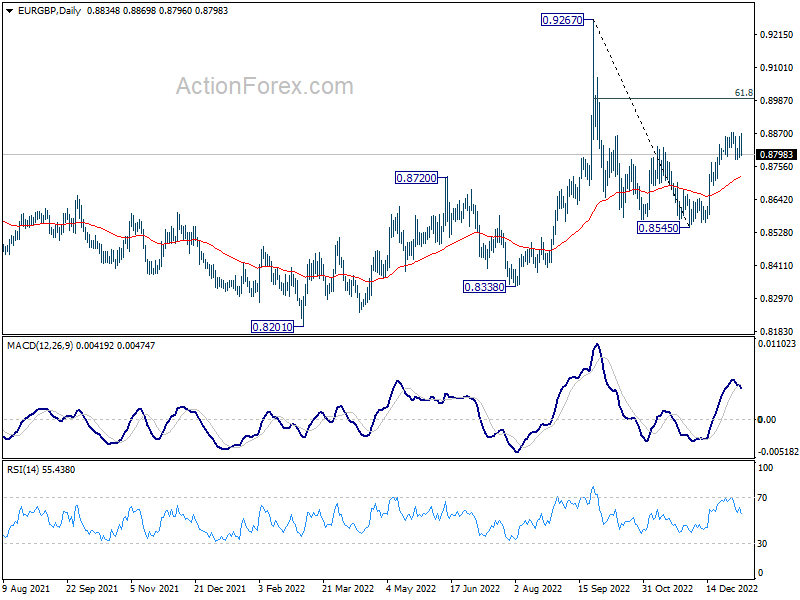
In the bigger picture, outlook is mixed for now as rise from 0.8545 would either be part of the up trend from 0.8201 (2022 low), or just a correction to 0.9267 (2022 high). As long as 55 week EMA (now at 0.8609) holds, the former case is in favor, and break of 0.9267 should be seen next as up trend resumes at a later stage. However, sustained break of 55 week EMA will shift favor to the latter case, for another decline back towards 0.8201.
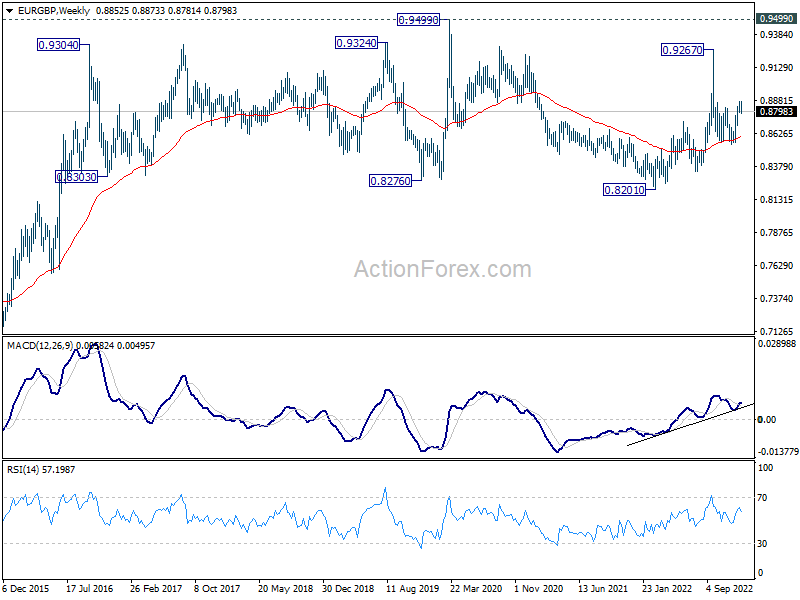
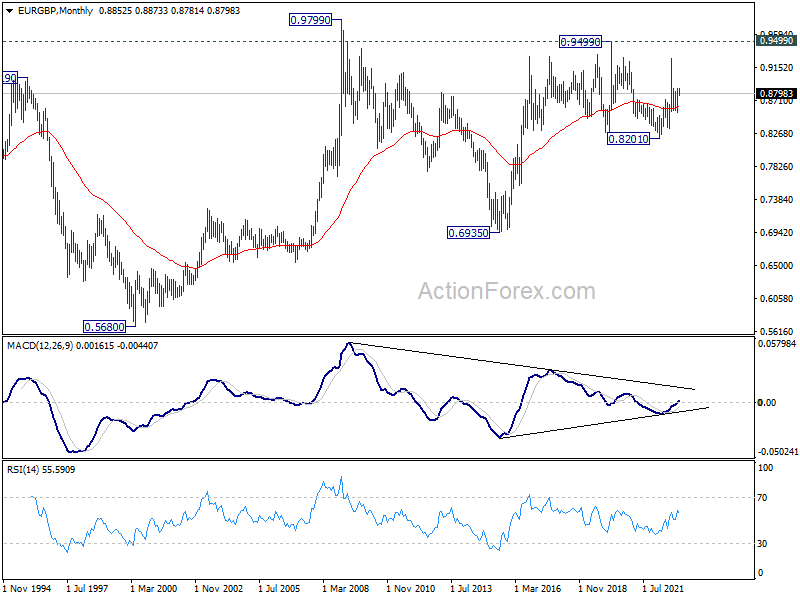
In the long term picture, long term range pattern is extending. But rise from 0.6935 (2015 low) is expected to extend at a later stage, to 0.9799 (2009 high).
EUR/AUD Weekly Outlook
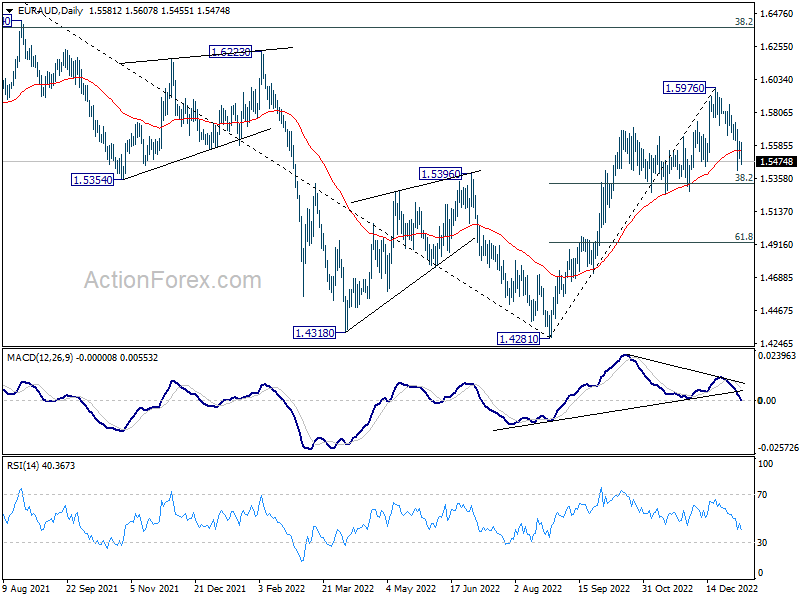
EUR/AUD's decline from 1.5976 last week argues that it's already in correction to whole rally from 1.4281. As a temporary low was formed at 1.5414, initial bias is neutral this week first. On the downside, break of 1.5414 will target 1.5976 to 38.2% retracement of 1.4281 to 1.5976 at 1.5329 next. However, on the upside, above 1.5739 minor resistance will suggest that the pull back has finished, and bring retest of 1.5976 high.
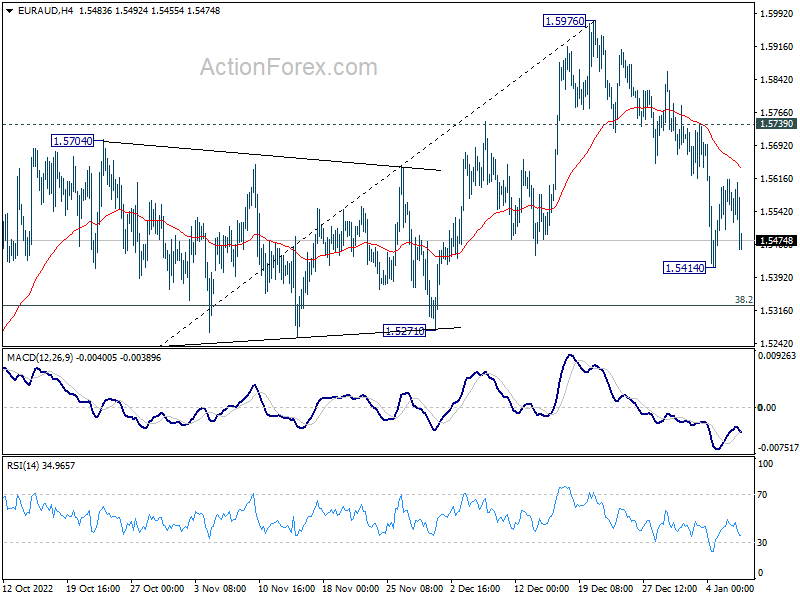
In the bigger picture, it's still early to confirm if rise from 1.4281 represents bullish trend reversal. But as long as 1.5271 support holds, such rally is in favor to continue. Break of 1.5976 will target 1.6434 key resistance next. On the other hand, firm break of 1.5271 will retain medium term bearishness instead.
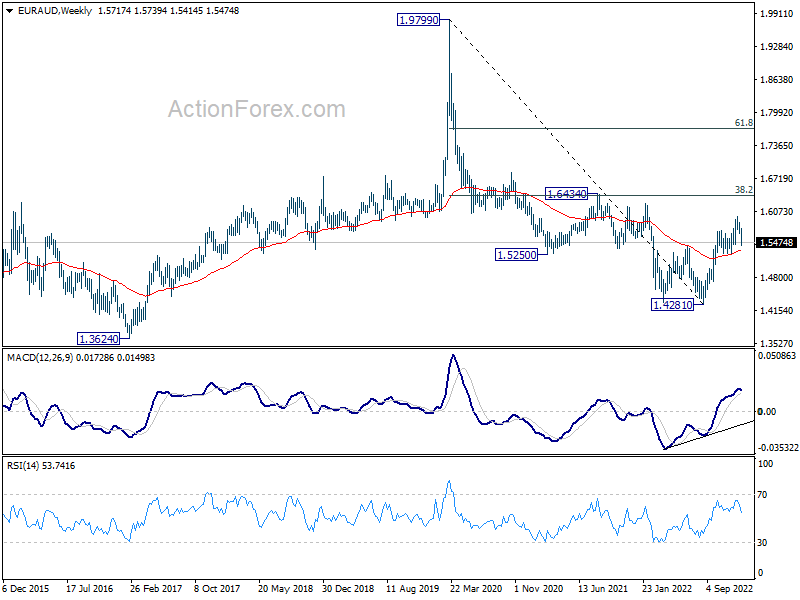
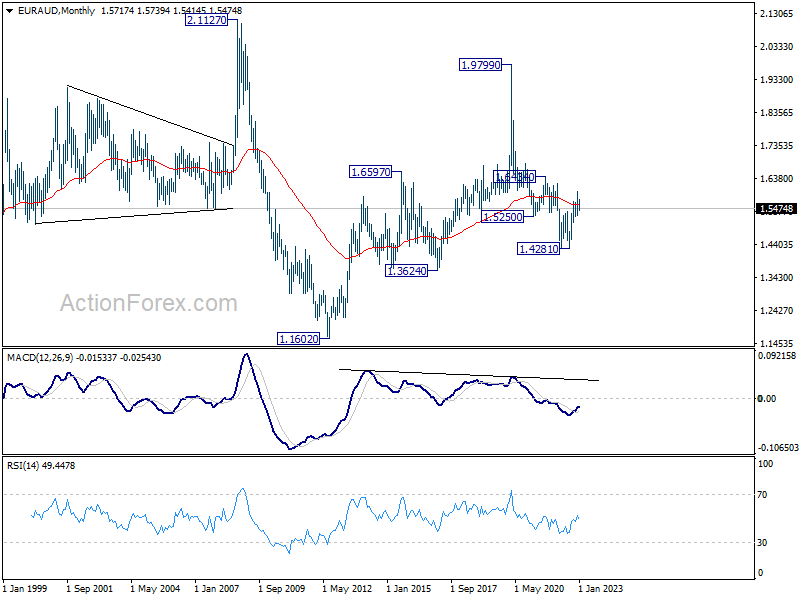
In the longer term picture, focus stays on 55 month EMA (now at 1.5595). Sustained trading above there will raise the chance of bullish trend reversal, and at least bring further rally to 1.6434 cluster resistance, 38.2% retracement of 1.9799 (2020 high) to 1.4281 at 1.6389. However, rejection by 55 month EMA will suggest that down trend form 1.9799 is still in progress for another low below 1.4281.
EUR/CHF Weekly Outlook
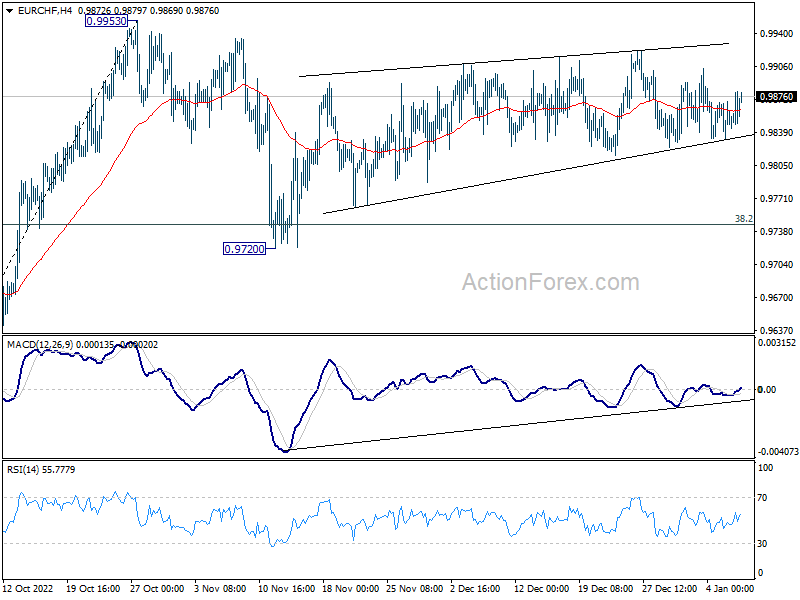
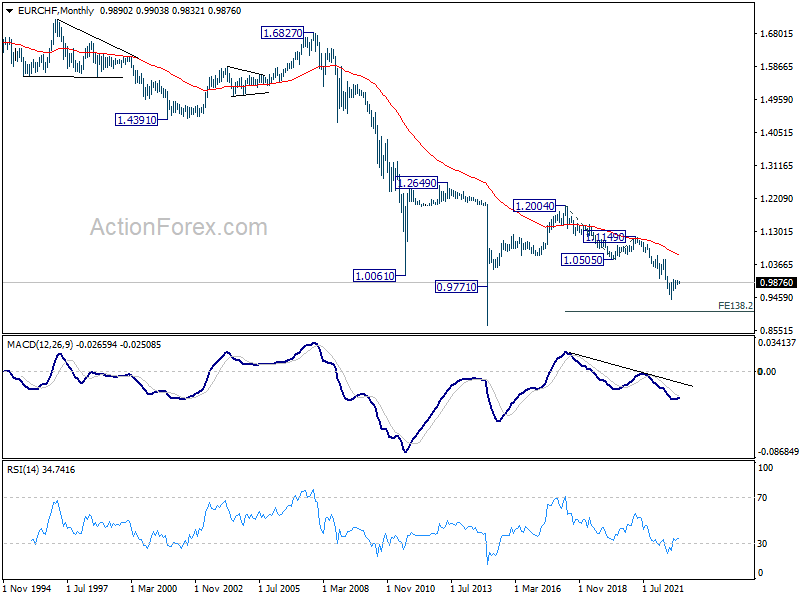
EUR/CHF is still bounded inside consolidation pattern from 0.9953 last week. Overall outlook remains unchanged. Initial bias stays neutral this week first. On the upside, firm break of 0.9953 resistance will resume larger rally from 0.9407 to 1.0072 fibonacci level. However, break of 0.9720 will extend the decline from 0.9953 to 61.8% retracement of 0.8407 to 0.9953 at 0.9616.
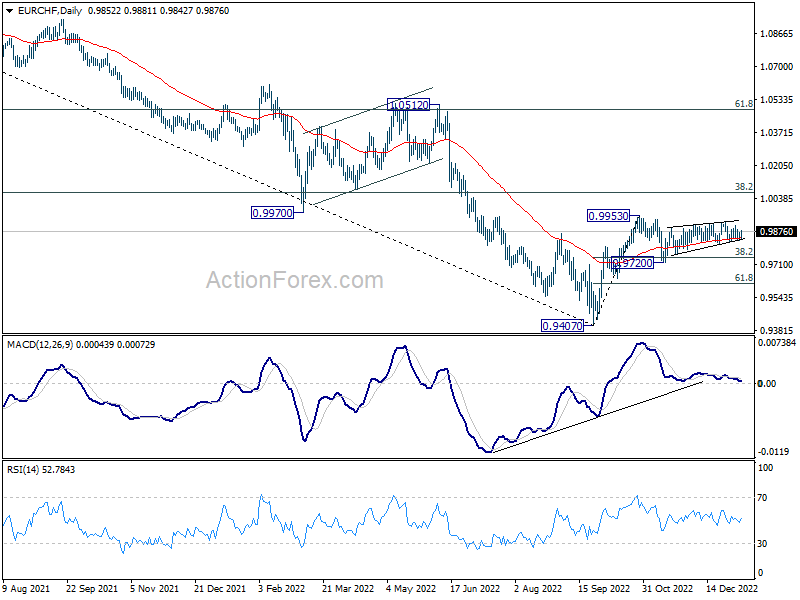
In the bigger picture, as long as 38.2% retracement of 1.1149 to 0.9407 at 1.0072 holds, price actions from 0.9407 medium term bottom will be treated as a corrective pattern. That is, long term down trend would resume through this low at a later stage. Nevertheless, firm break of 1.0072 will also have 55 week EMA (now at 1.0041) taken out. That would be an initial sign of long term bullish reversal.
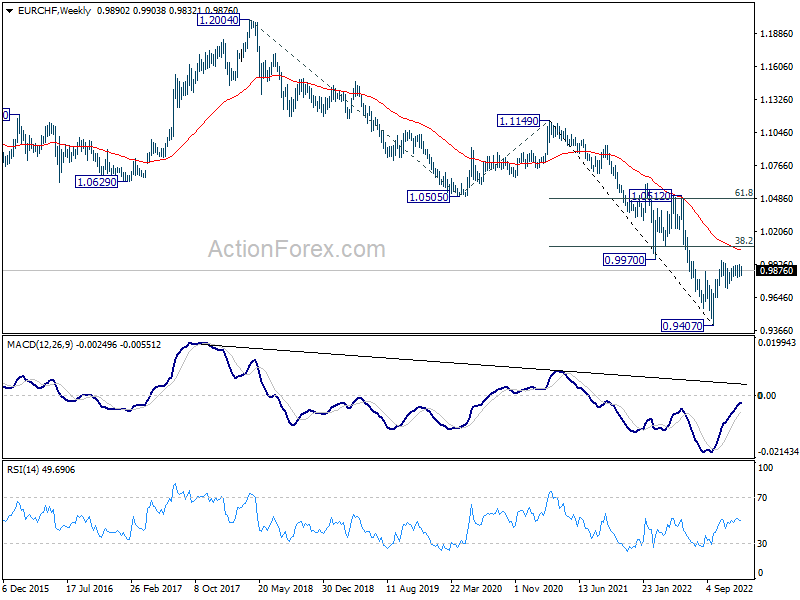
In the long term picture, capped well below 55 month EMA, EUR/CHF is seen as extending the multi-decade down trend. There is no prospect of a bullish reversal until firm break of 1.0505 support turned resistance (2020 low). In case of resumption, next target is 138.2% projection of 1.2004 to 1.0505 to 1.1149 at 0.9033.
The Weekly Bottom Line: Plenty of Jobs, Except in Congress
U.S. Highlights
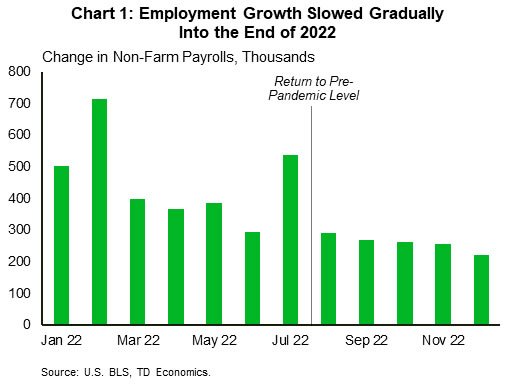
The labor market cooled modestly in December, with 223k new jobs added and the unemployment rate ticking back down to 3.5%.
The House of Representatives failed to elect a Speaker of the House on the first ballot for the first time in 100 years, delaying the start of the new legislative session in the lower chamber of Congress.
FOMC minutes from the December meeting underlined the hawkish stance of the committee and warned of the dangers of a pre-mature easing of financial conditions.
Canadian Highlights
- Oil prices slid heavily this week, greased by demand concerns as the world’s second largest consumer, China, struggles through its worst battle with COVID yet.
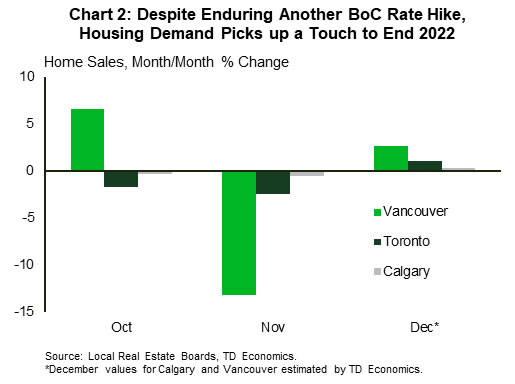
- The impact on housing demand from the newly implemented foreign buying tax should be modest. This week also revealed that, even with BoC rate hikes, housing demand picked up in key markets last December.
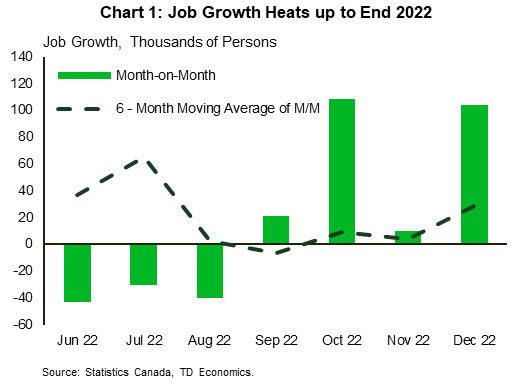
- It was a joyous December for job seekers, as employment surged by 104k in the month. The barn-burner report likely swings the pendulum in favour of further action by the BoC.
U.S. - Plenty of Jobs, Except in Congress
The start of the new year kicked off with several important December data releases, including an update on the labor market and FOMC meeting minutes. In addition, the new Congressional session got off to a rocky start, with the House of Representatives unable to elect a Speaker of the House. Equity markets fluctuated on the week with the S&P 500 down 0.4% while yields declined sharply, with the 10 Year Treasury at 3.58% as of the time of writing.
The exceptional strength seen in the jobs market over the past two years slowed into the end of 2022, with December adding 223k new jobs and bringing the annual total to 4.5 million (Chart 1). The labor market remained tight with the unemployment rate declining back to 3.5% as the labor force rose by 0.3% and the participation rate ticked up by 0.1 percentage-points. Average hourly earnings growth decelerated to 0.3% month-on-month, inciting an initial rally in equity markets as participants looked for evidence which might lead to a reprieve from the current aggressive round of rate hikes. The report also showed a notable uptick in the number of multiple job holders reflecting the weight of inflation and rate hikes on households as they seek additional support through secondary incomes.
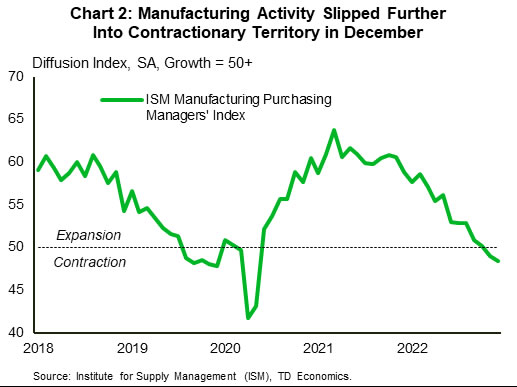
Earlier in the week, manufacturing data showed signs of further slowing, with the ISM manufacturing purchasing managers’ index (PMI) slipping further into contractionary territory in December (Chart 2). After two years of growth the industry has begun to give back some of its gains, in large part due to the direct and indirect effects of higher rates. We also saw this play a part in the ISM Services PMI which declined sharply and showed the sector contracting in December for the first time in 30 months. Within the services index, declines were led by new orders which dropped sharply by over 10.8 percentage-points relative to November. On a more positive note, the manufacturing report showed a continued decline in supply price pressures and improving delivery times, which will be welcome news for the Federal Reserve.
FOMC meeting minutes released on Wednesday unsurprisingly echoed earlier sentiments expressed by Chair Powell at his December 14th press conference. Members pushed back against the loosening of financial conditions seen in recent months on the back of softer inflation reports, noting that “an unwarranted easing in financial conditions…would complicate the committee’s effort to restore price stability”. The minutes reiterated that “it would take substantially more evidence of progress to be confident that inflation was on a sustained downward path”, and this was further emphasized by the fact that no committee members foresee cutting rates this year.
Minneapolis Fed President (and 2023 FOMC member) Neel Kashkari also released an essay on Wednesday in which he noted the need to raise rates by another 100bps this year, which helped to briefly push the odds of a 50bps hike in February close to 50%, though they have since declined back to roughly 25%. Next week we will get December CPI data which will help clarify whether the recent downturn in inflation persisted into the end of the year.
Canada – You're Hired
The first week of the new year turned out to be a tough one for oil markets. Indeed, the WTI benchmark was down about $5/barrel (as of writing), greased by demand concerns as the world's second largest consumer, China, struggles through its worst battle with COVID yet. For their part, bond yields are tracking lower on the week, even with this morning's barn-burner of a jobs report.
Hiring blew away expectations to end 2022, as a meaty 104k positions were added in December (Chart 1). Adding to the strong tone of the report was the fact that gains were concentrated in full-time, private sector positions. In addition, hiring spanned several industries and provinces. The unemployment rate also dipped to 5%, near an all-time low. Less eye-popping was the pedestrian 0.1% month-on-month gain in hours worked. Wage growth also decelerated in year-on-year terms but remained hot at 5.1%.
In its December interest rate announcement, the Bank of Canada communicated that it would be considering whether the policy rate needs to move higher, after hiking rates at a very rapid pace in 2022. The jobs report certainly swings the pendulum towards further action on rates. Our current forecast calls for the Bank of Canada to hike their policy rate by 25 basis points at its upcoming meeting in late January.
Developments in Canadian housing markets also made headlines this week, with several prognosticators stepping forward to deliver their views on housing for 2023. Our take is that another subdued year for activity is in the cards, although housing should find its bottom. Conditions are already soft in most markets across Canada, and some further near-term impact should come from the new two-year ban on foreign homebuying that came into effect on January 1st. However, we think the impact on demand won't be overly significant for a few key reasons. First, existing foreign buying taxes in Ontario and B.C. have already drained much of this demand from these markets. In addition, there are several exemptions to the ban, including for foreign students and temporary workers who have been in Canada for some time.
This week also offered a glimpse on how key housing markets performed in December. As it turns out, the story was more "ho, ho, ho" than "bah, humbug", at least from an economic growth perspective. Indeed, after several months of weakness, home sales increased month-on-month in Toronto, Calgary, and Vancouver (Chart 2). Average prices, meanwhile, were flat in Toronto for the 3rd straight month. Importantly, new supply in all three markets declined. More broadly, there have been no signs so far that the high interest rate backdrop has resulted in forced selling, although that remains a key risk. All told, Canadian housing markets entered this year on a better-than-anticipated footing, although the backdrop is still quite weak.
Weekly Economic & Financial Commentary: Economic Growth Remains on a Positive Trajectory, For Now
Summary
United States: Economic Growth Remains on a Positive Trajectory, For Now
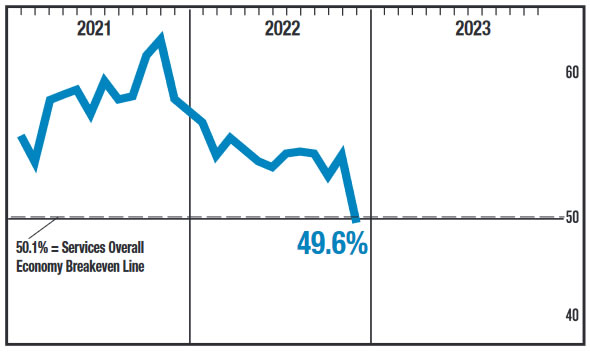
- During December, payrolls rose by 223K while the unemployment rate fell to 3.5% and average hourly earnings eased 0.3%. Job openings (JOLTS) edged down to 10.46 million in November. ISM manufacturing fell to 48.4 in December, while the services index unexpectedly dropped to 49.6. Construction spending increased 0.2% in November. The U.S. trade deficit narrowed to $61.5 billion in November.
- Next week: Small Business Optimism (Tue), CPI (Thu), Consumer Sentiment (Fri)
International: Fiscal Policy Has Brazil Off to a Rocky Start
- Enhanced government spending has the potential to place Brazil's sovereign debt burden on a more unsustainable trajectory. With Brazil's public finances already in a precarious position and Lula now officially sworn into office, concerns regarding a lack of fiscal discipline are starting to materialize and shake confidence.
- Next week: Mexico Inflation (Mon), Brazil Inflation (Tue), Central Bank of Peru (Thu)
Interest Rate Watch: Clear Message from December Minutes: Higher Rates for Longer
- The minutes from the Fed's latest policy meeting in December were released on Wednesday and highlighted a mildly-hawkish to neutral tone from Fed officials headed into last month's meeting. What stands out to us is the Fed's direct communication: Don't underestimate its reaction function. Expect rates to remain higher for longer.
Credit Market Insights: The Housing Market is Collateral Damage
- As the Fed continues its inflation fight, elevated mortgage rates have crushed affordability for potential homebuyers. The Mortgage Bankers Association (MBA) reported that refinance mortgage applications fell 86.6% year-over-year in the last week of December, and applications for purchase were down 42.4%. While home prices have started to slide, we do not expect price declines as severe as the housing bust.
Topic of the Week: House Arrest: What a Perilous Speaker Vote Means for the Budget
- The U.S. House of Representatives continues its quest for a speaker. On Tuesday, the chamber went to a second ballot for the first time in a century after Representative Kevin McCarthy (R-CA) fell short of the votes needed to secure the speaker position.
Week Ahead – Inflation Remains Key
US
This week’s main event will be when a little inflation report comes out. The US CPI report for December is expected to show disinflation trends remain firmly in place. The year-over-year CPI reading is expected to cool from 7.1% to 6.6%, while the monthly reading is expected to remain flat. At the end of the week, the University of Michigan sentiment report is expected to show a modest improvement and could show inflation expectations continue to come down.
Earnings season begins on Friday, and everyone will pay close attention to what the banks say about the economy. Recession calls could get a major boost if JPMorgan, Citigroup, and Wells Fargo turn pessimistic about the consumer.
US politics will dominate weekend headlines as Republicans try to elect a speaker. The House can’t function without a speaker and this impasse has implications for national security-related briefings and oversight.
EU
A quiet week in store with only a few relatively small data points due, the most notable of which being the unemployment report for the eurozone. All eyes now on the ECB meeting early next month after the December inflation data showed price growth slowing considerably but underlying core prices rising.
UK
A few Bank of England policymakers are due to speak over the next week, including Catherine Mann on Saturday and Huw Pill on Sunday which may help set the tone for the week. Governor Andrew Bailey will also make an appearance on Tuesday so we could get a better idea of where they stand in the new year.
That aside it’s pretty quiet from a UK data standpoint with monthly GDP figures on Friday the only notable releases as we look for confirmation of the economy being in recession.
Russia
A quiet one next week with inflation data on Wednesday the only notable release. Focus remains on the war in Ukraine and what the next development in that will be.
South Africa
Government efforts to amend the mandate of the SARB have not been greeted well by the markets, the view being that any changes could weaken its inflation commitment and blur the lines between the institutions. The currency has weakened in response to the reports although any changes are not likely to occur any time soon and probably not at all if past attempts are anything to go by. The government doesn’t have the super-majority required to make the constitutional changes without help from opposition parties.
Turkey
Unemployment and industrial production figures are the only notable releases next week.
Switzerland
A very quiet week with unemployment the only release of note.
In the last week of 2022, China announced that people entering the country would no longer be required to undergo quarantine. It’s one of the most important steps the world’s second-largest economy has taken toward reopening to the world since the start of the pandemic. China has resumed its international contact with countries around the world.
At the same time, China will also relax the Covid controls for international arrivals from 8 January 2023, downgrading Covid management from Category A to Category B. The most important measure is that international arrivals will no longer be subject to testing and quarantine. International arrivals will only be required to have a negative PCR test within 48 hours prior to departure. They will no longer need to apply for a health code, as travelers will only need to declare their health status on their customs cards.
The centralized quarantine system has also been lifted in China, and the movement of people within the country is about to return to pre-pandemic conditions. Health authorities in China and abroad are concerned about the lack of herd immunity in China due to the long-standing zero-Covid policy and the relatively low vaccination rate of high-risk groups in the country over the past three years. A number of countries have now introduced certain restrictions on the entry of Chinese tourists in terms of testing and quarantine measures. The Chinese government’s subsequent response to a large number of confirmed new cases will be one of the risk events that the market will be watching.
As several countries and regions worldwide may enter a recession in 2023, external demand will decline, and export-related activities, including manufacturing, may slow down, hindering China’s economic recovery. China’s economic recovery may only get going in the second half of this year. The Chinese government is expected to increase its financial strength to support the domestic economy by continuing to build unfinished domestic projects and perhaps developing more transport, energy, and technology infrastructure.
Next week brings CPI data for December which is expected to have little impact on the market.
India
A few releases of note next week including inflation and industrial output on Thursday.
Australia & New Zealand
China has recently eased the domestic and international Covid policy and the rebound in the economy is expected to boost demand for commodities such as iron ore. This could be supportive for commodity currencies this year.
Australian retail sales and the RBA CPI are eyed for further guidance on whether the inflation level has improved.
The Bank of Japan unexpectedly adjusted its government bond yield curve control on 20 December, triggering a spike in the yen. In response, the December summary of opinions stated that the revision of the YCC would help improve market functioning, that it was not an exit policy shift, and that Quantitative and Qualitative Easing (QQE) and YCC should continue if needed. Traders are not convinced.
Next week focuses on the Japan Tokyo CPI, core CPI, and CPI excluding fresh food for further guidance on the level and path of inflation in Japan.
Economic Calendar
Saturday, Jan. 7
Economic Events
- BOE’s Mann speaks on the world economy
Sunday, Jan. 8
- BOE’s Pill speaks on monetary policy at the AEA meeting in New Orleans
- NATO Secretary General Stoltenberg and Swedish PM Kristersson speak at the Security Policy conference Folk och Forsvar in Sweden
Monday, Jan. 9
Economic Data/Events
- Australia foreign reserves
- Singapore foreign reserves
- Australia building approvals
- China aggregate financing, money supply, new yuan loans
- Czech Republic GDP
- Eurozone unemployment
- France trade
- Germany industrial production
- Italy unemployment
- Mexico CPI
- Thailand consumer confidence
- Fed’s Bostic in moderated discussion on the economy at the Rotary Club of Atlanta
- BOE’s Pill speaks on the UK economic and monetary policy outlook at Money Marketeers event
- Norwegian Petroleum Directorate annual report
- Swiss National Bank releases 2022 results
Tuesday, Jan. 10
Economic Data/Events
- US wholesale inventories
- Colombia retail sales
- France industrial production
- Japan household spending, Tokyo CPI
- Mexico international reserves
- New Zealand house sales
- Philippines trade
- South Korea BoP
- South Africa manufacturing production
- Spain industrial production
- Turkey industrial production
- Symposium at Riksbank in Stockholm. Speeches by Fed Chair Powell, BOE Governor Bailey, ECB’s Schnabel, de Cos, and Knot
- World Bank expected to release global economic prospects report
Wednesday, Jan. 11
Economic Data/Event
- Australia retail sales, CPI, job vacancies
- China FDI
- Japan leading index
- Mexico industrial production
- New Zealand home sales, commodity prices
- Turkey current account
- ECB’s Holzmann and Vujcic speak in Vienna at the Euromoney CEE conference
- Bank of Italy releases banks and money monthly statistics
Thursday, Jan. 12
Economic Data/Events
- US CPI, initial jobless claims
- India CPI
- Australia trade
- China CPI, PPI
- India industrial production
- Japan BoP
- New Zealand building permits
- Fed’s Bullard discusses the economy and monetary policy at a virtual event hosted by the Wisconsin Bankers Association
- Fed’s Barkin speaks at VBA/VA Chamber
- ECB consumer expectations survey for November, and economic bulletin
- USDA releases monthly world agricultural supply/demand estimates (WASDE)
Friday, Jan. 13
Economic Data/Events
- US University of Michigan consumer sentiment
- France CPI
- Poland CPI
- Russia CPI
- Australia home loans
- Canada existing home sales
- China trade
- Eurozone industrial production
- India trade
- Italy industrial production
- Japan money stock
- Thailand forward contracts, foreign reserves
- UK industrial production
- Czech Republic presidential elections first round voting starts
- Earnings Season Reports from: BlackRock, Citigroup, Delta Air Lines, Didi Global, First Republic, JPMorgan Chase, UnitedHealth Group, and Wells Fargo
- Italy’s Istat releases monthly economic note
Sovereign Rating Updates
- Poland (Fitch)
- Spain (Moody’s)
- Iceland (Moody’s)
- Ireland (DBRS)
US ISM services dropped sharply to 49.6, correspond to -0.2% annualized GDP contraction
US ISM Services PMI dropped sharply from 56.5 to 49.6 in December, well below expectation of 55.5. Business activity/production tumbled from 64.7 to 54.7. New orders dropped from 56.0 to 45.2. Employment dropped from -1.7 to 49.8. Prices dropped from 70.0 to 67.6.
ISM said: "The past relationship between the Services PMI and the overall economy indicates that the Services PMI for December (49.6 percent) corresponds to a 0.2-percent decrease in real gross domestic product (GDP) on an annualized basis."
Forward Guidance: U.S. Inflation Data Watched Closely for Further Signs of Easing
U.S. December inflation data will be watched closely next week for fresh evidence that early easing in price growth in recent months could be sustained. We expect year-over-year U.S. consumer price growth to slow significantly in December to 6.3% from 7.1% in November. That would be the lowest level of annual price growth since October 2021 and below the peak 9.1% rate in June 2022. The steep decline in headline price growth is largely thanks to a significant drop in energy prices. Average gasoline prices fell 10% (seasonally adjusted) in December from November on lower oil prices.
But broader measures of inflation have also shown signs of slowing. Grocery prices have continued to surge higher, but the pace of increase has pulled back. We expect ‘core’ (excluding food & energy products) price growth to slow to 5.6% year-over-year in December from 6.0% in October. By our count, almost half of the year-over-year increase in ‘core’ price growth is coming from higher home rents as earlier price increases pass through the CPI with a lag as leases are renewed. The rise in rents will moderate in the year ahead, reflecting significantly slower growth in the current rental market.
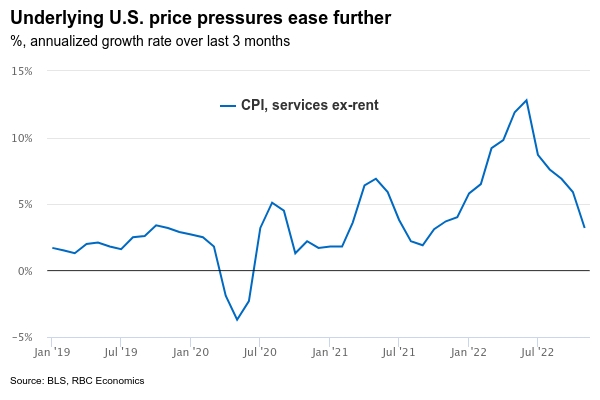
Federal Reserve policymakers will be paying more attention to signs that suggest the early softening in broader inflation pressures will persist. Price growth for purchased goods has been slowing as global supply chain and cost pressures ease. And prices of services excluding home rents (a key indicator of domestically driven inflation) has also been slowing over the second half of 2022.
Further signs of declining price growth would support further slowing in the pace of hikes from the Fed. We continue to expect 50 basis point of additional hikes to the Fed funds target range in Q1 before a pause at a terminal rate of 4.75% to 5.0%.
Week ahead data watch
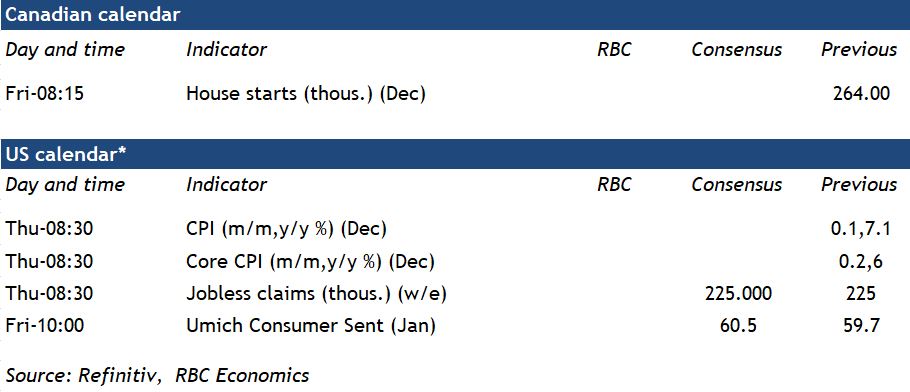
- Housing starts likely remained steady at 260,000 units in December from the annual pace of 264,159 units in November. Residential building permit issuance was still strong in October, with a 3-month rolling average value of 266,000.
Weekly Focus – A Tug of War in Financial Markets
2023 has arrived and it looks set to be another interesting year for financial markets. Diverging forces are at play leaving markets in a tug of war between different drivers.
In bond markets lower inflation and recession points to lower yields, but on the other hand still strong labour markets and high wage pressures as well as the Chinese reopening, which is set to be an inflationary force, is pulling in the other direction. An easing of financial conditions also challenge central banks as tighter conditions are needed to cool down the economy further. Hence, we see a risk of more hikes (and fewer cuts in H2 and 2024) than markets currently price - especially in the US. We look for bond yields to be range bound for some time caught in the middle of the diverging forces.
In equity markets lower inflation, somewhat better visibility than in 2023, the Chinese reopening as well as plenty of cash on the sideline are all positive forces that could reduce risk premia and underpin stocks. However, the outlook of recession, still hawkish central banks and profits under pressure still point to a more defensive stance. We believe stocks will end the year higher but see the short-term outlook being murky still. EM should benefit from the Chinese reopening as we have seen reflected in markets also lately.
In the FX market we see more two-way action for the USD. The USD has weakened lately but we look for a rebound as the market prices too few Fed hikes and current account imbalances still favour the USD. We look for EUR/USD to go back to previous lows around 0.98 over coming quarters but it is unlikely to happen in a straight line.
We see increasing signs that headline inflation has peaked. German inflation for December dropped to 8.6% y/y from 10.0% y/y while Spanish inflation declined to 5.8% y/y from 6.8% y/y. However, the drop in Germany was driven by a government-backed discount to the energy bill and core inflation was high in both countries. Oil and gas prices have moved lower this week adding downward pressure on goods inflation and transport services. However, a key concern for the ECB is still the tight labour market. In an interview last week, ECB President Christine Lagarde said that wages are probably rising faster than expected and limiting fast wage growth was key to reining in inflation.
The Fed also struck a hawkish tone in the FOMC minutes from the December meeting and Fed member Neel Kaskhari (voter, hawk) said on Wednesday he sees rates move to 5.4% (market prices peak around 5%). Like ECB, the Fed also highlights a tight labour market as key for sustaining the tightening path. In addition, easing financial conditions is a concern for the Fed, see also Research US - Good news is bad news for the Fed, 4 January.
China' re-opening has led to a surge in Covid cases, but the wave looks set to peak within the next month. We look for a recovery starting in February/March, which will make China an inflationary force in the global economy again, see China Outlook - Earlier reopening to drive faster rebound, 3 January.
Next week all eyes will be on the US CPI for December. Lower gasoline and food prices will likely weigh on the headline (0.0% m/m), but services will continue to support core (0.3% m/m). In the euro area, we will keep an eye on data for unemployment and ECB comments following the recent CPI prints.
Could the Data Releases Produce Hawkish Expectations for the Bank of Japan?
The second week of the new trading year brings a busier calendar in the Asian powerhouse. There are a plethora of data releases starting with Tokyo CPIs and ending with flow statistics on Friday. With the first BoJ meeting for 2023 scheduled on January 18, the market will have the chance to discover if there are dramatic changes in the underlying economic currents. And potentially offer some excuse for the BoJ hawks to reappear.
Could the BoJ get a lifeline from the data?
The BoJ has been on the sidelines in the current rate hiking race, joining just a handful of the developed world central banks that did not raise interest rates in 2022. It has actually been 16 years since the last BoJ rate hike. However, potentially under domestic pressure, the BoJ managed to steal the headlines before the festive period with its surprising decision to alter the yield curve control. It currently allows the 10-year yield to rise up to 0.5%, double the previous ceiling of just 0.25%.
Inside the same announcement, it mentioned that it will continue to buy Japanese bonds at an increased rate of JPY 9tln per month, the previous pace was JPY 7.3tln per month, but the market, in its inherent need for hawkish news, ignored this side of the story. The post-announcement hawkish market reaction has increased expectations for the new BoJ Governor taking over on April 9. The 40% probability of a 25-bps rate hike in April currently priced in could potentially nudge higher, on the back of the upcoming data and the market chatter about the new man-in-charge.
Tokyo CPI frontrunning the nationwide print
The trading week starts with Tokyo CPI for December. This regional CPI tends to come at least 2 weeks earlier than the national CPI, providing an early preview of the inflation pressures. The November print came at 3.7% surpassing the May 2014 peak remove extra space and recording the highest growth since January 1991. While the headline inflation numbers look tempting for the BoJ, the muted core inflation index, excluding food, energy, and alcoholic beverages seems to have put a firm lid on any hawkish thoughts up to now. It remains pinned down at the 1-1.5% region for both the Tokyo region and nationwide.
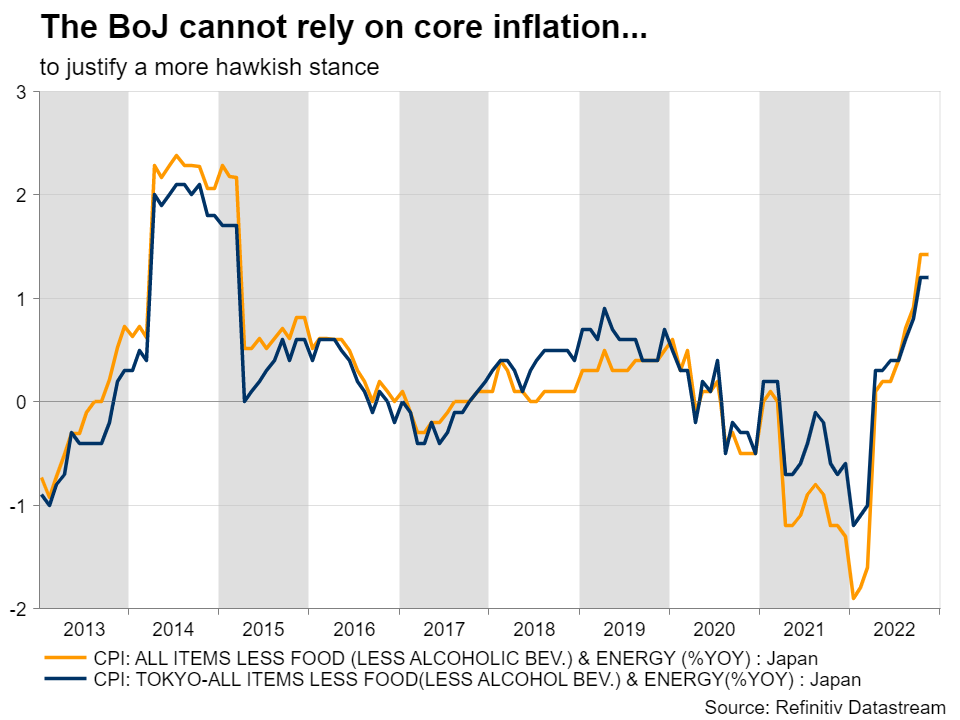
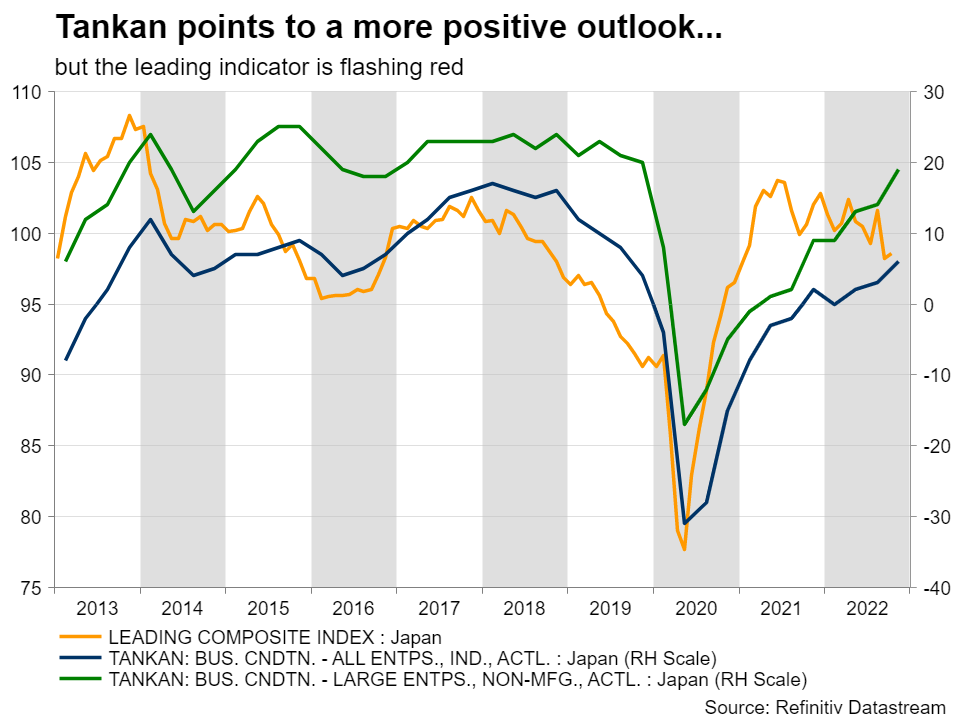
Leading indicator and Current Account details not painting a rosy picture
Since the inflation prints are not offering sufficient evidence, the JPY bulls have turned to the remaining set of data. For example, the Tankan, considered the heavyweight in the data calendar, has been improving lately. The next quarterly print comes in April, but the leading indicator, published on Wednesday, tends to offer an early preview for the possible moves ahead. It has been on a downward path, flashing red for a bumpy road ahead. On a similar note, the Current Account statistics have turned negative on the back of the increased oil prices and the inflation rally reducing goods demand globally. Putting the above-mentioned findings together, the picture remains muddy in Japan, potentially tying BoJ’s hands.
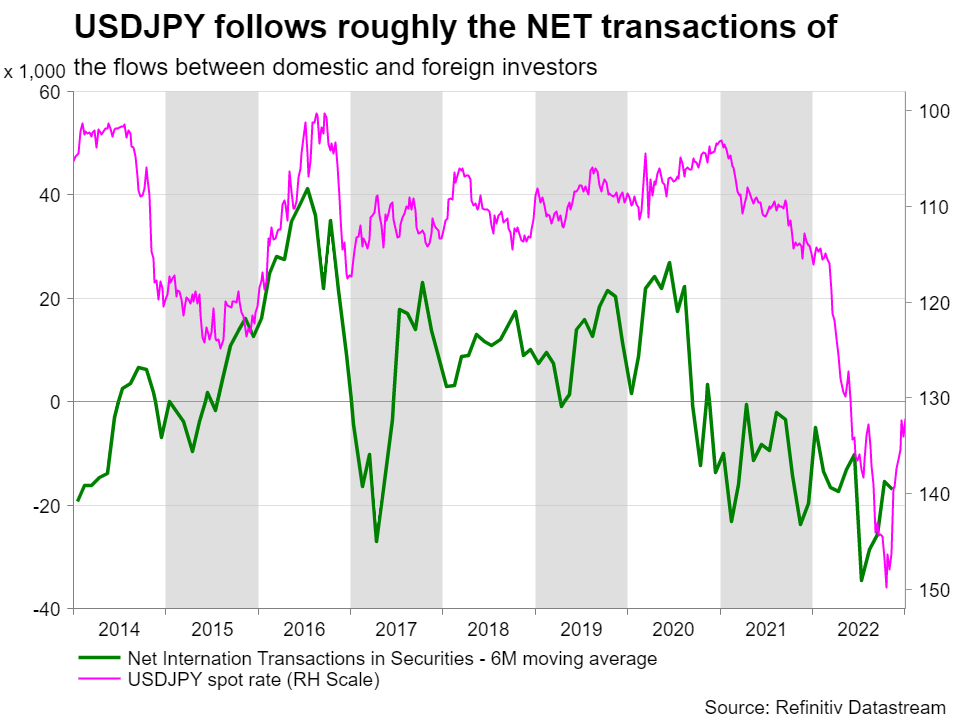
Flow data could get more attention going forward
The latest portfolio investment numbers will also be released. On Wednesday, January 4, the weekly flow statistics for the penultimate week of 2022 showed that foreign investors sold an unprecedented amount of Japanese government bonds, and that Japanese investors continued to shed foreign long-term debt securities. The former move appears to be pure positioning for a bearish BoJ, while the latter refers mostly to life insurers cutting foreign exposure to reduce their hedging costs. Historically, flows matter for the Japanese economy and the yen, and it would be interesting to see whether the recovery seen in the yen since late October could rekindle the Japanese investors’ love for foreign securities.
Dollar/yen downward path in question?
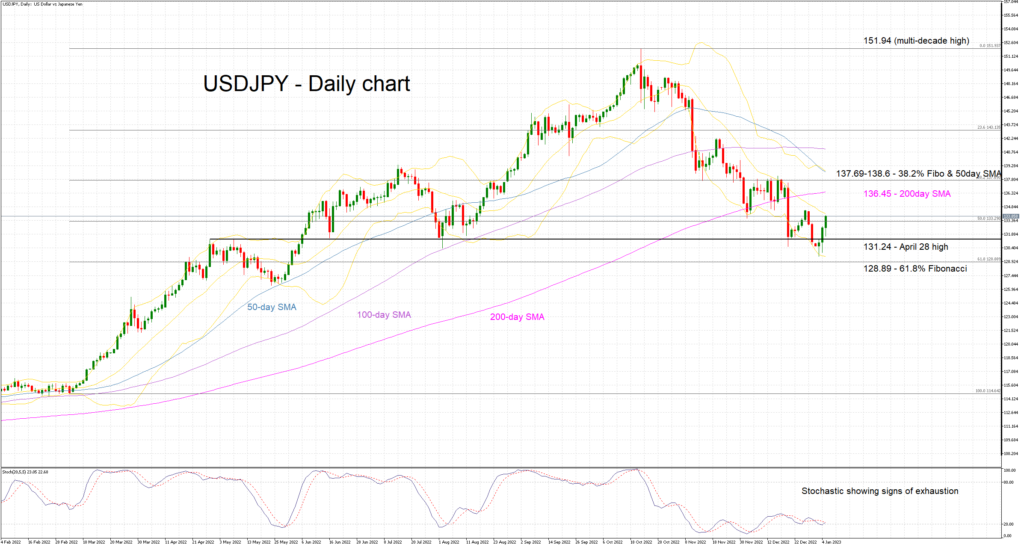
Amidst the volatile fourth quarter, the yen managed to benefit from the dollar underperformance and recovered part of its 2022 losses. It is currently caught up in an area that proved tough to clear in early August. The overall sentiment in the market appears to remain yen bullish, but the momentum indicators are starting to display signs of exhaustion, predominantly the stochastic oscillator. A confident move below the April 28 high at 131.34 could prove the triggering factor for the yen bulls to aim for a new lower low in the dollar/yen pair.