Sample Category Title
RBA Board Considered Pause in December
Despite the pause consideration the case was weak – expect another hike of 25 in February.
The Reserve Bank Board considered three options in its deliberations at the December Board meeting. The options were: 50 basis point increase in the cash rate; 25 basis point increase; or no increase .
This contrasts with recent meetings when only the 50 basis point and 25 basis point options were considered.
Given consistent rhetoric from the Bank about pausing it would come as no surprise that the Board did consider the pause. Indeed, it came as a bigger surprise that 50 basis points was still on the table.
The case for pausing rested on the theme of placing “further emphasis on the lagged effects of a large policy adjustment to date, and the value in proceeding cautiously in an uncertain environment.”
But this argument seemed to be quickly dismissed, noting that the Bank’s forecasts in the November SOMP were that, despite further increases in interest rates (forecasts are based on market pricing and analysts forecasts), “inflation was expected to take several years to return to the target range.” Most importantly, since the forecasts were released in early November “incoming information had not warranted a reassessment of that broad outlook.”
It is also interesting that the Board noted that “members noted that no other central bank had yet paused.”
As with the October and November meetings, the case for 25 basis points over 50 basis points relied on the lags associated with policy: “There had already been a significant cumulative increase in interest rates and the full effects of this adjustment would take time to occur.”
The impact of the policy changes was also likely to be delayed more than normal due to the predominance of fixed rate mortgages savings buffers; and the strong reopening effect that may extend into the summer holidays.
It was also once again noted that there were benefits in acting consistently.
The argument for 50 basis points was quite robust – inflation is too high in an economy operating with excess demand; some other economies had seen wages pick up strongly, risking entrenched inflation; the inflation mind-set was shifting; wages growth potentially building; and the cash rate is not at a high level historically.
Members concluded that the range of options considered would continue to be discussed at future meetings.
In the final paragraph the Board chose, for the first time in any recent final paragraph, to strongly emphasise the dangers of inflation further than we have seen in the Minutes of earlier meetings, “High inflation damages the economy and makes life more difficult for people” and of course the Board repeats the wording in an earlier paragraph that “The Board expects to increase interest rates further over the period ahead, but it is not on a pre set path.” That final qualification is consistent with the signal that the Board will continue to consider the three options going forward.
Despite the fact that the Board considered the “pause” option, these Minutes do not paint a dovish picture of the Board.
Having discussed a pause on multiple occasions in recent RBA communications it would be surprising that the pause option was not raised at the meeting.
But the key is that the current forecasts which have rates rising further are still pointing to a number of years where the inflation rate is outside the range. So unless there has been a change in the data since those November forecasts were released, the Board needs to press on.
The monthly inflation print that came after the November meeting was lower than expected but mainly due to supply side effects and the Board noted that they “needed to be interpreted with caution” while key services inflation was only going to be reported later in the quarter.
The key issue for the RBA is around demand and wages growth. The fear is noted in the “50” discussion, “inflation mind set was shifting… wages growth potentially building.”
The Minutes point out a number of very recent developments on wages – “around 35% of firms in liaison had reported wage increases of greater than 5% in October and November”; “liaison reported that labour availability remained a key challenge, although there were tentative signs this had started to ease a little.”
Since the Board meeting the November employment report highlighted those prospects: 3.4% unemployment; 107,100 jobs being added in October and November; 0.2% fall in the underemployment rate; record high participation and employment-to-population ratio indicating very tight labour markets.
Tighter labour markets than expected even at the November Board and the November forecasts in the SOMP raise the risk to the Board that the scenario we have seen in other countries could repeat in Australia (see the case for “50”).
This risk will be even more of a concern if, as the Board notes, resilience to the slowdown through household savings buffers; high fixed rate exposure from mortgages; and an ongoing reopening effect reflect solid spending momentum in the early months of 2023.
Conclusion
Westpac expects the economy to slow through 2023 with “stagnation” in the second half but does see some momentum extending into 2023.
When the Board comes to consider its options at the next meeting in February it will have the December quarter Inflation Report but will also be observing data for the holiday period that may be holding up better than expected.
Based on the analysis in the Minutes, that will set the scene for hikes in both February and March (December quarter Wages Report available for the March meeting) while the May meeting will also be confronted with uncomfortably high inflation for the March quarter and a central bank that is observing tight labour markets and rising wages pressures.
A hike in May will be appropriate following other central banks, who will already be on hold, and the clear evidence of the economic damage builds – time to pause at the June meeting for the rest of the year.
GBP/USD Trims Gains, Why Dips Could Be Limited
Key Highlights
- GBP/USD corrected lower sharply from the 1.2450 resistance zone.
- A key bullish trend line is forming with support near 1.2140 on the 4-hours chart.
- EUR/USD is struggling to stay above the 1.0550 support zone.
- Gold price might attempt a fresh increase above the $1,800 resistance zone.
GBP/USD Technical Analysis
The British Pound climbed above the 1.2300 zone against the US Dollar. GBP/USD even traded close to the 1.2450 level before the bears emerged.
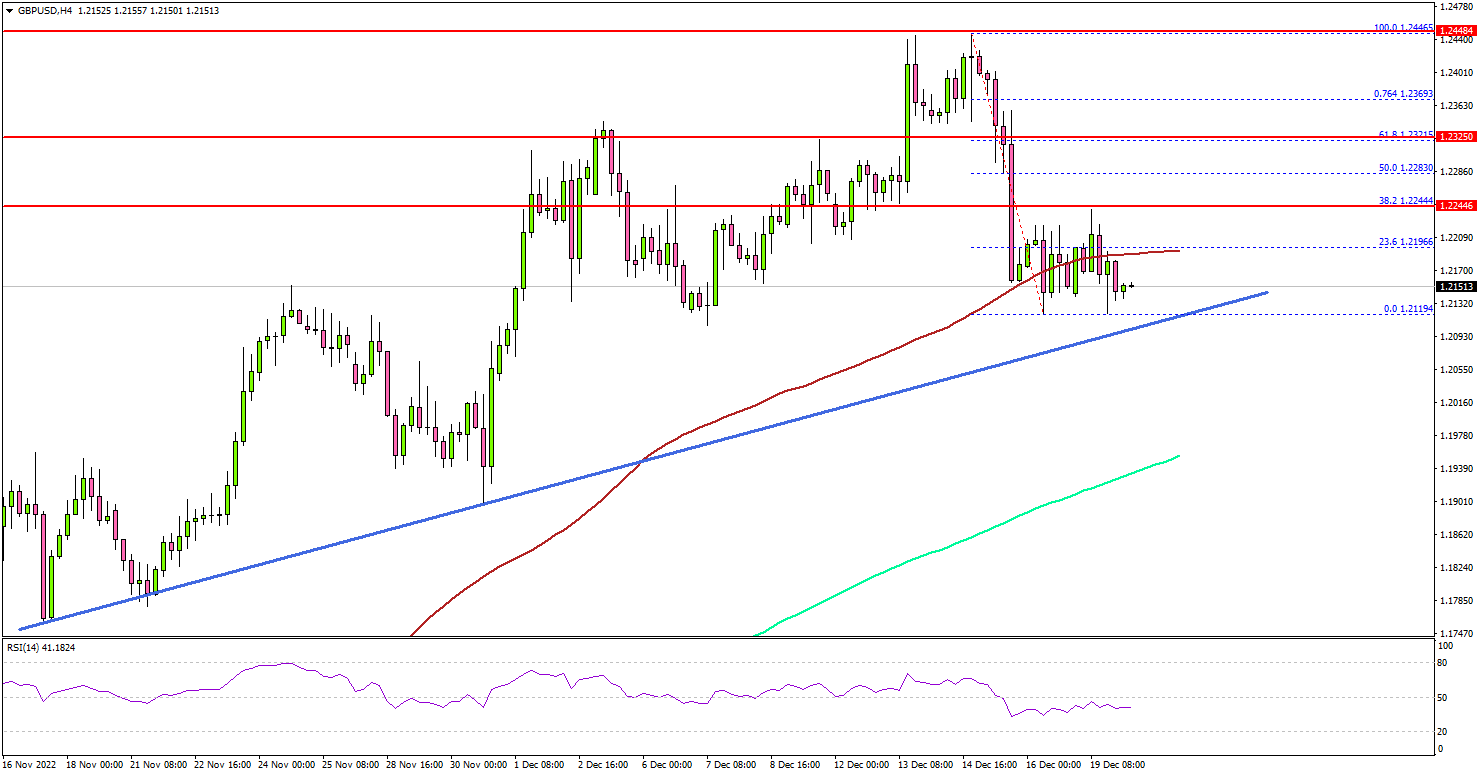
Looking at the 4-hours chart, the pair traded as high as 1.2446 before there was a downside correction. There was a move below the 1.2350 and 1.2320 support levels. The pair even spiked below the 1.2200 support zone and the 100 simple moving average (red, 4-hours).
On the downside, there is a decent support forming near the 1.2120 zone. There is also a key bullish trend line forming with support near 1.2140 on the same chart.
The next major support is near the 1.2080 zone, below which the pair might dive towards the 200 simple moving average (green, 4-hours). Any more losses might open the doors for a move towards the 1.1800 support zone.
On the upside, an initial resistance is near the 1.2250 level. The next major resistance may perhaps be near 1.2320. A clear move above the 1.2320 resistance might start a steady increase. In the stated case, GBP/USD may perhaps rise towards the 1.2380 level. Any more gains could lead the pair towards the 1.2240 resistance zone.
Looking at EUR/USD, the pair is showing a few bearish signs and there is now a risk of a downside break below the 1.0550 support zone.
Economic Releases
- US Housing Starts for Nov 2022 (MoM) – Forecast 1.415M, versus 1.425M previous.
- US Building Permits March 2022 (MoM) – Forecast 1.470M, versus 1.512M previous.
EUR/USD Aimed at Growth
The currency major has tested six-month highs and remains at 1.0610.
By now, investors have got maximum information from December. The US Fed has increased the interest rate to 4.50% and promised further increases in accordance with inflation. The European Central Bank has lifted the rate to 2.50% as expected but the comments turned out to be even more carnivorous than expected.
The final inflation report in the Euro zone in November demonstrated growth to 10.1% y/y against the forecast 10.0%. Meanwhile, the base CPI remained at 5.0% y/y.
Until Christmas, the markets will continue analysing the information to become active again after winter holidays.
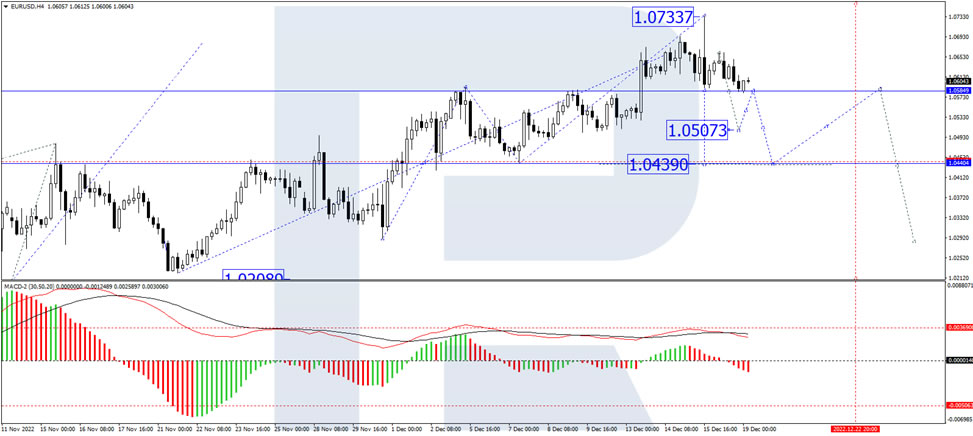
On H4, the pair has completed an impulse of decline to 1.0586. Today a consolidation range is expected to form above it. With an escape downwards, a wave of decline to 1.0507 might become possible. The goal is local. Then growth to 1.0585 and a decline to 1.0440 will become possible. Technically, the scenario is confirmed by the MACD: its signal line is headed strictly down, suggesting further development of the wave of decline.
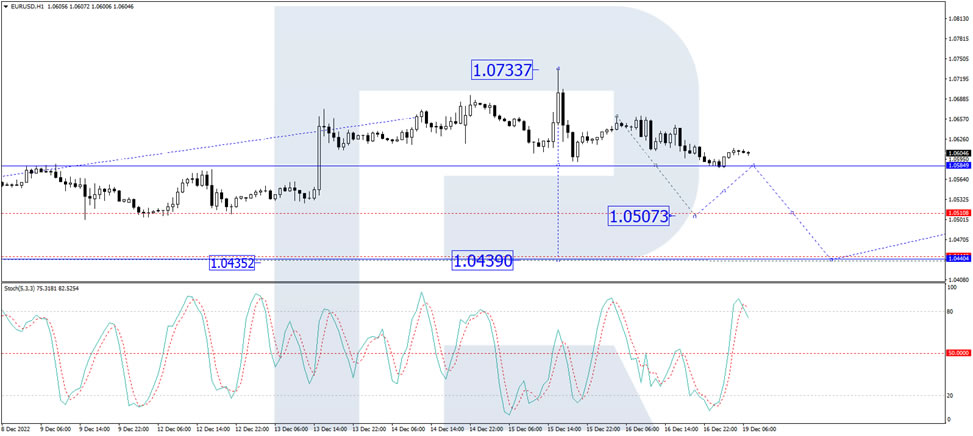
On H1, the pair has formed a structure of decline to 1.0585. A link of correction to 1.0640 is not excluded, followed by falling to 1.0555, from where the wave might continue to 1.0510. The goal is local. Technically, the scenario is confirmed by the Stochastic: its signal line is above 80 and is preparing to develop a new impulse of decline to 20.
AUDJPY Wave Analysis
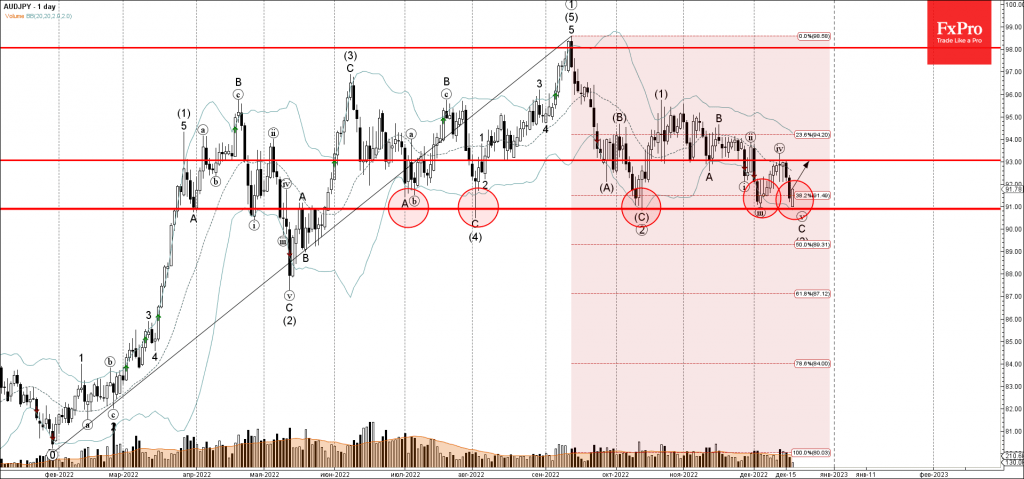
- AUDJPY reversed from pivotal support level 91.00
- Likely to rise to resistance level 93.00
AUDJPY under the bullish pressure after the price reversed up from the pivotal support level 91.00 (which has been reversing the price from the start of July), coinciding with the lower daily Bollinger Band and the 38.2% Fibonacci correction of the upward impulse from February.
The upward reversal from the support level 91.00 stopped the previous downward impulse wave C from the middle of November.
AUDJPY can be expected to rise further toward the next resistance level 93.00 (which stopped wave (iv) earlier this month)).
AUDCHF Wave Analysis
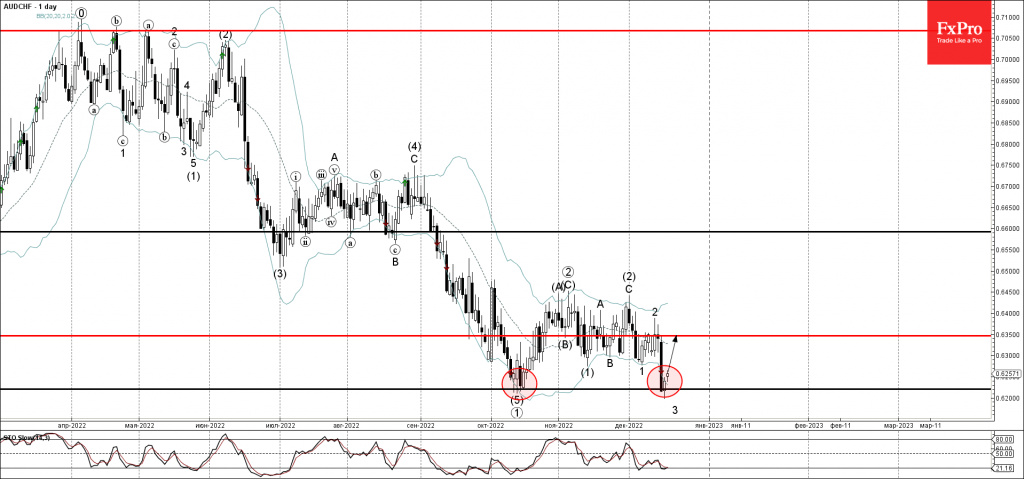
- AUDCHF reversed from support level 0.6220
- Likely to rise to resistance level 0.6350
AUDCHF recently reversed up from the major support level 0.6220 (which stopped the sharp downtrend in October), coinciding with the lower daily Bollinger Band.
The upward reversal from the support level 0.6220 runs counter to the strong multi-month downtrend inside which the pair has been trading from April.
Given the clear bullish divergence on the daily Stochastic indicator, AUDCHF can be expected to rise further toward the next resistance level 0.6350.
Will EURCHF Emerge Above Parity Soon?
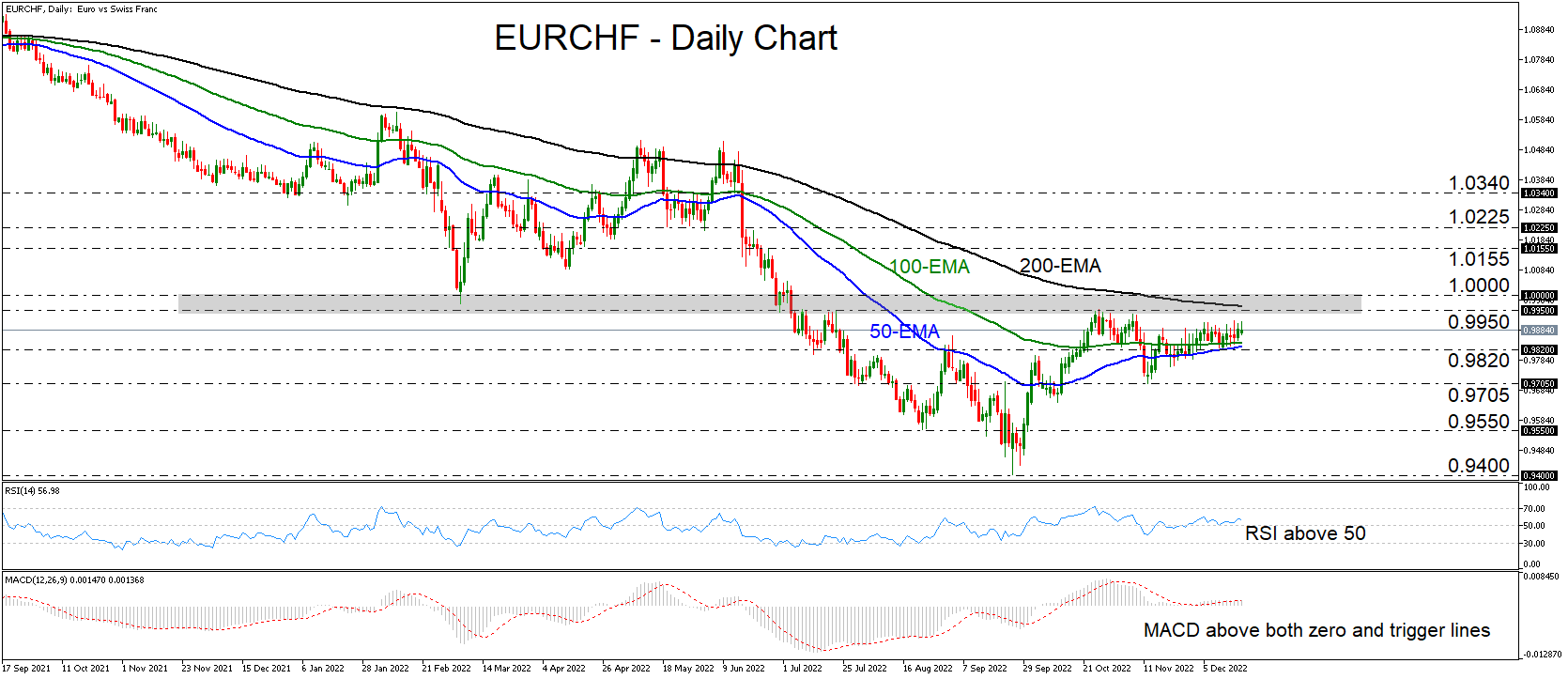
EURCHF has been trading in a consolidative manner lately, staying slightly above the 0.9820 zone, which is near the 50- and 100-day exponential moving averages (EMA). That said, it also remains below the 0.9950 hurdle, which provided resistance between October27 and November 9, and also lies slightly below the 200-day EMA. Despite the pair staging a decent recovery after hitting a record low of 0.9400 on September 26, a break above parity may be needed to reinforce the bullish case.
Both the daily oscillators are detecting positive momentum, but they are flattening, confirming the fading speed of the latest recovery. That’s another development adding credence to the narrative that a break above 1.0000 may be needed to brighten the outlook.
A clear and decisive break above parity could pave the way towards the 1.0155 territory, marked by the high of June 27, or the 1.0225 zone, which provided strong support between May 19 and June 2. If neither zone is able to stop the bulls, then the advance may continue towards the 1.0340 barrier, marked by the inside swing low of June 14.
On the downside, a break below 0.9705 may be the move signaling that the bears have gained the upper hand again. It would confirm a lower low on the daily chart and may see scope for declines towards the low of August 24, at 0.9550. Should that barrier fail to attract the bulls, the slide may extend towards the record low of 0.9400.
To sum up, EURCHF has staged a relatively decent comeback since September 26, when it hit an all-time low at 0.9400. However, for the recovery to continue, a break above parity may be needed.
German Business Quickly Recovers from the Shock
Germany’s business sentiment index rose in December for the third month, returning to August levels on the back of more optimistic expectations, while assessment of the current situation has improved just slightly. Ifo Business Climate Index for Germany jumped from 86.4 to 88.6 in December, better than the 87.6 expected. In a commentary on the publication, the President of the ifo Institute notes that “business is entering the holiday season with a sense of hope”.
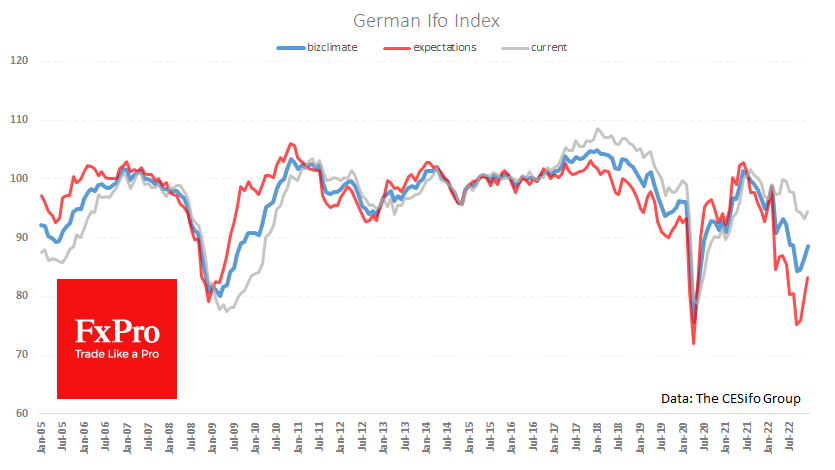
Market participants closely follow the Ifo index because of its strong predictive power for the economy. But even more interesting is that the strong reversal from decline to growth coincided with the turnaround in the German indices.
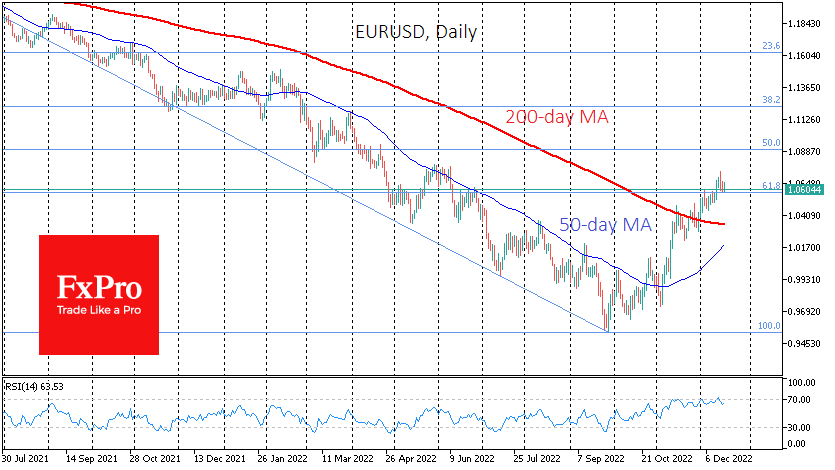
The rise in German business sentiment may also be good news for EURUSD buyers. In 2020 and 2009, EURUSD accompanied the index’s recovery for the first several months. However, breaking the multi-year downtrend may take a significant fundamental change, which is too early to tell.
The EURUSD appears locally tired after its two-and-a-half-month rally and in a tactically overbought condition. The Euro has been losing ground against the USD during the last two trading sessions, retracing from 1.0730 to 1.0600. Still, it is the only major currency that has managed to break above the 200-day MA, which many consider a technical change in the long-term trend.
The bullish trend in the single currency might continue if the ECB’s decisiveness in fighting inflation does not negatively impact business sentiment.
EUR/USD Mid-Day Outlook
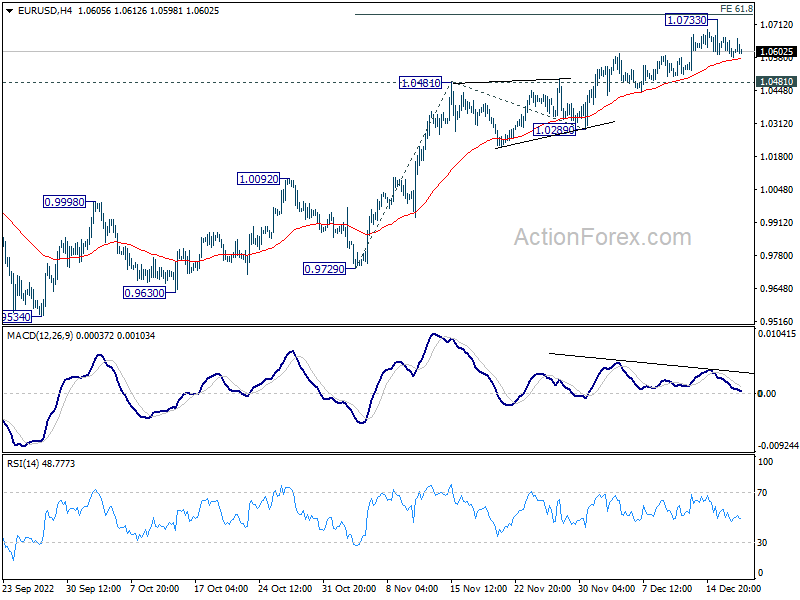
Daily Pivots: (S1) 1.0561; (P) 1.0612; (R1) 1.0639; More...
Range trading continues in EUR/USD and intraday bias remains neutral. Further rally is expected as long as 1.0481 resistance turned support holds. Firm break of 61.8% projection of 0.9729 to 1.0481 from 1.0289 at 1.0754 will pave the way to 100% projection at 1.1041. However, firm break of 1.0481 will confirm short term topping and bring deeper fall to 1.0289 support.
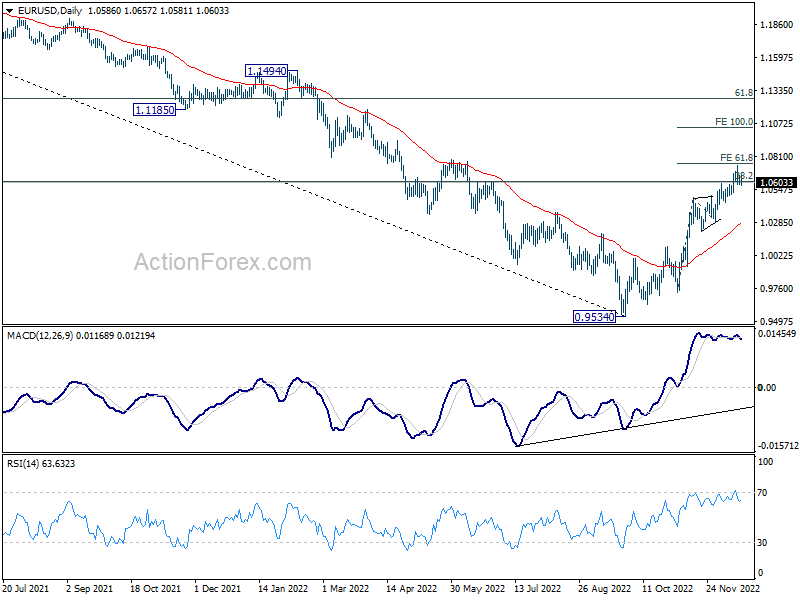
In the bigger picture, focus stays on 38.2% retracement of 1.2348 (2021 high) to 0.9534 at 1.0609. Rejection by 1.0609 will suggest that price actions from 0.9534 medium term bottom are developing into a corrective pattern. Thus, medium bearishness is retained for another fall through 0.9534 at a later stage. However, sustained break of 1.0609 will raise the chance of trend reversal and target 61.8% retracement at 1.1273.
GBP/USD Mid-Day Outlook
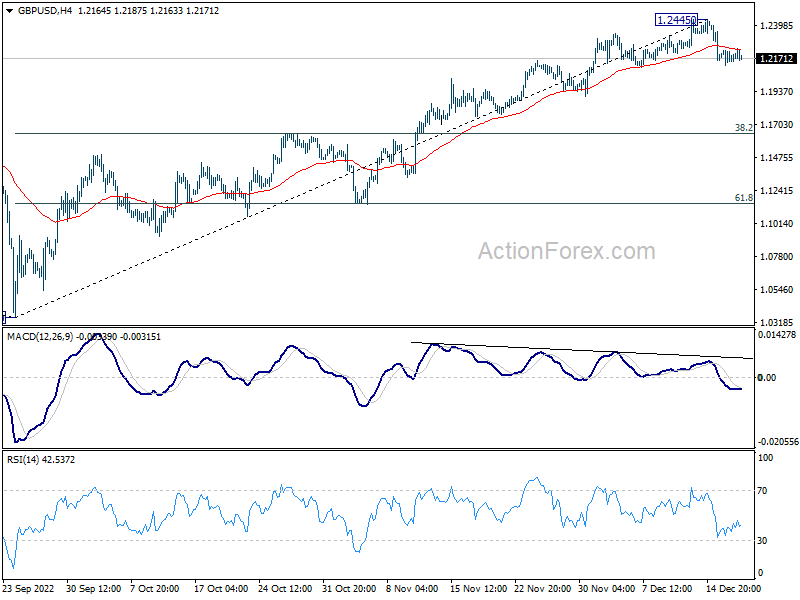
Daily Pivots: (S1) 1.2097; (P) 1.2160; (R1) 1.2200; More...
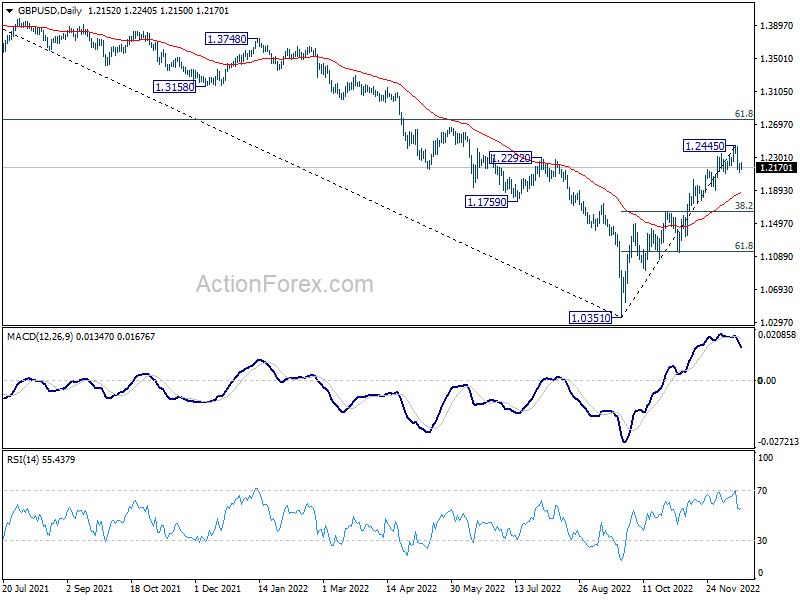
Outlook in GBP/USD remains unchanged and intraday bias stays mildly on the downside. Fall from 1.2445 short term top is in progress for 55 day EMA (now at 1.1863). Firm break there will target 38.2% retracement of 1.0351 to 1.2445 at 1.1645. For now, risk will stay on the downside as long as 1.2445 resistance holds, in case of recovery.
In the bigger picture, rise from 1.0351 medium term bottom is at least correcting whole down trend from 1.4248 (2021 high). Further rise is expected as long as 1.1644 resistance turned support holds. Next target is 61.8% retracement of 1.4248 to 1.0351 at 1.2759. Sustained break there will pave the way back to 1.4248. This will remain the favored case as long as 55 day EMA (now at 1.1863) holds.